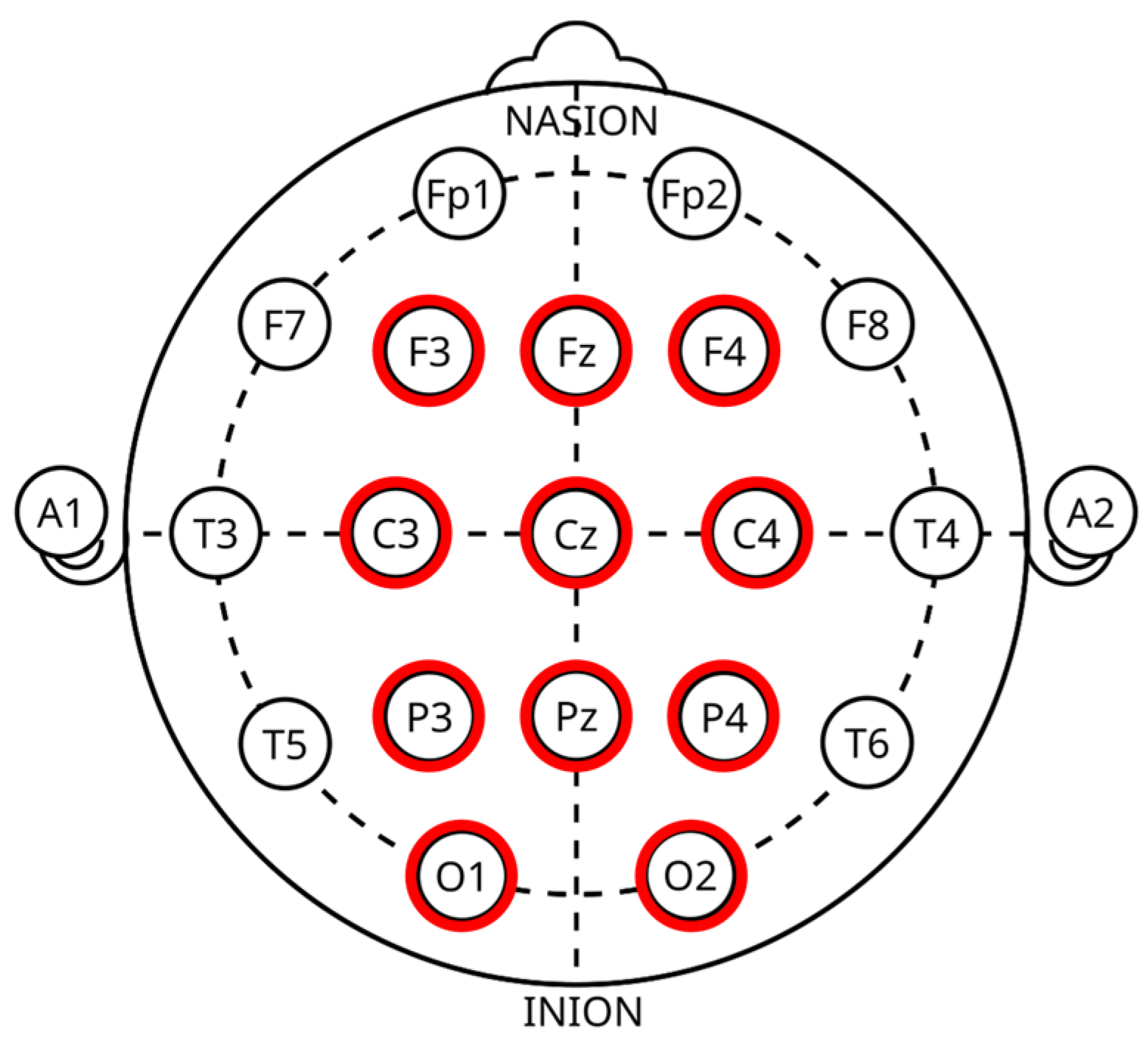
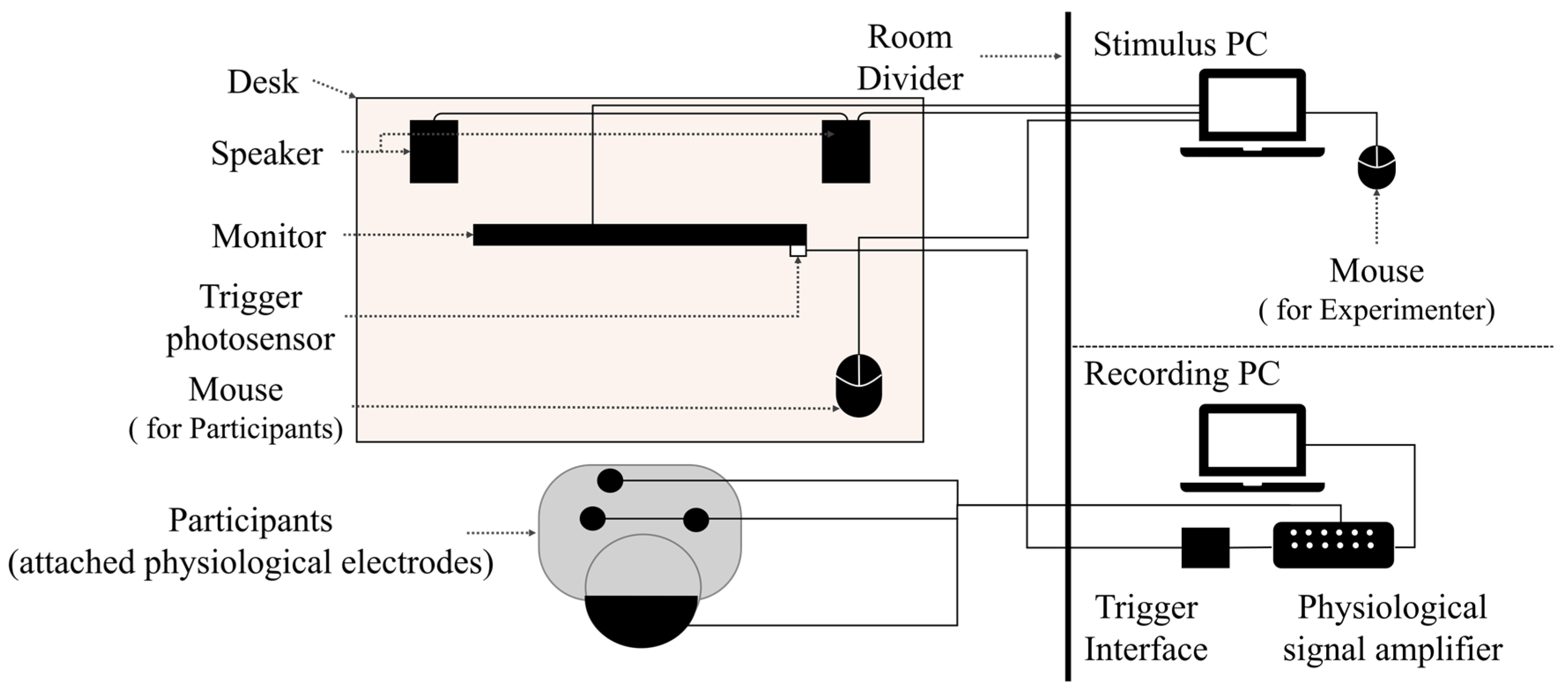
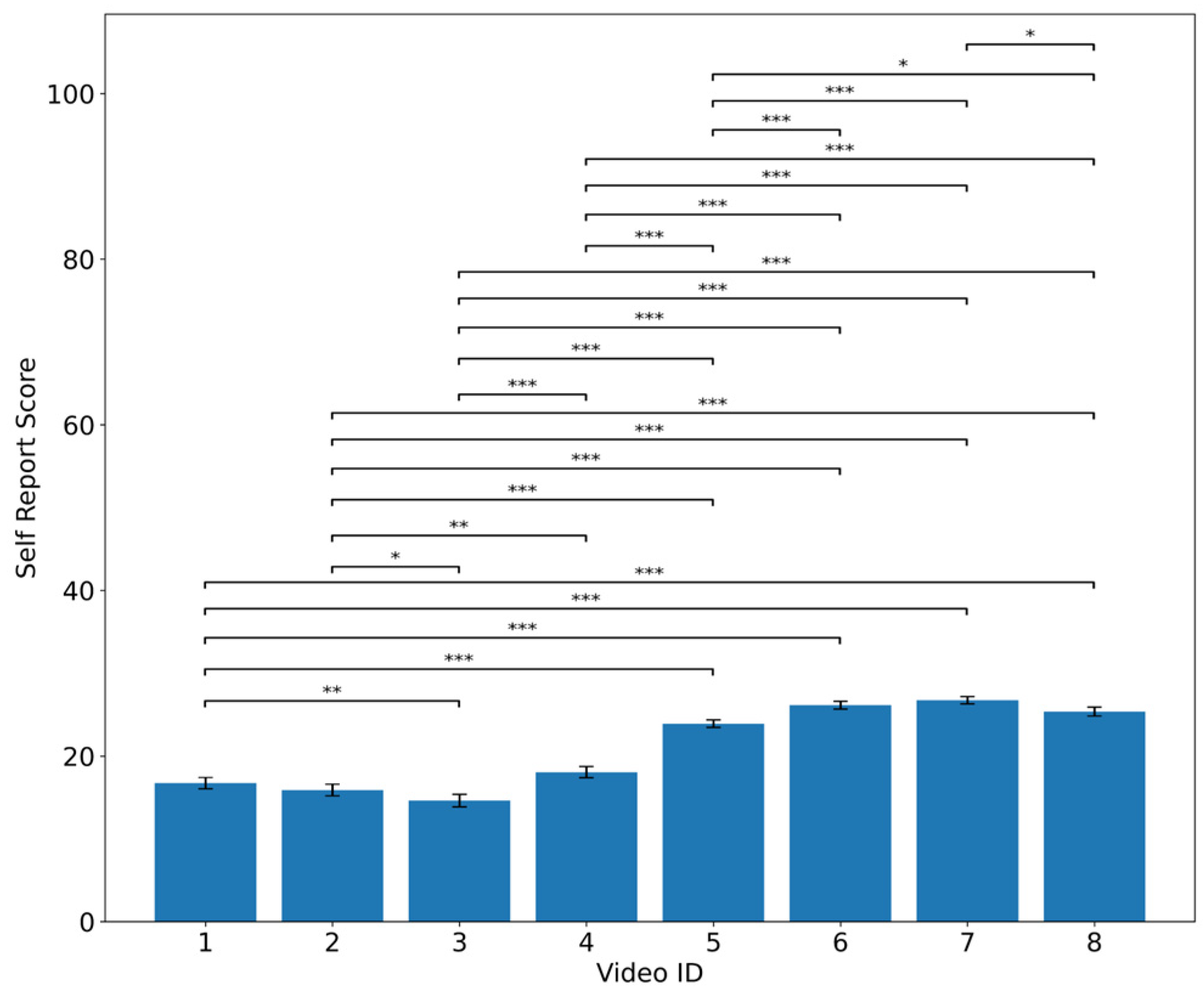
Toward Objective Assessment of Positive Affect: EEG and HRV Indices Distinguishing High and Low Arousal Positive Affect

 , and
, and
Abstract
1. Introduction
1.1. Background
1.2. Related Work and Issues
1.2.1. Category of Positive Affect
1.2.2. Assessing Emotional States Using Physiological Indices
1.2.3. Issues
2. Purpose and Proposal
2.1. Purpose
2.2. Proposal Method
2.2.1. Hypothesis and Experimental Design
2.2.2. Questionnaire Items
2.2.3. Physiological Indices Selection
2.3. Contribution and Structure of This Study
3. Experimental Method
3.1. Stimuli
3.2. Measuring Instruments
3.3. Experimental Setup and Procedure
3.4. Participants
4. Data Analysis Method
4.1. Physiological Signal Preprocessing and Index Computation
4.1.1. ECG Preprocessing and HRV Index Computation
4.1.2. EEG Preprocessing and Index Computation
4.2. Data Normalization Method
4.3. Manipulation Check with Self-Reported Emotion Assessment
4.4. Comparison of Physiological Indices
5. Results and Discussion
5.1. Manipulation Check Statistical Comparison Among Stimuli for Manipulation Check and Select Stimuli
5.2. Physiological Analyses
5.2.1. HRV
5.2.2. EEG
5.3. Contributions
5.4. Limitation and Future Work
6. Conclusions
Author Contributions
Funding
Institutional Review Board Statement
Informed Consent Statement
Data Availability Statement
Conflicts of Interest
Appendix A. Effect Size and CI for Manipulation Check

| Video-ID Pair | n_Pairs | Mean Difference | Mean Difference (95% CI) | p Value | Effect Size | ||
|---|---|---|---|---|---|---|---|
| Low | High | ||||||
| 1 | 2 | 50 | 0.84 | −0.260 | 2.000 | 0.428 | 0.165 |
| 1 | 3 | 50 | 2.12 | 1.040 | 3.240 | 0.008 | 0.488 |
| 1 | 4 | 50 | −1.32 | −2.700 | 0.060 | 0.174 | 0.288 |
| 1 | 5 | 50 | −7.16 | −8.641 | −5.740 | 0.000 | 0.858 |
| 1 | 6 | 50 | −9.4 | −11.000 | −7.860 | 0.000 | 0.870 |
| 1 | 7 | 50 | −10 | −11.600 | −8.460 | 0.000 | 0.868 |
| 1 | 8 | 50 | −8.64 | −10.400 | −6.880 | 0.000 | 0.837 |
| 2 | 3 | 50 | 1.28 | 0.380 | 2.220 | 0.017 | 0.461 |
| 2 | 4 | 50 | −2.16 | −3.260 | −1.020 | 0.002 | 0.540 |
| 2 | 5 | 50 | −8 | −9.580 | −6.480 | 0.000 | 0.848 |
| 2 | 6 | 50 | −10.24 | −11.900 | −8.560 | 0.000 | 0.855 |
| 2 | 7 | 50 | −10.84 | −12.520 | −9.180 | 0.000 | 0.870 |
| 2 | 8 | 50 | −9.48 | −11.440 | −7.460 | 0.000 | 0.822 |
| 3 | 4 | 50 | −3.44 | −4.600 | −2.380 | 0.000 | 0.735 |
| 3 | 5 | 50 | −9.28 | −10.961 | −7.600 | 0.000 | 0.857 |
| 3 | 6 | 50 | −11.52 | −13.300 | −9.740 | 0.000 | 0.865 |
| 3 | 7 | 50 | −12.12 | −13.920 | −10.340 | 0.000 | 0.865 |
| 3 | 8 | 50 | −10.76 | −12.760 | −8.780 | 0.000 | 0.864 |
| 4 | 5 | 50 | −5.84 | −7.280 | −4.480 | 0.000 | 0.834 |
| 4 | 6 | 50 | −8.08 | −9.560 | −6.620 | 0.000 | 0.867 |
| 4 | 7 | 50 | −8.68 | −10.200 | −7.180 | 0.000 | 0.863 |
| 4 | 8 | 50 | −7.32 | −9.060 | −5.660 | 0.000 | 0.851 |
| 5 | 6 | 50 | −2.24 | −2.960 | −1.500 | 0.000 | 0.715 |
| 5 | 7 | 50 | −2.84 | −3.620 | −2.060 | 0.000 | 0.768 |
| 5 | 8 | 50 | −1.48 | −2.360 | −0.520 | 0.013 | 0.474 |
| 6 | 7 | 50 | −0.6 | −1.060 | −0.140 | 0.069 | 0.422 |
| 6 | 8 | 50 | 0.76 | −0.060 | 1.640 | 0.428 | 0.209 |
| 7 | 8 | 50 | 1.36 | 0.660 | 2.140 | 0.013 | 0.501 |
References
- Mental Disorders. Available online: https://www.who.int/news-room/fact-sheets/detail/mental-disorders (accessed on 14 November 2025).
- Mental Health at Work. Available online: https://www.who.int/news-room/fact-sheets/detail/mental-health-at-work (accessed on 14 November 2025).
- Piao, X.; Xie, J.; Managi, S. Continuous Worsening of Population Emotional Stress Globally: Universality and Variations. BMC Public Health 2024, 24, 3576. [Google Scholar] [CrossRef]
- Dar, T.; Radfar, A.; Abohashem, S.; Pitman, R.K.; Tawakol, A.; Osborne, M.T. Psychosocial Stress and Cardiovascular Disease. Curr. Treat. Options Cardiovasc. Med. 2019, 21, 23. [Google Scholar] [CrossRef]
- Kalmbach, D.A.; Anderson, J.R.; Drake, C.L. The Impact of Stress on Sleep: Pathogenic Sleep Reactivity as a Vulnerability to Insomnia and Circadian Disorders. J. Sleep Res. 2018, 27, e12710. [Google Scholar] [CrossRef]
- Kubzansky, L.D.; Huffman, J.C.; Boehm, J.K.; Hernandez, R.; Kim, E.S.; Koga, H.K.; Feig, E.H.; Lloyd-Jones, D.M.; Seligman, M.E.P.; Labarthe, D.R. Positive Psychological Well-Being and Cardiovascular Disease: JACC Health Promotion Series. J. Am. Coll. Cardiol. 2018, 72, 1382–1396. [Google Scholar] [CrossRef]
- Dockray, S.; Steptoe, A. Positive Affect and Psychobiological Processes. Neurosci. Biobehav. Rev. 2010, 35, 69–75. [Google Scholar] [CrossRef]
- Zuccarella-Hackl, C.; Princip, M.; Sivakumar, S.; von Känel, R. Positive Psychological Well-Being and Cardiovascular Health. Front. Psychiatry 2024, 15, 1443978. [Google Scholar] [CrossRef]
- Seligman, M.E.P.; Csikszentmihalyi, M. Positive Psychology: An Introduction. Am. Psychol. 2000, 55, 5–14. [Google Scholar] [CrossRef] [PubMed]
- Alex Linley, P.; Joseph, S.; Harrington, S.; Wood, A.M. Positive Psychology: Past, Present, and (Possible) Future. J. Posit. Psychol. 2006, 1, 3–16. [Google Scholar] [CrossRef]
- Fredrickson, B.L. What Good Are Positive Emotions? Rev. Gen. Psychol. 1998, 2, 300–319. [Google Scholar] [CrossRef] [PubMed]
- Fredrickson, B.L.; Branigan, C. Positive Emotions Broaden the Scope of Attention and Thought-Action Repertoires. Cogn. Emot. 2005, 19, 313–332. [Google Scholar] [CrossRef]
- Eisenberg, N.; Miller, P.A. The Relation of Empathy to Prosocial and Related Behaviors. Psychol. Bull. 1987, 101, 91–119. [Google Scholar] [CrossRef]
- Zaki, J.; Bolger, N.; Ochsner, K. It Takes Two: The Interpersonal Nature of Empathic Accuracy. Psychol. Sci. 2008, 19, 399–404. [Google Scholar] [CrossRef]
- Taghizadeh, M.S.; Seyri, H. Do Positive Emotions Spark Creativity? Unpacking the Role of Positive Emotions in EFL Teachers’ Creativity. Acta Psychol. 2025, 260, 105566. [Google Scholar] [CrossRef]
- Armenta, C.N.; Fritz, M.M.; Lyubomirsky, S. Functions of Positive Emotions: Gratitude as a Motivator of Self-Improvement and Positive Change. Emot. Rev. 2017, 9, 183–190. [Google Scholar] [CrossRef]
- Tarrier, N.; Humphreys, A.-L. PTSD and the Social Support of the Interpersonal Environment: The Development of Social Cognitive Behavior Therapy. J. Cogn. Psychother. 2003, 17, 187–198. [Google Scholar] [CrossRef]
- Vasileiou, D.; Moraitou, D.; Diamantaras, K.; Papaliagkas, V.; Pezirkianidis, C.; Tsolaki, M. Positive Psychology Interventions in Early-Stage Cognitive Decline Related to Dementia: A Systematic Review of Cognitive and Brain Functioning Outcomes of Mindfulness Interventions. Brain Sci. 2025, 15, 580. [Google Scholar] [CrossRef]
- Watson, D.; Clark, L.A.; Tellegen, A. Development and Validation of Brief Measures of Positive and Negative Affect: The PANAS Scales. J. Pers. Soc. Psychol. 1988, 54, 1063–1070. [Google Scholar] [CrossRef]
- Finucane, A.M.; Dima, A.; Ferreira, N.; Halvorsen, M. Basic Emotion Profiles in Healthy, Chronic Pain, Depressed and PTSD Individuals. Clin. Psychol. Psychother. 2012, 19, 14–24. [Google Scholar] [CrossRef]
- Mather, M.; Carstensen, L.L. Aging and Attentional Biases for Emotional Faces. Psychol. Sci. 2003, 14, 409–415. [Google Scholar] [CrossRef]
- Rabin, L.A.; Smart, C.M.; Crane, P.K.; Amariglio, R.E.; Berman, L.M.; Boada, M.; Buckley, R.F.; Chételat, G.; Dubois, B.; Ellis, K.A.; et al. Subjective Cognitive Decline in Older Adults: An Overview of Self-Report Measures Used across 19 International Research Studies. J. Alzheimers Dis. 2015, 48, S63–S86. [Google Scholar] [CrossRef] [PubMed]
- Carolan, L.A.; Power, M.J. What Basic Emotions Are Experienced in Bipolar Disorder? Clin. Psychol. Psychother. 2011, 18, 366–378. [Google Scholar] [CrossRef]
- Shiota, M.N.; Neufeld, S.L.; Danvers, A.F.; Osborne, E.A.; Sng, O.; Yee, C.I. Positive Emotion Differentiation: A Functional Approach. Soc. Personal. Psychol. Compass 2014, 8, 104–117. [Google Scholar] [CrossRef]
- McManus, M.D.; Nakamura, J.; Siegel, J.T. Hiding in Plain Sight: The Distinct Importance of Low-Arousal Positive Affect. Motiv. Emot. 2024, 48, 336–422. [Google Scholar] [CrossRef]
- McManus, M.D.; Siegel, J.T.; Nakamura, J. The Predictive Power of Low-Arousal Positive Affect. Motiv. Emot. 2019, 43, 130–144. [Google Scholar] [CrossRef]
- Gilbert, P.; McEwan, K.; Mitra, R.; Franks, L.; Richter, A.; Rockliff, H. Feeling Safe and Content: A Specific Affect Regulation System? Relationship to Depression, Anxiety, Stress, and Self-Criticism. J. Posit. Psychol. 2008, 3, 182–191. [Google Scholar] [CrossRef]
- Barrett, L.F.; Bliss-Moreau, E. Affect as a Psychological Primitive. Adv. Exp. Soc. Psychol. 2009, 41, 167–218. [Google Scholar] [CrossRef] [PubMed]
- Painter, J.M.; Mote, J.; Peckham, A.D.; Lee, E.H.; Campellone, T.R.; Pearlstein, J.G.; Morgan, S.; Kring, A.M.; Johnson, S.L.; Moskowitz, J.T. A Positive Emotion Regulation Intervention for Bipolar I Disorder: Treatment Development and Initial Outcomes. Gen. Hosp. Psychiatry 2019, 61, 96–103. [Google Scholar] [CrossRef] [PubMed]
- Pei, G.; Li, H.; Lu, Y.; Wang, Y.; Hua, S.; Li, T. Affective Computing: Recent Advances, Challenges, and Future Trends. Intell. Comput. 2024, 3, 76. [Google Scholar] [CrossRef]
- Wang, K.; Wei, L.; Liu, Y.; Chen, J.; Zhan, Y.; Jin, H.; Qi, C.; Chen, Z. Correction to: Affective Computing for Healthcare: Recent Trends, Applications, Challenges, and Beyond. In Communications in Computer and Information Science; Springer Nature: Singapore, 2025; p. C1. [Google Scholar]
- Marín-Morales, J.; Higuera-Trujillo, J.L.; Greco, A.; Guixeres, J.; Llinares, C.; Scilingo, E.P.; Alcañiz, M.; Valenza, G. Affective Computing in Virtual Reality: Emotion Recognition from Brain and Heartbeat Dynamics Using Wearable Sensors. Sci. Rep. 2018, 8, 13657. [Google Scholar] [CrossRef]
- Spezialetti, M.; Placidi, G.; Rossi, S. Emotion Recognition for Human-Robot Interaction: Recent Advances and Future Perspectives. Front. Robot. AI 2020, 7, 532279. [Google Scholar] [CrossRef]
- Val-Calvo, M.; Alvarez-Sanchez, J.R.; Ferrandez-Vicente, J.M.; Fernandez, E. Affective Robot Story-Telling Human-Robot Interaction: Exploratory Real-Time Emotion Estimation Analysis Using Facial Expressions and Physiological Signals. IEEE Access 2020, 8, 134051–134066. [Google Scholar] [CrossRef]
- Shiota, M.N.; Neufeld, S.L.; Yeung, W.H.; Moser, S.E.; Perea, E.F. Feeling Good: Autonomic Nervous System Responding in Five Positive Emotions. Emotion 2011, 11, 1368–1378. [Google Scholar] [CrossRef]
- Hu, X.; Yu, J.; Song, M.; Yu, C.; Wang, F.; Sun, P.; Wang, D.; Zhang, D. EEG Correlates of Ten Positive Emotions. Front. Hum. Neurosci. 2017, 11, 26. [Google Scholar] [CrossRef] [PubMed]
- Watson, D.; Clark, L.A. The PANAS-X: Manual for the Positive and Negative Affect Schedule-Expanded Form; University of Iowa: Iowa City, IA, USA, 1999. [Google Scholar]
- Koga, M.T.Y.K. Construction of a Multiple Mood Scale. Jpn. J. Psychol. 1992, 62, 350–356. [Google Scholar] [CrossRef] [PubMed]
- Matsubara, T.; Tagai, K. Reliability of State-Trait Serenity Scale. Proc. Annu. Conv. Jpn. Psychol. Assoc. 2023, 87, 659. [Google Scholar] [CrossRef]
- Mauss, I.B.; Robinson, M.D. Measures of Emotion: A Review. In Cognition and Emotion; Psychology Press: London, UK, 2010; pp. 109–137. [Google Scholar]
- Hagemann, D.; Waldstein, S.R.; Thayer, J.F. Central and Autonomic Nervous System Integration in Emotion. Brain Cogn. 2003, 52, 79–87. [Google Scholar] [CrossRef]
- Shaffer, F.; Ginsberg, J.P. An Overview of Heart Rate Variability Metrics and Norms. Front. Public Health 2017, 5, 258. [Google Scholar] [CrossRef]
- Appelhans, B.M.; Luecken, L.J. Heart Rate Variability as an Index of Regulated Emotional Responding. Rev. Gen. Psychol. 2006, 10, 229–240. [Google Scholar] [CrossRef]
- McCraty, R.; Shaffer, F. Heart Rate Variability: New Perspectives on Physiological Mechanisms, Assessment of Self-Regulatory Capacity, and Health Risk. Glob. Adv. Health Med. 2015, 4, 46–61. [Google Scholar] [CrossRef] [PubMed]
- Pham, T.; Lau, Z.J.; Chen, S.H.A.; Makowski, D. Heart Rate Variability in Psychology: A Review of HRV Indices and an Analysis Tutorial. Sensors 2021, 21, 3998. [Google Scholar] [CrossRef]
- Sergent, J.; Ohta, S.; Macdonald, B.; Zuck, E. Segregated Processing of Facial Identity and Emotion in the Human Brain: A PET Study. Vis. Cogn. 1994, 1, 349–369. [Google Scholar] [CrossRef]
- Chen, X.; Zeng, W.; Shi, Y.; Deng, J.; Ma, Y. Intrinsic Prior Knowledge Driven CICA fMRI Data Analysis for Emotion Recognition Classification. IEEE Access 2019, 7, 59944–59950. [Google Scholar] [CrossRef]
- Alarcão, S.M.; Fonseca, M.J. Emotions Recognition Using EEG Signals: A Survey. IEEE Trans. Affect. Comput. 2019, 10, 374–393. [Google Scholar] [CrossRef]
- Niemic, C.P. Studies of Emotion: A Theoretical and Empirical Review of Psychophysiological Studies of Emotion. J. Undergrad. Res. 2002, 1, 15–18. [Google Scholar]
- Dale, A.M.; Sereno, M.I. Improved Localization of Cortical Activity by Combining EEG and MEG with MRI Cortical Surface Reconstruction: A Linear Approach. J. Cogn. Neurosci. 1993, 5, 162–176. [Google Scholar] [CrossRef]
- Balconi, M.; Vandelli, G.V.; Angioletti, L. Be Creative to Innovate! EEG Correlates of Group Decision-Making in Managers. Sustainability 2024, 16, 2175. [Google Scholar] [CrossRef]
- Gannouni, S.; Aledaily, A.; Belwafi, K.; Aboalsamh, H. Emotion Detection Using Electroencephalography Signals and a Zero-Time Windowing-Based Epoch Estimation and Relevant Electrode Identification. Sci. Rep. 2021, 11, 7071. [Google Scholar] [CrossRef]
- Miranda-Correa, J.A.; Abadi, M.K.; Sebe, N.; Patras, I. AMIGOS: A Dataset for Affect, Personality and Mood Research on Individuals and Groups. IEEE Trans. Affect. Comput. 2021, 12, 479–493. [Google Scholar] [CrossRef]
- Stone, J.L.; Hughes, J.R. Early History of Electroencephalography and Establishment of the American Clinical Neurophysiology Society. J. Clin. Neurophysiol. 2013, 30, 28–44. [Google Scholar] [CrossRef]
- Xu, J.; Zhong, B. Review on Portable EEG Technology in Educational Research. Comput. Hum. Behav. 2018, 81, 340–349. [Google Scholar] [CrossRef]
- Jafari, M.; Shoeibi, A.; Khodatars, M.; Bagherzadeh, S.; Shalbaf, A.; García, D.L.; Gorriz, J.M.; Acharya, U.R. Emotion Recognition in EEG Signals Using Deep Learning Methods: A Review. Comput. Biol. Med. 2023, 165, 107450. [Google Scholar] [CrossRef]
- Luo, J.; Yan, C.; He, Y. EEG Power Spectral Signatures of Emotional Word Processing in Sentence Contexts. In Proceedings of the 2025 10th International Conference on Intelligent Computing and Signal Processing (ICSP), Xi’an China, 16–18 May 2025; IEEE: Piscataway, NJ, USA, 2025; pp. 421–427. [Google Scholar]
- Li, X.; Zhang, Y.; Tiwari, P.; Song, D.; Hu, B.; Yang, M.; Zhao, Z.; Kumar, N.; Marttinen, P. EEG Based Emotion Recognition: A Tutorial and Review. ACM Comput. Surv. 2023, 55, 79. [Google Scholar] [CrossRef]
- Gasser, T.; Bächer, P.; Steinberg, H. Test-Retest Reliability of Spectral Parameters of the EEG. Electroencephalogr. Clin. Neurophysiol. 1985, 60, 312–319. [Google Scholar] [CrossRef]
- Salinsky, M.C.; Oken, B.S.; Morehead, L. Test-Retest Reliability in EEG Frequency Analysis. Electroencephalogr. Clin. Neurophysiol. 1991, 79, 382–392. [Google Scholar] [CrossRef]
- Uudeberg, T.; Päeske, L.; Hinrikus, H.; Lass, J.; Põld, T.; Bachmann, M. Individual Stability of Single-Channel EEG Measures over One Year in Healthy Adults. Sci. Rep. 2025, 15, 28426. [Google Scholar] [CrossRef] [PubMed]
- Liu, H.; Zhang, Y.; Li, Y.; Kong, X. Review on Emotion Recognition Based on Electroencephalography. Front. Comput. Neurosci. 2021, 15, 758212. [Google Scholar] [CrossRef]
- Hasnul, M.A.; Aziz, N.A.A.; Alelyani, S.; Mohana, M.; Aziz, A.A. Electrocardiogram-Based Emotion Recognition Systems and Their Applications in Healthcare—A Review. Sensors 2021, 21, 5015. [Google Scholar] [CrossRef]
- Rahman, M.A.; Anjum, A.; Milu, M.M.H.; Khanam, F.; Uddin, M.S.; Mollah, M.N. Emotion Recognition from EEG-Based Relative Power Spectral Topography Using Convolutional Neural Network. Array 2021, 11, 100072. [Google Scholar] [CrossRef]
- Rahman, M.A.; Mamun, M.; Khanam, F.; Khurshed, M.; Ahmad, M. EEG Based Brain Alertness Monitoring by Statistical and Artificial Neural Network Approach. Int. J. Adv. Comput. Sci. Appl. 2019, 10, 1. [Google Scholar] [CrossRef]
- Khanam, F.; Rahman, M.A.; Ahmad, M. Evaluating Alpha Relative Power of EEG Signal during Psychophysiological Activities in Salat. In Proceedings of the 2018 International Conference on Innovations in Science, Engineering and Technology (ICISET), Chittagong, Bangladesh, 27–28 October 2018; IEEE: Piscataway, NJ, USA, 2018; pp. 195–200. [Google Scholar]
- Grühn, D.; Sharifian, N. Lists of Emotional Stimuli. In Emotion Measurement; Elsevier: Amsterdam, The Netherlands, 2016; pp. 145–164. [Google Scholar]
- Nakagawa, Y.; Laohakangvalvit, T.; Matsubara, T.; Tagai, K.; Sugaya, M. Self-Reported and Physiological Evaluation of HAPA and LAPA Toward Positive Emotion Support. SEATUC J. Sci. Eng. 2025, 5, 115–122. [Google Scholar] [CrossRef]
- Klem, G.H.; Lüders, H.O.; Jasper, H.H.; Elger, C. The Ten-Twenty Electrode System of the International Federation. Electroencephalogr. Clin. Neurophysiol. Suppl. 1999, 52, 3–6. [Google Scholar]
- Wikipedia Contributors. 10–20 System (EEG). Available online: https://en.wikipedia.org/wiki/10%E2%80%9320_system_(EEG) (accessed on 8 January 2026).
- Makowski, D.; Pham, T.; Lau, Z.J.; Brammer, J.C.; Lespinasse, F.; Pham, H.; Schölzel, C.; Chen, S.H.A. NeuroKit2: A Python Toolbox for Neurophysiological Signal Processing. Behav. Res. Methods 2021, 53, 1689–1696. [Google Scholar] [CrossRef] [PubMed]
- Brunner, C.; Delorme, A.; Makeig, S. EEGLAB—An Open Source Matlab Toolbox for Electrophysiological Research. Biomed. Tech. 2013, 58, 000010151520134182. [Google Scholar] [CrossRef]
- Delorme, A.; Makeig, S. EEGLAB: An Open Source Toolbox for Analysis of Single-Trial EEG Dynamics Including Independent Component Analysis. J. Neurosci. Methods 2004, 134, 9–21. [Google Scholar] [CrossRef]
- Pion-Tonachini, L.; Kreutz-Delgado, K.; Makeig, S. ICLabel: An Automated Electroencephalographic Independent Component Classifier, Dataset, and Website. Neuroimage 2019, 198, 181–197. [Google Scholar] [CrossRef]
- Urigüen, J.A.; Garcia-Zapirain, B. EEG Artifact Removal—State-of-the-Art and Guidelines. J. Neural Eng. 2015, 12, 031001. [Google Scholar] [CrossRef] [PubMed]
- Erat, K.; Şahin, E.B.; Doğan, F.; Merdanoğlu, N.; Akcakaya, A.; Durdu, P.O. Emotion Recognition with EEG-Based Brain-Computer Interfaces: A Systematic Literature Review. Multimed. Tools Appl. 2024, 83, 79647–79694. [Google Scholar] [CrossRef]
- Liao, J.-C.; Fang, W.-C. An ICA-Based Automatic Eye Blink Artifact Eliminator for Real-Time Multi-Channel EEG Applications. In Proceedings of the 2013 IEEE International Conference on Consumer Electronics (ICCE), Las Vegas, NV, USA, 11–14 January 2013; IEEE: Piscataway, NJ, USA, 2013. [Google Scholar]
- Gramfort, A.; Luessi, M.; Larson, E.; Engemann, D.A.; Strohmeier, D.; Brodbeck, C.; Goj, R.; Jas, M.; Brooks, T.; Parkkonen, L.; et al. MEG and EEG Data Analysis with MNE-Python. Front. Neurosci. 2013, 7, 267. [Google Scholar] [CrossRef]
- Laohakangvalvit, T.; Sripian, P.; Nakagawa, Y.; Feng, C.; Tazawa, T.; Sakai, S.; Sugaya, M. Study on the Psychological States of Olfactory Stimuli Using Electroencephalography and Heart Rate Variability. Sensors 2023, 23, 4026. [Google Scholar] [CrossRef]
- Wobbrock, J.O.; Findlater, L.; Gergle, D.; Higgins, J.J. The Aligned Rank Transform for Nonparametric Factorial Analyses Using Only ANOVA Procedures. In Proceedings of the CHI Conference on Human Factors in Computing Systems (CHI ‘11), Vancouver, BC, Canada, 7–12 May 2011; ACM: New York, NY, USA, 2011. [Google Scholar]
- Castaldo, R.; Montesinos, L.; Melillo, P.; James, C.; Pecchia, L. Ultra-Short Term HRV Features as Surrogates of Short Term HRV: A Case Study on Mental Stress Detection in Real Life. BMC Med. Inform. Decis. Mak. 2019, 19, 12. [Google Scholar] [CrossRef] [PubMed]
- Schaaff, K.; Adam, M.T.P. Measuring Emotional Arousal for Online Applications: Evaluation of Ultra-Short Term Heart Rate Variability Measures. In Proceedings of the 2013 Humaine Association Conference on Affective Computing and Intelligent Interaction (ACII), Geneva, Switzerland, 2–5 September 2013; IEEE: Piscataway, NJ, USA, 2013. [Google Scholar]
- Hachenberger, J.; Li, Y.-M.; Siniatchkin, M.; Hermenau, K.; Ludyga, S.; Lemola, S. Heart Rate Variability’s Association with Positive and Negative Affect in Daily Life. Sensors 2023, 23, 966. [Google Scholar] [CrossRef] [PubMed]
- Klimesch, W. EEG Alpha and Theta Oscillations Reflect Cognitive and Memory Performance: A Review and Analysis. Brain Res. Rev. 1999, 29, 169–195. [Google Scholar] [CrossRef]
- Aftanas, L.I.; Golocheikine, S.A. Human Anterior and Frontal Midline Theta and Lower Alpha Reflect Emotionally Positive State and Internalized Attention. Neurosci. Lett. 2001, 310, 57–60. [Google Scholar] [CrossRef]
- Knyazev, G.G. Motivation, Emotion, and Their Inhibitory Control Mirrored in Brain Oscillations. Neurosci. Biobehav. Rev. 2007, 31, 377–395. [Google Scholar] [CrossRef] [PubMed]
- Codispoti, M.; De Cesarei, A.; Ferrari, V. Alpha-Band Oscillations and Emotion: A Review of Studies on Picture Perception. Psychophysiology 2023, 60, e14438. [Google Scholar] [CrossRef] [PubMed]
- Ray, W.J.; Cole, H.W. EEG Alpha Activity Reflects Attentional Demands, and Beta Activity Reflects Emotional and Cognitive Processes. Science 1985, 228, 750–752. [Google Scholar] [CrossRef]
- Luo, M.; Gan, Q.; Huang, Z.; Jiang, Y.; Li, K.; Wu, M.; Yang, D.; Shao, H.; Chen, Y.; Fu, Y.; et al. Changes in Mental Health and EEG Biomarkers of Undergraduates under Different Patterns of Mindfulness. Brain Topogr. 2024, 37, 75–87. [Google Scholar] [CrossRef]
- Zemla, K.; Wojcik, G.M.; Postepski, F.; Wróbel, K.; Kawiak, A.; Sedek, G. Modeling of Brain Cortical Activity during Relaxation and Mental Workload Tasks Based on EEG Signal Collection. Appl. Sci. 2023, 13, 4472. [Google Scholar] [CrossRef]
- Rahman, M.M.; Sarkar, A.K.; Hossain, M.A.; Hossain, M.S.; Islam, M.R.; Hossain, M.B.; Quinn, J.M.W.; Moni, M.A. Recognition of Human Emotions Using EEG Signals: A Review. Comput. Biol. Med. 2021, 136, 104696. [Google Scholar] [CrossRef]
- Sharma, R.; Meena, H.K. Emerging Trends in EEG Signal Processing: A Systematic Review. SN Comput. Sci. 2024, 5, 415. [Google Scholar] [CrossRef]
- Bradley, M.M.; Lang, P.J. Measuring Emotion: The Self-Assessment Manikin and the Semantic Differential. J. Behav. Ther. Exp. Psychiatry 1994, 25, 49–59. [Google Scholar] [CrossRef] [PubMed]
- Hu, F.; He, K.; Wang, C.; Zheng, Q.; Zhou, B.; Li, G.; Sun, Y. STRFLNet: Spatio-Temporal Representation Fusion Learning Network for EEG-Based Emotion Recognition. IEEE Trans. Affect. Comput. 2025. [Google Scholar] [CrossRef]
- Wang, J.; Ning, X.; Xu, W.; Li, Y.; Jia, Z.; Lin, Y. Multi-Source Selective Graph Domain Adaptation Network for Cross-Subject EEG Emotion Recognition. Neural Netw. 2024, 180, 106742. [Google Scholar] [CrossRef] [PubMed]
- Ronca, V.; Flumeri, G.D.; Giorgi, A.; Vozzi, A.; Capotorto, R.; Germano, D.; Sciaraffa, N.; Borghini, G.; Babiloni, F.; Aricò, P. O-CLEAN: A Novel Multi-Stage Algorithm for the Ocular Artifacts’ Correction from EEG Data in out-of-the-Lab Applications. J. Neural Eng. 2024, 21, 056023. [Google Scholar] [CrossRef]




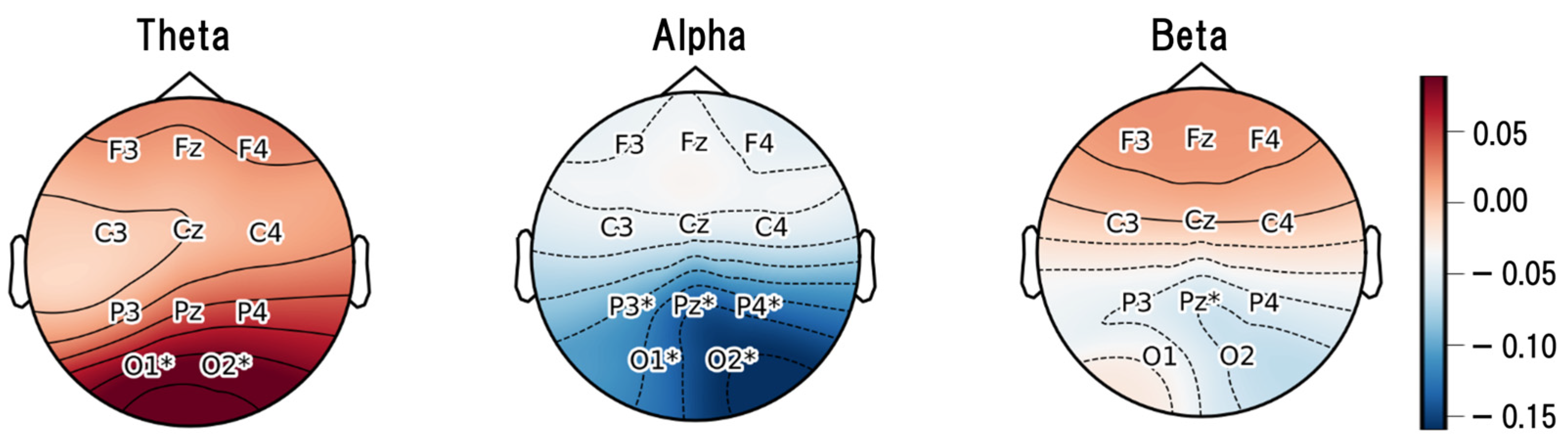
| Indices | Description |
|---|---|
| SDNN | Standard deviation of NN intervals |
| RMSSD | Root mean square of consecutive RR interval differences |
| pNN50 | Percentage of successive RR intervals that differ by more than 50 ms |
| Indices | Frequency Band (Hz) |
|---|---|
| Theta | 4–7 Hz |
| Alpha | 8–12 Hz |
| Beta | 13–30 Hz |
| Generation | Male | Female |
|---|---|---|
| 20 s | 9 | 9 |
| 30 s | 9 | 9 (1) |
| 40 s | 9 (1) | 9 (2) |
| VideoID | 1 | 2 | 3 | 4 | 5 | 6 | 7 | 8 |
|---|---|---|---|---|---|---|---|---|
| 1 | — | 0.17 | 0.49 | 0.29 | 0.86 | 0.87 | 0.87 | 0.84 |
| 2 | — | 0.46 | 0.54 | 0.85 | 0.86 | 0.87 | 0.82 | |
| 3 | — | 0.74 | 0.86 | 0.87 | 0.87 | 0.86 | ||
| 4 | — | 0.83 | 0.87 | 0.86 | 0.85 | |||
| 5 | — | 0.72 | 0.77 | 0.47 | ||||
| 6 | — | 0.42 | 0.21 | |||||
| 7 | — | 0.50 | ||||||
| 8 | — |
| Indices | Mean Different | Mean Difference (95% CI) | p Value | Effect Size | |
|---|---|---|---|---|---|
| Low | High | ||||
| SDNN | 1.797 | −1.120 | 5.116 | 0.263 | 0.07 |
| RMSSD | 0.479 | −3.014 | 4.724 | 1.000 | 0.24 |
| pNN50 | 0.364 | −0.562 | 1.365 | 1.000 | 0.09 |
| Indices | Main Effect: Condition | Main Effect: Channel | Interaction |
|---|---|---|---|
| Theta | p < 0.001 | 0.004 | 0.492 |
| Alpha | p < 0.001 | p < 0.001 | 0.010 |
| Beta | 0.002 | p < 0.001 | 0.185 |
| Indices | Channel | Mean Difference | Mean Difference (95% CI) | p Value | Effect Size | |
|---|---|---|---|---|---|---|
| Low | High | |||||
| Theta | O1 | 0.083 | 0.042 | 0.125 | 0.022 | 0.474 |
| O2 | 0.089 | 0.033 | 0.140 | 0.049 | 0.444 | |
| Alpha | O1 | −0.125 | −0.175 | −0.074 | 0.002 | 0.545 |
| O2 | −0.159 | −0.208 | −0.107 | p < 0.001 | 0.652 | |
| P3 | −0.103 | −0.142 | −0.063 | p < 0.001 | 0.595 | |
| P4 | −0.131 | −0.171 | −0.091 | p < 0.001 | 0.687 | |
| Pz | −0.139 | −0.180 | −0.099 | p < 0.001 | 0.700 | |
| Beta | Pz | −0.059 | −0.093 | −0.026 | 0.030 | 0.463 |
Disclaimer/Publisher’s Note: The statements, opinions and data contained in all publications are solely those of the individual author(s) and contributor(s) and not of MDPI and/or the editor(s). MDPI and/or the editor(s) disclaim responsibility for any injury to people or property resulting from any ideas, methods, instructions or products referred to in the content. |
© 2026 by the authors. Licensee MDPI, Basel, Switzerland. This article is an open access article distributed under the terms and conditions of the Creative Commons Attribution (CC BY) license.
Share and Cite
Nakagawa, Y.; Laohakangvalvit, T.; Matsubara, T.; Tagai, K.; Sugaya, M. Toward Objective Assessment of Positive Affect: EEG and HRV Indices Distinguishing High and Low Arousal Positive Affect. Sensors 2026, 26, 521. https://doi.org/10.3390/s26020521
Nakagawa Y, Laohakangvalvit T, Matsubara T, Tagai K, Sugaya M. Toward Objective Assessment of Positive Affect: EEG and HRV Indices Distinguishing High and Low Arousal Positive Affect. Sensors. 2026; 26(2):521. https://doi.org/10.3390/s26020521
Chicago/Turabian StyleNakagawa, Yuri, Tipporn Laohakangvalvit, Toshitaka Matsubara, Keiko Tagai, and Midori Sugaya. 2026. "Toward Objective Assessment of Positive Affect: EEG and HRV Indices Distinguishing High and Low Arousal Positive Affect" Sensors 26, no. 2: 521. https://doi.org/10.3390/s26020521
APA StyleNakagawa, Y., Laohakangvalvit, T., Matsubara, T., Tagai, K., & Sugaya, M. (2026). Toward Objective Assessment of Positive Affect: EEG and HRV Indices Distinguishing High and Low Arousal Positive Affect. Sensors, 26(2), 521. https://doi.org/10.3390/s26020521