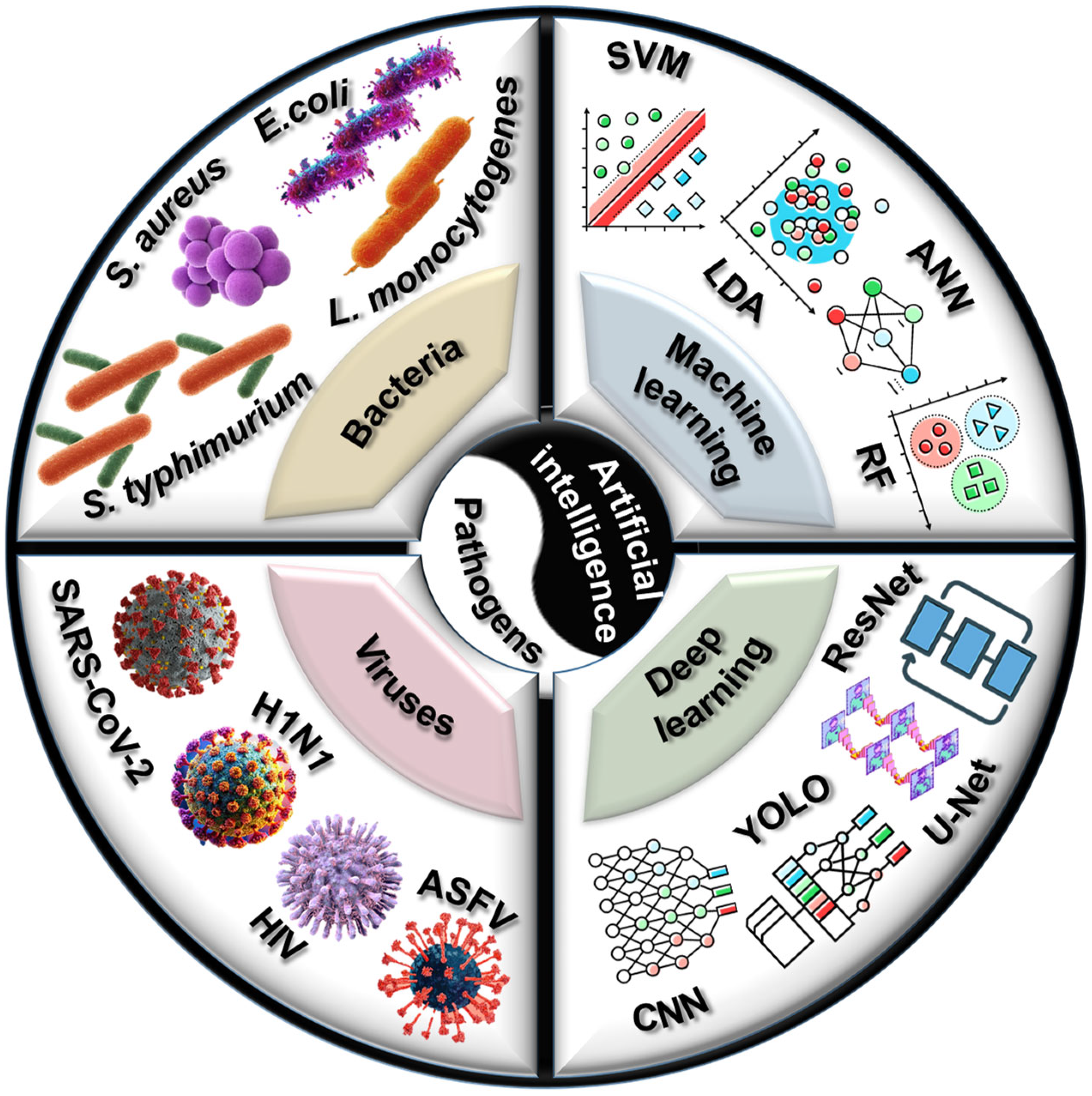
Emerging Trends in Artificial Intelligence-Assisted Colorimetric Biosensors for Pathogen Diagnostics



Abstract
1. Introduction
1.1. Sensing Challenges in Pathogen Detection
1.2. Limitations of Conventional Colorimetric Biosensors
1.3. Artificial Intelligence-Based Solution for Colorimetric Biosensors
1.3.1. Role of Artificial Intelligence in Colorimetric Biosensors
1.3.2. ML Algorithms for Colorimetric Biosensors
1.3.3. DL Algorithms for Colorimetric Biosensors
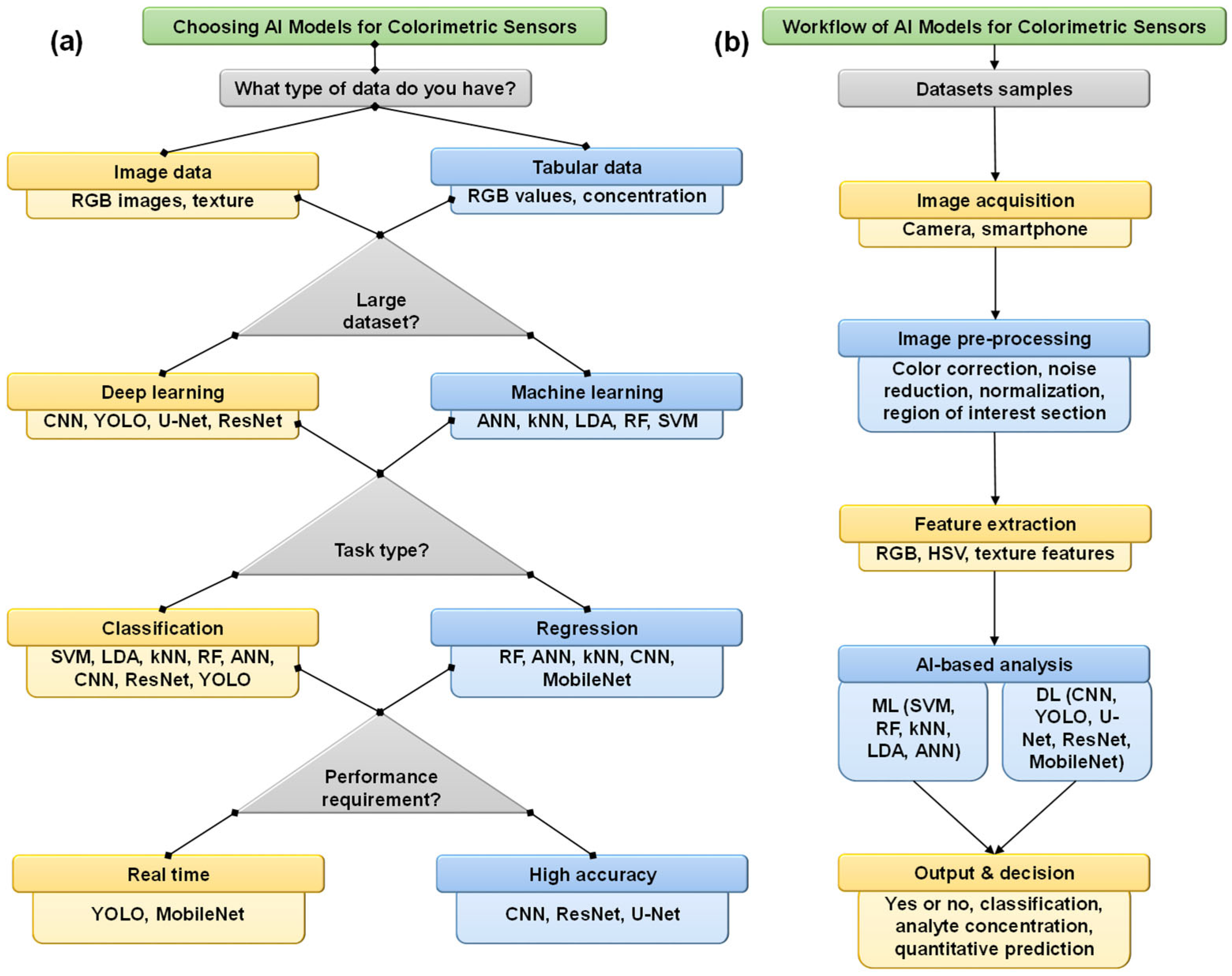
1.3.4. Selection Criteria and Workflow for ML and DL Algorithms in Colorimetric Biosensors
1.3.5. Explainable AI for Transparent Colorimetric Biosensors
1.4. Scope of This Review
2. AI-Assisted Colorimetric Detection of Bacteria
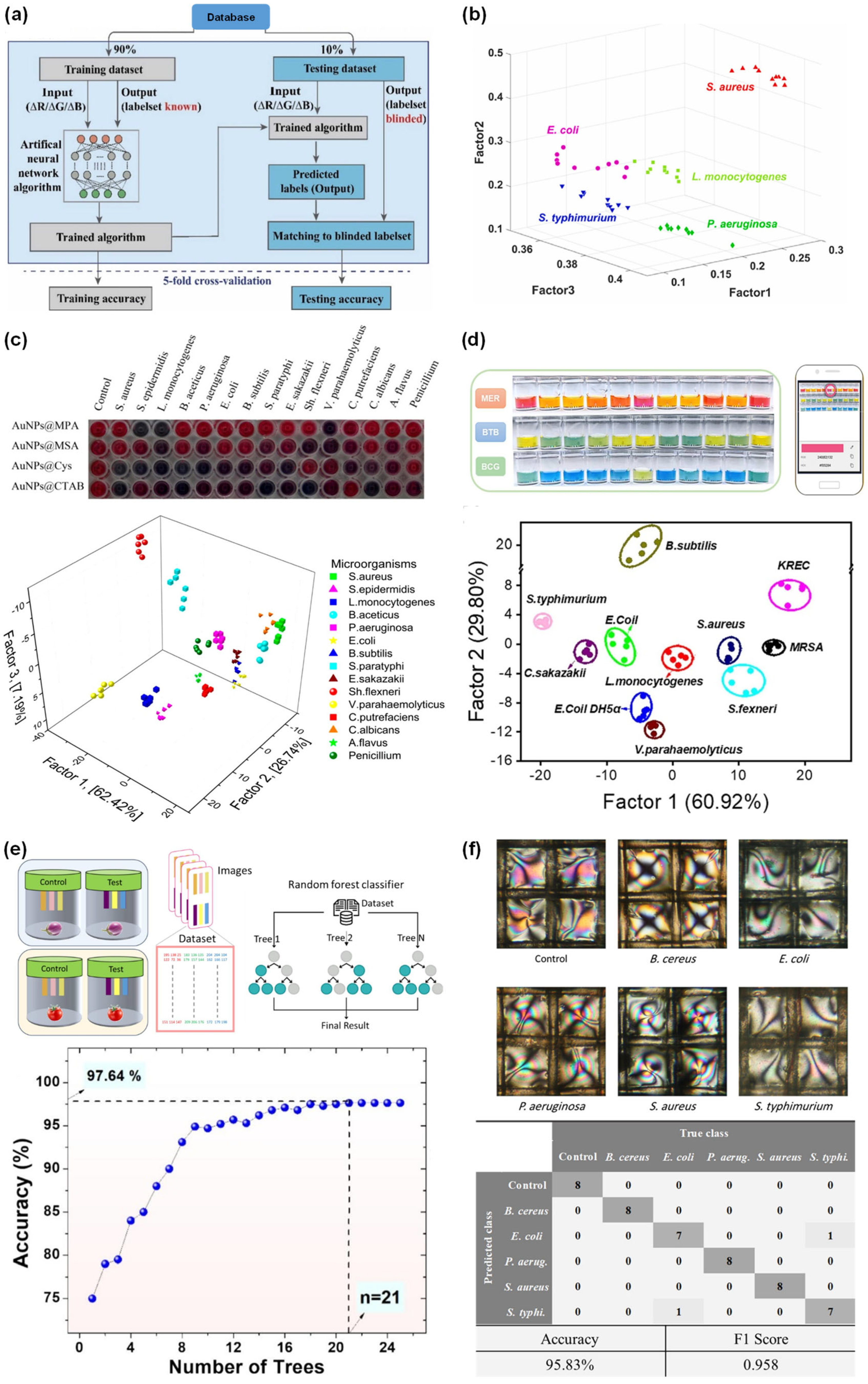
2.1. ML-Based Colorimetric Detection of Bacteria
2.1.1. ANN for Bacterial Detection

| Sl. No. | Category/AI Algorithm | Target Bacteria | Data Size | Accuracy | LOD/Linear Range | Reaction Time | Real Samples | Ref. |
|---|---|---|---|---|---|---|---|---|
| 1 | ML/ANN | E. coli O157:H7, Salmonella, and L. monocytogenes | 500 | 90% | 10 CFUs·g−1/N.A. | N.A. | Chicken | [15] |
| 2 | ML/ANN | E. coli O157:H7 and S. enteritidis | 200 | 92% | 10 CFUs·g−1/N.A. | 24 h | Shredded cheddar cheese | [16] |
| 3 | ML/kNN | E. coli, S. typhimurium, S. aureus, P. aeruginosa, Shigella, and L. monocytogenes | 200 | 100% | 92–121 CFUs·mL−1/N.A. | 60 min | Tap water | [17] |
| 4 | ML/kNN | S. typhimurium, E. coli, S. aureus, P. aeruginosa, and L. monocytogenes | 75 | 98% | 103 CFUs·mL−1/103–107 CFUs·mL−1 | 5 min | Tap water and milk | [18] |
| 5 | ML/kNN | E. coli, P. aeruginosa, S. aureus, S. typhimurium, and L. monocytogenes | 50 | 80% | 103 CFUs·mL−1/103–107 CFUs·mL−1 | 30 min | Tap water | [19] |
| 6 | ML/LDA | S. aureus, S. epidermidis, L. monocytogenes, B. aceticus, P. aeruginosa, E. coli, B. subtilis, S. paratyphi, E. sakazakii, S. flexneri, V. parahemolyticus, C. putrefaciens, C. albicans, A. flavus, and Penicillium | 60 | 100% | N.A./N.A. | 5 s | N.A. | [20] |
| 7 | ML/LDA | B. subtilis, E. coli, S. typhimurium, kanamycin-resistant E. coli (KREC), methicillin-resistant S. aureus (MRSA), S. aureus, V. parahaemolyticus, S. flexneri, and C. sakazakii | 180 | 100% | N.A./103–106 CFUs·mL−1 | 30 min | Tap water | [21] |
| 8 | ML/LDA | S. aureus, Salmonella, V. vulnificus, V. harvey, L. monocytogenes, and V. parahaemolyticus | 72 | 95% | N.A./105–108 CFUs·mL−1 | 10 min | Sea water, lake water, tap water, and coconut water | [22] |
| 9 | ML/LDA | S. aureus, E. coli, S. typhimurium, S. senftenberg, L. monocytogenes, S. epidermidis, and B. subtilis | 80 | 100% | N.A./103–107 CFUs·mL−1 | 50 min | Serum and urine | [23] |
| 10 | ML/LDA | MRSA, L. monocytogenes, E. coil, S. flexneri, KREC, S. typhimurium, B. subtilis, S. aureus, C. sakazakii, and V. parahaemolyticus | 50 | 100% | N.A./103–107 CFUs·mL−1 | 6 h | Tap water | [24] |
| 11 | ML/LDA | S. aureus, E. coli, and E. faecalis | 50 | 100% | 105 CFUs·mL−1/N.A. | 20 min | Urine | [25] |
| 12 | ML/LDA | E. coli, S. typhimurium, E. sakazakii, P. aeruginosa, S. aureus, and L. monocytogenes | 150 | 93.3% | N.A./N.A. | 15 min | Milk | [26] |
| 13 | ML/RF | E. coli and S. epidermidis | 320 | 97% | 10 CFUs·mL−1/102–107 CFUs·mL−1 | 15 min | Tap water, sea water, and artificial saliva | [27] |
| 14 | ML/RF | E. coli, P. aeruginosa, S. aureus, and P. syringae | 300 | 97.64% | N.A./N.A. | 30 min | Vegetables | [28] |
| 15 | ML/SVM | E. coli and S. typhimurium | N.A. | N.A. | 103 CFUs·mL−1/102–108 CFUs·mL−1 | 30 min | Pear juice | [29] |
| 16 | ML/SVM | E. coli, S. aureus, S. typhimurium, E. faecium, and P. aeruginosa | N.A. | 93.3% | 105 CFUs·mL−1/N.A. | 10 min | Pond water | [30] |
| 17 | ML/SVM | E. coli, K. aerogenes, P. aeruginosa, P. vulgaris, E. faecalis, E. faecium, S. aureus, S. epidermidis, M. albican, and C. glabrata | 60 | 97% | 104 CFUs·mL−1/N.A. | 60 min | Urine | [31] |
| 18 | ML/SVM | C. sakazakii, S. enteritidis, L. monocytogenes, V. parahaemolyticus, S. aureus, S. dysenteriae, C. jejuni, and E. coli | 300 | 93.75% | 102 CFUs·mL−1/102–107 CFUs·mL−1 | 60 min | Milk | [32] |
| 19 | ML/SVM | B. cereus, E. coli, P. aeruginosa, S. aureus, and S. typhimurium | N.A. | 86.58–97.92% | 10 CFUs·mL−1/10–106 CFUs·mL−1 | 20 min | Drinking water, milk, and apple juice | [33] |
| 20 | DL/CNN-SVM | E. coli, P. aeruginosa, and S. aureus | 1000 | 96.2% | 10 CFUs·mL−1/10–103 CFUs·mL−1 | 24 h | Human blood | [34] |
| 21 | DL/YOLO | E. coli, P. aeruginosa, S. aureus, and Group A Streptococcus | 1419 | 92% | 10 CFUs·mL−1/10–105 CFUs·mL−1 | 60 min | Blueberry | [35] |
| 22 | DL/YOLO | E. coli, S. pneumoniae, and H. influenzae | 500 | 97.8% | 6.25 fmol/0–500 fmol | 15 min | N.A. | [36] |

2.1.2. kNN for Bacterial Detection
2.1.3. LDA for Bacterial Detection
2.1.4. RF for Bacterial Detection
2.1.5. SVM for Bacterial Detection
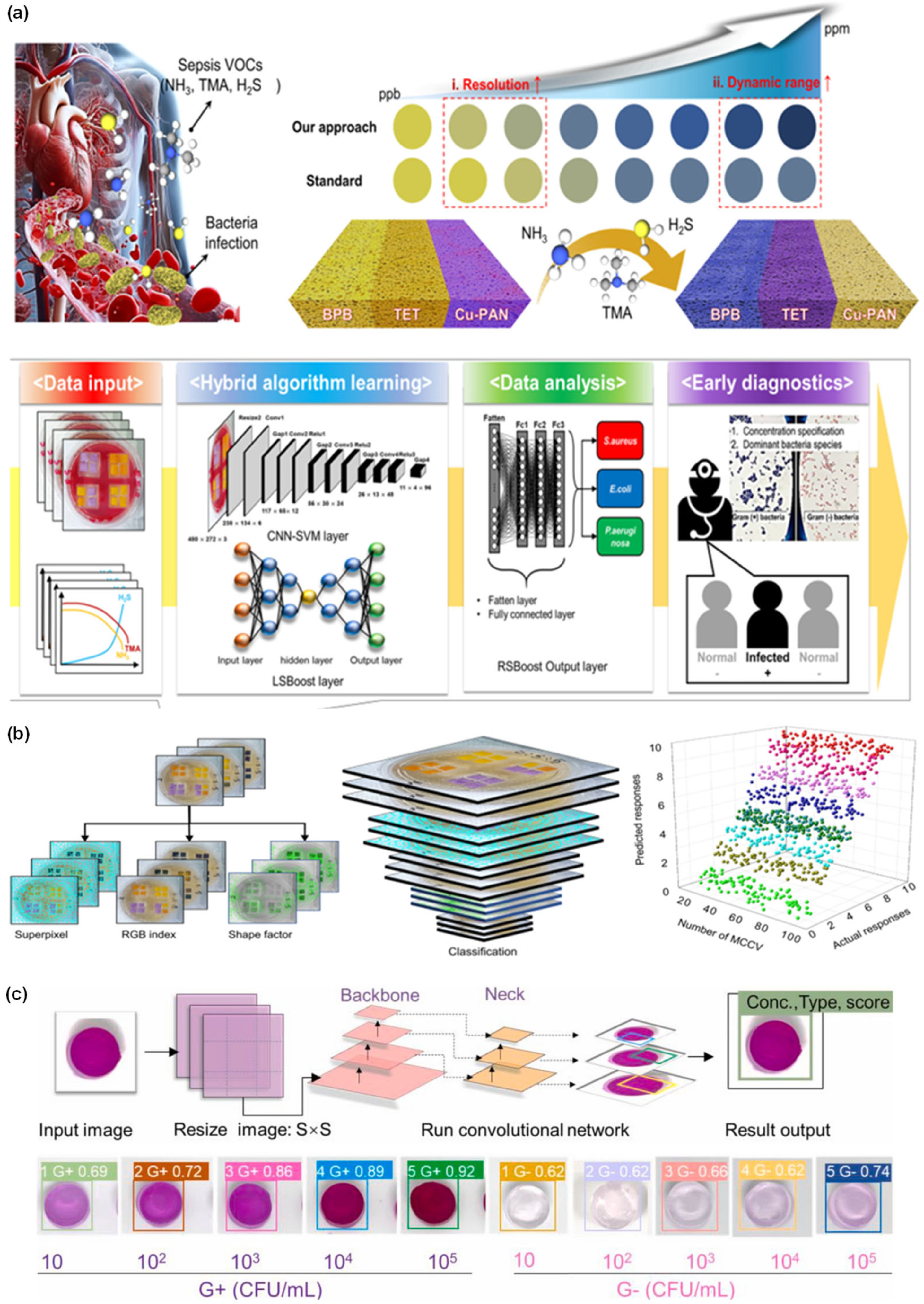
2.2. DL-Based Colorimetric Detection of Bacteria
2.2.1. CNN for Bacterial Detection
2.2.2. YOLO for Bacterial Detection
3. AI-Assisted Colorimetric Detection of Viruses
3.1. ML-Based Colorimetric Detection of Viruses
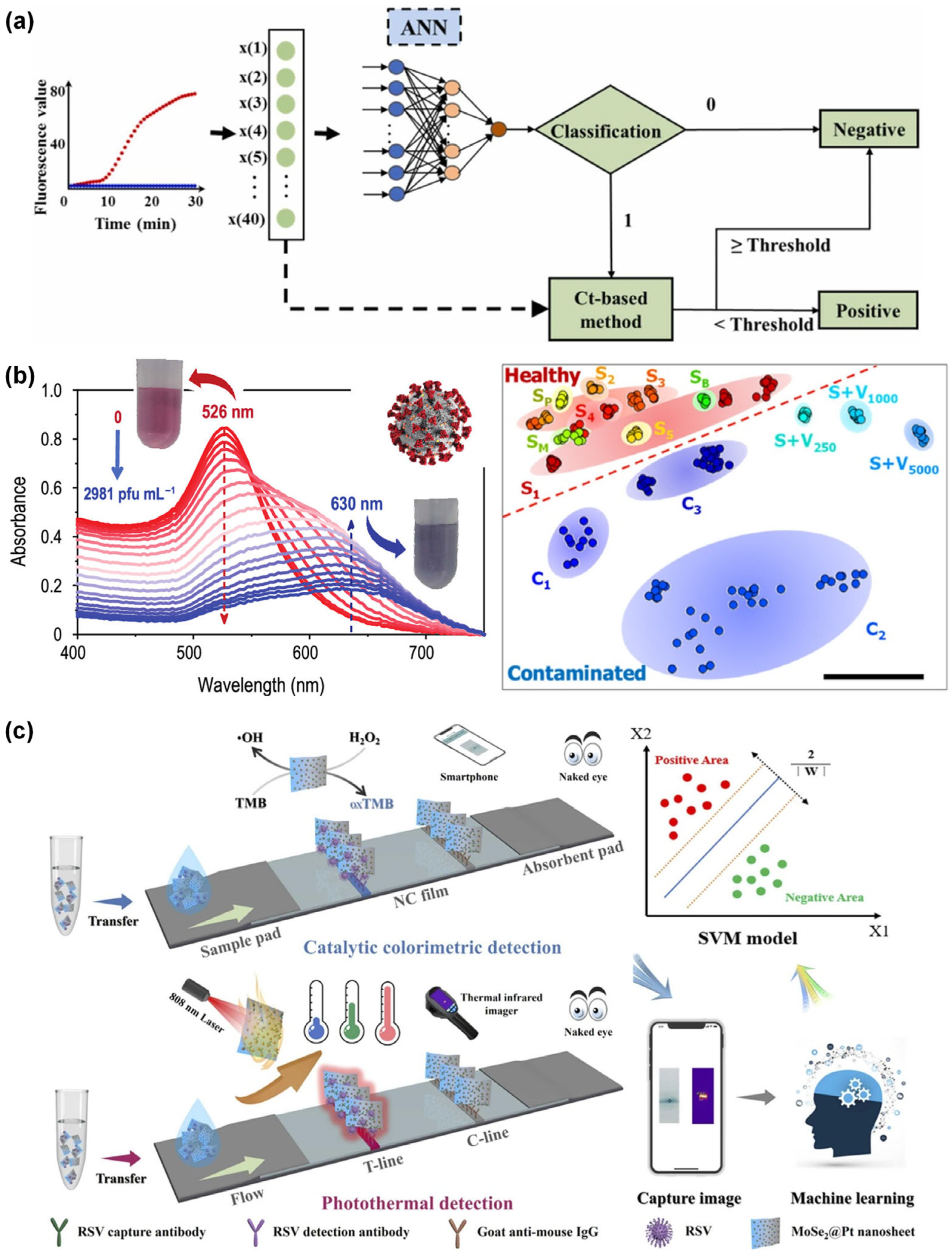
3.1.1. ANN for Virus Detection
| Sl. No. | Category/AI Algorithm | Target Viruses | Data Size | Accuracy | LOD/Linear Range | Reaction Time | Real Samples | Ref. |
|---|---|---|---|---|---|---|---|---|
| 1 | ML/ANN | ASFV | 392 | 97.5% | 5 × 10² copies·mL−1/5 × 102–5 × 10⁶ copies·mL−1 | 30 min | N.A. | [37] |
| 2 | ML/RF | SARS-CoV-2 | 1200 | 100% | 0.28 PFUs·mL−1/7–2000 PFUs·mL−1 | 30 min | Saliva and river water | [38] |
| 3 | ML/SVM | SARS-CoV-2 and H1N1 influenza | 500 | 95% | 6.2 copies·mL−1/7.2–7.2 × 106 copies·mL−1 | 13 min | Saliva | [39] |
| 4 | ML/SVM | H1N1, H3N2, FLUB, and SARS-CoV-2 | 200 | 97.5% | 0.1 × 10⁵ copies·mL−1/0–20 × 105 copies·mL−1 | 15 min | Nasal swabs | [40] |
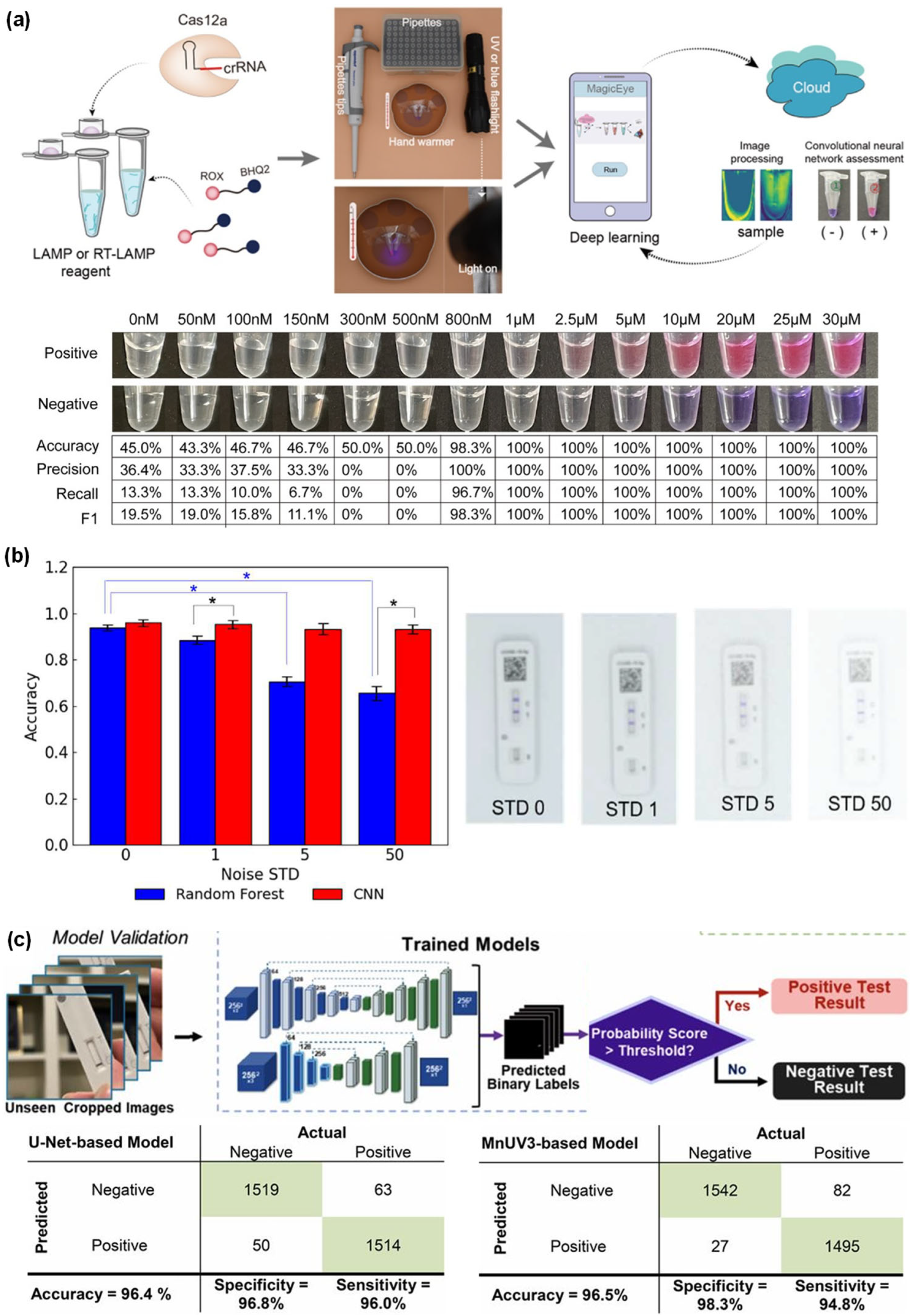
| 5 | DL/CNN | SARS-CoV-2 | 595,339 | 98.4% | N.A./N.A. | 15 min | Human blood | [41] |
| 6 | DL/CNN | SARS-CoV-2 | 726 | 99% | N.A./N.A. | N.A. | Nasal swabs | [42] |
| 7 | DL/CNN | SARS-CoV-2 and ASFV | 2543 | 100% | 58 total copies/0–7 × 105 total copies | 30 min | Human blood | [43] |
| 8 | DL/CNN | Human immunodeficiency virus | 11,374 | 98.9% | N.A./N.A. | N.A. | Blood, serum, and plasma | [44] |
| 9 | DL/CNN | SARS-CoV-2 | 894 | 97.9% | N.A./N.A. | 2 min | Naso-oropharyngeal swabs and saliva | [45] |
| 10 | DL/CNN | SARS-CoV-2 N-protein | 2586 | 95.3% | 0.074 ng/0.074–7.4 ng | 15 min | N.A. | [46] |
| 11 | DL/CNN | SARS-CoV-2 | 1500 | 98% | 0.156 ng·mL−1/N.A. | 15 min | N.A. | [47] |
| 12 | DL/U-Net | SARS-CoV-2 N-protein | 3146 | 96.5% | 1 nM/1–100 nM | 0.2 s | N.A. | [48] |
| 13 | DL/ResNet | SARS-CoV-2 | 213 | 100% | 3.7 × 10² copies·mL−1/N.A. | 75 min | Nasopharyngeal swabs | [49] |
| 14 | DL/ResNet | SARS-CoV-2 | N.A. | 94.52% | 2.5 pg·mL−1/0.1–10,000 pg·mL−1 | 15 min | Nasopharyngeal swabs | [50] |
| 15 | DL/ResNet | SARS-CoV-2 | 234 | N.A. | 160 ng·mL−1/625–10,000 pg·mL−1 | 20 min | Serum | [51] |

3.1.2. RF for Virus Detection
3.1.3. SVM for Virus Detection
3.2. DL-Based Colorimetric Detection of Viruses
3.2.1. CNN for Virus Detection
3.2.2. U-Net and ResNet for Virus Detection
4. Conclusions and Challenges
5. Future Perspectives
- Standardization and validation: Develop standardized protocols for image acquisition, data annotation, preprocessing, and performance reporting to ensure model reproducibility and universal applicability. The establishment of a centralized international committee involving regulatory agencies, institutions, and industry would facilitate harmonized guidelines and regulated clinical validation across laboratories worldwide.
- Cause study-driven applications: Practical implementations such as AI-powered LFA kits for infectious disease detection, food safety monitoring, and water quality monitoring can serve as examples for broad acceptance.
- Collaborative research: Strategic partnerships with hospitals, research institutes, and global health organizations will support the creation of diverse datasets and adaptable AI models.
- Proof-of-concept projects: Deployment of proof-of-concept studies to integrate AI-enhanced biosensors in clinical, environmental, and industrial areas, such as POCT and multi-sensor devices in public health.
- Infrastructure integration: Incorporate IoT-enabled and AI-driven biosensors into a large-scale health and environmental surveillance system to support real-time diagnostics and global monitoring.
- Multimodal sensor integration: Integrating colorimetric sensing with complementary models such as acoustic, electrochemical, viscosity, and thermal modalities can enhance diagnostic accuracy and response speed. The application of XAI tools such as SHAP, LIME, and Grad-CAM will further enhance interpretability and acceptance. In the long term, unified multimodal AI frameworks capable of jointly analyzing heterogeneous sensor data are expected to significantly improve pathogen detection in multiple environments.
Author Contributions
Funding
Institutional Review Board Statement
Informed Consent Statement
Data Availability Statement
Acknowledgments
Conflicts of Interest
References
- WHO. Pathogens Prioritization: A Scientific Framework for Epidemic and Pandemic Research Preparedness; Health Emergencies Progrmme; World Health Organization: Geneva, Switzerland, 2024; pp. 1–73. [Google Scholar]
- Khan, H.; Jan, Z.; Ullah, I.; Alwabli, A.; Alharbi, F.; Habib, S.; Muhammad, I.; Byung-Joo, S.; Mi Young, L.; JaKeoung, K. A Deep Dive into AI Integration and Advanced Nanobiosensor Technologies for Enhanced Bacterial Infection Monitoring. Nanotechnol. Rev. 2024, 13, 20240056. [Google Scholar] [CrossRef]
- Tugba, A.; Mahshid, R.; Mustafa, S.; Volkan, K.; Nesrin, H. The Role of Artificial Intelligence in Advancing Biosensor Technology: Past, Present, and Future Perspectives. Adv. Mater. 2025, 37, 2504796. [Google Scholar] [CrossRef] [PubMed]
- Murray, C.J.L.; Ikuta, K.S.; Sharara, F.; Swetschinski, L.; Aguilar, G.R.; Gray, A.; Han, C.; Bisignano, C.; Rao, P.; Wool, E.; et al. Articles Global Burden of Bacterial Antimicrobial Resistance in 2019: A Systematic Analysis. Lancet 2022, 399, 629–655. [Google Scholar] [CrossRef] [PubMed]
- WHO. Antimicrobial Resistance. 2025. Available online: https://www.who.int/news-room/fact-sheets/detail/antimicrobial-resistance (accessed on 6 January 2026).
- WHO. WHO Policy Brief: COVID-19 Surveillance. December 2024. pp. 1–8. Available online: https://www.who.int/docs/default-source/coronaviruse/policy-briefs/policy-brief_covid-19_surveillance.pdf?sfvrsn=53601807_2&download=true (accessed on 6 January 2026).
- Pitout, J.D.D.; Peirano, G.; Kock, M.M.; Strydom, K.; Matsumura, Y. The Global Ascendency of OXA-48-Type Carbapenemases. Clin. Microbiol. Rev. 2019, 33, e00102-19. [Google Scholar] [CrossRef]
- Yang, Y.; Li, H.; Jones, L.; Murray, J.; Haverstick, J.; Naikare, H.K.; Mosley, Y.C.; Tripp, R.A.; Ai, B.; Zhao, Y. Rapid Detection of SARS-CoV-2 RNA in Human Nasopharyngeal Specimens Using Surface-Enhanced Raman Spectroscopy and Deep Learning Algorithms. ACS Sens. 2023, 8, 297–307. [Google Scholar] [CrossRef]
- Wang, W.; Chen, K.; Ma, X.; Guo, J. Artificial Intelligence Reinforced Upconversion Nanoparticle-Based Lateral Flow Assay via Transfer Learning. Fundam. Res. 2023, 3, 544–556. [Google Scholar] [CrossRef]
- Shende, P.; Prabhakar, B.; Patil, A. Trends in Analytical Chemistry Color Changing Sensors: A Multimodal System for Integrated Screening. Trends Anal. Chem. 2019, 121, 115687. [Google Scholar] [CrossRef]
- Damborský, P.; Juraj, Š.; Katrlík, J. Optical Biosensors. Essays Biochem. 2016, 60, 91–100. [Google Scholar] [CrossRef]
- Bhaiyya, M.; Panigrahi, D.; Rewatkar, P.; Haick, H. Role of Machine Learning Assisted Biosensors in Point-of-Care- Testing For Clinical Decisions. ACS Sens. 2024, 9, 4495–4519. [Google Scholar] [CrossRef]
- Wang, J.; Xu, B.; Shi, L.; Zhu, L.; Wei, X. Prospects and Challenges of AI and Neural Network Algorithms in MEMS Microcantilever Biosensors. Processes 2022, 10, 1658. [Google Scholar] [CrossRef]
- Lee, S.; Soo, J.; Hye, J.; Woo, H.; Lee, C.; Hwan, J.; Lee, K.; Chung, S.; Sung, D. Artificial Intelligence in Bacterial Diagnostics and Antimicrobial Susceptibility Testing: Current Advances and Future Prospects. Biosens. Bioelectron. 2025, 280, 117399. [Google Scholar] [CrossRef] [PubMed]
- Jia, Z.; Luo, Y.; Wang, D.; Holliday, E.; Sharma, A.; Green, M.M.; Roche, M.R.; Thompson-witrick, K.; Flock, G.; Pearlstein, J.; et al. Surveillance of Pathogenic Bacteria on a Food Matrix Using Machine-Learning-Enabled Paper Chromogenic Arrays. Biosens. Bioelectron. 2024, 248, 115999. [Google Scholar] [CrossRef] [PubMed]
- Jia, Z.; Lin, Z.; Luo, Y.; Cardoso, Z.A.; Wang, D.; Flock, G.H.; Thompson-witrick, K.A.; Yu, H.; Zhang, B. Enhancing Pathogen Identification in Cheese with High Background Microflora Using an Artificial Neural Network-Enabled Paper Chromogenic Array Sensor Approach. Sens. Actuators B Chem. 2024, 410, 135675. [Google Scholar] [CrossRef]
- Zhang, S.; Zhu, W.; Zhang, J.; Zhang, X.; Wang, F. Perovskite Quantum Dot-Based Fluorescent Sensor Array Coupled with Machine Learning for Rapid Pathogenic Bacteria Detection and Identification. Chem. Eng. J. 2025, 522, 167280. [Google Scholar] [CrossRef]
- Zhang, X.; Zhu, W.; Mei, L.; Zhang, S.; Liu, J.; Wang, F. Machine Learning-Enhanced Bacteria Detection Using a Fluorescent Sensor Array with Functionalized Graphene Quantum Dots. ACS Appl. Mater. Interfaces 2025, 17, 3084–3096. [Google Scholar] [CrossRef]
- Zhu, L.; Mei, L.; Xuan, Y.; Wang, F. Machine Learning Assisted Paper-Based Fluorescent Sensor Array with Metal-Doped Multicolor Carbon Quantum Dots for Identification and Inactivation of Bacteria. Talanta 2025, 293, 128035. [Google Scholar] [CrossRef]
- Li, B.; Li, X.; Dong, Y.; Wang, B.; Li, D.; Shi, Y.; Wu, Y. Colorimetric Sensor Array Based on Gold Nanoparticles with Diverse Surface Charges for Microorganisms Identi Fi Cation. Anal. Chem. 2017, 89, 10639–10643. [Google Scholar] [CrossRef]
- Zhao, M.; Lin, X.; Zhou, X.; Zhang, Y.; Wu, H.; Liu, Y. Single Probe-Based Chemical-Tongue Sensor Array for Multiple Bacterial Identi Fi Cation and Photothermal Sterilization in Real Time. ACS Appl. Mater. Interfaces 2022, 14, 7706–7716. [Google Scholar] [CrossRef]
- Li, Y.; Chen, F.; Liu, Y.; Arif, M.; Zhao, H.; Cao, H.; Ye, D. Identification of Multiple Foodborne Pathogens Using Single-Atom Nanozyme Colorimetric Sensor Arrays and Machine Learning. Chem. Eng. J. 2025, 511, 162115. [Google Scholar] [CrossRef]
- Lin, X.; Zhai, K.; Liu, B.M.; Chen, J. Metabolism-Driven Colorimetric “Read-to-Answer” Sensor Array for Bacterial Discrimination and Antimicrobial Susceptibility Testing. Anal. Chem. 2025, 97, 17040–17049. [Google Scholar] [CrossRef]
- Zhou, X.; Wu, H.; Chen, X.; Li, W.; Zhang, J.; Wang, M.; Zhang, J.; Wang, S.; Liu, Y. Glucose-Metabolism-Triggered Colorimetric Sensor Array for Point-of-Care Differentiation and Antibiotic Susceptibility Testing of Bacteria. Food Chem. 2024, 438, 137983. [Google Scholar] [CrossRef] [PubMed]
- Wang, X.; Li, H.; Yang, J.; Wu, C.; Chen, M.; Wang, J.; Yang, T. Chemical Nose Strategy with Metabolic Labeling and “Antibiotic- Responsive Spectrum” Enables Accurate and Rapid Pathogen Identification. Anal. Chem. 2024, 96, 427–436. [Google Scholar] [CrossRef] [PubMed]
- Wang, Y.; Li, J.; Liu, H.; Du, X.; Yang, L.; Zeng, J. Single-Probe-Based Colorimetric and Photothermal Dual-Mode Identification of Multiple Bacteria. Anal. Chem. 2023, 95, 3037–3044. [Google Scholar] [CrossRef] [PubMed]
- Pennacchio, A.; Giampaolo, F.; Cafaro, V.; Cicatiello, P.; Della, B.; Giardina, P.; Rosanova, R.; Savoia, M.; Velotta, R.; Piccialli, F.; et al. A Bacterial Biosensor Based on Gold Nanoparticles Functionalized by a Hydrophobin-Chimera and Combined with Machine Learning for User-Friendly Detection. Sens. Actuators B Chem. 2024, 410, 135645. [Google Scholar] [CrossRef]
- Acharyya, S.; Sarkar, B.; Lekhashree, L.K.; Mukherji, S. Efficacious Paper-Based Colorimetric Detection of Bacterial Contamination in Vegetables Utilizing Indicator Dyes and Machine Learning. Food Chem. 2025, 495, 146408. [Google Scholar] [CrossRef]
- Somvanshi, S.B.; Ulloa, A.M.; Zhao, M.; Liang, Q.; Kumar, A.; Lucas, A.; Jadhav, K.M.; Allebach, J.P.; Stanciu, L.A. Microfluidic Paper-Based Aptasensor Devices for Multiplexed Detection of Pathogenic Bacteria. Biosens. Bioelectron. 2022, 207, 114214. [Google Scholar] [CrossRef]
- Kim, S.; Hee, M.; Wiwasuku, T.; Day, A.S.; Youngme, S.; Soo, D.; Yoon, J. Human Sensor-Inspired Supervised Machine Learning of Smartphone-Based Paper Microfluidic Analysis for Bacterial Species Classification. Biosens. Bioelectron. 2021, 188, 113335. [Google Scholar] [CrossRef]
- Yang, J.; Li, G.; Chen, S.; Su, X.; Xu, D.; Zhai, Y.; Liu, Y.; Hu, G.; Chunxian, G.; Hong Bin, Y.; et al. Machine Learning-Assistant Colorimetric Sensor Arrays for Intelligent and Rapid Diagnosis of Urinary Tract Infection. ACS Sens. 2024, 9, 1945–1956. [Google Scholar] [CrossRef]
- Li, Y.; Cui, Z.; Wang, Z.; Shi, L.; Zhuo, J.; Yan, S.; Ji, Y.; Wang, Y.; Zhang, D.; Wang, J. Machine-Learning-Assisted Aggregation-Induced Emissive Nanosilicon-Based Sensor Array for Point-of-Care Identification of Multiple Foodborne Pathogens. Anal. Chem. 2024, 96, 6588–6598. [Google Scholar] [CrossRef]
- Mousavizadegan, M.; Hosseini, M.; Mohammadimasoudi, M.; Guan, Y.; Xu, G. Machine Learning-Assisted Liquid Crystal Optical Sensor Array Using Cysteine-Functionalized Silver Nanotriangles for Pathogen Detection in Food and Water. ACS Appl. Mater. Interfaces 2024, 16, 70419–70428. [Google Scholar] [CrossRef]
- Shin, J.; Kim, G.S.; Ha, S.; Yoon, T.; Lee, J.; Lee, T.; Heo, W.; Lee, K.; Park, S.J.; Park, S.; et al. Artificially Intelligent Nasal Perception for Rapid Sepsis Diagnostics. NPJ Digit. Med. 2025, 8, 476. [Google Scholar] [CrossRef] [PubMed]
- Cui, R.; Tang, H.; Huang, Q.; Ye, T.; Chen, J.; Huang, Y.; Hou, C.; Wang, S.; Ramadan, S.; Li, B.; et al. AI-Assisted Smartphone-Based Colorimetric Biosensor for Visualized, Rapid and Sensitive Detection of Pathogenic Bacteria. Biosens. Bioelectron. 2024, 259, 116369. [Google Scholar] [CrossRef] [PubMed]
- Papadopoulos, M.; Kokkinis, A.; Lamprou, E.; Kalligosfyri, P.M.; Koustoumpardis, P.N.; Kalogianni, D.P. Smartphone-Powered Automated Image Recognition Tool for Multianalyte Rapid Tests: Application to Infectious Diseases. Anal. Biochem. 2025, 97, 13340–13349. [Google Scholar] [CrossRef] [PubMed]
- Miao, G.; Jiang, X.; Yang, D.; Fu, Q.; Zhang, L.; Ge, S.; Ye, X.; Xia, N.; Qian, S.; Qiu, X. A Hand-Held, Real-Time, AI-Assisted Capillary Convection PCR System for Point-of-Care Diagnosis of African Swine Fever Virus. Sens. Actuators B Chem. 2022, 358, 131476. [Google Scholar] [CrossRef]
- Materon, E.M.; Faustino, R.G.; Almeida, M.B.; Shimizu, F.M.; Wong, A.; Teodoro, K.B.R.; Silva, F.S.R.; Lima, M.J.A.; Angelim, M.K.S.C.; Melendez, M.E.; et al. Colorimetric Detection of SARS-CoV-2 Using Plasmonic Biosensors and Smartphones. ACS Appl. Mater. Interfaces 2022, 14, 54527–54538. [Google Scholar] [CrossRef]
- AbdELFatah, T.; Jalali, M.; Yedire, S.G.; Hosseini, I.I.; Mata, R.; Khan, H.; Hamidi, S.V.; Jeanne, O.; Moakhar, R.S.; Mclean, M.; et al. Nanoplasmonic Amplification in Microfluidics Enables Accelerated Colorimetric Quantification of Nucleic Acid Biomarkers from Pathogens. Nat. Nanotechnol. 2023, 18, 922–932. [Google Scholar] [CrossRef]
- Xu, M.; Zhao, S.; Zhang, W.; Li, D. Wheatgrass-Inspired MoSe2@Pt Heterojunctions with Enhanced Catalytic and Photothermal Functionalities for Highly Sensitive Pathogen Diagnosis Based on Machine Learning. Sens. Actuators B Chem. 2025, 426, 137020. [Google Scholar] [CrossRef]
- Wong, N.C.K.; Meshkinfamfard, S.; Turbé, V.; Whitaker, M.; Moshe, M.; Bardanzellu, A.; Dai, T.; Pignatelli, E.; Barclay, W.; Darzi, A.; et al. Machine Learning to Support Visual Auditing of Home-Based Lateral Flow Immunoassay Self-Test Results for SARS-CoV-2 Antibodies. Commun. Med. 2022, 2, 78. [Google Scholar] [CrossRef]
- Arumugam, S.; Ma, J.; Macar, U.; Han, G.; Mcaulay, K.; Ingram, D.; Ying, A.; Chellani, H.H.; Chern, T.; Reilly, K.; et al. Rapidly Adaptable Automated Interpretation of Point-of-Care COVID-19 Diagnostics. Commun. Med. 2023, 3, 91. [Google Scholar] [CrossRef]
- Xie, S.; Tao, D.; Fu, Y.; Xu, B.; Tang, Y.; Steinaa, L.; Hemmink, J.D.; Pan, W.; Huang, X.; Nie, X.; et al. Rapid Visual CRISPR Assay: A Naked-Eye Colorimetric Detection Method for Nucleic Acids Based on CRISPR/Cas12a and a Convolutional Neural Network. ACS Synth. Biol. 2022, 11, 383–396. [Google Scholar] [CrossRef]
- Turbé, V.; Herbst, C.; Mngomezulu, T.; Meshkinfamfard, S.; Dlamini, N.; Mhlongo, T.; Smit, T.; Cherepanova, V.; Shimada, K.; Budd, J.; et al. Deep Learning of HIV Field-Based Rapid Tests. Nat. Med. 2021, 27, 1165–1170. [Google Scholar] [CrossRef]
- Lee, S.; Park, J.S.; Woo, H.; Yoo, Y.K.; Lee, D.; Chung, S.; Yoon, D.S.; Lee, K.-B.; Lee, J.H. Rapid Deep Learning-Assisted Predictive Diagnostics for Point-of-Care Testing. Nat. Commun. 2024, 15, 1695. [Google Scholar] [CrossRef]
- Davis, A.M.; Tomitaka, A. Machine Learning-Based Quantification of Lateral Flow Assay Using Smartphone-Captured Images. Biosensors 2025, 15, 19. [Google Scholar] [CrossRef]
- Lee, S.; Kim, S.; Yoon, D.S.; Park, J.S.; Woo, H.; Lee, D.; Cho, S.; Park, C.; Yoo, Y.K.; Lee, K.-B.; et al. Sample-to-Answer Platform for the Clinical Evaluation of COVID-19 Using a Deep Learning-Assisted Smartphone-Based Assay. Nat. Commun. 2023, 14, 2361. [Google Scholar] [CrossRef]
- Xue, M.; Gonzalez, D.H.; Gao, X.; Lillehoj, P.B.; Osikpa, E. Rapid and Automated Interpretation of CRISPR- Cas13-Based Lateral Flow Assay Test Results Using Machine Learning. Sens. Diagn. 2025, 4, 171–181. [Google Scholar] [CrossRef]
- Jaroenram, W.; Chatnuntawech, I.; Kampeera, J.; Pengpanich, S.; Wansika, K. One-Step Colorimetric Isothermal Detection of COVID-19 with AI-Assisted Automated Result Analysis: A Platform Model for Future Emerging Point-of-Care RNA/DNA Disease Diagnosis. Talanta 2022, 249, 123375. [Google Scholar] [CrossRef] [PubMed]
- Zhao, S.; Xu, M.; Lin, C.; Zhang, W.; Li, D.; Peng, Y.; Tanemura, M.; Yang, Y. AI-Driven Comprehensive SERS-LFIA System: Improving Virus Automated Diagnostics Through SERS Image Recognition and Deep Learning. Biosensors 2025, 15, 458. [Google Scholar] [CrossRef] [PubMed]
- Tong, H.; Cao, C.; You, M.; Han, S.; Liu, Z.; Xiao, Y.; Feng, X. Artificial Intelligence-Assisted Colorimetric Lateral Flow Immunoassay for Sensitive and Quantitative Detection of COVID-19 Neutralizing Antibody. Biosens. Bioelectron. 2022, 213, 114449. [Google Scholar] [CrossRef] [PubMed]


| Category | AI Algorithm | Role in Colorimetric Sensor | Working Principle | Learning Type/Input Data Type | Application Conditions | Data Requirements | Practical Considerations |
|---|---|---|---|---|---|---|---|
| Machine learning (ML) | Support vector machine (SVM) | Classifies of color-intensity features (+ or −) | Constructs a separating hyperplane color space | Supervised/handcrafted images | Good for high-dimensional and lower data | Labeled and clear classes data | Requires careful tuning |
| Random forest (RF) | Predicts concentrations from RGB/HSV | Builds multiple decision trees to enhance accuracy | Supervised/handcrafted images | Works for classification and regression | Labeled data and mixed features | Less sensitive and may fail to detect computational outliers | |
| k-Nearest neighbor (kNN) | Identification of unknown nearest color | Classifies by comparing its color vector with kNN | Supervised/handcrafted images | Best for small and well-clustered datasets | Larger labeled datasets for nearest color | Slow dataset growth and scale-sensitive | |
| Linear discriminant analysis (LDA) | Classification of analyte categories using color | Linear projection maximizing class separation | Supervised/handcrafted images | Best for simple and clear class separability | Labeled datasets for normal distribution | Weak linear patterns | |
| Artificial neural network (ANN) | Mapping of color intensity | Models nonlinear relationships and out mapping | Supervised/handcrafted image | Complex and non-linear data | Labeled feature engineering | Overfitting and high time for training | |
| Deep learning (DL) | Convolutional neural network (CNN) | Extracts spatial and texture color | Convolution and pooling layers feature | Supervised/raw images | Strong for image-based recognition | Larger labeled datasets | High graphics processing unit acceleration |
| You only look once (YOLO) | Identification of control and positive line | One stage detector with boxes and classes | Supervised/raw images | Real-time detection | Image with bounding boxes and labels | Efficient but may miss crowded data | |
| U-shaped network (U-Net) | Segment ROI/reactive zone for quantification | Encoder−decoder network for pixel-wise | Supervised/raw images | Excellent for segmentation | Datasets with pixel-level masks | Effective for high computed cost | |
| Residual network (ResNet) | Deep transfer learning for multi-analyte | Residual blocks enable very deep image | Supervised/raw images | Great for deep feature large datasets | Larger labeled datasets | Highly efficient but expensive | |
| MobileNet | On-site color analysis | Depth-wise separable color analysis | Supervised/raw images | Ideal for mobile | Larger labeled images | Speed but low accuracy |
Disclaimer/Publisher’s Note: The statements, opinions and data contained in all publications are solely those of the individual author(s) and contributor(s) and not of MDPI and/or the editor(s). MDPI and/or the editor(s) disclaim responsibility for any injury to people or property resulting from any ideas, methods, instructions or products referred to in the content. |
© 2026 by the authors. Licensee MDPI, Basel, Switzerland. This article is an open access article distributed under the terms and conditions of the Creative Commons Attribution (CC BY) license.
Share and Cite
Maruthupandi, M.; Lee, N.Y. Emerging Trends in Artificial Intelligence-Assisted Colorimetric Biosensors for Pathogen Diagnostics. Sensors 2026, 26, 439. https://doi.org/10.3390/s26020439
Maruthupandi M, Lee NY. Emerging Trends in Artificial Intelligence-Assisted Colorimetric Biosensors for Pathogen Diagnostics. Sensors. 2026; 26(2):439. https://doi.org/10.3390/s26020439
Chicago/Turabian StyleMaruthupandi, Muniyandi, and Nae Yoon Lee. 2026. "Emerging Trends in Artificial Intelligence-Assisted Colorimetric Biosensors for Pathogen Diagnostics" Sensors 26, no. 2: 439. https://doi.org/10.3390/s26020439
APA StyleMaruthupandi, M., & Lee, N. Y. (2026). Emerging Trends in Artificial Intelligence-Assisted Colorimetric Biosensors for Pathogen Diagnostics. Sensors, 26(2), 439. https://doi.org/10.3390/s26020439