Digital Twin Modeling for Landslide Risk Scenarios in Mountainous Regions
 ,
,  , , and
Highlights
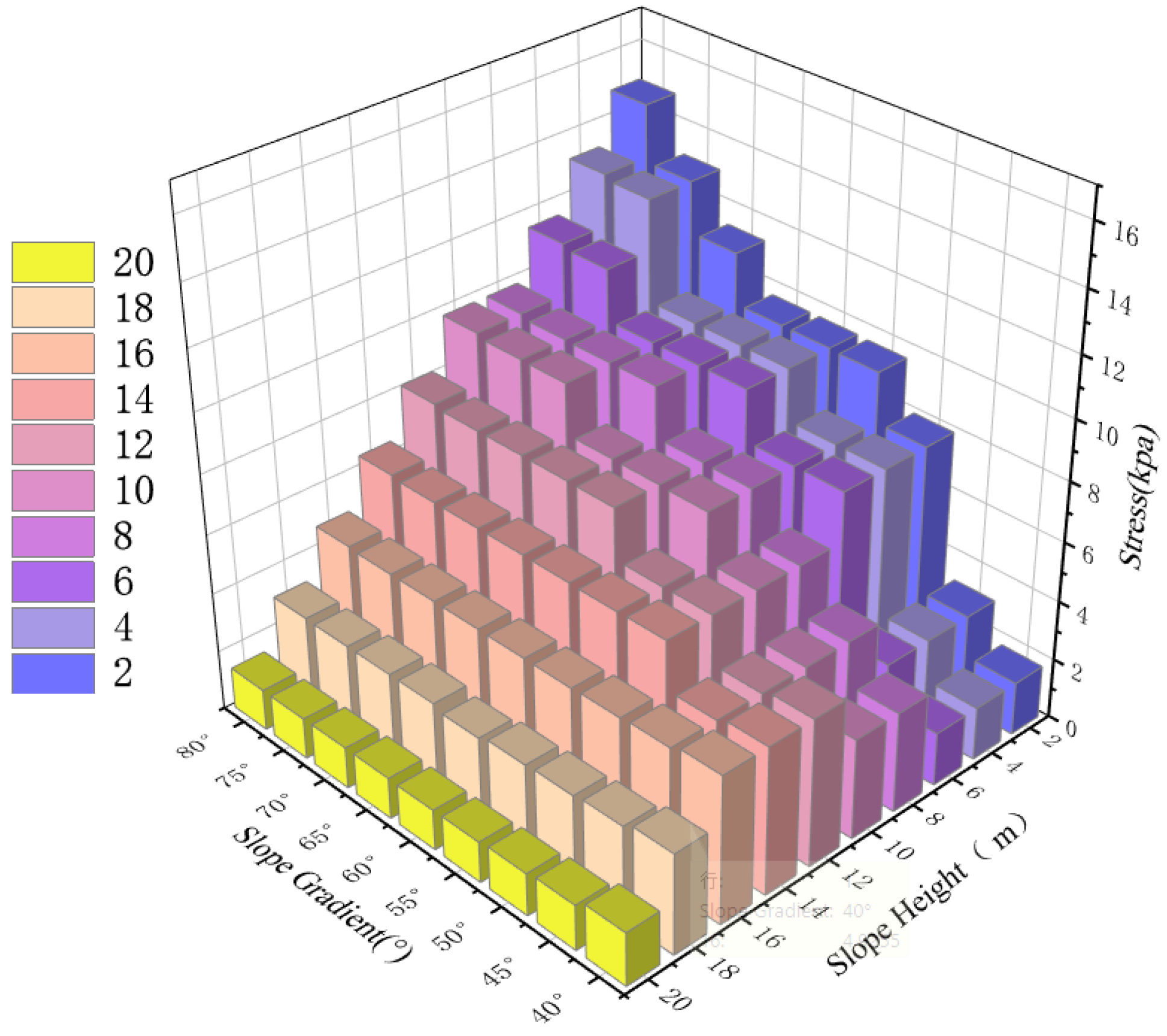
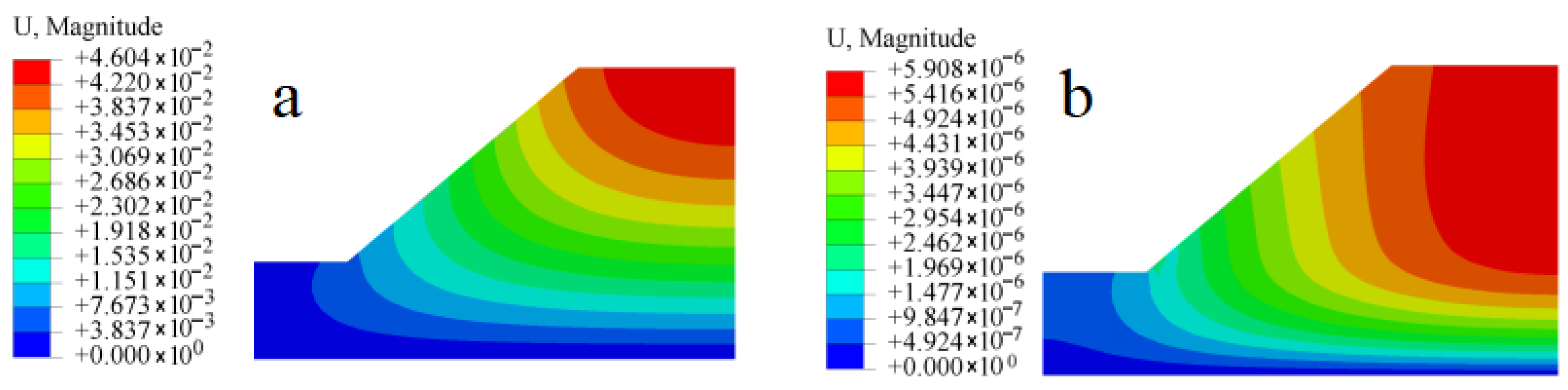
- A sensitive zone of the landslide mass was identified in the numerical simulations. Both stress and displacement results consistently showed the highest concentration at one-tenth of the slope height above the toe, rather than at the crest or base.
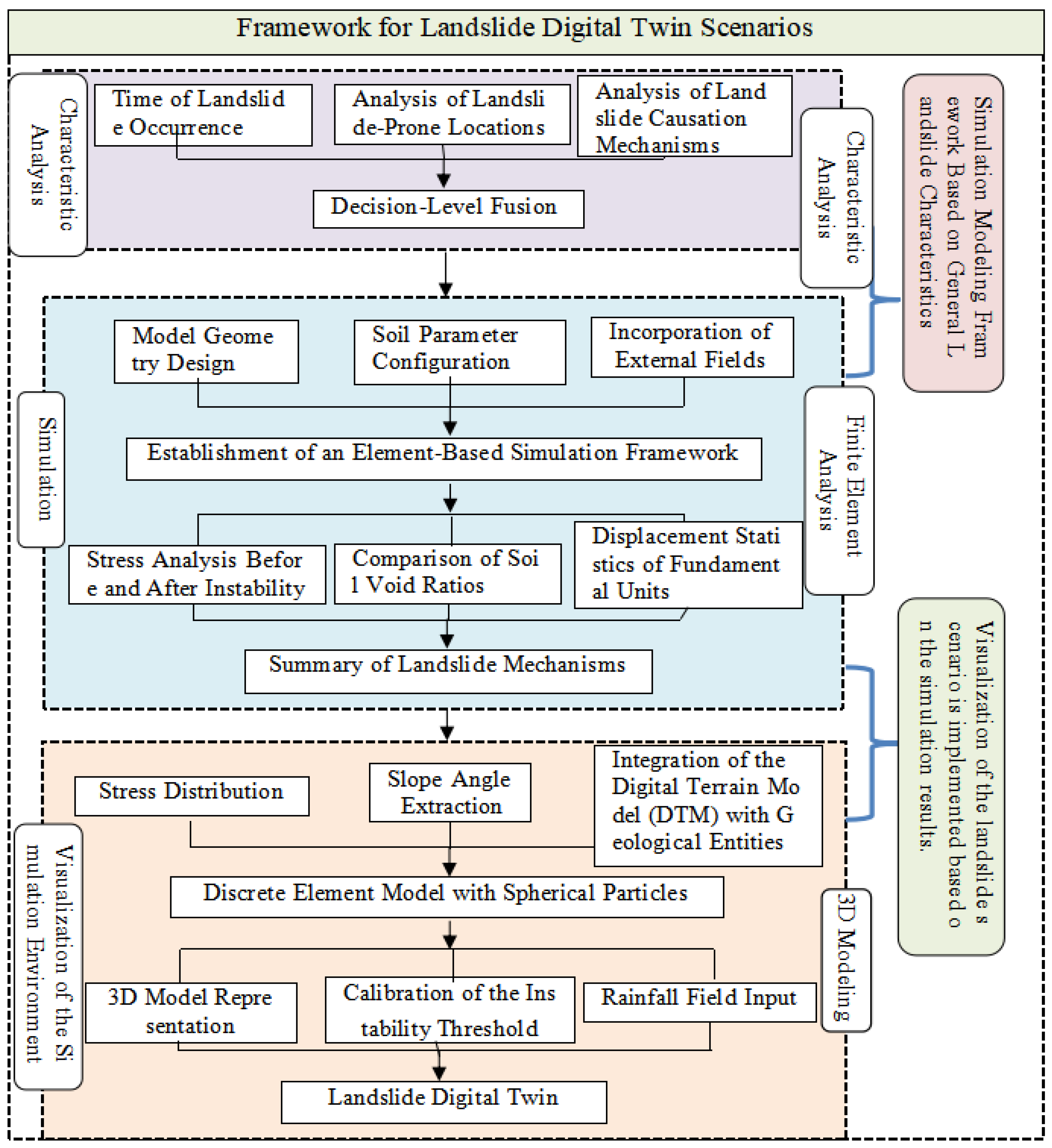
- Advanced Simulation Framework: The novel 3D digital twin approach improves computational efficiency and enables realistic landslide evolution mapping.
- This finding offers a new perspective for future research, as the identified stress and displacement concentration zone provides a tangible focus for further investigation.
- Advanced Predictive Modeling: The 3D digital twin framework provides a more stable method for simulating landslides. This approach introduces a physics-driven framework, effectively addressing the lack of realistic physical parameters in conventional hazard scenario modeling.
Abstract
1. Introduction
2. Materials and Methods
2.1. Characteristic Analysis
2.2. Simulation
2.2.1. Slope Model Configuration
2.2.2. Key Soil Parameter Configuration
2.3. Three-Dimensional Engine-Based Terrain Representation
2.3.1. Fundamentals of the Particle Model
2.3.2. Three-Dimensional Terrain Scene Representation
2.4. Numerical Implementation and Reproducibility Details
2.4.1. Step 1: Geometry Creation
2.4.2. Step 2: Material Property Definition
2.4.3. Step 3: Analysis Step Configuration
2.4.4. Step 4: Load Application
2.4.5. Step 5: Mesh Generation
3. Results
3.1. Stress Extraction and Analysis
3.2. Accuracy Discussion
3.2.1. Accuracy of the Numerical Simulation
3.2.2. Model Accuracy
4. Discussion
5. Conclusions
Supplementary Materials
Author Contributions
Funding
Data Availability Statement
Conflicts of Interest
References
- Li, S.; Zhang, W.; Chen, L.; Liang, Z.; Zhang, Y.; Wang, Z. Digital twin space and its applications: Concurrent discussion on the space reconstruction of geographical resear. Acta Geogr. Sin. 2022, 77, 507–517. [Google Scholar]
- Gong, J.H.; Lin, H.; Xu, B.L.; Li, W.H.; Zhang, G.Y. Primary exploration of geographic metaverse from the perspective of virtual geographic environment. Natl. Remote Sens. Bull. 2024, 28, 1145–1160. [Google Scholar]
- Grieves, M. Intelligent digital twins and the development and management of complex systems. Digit. Twin 2024, 2, 8. [Google Scholar] [CrossRef]
- Rosen, R.; Wichert, V.G.; Lo, G. About the lmportance of autonomy and digital twins for the future of manufacturing. IFAC Pap. 2015, 48, 567–572. [Google Scholar]
- Zhang, H.; Lu, X.; Li, S.; Chen, C.; Yang, J.; Zhang, X.; Meng, F. A Review of Metal Appearance Defect Detection Based on Machine Vision. Manuf. Upgrad. Today 2024, 29–33. [Google Scholar]
- Liu, Y. Review of Bridge Apparent Defect Inspection Based on Machine Vision. China J. Highw. Transp. 2024, 37, 1–15. [Google Scholar]
- Jiang, H. Design and implementation of intelligent manufacturing system based on sensor networks andcloud computing technology. Opt. Quantum Electron. 2023, 53, 278. [Google Scholar]
- Zhang, J. Research on visual recognition and positioning of industrial robots based on big data technology. Appl. Math. Nonlinear Sci. 2024, 9, 4. [Google Scholar] [CrossRef]
- Yuan, J.; Yu, H.; Sun, Z.; Li, Y. Research on the quality control strategy of marine engineering based on big data technology. Appl. Math. Nonlinear Sci. 2024, 9. [Google Scholar] [CrossRef]
- Wang, S.; Zhang, J.; Wang, P.; Law, J.; Calinescu, R.; Mihaylova, L. A deep learning-enhanced Digital Twin framework for improving safety and reliability in human–robot collaborative manufacturing. Robot. Comput.-Integr. Manuf. 2024, 85, 102608. [Google Scholar] [CrossRef]
- Wang, Y.; Wang, S.; Yang, W.; Shen, C.; Li, J. A digital-twin-based adaptive multi-objective Harris Hawks Optimizer for dynamic hybrid flow green scheduling problem with dynamic events. Appl. Soft Comput. J. 2023, 143, 110274. [Google Scholar] [CrossRef]
- Wu, B.; Wei, Q.; Li, X.; Kou, Y.; Lu, W.; Ge, H.; Guo, X. A four-dimensional digital twin framework for fatigue damage assessment of semi-submersible platforms and practical application. Ocean. Eng. 2024, 301, 117273. [Google Scholar] [CrossRef]
- Saback, V.; Popescu, C.; Blanksvärd, T.; Täljsten, B. Analysis of Digital Twins in the construction lndustry: Practical applications, purpose, and parallel with other lndustries. Buildings 2024, 14, 1361. [Google Scholar] [CrossRef]
- Ammar, A.; Maier, F.; Pratt, S.W.; Richard, E.; Dadi, G. Practical application of Digital Twins for transportation asset data management:case example of a safety hardware asset. Transp. Res. Rec. 2024, 2678, 114–130. [Google Scholar] [CrossRef]
- Ukwuoma, C.H.; Dusserre, G.; Coatrieux, G.; Vincent, J. Analysis of digital twin and its physical object: Exploring the efficiency and accuracy of datasets for real-world application. Data Sci. Manag. 2024, 7, 361–375. [Google Scholar] [CrossRef]
- Kunath, M.; Winkler, H. Integrating the Digital Twin of the manufacturing system into a decision support system for improving the order management process. Procedia CIRP 2018, 72, 225–231. [Google Scholar] [CrossRef]
- Hofmann, W.; Branding, F. Implementation of an IoT- and cloud-based Digital Twin for real-time decision support in port operations. IFAC Pap. 2019, 52, 2104–2109. [Google Scholar] [CrossRef]
- Yu, W.-P. Study of the Types of Geological Disasters in Yaoan Area, Chuxiong, Yunnan Province. Value Eng. 2015, 34, 178–180. [Google Scholar]
- Huang, C.; Xu, S.; Xu, Q. Analysis of the Causes and Control Effects of Geological Disasters in Dongchuan Area, Yunnan Province. China Water Transp. 2019, 19, 209–210. [Google Scholar]
- Zhuang, J.; Peng, J.; Zhang, L. Risk Assement and Prediction of the Shallow Landslide at Different Precipitation in Loess Plateau. J. Jil Univ. Earth Sci. Ed. 2013, 43, 867–876. [Google Scholar]
- Fang, L. Prediction of rainfall-Induced landslide-Mudslide hazard chain using coupled TRIGRS and RAMMS models. Int. J. Inf. Syst. Model. Des. IJISMD 2025, 15, 1–23. [Google Scholar] [CrossRef]
- Zhao, B.; Zhang, L.; Gu, X.; Luo, W.; Yu, Z.; Yuan, L. How is the occurrence of rainfall-triggered landslides related to extreme rainfall? Geomorphology 2025, 475, 109666. [Google Scholar] [CrossRef]
- Fengqi, S.; Wenliang, Q. Frost heaving pressure in fractured rock under different freezing paths: Multiphysics analysis. Theor. Appl. Fract. Mech. 2025, 140, 105184. [Google Scholar] [CrossRef]
- Xianxiang, Z.; Qi, Z.; Maoliang, L.; Wenquan, Z. Mining-induced damage evolution and infiltration failure in deep mudstone-sandstone interbedded strata. Results Eng. 2025, 28, 107095. [Google Scholar]
- Macatulad, E.; Biljecki, F. Continuing from the Sendai Framework midterm: Opportunities for urban digital twins in disaster risk management. Int. J. Disaster Risk Reduct. 2024, 102, 104310. [Google Scholar] [CrossRef]
- Ariyachandra, F.M.R.M.; Wedawatta, G. Digital Twin smart cities for disaster risk management: A review of evolving concepts. Sustainability 2023, 15, 11910. [Google Scholar] [CrossRef]
- Yun, S.-J.; Kwon, J.-W.; Kim, W.-T. A novel Digital Twin architecture with similarity-based hybrid modeling for supporting dependable disaster management systems. Sensors 2022, 22, 4774. [Google Scholar] [CrossRef]
- Liang, M. The Application of ABAQUS in Finite Element Simulation of Stamping Forming. Intell. Manuf. 2005, 8, 48–50. [Google Scholar]
- Liu, C. Genetic Types of Landslide and Debris Flow Disasters in China. Geol. Rev. 2014, 60, 858–868. [Google Scholar]
- System and Method for Modeling Supervisory Control of Heterogeneous Unmanned Vehicles Through Discrete Event Simulation. U.S. Patent 9,449,142, 20 September 2016.
- Cheng, W.; Bian, H.; Hattab, M.; Yang, Z. Numerical modelling of desiccation shrinkage and cracking of soils. Eur. J. Environ. Civ. Eng. 2023, 27, 3525–3545. [Google Scholar] [CrossRef]
- Chen, G.; Wu, X.; Hu, L.; Chi, Y.; Jia, T.; Luo, Y. Numerical Analysis of 3D Slope Stability in a Rainfall-Induced Landslide: Insights from Different Hydrological Conditions and Soil Layering. Water 2025, 17, 3316. [Google Scholar] [CrossRef]
- Shi, L.; Zeng, Z.; Bai, B.; Li, X. Effect of the intermediate principal stress on the evolution of mudstone permeability under true triaxial compression. Greenh. Gases Sci. Technol. 2018, 8, 37–50. [Google Scholar] [CrossRef]
- Huang, X.-H.; Yi, W.; Huang, H.-F.; Deng, Y.-H. Study and application of the relationship between preferential flowpenetration and slope deformation. Rock Soil Mech. 2020, 41, 1396–1403. [Google Scholar]
- Li, X.; Wang, X. Analysis of Influence Factor on Soil Shear Strength in Slope under Different Land Use Types. J. Soil Water Conserv. 2017, 31, 80–84. [Google Scholar]
- Li, X.; Wang, X. Analysis of Soil Shear Strength under Different Land Use Patterns and Its Principal Influence Factors. J. Soil Water Conserv. 2016, 30, 102–106. [Google Scholar]
- Li, M.; Jiang, Z.; Man, W.; Chen, J. Study on could rendering technology of intelligent mine digital twin system using unreal engine. Bullet Surv. Mapp. 2023, 26–30. [Google Scholar] [CrossRef]
- Lourenço, D.S.; Sassa, K.; Fukuoka, H. Failure process and hydrologic response of a two layer physical model: Implications for rainfall-induced landslides. Geomorphology 2005, 73, 115–130. [Google Scholar] [CrossRef]
- Ding, J.; Yang, Z.; Shang, Y.; Zhou, S.; Yin, J. A new method for spatio-temporal prediction of rainfall-induced landslide. Sci. China Ser. D 2006, 49, 421–430. [Google Scholar] [CrossRef]
- Qing, C. Regional Monitoring and Early Warning System for Tailings Storage Based on Unreal Engine 5. Master’s Thesis, Jiangxi University of Science and Technology, Ganzhou, China, 2024. [Google Scholar] [CrossRef]
- Marsden, C.; Shankar, F. Using unreal engine to visualize a cosmological volume. Universe 2020, 6, 168. [Google Scholar] [CrossRef]
- Conde, D.; Balado, J.; Soilán, M.; Martínez, J.; Arias, P. LiDAR data processing for digitization of the castro of santatrega and integration in unreal engine 5. Int. J. Archit. Herit. 2025, 19, 131–151. [Google Scholar] [CrossRef]
- Ding, Y.; Xu, Z.; Zhu, Q.; Li, H.; Luo, Y.; Bao, Y.; Tang, L.; Zeng, S. Integrated data-model-knowledge representation for natural resource entities. Int. J. Digit. Earth 2022, 15, 653–678. [Google Scholar] [CrossRef]
- Wang, J.; Wang, X.; Yao, Q.; Xu, G.; Luo, Y.; Li, H. Mechanism of bed scour erosion in narrow and steep debris-flow channels based on SPH–DEM–FEM coupling. Eng. Geol. 2025, 354, 108182. [Google Scholar] [CrossRef]
- Rosen, R.; Fischer, J.; Boschert, S. Next generation Digital Twin: An ecosystem for mechatronic systems? IFAC PapersOnLine 2019, 52, 265–270. [Google Scholar] [CrossRef]
- Segalman, D.; Reese, G.; Field, R., Jr.; Fulcher, C. Estimating the probability distribution of von mises stress for structures undergoing random excitation. J. Vib. Acoust. 2000, 122, 42–48. [Google Scholar] [CrossRef]
- Segalman, J.D.; Fulcher, W.C.; Reese, M.G.; Field, R.V., Jr. An efficient method for calculating R.M.S von mises stress in a random vibration environment. J. Sound Vib. 2000, 230, 393–410. [Google Scholar] [CrossRef]
- Zhou, D. The Application of Coordinate Transformation in Stress Analysis. Mech. Eng. 1990, 53–56. [Google Scholar] [CrossRef]
- An, Q.; Guo, Q.; Zhao, S. The Research and Measurements of the Stress in Surrounding Rock of Underground Tunnel. Rock Soil Mech. 1996, 48–53. [Google Scholar] [CrossRef]
- Lin, C. Deriving the formula of specific energy of transform form the concept of stress tensor. J. Inn. Mong. For. Coll. 1994, 16, 1–3. [Google Scholar]




| Parameter | Unit | Value |
|---|---|---|
| Slope Height | m | 20 |
| Dry Density | g/cm3 | 1.3 |
| Deformation Modulus | MPa | 30 |
| Poisson’s Ratio | 0.3 | |
| Saturated Permeability Coefficient | m/h | 0.018 |
| Initial Void Ratio | 1 | |
| Effective Cohesion | kPa | 15–40 |
| Effective Internal Friction Angle | 30 | |
| Rainfall Intensity Level | Extreme Rainstorm |
| Poisson’s Ratio | The Maximum Displacement | The Minimum Displacement |
|---|---|---|
| 0.3 | 0.005757 m | 0.0004798 m |
| 0.35 | 0.005597 m | 0.0004664 m |
Disclaimer/Publisher’s Note: The statements, opinions and data contained in all publications are solely those of the individual author(s) and contributor(s) and not of MDPI and/or the editor(s). MDPI and/or the editor(s) disclaim responsibility for any injury to people or property resulting from any ideas, methods, instructions or products referred to in the content. |
© 2026 by the authors. Licensee MDPI, Basel, Switzerland. This article is an open access article distributed under the terms and conditions of the Creative Commons Attribution (CC BY) license.
Share and Cite
Li, L.; Tang, B.; Cai, F.; Wei, L.; Zhu, X.; Fan, D. Digital Twin Modeling for Landslide Risk Scenarios in Mountainous Regions. Sensors 2026, 26, 421. https://doi.org/10.3390/s26020421
Li L, Tang B, Cai F, Wei L, Zhu X, Fan D. Digital Twin Modeling for Landslide Risk Scenarios in Mountainous Regions. Sensors. 2026; 26(2):421. https://doi.org/10.3390/s26020421
Chicago/Turabian StyleLi, Lai, Bohui Tang, Fangliang Cai, Lei Wei, Xinming Zhu, and Dong Fan. 2026. "Digital Twin Modeling for Landslide Risk Scenarios in Mountainous Regions" Sensors 26, no. 2: 421. https://doi.org/10.3390/s26020421
APA StyleLi, L., Tang, B., Cai, F., Wei, L., Zhu, X., & Fan, D. (2026). Digital Twin Modeling for Landslide Risk Scenarios in Mountainous Regions. Sensors, 26(2), 421. https://doi.org/10.3390/s26020421