Label-Efficient and Lightweight Spectrum Prediction for UAV-Based Spectrum Sensing: A Critical Review


Abstract
1. Introduction
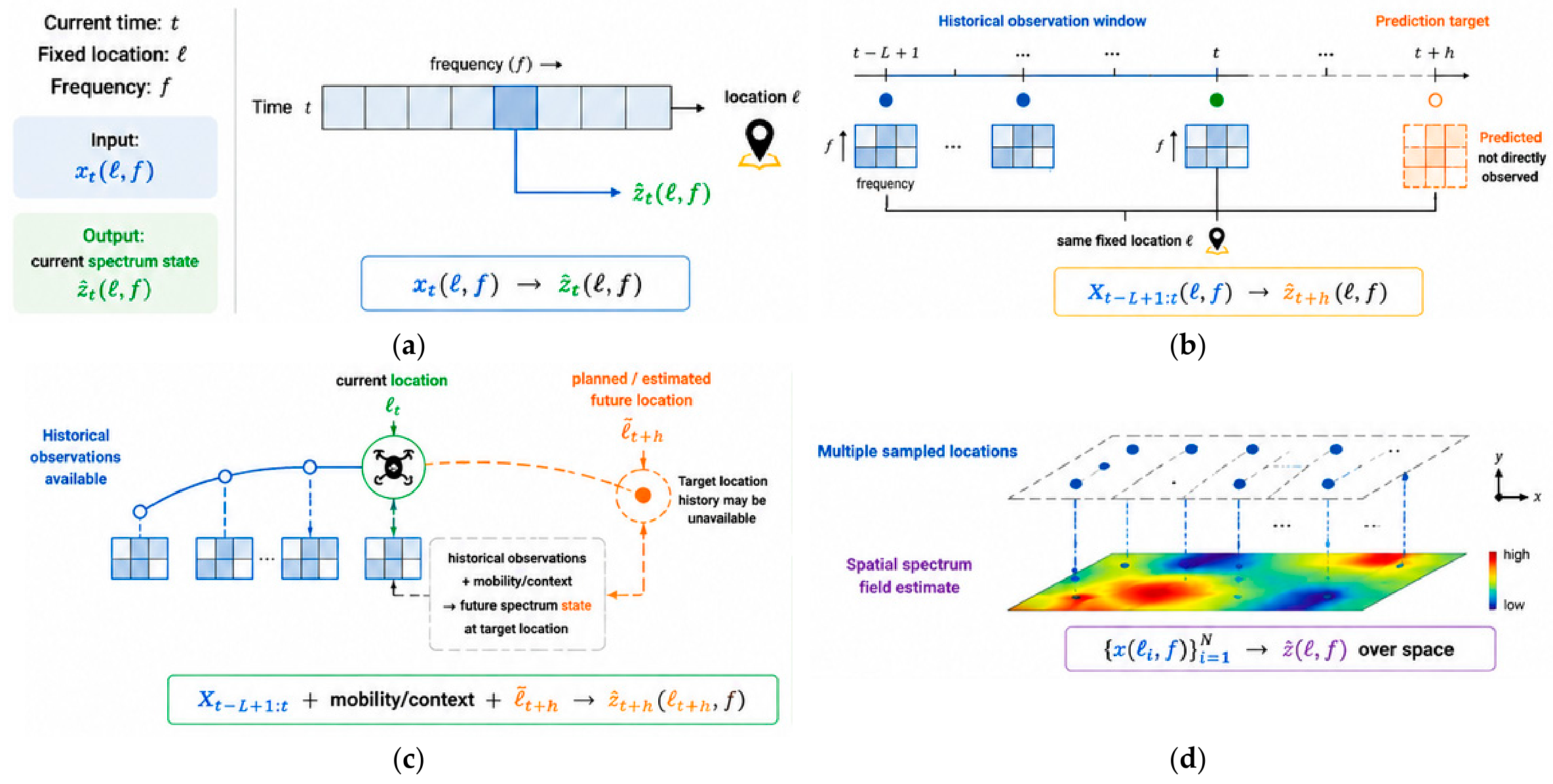
- We clarify the task and terminology boundaries of UAV-oriented spectrum prediction by adopting explicit working distinctions among current-state spectrum sensing, future spectrum prediction, static spectrum mapping, next-location prediction, and UAV-associated frequency-hopping prediction. Strict few-shot learning is also distinguished from the broader category of label-efficient learning.
- We provide a structured reconstruction of the field’s development by tracing changes in prediction targets, spatial and temporal scope, operating conditions, and data-efficiency requirements. The review covers the progression from next-location and time–frequency prediction to spectrum-state duration estimation, arbitrary-flight-path prediction, three-dimensional and low-altitude prediction, sparse-data adaptation, and frequency-hopping prediction.
- We develop a common framework for assessing evidence relevance and deployment realism. Direct UAV-specific prediction evidence is distinguished from transferable evidence from general radio-spectrum studies and from evidence concerning UAV operating contexts. The framework separately records the UAV’s role, data provenance, validation setting, hardware platform, and degree of deployment realism.
- We identify a central gap in the existing evidence base. Although prior studies have addressed UAV-related prediction, target-domain data scarcity, computational efficiency, embedded execution, and spectrum-drift adaptation, the existing literature provides limited integrated evidence on their joint satisfaction using UAV-acquired data, UAV-mounted hardware, and representative flight conditions.
2. Review Scope and Methodology
2.1. Review Scope
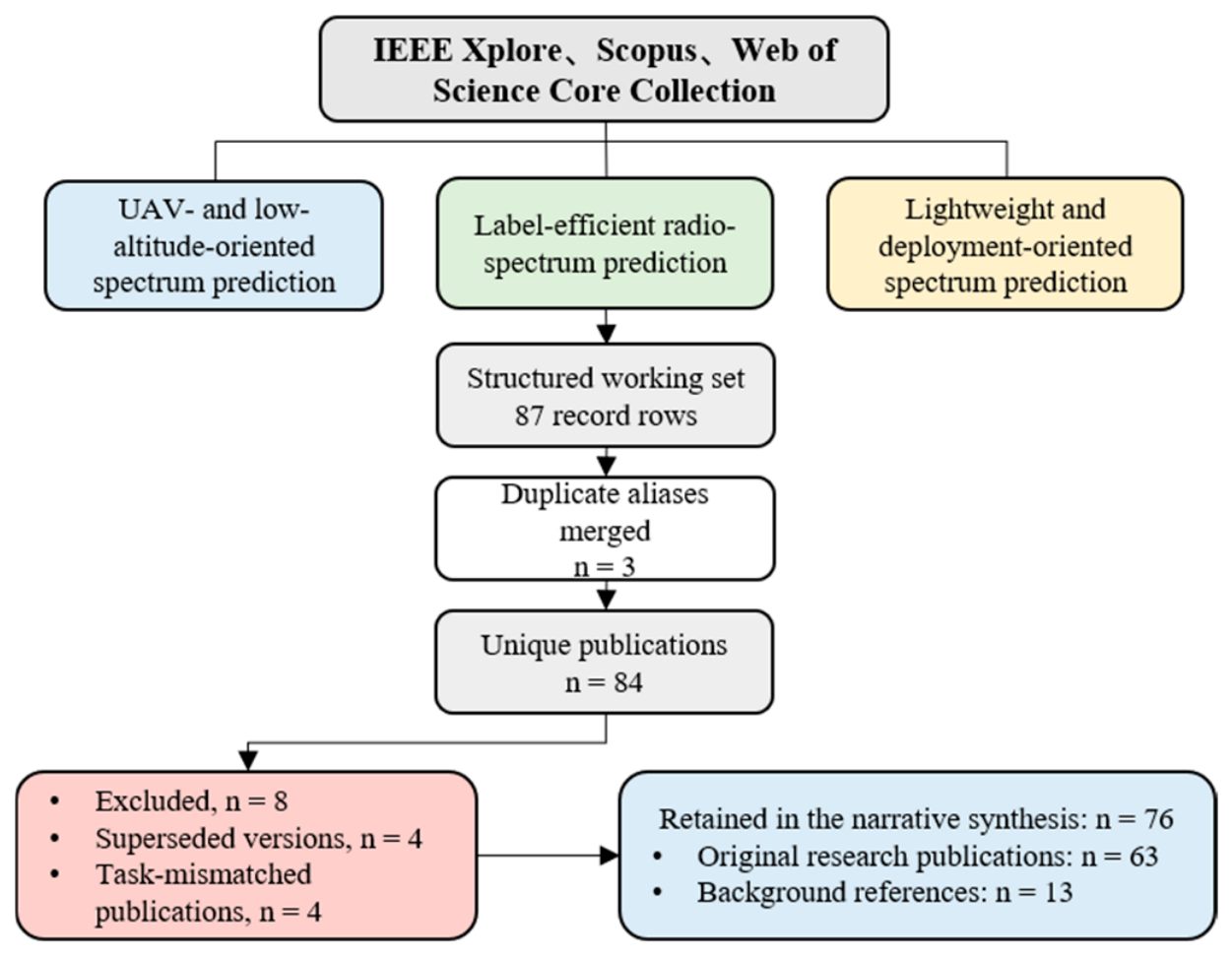
2.2. Evidence Classification and Extraction
- Core/E1: direct UAV- or low-altitude-oriented spectrum-prediction studies, including UAV-associated RF prediction;
- Adjacent-A/E2: transferable radio-spectrum prediction, adaptation, efficiency, or deployment methods evaluated without direct UAV onboard validation;
- Adjacent-B/E3: UAV spectrum sensing, measurement, mapping, sampling, channel knowledge, or deployment-constraint studies relevant to spectrum prediction;
- Background/E4: reviews, tutorials, and methodological studies used for terminology and conceptual classification.
3. UAV Spectrum Prediction: Tasks, Development, and Constraints
3.1. Prediction Tasks in UAV-Based Spectrum Sensing
- Spectrum-state duration prediction: prediction of how long an idle or occupied state will persist [10];
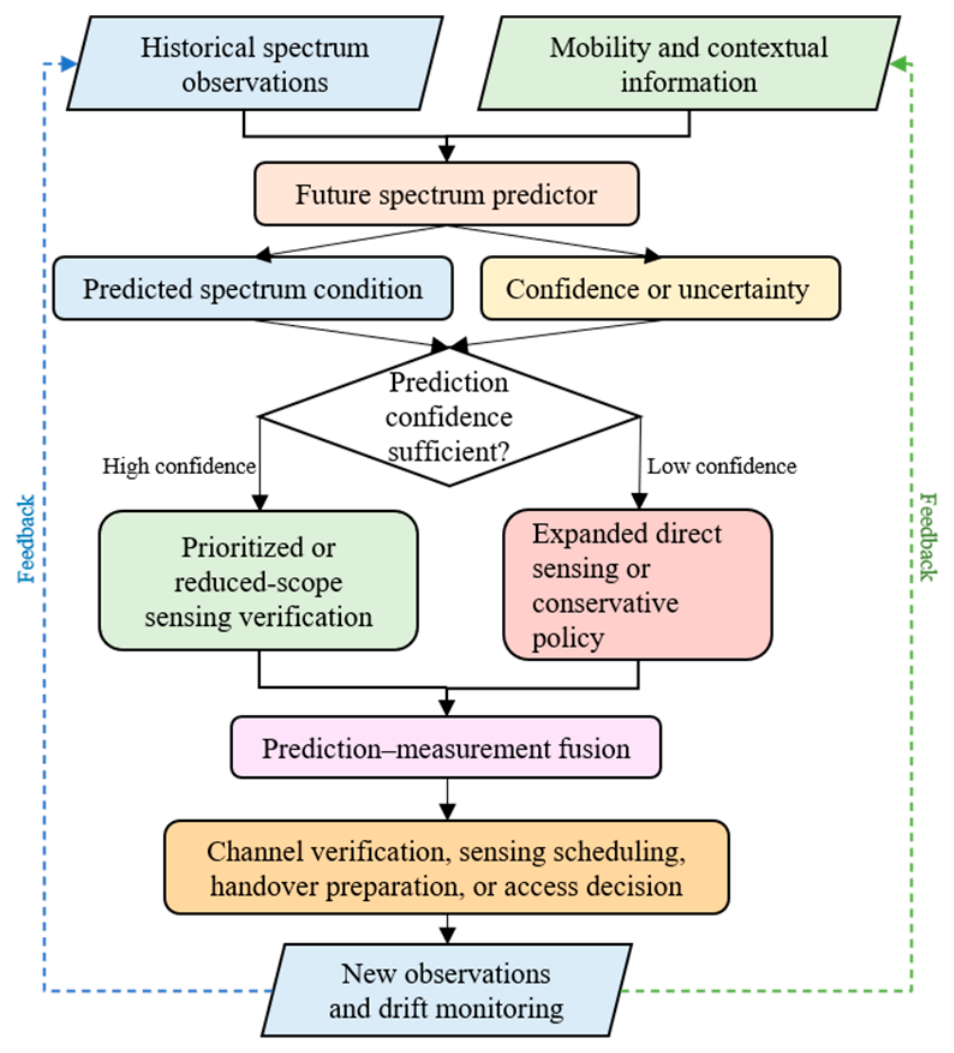
3.2. Prediction-Assisted Sensing Workflow
3.3. Constraints in Low-Altitude UAV Scenarios
- Data efficiency: Labeled or target-domain data required for training or adaptation;
- Model efficiency: Parameters, model size, computational complexity, memory, and inference latency;
- System efficiency: Sensing overhead, communication cost, update cost, power consumption, energy use, and mission-level effects.
3.4. Development of UAV-Oriented Spectrum Prediction
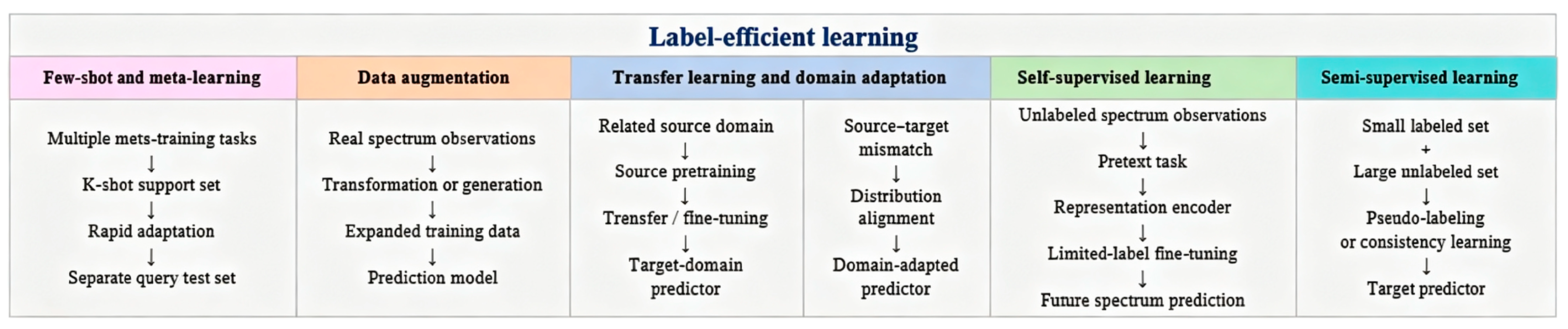
4. Label-Efficient Learning Methods
4.1. Data Augmentation
4.2. Transfer Learning and Domain Adaptation
4.3. Few-Shot and Meta-Learning
4.4. Self-Supervised and Semi-Supervised Learning
4.5. Relevance to UAV Spectrum Prediction
5. Trade-Offs Between Few-Shot Generalization and Lightweight Deployment
5.1. Lightweight Network Architectures
5.2. Pruning and Quantization
5.3. Knowledge Distillation
5.4. Deployment-Oriented Evaluation
6. Synthesis, Research Gaps, and Future Directions
6.1. Cross-Study Synthesis and Evidence Gaps
6.2. Generalization and Deployment Efficiency
6.3. Future Directions
7. Conclusions
Author Contributions
Funding
Institutional Review Board Statement
Informed Consent Statement
Data Availability Statement
Acknowledgments
Conflicts of Interest
Abbreviations
| UAV | Unmanned aerial vehicle |
| RF | Radio frequency |
| PSD | Power spectral density |
| RSS | Received signal strength |
| HMM | Hidden Markov model |
| CHMM | Continuous hidden Markov model |
| 2DHMM | Two-dimensional hidden Markov model |
| HT-HMM | Homotopy estimation based hidden Markov model |
| MOHT-HMM | Multi-order homotopy estimation based hidden Markov model |
| NLH-HMM | Non-linear homotopy estimation based hidden Markov model |
| LSTM | Long short-term memory |
| CNN | Convolutional neural network |
| CNN-LSTM | Convolutional neural network-long short-term memory |
| GRU | Gated recurrent unit |
| TCN | Temporal convolutional network |
| DNN | Deep neural network |
| GNN | Graph neural network |
| MAML | Model-agnostic meta-learning |
| NAS | Neural architecture search |
| SDR | Software-defined radio |
| RTL-SDR | RTL software-defined radio |
| FPGA | Field-programmable gate array |
| CPU | Central processing unit |
| GPU | Graphics processing unit |
| MACs | Multiply-accumulate operations |
| FLOPs | Floating-point operations |
| MSE | Mean squared error |
| MAE | Mean absolute error |
| RMSE | Root mean squared error |
| MAPE | Mean absolute percentage error |
| FID | Frechet inception distance |
| SNR | Signal-to-noise ratio |
| FHSS | Frequency-hopping spread spectrum |
| YOLO | You only look once |
| PRISMA | Preferred Reporting Items for Systematic Reviews and Meta-Analyses |
| PRISMA-ScR | Preferred Reporting Items for Systematic Reviews and Meta-Analyses extension for Scoping Reviews |
| PRISMA-S | Preferred Reporting Items for Systematic Reviews and Meta-Analyses literature search extension |
| INT8 | 8-bit integer |
| NR | Not reported |
References
- Xing, X.; Jing, T.; Cheng, W.; Huo, Y.; Cheng, X. Spectrum prediction in cognitive radio networks. IEEE Wirel. Commun. 2013, 20, 90–96. [Google Scholar] [CrossRef] [Scilit]
- Ding, G.; Jiao, Y.; Wang, J.; Zou, Y.; Wu, Q.; Yao, Y.-D.; Hanzo, L. Spectrum inference in cognitive radio networks: Algorithms and applications. IEEE Commun. Surv. Tutor. 2018, 20, 150–182. [Google Scholar] [CrossRef] [Scilit]
- Eltom, H.; Kandeepan, S.; Evans, R.J.; Liang, Y.-C.; Ristic, B. Statistical spectrum occupancy prediction for dynamic spectrum access: A classification. EURASIP J. Wirel. Commun. Netw. 2018, 2018, 29. [Google Scholar] [CrossRef] [Scilit]
- Cullen, A.C.; Rubinstein, B.I.P.; Kandeepan, S.; Flower, B.; Leong, P.H.W. Predicting dynamic spectrum allocation: A review covering simulation, modelling, and prediction. Artif. Intell. Rev. 2023, 56, 10921–10959. [Google Scholar] [CrossRef] [Scilit]
- Santana, G.M.D.; de Cristo, R.S.; Branco, K.R.L.J.C. Integrating cognitive radio with unmanned aerial vehicles: An overview. Sensors 2021, 21, 830. [Google Scholar] [CrossRef] [Scilit] [PubMed]
- Zhao, Y.; Luo, S.; Yuan, Z.; Lin, R. A new spectrum prediction method for UAV communications. In Proceedings of the 2019 IEEE 5th International Conference on Computer and Communications (ICCC), Chengdu, China, 6–9 December 2019; pp. 826–830. [Google Scholar] [CrossRef] [Scilit]
- Luo, S.; Zhao, Y.; Xiao, Y.; Lin, R.; Yan, Y. A temporal-spatial spectrum prediction using the concept of homotopy theory for UAV communications. IEEE Trans. Veh. Technol. 2021, 70, 3314–3324. [Google Scholar] [CrossRef] [Scilit]
- Zhang, Q.; Luo, S.; Liu, H.; Lin, R. A spectrum prediction method based on two-dimensional hidden Markov model for UAV communications. In Proceedings of the 2022 19th International Computer Conference on Wavelet Active Media Technology and Information Processing (ICCWAMTIP), Chengdu, China, 16–18 December 2022; pp. 1–5. [Google Scholar] [CrossRef] [Scilit]
- Chen, Y.; Zhang, Q.; Luo, S.; Lin, R. Homotopy-informed LSTM for efficient spectrum prediction in UAV communications. In Proceedings of the 2023 20th International Computer Conference on Wavelet Active Media Technology and Information Processing (ICCWAMTIP), Chengdu, China, 15–17 December 2023; pp. 1–5. [Google Scholar] [CrossRef] [Scilit]
- Luo, S.; Zhou, T.; Xiao, Y.; Lin, R.; Yan, Y. Predicting spectrum status duration using non-linear homotopy estimation based HMM for UAV communications. Signal Process. 2023, 212, 109131. [Google Scholar] [CrossRef] [Scilit]
- Luo, S.; Zhou, W.; Wu, L.; Zhang, Q.; Lin, R.; Yan, Y.; Li, H.; Xie, S. A homotopy estimation based temporal-spatial spectrum prediction for UAV communications with arbitrary flight paths. Sci. Rep. 2025, 15, 25094. [Google Scholar] [CrossRef] [Scilit] [PubMed]
- Dai, X.; Huang, M. Research on a radio-frequency spectrum prediction algorithm for unmanned aerial vehicle communication. Nonlinear Opt. Quantum Opt. Concepts Mod. Opt. 2024, 59, 97–108. [Google Scholar]
- Cheng, S.; Li, X.; Lin, X.; Ding, H.; Sun, Y. 3D spatial spectrum prediction for UAV networks based on a multi-scale temporal model. In Proceedings of the 2025 IEEE Wireless Communications and Networking Conference (WCNC), Milan, Italy, 24–27 March 2025; pp. 1–6. [Google Scholar] [CrossRef] [Scilit]
- Zhang, R.; Qu, Y.; Zhu, X.; Dai, H.; Dong, C. Multi-UAV distributed incremental learning for frequency-hopping prediction. In Communications and Computer Information Sciences; Springer: Berlin/Heidelberg, Germany, 2025; Volume 2341, pp. 16–26. [Google Scholar] [CrossRef] [Scilit]
- Deng, M.; Zhou, Y.; Lao, X.; Yao, Z. Nonlinear hop frequency prediction based on HT-HMM in navigation confrontation scenarios. In Proceedings of the 2025 IEEE 102nd Vehicular Technology Conference (VTC2025-Fall), Chengdu, China, 19–22 October 2025. [Google Scholar] [CrossRef] [Scilit]
- Zhao, B.; Zhang, W.; Wei, X.; Wang, S.; Chen, Z. A Meta-BAGRU-based spectrum prediction scheme for low-altitude intelligent networks. In Proceedings of the 2026 6th International Conference on Neural Networks, Information and Communication Engineering (NNICE), Hefei, China, 23–25 January 2026; pp. 881–885. [Google Scholar] [CrossRef] [Scilit]
- Li, Y.; Xiong, Z.; Xu, W.; Chen, A. Short-term prediction of frequency hopping spread spectrum signals via temporal-attention-enhanced CNN with hopping-sequence prior. In Proceedings of the 2026 7th International Conference on Computing, Networks and Internet of Things (CNIOT), Guangzhou, China, 22–24 May 2026; pp. 1–6. [Google Scholar] [CrossRef] [Scilit]
- Tuong, V.D.; Nguyen-Trong, K.; Dao, N.-N.; Cho, S. Predictive modeling of frequency hopping signals via deep reinforcement learning. In Proceedings of the 2026 40th International Conference on Information Networking (ICOIN), Hanoi, Vietnam, 14–16 January 2026; pp. 297–302. [Google Scholar] [CrossRef] [Scilit]
- Basak, S.; Rajendran, S.; Pollin, S.; Scheers, B. Spectrum prediction for protocol-aware RF jamming. IEEE Trans. Cogn. Commun. Netw. 2024, 10, 363–373. [Google Scholar] [CrossRef] [Scilit]
- Zhang, X.; Zheng, X.; Ma, Y.; Zhang, T.; Zhang, W.; Zhang, Q. Multi-scale spatio-temporal representation-based 3-D long-term spectrum prediction. IEEE Trans. Cogn. Commun. Netw. 2026, 12, 1821–1833. [Google Scholar] [CrossRef] [Scilit]
- Xu, X.; Hao, J.; Jiang, S.; Qi, N.; Dang, X. Multi-UAV channel and power optimization: A transformer-based cooperative learning approach. In Proceedings of the 2026 International Wireless Communications and Mobile Computing Conference (IWCMC), Wuzhou/Shanghai, China, 1–6 June 2026; pp. 1185–1191. [Google Scholar] [CrossRef] [Scilit]
- Chen, C.; Zheng, J.; Li, F.; Wu, F.; Xu, Y.; Ding, Z.; Yang, D.; Xiao, L. Fast aerial channel knowledge map construction via an energy-constrained UAV. IEEE Trans. Veh. Technol. 2026; in press. [CrossRef] [Scilit]
- Shrestha, R.; Romero, D.; Chepuri, S.P. Spectrum surveying: Active radio map estimation with autonomous UAVs. IEEE Trans. Wirel. Commun. 2023, 22, 627–641. [Google Scholar] [CrossRef] [Scilit]
- Wei, Z.; Yao, R.; Kang, J.; Chen, X.; Wu, H. Three-dimensional spectrum occupancy measurement using UAV: Performance analysis and algorithm design. IEEE Sens. J. 2022, 22, 9146–9157. [Google Scholar] [CrossRef] [Scilit]
- Ivanov, A.; Muhammad, B.; Tonchev, K.; Mihovska, A.; Poulkov, V. UAV-based volumetric measurements toward radio environment map construction and analysis. Sensors 2022, 22, 9705. [Google Scholar] [CrossRef] [Scilit] [PubMed]
- Yin, K.; Fang, S.; Chu, F.; Fan, Y. Compressed tensor completion: Approach for UAV-aided 3-D radio map construction. IEEE Internet Things J. 2024, 11, 40516–40531. [Google Scholar] [CrossRef] [Scilit]
- Wu, Q.; Shen, F.; Wang, Z.; Ding, G. 3D spectrum mapping based on ROI-driven UAV deployment. IEEE Netw. 2020, 34, 24–31. [Google Scholar] [CrossRef] [Scilit]
- Feng, Y.; Xu, W.; Zhang, Z.; Wang, F. Continuous hidden Markov model based spectrum sensing with estimated SNR for cognitive UAV networks. Sensors 2022, 22, 2620. [Google Scholar] [CrossRef] [Scilit] [PubMed]
- Luo, S.; Xiao, Y.; Lin, R.; Xie, X.; Bi, G.; Zhao, Y.; Huang, J. Opportunistic spectrum access for UAV communications towards ultra dense networks. IEEE Access 2019, 7, 175021–175032. [Google Scholar] [CrossRef] [Scilit]
- Maeng, S.J.; Raouf, A.H.F.; Ozdemir, O.; Zajkowski, T.; Mushi, M.; Sichitiu, M.L.; Dutta, R.; Güvenç, İ. Altitude-dependent sub-6 GHz spectrum activity: Survey, measurement trends, and modeling insights. Comput. Netw. 2026, 287, 112509. [Google Scholar] [CrossRef] [Scilit]
- Lin, F.; Chen, J.; Sun, J.; Ding, G.; Yu, L. Cross-band spectrum prediction based on deep transfer learning. China Commun. 2020, 17, 66–80. [Google Scholar] [CrossRef] [Scilit]
- Lin, F.; Chen, J.; Ding, G.; Jiao, Y.; Sun, J.; Wang, H. Spectrum prediction based on GAN and deep transfer learning: A cross-band data augmentation framework. China Commun. 2021, 18, 18–32. [Google Scholar] [CrossRef] [Scilit]
- Peng, C.; Zhang, M.; Hu, W.; Wang, L. Cross-band spectrum prediction algorithm based on transfer learning and meta learning. In Proceedings of the 2021 7th International Conference on Computer and Communications (ICCC), Chengdu, China, 10–13 December 2021; pp. 2303–2307. [Google Scholar] [CrossRef] [Scilit]
- Li, K.; Li, C.; Chen, J.; Zhang, Q.; Liu, Z.; He, S. Boost spectrum prediction with temporal-frequency fusion network via transfer learning. IEEE Trans. Mob. Comput. 2023, 22, 3209–3223. [Google Scholar] [CrossRef] [Scilit]
- Peng, C.; Zhu, R.; Zhang, M.; Wang, L. Cross-band spectrum prediction algorithm based on data conversion using generative adversarial networks. China Commun. 2023, 20, 136–152. [Google Scholar] [CrossRef] [Scilit]
- Pan, G.; Wu, Q.; Ding, G.; Wang, W.; Li, J.; Xu, F.; Zhou, B. Deep stacked autoencoder-based long-term spectrum prediction using real-world data. IEEE Trans. Cogn. Commun. Netw. 2023, 9, 534–548. [Google Scholar] [CrossRef] [Scilit]
- Chen, X.; Wang, J.; Huang, Q. Joint spectrum cartography and prediction via tensor-structural self-supervised regularization. In Proceedings of the 2024 IEEE Global Communications Conference (GLOBECOM), Cape Town, South Africa, 8–12 December 2024; pp. 2773–2778. [Google Scholar] [CrossRef] [Scilit]
- Pan, G.; Wu, Q.; Zhou, B.; Li, J.; Wang, W.; Ding, G.; Yau, D.K.Y. Spectrum prediction with deep 3D pyramid vision transformer learning. IEEE Trans. Wirel. Commun. 2025, 24, 509–525. [Google Scholar] [CrossRef] [Scilit]
- Shang, Z.; Qiao, X.; Ji, H.; Zhou, F.; Wu, H.; Zhang, T. The cross-domain enhanced spectrum prediction framework using knowledge distillation. IEEE Commun. Lett. 2025, 29, 2501–2505. [Google Scholar] [CrossRef] [Scilit]
- Li, S.; Sun, Y.; Han, Y.; Zhang, Z.; Yao, M.; Chen, J.; Tian, Q.; Lin, Y. CL-MFGCN: Graph structure contrastive learning and multiscale feature fusion graph convolutional network for spectrum prediction. IEEE Internet Things J. 2025, 12, 3600–3612. [Google Scholar] [CrossRef] [Scilit]
- Chen, P.; Li, S.; Cheng, L.; Fu, X.; Wu, Y.-C.; Theodoridis, S. FieldFormer: Self-supervised reconstruction of physical fields via tensor attention prior. IEEE Trans. Signal Process. 2025, 73, 2704–2718. [Google Scholar] [CrossRef] [Scilit]
- Timilsina, S.; Shrestha, S.; Fu, X. Domain-factored untrained deep prior for spectrum cartography. IEEE Signal Process. Lett. 2025, 32, 3440–3444. [Google Scholar] [CrossRef] [Scilit]
- Zhang, W.; Wang, Y.; Liu, L.; Tian, Z. FedRME: Federated learning for enhanced distributed radiomap estimation. In Proceedings of the 2024 IEEE Vehicular Technology Conference (VTC2024-Fall), Washington, DC, USA, 7–10 October 2024. [Google Scholar] [CrossRef] [Scilit]
- Jin, Z.; Zhang, C.; Yao, K.; Cao, D.; Kim, S.; Jin, Y. Primary user-awareness-based energy-efficient duty-cycle scheme in cognitive radio networks. Comput. Mater. Contin. 2022, 70, 5991–6005. [Google Scholar] [CrossRef] [Scilit]
- Aygül, M.A.; Nazzal, M.; Arslan, H. Deep RL-based spectrum occupancy prediction exploiting time and frequency correlations. In Proceedings of the 2022 IEEE Wireless Communications and Networking Conference (WCNC), Austin, TX, USA, 10–13 April 2022; pp. 2399–2404. [Google Scholar] [CrossRef] [Scilit]
- Zhang, T.; Ji, H.; Zhang, J.; Shang, Z.; Wu, H.; Qiao, X. T-2S: An incremental spectrum prediction framework based on bidirectional distillation. IEEE Trans. Veh. Technol. 2026, 75, 11997–12001. [Google Scholar] [CrossRef] [Scilit]
- Li, S.; Sun, Y.; Zhang, F.; Zhang, Z.; Han, Y.; Xiang, W.; Gui, G.; Lin, Y. PINN-CTDG: A physics-informed graph neural network for continuous-time domain generalization in spectrum prediction. IEEE Trans. Cogn. Commun. Netw. 2026, 12, 9702–9717. [Google Scholar] [CrossRef] [Scilit]
- Cheng, S.; Li, X.; Lin, X.; Ding, H.; Sun, Y. TSS-LCD: A temporal-spectral-spatial-guided latent conditional diffusion model for spectrum prediction under incomplete observations. IEEE Trans. Cogn. Commun. Netw. 2026, 12, 7259–7273. [Google Scholar] [CrossRef] [Scilit]
- Rojas, A.; Follet, G.; Jovanovic Dolecek, G.; De La Rosa, J.M.; Liñan-Cembrano, G. Prediction-based spectrum sensing framework for cognitive radio. IEEE Open J. Circuits Syst. 2025, 6, 313–328. [Google Scholar] [CrossRef] [Scilit]
- Siddhartha; Lee, Y.H.; Moss, D.J.M.; Faraone, J.; Blackmore, P.; Salmond, D.; Boland, D.; Leong, P.H.W. Long short-term memory for radio frequency spectral prediction and its real-time FPGA implementation. In Proceedings of the 2018 IEEE Military Communications Conference, Los Angeles, CA, USA, 29–31 October 2018. [Google Scholar] [CrossRef] [Scilit]
- Kim, S.-J.; Giannakis, G.B. Cognitive radio spectrum prediction using dictionary learning. In Proceedings of the 2013 IEEE Global Communications Conference (GLOBECOM), Atlanta, GA, USA, 9–13 December 2013; pp. 3206–3211. [Google Scholar] [CrossRef] [Scilit]
- Radhakrishnan, N.; Kandeepan, S.; Yu, X.; Baldini, G. Performance analysis of long short-term memory-based Markovian spectrum prediction. IEEE Access 2021, 9, 149582–149595. [Google Scholar] [CrossRef] [Scilit]
- Radhakrishnan, N.; Kandeepan, S. An improved initialization method for fast learning in long short-term memory-based Markovian spectrum prediction. IEEE Trans. Cogn. Commun. Netw. 2021, 7, 729–738. [Google Scholar] [CrossRef] [Scilit]
- Mosavat-Jahromi, H.; Li, Y.; Cai, L.; Pan, J. Prediction and modeling of spectrum occupancy for dynamic spectrum access systems. IEEE Trans. Cogn. Commun. Netw. 2021, 7, 715–728. [Google Scholar] [CrossRef] [Scilit]
- Cheng, R.; Zhang, J.; Deng, J.; Zhu, Y. Lightweight spectrum prediction based on knowledge distillation. Radioengineering 2023, 32, 469–478. [Google Scholar] [CrossRef] [Scilit]
- Ji, N.; Zhang, Y.; Guo, Y.; Wang, Y.; Guo, L.; Lin, Y.; Mehbodniya, A.; Gui, G.; Sari, H. Adaptive broad learning network for lightweight multi-dimensional spectrum prediction. IEEE Trans. Veh. Technol. 2025, 74, 4498–4509. [Google Scholar] [CrossRef] [Scilit]
- Ji, N.; Liu, T.; Zhang, Y.; Wang, Q.; Ohtsuki, T.; Gui, G.; Yuen, C.; Adachi, F. Generative augmented cascade broad learning for lightweight multi-band spectrum prediction. IEEE Trans. Cogn. Commun. Netw. 2026, 12, 382–394. [Google Scholar] [CrossRef] [Scilit]
- Li, R.; Liu, C.; Wang, S.; Lin, Y.; Gui, G. Lightweight continuous-time graph learning for spectrum prediction in 6G networks. IEEE Internet Things J. 2026, 13, 14695–14704. [Google Scholar] [CrossRef] [Scilit]
- Cheng, X.; Li, R.; Wang, S.; Tang, T.; Ohtsuki, T.; Sari, H.; Gui, G. LightSP: A two-timescale deep-broad learning framework for cloud-edge spectrum prediction. IEEE Internet Things J. 2026; in press. [CrossRef] [Scilit]
- Mahboob, S.; Mohammadi, N.; Liu, L. GraphSpecRC: A graph-based recurrent learning approach for real-time spectrum prediction. IEEE Trans. Wirel. Commun. 2026; in press. [CrossRef] [Scilit]
- Zou, R.; Wang, W. FLuMe: Understanding differential spectrum mobility features in high resolution. IEEE Trans. Mob. Comput. 2024, 23, 14186–14200. [Google Scholar] [CrossRef] [Scilit]
- Zou, R.; Wang, W. Effi-Ace: Efficient and accurate prediction for high-resolution spectrum tenancy. In Proceedings of the IEEE INFOCOM 2024, Vancouver, BC, Canada, 20–23 May 2024; pp. 2199–2208. [Google Scholar] [CrossRef] [Scilit]
- Wang, S.; Liu, Z.; Xie, R.; Ran, L. Online sequential extreme learning machine-based active interference activity prediction for cognitive radar. Remote Sens. 2022, 14, 2737. [Google Scholar] [CrossRef] [Scilit]
- Li, X.; Wang, X.; Song, T.; Hu, J. Robust online prediction of spectrum map with incomplete and corrupted observations. IEEE Trans. Mob. Comput. 2022, 21, 4583–4594. [Google Scholar] [CrossRef] [Scilit]
- Al-Tahmeesschi, A.; Umebayashi, K.; Iwata, H.; Lehtomäki, J.; López-Benítez, M. Feature-based deep neural networks for short-term prediction of WiFi channel occupancy rate. IEEE Access 2021, 9, 85645–85660. [Google Scholar] [CrossRef] [Scilit]
- Ozyegen, O.; Mohammadjafari, S.; Kavurmacioglu, E.; Maidens, J.; Bener, A.B. Experimental results on the impact of memory in neural networks for spectrum prediction in land mobile radio bands. IEEE Trans. Cogn. Commun. Netw. 2020, 6, 771–782. [Google Scholar] [CrossRef] [Scilit]
- Aygül, M.A.; Nazzal, M.; Sağlam, M.İ.; da Costa, D.B.; Ateş, H.F.; Arslan, H. Efficient spectrum occupancy prediction exploiting multidimensional correlations through composite 2D-LSTM models. Sensors 2021, 21, 135. [Google Scholar] [CrossRef] [Scilit] [PubMed]
- Wang, L.; Hu, J.; Zhang, C.; Jiang, R.; Chen, Z. Deep learning models for spectrum prediction: A review. IEEE Sens. J. 2024, 24, 28553–28575. [Google Scholar] [CrossRef] [Scilit]
- Aygül, M.A.; Çırpan, H.A.; Arslan, H. Machine learning-based spectrum occupancy prediction: A comprehensive survey. Front. Commun. Netw. 2025, 6, 1482698. [Google Scholar] [CrossRef] [Scilit]
- Pan, G.; Yau, D.K.Y.; Zhou, B.; Wu, Q. Deep learning for spectrum prediction in cognitive radio networks: State-of-the-art, new opportunities, and challenges. IEEE Netw. 2026, 40, 192–200. [Google Scholar] [CrossRef] [Scilit]
- El-haryqy, N.; Madini, Z.; Zouine, Y. A review of deep learning techniques for enhancing spectrum sensing and prediction in cognitive radio systems: Approaches, datasets, and challenges. Int. J. Comput. Appl. 2024, 46, 1104–1128. [Google Scholar] [CrossRef] [Scilit]
- Reddy, Y.S.; Kumar, A.; Pandey, O.J.; Cenkeramaddi, L.R. Spectrum cartography techniques, challenges, opportunities, and applications: A survey. Pervasive Mob. Comput. 2022, 79, 101511. [Google Scholar] [CrossRef] [Scilit]
- Romero, D.; Kim, S.-J. Radio map estimation: A data-driven approach to spectrum cartography. IEEE Signal Process. Mag. 2022, 39, 53–72. [Google Scholar] [CrossRef] [Scilit]
- Falco, M.; Pagano, A.; Croce, D. AI-driven spectrum sensing: An in-depth meta-analysis of trends, challenges and opportunities. Comput. Netw. 2026, 275, 111789. [Google Scholar] [CrossRef] [Scilit]
- Jagatheesaperumal, S.K.; Ahmad, I.; Höyhtyä, M.; Khan, S.; Gurtov, A. Deep learning frameworks for cognitive radio networks: Review and open research challenges. J. Netw. Comput. Appl. 2025, 233, 104051. [Google Scholar] [CrossRef] [Scilit]
- Li, M.; Chen, Z.; Luan, G.; Huang, H. Hidden Markov model-based spectrum prediction and dynamic access for space-air-ground integrated networks. In Proceedings of the 2026 China Aerospace Information Technology Conference (CAIT), Wuzhen, China, 9–11 May 2026; pp. 1–4. [Google Scholar] [CrossRef] [Scilit]



| Evidence Category | Final Records | Final Citation Numbers | Main Use |
|---|---|---|---|
| Core/E1 | 14 | [6,7,8,9,10,11,12,13,14,15,16,17,18,19] | Direct UAV or low-altitude prediction evidence |
| Adjacent-A/E2 | 38 | [31,32,33,34,35,36,37,38,39,40,41,42,43,44,45,46,47,48,49,50,51,52,53,54,55,56,57,58,59,60,61,62,63,64,65,66,67,76] | Transferable radio-spectrum prediction and deployment evidence |
| Adjacent-B/E3 | 11 | [20,21,22,23,24,25,26,27,28,29,30] | UAV sensing, mapping, sampling, and scenario constraints |
| Background/E4 | 13 | [1,2,3,4,5,68,69,70,71,72,73,74,75] | Terminology, reviews, and methodological context |
| Total retained | 76 | [1,2,3,4,5,6,7,8,9,10,11,12,13,14,15,16,17,18,19,20,21,22,23,24,25,26,27,28,29,30,31,32,33,34,35,36,37,38,39,40,41,42,43,44,45,46,47,48,49,50,51,52,53,54,55,56,57,58,59,60,61,62,63,64,65,66,67,68,69,70,71,72,73,74,75,76] | Narrative synthesis |
| Superseded versions | 4 | Not retained | Version control |
| Duplicate aliases | 3 | Not separately counted | Deduplication |
| Task-mismatched exclusions | 4 | Not retained | UAV detection, classification, tracking, or localization |
| Reference | Prediction Target | Data and Setting | Main Method | Reported Result | Evidence Boundary |
|---|---|---|---|---|---|
| Zhao et al. [6] | Next-location spectrum state | Simulation and ground RTL-SDR measurements; approximately 12.28 MHz; seven positions; 300-sample training sequence | SNS-HMM | Simulation prediction probability up to 72.12% and 66.54%; measured results 84.67–99.5% | No real UAV-flight acquisition; hardware NR |
| Luo et al. [7] | Next-time and next-location spectrum state | Ground measurements approximating approximately 100 m flight altitude; 12.2792 MHz; two known and five unknown positions | HT-HMM | Prediction probability 85–95%; average running time 0.0155 s | Ground-based measurement and CPU execution; no onboard validation |
| Zhang et al. [8] | Time–frequency spectrum state | MATLAB Poisson simulation; input matrix; 18 km path | HT-2DHMM | Approximately 2–3 percentage-point improvement over 1D-HMM | No real spectrum measurement; training/test split NR |
| Chen et al. [9] | Next-location spectrum state | Ground RTL-SDR measurements near Chengdu airport; direct-path setting | HT-LSTM | HT-LSTM 72.00–82.83%; direct LSTM 80.03–88.38% | Limited to the interpolation setting; hardware metrics NR |
| Luo et al. [10] | Spectrum-state duration | Ground RTL-SDR measurements; 122.792 MHz and other frequency points; 1200 samples per position | NLH-HMM | Prediction Feasibility Ratio 54–70% | Feasibility ratio is not classification accuracy; no onboard validation |
| Dai and Huang [12] | UAV communication spectrum state | UAV communication scenario; detailed quantitative fields NR | RF-spectrum prediction method | NR in supplied extraction | Direct UAV relevance, but quantitative evidence incomplete |
| Cheng et al. [13] | Three-dimensional spatial spectrum | ElectroSense measurements; 600–700 MHz; four ground sensors and 100 frequency points | 3DS-FF and MS-TE | MAPE 1.04%; MAE 0.0754; RMSE 0.0904 | Fixed ground sensors; no airborne acquisition or onboard hardware |
| Luo et al. [11] | Arbitrary-path spectrum state | Ground RTL-SDR measurements; 124.8411 MHz; three known and 14 unknown positions | MOHT-HMM | 82.49–93.90%; HMM 84.05–94.60% | Arbitrary path remained simplified; no in-flight validation |
| Zhang et al. [14] | Multi-UAV frequency-hopping prediction | Distributed UAV learning scenario; detailed quantitative fields NR | Incremental learning | NR in supplied extraction | UAV role includes sensing and computation; onboard evidence NR |
| Deng et al. [15] | Nonlinear hopping-frequency prediction | Navigation-confrontation scenario | HT-HMM | NR in supplied extraction | RF or navigation scenario; deployment evidence NR |
| Zhao et al. [16] | Low-altitude spectrum prediction | Low-altitude intelligent-network scenario | Meta-BAGRU | NR in supplied extraction | UAV-related application, but target-domain and hardware details NR |
| Li et al. [17] | FHSS short-term prediction | FHSS signal scenario | Temporal-attention CNN | NR in supplied extraction | UAV/RF-source relevance; onboard execution NR |
| Tuong et al. [18] | Future hopping points | RF frequency-hopping scenario | Deep reinforcement learning | NR in supplied extraction | UAV-associated RF prediction; onboard execution NR |
| Basak et al. [19] | Future time–frequency sequence of UAV RF signals | MATLAB synthetic data and four commercial UAV RF recordings; 2.4 GHz; X310 SDR | CNN-LSTM and YOLO-assisted models | 93.2% at 1 MHz and 99.5% at 5 MHz; CNN-LSTM inference 24.7 ms | UAV is the RF target/source, not the prediction platform; no onboard validation |
| Reference | Mechanism | Target-Domain Setting | Quantitative Information | Evidence Boundary |
|---|---|---|---|---|
| Lin et al. [31] | Cross-band deep transfer learning | GSM1800 to GSM900 or TV-band data; target data reported by days | One-day target setting favored transfer; exact label count NR | Non-UAV terrestrial evidence |
| Lin et al. [32] | GAN augmentation and transfer | GSM900 uplink to HF 20–30 MHz; 128 real target images and 4000 generated images | Approximately 0.1 s/epoch; RMSE and FID used | Generated-data mismatch and anomalous-frequency limitations |
| Peng et al. [33] | Transfer learning and meta-learning | Cross-band target adaptation using 50 target samples | Small-sample adaptation reported | Not a standardized UAV few-shot protocol |
| Li et al. [34] | Temporal–frequency fusion with transfer learning | Related radio-spectrum domains | Target-domain performance improvement reported | No UAV-acquired target-domain data |
| Peng et al. [35] | GAN-based data conversion | Cross-band spectrum prediction | Generated data used for target-domain augmentation | Transferability to low-altitude flight conditions NR |
| Pan et al. [36] | Deep stacked autoencoder and long-term prediction | Real-world spectrum data | Long-term prediction evaluated; detailed target-data protocol NR | Unsupervised representation evidence, not UAV onboard validation |
| Chen et al. [37] | Tensor-structural self-supervised regularization | Joint spectrum cartography and prediction | Quantitative fields NR in supplied extraction | Spatial reconstruction and prediction must remain separated |
| Pan et al. [38] | Deep 3D pyramid vision transformer | Multidimensional spectrum prediction | Quantitative fields NR in supplied extraction | Transferable 3D evidence; UAV hardware NR |
| Shang et al. [39] | Cross-domain knowledge distillation | Data-rich Station A to data-limited Station B | MSE improvement of 45.9% over CESP in one 50-sample setting; 39.4% over DSIL in another setting | Not compression-oriented distillation |
| Li et al. [40] | Graph contrastive learning and multiscale fusion | Multichannel spectrum prediction | Quantitative fields NR | Non-UAV graph-learning evidence |
| Chen et al. [41] | Self-supervised physical-field reconstruction | Physical-field completion | Quantitative fields NR | Reconstruction evidence, not necessarily future prediction |
| Timilsina et al. [42] | Untrained deep prior | Domain-factored spectrum cartography | Quantitative fields NR | No UAV onboard validation |
| Zhang et al. [43] | Federated radio-map estimation | Distributed sensing nodes | Quantitative fields NR | Supports distributed spatial estimation rather than direct future prediction |
| Reference | Efficiency Mechanism | Parameters | Latency or Timing | Memory and Power | Hardware | Deployment Level |
|---|---|---|---|---|---|---|
| Kim and Giannakis [51] | Dictionary learning | NR | NR | NR | NR | Algorithm-level |
| Radhakrishnan et al. [52] | LSTM performance–complexity analysis | NR | NR | NR | NR | Algorithm-level |
| Radhakrishnan and Kandeepan [53] | Fast LSTM initialization | NR | Training efficiency reported | NR | NR | Algorithm-level |
| Mosavat-Jahromi et al. [54] | Statistical and neural prediction modeling | NR | NR | NR | NR | Algorithm-level |
| Cheng et al. [55] | Compression-oriented knowledge distillation | Teacher–student comparison reported; exact parameters NR in supplied extraction | Hardware latency NR | Memory and energy NR | General computing platform | Model-compression evidence |
| Ji et al. [56] | Adaptive broad learning and incremental nodes | NR | Training 0.7594–1.3594 s; inference 0.0029–0.0099 s | NR | Intel Xeon Silver 4210R CPU | CPU efficiency |
| Ji et al. [57] | Generative augmented cascade broad learning | NR | NR | NR | NR | Algorithm-level |
| Li et al. [58] | Sparse continuous-time graph learning | NR | GPU and CPU timing reported | Memory reported as 1.42 GB; energy NR | RTX2080Ti and CPU | Platform-specific computational evidence |
| Cheng et al. [59] | Cloud–edge two-timescale learning | NR | NR | Communication and energy NR | Cloud/edge setting | System architecture evidence |
| Mahboob et al. [60] | Graph-based recurrent prediction | NR | Real-time objective; exact value NR | NR | NR | Algorithm-level |
| Zou and Wang [61] | High-resolution spectrum mobility modeling | NR | NR | NR | NR | Algorithm-level |
| Zou and Wang [62] | Efficient high-resolution spectrum prediction | NR | NR | NR | NR | Algorithm-level |
| Wang et al. [63] | Online sequential extreme learning | NR | Online update setting | NR | NR | Online algorithm evidence |
| Li et al. [64] | Robust online spectrum-map prediction | NR | Online prediction setting | NR | NR | Online algorithm evidence |
| Al-Tahmeesschi et al. [65] | Feature-based DNN simplification | NR | NR | NR | NR | Algorithm-level |
| Ozyegen et al. [66] | Memory-impact analysis | NR | NR | Memory considered; exact values NR | Land-mobile-radio setting | Complexity evidence |
| Aygül et al. [67] | Composite 2D-LSTM | NR | NR | NR | General computing platform | Multidimensional prediction evidence |
| Rojas et al. [49] | Prediction-assisted sensing | Partial; YOLOv8n 3 M parameters | System cycle 28.101 ms; prediction thread 27.799 ms; YOLO 0.208 ms | Approximately 4.8 W estimated; peak memory NR | Raspberry Pi 5 and two ADALM-PLUTO SDRs | Embedded edge validation |
| Siddhartha et al. [50] | FPGA LSTM implementation | NR | Real-time implementation reported | NR | FPGA | Hardware acceleration |
| Basak et al. [19] | CNN-LSTM RF prediction | 12.7 M parameters | 24.7 ms on RTX2080Ti | Memory and energy NR | RTX2080Ti and X310 SDR | Workstation and laboratory RF evidence |
Disclaimer/Publisher’s Note: The statements, opinions and data contained in all publications are solely those of the individual author(s) and contributor(s) and not of MDPI and/or the editor(s). MDPI and/or the editor(s) disclaim responsibility for any injury to people or property resulting from any ideas, methods, instructions or products referred to in the content. |
© 2026 by the authors. Licensee MDPI, Basel, Switzerland. This article is an open access article distributed under the terms and conditions of the Creative Commons Attribution (CC BY) license.
Share and Cite
Xu, R.; Li, C.; Su, Q.; Luo, Z.; Wang, X. Label-Efficient and Lightweight Spectrum Prediction for UAV-Based Spectrum Sensing: A Critical Review. Sensors 2026, 26, 5567. https://doi.org/10.3390/s26175567
Xu R, Li C, Su Q, Luo Z, Wang X. Label-Efficient and Lightweight Spectrum Prediction for UAV-Based Spectrum Sensing: A Critical Review. Sensors. 2026; 26(17):5567. https://doi.org/10.3390/s26175567
Chicago/Turabian StyleXu, Rong, Changqing Li, Qi Su, Zhangkai Luo, and Xianpeng Wang. 2026. "Label-Efficient and Lightweight Spectrum Prediction for UAV-Based Spectrum Sensing: A Critical Review" Sensors 26, no. 17: 5567. https://doi.org/10.3390/s26175567
APA StyleXu, R., Li, C., Su, Q., Luo, Z., & Wang, X. (2026). Label-Efficient and Lightweight Spectrum Prediction for UAV-Based Spectrum Sensing: A Critical Review. Sensors, 26(17), 5567. https://doi.org/10.3390/s26175567