1. Introduction
Industrial Internet of Things (IIoT) systems are increasingly deployed in heavy industrial facilities to enable real-time monitoring, predictive maintenance, and safety-critical operations. Cuozzo et al. [
1] suggest that IIoT systems require stringent reliability, latency, availability and timeliness. They state that reliability is measured as the percentage of successfully delivered packets within the required time frame, focusing on individual packet losses, while ensuring that packet losses are kept to a minimum to avoid application failure. Additionally, the study reports that the simultaneous connections of thousands of IoT devices can take advantage of small-cell or cell-free communication systems, in which cutting-edge low-power radio access techniques allow for higher coverage and capacity. Small-cell systems enable localised connectivity, providing wireless communication in specific zones of a factory or plant, which can help industrial networks meet scalability and flexibility requirements even in a dynamic environment with varying device densities. From our earlier work [
2], where we conducted a survey on the mining industry in Zambia, we learnt that a copper smelter can have a smart mining infrastructure with 6000 sensors to cater for all processes at the smelter such as copper production, oxygen production, cobalt recovery, sulphuric acid production, water treatment and air quality monitoring. Different types of sensors are employed in various processes to monitor temperature, level, pressure, flow (for fuel, gases, and water) and equipment status. Ensuring reliable and energy-efficient wireless communication in these environments is challenging due to high node density, metallic infrastructure, electromagnetic interference, high temperatures, moving vehicles and long propagation distances. The authors of [
3,
4,
5] report that metallic structures often lead to high path loss, signal attenuation and shadow fading. Failure to deliver critical alarm messages on time can lead to production downtime, safety and environmental hazards, or equipment damage, making reliable wireless communication a key requirement for industrial IoT networks.
Among low-power wide-area network (LPWAN) technologies, LoRaWAN has emerged as a popular solution due to its long-range coverage, low energy consumption, and ability to support large-scale deployments. However, in dense single-gateway deployments, LoRaWAN performance can be affected by packet collisions and channel congestion, which reduce the reliability of alarm and telemetry traffic. To address these limitations, alternative mechanisms such as lightweight scheduling (RS-LoRa) [
6] have been proposed, as well as spreading factor reservation for prioritising critical traffic [
7]. However, the effectiveness of such mechanisms in realistic industrial smelter environments, particularly under varying node densities and gateway architectures, remains largely unexplored.
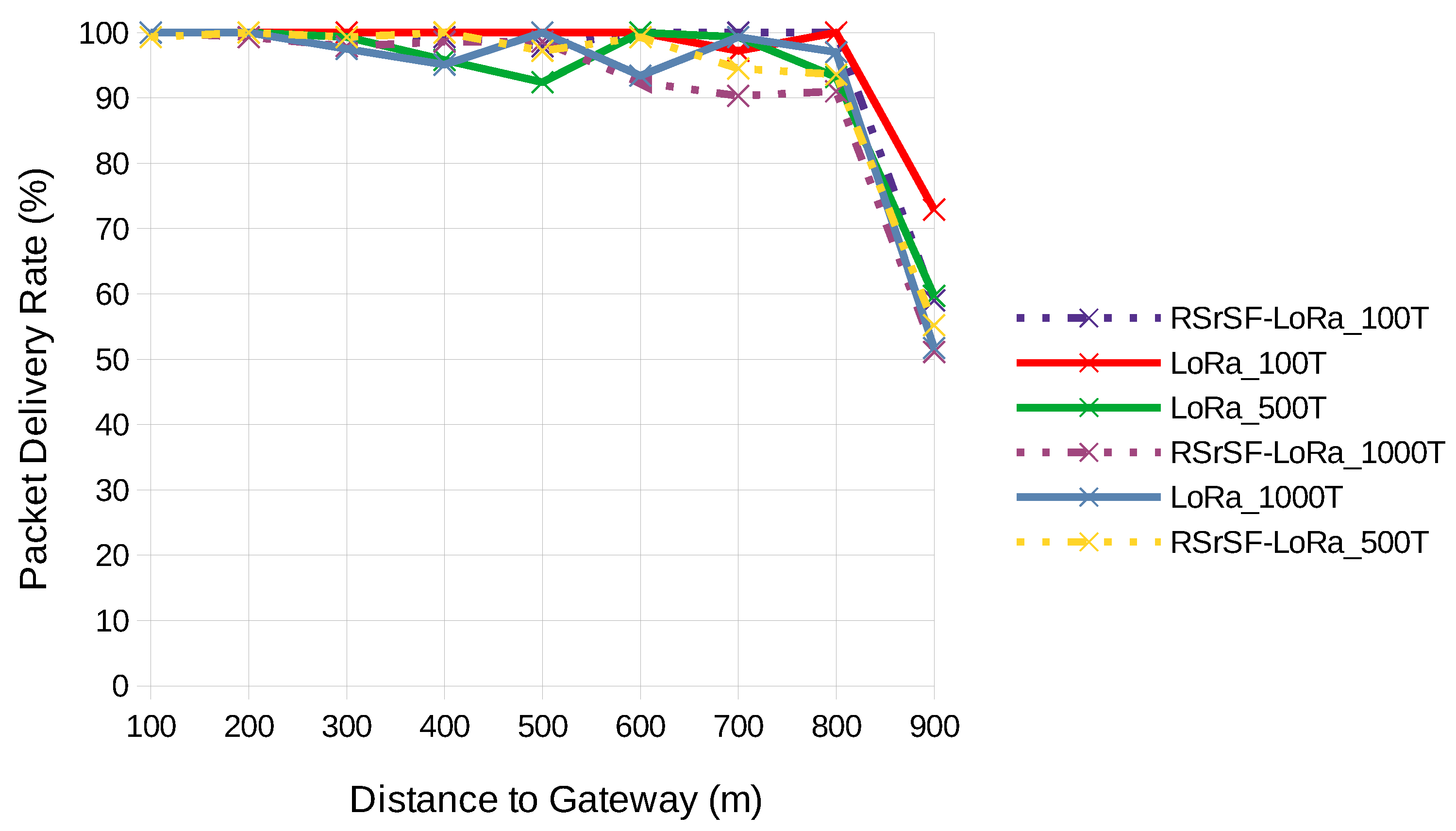
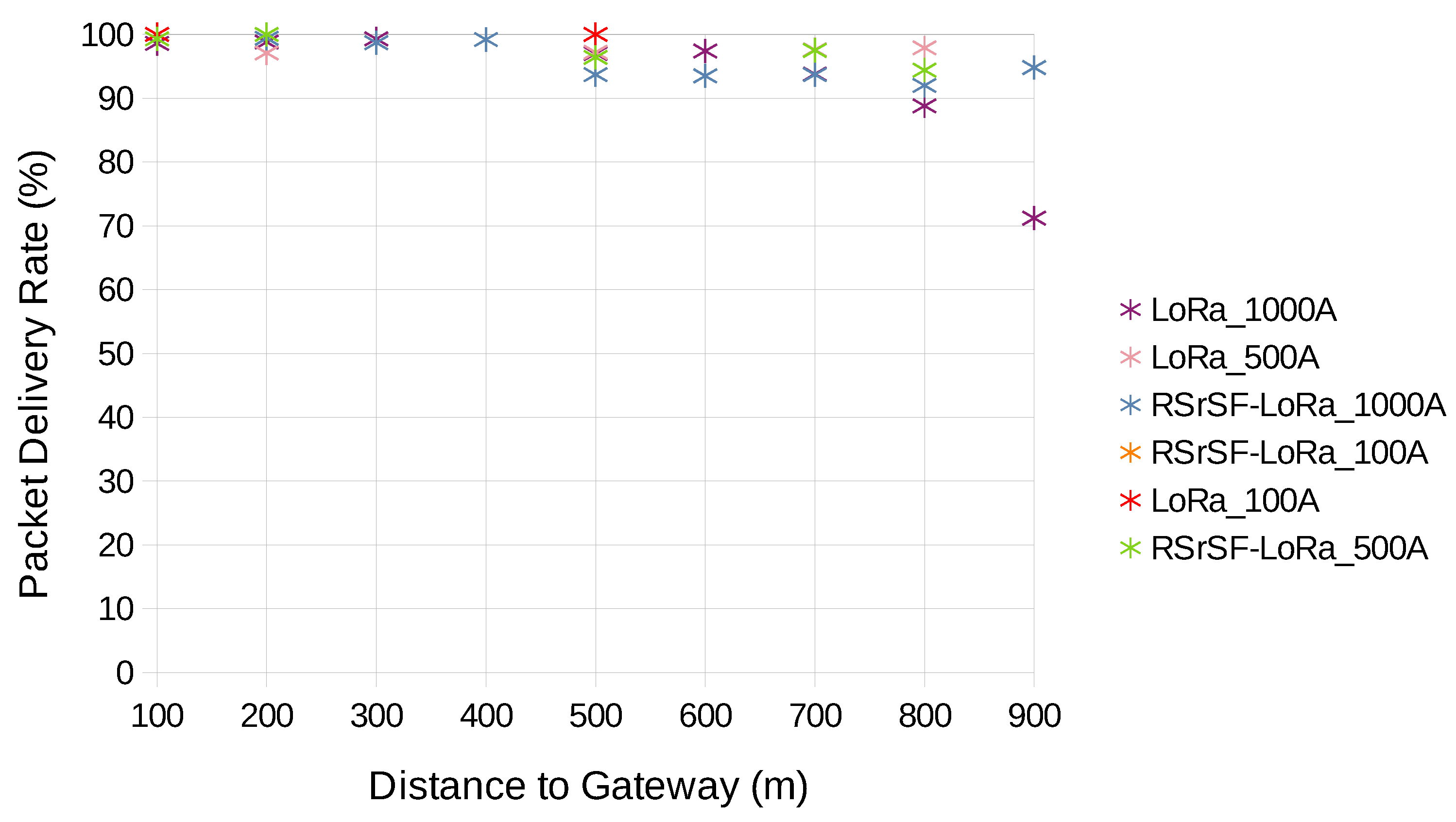
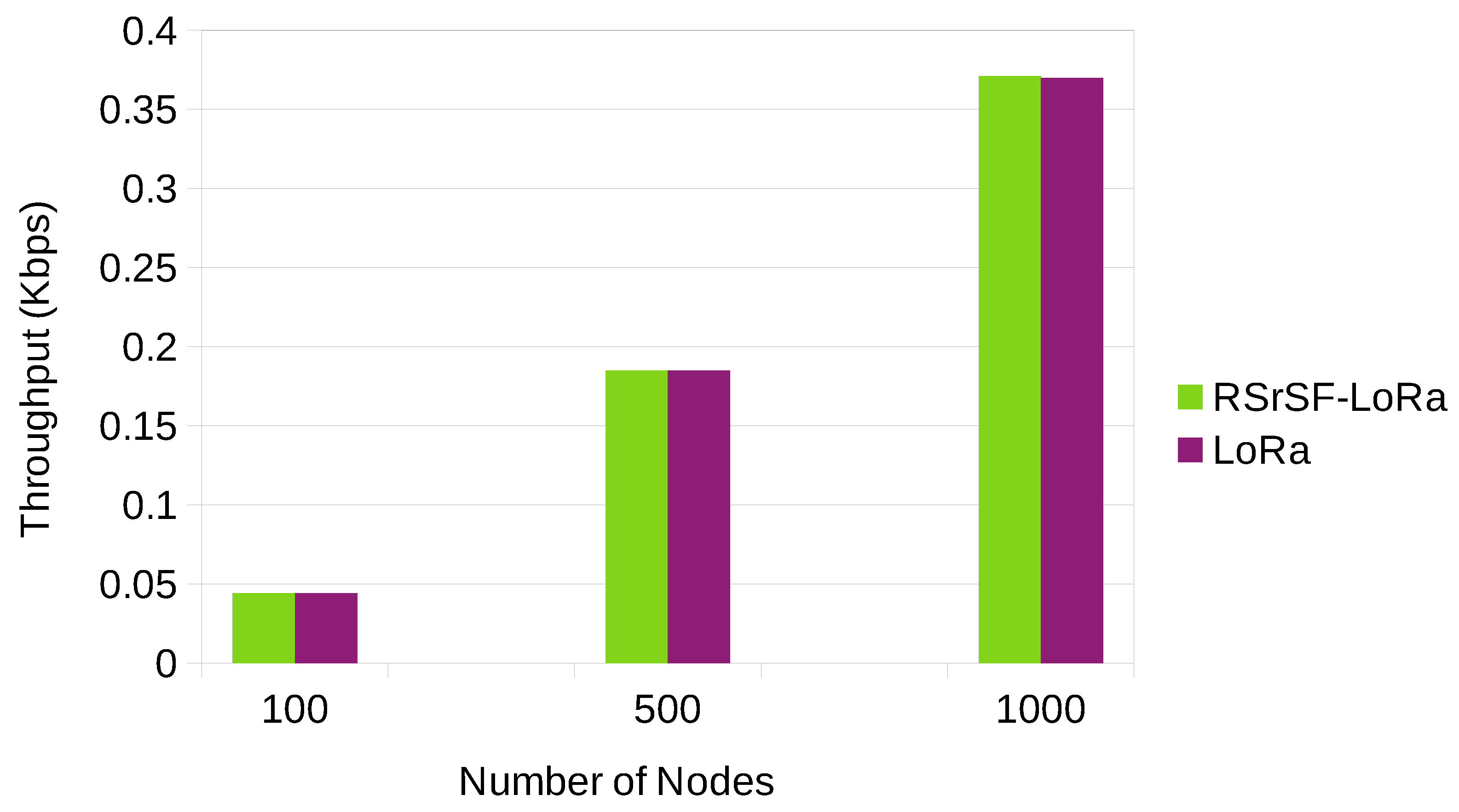
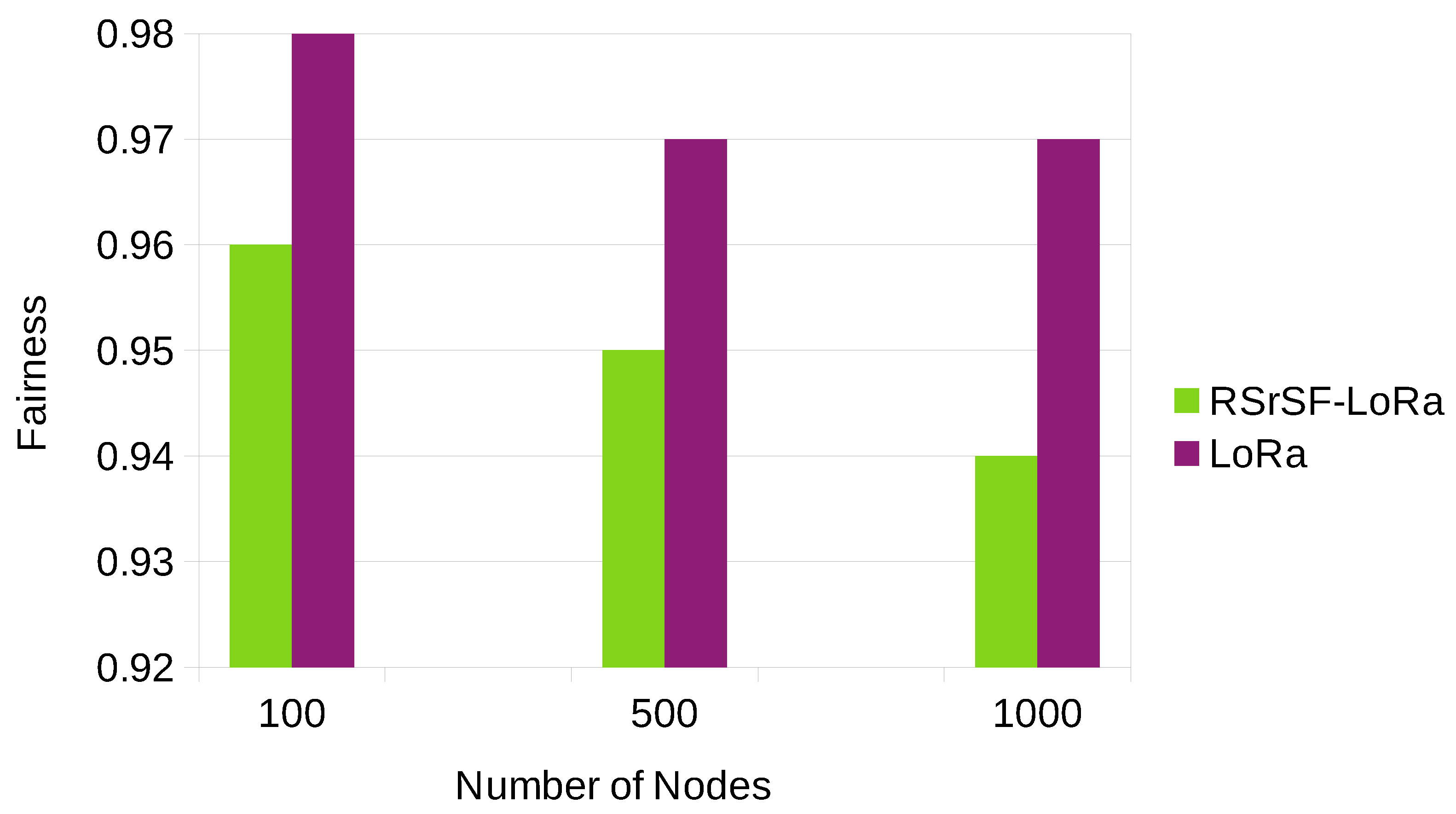
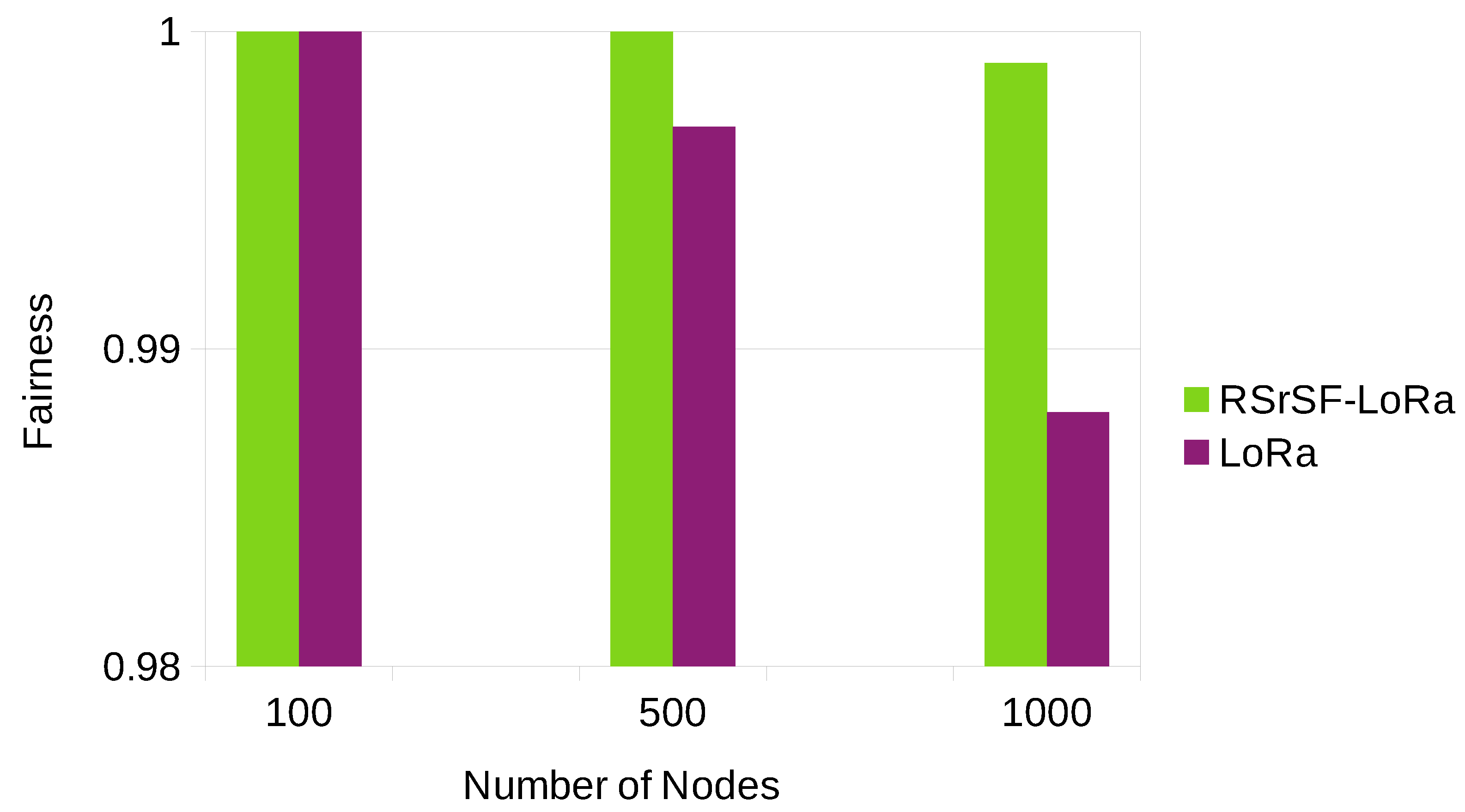
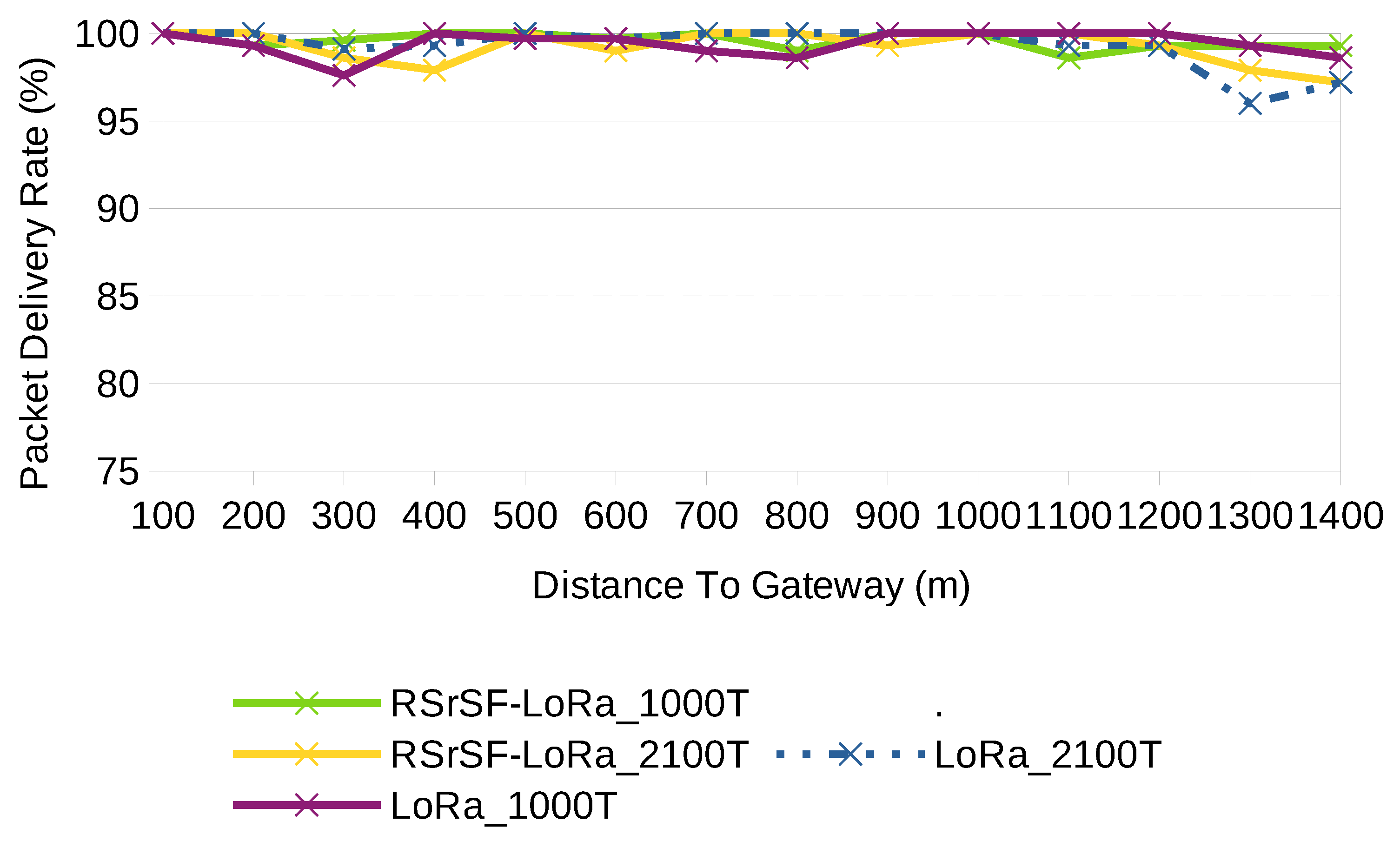
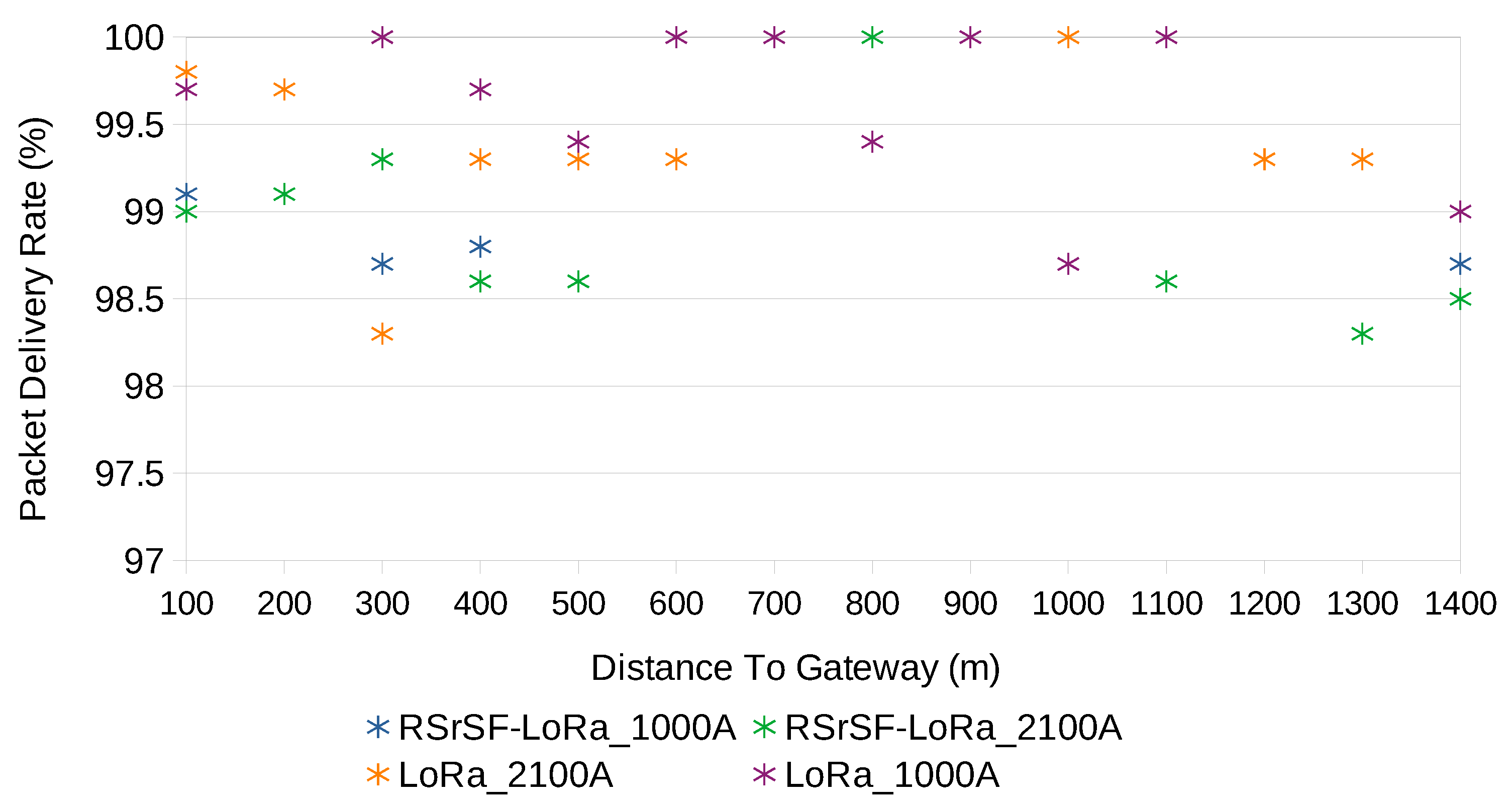
To bridge this gap, this paper presents RSrSF-LoRa, a hybrid implementation of RS-LoRa with a reserved spreading factor mechanism, and evaluates its performance against conventional LoRaWAN in smelter IoT deployments. The study considers multiple network scenarios: single-gateway deployments with 100, 500 and 1000 nodes, and seven-gateway deployments with 1000 and 2100 nodes. Performance is assessed using key metrics including packet delivery ratio (PDR), throughput, fairness, scalability and energy consumption, with particular focus on scenarios where PDR variability and alarm node energy usage are significant. The simulation results demonstrate that RSrSF-LoRa improves the reliability of alarm communication in dense single-gateway deployments, extending reliable transmission distances from 700 m to 900 m, while achieving comparable performance in multi-gateway or lower-density scenarios.
The main contributions of this work are as follows:
The remainder of the paper is organized as follows.
Section 2 reviews related work on LoRaWAN, RS-LoRa, and SF reservation strategies.
Section 3 describes the system and mining channel model as well as the RSrSF-LoRa mechanism, while
Section 4 outlines the implementation.
Section 5 presents the performance evaluation and discussion. Finally,
Section 6 concludes this paper and highlights future research directions.
2. Related Work
The related works cover studies that have been done on LoRaWAN in mining environments to determine its reliability and the feasibility of its use in mining applications, as well as specific studies aimed at improving its performance. Additional studies involve the performance of LoRaWAN in industrial environments and LoRaWAN reliability in general. Nessa et al. [
8] evaluated the performance of LoRa and LoRaWAN technologies in an underground mine in the presence of different kinds of traffic and proposed a redundant retransmission-aided adaptive latency reduction protocol for low-latency communication where the ACK-timeout is adjusted based on the air time of the previous uplink transmission and contention stage. Simulation results demonstrated a significant improvement in the performance of the proposed system compared to LoRaWAN in terms of data extraction ratio (DER) and average transmission delay for emergency traffic. However, DERs for localisation and sensing data were degraded in the proposed protocol compared to LoRaWAN. A new MAC protocol based on time division multiple access (TDMA) is developed by the authors of [
9] to provide better connectivity to the IIoT system in harsh underground environments using LoRa wireless technology, together with an algorithm to support roaming that manages slot assignments to eliminate collisions while minimising the number of needed slots for a given number of gateways. The proposed MAC protocol and experimental tests provide practical results, showcasing its viability as an attractive alternative solution to meet the challenges presented in the mining and tunneling industry.
Other studies in mining involve LoRa propagation and coverage measurements as well as development of propagation models in the underground mine environment. Branch et al. [
10] took measurements of LoRa radio propagation in a selected drift segment of an underground gold mine for line-of-sight (LOS) and non-line-of-sight (NLOS) communication. They further developed foundation models for LoRa signal behavior in mining scenarios, focusing on the block cave mining method. The findings were that for LOS communication, path loss was well modeled by a power law with a path loss index of 1.25 and variability in signal strength using a log-normal distribution with a mean of 4.5 dB. NLOS over short distances was successfully modeled using Fresnel diffraction with a path loss of 2 and a free-space model. They also studied the effects of SF on signal strength, which indicated that SF has a variable impact on the received signal strength indicator (RSSI) and a more consistent effect on signal-to-noise ratio (SNR). Their findings gave a good understanding of LoRa behaviour in this environment, which would lead to the development of LoRa applications underground. In [
11], the authors conducted a study involving design and deployment of a LoRa-based IIoT system for monitoring the underground coal mine at the shaft, roadway, and face region. In addition, a new data rate algorithm for mesh network topology is proposed to optimise the data rate and maximise the coverage distance with minimal repeaters. Implementation of the proposed algorithm achieves a 1.46 kbps data rate at SF9, a bandwidth of 125 kHz and transmitter power of 11 dBm while extending the battery life of the deployed end nodes. Deployed end nodes achieve a maximum of 180 m under diffused LOS conditions in the roadway region of the operational mine.
Additional studies consider performance evaluation of LoRaWAN in industrial environments. Mining is an industrial environment; thus, these studies provide options that can be considered for deployment in these environments. A study carried out by the authors of [
7] determined the performance of LoRaWAN for handling telemetry and alarms in industrial applications in which the potential of using spreading factor allocation strategies to prioritise alarm messages in the indoor and open-field environment was investigated. System-level simulations were used to compare the proposed solution with a benchmark scenario where no alarm was considered. The results show that it is possible to achieve high reliability with reasonably low delay without significantly affecting the performance of regular links. Magrin et al. [
12] evaluate the performance of LoRaWAN in industrial scenarios for IIoT end nodes providing monitoring and sensing information by utilising the 2.4 GHz frequency for the EU region. They also analyse higher-layer impacts of different LoRa physical (PHY) layer models using industrial channel models, considering confirmed/unconfirmed traffic and multi-gateway deployments. The implementation changes were made for the publicly available LoRaWAN module for Network Simulator 3 (ns-3). The results show that when utilizing the frequency 2.4 GHz, the transmission time in the LoRaWAN network improved by 80%, decreasing from 75 ms to 14 ms, and resulted in the best performance, with a packet delivery rate above 90% due to the extended bandwidth in the case of the massive machine-type communication (mMTC) scenario with thousands of devices deployed.
A few studies involved improving the reliability and scalability of LoRaWAN in non-mining and non-industrial environments. However, they provide useful insights that could benefit these environments. Reynders et al. [
6] propose a new MAC layer, RS-LoRa, to improve the reliability and scalability of LoRa wide-area networks (LoRaWANs) and implemented it in ns-3, evaluating its performance through extensive simulations. RS-LoRa involves a two-step lightweight scheduling that starts with the gateway and then the end nodes. Through the lightweight scheduling, nodes are guided to select different SFs to increase network reliability and scalability. The results show that in a single gateway of 1000 nodes, RS-LoRa can reduce the packet error ratio of legacy LoRaWAN by 20%. Herrería-Alonso et al. [
13] developed Longest First-Slotted Carrier-Sense Multiple Access with Collision Avoidance (LFS-CSMA), a new MAC mechanism that enhances the scalability of LoRaWAN by combining the well-known slotted Aloha and CSMA schemes. Longer frames are transmitted earlier within a given time slot, and then devices with short frames to be transmitted can check the channel availability before sending them and avoid collisions if they detect an ongoing transmission. Results indicate that LFS-CSMA causes far fewer collisions than traditional MAC mechanisms, thus improving the scalability of LoRaWAN networks significantly.
In the context of LoRaWAN communications for mining and industrial applications, our work stands out by examining the performance of legacy LoRaWAN and the designed hybrid MAC mechanism RSrSF-LoRa in a smelter environment, a surface mining environment dominated by metallic structures (obstacles), interference, and moving objects. Many studies on IIoT networks involving LoRaWAN in mining are currently focusing on the underground environment. This study therefore provides design insights for reliable and energy-aware industrial IoT networks in smelter environments while adding a new dimension to the existing LoRaWAN research in mining.
Table 1 presents a summary comparison of the related works discussed in this section and our work.
3. System Design
In this section, the system and mining channel model are presented together with the RSrSF-LoRa algorithm that integrates the spreading factor reservation strategy and lightweight scheduling (RS-LoRa). Industrial LoRa deployments commonly exhibit heterogeneous traffic patterns, combining periodic telemetry with sporadic, time-critical alarm events. RS-LoRa improves scalability through probabilistic spreading factor allocation and coordinated access, but just like regular LoRaWAN, it does not explicitly differentiate between traffic classes with distinct reliability requirements. The purpose of the design, on the one hand, is to give priority to alarms by reserving an SF for them while at the same time using lightweight scheduling to distribute the remaining spreading factors across telemetry end nodes. Thus, lightweight scheduling helps to prevent overcrowding-assigned telemetry nodes to an inappropriate SF, a challenge noted by Filho et al. [
7], which impaired telemetry communication in their study involving strategic allocation of spreading factors for the transmission of alarms and telemetry in industrial environments. On the other hand, integrating SF reservation and lightweight scheduling is aimed at addressing the packet collisions caused by the Aloha MAC protocol, channel congestion, and capture effect. Therefore, the design of RSrSF-LoRa is motivated by the observation that alarm traffic, although infrequent, must be protected from contention caused by telemetry transmissions while at the same time ensuring that telemetry transmission is not impaired.
3.1. System Model
The ns-3 LoRaWAN module does not classify the end nodes as alarms and telemetry; they are just created generally as end nodes (EDs); thus, we create two types of EDs, namely telemetry (regular) nodes and alarms (event-triggered) nodes. Telemetry EDs transmit packets to the network server via the gateways periodically at intervals of 600 s, while alarm EDs generate packets according to a Poisson process with a mean inter-arrival time of 600 s. This means that the inter-arrival time is exponentially distributed with mean 600 s, expressed as
and transmission time, expressed as
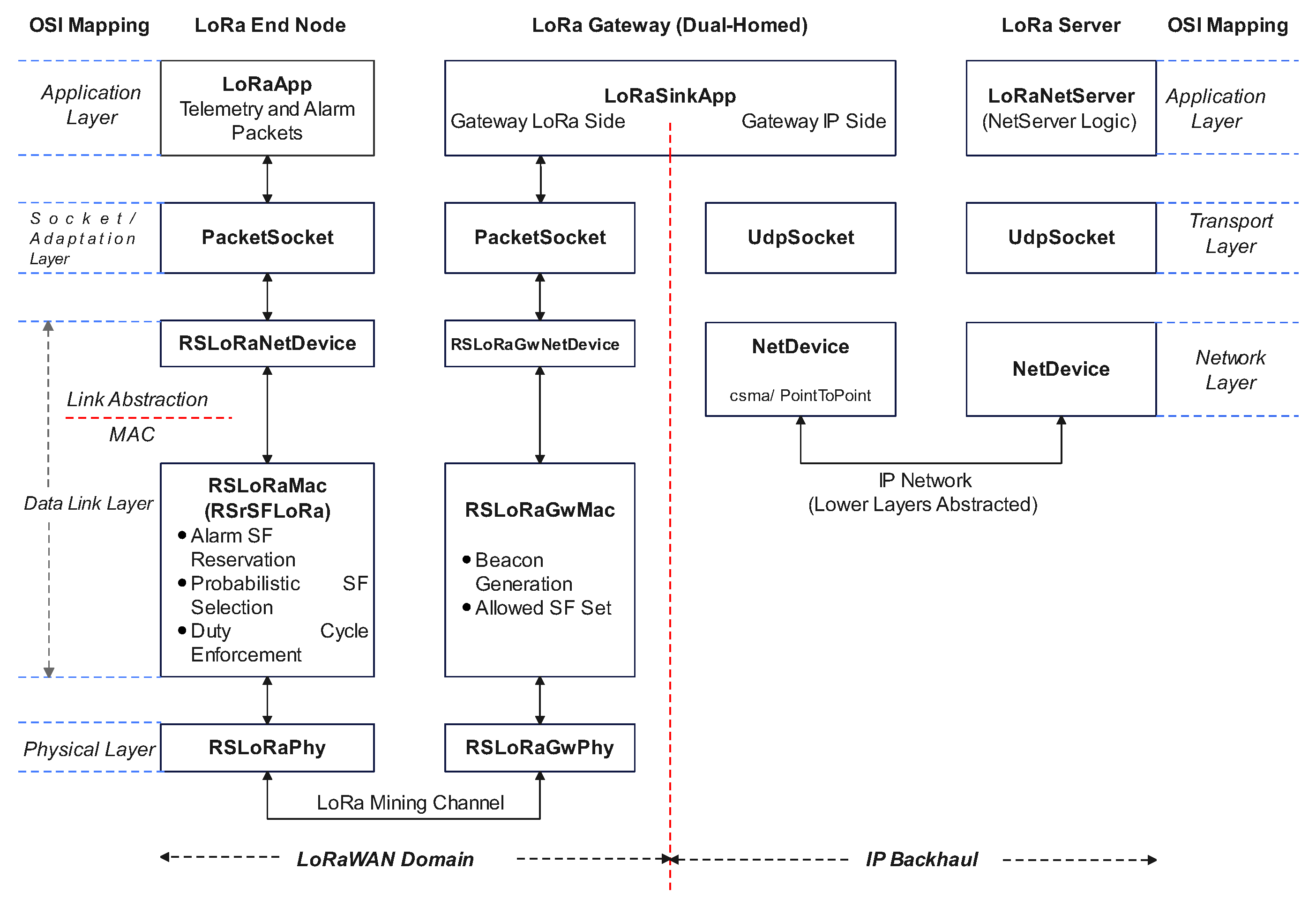
The packet sizes for telemetry and the alarms are 28 and 14 bytes, respectively. We model a mining environment that is typical for the copper smelter outdoor environment and create a LoRa wide-area network that implements our algorithm at the MAC layer. We assumed a case of the air-quality monitoring system in which the EDs are not only placed within the smelter area but also in areas away from the smelter within the mine and away from the mine into the city. Copper smelting normally results in the production of toxic gases, such as sulphur dioxide and carbon dioxide, which can affect humans and other living organisms. Thus, sulphur dioxide, for instance, is safely channeled to the acid plant for production of sulphuric acid. The air monitoring system thus serves the critical purpose of ensuring that there is 0% of sulphur dioxide in the air. The gateway(s) can be connected to the network server using a wired connection such as Ethernet (optical Fibre) or wireless using a cellular connection (i.e., 4G or 5G). The system uses a combination of lightweight scheduling and spreading factor reservation. The spreading factor reservation is used to reserve a more robust spreading factor for alarms at any given time.
3.1.1. Lightweight Scheduling
Lightweight scheduling starts with the gateways that are also responsible for coordinating the whole process and then with the EDs. Each channel is scheduled by specifying the allowed transmission power and SF in each subframe. The gateway specifies the allowed transmission power of the nodes using its received signal strength (RSS) of uplink traffic. This information is relayed to the EDs using beacons from the gateway and gives the allowed RSS of each channel per subframe. The ED joining process is the same as that of legacy LoRaWAN. Each ED uses the information in the beacons to choose its own transmission parameters, namely, channel, SF, and transmission power. This process is performed at each end node in a distributed manner. Based on the study by Reyders et al. [
6], different spreading factors are selected with different probabilities. This can be represented mathematically as follows:
Let S be the set of all LoRa spreading factors {7, 8, 9, 10, 11, 12};
be the set of allowed SFs on channel i (this is what is advertised in the beacon);
be the selection weight (or preference) for SFs.
These weights encode the lightweight scheduling policy (fairness, load balancing, learning, etc.). The probability that a node selects spreading factor s on channel i is generally given as
is forbidden, so its probability is zero. The denominator in the expression ensures that the probabilities sum to 1 over
. This means that given the set of admissible spreading factors
announced in the beacon for channel i, an end device selects SF
with a probability proportional to a weight
.
More specifically, to achieve the lowest packet error ratio, Rappaport et al. [
14] states that the preference is the achieved data rate; therefore, the weights are replaced by the achieved data rates. The expression for the probability of selecting an SF s by an end node is therefore
where
is the set of allowed spreading factors on channel i (from the beacon),
is a candidate spreading factor,
is achievable data rate when using spreading factor s,
is achievable data rate for another SF , and we have .
The achievable coding rate
is in turn given by
where
, BW is bandwidth, and CR is the coding rate index.
This means that lightweight scheduling enables EDs to select spreading factors probabilistically, assigning higher selection probability to SFs with higher achievable data rates, thereby reducing airtime and improving overall spectral efficiency.
Reliability of Beacons: Beacons are used for carrying downlink information and synchronising nodes. Once a node wakes up, it listens to the latest beacon and then adapts its clock to the gateway. To increase the reliability of beacons against collisions with beacons from other gateways and interference from other networks operating at the same frequency, they are transmitted on different channels. Additionally, different SFs are used to transmit them, so as to increase reception probability and to ensure that the first beacon is received by all end nodes, including those at the cell edge; it is sent using SF12. For a detailed illustration of this aspect together with channel assignment, refer to the study by the authors of [
6].
The lightweight scheduling concept is being used in our work to help distribute spreading factors for telemetry nodes, a measure taken to prevent them from crowding in one inappropriate SF.
3.1.2. Spreading Factor Reservation
Using the lightweight scheduling information, each alarm end node determines the SF to use for transmission, and based on all SF values estimated as adequate for the alarm nodes, the highest one is chosen and adopted as the reserved SF (rSF). Hence, all the alarm nodes transmitting at a particular instance will be allocated the rSF. The telemetry nodes will also use the lightweight scheduling information to determine the SF to use for transmission but will not be allocated the rSF unless it is the highest one, that is, SF12. To prevent telemetry nodes from choosing the rSF when it is less than SF12, they will choose another SF from the set of SFs available for the selected channel. For instance: If the set of allowed SFs for a channel = SF8, SF9, and SF10 and rSF is SF9, a telemetry node can choose either SF8 or SF10. Another example is if the set of allowed SFs for a channel = SF10, SF11, and SF12 and if rSF is SF11, a telemetry node can choose either SF10 or SF12. However, if from the lightweight scheduling a telemetry node is assigned to use SF12 and the rSF is SF12, it will maintain SF12. This concept is being used to enable reservation of SF for alarms that is more robust as a way of giving priority to alarm transmission.
3.1.3. RSrSF-LoRa
Upon receiving the beacon message from the gateway specifying the allowed transmission parameters per channel for each subframe, the EDs will use this information to determine their applicable or own transmission parameters. The steps for both alarm and telemetry nodes are as follows:
Alarm end nodes:
Find the available channel by listening to the latest beacon.
Determine the channel by searching over all available channels.
Select one with the highest target RSS () which is lower than the estimated RSS of the beacon from the gateway ().
If the channel is found, a random SF is selected from , where is the set of allowed SFs per channel,
Compare SFs selected by alarms for this subframe and assign the highest one to all alarms. This is the reserved SF (rSF).
Select the channel that has this rSF and matching estimated of each alarm.
Otherwise, if the channel is not found, the lowest SF (SF = 7) is selected, which means the alarm node is close to the gateway.
Compute the transmit power using this rSF and estimated .
Select a random time for transmission between beacons (before the arrival of the next beacon).
Telemetry end nodes:
Find the available channel by listening to the latest beacon.
Determine the channel by searching over all available channels.
Select one with the highest target RSS that is lower than the estimated RSS of the beacon from the gateway.
If the channel is found, a random SF is selected from , where is the set of allowed SFs per channel.
Case 1: If the selected SF = = rSF and , choose SF from the set of remaining SFs, and proceed to step 5.
Case 2: If the selected SF = = rSF and rSF = = 12, maintain this SF and proceed to step 5.
Case 3: If the selected SF! = rSF, proceed to step 5.
Otherwise, if the channel is not found, the lowest SF is selected, which means that the end node is close to the gateway.
Calculate required transmit power based on the determined SF and target RSS. It is worth noting that an increase in SF by 1 brings an increase of 2.5 dB in the sensitivity of the gateway, according to the datasheet of the LoRa transceiver (SX1272/73, Semtech Corporation, Camarillo, CA, USA) [
15].
Select time for transmission between beacons (before the arrival of the next beacon).
The algorithm is presented below.
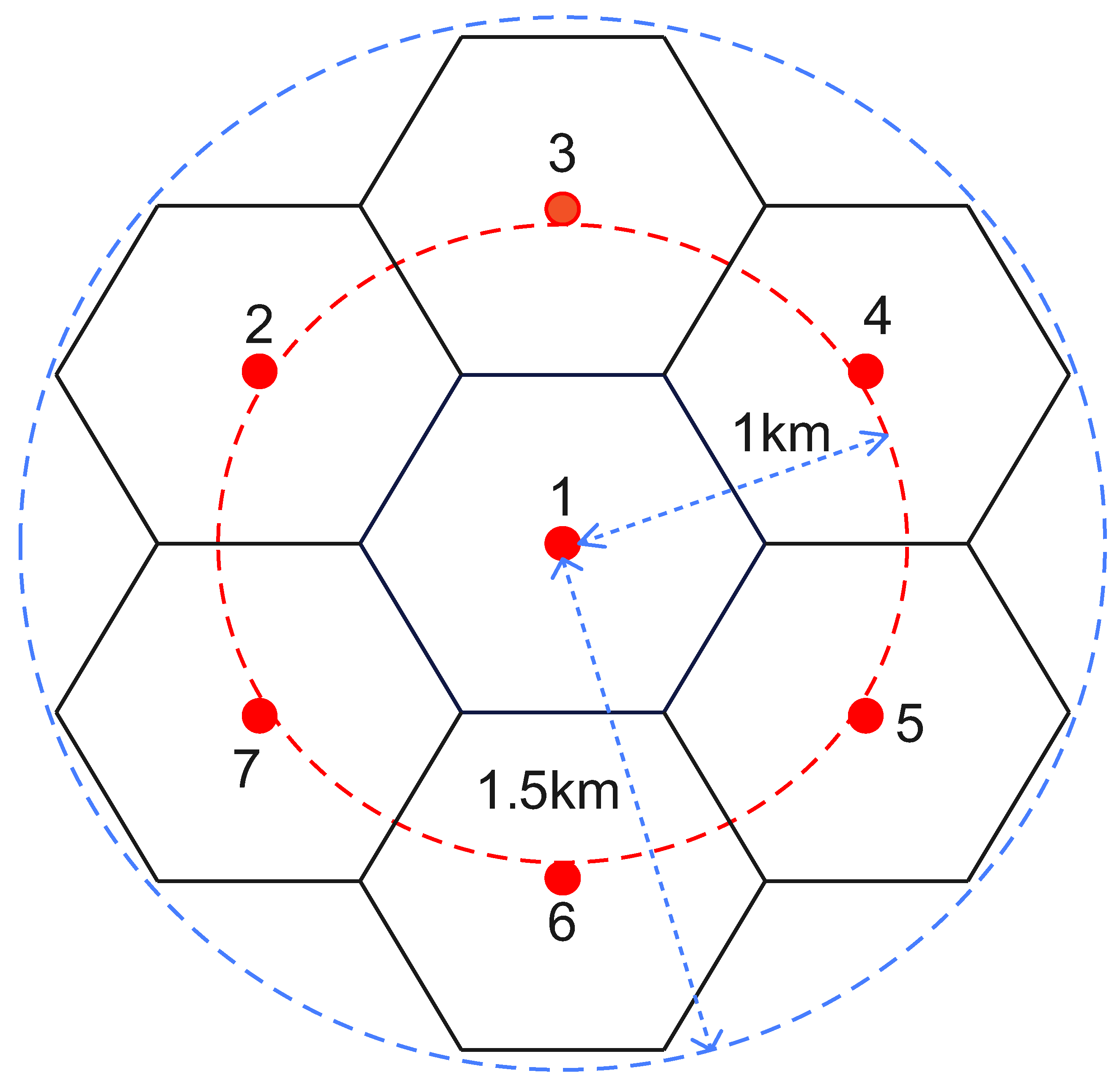
Apart from using the combination of spreading factor reservation and lightweight scheduling, other techniques have been incorporated to enhance the reliability of transmissions. Emergency traffic (alarms) is retransmitted whenever an acknowledgement (ACK) is not received within the two reception windows, with a maximum of eight retransmission attempts. Non-emergency traffic (telemetry) does not have retransmissions as a tradeoff measure to reduce the traffic load in the network and energy consumption. Another technique used is spatial diversity, which benefits both alarm and telemetry transmission because more than one gateway is used, and normally, for LoRaWAN transmission, EDs use the gateway with the strongest signal. In our simulations, we employed seven gateways because the higher the number of gateways, the better the spatial diversity according to the authors of [
7].
3.2. Analysis of Computational and Implementation Overhead
RSrSF-LoRa is intended for deployment on battery-powered, memory-constrained EDs; thus, it is vital to analyse its computational and implementation overhead relative to legacy LoRaWAN and RS-LoRa. In this subsection, the complexity of Algorithm 1 is presented along with associated overhead. The parameters that determine the computational costs are as follows: the number of uplink channels
, the number of spreading factors
(SF7-12), the total number of end devices N, the number of alarms
, and the number of telemetry nodes
.
| Algorithm 1 To Determine Transmission Parameters For Alarm and Telemetry End Node |
- Input:
, , I, , , , , - Output:
, , , ,
- 1:
if then - 2:
▹: a temporary variable - 3:
- 4:
- 5:
for do - 6:
if then - 7:
▹ Select channel - 8:
- 9:
- 10:
end if - 11:
end for - 12:
if then - 13:
- 14:
▹ Highest SF from is reserved - 15:
- 16:
- 17:
for do - 18:
if then - 19:
- 20:
- 21:
end if - 22:
end for - 23:
if then - 24:
- 25:
else - 26:
- 27:
- 28:
- 29:
end if - 30:
- 31:
- 32:
end if - 33:
end if - 34:
if then - 35:
- 36:
- 37:
end if - 38:
for do - 39:
if then - 40:
- 41:
- 42:
- 43:
end if - 44:
end for - 45:
if then - 46:
- 47:
if then - 48:
- 49:
end if - 50:
- 51:
else - 52:
- 53:
- 54:
- 55:
end if - 56:
- 57:
|
3.2.1. Time Complexity of Algorithm
Table 2 gives the corresponding operation counts.
The sum of the contributions outlined above gives the per subframe ED complexity as
for both traffic classes.
and
are fixed by the parameters in
Table 3; therefore,
is bounded by a constant in practice. Therefore, the complexity of the end device is in the same asymptotic class as RS-LoRa, with the reservation mechanism contributing an additive constant rather than a change in growth. It contributes 27 operations out of the 77 performed by an alarm ED and 45 of the 115 operations performed by a telemetry ED.
3.2.2. Memory Complexity
The beacon-derived allowed SF set and the target RSS set are maintained by the end device, which requires storage, and this is inherited from RS-LoRa. RSrSF-LoRa thus adds the following: the traffic class (1 bit), reserved spreading factor (3 bits), a retransmission counter with a maximum of eight attempts (4 bits), an acknowledgment flag (1 bit), and one timer handle. This gives an incremented memory complexity equal to 8 bytes per device at most.
The per-subframe reserved-SF register at the gateway requires only 1 byte and an acknowledgment context of approximately bytes, yielding the gateway state. In the case of the dense single-gateway scenario where and , this is approximately 121 bytes. These values are negligible compared to the several kilobytes of RAM available on microcontrollers normally paired with -class transceivers.
3.2.3. Comparison with Alternative Mechanisms
The results obtained above for RSrSF-LoRa are compared with the reliability mechanisms reviewed in
Section 2. LFS-CSMA [
13] and TDMA MAC [
9] have structurally higher costs required to achieve determinism. The former requires carrier sensing before every transmission, which demands an additional on-time receiver, an energy cost absent from purely scheduled schemes, while the latter requires per-slot assignment. RSrSF-LoRa retains the
per-device cost of RS-LoRa while adding traffic differentiation.
Table 3 summarises the complexity comparisons of the reliability schemes.
3.2.4. Implementation Overhead
RSrSF-LoRa is implemented within the MAC sublayer, and, relative to RS-LoRa, this introduces only reserved SF selection, reserved SF comparison, optional channel selection, traffic classification, one additional transmit power calculation, and alarm retransmission. It does not change the physical layer, and the mining channel model is shared unchanged with the LoRaWAN baseline.
The practical consequence is that there is no change in modulation, transceiver configuration, or radio front-end behaviour. Implementation overheads are negligible, and RSrSF-LoRa, in principle, has the potential of being deployable on existing -based hardware as a firmware update rather than a hardware replacement. However, the mechanism requires coordinated updates at both the gateways and the end devices, and is therefore an extension of RS-LoRa rather than an interoperable drop-in replacement for the unmodified LoRaWAN deployments.
3.3. Channel, Noise and Interference Model
The smelter environment is characterized by dense metallic structures, large obstructions, and significant electromagnetic interference. The authors of previous studies on industrial wireless channels report high path loss exponents, strong log-normal shadowing, severe multi-path fading, and elevated noise floors [
3,
4,
16]. Given the similarity, and, in many aspects, increased harshness of smelters compared to underground mines and heavy industrial plants as indicated by Qaraqe et al. [
17], the adopted channel model consisting of log-distance path loss, log-normal shadowing, Nakagami fading, and increased noise floor is well justified. In addition to static propagation impairments, industrial environments such as smelters contain mobile metallic objects including trucks, cranes, and forklifts. The authors of [
18,
19] report that these moving objects act as dynamic scatterers and blockers, causing time-varying shadowing and multi-path fading. To capture this non-stationary interference behavior, a way point mobility model was used to represent vehicle motion along predefined operational paths, which is a widely accepted abstraction for industrial mobility, as stated by Camp et al. [
20]. Raza et al. [
21] indicates that this approach allows realistic modeling of mobility-induced interference effects on long-duration LoRa transmissions.
All LoRa end devices considered in this work are stationary and deployed within and around a heavy-industrial smelter environment. The wireless channel is modeled as a composite propagation process that captures large-scale attenuation, shadowing, small-scale fading, receiver noise, and dynamic interference generated by moving mining vehicles.
3.3.1. Propagation Effects
The large-scale path loss between a transmitting device i and a receiving device j, separated by a fixed distance
, is modeled using a log-distance formulation:
where,
= 1 m is the reference distance,
= 46.67 dB is the reference loss, and
is the path loss exponent. Studies by the authors of [
22,
23] report that this exponent reflects the severe attenuation caused by dense metallic structures such as furnaces, cranes, and ducts commonly found in smelters.
The authors of [
14,
16] show that shadowing due to large static obstructions is modeled as a log-normal random variable with standard deviation 6 dB, consistent with values reported for dense industrial environments, and is applied as an additive loss term to the large-scale path loss.
where
denotes the normal (Gaussian) distribution.
The authors of [
24,
25,
26] report that small-scale multipath fading is modeled using a Nakagami-m distribution with unit mean, which provides a flexible framework for representing a range of industrial multipath conditions without requiring explicit line-of-sight assumptions. The fading parameter m is distance-dependent, with Rayleigh fading (m = 1) at short distances and progressively milder fading at intermediate and larger distances (m = 1.5 and m = 2, respectively). This captures the transition from rich scattering near dense machinery to propagation dominated by a small number of strong reflected components over longer links. The resulting received signal power at device j is given by
where
is the transmit power and
denotes the Nakagami fading power gain.
3.3.2. Receiver Noise
The authors of [
27,
28] indicate that the receiver noise is modeled as a constant noise floor applied at the physical layer. A noise power of
N = −100 dBm is assumed, representing elevated thermal and electromagnetic interference conditions typical of heavy-industrial environments.
3.3.3. Vehicle Induced-Interference
In addition to receiver noise, time-varying interference is introduced by heavy mining vehicles moving around the smelter. Studies by the authors of [
14,
29] report that these vehicles do not carry communication devices but act as dynamic sources of broadband electromagnetic interference due to their motion and electrical subsystems. Their motion is modeled using stochastic and way-point-based mobility patterns, resulting in a time-dependent aggregate interference power;
where
(t) denotes the interference contribution of the k-th vehicle.
3.3.4. Signal-to-Interference-and-Noise Ratio
Combining propagation effects, receiver noise, and vehicle-induced interference, the instantaneous signal-to-interference-and-noise ratio (SINR) at the receiver is expressed as
In decibel form,
In (11),
, N and
are expressed in linear power quantities (mW). In (12), the same quantities are represented in logarithmic form, where powers are expressed in dBm and gains/losses in dB, yielding the SINR in dB.
Packet reception is determined by comparing the SINR to the spreading-factor-dependent LoRa demodulation threshold
γSF, as specified in LoRa physical-layer documentation and prior studies by the authors of [
15,
30]. A packet is successfully received if
.
6. Conclusions
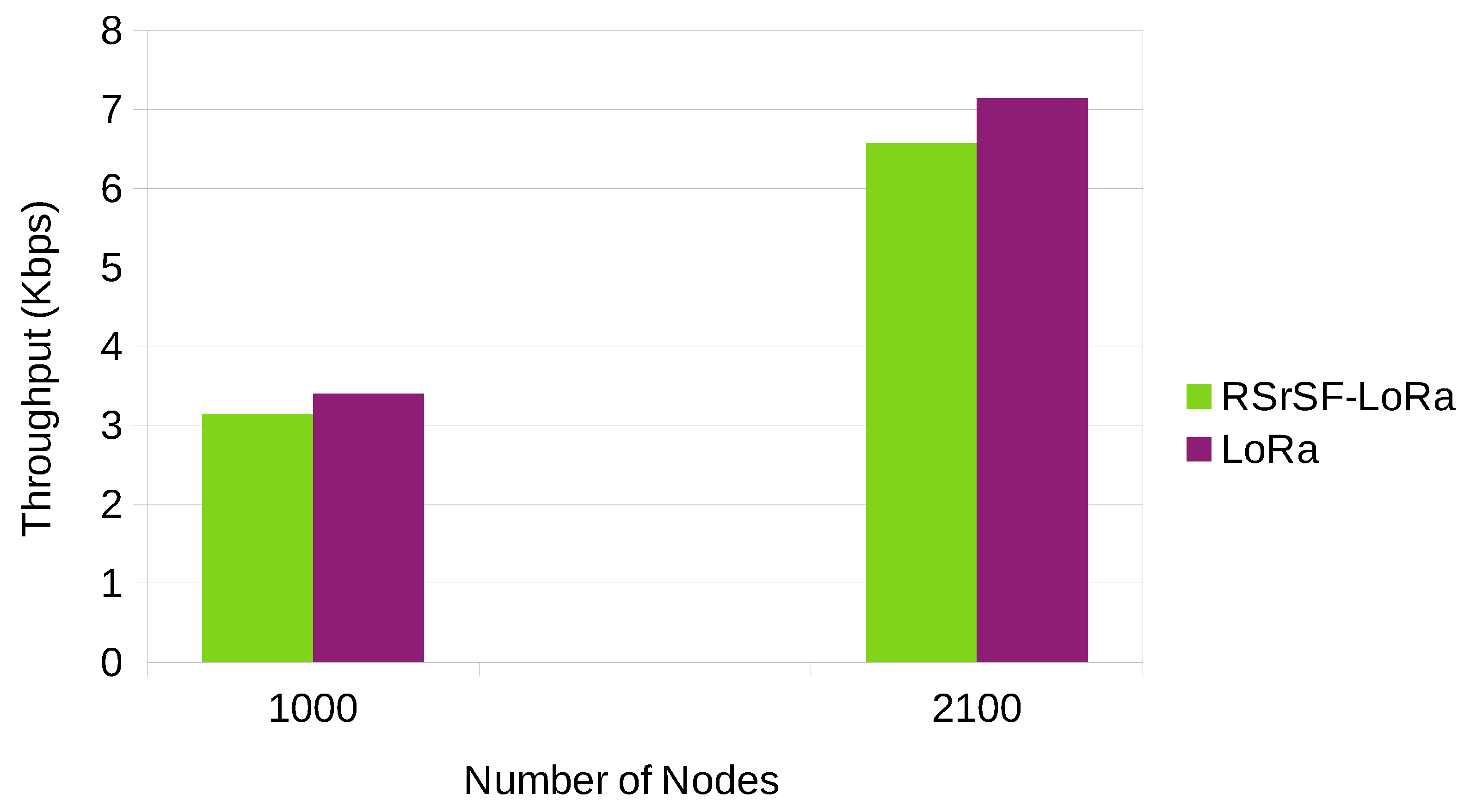
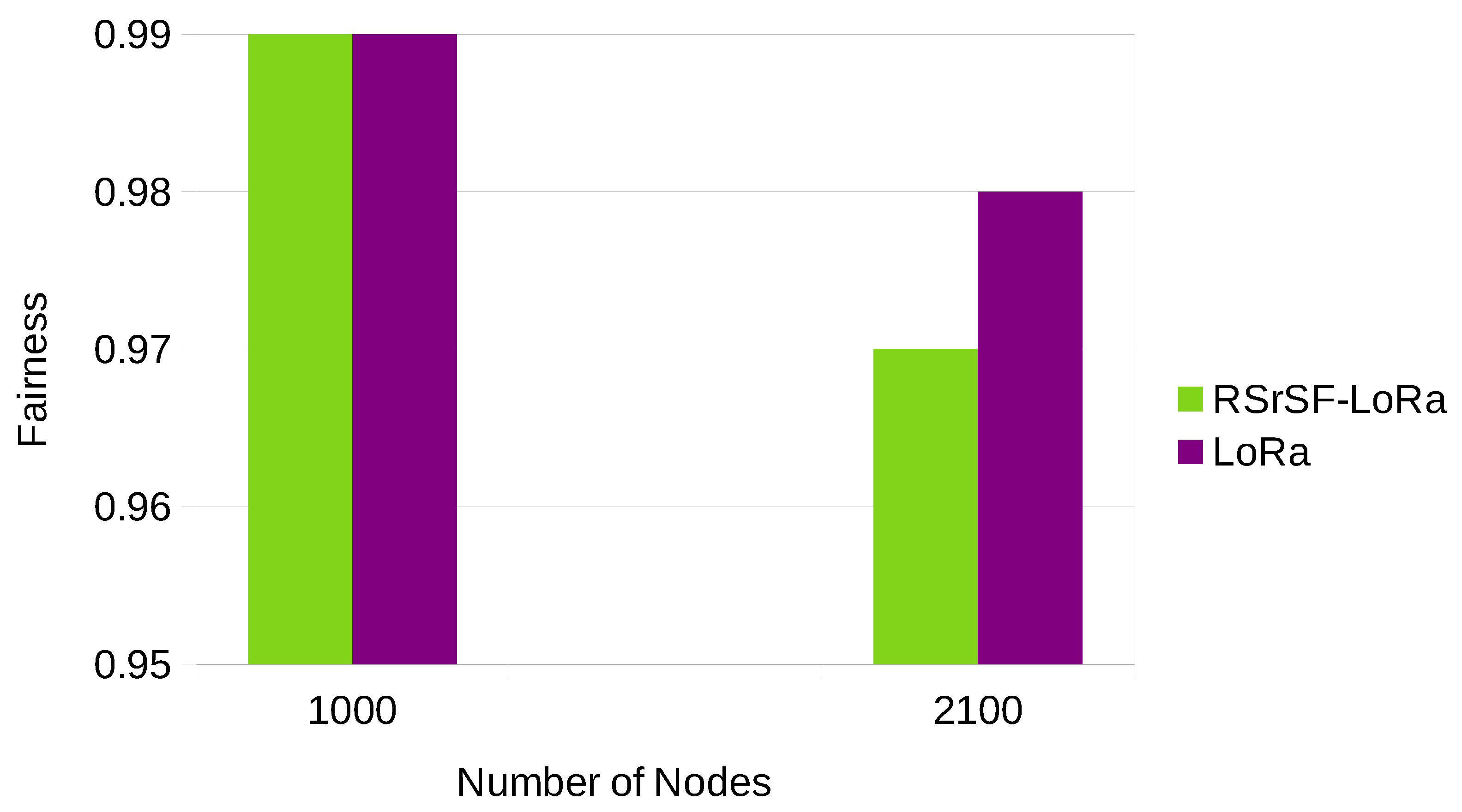
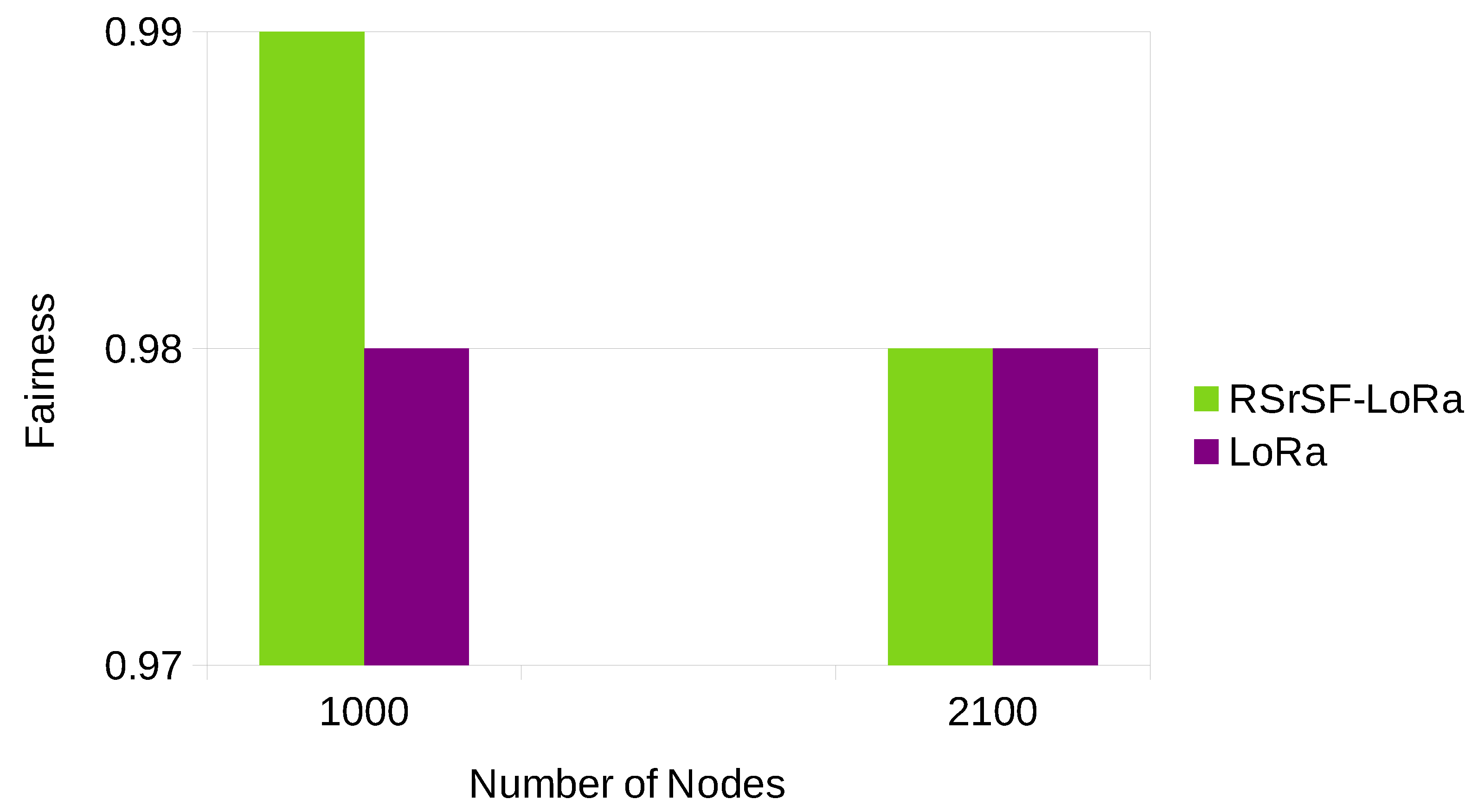
The simulation results indicate that both RSrSF-LoRa and LoRaWAN achieve high reliability in multi-gateway deployments, with packet delivery ratio (PDR) values exceeding 97%. However, in single-gateway dense scenarios with 1000 nodes, RSrSF-LoRa significantly improves the reliability of alarm messages, extending the acceptable PDR range from 700 m (LoRaWAN) to 900 m. Throughput and fairness remain comparable across both mechanisms, while energy consumption for alarm nodes in RSrSF-LoRa is slightly higher due to reserved transmission, but overall energy usage remains acceptable. These results demonstrate that RSrSF-LoRa provides reliability benefits in high-density industrial deployments without compromising the overall performance of the network, providing valuable guidance for designing reliable and energy-efficient IIoT networks in smelter environments.
Therefore, our proposals for future work are as follows: for the single-gateway network, there is a need to determine how to position the gateway in such a way that we can incorporate a relay device (repeater) that would increase the range with minimal cost in infrastructure compared to the seven-gateway arrangement. A limitation observed in this study for dense multi-gateway deployments is that a small fraction of nodes experienced transmission starvation. Future enhancements will incorporate starvation-avoidance and guaranteed-access mechanisms for critical alarm traffic to further enhance reliability in dense multi-gateway deployments. Although conceptually, RSrSF-LoRa has been implemented, further studies are needed to enhance the work and make it possible to apply RSrSF-LoRa in real-world applications by incorporating intelligent coordination in determining the highest SF for the alarms without adding any delay. This study compared RSrSF-LoRa with legacy LoRaWAN; however, future work should also include a comparison with the more recent LoRa MAC enhancement schemes. It would also be worthwhile to investigate and resolve the challenges of alternative spreading factor allocation strategies to see if they will produce a better result, and observed performance improvements should be explained using collision statistics. This should also include evaluation of average and tail latency, deadline-miss probability, number of retransmissions, and alarm-delivery outage probability. A further study will investigate incorporation of Forward Error Correction such as the 4/8 Hamming code without disturbing the required low bit rate transmission for LoRaWAN, as well as integrating Finite Impulse Response (FIR) or Infinite Impulse Response (IIR) filters after demodulation at the receiver to increase immunity to the propagation effects of the mining channel. Another study will exploit the concept of First-Slotted Carrier-Sense Multiple Access with Collision Avoidance (LFS-CSMA) by prioritising alarm messages, transmitting them earlier within a given time slot, and then telemetry messages will check the channel availability before sending and avoid collisions if they detect an ongoing transmission.
This study has also demonstrated the potential of LoRaWAN to improve air-quality monitoring for poisonous gases resulting from copper smelting. Some traditional wireless technologies fail at the smelter within a range of 600 m. In addition, current systems use sensors that depend on grid-connected power, making it difficult to deploy many sensor nodes since they are limited to deployment in only a few strategic locations or facilities. LoRa end nodes are battery-powered; hence, they are feasible for dense deployments.



 ,
,