Real-Time Stress Experiences and Physiological and Psychological Responses Among LGBTQ+ Young Adults: Findings from the Stress and Heart Pilot Study

 , , and
Abstract
1. Introduction
1.1. Stress, Autonomic Functioning, and Cardiovascular Risk
1.2. Stress, Affect, and Mental Health
1.3. The Additive Burden of Minority Stress
1.4. Gaps in the Literature
1.5. The Present Study
2. Materials and Methods
2.1. Study Design and Data Collection
2.2. Wearable Sensor Data Acquisition and Processing
2.3. Measures
2.3.1. Primary Outcomes
2.3.2. Primary Predictors
2.3.3. Demographic Variables
2.4. Analysis
2.4.1. Physiological Outcomes
2.4.2. Psychological Outcomes
3. Results
3.1. Participant Characteristics
3.2. Prompt-Level Observations
3.3. Descriptive Statistics for Physiological and Psychological Outcomes
3.4. Physiological Outcomes: Stress Score
3.5. Psychological Outcomes: Positive Affect and Negative Affect
3.6. Supplementary and Sensitivity Analyses
4. Discussion
4.1. Summary of Findings
4.2. LGBTQ+-Specific Stress Experiences and Physiological and Psychological Responses
4.3. General Stress Experiences and Physiological and Psychological Responses
4.4. Methodological Contributions
4.5. Limitations
5. Conclusions
Supplementary Materials
Author Contributions
Funding
Institutional Review Board Statement
Informed Consent Statement
Data Availability Statement
Acknowledgments
Conflicts of Interest
Abbreviations
| COMB | combined stress variable indicating endorsement of any of the four stress variables |
| CPS | current perceived stress |
| EDS | Everyday Discrimination Scale |
| EMA | ecological momentary assessment |
| EMA-SE | EMA of stressful events |
| HIPAA | Health Insurance Portability and Accountability Act |
| HRV | heart rate variability |
| IBI | interbeat interval |
| IRB | Internal Review Board |
| LGBTQ+ | lesbian, gay, bisexual, transgender, queer, and other diverse sexual and gender identities |
| NA | negative affect |
| PA | positive affect |
| PANAS | Positive and Negative Affect Schedule |
| PPG | photoplethysmography |
| SOMI-SF | Sexual Orientation Microaggression Inventory Short Form |
| TPR | total peripheral resistance |
Appendix A

| Mood | |
| Affective emotional states (I-PANAS-SF) | |
| Leading question | Right now I feel… Select all that apply. |
| Items | Happy, Relaxed, Angry, Annoyed, Anxious, Depressed, Afraid, Confident, Inspired, Hopeful, Bored |
| Response options | Not at all; A little; Moderately; Quite a bit; Extremely |
| Stressful Events | |
| Everyday Discrimination Scale | |
| Leading question | Since your last prompt, have you experienced any of the following discriminatory event? Select all that apply. |
| Items | Treated with less courtesy or respect than others Treated as if others are afraid of you Treated as if others think you are dishonest or immoral Treated as inferior, less smart/capable than others Insulted or called names (direct or overheard) Received poorer service than others (restaurants, stores, etc.) Treated unfairly by your family Stereotyped or negatively labeled Threatened or harassed Avoided, excluded, or ignored Have your perspective/feelings overlooked Physically or sexually assaulted Other |
| Response options | Yes; No |
| Follow-up question | You selected (present their selection). Is it related to any of the following statuses? Select all that apply. |
| Response options | Sexual orientation; Gender identity; Gender; Race/ethnicity; Mental health; Physical health; Appearance; Weight/body size; Religion; Other (Please describe); None/non-applicable |
| Follow-up question | When were you treated with (present their selection)? |
| Response options | 0–30 min ago; 30–60 min ago;1–2 h ago; 2–3 h ago; More than 3 h ago |
| Follow-up question | Where were you treated with (present their selection)? |
| Response options | In-person; Online/mobile device |
| Follow-up question | You selected In-person. Please describe where it occurred. Select all that apply. |
| Response options | Work/school; My home; Other’s home; Community space (neighborhood, store, park, gym, bar, restaurant, etc.); LGBTQ community space; Other place (DMV, hospital/clinic, post-office, police station, etc.) |
| Follow-up question | You selected online. Please describe where it occurred. Select all that apply. |
| Response options | Phone call/text message; Email/direct message; Work/school meeting; Social media (Twitter, Instagram, Reddit, etc.); Dating apps, Online gaming; Online social gathering (Zoom, Google Meet, etc.); Other online space |
| Sexual Orientation Microaggression Inventory (SOMI-SF) | |
| Leading question | Someone said something similar to the following about you or LGBTQ people. (Select all that apply) |
| Items | Not to act so gay, butch, queer, etc. You know how gay people are Being LGBTQ is just a phase LGBTQ people don’t face discrimination LGBTQ people overreact when talking about a negative experience related to their sexual orientation or gender identity I don’t mind or have nothing against LGBTQ people, but they shouldn’t be so public or open Being LGBTQ is a sin or immoral Used the wrong personal pronoun |
| Response options | Yes; No |
| Follow-up question | When did you hear someone say (present their selection). |
| Response options | 0–30 min ago; 30–60 min ago; 1–2 h ago; 2–3 h ago; More than 3 h ago |
| Ecological Momentary Assessment of Stressful Events | |
| Items | Did anything else stressful occur since the last prompt that you haven’t mentioned yet? A stressful event is any event, even a minor one, which negatively affected you. |
| Response options | Yes; No |
| Follow-up question | How would you describe the stressful event(s)? |
| Response options | Argument; conflict; disagreement; Financial event; Home-related event; Work-related event; Health event; Event that happened to others; Traffic or transportation event; Other |
| Follow-up question | When did the event happen? |
| Response options | 0–30 min ago; 30–60 min ago; 1–2 h ago; 2–3 h ago; More than 3 h ago |
| Follow-up question | How stressful was the event? |
| Response options | Not at all; A little; Moderately; Quite a bit; Extremely |
| General Stress | |
| Items | At the moment, I feel stressed |
| Response options | Not at all; A little; Moderately; Quite a bit; Extremely |
| Substance Use | |
| Alcohol Use | |
| Leading question | Did you drink alcohol? |
| Response options | No; Yes |
| Follow-up question | How many alcoholic drinks did you have? (1 standard drink being one 12 oz. beer/wine cooler, 5 oz. glass of wine, one cocktail, or a shot (1.25 oz.) of hard liquor.) |
| Response options | 1 or less; 2; 3; 4; 5; 6; 7 or more |
| Follow-up question | What were your reasons/motivations for drinking alcohol? Select all that apply. |
| Response options | Enjoyment/fun/excitement; Coping with sadness/anger/frustration; Coping with tension/stress/anxiety; Relaxation; To socialize/conform socially/peer pressure; Sexual enhancement; It’s a habit/compulsive use reasons; It’s what was available/easier to get; To feel more comfortable as an LGBTQ individual; To relieve/manage boredom; To manage physical pain; To experiment; Influenced by another substance; Other (Please describe) |
| E-cigarette | |
| Leading question | Did you vape or use an e-cigarette device? |
| Response options | No; Yes |
| Follow-up question | About how many puffs of an e-cigarette did you take? |
| Response options | 1–10; 11–20; 21–30; 31–40 |
| Follow-up question | What were your reasons/motivations for vaping/using an e-cigarette device? Select all that apply. |
| Response options | Enjoyment/fun/excitement; Coping with sadness/anger/frustration; Coping with tension/stress/anxiety; Relaxation; To socialize/conform socially/peer pressure; Sexual enhancement; It’s a habit/compulsive use reasons; It’s what was available/easier to get; To feel more comfortable as an LGBTQ individual; To relieve/manage boredom; To manage physical pain; To experiment; Influenced by another substance; Other (Please describe) |
| Cigarette Smoking | |
| Leading question | Did you smoke cigarettes? |
| Response options | No; Yes |
| Follow-up question | How many cigarettes did you smoke? |
| Response options | 1 or less; 2; 3; 4; 5; 6; 7; 8; 9; 10 or more |
| Follow-up question | What were your reasons/motivations for smoking cigarettes? Select all that apply. |
| Response options | Enjoyment/fun/excitement; Coping with sadness/anger/frustration; Coping with tension/stress/anxiety; Relaxation; To socialize/conform socially/peer pressure; Sexual enhancement; It’s a habit/compulsive use reasons; It’s what was available/easier to get; To feel more comfortable as an LGBTQ individual; To relieve/manage boredom; To manage physical pain; To experiment; Influenced by another substance; Other (Please describe) |
| Marijuana | |
| Leading question | Did you smoke or consume marijuana/cannabis? |
| Follow-up question | What were your reasons/motivations for smoking or consuming marijuana/cannabis? Select all that apply. |
| Response options | Enjoyment/fun/excitement; Coping with sadness/anger/frustration; Coping with tension/stress/anxiety; Relaxation; To socialize/conform socially/peer pressure; Sexual enhancement; It’s a habit/compulsive use reasons; It’s what was available/easier to get; To feel more comfortable as an LGBTQ individual; To relieve/manage boredom; To manage physical pain; To experiment; Influenced by another substance; Other (Please describe) |
References
- Bonomo, J.A.; Luo, K.; Ramallo, J.A. LGBTQ+ cardiovascular health equity: A brief review. Front. Cardiovasc. Med. 2024, 11, 1350603. [Google Scholar] [CrossRef] [PubMed]
- Caceres, B.A.; Streed, C.G. Cardiovascular health concerns in sexual and gender minority populations. Nat. Rev. Cardiol. 2021, 18, 227–228. [Google Scholar] [CrossRef] [PubMed]
- Clark, C.J.; Borowsky, I.W.; Salisbury, J.; Usher, J.; Spencer, R.A.; Przedworski, J.M.; Renner, L.M.; Fisher, C.; Everson-Rose, S.A. Disparities in long-term cardiovascular disease risk by sexual identity: The National Longitudinal Study of Adolescent to Adult Health. Prev. Med. 2015, 76, 26–30. [Google Scholar] [CrossRef] [PubMed]
- Morgan, E.; D’Aquila, R.; Carnethon, M.R.; Mustanski, B. Cardiovascular disease risk factors are elevated among a cohort of young sexual and gender minorities in Chicago. J. Behav. Med. 2019, 42, 1073–1081. [Google Scholar] [CrossRef] [PubMed]
- Sherman, J.; Dyar, C.; McDaniel, J.; Funderburg, N.T.; Rose, K.M.; Gorr, M.; Morgan, E. Sexual minorities are at elevated risk of cardiovascular disease from a younger age than heterosexuals. J. Behav. Med. 2022, 45, 571–579. [Google Scholar] [CrossRef] [PubMed]
- Martin, S.S.; Aday, A.W.; Almarzooq, Z.I.; Anderson, C.A.M.; Arora, P.; Avery, C.L.; Baker-Smith, C.M.; Barone Gibbs, B.; Beaton, A.Z.; Boehme, A.K.; et al. 2024 Heart Disease and Stroke Statistics: A Report of US and Global Data From the American Heart Association. Circulation 2024, 149, e347–e913. [Google Scholar] [CrossRef] [PubMed]
- Udupa, N.S.; Twenge, J.M.; McAllister, C.; Joiner, T.E. Increases in poor mental health, mental distress, and depression symptoms among U.S. adults, 1993–2020. J. Mood Anxiety Disord. 2023, 2, 100013. [Google Scholar] [CrossRef] [PubMed]
- McEwen, B.S. Physiology and neurobiology of stress and adaptation: Central role of the brain. Physiol. Rev. 2007, 87, 873–904. [Google Scholar] [CrossRef] [PubMed]
- McEwen, B.S. Neurobiological and Systemic Effects of Chronic Stress. Chronic Stress 2017, 1, 2470547017692328. [Google Scholar] [CrossRef] [PubMed]
- Slavich, G.M.; Irwin, M.R. From stress to inflammation and major depressive disorder: A social signal transduction theory of depression. Psychol. Bull. 2014, 140, 774–815. [Google Scholar] [CrossRef] [PubMed]
- Kim, H.G.; Cheon, E.J.; Bai, D.S.; Lee, Y.H.; Koo, B.H. Stress and Heart Rate Variability: A Meta-Analysis and Review of the Literature. Psychiatry Investig. 2018, 15, 235–245. [Google Scholar] [CrossRef] [PubMed]
- Vaccarino, V.; Bremner, J.D. Stress and cardiovascular disease: An update. Nat. Rev. Cardiol. 2024, 21, 603–616. [Google Scholar] [CrossRef] [PubMed]
- Kemp, A.H.; Quintana, D.S. The relationship between mental and physical health: Insights from the study of heart rate variability. Int. J. Psychophysiol. 2013, 89, 288–296. [Google Scholar] [CrossRef] [PubMed]
- Thayer, J.F.; Yamamoto, S.S.; Brosschot, J.F. The relationship of autonomic imbalance, heart rate variability and cardiovascular disease risk factors. Int. J. Cardiol. 2010, 141, 122–131. [Google Scholar] [CrossRef] [PubMed]
- Jarczok, M.N.; Weimer, K.; Braun, C.; Williams, D.P.; Thayer, J.F.; Gündel, H.O.; Balint, E.M. Heart rate variability in the prediction of mortality: A systematic review and meta-analysis of healthy and patient populations. Neurosci. Biobehav. Rev. 2022, 143, 104907. [Google Scholar] [CrossRef] [PubMed]
- Mereish, E.H.; Goldstein, C.M. Minority Stress and Cardiovascular Disease Risk Among Sexual Minorities: Mediating Effects of Sense of Mastery. Int. J. Behav. Med. 2020, 27, 726–736. [Google Scholar] [CrossRef] [PubMed]
- Rosati, F.; Williams, D.P.; Juster, R.P.; Thayer, J.F.; Ottaviani, C.; Baiocco, R. The Cardiovascular Conundrum in Ethnic and Sexual Minorities: A Potential Biomarker of Constant Coping With Discrimination. Front. Neurosci. 2021, 15, 619171. [Google Scholar] [CrossRef] [PubMed]
- Hammen, C. Stress and depression. Annu. Rev. Clin. Psychol. 2005, 1, 293–319. [Google Scholar] [CrossRef] [PubMed]
- Daviu, N.; Bruchas, M.R.; Moghaddam, B.; Sandi, C.; Beyeler, A. Neurobiological links between stress and anxiety. Neurobiol. Stress 2019, 11, 100191. [Google Scholar] [CrossRef] [PubMed]
- Yehuda, R.; Hoge, C.W.; McFarlane, A.C.; Vermetten, E.; Lanius, R.A.; Nievergelt, C.M.; Hobfoll, S.E.; Koenen, K.C.; Neylan, T.C.; Hyman, S.E. Post-traumatic stress disorder. Nat. Rev. Dis. Primer 2015, 1, 15057. [Google Scholar] [CrossRef] [PubMed]
- Koob, G.F.; Schulkin, J. Addiction and stress: An allostatic view. Neurosci. Biobehav. Rev. 2019, 106, 245–262. [Google Scholar] [CrossRef] [PubMed]
- Gerin, W.; Zawadzki, M.J.; Brosschot, J.F.; Thayer, J.F.; Christenfeld, N.J.; Campbell, T.S.; Smyth, J.M. Rumination as a mediator of chronic stress effects on hypertension: A causal model. Int. J. Hypertens. 2012, 2012, 453465. [Google Scholar] [CrossRef] [PubMed]
- Hosseini-Kamkar, N.; Varvani Farahani, M.; Nikolic, M.; Stewart, K.; Goldsmith, S.; Soltaninejad, M.; Rajabli, R.; Lowe, C.; Nicholson, A.A.; Morton, J.B.; et al. Adverse Life Experiences and Brain Function: A Meta-Analysis of Functional Magnetic Resonance Imaging Findings. JAMA Netw. Open 2023, 6, e2340018. [Google Scholar] [CrossRef] [PubMed]
- Eldahan, A.I.; Pachankis, J.E.; Jonathon Rendina, H.; Ventuneac, A.; Grov, C.; Parsons, J.T. Daily minority stress and affect among gay and bisexual men: A 30-day diary study. J. Affect. Disord. 2016, 190, 828–835. [Google Scholar] [CrossRef] [PubMed]
- Mereish, E.H.; Miranda, R.; Liu, Y.; Hawthorne, D.J. A daily diary study of minority stress and negative and positive affect among racially diverse sexual minority adolescents. J. Couns. Psychol. 2021, 68, 670–681. [Google Scholar] [CrossRef] [PubMed]
- Zautra, A.J.; Affleck, G.G.; Tennen, H.; Reich, J.W.; Davis, M.C. Dynamic approaches to emotions and stress in everyday life: Bolger and Zuckerman reloaded with positive as well as negative affects. J. Personal. 2005, 73, 1511–1538. [Google Scholar] [CrossRef] [PubMed]
- Sin, N.L.; Almeida, D.M. Daily Positive Experiences and Health: Biobehavioral Pathways and Resilience to Daily Stress. In The Oxford Handbook of Integrative Health Science; Oxford University Press: Oxford, UK, 2018. [Google Scholar] [CrossRef]
- Meyer, I.H. Prejudice as stress: Conceptual and measurement problems. Am. J. Public Health 2003, 93, 262–265. [Google Scholar] [CrossRef] [PubMed]
- Meyer, I.H. Minority stress and mental health in gay men. J. Health Social. Behav. 1995, 36, 38–56. [Google Scholar] [CrossRef]
- Hatzenbuehler, M.L. How does sexual minority stigma “get under the skin”? A psychological mediation framework. Psychol. Bull. 2009, 135, 707–730. [Google Scholar] [CrossRef] [PubMed]
- Nadal, K.L.; Whitman, C.N.; Davis, L.S.; Erazo, T.; Davidoff, K.C. Microaggressions Toward Lesbian, Gay, Bisexual, Transgender, Queer, and Genderqueer People: A Review of the Literature. J. Sex. Res. 2016, 53, 488–508. [Google Scholar] [CrossRef] [PubMed]
- Auguste, E.E.; Cruise, K.R.; Jimenez, M.C. The Effects of Microaggressions on Depression in Young Adults of Color: Investigating the Impact of Traumatic Event Exposures and Trauma Reactions. J. Trauma. Stress 2021, 34, 985–994. [Google Scholar] [CrossRef] [PubMed]
- Meyer, I.H. Prejudice, social stress, and mental health in lesbian, gay, and bisexual populations: Conceptual issues and research evidence. Psychol. Bull. 2003, 129, 674–697. [Google Scholar] [CrossRef] [PubMed]
- McEwen, B.S. Protective and damaging effects of stress mediators. N. Engl. J. Med. 1998, 338, 171–179. [Google Scholar] [CrossRef] [PubMed]
- Thayer, J.F.; Ahs, F.; Fredrikson, M.; Sollers, J.J., 3rd; Wager, T.D. A meta-analysis of heart rate variability and neuroimaging studies: Implications for heart rate variability as a marker of stress and health. Neurosci. Biobehav. Rev. 2012, 36, 747–756. [Google Scholar] [CrossRef] [PubMed]
- Flentje, A.; Heck, N.C.; Brennan, J.M.; Meyer, I.H. The relationship between minority stress and biological outcomes: A systematic review. J. Behav. Med. 2020, 43, 673–694. [Google Scholar] [CrossRef] [PubMed]
- Flentje, A.; Sunder, G.; Tebbe, E. Minority stress in relation to biological outcomes among sexual and gender minority people: A systematic review and update. J. Behav. Med. 2025, 48, 22–42. [Google Scholar] [CrossRef] [PubMed]
- Nicholson, A.A.; Siegel, M.; Wolf, J.; Narikuzhy, S.; Roth, S.L.; Hatchard, T.; Lanius, R.A.; Schneider, M.; Lloyd, C.S.; McKinnon, M.C.; et al. A systematic review of the neural correlates of sexual minority stress: Towards an intersectional minority mosaic framework with implications for a future research agenda. Eur. J. Psychotraumatol. 2022, 13, 2002572. [Google Scholar] [CrossRef] [PubMed]
- Shiffman, S.; Stone, A.A.; Hufford, M.R. Ecological momentary assessment. Annu. Rev. Clin. Psychol. 2008, 4, 1–32. [Google Scholar] [CrossRef] [PubMed]
- Rosenbach, H.; Itzkovitch, A.; Gidron, Y.; Schonberg, T. Assessing Stress Level Scores Against Wearables-Driven Physiological Measurements. Stress Health 2025, 41, e70125. [Google Scholar] [CrossRef] [PubMed]
- Urueta Tapia, D.; Corliss, H.L.; Lee, K.H.; Calzo, J.P.; Jun, H.-J. Assessing Minority Stress and Physiological Response Through Ecological Momentary Assessment and Sensors: Protocol for a Feasibility and Acceptability of the Stress and Heart Pilot Study. JMIR Form. Res. 2025, 9, e68733. [Google Scholar] [CrossRef] [PubMed]
- Williams, D.R.; Yu, Y.; Jackson, J.S.; Anderson, N.B. Racial Differences in Physical and Mental Health: Socio-economic Status, Stress and Discrimination. J. Health Psychol. 1997, 2, 335–351. [Google Scholar] [CrossRef] [PubMed]
- Businelle, M.S.; Hébert, E.T.; Shi, D.; Benson, L.; Kezbers, K.M.; Tonkin, S.; Piper, M.E.; Qian, T. Investigating Best Practices for Ecological Momentary Assessment: Nationwide Factorial Experiment. J. Med. Internet Res. 2024, 26, e50275. [Google Scholar] [CrossRef] [PubMed]
- Metcalf, O.; Henry, L.M.; Fairbairn, C.E.; Flanagan, J.C. Digital Technology Prediction of Anger, Aggression, and Violence: Recent Innovations and Methodological Considerations. J. Interpers. Violence 2025, 8862605251343199. [Google Scholar] [CrossRef] [PubMed]
- Firstbeat Technologies, L. Stress and Recovery Analysis Method Based on 24-Hour Heart Rate Variability; Firstbeat Technologies Ltd.: Jyväskylä, Finland, 2014. [Google Scholar]
- Garmin. vívosmart 4 Owner’s Manual. Available online: https://www8.garmin.com/manuals/webhelp/vivosmart4/EN-US/vivosmart_4_OM_EN-US.pdf (accessed on 18 March 2026).
- Quigley, K.S.; Gianaros, P.J.; Norman, G.J.; Jennings, J.R.; Berntson, G.G.; de Geus, E.J.C. Publication guidelines for human heart rate and heart rate variability studies in psychophysiology—Part 1: Physiological underpinnings and foundations of measurement. Psychophysiology 2024, 61, e14604. [Google Scholar] [CrossRef] [PubMed]
- Yang, J.; Kershaw, K.N. Feasibility of using ecological momentary assessment and continuous heart rate monitoring to measure stress reactivity in natural settings. PLoS ONE 2022, 17, e0264200. [Google Scholar] [CrossRef] [PubMed]
- Ranzenhofer, L.M.; Engel, S.G.; Crosby, R.D.; Haigney, M.; Anderson, M.; McCaffery, J.M.; Tanofsky-Kraff, M. Real-time assessment of heart rate variability and loss of control eating in adolescent girls: A pilot study. Int. J. Eat. Disord. 2016, 49, 197–201. [Google Scholar] [CrossRef] [PubMed]
- Narvaez Linares, N.F.; Charron, V.; Ouimet, A.J.; Labelle, P.R.; Plamondon, H. A systematic review of the Trier Social Stress Test methodology: Issues in promoting study comparison and replicable research. Neurobiol. Stress 2020, 13, 100235. [Google Scholar] [CrossRef] [PubMed]
- Juarascio, A.S.; Crochiere, R.J.; Tapera, T.M.; Palermo, M.; Zhang, F. Momentary changes in heart rate variability can detect risk for emotional eating episodes. Appetite 2020, 152, 104698. [Google Scholar] [CrossRef] [PubMed]
- Kim, J.; Foo, J.C.; Murata, T.; Togo, F. Reduced heart rate variability is related to fluctuations in psychological stress levels in daily life. Stress Health 2024, 40, e3447. [Google Scholar] [CrossRef] [PubMed]
- Renna, M.E.; Shrout, M.R.; Madison, A.A.; Bennett, J.M.; Malarkey, W.B.; Emery, C.F.; Kiecolt-Glaser, J.K. Distress disorder histories predict HRV trajectories during and after stress. Psychoneuroendocrinology 2022, 135, 105575. [Google Scholar] [CrossRef] [PubMed]
- Mohammadi, A.; Emamgoli, A.; Shirinkalam, M.; Meftahi, G.H.; Yagoobi, K.; Hatef, B. The persistent effect of acute psychosocial stress on heart rate variability. Egypt. Heart J. 2019, 71, 18. [Google Scholar] [CrossRef] [PubMed]
- Roddick, C.M.; Seo, Y.S.; Barkovich, S.-L.; Forrester, L.; Chen, F.S. Cardiac vagal recovery following acute psychological stress in human adults: A scoping review. Neurosci. Biobehav. Rev. 2025, 176, 106268. [Google Scholar] [CrossRef] [PubMed]
- Watson, D.; Clark, L.A.; Tellegen, A. Development and validation of brief measures of positive and negative affect: The PANAS scales. J. Personal. Soc. Psychol. 1988, 54, 1063–1070. [Google Scholar] [CrossRef] [PubMed]
- Williams, D.R.; Mohammed, S.A. Discrimination and racial disparities in health: Evidence and needed research. J. Behav. Med. 2009, 32, 20–47. [Google Scholar] [CrossRef] [PubMed]
- Swim, J.K.; Pearson, N.B.; Johnston, K.E. Daily Encounters with Heterosexism. J. Homosex. 2007, 53, 31–48. [Google Scholar] [CrossRef] [PubMed]
- Wright, A.J.; Wegner, R.T. Homonegative Microaggressions and Their Impact on LGB Individuals: A Measure Validity Study. J. LGBT Issue Couns. 2012, 6, 34–54. [Google Scholar] [CrossRef]
- Nadal, K.L. A brief history of lesbian, gay, bisexual, and transgender people and civil rights. In That’s So Gay! Microaggressions and the Lesbian, Gay, Bisexual, Transgender Community; American Psychological Association: Washington, DC, USA, 2013; pp. 14–37. [Google Scholar] [CrossRef]
- Livingston, N.A.; Flentje, A.; Heck, N.C.; Szalda-Petree, A.; Cochran, B.N. Ecological momentary assessment of daily discrimination experiences and nicotine, alcohol, and drug use among sexual and gender minority individuals. J. Consult. Clin. Psychol. 2017, 85, 1131–1143. [Google Scholar] [CrossRef] [PubMed]
- Swann, G.; Bettin, E.; Ryan, D.T.; Clifford, A.; Newcomb, M.E.; Whitton, S.W.; Mustanski, B. The Sexual Orientation Microaggression Inventory Short Form (SOMI-SF): Validation in Three Samples of Racially/Ethnically Diverse Sexual Minority Youth. Sex. Res. Social. Policy 2023, 20, 589–598. [Google Scholar] [CrossRef] [PubMed]
- Swann, G.; Minshew, R.; Newcomb, M.E.; Mustanski, B. Validation of the Sexual Orientation Microaggression Inventory in Two Diverse Samples of LGBTQ Youth. Arch. Sex. Behav. 2016, 45, 1289–1298. [Google Scholar] [CrossRef] [PubMed]
- Science of Behavior Change. Ecological Momentary Assessment of Stressful Events. Open-Source Instruments and Procedures Repository. Available online: https://repository.scienceofbehaviorchange.org/ (accessed on 1 April 2026).
- Park, S.H.; Petrunoff, N.A.; Wang, N.X.; van Dam, R.M.; Sia, A.; Tan, C.S.; Müller-Riemenschneider, F. Daily park use, physical activity, and psychological stress: A study using smartphone-based ecological momentary assessment amongst a multi-ethnic asian cohort. Ment. Health Phys. Act. 2022, 22, 100440. [Google Scholar] [CrossRef]
- Littman, A.J.; White, E.; Satia, J.A.; Bowen, D.J.; Kristal, A.R. Reliability and validity of 2 single-item measures of psychosocial stress. Epidemiology 2006, 17, 398–403. [Google Scholar] [CrossRef] [PubMed]
- Vinstrup, J.; Jay, K.; Jakobsen, M.D.; Andersen, L.L. Single-item measures of stress during work- and private time in healthcare workers. Work 2021, 70, 583–589. [Google Scholar] [CrossRef] [PubMed]
- Elo, A.-L.; Leppänen, A.; Jahkola, A. Validity of a single-item measure of stress symptoms. Scand. J. Work. Environ. Health 2003, 29, 444–451. [Google Scholar] [CrossRef] [PubMed]
- Murray, A.L.; Xiao, Z.; Zhu, X.; Speyer, L.G.; Yang, Y.; Brown, R.H.; Katus, L.; Eisner, M.; Ribeaud, D. Psychometric evaluation of an adapted version of the perceived stress scale for ecological momentary assessment research. Stress Health 2023, 39, 841–853. [Google Scholar] [CrossRef] [PubMed]
- Stroup, W.W.; Milliken, G.A.; Claassen, E.A.; Wolfinger, R.D. SAS for Mixed Models: Introduction and Basic Applications, 3rd ed.; SAS Institute Inc.: Cary, NC, USA, 2018. [Google Scholar]
- Bolger, N.; Laurenceau, J.-P. Intensive Longitudinal Methods: An Introduction to Diary and Experience Sampling Research; Guilford Publications: New York, NY, USA, 2013; p. 256. [Google Scholar]
- Dhiman, P.; Ma, J.; Qi, C.; Bullock, G.; Sergeant, J.C.; Riley, R.D.; Collins, G.S. Sample size requirements are not being considered in studies developing prediction models for binary outcomes: A systematic review. BMC Med. Res. Methodol. 2023, 23, 188. [Google Scholar] [CrossRef] [PubMed]
- Morris, T.P.; Walker, A.S.; Williamson, E.J.; White, I.R. Planning a method for covariate adjustment in individually randomised trials: A practical guide. Trials 2022, 23, 328. [Google Scholar] [CrossRef] [PubMed]
- Scandola, M.; Tidoni, E. Reliability and Feasibility of Linear Mixed Models in Fully Crossed Experimental Designs. Adv. Method Pract. Psychol. Sci. 2024, 7, 25152459231214454. [Google Scholar] [CrossRef]
- Figueroa, W.S.; Zoccola, P.M.; Manigault, A.W.; Hamilton, K.R.; Scanlin, M.C.; Johnson, R.C. Daily stressors and diurnal cortisol among sexual and gender minority young adults. Health Psychol. 2021, 40, 145–154. [Google Scholar] [CrossRef] [PubMed]
- Nicholas, J.; Bresin, K. Everyday Sexual and Gender Minority Stress and Health: A Systematic Review of Experience Sampling Studies. Arch. Sex. Behav. 2024, 53, 1221–1243. [Google Scholar] [CrossRef] [PubMed]
- Keenan, K.; Berona, J.; Hipwell, A.E.; Stepp, S.D.; Romito, M.T. Validity of the Trier Social Stress Test in studying discrimination stress. Stress 2021, 24, 113–119. [Google Scholar] [CrossRef] [PubMed]
- Huebner, D.M.; McGarrity, L.A.; Perry, N.S.; Spivey, L.A.; Smith, T.W. Cardiovascular and cortisol responses to experimentally-induced minority stress. Health Psychol. 2021, 40, 316–325. [Google Scholar] [CrossRef] [PubMed]
- Seaton, E.K.; Zeiders, K.H. Daily racial discrimination experiences, ethnic-racial identity, and diurnal cortisol patterns among Black adults. Cult. Divers. Ethn. Minor. Psychol. 2021, 27, 145–155. [Google Scholar] [CrossRef] [PubMed]
- Cook, S.H.; Wood, E.P.; Rodrigues, M.; Jachero Caldas, J.; Delorme, M. Assessment of a Daily Diary Study Including Biospecimen Collections in a Sample of Sexual and Gender Minority Young Adults: Feasibility and Acceptability Study. JMIR Form. Res. 2024, 8, e52195. [Google Scholar] [CrossRef] [PubMed]
- Chuntova, N.; Ait Abdelmalek, I.; Lavallée-Rodrigue, K.; Thériault, E.-R.; Hogan, R.; Guenoun, Z.; Boulette, J.; Romain, A.J.; DuBois, L.Z.; Juster, R.-P. Intersectional stigma, health behaviors, and allostatic load among sexual and gender diverse people. Psychoneuroendocrinology 2026, 184, 107708. [Google Scholar] [CrossRef] [PubMed]
- Dyar, C.; Herry, E.; Pirog, S. Emotion regulation strategies and coping self-efficacy as moderators of daily associations between transgender and gender diverse (TGD) enacted stigma and affect among TGD young adults assigned female at birth. Social. Sci. Med. 2024, 358, 117261. [Google Scholar] [CrossRef] [PubMed]
- Smith, A.U.; Bostwick, W.B.; Burke, L.; Hequembourg, A.L.; Santuzzi, A.; Hughes, T.L. How deep is the cut? The influence of daily microaggressions on bisexual women’s health. Psychol. Sex. Orientat. Gend. Divers. 2023, 10, 535–548. [Google Scholar] [CrossRef] [PubMed]
- Weber, J.; Angerer, P.; Apolinario-Hagen, J. Physiological reactions to acute stressors and subjective stress during daily life: A systematic review on ecological momentary assessment (EMA) studies. PLoS ONE 2022, 17, e0271996. [Google Scholar] [CrossRef] [PubMed]
- Vaessen, T.; Rintala, A.; Otsabryk, N.; Viechtbauer, W.; Wampers, M.; Claes, S.; Myin-Germeys, I. The association between self-reported stress and cardiovascular measures in daily life: A systematic review. PLoS ONE 2021, 16, e0259557. [Google Scholar] [CrossRef] [PubMed]
- Rackoff, G.N.; Newman, M.G. Reduced positive affect on days with stress exposure predicts depression, anxiety disorders, and low trait positive affect 7 years later. J. Abnorm. Psychol. 2020, 129, 799–809. [Google Scholar] [CrossRef] [PubMed]
- Boemo, T.; Nieto, I.; Vazquez, C.; Sanchez-Lopez, A. Relations between emotion regulation strategies and affect in daily life: A systematic review and meta-analysis of studies using ecological momentary assessments. Neurosci. Biobehav. Rev. 2022, 139, 104747. [Google Scholar] [CrossRef] [PubMed]
- Wardecker, B.M.; Surachman, A.; Matsick, J.L.; Almeida, D.M. Daily Stressor Exposure and Daily Well-Being Among Sexual Minority and Heterosexual Adults in the United States: Results from the National Study of Daily Experiences (NSDE). Ann. Behav. Med. 2022, 56, 536–550. [Google Scholar] [CrossRef] [PubMed]
- Dickerson, S.S.; Kemeny, M.E. Acute Stressors and Cortisol Responses: A Theoretical Integration and Synthesis of Laboratory Research. Psychol. Bull. 2004, 130, 355–391. [Google Scholar] [CrossRef] [PubMed]
- Stawski, R.S.; Cichy, K.E.; Piazza, J.R.; Almeida, D.M. Associations among daily stressors and salivary cortisol: Findings from the National Study of Daily Experiences. Psychoneuroendocrinology 2013, 38, 2654–2665. [Google Scholar] [CrossRef] [PubMed]
- Akbar, F.; Mark, G.; Prausnitz, S.; Warton, E.M.; East, J.A.; Moeller, M.F.; Reed, M.E.; Lieu, T.A. Physician Stress During Electronic Health Record Inbox Work: In Situ Measurement with Wearable Sensors. JMIR Med. Inform. 2021, 9, e24014. [Google Scholar] [CrossRef] [PubMed]
- Carreiro, S.; Chintha, K.K.; Shrestha, S.; Chapman, B.; Smelson, D.; Indic, P. Wearable sensor-based detection of stress and craving in patients during treatment for substance use disorder: A mixed methods pilot study. Drug Alcohol Depend. 2020, 209, 107929. [Google Scholar] [CrossRef] [PubMed]
- Trujillo, M.A.; Newman, D.B.; Mendes, W.B. Sexual orientation and daily stress and well-being. Health Psychol. 2025, 44, 197–206. [Google Scholar] [CrossRef] [PubMed]
- Gautam, K.; Paudel, K.; Bautista, B.; Khati, A.; Sujan, M.S.H.; Xu, R.; Copenhaver, M.M.; Wickersham, J.A.; Valente, P.K.; Park, C.L.; et al. Systematic review of ecological momentary assessment for assessing mental health among sexual and gender minorities. npj Digit. Public Health 2026, 1, 3. [Google Scholar] [CrossRef]

| Characteristics | Mean/n | SD/% |
|---|---|---|
| Age (mean, years) | 21.7 | 2.59 |
| Race/ethnicity | ||
| Non-Hispanic White | 9 | 45 |
| Non-Hispanic Black | 1 | 5 |
| Non-Hispanic Asian | 2 | 10 |
| Hispanic | 5 | 25 |
| Multi-Racial Non-Hispanic Black and Asian | 1 | 5 |
| Multi-Racial Non-Hispanic Asian and White | 2 | 10 |
| Sexual Orientation | ||
| Lesbian/Gay | 8 | 40 |
| Bisexual | 2 | 10 |
| Pansexual | 4 | 20 |
| Queer | 6 | 30 |
| Gender Identity | ||
| Cisgender man | 4 | 20 |
| Cisgender woman | 6 | 30 |
| Transwoman/Transfeminine | 1 | 5 |
| Transman/Transmasculine | 2 | 10 |
| Non-binary | 7 | 35 |
| Employment status | ||
| Employed Full-time | 5 | 25 |
| Employed Part-time | 6 | 30 |
| Student | 9 | 45 |
| Marital Status | ||
| Single | 13 | 65 |
| Living with a partner | 2 | 10 |
| Not living with a partner | 5 | 25 |
| Income (US $) | ||
| Under $20,000 | 12 | 60 |
| $20,000–$40,000 | 3 | 15 |
| $40,000–$60,000 | 2 | 10 |
| $60,000–$80,000 | 1 | 5 |
| Prefer not to answer | 2 | 10 |
| Stress Experience Measure | Physiological Stress Score (1–100) | Positive Affect (0–4) | Negative Affect (0–4) | |||||||||
|---|---|---|---|---|---|---|---|---|---|---|---|---|
| n | Mean | SD | Range | n | Mean | SD | Range | n | Mean | SD | Range | |
| 20 Participants (EMA n = 1001) | ||||||||||||
| Everyday Discrimination Scale (EDS) | ||||||||||||
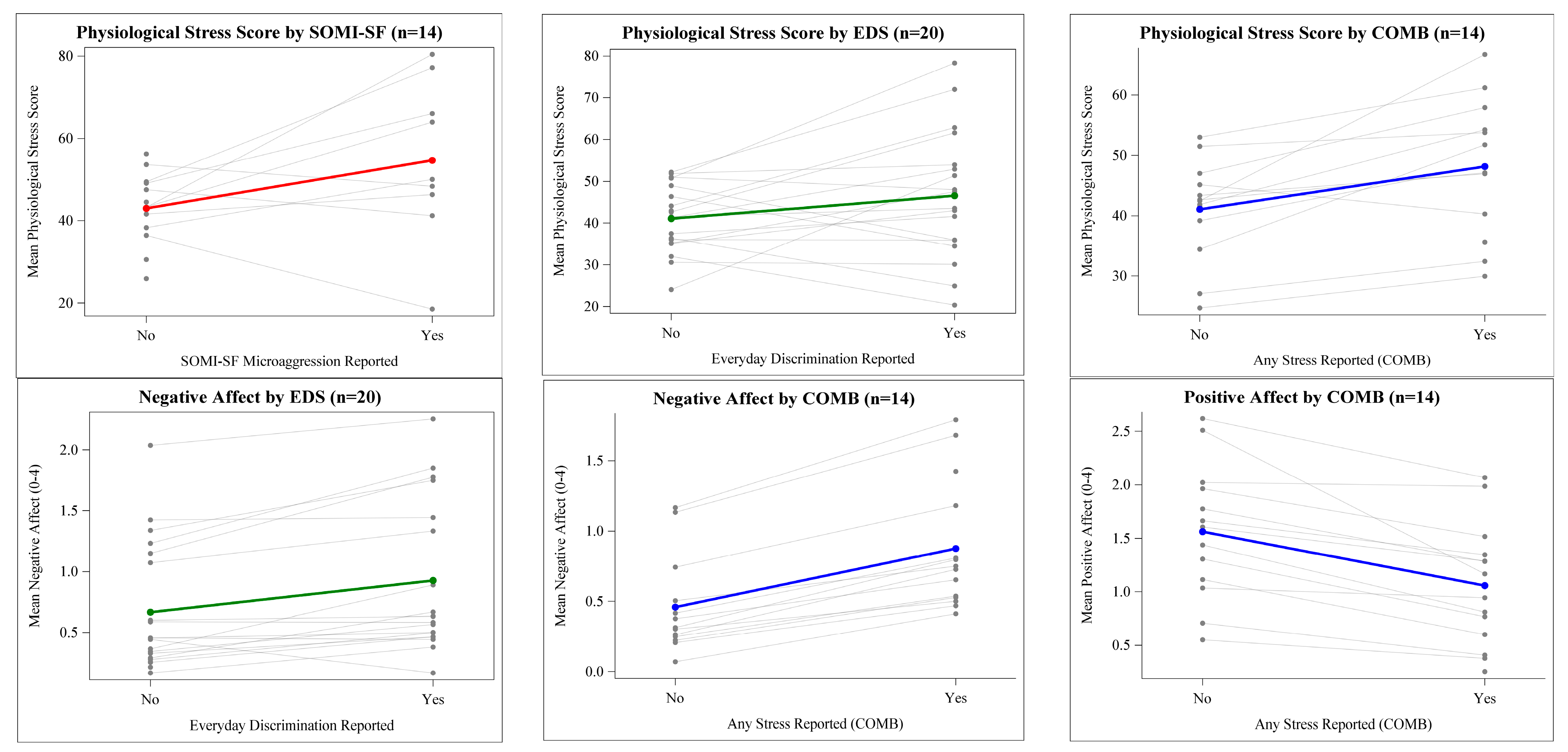
| No discrimination reported | 577 | 39.9 | 20.8 | (0.3–98.0) | 878 | 1.31 | 0.89 | (0.0–3.8) | 878 | 0.61 | 0.60 | (0.0–3.0) |
| Discrimination reported | 96 | 46.4 | 21.2 | (6.1–91.3) | 123 | 0.80 | 0.92 | (0.0–3.6) | 123 | 1.41 | 0.96 | (0.0–3.5) |
| 14 Participants (EMA n = 699) | ||||||||||||
| Sexual Orientation Microaggression Inventory (SOMI-SF) | ||||||||||||
| No microaggression reported | 359 | 41.8 | 22.2 | (2.3–98.0) | 618 | 1.3 | 0.9 | (0.0–3.4) | 618 | 0.6 | 0.6 | (0.0–3.5) |
| Microaggression reported | 62 | 50.0 | 20.9 | (6.1–91.3) | 81 | 1.1 | 0.8 | (0.0–3.6) | 81 | 1.0 | 0.7 | (0.0–3.3) |
| EMA of Stressful Event (EMA-SE) | ||||||||||||
| No stressful event reported | 372 | 42.1 | 21.8 | (2.3–98.0) | 635 | 1.3 | 0.9 | (0.0–3.6) | 635 | 0.7 | 0.6 | (0.0–3.3) |
| Stressful event reported | 49 | 50.7 | 23.9 | (6.2–92.4) | 64 | 0.9 | 0.8 | (0.0–3.4) | 64 | 1.0 | 0.7 | (0.0–3.5) |
| Current Perceived Stress (CPS) | ||||||||||||
| Not at all to a little | 258 | 42.9 | 22.5 | (2.3–98.0) | 468 | 1.6 | 0.8 | (0.0–3.6) | 468 | 0.5 | 0.5 | (0.0–3.2) |
| Moderately to extremely | 163 | 43.3 | 21.8 | (2.6–92.4) | 231 | 0.7 | 0.6 | (0.0–2.4) | 231 | 1.2 | 0.7 | (0.0–3.5) |
| Combined Stress experience (COMB) | ||||||||||||
| No stress experience reported | 198 | 40.5 | 22.3 | (2.3–98.0) | 388 | 1.6 | 0.8 | (0.0–3.4) | 388 | 0.4 | 0.4 | (0.0–2.3) |
| Stress experience reported | 223 | 45.3 | 21.8 | (2.6–92.4) | 311 | 0.9 | 0.7 | (0.0–3.6) | 311 | 1.0 | 0.7 | (0.0–3.5) |
| Physiological Outcome | Psychological Outcomes | ||||||||
|---|---|---|---|---|---|---|---|---|---|
| Stress Score | Positive Affect | Negative Affect | |||||||
| β | p-Value | 95% CI | β | p-Value | 95% CI | β | p-Value | 95% CI | |
| 20 Participants (n = 673) * | |||||||||
| Everyday Discrimination Scale | |||||||||
| No discrimination reported | 0 | 0 | 0 | ||||||
| Discrimination reported | 4.06 | 0.091 | (−0.66, 8.79) | −0.06 | 0.308 | (−0.17, 0.05) | 0.22 | <0.0001 | (0.13, 0.30) |
| 14 Participants (n = 421) * | |||||||||
| Sexual Orientation Microaggression Inventory (SOMI-SF) | |||||||||
| No microaggression reported | 0 | 0 | 0 | ||||||
| Microaggression reported | 8.16 | 0.025 | (1.02, 15.31) | −0.10 | 0.231 | (−0.27, 0.07) | 0.08 | 0.221 | (−0.05, 0.20) |
| EMA of Stressful Event | |||||||||
| No stressful event reported | 0 | 0 | 0 | ||||||
| Stressful event reported | 5.28 | 0.104 | (−1.08, 11.65) | −0.30 | <0.0001 | (−0.44, −0.16) | 0.38 | <0.0001 | (0.27, 0.48) |
| Current Perceived Stress | |||||||||
| Not at all to a little | 0 | 0 | 0 | ||||||
| Moderately to extremely | 3.62 | 0.149 | (−1.31, 8.56) | −0.52 | <0.0001 | (−0.62, −0.42) | 0.44 | <0.0001 | (0.36, 0.51) |
| Combined Stress Experience | |||||||||
| No stress experience reported | 0 | 0 | 0 | ||||||
| Stress experience reported | 5.93 | 0.008 | (1.53, 10.34) | −0.31 | <0.0001 | (−0.41, −0.22) | 0.33 | <0.0001 | (0.26, 0.39) |
Disclaimer/Publisher’s Note: The statements, opinions and data contained in all publications are solely those of the individual author(s) and contributor(s) and not of MDPI and/or the editor(s). MDPI and/or the editor(s) disclaim responsibility for any injury to people or property resulting from any ideas, methods, instructions or products referred to in the content. |
© 2026 by the authors. Licensee MDPI, Basel, Switzerland. This article is an open access article distributed under the terms and conditions of the Creative Commons Attribution (CC BY) license.
Share and Cite
Jun, H.-J.; Lee, K.-H.; Urueta Tapia, D.; Calzo, J.P.; Corliss, H.L. Real-Time Stress Experiences and Physiological and Psychological Responses Among LGBTQ+ Young Adults: Findings from the Stress and Heart Pilot Study. Sensors 2026, 26, 3872. https://doi.org/10.3390/s26123872
Jun H-J, Lee K-H, Urueta Tapia D, Calzo JP, Corliss HL. Real-Time Stress Experiences and Physiological and Psychological Responses Among LGBTQ+ Young Adults: Findings from the Stress and Heart Pilot Study. Sensors. 2026; 26(12):3872. https://doi.org/10.3390/s26123872
Chicago/Turabian StyleJun, Hee-Jin, Kang-Hyuk Lee, Dulce Urueta Tapia, Jerel P. Calzo, and Heather L. Corliss. 2026. "Real-Time Stress Experiences and Physiological and Psychological Responses Among LGBTQ+ Young Adults: Findings from the Stress and Heart Pilot Study" Sensors 26, no. 12: 3872. https://doi.org/10.3390/s26123872
APA StyleJun, H.-J., Lee, K.-H., Urueta Tapia, D., Calzo, J. P., & Corliss, H. L. (2026). Real-Time Stress Experiences and Physiological and Psychological Responses Among LGBTQ+ Young Adults: Findings from the Stress and Heart Pilot Study. Sensors, 26(12), 3872. https://doi.org/10.3390/s26123872