7.1. Industrial Practices and ICAO Standardization
Digitization has brought significant cybersecurity challenges, mainly because legacy trust models are highly incompatible with IP-based, open, and broadcast-dependent architectures. In order to address vulnerabilities in subsystems such as GNSS, ADS-B, and concepts in line with Zero Trust Architecture are currently being explored.
For Zero Trust implementation in CNS systems, the following documentation shall be adhered to as they provide regulatory baseline that any ZTA framework must comply with.
Annex 10 Volume III—Communication Systems: Part I addresses Aeronautical Telecommunication network (ATN), Communication Systems, and VHF Digital Link (VDL) Modes 2, 3, and 4. These standards are the ones that define communication paths that ZTA policy enforcement points must secure.
Global Navigation Satellite System (GNSS) Manual (DOC 9849) and Performance Based Navigation (DOC 9613): These documents provide guidance on GNSS and PBN implementation and operation. For ZTA applied to navigation systems, the authentication and integrity requirements for navigational data must align with the provisions outlined in these manuals.
Manual on Secondary Surveillance Radar (SSR) Systems (DOC 9684) and Manual on Mode S Specific Services (DOC 9688): These documents outline surveillance data formats and exchange protocols [
38,
39]. Micro-segmentation strategies for ZTA must operate within these defined protocols.
Recent developments in Zero Trust Architecture (ZTA) within aviation systems must be comprehended in alignment with global regulatory frameworks as defined by the International Civil Aviation Organization (ICAO). Identity management, resilience, and secure information sharing are highlighted in ICAO cybersecurity guidelines, including the Aviation Cybersecurity Strategy and Trust Frameworks that closely align with ZTA.
Furthermore, the integration of ZTA mechanisms into the CNS environment is influenced by the stringent criteria imposed on safety-critical systems by avionics certification and system assurance standards like DO-178C and DO-254 [
40].
Though the International Civil Aviation Organization (ICAO) has not explicitly standardized ZTA, its recent requirements on redundancy, resilience, and integrity assurance implicitly align with ZTA concepts. CNS systems are used across various nations. Implementing a ZTA framework requires collaboration across different countries’ regulatory bodies (e.g., FAA, EASA) and approval from international bodies like ICAO and EUROCAE WG-72.
7.4. Zero Trust Architecture for CNS Systems
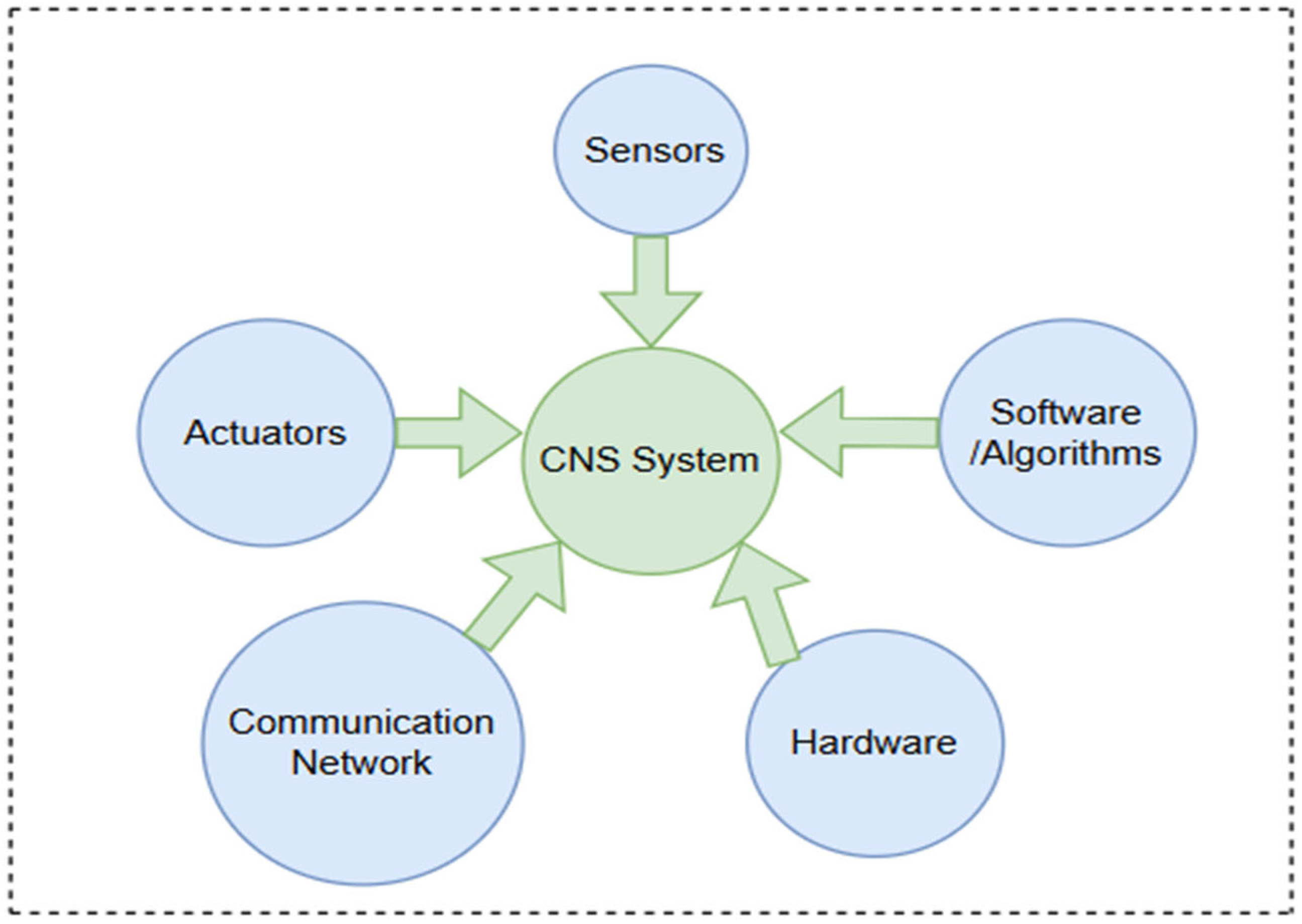
To implement the four guiding principles in a distributed avionics system, designers should consider all the building blocks of current cyber-physical systems. Zero Trust for CNS systems design and development incorporates several layers and components, such as sensors, actuators, processing units (HW), algorithms (SW), a communication network, and verification methods.
Figure 6 illustrates the key techniques currently focused on, which are classified across different system components.
7.4.1. Zero Trust in Sensor Components
The Zero Trust CNS systems design in
Figure 6 typically incorporates sensor components for the system to be trustworthy based on their physical activity. The messages received via a data communication bus are mostly assumed to be authentic. However, this current approach poses significant security risks if cyber-criminals manage to breach the sensors.
The sensors are one critical component that is incorporated in CNS systems, which implies that data from them is inherently trusted. This presents several limitations, because firstly, there is no verification of device identification, meaning that any counterfeit or unverified sensor can be connected to the system. There is also no integrity protection or message authentication, which leaves sensor outputs vulnerable to replay attacks and spoofing. The cross-sensor validation before the data is processed is also not considered yet. In CNS systems, sensors such as air data, GPS, and radars are susceptible to manipulation and spoofing, and without behavioral validation, they can feed misleading data into navigation and control algorithms.
- a.
Online authentication
Fostering secure collaboration between sensors and platforms, similar to how TLS and HTTPS protect web transactions, could be an effective protection. This model enables components to recognize and authenticate each other, establish secure connections, and measure firmware. This technique could protect intellectual property in the semiconductor industry and prevent physical assaults and unauthorized firmware updates. The platform’s protocol challenges new sensor components connected to the system. For example, if a drone’s camera, GPS receiver, or Inertial Measurement Unit (IMU) is changed, then the platform would check its authenticity using this protocol with public key cryptography certificates.
- b.
Fault-Tolerant Redundancy
The dependability of Integrated Circuits (ICs) is becoming a key concern due to technical difficulties introduced by diminishing nodes. Reliability and performance are complex issues due to sensitivity to external factors such as radiation-related effects (from cosmic rays or radioactive decay), electromigration, high temperatures, process variation, and transistor aging. To implement a Zero Trust approach, it is imperative that robust and fault-resistant systems that can withstand manufacturing faults and transient errors are designed.
Designing fault-tolerant systems has been practiced for decades, particularly in aviation, space exploration, and healthcare. This strategy enables a system to function in a degraded mode, rather than failing completely due to a malfunctioning component. Several techniques for fault tolerance and recovery mechanisms are discussed as follows:
Triple Modular Redundancy (TMR) involves running the same code simultaneously across three redundant modules (System on Chips) on a platform. The results are processed by a majority-voting aggregator into a single output. If one of the three modules malfunctions or fails, then the other two can correct the fault and continue operating without any interruption. However, this technique increases power, size, and weight by three times, making it unsuitable for autonomous machines like drones. This is because the efficiency of a drone is determined by its available battery capacity.
Another technique is Dual Modular Redundancy (DMR), which uses two redundant modules to execute the same code simultaneously. A voting aggregator identifies potential malfunctions and failures. This technique conserves power, size, and weight but cannot recover from faults.
Checkpointing with the roll-back technique is another method: instead of comparing the outputs of each module at every instruction, it just captures periodic snapshots of the system in a good state of execution. So, when a fault occurs, the system can revert to a recent snapshot. Implementing such mechanisms for real-time systems may be difficult and can even impair functionality. Aircraft may crash due to delays caused by roll-back operations while they are attempting to recover from a fault. The roll-forward approach allows both modules to execute their jobs speculatively. A third module, temporarily powered up, can determine which of the two original modules is malfunctioning. After identifying the fault, the faulty module will roll forward to match the state of the other module, allowing recovery from the fault.
- c.
Continuous Digital Twin Validation
The Zero Trust concept emphasizes continuous verification and monitoring for sensor components in a digital twin framework. Continuous verification verifies a sensor’s identification and status at each interaction, not only during initial authentication. The system validates the sensor’s identity using cryptographic methods and ensures its software is up-to-date, uncompromised, and running within expected parameters. Continuous Monitoring involves observing sensor behavior and data in real-time to detect anomalies. The system scrutinizes sensor behavior, data, and network interactions for any deviations from normal patterns to discover anomalies using machine learning algorithms. Any detected anomalies trigger real-time alerts and appropriate response mechanisms. A digital twin environment allows for modeling and simulation of potential issues, experimenting with various responses, and optimization of verification and monitoring processes without affecting the actual physical system.
7.4.2. Zero Trust on Actuator Components
Actuators, like sensors, are key components and are very crucial in systems. They perform physical actions in a system based on the inputs they receive, and this makes them targets for cyber-attacks aimed at disrupting the operation of the system. Most ZT approaches for sensors can also be applied to actuators. Since actuators are the components that change the system’s states, the Runtime Assurance concept can be related to ZT for the actuator components.
- a.
Runtime Assurance
RTA, ZT, and actuator components work together to ensure safety and security in actuator-controlled systems. The ZT security concept requires verification of all interactions with actuator components, including continuous authentication, data encryption, and network segmentation. Meanwhile, RTA is a constant, continuous process ensuring the correct and safe operation of the system. The process involves monitoring actuator statuses, ensuring command safety, and reacting to anomalies in real time, such as shutting down the actuator, activating redundancy systems, or alerting operators.
7.4.3. Zero Trust on Computing Hardware Components
Once a piece of hardware is manufactured and shipped to the user, it can be challenging to update or modify it to guard against new security threats that may emerge. Below are a few ZT strategies and principles that can help to mitigate this issue.
- a.
Secure by design
This technique entails developing secure hardware from the ground up. Security is a primary consideration during hardware design and development, and not an afterthought. Designing hardware with security in mind involves lowering the attack surface, implementing strong access controls, and protecting critical data through encryption. The secure by design principle advocates proactive vulnerability remediation to prevent future threats from exploiting them.
- b.
Security Through Obscurity
Adding obscurity can improve hardware security, but it is not a stand-alone strategy. The goal is to make the hardware system difficult for attackers to understand or predict. Proprietary protocols, scrambled memory layouts, and obscured firmware can help achieve this. Although this does not make the system immune to attacks, it does increase the barrier for possible attackers, thus stalling and adding an extra layer of security.
- c.
Hardware-Based Security Features
Certain security features can be implemented directly into the hardware. Secure boot mechanisms, hardware random number generation for stronger encryption, and cryptographic key storage modules are examples of security measures. Hardware-based features can provide strong defense against software-based attacks and other various threats.
- d.
Redundancy and Resilience
Building redundancy and resilience into hardware ensures continuous operation, even if a component of the system is compromised. Redundant components can take over if primary components fail or are compromised. Error-checking and correction techniques can maintain data integrity. Designing fail-safe modes helps prevent catastrophic failures, while automated recovery techniques can restore operations after disruptions. These factors improve the system’s resilience and recovery from attacks.
- e.
Physical Security
Ensuring the physical security of hardware is another key consideration. This prevents attackers from tampering with or directly accessing the hardware to obtain sensitive data. Security measures can range from simple locks to advanced methods like tamper-evident seals, transparent casing, and self-destruction mechanisms that delete sensitive data upon detection of tampering.
- f.
Lifecycle Management
Although hardware tends to be more static than software, it can nonetheless be modified. Hardware components can be changed or replaced over time to address evolving threats. The hardware lifecycle management procedure must be secure and strong to avoid unauthorized alterations. In some cases, “firmware” updates can modify the hardware’s operation. In others, it might involve a secure, physical replacement process. Maintaining hardware systems over time ensures maximum security against evolving threats.
7.4.4. Zero Trust on Software Algorithm Components
Compared to hardware, software can be patched and updated remotely as new threats are identified. Below are some key ZT principles and strategies for ensuring software security over time:
- a.
Principle of Least Privilege
The principle of least privilege is a central element of Zero Trust. Software components should only have sufficient permissions to execute their task. This technique reduces the risk of component compromise by requiring consistent verification of identity and authorization, reinforcing Zero Trust policy. Data in a computer system can be in three states: in transit (moving across networks), at rest (stored), or in use (for processing or computation).
Confidential computing protects data and code, ensuring correct computation in applications. Implementing Zero Trust Architectures can be streamlined by ensuring data confidentiality, data integrity, and code integrity. This eliminates uncertainties from operating systems, hypervisors, and other applications. Traditionally, highly privileged operating systems or hypervisors have had unrestricted access to application memory, which poses a vulnerability. Historically, industry efforts have concentrated on strengthening these components to prevent attacks. Confidential computing involves assigning resource management to operating systems or hypervisors and restricting their access to application memory, transforming the current model. This shifts the trust dependency from operating systems or hypervisors to the hardware, thus reducing the Trusted Computing Base (TCB) and further enhancing security [
46].
- b.
Secure Coding Practices
Implementing secure coding practices is crucial in a Zero Trust environment. Developers should be aware that any system, including internal components, can be compromised. To ensure security, code should be built defensively, with the assumption that any input can be a potential attack vector. To reduce security concerns, it is important to validate input, handle errors securely, and conduct regular code reviews.
- c.
Software Patches and Updates
Maintaining the latest patches and updates is crucial in a Zero Trust system. Patches and updates often address known vulnerabilities that could be exploited by attackers. A compromised component could undermine the whole Zero Trust strategy, so ensuring timeous updates for all components is of utmost importance.
7.4.5. Zero Trust on Communication Network Components
The security of the communication network is of paramount importance as they are critical element in any system, especially considering a Zero Trust Model. Below are the main points related to securing these components:
Network Segmentation holds a significant value in the Zero Trust Framework. Network Segmentation involves dividing the network into smaller networks that function independently. This method aims to prevent lateral movement within the network, particularly for possible invaders to CNS systems. If an attacker gains access to one portion of the network, then segmentation prevents intrusion from spreading further and affecting other parts, especially because ground CNS systems are highly interconnected. As a result, if a device in one segment is compromised, the threat is confined to that specific segment, minimizing the overall impact on the network [
47].
- b.
End-to-end Communication Encryption
The Zero Trust concept emphasizes encryption for all network traffic. Encrypting data during transit prevents hostile actors from manipulating or exploiting intercepted data. Encryption should apply to all data, not only sensitive information. Even seemingly harmless data may provide valuable insight to a skilled attacker [
48].
- c.
Intrusion Detection and Prevention Systems (IDPS)
Zero trust emphasizes the importance of intrusion detection and prevention technologies. These systems monitor network traffic to detect malicious activities and policy violations. When an IDPS detects a danger, it can take defensive actions like blocking or reducing network traffic to protect network integrity [
49].
- d.
Software Defined Perimeter (SDP)
A software-defined perimeter contributes to implementing a Zero Trust model across network components. An SDP creates an invisible network to outsiders. Access to network resources is controlled based on user identification, device, and context, rather than the network location alone. This approach adheres to the Zero Trust Principles and does not trust any user or device by default, regardless of their position within or outside the network.
- e.
Micro Segmentation
Micro-segmentation, a finer level of network segmentation, is particularly beneficial in cloud networks. Micro-segmentation separates workload and application components into independent segments. This method reduces the attack surface and prevents emerging risks within a network. This approach protects the entire system by isolating each part.
- f.
Network Resilience
A Zero Trust strategy requires designing a network that can resist attacks and failures and quickly recover from them. To ensure system reliability, redundancy, effective failover mechanisms, and rapid incident response are necessary. A resilient network is capable of limiting damage from breaches and recovering quickly and effectively, rather than only resisting attacks [
49].
7.4.6. Verification and Validation (V&V) Procedures
Incorporating Zero Trust principles into system engineering verification and validation procedures can enhance the reliability and security of a system. Here is how Zero Trust can be applied to these processes:
The verification phase should ensure that avionics systems are designed to adhere to Zero Trust principles from the outset. This includes ensuring strong access restrictions, network segmentation, and strict data protection standards are in place in avionics systems. Check critical components like sensors and actuators to ensure they function on the “least privilege” principle, eliminating extraneous permissions that could expose them to potential risks.
- b.
Validation
Validation tests the system to ensure it meets the end user demands and performs as per the specifications. To implement Zero Trust, security measures must be tested to confirm their effectiveness. For example, conduct a penetration test to prevent access to the system, or simulate a compromised device to ensure the system detects and responds effectively.
- c.
Continual Verification
CNS systems are dynamic and require continuous monitoring. Continuous verification is a key component of implementing Zero Trust. Implementing real-time assurance systems with constant monitoring can help ensure system integrity. Anomalies in sensor readings or unexpected behaviors in actuators must trigger rapid alerts and responses [
37].
- d.
Audits and Documentation
Logging and analyzing all CNS system actions is crucial for detecting abnormal behaviors. The trail helps in identifying and understanding potential threats. Effective documentation of V&V processes ensures a clear and traceable record of system behavior and responses to security events.
- e.
Feedback Loop
CNS systems, like any other Zero Trust implementations, should prioritize continuous improvement. Regular monitoring, testing, and incident responses can provide valuable insight for system design and operation. If a vulnerability is identified in the CNS subsystem, then corrective measures should be implemented and re-verified to ensure the issue is fully remedied.
- (a)
Software/Algorithms
The computational logic and background processes are trusted by default. The systems do not represent secure boot, runtime integrity monitoring, firmware signing, and partitioning mechanisms. This introduces risks such as unauthorized parameter changes, firmware modifications, and exploitation of vulnerabilities in algorithm implementations.
In the absence of memory isolation and runtime verification, compromised software could generate unsafe actuator commands, and navigation solutions may be manipulated. In safety-critical CNS systems, software must not only meet minimum functional requirements but also extend to maintaining integrity to guard against intentional tampering.
- (b)
Hardware
Hardware is another trusted contributor to the CNS systems without any visibility of security controls. There is little to no hardware root of trust, cryptographic key storage, secure elements, and supply chain protection mechanisms. This presents the risks like counterfeit circuit boards, hardware bugs, and bitstream replacements. Since avionics systems have a long-life span, supply chain and lifecycle integrity are critical. The security architecture assumes trust without any demonstration of how that trust is established and maintained.
- (c)
Communication Network
The communication network interconnects CNS systems with external components and other avionics systems without authentication, encryption, and segmentation in place. Traditional CNS communications buses do not include additional protective layers and native security features, which makes them susceptible to spoofing, message injection, replay attacks, and denial-of-service conditions. The communication network allows for seamless communication without restrictions like strict identity verification and least-privilege communication policies between system elements.
7.5. Generic Challenges with ZTA Implementation in CNS Systems Across Air Navigation Service Providers (ANSPs)
Implementing the Zero Trust principles in avionics systems presents a different set of challenges that need attentive strategic and planning responses. While the benefits of Zero Trust are significant, to maximize its benefits and full adoption, the challenges need to be carefully navigated.
The biggest challenge with the adoption of Zero Trust Architecture in CNS systems is the fact that, amongst the three disciplines, there are legacy systems that are still used and were only compatible with traditional security models, but with the increase in modern cybersecurity threats, those models are no longer effective.
When the CNS data is shared across centers, the external service providers are involved as they are the ones with the infrastructure to transfer the information at a correct bit rate and in real-time, since timestamping is the most crucial measure for the validity of information. That poses challenges, especially with encryption, as the collaborative decision-making (CDM) system needs to be in place and effective so that there can be that surety that the data shared is not vulnerable to cyber-attacks (e.g., interception of voice between the air traffic controller and pilot).
Another challenge with the full implementation of ZTA in CNS is the design that enables continuous patching and updating mechanisms throughout the lifespan of equipment, which is usually between 10 and 15 years. The sad reality is that the original equipment manufacturers usually stop supporting their products after a few years and recommend the purchase of their new products, and in aviation, that is not practically possible.
Below are other key barriers to Zero Trust implementation.
Cultural Barriers and Organizational Resistance
The transition from the traditional security approaches to the Zero Trust framework requires a lot of cultural shifts in the aviation sector. This sector is promoting safety culture, and time is also a crucial part in all tasks conducted, hence why there may be resistance to adopting continuous verification and privilege access principles of zero trust. The new change management strategies, transparent communication, and comprehensive training need to be implemented to adopt a Zero Trust framework.
Technical Complexity and Integration
CNS systems can be complex as a standalone system because of how they are integrated with each other. Integrating Zero Trust on top of that can be very technically challenging and would require extensive resources. Surveillance technologies, navigation, and diverse communication legacy systems may present compatibility challenges. Maintaining operational functionality is a key priority to ensure safety in aviation, so there is a need for careful planning and implementation in stages to ensure seamless interconnectivity amongst CNS and Zero Trust components.
Balancing Security and Usability
The other challenge with Zero Trust adoption is finding the balance between Zero Trust-intensive security measures and user experience. Continuous verification and least privilege access policies may lead to delays in system restoration and also frustrate the user, which can lead to operational inefficiencies. To overcome this, aviation entities should streamline authentication processes, intuitive interfaces to optimize workflows in ensuring that security enhancements do not hinder operations.
Data Privacy and Regulatory Compliance
In a highly regulated industry like aviation, continuous verification and access controls may raise data privacy concerns. The companies will need to ensure compliance with ICAO and GDPR mandates while implementing robust security measures. This also necessitates the understanding of legal requirements and data governance practices.
Financial considerations
To implement Zero Trust, there is a need for significant investment in technology, maintenance, and staffing. Aviation organizations will have to allocate resources for upgrading security infrastructure, deploying monitoring tools, and personnel training. Balancing the costs and benefits will require a thorough cost–benefit analysis and strategic resource allocation.
Organizational scalability
Strategies used for the implementation of Zero Trust shall also accommodate the scalability and growth of organizations in the aviation sector. To ensure Zero Trust architecture is still effective even after the organization expands and evolves, careful architectural planning and adaptability to changing operational needs are required.