A Novel Optimal Layout Method for Rain Gauge Network Based on Mutual Information Entropy and Deep Learning Model



Abstract
1. Introduction
2. Materials and Methods
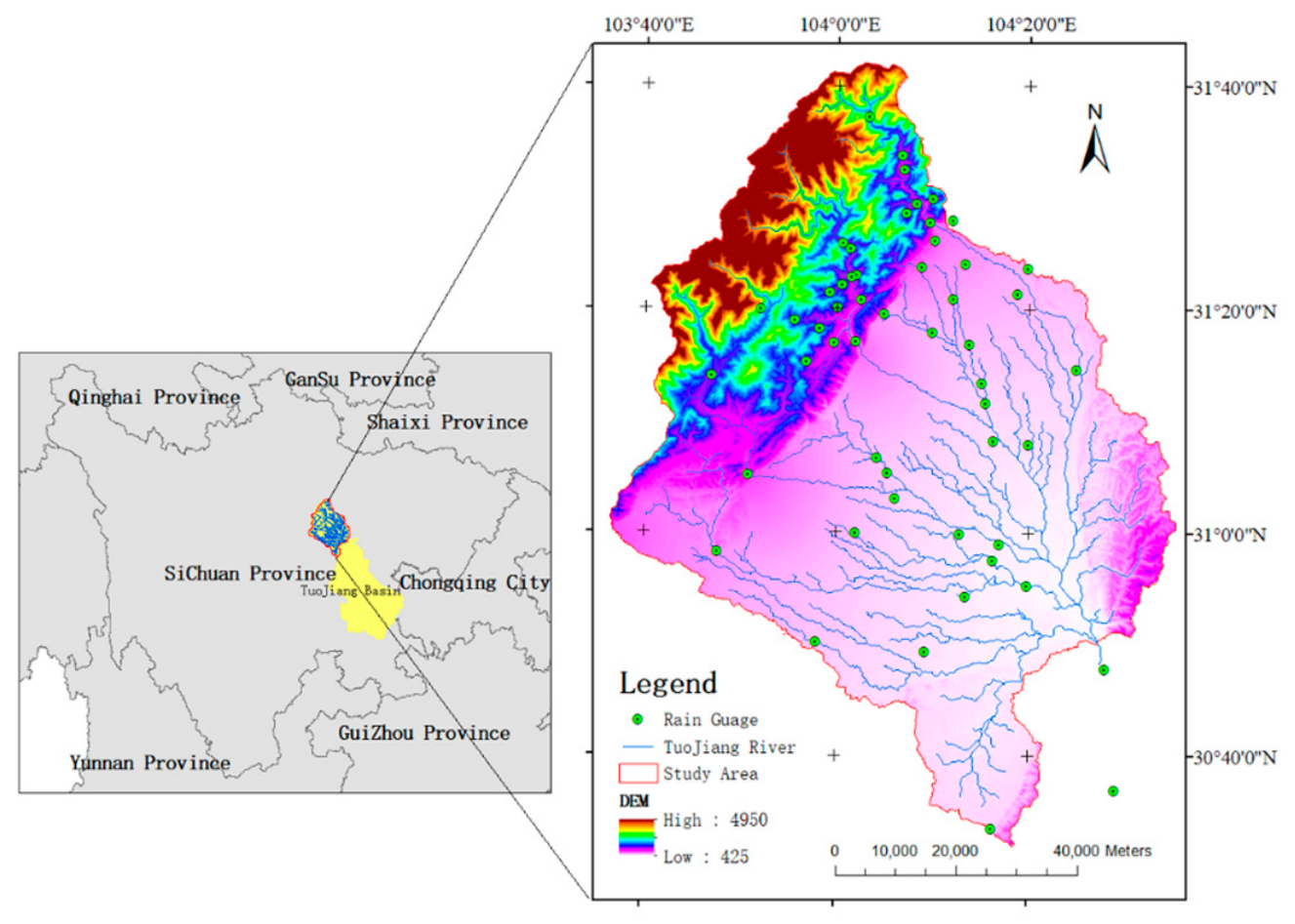
2.1. Study Area Overview
2.2. Data Sources and Preprocessing
2.3. Research Methods
- (1)
- Calculation of Basic Characteristic Values
- (2)
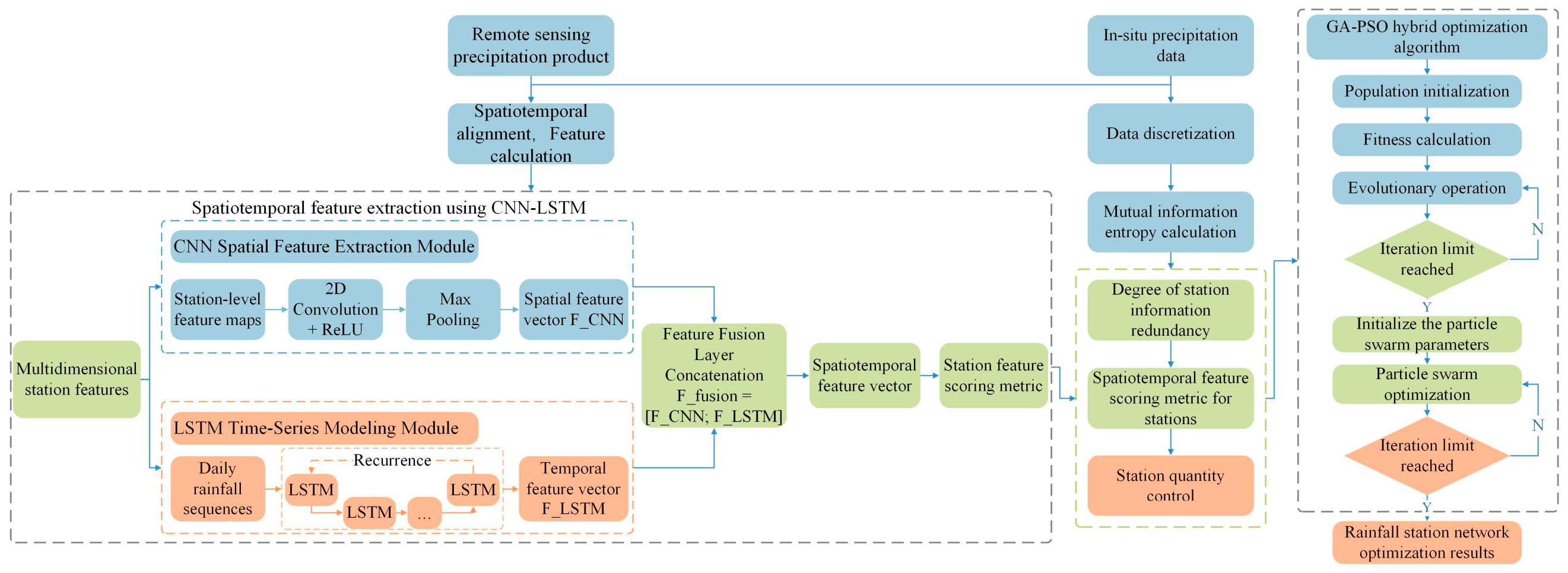
- Construction of the CNN-LSTM Spatiotemporal Deep Learning Model
- Input layer. The multidimensional features constructed during the basic feature calculation step, including station spatial features, remote sensing grid features, and rainfall time-series features, are standardized and then fed into the CNN and LSTM modules.
- CNN Spatial Feature Extraction Module. In this study, a two-dimensional convolutional neural network (2D-CNN) is employed to extract spatial features from station-level feature maps. Unlike a 3D-CNN, which is typically used for volumetric or spatiotemporal tensor data, the adopted 2D-CNN operates on two-dimensional feature maps constructed from station-related spatial attributes and remote sensing precipitation descriptors, including longitude, latitude, elevation, slope, aspect, and grid-based precipitation features. The 2D-CNN module captures local spatial dependencies, spatial gradients, and rainfall clustering patterns among neighboring stations through two-dimensional convolution (Equation (1)) and pooling operations (Equation (2)). The extracted spatial representations are subsequently fused with the temporal features learned by the LSTM module.
- 3.
- LSTM Time-Series Modeling Module (Equation (3)). Focusing on the temporal dependence of rainfall, this module captures the long-term evolutionary patterns of rainfall (including seasonal cycles, continuity of rainstorm processes, interannual variation trends, etc.) through gating mechanisms, avoiding the vanishing gradient problem of traditional Recurrent Neural Networks (RNNs).
- 4.
- Feature Fusion Layer. The spatial feature vector output by the CNN module and the temporal feature vector output by the LSTM module are concatenated and fused (Equation (4)) to construct a unified spatiotemporal fusion feature vector, which comprehensively represents the spatiotemporal representativeness of each station.
- 5.
- Model Training and Hyperparameter Optimization. The Adam optimizer is adopted with an initial learning rate of 0.001. This optimizer features fast convergence and strong stability, and can effectively alleviate local optima during model training. The loss function uses Mean Squared Error (MSE), which takes the error between estimated rainfall and observed rainfall at stations as the optimization objective, expressed as follows:
- (3)
- Calculation of Information Entropy
- (4)
- Construction of Coupled Information Entropy Index and Optimization Solution
- (a)
- Construction of Comprehensive Index
- (b)
- Solution by GA-PSO Hybrid Optimization Algorithm
3. Process and Results of Station Network Layout
3.1. Data Matching and Unification
3.2. CNN-LSTM Spatial Feature Extraction
- Model Construction. In accordance with the CNN-LSTM architecture described in Section 2.3, the preprocessed multidimensional feature vectors are used as model inputs. Spatial-related features (elevation, slope, aspect, remote sensing grid features, etc.) are fed into the CNN spatial feature extraction module, while temporal-related features (daily rainfall series, temporal statistical characteristics, etc.) are imported into the LSTM time-series modeling module. This ensures that the two modules extract features independently and lays a foundation for subsequent spatiotemporal feature fusion.
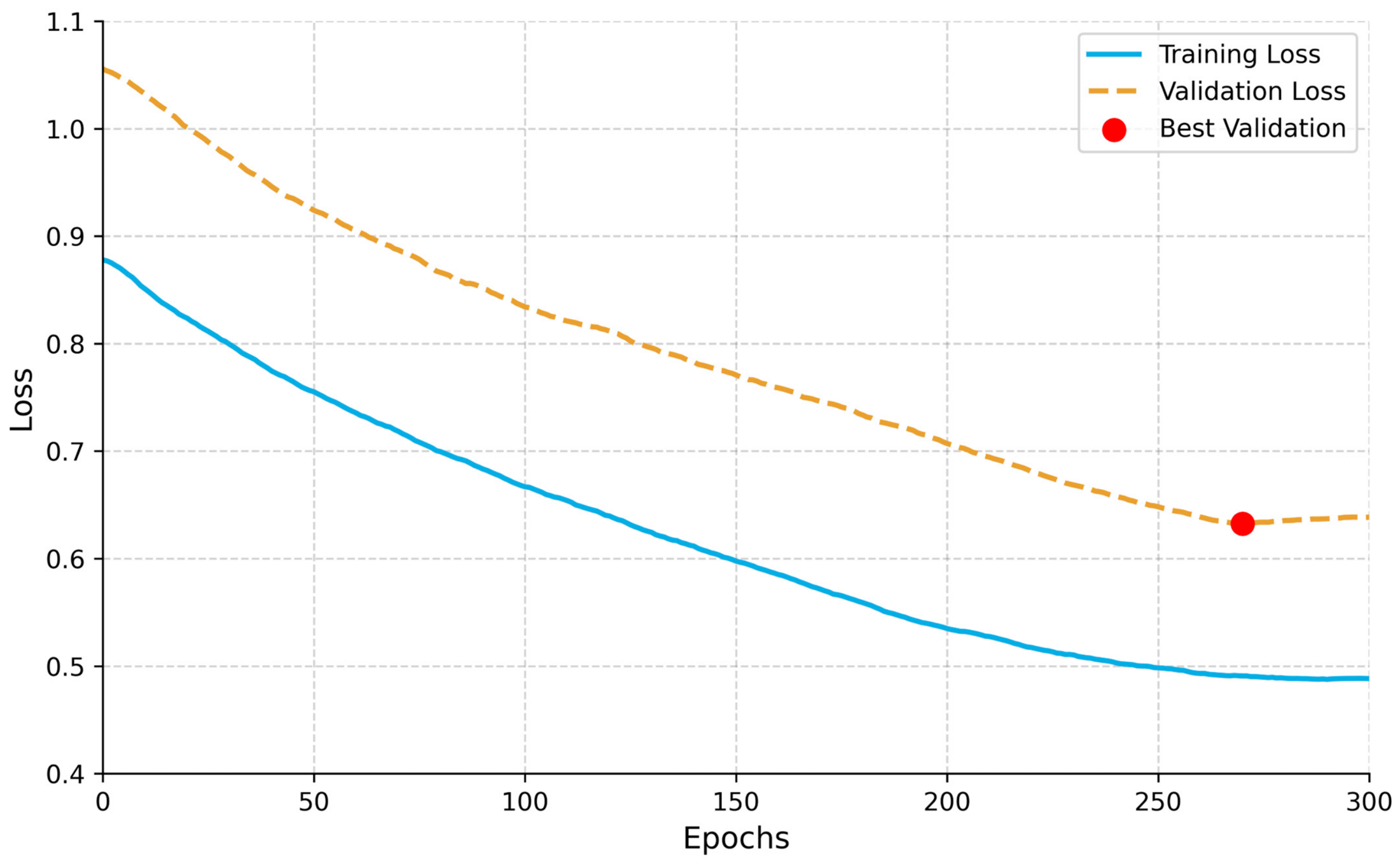
- Model Training. The CNN-LSTM model was trained according to the strategy described in Section 2.3. In this section, the final hyperparameter configuration and training results are reported. The key hyperparameters were optimized using the grid search method, including the look-back window length, the number of CNN convolutional kernels, the number of LSTM hidden-layer units, the learning rate, and the batch size. The look-back window was tuned by considering both the physical lag-time of rainfall events in the upper Tuojiang River Basin and the validation performance of the model. Candidate window lengths were tested to balance the representation of short-term rainfall persistence and the avoidance of excessive temporal redundancy. The spatial filters in the CNN module were tuned to capture local spatial gradients and neighborhood-scale rainfall heterogeneity associated with terrain variation, including elevation, slope, aspect, and remote sensing precipitation descriptors. The final optimal hyperparameter combination was determined as follows: the numbers of kernels in the three CNN convolutional layers were 32, 64, and 128, respectively, and the LSTM hidden-layer units were 128 and 64.
- 3.
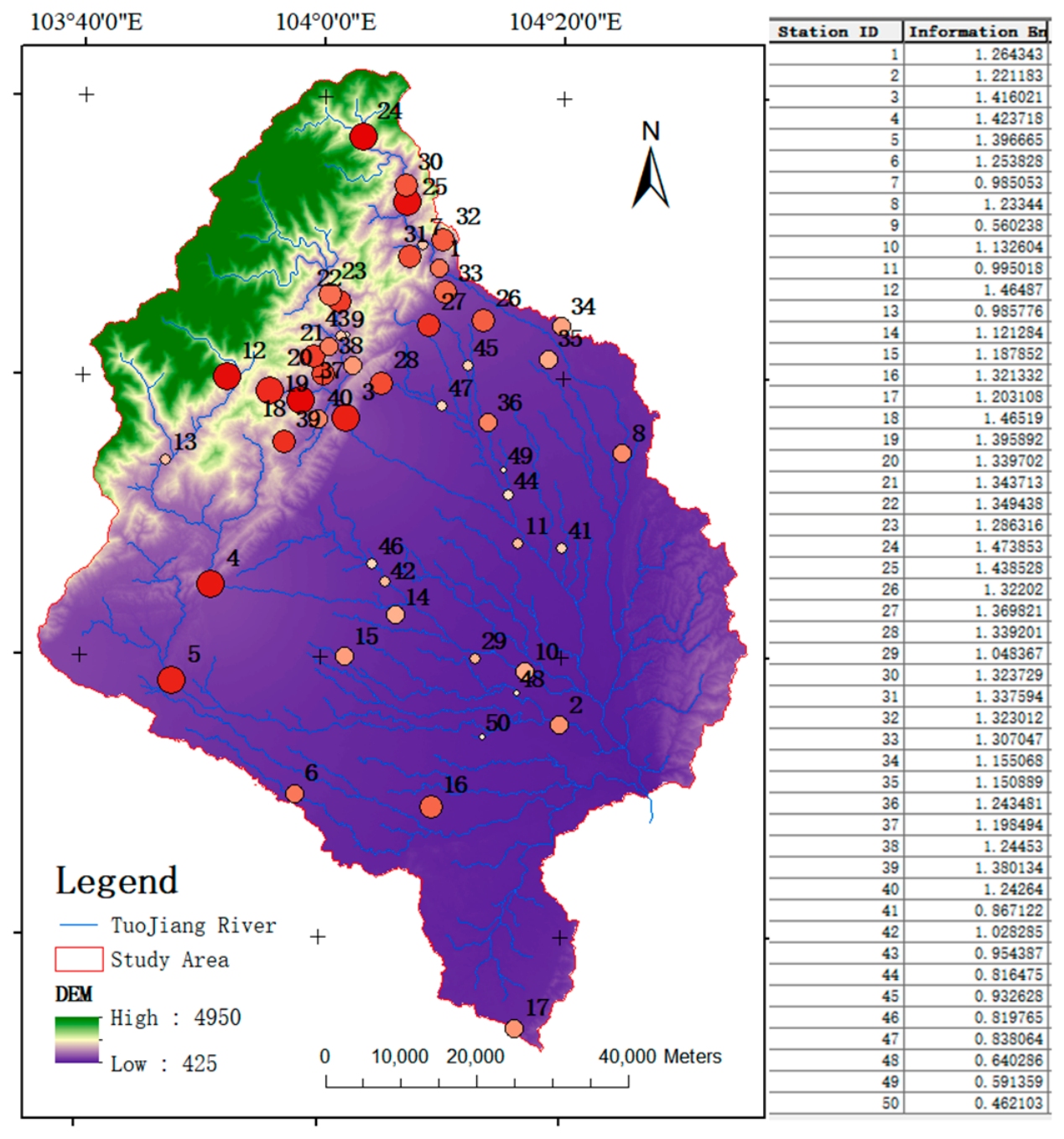
- Calculation of Prediction Error (MSE). After model training and validation, the preprocessed feature vectors of all 50 rain gauges are input into the trained CNN-LSTM model. Through the collaborative operation of each module, spatial and temporal features are extracted and fused. The prediction output layer then generates predicted rainfall features and observed rainfall features for each station. These values are substituted into the MSE formula to calculate the prediction error for individual stations and different station network combinations. The results serve as core input indicators for the subsequent GA-PSO hybrid optimization algorithm, providing quantitative support for the “accurate monitoring” objective of station network optimization.
3.3. Calculation of Information Entropy
3.4. Solution by GA-PSO Hybrid Optimization Algorithm
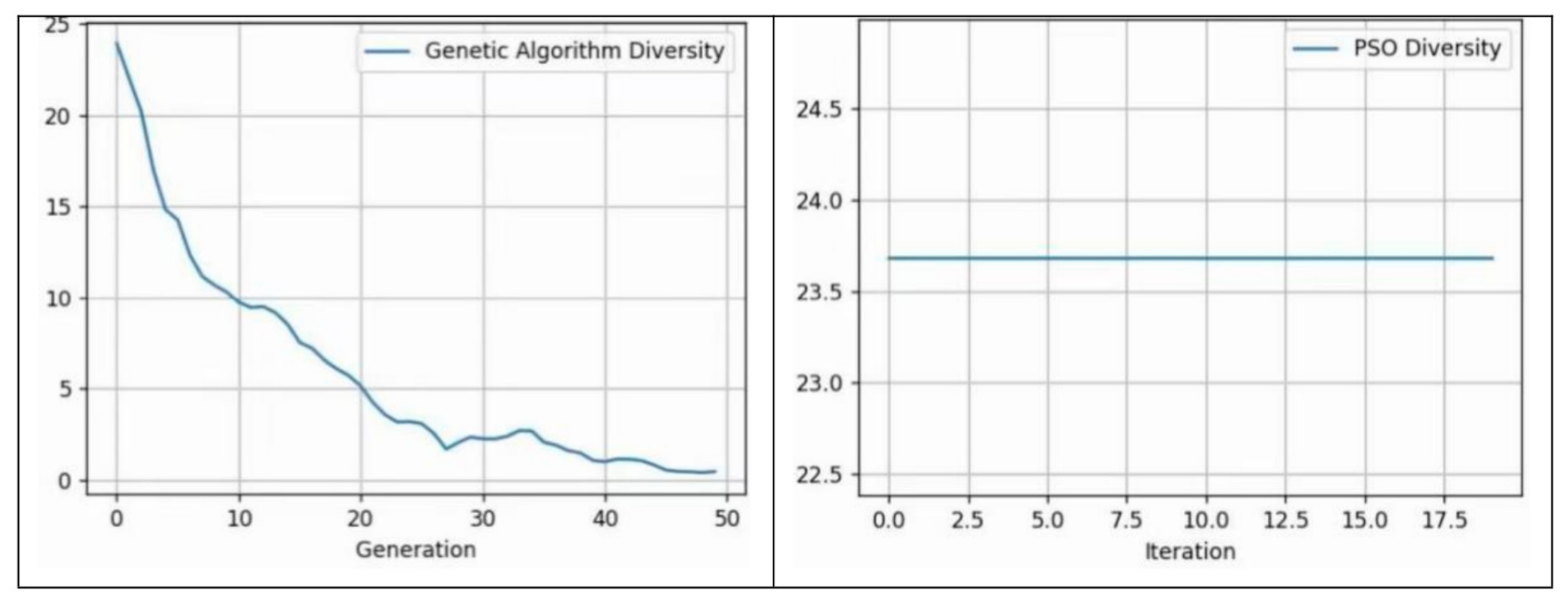
- Parameter Initialization. Core parameters of GA and PSO are initialized as follows: GA parameters: population size = 50, maximum iteration = 50, crossover probability = 0.7, mutation probability = 0.4 (bit-flipping mutation). PSO parameters: number of particles = 20, maximum iteration = 10, inertia weight w = 0.5, acceleration coefficients c1 = 0.8 and c2 = 0.9.
- Fitness Calculation. Combined with the previously calculated prediction error (MSE), mean mutual information between stations (MI), and number of stations (N), the fitness value of each individual (station network scheme) is computed using the fitness function.
- GA Global Search. GA iteration is initiated. Through selection (randomly sampling 3 individuals each time and selecting the one with optimal fitness for the next generation), crossover (parental gene recombination), and mutation operations, the optimal station network scheme in the GA stage is output after 50 iterations.
- PSO Local Optimization. The optimal solution from GA is taken as the initial position of the first particle, and 20 binary-coded particles are initialized. The velocity update formula of PSO is adopted as follows:
- 5.
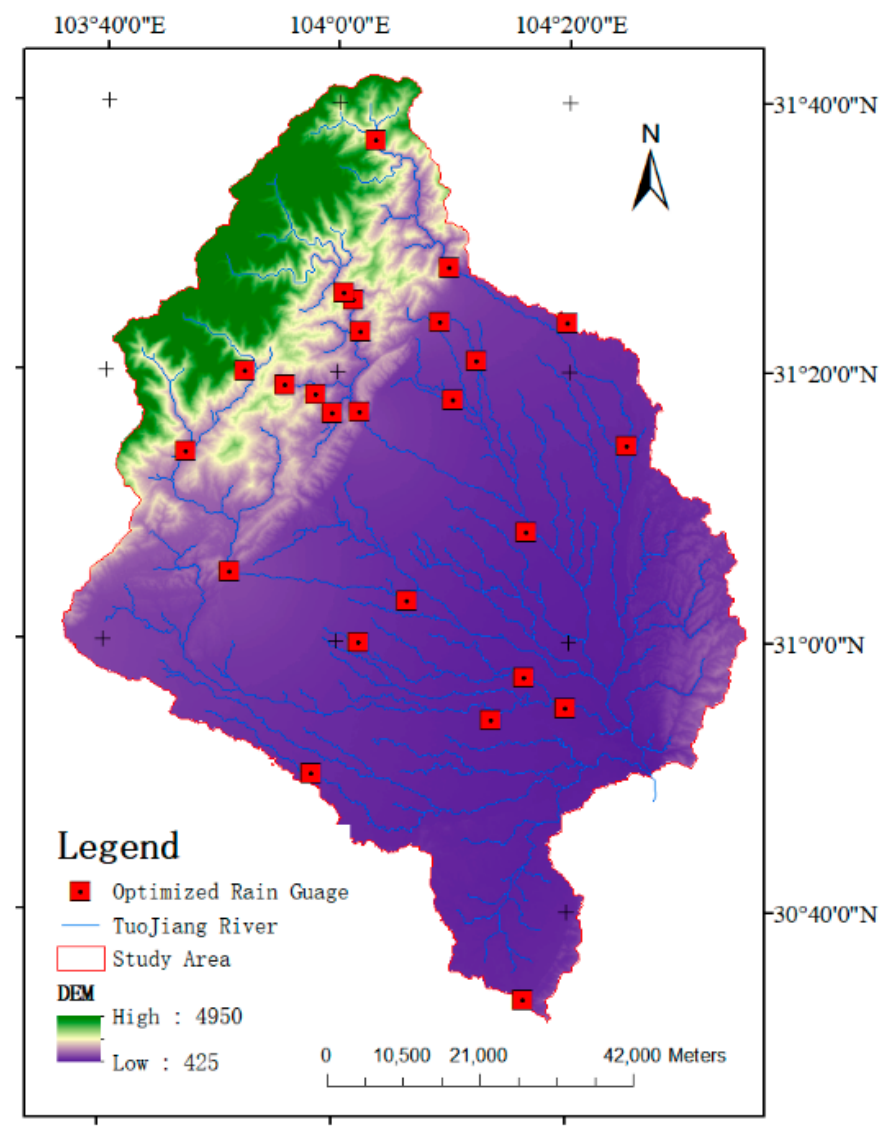
- Output of Optimized Rain Gauge Network Layout. After PSO iteration is completed, the global optimal solution is output as the final layout scheme for rain gauge network optimization in the upper Tuojiang River, achieving the coordinated goals of streamlined network structure, low redundancy, and high monitoring accuracy. The optimized results of the rain gauge network in the study area are shown in Figure 7.
4. Comparison and Discussion
4.1. Comparison of Spatial Network Structure
4.2. Comparison of Spatial Rainfall Distribution
4.3. Comparison of Mean Relative Error
4.4. Comparison of Station Network Information Entropy
- (1)
- The total information entropy of the station network characterizes the overall capacity of the network to capture rainfall information. A higher entropy value indicates a greater total information volume and a stronger ability to depict the spatiotemporal variability of rainfall within the basin. The original 50-station network yields a total information entropy of 95.1706 bits. After optimization via the proposed method, the 25-station network achieves a total information entropy of 46.9153 bits, outperforming the 44.7836 bits obtained by the traditional method. Retaining a higher total information volume while halving the number of stations demonstrates that the stations selected by the proposed method contribute more comprehensively and exhibit stronger representativeness of the basin’s rainfall patterns.
- (2)
- The joint information entropy reflects the combined uncertainty and overall informational richness collectively provided by all stations, demonstrating the network’s informational completeness as an integrated system. The proposed method yields an optimized joint information entropy of 9.7978 bits, which is higher than the 9.5939 bits achieved by the traditional method. This suggests that the network optimized by the proposed method possesses a more robust overall information structure and enhanced synergistic observation capabilities among station combinations, allowing for a more comprehensive delineation of the spatial distribution patterns of rainfall.
- (3)
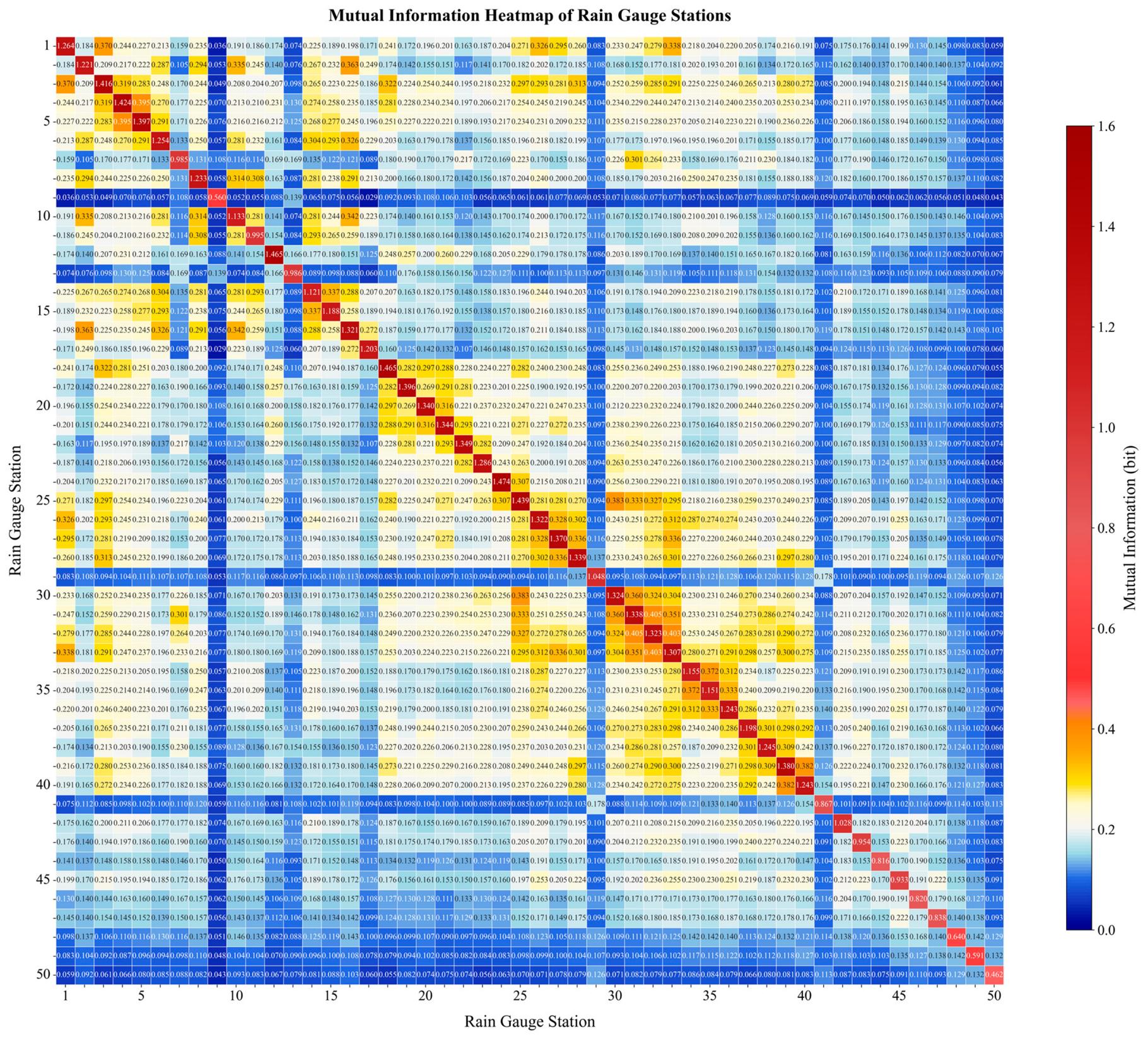
- The average mutual information entropy measures the degree of rainfall information overlap among stations. A larger value denotes higher information redundancy, whereas a smaller value implies stronger informational complementarity. The network optimized by the proposed method exhibits an average mutual information entropy of 0.2264 bits, slightly higher than the 0.2164 bits from the traditional method. This indicates that while the proposed method effectively reduces redundancy, it refrains from over-minimizing mutual information. Instead, it strikes a balance between total information volume and spatial representativeness, resulting in a more uniform station layout and a more scientifically sound observation structure.
- (4)
- Redundant information entropy, defined as the difference between total and joint information entropy, represents the volume of duplicated and overlapping invalid information within the network. A lower redundancy entropy signifies a more streamlined network and a more efficient layout. The redundant information entropy of the original network reaches as high as 84.4625 bits, which drastically decreases to 37.1175 bits after optimization using the proposed method, significantly mitigating information overlap. Compared to the traditional method, the magnitude of redundancy reduction in the proposed method is slightly smaller. This is because the proposed approach prioritizes the retention of high-information stations over the mere minimization of redundancy, thereby maximizing the preservation of valid information while streamlining the stations.
5. Conclusions
Author Contributions
Funding
Data Availability Statement
Conflicts of Interest
References
- Mishra, A.K.; Coulibaly, P. Developments in hydrometric network design: A review. Rev. Geophys. 2009, 47, RG2001. [Google Scholar] [CrossRef]
- Wang, J.; Chen, J.; Shen, P.; Guan, X.; Liu, X.; Massari, C.; Wang, Z.; Feng, M.; Wang, Q.; Lu, Y.; et al. Regional-scale intelligent optimization and topography impact in restoring global precipitation data gaps. Commun. Earth Environ. 2025, 6, 671. [Google Scholar] [CrossRef]
- Suri, A.; Azad, S. Optimal placement of rain gauge networks in complex terrains for monitoring extreme rainfall events: A review. Theor. Appl. Climatol. 2024, 155, 2511–2521. [Google Scholar] [CrossRef]
- Li, D.; Wang, J.; Deng, K.; Zhang, D.; Zhao, C.; Leng, H.; Wen, Y.; Liu, Y.; Ren, K.; Song, J. Review on deep learning quantitative precipitation nowcasting: Advances and challenges. Expert Syst. Appl. 2026, 305, 130775. [Google Scholar] [CrossRef]
- Feki, H.; Slimani, M.; Cudennec, C. Geostatistically based optimization of a rainfall monitoring network extension: Case of the climatically heterogeneous Tunisia. Hydrol. Res. 2016, 48, 514–541. [Google Scholar] [CrossRef]
- Wang, K.; Chen, N.; Tong, D.; Wang, K.; Wang, W.; Gong, J. Optimizing precipitation station location: A case study of the Jinsha River Basin. Int. J. Geogr. Inf. Sci. 2015, 30, 1207–1227. [Google Scholar] [CrossRef]
- Li, C.; Singh, V.P.; Mishra, A.K. Entropy theory-based criterion for hydrometric network evaluation and design: Maximum information minimum redundancy. Water Resour. Res. 2012, 48, W05521. [Google Scholar] [CrossRef]
- Alfonso, L.; He, L.; Price, R.; Lobbrecht, A. Information theory applied to evaluate the discharge monitoring network of the Magdalena River. J. Hydroinformatics 2013, 15, 211–228. [Google Scholar] [CrossRef]
- Huang, Y.; Zhao, H.; Jiang, Y.; Lu, X. A method for the optimized design of a rain gauge network combined with satellite remote sensing data. Remote Sens. 2020, 12, 194. [Google Scholar] [CrossRef]
- Chin, W.F.L.; Suhaili, W.S. Rain gauge network optimization in Brunei-Muara district using historical data. In Proceedings of the 6th International Conference on Applied Computational Intelligence in Information Systems (ACIIS), Bandar Seri Begawan, Brunei, 23–25 October 2023; IEEE: Bandar Seri Begawan, Brunei, 2023; pp. 1–6. [Google Scholar]
- Haggag, M.; Elsayed, A.A.; Awadallah, A.G. Evaluation of rain gauge network in arid regions using geostatistical approach: Case study in Northern Oman. Arab. J. Geosci. 2016, 9, 552. [Google Scholar] [CrossRef]
- Skok, G. Analytical and practical examples of estimating the average nearest-neighbor distance in a rain gauge network. Meteorol. Z. 2006, 15, 565–573. [Google Scholar] [CrossRef]
- Shi, X.; Chen, Z.; Wang, H.; Yeung, D.Y.; Wong, W.K.; Woo, W.C. Convolutional LSTM network: A machine learning approach for precipitation nowcasting. Adv. Neural Inf. Process. Syst. 2015, 28, 802–810. [Google Scholar]
- Shi, X.; Gao, Z.; Lausen, L.; Wang, H.; Yeung, D.Y.; Wong, W.K.; Woo, W.C. Deep learning for precipitation nowcasting: A benchmark and a new model. Adv. Neural Inf. Process. Syst. 2017, 30, 5617–5627. [Google Scholar]
- Chen, S.; Xu, X.; Zhang, Y.; Shao, D.; Zhang, S.; Zeng, M. Two-stream convolutional LSTM for precipitation nowcasting. Neural Comput. Appl. 2022, 34, 13281–13290. [Google Scholar] [CrossRef]
- Zhang, T.; Liang, Z.; Bi, C.; Wang, J.; Hu, Y.; Li, B. Statistical post-processing for precipitation forecast through deep learning coupling large-scale and local-scale spatiotemporal information. Water Resour. Manag. 2025, 39, 145–160. [Google Scholar] [CrossRef]
- Xu, C.; Liu, J.; Han, S.; Duan, X.; Xiang, L.; Zhang, T. FourCastLSTM: A precipitation nowcasting model integrating global and local spatiotemporal features. Comput. Geosci. 2025, 204, 105966. [Google Scholar] [CrossRef]
- Nourani, V.; Tosan, M.; Huang, J.J.; Gebremichael, M.; Kantoush, S.A.; Dastourani, M. Advances in multi-source data fusion for precipitation estimation: Remote sensing and machine learning perspectives. Earth Sci. Rev. 2025, 270, 105253. [Google Scholar] [CrossRef]
- Yeh, H.C.; Chen, Y.C.; Chang, C.H.; Ho, C.H.; Wei, C. Rainfall network optimization using radar and entropy. Entropy 2017, 19, 553. [Google Scholar] [CrossRef]
- Dai, Q.; Bray, M.; Zhuo, L.; Islam, T.; Han, D. A scheme for rain gauge network design based on remotely sensed rainfall measurements. J. Hydrometeorol. 2017, 18, 363–379. [Google Scholar] [CrossRef]
- Hsu, K.L.; Gao, X.; Sorooshian, S.; Gupta, H.V. Precipitation estimation from remotely sensed information using artificial neural networks. J. Appl. Meteorol. 1997, 36, 1176–1190. [Google Scholar] [CrossRef]
- Zeweldi, D.A.; Gebremichael, M. Sub-daily scale validation of satellite-based high-resolution rainfall products. Atmos. Res. 2009, 92, 427–433. [Google Scholar] [CrossRef]
- Cánovas-García, F.; García-Galiano, S.; Karbalaee, N. Validation of a global satellite rainfall product for real time monitoring of meteorological extremes. In Proceedings of the SPIE 10421, Remote Sensing for Agriculture, Ecosystems, and Hydrology XIX, Warsaw, Poland, 11–14 September 2017; SPIE: Bellingham, WA, USA, 2017; Volume 10421, pp. 1042109-1–1042109-12. [Google Scholar]
- Teegavarapu, R.S.V.; Chandramouli, V. Improved weighting methods, deterministic and stochastic data-driven models for estimation of missing precipitation records. J. Hydrol. 2005, 312, 191–206. [Google Scholar] [CrossRef]
- Moritz, S.; Bartz-Beielstein, T. imputeTS: Time series missing value imputation in R. R J. 2017, 9, 207–218. [Google Scholar] [CrossRef]
- Arellano, C.J.; Dao, V.; Gorooh, V.A.; Alharbi, R.S.; Nguyen, P. Performance of the PERSIANN family of products over the Mekong River Basin and their application for the analysis of trends in extreme precipitation indices. Atmosphere 2023, 14, 1832. [Google Scholar] [CrossRef]
- Shannon, C.E. A mathematical theory of communication. Bell Syst. Tech. J. 1948, 27, 379–423. [Google Scholar] [CrossRef]
- Holland, J.H. Adaptation in Natural and Artificial Systems: An Introductory Analysis with Applications to Biology, Control, and Artificial Intelligence; University of Michigan Press: Ann Arbor, MI, USA, 1975. [Google Scholar]
- Kennedy, J.; Eberhart, R. Particle swarm optimization. In Proceedings of the IEEE International Conference on Neural Networks, Perth, WA, Australia, 27 November–1 December 1995; IEEE: Piscataway, NJ, USA, 1995; Volume 4, pp. 1942–1948. [Google Scholar]
- Settles, M.; Soule, T. Breeding swarms: A GA/PSO hybrid. In Proceedings of the 7th Annual Conference on Genetic and Evolutionary Computation (GECCO ’05), Washington, DC, USA, 25–29 June 2005; Association for Computing Machinery: New York, NY, USA, 2005; pp. 161–168. [Google Scholar]
- Scott, D.W. On optimal and data-based histograms. Biometrika 1979, 66, 605–610. [Google Scholar] [CrossRef]
- Huang, Y.; Zhao, H.; Jiang, Y.; Lu, X.; Hao, Z.; Duan, H. Comparison and analysis of different discrete methods and entropy-based methods in rain gauge network design. Water 2019, 11, 1357. [Google Scholar] [CrossRef]





| Temporal Scale | Kriging Interpolation Result/mm | Mean Relative Error/% | |||
|---|---|---|---|---|---|
| Original Rainfall Station | Proposed Method | Traditional Method | Proposed Method | Traditional Method | |
| 2015–2024 Total precipitation | 8524.52 | 8163.73 | 7662.44 | 4.24 | 10.12 |
| Mean annual precipitation in 2015 | 348.43 | 460.22 | 314.03 | 32.08 | 9.87 |
| Mean annual precipitation in 2016 | 619.07 | 644.03 | 530.86 | 4.03 | 14.25 |
| Mean annual precipitation in 2017 | 653.00 | 700.93 | 539.12 | 7.34 | 17.44 |
| Mean annual precipitation in 2018 | 1049.28 | 1055.81 | 825.70 | 0.62 | 21.31 |
| Mean annual precipitation in 2019 | 647.71 | 597.80 | 572.75 | 7.71 | 11.57 |
| Mean annual precipitation in 2020 | 1170.10 | 1073.94 | 1103.74 | 8.22 | 5.67 |
| Mean annual precipitation in 2021 | 1064.42 | 956.50 | 983.02 | 10.14 | 7.65 |
| Mean annual precipitation in 2022 | 949.83 | 822.18 | 844.40 | 13.44 | 11.10 |
| Mean annual precipitation in 2023 | 888.65 | 821.54 | 845.06 | 7.55 | 4.91 |
| Mean annual precipitation in 2024 | 1134.01 | 1030.78 | 1103.74 | 9.10 | 2.67 |
| Mean monthly precipitation | 71.04 | 68.03 | 63.85 | 4.24 | 10.12 |
| Leave-Out Year | MRE of Proposed Method (%) | MRE of Traditional Method (%) |
|---|---|---|
| 2015 | 34.81 | 14.23 |
| 2016 | 6.12 | 16.72 |
| 2017 | 7.48 | 20.88 |
| 2018 | 1.31 | 25.61 |
| 2019 | 8.02 | 14.32 |
| 2020 | 9.23 | 8.53 |
| 2021 | 11.14 | 11.61 |
| 2022 | 14.36 | 13.76 |
| 2023 | 7.61 | 7.38 |
| 2024 | 10.24 | 5.54 |
| Mean | 11.03 | 13.86 |
| All Stations in the Study Area | Optimized Station Network in This Study | Station Network Optimized by Traditional Methods | |
|---|---|---|---|
| Number of stations | 50 | 25 | 25 |
| Total information entropy of the station network (bit) | 95.1706 | 46.9153 | 44.7836 |
| Joint information entropy of the station network (bit) | 10.7081 | 9.7978 | 9.5939 |
| Average mutual information entropy of the station network (bit) | 0.2462 | 0.2264 | 0.2164 |
| Redundant information entropy of the station network (bit) | 84.4625 | 37.1175 | 35.1897 |
Disclaimer/Publisher’s Note: The statements, opinions and data contained in all publications are solely those of the individual author(s) and contributor(s) and not of MDPI and/or the editor(s). MDPI and/or the editor(s) disclaim responsibility for any injury to people or property resulting from any ideas, methods, instructions or products referred to in the content. |
© 2026 by the authors. Licensee MDPI, Basel, Switzerland. This article is an open access article distributed under the terms and conditions of the Creative Commons Attribution (CC BY) license.
Share and Cite
Huang, Y.; Lu, X.; Luo, H.; Liu, B.; Wang, R. A Novel Optimal Layout Method for Rain Gauge Network Based on Mutual Information Entropy and Deep Learning Model. Sensors 2026, 26, 3532. https://doi.org/10.3390/s26113532
Huang Y, Lu X, Luo H, Liu B, Wang R. A Novel Optimal Layout Method for Rain Gauge Network Based on Mutual Information Entropy and Deep Learning Model. Sensors. 2026; 26(11):3532. https://doi.org/10.3390/s26113532
Chicago/Turabian StyleHuang, Yanyan, Xin Lu, Han Luo, Bin Liu, and Rui Wang. 2026. "A Novel Optimal Layout Method for Rain Gauge Network Based on Mutual Information Entropy and Deep Learning Model" Sensors 26, no. 11: 3532. https://doi.org/10.3390/s26113532
APA StyleHuang, Y., Lu, X., Luo, H., Liu, B., & Wang, R. (2026). A Novel Optimal Layout Method for Rain Gauge Network Based on Mutual Information Entropy and Deep Learning Model. Sensors, 26(11), 3532. https://doi.org/10.3390/s26113532