Tailorable 2D MoS2 via Oxide Sulfidation for Photodetection and Contact Engineering




Highlights
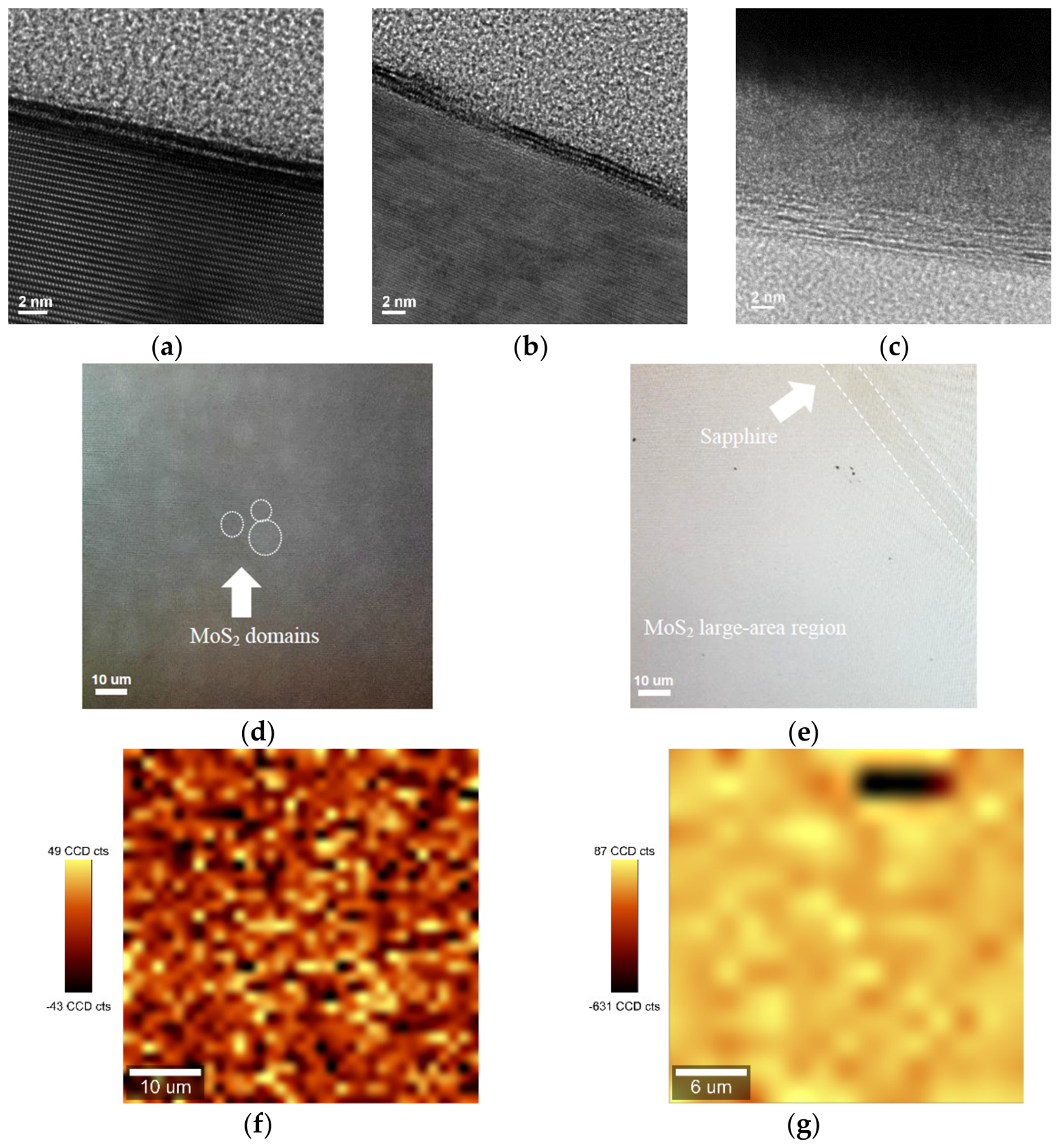
- Controllable Oxide-to-Sulfide Synthesis: A scalable fabrication strategy was developed using RF magnetron sputtering of MoO3 precursors followed by precise chemical-vapor sulfidation to produce high-quality, thickness-tunable MoS2 films with uniform interlayer spacing.
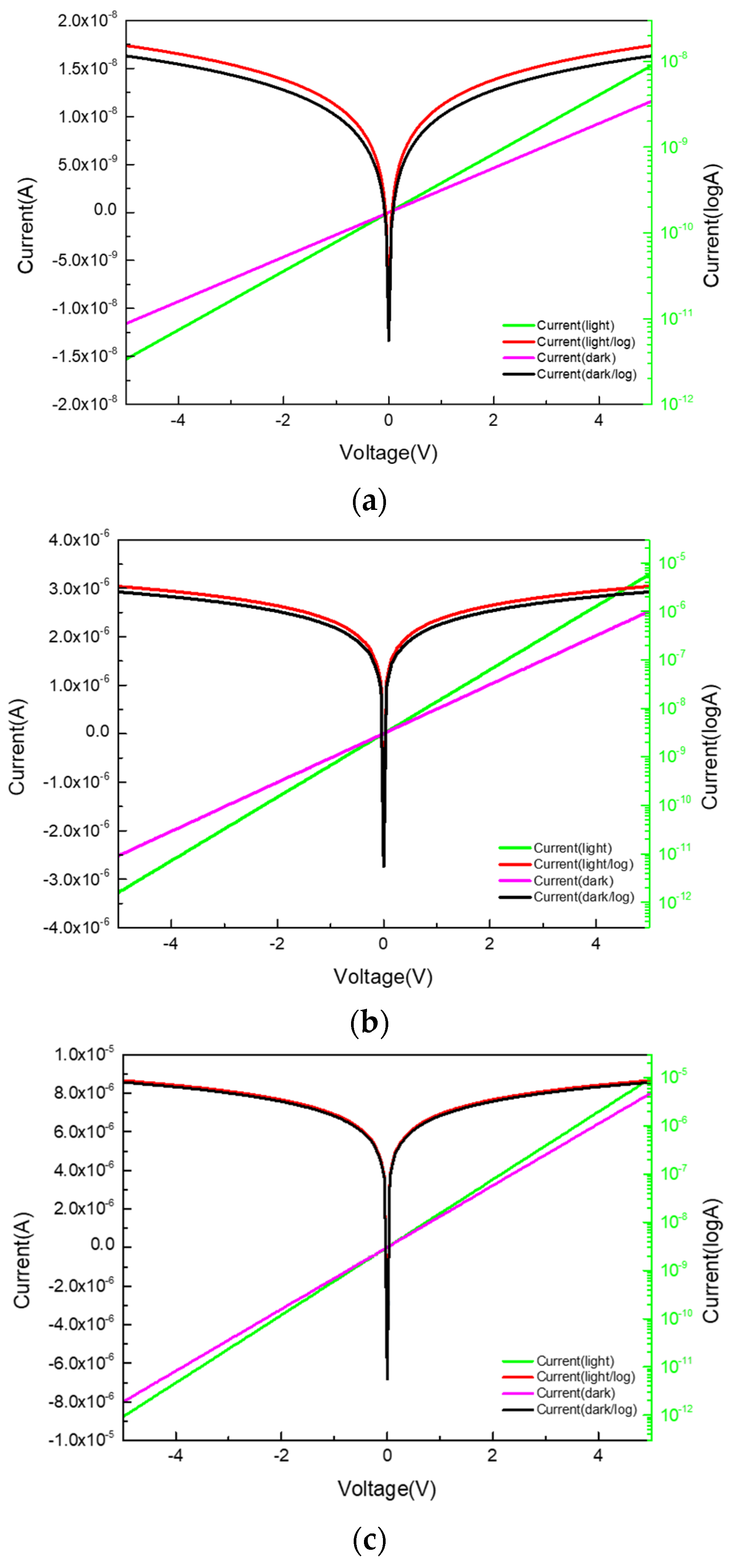
- Environment-Induced Negative Photoconductivity: The research identified the emergence of negative photoconductivity in bilayer MoS2 under ambient conditions, attributed to electron-trapping states from molecular adsorption and surface oxidation rather than structural traps.
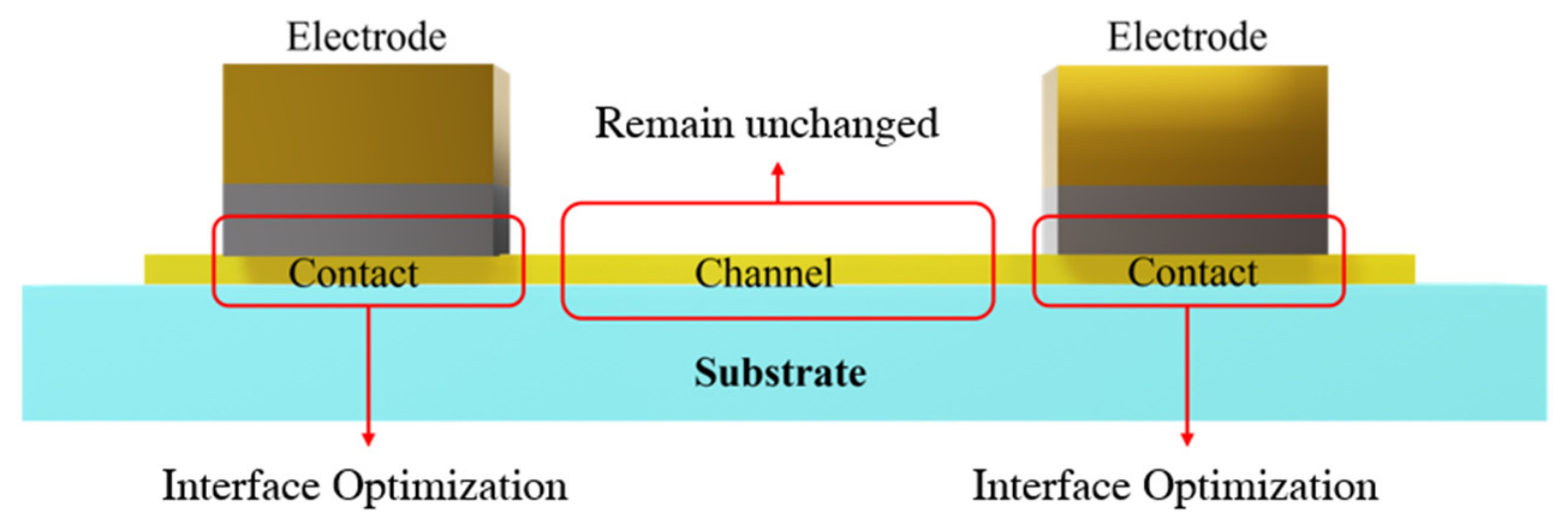
- Contact Engineering for Performance Enhancement: Low-temperature thermal annealing of Ni electrodes effectively optimizes the metal-semiconductor interface and improves effective carrier injection, significantly enhancing the photocurrent of 2D optoelectronic devices.
- Unified Design Strategy for 2D Sensors: These findings provide critical insights into how surface adsorption and interfacial properties govern carrier transport, offering a robust framework for engineering high-performance and scalable TMD-based sensing technologies.
Abstract
1. Introduction
2. Materials and Methods
2.1. Substrate Preparation
2.2. Film Growth
2.3. Device Fabrication
2.4. Characterization
3. Results and Discussion
3.1. Material Analysis
3.2. Device Characterization
3.2.1. Photoconductive
3.2.2. Negative Photoconductivity
3.2.3. Contact Engineering
4. Conclusions
Author Contributions
Funding
Data Availability Statement
Acknowledgments
Conflicts of Interest
Abbreviations
| 2D | Two-dimensional |
| TMDs | Transition metal dichalcogenides |
| MoS2 | Molybdenum disulfide |
| WS2 | Tungsten disulfide |
| CVD | Chemical vapor deposition |
| RF | Radio frequency |
| TMO | Transition metal oxide |
| MSM | Metal–Semiconductor–Metal |
| IDEs | Interdigitated electrodes |
| TEM | Transmission electron microscopy |
| OM | Optical microscopy |
| SHG | Second-harmonic generation |
| EDS | Energy dispersive spectroscopy |
| MoO3 | Molybdenum trioxide |
| NPC | negative photoconductivity |
References
- Novoselov, K.S.; Geim, A.K.; Morozov, S.V.; Jiang, D.; Zhang, Y.; Dubonos, S.V.; Grigorieva, I.V.; Firsov, A.A. Electric Field Effect in Atomically Thin Carbon Films. Science 2004, 306, 666–669. [Google Scholar] [CrossRef]
- Geim, A.K.; Novoselov, K.S. The Rise of Graphene. Nat. Mater. 2007, 6, 183–191. [Google Scholar] [CrossRef]
- Bhimanapati, G.R.; Lin, Z.; Meunier, V.; Jung, Y.; Cha, J.; Das, S.; Xiao, D.; Son, Y.; Strano, M.S.; Cooper, V.R.; et al. Recent Advances in Two-Dimensional Materials beyond Graphene. ACS Nano 2015, 9, 11509–11539. [Google Scholar] [CrossRef]
- Han, S.A.; Bhatia, R.; Kim, S.W. Synthesis, properties and potential applications of two-dimensional transition metal dichalcogenides. Nano Converg. 2015, 2, 17. [Google Scholar] [CrossRef]
- Hu, J. Review of Applications and Research of 2D TMDCs (WS2 & MoS2). Mech. Eng. Mater. Sci. Indep. Study 2022, 191, 1–6. [Google Scholar]
- Choi, W.; Cho, M.Y.; Konar, A.; Lee, J.H.; Cha, G.B.; Hong, S.C.; Kim, S.; Kim, J.; Jena, D.; Joo, J.; et al. High-detectivity multilayer MoS2 phototransistors with spectral response from ultraviolet to infrared. Adv. Mater. 2012, 24, 5832–5836. [Google Scholar] [CrossRef] [PubMed]
- Di Bartolomeo, A.; Kumar, A.; Durante, O.; Sessa, A.; Faella, E.; Viscardi, L.; Intonti, K.; Giubileo, F.; Martucciello, N.; Romano, P.; et al. Temperature-dependent photoconductivity in two-dimensional MoS2 transistors. Mater. Today Nano 2023, 24, 100382. [Google Scholar] [CrossRef]
- Perkins, F.K.; Friedman, A.L.; Cobas, E.; Campbell, P.M.; Jernigan, G.G.; Jonker, B.T. Chemical Vapor Sensing with Monolayer MoS2. Nano Lett. 2013, 13, 668–673. [Google Scholar] [CrossRef]
- Kuan, C.Y.; Chang, S.P.; Liou, G.Y.; Chang, S.H.; Chang, S.J. Fabrication and Application of Two-Dimensional Tungsten Disulfide Thin Film. Int. J. Mod. Phys. B 2024, 39, 2540013. [Google Scholar] [CrossRef]
- Jin, L.; Wen, J.; Odlyzko, M.; Seaton, N.; Li, R.; Haratipour, N.; Koester, S.J. High-Performance WS2 MOSFETs with Bilayer WS2 Contacts. ACS Omega 2024, 9, 12345–12352. [Google Scholar] [CrossRef]
- Sebastian, A.; Pendurthi, R.; Choudhury, T.H.; Redwing, J.M.; Das, S. Benchmarking Monolayer MoS2 and WS2 Field-Effect Transistors. Nat. Commun. 2021, 12, 693. [Google Scholar] [CrossRef]
- Chen, Y.; Zhang, B.; Zhang, S.; Ao, Z.; Lan, X.; Yang, R.; Xie, J.; Wen, W.; Du, Y.; Lv, W.; et al. Tunable Bilayer WS2–WSe2 and WS2–MoS2 Lateral Heterostructures for Self-Powered Photodetectors. Nanoscale 2025, 17, 3456–3465. [Google Scholar] [CrossRef]
- Tian, X.; Wang, S.; Li, H.; Li, M.; Chen, T.; Xiao, X.; Wang, Y. Recent Advances in MoS2-Based Nanomaterial Sensors for Room-Temperature Gas Detection. Sens. Diagn. 2023, 2, 1000–1015. [Google Scholar] [CrossRef]
- Kang, K.; Blizzard, B.; Zhang, L.; Zhao, P. Growth mechanism of largescale MoS2 monolayer by sulfurization of MoO3 film. Mater. Res. Express 2016, 3, 075009. [Google Scholar]
- Salazar, N.; Beinik, I.; Lauritsen, J.V. Single-layer MoS2 formation by sulfidation of molybdenum oxides in different oxidation states on Au(111). Phys. Chem. Chem. Phys. 2017, 19, 14020–14029. [Google Scholar] [CrossRef]
- Weber, T.; Muijsers, J.C.; van Wolput, J.H.M.C.; Verhagen, C.P.J.; Niemantsverdriet, J.W. Basic reaction steps in the sulfidation of crystalline MoO3 to MoS2, as studied by X-ray photoelectron and infrared emission spectroscopy. J. Phys. Chem. 1996, 100, 14144–14150. [Google Scholar] [CrossRef]
- Berkdemir, A.; Gutiérrez, H.R.; Botello-Méndez, A.R.; Perea-López, N.; Elías, A.L.; Chia, C.-I.; Wang, B.; Crespi, V.H.; López-Urías, F.; Charlier, J.-C.; et al. Identification of individual layers in atomically thin MoS2 crystals using Raman spectroscopy. Sci. Rep. 2013, 3, 1755. [Google Scholar] [CrossRef]
- Lee, Y.; Zhang, X.; Zhang, W.; Chang, M.; Lin, C.; Chang, K.; Yu, Y.; Wang, J.T.; Chang, C.; Li, L.; et al. Synthesis of Large-Area MoS2 Atomic Layers with Chemical Vapor Deposition. Nano Lett. 2012, 12, 1536. [Google Scholar] [CrossRef] [PubMed]
- Le, T.X.H.; Esmilaire, R.; Drobek, M.; Bechelany, M.; Vallicari, C.; Cerneaux, S.; Julbe, A.; Cretin, M. Nitrogen-Doped Graphitized Carbon Electrodes for Biorefractory Pollutant Removal. J. Phys. Chem. C 2017, 121, 15189. [Google Scholar] [CrossRef]
- Gedda, M.; Yengel, E.; Faber, H.; Paulus, F.; Kreß, J.A.; Tang, M.-C.; Zhang, S.; Hacker, C.A.; Kumar, P.; Naphade, D.R.; et al. Ruddlesden-Popper-Phase Hybrid Halide Perovskite/Small-Molecule Organic Blend Memory Transistors. Adv. Mater. 2021, 33, 2003137. [Google Scholar] [CrossRef]
- Liu, D.; Guo, Y.; Fang, L.; Robertson, J. Sulfur vacancies in monolayer MoS2 and its electrical contacts. Appl. Phys. Lett. 2013, 103, 183113. [Google Scholar] [CrossRef]
- Mak, K.F.; Lee, C.; Hone, J.; Shan, J.; Heinz, T.F. Atomically Thin MoS2: A New Direct-Gap Semiconductor. Phys. Rev. Lett. 2010, 105, 136805. [Google Scholar] [CrossRef]
- Yin, Z.; Li, H.; Li, H.; Jiang, L.; Shi, Y.; Sun, Y.; Lu, G.; Zhang, Q.; Chen, X.; Zhang, H. Single-Layer MoS2 Phototransistors. ACS Nano 2012, 6, 74–80. [Google Scholar] [CrossRef]
- Gustafson, C.R.; Wines, D.; Gulian, E.; Ataca, C.; Hayden, L.M. Positive and Negative Photoconductivity in Monolayer MoS2 as a Function of Physisorbed Oxygen. J. Phys. Chem. C 2021, 125, 9875–9881. [Google Scholar] [CrossRef]
- Tailor, N.K.; Aranda, C.A.; Saliba, M.; Satapathi, S. Negative Photoconductivity: Bizarre Physics in Semiconductors. ACS Mater. Lett. 2022, 4, 2535–2550. [Google Scholar] [CrossRef]
- Kappera, R.; Voiry, D.; Yalcin, S.E.; Branch, B.; Gupta, G.; Mohite, A.D.; Chhowalla, M. Phase-engineered low-resistance contacts for ultrathin MoS2 transistors. Nat. Mater. 2014, 13, 1128–1134. [Google Scholar] [CrossRef]
- Wang, Q.H.; Kalantar-Zadeh, K.; Kis, A.; Coleman, J.N.; Strano, M.S. Electronics and optoelectronics of two-dimensional transition metal dichalcogenides. Nat. Nanotechnol. 2012, 7, 699–712. [Google Scholar] [CrossRef] [PubMed]



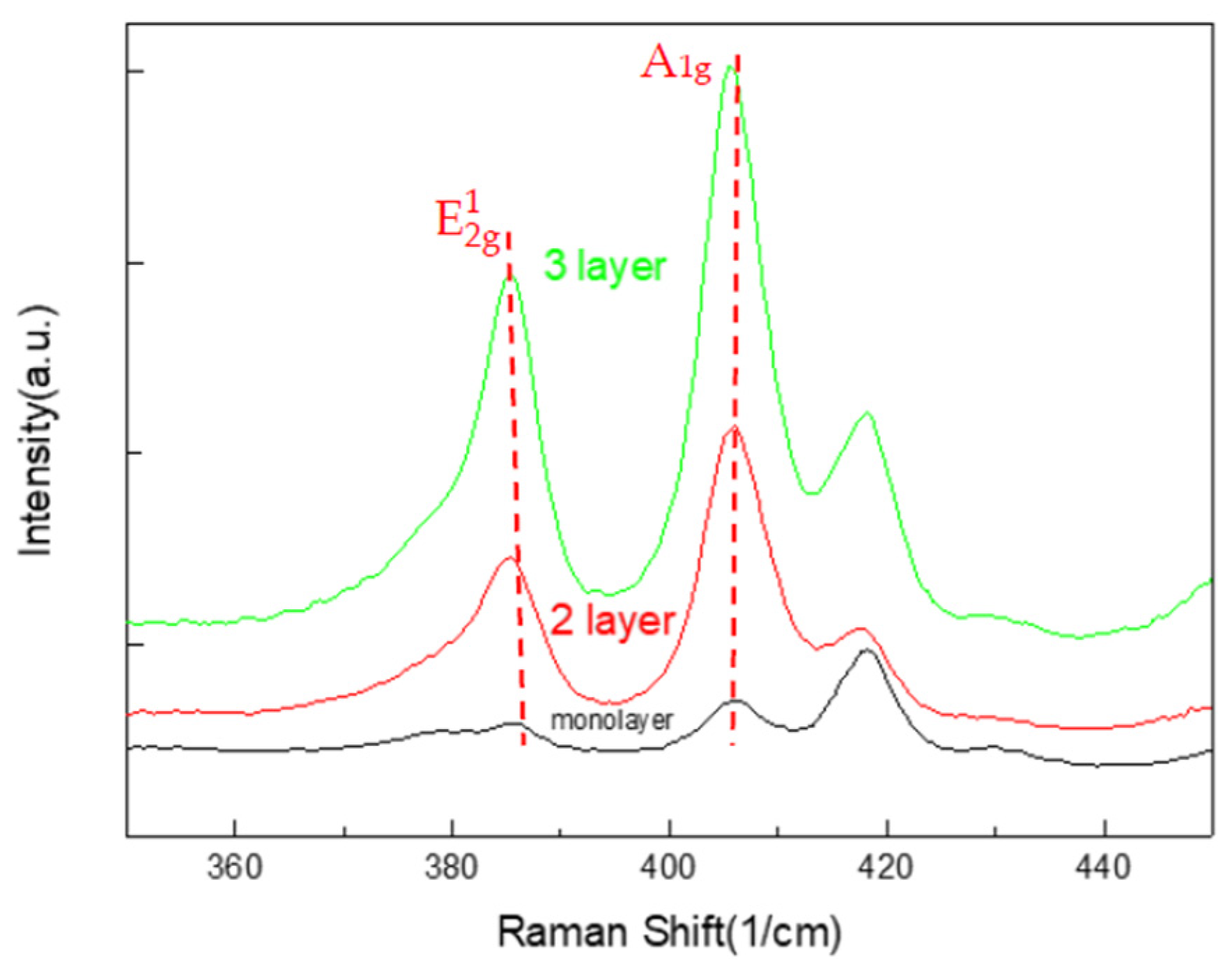
| Layer Number | E2g1 (cm−1) | A1g (cm−1) | Δ(A1g − E2g1) (cm−1) |
|---|---|---|---|
| 1 | 386.36 | 405.55 | 19.19 |
| 2 | 385.35 | 406.06 | 20.71 |
| 3 | 384.84 | 406.56 | 21.72 |
Disclaimer/Publisher’s Note: The statements, opinions and data contained in all publications are solely those of the individual author(s) and contributor(s) and not of MDPI and/or the editor(s). MDPI and/or the editor(s) disclaim responsibility for any injury to people or property resulting from any ideas, methods, instructions or products referred to in the content. |
© 2026 by the authors. Licensee MDPI, Basel, Switzerland. This article is an open access article distributed under the terms and conditions of the Creative Commons Attribution (CC BY) license.
Share and Cite
Kuan, C.-Y.; Chang, S.-P.; Chang, S.-J.; Chen, J.-F.; Lai, W.-C. Tailorable 2D MoS2 via Oxide Sulfidation for Photodetection and Contact Engineering. Sensors 2026, 26, 3523. https://doi.org/10.3390/s26113523
Kuan C-Y, Chang S-P, Chang S-J, Chen J-F, Lai W-C. Tailorable 2D MoS2 via Oxide Sulfidation for Photodetection and Contact Engineering. Sensors. 2026; 26(11):3523. https://doi.org/10.3390/s26113523
Chicago/Turabian StyleKuan, Chieh-Yu, Sheng-Po Chang, Shoou-Jinn Chang, Jone-Fang Chen, and Wei-Chih Lai. 2026. "Tailorable 2D MoS2 via Oxide Sulfidation for Photodetection and Contact Engineering" Sensors 26, no. 11: 3523. https://doi.org/10.3390/s26113523
APA StyleKuan, C.-Y., Chang, S.-P., Chang, S.-J., Chen, J.-F., & Lai, W.-C. (2026). Tailorable 2D MoS2 via Oxide Sulfidation for Photodetection and Contact Engineering. Sensors, 26(11), 3523. https://doi.org/10.3390/s26113523