Biomechanical Modeling and Analysis of the Lower-Limb Musculoskeletal System for Hemiplegia: A Pilot Study

Abstract
1. Introduction
2. Method
2.1. Skeletal Muscle Model
2.1.1. Skeletal Model
2.1.2. Muscle Model
2.2. Muscle Activation Model
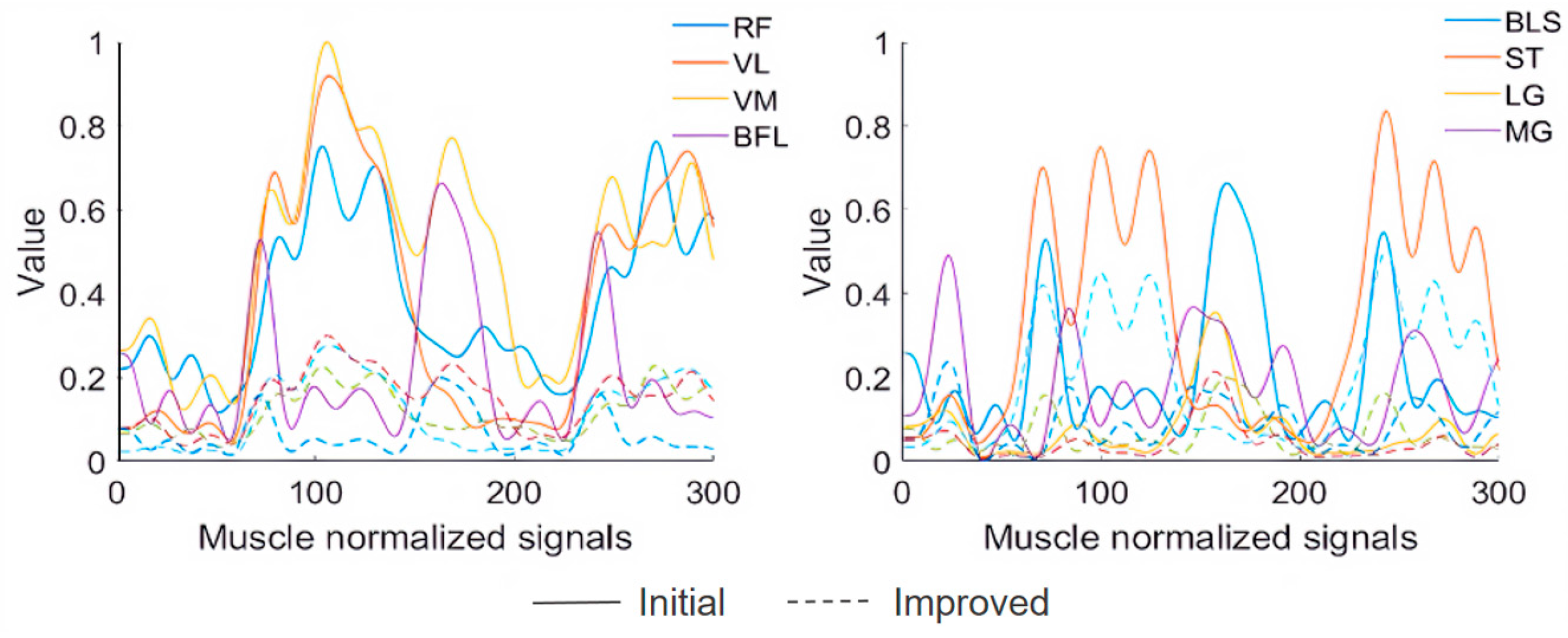
2.3. Improved Hill Muscle Model (iHMM)
2.4. Model Calibration
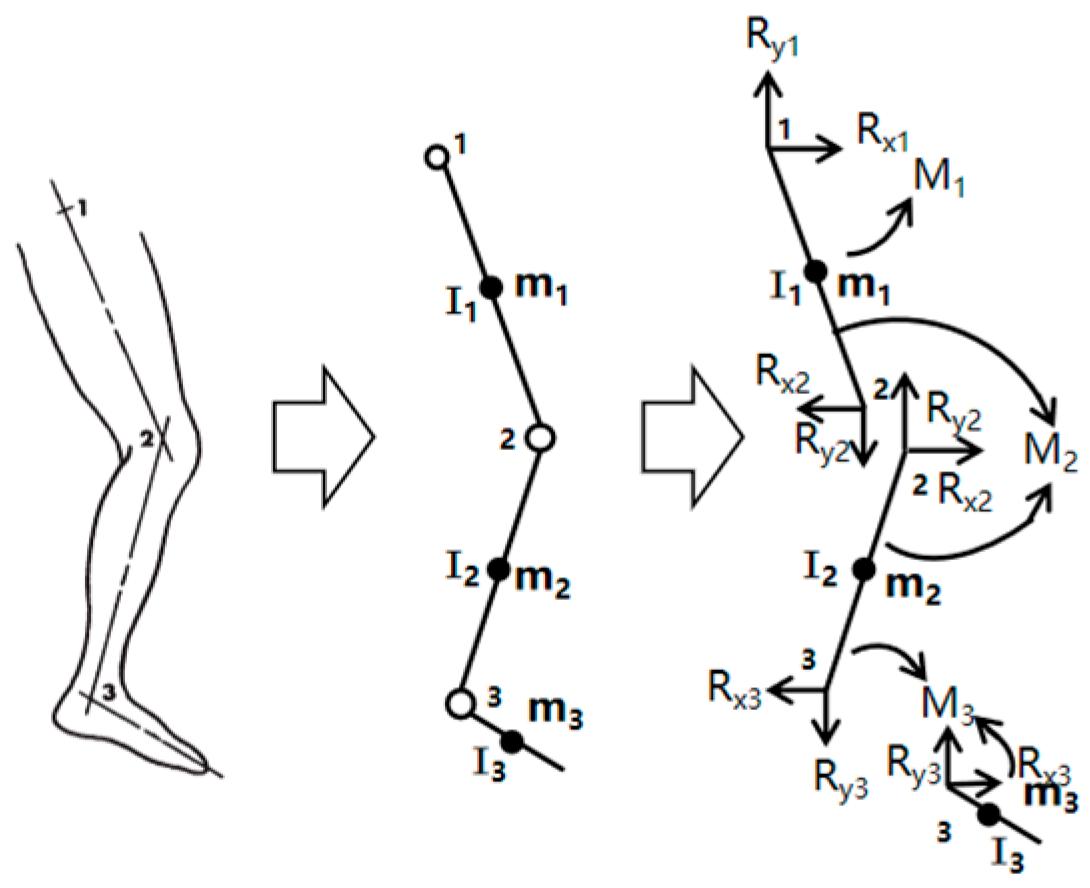
2.5. Human Lower Limb Dynamics
3. Experimental Results
3.1. Participants and Experimental Protocol
3.2. Model Evaluation Strategy
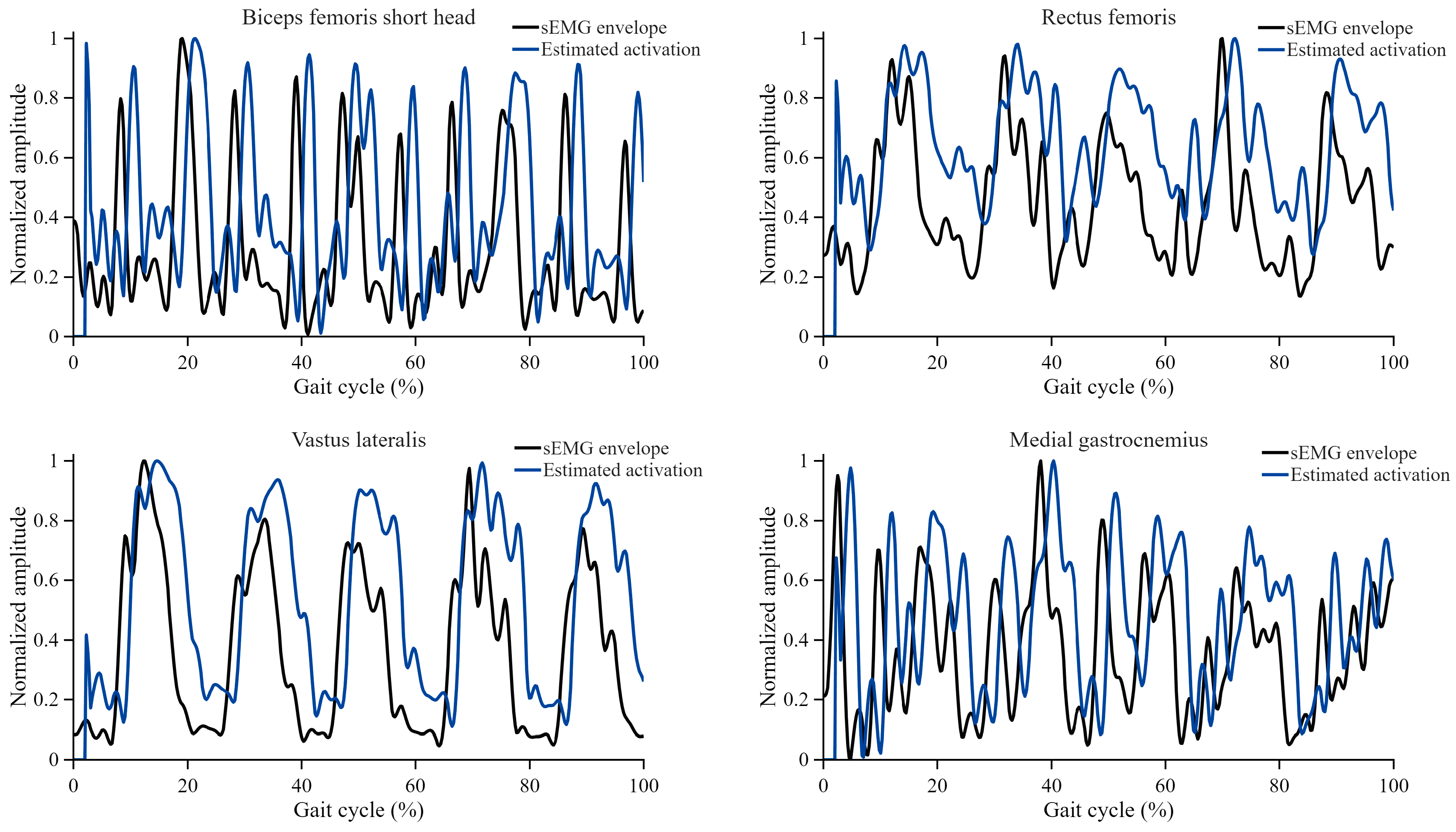
3.3. Muscle Force Estimation
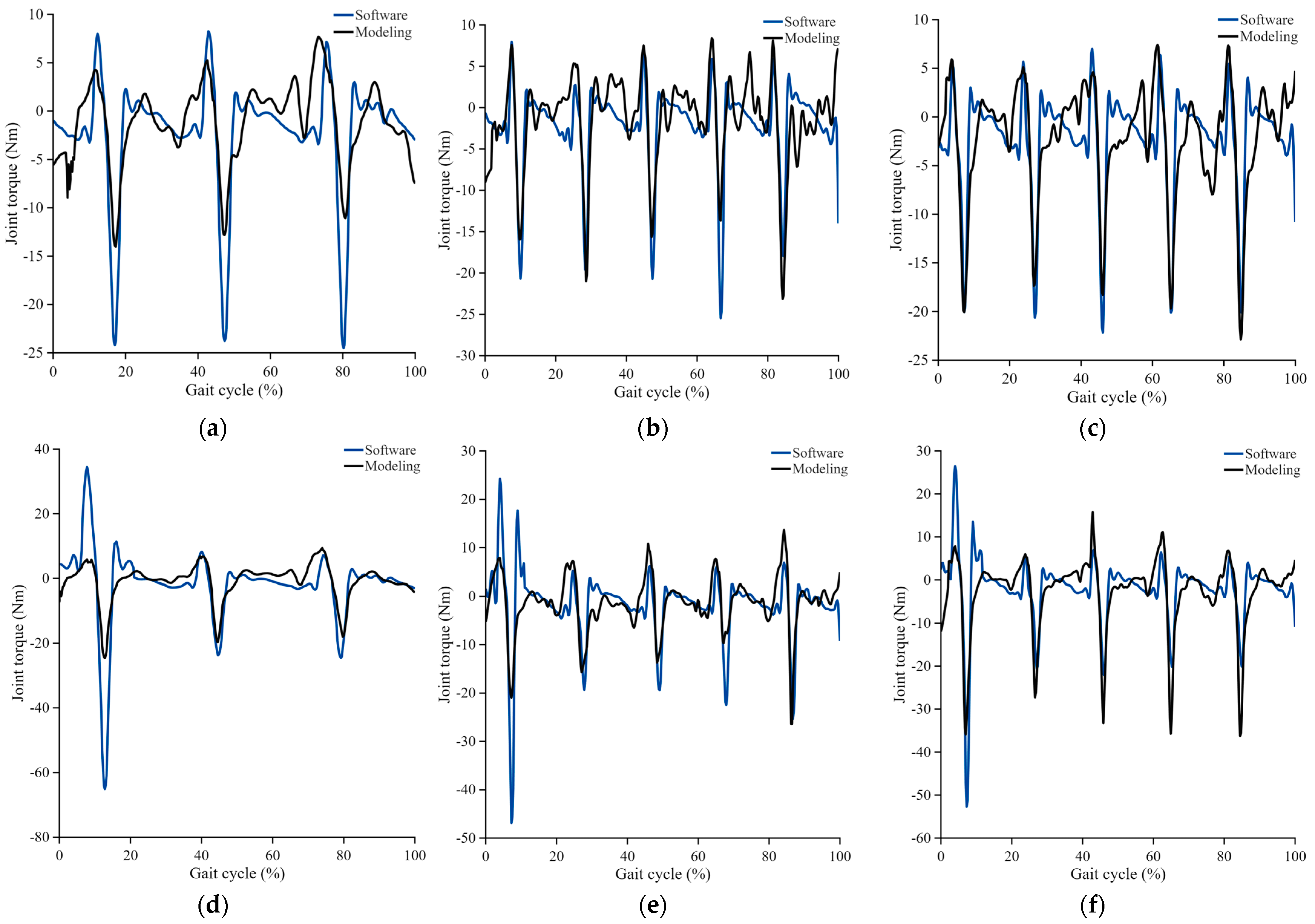
3.4. Knee Joint Torque Estimation
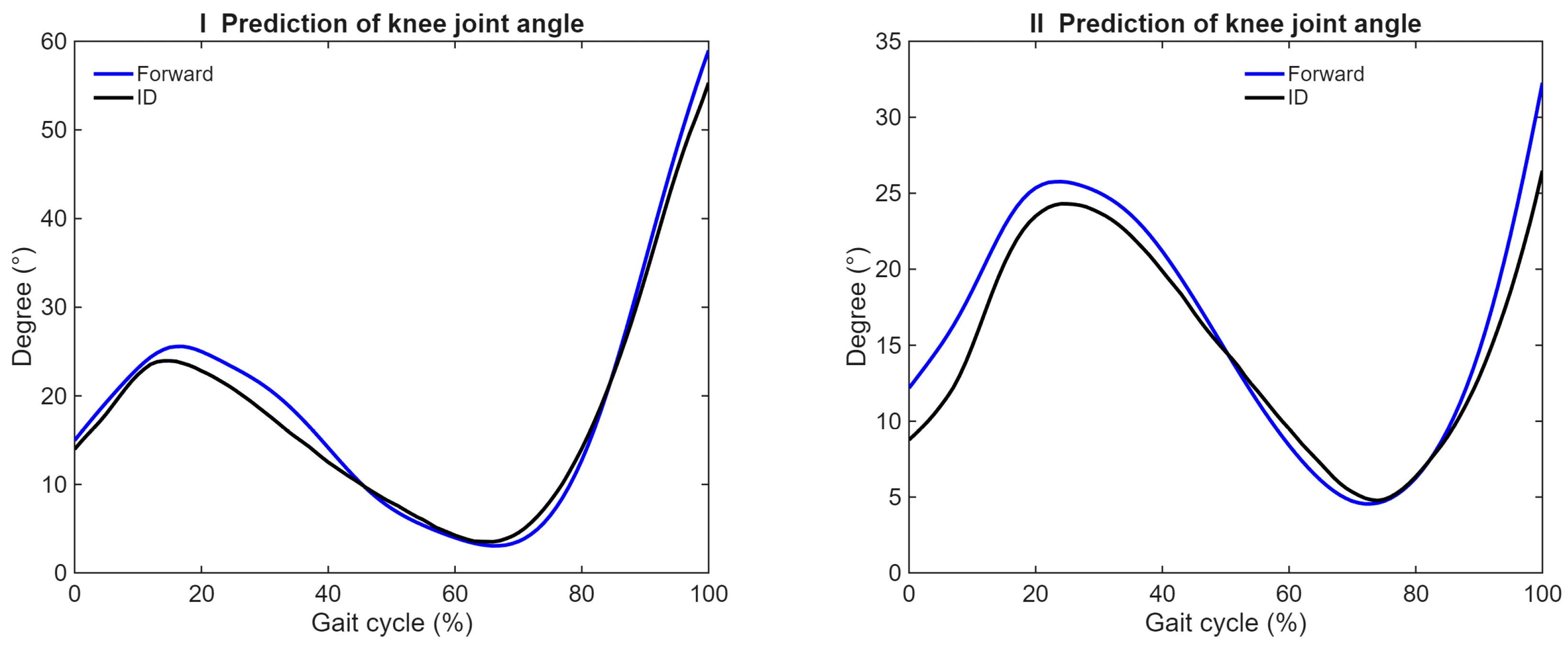
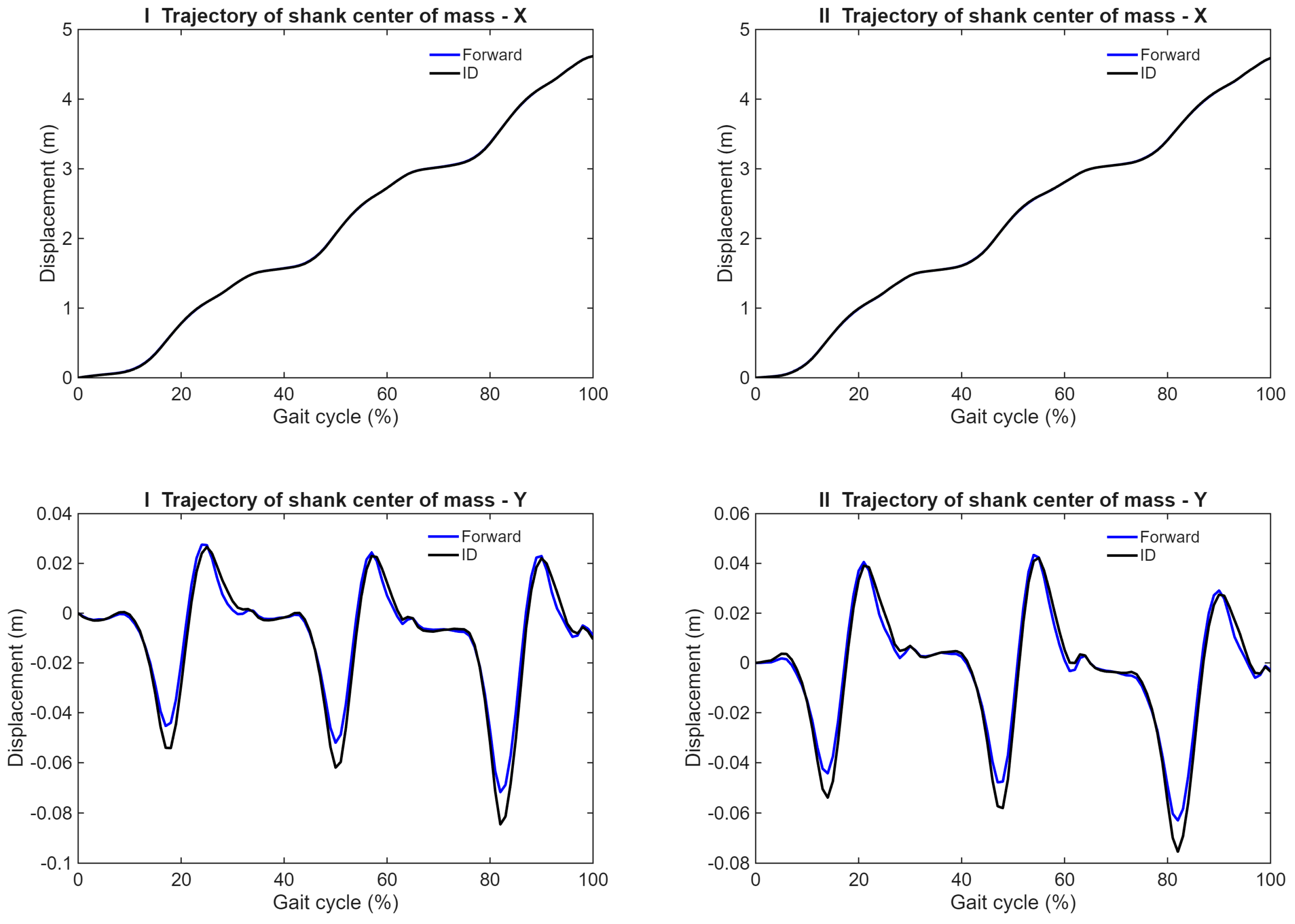
3.5. Knee Joint Motion and Shank Center-of-Mass Trajectory Results
4. Discussion
5. Conclusions
Author Contributions
Funding
Institutional Review Board Statement
Informed Consent Statement
Data Availability Statement
Conflicts of Interest
References
- Prenton, S.; Hollands, K.L.; Kenney, L.P.J.; Onmanee, P. Functional electrical stimulation and ankle foot orthoses provide equivalent therapeutic effects on foot drop: A meta-analysis providing direction for future research. J. Rehabil. Med. 2018, 50, 129–139. [Google Scholar] [CrossRef]
- Naik, G.R.; Selvan, S.E.; Arjunan, S.P.; Acharyya, A.; Kumar, D.K.; Ramanujam, A.; Nguyen, H.T. An ICA-EBM-based sEMG classifier for recognizing lower limb movements in individuals with and without knee pathology. IEEE Trans. Neural Syst. Rehabil. Eng. 2018, 26, 675–686. [Google Scholar] [CrossRef]
- Chen, W.; Zhang, B.; Tan, X.; Zhao, Y.; Liu, L.; Zhao, X. Hip–knee–ankle rehabilitation exoskeleton with compliant actuators: From human–robot interaction control to clinical evaluation. IEEE Trans. Robot. 2024, 41, 269–288. [Google Scholar] [CrossRef]
- Liang, X.; Yan, Y.; Wang, W.; Su, T.; He, G.; Li, G.; Hou, Z. Adaptive human–robot interaction torque estimation with high accuracy and strong tracking ability for a lower limb rehabilitation robot. IEEE/ASME Trans. Mechatron. 2024, 29, 4814–4825. [Google Scholar] [CrossRef]
- Rajagopal, A.; Dembia, C.L.; DeMers, M.S.; Delp, D.D.; Hicks, J.L.; Delp, S.L. Full-Body Musculoskeletal Model for Muscle-Driven Simulation of Human Gait. IEEE Trans. Biomed. Eng. 2016, 63, 2068–2079. [Google Scholar] [CrossRef] [PubMed]
- Cardona, M.; Garcia Cena, C.E. Biomechanical Analysis of the Lower Limb: A Full-Body Musculoskeletal Model for Muscle-Driven Simulation. IEEE Access 2019, 7, 92709–92723. [Google Scholar] [CrossRef]
- Li, K.; Zhang, J.; Liu, X.; Zhang, M. Estimation of continuous elbow joint movement based on human physiological structure. Biomed. Eng. Online 2019, 18, 31. [Google Scholar] [CrossRef] [PubMed]
- Peng, Y.; Wang, W.; Zeng, Y.; Chen, Z.; Li, H.; Li, G. Analysis of Pelvis and Lower Limb Coordination in Stroke Patients Using Smartphone-Based Motion Capture. IEEE Trans. Biomed. Eng. 2025, 72, 2425–2436. [Google Scholar] [CrossRef] [PubMed]
- Dubey, L.; Karthikbabu, S.; Mohan, D. Effects of pelvic stability training on movement control, hip muscles strength, walking speed and daily activities after stroke: A randomized controlled trial. Ann. Neurosci. 2018, 25, 80–89. [Google Scholar] [CrossRef]
- Menezes, K.K.; Nascimento, L.R.; Faria, C.D.C.M.; Avelino, P.R.; Scianni, A.A.; Polese, J.C.; Faria-Fortini, I.; Teixeira-Salmela, L.F. Deficits in motor coordination of the paretic lower limb best explained activity limitations after stroke. Physiother. Theory Pract. 2020, 36, 417–423. [Google Scholar] [CrossRef]
- Rasool, G.; Afsharipour, B.; Suresh, N.L.; Rymer, W.Z. Spatial Analysis of Multichannel Surface EMG in Hemiplegic Stroke. IEEE Trans. Neural Syst. Rehabil. Eng. 2017, 25, 1802–1811. [Google Scholar] [CrossRef]
- Li, K.; Zhang, J.; Wang, L.; Zhang, M.; Li, J.; Bao, S. A review of the key technologies for sEMG-based human-robot interaction systems. Biomed. Signal Process. Control 2020, 62, 102074. [Google Scholar] [CrossRef]
- Chen, Y.; Wang, Y.; Gao, F.; Dong, B.; Chen, W.; Liu, R. A Computational Method to Identify Optimal Functional Muscle Synergies from Estimated Muscle Activations. IEEE Trans. Instrum. Meas. 2024, 73, 7505114. [Google Scholar] [CrossRef]
- Guo, T.; Li, K.; Li, H.; Liu, X.; Zhang, J.; Li, J. Biomechanical analysis of gait based on surface electromyography signals. In 2024 IEEE International Conference on Signal, Information and Data Processing (ICSIDP); IEEE: New York, NY, USA, 2024; p. 14. [Google Scholar] [CrossRef]
- Li, K.; Liu, X.; Zhang, J.; Zhang, M.; Hou, Z. Continuous motion and time-varying stiffness estimation of the human elbow joint based on sEMG. J. Mech. Med. Biol. 2019, 19, 1950040. [Google Scholar] [CrossRef]
- An, K.N.; Kwak, B.M.; Chao, E.Y.; Morrey, B.F. Determination of muscle and joint forces: A new technique to solve the indeterminate problem. J. Biomech. Eng. 1984, 106, 364–367. [Google Scholar] [CrossRef]
- Pandy, M.G.; Zajac, F.E.; Sim, E.; Levine, W.S. An optimal control model for maximum-height human jump. J. Biomech. 1990, 23, 1185–1198. [Google Scholar] [CrossRef] [PubMed]
- Bi, L.; Feleke, A.G.; Guan, C. A review on EMG-based motor intention prediction of continuous human upper limb motion for human-robot collaboration. Biomed. Signal Process. Control 2019, 51, 113–127. [Google Scholar] [CrossRef]
- Lyu, Y.; Xie, K.; Shan, X.; Leng, Y.; Li, L.; Zhang, X.; Song, R. Time-varying and speed-matched model for the evaluation of stroke-induced changes in ankle mechanics. J. Biomech. 2024, 165, 111997. [Google Scholar] [CrossRef]
- Ding, Q.C.; Han, J.D.; Zhao, X.G. Continuous estimation of human multi-joint angles from sEMG using a state-space model. IEEE Trans. Neural Syst. Rehabil. Eng. 2017, 25, 1518–1528. [Google Scholar] [CrossRef]
- Zhang, L.; Soselia, D.; Wang, R.; Gutierrez-Farewik, E.M. Lower-limb joint torque prediction using LSTM neural networks and transfer learning. IEEE Trans. Neural Syst. Rehabil. Eng. 2022, 30, 600–609. [Google Scholar] [CrossRef] [PubMed]
- Li, J.; Zhang, B.; Tan, X.; Chen, W.; Liu, Z.; Zhang, J.; Huo, W.; Huang, J.; Liu, L.; Zhao, X. K2MUSE: A human lower-limb multimodal walking dataset spanning task and acquisition variability for rehabilitation robotics. Int. J. Robot. Res. 2026. [Google Scholar] [CrossRef]
- Zhang, J.; Zhao, Y.; Bao, T.; Li, Z.; Qian, K.; Frangi, A.F.; Xie, S.Q.; Zhang, Z.Q. Boosting personalized musculoskeletal modeling with physics-informed knowledge transfer. IEEE Trans. Instrum. Meas. 2022, 72, 2500811. [Google Scholar] [CrossRef]
- Zhang, J.; Zhao, Y.; Shone, F.; Li, Z.; Frangi, A.F.; Xie, S.Q.; Zhang, Z.Q. Physics-informed deep learning for musculoskeletal modeling: Predicting muscle forces and joint kinematics from surface EMG. IEEE Trans. Neural Syst. Rehabil. Eng. 2022, 31, 484–493. [Google Scholar] [CrossRef]
- Ma, S.; Zhang, J.; Shi, C.; Di, P.; Robertson, I.D.; Zhang, Z.Q. Physics-informed deep learning for muscle force prediction with unlabeled sEMG signals. IEEE Trans. Neural Syst. Rehabil. Eng. 2024, 32, 1246–1256. [Google Scholar] [CrossRef] [PubMed]
- Trabassi, D.; Castiglia, S.F.; Bini, F.; Marinozzi, F.; Ajoudani, A.; Lorenzini, M.; Chini, G.; Varrecchia, T.; Ranavolo, A.; De Icco, R.; et al. Optimizing rare disease gait classification through data balancing and generative AI: Insights from hereditary cerebellar ataxia. Sensors 2024, 24, 3613. [Google Scholar] [CrossRef]
- Ding, Q.C.; Xiong, A.B.; Zhao, X.G.; Han, J.D. A review on researches and applications of sEMG-based motion intent recognition methods. Acta Autom. Sin. 2016, 42, 13–25. [Google Scholar]
- Falisse, A.; Van Rossom, S.; Jonkers, I.; De Groote, F. EMG-Driven Optimal Estimation of Subject-SPECIFIC Hill Model Muscle–Tendon Parameters of the Knee Joint Actuators. IEEE Trans. Biomed. Eng. 2017, 64, 2253–2262. [Google Scholar] [CrossRef]
- Mo, F.; Zhang, Q.; Zhang, H.; Long, J.; Wang, Y.; Chen, G.; Ye, J. A simulation-based framework with a proprioceptive musculoskeletal model for evaluating the rehabilitation exoskeleton system. Comput. Methods Programs Biomed. 2021, 208, 106270. [Google Scholar] [CrossRef] [PubMed]
- Klein Horsman, M.D.; Koopman, H.F.J.M.; van der Helm, F.C.T.; Prosé, L.P.; Veeger, H.E.J. Morphological muscle and joint parameters for musculoskeletal modelling of the lower extremity. Clin. Biomech. 2007, 22, 239–247. [Google Scholar] [CrossRef]
- Buchanan, T.S.; Lloyd, D.G.; Manal, K.; Besier, T.F. Neuromusculoskeletal modeling: Estimation of muscle forces and joint moments and movements from measurements of neural command. J. Appl. Biomech. 2004, 20, 367–395. [Google Scholar] [CrossRef]
- Zhang, X.; Jiang, Z.; Li, X.; Xu, P.; Lucev Vasic, Z.; Culjak, I.; Cifrek, M.; Du, M.; Gao, Y. Dynamics combined with Hill model for functional electrical stimulation ankle angle prediction. IEEE J. Biomed. Health Inform. 2022, 27, 2186–2196. [Google Scholar] [CrossRef]
- Zhou, Y.; Li, J.; Zuo, S.; Zhang, J.; Dong, M.; Sun, Z. An Online Estimating Framework for Ankle Actively Exerted Torque Under Multi-DOF Coupled Dynamic Motions via sEMG. IEEE Trans. Neural Syst. Rehabil. Eng. 2025, 33, 81–91. [Google Scholar] [CrossRef]
- Muñoz-Pepi, I.; Garcia-Hernandez, N.; Parra-Vega, V. Forward neuromusculoskeletal dynamics with continuous muscle wrap. IEEE Robot. Autom. Lett. 2023, 8, 5942–5949. [Google Scholar] [CrossRef]
- Chen, Z.; Franklin, D.W. Musculotendon parameters in lower limb models: Simplifications, uncertainties, and muscle force estimation sensitivity. Ann. Biomed. Eng. 2023, 51, 1147–1164. [Google Scholar] [CrossRef]
- Zhao, Y.; Zhang, Z.; Li, Z.; Yang, Z.; Dehghani-Sanij, A.A.; Xie, S.Q. An EMG-driven musculoskeletal model for estimating continuous wrist motion. IEEE Trans. Neural Syst. Rehabil. Eng. 2020, 28, 3113–3120. [Google Scholar] [CrossRef]
- Sun, L.; Sun, Y.; Huang, Z.; Hou, J.; Wu, J. A hill-type submaximally-activated musculotendon model and its simulation. In 2015 14th International Symposium on Distributed Computing and Applications for Business Engineering and Science (DCABES); IEEE: New York, NY, USA, 2015; pp. 439–442. [Google Scholar]
- Ackland, D.C.; Lin, Y.C.; Pandy, M.G. Sensitivity of model predictions of muscle function to changes in moment arms and muscle-tendon properties: A Monte-Carlo analysis. J. Biomech. 2012, 45, 1463–1471. [Google Scholar] [CrossRef]
- Andersson, J.A.E.; Gillis, J.; Horn, G.; Rawlings, J.B.; Diehl, M. CasADi—A software framework for nonlinear optimization and optimal control. Math. Program. Comput. 2018, 11, 1–36. [Google Scholar] [CrossRef]
- Siston, R.A.; Delp, S.L. Evaluation of a new algorithm to determine the hip joint center. J. Biomech. 2006, 39, 125–130. [Google Scholar] [CrossRef] [PubMed]
- Ehrig, R.M.; Taylor, W.R.; Duda, G.N.; Heller, M.O. A survey of formal methods for determining functional joint axes. J. Biomech. 2007, 40, 2150–2157. [Google Scholar] [CrossRef] [PubMed]
- Xu, R.; Zhang, H.; Shi, X.; Liang, J.; Wan, C.; Ming, D. Lower-limb motor assessment with corticomuscular coherence of multiple muscles during ankle dorsiflexion after stroke. IEEE Trans. Neural Syst. Rehabil. Eng. 2023, 31, 160–168. [Google Scholar] [CrossRef]
- Crossley, C.B.; Worsey, M.T.; Diamond, L.E.; Saxby, D.J.; Wackwitz, T.; Bourne, M.N.; Lloyd, D.G.; Pizzolato, C. A calibrated EMG-informed neuromusculoskeletal model can estimate hip and knee joint contact forces in cycling better than static optimisation. J. Biomech. 2025, 182, 112586. [Google Scholar] [CrossRef] [PubMed]
- Molinaro, D.D.; Kang, I.; Young, A.J. Estimating human joint moments unifies exoskeleton control, reducing user effort. Sci. Robot. 2024, 9, eadi8852. [Google Scholar] [CrossRef] [PubMed]



| Subject | Gender/Age | Height/Weight | Hemiplegic Side | Course | Brunnstrom |
|---|---|---|---|---|---|
| 1 | male/58 | 175/72 | right | five months | V |
| 2 | male/53 | 178/78 | right | three months | IV |
| 3 | male/49 | 172/65 | right | four months | V |
| 4 | male/60 | 168/63 | right | three months | IV |
| 5 | female/55 | 165/60 | left | six months | V |
| 6 | male/48 | 178/75 | left | three months | IV |
| Mean ± SD | -/53.8 ± 4.8 | 172.7 ± 5.4/68.8 ± 7.2 | - | - | - |
| Optimization Parameters | Muscles | Initial Value | Subject 1 | Subject 2 | Subject 3 | Subject 4 | Subject 5 | Subject 6 |
|---|---|---|---|---|---|---|---|---|
| sEMG correction coefficient c | RF | 0.50 | 0.10 | 0.37 | 0.56 | 0.34 | 0.10 | 0.11 |
| VL | 0.50 | 0.10 | 0.99 | 0.99 | 0.96 | 0.10 | 0.10 | |
| VM | 0.50 | 0.10 | 0.10 | 0.32 | 0.16 | 0.10 | 0.27 | |
| BFL | 0.50 | 0.10 | 0.99 | 0.99 | 0.99 | 0.10 | 0.10 | |
| BFS | 0.50 | 0.16 | 0.10 | 0.12 | 0.14 | 0.13 | 0.17 | |
| ST | 0.50 | 0.47 | 0.99 | 0.58 | 0.92 | 0.28 | 0.21 | |
| LG | 0.50 | 1.00 | 0.98 | 0.96 | 0.99 | 0.75 | 1.00 | |
| MG | 0.50 | 0.10 | 0.68 | 0.43 | 0.68 | 0.10 | 0.10 | |
| Damping Coefficients B | RF | 0.50 | 1.00 | 0.32 | 0.53 | 0.62 | 1.00 | 1.00 |
| VL | 0.50 | 0.01 | 0.08 | 0.78 | 0.85 | 0.01 | 0.01 | |
| VM | 0.50 | 0.05 | 0.03 | 0.02 | 0.05 | 0.07 | 0.01 | |
| BFL | 0.50 | 1.00 | 0.85 | 1.00 | 0.86 | 0.98 | 1.00 | |
| BFS | 0.50 | 1.00 | 0.30 | 0.04 | 0.23 | 0.06 | 0.01 | |
| ST | 0.50 | 0.95 | 0.95 | 0.96 | 0.98 | 0.98 | 1.00 | |
| LG | 0.50 | 1.00 | 0.40 | 0.06 | 0.32 | 0.05 | 0.01 | |
| MG | 0.50 | 0.01 | 0.22 | 0.01 | 0.32 | 0.32 | 0.01 | |
| sEMG Delay d | / | 10.00 | 20.00 | 20.00 | 20.00 | 20.00 | 20.00 | 20.00 |
| Neural Activation Factors | / | 0.50 | 0.66 | 0.43 | 0.35 | 0.62 | 0.50 | 0.66 |
| 0.50 | 0.48 | 0.41 | 0.49 | 0.43 | 0.45 | 0.48 | ||
| Muscle Activation Factors | / | −1.50 | −2.31 | −2.66 | −2.45 | −2.56 | −2.34 | −2.31 |
| Percentage Change Factors | / | 0.15 | 0.25 | 0.23 | 0.24 | 0.23 | 0.23 | 0.25 |
| Subject | R | ME (Nm) | RMSE (Nm) | RMSE/Body Mass (Nm/kg) | nRMSE (% Peak Torque) |
|---|---|---|---|---|---|
| 1 | 0.724 | 3.104 | 4.013 | 0.056 | 18.112 |
| 2 | 0.742 | 3.061 | 4.151 | 0.058 | 16.936 |
| 3 | 0.738 | 2.920 | 3.872 | 0.054 | 15.203 |
| 4 | 0.747 | 3.071 | 3.924 | 0.055 | 17.709 |
| 5 | 0.740 | 3.848 | 5.550 | 0.077 | 10.531 |
| 6 | 0.807 | 4.366 | 7.814 | 0.109 | 12.002 |
| Index | Correlation | Mean Error | Root Mean Square |
|---|---|---|---|
| Data | |||
| Knee Angle | 0.99 | 1.541° | 1.938° |
| Shank Position-X | 0.99 | 0.002 m | 0.003 m |
| Shank Position-Y | 0.99 | 0.003 m | 0.005 m |
Disclaimer/Publisher’s Note: The statements, opinions and data contained in all publications are solely those of the individual author(s) and contributor(s) and not of MDPI and/or the editor(s). MDPI and/or the editor(s) disclaim responsibility for any injury to people or property resulting from any ideas, methods, instructions or products referred to in the content. |
© 2026 by the authors. Licensee MDPI, Basel, Switzerland. This article is an open access article distributed under the terms and conditions of the Creative Commons Attribution (CC BY) license.
Share and Cite
Li, K.; Sun, Y.; Li, C.; Guo, T.; Li, H. Biomechanical Modeling and Analysis of the Lower-Limb Musculoskeletal System for Hemiplegia: A Pilot Study. Sensors 2026, 26, 3353. https://doi.org/10.3390/s26113353
Li K, Sun Y, Li C, Guo T, Li H. Biomechanical Modeling and Analysis of the Lower-Limb Musculoskeletal System for Hemiplegia: A Pilot Study. Sensors. 2026; 26(11):3353. https://doi.org/10.3390/s26113353
Chicago/Turabian StyleLi, Kexiang, Ye Sun, Chuang Li, Tongzan Guo, and Hui Li. 2026. "Biomechanical Modeling and Analysis of the Lower-Limb Musculoskeletal System for Hemiplegia: A Pilot Study" Sensors 26, no. 11: 3353. https://doi.org/10.3390/s26113353
APA StyleLi, K., Sun, Y., Li, C., Guo, T., & Li, H. (2026). Biomechanical Modeling and Analysis of the Lower-Limb Musculoskeletal System for Hemiplegia: A Pilot Study. Sensors, 26(11), 3353. https://doi.org/10.3390/s26113353