1. Introduction
Precise event timing is a foundational requirement in a wide class of modern sensing and instrumentation systems. In many architectures of practical and scientific interest, the most relevant observable is not the amplitude of a slowly varying analog signal but the exact arrival time of one or more transitions. This timing-centric view arises naturally in time-of-flight (ToF) ranging, photon-counting instrumentation, coincidence measurements, pulsed radiation sensing, asynchronous trigger chains, and fast biomedical or laboratory front-ends. Time-to-digital converters (TDCs), therefore, remain central building blocks in time-domain measurement systems, and their design principles, implementation trade-offs, and error sources are well established in both foundational monographs and recent surveys [
1,
2].
The importance of timing extraction becomes even more evident in time-resolved sensing. In single-photon avalanche diode (SPAD) imagers and related optical timing systems, the usefulness of the detector is inseparable from the timestamping or histogramming chain that follows each detected event [
3,
4]. This applies to direct and indirect ToF imaging, fluorescence lifetime imaging microscopy (FLIM), time-correlated single-photon counting (TCSPC), fast depth sensing, and other photon-efficient low-light instrumentation workflows [
5,
6]. Recent sensor-side work on SPAD-based LiDAR arrays, direct ToF architectures, TDC-sharing readout strategies, correlation-assisted pixels, short-pulse demodulator pixels, and stacked low-light SPAD imagers further illustrates how tightly detector architecture and timing electronics are coupled in practical systems [
7,
8,
9,
10,
11,
12,
13]. Similar considerations also apply beyond optical sensing whenever asynchronous physical events must be converted into trustworthy digital timing information under constrained laboratory conditions.
A practical consequence of this context is that a timing front-end should not be evaluated only by nominal interpolation capability. In sensing-oriented instrumentation, the useful performance of the front-end depends simultaneously on several layers: the quality of the event interface, the robustness of the fine-time extraction stage, the validity of the resulting timestamp, the treatment of abnormal events, the available export bandwidth, and the reproducibility of the complete acquisition workflow. This broader perspective is consistent with instrumentation-oriented reviews spanning detector metrology, TCSPC electronics, and FLIM microsystems, all of which emphasize that timing quality must be interpreted together with the acquisition chain that supports it [
14,
15,
16].
Field-programmable gate arrays (FPGAs) are attractive platforms for implementing this type of front-end because they offer flexibility, short development cycles, relatively low cost, and access to native fast-carry resources that can be exploited for within-clock-cycle interpolation. More broadly, timing front-ends for SPAD-based systems also draw on insights from the detector and readout literature, from early timing demonstrations with discrete SPADs to later reviews of array-level device and electronics behavior [
17,
18,
19,
20,
21]. FPGA-based TDCs have therefore been studied for more than a decade, and the field has matured to the point that a new contribution in this area can no longer be justified simply by showing that a delay-line TDC has been implemented in programmable logic [
22,
23]. Instead, the challenge is to demonstrate that the proposed architecture behaves robustly under realistic operating conditions and that it integrates naturally into a measurement workflow that can be trusted, repeated, and analyzed.
A key implication of this perspective is that the present work is not framed as a best-case standalone TDC metrology study. Rather, the objective is to characterize a practical timing front-end under experimentally relevant constraints, including internal observability, event trustworthiness, export compatibility, and operating-region robustness. In this context, time-resolved sensing requires not only interpolation but also event qualification and measurement methodology.
The relevance of these issues is also evident in SPAD- and ToF-related systems. State-of-the-art SPAD imagers and photon-timing arrays have shown that timing resolution, histogramming capability, event throughput, dead time, and readout architecture strongly influence the practical quality of the measurement chain [
5,
24,
25,
26]. Likewise, in FLIM and TCSPC workflows, dead-time effects, pile-up distortion, and the handling of invalid or biased events are not peripheral nuisances but central parts of the acquisition problem [
6,
27,
28,
29]. These observations motivate an architecture in which the event-timing front-end is treated as a measurement subsystem rather than as an isolated interpolation macro. Although the present work does not implement a detector-integrated SPAD system, its architectural choices are motivated by timing-chain requirements that are typical of SPAD-based time-resolved sensing workflows, including asynchronous event arrival, dead-time sensitivity, event trustworthiness, and constrained downstream readout.
The work presented here is therefore positioned as a robust FPGA-based edge-event timing front-end for time-resolved sensing. The implemented system begins with an asynchronous event input and conditions that event for propagation through a carry-chain tapped delay line. The fine state of the delay line is captured coherently, interpreted by cleanup and encoding logic, and combined with a coarse counter to produce a coarse–fine timestamp. In parallel, the system generates event-quality flags that distinguish well-formed events from abnormal or potentially untrustworthy ones. A dead-time-aware handling policy is also included, and accepted events are packetized for export through a lightweight UART interface. The proposed design is thus better understood as a complete event-timing front-end than as a bare carry-chain interpolation block.
The main contribution of the paper is methodological and system-oriented rather than purely interpolation-centric. The proposed front-end combines coarse–fine timestamp formation with explicit event-quality qualification and is characterized through a dual-mode workflow. An internal validation mode, based on ILA observation under MHz-range short-pulse excitation, verifies intrinsic timing-core behavior. An automated export mode, based on UART/MATLAB acquisition, identifies practical host-compatible operating points and separates timing-core capability from constraints imposed by the surrounding measurement infrastructure. In the present work, the front-end implementation and validation are FPGA-based, whereas MATLAB is used only at the host side for data capture, decoding, metric extraction, and figure generation.
The final results support this dual-mode interpretation. Internal ILA observations confirm valid event detection and coherent fine-time extraction under MHz-range short-pulse excitation, while the corrected UART/MATLAB workflow enables quantitative characterization under lower-rate export-compatible conditions. In particular, the baseline condition of 5 kHz and 20 ns yields 1000 captured events per run, essentially a 100% valid-event ratio, negligible saturation, and repeatable exploration of several tens of fine-code bins. A more aggressive condition at 10 kHz and 10 ns retains similarly high event validity while extending the explored fine-code range.
The remainder of the paper is organized as follows.
Section 2 positions the contribution with respect to FPGA-based TDCs and sensing-oriented timing systems.
Section 3 describes the architecture, implementation strategy, and resource cost of the proposed front-end.
Section 4 presents the dual-mode experimental methodology.
Section 5 reports the measured results across the main validation and export-characterization experiments.
Section 6 discusses the interpretation, limitations, and comparative positioning of the work, and
Section 7 concludes the paper.
2. Related Work and Quantitative Positioning
The design space of time-to-digital conversion is broad and includes delay-line, Vernier, oscillator-based, multisampling, flash-like, and hybrid approaches [
1,
2]. Each class occupies a different point in the trade-off space between timing resolution, conversion range, nonlinearity, scalability, power, and implementation complexity. In application-specific integrated circuits, these trade-offs are often addressed through custom analog–digital co-design. In contrast, FPGA-based TDCs must operate within a fixed programmable implementation whose timing properties are only partially controllable, which makes issues such as placement sensitivity, bin nonuniformity, thermometer-code integrity, and implementation-dependent reproducibility especially important [
22,
23].
Within FPGA implementations, carry-chain-based delay lines have become especially prominent because they reuse native fast-propagation structures and provide a compact route to within-clock-cycle interpolation. Early influential works demonstrated that competitive timing behavior could be obtained by directly exploiting FPGA primitives, thereby establishing the carry-chain tapped delay line (TDL) as a practical interpolation strategy [
30,
31]. Later work expanded the field toward alternative interpolation resources, higher channel counts, improved calibration, missing-code suppression, lower nonlinearity, and more scalable channel organizations [
32,
33,
34,
35,
36]. More recent studies continued this trend through multiple-time-coding-line structures, temperature-aware correction, timestamp management, and Artix-7-specific delay-line organization [
37,
38,
39,
40].
This literature makes two points especially clear. First, the use of a carry chain by itself does not, on its own, establish a new sensing-oriented contribution. Second, the practical engineering challenges of FPGA-based TDCs remain highly relevant even when the interpolation principle is well known. Reviews of FPGA timing systems emphasize that nonuniform bin widths, bubble errors, missing codes, routing perturbations, calibration overhead, reproducibility across implementations, and dataflow complexity continue to define much of the real difficulty of programmable-logic time interpolation [
22,
23]. Accordingly, particularly informative contributions are not only those that improve raw timing figures but also those that clarify how timing architectures behave under realistic measurement conditions and system-level constraints.
From the perspective of sensing systems, this broader framing becomes even more important. In ToF imagers, SPAD arrays, and TCSPC/FLIM instrumentation, the timing path cannot be analyzed in isolation from the event-generation and readout chain. Direct ToF sensors, SPAD timing arrays, and histogramming imagers all illustrate that the practical value of a TDC is intertwined with detector architecture, event throughput, dead time, multi-event handling, and output data organization [
5,
24,
25,
26]. In FLIM and TCSPC workflows, timing quality is further influenced by pile-up distortion, dead-time effects, and the assumptions used in post-processing to interpret photon arrival data [
6,
27,
28,
29]. More broadly, SPAD-oriented literature likewise shows that photon-timing performance must be considered together with detector figures of merit, readout organization, and system-level bandwidth [
3,
4]. Recent sensor-level work on LiDAR arrays, direct ToF architectures, TDC-sharing SPAD arrays, correlation-assisted pixels, and short-pulse ToF pixel designs further reinforces this application-side perspective [
7,
8,
9,
10,
11]. In this context, the present work is best understood as a sensing-oriented contribution at the level of the timing front-end and its experimental characterization, rather than as a full detector-integrated sensor demonstration.
Table 1 summarizes representative prior work used to position the proposed front-end with respect to FPGA-based TDC implementations and time-resolved sensing systems. Its purpose is not to claim universal superiority, but to provide a compact comparative context for the sensing-oriented positioning adopted in this manuscript.
3. Architecture and Implementation
The proposed system is organized as a compact but complete edge-event timing front-end intended for time-resolved sensing experiments in which the most relevant information is encoded primarily in event arrival time. Rather than presenting the design as an isolated delay-line TDC macro, the architecture is conceived as a full measurement-oriented timing path that begins with an asynchronous event input and ends with a validated coarse–fine timestamp together with event-quality metadata suitable for host-side interpretation. This system-level perspective is important because, in practical sensing workflows, the usefulness of a timing front-end depends not only on interpolation capability but also on whether valid events can be distinguished from abnormal ones, whether internal behavior remains observable during experimental development, and whether the resulting timing data can be exported in a form that is trustworthy and analyzable.
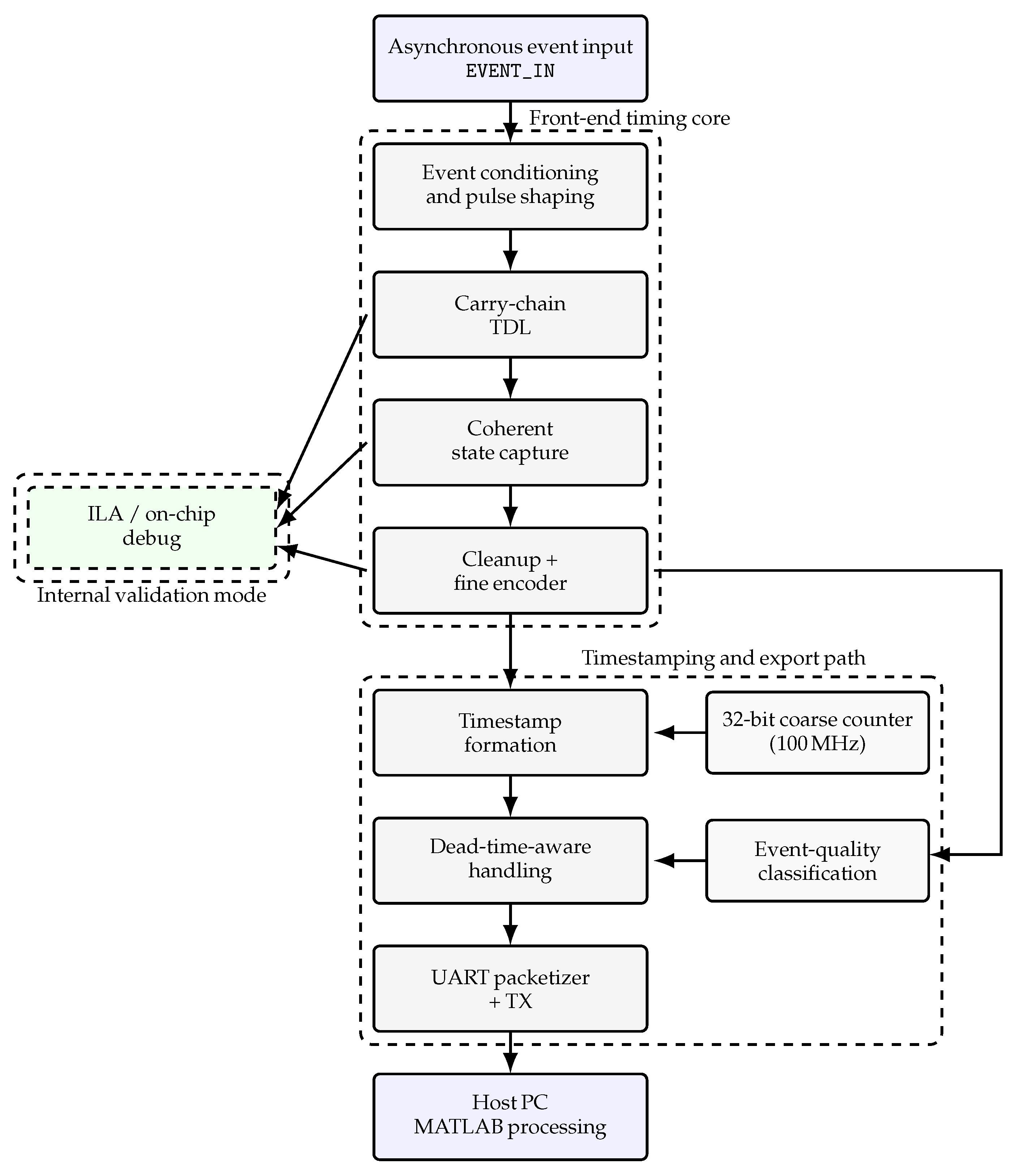
Figure 1 summarizes the overall organization of the proposed front-end. The signal flow is represented explicitly from top to bottom, starting from the asynchronous digital event input, denoted in the figure as
EVENT_IN, and continuing through the event-conditioning stage, the carry-chain tapped delay line (TDL), the coherent state-capture block, and the cleanup plus fine-encoding stage. The resulting fine-time information is combined with a coarse timing reference in the coarse–fine timestamp formation block, while a parallel event-quality path generates the flags later used for event acceptance and classification. The lower part of the diagram represents the dead-time-aware handling and UART-based export path, which connects the internal timing core to the host-side MATLAB (version R2025a) processing workflow. In parallel, selected internal signals are routed to the ILA/debug branch, highlighting the distinction between the internal validation mode and the automated export mode used later in the measurement campaign.
3.1. Event Input Conditioning and Launch into the Fine-Time Path
The entry point of the front-end is an asynchronous digital event input, denoted here as an edge-event signal. In contrast to clock-synchronous logic, this signal is not guaranteed to align with the FPGA system clock, and therefore, its handling must preserve timing information rather than suppress it through immediate synchronization. For that reason, the event is first processed by a dedicated conditioning stage that prepares it for propagation through the fine-time interpolation path.
The role of the conditioning stage is twofold. First, it creates a pulse compatible with the intended TDL observation window. Second, it reduces ambiguity in the launch behavior so that the subsequent delay-line capture remains interpretable. In practical terms, excessively narrow pulses may reduce observability of the propagation front, whereas excessively wide pulses can distort the useful delay-line pattern or increase the likelihood of edge-window saturation. This is also the point at which event handling begins to acquire measurement-level meaning, since distorted or closely spaced events may need to be rejected or explicitly classified rather than accepted blindly.
3.2. Carry-Chain Tapped Delay Line
Fine-time interpolation is implemented using the native
CARRY4 resources of the Xilinx Artix-7 FPGA. These carry structures provide a fast and relatively regular propagation path that can be repurposed as a tapped delay line, an approach that is well established in FPGA-based TDC design [
22,
23,
30,
31]. In the present implementation, the TDL contains 128 effective taps arranged as a vertically constrained carry structure. This organization was selected to reduce placement-induced irregularity and to improve reproducibility across builds.
Although the broader methodological framing of the paper is intended to remain relevant beyond a single vendor, the present realization is specifically a Xilinx Artix-7 implementation and relies on Xilinx-specific resources, most notably CARRY4 delay elements and the integrated logic analyzer (ILA) used for internal validation.
At a conceptual level, the operating principle is straightforward. When the conditioned event arrives, it propagates asynchronously through the carry chain. At the next observation instant, the states of all taps are sampled simultaneously and captured into registers. The resulting sampled pattern provides a spatial snapshot of the edge position within the delay line. In an idealized case, the captured vector resembles a thermometer code, with a transition separating taps already reached by the propagating edge from taps that have not yet been reached. The location of this transition contains the fine-time information.
Given the 128-tap depth used in this implementation and the 100 MHz coarse clock, a nominal average within-clock-cycle granularity on the order of 78 ps would be expected if the full clock interval were sampled uniformly. This value is included only as an approximate scale reference. In an FPGA carry-chain TDL, the effective bin widths are known to be nonuniform and implementation-dependent, so this nominal estimate should not be interpreted as a calibrated resolution figure.
In practice, however, the behavior of a carry-chain TDL inside an FPGA is not ideal. The effective delay associated with each tap may vary because of device-level nonuniformity, routing perturbations, and synthesis or implementation details [
34,
36,
40]. Furthermore, the captured pattern may show local irregularities, especially near the transition region, producing bubble-like artifacts or ambiguous partial transitions. These effects are well known in the literature and help explain why a useful timing front-end must incorporate not only a delay line but also a robust interpretation path.
3.3. Coherent State Capture, Cleanup, and Fine-Code Extraction
A central design feature of the proposed system is that the raw delay-line state is captured coherently and preserved long enough to be interpreted in a stable way. Rather than attempting to derive a fine code from loosely observed asynchronous behavior, the system explicitly latches the TDL state and then processes this captured vector through a cleanup and encoding stage. This separation between physical capture and digital interpretation improves robustness and also provides essential debug visibility.
The architecture, therefore, distinguishes between three levels of internal representation:
The implicit asynchronous propagation state of the edge inside the carry chain;
The latched raw tap vector acquired at the observation instant;
The cleaned and encoded fine-time result exported to the rest of the front-end.
This layered interpretation is particularly useful during bring-up and measurement. If an event later appears suspicious at the packet level, the internal latched state can still be inspected to determine if the problem originated in the physical TDL behavior, in the encoding stage, or in a later export block. In this sense, observability is treated as part of robustness rather than as a secondary debug convenience.
The fine-time output is represented with 7 bits in the implementation used for this study, which is consistent with the 128-tap TDL depth. Importantly, the encoded fine result is not exported blindly. It is accompanied by a set of flags that indicate whether the event should be regarded as valid or whether one of several exceptional conditions occurred.
A key role of the cleanup and encoding stage is to transform the coherently captured TDL state into an interpreted event representation that is both exportable and diagnostically meaningful. In practice, this means suppressing non-ideal transition patterns that are not accepted as trustworthy fine-time observations; producing a cleaned, thermometer-like representation for internal interpretation; extracting the encoded fine value when the event is accepted; and generating the companion validity and anomaly indicators used later in the event-quality and dead-time-aware handling stages. This separation between the raw captured state and the interpreted event output is central to the observability-oriented architecture adopted in this work.
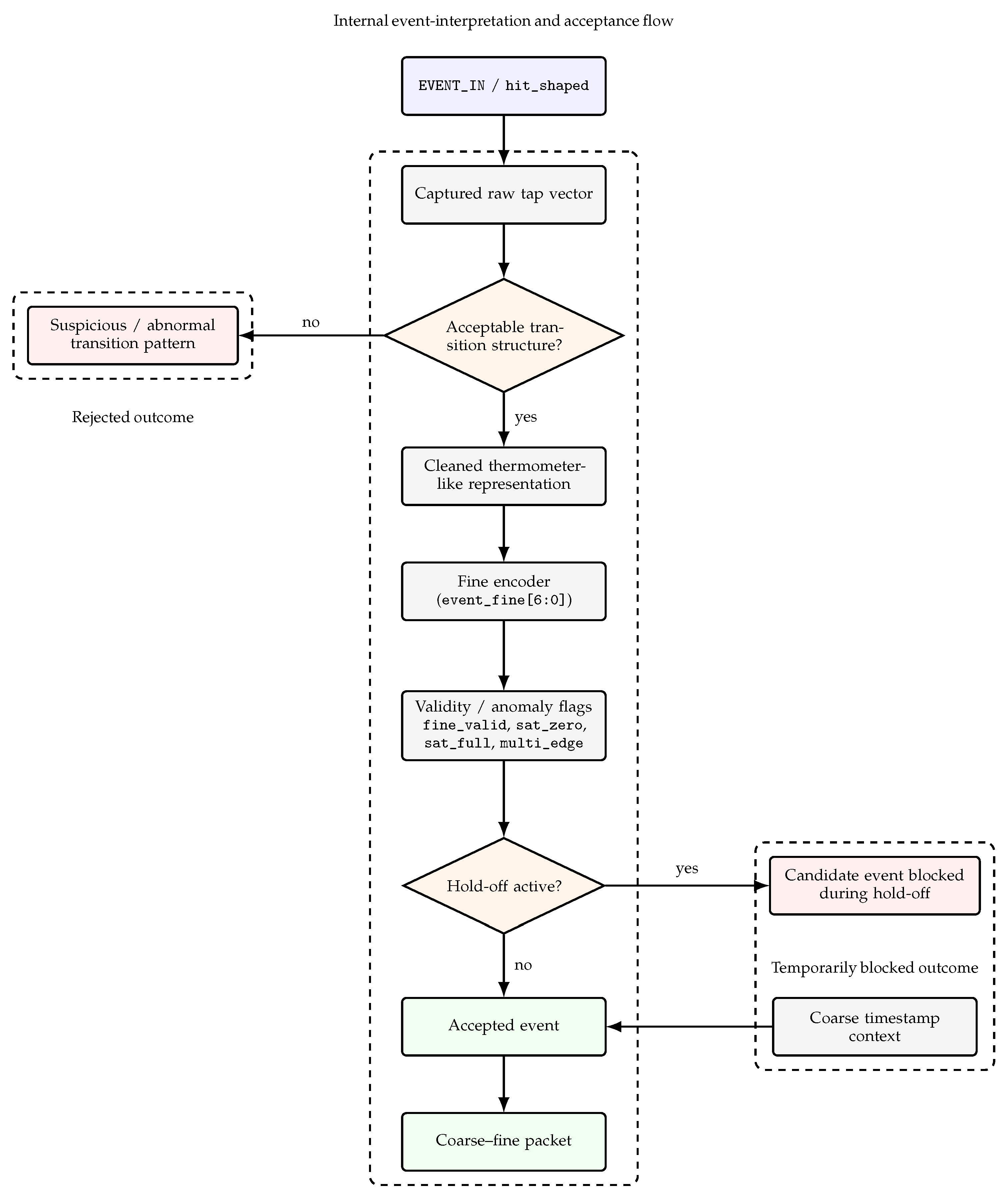
In operational terms, the cleanup and encoding flow can be understood as a sequence of six steps. First, the raw tap vector produced by the coherent state-capture block is frozen and made available to the digital interpretation path. Second, the transition structure of that vector is inspected to determine whether it resembles an acceptable monotonic edge pattern or a clearly abnormal case. Third, patterns that are obviously inconsistent with a trustworthy single-edge interpretation are not promoted directly to a valid fine-time event. Fourth, when the captured structure is acceptable, a cleaned thermometer-like representation is derived for internal interpretation. Fifth, the corresponding fine position is encoded into the exported event_fine[6:0] field. Finally, the validity and anomaly indicators are generated so that the downstream event-quality and acceptance logic can distinguish usable events from suspicious ones. This stepwise interpretation is central to the front-end because it separates raw captured TDL behavior from the accepted digital event representation ultimately exposed to the rest of the system.
3.4. Coarse Timestamp Path
Because the carry-chain TDL provides only within-clock-cycle information within a limited observation window, it must be paired with a coarse timing reference in order to generate useful timestamps across longer intervals. The proposed architecture therefore includes a 32-bit coarse counter clocked at 100 MHz. This counter provides the clock-cycle-level timing context, while the fine code identifies the event position within the current clock period.
The timestamp produced by the front-end is thus naturally interpreted as a coarse–fine pair. This representation is common in TDC systems because it allows high temporal granularity to be achieved without sacrificing range [
1,
2]. In the present work, however, the emphasis is not on formal metrological reconstruction of absolute time over a very wide dynamic range but on obtaining robust event timing information under realistic sensing-style operating conditions. For that reason, the most relevant experimental quantities later in the paper are not classical calibrated linearity metrics such as differential nonlinearity (DNL) and integral nonlinearity (INL) but event validity, occupied fine-code range, stability across runs, and the distinction between internal operating capability and export-compatible operating points.
3.5. Event-Quality Classification
One of the distinctive aspects of the proposed front-end is the explicit generation of event-quality metadata. Together with the coarse and fine timing fields, the architecture produces a set of flags that classify the sampled event. These flags include a valid-event indication and explicit markers for saturation at the beginning or end of the effective observation window, as well as detection of multi-edge or otherwise abnormal patterns.
This design choice reflects a conservative measurement philosophy. In a laboratory front-end intended for time-resolved sensing, it is often preferable to mark questionable events explicitly rather than silently convert every observed pattern into an apparently valid timestamp. This is especially true when the input excitation is asynchronous, the delay line is finite, and the operating point may vary with stimulus conditions. A front-end that can distinguish usable events from suspicious ones is therefore more valuable for real experiments than one that simply outputs a fine code whenever activity occurs.
The usefulness of such classification is reinforced by the application context. In TCSPC, FLIM, or event-driven ranging systems, even a relatively small fraction of biased or malformed events can distort the interpretation of the timing distribution, especially if those events are not explicitly identifiable [
6,
27,
28]. By exporting event-quality metadata together with each timestamp, the front-end supports cleaner downstream processing and more defensible interpretation of the measured data.
3.6. Dead-Time-Aware Event Handling
The architecture also includes a dead-time-aware handling policy. This block is motivated by a practical issue that appears in many event-driven timing systems: when two events arrive too closely spaced in time, the second one may interact with the residual state of the first event or with the transient state of the front-end itself. In such cases, accepting every event indiscriminately may degrade the quality of the dataset or make the resulting timing words difficult to interpret.
To address this, the implementation includes an exclusion mechanism that identifies events arriving within a short hold-off interval after a previously accepted event. Depending on the internal state and the operating mode, such events may be rejected or flagged. In the experimental campaign, the hold-off interval was set to 32 clock cycles, corresponding to approximately 320 ns at 100 MHz, so that accepted events would correspond to interpretable timing states rather than to closely spaced ambiguous captures. The precise role of dead-time-aware handling in this paper is, therefore, not to optimize maximum throughput but to preserve measurement trustworthiness under asynchronous excitation.
From an architectural perspective, this block should therefore be understood as part of the event-acceptance policy of the front-end rather than as a throughput-optimization mechanism. Its role is to prevent the export path and the interpreted timing record from being populated by events that are too closely spaced to be regarded as reliably independent under the internal state assumptions of the measurement chain.
At the behavioral level, the dead-time-aware logic operates as a simple sequential acceptance mechanism. When a qualified event is accepted, the hold-off counter is loaded with the configured exclusion interval of 32 clock cycles. While this counter remains nonzero, subsequent candidate events are prevented from being accepted into the exported event stream, even if activity is observed at the input. Once the counter expires, a new qualified event may again be promoted to the accepted-event path. This behavior is intentionally conservative: rather than attempting to maximize raw event throughput, the block ensures that the interpreted timing record is populated by events that satisfy the front-end’s spacing assumptions and therefore remain easier to analyze and trust.
It is important to interpret this hold-off setting in the context of the experiments reported in this paper. At the UART operating points used in the quantitative campaign ( 5 kHz and 10 kHz), the inter-event spacing is in the 100 μs to 200 μs range, and therefore, the configured 320 ns hold-off does not become a practically limiting factor. In other words, the dead-time-aware mechanism is present and configured during the reported measurements, but it is not strongly exercised by the low-rate laboratory excitation used for the export-compatible campaign. Its relevance would become more apparent in scenarios involving much more closely spaced events, such as detector-driven timing chains or higher-rate asynchronous sensing conditions.
While
Figure 1 provides the top-level architectural organization of the front-end,
Figure 2 focuses specifically on the internal interpretation and acceptance flow of the key event-processing blocks. Its purpose is not to repeat the system-level architecture but to clarify how captured TDL activity is inspected, classified, and either promoted to an accepted coarse–fine event or diverted to a suspicious or blocked candidate-event outcome.
Table 2 complements this view by summarizing the main inputs, outputs, and functional role of the principal processing blocks.
3.7. UART Packetization and Streaming
Accepted events are exported through a lightweight UART streamer, providing a simple and transparent path suitable for laboratory-scale acquisition and MATLAB-based analysis. This export link is not intended to maximize throughput; its methodological role is to define the practical host-visible regime used for repeatable automated characterization. Crucially, the maximum rate at which events can be exported through this link is not the same as the maximum rate at which the internal front-end can detect and classify events—an asymmetry that directly motivates the dual-mode strategy described in
Section 4.
3.8. Implementation Platform and Physical Constraints
The complete system is implemented on the Digilent Basys 3 platform, based on a Xilinx Artix-7 FPGA. The choice of this platform is deliberate: it is low cost, widely available, and well-suited for experimental work in which accessibility and reproducibility matter. The system clock is 100 MHz, and the UART interface operates at 921,600 baud.
Because carry-chain timing behavior is sensitive to physical organization inside the FPGA design, placement control plays an important role in the implementation. The TDL is therefore constrained to a consecutive vertical carry structure in order to reduce variability associated with uncontrolled place-and-route solutions. This does not make the structure perfectly uniform, but it helps improve consistency and aligns with established good practice in FPGA-based timing design [
22,
23].
3.9. Internal Observability and Representative Waveform Behavior
A further strength of the implementation is that internal observability was treated as a first-class design goal. In addition to the packetized UART stream, the front-end exposes internal states and event-quality signals to the integrated logic analyzer. This includes the cleaned thermometer representation, the encoded fine-time result, the event strobe, and the main validity and saturation flags. Such visibility greatly simplifies debugging and was essential in distinguishing between problems intrinsic to the timing core and problems caused by the export path.
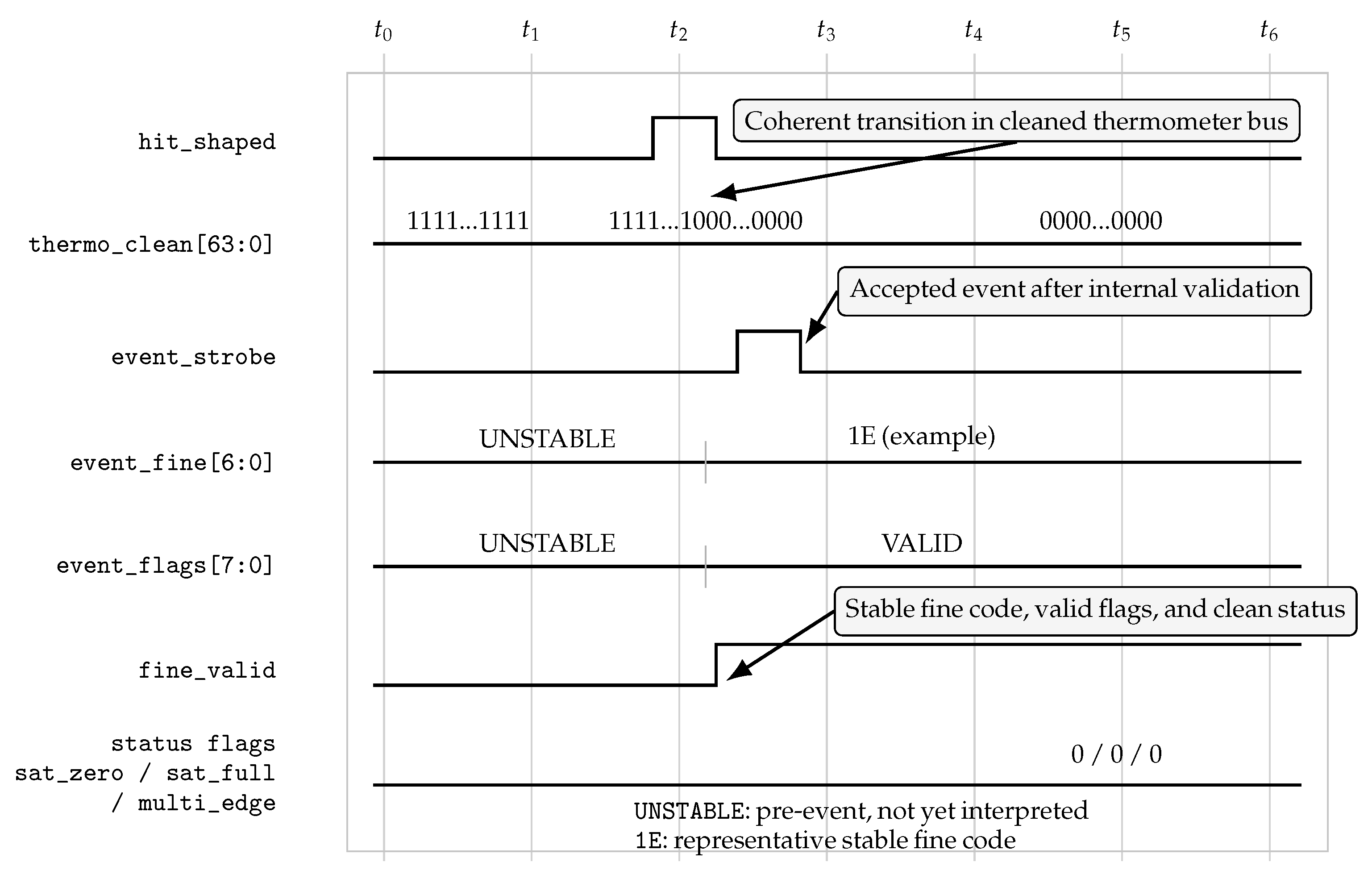
Figure 3 provides a didactic waveform diagram illustrating the signal-level interpretation of a valid internal event in the validation mode. The diagram is schematic rather than a direct screen capture, and its purpose is to clarify the temporal sequencing between the internal shaped hit (
hit_shaped), the cleaned thermometer representation (
thermo_clean[63:0]), the accepted-event strobe (
event_strobe), the encoded fine output (
event_fine[6:0]), the event-quality word (
event_flags[7:0]), the explicit fine-valid indication (
fine_valid), and the main status indicators (
sat_zero,
sat_full, and
multi_edge). In the pre-event region, the labels
UNSTABLE denote values that are not yet interpreted as stable event outputs. After the accepted-event strobe, the fine output settles to the representative code
1E, used here only as an illustrative example of a stable encoded value rather than as a special or preferred code. Likewise, the transition from
UNSTABLE to
VALID in
event_flags[7:0] indicates the transition from a pre-event/non-interpreted flag word to a stable accepted-event classification. The assertion of
fine_valid and the clean
0/0/0 status pattern indicate that the shown event is accepted without zero-end saturation, full-end saturation, or multi-edge ambiguity. The quantitative behavioral evidence for this type of coherent internal behavior is provided separately in
Figure 4.
Together,
Figure 1 and
Figure 3 provide a compact visual summary of how an asynchronous event is processed through the front-end and represented as a validated coarse–fine timing word with associated status information.
3.10. Implementation Cost and Resource Utilization
Table 3 summarizes the implementation cost on the target Basys 3/Artix-7 platform. A distinction is made between the debug-enabled build used during ILA-based internal validation and the practical functional design itself. This distinction is important because the integrated ILA core and associated debug hub dominate the resource usage of the instrumented implementation, particularly in LUTs, registers, and block RAM. By contrast, the sensing front-end remains comparatively lightweight. Based on the reported post-implementation hierarchical utilization, the functional design is estimated to require around 1.3 k LUTs, about 0.5 k registers, 381 occupied slices, no block RAM, and only one global clock buffer. These figures support the interpretation of the proposed architecture as a compact timing front-end whose large debug-enabled footprint is driven primarily by observability requirements rather than by the timing architecture itself.
4. Experimental Methodology
4.1. Methodological Rationale
A central premise of this work is that the behavior of a sensing-oriented timing front-end cannot be assessed adequately through a single experimental regime. During experimental development, it became clear that two distinct but complementary issues had to be addressed. First, the intrinsic internal behavior of the FPGA timing core had to be validated under short-pulse, relatively high-rate excitation conditions representative of an edge-driven sensing front-end. Second, the practical ability to export, decode, and analyze large sets of timestamped events had to be evaluated under host-compatible operating conditions. These two requirements are not equivalent, and in the present system, they are not governed by the same limiting mechanism.
This observation led to the definition of a dual-mode methodology composed of an internal validation mode and an automated export mode. The first mode is centered on integrated logic analyzer (ILA) observation of internal signals and is intended to verify that the timing core itself behaves coherently under MHz-range short-pulse excitation. The second mode is centered on UART streaming and MATLAB-based post-processing and is intended to support repeatable large-set quantitative analysis under export-compatible operating points. The methodology is therefore stimulus-aware in two complementary senses: it considers both the effect of input conditions on the internal TDL behavior and the practical constraints imposed by the communication path used for automated host-side logging.
This separation is particularly important in the present work because the experimental campaign was carried out with the Digilent Digital Discovery generator integrated into the laboratory setup, and the accessible stimulus space was therefore defined by its timing configuration granularity. In practice, this meant that event frequency and minimum achievable pulse width were not fully independent, since the available duty-cycle resolution coupled both quantities. Rather than treating this constraint as incidental, the methodology was defined explicitly around it so that the reported operating regions would remain reproducible within the actual laboratory workflow used to validate the front-end.
Likewise, the UART output path introduces a practical ceiling on the rate at which timestamped events can be exported and processed reliably. If these external constraints were ignored, the measured operating region of the complete system could easily be misinterpreted as an intrinsic limitation of the TDL timing core itself. The methodology adopted here is designed precisely to avoid that conceptual error.
It is also important to clarify the intended scope of the measurements. The goal of the experimental campaign is not to provide a full TDC metrology study in the classical sense, with exhaustive calibrated DNL/INL, PVT dependence, or best-case single-shot precision benchmarking. Instead, the purpose is to characterize the front-end as an experimentally usable timing subsystem under realistic sensing-style constraints, with emphasis on event validity, operating-region robustness, internal observability, and export-compatible behavior.
4.2. Measurement Objectives
The experimental campaign was structured around six specific methodological objectives:
To verify valid event detection and classification by the internal timing front-end under MHz-range excitation with short pulses.
To identify a safe operating point for reliable large-set automated export through UART.
To assess the repeatability of that safe export operating point across multiple runs and acquisition sessions.
To evaluate front-end robustness against pulse-width variation at a fixed event rate.
To determine whether a more aggressive operating point can preserve high validity while extending the explored fine-code range.
To characterize how the transition from the safe to the aggressive export regime evolves as frequency is increased.
The first objective is addressed through the ILA-based internal validation mode. Objectives two through six are addressed through the UART/MATLAB export mode. This decomposition ensures that each experiment addresses a well-defined methodological objective and prevents the measurement campaign from degenerating into a mere catalog of operating conditions.
4.3. Experimental Modes
4.3.1. Internal Validation Mode
In the internal validation mode, the objective is not to export thousands of events to the host PC but to verify the behavior of the timing core itself. This mode uses the integrated logic analyzer to capture internal signals such as the cleaned thermometer representation, the encoded fine-time result, the event strobe, and the main event-quality flags. The main experimental conditions in this mode are in the MHz range, with short pulses close to the regime that had previously shown coherent internal TDL behavior during bring-up.
Representative conditions in this mode include approximately MHz and MHz with pulse widths close to 10 ns. These conditions are not intended to define the final automated operating point of the complete system. Instead, they are used to demonstrate that the internal front-end can detect valid events, produce coherent thermometer-like patterns, and extract stable fine codes in a regime closer to the temporal dynamics expected from an event-driven sensing front-end.
This mode is therefore especially valuable for separating internal timing capability from export bandwidth. A valid internal event observed through ILA does not imply that the UART link can sustain continuous high-rate export of all such events. What it does show is that the TDL-based timing core itself is not intrinsically limited to the much lower event rates later used for automated host logging.
4.3.2. Automated Export Mode
In the automated export mode, the purpose shifts from qualitative internal validation to quantitative large-set characterization. In this regime, each accepted event is packetized and exported through the UART link to a MATLAB acquisition and analysis pipeline. This mode is used to collect repeatable statistics on large event sets and to generate the summary metrics that later structure the results section, including valid-event ratio, saturation rate, multi-edge occurrence, occupied fine-code bins, and explored fine-code range.
Unlike the internal validation mode, the export mode must satisfy both internal timing quality and practical host-side communication constraints. An operating point is therefore considered useful only if it simultaneously preserves a high ratio of valid events, avoids strong saturation or multi-edge behavior, allows reliable packet export and decoding, and yields a sufficiently rich fine-code distribution to support meaningful analysis.
The export mode is thus deliberately more conservative than the ILA mode, not because the timing core ceases to function at higher rates, but because the end-to-end measurement chain must remain reliable, repeatable, and interpretable.
4.4. Stimulus Constraints and Operating-Point Selection
The selection of operating points was strongly influenced by the practical limitations of the external signal generator. In the Digilent Digital Discovery setup used in this work, the minimum duty cycle that could be configured reliably was 0.01%. As a result, the minimum pulse width depends on the selected event frequency. For example, at 1 kHz, the minimum available pulse width becomes approximately 100 ns, whereas at 5 kHz, the same minimum duty corresponds to approximately 20 ns, and at 10 kHz, it corresponds to approximately 10 ns. This coupling is central to understanding the final experimental matrix.
From internal exploratory observations, it was found that short pulses around 10 ns produced the most convincing internal TDL behavior in the ILA, whereas substantially wider pulses were not needed for internal validation at MHz-range excitation. However, a fully automated campaign at an MHz-rate event injection would not be compatible with reliable export through the UART link. A compromise, therefore, had to be found for the quantitative campaign.
The selected baseline export condition was 5 kHz with a pulse width of 20 ns, corresponding to the minimum available duty at that frequency. This operating point was prioritized because it balances UART bandwidth constraints with the temporal dynamics of the internal timing core while remaining close to the experimentally preferred short-pulse regime. A second, more aggressive export condition was selected at 10 kHz with a pulse width of 10 ns. For brevity, this more exploratory high-rate condition is referred to hereafter as the aggressive operating point. The comparison between these two conditions becomes one of the central quantitative results of the paper.
4.5. Experimental Matrix
The final experimental matrix is organized into six blocks.
This block includes representative internal captures in the MHz range, such as approximately MHz/1.01% and MHz/1.00%. Its purpose is to demonstrate valid internal event detection, coherent thermometer behavior, and clean event flags under short-pulse excitation. These experiments provide the main evidence that the internal TDL front-end is not fundamentally limited by the much lower event rates used later in export mode.
This block consists of repeated runs at 5 kHz and 20 ns. Its purpose is to establish the safe export operating point. Metrics extracted from this block include the number of captured packets, the valid-event ratio, the saturation percentages, the multi-edge rate, the minimum and maximum observed fine code, and the number of occupied fine-code bins.
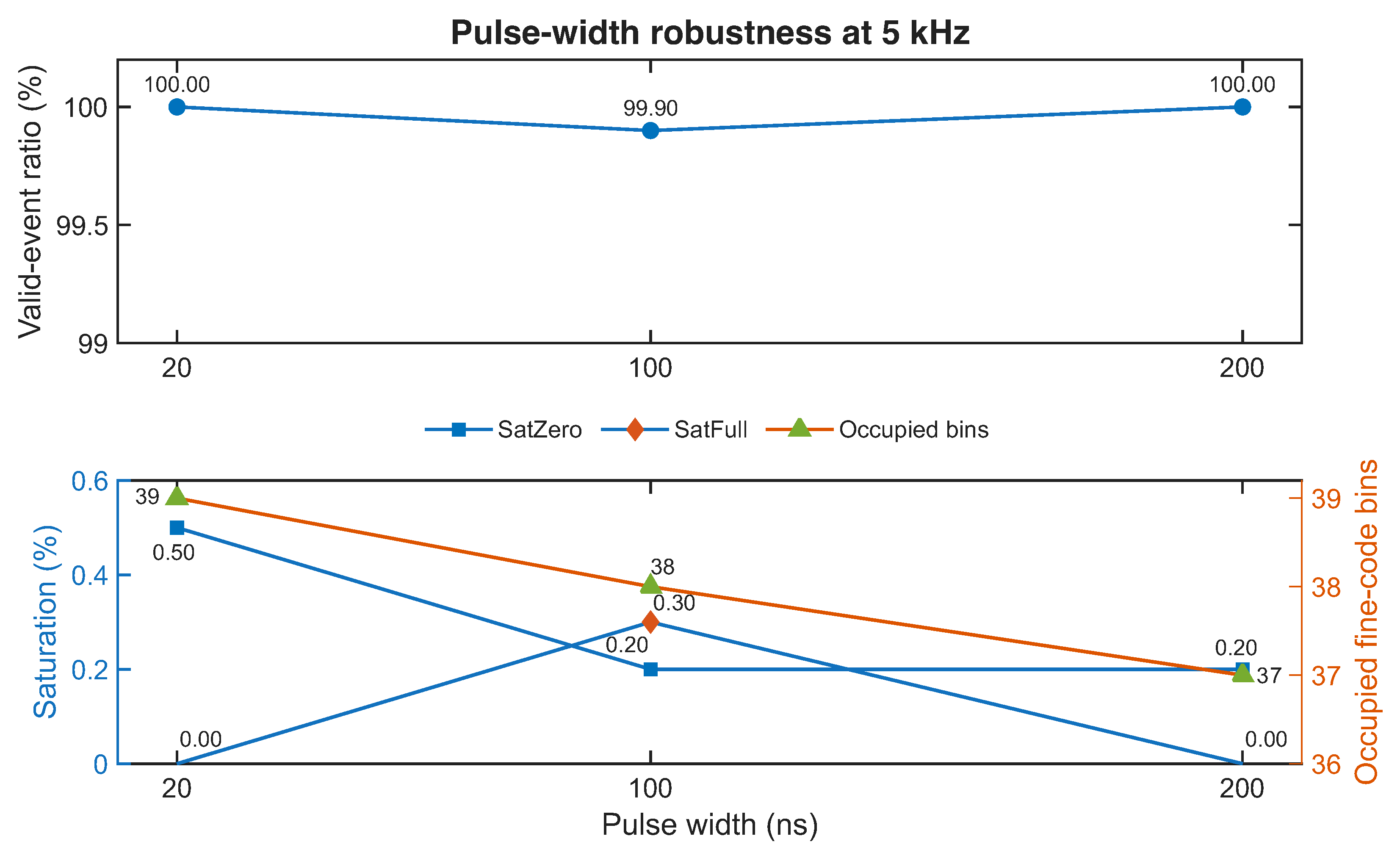
This block keeps the frequency fixed at 5 kHz while varying the pulse width across 20 ns, 100 ns, and 200 ns. Its purpose is not necessarily to identify a catastrophic failure boundary but to determine if the baseline remains robust under moderate widening of the input pulse within the practically accessible range.
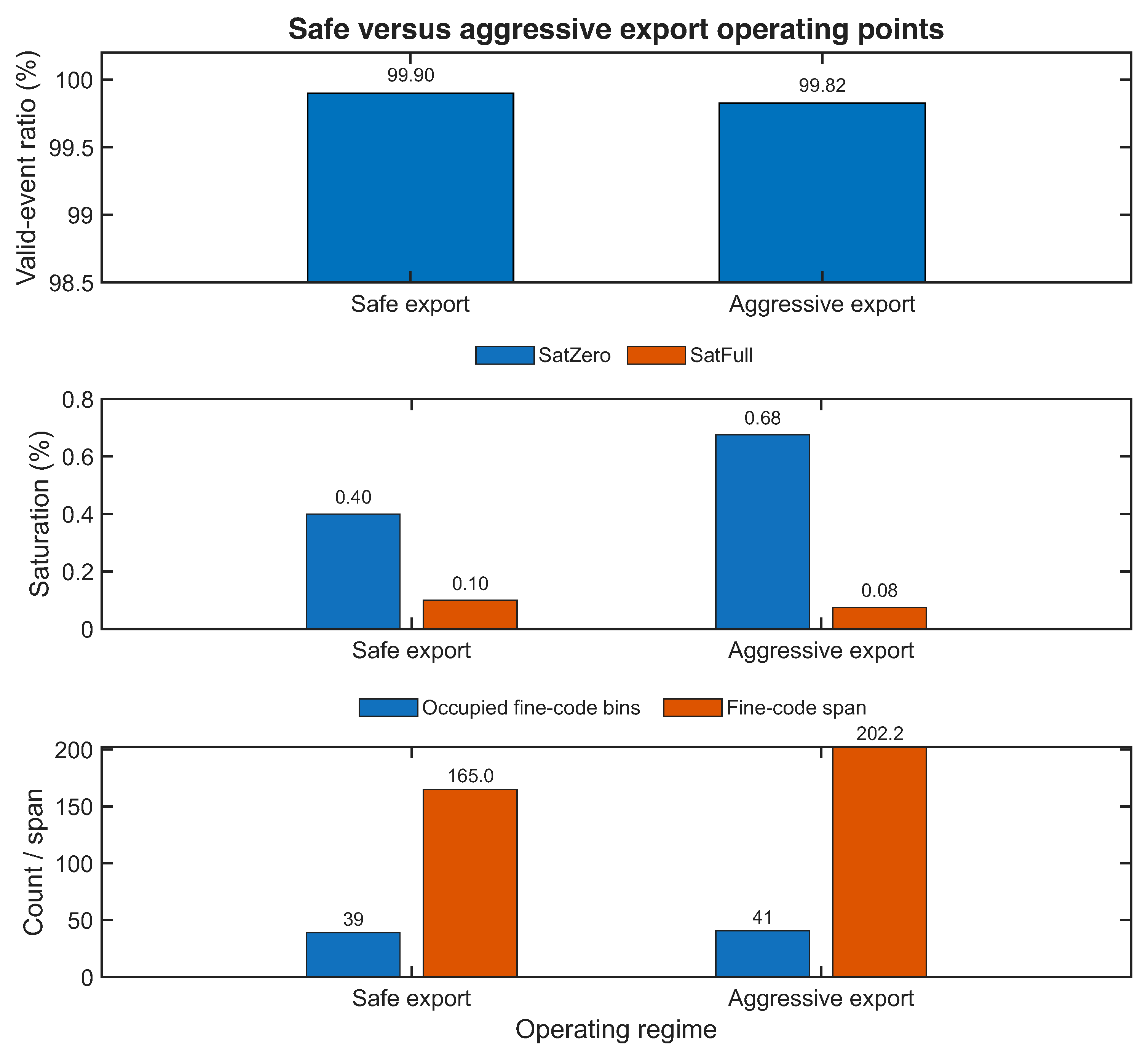
This block compares the safe baseline of 5 kHz/20 ns against the more aggressive point of 10 kHz/10 ns. It is intended to assess if the front-end can maintain high event validity while extending the explored fine-code range under a more demanding export condition.
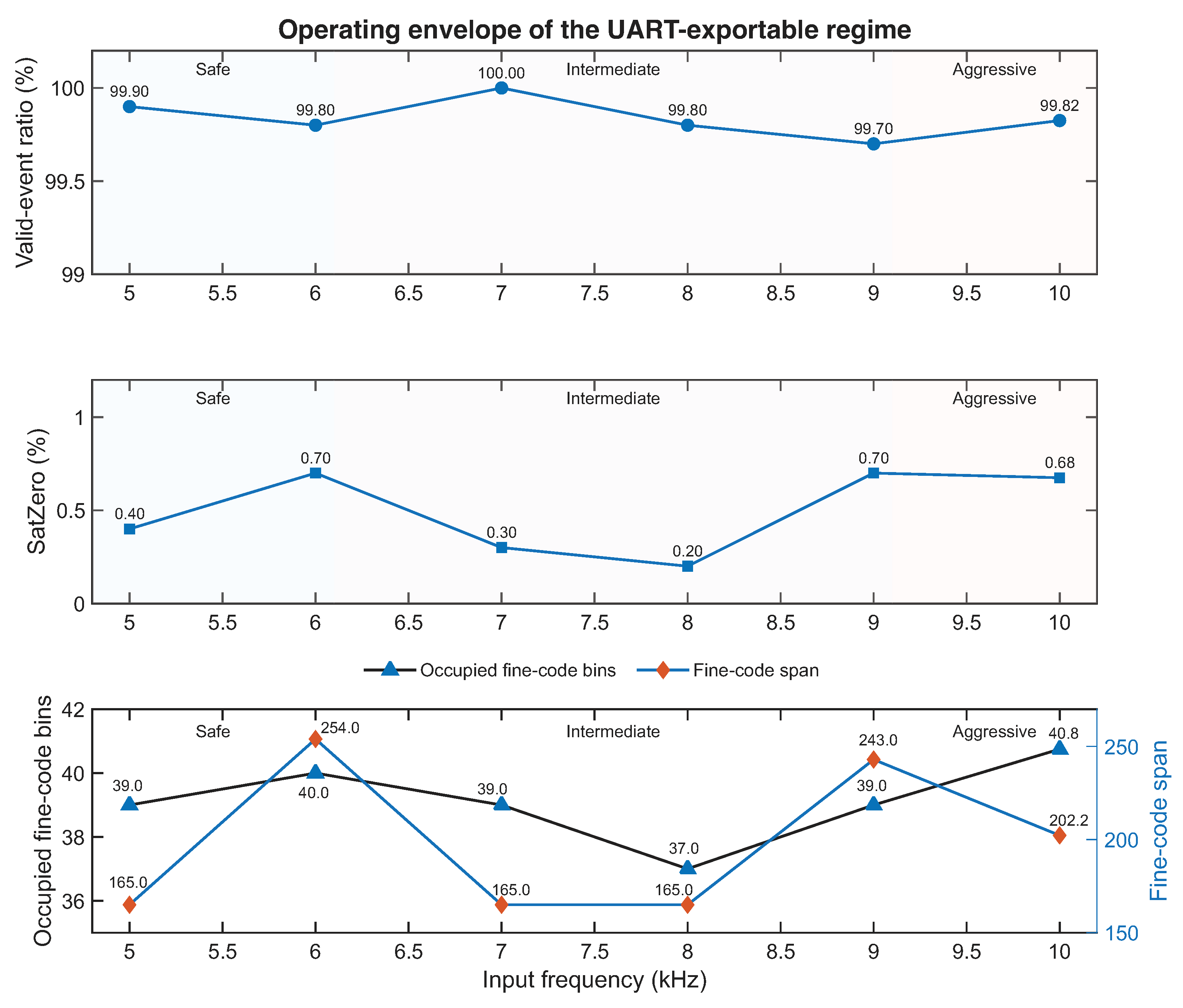
This block bridges the gap between the conservative export regime and the more demanding short-pulse operating point. In this experiment, the pulse width is kept fixed in the short-pulse regime while the event frequency is stepped progressively between the safe and aggressive conditions. Its purpose is not to identify a single abrupt export limit but to determine if the export-visible degradation emerges gradually or abruptly as the system is pushed toward higher-rate operation. For consistency, the same metrics extracted throughout the UART campaign are used here as well, including valid-event ratio, saturation indicators, occupied fine-code bins, and fine-code span.
This block includes additional repetitions of the baseline condition and repeated acquisitions performed later in time. Its purpose is to verify that the selected baseline is not merely a one-off favorable condition but a reproducible and temporally stable operating point.
Taken together, the matrix defines a coherent experimental progression: internal validation, baseline establishment, robustness assessment, safe-versus-aggressive comparison, and intermediate operating-space exploration.
Table 4 summarizes the resulting experimental matrix, including the two operating modes, the main block-level objectives, the representative conditions, and the principal metrics used throughout the measurement campaign.
4.6. UART Packet Integrity and Host-Side Processing
The automated export mode relies on a custom UART streamer that packetizes each accepted event into a compact frame containing a header, coarse timestamp information, fine code, event flags, and checksum. The relevance of this export path is that it defines the practical host-visible regime used for repeatable automated characterization.
During experimental development, a defect was identified in the byte-sequencing logic of the initial streamer implementation, producing packet misalignment in early runs. After correcting this issue, the UART path became stable enough to support the quantitative campaign reported in the paper. Only post-fix runs were retained for final analysis, so the reported results correspond to a validated end-to-end export chain.
On the host side, MATLAB was used only for packet capture, decoding, metric extraction, experiment logging, and figure generation. The timing front-end itself was implemented and experimentally validated on an Xilinx Artix-7 FPGA (Basys 3 platform), while the MATLAB processing flow reads the UART stream, reconstructs event fields, decodes the flags, computes per-run summaries, and updates the experiment workbook. In parallel, separate scripts were developed for the ILA CSV workflow, allowing internal captures to be processed into event-level summaries and supporting the unified use of ILA and UART evidence in the final paper.
4.7. Recorded Metrics
The methodology emphasizes metrics that are directly meaningful for sensing-oriented front-end operation. For each export run, the following quantities were recorded:
Number of accepted packets;
Valid-event percentage;
Saturation-at-zero percentage;
Saturation-at-full percentage;
Multi-edge percentage;
Minimum observed fine code;
Maximum observed fine code;
Number of occupied fine-code bins.
These metrics were selected because they jointly characterize whether the front-end is merely active or actually useful. A good operating point should not only yield packets but also do so with high event validity, low abnormal-event rates, and a sufficiently rich fine-code distribution. The number of occupied bins and the explored fine-code range are especially relevant in this work because they provide an experimentally accessible measure of whether the front-end is exploring a useful portion of its internal timing state space. In this paper, the reported fine-code span is used as an empirical descriptor of the explored code interval within the corresponding processed dataset, rather than as a claim of calibrated linear code-space coverage. More specifically, the span is defined as the difference between the maximum and minimum fine-code values observed within a given acquisition run or aggregated dataset, expressed in units of fine-code bins. Since the encoder output is a 7-bit word and the TDL contains 128 taps, valid fine codes nominally range from 0 to 127. However, the reported span values in some experiments exceed this nominal range because the span metric is computed across the aggregated dataset, combining multiple runs, each of which may explore a different sub-interval of the fine-code axis depending on the exact phase relationship between the asynchronous input event and the system clock at the moment of capture. The span, therefore, reflects the union of fine-code intervals explored across all contributing acquisitions, not a single-run excursion that violates the 7-bit constraint. Individual per-run fine-code values remain within the 0–127 range enforced by the encoder.
For the ILA mode, the metrics are necessarily more structured and less purely statistical because the capture depth and trigger conditions differ from the UART export regime. Even so, the ILA CSV processing allows one to count event strobes, valid internal events, saturation and multi-edge occurrences, and the occupied fine-code range for the internal validation conditions. These data are not used as a substitute for the UART quantitative campaign but as complementary evidence that the internal front-end behaves coherently under higher-rate excitation.
4.8. Criteria for Experimental Success
The experimental campaign was not judged by a single best-case timing number. Instead, each block had its own criterion of success.
For the ILA validation mode, success required the observation of coherent, cleaned thermometer patterns; stable fine-code extraction; valid-event flags; and the absence of clear invalid conditions in representative events. For the baseline UART mode, success required reliable capture of 1000 events per run together with a near-unity valid-event ratio and low saturation. For the width sweep, success meant determining if the baseline behavior remained stable as pulse width increased. For the safe versus aggressive comparison, success meant identifying if a more demanding operating point could preserve high validity while expanding the explored fine-code range. For the intermediate sweep, success meant determining if the transition between conservative and aggressive export regimes remained gradual and interpretable. Finally, for the repeatability block, success required that the baseline metrics remain consistent across multiple runs and across measurements separated in time.
This way of defining success is particularly appropriate for a sensing-oriented front-end. Rather than maximizing a single isolated implementation metric, the methodology seeks to identify operating points that are simultaneously meaningful, trustworthy, and experimentally reproducible.
5. Experimental Results
5.1. Overview of the Experimental Evidence
The experimental results are presented according to the dual-mode methodology introduced in
Section 4. Internal ILA-based evidence is first used to verify that the timing front-end behaves coherently under MHz-range short-pulse excitation, whereas the UART/MATLAB campaign is then used to identify and characterize operating points that are meaningful from the viewpoint of practical, reproducible, large-set measurements. This organization avoids conflating the intrinsic internal capability of the TDL-based timing core with the more restrictive operating region of the complete host-visible export chain.
5.2. Internal Validation Under MHz-Range Excitation
The first set of results concerns the internal validation mode. In this regime, the purpose is not to maximize host-visible export throughput but to verify that the timing front-end itself behaves coherently under short-pulse excitation in the MHz range.
Figure 3, described above, provided a stylized ILA-like waveform diagram illustrating the expected internal behavior of a valid event in this mode. In this figure, the
UNSTABLE annotations denote pre-stabilization or non-interpreted values, whereas
1E and
VALID denote representative stable outputs after event acceptance. The internal shaped hit is followed by a coherent transition in the cleaned thermometer bus, an accepted-event strobe, a stable fine-code output, and clean event-quality indicators without saturation or multi-edge ambiguity.
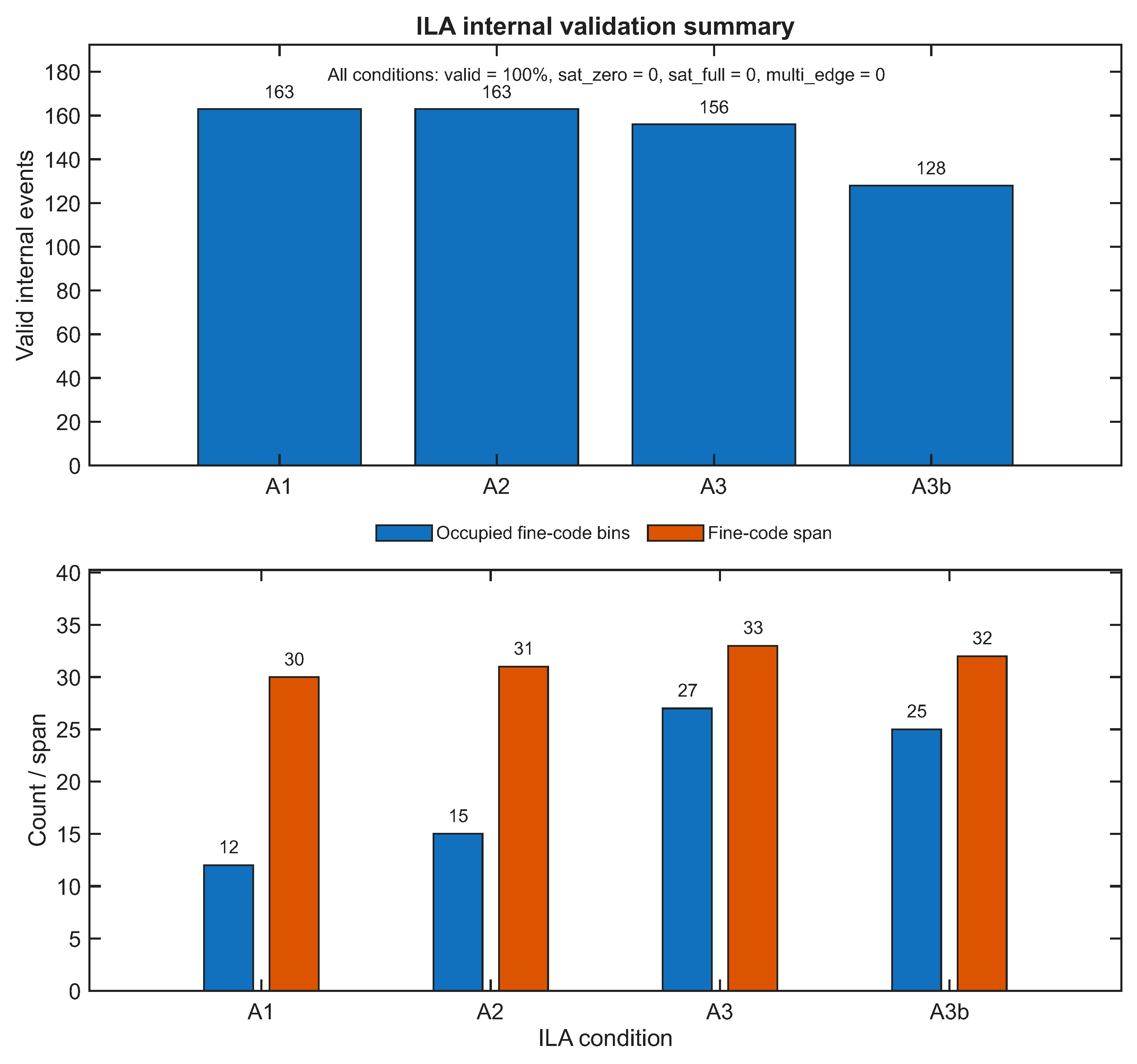
For clarity, the representative ILA conditions labeled A1, A2, A3, and A3b all use 10 ns pulses and differ only slightly in excitation frequency, spanning approximately 1.00 MHz to 1.01 MHz. In particular, A1 and A3b correspond to the slightly detuned MHz case, whereas A2 and A3 correspond to the MHz case.
Figure 4 summarizes the quantitative results obtained from the processed ILA captures for the main internal-validation conditions A1, A2, A3, and A3b. Since all accepted internal events in these captures were classified as valid, and no saturation or multi-edge pathologies were observed, the figure emphasizes two more informative descriptors: the number of valid internal events observed within the acquisition window and the extent of the occupied fine-code space. In this way, the figure complements the waveform-level interpretation of
Figure 3 with compact quantitative evidence that the internal timing front-end remains coherently active under the selected MHz-range short-pulse conditions. The absolute number of valid internal events observed in each ILA capture should be interpreted as a descriptor of activity within the corresponding capture window rather than as a normalized throughput metric, since the ILA observation context is determined by trigger and windowing conditions rather than by a long statistical acquisition protocol.
The results in
Figure 4 show that the internal validation mode is not limited to isolated anecdotal observations. Instead, the processed ILA consistently exhibits valid internal activity together with nontrivial fine-code occupation across all selected conditions. The number of valid events observed in the capture window remains substantial in every case, while the occupied-bin and fine-span metrics confirm that the internal front-end is exploring a meaningful portion of the fine-time state space.
This result should be interpreted carefully. It does not imply that the complete host-visible acquisition chain can sustain continuous MHz-range export. Rather, it shows that the internal front-end remains coherent under conditions that are more demanding than those adopted for the automated UART campaign. In this sense, the ILA evidence supports the view that the export-compatible operating points are constrained primarily by the full measurement chain rather than by an intrinsic inability of the timing core to operate under higher-rate short-pulse excitation.
The reported MHz-range ILA validation should therefore be interpreted as representative internal validation under the stimulus and capture conditions available in the present study, rather than as an absolute ceiling of the timing core itself. Extending this validation toward higher sustained rates would require a correspondingly faster stimulus/capture chain and is therefore left for future work.
5.3. Safe Export Baseline: Reproducibility and Stability
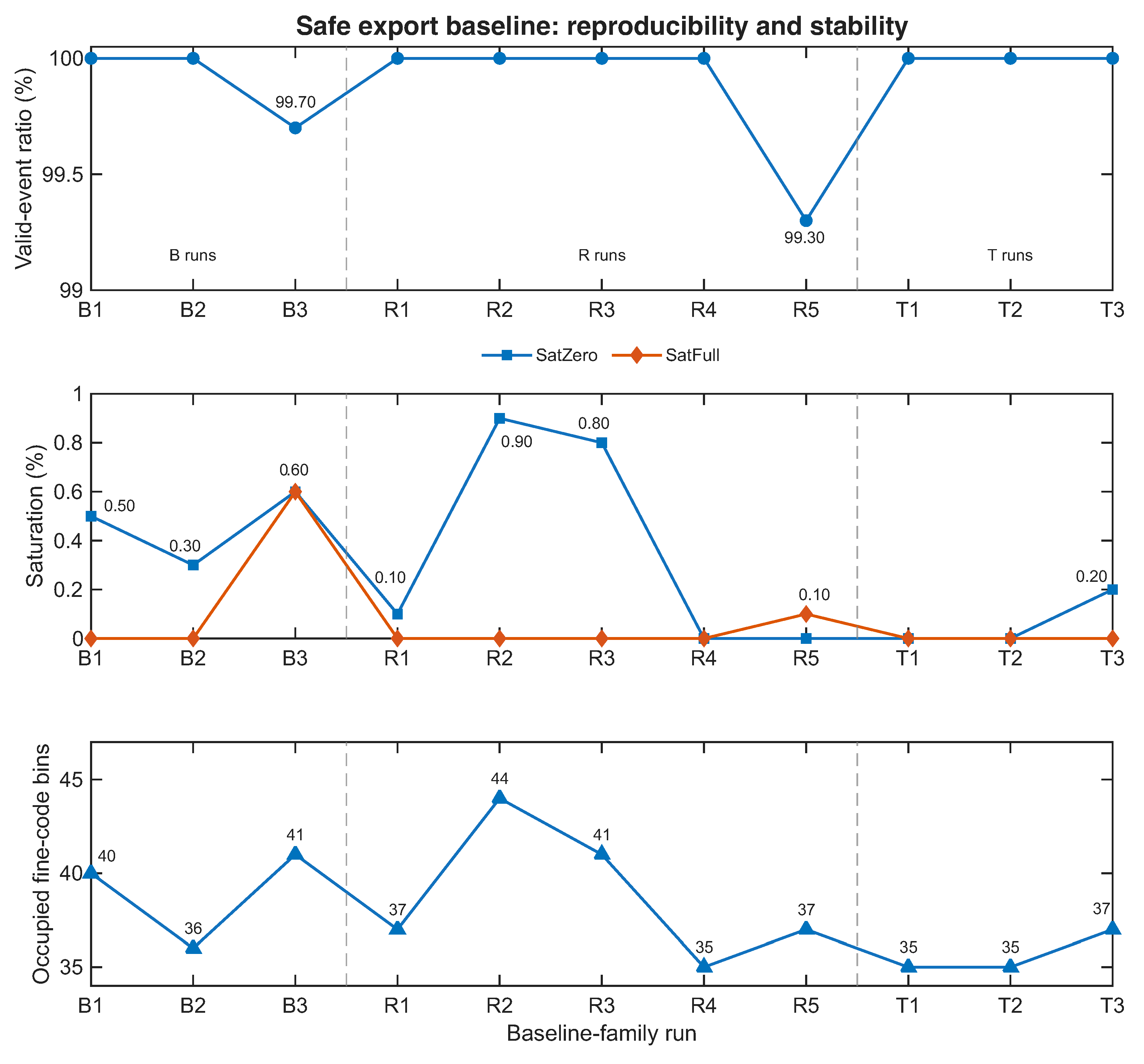
The central quantitative result of the paper is the identification of a safe export operating point at 5 kHz and 20 ns. This condition was selected because it preserves a short pulse width compatible with the useful internal regime while remaining safely within the bandwidth envelope of the corrected UART/MATLAB acquisition chain. The first question addressed experimentally was whether this operating point is merely functional or if it is also repeatable and stable.
To answer that question, the baseline condition was evaluated across three initial runs (B1–B3), five additional repeatability runs (R1–R5), and three later-session temporal-stability runs (T1–T3). The resulting aggregate statistics are summarized in
Table 5, while
Figure 5 shows the run-to-run evolution of the key baseline metrics.
Several important observations follow from these results. First, the packet-based acquisition chain remained fully usable throughout the baseline family, with 1000 accepted packets obtained in every run. This confirms that the corrected UART path was not merely functional in isolated tests but stable enough to sustain repeated acquisition across the full baseline block.
Second, the valid-event ratio remained extremely high across all baseline-family runs. While individual runs showed small variations, the aggregate mean of 99.92% indicates that the operating point is not only usable but also highly selective in accepting events that remain interpretable according to the front-end’s own quality criteria. This is an important result in the context of sensing-oriented timing front-ends, because it means that the exported timestamp stream is dominated by events that the system itself considers trustworthy. The run-to-run standard deviation of the valid-event ratio across the 12-run baseline family was 0.21 percentage points, confirming that the operating point is not only high-performing in isolation but also statistically stable across repeated acquisitions.
Third, the saturation metrics remained very low. Saturation at the beginning of the effective observation window stayed at the sub-percent level on average, while saturation at the full end was even smaller. Multi-edge behavior was negligible. These results suggest that the chosen baseline successfully balances a sufficiently short pulse width with a sufficiently conservative export rate, thereby avoiding invalid operation without collapsing the explored timing region.
Finally, the number of occupied fine-code bins remained consistently in the high-30s to low-40s range. This complements the validity statistics. A front-end that yields nearly 100% valid events but collapses into only one or two fine codes would not be very useful. In contrast, the present results show that the baseline operating point combines high validity with nontrivial fine-code exploration. Across the 12 baseline-family runs, the corresponding run-to-run variations remained modest, with no indication of systematic drift or collapse of the selected operating point.
5.4. Fine-Code Distribution Under the Baseline Condition
The aggregate fine-code behavior of the baseline family is illustrated in
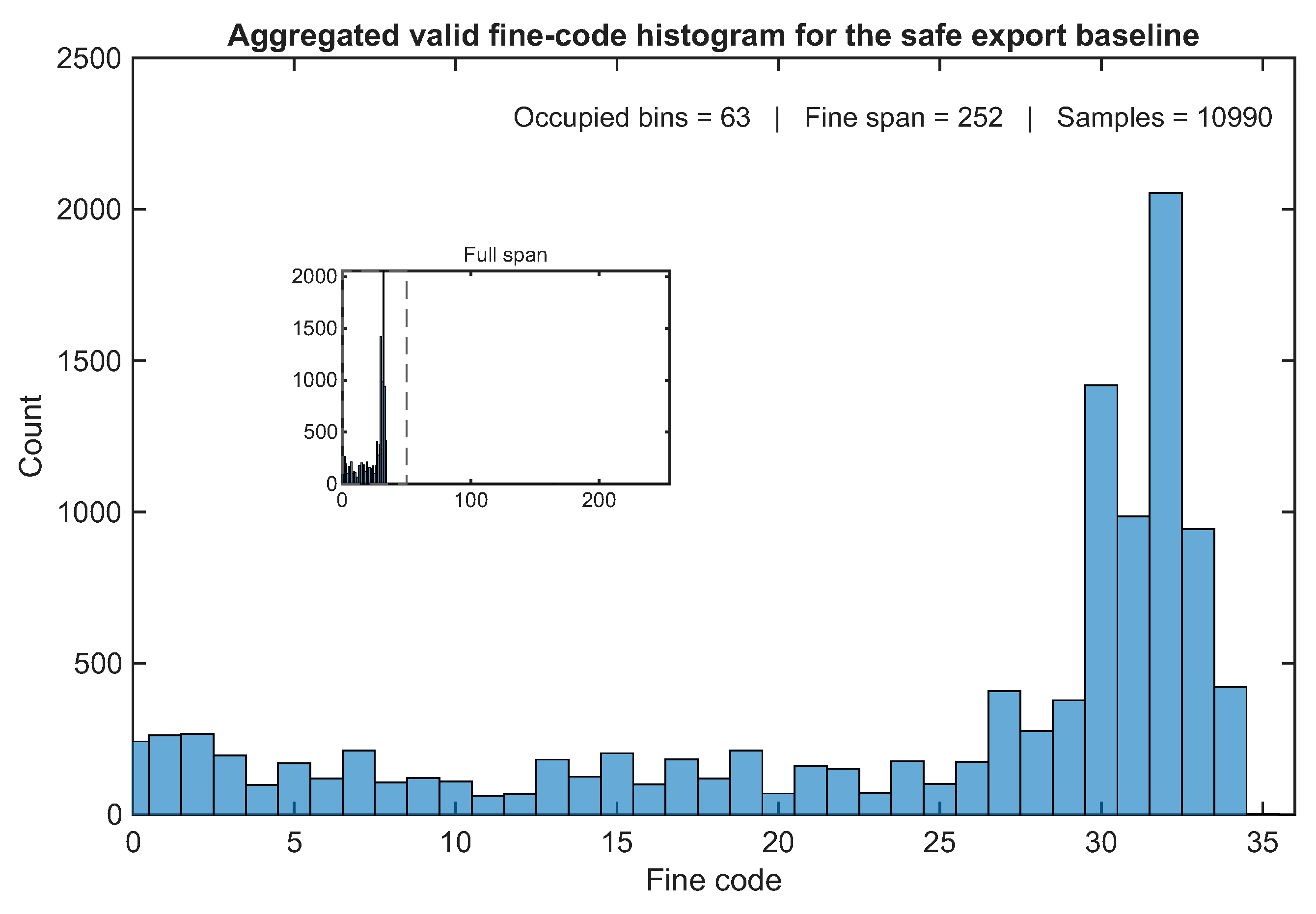
Figure 6, which reports the histogram obtained by accumulating all valid fine-code samples from runs B1–B3, R1–R5, and T1–T3. The purpose of this figure is not to extract formal metrological quantities such as DNL or INL but to verify that the safe export baseline remains associated with a nontrivial distribution of valid fine codes rather than collapsing into a narrowly confined subset of the fine-time space. In this sense, the histogram complements the repeatability trends of
Figure 5 by showing how the valid-event stream is distributed internally across the fine-code axis.
To improve the readability of this distribution, the main panel of
Figure 6 focuses on the lower-code region where most valid fine-code samples are concentrated, whereas the inset preserves the full explored fine-code span. Although the occupied span extends to substantially higher sparse codes, most valid samples cluster in the lower-code region shown in the main panel. This presentation avoids visually diluting the dominant occupancy structure while still making the broader explored range explicit.
In this context, the reported fine-code span should be interpreted strictly as a descriptor of the numerical interval covered by the processed valid-event population within the corresponding analysis dataset. It is not intended to represent the direct calibrated range of the exported event_fine[6:0] field nor to imply that the 7-bit fine word alone linearly spans that full numerical extent. Rather, the span metric is used here only to summarize how broadly the processed valid-event distribution extends within the analysis space adopted for comparative occupancy interpretation.
Figure 6 shows that, even though most valid samples are concentrated in a lower-code region, the baseline front-end behavior cannot be reduced to a single preferred code. Instead, valid fine codes are distributed over a broad interval, consistent with the occupied-bin counts reported in
Figure 5 and
Table 5. This observation is important because it rules out a trivial interpretation of the high valid-event ratio. In other words, the excellent event validity of the baseline is not obtained by collapsing the front-end into only one or two recurrent codes but by operating in a regime that remains both selective and internally informative. The sparse higher-code occurrences visible in the inset are retained to preserve the full explored range of the processed valid-event dataset. In the absence of a dedicated calibration-oriented interpretation of that extended region, they are not used here as the basis for a separate physical claim, but simply as part of the broader occupancy picture associated with the baseline regime.
At the same time, the aggregated histogram is not uniform, and this point deserves explicit discussion. In an FPGA carry-chain TDL, nonuniform bin widths and implementation-dependent delay perturbations are well known, so the observed distribution should not be interpreted as evidence of ideal linearity. The present figure is therefore used as a qualitative indicator of nontrivial fine-code occupation rather than as a substitute for formal DNL/INL analysis. The nonuniformity observed here is compatible with the expected behavior of an uncalibrated FPGA TDL and does not invalidate the main conclusion of the figure, namely that the baseline operating point preserves access to a meaningful portion of the internal fine-time space.
Although the histogram of
Figure 6 is useful as an occupancy descriptor of the safe export regime, it is not in itself a formal code-density metrology result. For that reason, it is useful to distinguish it from the type of preliminary DNL/INL and RMS evidence that would be considered suitable for dedicated TDC-oriented reporting.
5.5. Preliminary Code-Density and Fine-Time Dispersion Characterization
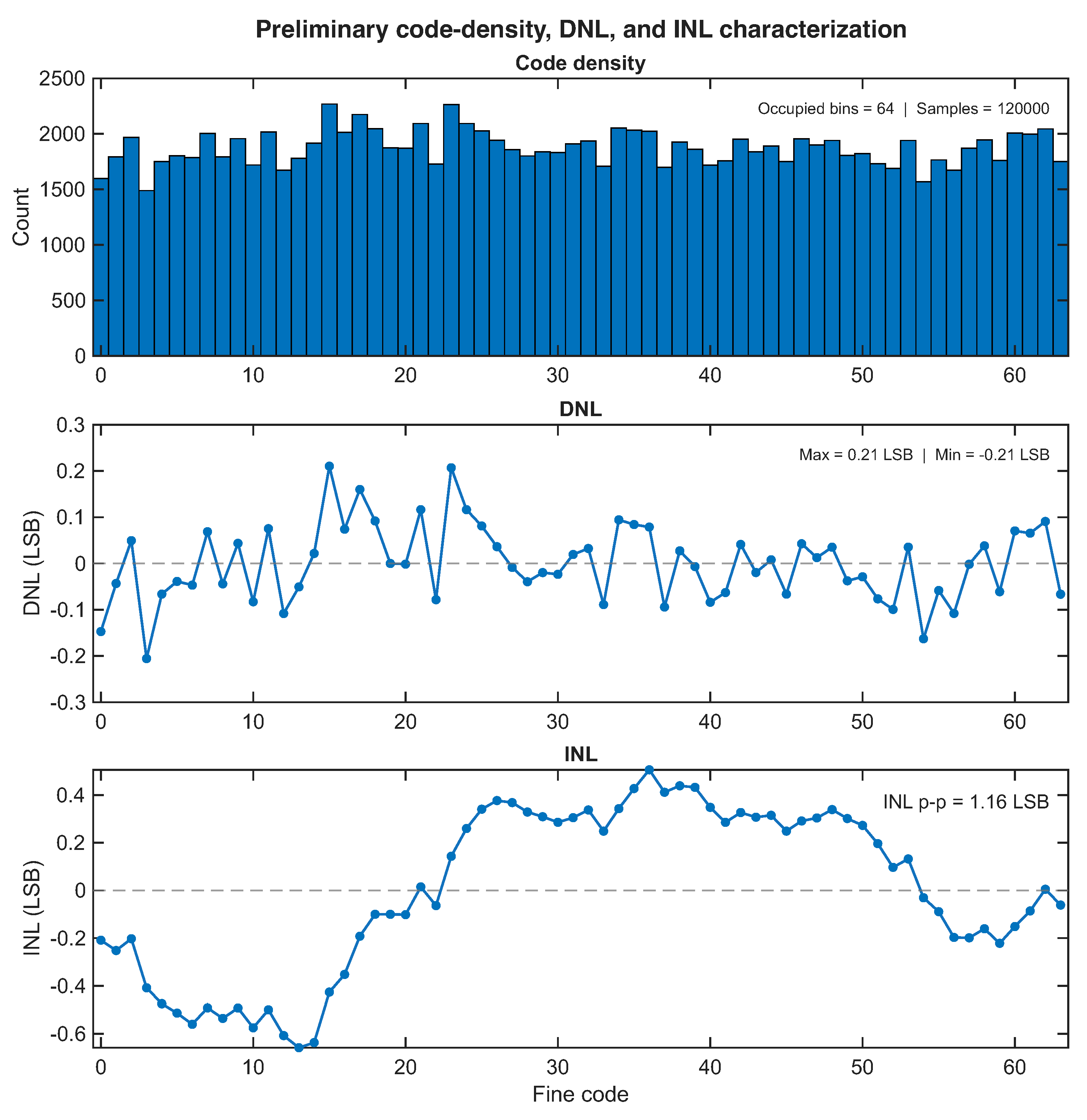
To complement the main operating-region analysis, a supplementary metrological characterization was performed in order to obtain a first-order view of the uncalibrated temporal behavior of the FPGA carry-chain front-end. The metrological indicators reported in this subsection were extracted from a dedicated filtered UART campaign assembled specifically for code-density and local-dispersion analysis and, therefore, use a substantially larger sample count than the baseline occupancy histogram reported earlier. In the present case, the DNL/INL/RMS estimates are based on approximately 120,000 filtered samples collected under a dedicated metrological acquisition at 5 kHz event frequency and 20 ns pulse width—the same stimulus condition as the safe export baseline (but with a substantially longer acquisition duration selected specifically to accumulate sufficient counts for code-density evaluation). This acquisition is therefore stimulus-compatible with the baseline family but constitutes a separate, longer-duration dataset assembled for metrological purposes.
Figure 6, by contrast, is based on the aggregated baseline-family runs (B1–B3, R1–R5, T1–T3) and serves a different interpretive purpose.
Figure 7 reports the resulting preliminary code-density characterization obtained from filtered UART captures under asynchronous excitation. The upper panel shows the fine-code occupancy histogram, while the middle and lower panels report the corresponding DNL and INL estimates. The fine-code range covered in this preliminary metrological analysis is narrower than the one visible in the aggregated baseline histogram of
Figure 6. This difference is expected because the two figures serve different interpretive purposes:
Figure 6 is an occupancy-oriented descriptor of the safe export regime over the full explored fine-code span, whereas the present analysis focuses on the metrologically useful region selected from dedicated filtered captures for code-density evaluation. As expected for an uncalibrated FPGA TDL, the code-density distribution is not perfectly uniform, which is consistent with the known nonuniformity of carry-chain bin widths and implementation-dependent delay perturbations. The DNL oscillates around zero with moderate excursions, whereas the INL evolves smoothly over the analyzed fine-code region without catastrophic discontinuities. These results should, therefore, be interpreted as a preliminary descriptor of bin nonuniformity rather than as a substitute for a dedicated calibration-grade linearity campaign. The dedicated metrological acquisition should, therefore, be interpreted as a supplementary characterization dataset rather than as part of the baseline-family operating-envelope experiments defined in
Section 4.
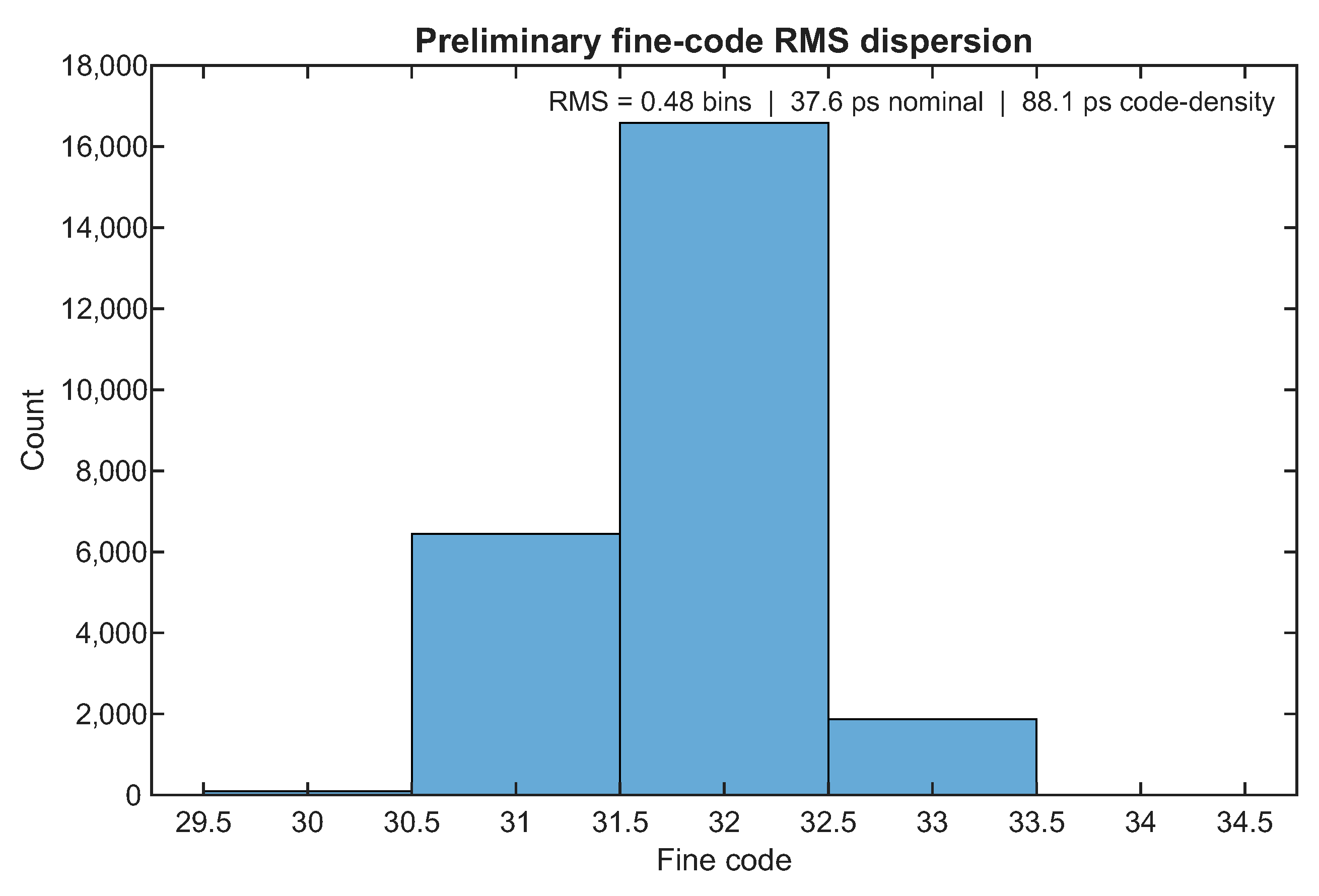
Figure 8 reports the corresponding preliminary fine-code RMS dispersion result. In this case, the relevant visual signature is a localized distribution concentrated around a relatively narrow subset of codes, which is consistent with a repeatability-oriented interpretation of RMS under approximately fixed timing conditions. This should be distinguished from the much broader histograms used elsewhere in the paper to illustrate global fine-code occupancy under asynchronous exploration of the operating space. In the present context, the RMS quantity is used only as a compact indicator of local fine-time dispersion and should not be interpreted as a formal single-shot precision benchmark. The difference between the nominal-bin and code-density-derived RMS estimates reflects the nonuniformity of the underlying FPGA TDL. The nominal estimate assumes a uniform average bin width, whereas the code-density-derived estimate incorporates the measured unequal occupation of the fine bins and is therefore more conservative. These two values should not be interpreted as contradictory but as two complementary ways of expressing the same local dispersion result under different assumptions about bin uniformity.
Table 6 summarizes the corresponding preliminary metrological indicators. These quantities provide a compact first-order view of the uncalibrated temporal behavior of the front-end. In particular, the occupied-bin count and sample count quantify the extent of the analyzed region, the DNL and INL values provide a preliminary description of bin nonuniformity, and the RMS quantities summarize the local fine-time dispersion in both code units and approximate temporal units.
Taken together, these preliminary results provide a useful metrological complement to the main sensing-oriented characterization presented in the paper. They indicate that the front-end exhibits the expected bin nonuniformity of an uncalibrated FPGA TDL while still supporting an experimentally interpretable fine-time response over a nontrivial portion of the accessible code space. At the same time, the scope of these results remains deliberately limited: they should be understood as first-order descriptors of uncalibrated behavior, not as a replacement for a full swept-delay, calibration-heavy TDC metrology campaign. Their role in the paper is therefore supplementary rather than central: they provide a first-order metrological context for the front-end without altering the main operating-region narrative established by the baseline, robustness, and operating-envelope experiments.
5.6. Robustness Against Pulse-Width Variation at Fixed Frequency
The next question addressed experimentally was whether the baseline behavior remains robust when the pulse width is increased while the frequency is held fixed at 5 kHz. This was explored through three conditions: 20 ns (C1), 100 ns (C2), and 200 ns (C3). The corresponding results are summarized in
Table 7 and illustrated in
Figure 9. While
Table 7 reports the dominant descriptors used for compact comparison,
Figure 9 also includes the
SatFull indicator, which remained negligible throughout the explored pulse-width range.
These results show that the baseline operating region does not collapse when the pulse width is increased within the explored range. As seen in the upper panel of
Figure 9, the valid-event ratio remains effectively unchanged, staying at or very near unity across all three conditions. The lower panel shows that the saturation indicators remain low and that the number of occupied fine-code bins changes only slightly, from 39 to 37–38 bins. Taken together, these observations indicate that the selected export-compatible baseline is not excessively fragile with respect to moderate widening of the input pulse.
5.7. Safe Versus Aggressive Export Operating Points
The next experimental objective was to determine if a more aggressive export operating point could preserve the high event validity of the safe baseline while extending the explored internal timing region. To address this, the representative safe export condition D1 (5 kHz, 20 ns) was compared against the aggressive export family formed by D2, G1, G2, and G3 (10 kHz, 10 ns). The comparison is summarized in
Table 8 and visualized in
Figure 10, where the valid-event ratio, the saturation indicators, and the fine-code exploration metrics are shown separately in order to preserve the readability of their different numerical scales.
Figure 10 confirms that the aggressive operating region does not collapse. The valid-event ratio remains very high in both regimes, the increase in saturation indicators is modest, and the occupied fine-code bins and span are broader at the aggressive point. The main trade-off is therefore not a collapse in validity but a modest increase in saturation indicators in exchange for a more widely explored fine-code region. The transition between these two anchor points is examined next through an intermediate export-frequency sweep.
5.8. Intermediate Export-Frequency Sweep and Operating Envelope
The comparison between the safe and aggressive export regimes establishes that the front-end can be operated under both conservative and more exploratory UART-compatible conditions. However, these two anchor points alone do not fully describe how the export-visible behavior evolves between them. To clarify that transition, an additional intermediate sweep was carried out at a fixed short pulse width while progressively increasing the export frequency between the safe and aggressive regimes.
In this additional experiment, the pulse width was kept fixed in the short-pulse regime while the event frequency was stepped through intermediate conditions between 5 kHz and 10 kHz. The purpose of this sweep was not to identify a single abrupt export limit, but rather to determine if the degradation of export-visible behavior, if any, emerges gradually or abruptly as the operating point moves from the safe regime toward the aggressive one. The same metrics used throughout the UART campaign were retained here as well, namely the valid-event ratio, the dominant saturation indicator, and two complementary descriptors of fine-code exploration: the number of occupied fine-code bins and the fine-code span. Here again, the fine-code span is used only as an empirical descriptor of how widely the processed valid-event population extends within the corresponding analysis dataset, rather than as a calibrated statement about the direct linear range of the exported 7-bit fine field.
Figure 11 summarizes the resulting operating envelope. The background shading highlights the safe, intermediate, and aggressive regions across all three panels. The upper panel reports the valid-event ratio, the middle panel shows the evolution of zero-end saturation, and the lower panel summarizes fine-code exploration through the occupied-bin count and the fine-code span, which are shown separately to preserve the readability of both quantities despite their different numerical scales.
The operating-envelope view shows that the export-compatible behavior does not admit a binary “working/not working” interpretation. The valid-event ratio remains high, and zero-end saturation stays modest across the full range. Fine-code exploration does not evolve monotonically—both the occupied-bin count and the span fluctuate while remaining interpretable—consistent with the combined influence of the timing core, the stimulus, and the export chain. The sweep, therefore, connects the baseline, the intermediate points, and the aggressive endpoint into a coherent picture: degradation is gradual rather than abrupt, and the UART-visible limit is shaped by the full measurement chain rather than by a collapse of the internal timing core.
5.9. Integrated Interpretation of Internal and Export Modes
The individual result blocks gain additional meaning when considered together. The ILA mode shows that the internal timing front-end remains coherent under MHz-range short-pulse excitation, whereas the UART campaign identifies a practical host-visible operating space organized into safe, intermediate, and aggressive regions. With the addition of the intermediate export-frequency sweep, the transition between these regions can be interpreted experimentally rather than only conceptually.
In particular,
Figure 11 shows that the practical UART-visible regime is not separated from the more exploratory region by an abrupt behavioral discontinuity. Instead, the measured valid-event ratio, saturation behavior, and fine-code exploration remain interpretable as the operating point moves from the conservative export region toward the aggressive endpoint. This observation supports the view that the practical export limit is shaped by the complete measurement chain rather than by a sudden collapse of the internal timing core itself.
Taken together, the reported measurements support a consistent interpretation of the proposed architecture as an experimentally characterized event-timing subsystem with distinct internal and export-visible operating regimes. This interpretation is developed further in the following discussion.
6. Discussion
6.1. System-Level Interpretation of the Front-End
The experimental results confirm that the proposed design is more usefully interpreted as a sensing-oriented timing front-end than as a carry-chain interpolation macro. Conventional TDC figures such as minimum time bin, RMS precision, and calibrated linearity remain important, but they are not sufficient for a front-end that must operate under asynchronous excitation, classify abnormal events, interface with a constrained export path, and support reproducible host-side analysis. The present work is therefore application-motivated and sensing-oriented but not a full detector-integrated sensor demonstration: it is a detector-independent timing front-end whose design choices are motivated by constraints common in SPAD-based time-resolved sensing workflows.
6.2. Internal Operating Capability Versus Export-Compatible Operation
A central conceptual result of the paper is the distinction between the internal operating capability of the timing front-end and the more restrictive regime that remains compatible with host-visible export. The measurements show that these two regimes are related but not identical: the ILA-based observations confirm coherent internal behavior under MHz-range short-pulse excitation, whereas the UART-based campaign defines the operating space in which large event sets can be exported and analyzed reproducibly. In this sense, the host-visible regime is constrained by the complete measurement chain, whereas the internal timing core remains functional in a substantially faster regime.
6.3. Meaning of the Safe and Aggressive Operating Regions
The results identify 5 kHz/20 ns as a safe export operating point. The usefulness of this point lies not in being the most aggressive condition the system can tolerate, but in combining several desirable properties simultaneously: very high valid-event ratio, negligible abnormal-event rates, reproducible packet capture, and consistent occupation of a meaningful fine-code subset. In other words, it is a condition that can be trusted for repeated automated acquisition.
This is an important practical result because sensing experiments often require long captures, repeated acquisitions, or parameter sweeps in which the user cannot afford to revalidate the measurement chain manually at every step. A front-end that behaves well only in isolated hand-tuned conditions is of limited value. The baseline results presented here instead indicate that the proposed front-end can sustain a quantitatively useful and reproducible operating regime over repeated runs and over time-separated acquisitions.
The identification of a more aggressive operating region at 10 kHz/10 ns adds a second layer to the experimental picture. This result shows that the front-end is not limited to a single conservative regime. Rather, it can also operate under a more demanding export condition that preserves high event validity while extending the explored fine-code range. The aggressive regime is not claimed to be universally better: the measurements show a modest increase in saturation-related indicators, which is entirely consistent with the intuition that a shorter-pulse, higher-rate condition should impose tighter constraints on the front-end. However, the degradation remains small compared with the gain in explored fine-code range, which makes the aggressive point experimentally meaningful rather than marginal.
Taken together, the safe and aggressive conditions show that the front-end is better understood in terms of a useful operating space than in terms of a single “best” point. This interpretation is reinforced by the intermediate sweep, which shows that the transition between conservative and more exploratory export regimes is gradual rather than abrupt.
6.4. Interpretation of the Pulse-Width Sweep
The pulse-width sweep at a fixed 5 kHz deserves a careful reading. Before the final campaign, it would have been reasonable to expect a narrative in which increased pulse width rapidly destroys the quality of the TDL observation. The measurements do not support such a strong statement in the 20 ns to 200 ns interval explored here. Instead, the front-end remained largely robust, with negligible change in the valid-event ratio and only small variations in saturation statistics and occupied fine-code bins.
This does not mean that pulse width is unimportant. On the contrary, pulse width clearly played a central role in selecting the useful operating region during exploratory work, and the short-pulse regime remained the preferred one for internal ILA validation. What the results show is more nuanced: once the export-compatible baseline has been identified at 5 kHz, the front-end does not collapse when the pulse is widened moderately within the explored range.
From the standpoint of sensing-oriented instrumentation, this is a useful rather than disappointing result. Robustness under moderate stimulus variation is often more valuable than a fragile optimum. The pulse-width sweep therefore contributes positively to the paper even though it does not support an extreme failure-boundary narrative. It shows that the baseline operating point is not excessively brittle, which strengthens the argument that it can serve as a practical measurement condition.
A related implication is that the robustness observed here should not be confused with formal linearity preservation. The pulse-width sweep shows that the selected export-compatible regime remains usable under moderate stimulus variation, but it does not by itself imply that the fine-time mapping is invariant or calibration-free. In an FPGA TDL, moderate changes in the excitation regime may leave event validity largely unchanged while still altering the detailed occupation of fine bins. This distinction is important for interpreting the present paper correctly: the sweep supports the robustness of front-end usability, not a full metrological invariance claim.
6.5. Relevance to Time-Resolved Sensing Workflows
The broader relevance of these results lies in their fit with the practical needs of time-resolved sensing. Recent discussions in SPAD and FLIM instrumentation emphasize that system value is often determined by the joint behavior of detector physics, timing electronics, throughput, and data conditioning rather than by a single isolated timing figure [
7,
16,
21]. In SPAD-based ToF, TCSPC, FLIM, and other event-oriented acquisition chains, a timing front-end must do more than interpolate time finely. It must also sustain valid operation under asynchronous event arrival, preserve interpretability of the timestamp stream, and provide enough observability that invalid cases can be identified and managed. These requirements become particularly visible in systems where dead time, throughput, and bias introduced by invalid events can distort the measurement result if left untreated [
3,
5,
6,
27,
28,
29].
The proposed front-end does not claim to replace application-specific ASIC imagers or highly integrated photon-counting systems. Rather, it occupies a different but still relevant niche: it provides a flexible and accessible timing subsystem that can be embedded into a sensing-oriented laboratory workflow. In such workflows, it is often more useful to have a front-end whose internal behavior can be validated, whose export path can be trusted, and whose operating points are experimentally justified than to have a nominally finer but less observable black-box timing block.
This is why the paper emphasizes methodology as much as architecture. The dual-mode strategy is not a peripheral convenience; it is part of what makes the front-end useful for sensing-oriented experimentation. It allows the same hardware to be understood both as an internally fast event detector and as a conservative, host-compatible measurement subsystem.
This connection can be made more concrete in SPAD-oriented terms. In practical TCSPC and related photon-timing workflows, the timing contribution of the front-end should remain smaller than, or at least not overwhelmingly dominate, the detector-side temporal uncertainty if the overall system is to preserve useful timing resolution. In many CMOS SPAD technologies, detector-side timing jitter spans the range from a few tens of picoseconds to several hundreds of picoseconds, depending on device structure, process, and operating conditions. Likewise, dead-time-aware handling is directly relevant because SPAD-based chains are themselves shaped by detector recovery and event-spacing constraints, often in the tens-of-nanoseconds range depending on the device and readout organization. From that perspective, the present front-end is not offered as a detector-integrated SPAD readout but as a detector-independent timing subsystem whose event qualification, hold-off handling, and export-aware characterization are aligned with constraints that are common in SPAD-based laboratory timing workflows. In the present experiments, the configured 320 ns hold-off is conservative with respect to the 5 kHz to 10 kHz UART campaign and therefore is not a practically limiting factor at the reported operating points. Its significance lies instead in showing that the front-end already includes a mechanism compatible with scenarios in which events can occur much closer in time, as is common in detector-driven timing chains. Accordingly, in the present paper, the dead-time-aware block should be understood primarily as an architectural provision aligned with detector-driven and higher-rate asynchronous timing scenarios, rather than as a feature that is quantitatively stressed by the low-rate UART operating points used in the reported export campaign.
6.6. Relationship to the FPGA-TDC Literature
Relative to the FPGA-TDC literature, the present contribution is not positioned by raw-resolution claims. Prior work has already demonstrated that carry-chain TDLs can achieve impressive timing performance under careful design and calibration [
30,
31,
33,
34,
36,
38]. What the present paper adds is an experimentally grounded way of organizing such a front-end for sensing-oriented use: the novelty lies in the integration of event qualification, dual-mode characterization, and export-aware operating-point selection. This comparative interpretation is quantified in the tables below.
6.7. Comparative Positioning with Prior FPGA-TDC and Sensing-Oriented Front-Ends
Table 9 positions the present work against representative FPGA-based TDC implementations. Rather than claiming the best absolute resolution, the comparison highlights the dimensions most distinctive to this contribution: explicit event-quality qualification, dead-time-aware handling, export-compatible operation, ILA-based internal observability, and structured characterization of safe, intermediate, and aggressive operating regions.
As
Table 9 makes clear, the contribution combines a low-cost Artix-7 implementation with a dual-mode validation strategy—internal MHz-range ILA observation and repeatable host-visible UART export, in which trustworthiness, observability, and export compatibility are treated as first-class design objectives alongside timing granularity.
To complement the qualitative positioning of
Table 9,
Table 10 summarizes a compact set of quantitative indicators that are directly relevant to the present implementation, namely nominal within-clock-cycle granularity, estimated functional implementation cost, and the scope of reported linearity-related characterization. The purpose of this table is not to infer strict one-to-one comparability across architectures with different channel counts, calibration procedures, FPGA families, and validation methodologies, but to place the present Artix-7 front-end within a more explicit quantitative context.
As shown in
Table 9, several prior FPGA-TDC works report stronger raw timing metrics, including finer effective resolution, lower RMS precision, higher channel count, or more advanced calibration procedures [
30,
31,
33,
34,
38]. By contrast, the present front-end contributes a different kind of result: a compact and experimentally observable timing subsystem in which internal correctness, event qualification, export compatibility, and operating-envelope characterization are treated as first-class design objectives. This makes the work particularly relevant for time-resolved sensing chains and laboratory instrumentation scenarios in which trustworthy and reproducible event streaming matters alongside timing granularity.
6.8. Limitations and Scope
The interpretation above should be balanced with a clear statement of limitations. First, the present paper does not provide a full calibration-heavy metrological characterization in the sense of detailed DNL/INL extraction, single-shot RMS precision evaluation under a dedicated swept-delay setup, or formal temperature/voltage drift compensation. These are important topics and are strongly represented in prior FPGA-TDC literature, but they were not the primary focus of the present campaign.
Second, the ILA mode, while extremely useful for internal validation, is not intended as a substitute for long statistical acquisition. Its capture depth, trigger dependence, and structured observability make it ideal for internal behavior verification but less appropriate as the sole basis for large-scale quantitative claims. That is precisely why the paper treats ILA and UART as complementary rather than interchangeable.
Third, the export mode is constrained by the UART path and by the external signal generator’s duty-cycle granularity. These are real limitations of the experimental setup. However, they do not invalidate the results; instead, they define the regime in which the present study is honest and reproducible. One of the strengths of the work is that these constraints are made explicit rather than hidden.
Finally, the conclusions of the paper should be interpreted as applying to the demonstrated front-end architecture and workflow rather than as a universal statement about all FPGA-based timing systems. The goal is to provide a robust, experimentally justified case study and methodology, not to claim a fully general theory of export-limited TDC operation.
6.9. Implications for Future Work
The most immediate extension of the present work would be to combine the current dual-mode methodology with a more formal timing-metrology campaign. In practical terms, this would mean preserving the internal-versus-export distinction established here while adding a calibrated swept-delay setup capable of supporting bin-width estimation, DNL/INL extraction, and direct precision measurements. Such an extension would make it possible to connect the present operating-point-based analysis with the classical performance descriptors of the TDC literature.
A second direction would be to strengthen the export path. The present results already show that the internal core can operate in a faster regime than the UART-friendly one. Replacing or augmenting the export interface with a higher-bandwidth path would therefore allow future work to probe the boundary between internal capability and sustained host-visible throughput more directly.
A third promising direction lies in application-level integration. Since the front-end already exposes valid-event information and supports conservative versus aggressive operating-point selection, it could be coupled naturally to event-driven sensing demonstrators in which timestamp trustworthiness matters as much as nominal timing granularity. Examples include SPAD-based laboratory demonstrators, pulsed radiation sensor front-ends, or asynchronous event-classification chains in which timing and event validity must be considered jointly.
7. Conclusions
This work has presented and experimentally characterized an FPGA-based edge-event timing front-end for time-resolved sensing and event-driven measurement scenarios. The resulting system combines carry-chain-based fine interpolation, coarse–fine timestamp formation, explicit event-quality assessment, dead-time-aware handling, and lightweight UART-compatible export within a unified sensing-oriented timing workflow.
The results support a dual interpretation of the front-end. On the one hand, the ILA-based validation mode shows that the internal timing core exhibits coherent internal behavior under MHz-range short-pulse excitation, with valid internal events, stable fine-code behavior, and clean status indicators. On the other hand, the UART-based campaign identifies a practically useful export-visible operating space organized into safe, intermediate, and aggressive regimes. Within that space, the front-end maintains high event validity, low saturation, and nontrivial fine-code exploration, while the operating-envelope analysis shows that the transition from conservative to more exploratory conditions remains interpretable across the explored range and is not associated with catastrophic degradation of export-visible behavior.
The final comparative positioning clarifies the scope of the contribution. The value of the proposed front-end lies in showing that a low-cost FPGA-based timing subsystem can be made experimentally meaningful through the combination of internal observability, explicit event qualification, export-aware design, and structured operating-region characterization. Overall, the manuscript shows that the proposed architecture can be interpreted as a compact event-timing subsystem whose behavior is characterized across complementary internal and export-visible regimes, providing a useful basis for future work toward richer export interfaces, denser operating-envelope exploration, more formal timing-metrology extensions, and more application-specific time-resolved sensing chains.