Sustainable Development Strategies for RIS-Assisted Mobile Networks


Abstract
1. Introduction
2. The Research Gap
3. Background
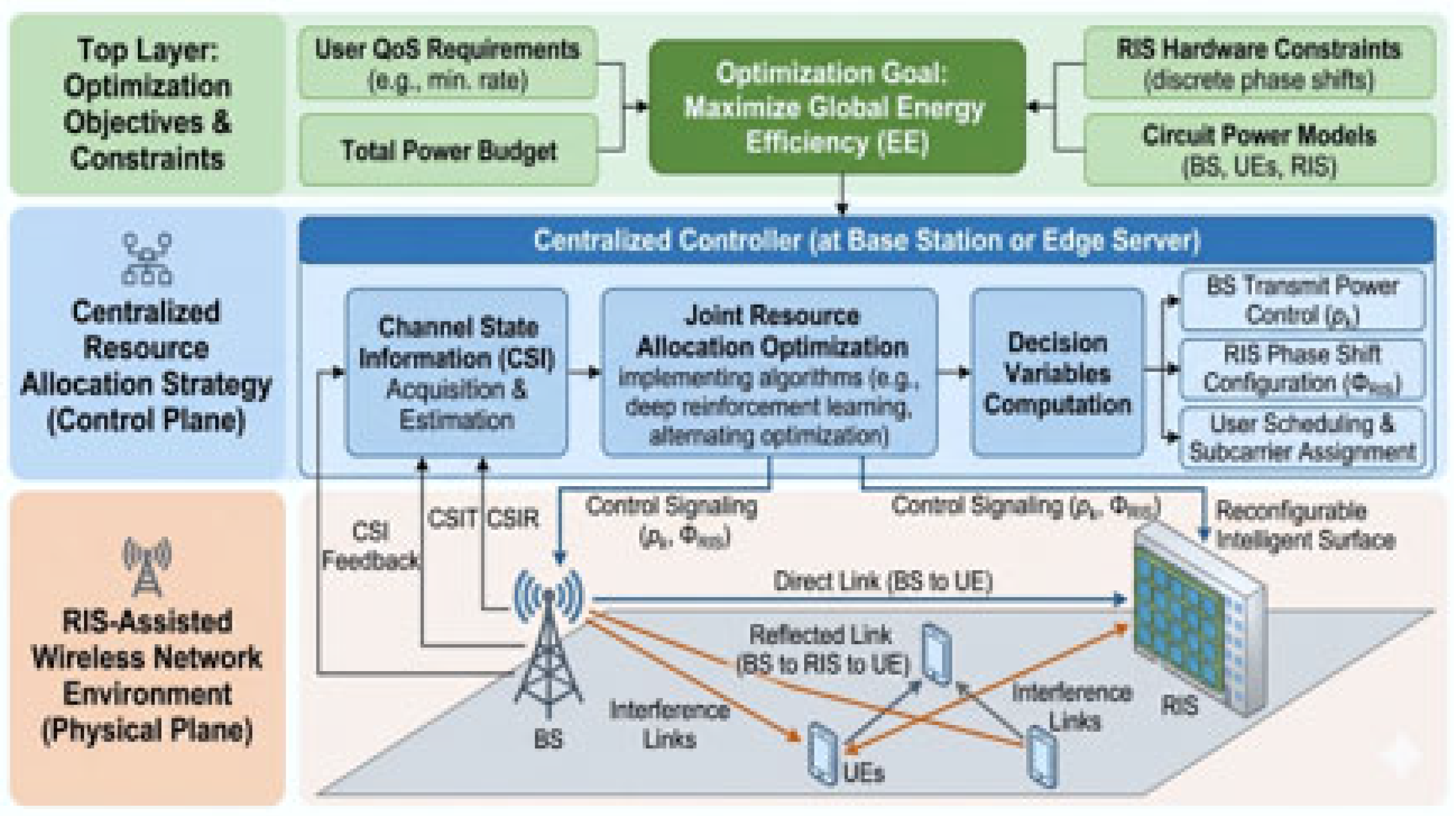
4. Sustainable Green Resource Allocation
5. Integration with Cell-Free Massive MIMO and Edge Computing
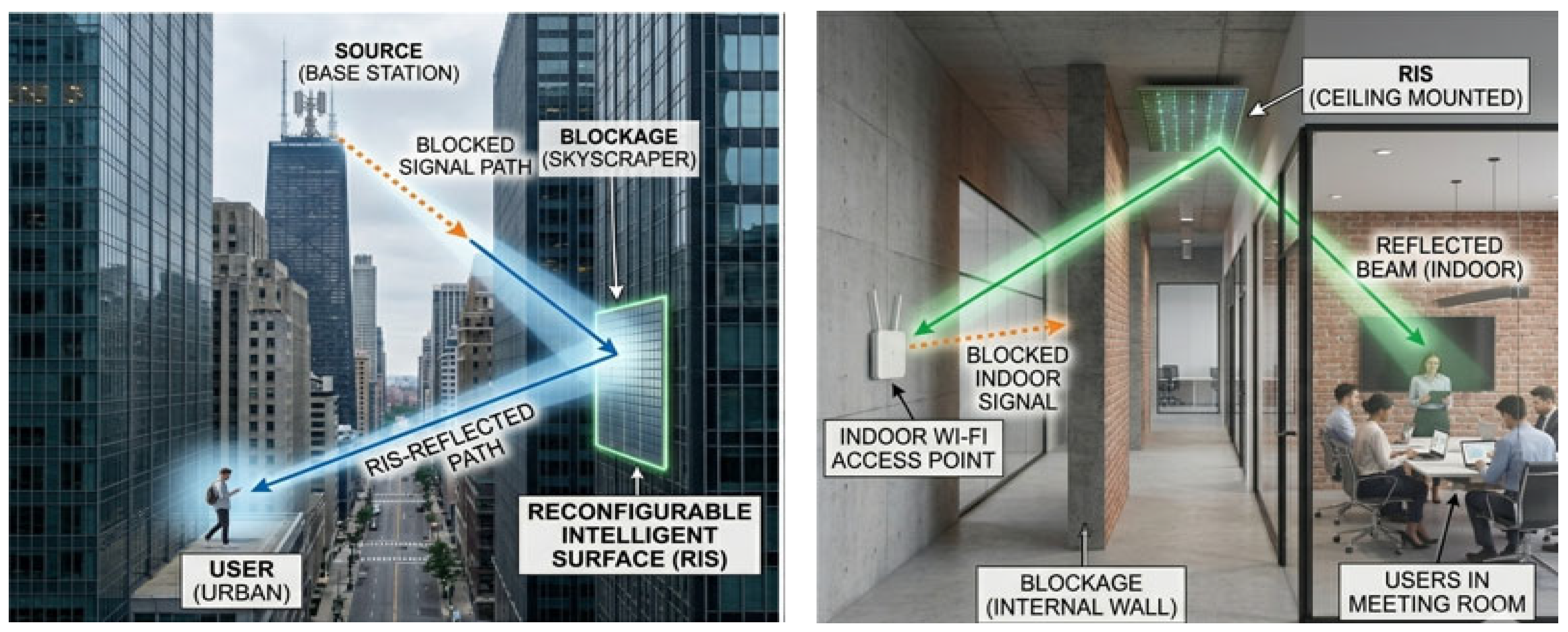
6. RIS Network Resilience and Extended Coverage
7. Mathematical Core of Sustainable Network Development
7.1. Sustainable RIS System Model
7.2. Sustainable Power Consumption Model
7.3. Sustainable Energy Efficiency Maximization
8. Discussion
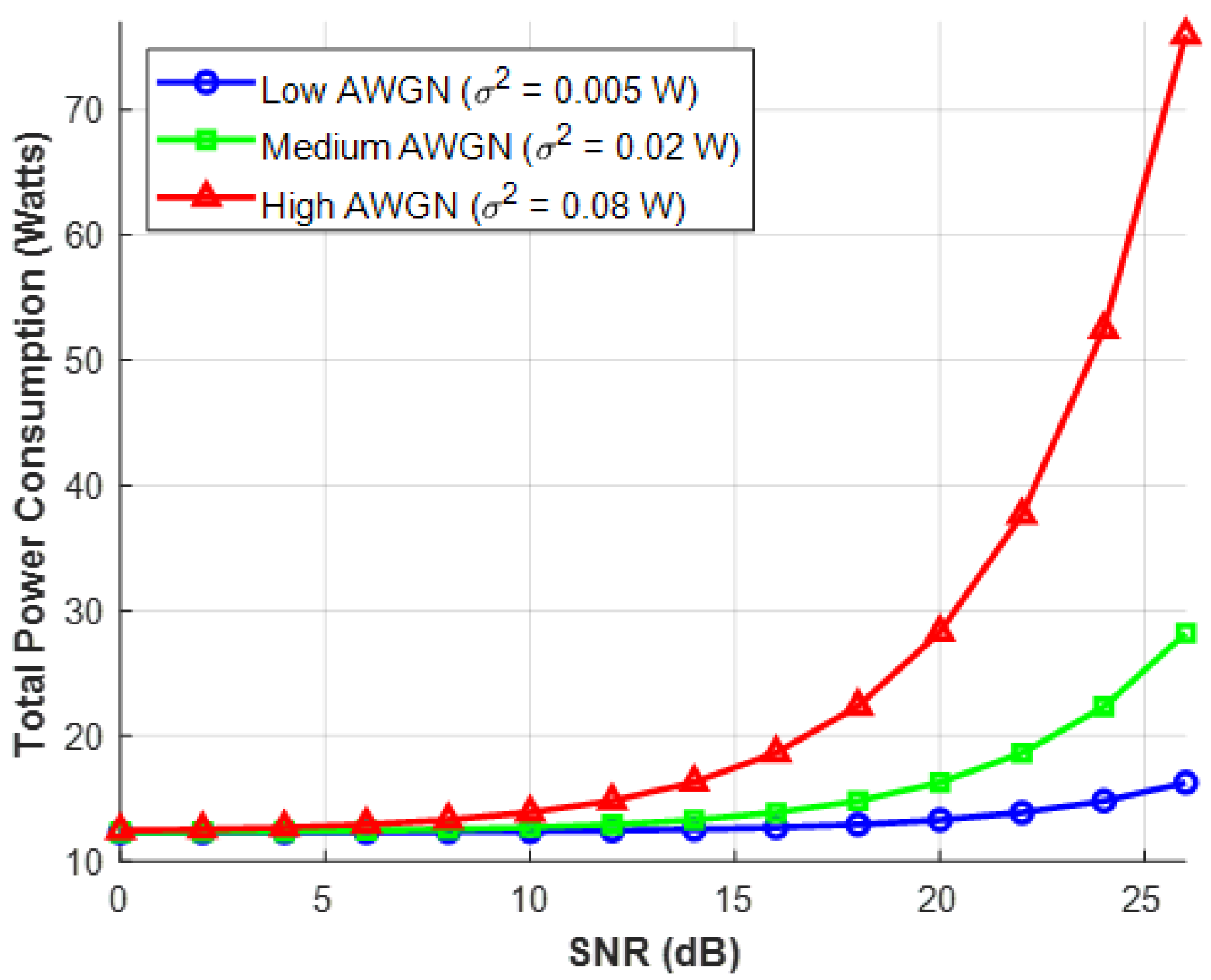
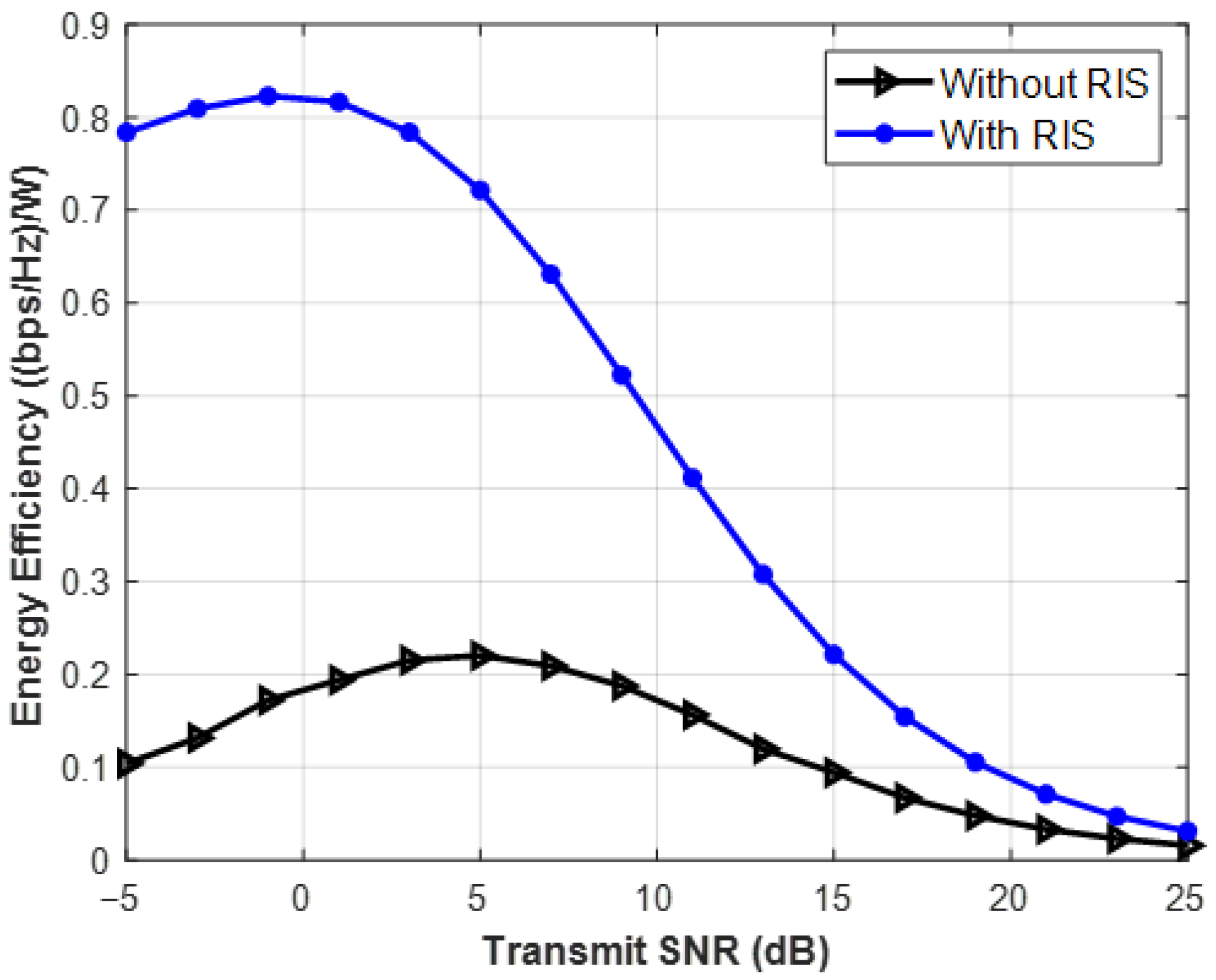
8.1. The Green Operating Point and the Bell Curve Phenomenon
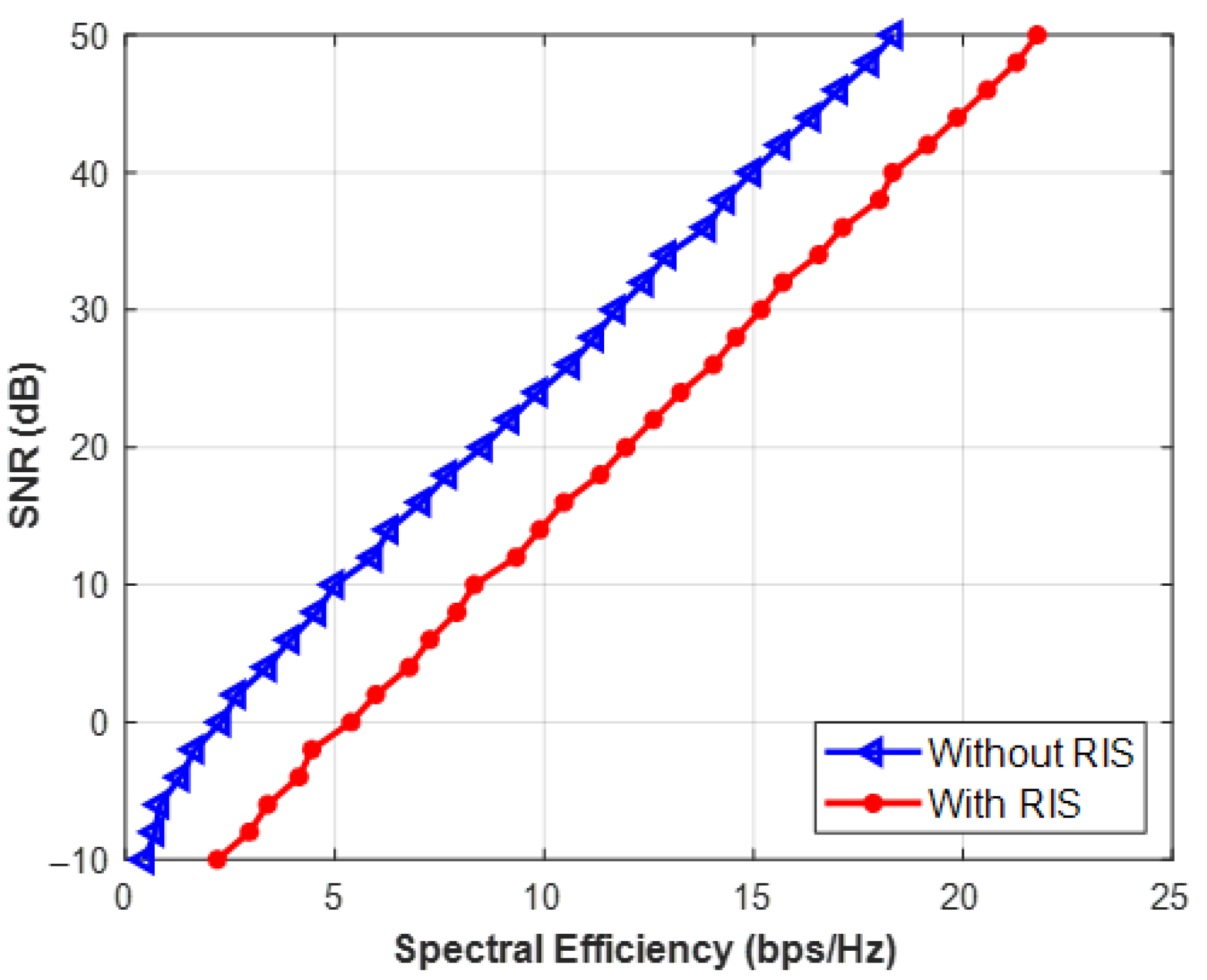
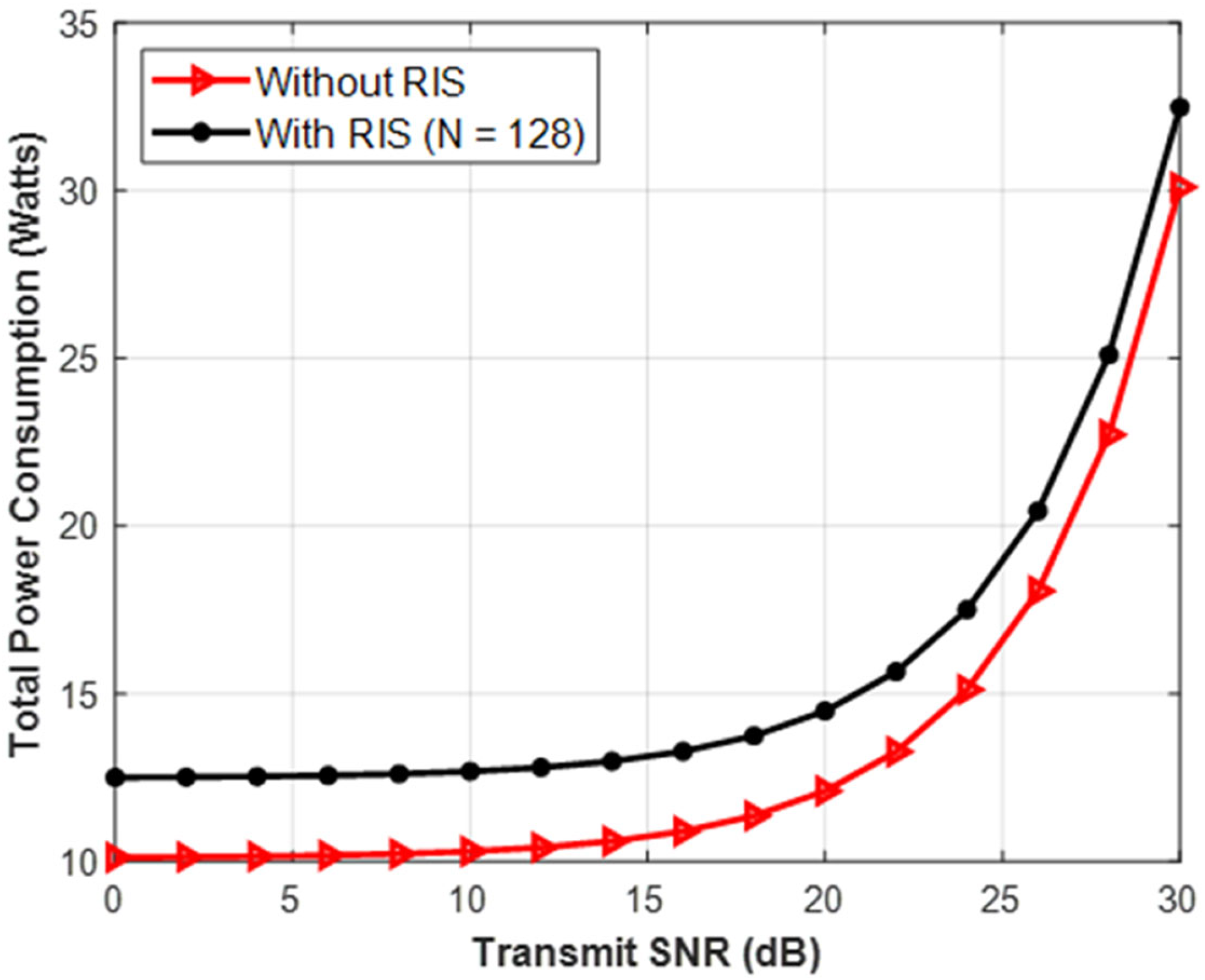
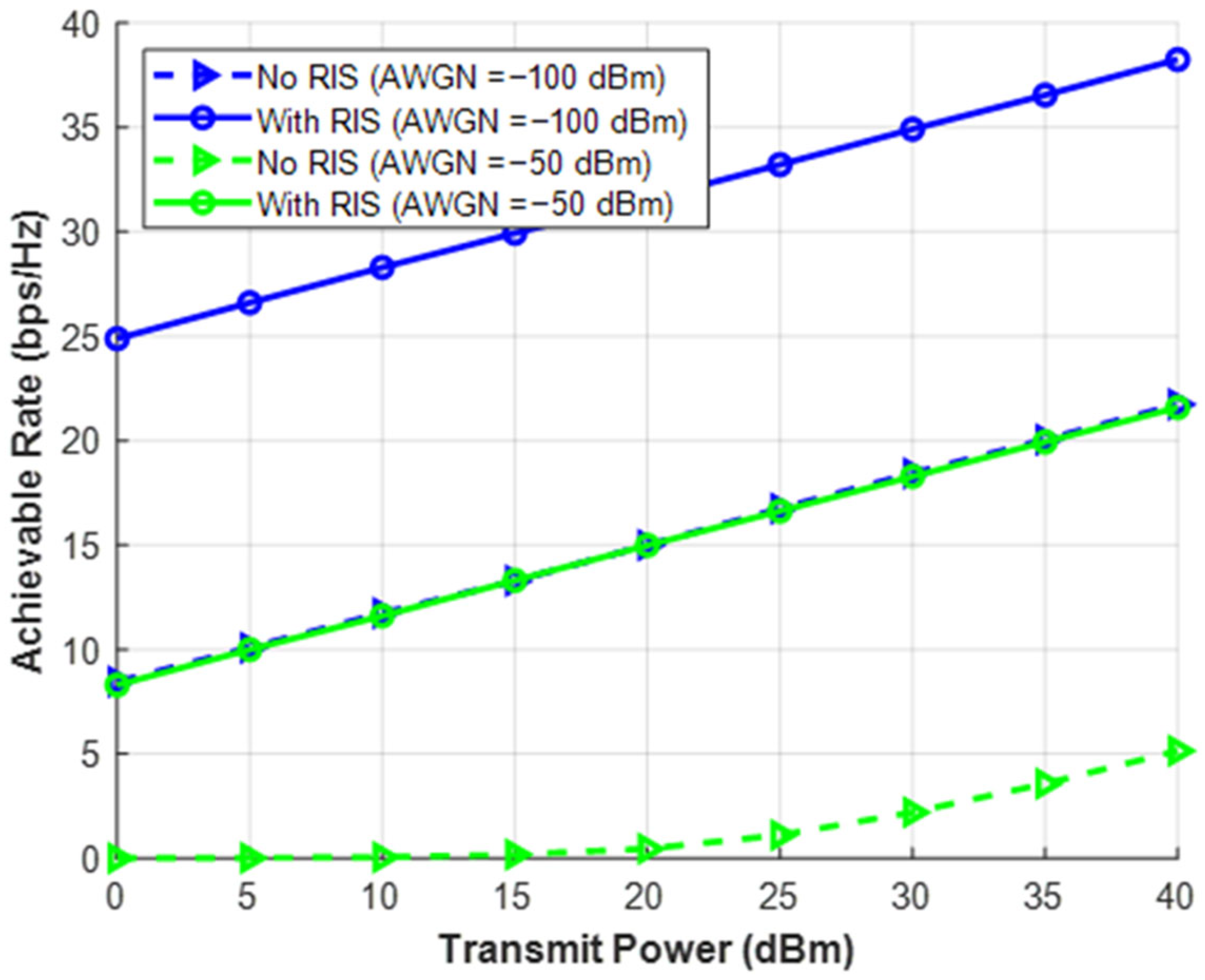
8.2. The N2 Power Scaling Advantage of RIS
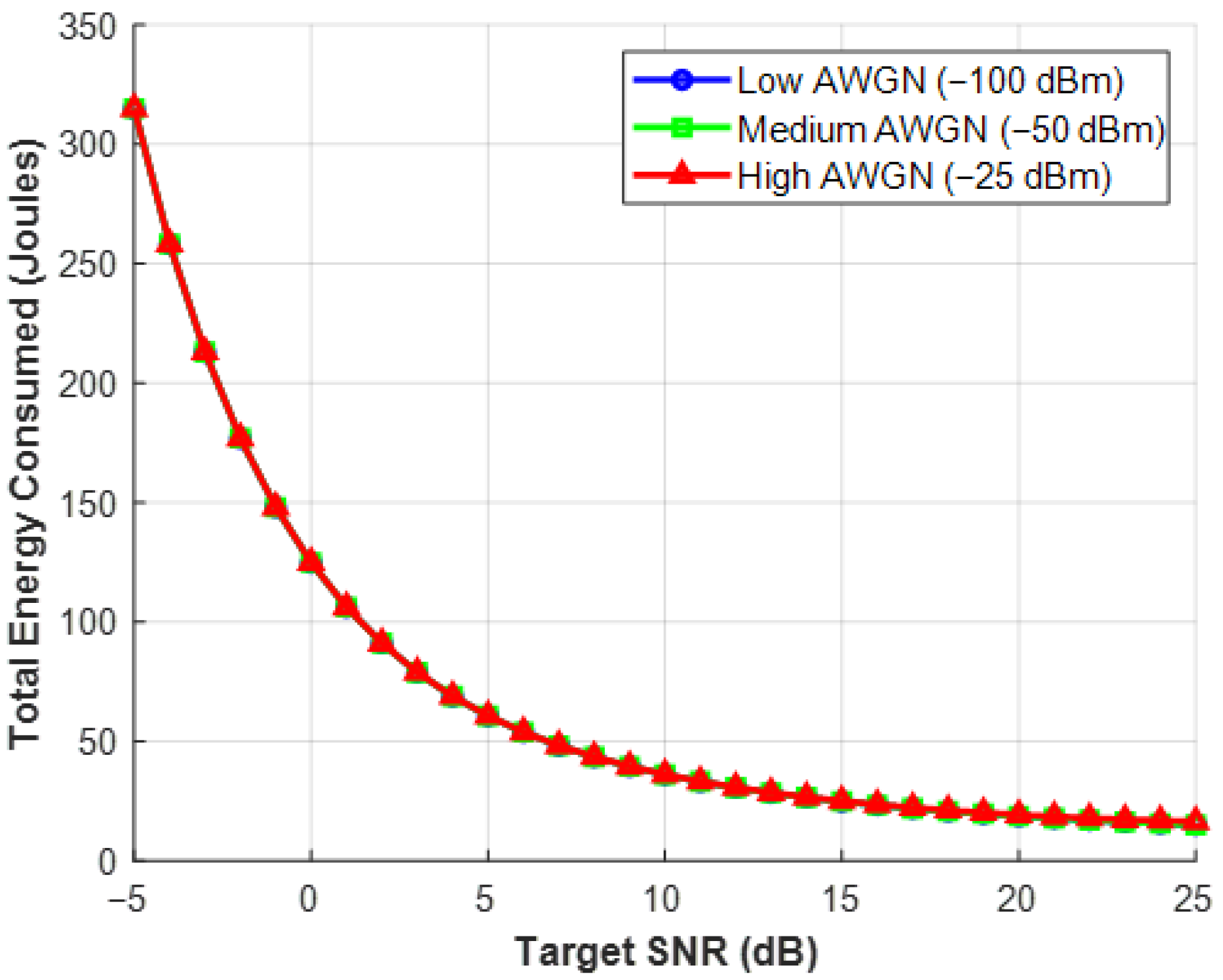
8.3. Energy Volume Trade-Offs for Sustainable IoT
8.4. RIS System Analysis in Wireless Communication
8.4.1. Strengths (Internal Advantages)
8.4.2. Comparison with the Existing Work
8.4.3. Opportunities (External Market Potential)
8.5. Practical Limitations and Deployment Conditions
8.6. Considerations for Future Research
- Strong Green Operating Point optimization techniques that can work well in the face of faulty CSI need to be researched.
- Mobility-aware RIS phase tracking and finite-resolution phase control must be considered in future research.
- Hardware-in-the-loop validation and the investigation of increasingly intricate multi-user and multi-RIS deployment situations are needed.
9. Contributions
- The Green Operating Point is a verifiable threshold that restricts base stations transmitting power. Since grid power consumption scales linearly and data speeds only scale logarithmically, limiting electricity at this precise peak eliminates significant energy waste while maintaining the necessary Quality of Service.
- IoT Volumetric Energy Trade-off: The study determines the precise bottom of a rigid, U-shaped energy consumption curve by calculating the total energy (in Joules) needed to transmit a fixed data payload (e.g., 10 Mbits). This offers a guide for optimizing the battery life of billions of IoT devices in the future.
- Quantification of the N2 Power Scaling Law: The study demonstrates that received signal power scales proportionately to the square of the reflecting elements N2 using an Alternating Optimization framework. It shows that in extremely obstructed and loud situations, 40 dBm of raw active transmit power can be successfully replaced by adding 64 RIS pieces, which demand a mere 0.32 Watts of hardware power.
- Two-Level Mathematical Structure for 6G Sustainability: Using Dinkelbach’s transformation and Alternating Optimization, the authors developed a cooperative resource allocation model. Net-zero network deployments are made possible by the framework’s effective solution of the extremely non-convex EE maximization issue, which separates active base station beamforming from the severe unit-modulus limitations of passive RIS phase shifts.
10. Conclusions
Funding
Data Availability Statement
Acknowledgments
Conflicts of Interest
References
- Alageel, A.; Ibrahim, A.H. Enhancing Space Coverage area for Cellular Communication Systems via 3D-IRS. Int. J. Intell. Syst. Appl. Eng. 2024, 12, 4462–4469. [Google Scholar]
- Taneja, A.; Alqahtani, A.; Alqahtani, N. Energy aware resource association in RIS assisted VLC-RF communication network. PLoS ONE 2025, 20, e0327467. [Google Scholar] [CrossRef]
- de Figueiredo, F.A.P. Unlocking the Power of Reconfigurable Intelligent Surfaces: From Wireless Communication to Energy Efficiency and Beyond. Appl. Sci. 2023, 13, 11750. [Google Scholar] [CrossRef]
- Alaqeel, A.S.; Ibrahim, A.H. Full Space Coverage Enhancement for Cellular Communication Systems via 3D-IRS: 2W Deployment Toward 6G Application. IEEE Access 2026, 14, 27554–27564. [Google Scholar] [CrossRef]
- Sode, M.; Ponschab, M.; Ribeiro, L.N.; Haesloop, S.; Tohidi, E.; Peter, M.; Stańczak, S.; Mohamed, B.H.; Keusgen, W.; Mellein, H.; et al. Reconfigurable Intelligent Surfaces for 6G Mobile Networks: An Industry R&D Perspective. IEEE Access 2024, 12, 163155–163171. [Google Scholar] [CrossRef]
- Wu, Q.; Zhang, R. Intelligent Reflecting Surface Wireless Network via Joint Active and Passive Beamforming. IEEE Trans. Wirel. Commun. 2019, 18, 5394–5409. [Google Scholar] [CrossRef]
- Gong, S.; Lu, X.; Hoang, D.T.; Niyato, D.; Shu, L.; Kim, D.I.; Liang, Y.C. Toward Smart Wireless Communications via Intelligent Reflecting Surfaces: A Contemporary Survey. IEEE Commun. Surv. Tutor. 2020, 22, 2283–2314. [Google Scholar] [CrossRef]
- Ibrahim, A.H. Channel modeling and Propagation Prediction for RIS Assisted 6G Mobile Communication Systems. Int. J. Adv. Signal Image Sci. 2026, 12, 1089–1102. [Google Scholar] [CrossRef]
- Li, Z.; Topal, O.A.; Demir, Ö.T.; Björnson, E.; Cavdar, C. mmWave Coverage Extension Using Reconfigurable Intelligent Surfaces in Indoor Dense Spaces. arXiv 2023, arXiv:2302.09257. [Google Scholar] [CrossRef]
- Worka, C.E.; Khan, F.A.; Ahmed, Q.Z.; Sureephong, P.; Alade, T. Reconfigurable Intelligent Surface (RIS)-Assisted Non-Terrestrial Network (NTN)-Based 6G Communications: A Contemporary Survey. Sensors 2024, 24, 6958. [Google Scholar] [CrossRef] [PubMed]
- Marandi, L.; Humadi, K.; Karabulut Kurt, G.; Ajib, W.; Zhu, W.-P. Improving SAGIN Resilience to Jamming with Reconfigurable Intelligent Surfaces. arXiv 2025, arXiv:2507.03729. [Google Scholar] [CrossRef]
- Yang, H.; Xiong, Z.; Zhao, J.; Niyato, D.; Wu, Q.; Tornatore, M. Intelligent Reflecting Surface Assisted Anti-Jamming Communications: A Fast Reinforcement Learning Approach. IEEE Trans. Wirel. Commun. 2021, 20, 1963–1974. [Google Scholar] [CrossRef]
- Huang, C.; Zappone, A.; Alexandropoulos, G.C.; Debbah, M.; Yuen, C. Reconfigurable Intelligent Surfaces for Energy Efficiency in Wireless Communication. IEEE Trans. Wirel. Commun. 2019, 18, 4157–4170. [Google Scholar] [CrossRef]
- Zhang, C.; Lu, H.; Chen, C.W. Reconfigurable Intelligent Surfaces-Enhanced Uplink User-Centric Networks on Energy Efficiency Optimization. IEEE Trans. Wirel. Commun. 2023, 22, 9013–9028. [Google Scholar] [CrossRef]
- Wang, W.; Song, J.; Zhou, J. Energy-Efficient Access Point Selection Scheme for Reconfigurable-Intelligent-Surface-Assisted Cell-Free Massive MIMO Systems. Electronics 2024, 13, 1397. [Google Scholar] [CrossRef]
- Wang, Y.; Peng, J. Energy Efficiency Fairness of Active Reconfigurable Intelligent Surfaces-Aided Cell-Free Network. IEEE Access 2023, 11, 5884–5893. [Google Scholar] [CrossRef]
- Li, Z.; Chen, M.; Yang, Z.; Zhao, J.; Wang, Y.; Shi, J.; Huang, C. Energy Efficient Reconfigurable Intelligent Surface Enabled Mobile Edge Computing Networks with NOMA. arXiv 2021, arXiv:2105.00093. [Google Scholar] [CrossRef]
- Li, Z. Coverage Performance Analysis of Reconfigurable Intelligent Surface-aided Millimeter Wave Network with Blockage Effect. Doctoral Dissertation, University of Sheffield, Sheffield, UK, 2023; White Rose eTheses Online. Available online: https://etheses.whiterose.ac.uk/id/eprint/32118/ (accessed on 25 November 2025).
- Khaloopour, L.; Su, Y.; Raskob, F.; Meuser, T.; Bless, R.; Janzen, L.; Abedi, K.; Andjelkovic, M.; Chaari, H.; Chakraborty, P.; et al. Resilience-by-Design in 6G Networks: Literature Review and Novel Enabling Concepts. arXiv 2024, arXiv:2405.17480. [Google Scholar] [CrossRef]
- Zargari, S.; Khalili, A.; Zhang, R. Energy efficiency maximization via joint active and passive beamforming design for multiuser MISO IRS-aided SWIPT. IEEE Wirel. Commun. Lett. 2021, 10, 557–561. [Google Scholar] [CrossRef]



| Parameter | Symbol | Value | Unit | Justification |
|---|---|---|---|---|
| Number of BS antennas | M | 4 to 16 | — | Simulation hypothesis |
| Number of RIS elements | N | 8 to 256 | — | RIS-size sensitivity study |
| RIS element power | PRIS | 0.006 | W | Average control |
| BS power | PBS | 10 | W | Base station power |
| UE power | PUE | 10 | mW | User equipment power model |
| Carrier frequency | fc | 30–60 | GHz | 6G/UMi simulation setup |
| Bandwidth | (B) | 10 | MHz | Rate calculation |
| Path-loss model | PLd | 3 | GPP UMi | Urban microcell scenario |
| Channel condition | — | Quasi-static | — | Baseline analytical tractability |
| Noise Power Spectral Density | No | −175 | dBm/Hz | Thermal-noise model |
| Algorithm Convergence Threshold | ϵ | 10−4 | - | Small positive scalar |
| Power Amplifier Efficiency | μ | 50 | % | Optimal value |
| Work | Method | EE Gain | Complexity |
|---|---|---|---|
| Huang et al. [13] | Joint Beamforming | High | High |
| Active RIS | Amplified Reflection | Very High | Very High |
| Proposed | Passive RIS + AO + GOP | High + Sustainable | Medium |
Disclaimer/Publisher’s Note: The statements, opinions and data contained in all publications are solely those of the individual author(s) and contributor(s) and not of MDPI and/or the editor(s). MDPI and/or the editor(s) disclaim responsibility for any injury to people or property resulting from any ideas, methods, instructions or products referred to in the content. |
© 2026 by the author. Licensee MDPI, Basel, Switzerland. This article is an open access article distributed under the terms and conditions of the Creative Commons Attribution (CC BY) license.
Share and Cite
Ibrahim, A.H. Sustainable Development Strategies for RIS-Assisted Mobile Networks. Sensors 2026, 26, 3243. https://doi.org/10.3390/s26103243
Ibrahim AH. Sustainable Development Strategies for RIS-Assisted Mobile Networks. Sensors. 2026; 26(10):3243. https://doi.org/10.3390/s26103243
Chicago/Turabian StyleIbrahim, Anwar Hassan. 2026. "Sustainable Development Strategies for RIS-Assisted Mobile Networks" Sensors 26, no. 10: 3243. https://doi.org/10.3390/s26103243
APA StyleIbrahim, A. H. (2026). Sustainable Development Strategies for RIS-Assisted Mobile Networks. Sensors, 26(10), 3243. https://doi.org/10.3390/s26103243