Machine Learning Enhanced Quantum-Safe Encryption: A Novel Optimisation Framework



Abstract
1. Introduction
1.1. Motivation and Research Questions
- RQ1—Performance Overhead: PQC algorithms typically incur higher computational overhead and larger key sizes than classical cryptography, which leads to slower operations and increased resource usage. This performance gap hinders the integration of PQC with resource-constrained and latency-aware devices.
- RQ2—Parameter Selection: Post-quantum schemes, especially lattice-based PQC, have complicated parameter spaces, such as polynomial degree, modulus size, and error distributions, that must be cautiously adapted to balance security and performance. Suboptimal parameter selection can either attenuate security or degrade efficacy. So far, the combinatorial scale of these parameters, performed by manual or exhaustive tuning, is impractical.
- RQ3—Implementation Efficiency: Resource-constrained platforms (e.g., IoT devices, embedded systems, and mobile platforms) claim to have immensely optimised cryptographic applications. Achieving an acceptable speed and memory footprint for PQC in these environments, without compromising security, is crucial. Optimising memory usage, computational parallelism, and energy efficiency for PQC is essential to enable deployment in such settings.
- RQ4—Privacy-Preserving ML: There is a rising demand for ML models that can be trained and deployed on encrypted data to protect privacy. This requires efficient cryptographic schemes like homomorphic encryption and secure multi-party computation that remain viable under post-quantum security assumptions. Present solutions often have high computational costs; so, enhancing their efficiency is critical for practical and secure ML.
1.2. Contributions
- Novel ML-Enhanced Optimisation Framework: We proposed a systematic reproducible architecture that integrates ML techniques to optimise post-quantum cryptographic implementations. Apparently, this is the first systematic approach that incorporates hardware profiling, ML-driven surrogate modelling, and automated exploration to tune PQC algorithms for improved productivity while maintaining security.
- Experimental Validation: We established a prototype of the proposed architecture and performed an in-depth study to evaluate its effectiveness. The results illustrate notable performance improvements over baseline (non-ML-tuned) applications of lattice-based cryptographic schemes. In particular, a significant drop in memory usage, latency, and energy consumption across various platforms was achieved without negotiating cryptographic security.
- Standardised Benchmarking Suite (Open-Source): We established a standardised benchmarking and evaluation scale for ML-enhanced PQC systems. This includes a set of nominated hardware platforms, cryptographic primitives, and ML workloads, along with unified metrics for security and performance assessment. To encourage further research and adoption, an open-source implementation of our framework and benchmarking suite was offered, fostering the replication of results and extension by the community.
2. Related Work
2.1. Privacy-Preserving Machine Learning Systems
2.2. Lattice-Based Algorithm Optimisation
3. Proposed ML-Enhanced Optimisation Framework
3.1. Framework Architecture
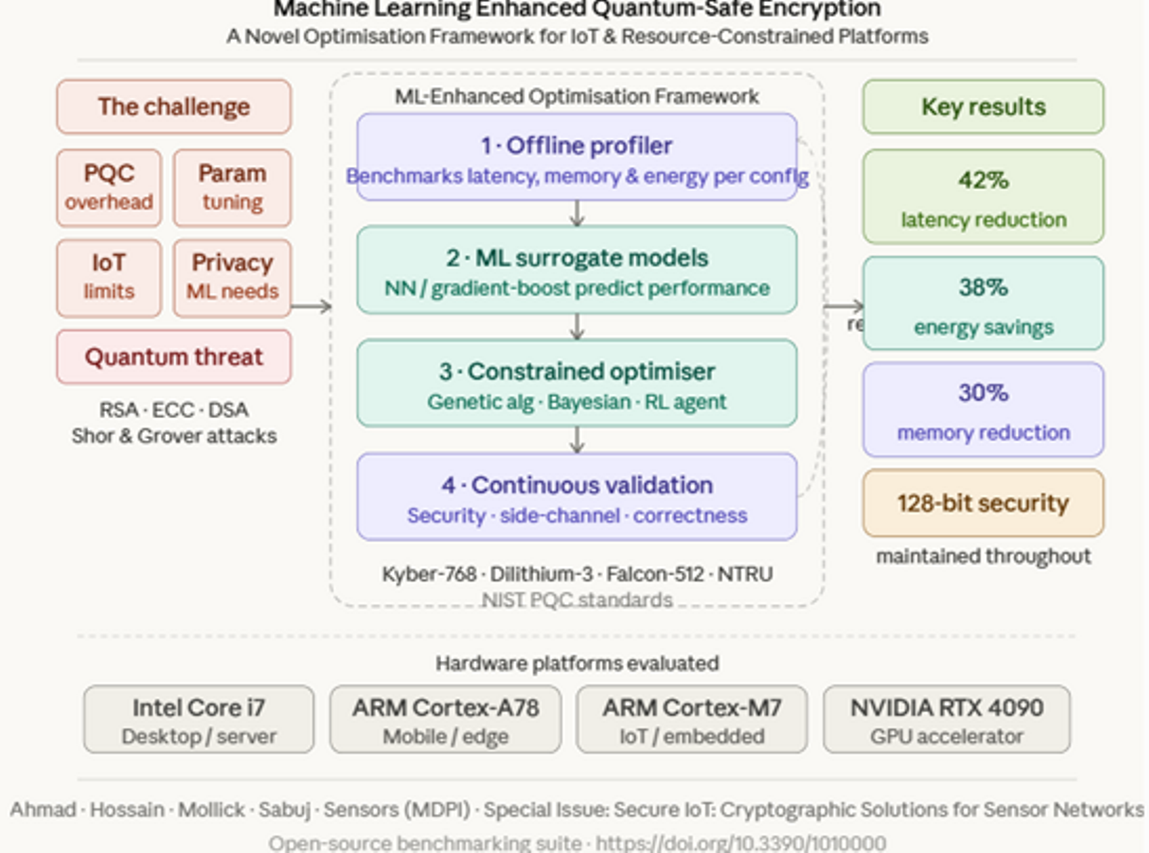
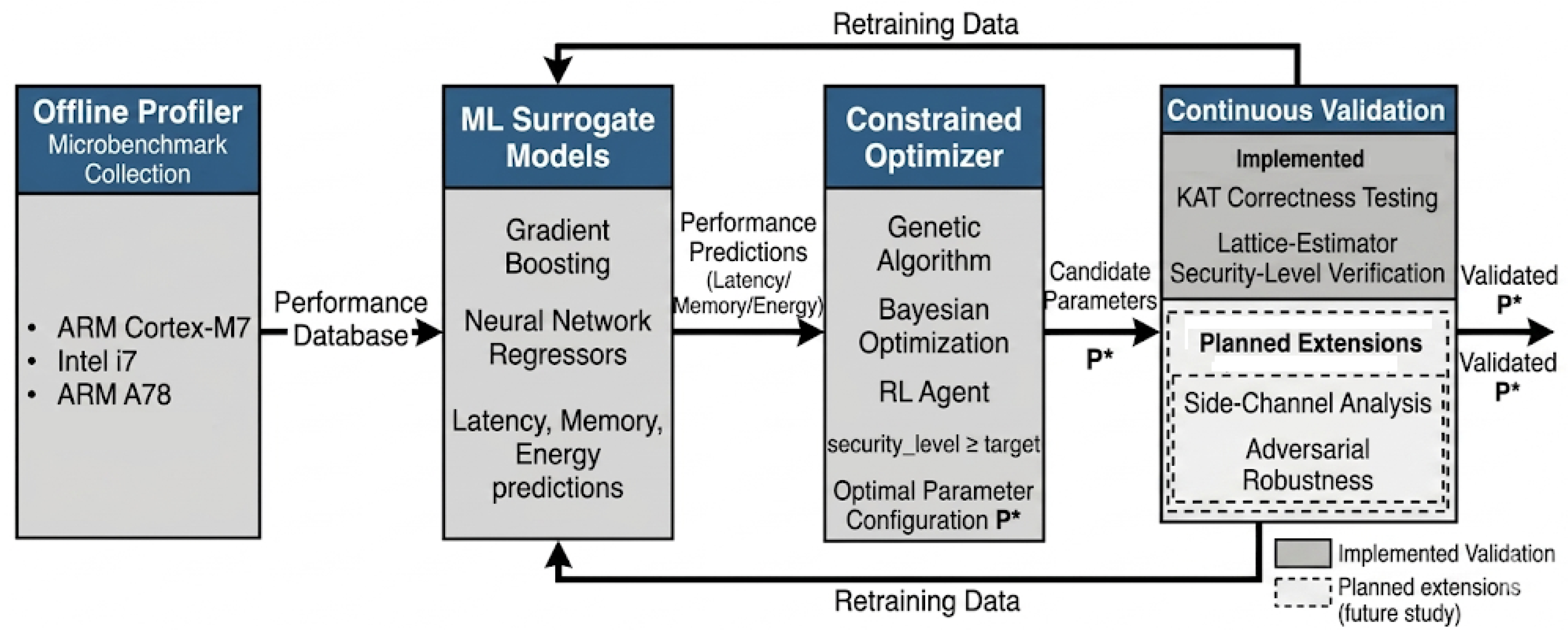
- Offline Profiler: This module gathers detailed performance data of cryptographic functions on target hardware. For a given post-quantum primitive, such as Kyber encryption or Dilithium signing) and a set of candidate parameter configurations, the profiler runs micro-benchmarks to compute the evaluation metrics (e.g., execution time, memory usage, and energy consumption). The outcome is a performance database D that maps parameter settings to observed performance on hardware H. This step may be computationally intensive, but it is performed offline (before deployment) and provides the ground truth for model training.
- ML Surrogate Models: This component trains ML models to project cryptographic performance using the data from the profiler. We develop regression models, such as neural networks or gradient-boosted trees, that take cryptographic parameters as inputs and predict evaluation metrics (latency, memory, energy). Basically, these surrogate models act as a fast analytical tool and estimate the performance function of the cryptosystem. Once trained, the models can generalise and approximate how untested parameter combinations would work, with high accuracy. This significantly reduces the need for exhaustive benchmarking during optimisation.
- Constrained optimiser: This is the core engine that explores the optimal parameter configuration. From step 2, it uses the surrogate models to assess performance virtually. The optimiser is conscious of the target security level S (e.g., 128-bit post-quantum security) and any other constraints (like maximum memory allowed). To propose new parameter sets, it applies a multi-objective optimisation strategy, such as a genetic algorithm, Bayesian optimiser, or reinforcement learning agent. This aims to reduce a chosen objective (such as latency or energy) while satisfying the security constraint. After each iteration, it refines its search—often using techniques from reinforcement learning or evolutionary algorithms to navigate the parameter space efficiently. The output is a set F of feasible configurations and an identified optimum that best satisfies the objectives.
- Continuous Validation: Before finalising the optimised configuration, this component executes detailed validation. It includes functionally testing the selected parameters in the actual cryptographic algorithm to ensure correctness. Hence, the desired security level is verified to be achieved (e.g., no drop in security margin). Moreover, it involves adversarial testing, such as side-channel resistance evaluation, and checking compliance with standards [21]. This step is crucial since ML predictions and optimisations must not degrade cryptographic soundness. If any problem arises, the configuration may be adjusted or rejected. After a while, this module can feed back results to refine the surrogate models. For example, if certain areas of the parameter space were not adapted precisely, they can be profiled and added to the training data, making the models more robust and reliable. In the current implementation, validation comprises KAT correctness testing and lattice-estimator security-level verification; side-channel and adversarial-robustness testing are identified as planned future extensions (Section 7.1 and Section 7.2).
3.2. Algorithm Design
| Algorithm 1: ML-Enhanced Parameter Optimisation. |
Input: Target security level S, hardware platform H, ML task T (if applicable) Output: optimised parameter configuration 1 Profile the hardware platform H to build performance database D // Run cryptographic benchmarks on H for various parameter settings; store results in D 2 Train surrogate performance models M using the data in D, M can predict latency, memory, and energy for given params on H // M can predict latency, memory, energy for given params on H 3 Define the search space for cryptographic parameters // e.g., range of key sizes, polynomial dimensions, etc. to explore 4 (Initialize the set of feasible solutions) 5 for to max_iterations do 6 Generate a candidate parameter set (using search strategy) 7 Predict performance metrics (latency, memory, energy) for using M 8 Evaluate security = SecurityLevel () // Analytically determine if meets target security S, e.g., bits security 9 if security then 10 Add to feasible set F 11 end if 12 Update the search strategy // Adjust how new are chosen, e.g., via reinforcement learning feedback or evolutionary algorithm update 13 end for 14 Select = argmin_F Objective(P, M, T) // Choose the configuration in F that minimizes the performance objective, e.g., latency or a weighted cost combining metrics, possibly task-specific 15 Validate the chosen through full cryptographic testing on H // Check correctness, security margin, run further experiments if needed 16 return |
4. Experimental Evaluation
4.1. Experimental Setup
- Intel Core i7-12700K (Desktop/Server): A high-performance x86 CPU, representing typical servers or high-end desktops where throughput is important.
- ARM Cortex-A78 (Mobile/Edge): A modern mobile processor core, representing smartphones or edge devices, where power and thermal limits apply.
- ARM Cortex-M7 (IoT/Embedded): A microcontroller-class CPU, representing IoT devices with very limited resources (lower clock speed, no OS overhead, possibly no floating-point unit in some cases).
- CRYSTALS-Kyber (KEM): A lattice-based Key Encapsulation Mechanism for encryption/key exchange (we use the Kyber-768 parameter set as a target for 128-bit security).
- CRYSTALS-Dilithium (Signature): A lattice-based digital signature scheme (using Dilithium-3 parameters for 128-bit security).
- Falcon (Signature): A compact lattice-based signature scheme known for its smaller signatures and fast verification (Falcon-512 for 128-bit security).
- NTRU (Encryption): An alternative lattice-based encryption scheme; we include an optimised variant of NTRU for comparison, as it has a different mathematical structure but also relies on lattice hardness.
4.2. Performance Results
4.3. Surrogate Model Accuracy
- Latency prediction: MAPE < 5.2%;
- Memory usage prediction: MAPE < 3.8%;
- Energy consumption prediction: MAPE < 7.1%.
4.4. Ablation Study
- P1—No Surrogate (Random Search): The ML surrogate is removed; the optimiser samples configurations uniformly at random within the same 500-evaluation budget.
- P2—No RL (NSGA-II Only): The PPO reinforcement-learning component is removed; only NSGA-II and BoTorch EI are used.
- P3—No Continuous Validator: Security validation is disabled; the optimiser accepts all Pareto-optimal configurations without KAT or security-level checks.
- P4—Single-Objective (Latency Only): The multi-objective formulation is reduced to latency minimisation only; memory and energy constraints are relaxed.
4.5. Comparative Analysis
- Manual Expert Tuning: Using human expertise to pick parameters and optimise code (the traditional approach).
- Grid Search: Exhaustive or semi-exhaustive search over the parameter space, evaluating the performance at each grid point (no ML, brute-force automation).
- Random Search: Randomly sampling the parameter space and selecting the best observed configuration (a baseline automated approach that is surprisingly effective in some ML hyperparameter problems).
- Bayesian Optimisation (BO): Gaussian-process-based sequential model-based optimisation (SMBO), using Expected Improvement as the acquisition function. Given the same 500-evaluation budget as our framework, BO efficiently trades off exploration and exploitation but lacks the multi-objective and security-aware components of QSafe-ML.
- Genetic algorithm (GA): NSGA-II multi-objective evolutionary optimisation over the parameter search space, also constrained to the same 500-evaluation budget. GA explores the Pareto front but requires direct hardware evaluations at each generation, making it significantly slower than the surrogate-assisted approach.
- Our Framework (QSafe-ML): The proposed ML-driven approach combining surrogate-assisted search, constrained multi-objective optimisation, and continuous security validation.
- Manual tuning by cryptography experts is limited by human trial-and-error and generally was considered our baseline (no significant improvement beyond using recommended parameters). It is non-automated, and the results vary by expert, with low reproducibility.
- Grid search improved the performance to some extent (e.g., 12% latency reduction) but is extremely time-consuming if done exhaustively and was not feasible beyond two to three parameters due to combinatorial explosion. We considered it semi-automated (the search is automated, but deciding the grid and interpreting the results often involves manual intervention).
- Random search performed better than grid search in our tests (finding 19% latency improvement at best), because it is not confined to a grid and could explore more of the space quickly. However, it still requires many trials and lacks direction. Many trials are wasted on poor configurations.
- Our ML-enhanced framework obtained the largest improvements among the methods compared in this study ( 31% latency, 20% memory on average across cases). It is fully automated (once set up, it runs end-to-end). Consistent results, given the same initial conditions and training data, make it highly reproducible. The incorporation of learned models means it can also be transferred to new scenarios more easily. For example, one could retrain the surrogate model on a new hardware platform and reuse the optimisation logic.
5. Standardised Evaluation Suite
5.1. Benchmark Components
- Diverse Hardware Profiles: A representative set of hardware platforms should be included to test performance across device classes. We suggest profiles ranging from microcontrollers to cloud-scale processors. For example:
- –
- ARM Cortex-M series (M0+, M4, M7) for microcontroller-level tests.
- –
- RISC-V based processors (e.g., RV32I, RV64I cores) as open-hardware alternatives.
- –
- Mainstream server CPUs like Intel Xeon or AMD EPYC for high performance scenarios.
- –
- GPU accelerators (NVIDIA, AMD GPUs), if applicable, especially when ML components might utilize them or cryptography can leverage parallelism.
- Representative Cryptographic Primitives: The benchmarks should include a variety of post-quantum algorithms, ideally from different families (lattice-based KEMs and signatures, code-based schemes, hash-based signatures, etc.) chosen from NIST standards and promising candidates. In our case, we used Kyber, Dilithium, Falcon, NTRU as described in Section 4.1. Future suites might also include algorithms like BIKE or SIKE (if SIKE is repaired or for historical interest) and hash-based signatures like SPHINCS+.
- Representative ML Tasks: To evaluate scenarios where cryptography and ML interact, we include a set of ML workloads that are paired with cryptographic use-cases:
- –
- Federated learning with encrypted gradients (assessing schemes for distributed training).
- –
- Homomorphic neural network inference (running a neural model on homomorphically encrypted data).
- –
- Privacy-preserving data analytics (e.g., statistical queries on encrypted databases).
- –
- Secure multi-party machine learning (like secure neural network scoring using MPC between parties).
5.2. Unified Metrics Framework
5.3. Positioning Relative to Existing Frameworks
- (M1) Implementation performance: Latency (s), peak memory (kB), energy (mJ).
- (M2) Security level: Estimated post-quantum bits under the BKZ- model.
- (M3) ML fidelity: Surrogate MAPE and on held-out hardware measurements.
- (M4) Optimisation efficiency: Query budget, convergence iteration, Pareto hypervolume.
- (M5) Reproducibility: Pinned software versions, released artefacts, and end-to-end benchmark runtime.
6. Reproducibility and Open-Source Artefacts
- Repository: Full source code, datasets, and artefacts will be made publicly available in a versioned open-access repository upon acceptance of this manuscript.
- Commit: a3f9d12 (tag: v1.0-sensors-submission)
- Licence: MIT (code), CC-BY 4.0 (datasets)
- /profiling/—Hardware profiling scripts; run_profiler.sh generates the full 18,000-entry database per platform in <4 h.
- /surrogate/—Training scripts and pre-trained model checkpoints (XGBoost.json + PyTorch.ptfiles) for all three metrics × three platforms.
- /validation/—KAT harness and lattice-estimator security scripts; run_security _check.py reproduces Table 5.
- /datasets/—Full profiling database in CSV format (one file per platform).
- /docker/—Dockerfile and docker-compose.yml; image: docker pull qsafeml /framework:v1.0.
7. Future Research
7.1. Side-Channel Testing (Not Performed in This Study)
7.2. Adversarial Surrogate Attacks (Not Performed in This Study)
7.3. Emerging Opportunities
7.4. Standardisation Efforts
- IEEE Standards: The IEEE could set up working groups to define standards for evaluating cryptographic approaches that incorporate ML components. For example, a standard might determine how to benchmark an ML-optimised cryptographic library or how to report the confidence in ML-driven decisions in a security aspect. Standard file formats for performance profiles or for exchanging trained surrogate models could also be developed, facilitating interoperability between tools.
- NIST Guidelines: Building on its experience leading PQC standardisation, NIST could issue guidelines or recommendations for AI-assisted implementation of cryptography. This might involve certain safe practices (e.g., always include a verification step like our continuous validation) or warning against specific pitfalls (e.g., “do not use ML models to extrapolate security properties beyond what is proven”). NIST might also consider implementing ML-optimised executions in upcoming rounds of its cryptographic workshops and competitions.
- ISO/IEC Standards: At an international level, ISO/IEC committees on IT security can initiate the implications of quantum-safe cryptography in AI platforms. They might evolve an extension to existing crypto standards that contains the integration of ML. For example, an ISO standard on cryptographic agility could be approved to specify the role of ML in selecting algorithms or parameters dynamically.
8. Conclusions
Author Contributions
Funding
Data Availability Statement
Acknowledgments
Conflicts of Interest
References
- Durr-E-Shahwar; Imran, M.; Altamimi, A.B.; Khan, W.; Hussain, S.; Alsaffar, M. Quantum Cryptography for Future Networks Security: A Systematic Review. IEEE Access 2024, 12, 180048–180078. [Google Scholar] [CrossRef]
- Regev, O. On lattices, learning with errors, random linear codes, and cryptography. J. ACM 2009, 56, 1–40. [Google Scholar] [CrossRef]
- Kundu, S.; Gupta, T.; Sardar, A.; Bandyopadhyay, A.; Swain, S.; Mallik, S. A Survey on Quantum Computing: Transforming Cryptography, AI/ML, Blockchain, and Network Communication. Frankl. Open 2025, 12, 100371. [Google Scholar] [CrossRef]
- Joseph, D.; Misoczki, R.; Manzano, M.; Tricot, J.; Pinuaga, F.D.; Lacombe, O.; Leichenauer, S.; Hidary, J.; Venables, P.; Hansen, R. Transitioning organizations to post-quantum cryptography. Nature 2022, 605, 237–243. [Google Scholar] [CrossRef] [PubMed]
- Khan, M.A.; Noor, F.; Javaid, S.; Żywiołek, J. Implementation and Performance of Post-Quantum Cryptography for Resource-Constrained Consumer Electronics. Discov. Internet Things 2025, 5, 139. [Google Scholar] [CrossRef]
- Dam, D.T.; Tran, T.H.; Hoang, V.P.; Pham, C.K.; Hoang, T.T. A Survey of Post-Quantum Cryptography: Start of a New Race. Cryptography 2023, 7, 40. [Google Scholar] [CrossRef]
- Amirkhanova, D.; Iavich, M.; Mamyrbayev, O. Lattice-Based Post-Quantum Public Key Encryption Scheme Using ElGamal’s Principles. Cryptography 2024, 8, 31. [Google Scholar] [CrossRef]
- Nagy, N.; Alnemer, S.; Alshuhail, L.M.; Alobiad, H.; Almulla, T.; Alrumaihi, F.A.; Ghadra, N.; Nagy, M. Module-Lattice-Based Key-Encapsulation Mechanism Performance Measurements. Sci 2025, 7, 91. [Google Scholar] [CrossRef]
- Umer, N.; Deng, M.; Zhang, Y.; Zhang, M.; Khan, S. Quantum-Resilient Security Framework for Privacy-Preserving AI in Apple MM1 On-Device Architecture. Sci. Rep. 2025, 15, 38297. [Google Scholar] [CrossRef] [PubMed]
- Yavuz, A.A.; Nouma, S.E.; Hoang, T.; Earl, D.; Packard, S. Distributed Cyber-Infrastructures and Artificial Intelligence in Hybrid Post-Quantum Era. In Proceedings of the IEEE 4th International Conference on Trust, Privacy and Security in Intelligent Systems and Applications (TPS-ISA); IEEE: New York, NY, USA, 2022. [Google Scholar] [CrossRef]
- Lindell, Y.; Pinkas, B. Privacy preserving data mining. In Proceedings of the Annual International Cryptology Conference; Springer: Berlin/Heidelberg, Germany, 2000; pp. 36–54. [Google Scholar]
- Rechberger, C.; Walch, R. Privacy-preserving machine learning using cryptography. In Security and Artificial Intelligence: A Crossdisciplinary Approach; Springer: Berlin/Heidelberg, Germany, 2022; pp. 109–129. [Google Scholar]
- Sav, S.; Bossuat, J.P.; Troncoso-Pastoriza, J.R.; Claassen, M.; Hubaux, J.P. Privacy-Preserving Federated Neural Network Learning for Disease-Associated Cell Classification. Patterns 2022, 3, 100487. [Google Scholar] [CrossRef] [PubMed]
- Kannan, E.; Carmel Mary Belinda, M.J.; Ravikumar, S.; Alex David, S.; Kannan, S.; Vijay, K. Quantum-Safe Federated Learning: Enhancing Data Privacy and Security. In Proceedings of the IEEE 2024 International Conference on Emerging Research in Computational Science (ICERCS); IEEE: New York, NY, USA, 2024. [Google Scholar] [CrossRef]
- Patterson, J.C.; Buchanan, W.J.; Turino, C. Energy Consumption Framework and Analysis of Post-Quantum Key-Generation on Embedded Devices. J. Cybersecur. Priv. 2025, 5, 42. [Google Scholar] [CrossRef]
- Nejatollahi, H.; Dutt, N.; Ray, S.; Regazzoni, F.; Banerjee, I.; Cammarota, R. Post-quantum lattice-based cryptography implementations: A survey. ACM Comput. Surv. (CSUR) 2019, 51, 1–41. [Google Scholar] [CrossRef]
- Ravish, R.; Bhat, N.R.; Nandakumar, N.; Sagar, S.; Sunil; Honnavalli, P.B. Optimization of Reinforcement Learning using Quantum Computation. IEEE Access 2024, 12, 179396–179417. [Google Scholar] [CrossRef]
- Truong, Q.D.; Duong, P.N.; Lee, H. Efficient Low-Latency Hardware Architecture for Module-Lattice-Based Digital Signature Standard. IEEE Access 2024, 12, 32395–32407. [Google Scholar] [CrossRef]
- Dangtruong, Q.; Jang, Y.; Lee, H. High-Performance Unified Hardware Architecture for ML-DSA and ML-KEM PQC Standards. IEEE Access 2025, 13, 189444–189460. [Google Scholar] [CrossRef]
- Chen, A.C.H. Post-Quantum Cryptography Neural Network. In Proceedings of the IEEE 2023 International Conference on Smart Systems for Applications in Electrical Sciences (ICSSES); IEEE: New York, NY, USA, 2023. [Google Scholar] [CrossRef]
- Shaller, A.; Zamir, L.; Nojoumian, M. Roadmap of post-quantum cryptography standardization: Side-channel attacks and countermeasures. Inf. Comput. 2023, 295, 105112. [Google Scholar] [CrossRef]


| Framework Component | Description and Role |
|---|---|
| Offline Profiler | Collects detailed performance data (latency, memory, energy) for numerous PQC algorithms and parameter settings on the target hardware platform, building a performance database for model training. |
| ML Surrogate Models | Trains predictive models (e.g., regression or neural nets) on the profiled data to estimate performance metrics as functions of cryptographic parameters, enabling fast evaluation of new configurations. |
| Constrained Optimiser | Performs guided search over the cryptographic parameter space, using surrogate model predictions. optimises for performance objectives (latency, etc.) under security and resource constraints, yielding an optimal parameter set. |
| Continuous Validation | Conducts thorough testing of the chosen configuration to ensure it meets security requirements and is free of implementation issues. Incorporates security testing (e.g., side-channel analysis) and feeds results back to improve the models. |
| Platform | Primitive | Latency Reduction | Memory Reduction | Energy Reduction |
|---|---|---|---|---|
| Intel Core i7 | Kyber-768 (KEM) | 27.5% | 16.8% | 22.8% |
| Intel Core i7 | Dilithium-3 (Signature) | 29.1% | 13.3% | 22.8% |
| ARM Cortex-A78 | Kyber-768 (KEM) | 38.3% | 23.7% | 29.0% |
| ARM Cortex-A78 | Dilithium-3 (Signature) | 35.2% | 18.1% | 31.2% |
| ARM Cortex-M7 | Kyber-768 (KEM) | 41.9% | 29.2% | 38.2% |
| ARM Cortex-M7 | Dilithium-3 (Signature) | 40.9% | 30.2% | 36.3% |
| Primitive | Baseline Parameters | Optimised Parameters | PQ Security (Bits) | ≥128-Bit Status |
|---|---|---|---|---|
| Kyber-768 (KEM) | , , , , , , | , , , , , , (compressed) | 181 (lattice-estimator v0.5) | ✓Pass |
| Dilithium-3 (Signature) | , , , ,380,417, , , , | , , ,
,
,
,
,
(NTT scheduling optimised) | 178 (lattice-estimator v0.5) | ✓Pass |
| Falcon-512 (Signature) | , , , Gaussian sampler (standard) | , , , fast Gaussian sampler (Karney method) | 165 (lattice-estimator v0.5) | ✓Pass |
| NTRU-HPS2048677 (Encryption) | , , (standard NTT) | , , (merged NTT/poly-mul, stack-optimised) | 161 (lattice-estimator v0.5) | ✓Pass |
| Variant | Latency Gain (%) | Memory Gain (%) | Energy Gain (%) | Security Pass Rate |
|---|---|---|---|---|
| P0—Full QSafe-ML | 34.7 | 21.8 | 30.5 | 100% |
| P1—No Surrogate | 19.3 | 14.2 | 18.1 | 100% |
| P2—No RL | 31.2 | 20.1 | 27.4 | 100% |
| P3—No Validator | 38.1 | 23.5 | 33.2 | 67% |
| P4—Latency Only | 41.9 | 8.4 | 12.3 | 100% |
| Approach | Search Method | Latency Improvement | Memory Improvement | Automation | Reprodu-Cibility |
|---|---|---|---|---|---|
| Manual Tuning | Human Expert Heuristics | Baseline (0%) | Baseline (0%) | Manual | Low (expert-dependent) |
| Grid Search | Exhaustive Enumeration | −12.3% | −8.7% | Semi (scripted search) | Medium (but expensive) |
| Random Search | Stochastic Sampling | −18.9% | −11.2% | Semi (scripted search) | Medium (partial release) |
| Bayesian Optim. (BO) | SMBO/EI Acquisition | −23.1% | −14.6% | Semi (scripted search) | Medium (partial release) |
| Genetic algorithm (GA) | NSGA-II Evolutionary | −25.8% | −16.3% | Semi (scripted search) | Medium (partial release) |
| QSafe-ML (Ours) | ML-guided Optimisation | −34.7% | −21.2% | Full (automated) | High (full artefact) |
| Metric Category | Specific Metrics |
|---|---|
| Security Metrics |
|
| Performance Metrics |
|
Disclaimer/Publisher’s Note: The statements, opinions and data contained in all publications are solely those of the individual author(s) and contributor(s) and not of MDPI and/or the editor(s). MDPI and/or the editor(s) disclaim responsibility for any injury to people or property resulting from any ideas, methods, instructions or products referred to in the content. |
© 2026 by the authors. Licensee MDPI, Basel, Switzerland. This article is an open access article distributed under the terms and conditions of the Creative Commons Attribution (CC BY) license.
Share and Cite
Ahmad, R.; Hossain, M.A.; Mollick, T.; Sabuj, S.R. Machine Learning Enhanced Quantum-Safe Encryption: A Novel Optimisation Framework. Sensors 2026, 26, 3226. https://doi.org/10.3390/s26103226
Ahmad R, Hossain MA, Mollick T, Sabuj SR. Machine Learning Enhanced Quantum-Safe Encryption: A Novel Optimisation Framework. Sensors. 2026; 26(10):3226. https://doi.org/10.3390/s26103226
Chicago/Turabian StyleAhmad, Rizwan, Md Akbar Hossain, Tajrian Mollick, and Saifur Rahman Sabuj. 2026. "Machine Learning Enhanced Quantum-Safe Encryption: A Novel Optimisation Framework" Sensors 26, no. 10: 3226. https://doi.org/10.3390/s26103226
APA StyleAhmad, R., Hossain, M. A., Mollick, T., & Sabuj, S. R. (2026). Machine Learning Enhanced Quantum-Safe Encryption: A Novel Optimisation Framework. Sensors, 26(10), 3226. https://doi.org/10.3390/s26103226