Imagined Speech Brain–Computer Interface: A Task-Oriented Review of Neural Decoding


Abstract
1. Introduction
2. Literature Search, Selection Strategy, and Basic Background
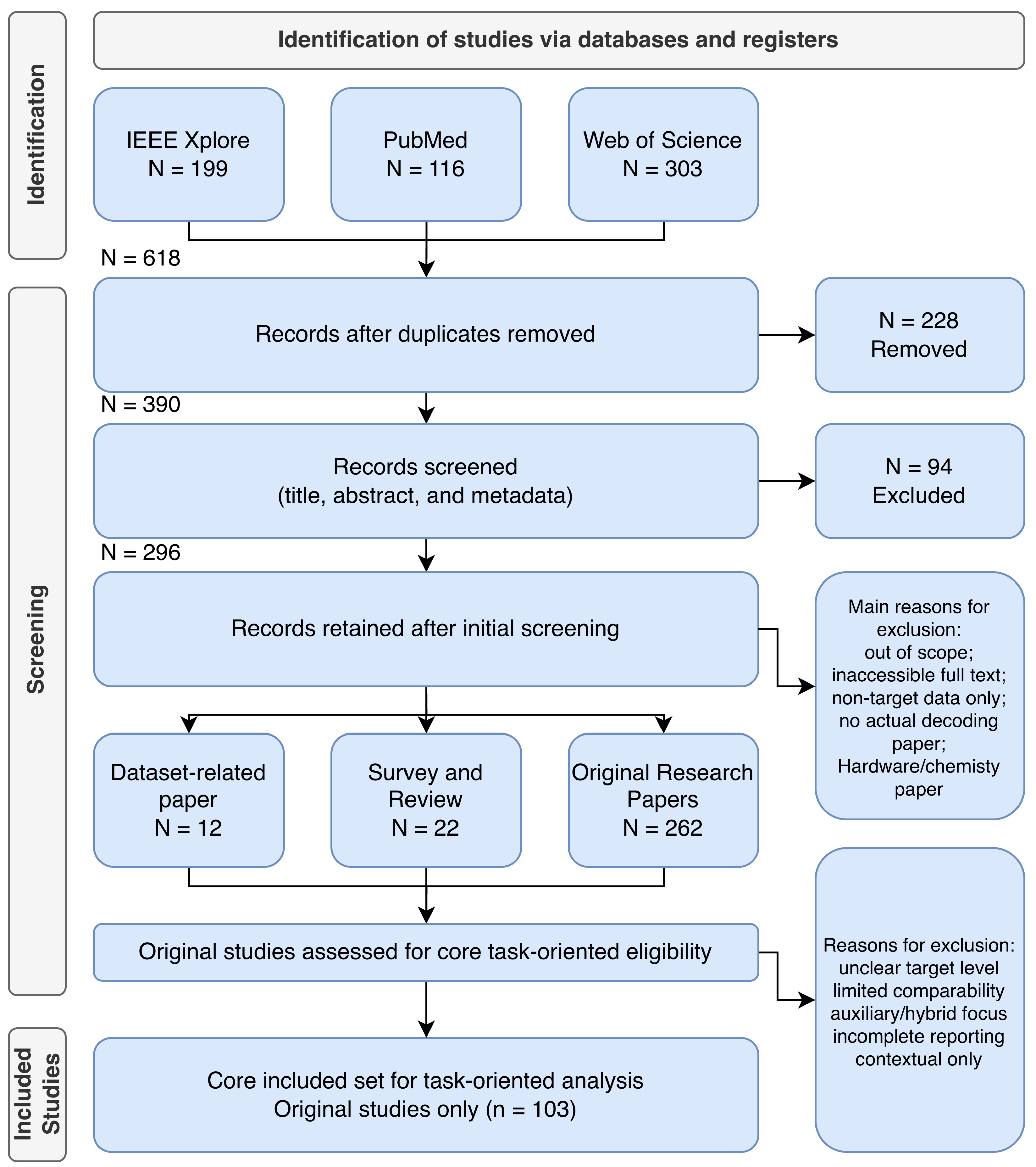
2.1. Literature Search Strategy
2.2. Screening Procedure, Inclusion/Exclusion Criteria, and Evidence Organization
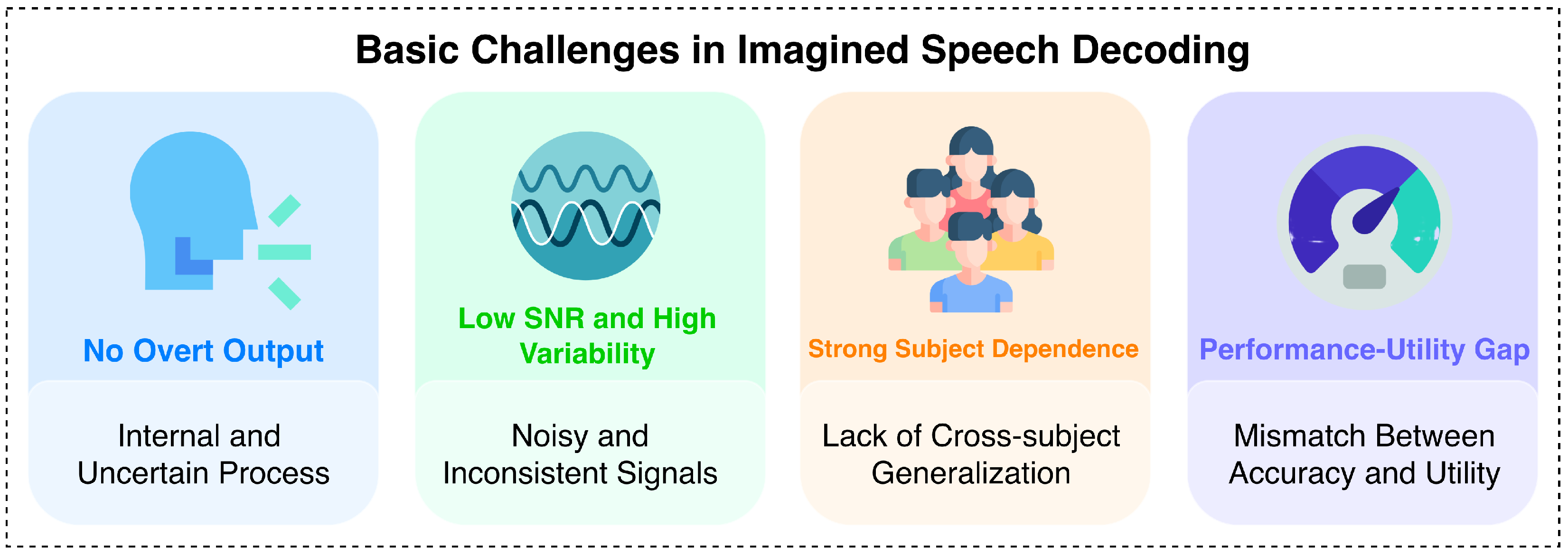
2.3. Basic Challenges of Imagined Speech Decoding
2.4. Why a Task-Oriented Framework Is Needed
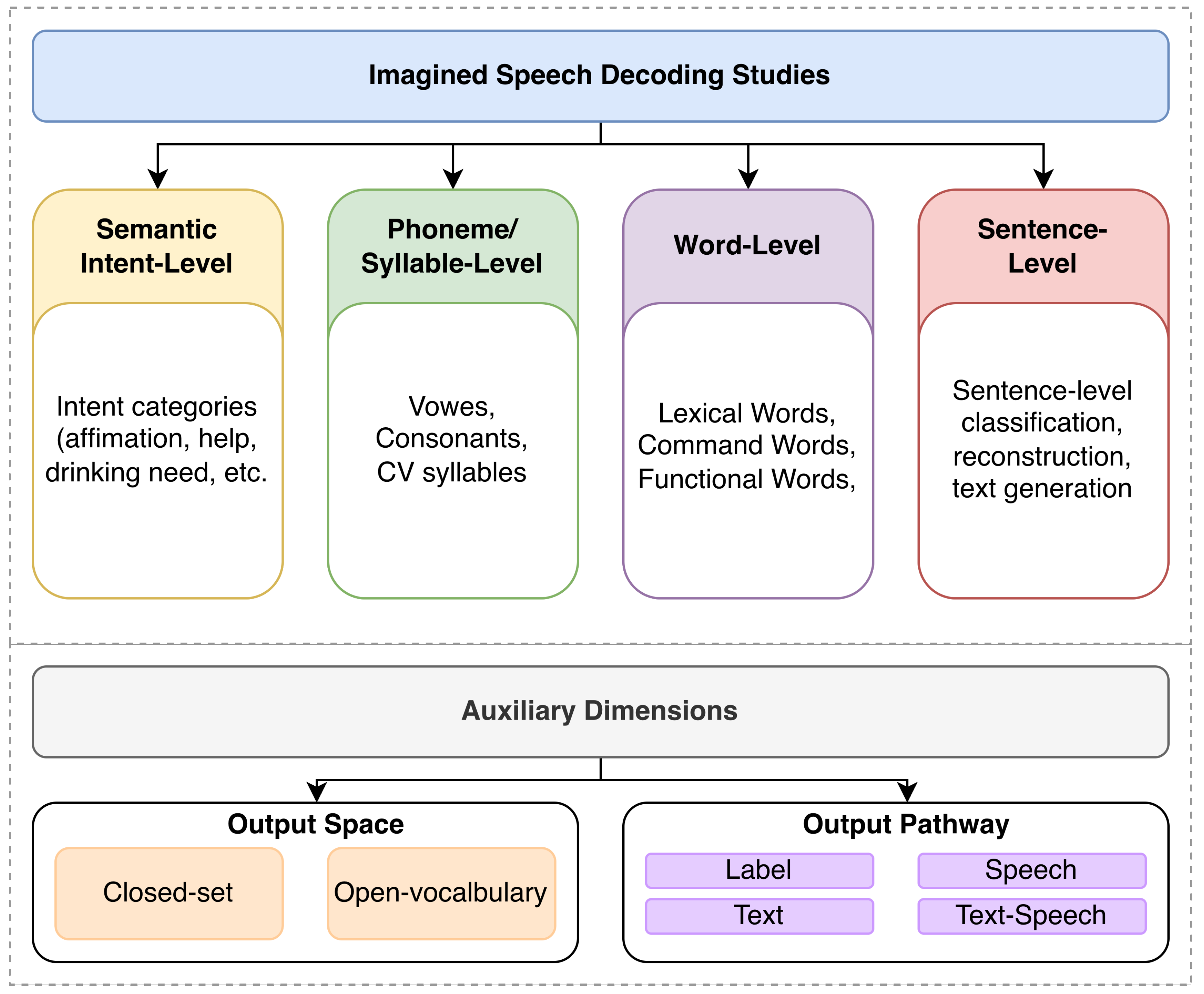
3. Task-Oriented Categorization Framework for Imagined Speech Decoding
3.1. Semantic or Intent-Level Decoding
3.2. Phoneme or Syllable-Level Decoding
3.3. Word-Level Decoding
3.4. Sentence or Language-Level Decoding
4. Cross-Cutting Auxiliary Dimensions and Cross-Category Analysis
4.1. Output-Space Property
4.2. Output Pathway
4.3. Interactions Between Main Task Levels and Auxiliary Dimensions
5. Discussion
5.1. Methodological Evolution of Imagined Speech Decoding
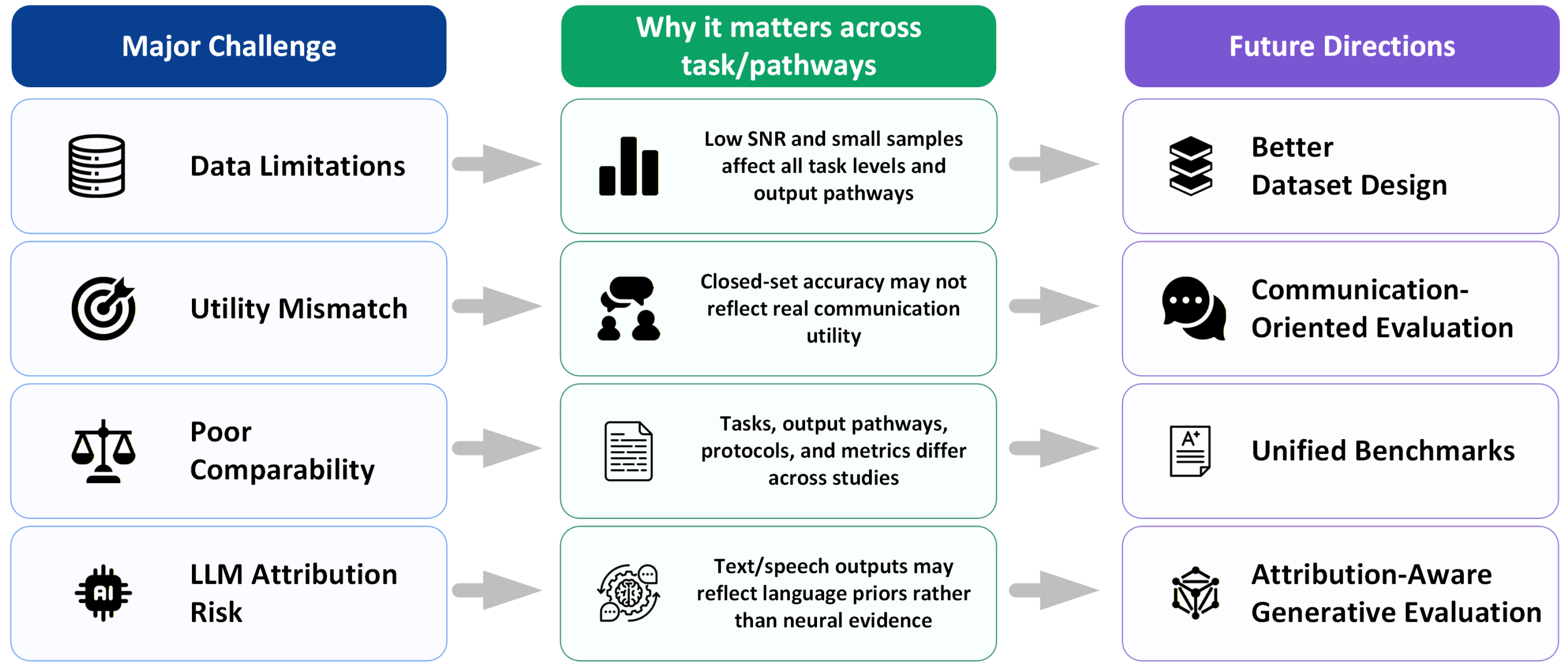
5.2. Challenges and Future Directions
6. Conclusions
Author Contributions
Funding
Institutional Review Board Statement
Informed Consent Statement
Data Availability Statement
Acknowledgments
Conflicts of Interest
Abbreviations
| LLMs | Large Language Models |
| CNN | Convolutional Neural Network |
| RNN | Recurrent Neural Network |
| LSTM | Long Short-Term Memory |
| MFCC | Mel-Frequency Cepstral Coefficient |
| CV | Consonant-Vowel |
| ECoG | Electrocorticography |
| MEG | Magnetoencephalography |
| fMRI | Functional Magnetic Resonance Imaging |
| fNIRS | Functional Near-Infrared Spectroscopy |
| EMG | Electromyography |
| sEEG | Stereoelectroencephalography |
Appendix A

| Item | Description |
|---|---|
| Database | Web of Science Core Collection |
| Search field | Topic |
| Search string | TS=((“imagined speech” OR “inner speech” OR “speech imagery” OR “covert speech” OR “silent speech”) AND (“EEG” OR “electroencephalography” OR “ECoG” OR “sEEG” OR “MEG” OR “fMRI” OR “fNIRS” OR “brain–computer interface” OR “BCI”) AND (decod* OR classif* OR recognit* OR “neural decoding” OR “machine learning” OR “deep learning” OR CNN OR RNN OR LSTM OR transformer OR “transfer learning” OR “domain adaptation”)) |
| Publication window | 1 January 2020 to 6 February 2026 |
| Document type/filter | Article; Review Article; Proceedings Paper; Early Access |
| Language | English |
| Query date | 6 February 2026 |
| Item | Description |
|---|---|
| Database | PubMed |
| Search field | Title/Abstract |
| Search string | ((“imagined speech”[Title/Abstract] OR “inner speech”[Title/Abstract] OR “speech imagery”[Title/Abstract] OR “covert speech”[Title/Abstract] OR “silent speech”[Title/Abstract]) AND (“EEG”[Title/Abstract] OR “electroencephalography”[Title/Abstract] OR “ECoG”[Title/Abstract] OR “sEEG”[Title/Abstract] OR “MEG”[Title/Abstract] OR “fMRI”[Title/Abstract] OR “fNIRS”[Title/Abstract] OR “brain–computer interface”[Title/Abstract] OR “BCI”[Title/Abstract]) AND (decoding[Title/Abstract] OR classification[Title/Abstract] OR recognition[Title/Abstract] OR “neural decoding”[Title/Abstract] OR “machine learning”[Title/Abstract] OR “deep learning”[Title/Abstract] OR CNN[Title/Abstract] OR RNN[Title/Abstract] OR LSTM[Title/Abstract] OR transformer[Title/Abstract] OR “transfer learning”[Title/Abstract] OR “domain adaptation”[Title/Abstract])) |
| Publication window | 1 January 2020 to 6 February 2026 |
| Document type/filter | Journal Article; Review |
| Language | English |
| Query date | 6 February 2026 |
| Item | Description |
|---|---|
| Database | IEEE Xplore |
| Search field | All Metadata |
| Search string | ((“imagined speech” OR “inner speech” OR “speech imagery” OR “covert speech” OR “silent speech”) AND (“EEG” OR “electroencephalography” OR “ECoG” OR “sEEG” OR “MEG” OR “fMRI” OR “fNIRS” OR “brain–computer interface” OR “BCI”) AND (decoding OR classification OR recognition OR “neural decoding” OR “machine learning” OR “deep learning” OR CNN OR RNN OR LSTM OR transformer OR “transfer learning” OR “domain adaptation”)) |
| Publication window | 1 January 2020 to 6 February 2026 |
| Document type/filter | Journals; Conferences; Early Access Articles |
| Language | English |
| Query date | 6 February 2026 |
Appendix B. Dataset Diagnostic Details
| Dataset/Resource | Subjects | Channels | Sampling Rate | Trials/Sessions | Preprocessing Notes | Split/Evaluation | Limitations/Access Notes |
|---|---|---|---|---|---|---|---|
| KaraOne [128] | 12 recruited; 8 used | 64 EEG + 4 EOG | 1 kHz | 132 trials; 4 trial states | EEGLAB; ocular removal; 1–50 Hz; Laplacian | LOSO cross-validation | Mixed phoneme/word targets; small sample; public-release status should be verified |
| ASU [129] | 15 | 64 | 1000 Hz raw; 256 Hz processed | 1–3 sessions/subject; 100 trials per word/sound | 8–70 Hz band-pass; 60 Hz notch; EOG artifact removal | 10-fold CV; random train/test split | Published dataset; vowels, short words, and long words; task groups differ across subjects |
| Coretto DB [130] | 15 | 6 | 1024 Hz | 50 trials/word; single session; approx. 3.5 h | 2–40 Hz FIR band-pass; artifact marking | RF/SVM baseline analysis | Spanish vowels and command words; low-channel setup limits spatial analysis |
| TOL [131] | 10 | 128 EEG + 8 EXG | 256 Hz | 475–570 trials/subject; 3 sessions; 5640 total trials | MNE-based processing scripts; processed and raw data provided | Dataset validation; no fixed universal benchmark split | Inner speech, pronounced speech, and visualized conditions; task execution cannot be directly verified |
| Chisco [132] | 3 | 125 EEG + 6 external | 1 kHz raw; 500 Hz processed | 6681 trials/subject; 5 days; 9 blocks/day | PREP; notch; high-pass; Autoreject; ICA | Semantic-category baseline classification | Large subject-specific dataset; only 3 subjects; sentence-level imagined speech |
| Words6 [133] | 15 | 64 | 2048 Hz | 50 trials/word; 6 imagined words | CAR; 0.01–250 Hz; 48–52 Hz notch; ICA | Classification baseline | Six-word closed-set task; open-access imagined-word dataset |
| FEIS [134] | 21 English; 2 Chinese | 14 | 256 Hz | Phase-specific CSV files for stimuli, thinking, speaking, and resting states | Raw CSV files; processing scripts provided | No fixed benchmark split reported | Open Zenodo dataset; low-channel Emotiv EPOC+ recording |
| 3M-CPSEED [135] | 20 | 32 or 128 | 500 Hz/ 1000 Hz raw; 500 Hz processed | 4 blocks; 1800 validated trials/subject | Downsampling; 50 Hz notch; 4–45 Hz; Autoreject; ICA | Dataset validation; transfer-learning potential | Different devices across subjects; overt, mouthed, and imagined speech modes |
| ArEEG [136] | 12 | 8 | 250 Hz | 15 sessions/subject; 25 trials/session; 15 s/trial; 4650 trials total | 50 Hz notch; 0.5–30 Hz band-pass; scaling to ±50 μV | 80/20 train–test split; participant-specific evaluation | OpenNeuro dataset; Arabic 5-command inner speech; low-density EEG; no subject-independent evaluation reported |
| DAIS [137] | 20 | 64 | 1024 Hz | 20 runs × 15 trials; 5993 trials total | 1–70 Hz; 49–51 Hz notch; re-reference; blink marking | Speaker-independent validation | Dutch articulated and covert speech in the same trial; 62 usable EEG channels for most subjects |
| Pragmatic Mandarin multimodal DB [138] | 30 | 64 EEG; 6 sEMG | 1000 Hz raw; 256 Hz processed EEG | 3 modality-homogeneous blocks; 10 materials; 50 repetitions/material; ∼48 min/subject | EEGLAB; bad-channel interpolation; average reference; 0–120 Hz; 50 Hz notch; downsampled; baseline correction; ICA | Mode-level validation; no fixed benchmark split reported | Open dataset with EEG, sEMG, and speech; imagined, silent, and overt Mandarin speech; individual material-level decoding not evaluated |
| Bimodal EEG-fMRI inner-speech DB [139] | 4 | 64 EEG + 6 external | 512 Hz | 320 EEG trials; 2 fMRI sessions | EEG ICA analysis; fMRI SPM12 | Open code/benchmark; subject-dependent use | OpenNeuro; nonsimultaneous EEG-fMRI; small sample |
| Simultaneous EEG-fMRI inner-speech DB [140] | 3 | 64 EEG + ECG | 5 kHz | 2 sessions; 8 words; 40 trials/word; 2-s fixation, 2-s task, 12-s rest | AAS correction for MRI gradient and cardiac artifacts; BIDS EEG/fMRI data | No fixed benchmark split reported | OpenNeuro; CC0 data; small sample; incomplete EEG sessions for sub-01/sub-02 |
| VocalMind [141] | 1 | 140 implanted contacts; 110 used after exclusion | 1000 Hz raw; 200 Hz processed | 20 words × 6 reps/mode; 100 sentences × 2 reps/mode; 3 speech modes; 67.85 min total | 30 abnormal contacts removed; CAR; high-gamma 70–150 Hz; low-frequency signal; downsampled to 200 Hz | Six-fold CV baseline for speech decoding | Zenodo dataset; single sEEG participant; Mandarin tonal speech; vocalized/mimed/imagined modes |
| Semantic EEG-fNIRS DB [142] | 12 (+7 EEG-only follow-up) | 64 EEG; fNIRS 11/14 ch | EEG 2048 Hz; fNIRS 8.92/7.81 Hz | 36 concepts; 5 reps/concept in Dataset 1; 7 reps/concept in Dataset 2 | Raw BIDS data; EEG/fNIRS preprocessing examples reported | No fixed benchmark split reported | OpenNeuro; semantic animals/tools task; task-order seed issue in Dataset 1 |
References
- Varbu, K.; Muhammad, N.; Muhammad, Y. Past, Present, and Future of EEG-Based BCI Applications. Sensors 2022, 22, 3331. [Google Scholar] [CrossRef]
- Panachakel, J.T.; Ramakrishnan, A.G. Decoding Covert Speech from EEG: A Comprehensive Review. Front. Neurosci. 2021, 15, 642251. [Google Scholar] [CrossRef]
- Rahman, N.; Khan, D.M.; Masroor, K.; Arshad, M.; Rafiq, A.; Fahim, S.M. Advances in brain-computer interface for decoding speech imagery from EEG signals: A systematic review. Cogn. Neurodyn. 2024, 18, 3565–3583. [Google Scholar] [CrossRef]
- Lopez-Bernal, D.; Balderas, D.; Ponce, P.; Molina, A. A State-of-the-Art Review of EEG-Based Imagined Speech Decoding. Front. Hum. Neurosci. 2022, 16, 867281. [Google Scholar] [CrossRef]
- Tates, A.; Matran-Fernandez, A.; Halder, S.; Daly, I. Speech imagery brain-computer interfaces: A systematic literature review. J. Neural Eng. 2025, 22, 031003. [Google Scholar] [CrossRef]
- Farwell, L.A.; Donchin, E. Talking off the top of your head: Toward a mental prosthesis utilizing event-related brain potentials. Electroencephalogr. Clin. Neurophysiol. 1988, 70, 510–523. [Google Scholar] [CrossRef] [PubMed]
- Bin, G.; Gao, X.; Yan, Z.; Hong, B.; Gao, S. An online multi-channel SSVEP-based brain-computer interface using a canonical correlation analysis method. J. Neural Eng. 2009, 6, 046002. [Google Scholar] [CrossRef] [PubMed]
- Hekmatmanesh, A.; Nardelli, P.H.J.; Handroos, H. Review of the State-of-the-Art of Brain-Controlled Vehicles. IEEE Access 2021, 9, 110173–110193. [Google Scholar] [CrossRef]
- Hekmatmanesh, A. Investigation of EEG Signal Processing for Rehabilitation Robot Control. Ph.D. Dissertation, Lappeenranta-Lahti University of Technology LUT, Lappeenranta, Finland, 2019. [Google Scholar]
- Su, K.; Tian, L. Systematic review: Progress in EEG-based speech imagery brain-computer interface decoding and encoding research. PeerJ Comput. Sci. 2025, 11, e2938. [Google Scholar] [CrossRef] [PubMed]
- Alzahrani, S.; Banjar, H.; Mirza, R. Systematic Review of EEG-Based Imagined Speech Classification Methods. Sensors 2024, 24, 8168. [Google Scholar] [CrossRef]
- Jin, Z.; Li, D.; Huang, S. A systematic review of EEG-based imagined speech decoding. Appl. Soft Comput. 2025, 183, 113563. [Google Scholar] [CrossRef]
- Fitriah, N.; Zakaria, H.; Rajab, T.L.E. EEG-Based Silent Speech Interface and Its Challenges: A Survey. Int. J. Adv. Comput. Sci. Appl. 2022, 13, 625–635. [Google Scholar] [CrossRef]
- Zhang, L.; Zhou, Y.; Gong, P.; Zhang, D. Speech Imagery Decoding Using EEG Signals and Deep Learning: A Survey. IEEE Trans. Cogn. Dev. Syst. 2025, 17, 22–39. [Google Scholar] [CrossRef]
- Xiong, W.; Ma, L.; Li, H. Synthesizing intelligible utterances from EEG of imagined speech. Front. Neurosci. 2025, 19, 1565848. [Google Scholar] [CrossRef] [PubMed]
- Zhang, F.; Chai, B.; Wu, Y.; Siok, W.T.; Wang, N. Linguistics and Human Brain: A perspective of computational neuroscience. arXiv 2026, arXiv:2602.08275. [Google Scholar] [CrossRef]
- Shah, N.P.; Pailla, T.; Ranzato, E.; Thapa, R.; Kaushik, P.; Gupta, A.; Sharma, D.K.; Phung, D.; Aryal, S. The Role of Artificial Intelligence in Decoding Speech from EEG Signals: A Scoping Review. Sensors 2022, 22, 6975. [Google Scholar] [CrossRef]
- Gonzalez-Lopez, J.A.; Gomez-Alanis, A.; Martín-Doñas, J.M.; Pérez-Córdoba, J.L.; Gomez, A.M. Silent Speech Interfaces for Speech Restoration: A Review. IEEE Access 2020, 8, 177995–178021. [Google Scholar] [CrossRef]
- Cooney, C.; Folli, R.; Coyle, D. Opportunities, Pitfalls and Trade-Offs in Designing Protocols for Measuring the Neural Correlates of Speech. Neurosci. Biobehav. Rev. 2022, 141, 104798. [Google Scholar] [CrossRef] [PubMed]
- Tang, J.; Chen, J.; Xu, X.; Liu, A.; Chen, X. Imagined Speech Reconstruction From Neural Signals—An Overview of Sources and Methods. IEEE Trans. Instrum. Meas. 2024, 73, 4011721. [Google Scholar] [CrossRef]
- Almufareh, M.F.; Farooq, A.; Tehsin, S.; Humayun, M.; Kausar, S. Inner Speech Decoding: A Comprehensive Review. WIREs Cogn. Sci. 2025, 16, e70016. [Google Scholar] [CrossRef]
- Shrividya, S.; Thundiyil, S.; Picone, J. Fluency in Imagined Speech Decoding Using Non-Invasive Techniques: A Review. In Proceedings of the IEEE Signal Processing in Medicine and Biology Symposium (SPMB); IEEE: New York, NY, USA, 2025; pp. 1–3. [Google Scholar]
- Page, M.J.; McKenzie, J.E.; Bossuyt, P.M.; Boutron, I.; Hoffmann, T.C.; Mulrow, C.D.; Shamseer, L.; Tetzlaff, J.M.; Akl, E.A.; Brennan, S.E.; et al. The PRISMA 2020 statement: An updated guideline for reporting systematic reviews. BMJ 2021, 372, n71. [Google Scholar] [CrossRef]
- Mubonanyikuzo, V.; Yan, H.; Komolafe, T.E.; Zhou, L.; Wu, T.; Wang, N. Detection of Alzheimer disease in neuroimages using vision transformers: Systematic review and meta-analysis. J. Med. Internet Res. 2025, 27, e62647. [Google Scholar] [CrossRef] [PubMed]
- Niu, Y.; Li, Z.; Yao, L.; Wu, X. BDR-GCL: Toward imagined speech decoding in naturalistic BCI systems via brain dynamics representation enhanced graph contrastive learning. Expert Syst. Appl. 2026, 296, 129058. [Google Scholar] [CrossRef]
- Rekrut, M.; Sharma, M.; Schmitt, M.; Alexandersson, J.; Krüger, A. Decoding Semantic Categories from EEG Activity in Silent Speech Imagination Tasks. In Proceedings of the 2021 9th International Winter Conference on Brain-Computer Interface (BCI); IEEE: New York, NY, USA, 2021; pp. 1–7. [Google Scholar] [CrossRef]
- Hossain, A.; Das, K.; Khan, P.; Kader, M.F. A BCI system for imagined Bengali speech recognition. Mach. Learn. Appl. 2023, 13, 100486. [Google Scholar] [CrossRef]
- Ramirez-Quintana, J.A.; Macias-Macias, J.M.; Ramirez-Alonso, G.; Chacon-Murguia, M.I.; Corral-Martinez, L.F. A novel deep capsule neural network for vowel imagery patterns from EEG signals. Biomed. Signal Process. Control 2023, 81, 104500. [Google Scholar] [CrossRef]
- Niimura, Y.; Takemoto, J.; Kai, A.; Nakagawa, S. Attention-based CNN and relative phase feature modeling for improved imagined speech recognition. In Proceedings of the 2023 Asia Pacific Signal and Information Processing Association Annual Summit and Conference (APSIPA ASC); IEEE: New York, NY, USA, 2023; pp. 8–14. [Google Scholar] [CrossRef]
- Wu, S.; Bhadra, K.; Giraud, A.-L.; Marchesotti, S. Adaptive LDA classifier enhances real-time control of an EEG brain-computer interface for decoding imagined syllables. Brain Sci. 2024, 14, 196. [Google Scholar] [CrossRef]
- Li, H.; Chen, F. Classify imaginary Mandarin tones with cortical EEG signals. In Interspeech 2020; ISCA: Baixas, France, 2020; pp. 4896–4900. [Google Scholar] [CrossRef]
- Kumar, P.; Scheme, E. A deep spatio-temporal model for EEG-based imagined speech recognition. In Proceedings of the ICASSP 2021—2021 IEEE International Conference on Acoustics, Speech and Signal Processing (ICASSP); IEEE: New York, NY, USA, 2021; pp. 995–999. [Google Scholar] [CrossRef]
- Ingolfsson, T.M.; Kartsch, V.; Benini, L.; Cossettini, A. A wearable ultra-low-power system for EEG-based speech-imagery interfaces. IEEE Trans. Biomed. Circuits Syst. 2025, 19, 743–755. [Google Scholar] [CrossRef]
- Fitriah, N.; Zakaria, H.; Budikayanti, A.; Suksmono, A.B.; Mengko, T.L.E.R. Decoding speech imagery: A spectro-spatial approach to electroencephalography band power analysis. IEEE J. Biomed. Health Inform. 2025, 1–14. [Google Scholar] [CrossRef]
- Kim, S.; Lee, Y.E.; Lee, S.H.; Lee, S.W. Diff-E: Diffusion-based learning for decoding imagined speech EEG. In Interspeech 2023; ISCA: Baixas, France, 2023; pp. 1159–1163. [Google Scholar] [CrossRef]
- Li, A.; Wang, Z.; Zhao, X.; Xu, T.; Zhou, T.; Hu, H. Enhancing word-level imagined speech BCI through heterogeneous transfer learning. In Proceedings of the 2024 46th Annual International Conference of the IEEE Engineering in Medicine and Biology Society (EMBC); IEEE: New York, NY, USA, 2024; pp. 1–4. [Google Scholar] [CrossRef]
- Kim, D.S.; Lee, S.H.; Yin, K.; Lee, S.W. Reconstructing unseen sentences from speech-related biosignals for open-vocabulary neural communication. IEEE Trans. Neural Syst. Rehabil. Eng. 2025, 33, 4338–4348. [Google Scholar] [CrossRef] [PubMed]
- Tang, J.; LeBel, A.; Jain, S.; Huth, A.G. Semantic reconstruction of continuous language from non-invasive brain recordings. Nat. Neurosci. 2023, 26, 858–866. [Google Scholar] [CrossRef] [PubMed]
- Pan, H.; Chu, X.; Miao, R.; Wang, M.; Wang, Y.; Li, Z. Text generation of speech imagery based on an enhanced CTA-BiLSTM model utilizing EEG signals. IEEE Trans. Consum. Electron. 2025, 71, 3442–3453. [Google Scholar] [CrossRef]
- Rastogi, S.; Dadwal, H.; Modi, K.; Bedi, J.; Singh, J. Towards sentence level imagined speech generation from EEG signals. In Interspeech 2025; ISCA: Baixas, France, 2025; pp. 5558–5562. [Google Scholar] [CrossRef]
- Meng, K.; Goodarzy, F.; Kim, E.; Park, Y.J.; Kim, J.S.; Cook, M.J.; Chung, C.K.; Grayden, D.B. Continuous synthesis of artificial speech sounds from human cortical surface recordings during silent speech production. J. Neural Eng. 2023, 20, 046019. [Google Scholar] [CrossRef]
- Dash, D.; Ferrari, P.; Wang, J. Decoding imagined and spoken phrases from non-invasive neural (MEG) signals. Front. Neurosci. 2020, 14, 290. [Google Scholar] [CrossRef] [PubMed]
- Angrick, M.; Ottenhoff, M.C.; Diener, L.; Ivucic, D.; Ivucic, G.; Goulis, S.; Saal, J.; Colon, A.J.; Wagner, L.; Krusienski, D.J.; et al. Real-time synthesis of imagined speech processes from minimally invasive recordings of neural activity. Commun. Biol. 2021, 4, 1055. [Google Scholar] [CrossRef] [PubMed]
- Rekrut, M.; Sharma, M.; Schmitt, M.; Alexandersson, J.; Krüger, A. Decoding Semantic Categories from EEG Activity in Object-Based Decision Tasks. In Proceedings of the 2020 8th International Winter Conference on Brain-Computer Interface (BCI); IEEE: New York, NY, USA, 2020; pp. 51–57. [Google Scholar] [CrossRef]
- Sereshkeh, A.R.; Yousefi, R.; Wong, A.T.; Chau, T. Online classification of imagined speech using functional near-infrared spectroscopy signals. J. Neural Eng. 2019, 16, 016005. [Google Scholar] [CrossRef]
- Rezazadeh Sereshkeh, A.; Yousefi, R.; Wong, A.T.; Chau, T. Development of a ternary hybrid fNIRS-EEG brain-computer interface based on imagined speech. Brain-Comput. Interfaces 2019, 6, 128–140. [Google Scholar] [CrossRef]
- Mahapatra, N.C.; Bhuyan, P. Decoding of imagined speech electroencephalography neural signals using transfer learning method. J. Phys. Commun. 2023, 7, 095002. [Google Scholar] [CrossRef]
- Mahapatra, N.C.; Bhuyan, P. Decoding of imagined speech neural EEG signals using deep reinforcement learning technique. In Proceedings of the 2022 International Conference on Advancements in Smart, Secure and Intelligent Computing (ASSIC); IEEE: New York, NY, USA, 2022; pp. 1–6. [Google Scholar]
- Li, M.; Pun, S.H.; Chen, F. A preliminary study of classifying spoken vowels with EEG signals. In Proceedings of the 2021 10th International IEEE/EMBS Conference on Neural Engineering (NER); IEEE: New York, NY, USA, 2021; pp. 13–16. [Google Scholar] [CrossRef]
- Cui, W.; Wang, X.; Li, M.; Pun, S.H.; Chen, F. A study of deep learning based classification of Mandarin vowels using spoken speech EEG signals. In Proceedings of the 2023 IEEE International Conference on Signal Processing, Communications and Computing (ICSPCC); IEEE: New York, NY, USA, 2023; pp. 1–5. [Google Scholar] [CrossRef]
- Zhang, Z.; Li, P.; Rangpong, P.; Connelly, A.; Yagi, T. Characterization and comparative analysis of auditory perception and imagery using EEG. In Proceedings of the 2024 16th Biomedical Engineering International Conference (BMEiCON); IEEE: New York, NY, USA, 2024; pp. 1–4. [Google Scholar] [CrossRef]
- Tiwari, S.; Goel, S.; Bhardwaj, A. Classification of imagined speech of vowels from EEG signals using multi-headed CNNs feature fusion network. Digit. Signal Process. 2024, 148, 104447. [Google Scholar] [CrossRef]
- Li, P.; Chen, F.; Wu, X. EEG-based speech decoding based on multi-mode joint modeling. In Interspeech 2025; ISCA: Baixas, France, 2025; pp. 5598–5602. [Google Scholar] [CrossRef]
- Hernandez-Galvan, A.; Ramirez-Alonso, G.; Ramirez-Quintana, J. A prototypical network for few-shot recognition of speech imagery data. Biomed. Signal Process. Control 2023, 86, 105154. [Google Scholar] [CrossRef]
- Panachakel, J.T.; Ganesan, R.A. Decoding imagined speech from EEG using transfer learning. IEEE Access 2021, 9, 135371–135383. [Google Scholar] [CrossRef]
- Kamble, A.; Ghare, P.H.; Kumar, V. Deep-learning-based BCI for automatic imagined speech recognition using SPWVD. IEEE Trans. Instrum. Meas. 2023, 72, 4001110. [Google Scholar] [CrossRef]
- Mohan, A.; Anand, R.S. Wavelet augmented phase coherence features for EEG-based imagined speech classification. IEEE Sens. Lett. 2025, 9, 7004204. [Google Scholar] [CrossRef]
- Carvalho, V.R.; Mendes, E.M.A.M.; Fallah, A.; Sejnowski, T.J.; Comstock, L.; Lainscsek, C. Decoding imagined speech with delay differential analysis. Front. Hum. Neurosci. 2024, 18, 1398065. [Google Scholar] [CrossRef]
- Parhi, M.; Tewfik, A.H. Classifying imaginary vowels from frontal lobe EEG via deep learning. In Proceedings of the 28th European Signal Processing Conference (EUSIPCO); IEEE: New York, NY, USA, 2021; pp. 1195–1199. [Google Scholar]
- Guo, Z.; Chen, F. Decoding articulation motor imagery using early connectivity information in the motor cortex: A functional near-infrared spectroscopy study. IEEE Trans. Neural Syst. Rehabil. Eng. 2023, 31, 506–518. [Google Scholar] [CrossRef]
- Clayton, J.; Wellington, S.; Valentini-Botinhaou, C.; Watts, O. Decoding imagined, heard, and spoken speech: Classification and regression of EEG using a 14-channel dry-contact mobile headset. In Interspeech 2020; ISCA: Baixas, France, 2020; pp. 4886–4890. [Google Scholar] [CrossRef]
- Panachakel, J.T.; Ramakrishnan, A.G. Classification of phonological categories in imagined speech using phase synchronization measure. In Proceedings of the 2021 43rd Annual International Conference of the IEEE Engineering in Medicine & Biology Society (EMBC); IEEE: New York, NY, USA, 2021; pp. 2226–2229. [Google Scholar] [CrossRef]
- Sharon, R.; Sur, M.; Murthy, H. Harnessing the multi-phasal nature of speech-EEG for enhancing imagined speech recognition. IEEE Open J. Signal Process. 2025, 6, 78–88. [Google Scholar] [CrossRef]
- Meng, K.; Grayden, D.B.; Cook, M.J.; Vogrin, S.; Goodarzy, F. Identification of discriminative features for decoding overt and imagined speech using stereotactic electroencephalography. In Proceedings of the 2021 9th International Winter Conference on Brain-Computer Interface (BCI); IEEE: New York, NY, USA, 2021; pp. 1–6. [Google Scholar] [CrossRef]
- Sakai, R.; Kai, A.; Nakagawa, S. Classification of imagined and heard speech using amplitude spectrum and relative phase of EEG. In Proceedings of the 2021 IEEE 3rd Global Conference on Life Sciences and Technologies (LifeTech); IEEE: New York, NY, USA, 2021; pp. 373–375. [Google Scholar] [CrossRef]
- Bisla, M.; Anand, R.S. EEG based brain computer interface system for decoding covert speech using deep neural networks. In Proceedings of the 2023 IEEE 12th International Conference on Communication Systems and Network Technologies (CSNT); IEEE: New York, NY, USA, 2023; pp. 414–419. [Google Scholar] [CrossRef]
- Mini, P.P.; Thomas, T.; Gopikakumari, R. Wavelet feature selection of audio and imagined/vocalized EEG signals for ANN based multimodal ASR system. Biomed. Signal Process. Control 2021, 63, 102218. [Google Scholar] [CrossRef]
- Ju, J.; Zhuang, Y.; Yi, C. An EEG-EMG-based hybrid brain-computer interface for decoding tones in silent and audible speech. IEEE Trans. Neural Syst. Rehabil. Eng. 2025, 33, 4206–4216. [Google Scholar] [CrossRef]
- Zhang, X.; Li, H.; Chen, F. EEG-based classification of imaginary Mandarin tones. In Proceedings of the 2020 Annual International Conference of the IEEE Engineering in Medicine and Biology Society (EMBC); IEEE: New York, NY, USA, 2020; pp. 3889–3892. [Google Scholar] [CrossRef]
- Kobayashi, N.; Morooka, T. Application of high-accuracy silent speech BCI to biometrics using deep learning. In Proceedings of the 2021 9th International Winter Conference on Brain-Computer Interface (BCI); IEEE: New York, NY, USA, 2021; pp. 1–6. [Google Scholar] [CrossRef]
- Ylinen, S.; Nora, A.; Service, E. Better phonological short-term memory is linked to improved cortical memory representations for word forms and better word learning. Front. Hum. Neurosci. 2020, 14, 209. [Google Scholar] [CrossRef]
- Lee, D.H.; Kim, S.J.; Lee, K.W. Decoding high-level imagined speech using attention-based deep neural networks. In Proceedings of the 2022 10th International Winter Conference on Brain-Computer Interface (BCI); IEEE: New York, NY, USA, 2022; pp. 1–4. [Google Scholar] [CrossRef]
- Li, M.; Pun, S.H.; Chen, F. Cross-paradigm data alignment to improve the calibration of asynchronous BCI systems in EEG-based speech imagery. In Proceedings of the 2024 46th Annual International Conference of the IEEE Engineering in Medicine and Biology Society (EMBC); IEEE: New York, NY, USA, 2024; pp. 1–4. [Google Scholar] [CrossRef]
- Padfield, N.; Camilleri, T.; Fabri, S.; Bugeja, M.; Camilleri, K. A combined EEG motor and speech imagery paradigm with automated successive halving for customizable command selection. Brain-Comput. Interfaces 2024, 11, 125–142. [Google Scholar] [CrossRef]
- Zhang, L.; Gong, P.; Sun, Q.; Zhou, Y.; Zhu, Q.; Zhang, D. A dual-branch Riemannian learning network for EEG speech imagery decoding. In Neural Information Processing—ICONIP 2024, Part XI; Mahmud, M., Doborjeh, M., Wong, K., Leung, A.C.S., Doborjeh, Z., Tanveer, M., Eds.; Springer: Singapore, 2025; pp. 335–349. [Google Scholar] [CrossRef]
- Ji, Y.; Li, F.; Fu, B.; Zhou, Y.; Wu, H.; Li, Y.; Shi, G. A novel hybrid decoding neural network for EEG signal representation. Pattern Recognit. 2024, 155, 110726. [Google Scholar] [CrossRef]
- Inoue, M.; Sato, M.; Tomeoka, K.; Nah, N.; Hatakeyama, E.; Arulkumaran, K.; Horiguchi, I.; Sasai, S. A silent speech decoding system from EEG and EMG with heterogenous electrode configurations. In Interspeech 2025; ISCA: Baixas, France, 2025; pp. 5603–5607. [Google Scholar] [CrossRef]
- Lee, D.Y.; Lee, M.; Lee, S.W. Decoding imagined speech based on deep metric learning for intuitive BCI communication. IEEE Trans. Neural Syst. Rehabil. Eng. 2021, 29, 1363–1374. [Google Scholar] [CrossRef]
- Bhalerao, S.V.; Pachori, R.B. Imagined speech-EEG detection using multivariate swarm sparse decomposition-based joint time-frequency analysis for intuitive BCI. IEEE Trans. Hum.-Mach. Syst. 2025, 55, 347–357. [Google Scholar] [CrossRef]
- Zheng, X.B.; Ling, B.W.K.; Xu, N.; Chen, J.R.; Zheng, S.Y. A novel quaternion optimization model for imagined speech classification. J. Franklin Inst. 2025, 362, 107789. [Google Scholar] [CrossRef]
- Jiang, M.; Zhang, W.; Ding, Y.; Teo, K.A.C.; Fong, L.; Zhang, S.; Guo, Z.; Liu, C.; Bhuvanakantham, R.; Sim, W.K.J.; et al. Decoding covert speech from EEG by functional areas spatio-temporal transformer. IEEE J. Biomed. Health Inform. 2026, 1–14. [Google Scholar] [CrossRef]
- Ko, B.K.; Lee, S.H.; Lee, S.W. Imagined speech detection using multi-receptive CNN for asynchronous BCI communication and neurorehabilitation. IEEE Trans. Neural Syst. Rehabil. Eng. 2025, 33, 2904–2914. [Google Scholar] [CrossRef] [PubMed]
- Kiroy, V.N.; Bakhtin, O.M.; Krivko, E.M.; Lazurenko, D.M.; Aslanyan, E.; Shaposhnikov, D.G.; Shcherban, I.V. Spoken and inner speech-related EEG connectivity in different spatial direction. Biomed. Signal Process. Control 2022, 71, 103224. [Google Scholar] [CrossRef]
- Ng, H.W.; Guan, C. Subject-independent meta-learning framework towards optimal training of EEG-based classifiers. Neural Netw. 2024, 172, 106108. [Google Scholar] [CrossRef] [PubMed]
- Ahmad, A.E.; Hafrag, H.; Meligy, Z.A.; Ali Abdelbary, H.; Selim, S. Advancing Arabic inner speech recognition with machine learning and deep learning. In Proceedings of the 2025 15th International Conference on Electrical Engineering (ICEENG); IEEE: New York, NY, USA, 2025; pp. 1–6. [Google Scholar] [CrossRef]
- Haresh, M.V.; Kannadasan, K.; Shameedha Begum, B. An EEG-based imagined speech recognition using CSP-TP feature fusion for enhanced BCI communication. Behav. Brain Res. 2025, 493, 115652. [Google Scholar] [CrossRef]
- Zhao, R.; Liu, H.; Zhang, S.; Tang, Q.; Yu, X.; Bai, Y.; Ni, G. An electroencephalogram-based study of neural responses to imagined speech in Mandarin. In Man-Machine Speech Communication—NCMMSC 2024; Ling, Z., Chen, X., Hamdulla, A., He, L., Li, Y., Eds.; Springer: Singapore, 2025; pp. 278–289. [Google Scholar] [CrossRef]
- Abdalla, H.E.M.; Al-Haddad, S.A.R.; Basri, H.B.; Aris, I.B.; Yusofv, A.H.K.B.; Neyaz, H. Brain-computer interface system based on common spatial patterns for inner speech recognition from electroencephalography signal by using convolutional neural networks. In Proceedings of the 2024 IEEE International Conference on Systems, Man, and Cybernetics (SMC); IEEE: New York, NY, USA, 2024; pp. 2021–2027. [Google Scholar] [CrossRef]
- Merola, N.R.; Venkataswamy, N.G.; Imtiaz, M.H. Can machine learning algorithms classify inner speech from EEG brain signals? In Proceedings of the 2023 IEEE World AI IoT Congress (AIIoT); IEEE: New York, NY, USA, 2023; pp. 466–470. [Google Scholar] [CrossRef]
- Lee, D.Y.; Lee, M.; Lee, S.W. Classification of imagined speech using Siamese neural network. In Proceedings of the 2020 IEEE International Conference on Systems, Man, and Cybernetics (SMC); IEEE: New York, NY, USA, 2020; pp. 2979–2984. [Google Scholar] [CrossRef]
- Wang, L.; Chen, Y. Neurophysiological feature analysis and classification for hybrid mental tasks based on time-varying brain network. Measurement 2026, 259, 119789. [Google Scholar] [CrossRef]
- Kaongoen, N.; Choi, J.; Jo, S. A novel online BCI system using speech imagery and ear-EEG for home appliances control. Comput. Methods Programs Biomed. 2022, 224, 107022. [Google Scholar] [CrossRef]
- Lee, D.H.; Jeong, J.H.; Ahn, H.J.; Lee, S.W. Design of an EEG-based drone swarm control system using endogenous BCI paradigms. In Proceedings of the 2021 9th International Winter Conference on Brain-Computer Interface (BCI); IEEE: New York, NY, USA, 2021; pp. 1–5. [Google Scholar] [CrossRef]
- Rekrut, M.; Fey, A.; Nadig, M.; Ihl, J.; Jungbluth, T.; Krueger, A. Classifying words in natural reading tasks based on EEG activity to improve silent speech BCI training in a transfer approach. In Proceedings of the 2022 IEEE International Conference on Metrology for Extended Reality, Artificial Intelligence and Neural Engineering (MetroXRAINE); IEEE: New York, NY, USA, 2022; pp. 703–708. [Google Scholar] [CrossRef]
- Bai, Y.; Zhang, S.; Zhao, R.; Han, X.; Ni, G.; Ming, D. Cross-hemispheric spatial-temporal attention network for decoding silent speech from EEG. IEEE Trans. Biomed. Eng. 2025, 1–12. [Google Scholar] [CrossRef] [PubMed]
- Guo, Z.; Jiang, M.; Liu, C.; Wu, M.; Lu, J.; Gulyás, B.; Guan, C. Enhancing EEG-based covert speech decoding through knowledge transfer. In Proceedings of the ICASSP 2025—2025 IEEE International Conference on Acoustics, Speech and Signal Processing (ICASSP); IEEE: New York, NY, USA, 2025; pp. 1–5. [Google Scholar] [CrossRef]
- Agarwal, P.; Kumar, S. EEG-based imagined words classification using Hilbert transform and deep networks. Multimed. Tools Appl. 2024, 83, 2725–2748. [Google Scholar] [CrossRef]
- Lee, Y.E.; Lee, S.H. EEG-Transformer: Self-attention from transformer architecture for decoding EEG of imagined speech. In Proceedings of the 2022 10th International Winter Conference on Brain-Computer Interface (BCI); IEEE: New York, NY, USA, 2022; pp. 1–4. [Google Scholar] [CrossRef]
- Zhao, Z.; Peng, Y.; Camilleri, K.; Kong, W.; Cichocki, A. Imagined speech decoding by learning consensus graph from RKHS-based multi-view EEG features. IEEE Signal Process. Lett. 2025, 32, 3944–3948. [Google Scholar] [CrossRef]
- Zheng, X.B.; Li, C.; Ling, B.W.K. Imagery speech classification based on general successive multivariate variational mode decomposition with different objective functions having different weights. IEEE Trans. Consum. Electron. 2025, 71, 10654–10667. [Google Scholar] [CrossRef]
- Ahn, H.J.; Lee, D.H.; Jeong, J.H.; Lee, S.W. Multiscale convolutional transformer for EEG classification of mental imagery in different modalities. IEEE Trans. Neural Syst. Rehabil. Eng. 2023, 31, 646–656. [Google Scholar] [CrossRef]
- Lee, S.H.; Lee, M.; Lee, S.W. Neural decoding of imagined speech and visual imagery as intuitive paradigms for BCI communication. IEEE Trans. Neural Syst. Rehabil. Eng. 2020, 28, 2647–2659. [Google Scholar] [CrossRef]
- Jeong, J.H.; Cho, J.H.; Lee, B.H.; Lee, S.W. Real-time deep neurolinguistic learning enhances noninvasive neural language decoding for brain-machine interaction. IEEE Trans. Cybern. 2023, 53, 7469–7482. [Google Scholar] [CrossRef] [PubMed]
- Kamble, A.; Ghare, P.H.; Kumar, V.; Kothari, A.; Keskar, A.G. Spectral analysis of EEG signals for automatic imagined speech recognition. IEEE Trans. Instrum. Meas. 2023, 72, 4009409. [Google Scholar] [CrossRef]
- Hernandez-Del-Toro, T.; Reyes-Garcia, C.A.; Villasenor-Pineda, L. Toward asynchronous EEG-based BCI: Detecting imagined words segments in continuous EEG signals. Biomed. Signal Process. Control 2021, 65, 102351. [Google Scholar] [CrossRef]
- Zheng, X.B.; Ling, B.W.K. A BCI system for imagined speech classification based on optimization theory. IEEE Trans. Consum. Electron. 2024, 70, 6679–6690. [Google Scholar] [CrossRef]
- Alharbi, Y.F.; Alotaibi, Y.A. Decoding imagined speech from EEG data: A hybrid deep learning approach to capturing spatial and temporal features. Life 2024, 14, 1501. [Google Scholar] [CrossRef]
- Wang, L.; Yan, Z.; Liu, Y.; Hu, L. Analysis and application of functional connectivity in synchronic hybrid mental tasks for brain-computer interface. Measurement 2021, 186, 110116. [Google Scholar] [CrossRef]
- Hossain, A.; Ovi, T.H.; Mahmood, M.A.I.; Kader, M.F. Classification of envisioned English speech from EEG using deep learning approaches. Mach. Learn. Appl. 2025, 22, 100752. [Google Scholar] [CrossRef]
- Şahin, E.; Özdemir, D. ThinkSTra: A transformer-driven architecture for decoding imagined speech from EEG with spatial-temporal dynamics. Med. Biol. Eng. Comput. 2025, online first, 1–26. [Google Scholar] [CrossRef] [PubMed]
- Anusha, J.; Reddy, S.C. Hybrid convolution (1D/2D)-based adaptive and attention-aided residual DenseNet approach on brain-computer interface for automatic imagined speech recognition framework. Comput. Speech Lang. 2026, 96, 101866. [Google Scholar] [CrossRef]
- Guo, Z.; Xu, L.; Tan, W.; Chen, F. Impact of generation rate of speech imagery on neural activity and BCI decoding performance: A fNIRS study. IEEE Trans. Neural Syst. Rehabil. Eng. 2025, 33, 1180–1190. [Google Scholar] [CrossRef]
- Singh, A.; Gumaste, A. Decoding imagined speech and computer control using brain waves. J. Neurosci. Methods 2021, 358, 109196. [Google Scholar] [CrossRef]
- Pan, H.; Wang, Y.; Li, Z.; Chu, X.; Teng, B.; Gao, H. A complete scheme for multi-character classification using EEG signals from speech imagery. IEEE Trans. Biomed. Eng. 2024, 71, 2454–2462. [Google Scholar] [CrossRef]
- Pan, H.; Teng, B.; Li, Z.; Fu, Y.; Li, L. A hybrid TH-LSTM-Transformer model for text generation from EEG signals during imagined character speech. Biomed. Signal Process. Control 2026, 113, 108871. [Google Scholar] [CrossRef]
- Iliopoulos, A.C.; Papasotiriou, I. Functional complex networks based on operational architectonics: Application on EEG-based brain-computer interface for imagined speech. Neuroscience 2022, 484, 98–118. [Google Scholar] [CrossRef] [PubMed]
- Zhang, C.; Zheng, X.; Yin, R.; Geng, S.; Xu, J.; Gao, X.; Lv, C.; Ling, Z.; Huang, X.; Cao, M.; et al. Decoding continuous character-based language from non-invasive brain recordings. arXiv 2024, arXiv:2403.11183. [Google Scholar]
- Liu, H.; Hajialigol, D.; Antony, B.; Han, A.; Wang, X. EEG2Text: Open vocabulary EEG-to-text decoding with EEG pre-training and multi-view transformer. arXiv 2024, arXiv:2405.02165. [Google Scholar]
- Xu, X.; Fu, C. Robust imagined speech production using AI-generated content network for patients with language impairments. IEEE Trans. Consum. Electron. 2025, 71, 1402–1411. [Google Scholar] [CrossRef]
- Li, H.; Wang, M.; Gao, H.; Zhao, S.; Li, G.; Wang, Y. Hybrid silent speech interface through fusion of electroencephalography and electromyography. In Interspeech 2023; ISCA: Baixas, France, 2023; pp. 1184–1188. [Google Scholar] [CrossRef]
- Park, J.H.; Lee, S.H.; Kim, S.; Lee, S.W. Dynamic neural communication: Convergence of computer vision and brain-computer interface. In Proceedings of the 2025 13th International Conference on Brain-Computer Interface (BCI); IEEE: New York, NY, USA, 2025; pp. 1–4. [Google Scholar] [CrossRef]
- Ye, Z.; Ai, Q.; Liu, Y.; de Rijke, M.; Zhang, M.; Lioma, C.; Ruotsalo, T. BrainLLM: Generative language decoding from brain recordings. Commun. Biol. 2025, 8, 346. [Google Scholar] [CrossRef]
- Mishra, A.; Shukla, S.; Torres, J.; Gwizdka, J.; Roychowdhury, S. Thought2Text: Text generation from EEG signal using large language models (LLMs). In Findings of the Association for Computational Linguistics: NAACL 2025; Association for Computational Linguistics: Stroudsburg, PA, USA, 2025; pp. 3747–3759. [Google Scholar]
- Zheng, H.; Wu, Y.; Qian, T.; Yue, W.; Wang, X. Guiding LLMs to decode text via aligning semantics in EEG. Expert Syst. Appl. 2025, 299, 130300. [Google Scholar] [CrossRef]
- Chen, H.; Zeng, W.; Chen, C.; Cai, L.; Wang, F.; Shi, Y.; Wang, L.; Zhang, W.; Li, Y.; Yan, H.; et al. EEG Emotion Copilot: Optimizing lightweight LLMs for emotional EEG interpretation with assisted medical record generation. Neural Netw. 2025, 192, 107848. [Google Scholar] [CrossRef]
- Fan, C.; Zhang, S.; Zhang, J.; Pan, Z.; Lv, Z. SSM2Mel: State space model to reconstruct mel spectrogram from the EEG. In Proceedings of the 2025 IEEE International Conference on Acoustics, Speech and Signal Processing (ICASSP); IEEE: New York, NY, USA, 2025; p. 7165. [Google Scholar] [CrossRef]
- Rousis, G.; Kalaganis, F.P.; Nikolopoulos, S.; Kompatsiaris, I.; Petrantonakis, P.C. Combining EEGNet with SPDNet towards an end-to-end architecture for imagined speech decoding. In Proceedings of the 2024 32nd European Signal Processing Conference (EUSIPCO); IEEE: New York, NY, USA, 2024; pp. 1531–1535. [Google Scholar] [CrossRef]
- Zhao, S.; Rudzicz, F. Classifying phonological categories in imagined and articulated speech. In Proceedings of the ICASSP 2015—2015 IEEE International Conference on Acoustics, Speech and Signal Processing; IEEE: New York, NY, USA, 2015; pp. 992–996. [Google Scholar] [CrossRef]
- Nguyen, C.H.; Karavas, G.K.; Artemiadis, P. Inferring imagined speech using EEG signals: A new approach using Riemannian manifold features. J. Neural Eng. 2018, 15, 016002. [Google Scholar] [CrossRef]
- Pressel Coretto, G.A.; Gareis, I.E.; Rufiner, H.L. Open access database of EEG signals recorded during imagined speech. Proc. SPIE 2017, 10160, 1016002. [Google Scholar] [CrossRef]
- Nieto, N.; Peterson, V.; Rufiner, H.L.; Kamienkowski, J.E.; Spies, R. Thinking out loud, an open-access EEG-based BCI dataset for inner speech recognition. Sci. Data 2022, 9, 52. [Google Scholar] [CrossRef]
- Zhang, Z.; Ding, X.; Bao, Y.; Zhao, Y.; Liang, X.; Qin, B.; Liu, T. Chisco: An EEG-based BCI dataset for decoding of imagined speech. Sci. Data 2024, 11, 1265. [Google Scholar] [CrossRef]
- Varshney, Y.V.; Tiwari, A.; Pachori, R.B. Imagined speech classification using six phonetically distributed words. Front. Signal Process. 2022, 2, 760643. [Google Scholar] [CrossRef]
- Wellington, S.; Clayton, J. Fourteen-channel EEG with Imagined Speech (FEIS) Dataset; v1.0; University of Edinburgh: Edinburgh, UK, 2019. [Google Scholar] [CrossRef]
- Ma, X.; Jiang, Y.; Jiang, N. 3M-CPSEED, an EEG-based dataset for Chinese pinyin production in overt, mouthed, and imagined speech. Sci. Data 2026, 13, 34. [Google Scholar] [CrossRef]
- Metwalli, D.; Kiroles, A.E.; Radwan, Y.A.; Mohamed, E.A.; Barakat, M.; Ahmed, A.; Omar, A.M.; Selim, S. ArEEG: An open-access Arabic inner speech EEG dataset. Sci. Data 2025, 12, 1513. [Google Scholar] [CrossRef]
- Dekker, B.; Schouten, A.; Scharenborg, O. DAIS: The Delft Database of EEG Recordings of Dutch Articulated and Imagined Speech. In Proceedings of the ICASSP 2023—2023 IEEE International Conference on Acoustics, Speech and Signal Processing (ICASSP); IEEE: New York, NY, USA, 2023. [Google Scholar] [CrossRef]
- Zhao, R.; Bai, Y.; Zhang, S.; Zhu, J.; Liu, H.; Ni, G. An open dataset of multidimensional signals based on different speech patterns in pragmatic Mandarin. Sci. Data 2025, 12, 1934. [Google Scholar] [CrossRef]
- Liwicki, F.S.; Gupta, V.; Saini, R.; De, K.; Abid, N.; Rakesh, S.; Wellington, S.; Wilson, H.; Liwicki, M.; Eriksson, J. Bimodal electroencephalography-functional magnetic resonance imaging dataset for inner-speech recognition. Sci. Data 2023, 10, 378. [Google Scholar] [CrossRef]
- Liwicki, F.S.; Saini, R.; Chakladar, D.D.; Rakesh, S.; Gupta, V.; Liwicki, M.; Eriksson, J. Simultaneous electroencephalography (EEG) and functional magnetic resonance imaging (fMRI) data during an inner speech task. Data Brief 2025, 63, 112258. [Google Scholar] [CrossRef] [PubMed]
- He, T.; Wei, M.; Wang, R.; Wang, R.; Du, S.; Cai, S.; Tao, W.; Li, H. VocalMind: A stereotactic EEG dataset for vocalized, mimed, and imagined speech in tonal language. Sci. Data 2025, 12, 657. [Google Scholar] [CrossRef]
- Rybář, M.; Poli, R.; Daly, I. Simultaneous EEG and fNIRS recordings for semantic decoding of imagined animals and tools. Sci. Data 2025, 12, 613. [Google Scholar] [CrossRef]
- He, D.; Siok, W.T.; Wang, N. Toward robust, reproducible, and widely accessible intracranial language brain–computer interfaces: A comprehensive review of neural mechanisms, hardware, algorithms, evaluation, clinical pathways and future directions. arXiv 2026, arXiv:2603.12279. [Google Scholar]
- Li, Y.; Zeng, W.; Dong, W.; Han, D.; Chen, L.; Chen, H.; Kang, Z.; Gong, S.; Yan, H.; Siok, W.T.; et al. A tale of single-channel electroencephalography: Devices, datasets, signal processing, applications, and future directions. IEEE Trans. Instrum. Meas. 2025, 74, 4007920. [Google Scholar] [CrossRef]



| Review | Main Focus | Main Organization | Task-Level Taxonomy | Output-Space Distinction | Output-Pathway Analysis |
|---|---|---|---|---|---|
| Panachakel and Ramakrishnan, 2021 [2] | EEG-based covert and imagined speech decoding methods | Pipeline/method-oriented | Partial | No | Limited |
| Rahman et al., 2024 [3] | EEG speech imagery decoding for BCI communication | Method/progress-oriented systematic review | Partial | Limited | Limited |
| Lopez-Bernal et al., 2022 [4] | EEG-based imagined speech datasets, features, and classifiers | Dataset/feature/classifier-oriented | Partial | No | No |
| Alzahrani et al., 2024 [11] | EEG-based imagined speech classification | Classification-method-oriented | Partial | No | No |
| Tates et al., 2025 [5] | Speech imagery BCI methods and real-time progress | Systematic literature review | Partial | Limited | Limited |
| Su and Tian, 2025 [10] | EEG-based speech imagery decoding and encoding | Progress-oriented systematic review | Partial | Limited | Limited |
| Jin et al., 2025 [12] | EEG-based imagined speech decoding over the last decade | Theory/data/feature/model-oriented | Partial | Limited | Limited |
| Fitriah et al., 2022 [13] | Silent speech interfaces for assistive communication | Challenge/system-oriented | Limited | No | Limited |
| Zhang et al., 2025 [14] | Deep learning for EEG speech imagery decoding | Deep-learning-method-oriented survey | Partial | No | No |
| Shah et al., 2022 [17] | AI methods for EEG-based speech decoding | AI-method-oriented scoping review | Partial | No | Limited |
| Gonzalez-Lopez et al., 2020 [18] | Silent speech interfaces for speech restoration | Application/restoration-oriented | Limited | No | Limited |
| Cooney et al., 2022 [19] | Experimental protocols for speech-related neural studies | Protocol/design-oriented | Limited | No | No |
| Tang et al., 2024 [20] | Imagined speech reconstruction from neural signals | Source/reconstruction-oriented overview | Partial | Limited | Partial |
| Almufareh et al., 2025 [21] | Inner speech decoding from neural signals | Inner-speech-oriented review | Partial | Limited | Limited |
| Shrividya et al., 2025 [22] | Non-invasive imagined speech decoding and fluency gap | Technique/challenge-oriented | Partial | No | Limited |
| Present review | Task-oriented imagined speech decoding in BCI | Task-oriented framework | Yes | Yes | Yes |
| Study | Task Target | Task Level | Output Space | Output Pathway | Taxonomic Interpretation |
|---|---|---|---|---|---|
| Wu et al. [30] | Two imagined syllables for real-time BCI control | Phoneme/syllable-level | Closed-set | Neural-signal-to-label | Demonstrates discrimination of predefined sublexical speech units; should not be interpreted as word-, semantic-, or sentence-level decoding. |
| Fitriah et al. [34] | Predefined communicative words and short expressions, e.g., “yes,” “no,” “stop,” “help me,” and “thank you” | Word-level/fixed-phrase functional communication | Closed-set | Neural-signal-to-label | Evaluates discrimination among fixed communicative labels rather than open-ended language generation. |
| Pan et al. [39] | Twenty imagined short sentences represented through character-level labels | Sentence/language-level | Constrained text generation | Neural-signal-to-text | Moves beyond label classification by generating text-like output, but remains different from fully open-vocabulary language generation. |
| Task Level | Neural-Signal-to-Label | Neural-Signal-to-Text | Neural-Signal-to-Speech/Speech-Related Output | Total |
|---|---|---|---|---|
| Semantic/intent-level | 5 | 0 | 0 | 5 |
| Phoneme/syllable-level | 26 | 0 | 0 | 26 |
| Word-level | 54 | 1 | 1 | 56 |
| Sentence/language-level | 1 | 10 | 5 | 16 |
| Total | 86 | 11 | 6 | 103 |
| Dataset/Resource | Modality | Subjects | Primary Target | Task Level | Task Subtype/Notes |
|---|---|---|---|---|---|
| KaraOne [128] | EEG | 12 | 7 phonemic/syllabic prompts; 4 lexical words | Phoneme-/syllable-level + word-level | Mixed-level dataset |
| ASU [129] | EEG | 15 | Vowels; short words; long words | Phoneme-/syllable-level + word-level | Mixed-level dataset |
| Coretto DB [130] | EEG | 15 | 5 vowels; directional command words | Phoneme-/syllable-level + word-level | Mixed-level dataset |
| TOL [131] | EEG | 10 | Direction words | Word-level | Command-word task |
| Chisco [132] | EEG | 5 | Semantic-category sentences/phrases | Sentence-/language-level | Large-scale fixed-sentence closed-set corpus |
| Words6 [133] | EEG | 15 | Six imagined words | Word-level | General lexical word task |
| FEIS [134] | EEG | 21 | 16 English phonemes | Phoneme-/syllable-level | Low-channel imagined speech dataset |
| 3M-CPSEED [135] | EEG | 20 | Chinese pinyin/syllables across overt, mouthed, and imagined speech | Phoneme-/syllable-level | Chinese multi-mode dataset |
| ArEEG [136] | EEG | 12 | Five Arabic inner-speech commands | Word-level | Command-word dataset; 8-channel setup |
| DAIS [137] | EEG + speech | 20 | 15 Dutch prompts | Word-level | Articulated vs. imagined speech comparison dataset |
| Pragmatic Mandarin multimodal DB [138] | EEG + sEMG + speech | 30 | Mandarin speech patterns under overt, silent, and imagined modes | Mixed-level | Public multimodal Mandarin resource |
| Bimodal EEG-fMRI inner-speech DB [139] | EEG + fMRI | 4 | 8 words from social/numerical categories | Word-level + semantic-/intent-level | Nonsimultaneous bimodal dataset |
| Simultaneous EEG-fMRI inner-speech DB [140] | EEG + fMRI + ECG | 3 | 8 words from social/numerical categories | Word-level + semantic-/intent-level | Simultaneous multimodal dataset |
| VocalMind [141] | sEEG + speech | 1 | Mandarin words and sentences | Word-level + sentence-/language-level | Invasive resource; vocalized/mimed/imagined speech |
| Semantic EEG-fNIRS DB [142] | EEG + fNIRS | 12 (+7 EEG-only follow-up) | Semantic categories (animals vs. tools) under silent naming and sensory imagery tasks | Semantic-/intent-level | Related multimodal resource |
| Dataset | Task/Target Subset | Study | Metric | Reported Performance |
|---|---|---|---|---|
| KaraOne | Four-word imagined speech classification: pat, pot, knew, gnaw | Bisla and Anand [66] | Accuracy | 43.76% |
| KaraOne | Four-word imagined speech classification: pat, pot, knew, gnaw | Zheng et al. [100] | Accuracy | 80.51% |
| ASU | Long words: independent vs. cooperate | Panachakel and Ganesan [55] | Accuracy | 88.82% |
| ASU | Long words: independent vs. cooperate | Kamble et al. [56] | Accuracy | 94.82% |
| ASU | Short words: in, out, up | Panachakel and Ganesan [55] | Accuracy | 83.95% |
| ASU | Short words: in, out, up | Kamble et al. [56] | Accuracy | 94.68% |
| ASU | Vowels: /a/, /i/, /u/ | Panachakel and Ganesan [55] | Accuracy | 86.28% |
| ASU | Vowels: /a/, /i/, /u/ | Kamble et al. [56] | Accuracy | 84.50% |
| ASU | Short-long words: in vs. cooperate | Panachakel and Ganesan [55] | Accuracy | 92.80% |
| ASU | Short-long words: in vs. cooperate | Kamble et al. [56] | Accuracy | 94.26% |
Disclaimer/Publisher’s Note: The statements, opinions and data contained in all publications are solely those of the individual author(s) and contributor(s) and not of MDPI and/or the editor(s). MDPI and/or the editor(s) disclaim responsibility for any injury to people or property resulting from any ideas, methods, instructions or products referred to in the content. |
© 2026 by the authors. Licensee MDPI, Basel, Switzerland. This article is an open access article distributed under the terms and conditions of the Creative Commons Attribution (CC BY) license.
Share and Cite
Zhang, H.; Siok, W.T.; Wang, N. Imagined Speech Brain–Computer Interface: A Task-Oriented Review of Neural Decoding. Sensors 2026, 26, 3212. https://doi.org/10.3390/s26103212
Zhang H, Siok WT, Wang N. Imagined Speech Brain–Computer Interface: A Task-Oriented Review of Neural Decoding. Sensors. 2026; 26(10):3212. https://doi.org/10.3390/s26103212
Chicago/Turabian StyleZhang, Haodong, Wai Ting Siok, and Nizhuan Wang. 2026. "Imagined Speech Brain–Computer Interface: A Task-Oriented Review of Neural Decoding" Sensors 26, no. 10: 3212. https://doi.org/10.3390/s26103212
APA StyleZhang, H., Siok, W. T., & Wang, N. (2026). Imagined Speech Brain–Computer Interface: A Task-Oriented Review of Neural Decoding. Sensors, 26(10), 3212. https://doi.org/10.3390/s26103212