Leader–Following Fault-Tolerant Consensus Control for Multi-Agent Systems Based on Observers



Abstract
1. Introduction
- (1)
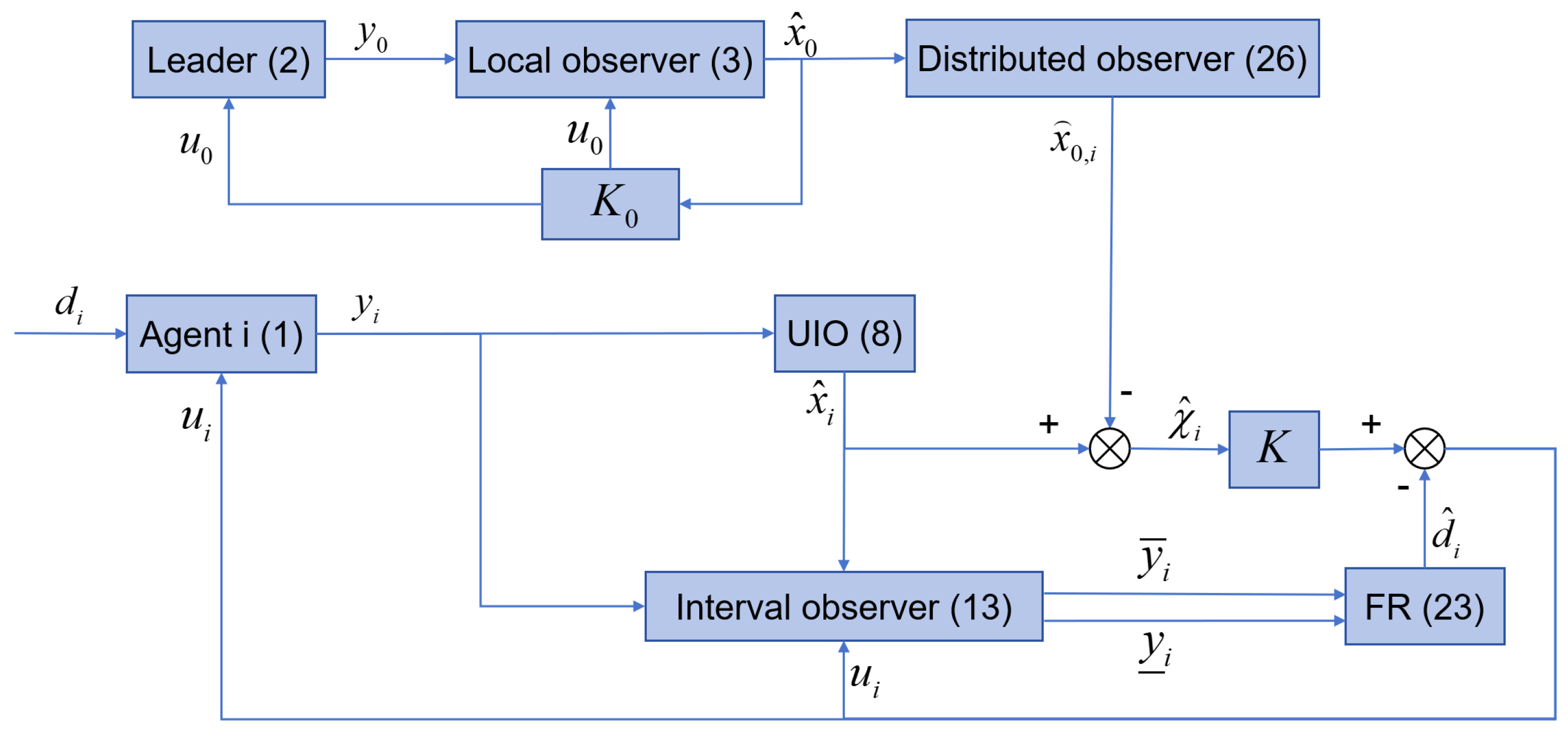
- Different from the work in [22,30,31], the followers considered in the present paper are subject to unknown disturbances and their states are unmeasurable. Thereby, a local UIO is designed for each follower to estimate the system state asymptotically. Moreover, through an interval observer, which is designed by sensor measurement output, an algebraic correlation linking the fault signal to the state estimation error is established. And then, an FR scheme, which can estimate the actual fault asymptotically, is developed. The proposed FR scheme can provide an asymptotically convergent estimate of the actual fault signal. This ensures that the reconstructed fault accurately approaches the true fault over time, thereby providing a highly precise baseline for generating a system compensation control scheme.
- (2)
- By using the state estimation of the leader which is offered by a local Luenberger-like observer and the information of the neighbors, a DO is constructed at each follower agent. Unlike fully distributed control protocols [32,33] that suffer from heavy communication burdens and complex gain-tuning coupled with network topologies, this structural separation allows the controller to be formulated in a simple centralized way, significantly reducing inter-agent communication overhead. The proposed DO is able to estimate the leader’s state asymptotically. Therefore, through the DO, each follower can access the leader’s state information. Consequently, a DO-based controller for each follower can be developed to fulfill the MAS consensus in a centralized way.
- (3)
- A DO-based fault-tolerant control protocol mechanism is developed through the combination of a simple feedback controller based on the state and FR. The proposed DO-based fault-tolerant control protocol can be viewed as a distributed control protocol, while the distributed feature is majorly reflected by the DO rather than the controller. In fact, because of the DO together with the local UIO, the controller becomes a simple state and FR feedback controller. More importantly, distinct from prior methods that only prove deterministic convergence, our framework mathematically establishes rigorous performance guarantees via Linear Matrix Inequalities (LMIs) shown in Theorem 1. In this way, the asymptotic convergence MAS consensus is reached.

| Paper | System | Fault Types | Observer | Control Architecture | Stability Guarantees |
|---|---|---|---|---|---|
| [34] | Nonlinear | Actuator | FO | Partially centralized | Finite-time |
| [35] | Nonlinear | ∖ | ∖ | Fully distributed | Finite-time |
| [36] | Linear | ∖ | ESO | Partially centralized | Exponential |
| [29] | Linear | Actuator, Sensor | Luenberger/Interval | Partially centralized | Asymptotic |
| Proposed | Linear | Actuator | UIO, Interval, DO | Partially centralized | Asymptotic |
2. Preliminaries and System Description
2.1. Graph Theory
2.2. Notations
2.3. System Description
3. Local Observer Design with FR
3.1. Local Observer for Leader
3.2. UIO and FR Designs for the Followers
4. DO Design and DO-Based Fault-Tolerant Control Protocol
4.1. DO Design
4.2. DO-Based Fault-Tolerant Control Protocol
| Algorithm 1 Calculation Process of Gain Matrix |
| Input: System matrices A, B, C; degree matrices ; Generalized Laplacian matrix . Output: DO gain matrix M; observer gain matrices L, ; and state feedback gain matrices K, .
|
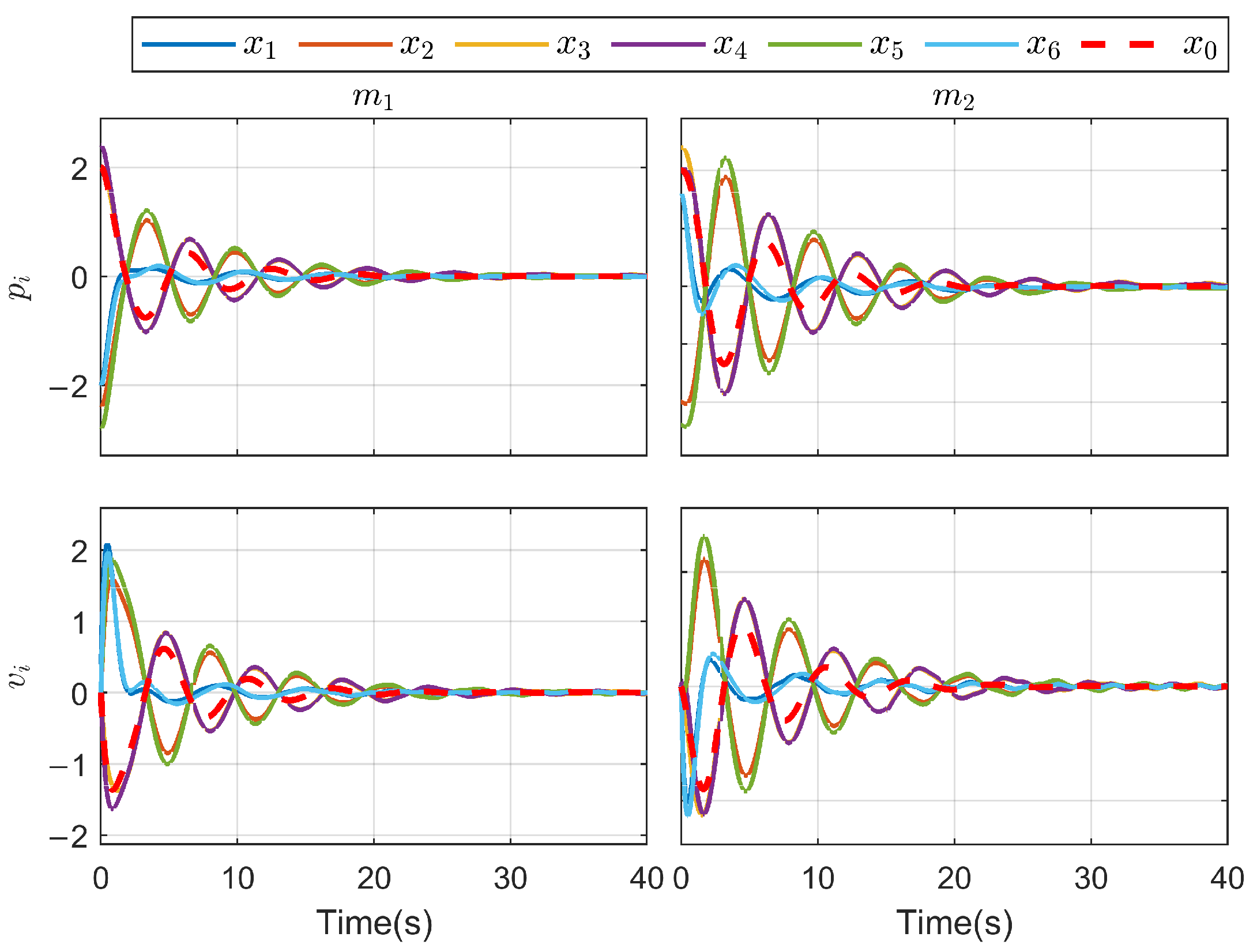
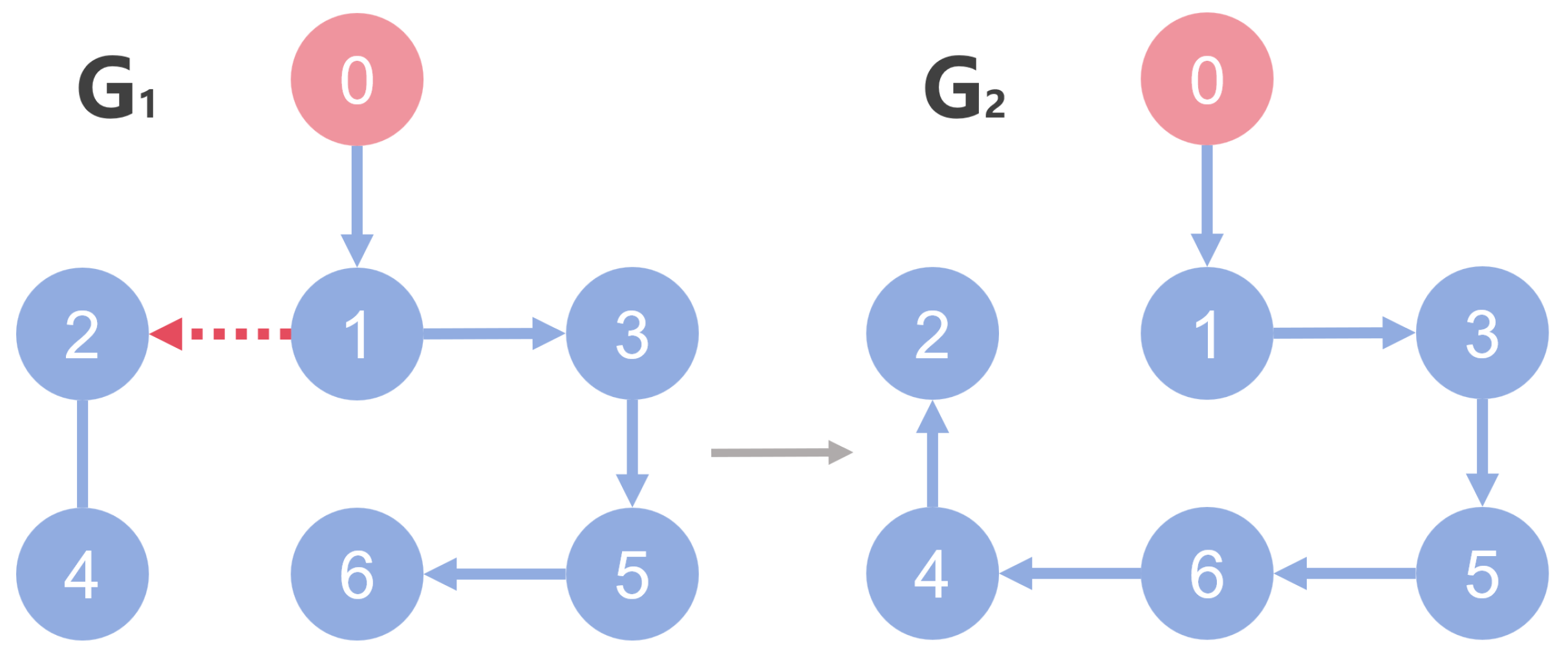
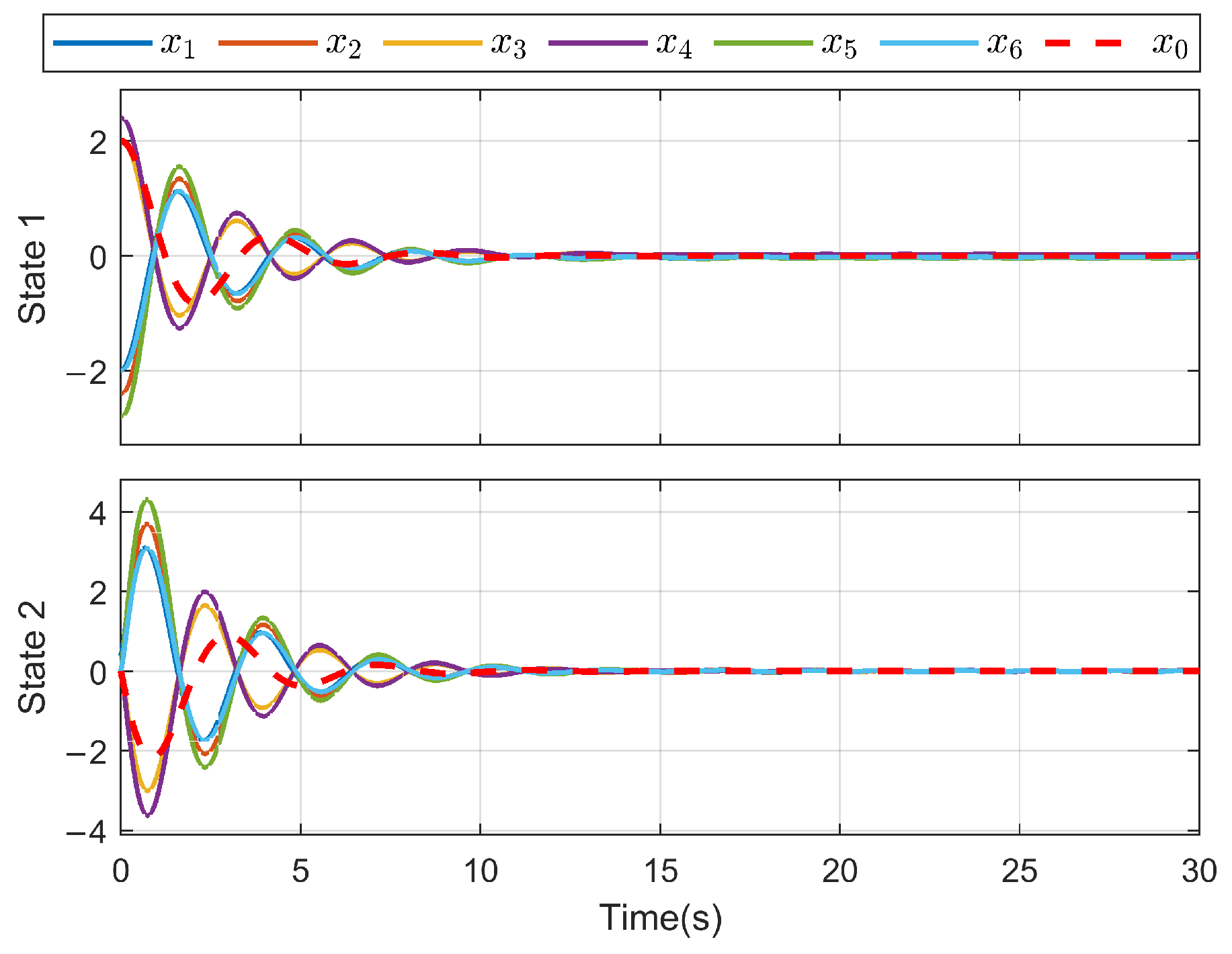
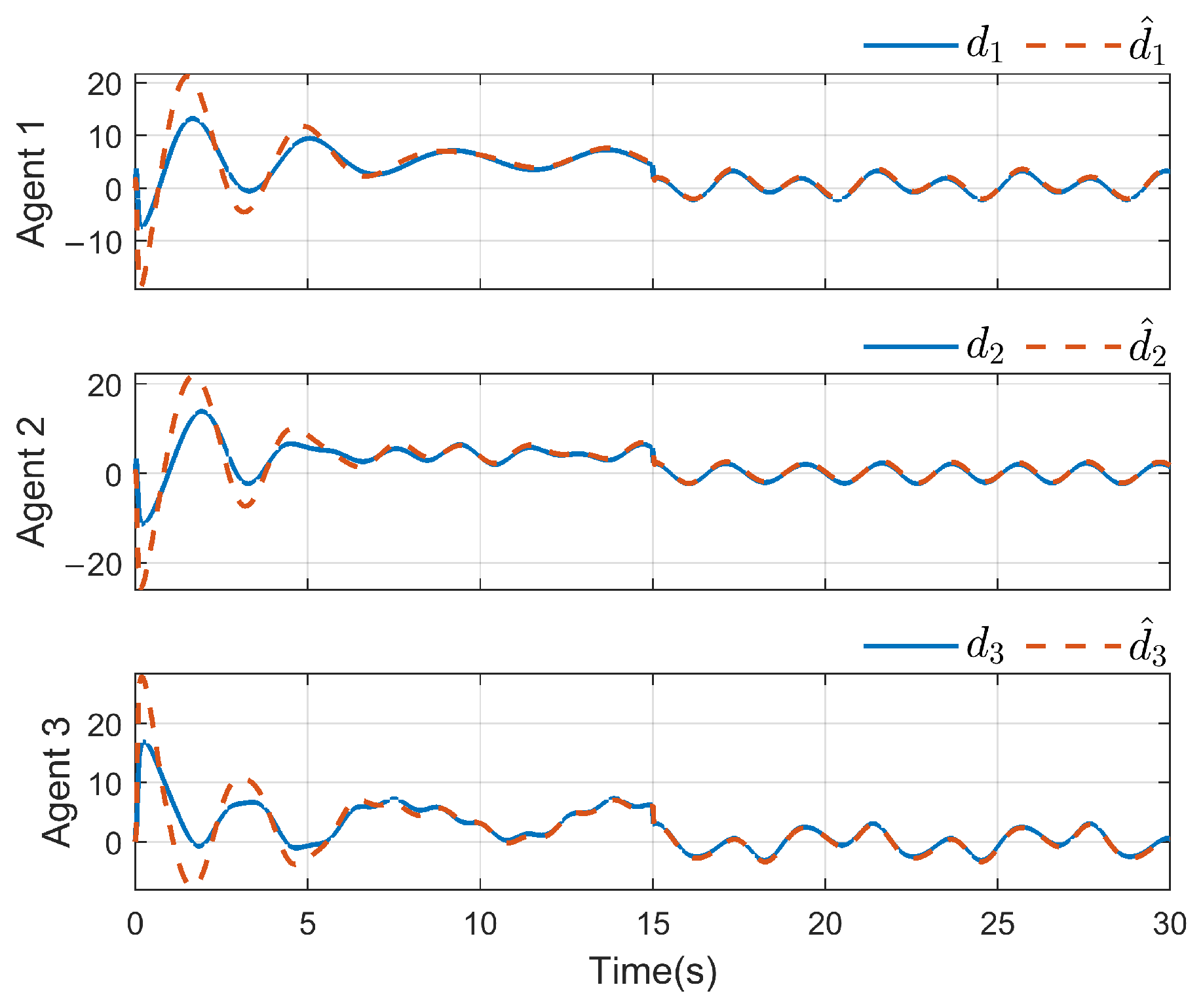
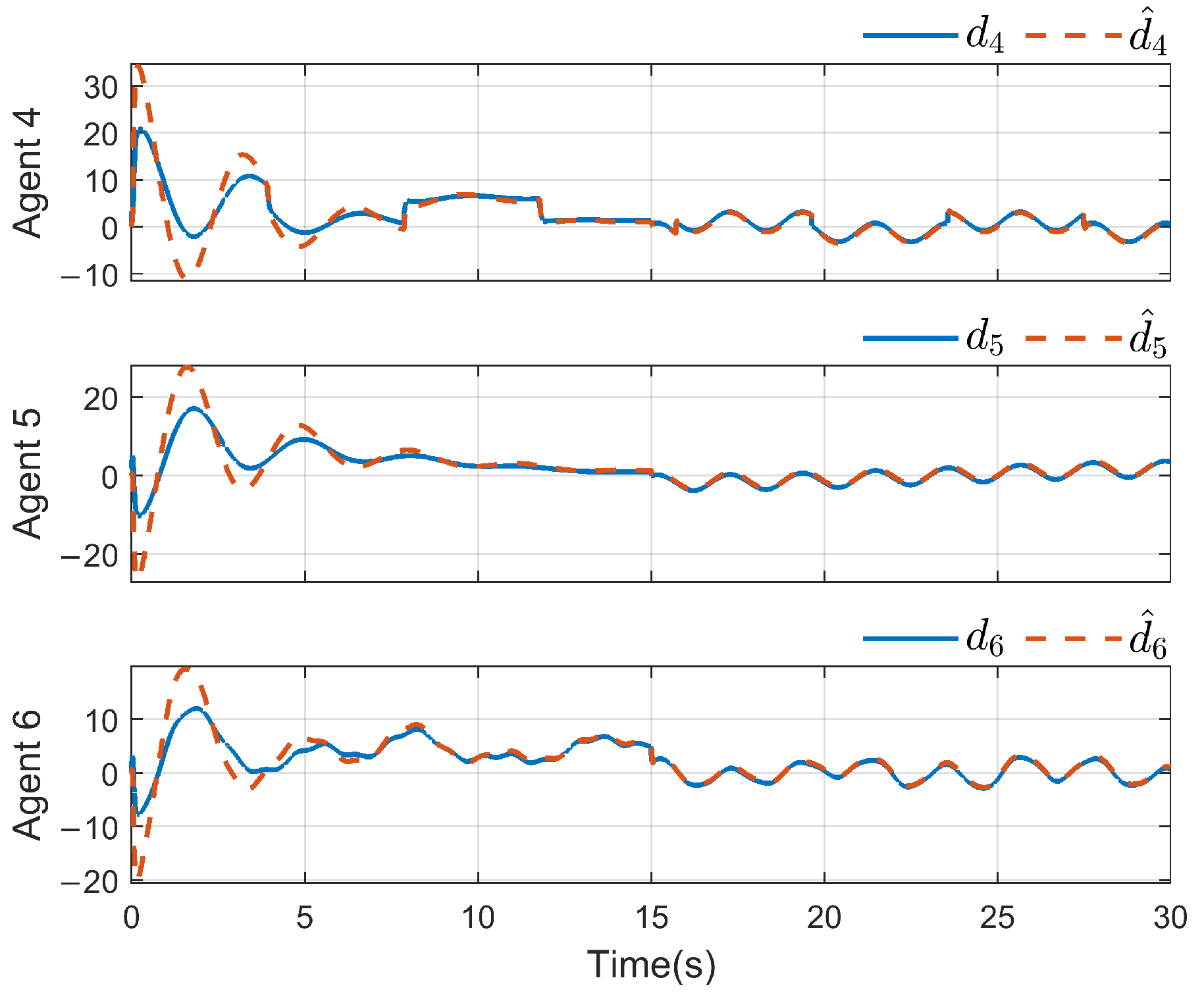
5. Simulation Results
6. Conclusions
Author Contributions
Funding
Institutional Review Board Statement
Informed Consent Statement
Data Availability Statement
Conflicts of Interest
Abbreviations
| LMI | Linear Matrix Inequality |
| UIO | Unknown Input Observer |
| DIO | Distributed Interval Observer |
| FR | Fault Reconstruction |
Appendix A. Proof of Lemma 1
Appendix B. Proof of Lemma 4
References
- Olfati-Saber, R. Distributed Kalman filtering for sensor networks. In Proceedings of the 2007 46th IEEE Conference on Decision and Control; IEEE: New York, NY, USA, 2007; pp. 5492–5498. [Google Scholar]
- Khan, M.W.; Wang, J.; Ma, M.; Xiong, L.; Li, P.; Wu, F. Optimal energy management and control aspects of distributed microgrid using multi-agent systems. Sustain. Cities Soc. 2019, 44, 855–870. [Google Scholar] [CrossRef]
- Gao, L.; Lu, H.; Wang, J.; Yu, X.Y.; Jiang, P.; Chen, F.; Li, H. Robust distributed average tracking with disturbance observer control. IEEE Trans. Autom. Sci. Eng. 2024, 22, 970–983. [Google Scholar] [CrossRef]
- Yu, Z.; Zhang, Y.; Jiang, B.; Fu, J.; Jin, Y.; Chai, T. Composite adaptive disturbance observer-based decentralized fractional-order fault-tolerant control of networked UAVs. IEEE Trans. Syst. Man Cybern. Syst. 2020, 52, 799–813. [Google Scholar] [CrossRef]
- Barzegar, A.; Rahimi, A. Fault diagnosis and prognosis for satellite formation flying: A survey. IEEE Access 2022, 10, 26426–26442. [Google Scholar] [CrossRef]
- Wang, J.; Gao, M.; Zhai, W.; Rida, I.; Zhu, X.; Li, Q. Knowledge generation and distillation for road segmentation in intelligent transportation systems. IEEE Trans. Intell. Transp. Syst. 2025, 1–13. [Google Scholar] [CrossRef]
- Davoodi, M.; Meskin, N.; Khorasani, K. Simultaneous fault detection and consensus control design for a network of multi-agent systems. Automatica 2016, 66, 185–194. [Google Scholar] [CrossRef]
- Yang, H.; Zhang, H.; Wang, Z.; Yan, H. Reliable leader-following consensus of discrete-time semi-Markovian jump multi-agent systems. IEEE Trans. Netw. Sci. Eng. 2023, 10, 3505–3518. [Google Scholar] [CrossRef]
- Wang, X.; Yang, D.; Chen, S. Particle swarm optimization based leader-follower cooperative control in multi-agent systems. Appl. Soft Comput. 2024, 151, 111130. [Google Scholar] [CrossRef]
- Fan, T.; Wan, Q.; Ding, Z. Topology switching for optimal leader-following consensus of multi-agent systems. IEEE Trans. Circuits Syst. II Express Briefs 2024, 71, 3845–3849. [Google Scholar] [CrossRef]
- Li, M.; Long, Y.; Zhang, K.; Li, T. Time-varying dynamic event-triggered-based prescribed-time leader-following consensus for multi-agent systems with input saturation. Appl. Math. Comput. 2026, 508, 129630. [Google Scholar] [CrossRef]
- Maffettone, G.C.; Boldini, A.; Porfiri, M.; di Bernardo, M. Leader-follower density control of spatial dynamics in large-scale multiagent systems. IEEE Trans. Autom. Control 2025, 70, 6783–6798. [Google Scholar] [CrossRef]
- Xue, Z.; Zhou, J.; Wu, L.; Su, H. Leader-following consensus of high-order multiagent systems under intermittent event-triggered control and intermittent self-triggered control. Int. J. Syst. Sci. 2026, 1–17. [Google Scholar] [CrossRef]
- Zhang, W.; Huang, Q.; Alhudhaif, A. Event-triggered fixed-time bipartite consensus for nonlinear disturbed multi-agent systems with leader-follower and leaderless controller. Inf. Sci. 2024, 662, 120243. [Google Scholar] [CrossRef]
- Chen, C.; Zheng, Z.; Lewis, F.L.; Xie, K.; Xie, S. Solo Adaptation for Distributed Synchronization with Application to Event-Triggered Linear Multiagent Systems. IEEE Trans. Autom. Control 2025, 70, 4225–4232. [Google Scholar] [CrossRef]
- He, C.; Huang, J. Adaptive distributed observer for general linear leader systems over periodic switching digraphs. Automatica 2022, 137, 110021. [Google Scholar] [CrossRef]
- Wu, X.; Ding, S.; Zhao, N.; Wang, H.; Niu, B. Neural-network-based event-triggered adaptive secure fault-tolerant containment control for nonlinear multi-agent systems under denial-of-service attacks. Neural Netw. 2025, 191, 107725. [Google Scholar] [CrossRef]
- Cao, G.; Wang, J. Distributed unknown input observer. IEEE Trans. Autom. Control 2023, 68, 8244–8251. [Google Scholar] [CrossRef]
- Yang, Y.; He, Y. Time-varying formation-containment control for heterogeneous multiagent systems with communication and output delays via observer-based feedback protocol. IEEE Trans. Autom. Sci. Eng. 2025, 22, 15435–15448. [Google Scholar] [CrossRef]
- Hong, Y.; Chen, G.; Bushnell, L. Distributed observers design for leader-following control of multiagent networks. Automatica 2008, 44, 846–850. [Google Scholar] [CrossRef]
- Parviz Valadbeigi, A.; Soltanian, F.; Shasadeghi, M. Robust H∞ Output Consensus in Heterogeneous Multiagent Discrete-Time Systems Using Q-Learning Algorithm. Iran. J. Sci. Technol. Trans. Electr. Eng. 2025, 49, 251–263. [Google Scholar] [CrossRef]
- Wang, S.; Meng, X.; Zhang, H.; Lewis, F.L. Learning nonlinear dynamics in synchronization of knowledge-based leader-following networks. Automatica 2024, 166, 111695. [Google Scholar] [CrossRef]
- Bi, C.; Xu, X.; Liu, L.; Feng, G. Consensus of multiagent systems under unbounded communication delays via adaptive distributed observers. IEEE Trans. Control Netw. Syst. 2025, 12, 1613–1625. [Google Scholar] [CrossRef]
- Zamani, N.; Kamali, M.; Askari-Marnani, J.; Kalantari, H.; Aghdam, A.G. Fault-tolerant leader-follower controller for uncertain nonlinear multiagent systems. IEEE Trans. Autom. Sci. Eng. 2024, 22, 9376–9387. [Google Scholar] [CrossRef]
- Cai, Y.; Zhang, H.; Li, W.; Mu, Y.; He, Q. Distributed bipartite adaptive event-triggered fault-tolerant consensus tracking for linear multiagent systems under actuator faults. IEEE Trans. Cybern. 2021, 52, 11313–11324. [Google Scholar] [CrossRef] [PubMed]
- Ma, L.; Zhu, F. Human-in-the-loop formation control for multi-agent systems with asynchronous edge-based event-triggered communications. Automatica 2024, 167, 111744. [Google Scholar] [CrossRef]
- Zhu, F.; Li, M. Distributed interval observer and distributed unknown input observer designs. IEEE Trans. Autom. Control 2024, 69, 8868–8875. [Google Scholar] [CrossRef]
- Ma, L.; Zhu, F.; Zhao, X. Human-in-the-loop formation-containment control for multiagent systems: An observer-based distributed unknown input reconstruction method. IEEE Trans. Control Netw. Syst. 2023, 10, 2178–2189. [Google Scholar] [CrossRef]
- Ling, X.; Xu, H.; Zhu, F. Active Compensation Fault-Tolerant Control for Uncertain Systems with Both Actuator and Sensor Faults. Sensors 2026, 26, 267. [Google Scholar] [CrossRef]
- Lin, G.; Li, H.; Ma, H.; Zhou, Q. Distributed containment control for human-in-the-loop MASs with unknown time-varying parameters. IEEE Trans. Circuits Syst. I Regul. Pap. 2022, 69, 5300–5311. [Google Scholar] [CrossRef]
- Guo, X.; Wang, C.; Liu, L. Adaptive fault-tolerant control for a class of nonlinear multi-agent systems with multiple unknown time-varying control directions. Automatica 2024, 167, 111802. [Google Scholar] [CrossRef]
- Busacca, F.; Galluccio, L.; Palazzo, S.; Panebianco, A.; Raftopoulos, R. Bandits Under the Waves: A Fully-Distributed Multi-Armed Bandit Framework for Modulation Adaptation in the Internet of Underwater Things. IEEE Trans. Netw. Serv. Manag. 2025, 23, 639–653. [Google Scholar] [CrossRef]
- Zhang, Z.; Huang, B.; Zhou, X.; Peng, H. Fully distributed dynamic event-triggered formation-containment control for networked unmanned surface vehicles with intermittent wireless network communications. ISA Trans. 2025, 156, 202–216. [Google Scholar] [CrossRef] [PubMed]
- Hou, Z.; Lv, Z.; Wu, Y.; Zhou, H. Finite-Time Fault-Tolerant Control for a Coaxial Tilt-Rotor eVTOL Under a Rotor Fault. IEEE Trans. Ind. Electron. 2026, 1–13. [Google Scholar] [CrossRef]
- Gao, Z.; Ni, S.; Guo, G.; Xu, Y.; Li, H.; Mumtaz, S.; Politis, I. Multi-Lane Merging Control for Vehicular Platoons in 2-D Planar with Prescribed Performance. IEEE Trans. Veh. Technol. 2025, 1–14. [Google Scholar] [CrossRef]
- Rojas, A.; Sun, L.; Zhao, X.; Liu, Y. Quasi-symplectic ADRC hybridization to stabilize a flexible truss for a space telescope. Aerosp. Sci. Technol. 2026, 176, 112085. [Google Scholar] [CrossRef]
- Corless, M.; Tu, J. State and input estimation for a class of uncertain systems. Automatica 1998, 34, 757–764. [Google Scholar] [CrossRef]
- Zhu, F.; Fu, Y.; Dinh, T.N. Asymptotic convergence unknown input observer design via interval observer. Automatica 2023, 147, 110744. [Google Scholar] [CrossRef]
- Mazenc, F.; Dinh, T.N.; Niculescu, S.I. Interval observers for discrete-time systems. Int. J. Robust Nonlinear Control 2014, 24, 2867–2890. [Google Scholar] [CrossRef]
- Levant, A. Higher-order sliding modes, differentiation and output-feedback control. Int. J. Control 2003, 76, 924–941. [Google Scholar] [CrossRef]
- Wang, S.; Huang, J. Adaptive leader-following consensus for multiple Euler–Lagrange systems with an uncertain leader system. IEEE Trans. Neural Netw. Learn. Syst. 2018, 30, 2188–2196. [Google Scholar] [CrossRef]
- Zhang, X.; Hengster-Movrić, K.; Šebek, M.; Desmet, W.; Faria, C. Distributed observer and controller design for spatially interconnected systems. IEEE Trans. Control Syst. Technol. 2017, 27, 1–13. [Google Scholar] [CrossRef]
- Lu, M. A sensory feedback based discrete distributed observer to cooperative output regulation. IEEE Trans. Autom. Control 2022, 67, 4762–4769. [Google Scholar] [CrossRef]
- Liu, T.; Wang, S.; Huang, J. An adaptive distributed observer for a class of uncertain linear leader systems over jointly connected switching networks and its application. IEEE Trans. Autom. Control 2024, 69, 7340–7355. [Google Scholar] [CrossRef]


| Fault Mode | |||
|---|---|---|---|
| Normal | 1 | 1 | |
| Outage | 0 | 0 | |
| Bias | 1 | 1 | |
| Stuck | 0 | 0 | |
| Loss performance | >0 | <1 |
Disclaimer/Publisher’s Note: The statements, opinions and data contained in all publications are solely those of the individual author(s) and contributor(s) and not of MDPI and/or the editor(s). MDPI and/or the editor(s) disclaim responsibility for any injury to people or property resulting from any ideas, methods, instructions or products referred to in the content. |
© 2026 by the authors. Licensee MDPI, Basel, Switzerland. This article is an open access article distributed under the terms and conditions of the Creative Commons Attribution (CC BY) license.
Share and Cite
Liu, T.; Zhu, F.; Xu, H. Leader–Following Fault-Tolerant Consensus Control for Multi-Agent Systems Based on Observers. Sensors 2026, 26, 3153. https://doi.org/10.3390/s26103153
Liu T, Zhu F, Xu H. Leader–Following Fault-Tolerant Consensus Control for Multi-Agent Systems Based on Observers. Sensors. 2026; 26(10):3153. https://doi.org/10.3390/s26103153
Chicago/Turabian StyleLiu, Tengzi, Fanglai Zhu, and Haichuan Xu. 2026. "Leader–Following Fault-Tolerant Consensus Control for Multi-Agent Systems Based on Observers" Sensors 26, no. 10: 3153. https://doi.org/10.3390/s26103153
APA StyleLiu, T., Zhu, F., & Xu, H. (2026). Leader–Following Fault-Tolerant Consensus Control for Multi-Agent Systems Based on Observers. Sensors, 26(10), 3153. https://doi.org/10.3390/s26103153