

A Method for Continuous Dual-Offline Payment of Cryptocurrency Based on Asset Credentials


Abstract
1. Introduction
- 1.
- Creatively constructs asset credentials for fund transfers and designs an anti-tampering mechanism for asset credentials to ensure their integrity and authenticity. Elliptic curve algorithms and zero-knowledge proof technology are employed to ensure the privacy and security of asset credentials during their creation and transfer. Elliptic curve algorithms are used to generate key pairs and implement digital signatures for constructing asset credentials. The computational difficulty of the elliptic curve discrete logarithm problem and the integrity verification mechanism of signatures are leveraged to ensure that the information within asset credentials remains unaltered.
- 2.
- Creatively designs a credential decomposition mechanism to enable multiple consecutive offline payments between hardware wallets. Input credentials are decomposed into change credentials and receipt credentials, with the original input credentials deleted and the change credentials retained as input credentials for the next dual-offline payment, enabling continuous dual-offline payments.
- 3.
- Creatively designs global verification during settlement to ensure that the multiple asset credentials decomposed during settlement are genuine and valid. The payment center verifies the credential signatures to ensure that the decomposed change credentials and receipt credentials comply with the zero-balance equation, combined with the hash of the original credential submitted by the hardware, the asset decomposition chain is traced, and the decomposed credentials are verified through elliptic curve signatures to ensure their authenticity and legitimate origin.
2. Related Work
3. System Design and Implementation
3.1. Offline Payment Architecture Design Based on Asset Certificates
3.1.1. Concept of Credentials
- 1.
- Commutative and associative properties of elliptic curve addition and scalar multiplication: For any scalars , the following holds:where H is a point on the elliptic curve.
- 2.
- Hash operation: SHA256(abc) denotes the hash calculation of abc using the SHA256 algorithm. The symbol “|” in indicates concatenating A, B, and C in order.
3.1.2. System Architecture
3.1.3. Credential Transfer Process
- 1.
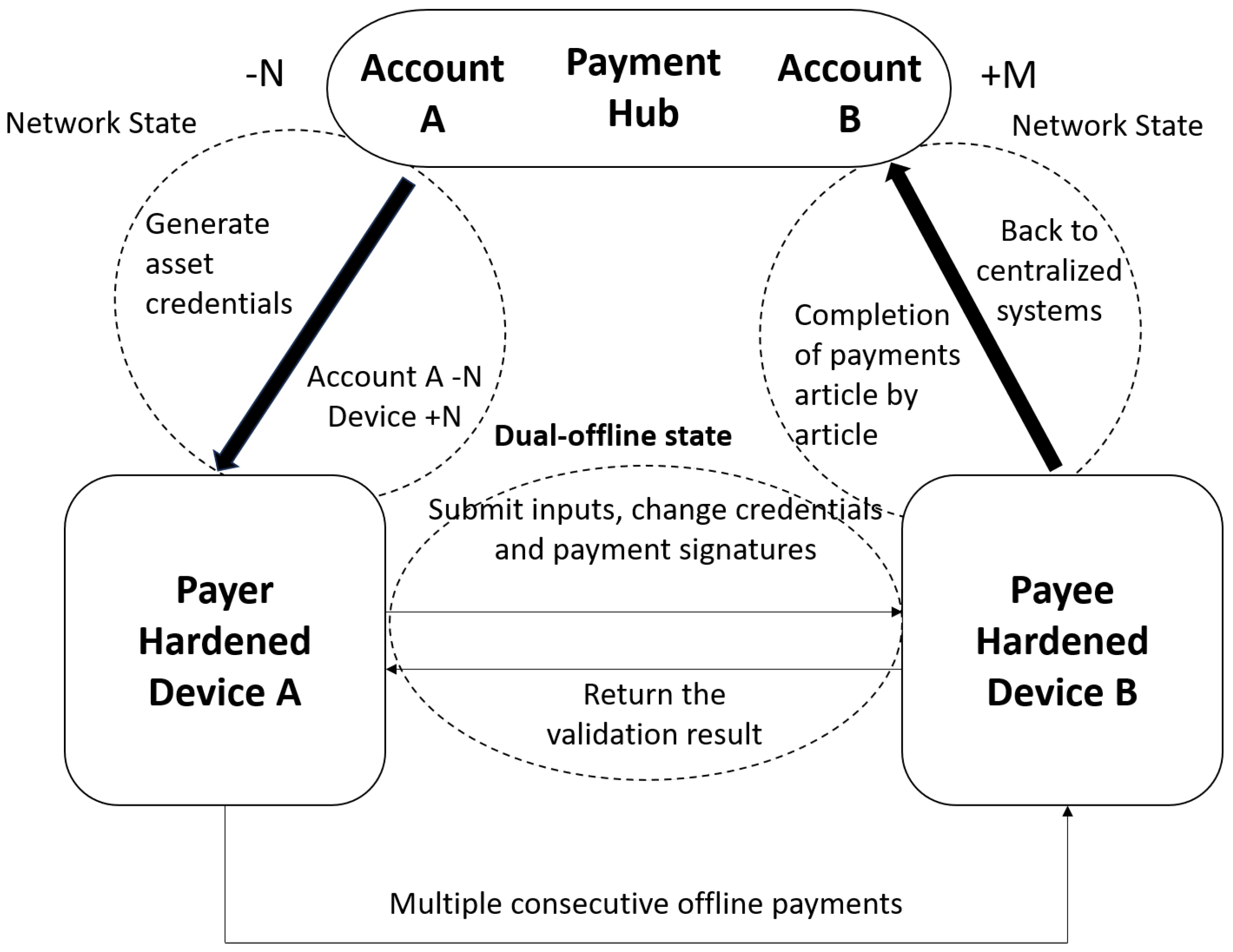
- Online transfer phase. The payment center creates the asset credential, then transfers the generated asset credential to the hardware wallet while online. At this point, the corresponding amount is deducted from the payment center’s account and added to the hardware wallet’s funds. The detailed calculation process is shown in Equations (3)–(13).
- 2.
- Continuous dual-offline payment phase. The payer (holding wallet A) submits the asset credential (input credential) from hardware wallet A to hardware wallet B for the payee (holding wallet B) in an offline state, completing the dual-offline payment. This process enables multiple consecutive offline payments. The payer’s hardware wallet A decomposes the asset credential (input credential), generating a change credential that is retained in hardware wallet A as an input credential for the next transaction; hardware wallet B generates a receipt credential during the dual-offline payment process; finally, multiple consecutive offline payments generate multiple receipt credentials, which are temporarily stored in hardware wallet B while offline. The detailed calculation process is shown in Equations (14)–(21).
- 3.
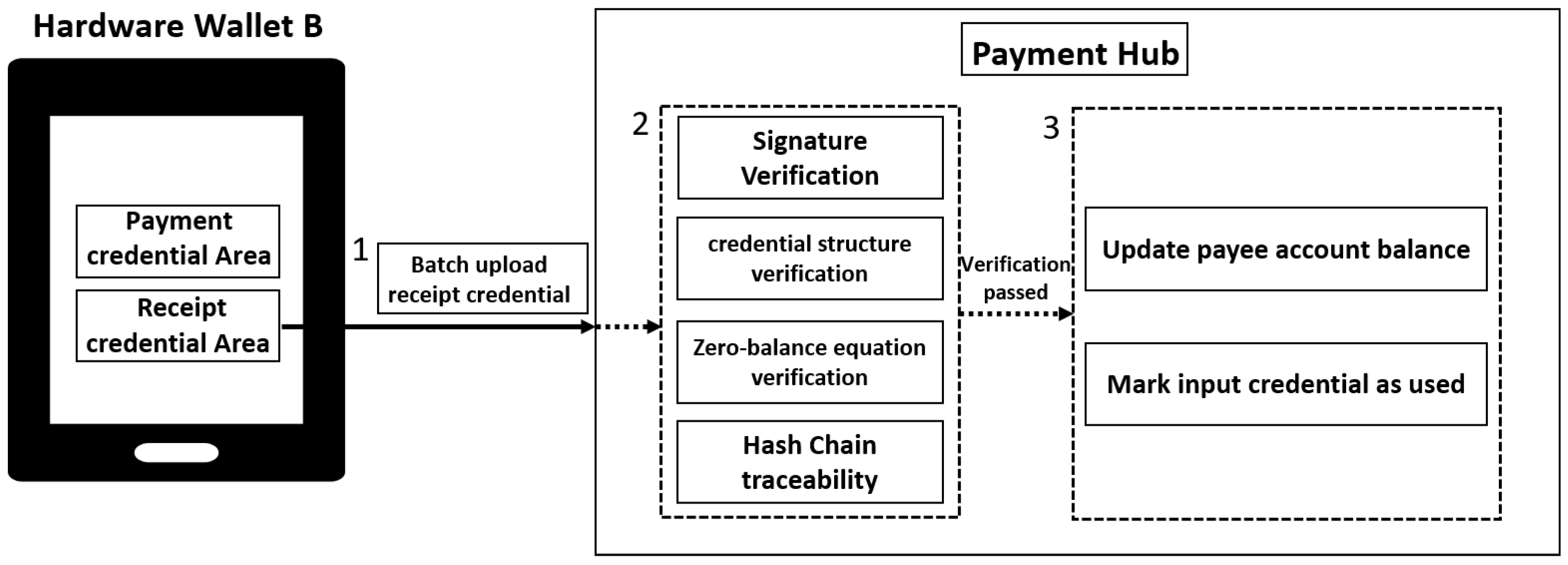
- Online settlement phase. In an online state, multiple receipt credentials in hardware wallet B are batch-uploaded to the payment center for settlement. This process verifies the validity of multiple newly generated receipt credentials and ultimately determines whether the entire payment was successfully completed.
- 1.
- After asset credentials are transferred from the payment center to the hardware wallet, ensure that the content has not been tampered with.
- 2.
- During multiple consecutive offline payments, ensure successful transactions while preventing double-spending.
- 3.
- After asset credentials in the hardware wallet are settled at the payment center, verify that all receipt credentials generated during multiple consecutive offline payments are authentic and valid.
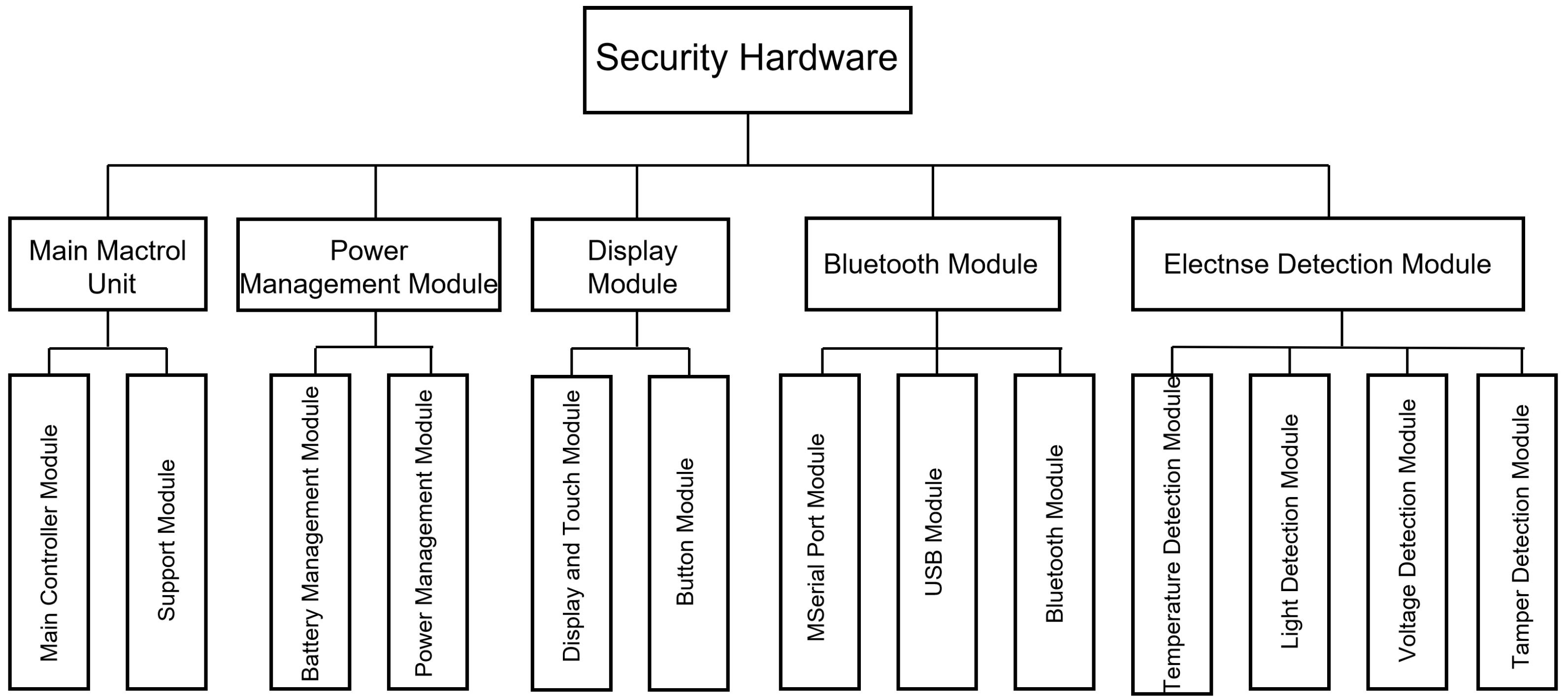
3.2. Hardware Wallet Design for Continuous Dual-Offline Payment Architecture
3.3. Offline Payment Method Based on Credential Generation
- 1.
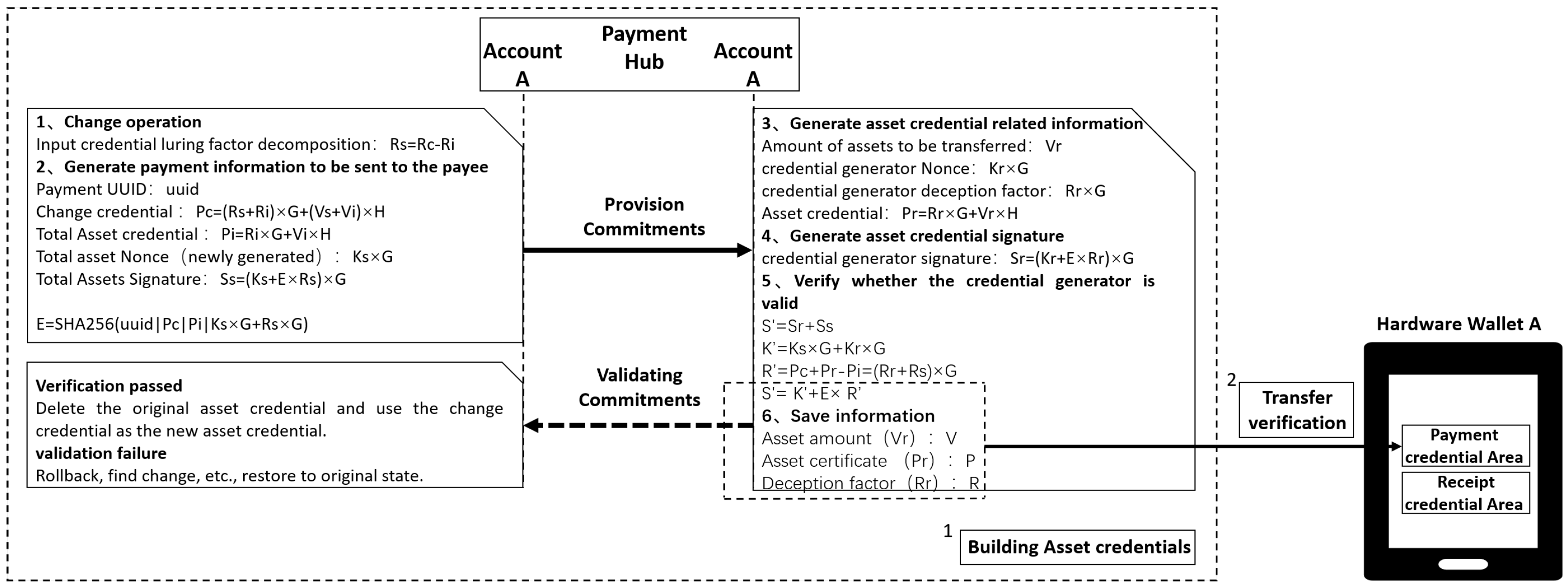
- Change operation. First, the payment center receives the transfer request from hardware wallet A and generates the asset credential based on the transfer amount and the system’s internal state. The amount to be transferred to hardware wallet A is calculated from the total assets in the payment center, resulting in a change amount equal to the total assets minus the amount to be transferred.
- 2.
- Generate asset information and send it to the credential generation party. The generated content includes the payment , change credential, total asset credential, and total asset nonce. Calculate the credential hash value based on the asset information.Thus, the total asset signature is generated:
- 3.
- Generate asset credential-related information. This includes the amount of assets to be transferred , the credential generator’s Nonce, and the credential generator’s spoofing factor . Based on this information, the asset credential is generated as follows: credential
- 4.
- Generate the asset credential signature. Based on the credential hash value calculated in the previous step, generate the signature for the asset credential to be transferred:
- 5.
- Verify the validity of credential generation. Based on the total asset signatureThe asset credential signature isThe signature for the transfer process is :Because the zero-balance calculation of the amount yieldsWhen the asset credential issuer verifiesIf the equation holds, it indicates that the constructed asset credential is valid.
- 6.
- Save information. The transferred asset amount, asset credential, and spoofing factor are stored in the payment center.
3.4. Continuous Dual-Offline Payment Method
- 1.
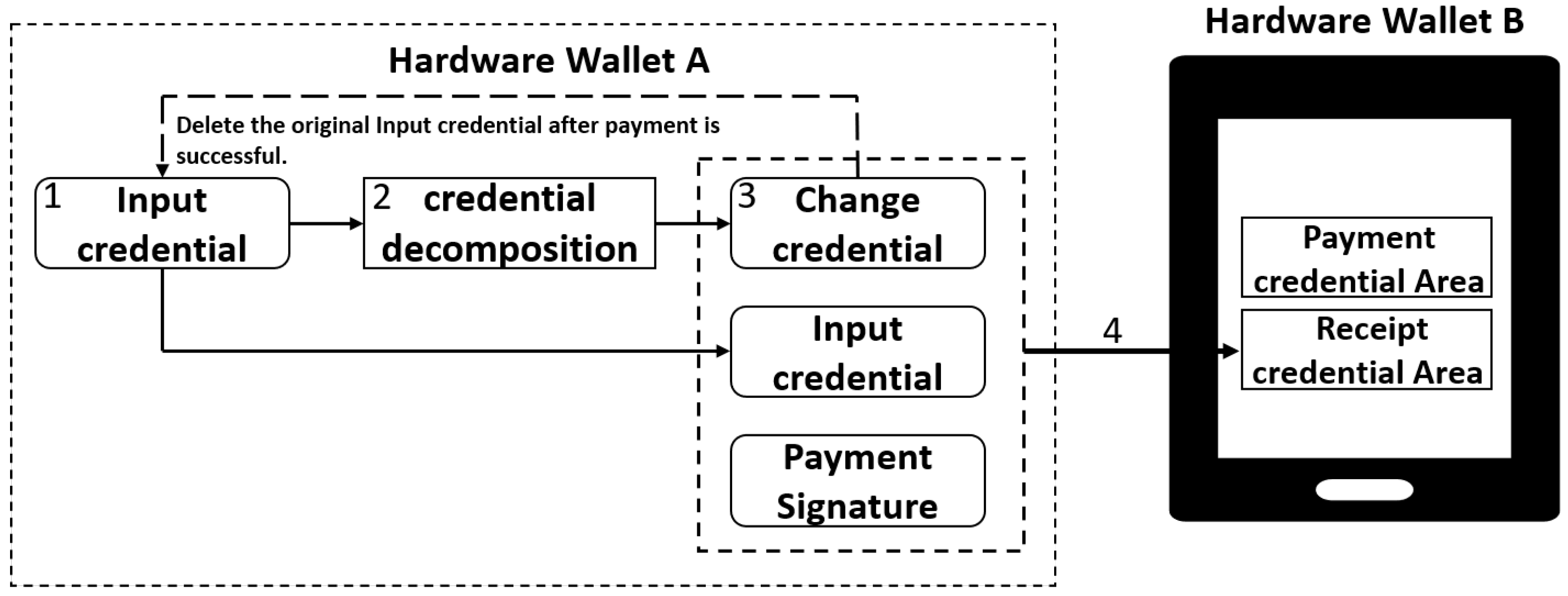
- Prepare the input credential. The input credential originates from either the original credential initially transferred by the payment center or the change credential retained from previous offline payments. Each offline payment identifies the specific input credential to use and immediately deletes it from the wallet after use to prevent reuse and guard against double-spending attacks. The detailed calculation process is shown in Equation (14).
- 2.
- Split the credential. The system processes the amount in the input credential, dividing it into two portions according to the current payment scenario: the payment amount to be transferred to the recipient and the remaining change amount. The system then automatically generates and locally stores a change credential. This step includes automatic verification of a sufficient input amount and ensures the equation “payment amount + change amount = input credential amount” holds true, maintaining the asset conservation constraint. The detailed calculation process is shown in Equation (15).
- 3.
- Generate new credentials. The payment process generates two new asset credentials—a change credential and a receipt credential. The change credential retains the remaining amount as the next payment’s input credential, stored locally in hardware wallet A (updating its credential records). The receipt credential is created by hardware wallet B based on the change credential and original input credential information, then stored in hardware wallet B’s receiving credential area. The detailed calculation process is shown in Equations (16)–(19).
- 4.
- Transaction verification. Hardware wallet B verifies the transaction and transmits the verification result to hardware wallet A via NFC. Successful verification leads hardware wallet A to adopt the change credential as its new input credential, while hardware wallet B temporarily stores the receipt credential as a pending settlement asset. Failed verification triggers a rollback to the pre-transaction state in hardware wallet A. The detailed calculation process is shown in Equations (20) and (21).
3.5. Batch Credential Verification Settlement Method
- 1.
- Batch uploading of receipt credentials to the blockchain. The payee connects hardware wallet B to the payment center while online. At this point, the system automatically submits all pending receipt credentials in chronological order to the payment center in batches. Each uploaded asset credential includes structural fields, signature information, and the hash chain of the original input credential.
- 2.
- Verification of the authenticity and validity of receipt credentials. The payment center performs signature verification and credential structure verification on each received receipt credential. Signature verification involves using the payer’s public key to validate the signature in the credential, confirming that the credential’s origin is authentic and not fabricated. During credential structure verification, the system parses the internal fields of the credential to verify whether it conforms to the standard structure definition, preventing missing or forged fields. When the payment center receives multiple receipt credentials requiring settlement, to confirm that the assets in the continuous dual-offline payment process have not been tampered with, the system performs a zero-balance equation verification on the payment chain of the continuous dual-offline payment. During verification, if the equation “payment amount + change amount = input credential amount” is satisfied, and the hash value of the input credential can be found in the payment center’s records as the original hash record, the system deems the payment process complete and valid, and the payment can be successfully settled at the payment center. Additionally, the payment center performs deduplication on the hash values of all settled or pending credentials. If a duplicate hash value is detected in any credential, the system will reject the payment record and mark it as a potential double-spending attempt. The system also uses chained hash relationships to trace the origin and path of each credential, further enhancing its anti-counterfeiting verification capability.
- 3.
- Settlement implementation and status update. All verified receipt credentials processed through the payment center are credited to the recipient’s account, completing the asset posting. The status of the corresponding input credential record is marked. Simultaneously, the system generates a complete payment record and settlement credential, concluding the entire dual-offline payment process.
4. Security Analysis
4.1. Formal Adversarial Model
4.1.1. System Environment and Participant Assumptions
4.1.2. Cryptographic Hardness Assumptions
- Trusted payment center: The payment center is assumed to be fully trusted. It is responsible for issuing initial credentials, verifying batch settlements, and resolving potential conflicts. The payment center is honest in following the protocol and does not collude with malicious payers or payees. This assumption is necessary for the global verification and batch settlement mechanisms.
- Elliptic curve discrete logarithm problem (ECDLP): Given generator G and , it is computationally infeasible for any probabilistic polynomial-time (PPT) adversary to compute R.
- Random oracle model: The SHA-256 hash function behaves as a true random oracle, guaranteeing collision resistance and pre-image resistance.
- Secure element isolation: The physical hardware enforces strict non-extractability of private keys and atomicity of the internal “decompose-and-delete” credential lifecycle.
4.1.3. Adversary Capabilities
- (Intercept): Intercept data transmitted over the offline NFC channel.
- (Tamper): Attempt to modify local credential states or storage.
- (Forge): Attempt to forge Schnorr signatures without the private key.
- (Replay): Replay previously captured transaction data.
- (Compromise): Control the device interface to initiate arbitrary offline payments.
- (Malicious wallet): Act as a malicious payee/payer attempting to extract additional funds.
4.1.4. Formal Security Goals
- Goal 1
- (Balance Privacy): cannot deduce the actual transaction amount or remaining balance from intercepted credentials. .
- Goal 2
- (Transaction Integrity): cannot forge a valid payment credential without detection. .
- Goal 3
- (Chain Consistency): cannot alter any intermediate credential or within a continuous chain without failing the global settlement verification. .
- Goal 4
- (Anti-Double-Spending across the Chain): cannot successfully spend the same input credential multiple times across different devices or sessions. .
4.1.5. Threat Scenarios Specific to Continuous Payments
- TS-1
- (Chain Tampering): A malicious payer alters an intermediate change credential locally to inflate the input balance for step .
- TS-2
- (Sequence Attack): An adversary reorders the sequence of continuous payments to disrupt the settlement logic.
- TS-3
- (Batch Replay): A malicious payee attempts to batch-upload the same set of valid receipt credentials multiple times during settlement.
- TS-4
- (Cross-Device Double Spending): A payer clones a valid change credential to another compromised hardware device to initiate simultaneous offline forks.
4.2. Security Proofs
4.2.1. Proof of Goal 1 & Goal 2 (Privacy and Integrity)
4.2.2. Proof of Goal 3 (Chain Consistency)
4.2.3. Proof of Goal 4 (Anti-Double-Spending Across the Chain)
5. Experimental Design and Performance Evaluation
5.1. Experimental Environment and Deployment
- 1.
- Development platform and tools. The cryptocurrency dual-offline payment system in this paper uses the Solidity language to write the core contract logic, employs Hardhat as the local contract development and deployment framework, builds a test blockchain environment, and conducts multiple rounds of functionality and performance testing. The selected contract compiler version is Solidity v0.8.28, which offers robust security and computational stability. Additionally, to support offline payment verification and asset credential structure design, the system integrates the ECDSA cryptographic library and SHA256 hash function provided by Open Zeppelin to implement a dual-signature mechanism, verify data integrity, and prevent tampering. The tools and components used in the experiment are shown in Table 2 below.
- 2.
- Local blockchain deployment environment. To achieve precise control and batch payment testing, this paper utilizes the local blockchain simulation node provided by Hardhat for deployment. This node can simulate a high-performance operating environment, facilitating repeated execution of batch payment scripts and monitoring of gas fee consumption. The local blockchain is configured as follows: the single-block gas limit is set to 100,000,000 to ensure high-concurrency payment writes; the allowUnlimitedContractSize configuration is enabled to deploy large complex contracts; the payment packaging block time remains the default to simulate confirmation delays in real networks.
- 3.
- Smart contract deployment and functional coverage. The proposed cryptocurrency dual-offline payment system mainly deploys two core smart contracts: the payment storage contract and the wallet contract. The payment storage contract supports batch storage of payment data, dual-signature verification of credentials, and asset splitting records; the wallet contract simulates fund transfers and settlements in the dual-offline payment system while maintaining payment credential structures. Contract deployment uses automated deployment scripts written in JavaScript, which are executed via commands on the local network and output contract addresses upon completion for subsequent test calls.
- 4.
- Test scripts and data generation methods. To simulate dual-offline payment scenarios, the system designs a batch payment test script supporting multiple functions, including the automatic generation of N offline payment data per test round. Each payment contains the following fields: payment , asset credential Pi, change credential Pc, and signature Ss. The script also simulates credential decomposition and hash chain recording in continuous payment scenarios, performs batch calls to the storeTransactionsBatch() function for on-chain processing, and records gas consumption and execution time for each batch. Test data is generated automatically using local pseudo-random functions and the library, ensuring data independence and unpredictability.
- 5.
- Performance testing. For systematic evaluation of batch on-chain performance, the system implements a console. The following are measured: total gas consumption per payment round, average gas consumption per payment, total execution time, and average execution time per payment.
5.2. Functional Validation Testing
- 1.
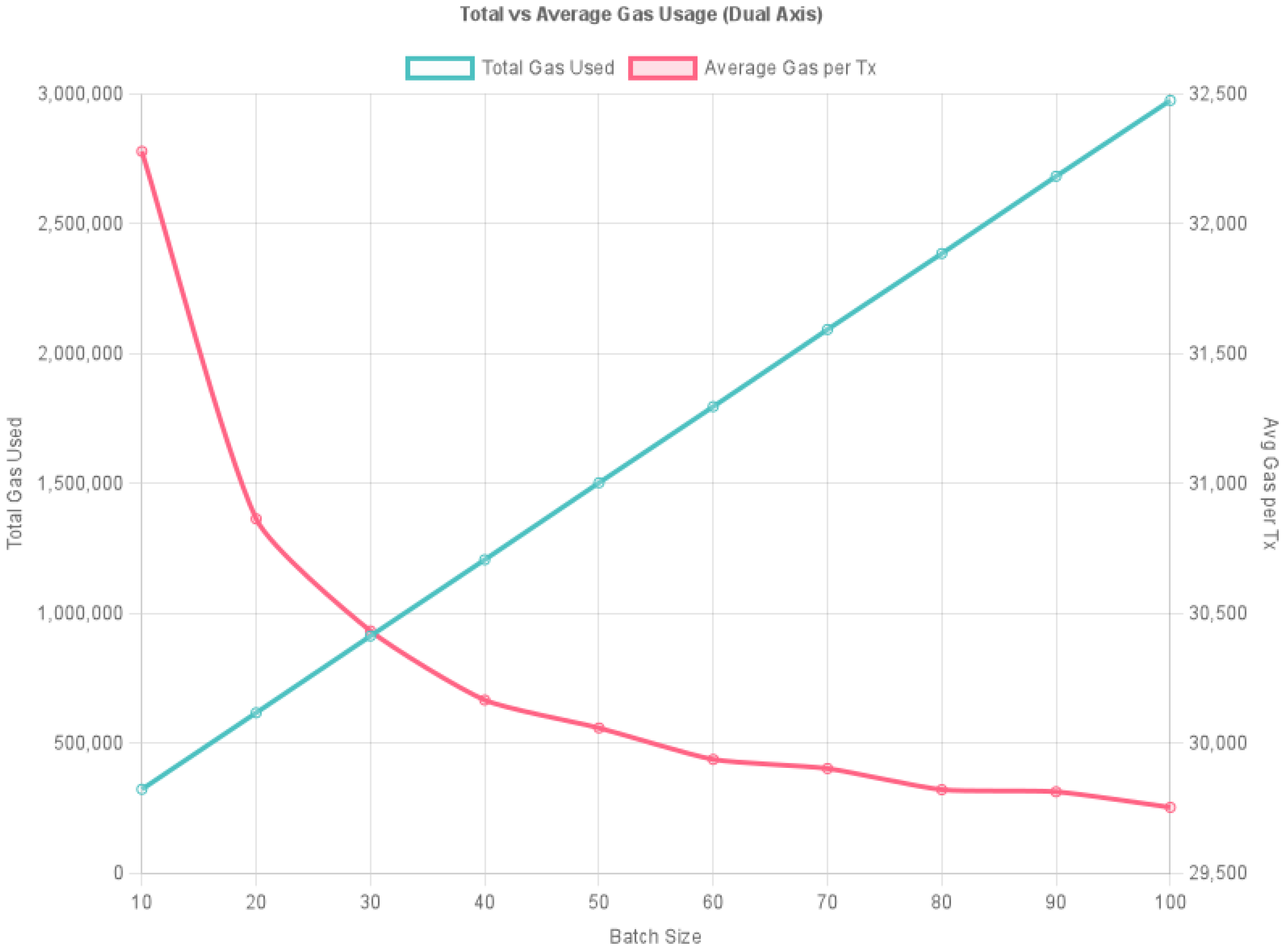
- The total gas consumption of the system for continuous dual-offline digital currency payments exhibits non-linear growth. As the batch processing scale increases from 10 to 100 transactions, the system’s total gas consumption shows a non-linear upward trend. This indicates that the system has good scalability in its overall processing logic and can reliably handle larger batches of continuous offline payment requests.
- 2.
- The proposed continuous dual-offline digital currency payment system operates stably across multiple batch scenarios. The gas consumption results show that as the batch size increases, the gas consumption per transaction decreases from 32,000 to approximately 29,000, representing an overall reduction of about 10%. The decreasing rate slows down and stabilizes as the batch size grows. All batch processing experiments were completed without exception, with stable gas consumption fluctuations and no abrupt spikes or drops. This demonstrates that both the smart contract logic and signature verification process exhibit excellent stability and can adapt to continuous payment workloads of varying scales.
- 1.
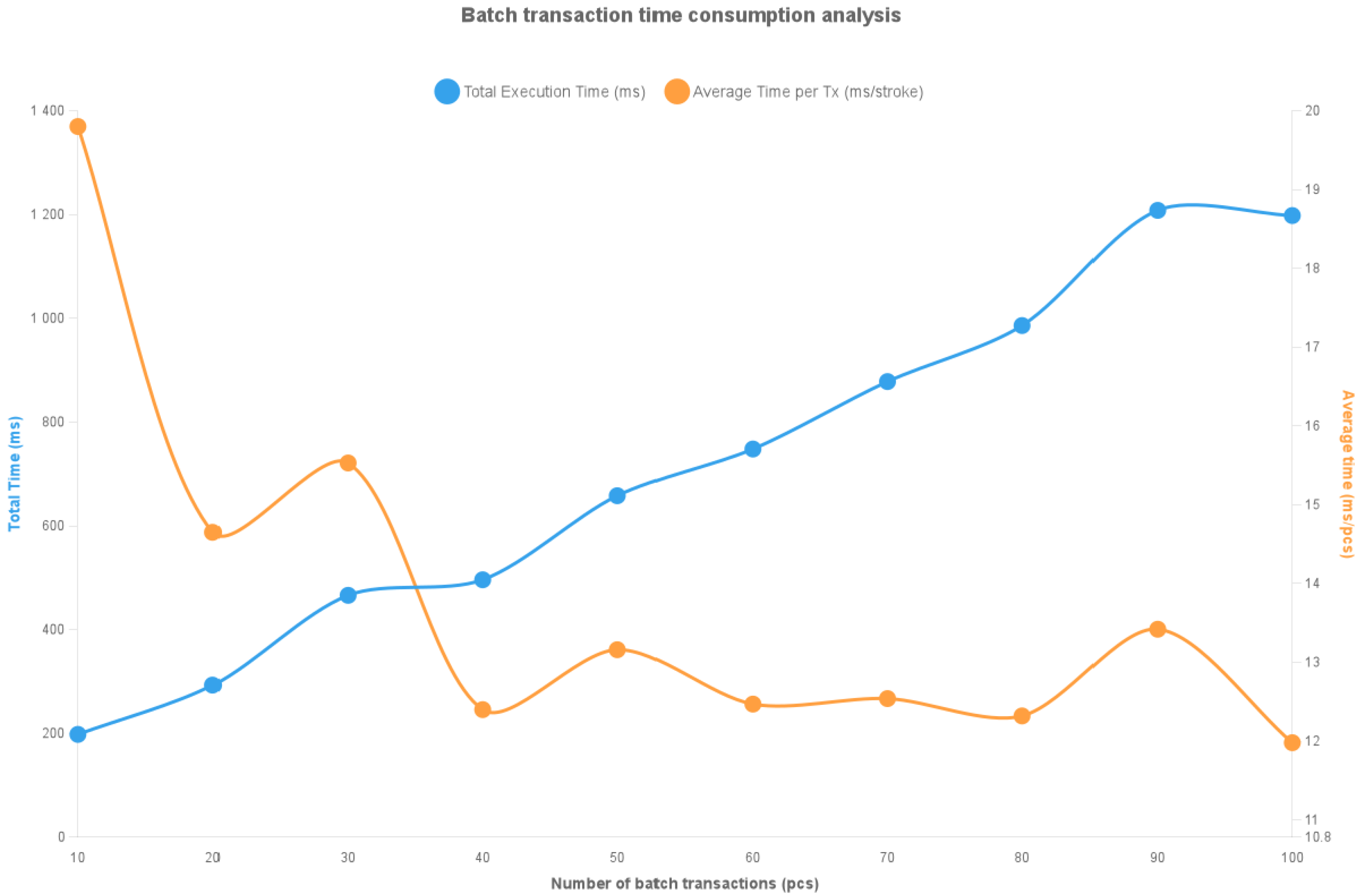
- The total execution time shows non-linear growth with batch size. When the batch size increases from 10 to 100 transactions, the total execution time grows from approximately 0.2 s to slightly above 1.2 s, demonstrating a stable upward trend without drastic fluctuations. This indicates the system maintains good thread scheduling and processing overhead control in batch payment scenarios, enabling linear scaling for larger-scale offline payment requests.
- 2.
- The average per-transaction execution time decreases significantly and stabilizes. As the batch size expands, the average execution time per transaction decreases from an initial 19 ms to a minimum of 12 ms, representing a 35% reduction. In the 40–100 transaction range, the average execution time remains stable within a narrow fluctuation band of 12–14 ms, demonstrating that batch processing effectively reduces per-transaction execution time.
5.3. Benchmark Discussion
- Consecutive payment capability: The system enables multiple rounds of offline payments without requiring re-initialization between transactions. The credential decomposition mechanism automatically generates change credentials that serve as input for the next payment.
- Batch settlement on blockchain: After network recovery, all offline receipts can be uploaded and verified in a single batch transaction, significantly reducing on-chain gas costs.
- Privacy preservation: Zero-sum verification is integrated to protect transaction amounts and balances during the entire consecutive payment process.
- Tamper-proof and double-spending prevention: The asset credentials are protected by elliptic curve signatures, and the atomic “decompose-and-delete” mechanism ensures each credential can only be used once.
5.4. Engineering Applications of Cryptocurrency Dual-Offline Payment Systems
6. Conclusions
Author Contributions
Funding
Institutional Review Board Statement
Informed Consent Statement
Data Availability Statement
Conflicts of Interest
Abbreviations
| CBDC | Central Bank Digital Currency |
| NFC | Near Field Communication |
| TEEs | Trusted Execution Environments |
| PW | Pure Wallet |
| HD | Hierarchical Deterministic |
| SE | Secure Element |
| ECDSA | Elliptic Curve Digital Signature Algorithm |
References
- Zheng, Z.; Xie, S.; Dai, H.N.; Chen, X.; Wang, H. Blockchain challenges and opportunities: A survey. Int. J. Web Grid Serv. 2018, 14, 352–375. [Google Scholar] [CrossRef] [Scilit]
- Keister, T.; Sanches, D. Should central banks issue digital currency. Rev. Econ. Stud. 2023, 90, 404–431. [Google Scholar] [CrossRef] [Scilit]
- Espedal, S.B.; Janzso, D.A. Design Choices for Offline Transactions in a Norwegian Central Bank Digital Currency. Ph.D. Thesis, Norwegian University of Science and Technology (NTNU), Trondheim, Norway, 2022. [Google Scholar]
- Ozili, P.K. Central bank digital currency research around the World: A review of literature. J. Money Laund. Control 2023, 26, 215–226. [Google Scholar] [CrossRef] [Scilit]
- Chu, Y.; Lee, J.; Kim, S.; Kim, H.; Yoon, Y.; Chung, H. Review of offline payment function of CBDC considering security requirements. Appl. Sci. 2022, 12, 4488. [Google Scholar] [CrossRef] [Scilit]
- Christodorescu, M.; Gu, W.C.; Kumaresan, R.; Minaei, M.; Ozdayi, M.; Price, B.; Raghuraman, S.; Saad, M.; Sheffield, C.; Xu, M.; et al. Towards a two-tier hierarchical infrastructure: An offline payment system for central bank digital currencies. arXiv 2020, arXiv:2012.08003. [Google Scholar] [CrossRef] [Scilit]
- Aboulaiz, L.; Akintade, B.; Daud, H.; Lansey, M.; Rodden, M.; Sawyer, L.; Yip, M. Offline Payments: Implications for Reliability and Resiliency in Digital Payment Systems; Board of Governors of the Federal Reserve System: Washington, DC, USA, 2024. [Google Scholar]
- Atangana, O.; Barbier, M.; Khoukhi, L.; Royer, W. Securing Privacy in Offline Payment for Retail Central Bank Digital Currency: A Comprehensive Framework. In Proceedings of the Blockchain and Cryptocurrency Conference, Corfu, Greece, 18–20 October 2023; p. 25. [Google Scholar]
- Kumar, A.; Sah, B.K.; Mehrotra, T.; Rajput, G.K. A review on double spending problem in blockchain. In Proceedings of the 2023 International Conference on Computational Intelligence and Sustainable Engineering Solutions (CISES), Greater Noida, India, 29–30 April 2023; pp. 881–889. [Google Scholar]
- Benjelloun, S.; El Aissi, M.E.M.; Loukili, Y.; Ben Ali, S.W.; Chougrad, H.; El Boushaki, A. Big Data Processing: Batch-based processing and stream-based processing. In Proceedings of the 2020 Fourth International Conference on Intelligent Computing in Data Sciences (ICDS), Fez, Morocco, 21–23 October 2020; pp. 1–6. [Google Scholar]
- Tripathi, M.; Mukhopadhyay, A. Financial loss due to a data privacy breach: An empirical analysis. J. Organ. Comput. Electron. Commer. 2020, 30, 381–400. [Google Scholar] [CrossRef] [Scilit]
- Hossain, A.; Rahaman, H.; Jamil, A.; Khan, M.A. An algorithm for securing user credentials by combining Encryption and Hashing method. Int. J. Electr. Eng. Appl. Sci. (IJEEAS) 2020, 3, 35–42. [Google Scholar]
- Anwar, M.R.; Apriani, D.; Adianita, I.R. Hash algorithm in verification of certificate data integrity and security. APTISI Trans. Technopreneurship (ATT) 2021, 3, 181–188. [Google Scholar] [CrossRef] [Scilit]
- Bhatnagar, S.; Dayal, M.; Singh, D.; Upreti, S.; Upreti, K.; Kumar, J. Block-hash signature (BHS) for transaction validation in smart contracts for security and privacy using blockchain. J. Mob. Multimed. 2023, 19, 935–961. [Google Scholar] [CrossRef] [Scilit]
- Attarde, K.; Jaiswal, C.; Khatwani, R.; Pinto, G.; Kumar, V. A novel central bank digital currency framework design for offline and foreign transactions based on blockchain. Digit. Policy Regul. Gov. 2025, 27, 201–220. [Google Scholar] [CrossRef] [Scilit]
- Minwalla, C.; Miedema, J.; Hernandez, S.; Sutton-Lalani, A. A Central Bank Digital Currency for Offline Payments; Technical Report; Bank of Canada: Ottawa, ON, Canada, 2023. [Google Scholar]
- Thakur, S.; Breslin, J.G. Real-time Peer to Peer Energy Trade with Blockchain Offline Channels. In Proceedings of the 2020 IEEE International Conference on Power Systems Technology (POWERCON), Bangalore, India, 14–16 September 2020; pp. 1–6. [Google Scholar]
- San, A.M.; Sathitwiriyawong, C. Privacy-preserving offline mobile payment protocol based on NFC. In Proceedings of the 2016 International Computer Science and Engineering Conference (ICSEC), Chiang Mai, Thailand, 14–17 December 2016; pp. 1–5. [Google Scholar]
- Michalopoulos, P.; Olowookere, O.; Pocher, N.; Sedlmeir, J.; Veneris, A.; Puri, P. Privacy and Compliance Design Options in Offline Central Bank Digital Currencies. IEEE Trans. Netw. Serv. Manag. 2025, 22, 3748–3763. [Google Scholar] [CrossRef] [Scilit]
- Abla, P.; Li, T.; He, D.; Huang, H.; Yu, S.; Zhang, Y. Fair and Privacy-Preserved Data Trading Protocol by Exploiting Blockchain. IEEE Trans. Inf. Forensics Secur. 2024, 19, 9012–9025. [Google Scholar] [CrossRef] [Scilit]
- Jie, W.; Qiu, W.; Koe, A.S.V.; Li, J.; Wang, Y.; Wu, Y.; Li, J.; Zheng, Z. A Secure and Flexible Blockchain-Based Offline Payment Protocol. IEEE Trans. Comput. 2024, 73, 408–421. [Google Scholar] [CrossRef] [Scilit]
- Wu, F.; Ye, A.; Diao, Y.; Zhang, Y.; Chen, Y.; Huang, C. TrustChain: A privacy protection smart contract model with Trusted Execution Environment. Blockchain Res. Appl. 2025, 6, 100296. [Google Scholar] [CrossRef] [Scilit]
- Fang, F.; Ventre, C.; Basios, M.; Kong, H.; Kanthan, L.; Li, L.; Martinez-Rego, D.; Wu, F. Cryptocurrency trading: A comprehensive survey. Financ. Innov. 2022, 8, 13. [Google Scholar] [CrossRef] [Scilit]
- Igboanusi, I.S.; Dirgantoro, K.P.; Lee, J.M.; Kim, D.S. Blockchain side implementation of pure wallet (pw): An offline transaction architecture. ICT Express 2021, 7, 327–334. [Google Scholar] [CrossRef] [Scilit]
- Wang, H.; Li, X.; Gao, J.; Li, W. MOBT: A kleptographically-secure hierarchical-deterministic wallet for multiple offline Bitcoin transactions. Future Gener. Comput. Syst. 2019, 101, 315–326. [Google Scholar] [CrossRef] [Scilit]
- Chow, S.S.M.; Choo, K.K.R.; Han, J. Editorial for accountability and privacy issues in blockchain and cryptocurrency. Future Gener. Comput. Syst. 2021, 114, 647–648. [Google Scholar] [CrossRef] [Scilit]
- Ivanov, N.; Yan, Q. System-wide security for offline payment terminals. In International Conference on Security and Privacy in Communication Systems; Springer International Publishing: Cham, Switzerland, 2021; pp. 99–119. [Google Scholar]
- Dmitrienko, A.; Noack, D.; Yung, M. Secure wallet-assisted offline bitcoin payments with double-spender revocation. In Proceedings of the 2017 ACM Asia Conference on Computer and Communications Security, Abu Dhabi, United Arab Emirates, 2–6 April 2017; pp. 520–531. [Google Scholar]
- Takahashi, T.; Otsuka, A. Short paper: Secure offline payments in bitcoin. In International Conference on Financial Cryptography and Data Security; Springer International Publishing: Cham, Switzerland, 2019. [Google Scholar]
- Li, R.; Wang, Q.; Zhang, X.; Wang, Q.; Galindo, D.; Xiang, Y. An Offline Delegatable Cryptocurrency System. In Proceedings of the 2021 IEEE International Conference on Blockchain and Cryptocurrency (ICBC), Sydney, Australia, 3–6 May 2021; pp. 1–9. [Google Scholar]
- Kurt, A.; Sahin, A.; Harrilal-Parchment, R.; Akkaya, K. LNMesh: Who Said You need Internet to send Bitcoin? Offline Lightning Network Payments using Community Wireless Mesh Networks. In Proceedings of the 2023 IEEE 24th International Symposium on a World of Wireless, Mobile and Multimedia Networks (WoWMoM), Boston, MA, USA, 12–15 June 2023; pp. 261–270. [Google Scholar]
- Yang, B.; Feng, W.; Qin, Y.; Zhang, Y.; Tong, D. Dual Offline Anonymous E-payment Scheme for Mobile Devices Based on TEE and SE. J. Softw. 2024, 35, 3553–3576. [Google Scholar]
- Yang, B.; Zhang, Y.; Tong, D. DOPS: A Practical Dual Offline Payment Scheme of CBDC for Mobile Devices. In Proceedings of the 2023 IEEE 22nd International Conference on Trust, Security and Privacy in Computing and Communications (TrustCom), Exeter, UK, 1–3 November 2023; pp. 1835–1844. [Google Scholar]
- Yang, B.; Zhang, Y.; Tong, D. DOT-M: A dual offline transaction scheme of central bank digital currency for trusted mobile devices. In International Conference on Network and System Security; Springer Nature: Cham, Switzerland, 2022; pp. 233–248. [Google Scholar]
- Cecchetti, E.; Zhang, F.; Ji, Y.; Kosba, A.; Juels, A.; Shi, E. Solidus: Confidential distributed ledger transactions via PVORM. In Proceedings of the 2017 ACM SIGSAC Conference on Computer and Communications Security, Dallas, TX, USA, 30 October–3 November 2017; pp. 701–717. [Google Scholar]
- Ahamad, S.S. A Novel NFC-Based Secure Protocol for Merchant Transactions. IEEE Access 2022, 10, 1905–1920. [Google Scholar] [CrossRef] [Scilit]
- Ebadi Ansaroudi, Z.; Sharif, A.; Sciarretta, G.; Marino, F.A.; Ranise, S. Secure and Reliable Digital Wallets: A Threat Model for Secure Storage in eIDAS 2.0. In IFIP Annual Conference on Data and Applications Security and Privacy; Springer Nature: Cham, Switzerland, 2025; pp. 271–289. [Google Scholar]
- Caudevilla, O.; Kim, H.M. The Digital Yuan and Cross-Border Payments: China’s Rollout of Its Central Bank Digital Currency; University of Hong Kong Faculty of Law Research Paper No. 2023/30; University of Hong Kong: Hongkong, China, 2022. [Google Scholar]
- Huibers, F. Distributed ledger technology and the future of money and banking: Banking is necessary, banks are not. Bill Gates 1994. Account. Econ. Law Conviv. 2024, 14, 213–249. [Google Scholar]
- Si, H.; Huang, Y.; Li, G.; Zhao, Y.; Qi, Y.; Chen, W.; Gao, Z. A Cryptocurrency Dual-Offline Payment Method for Payment Capacity Privacy Protection. Electronics 2026, 15, 400. [Google Scholar] [CrossRef] [Scilit]





| Feature | Paper [19] | Paper [21] | Paper [22] | Paper [26] | Ours |
|---|---|---|---|---|---|
| Supports consecutive offline payments | ✗ | ✗ | ✗ | ✓ | ✓ |
| Anti-tampering mechanism | ✓ | ✓ | ✗ | ✗ | ✓ |
| Privacy protection | ✓ | ✓ | ✓ | ✓ | ✓ |
| Batch settlement on blockchain | ✗ | ✓ | ✓ | ✗ | ✓ |
| Experimental benchmark provided | ✗ | ✗ | ✗ | ✗ | ✓ |
| Tool Components | Version/Configuration | Description |
|---|---|---|
| Solidity | 0.8.28 | Smart contract development language |
| Hardhat | 2.x | Local development and deployment framework |
| Node.js | ≥v16 | JavaScript execution environment |
| Ethers.js | 5.x | Interaction with blockchain, signature verification |
| Open Zeppelin | 4.x | Security library (ECDSA) |
Disclaimer/Publisher’s Note: The statements, opinions and data contained in all publications are solely those of the individual author(s) and contributor(s) and not of MDPI and/or the editor(s). MDPI and/or the editor(s) disclaim responsibility for any injury to people or property resulting from any ideas, methods, instructions or products referred to in the content. |
© 2026 by the authors. Licensee MDPI, Basel, Switzerland. This article is an open access article distributed under the terms and conditions of the Creative Commons Attribution (CC BY) license.
Share and Cite
Si, H.; Huang, Y.; Li, G.; Qi, Y.; Chen, W.; Gao, Z. A Method for Continuous Dual-Offline Payment of Cryptocurrency Based on Asset Credentials. Sensors 2026, 26, 3039. https://doi.org/10.3390/s26103039
Si H, Huang Y, Li G, Qi Y, Chen W, Gao Z. A Method for Continuous Dual-Offline Payment of Cryptocurrency Based on Asset Credentials. Sensors. 2026; 26(10):3039. https://doi.org/10.3390/s26103039
Chicago/Turabian StyleSi, Huayou, Yaqian Huang, Guozheng Li, Yuanyuan Qi, Wei Chen, and Zhigang Gao. 2026. "A Method for Continuous Dual-Offline Payment of Cryptocurrency Based on Asset Credentials" Sensors 26, no. 10: 3039. https://doi.org/10.3390/s26103039
APA StyleSi, H., Huang, Y., Li, G., Qi, Y., Chen, W., & Gao, Z. (2026). A Method for Continuous Dual-Offline Payment of Cryptocurrency Based on Asset Credentials. Sensors, 26(10), 3039. https://doi.org/10.3390/s26103039