The Impact of the Accelerometer Sampling Rate on the Performance of Machine and Deep Learning Models in Wearable Fall-Detection Systems



Abstract
1. Introduction
2. Methodology
2.1. Data and Preprocessing
2.2. Evaluated Models
2.3. Experimental Settings
2.4. Evaluation Metrics
2.5. Experimental Validation of the Selected Model
3. Results
3.1. Comparative Performance Across Sampling Rates
Controlled Evaluation Using a Unified CNN-LSTM Architecture
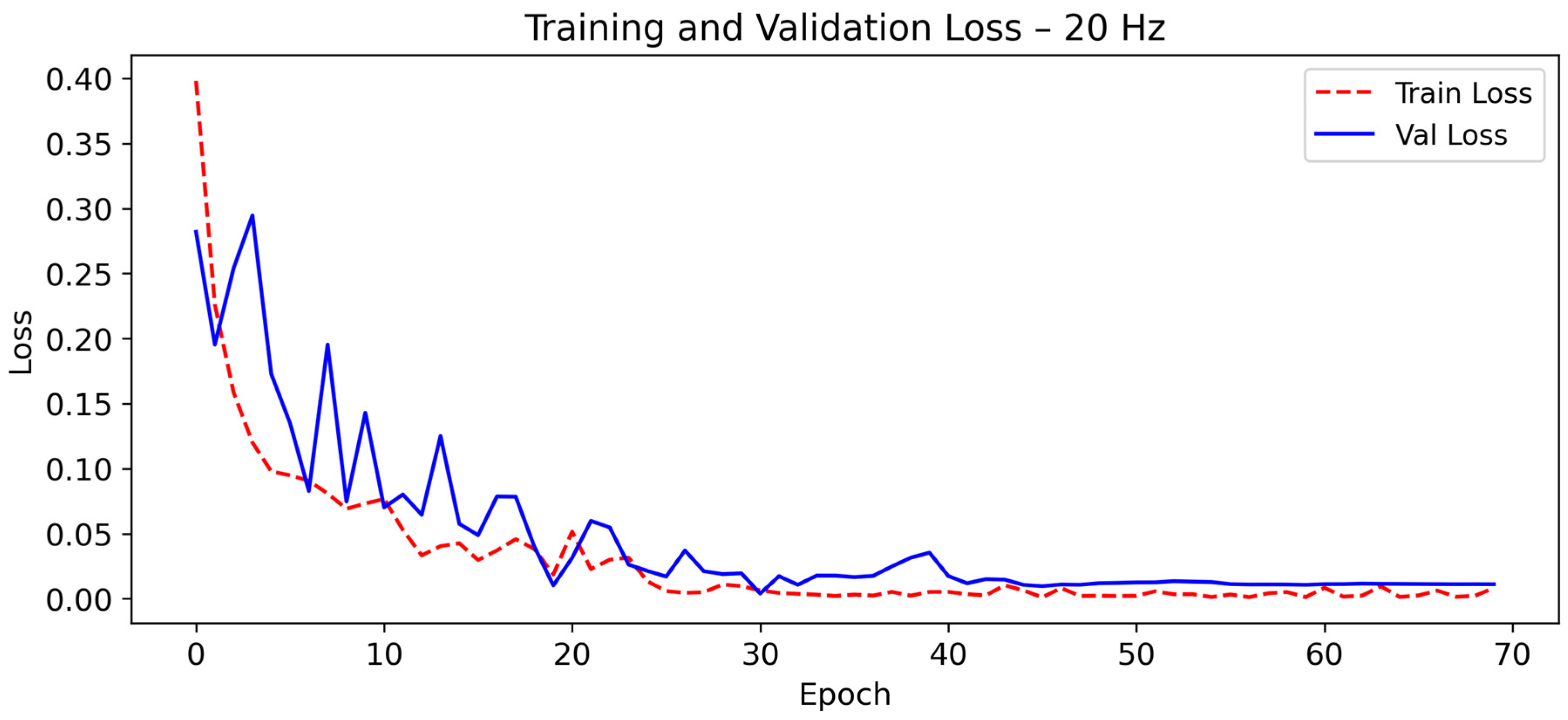
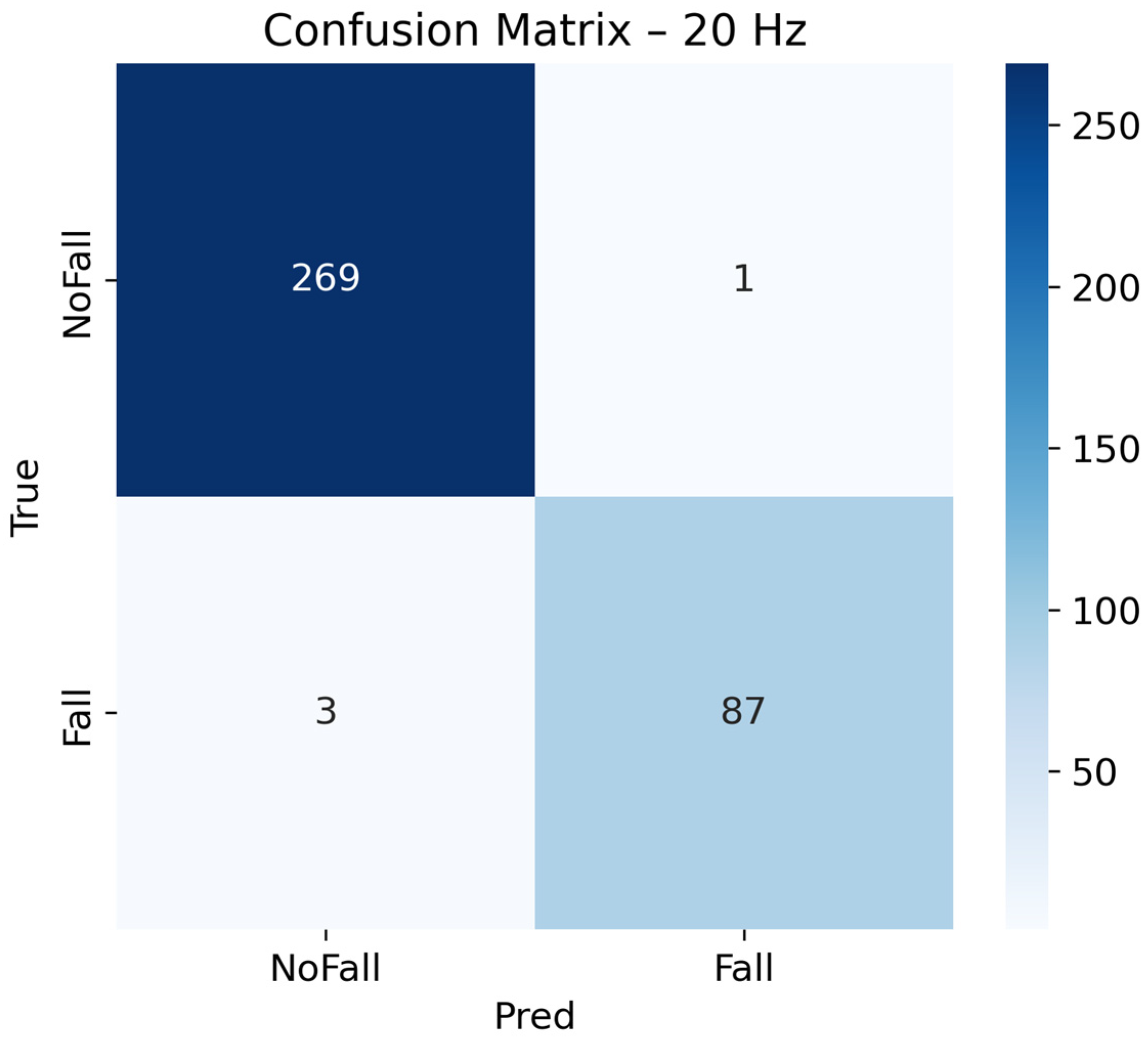
3.2. Optimal Model Configuration and In-Depth Evaluation
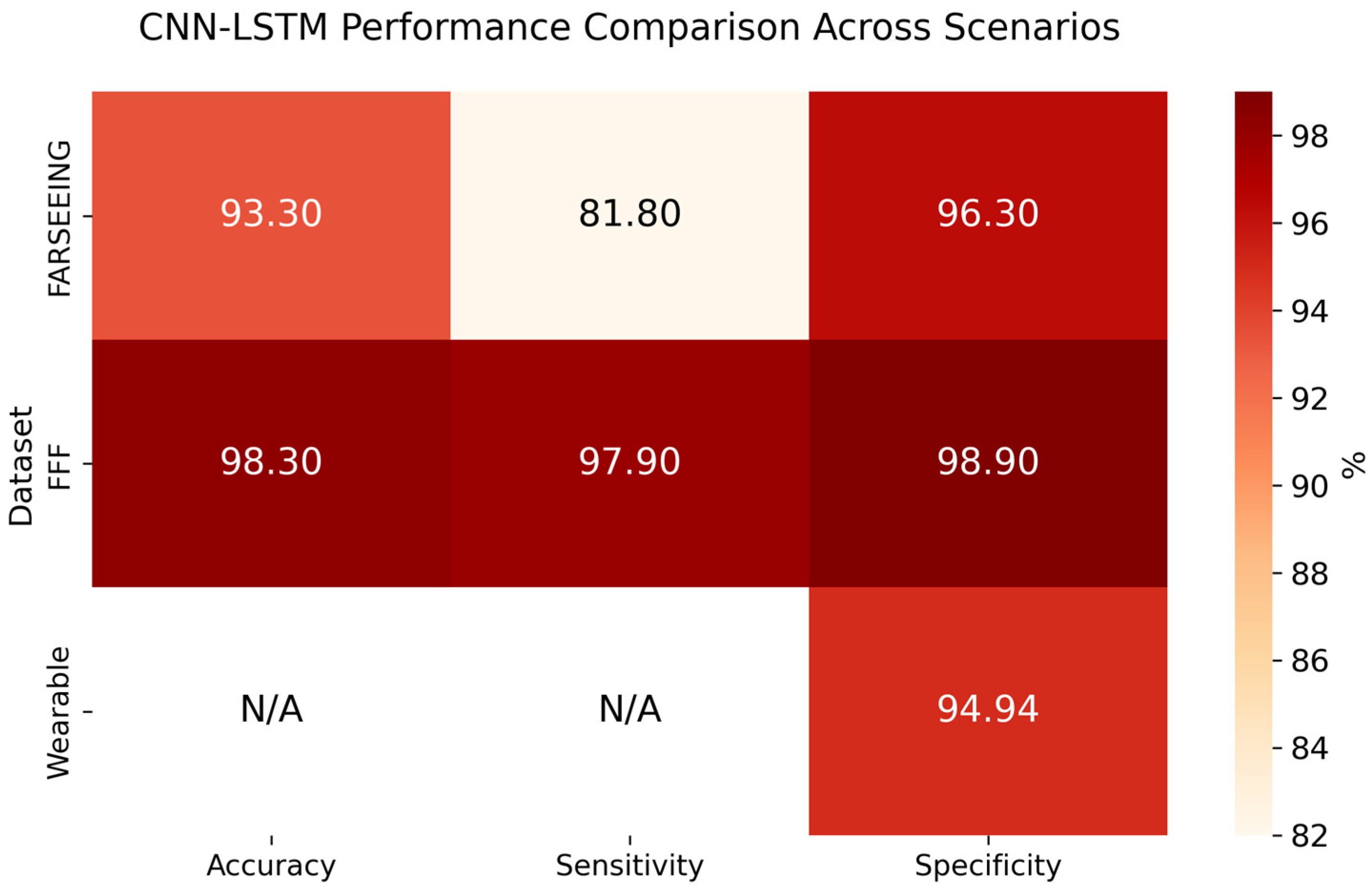
3.3. Validation on External Datasets (FARSEEING and FFF)
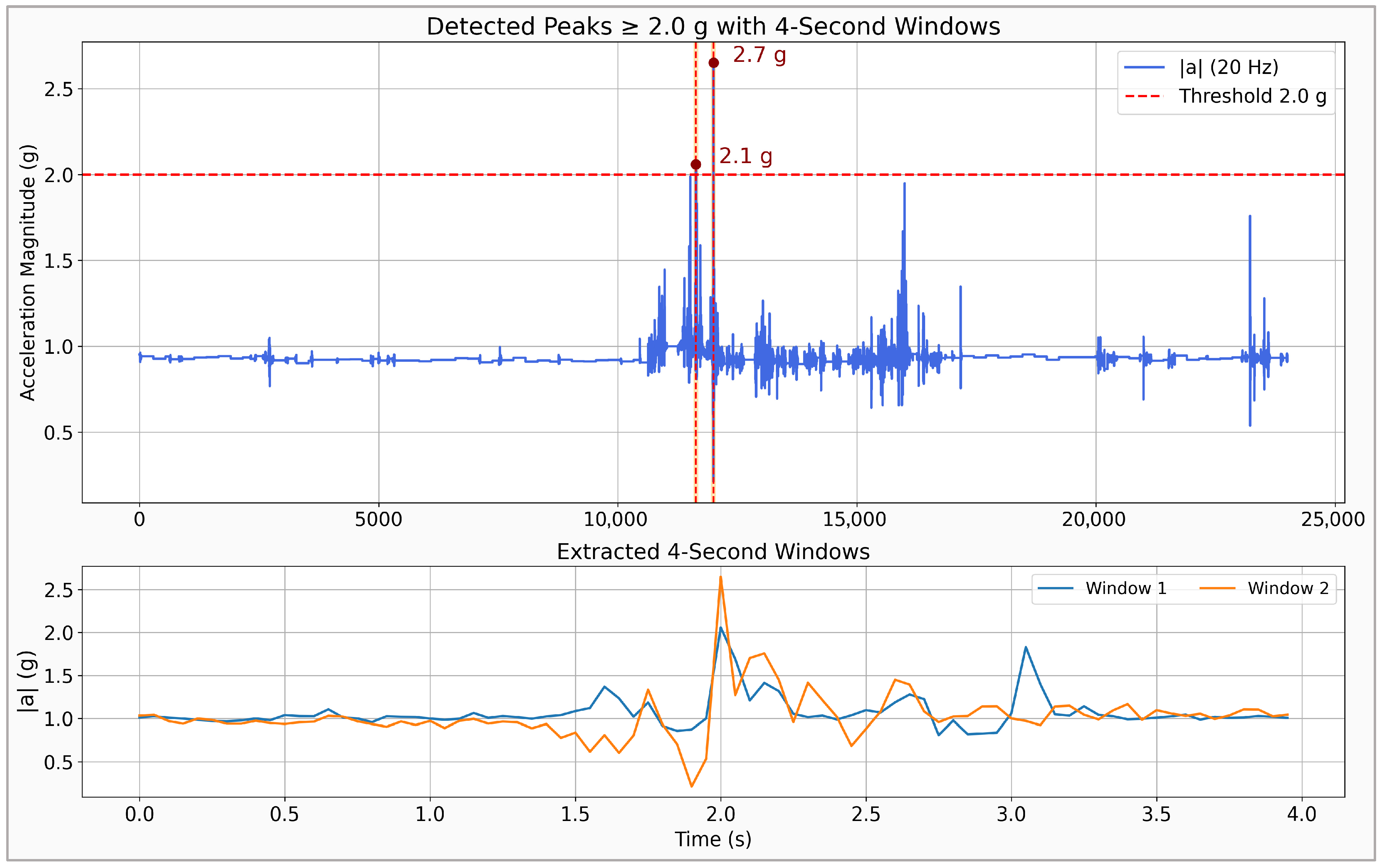
3.4. Experimental Validation on the Wearable Device
4. Discussion
5. Conclusions
Author Contributions
Funding
Institutional Review Board Statement
Informed Consent Statement
Data Availability Statement
Conflicts of Interest
References
- World Health Organization. Ageing and Health. Available online: https://www.who.int/news-room/fact-sheets/detail/ageing-and-health (accessed on 10 April 2023).
- World Health Organization. Falls. Available online: https://www.who.int/en/news-room/fact-sheets/detail/falls (accessed on 26 February 2023).
- United Nations. World Population Ageing 2017: Highlights. Available online: https://www.un-ilibrary.org/content/books/9789213627457 (accessed on 31 August 2025).
- World Health Organization. WHO Global Report on Falls Prevention in Older Age. Available online: https://apps.who.int/iris/handle/10665/43811 (accessed on 26 February 2023).
- Peel, N.M. Epidemiology of Falls in Older Age. Can. J. Aging 2011, 30, 7–19. [Google Scholar] [CrossRef] [PubMed]
- Tinetti, M.E.; Liu, W.L.; Claus, E.B. Predictors and Prognosis of Inability to Get Up After Falls Among Elderly Persons. JAMA 1993, 269, 65–70. [Google Scholar] [CrossRef]
- Wang, X.; Ellul, J.; Azzopardi, G. Elderly Fall Detection Systems: A Literature Survey. Front. Robot. AI 2020, 7, 71. [Google Scholar] [CrossRef] [PubMed]
- Qian, Z.; Lin, Y.; Jing, W.; Ma, Z.; Liu, H.; Yin, R.; Li, Z.; Bi, Z.; Zhang, W. Development of a Real-Time Wearable Fall Detection System in the Context of Internet of Things. IEEE Internet Things J. 2022, 9, 21999–22007. [Google Scholar] [CrossRef]
- Karar, M.E.; Shehata, H.I.; Reyad, O. A Survey of IoT-Based Fall Detection for Aiding Elderly Care: Sensors, Methods, Challenges and Future Trends. Appl. Sci. 2022, 12, 3276. [Google Scholar] [CrossRef]
- Casamassima, F.; Farella, E.; Benini, L. Context aware power management for motion-sensing body area network nodes. In Proceedings of the 2014 Design, Automation & Test in Europe Conference & Exhibition (DATE), Dresden, Germany, 24–28 March 2014; pp. 1–6. [Google Scholar] [CrossRef]
- Villa, M.; Casilari, E. Energy-Efficient Fall-Detection System Using LoRa and Hybrid Algorithms. Biomimetics 2025, 10, 313. [Google Scholar] [CrossRef]
- Salah, O.Z.; Selvaperumal, S.K.; Abdulla, R. Accelerometer-based elderly fall detection system using edge artificial intelligence architecture. Int. J. Electr. Comput. Eng. 2022, 12, 4430–4438. [Google Scholar] [CrossRef]
- Huynh, Q.T.; Nguyen, U.D.; Tran, B.Q. A Cloud-Based System for In-Home Fall Detection and Activity Assessment. In Proceedings of the IFMBE Proceedings; Springer: Berlin/Heidelberg, Germany, 2020; Volume 69, pp. 103–108. [Google Scholar] [CrossRef]
- Chang, W.J.; Chen, L.B.; Chen, M.C.; Su, J.P.; Sie, C.Y.; Yang, C.H. Design and Implementation of an Intelligent Assistive System for Visually Impaired People for Aerial Obstacle Avoidance and Fall Detection. IEEE Sens. J. 2020, 20, 10199–10210. [Google Scholar] [CrossRef]
- Li, Y.; Lin, Z.; Huang, Z.; Cai, Z.; Huang, L.; Wei, Z. A Channel Hopping LoRa Technology Based Emergency Communication System for Elderly People Living Alone. In Proceedings of the 2022 21st International Symposium on Communications and Information Technologies, ISCIT 2022, Xi’an, China, 27–30 September 2022; Institute of Electrical and Electronics Engineers Inc.: New York, NY, USA, 2022; pp. 19–26. [Google Scholar] [CrossRef]
- Wu, Y.; Zeng, P.; Ge, H. A Research of Fall Detection Module Based on NB-IOT. In Proceedings of the 2022 7th International Conference on Computer and Communication Systems, ICCCS 2022, Seoul, Republic of Korea, 3–5 November 2022; Institute of Electrical and Electronics Engineers Inc.: New York, NY, USA, 2022; pp. 197–201. [Google Scholar] [CrossRef]
- Liu, P.; Pan, J.; Zhu, H.; Li, Y. A Wearable Fall Detection System Based on 1D CNN. In Proceedings of the Proceedings—2021 2nd International Conference on Artificial Intelligence and Computer Engineering, ICAICE 2021, Hangzhou, China, 5–7 November 2021; Institute of Electrical and Electronics Engineers Inc.: New York, NY, USA, 2021; pp. 200–203. [Google Scholar] [CrossRef]
- Pena Queralta, J.; Gia, T.N.; Tenhunen, H.; Westerlund, T. Edge-AI in LoRa-based health monitoring: Fall detection system with fog computing and LSTM recurrent neural networks. In Proceedings of the 2019 42nd International Conference on Telecommunications and Signal Processing, TSP 2019, Budapest, Hungary, 1–3 July 2019; Institute of Electrical and Electronics Engineers Inc.: New York, NY, USA, 2019; pp. 601–604. [Google Scholar] [CrossRef]
- Cai, W.Y.; Guo, J.H.; Zhang, M.Y.; Ruan, Z.X.; Zheng, X.C.; Lv, S.S. GBDT-Based Fall Detection with Comprehensive Data from Posture Sensor and Human Skeleton Extraction. J. Healthc. Eng. 2020, 2020, 8887340. [Google Scholar] [CrossRef]
- Linhares, Í.; Andrade, R.M.C.; Júnior, E.C.; Oliveira, P.A.; Oliveira, B.; Aguilar, P. Lessons Learned from the Development of Mobile Applications for Fall Detection. In Proceedings of the GLOBAL HEALTH 2020: The Ninth International Conference on Global Health Challenges, Nice, France, 25–29 October 2020; pp. 10–25. [Google Scholar]
- Yuan, J.; Tan, K.K.; Lee, T.H.; Koh, G.C.H. Power-efficient interrupt-driven algorithms for fall detection and classification of activities of daily living. IEEE Sens. J. 2015, 15, 1377–1387. [Google Scholar] [CrossRef]
- Xu, T.; Se, H.; Liu, J. A two-step fall detection algorithm combining threshold-based method and convolutional neural network. Metrol. Meas. Syst. 2021, 28, 23–40. [Google Scholar] [CrossRef]
- Danilenka, A.; Sowiński, P.; Rachwał, K.; Bogacka, K.; Dąbrowska, A.; Kobus, M.; Baszczyński, K.; Okrasa, M.; Olczak, W.; Dymarski, P.; et al. Real-Time AI-Driven Fall Detection Method for Occupational Health and Safety. Electronics 2023, 12, 4257. [Google Scholar] [CrossRef]
- Maurer, U.; Smailagic, A.; Siewiorek, D.P.; Deisher, M. Activity recognition and monitoring using multiple sensors on different body positions. In Proceedings of the International Workshop on Wearable and Implantable Body Sensor Networks, Cambridge, MA, USA, 3–5 April 2006; Volume 2006, pp. 113–116. [Google Scholar] [CrossRef]
- Santoyo-Ramón, J.A.; Casilari, E.; Manuel Cano-García, J. A study of the influence of the sensor sampling frequency on the performance of wearable fall detectors. Measurement 2022, 193, 110945. [Google Scholar] [CrossRef]
- Nguyen, H.P.; Ayachi, F.; Lavigne-Pelletier, C.; Blamoutier, M.; Rahimi, F.; Boissy, P.; Jog, M.; Duval, C. Auto detection and segmentation of physical activities during a Timed-Up-and-Go (TUG) task in healthy older adults using multiple inertial sensors. J. Neuroeng. Rehabil. 2015, 12, 36. [Google Scholar] [CrossRef]
- Mathie, M.J.; Coster, A.C.F.; Lovell, N.H.; Celler, B.G. Accelerometry: Providing an integrated, practical method for long-term, ambulatory monitoring of human movement. Physiol. Meas. 2004, 25, R1. [Google Scholar] [CrossRef] [PubMed]
- Winter, D.A. Biomechanics and Motor Control of Human Movement, 4th ed.; John Wiley & Sons, Inc.: Hoboken, NJ, USA, 2009; pp. 1–370. [Google Scholar] [CrossRef]
- Antonsson, E.K.; Mann, R.W. The frequency content of gait. J. Biomech. 1985, 18, 39–47. [Google Scholar] [CrossRef]
- Liu, K.C.; Hsieh, C.Y.; Hsu, S.J.P.; Chan, C.T. Impact of Sampling Rate on Wearable-Based Fall Detection Systems Based on Machine Learning Models. IEEE Sens. J. 2018, 18, 9882–9890. [Google Scholar] [CrossRef]
- Sanchez-Iborra, R. LPWAN and Embedded Machine Learning as Enablers for the Next Generation of Wearable Devices. Sensors 2021, 21, 5218. [Google Scholar] [CrossRef]
- Sucerquia, A.; López, J.D.; Vargas-Bonilla, J.F. SisFall: A fall and movement dataset. Sensors 2017, 17, 198. [Google Scholar] [CrossRef]
- Zurbuchen, N.; Wilde, A.; Bruegger, P. A Machine Learning Multi-Class Approach for Fall Detection Systems Based on Wearable Sensors with a Study on Sampling Rates Selection. Sensors 2021, 21, 938. [Google Scholar] [CrossRef]
- SciPy Developers. scipy.signal.firwin—SciPy v1.16.2 Manual. Available online: https://docs.scipy.org/doc/scipy/reference/generated/scipy.signal.firwin.html (accessed on 28 November 2025).
- SciPy Developers. scipy.signal.resample_poly—SciPy Reference Guide. Available online: https://docs.scipy.org/doc/scipy/reference/generated/scipy.signal.resample_poly.html (accessed on 28 November 2025).
- Casilari, E.; Lora-Rivera, R.; García-lagos, F. A Study on the Application of Convolutional Neural Networks to Fall Detection Evaluated with Multiple Public Datasets. Sensors 2020, 20, 1466. [Google Scholar] [CrossRef] [PubMed]
- Alizadeh, J.; Bogdan, M.; Classen, J.; Fricke, C. Support Vector Machine Classifiers Show High Generalizability in Automatic Fall Detection in Older Adults. Sensors 2021, 21, 7166. [Google Scholar] [CrossRef]
- Özdemir, A.T.; Barshan, B. Detecting Falls with Wearable Sensors Using Machine Learning Techniques. Sensors 2014, 14, 10691–10708. [Google Scholar] [CrossRef]
- Mauldin, T.R.; Canby, M.E.; Metsis, V.; Ngu, A.H.H.; Rivera, C.C. SmartFall: A Smartwatch-Based Fall Detection System Using Deep Learning. Sensors 2018, 18, 3363. [Google Scholar] [CrossRef]
- Wang, J.; Chen, Y.; Hao, S.; Peng, X.; Hu, L. Deep learning for sensor-based activity recognition: A survey. Pattern Recognit. Lett. 2019, 119, 3–11. [Google Scholar] [CrossRef]
- Wu, J.; Wang, J.; Zhan, A.; Wu, C. Fall Detection with CNN-Casual LSTM Network. Information 2021, 12, 403. [Google Scholar] [CrossRef]
- Xu, J.; He, Z.; Zhang, Y. CNN-LSTM Combined Network for IoT Enabled Fall Detection Applications. J. Phys. Conf. Ser. 2019, 1267, 012044. [Google Scholar] [CrossRef]
- Wang, F.T.; Chan, H.L.; Hsu, M.H.; Lin, C.K.; Chao, P.K.; Chang, Y.J. Threshold-based fall detection using a hybrid of tri-axial accelerometer and gyroscope. Physiol. Meas. 2018, 39, 105002. [Google Scholar] [CrossRef]
- Klenk, J.; Schwickert, L.; Palmerini, L.; Mellone, S.; Bourke, A.; Ihlen, E.A.F.; Kerse, N.; Hauer, K.; Pijnappels, M.; Synofzik, M.; et al. The FARSEEING real-world fall repository: A large-scale collaborative database to collect and share sensor signals from real-world falls. Eur. Rev. Aging Phys. Act. 2016, 13, 8. [Google Scholar] [CrossRef]
- Mosquera-Lopez, C.; Wan, E.; Shastry, M.; Folsom, J.; Leitschuh, J.; Condon, J.; Rajhbeharrysingh, U.; Hildebrand, A.; Cameron, M.; Jacobs, P.G. Automated Detection of Real-World Falls: Modeled from People with Multiple Sclerosis. IEEE J. Biomed. Health Inform. 2021, 25, 1975–1984. [Google Scholar] [CrossRef] [PubMed]
- Arduino Nano 33 BLE Sense Rev2|Arduino Documentation. Available online: https://docs.arduino.cc/hardware/nano-33-ble-sense-rev2/ (accessed on 3 September 2024).
- Li, C.; Liu, M.; Yan, X.; Teng, G. Research on CNN-BiLSTM Fall Detection Algorithm Based on Improved Attention Mechanism. Appl. Sci. 2022, 12, 9671. [Google Scholar] [CrossRef]
- Galvão, Y.M.; Ferreira, J.; Albuquerque, V.A.; Barros, P.; Fernandes, B.J.T. A multimodal approach using deep learning for fall detection. Expert. Syst. Appl. 2021, 168, 114226. [Google Scholar] [CrossRef]
- Musci, M.; De Martini, D.; Blago, N.; Facchinetti, T.; Piastra, M. Online Fall Detection Using Recurrent Neural Networks on Smart Wearable Devices. IEEE Trans. Emerg. Top. Comput. 2021, 9, 1276–1289. [Google Scholar] [CrossRef]
- Thakur, N.; Han, C.Y. A Study of Fall Detection in Assisted Living: Identifying and Improving the Optimal Machine Learning Method. J. Sens. Actuator Netw. 2021, 10, 39. [Google Scholar] [CrossRef]
- González-Cañete, F.J.; Casilari, E. Consumption Analysis of Smartphone based Fall Detection Systems with Multiple External Wireless Sensors. Sensors 2020, 20, 622. [Google Scholar] [CrossRef]
- Yamane, T.; Kimura, M.; Morita, M. Effects of Sampling Frequency on Human Activity Recognition with Machine Learning Aiming at Clinical Applications. Sensors 2025, 25, 3780. [Google Scholar] [CrossRef]
- Google LLC. Google Colaboratory. Available online: https://colab.research.google.com/ (accessed on 28 November 2025).
- Afuan, L.; Isnanto, R.R. A comparative study of machine learning algorithms for fall detection in technology-based healthcare system: Analyzing SVM, KNN, decision tree, random forest, LSTM, and CNN. E3S Web Conf. 2025, 605, 03051. [Google Scholar] [CrossRef]
- Casilari, E.; Silva, C.A. An analytical comparison of datasets of Real-World and simulated falls intended for the evaluation of wearable fall alerting systems. Measurement 2022, 202, 111843. [Google Scholar] [CrossRef]
- Rezaie, H.; Ghassemian, M. Implementation study of wearable sensors for activity recognition systems. Healthc. Technol. Lett. 2015, 2, 95–100. [Google Scholar] [CrossRef] [PubMed]
- Bagalà, F.; Becker, C.; Cappello, A.; Chiari, L.; Aminian, K.; Hausdorff, J.M.; Zijlstra, W.; Klenk, J. Evaluation of Accelerometer-Based Fall Detection Algorithms on Real-World Falls. PLoS ONE 2012, 7, e37062. [Google Scholar] [CrossRef] [PubMed]
- Bourke, A.K.; Klenk, J.; Schwickert, L.; Aminian, K.; Ihlen, E.A.F.; Mellone, S.; Helbostad, J.L.; Chiari, L.; Becker, C. Fall detection algorithms for real-world falls harvested from lumbar sensors in the elderly population: A machine learning approach. In Proceedings of the Annual International Conference of the IEEE Engineering in Medicine and Biology Society, EMBS 2016, Orlando, FL, USA, 16–20 August 2016; pp. 3712–3715. [Google Scholar] [CrossRef]



| Model | Algorithm/ Model | Sampling Frequency (Hz) | Main Findings |
|---|---|---|---|
| Maurer et al. [24] | DT, k-NN, NB, Bayes Net | 1–30 (downsampled from 50 Hz) | Accuracy stabilized at 15–20 Hz; Decision Trees showed the best accuracy–complexity trade-off; final system implemented at 20 Hz |
| Santoyo-Ramón et al. [25] | CNN | 1–140 Hz (effective, via decimation) | Sensitivity and specificity > 95% at 15–20 Hz |
| Liu et al. [31] | SVM (RBF), k-NN, NB, DT | 3–200 (200/128 Hz original) | Accuracy ≥ 97% at ~22 Hz; SVM remains effective at lower sampling rates. |
| Ajerla et al. [30] | LSTM (edge framework) | 12.5, 25, 50, 100 and 200 (real-time data collection) | 50 Hz performed best; below 50 Hz missed falls; >50 Hz similar. Best overall system: 95.8% accuracy (waist + wrist). |
| This work | CNN-LSTM, CNN, LSTM, SVM, k-NN | 10, 20, 50 and 100 (downsampled from 200 Hz) | 20 Hz provides best accuracy–efficiency trade-off |
| Model | Common Parameters | Sampling Rate (Hz) | Model Configuration |
|---|---|---|---|
| CNN-LSTM | Window = 4 s; 70 epochs; 5 runs; Batch = 32; LSTM = 64–64; Dense = 128 + Dropout = 0.4; Optimizer = Adam; Loss = BCE; Output = Binary classification (Fall/No-Fall) | 10 | Conv(32,64), Dropout = 0.2/0.2, no PrePool |
| 20 | Conv(32,64), Dropout = 0.2/0.2, no PrePool | ||
| 50 | Conv(64,128), Dropout = 0.25/0.25, with PrePool | ||
| 100 | Conv(128,256), Dropout = 0.3/0.3, with PrePool | ||
| CNN | Window = 4 s; 70 epochs; 5 runs; Batch = 32; 3 Conv + BN + Dropout + GAP; Dense = 128 + Dropout = 0.4; Optimizer = Adam; Loss = BCE; Output = Binary classification (Fall/No-Fall) | 10 | Conv(32,64), Dropout = 0.2, no PrePool |
| 20 | Conv(32,64), Dropout = 0.2, no PrePool | ||
| 50 | Conv(64,128), Dropout = 0.25, with PrePool | ||
| 100 | Conv(128,256), Dropout = 0.3, with PrePool | ||
| LSTM + BN | Window = 4 s; 70 epochs; 5 runs; Batch = 32; LSTM(32,32) + BN + Dropout = 0.2; Dense = 64 + Dropout = 0.5; Optimizer = Adam; Loss = BCE; Output = Binary classification (Fall/No-Fall) | 10 | Window = 40 samples |
| 20 | Window = 80 samples | ||
| 50 | Window = 200 samples | ||
| 100 | Window = 400 samples | ||
| k-NN | Window = 4 s; StandardScaler; Validation sweep K = 1–20; Test with fixed K (5 or 15); Metric = Accuracy; Output = Binary classification (Fall/No-Fall) | 10 | Window = 40 samples, K = 5 or 15 |
| 20 | Window = 80 samples, K = 5 or 15 | ||
| 50 | Window = 200 samples, K = 5 or 15 | ||
| 100 | Window = 400 samples, K = 5 or 15 | ||
| SVM | Window = 4 s; Linear kernel; C = 1.0; StandardScaler; Optional kernels = RBF/Poly; Metric = ROC-AUC; Output = Binary classification (Fall/No-Fall) | 10 | Window = 40 samples |
| 20 | Window = 80 samples | ||
| 50 | Window = 200 samples | ||
| 100 | Window = 400 samples |
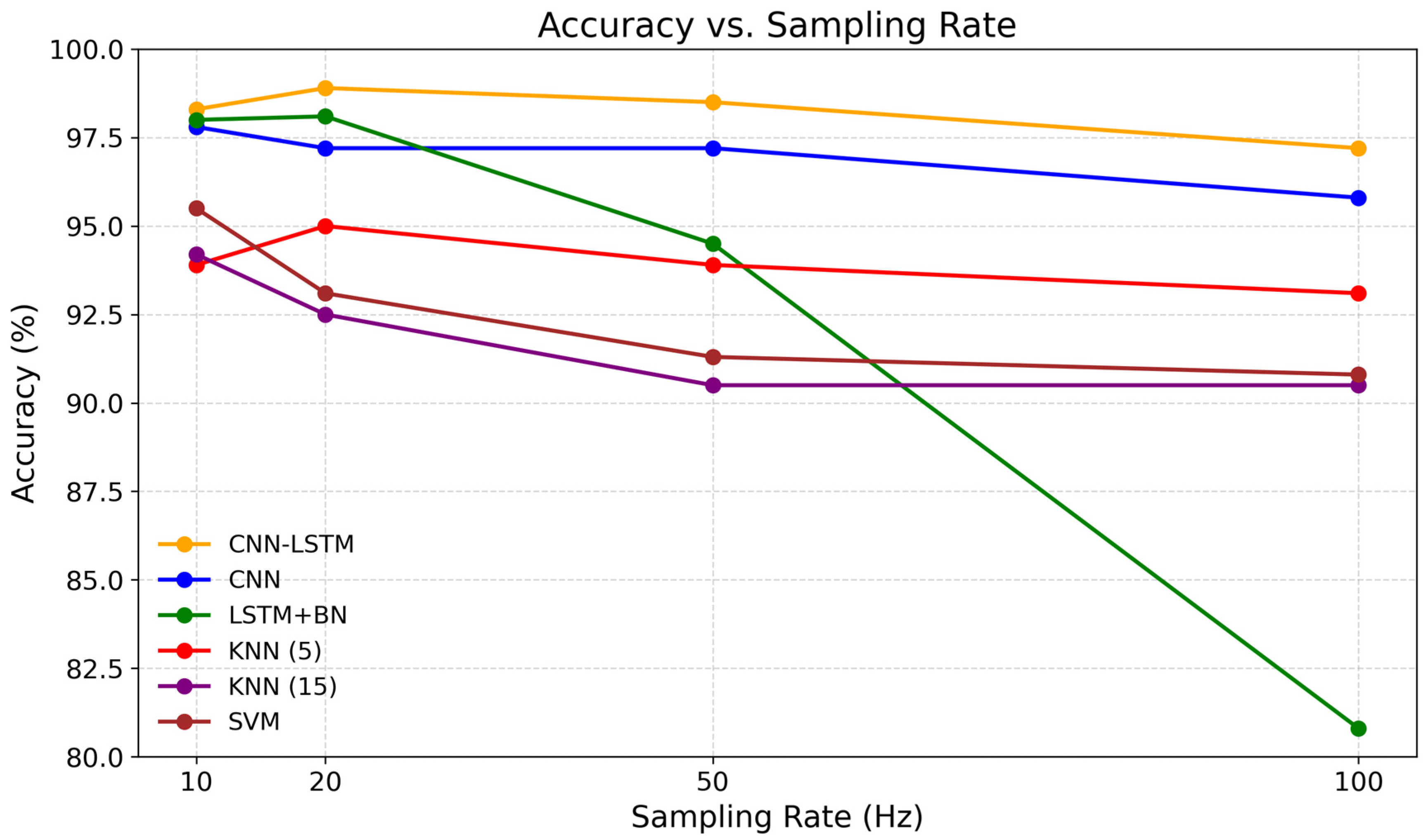
| Model | Sampling Rate (Hz) | Best Accuracy (%) | Sensitivity (%) | Specificity (%) | Accuracy (Mean (%) ± σ) |
|---|---|---|---|---|---|
| CNN-LSTM | 10 | 98.33 | 96.67 | 98.89 | 97.56 ± 0.77 |
| 20 | 98.89 | 96.67 | 99.63 | 98.11 ± 0.54 | |
| 50 | 98.61 | 97.78 | 98.89 | 97.33 ± 0.80 | |
| 100 | 97.22 | 97.78 | 97.04 | 96.06 ± 0.73 | |
| CNN | 10 | 97.78 | 96.67 | 98.15 | 97.61 ± 0.22 |
| 20 | 97.22 | 94.44 | 98.15 | 96.50 ± 0.52 | |
| 50 | 97.22 | 92.22 | 98.89 | 95.61 ± 1.13 | |
| 100 | 95.83 | 88.89 | 98.15 | 95.50 ± 0.27 | |
| LSTM (with Batch Norm) | 10 | 98.06 | 93.33 | 99.63 | 96.72 ± 0.75 |
| 20 | 98.06 | 95.56 | 98.89 | 97.06 ± 0.89 | |
| 50 | 94.44 | 96.67 | 93.70 | 89.72 ± 5.67 | |
| 100 | 80.83 | 37.78 | 95.19 | 79.94 ± 0.59 | |
| K-NN (5 neighbors) | 10 | 93.89 | 83.33 | 97.41 | N/A |
| 20 | 95.00 | 83.33 | 98.89 | ||
| 50 | 93.89 | 80.00 | 98.52 | ||
| 100 | 93.06 | 78.89 | 97.78 | ||
| K-NN (15 neighbors) | 10 | 94.17 | 83.33 | 97.78 | N/A |
| 20 | 92.50 | 70.00 | 100.00 | ||
| 50 | 90.56 | 64.44 | 99.26 | ||
| 100 | 90.56 | 62.22 | 100.00 | ||
| SVM | 10 | 95.56 | 93.33 | 96.30 | N/A |
| 20 | 93.06 | 90.00 | 94.07 | ||
| 50 | 91.39 | 90.00 | 91.85 | ||
| 100 | 90.83 | 90.00 | 91.11 |
| Model | Common Parameters and Model Configuration | Sampling Rate (Hz) | Best Accuracy (%) | Sensitivity (%) | Specificity (%) |
|---|---|---|---|---|---|
| CNN-LSTM | Window = 4 s; 70 epochs; 5 runs; Batch = 32; LSTM = 64–64; Dense = 128 + Dropout = 0.4; Optimizer = Adam; Loss = BCE; Output = Binary classification (Fall/No-Fall); Conv(32,64), Dropout = 0.2/0.2, no PrePool | 10 | 98.33 | 96.67 | 98.89 |
| 20 | 98.89 | 96.67 | 99.63 | ||
| 50 | 97.50 | 97.78 | 97.41 | ||
| 100 | 97.22 | 98.89 | 96.67 |
| Model | Sampling Rate (Hz) | Best Accuracy (%) | Sensitivity (%) | Specificity (%) |
|---|---|---|---|---|
| CNN-LSTM | 20 Hz | 98.89 | 96.67 | 99.63 |
| LSTM + BatchNorm | 20 Hz | 98.06 | 95.56 | 98.89 |
| CNN | 10 Hz | 97.78 | 96.67 | 98.15 |
| SVM | 10 Hz | 95.56 | 93.33 | 96.30 |
| KNN (5 neighbors) | 20 Hz | 95.00 | 83.33 | 98.89 |
| KNN (15 neighbors) | 10 Hz | 94.17 | 83.33 | 97.78 |
Disclaimer/Publisher’s Note: The statements, opinions and data contained in all publications are solely those of the individual author(s) and contributor(s) and not of MDPI and/or the editor(s). MDPI and/or the editor(s) disclaim responsibility for any injury to people or property resulting from any ideas, methods, instructions or products referred to in the content. |
© 2025 by the authors. Licensee MDPI, Basel, Switzerland. This article is an open access article distributed under the terms and conditions of the Creative Commons Attribution (CC BY) license.
Share and Cite
Villa, M.; Casilari, E. The Impact of the Accelerometer Sampling Rate on the Performance of Machine and Deep Learning Models in Wearable Fall-Detection Systems. Sensors 2026, 26, 162. https://doi.org/10.3390/s26010162
Villa M, Casilari E. The Impact of the Accelerometer Sampling Rate on the Performance of Machine and Deep Learning Models in Wearable Fall-Detection Systems. Sensors. 2026; 26(1):162. https://doi.org/10.3390/s26010162
Chicago/Turabian StyleVilla, Manny, and Eduardo Casilari. 2026. "The Impact of the Accelerometer Sampling Rate on the Performance of Machine and Deep Learning Models in Wearable Fall-Detection Systems" Sensors 26, no. 1: 162. https://doi.org/10.3390/s26010162
APA StyleVilla, M., & Casilari, E. (2026). The Impact of the Accelerometer Sampling Rate on the Performance of Machine and Deep Learning Models in Wearable Fall-Detection Systems. Sensors, 26(1), 162. https://doi.org/10.3390/s26010162