Review

Emerging Applications of Augmented and Mixed Reality Technologies in Motor Rehabilitation: A Scoping Review

1
LISiN—Laboratory for Engineering of the Neuromuscular System, Department of Electronics and Telecommunications, Politecnico di Torino, 10129 Turin, Italy
2
PoliToBIOMed Lab, Politecnico di Torino, 10129 Turin, Italy
3
Centre of Precision Rehabilitation for Spinal Pain (CPR Spine), School of Sport, Exercise and Rehabilitation Sciences, College of Life and Environmental Sciences, University of Birmingham, Birmingham B15 2TT, UK
*
Author to whom correspondence should be addressed.
Sensors 2025, 25(7), 2042; https://doi.org/10.3390/s25072042
Submission received: 14 February 2025 / Revised: 19 March 2025 / Accepted: 21 March 2025 / Published: 25 March 2025

Abstract

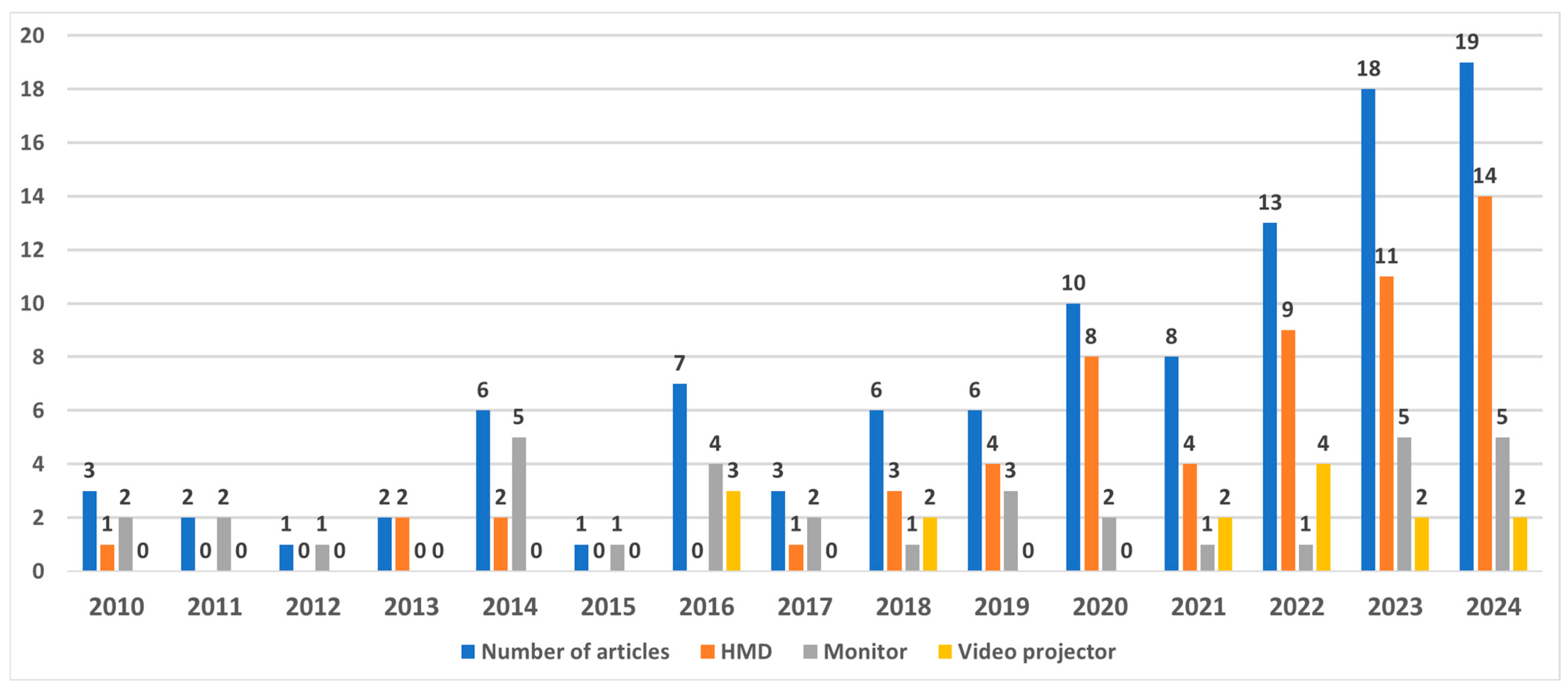
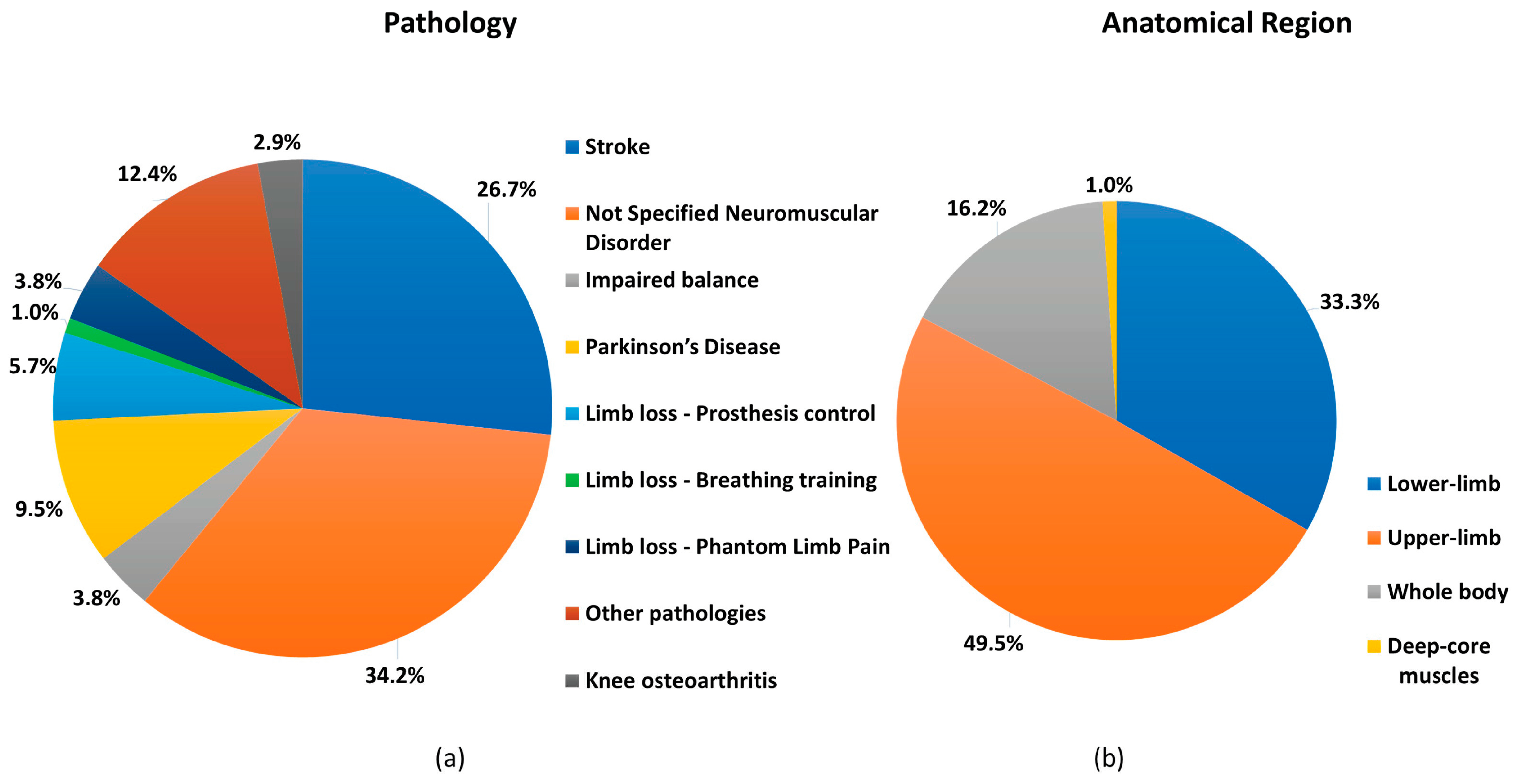
Background: Augmented Reality (AR) and Mixed Reality (MR) are emerging technologies with notable potential for motor rehabilitation. Given the novelty and breadth of this field, this scoping review aims to identify how and to what extent AR and MR technologies are used in motor rehabilitation. Methods: We conducted a search in Scopus and PubMed (2010–2024), following PRISMA-ScR guidelines. In the analysis, we focused on four key aspects: (I) the AR/MR display technologies, (II) the sensors used to collect data to generate the augmented information, (III) the pathologies addressed, and (IV) the assessment of usability and acceptability. Results: Among 105 selected studies, 58% developed new prototypes, while 42% tested existing systems. Head-mounted displays were the most common device (56.2%), followed by monitors (34.3%) and video projectors (14.3%). The most commonly used sensors were RGB-D cameras (31.4%), sensors for localization and mapping (33.3%), normal cameras (17.1%), and electromyography sensors (14.3%). Regarding the target pathology, 34.2% of studies did not focus on a specific pathology, 26.7% were on stroke, 10.5% on limb loss, and 9.5% on Parkinson’s disease. Over half (51.4%) of the studies investigated usability and acceptance. Conclusions: AR/MR technologies hold promise for motor rehabilitation, but limited comparative studies and long-term investigations currently hinder a clear understanding of their benefits.
Keywords: augmented reality; mixed reality; motor rehabilitation augmented reality; mixed reality; motor rehabilitation