Coded Aperture Optimization in X-Ray Computed Tomography via Sparse Covariance Matrix Estimation

Abstract
1. Introduction
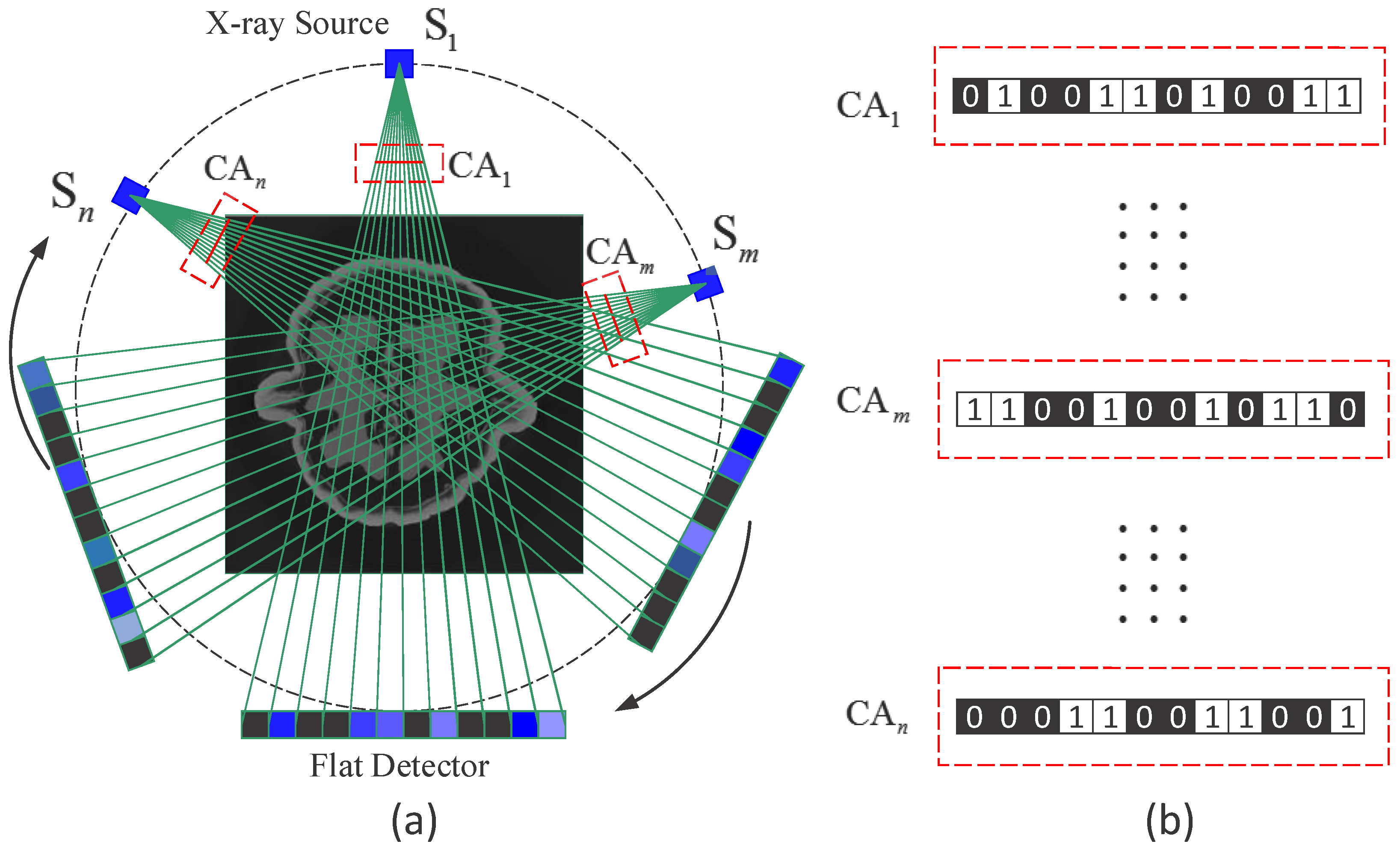
2. Forward Model
3. Coded Aperture Optimization
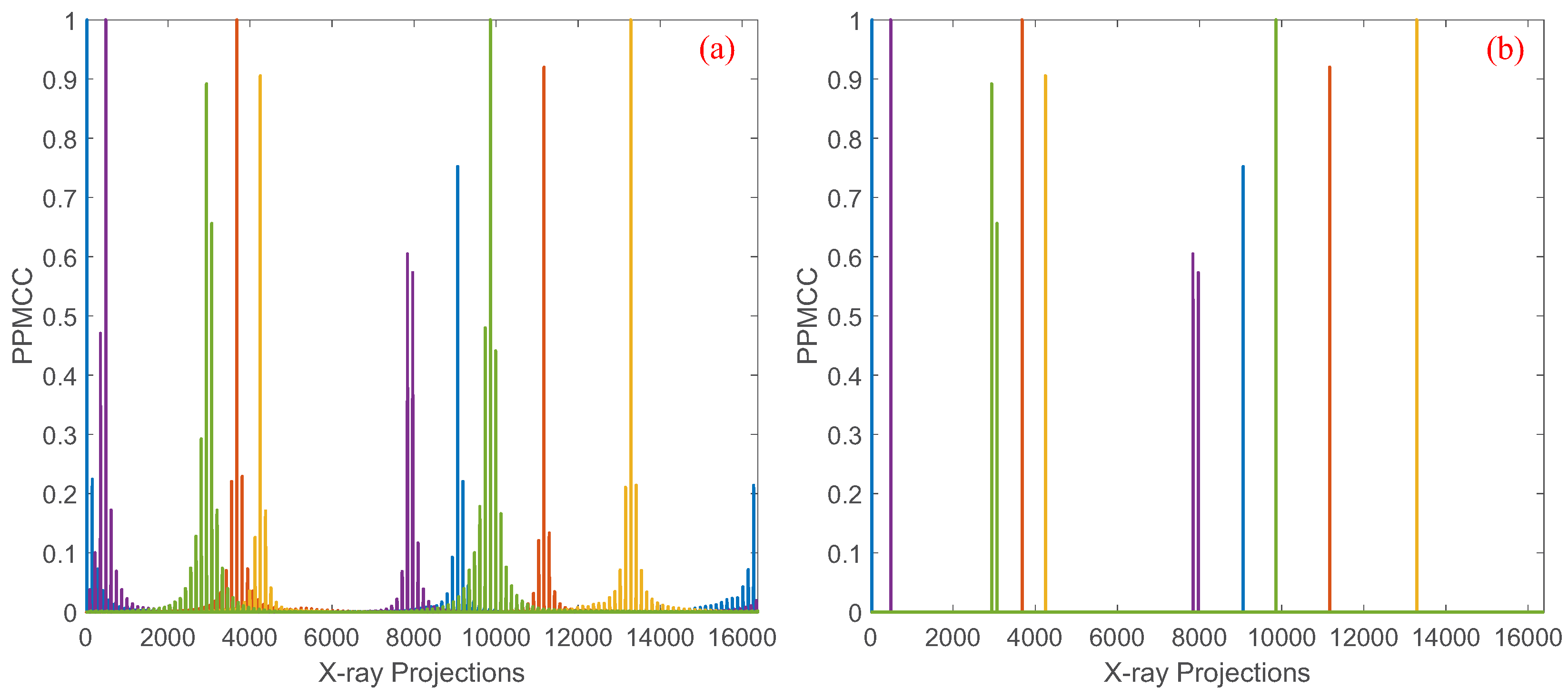
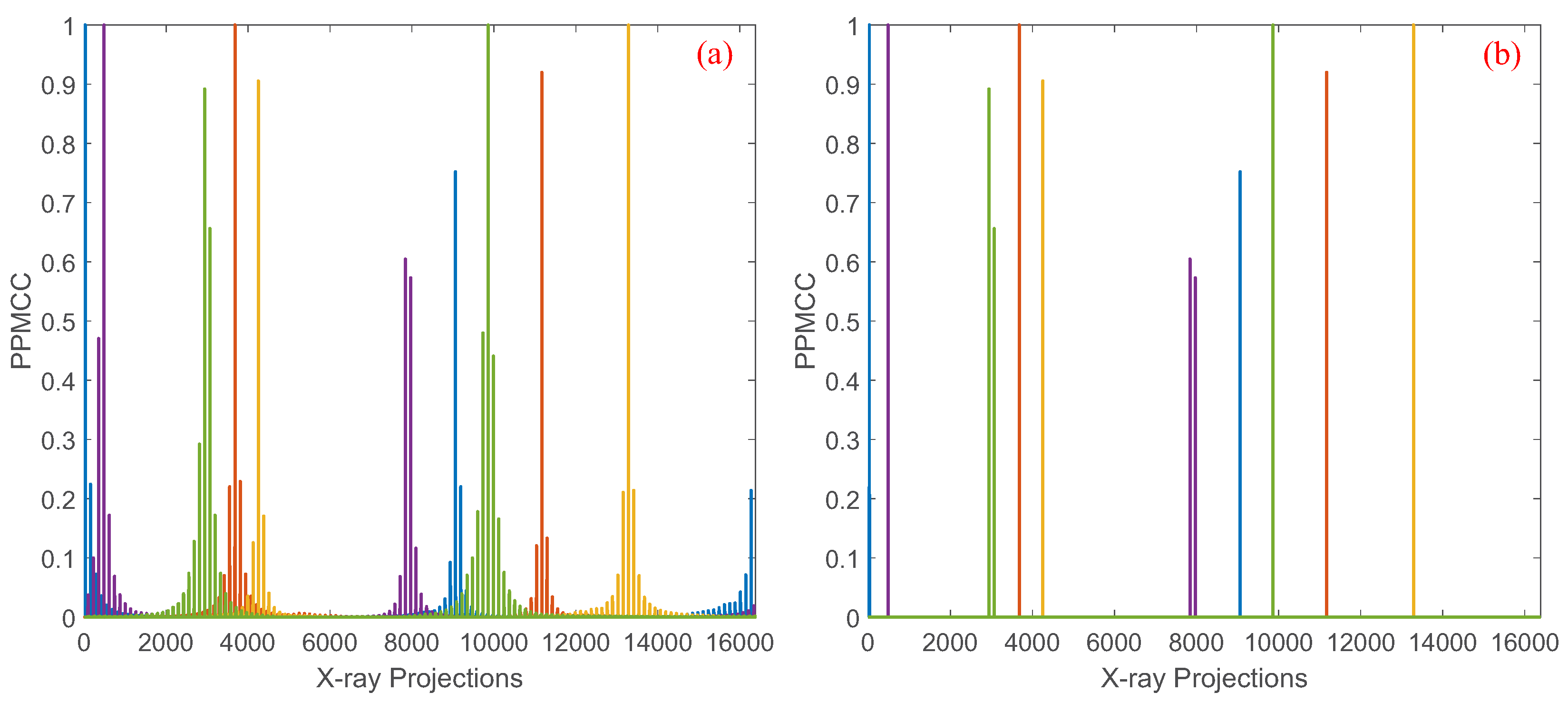
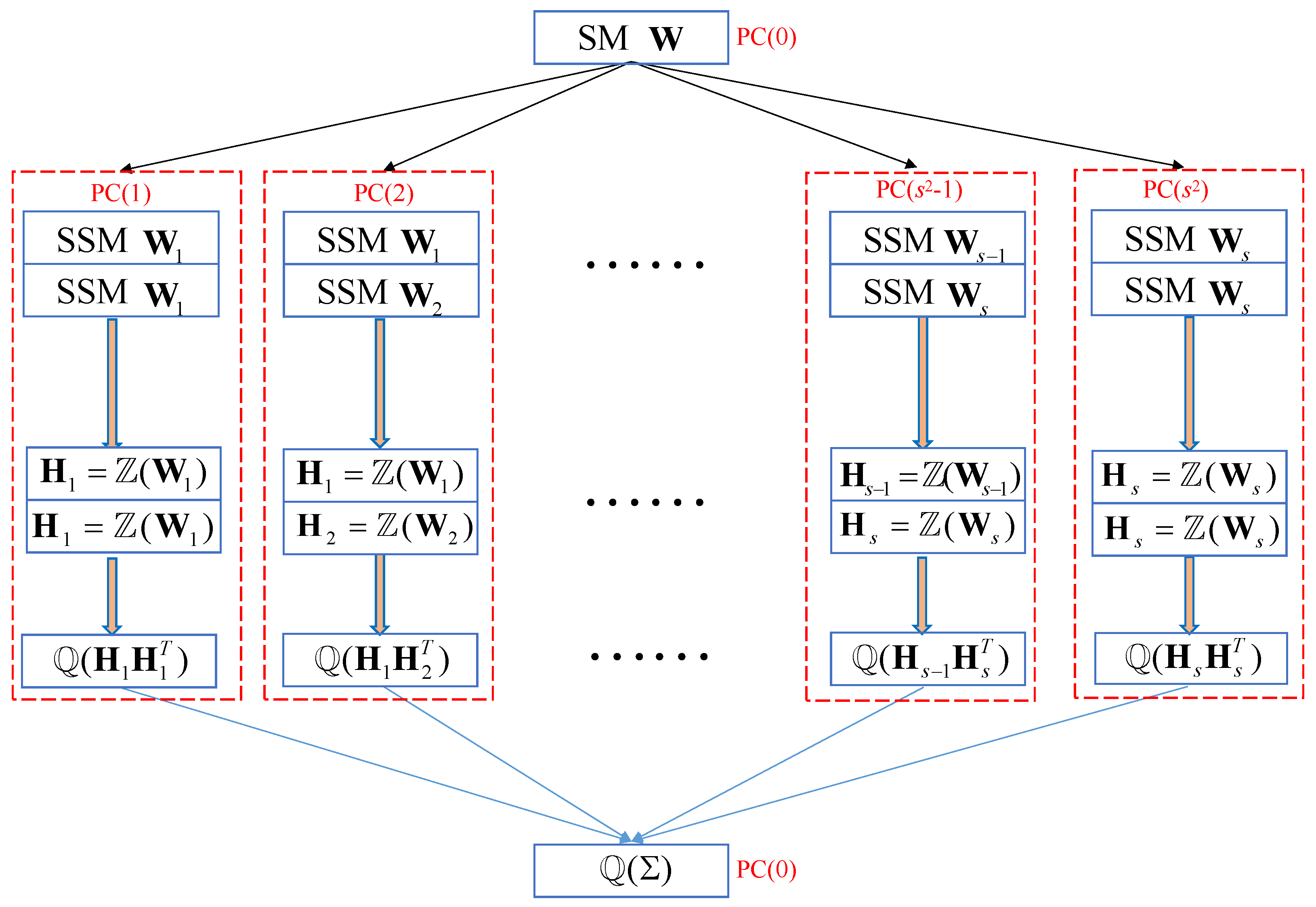
3.1. Sparse Correlation Estimation
3.2. Searching Algorithm
| Algorithm 1 Local optimization of coded apertures |
| Require: Sparse PPMCC matrix, ; Require: Number of iterations ; Require: and
|
4. Simulations
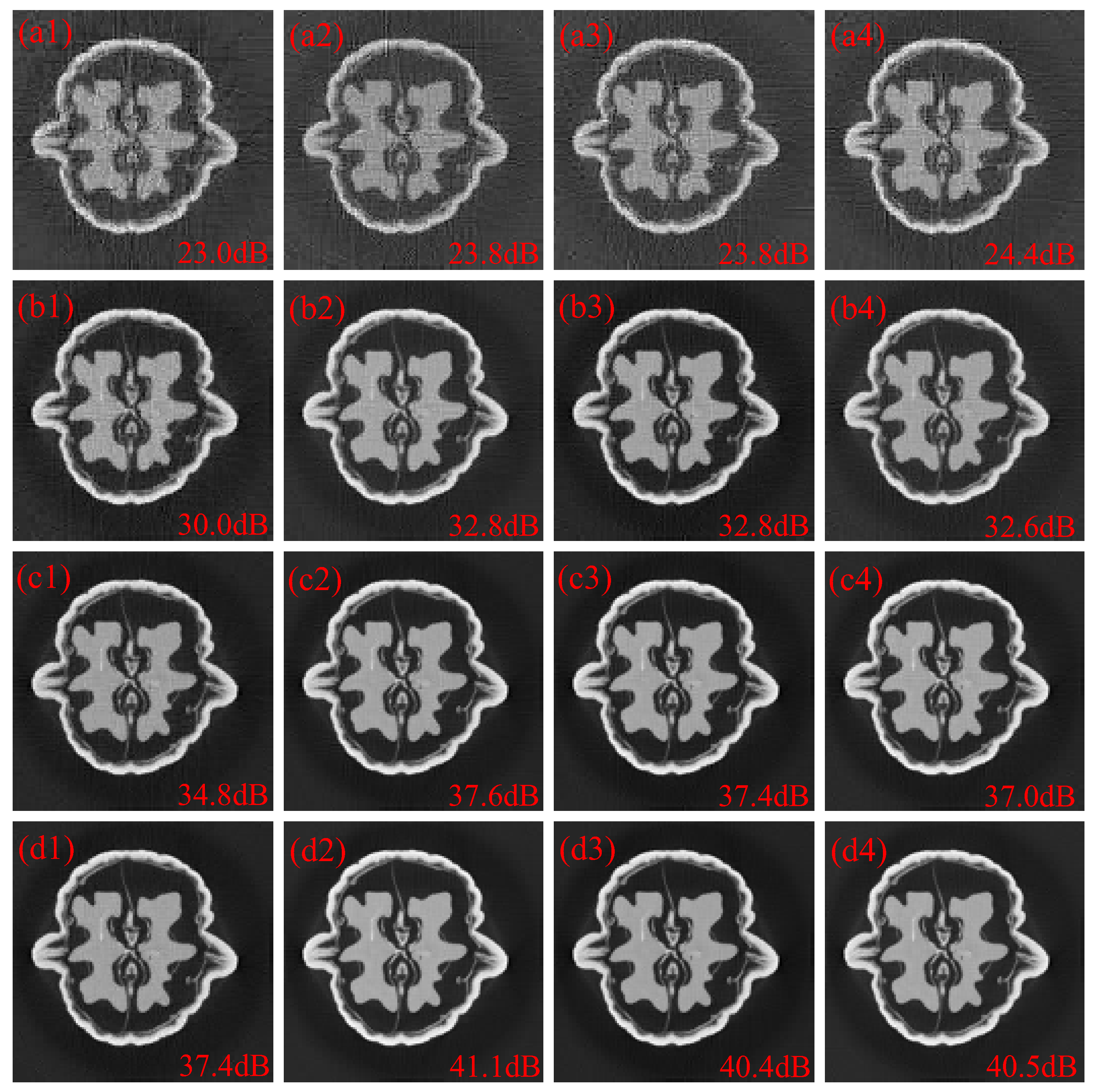
4.1. 128 × 128 Images
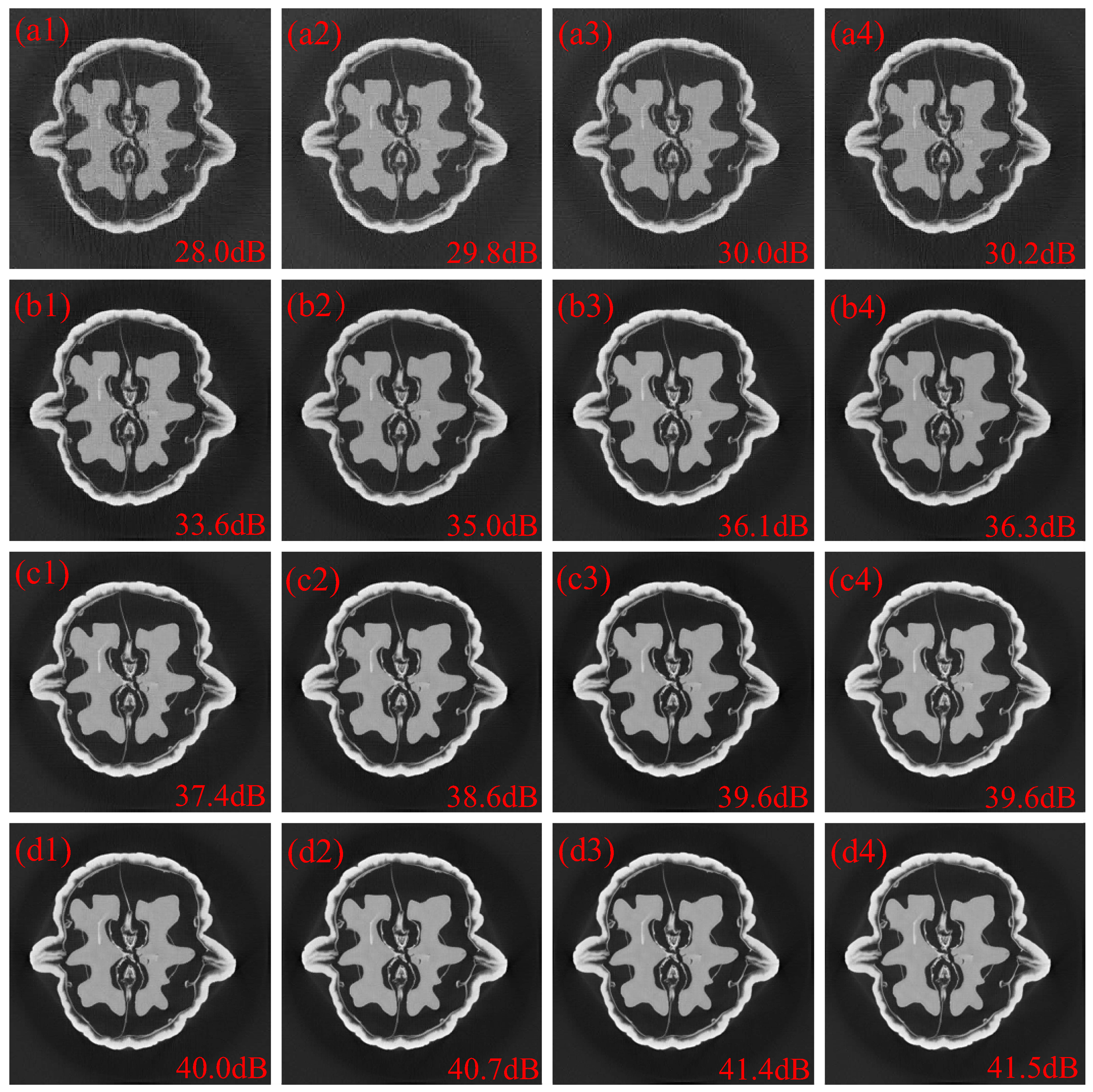
4.2. 256 × 256 Images
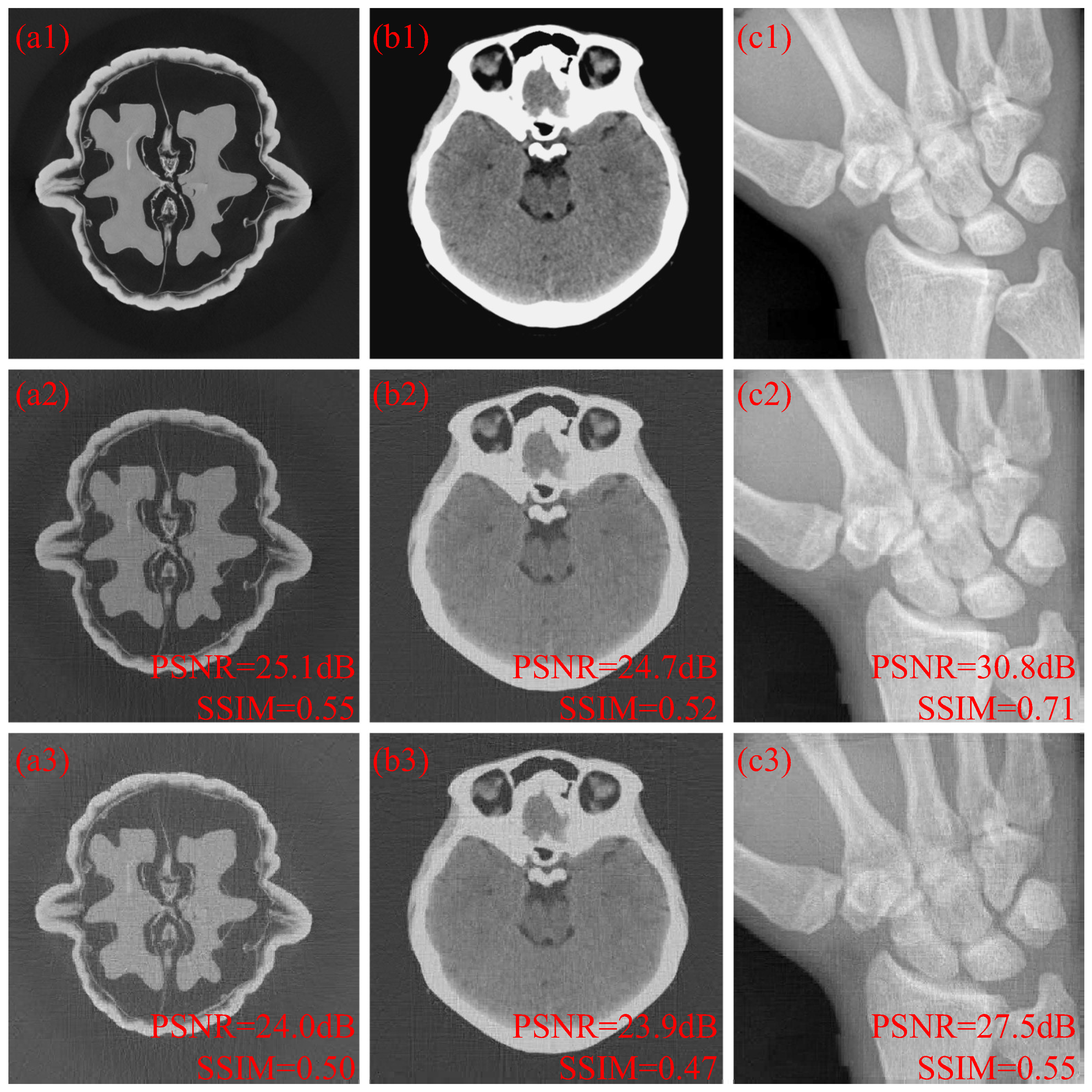
4.3. 512 × 512 Images
5. Conclusions
Author Contributions
Funding
Institutional Review Board Statement
Informed Consent Statement
Data Availability Statement
Conflicts of Interest
References
- Hsieh, J. Computed Tomography: Principles, Design, Artifacts, and Recent Advances; SPIE-The International Society for Optical Engineering Location: Bellingham, DC, USA, 2003. [Google Scholar]
- Stempert, R.; Boye, D. Volumetric Radiography of Watermarks. In Proceedings of the 84th Annual Meeting of the APS Southeastern Section, Milledgeville, GA, USA, 16–18 November 2017; Volume 62. [Google Scholar]
- Momose, A.; Takeda, T.; Itai, Y.; Hirano, K. Phase–contrast X–ray computed tomography for observing biological soft tissues. Nat. Med. 1996, 2, 473–475. [Google Scholar] [CrossRef] [Scilit] [PubMed]
- Natterer, F. Inversion ofthe attenuated Radon transform. Inverse Probl. 2001, 17, 113. [Google Scholar] [CrossRef] [Scilit]
- Smith, B.D. Image reconstruction from cone-beam projections: Necessary and sufficient conditions and reconstruction methods. IEEE Trans. Med. Imaging 2007, 4, 14–25. [Google Scholar] [CrossRef] [Scilit] [PubMed]
- Jorgensen, J.S.; Sidky, E.Y.; Pan, X. Quantifying admissible undersampling for sparsity-exploiting iterative image reconstruction in X-ray CT. IEEE Trans. Med. Imaging 2012, 32, 460–473. [Google Scholar] [CrossRef] [Scilit] [PubMed]
- Choi, K.; Brady, D.J. Coded aperture computed tomography. In Proceedings of the Adaptive Coded Aperture Imaging, Non-Imaging, and Unconventional Imaging Sensor Systems, San Diego, CA, USA, 2–6 August 2009; SPIE: Bellingham, WA, USA, 2009; Volume 7468, pp. 99–108. [Google Scholar]
- Cuadros, A.P.; Peitsch, C.; Arguello, H.; Arce, G.R. Coded aperture optimization for compressive X-ray tomosynthesis. Opt. Express 2015, 23, 32788–32802. [Google Scholar] [CrossRef] [Scilit] [PubMed]
- Zhao, Q.; Ma, X.; Restrepo, C.; Mao, T.; Zhang, T.; Ren, W.; Arce, G.R. Instant coded X-ray computed tomography via nonlinear reconstruction. Opt. Eng. 2023, 62, 068107. [Google Scholar] [CrossRef] [Scilit]
- Bacca, J.; Gelvez-Barrera, T.; Arguello, H. Deep coded aperture design: An end-to-end approach for computational imaging tasks. IEEE Trans. Comput. Imaging 2021, 7, 1148–1160. [Google Scholar] [CrossRef] [Scilit]
- Cuadros, A.P.; Arce, G.R. Coded aperture optimization in compressive X-ray tomography: A gradient descent approach. Opt. Express 2017, 25, 23833–23849. [Google Scholar] [CrossRef] [Scilit] [PubMed]
- Ma, X.; Zhao, Q.; Cuadros, A.; Mao, T.; Arce, G.R. Source and coded aperture joint optimization for compressive X-ray tomosynthesis. Opt. Express 2019, 27, 6640–6659. [Google Scholar] [CrossRef] [Scilit] [PubMed]
- Mejia, Y.; Arguello, H. Binary codification design for compressive imaging by uniform sensing. IEEE Trans. Image Process. 2018, 27, 5775–5786. [Google Scholar] [CrossRef] [Scilit] [PubMed]
- Mao, T.; Cuadros, A.P.; Ma, X.; He, W.; Chen, Q.; Arce, G.R. Fast optimization of coded apertures in X-ray computed tomography. Opt. Express 2018, 26, 24461–24478. [Google Scholar] [CrossRef] [Scilit] [PubMed]
- Mao, T.; Cuadros, A.P.; Ma, X.; He, W.; Chen, Q.; Arce, G.R. Coded aperture optimization in X-ray tomography via sparse principal component analysis. IEEE Trans. Comput. Imaging 2019, 6, 73–86. [Google Scholar] [CrossRef] [Scilit]
- Hasegawa, Y.; Yamada, Y.; Tamura, M.; Nomura, Y. Monte Carlo simulation of light transmission through living tissues. Appl. Opt. 1991, 30, 4515–4520. [Google Scholar] [CrossRef] [Scilit] [PubMed]
- Tillmann, A.M.; Pfetsch, M.E. The computational complexity of the restricted isometry property, the nullspace property, and related concepts in compressed sensing. IEEE Trans. Inf. Theory 2013, 60, 1248–1259. [Google Scholar] [CrossRef] [Scilit]
- Greub, W.H. Linear Algebra; Springer Science & Business Media: Heidelberg, Germany, 2012; Volume 23. [Google Scholar]
- Van Aarle, W.; Palenstijn, W.J.; Cant, J.; Janssens, E.; Bleichrodt, F.; Dabravolski, A.; De Beenhouwer, J.; Joost Batenburg, K.; Sijbers, J. Fast and flexible X-ray tomography using the ASTRA toolbox. Opt. Express 2016, 24, 25129–25147. [Google Scholar] [CrossRef] [Scilit] [PubMed]
- Hämäläinen, K.; Harhanen, L.; Kallonen, A.; Kujanpää, A.; Niemi, E.; Siltanen, S. Tomographic X-ray data of a walnut. arXiv 2015, arXiv:1502.04064. [Google Scholar] [CrossRef] [Scilit]
- Figueiredo, M.A.; Nowak, R.D.; Wright, S.J. Gradient projection for sparse reconstruction: Application to compressed sensing and other inverse problems. IEEE J. Sel. Top. Signal Process. 2008, 1, 586–597. [Google Scholar] [CrossRef] [Scilit]
- Arce, G.R.; Brady, D.J.; Carin, L.; Arguello, H.; Kittle, D.S. Compressive coded aperture spectral imaging: An introduction. IEEE Signal Process. Mag. 2013, 31, 105–115. [Google Scholar] [CrossRef] [Scilit]



| SR | 30% | 40% | 50% | 60% | 70% | 80% | 90% | 100% | |
|---|---|---|---|---|---|---|---|---|---|
| Random Method | PSNR | 22.99 | 27.49 | 29.91 | 32.41 | 34.77 | 35.90 | 37.37 | 38.99 |
| SSIM | 0.78 | 0.91 | 0.94 | 0.97 | 0.98 | 0.98 | 0.99 | 0.99 | |
| SPCA Method | PSNR | 23.75 | 29.73 | 32.83 | 35.53 | 37.59 | 39.69 | 41.14 | 41.82 |
| SSIM | 0.79 | 0.94 | 0.97 | 0.98 | 0.99 | 0.99 | 0.99 | 0.99 | |
| SCME | PSNR | 23.82 | 29.70 | 32.76 | 35.33 | 37.38 | 38.97 | 40.42 | 41.54 |
| SSIM | 0.79 | 0.94 | 0.97 | 0.98 | 0.99 | 0.99 | 0.99 | 0.99 | |
| SCME | PSNR | 24.43 | 29.53 | 32.61 | 35.08 | 37.04 | 39.01 | 40.49 | 41.56 |
| SSIM | 0.83 | 0.93 | 0.97 | 0.98 | 0.99 | 0.99 | 0.99 | 0.99 | |
| SCME | PSNR | 22.84 | 29.69 | 32.59 | 35.51 | 37.61 | 39.15 | 40.37 | 41.51 |
| SSIM | 0.75 | 0.94 | 0.97 | 0.98 | 0.99 | 0.99 | 0.99 | 0.99 | |
| SCME | PSNR | 23.25 | 29.33 | 32.41 | 35.18 | 37.10 | 39.69 | 40.68 | 41.76 |
| SSIM | 0.77 | 0.94 | 0.97 | 0.98 | 0.99 | 0.99 | 0.99 | 0.99 | |
| SCME | PSNR | 22.15 | 28.00 | 32.11 | 34.87 | 37.21 | 38.52 | 40.39 | 41.56 |
| SSIM | 0.73 | 0.91 | 0.96 | 0.98 | 0.99 | 0.99 | 0.99 | 0.99 |
| SR | 30% | 40% | 50% | 60% | 70% | 80% | 90% | 100% | |
|---|---|---|---|---|---|---|---|---|---|
| Random Method | PSNR | 28.07 | 31.11 | 33.58 | 35.54 | 37.41 | 38.63 | 39.93 | 41.20 |
| SSIM | 0.89 | 0.94 | 0.97 | 0.98 | 0.98 | 0.99 | 0.99 | 0.99 | |
| Separated Method | PSNR | 29.84 | 32.60 | 35.03 | 37.04 | 38.63 | 39.78 | 40.68 | 41.46 |
| SSIM | 0.93 | 0.96 | 0.97 | 0.98 | 0.99 | 0.99 | 0.99 | 0.99 | |
| SCME | PSNR | 30.07 | 33.65 | 36.12 | 38.05 | 39.61 | 40.52 | 41.37 | 42.07 |
| SSIM | 0.92 | 0.97 | 0.98 | 0.99 | 0.99 | 0.99 | 0.99 | 0.99 | |
| SCME | PSNR | 30.23 | 33.61 | 36.32 | 38.25 | 39.56 | 40.54 | 41.45 | 42.21 |
| SSIM | 0.93 | 0.97 | 0.98 | 0.99 | 0.99 | 0.99 | 0.99 | 0.99 | |
| SCME | PSNR | 29.82 | 32.87 | 35.49 | 37.66 | 39.64 | 41.00 | 41.68 | 42.41 |
| SSIM | 0.93 | 0.96 | 0.98 | 0.98 | 0.99 | 0.99 | 0.99 | 0.99 | |
| SCME | PSNR | 29.27 | 32.52 | 35.26 | 37.39 | 39.22 | 40.41 | 41.32 | 42.30 |
| SSIM | 0.92 | 0.96 | 0.98 | 0.98 | 0.99 | 0.99 | 0.99 | 0.99 |
Disclaimer/Publisher’s Note: The statements, opinions and data contained in all publications are solely those of the individual author(s) and contributor(s) and not of MDPI and/or the editor(s). MDPI and/or the editor(s) disclaim responsibility for any injury to people or property resulting from any ideas, methods, instructions or products referred to in the content. |
© 2025 by the authors. Licensee MDPI, Basel, Switzerland. This article is an open access article distributed under the terms and conditions of the Creative Commons Attribution (CC BY) license (https://creativecommons.org/licenses/by/4.0/).
Share and Cite
Jiang, Y.; Mao, T.; Zhou, J.; Zhao, Q.; Yin, J.; Yi, X.; Wu, H. Coded Aperture Optimization in X-Ray Computed Tomography via Sparse Covariance Matrix Estimation. Sensors 2025, 25, 7479. https://doi.org/10.3390/s25247479
Jiang Y, Mao T, Zhou J, Zhao Q, Yin J, Yi X, Wu H. Coded Aperture Optimization in X-Ray Computed Tomography via Sparse Covariance Matrix Estimation. Sensors. 2025; 25(24):7479. https://doi.org/10.3390/s25247479
Chicago/Turabian StyleJiang, Yuqi, Tianyi Mao, Jianyong Zhou, Qile Zhao, Jun Yin, Xuedong Yi, and Haiyou Wu. 2025. "Coded Aperture Optimization in X-Ray Computed Tomography via Sparse Covariance Matrix Estimation" Sensors 25, no. 24: 7479. https://doi.org/10.3390/s25247479
APA StyleJiang, Y., Mao, T., Zhou, J., Zhao, Q., Yin, J., Yi, X., & Wu, H. (2025). Coded Aperture Optimization in X-Ray Computed Tomography via Sparse Covariance Matrix Estimation. Sensors, 25(24), 7479. https://doi.org/10.3390/s25247479