Abstract
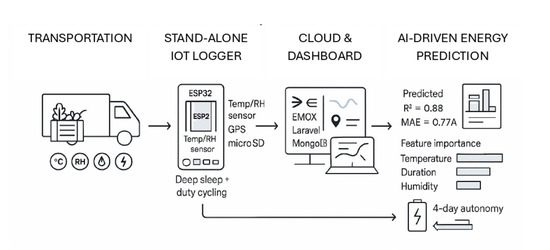
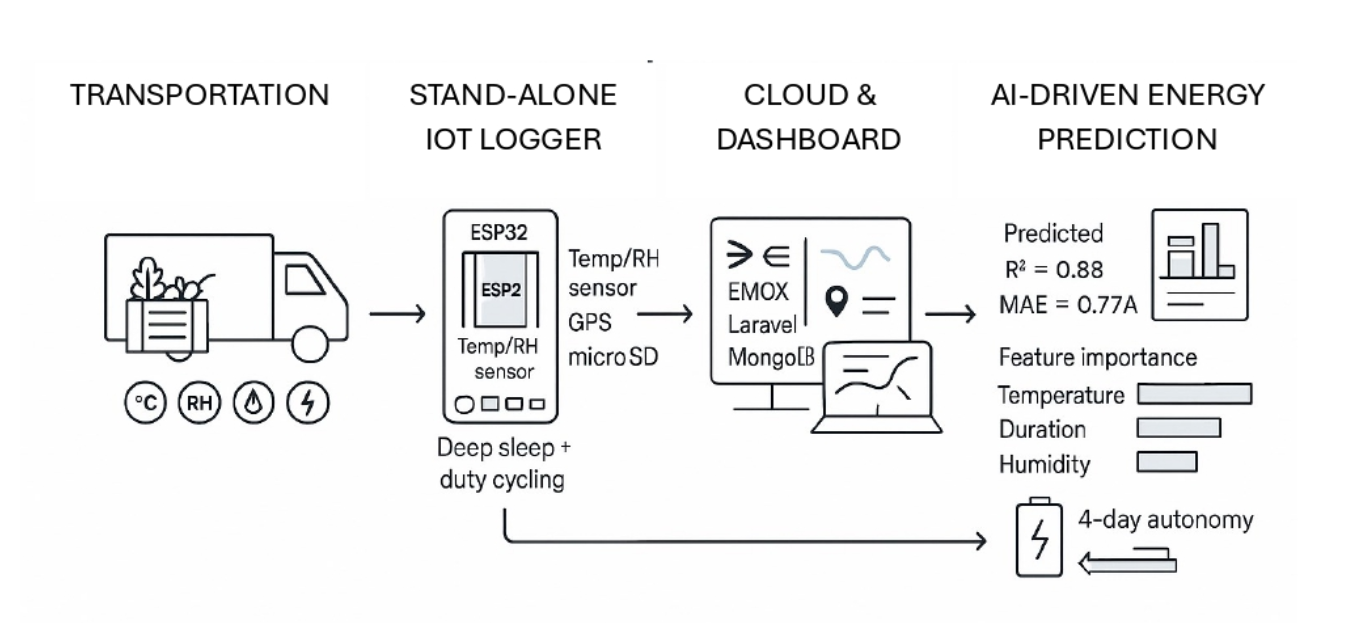
Temperature and humidity excursions during transport accelerate quality loss in fresh produce. This study develops and validates a self-contained Internet of Things (IoT) platform for in-transit monitoring and energy-aware operation. The battery-powered device operates independently of vehicle power and continuously logs temperature, relative humidity, GPS position, and onboard power draw. Power budgeting combines firmware-level deep-sleep scheduling with a LiFePO4 battery pack, enabling uninterrupted operation for up to four days. Using ∼10,000 time-stamped observations collected over four consecutive days in a standard dry truck (non-commercial validation), we trained and compared Gradient Boosting Machine (GBM), Random Forest (RF), and Linear Regression (LR) models to predict energy consumption under varying environmental and routing conditions. GBM and LR achieved high explanatory power () with a mean absolute error of 0.77 A·h, while RF provided interpretable feature importance data, identifying temperature as the dominant driver, followed by trip duration and humidity. The end-to-end system integrates an EMQX MQTT broker, a Laravel web application, MongoDB storage, and Node-RED flows for real-time dashboards and multi-day historical analytics. The proposed platform supports proactive decision-making in perishable logistics, with the AI analysis validating that the collected time-aligned on-route data can configure sampling/transmit cadence to preserve autonomy under stressful conditions.
1. Introduction
Fresh fruits and vegetables are highly susceptible to temperature and relative humidity (RH) excursions during transport; even brief spikes accelerate senescence, moisture loss, and microbial activity, shortening their shelf life and eroding their value. Passive interventions—such as pre-cooling and composite thermal insulation—can mitigate heat load, as demonstrated in postharvest studies of okra and related produce [1,2,3]. Yet, passive measures do not detect on-route fluctuations, adapt to events, or provide traceability at the granularity required for modern logistics, indicating the need for a self-contained Internet of Things (IoT) platform that combines continuous sensing with energy-aware operation and analytics, designed to function reliably without tapping vehicle power.
Related Studies
This subsection reviews prior research on the use of IoT for agriculture and food logistics, offline data logging with integrity, supply-chain analytics, and edge/AI systems for energy-aware operation, and highlights the gaps in the literature that motivated the proposal of our system.
Over the past decade, IoT has matured from pilots to large-scale systems employed in field sensing, networked telemetry, and cloud/edge analytics. Surveys and scoping studies demonstrate its benefits in terms of productivity gains, labor reduction, and decision support in agriculture, but also emphasize hurdles in its adoption, interoperability, and governance [4,5,6,7,8,9,10,11,12]. Within agri-food logistics, reference architectures and domain syntheses focus on end-to-end traceability and near-real-time decision support that integrate sensor streams with logistics information systems [13,14,15,16,17,18]. This study supports a design that binds environmental telemetry to route and time contexts (GPS, duration) and implements it in operator dashboards.
Transport corridors often experience coverage gaps; so, robust local logging with authenticated backfill is as critical as live streaming. A recent study by Garrido-López et al. [19] demonstrates the practical implementation of cellular IoT data loggers for monitoring perishable goods, achieving approximately one month of battery autonomy through optimized power consumption strategies in NB-IoT-enabled devices validated across refrigerated-transport routes. Studies on secure loggers, integrity checking, and connected-vehicle integration highlight patterns in the adoption of microSD persistence, periodic synchronization, and verifiable transfers to the cloud [20,21,22,23,24]. These design cues indicate the need for an offline-first workflow with device-scoped topics and access control so that records remain continuous across signal dropouts [25,26,27,28,29,30,31].
Studies across supply-chain analytics, inventory tracking, and forecasting show how continuous environmental data improves resource allocation and quality control [32,33,34,35,36,37,38,39,40,41,42,43,44]. Complementary studies on IoT logistics and fleet systems (e.g., context-aware transport, roadside units, vehicle telemetry) demonstrate gains in visibility and efficiency but typically assume stable power or infrastructure [45,46,47,48,49,50,51,52,53,54,55,56,57,58].
Processing closer to the source reduces latency and uplink dependence, enabling resilient, responsive monitoring in the field [59]. In parallel, reviews and applications of AI in agriculture and agri-food logistics show that lightweight, interpretable models can deliver practical value on modest datasets, particularly for resource-constrained systems [13,60]. Recent advances in ensemble modeling for cold-chain applications demonstrate improved prediction accuracy; for example, Luo et al. [61] reported that a K-medoids + long short-term memory (LSTM) + XGBoost ensemble achieved a mean absolute error of 2.5343 for temperature prediction in agricultural cold-chain loading environments, demonstrating the value of hybrid approaches for thermal dynamics modeling. Taken together, these ideas indicate the need for edge-centric designs in which firmware power policies and ML prediction co-evolve.
Beyond agriculture and logistics, operational energy forecasting has been investigated in several domains, including emergency responses, smart homes, manufacturing, and healthcare facilities. A recent study on time-series methods for use in emergency contexts highlights the role of short-horizon forecasting in supporting decision-making during critical events [62]. Actor–critic energy management schemes for smart homes use predictive models to schedule loads under dynamic tariffs [63], while deep learning has been applied to energy forecasting and condition monitoring in the manufacturing sector [64], and systematic reviews have synthesized AI-based energy prediction in healthcare facilities [65]. These cross-domain studies reinforce the value of compact, operational energy predictors and motivate our use of lightweight models for battery budgeting in perishable logistics.
Despite progress in this field, two practical solutions for perishable logistics need to be established: (i) stand-alone autonomy—battery-operated devices that operate reliably across multi-day domestic routes without vehicle power; (ii) operationalized energy analytics—models that explain and predict power draw as conditions change so that sampling, transmission, and battery sizing can be tuned proactively. Existing IoT deployments in agriculture and transport seldom integrate these capabilities within one deployable platform [1,2,3,4,5,6,7,8,9,10,11,12,13,14,15,16,17,18,20,21,22,23,24,25,26,27,28,29,30,31,32,33,34,35,36,37,38,39,40,41,42,43,44,45,46,47,48,49,50,51,52,53,54,55,56,57,58,59,60]. While progress has been made in IoT power management, rahman et al. [66] demonstrate that hybrid long short-term memory (LSTM) and gated recurrent unit (GRU) architectures can achieve effective power forecasting in IoT environmental monitoring systems (R2 82.04%, MAE 3.78%), providing a foundation for energy-aware operation in resource-constrained deployments.
Device-level studies on perishable goods/food transport generally emphasize traceability and continuous cloud visibility, often assuming vehicle power or cellular backhaul. For example, Pal and Kant [16] outline an IoT sensing infrastructure for fresh-food supply chains that relies on gateways and stable connectivity, while Bhutta and Ahmad [57] focus on secure identification and real-time cloud updates via cellular links. In contrast, our design is a vehicle-independent, battery-first logger that fuses Temp/RH, GPS, and onboard energy; operates in real-time and on-device with near-real-time cloud updates when in range; and guarantees verified backfill across coverage gaps encountered on domestic dry-truck routes. To address these gaps, we develop a battery-powered, ESP32-based data logger that continuously records temperature, RH, GPS, and onboard power draw; implements firmware-level deep-sleep scheduling; and sustains multi-day autonomy using a LiFePO4 pack. In deployment, the logger connects via an 802.11 network to a battery-powered cellular (4G-SIM) router for WAN access, enabling near-real-time cloud updates when coverage exists, and authenticated backfill otherwise; multiple nodes can share the same SSID while publishing to device-scoped topics with separate credentials. Using ∼10,000 time-stamped observations collected over four transport days, we train and compare Linear Regression (LR), Gradient Boosting Machine (GBM), and Random Forest (RF) models to predict energy consumption under changing environmental and routing conditions. In our experiments, LR and GBM provide high explanatory power (), while RF yields comparable errors and interpretable feature importance (temperature > duration > humidity), informing our choice of firmware policy and battery size. The end-to-end stack integrates EMQX (MQTT), a Laravel web application, MongoDB, and Node-RED for real-time dashboards and multi-day historical analytics. Distinct from prior traceability-focused deployments, our design couples vehicle-independent uplink with authenticated backfill and operationally uses short-horizon energy prediction to guarantee a ≥3-day autonomy target (4 days of autonomy were achieved) without vehicle power.
2. Development of the IoT-Based Monitoring System
2.1. System Architecture
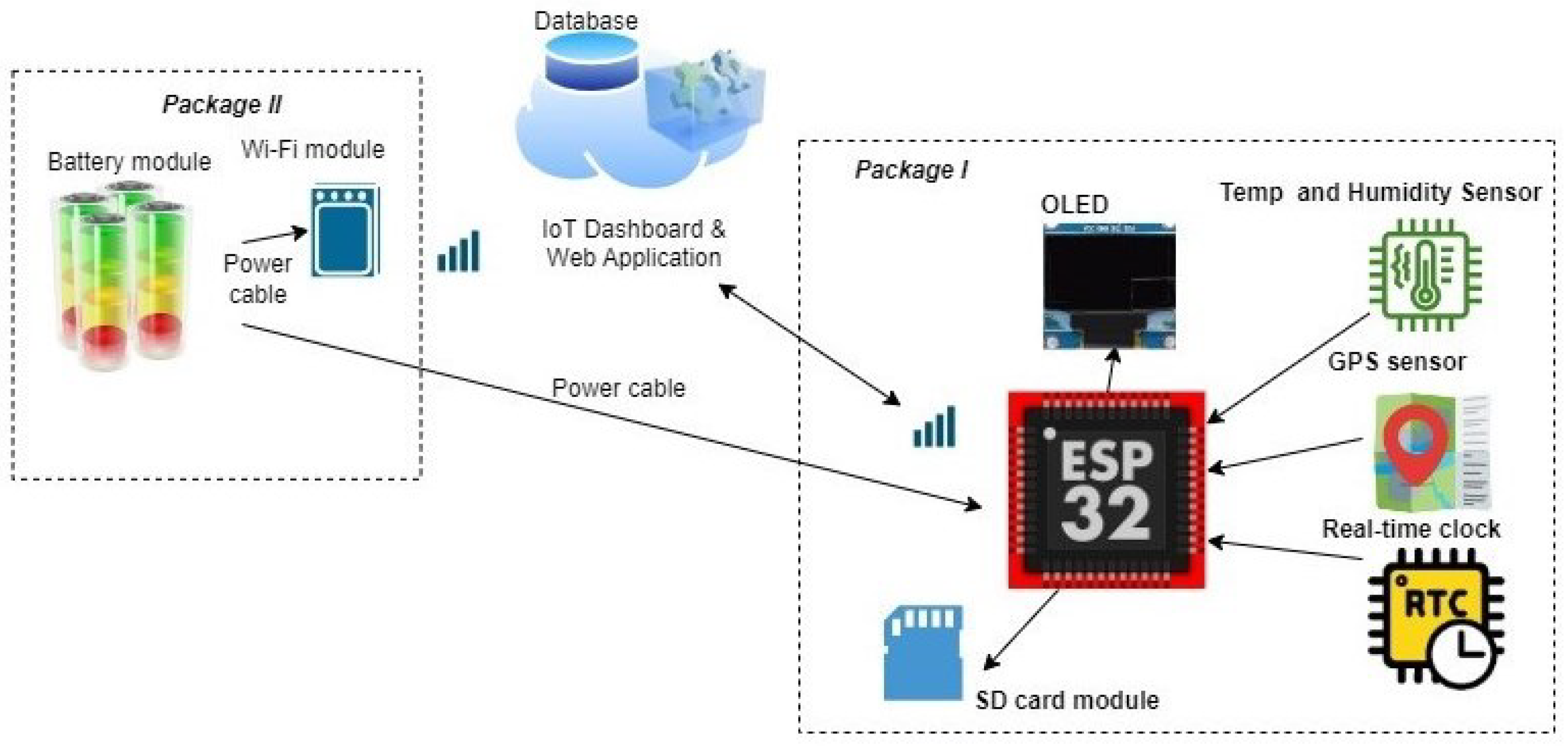
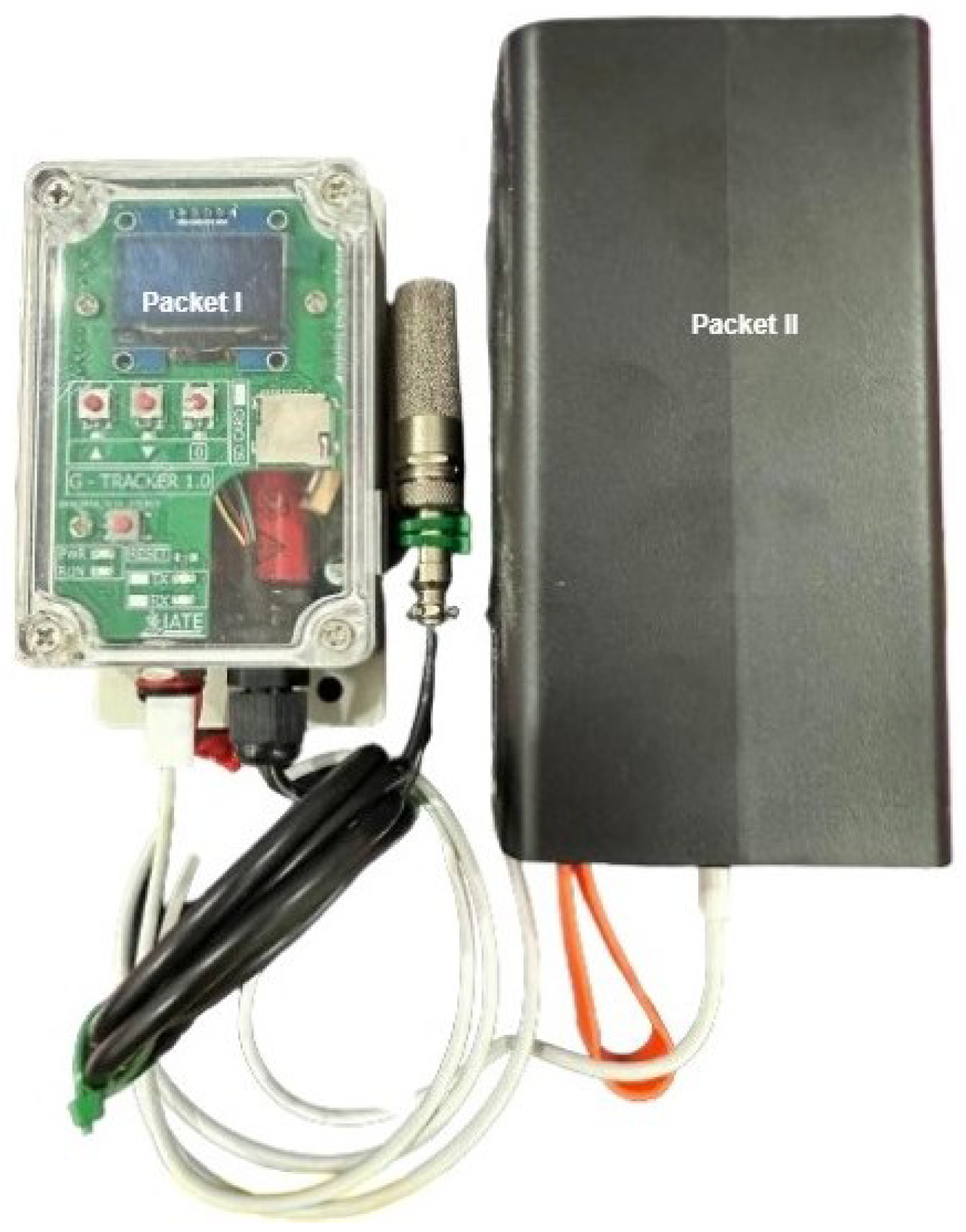
The platform follows a two-package layout to simplify installation and ensure electrical isolation. Packet I houses a sensing and compute system: an ESP32 microcontroller with Wi-Fi/Bluetooth, a calibrated temperature/RH sensor, a GPS module, a real-time clock (RTC), and a microSD card for resilient local logging. Packet II contains power and connectivity: a LiFePO4 battery pack with protection, DC–DC conversion (12 V and 5 V rails), and a Wi-Fi modem. The units are coupled via a keyed harness with over-current protection. Environmental measurements and GPS are timestamped on-device and published via MQTT when a link is available; otherwise, records accumulate locally and are backfilled upon reconnection. A web application renders live and historical views with user-level access controls. Figure 1 presents the system architecture. The components of this system are as follows:
Figure 1.
The system architecture.
2.2. Designed Hardware
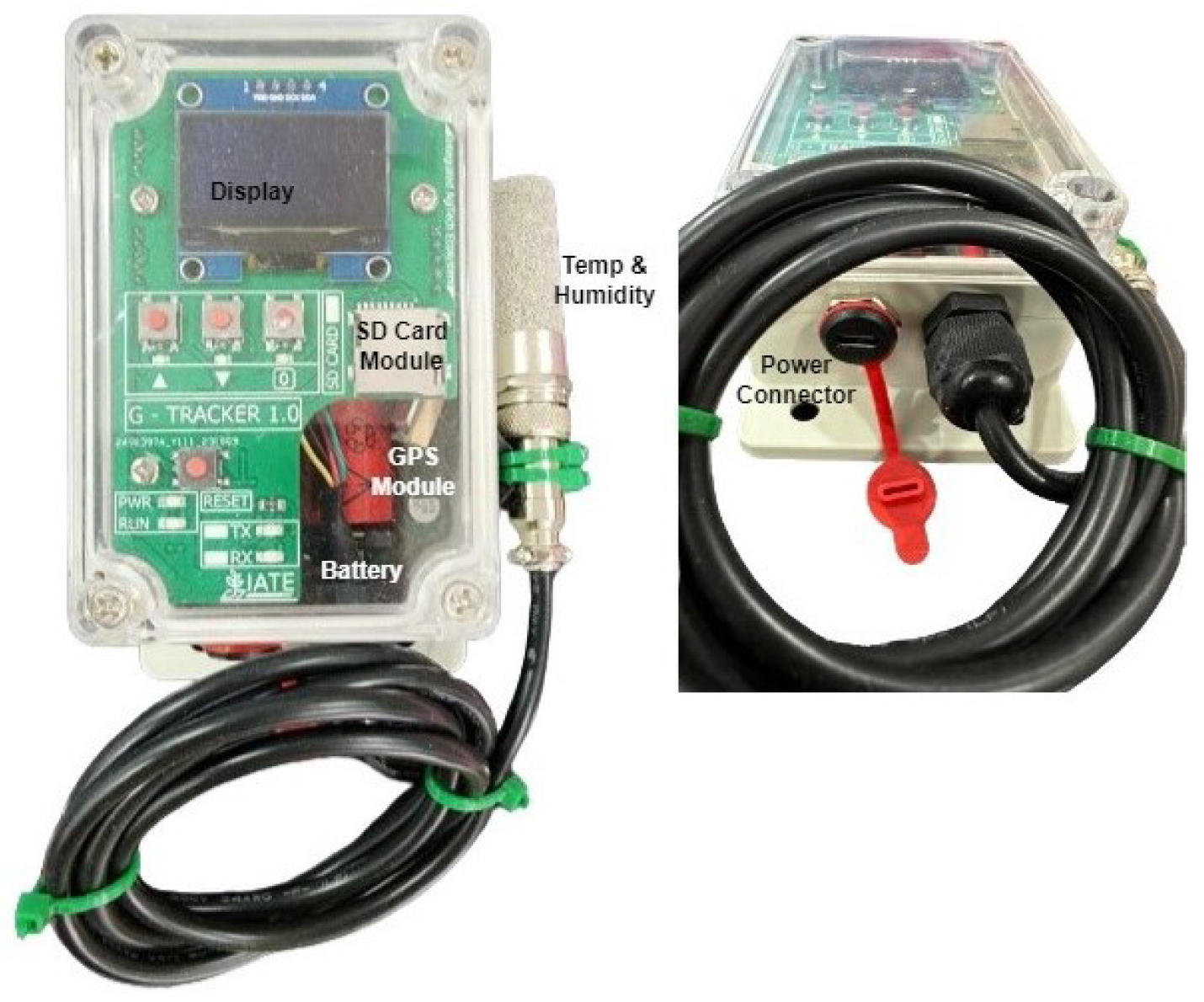
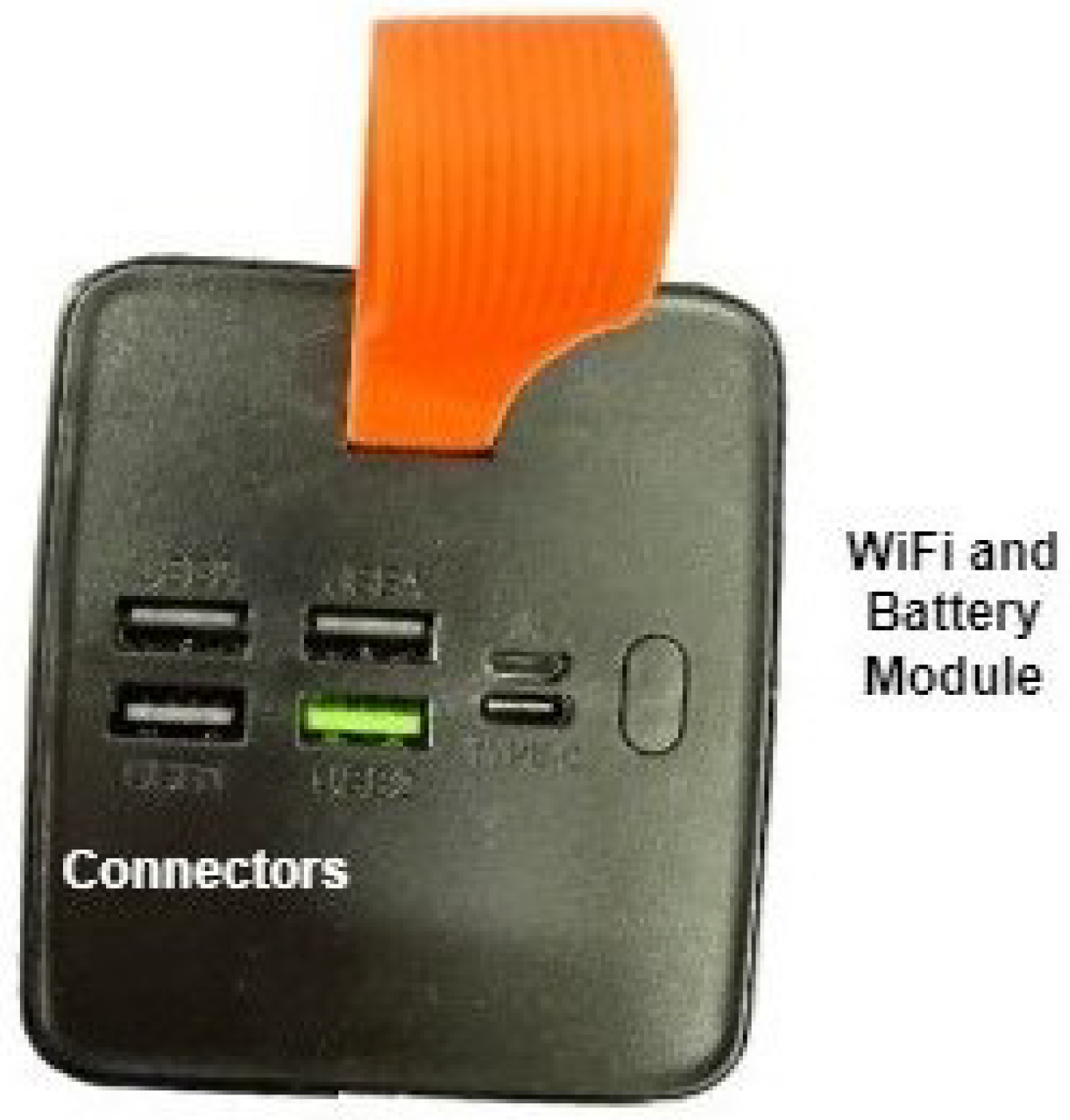
The ESP32 orchestrates sampling, storage, and transmission. The SHT-class digital sensor provides temperature (–40 °C to +125 °C) and 0–100% RH coverage. A NEO-6M GPS module reports position and speed to indicate route context and travel duration. The RTC maintains stable timekeeping throughout deep-sleep cycles, and a level-shifted microSD interface (SPI) provides sufficient storage during coverage gaps. The power stage employs a LiFePO4 pack with an adequate size for multi-day autonomy, with conversion efficiency and thermal limits accounted for in the budget. All connectors are vibration-rated, and EMI/ESD design rules are observed to protect the MCU and sensor lines. The design of the controller board is shown in Figure 2, Figure 3 and Figure 4. The sensing head is mounted near the cargo midline at approximately a 1.5 m height, away from walls and door gaps to reduce boundary-layer effects; multi-node layouts for spatial gradients will be addressed in future research.
Figure 2.
The system controller module (packet I).
Figure 3.
The power supply and internet module (packet II).
Figure 4.
The connection between packets I and II of the ITEMS system.
The controller is an ESP32-WROOM32 (Espressif Systems, Shanghai, China)(dual-core MCU with integrated 802.11 b/g/n), and temperature and RH are measured by an SHT3x-class digital sensor (I2C; –40 °C to +125 °C; 0–100 %RH; factory calibration). A u-blox NEO-6M GPS module (UART, 1 Hz NMEA) provides position and speed, while a DS3231 RTC (I2C; ±2 ppm) maintains timekeeping throughout deep sleep. Local persistence uses a microSD card (SPI, FAT32) with CSV records of the form {timestamp, seq_id, T, RH, lat, lon, speed, energy, CRC16}. For WAN access, the device connects over an 802.11 network to a battery-powered 4G-SIM router (vehicle-independent uplink) and publishes via MQTT over TCP (EMQX) to device-scoped topics with per-device credentials, QoS 1, and retained configuration; records carry a monotonic seq_id and CRC16, and the backend performs idempotent inserts keyed by (device, seq_id). Multiple sensor nodes can share the same SSID and publish concurrently under separate topics.
2.3. Communication and Data Flow
An EMQX MQTT broker mediates device topics, and a Laravel web application exposes role-based dashboards and APIs; MongoDB stores time-series documents for multi-day analysis, while Node-RED flows drive real-time visualization and alerting. Devices connect via an 802.11 network to a battery-powered 4G-SIM router (vehicle-independent uplink) and publish via MQTT over TCP to device-scoped topics with per-device credentials and retained configuration. Payloads carry a monotonic seq_id and CRC16; the backend performs idempotent inserts keyed by (device, seq_id) to prevent duplication. When WAN coverage drops, the device continues to perform real-time on-device sensing and logs measurements to the microSD; on reconnection, it replays buffered records in order for authenticated backfill. Multiple sensor nodes can share the same SSID and publish concurrently under separate topics. For fast dashboard rendering, latitude and longitude are rounded in the display, while the stored time series and CSV exports retain the precise coordinates. This opportunistic MQTT pattern (real-time on-device; near-real-time to cloud when in range) maintains visibility across the route and yields a synchronized stream used to validate simple configuration rules for sampling and transmit cadence.
3. Materials and Methods
The proposed platform targets domestic-produce transport using low-cost dry trucks. Across four consecutive days, the device logged temperature (°C), RH (%), GPS position/speed, RTC timestamps, and onboard power draw data to the microSD, uploading the data via MQTT opportunistically. Field trials were conducted in a standard dry truck over representative urban–peri-urban corridors to validate system reliability, online/offline continuity, and multi-day autonomy. Live, commercial produce shipments were not included at this stage; the goal was to exercise sensing, logging, and backhaul under realistic motion/coverage conditions prior to goods-specific trials.
Data schema and precision. The CSV records include precise latitude/longitude (6 decimal places; last 4–5 digits vary by fix), e.g., ..., 19.907263, 99.832147, .... To ensure UI responsiveness, the dashboard displays rounded coordinates (to two decimal places), while the backend and exports retain the precise coordinates.
3.1. Dataset and Preprocessing
Time stamps were aligned at 1 Hz. Short gaps (≤5 s) caused by mobility and handovers were linearly interpolated, while longer gaps remained (no imputation) and were backfilled to the cloud upon reconnection. To suppress transition spikes around lab→vehicle handovers, we applied an interquartile-range (IQR) filter with a Tukey multiplier , computed independently each day day and for each device. No additional smoothing was performed. Features were scaled (min–max) with parameters fitted on the training folds only and applied to the held-out test. For fast dashboard rendering, latitude and longitude were rounded in the display, while the stored time series and CSV exports retained the precise coordinates. Over the four days, daily record counts were approximately balanced at ∼2400–2700 per day (total ∼10,000).
3.2. Train/Test Split, Cross-Validation, and Metrics
A chronological 80/20 split was used to emulate forward-looking generalization. Model selection relied on 5-fold cross-validation within the training window. We report the mean absolute error (MAE), mean squared error (MSE), and coefficient of determination () for the held-out window; to reduce route-specific leakage, cross-validated selections were reapplied to the held-out split.
3.3. Models and Hyperparameters
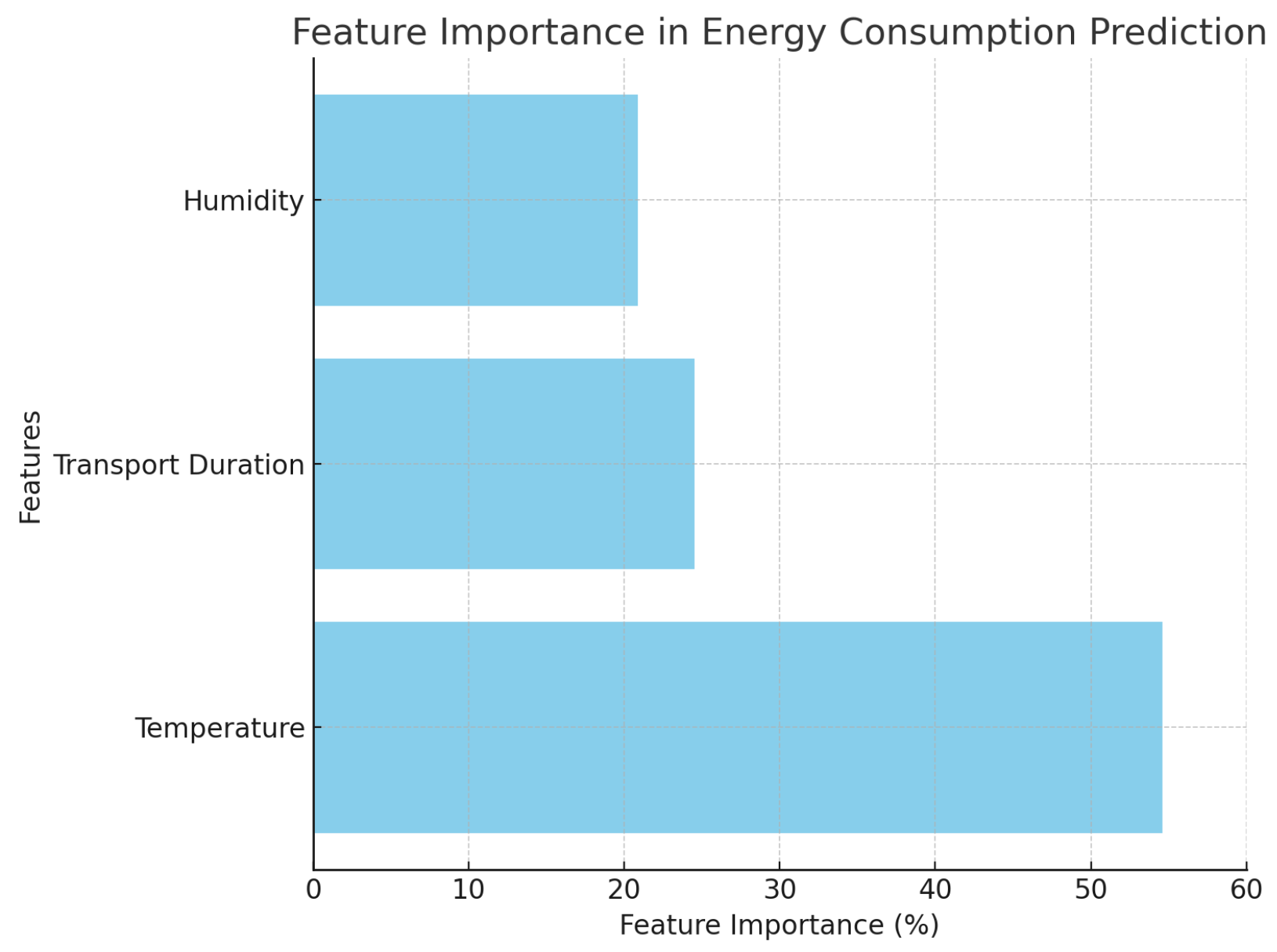
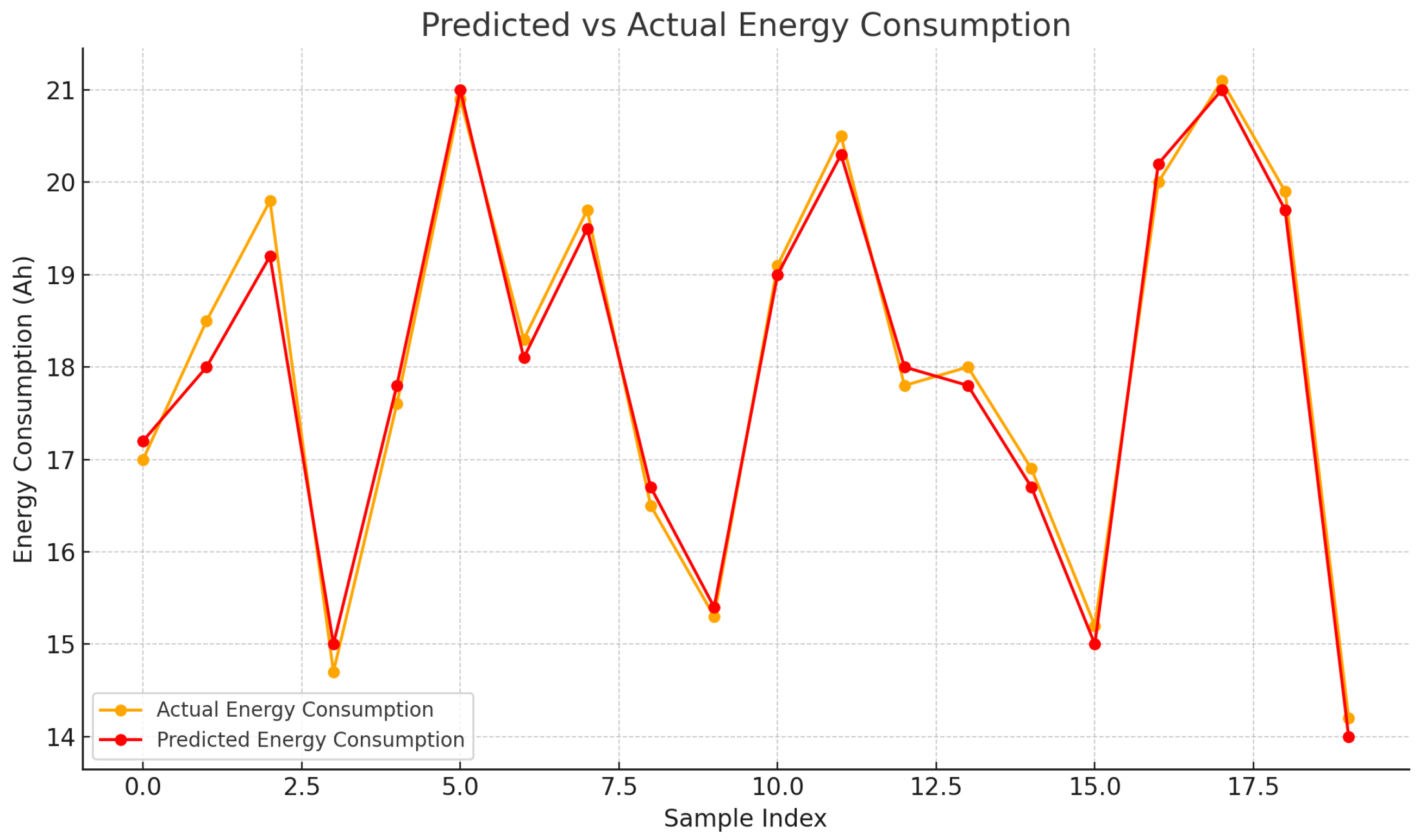
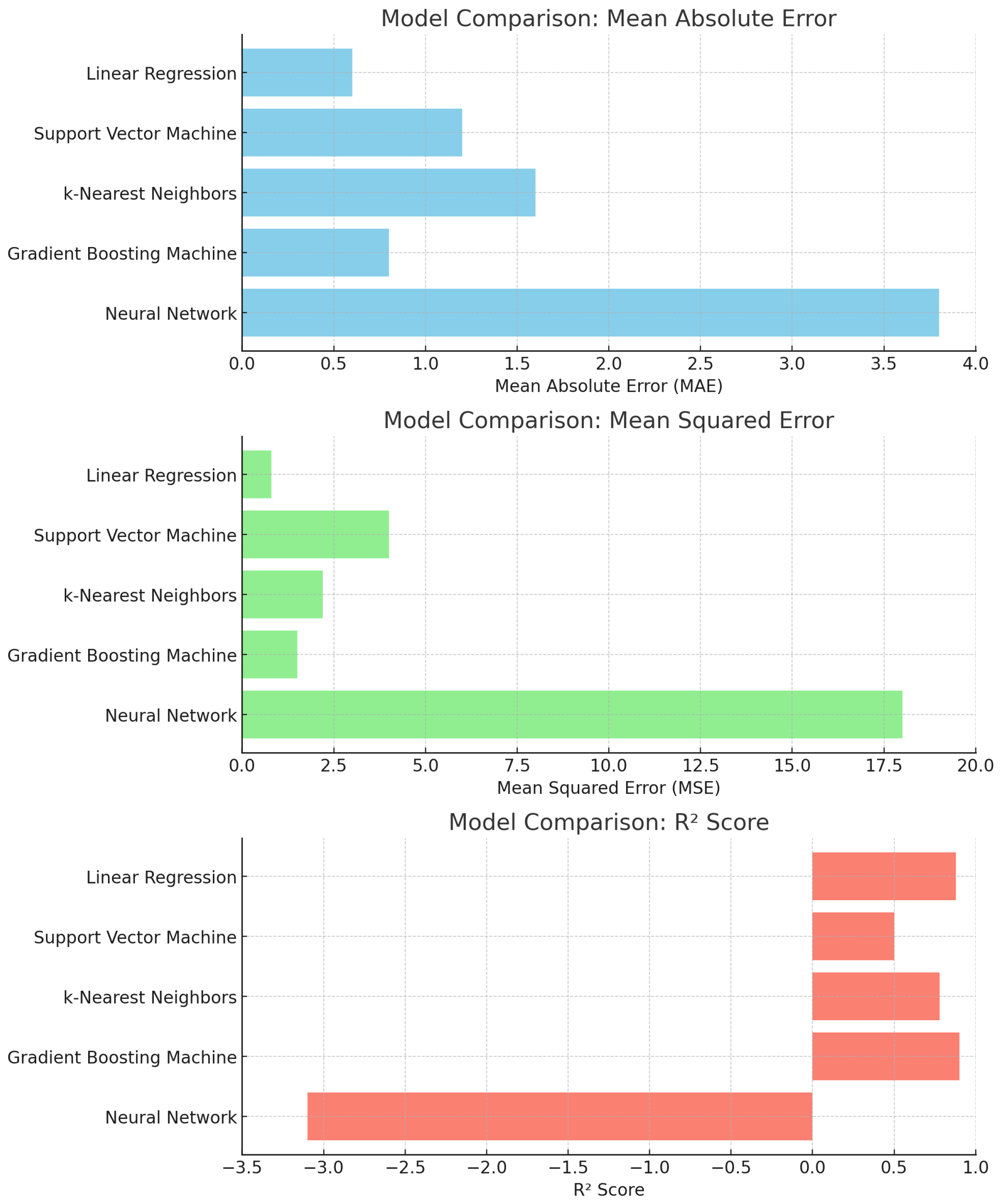
We evaluated the following lightweight regressors suitable for edge-constrained telemetry: Linear Regression (LR), Gradient Boosting Machine (GBM), Random Forest (RF), k-Nearest Neighbors (k-NN), Support Vector Machine (SVM, RBF kernel), and a small multilayer perceptron (MLP). Five of these (LR, SVM, k-NN, GBM, and MLP) represent the main candidate models in the aggregate comparison plot (Figure 5), while RF is used primarily as an interpretable ensemble to provide feature importance (Figure 6) and predicted-vs-actual data (Figure 7); its performance metrics are reported in Section 4.2.
Figure 5.
Model performance comparison (MAE, MSE, R2) across the five base models: LR, SVM, k-NN, GBM, and MLP (Neural Network). Random Forest (RF) obtains an MAE and R2 comparable to those of LR/GBM, and is discussed separately in Section 4.2 and Figure 6 and Figure 7.
Figure 6.
Feature importance (Random Forest) for predicting short-horizon energy consumption. Bars show normalized importance; temperature dominates, followed by transport duration and RH.
Figure 7.
Predicted vs. actual energy consumption on the held-out set (RF).
3.3.1. Feature Set
The predictors comprise temperature (°C), relative humidity (%), route duration (elapsed minutes), and transmission activity, with the latter defined as the count of MQTT publications in the trailing 60 min window (continuous). No interaction terms were included in the main models, as the focus is on operational prediction.
3.3.2. Configuration
The representative settings were as follows: RF (100–200 trees, max depth 10–20, minimum split 2–5); GBM (learning rate 0.1, 100–200 estimators); SVM (RBF, , ); k-NN (); MLP (two hidden layers, 64–128 units, ReLU, Adam). The grid search was nested within the cross-validation.
Rationale and energy-awareness: This subsection consolidates the above information regarding “Energy-Aware Analytics”: The the models are trained to predict power draw as a function of ambient temperature, RH, route duration, and transmission activity, with the aim of informing firmware duty-cycling and battery sizing. The performance metrics and feature importance for the trained models are reported and interpreted in Section 4, where we also discuss how they feed back into sampling cadence, radio coalescing, and reserve management.
3.3.3. Baselines
For context, we computed mean and persistence (last-value) baselines on the same chronological split; both underperformed compared to the learned models.
3.4. Power-Budget Modeling
The average draw is modeled as
Notation: and (mA) denote the average module currents in active and sleep states under the deployed firmware profile; and are the corresponding duty fractions (with for a given module). Daily requirements in A·h are obtained by time-weighting and summing across modules over a 24 h mission.
Measurement Protocol (Power)
Module currents were bench-measured under the deployed firmware profile. For each module, active and sleep currents were recorded with a precision DMM/data logger (resolution ≤1 mA) at a nominal 12.8 V, first in isolation and then in situ with the controller to confirm consistency. Each measurement covered multiple duty cycles (2 s active, 3 s sleep) and was averaged over repeated runs at a stable lab temperature. These values are represented by and in (1).
Table 1 presents the module-wise daily requirements with a 5 s cycle (2 s active, 3 s sleep) across modules, which balances excursion-detection latency during loading/stops against daily draw to meet the ≥3 day autonomy target (longer 10–30 s cycles reduce draw but may miss short heat spikes; the observed 4-day endurance indicates an adequate margin at 5 s); the total is 24.620 A·h day−1. For four days, the capacity is 98.482 A·h, and adding a 30% reserve yields 128.027 A·h. A 4S × 6P LiFePO4 configuration (24 cells, nominal 12.8 V, 132 A·h) satisfies the voltage and capacity targets.
Table 1.
Module’s daily power requirement (24 h mission, 5 s cycles).
4. Results
4.1. Energy Consumption and Battery Sizing
Applying (1) and scaling it to four days gave 98.482 A·h; with a 30% reserve, the required pack was 128.027 A·h. A 4S × 6P LiFePO4 pack (12.8 V, 132 A·h) met both the nominal voltage and capacity targets in bench trials across multiple four-day runs.
Purpose of the AI (Energy Consumption Prediction)
In our system, we use lightweight models (LR, GBM, RF) for short-horizon energy consumption prediction. This serves two practical purposes: (i) verification of the selected LiFePO4 pack against a ≥3-day autonomy target (4 days of autonomy was demonstrated), and (ii) simplified device configuration when stress increases (shorter sampling, more frequent burst transmission, and a reserve safeguard). The AI is therefore operational and system-facing rather than a stand-alone ML tool. Across the bench and field trials, the logger completed all four-day runs without brown-out, and the measured depth of discharge remained within the 30% reserve margin established by the analytical budget. In practice, the predictor is used to maintain this safety margin: when the forecast approaches the daily budget, the device switches to a more conservative profile (Section 4.2) so that a one-day reserve is preserved. A detailed comparison of total energy use against a fixed, non-adaptive policy is beyond the scope of the present study, but represents an avenue for future research.
4.2. Model Performance and Feature Importance
Across ∼10,000 samples, LR and GBM explained a large share of variance (), with the test MAE close to 0.77 A·h. On the same chronological split, the mean and persistence (last-value) baselines yielded higher errors and lower than LR/GBM/RF, confirming that the learned models meaningfully outperform trivial predictors. Residual plots showed no obvious trend of or inflation in variance across the operating range. RF achieved comparable errors while offering interpretable attributions: temperature was the dominant predictor in the fitted models, followed by route duration and RH (e.g., ∼55%, 25%, 20%). The multilayer perceptron (MLP) underperforms compared to the linear and tree-based models on this dataset. We attribute this to the relatively small sample size (∼10,000 records across four days) and the low-dimensional, nearly monotonic relationship between the predictors (temperature, RH, elapsed duration, transmission activity) and power draw. In this regime, a more flexible neural architecture offers limited benefits and can overfit without careful regularization, whereas well-tuned linear and ensemble models already capture the dominant trends. Importance is reported as permutation importance on the RF model, and pairwise correlations and variance-inflation checks do not indicate severe multicollinearity among the predictors. These predictions were used only to validate simple adjustments (shorter sampling and more frequent bursts during high temperatures) while keeping a one-day reserve; the primary focus remains on the system’s reliable data acquisition and continuity. We selected LR and GBM for their strong accuracy (test , MAE A·h), and RF for its interpretability; these predictions are used only for sizing verification and simplifying the configuration of the deployed logger. The permutation importance for RF is shown in Figure 6, while Figure 5 reports the MAE/MSE/R2 for the five base models (LR, SVM, k-NN, GBM, and MLP); RF achieves MAE and R2 values comparable to those of LR and GBM (see above), but is omitted from the bar chart to keep the comparison uncluttered. Figure 7 focuses on RF as the most interpretable ensemble, showing the predicted versus actual energy consumption on the held-out set.
Operational Countermeasures (Derived from Predictions)
To maintain a focus on the designed system, we use the energy predictor only to validate simple, actionable configuration of the device. When the consumption over the next 24 h is forecast to exceed , the day budget and ambient temperature increase, and the logger shortens the sampling interval (e.g., 60 s → 30 s) and increases burst transmit frequency (e.g., 10 min → 5 min) to improve excursion visibility. If the pack is projected to drop below a one-day reserve, the device switches to a low-power profile (e.g., 90 s sampling; deferring non-urgent uplink until coverage becomes available) and raises a dashboard alert that the pack should be swapped at the next hub. If residuals spike (potential anomaly), the current policy is retained and an alert is issued indicating a need for operator inspection. This process demonstrates that the behavior of the system can be simplified without changing the system-first operation.
4.3. Field Prototype and Telemetry
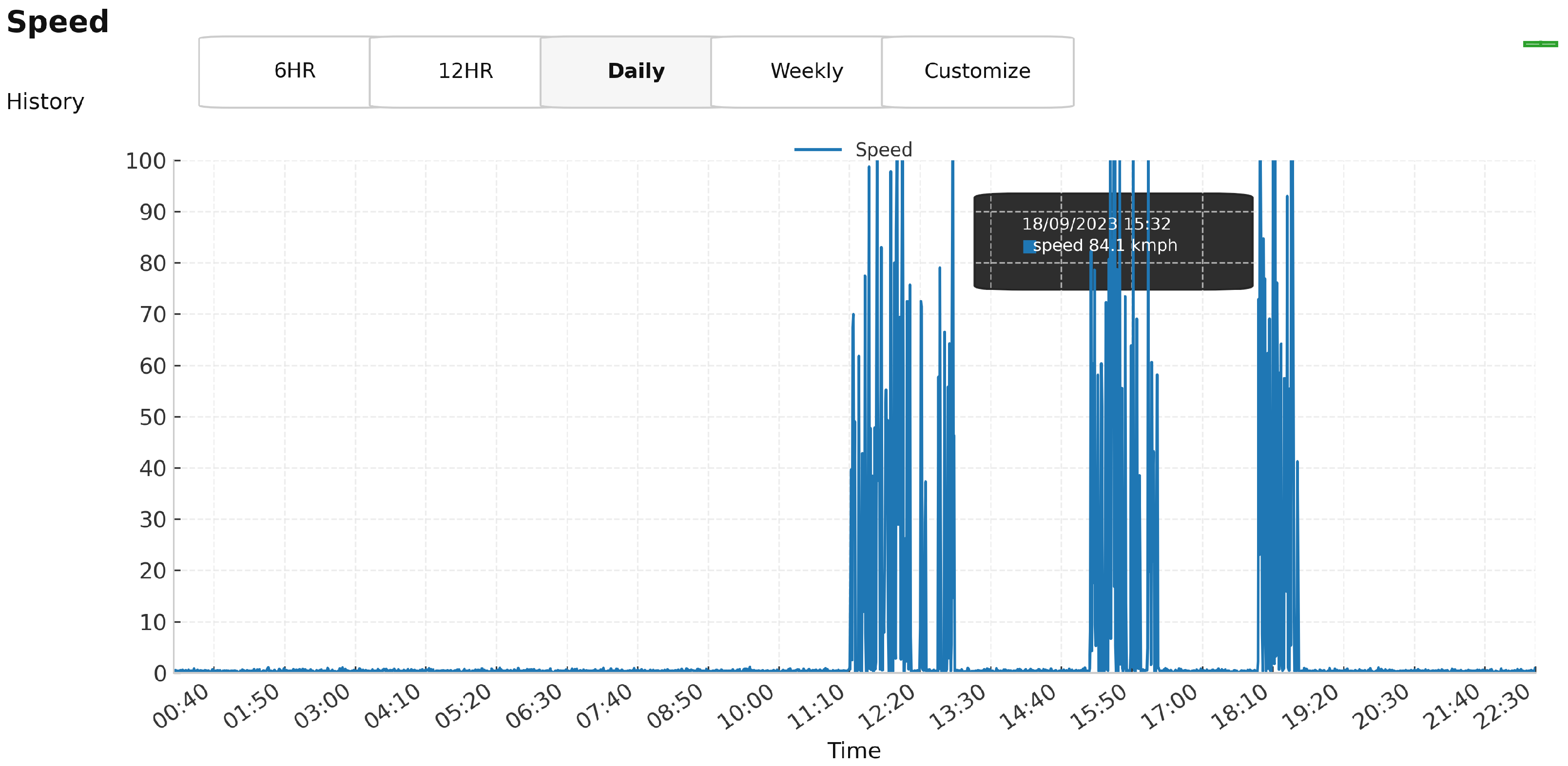
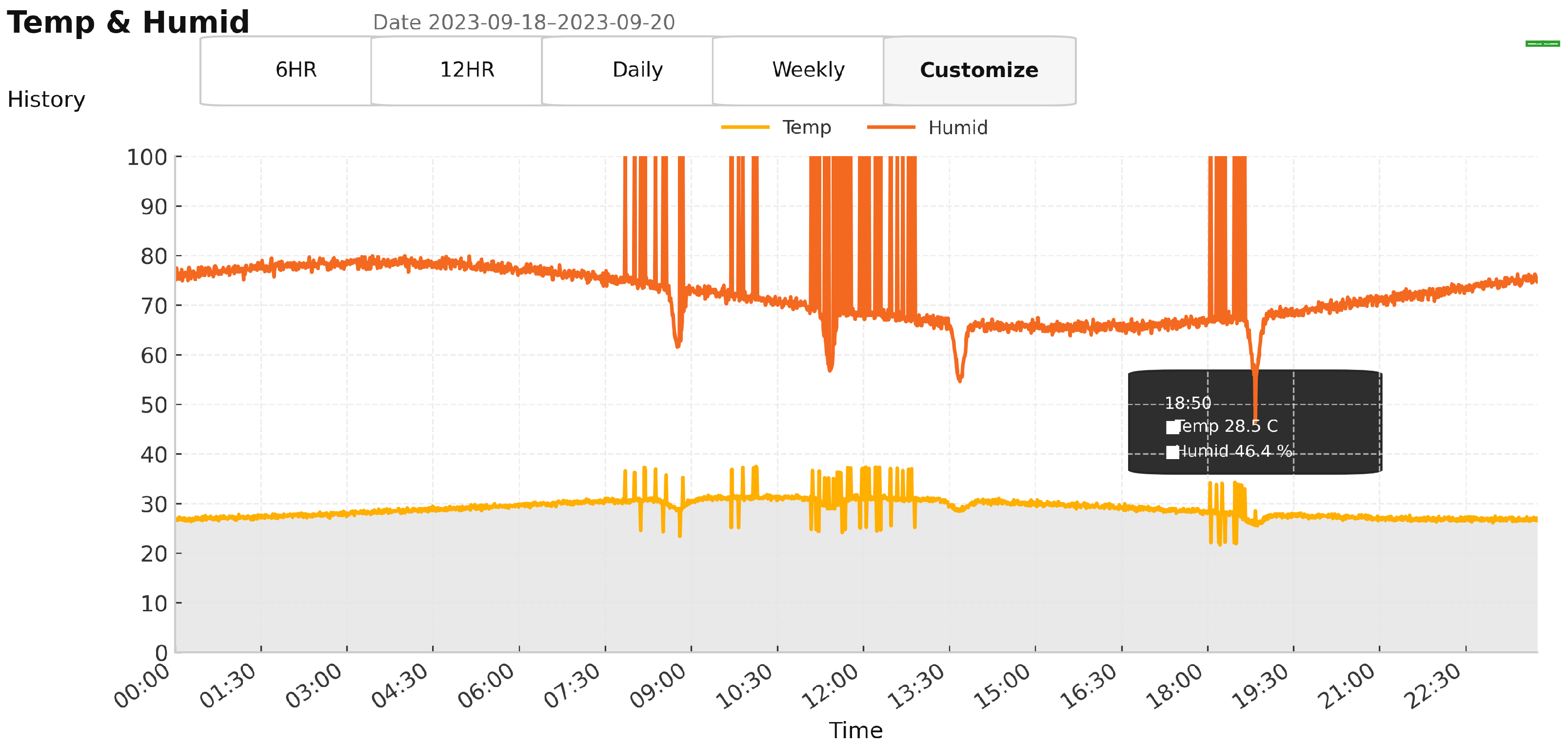
The dashboards show continuous T/RH trends, GPS location, and speed data. Figure 8 shows the on-route temperature and relative humidity time series, while Figure 9 presents vehicle speed over the same time window. For clarity, we do not include the raw latitude/longitude dashboard view as a separate figure, because the UI rounds coordinates to two decimal places and normalizes them on a 0–100 scale for fast rendering, which can be visually misleading. As described in Section 3.1, the underlying time series and CSV exports retain the precise coordinates (six decimal places) that are used to compute speed and route duration. Short spikes during lab→vehicle transitions reflect contextual changes rather than sensor drift, and continuity across coverage gaps confirms offline-first logging and authenticated backfill.
Figure 8.
Real-time temperature and RH trends during transport.
Figure 9.
Vehicle speed along the route. Clusters correspond to in-motion segments separated by brief stops.
5. Discussion
This section interprets the system outcomes and clarifies the scope and limitations of this study in relation to typical agri-food transport corridors.
Two outcomes of this study stand out with regard to perishable transport. First, a battery-first co-design enables reliable autonomy without vehicle power, and is an adequate size to achieve a ≥3-day autonomy target (demonstrating 4 days of autonomy in field trials) while preserving continuous telemetry. In deployment, the device connects via an 802.11 network to a battery-powered 4G-SIM router (vehicle-independent uplink): sensing and control are real-time and on-device, and cloud visibility is near-real-time when coverage exists; during gaps, records are buffered and verifiably backfilled on reconnection. Multiple sensor nodes can share the same SSID and publish concurrently under separate, device-scoped MQTT topics. Second, lightweight models (LR/GBM/RF) enable short-horizon prediction of energy consumption, which is used operationally to (i) verify the chosen battery sizing for long domestic corridors and (ii) trigger a simplified logger configuration (shorter sampling, more frequent burst transmission, reserve safeguard) during hot spells or prolonged stops. Together, these address autonomy and visibility on routes with intermittent coverage and close the sensing-to-action loop. This combination of analytical power budgeting and multi-day bench/field trials is the primary energy dimension demonstrated in this study; the ML predictor acts as a guardrail to keep consumption within the planned range and maintain a one-day reserve, rather than to completely minimize absolute energy use. Although recurrent neural architectures, such as long short-term memory (LSTM) or gated recurrent unit (GRU) networks, are natural candidates for richer, multi-step time-series forecasting, this study focuses on short-horizon budgeting from a modest four-day dataset. In this setting, simpler regressors are sufficient to meet the operational target we set (battery sizing and configuration triggers), and more complex sequence models represent an avenue of research for longer studies in the future (see Section 6).
Compared with prior agri-food IoT frameworks, which emphasize traceability but rarely integrate explicit energy modeling for stand-alone, battery-first deployments, this study quantifies the main predictors of power draw in the fitted models and translates analytics into straightforward policy (sampling cadence, radio bursts) while maintaining vehicle-independent uplink and continuity via opportunistic MQTT and authenticated backfill.
Threats to validity: External validity is constrained by the trial window, climate, and mix of goods being transported. Corridor coverage constrains WAN availability, with the battery-powered 4G-SIM router providing no backhaul in low-signal segments, causing updates to be deferred; however, the system remains real-time and on-device and replays buffered data at the next cell/hub. In addition, generalization of the system to refrigerated trucks or multi-modal routes may require re-calibration. Moreover, GPS jitter at very low speeds and intermittent wireless links introduce minor noise, which our preprocessing mitigates but does not eliminate. Finally, our tests were executed in a standard dry truck (non-commercial run) to validate the logger and uplink; while the thermal/coverage conditions reflect typical corridors, the results may differ under live refrigeration loads and handling practices.
6. Conclusions and Future Research
We demonstrate the practical application of a stand-alone, vehicle-independent monitoring platform and its operational use of short-horizon energy prediction to inform battery sizing and simplify logger configuration.
We present a vehicle-independent, stand-alone IoT platform for perishable logistics that unifies resilient sensing (T/RH/GPS), energy-aware firmware (deep sleep, burst transmission), and an online/offline pipeline with verified backfill. The system is adequately sized to achieve a ≥3-day autonomy target, demonstrating 4 days of autonomy in field trials. Lightweight AI is used primarily for short-horizon energy consumption prediction to verify battery sizing and to simplify the configuration of the logger (shorter sampling, more frequent burst transmission, reserve safeguard) during hot spells or prolonged stops. LR/GBM achieved strong accuracy (test , MAE A·h), and RF provided interpretable predictors (temperature > duration > humidity) in the fitted models, supporting this simple process while keeping the operation system-first.
Future research will (i) extend trials to live commercial shipments, including refrigerated trailers and shipments of multiple goods; (ii) evaluate multi-node deployments to capture spatial gradients within large trucks; (iii) improve security (TLS for MQTT, at-rest encryption) and explore energy harvesting/adaptive sleep to widen autonomy margins; and (iv) broaden datasets to encompass different seasons and corridors, including sequence-aware predictors (e.g., LSTM/GRU architectures) for route context and lightweight anomaly detection.
Author Contributions
Conceptualization: C.K.; Methodology: C.K., S.A., N.A.; Software: C.K., N.A.; Validation: R.S., K.T., C.P.; Formal Analysis: C.K.; Investigation: S.A., N.A., T.T., D.W.; Resources: S.C.; Data Curation: N.A., R.S., L.L.; Writing—Original Draft: C.K.; Writing—Review and Editing: S.C., P.M., C.-G.K.; Visualization: C.K.; Supervision: S.C.; Project Administration: S.C.; Funding Acquisition: S.C. All authors have read and agreed to the published version of the manuscript.
Funding
This research was supported by Mae Fah Luang University under the National Science, Research, and Innovation Fund (NSRF) 2024 [grant 672A04013], and the Office of the Permanent Secretary of the Ministry of Higher Education, Science, Research and Innovation [Reinventing University 2025: grant F01-683R-04-045]. We thank the Integrated AgriTech Ecosystem Research Group (IATE), Mae Fah Luang University, for providing financial support and equipment.
Institutional Review Board Statement
Not applicable.
Informed Consent Statement
Not applicable.
Data Availability Statement
The dataset and firmware settings used in this study are available from the corresponding author upon reasonable request.
Acknowledgments
During the preparation of this study, the author(s) used ChatGPT-4 for generating initial ideas and to improve the readability and language of some sections. The authors reviewed and edited this manuscript carefully and take full responsibility for its content.
Conflicts of Interest
The authors declare no conflicts of interest.
Abbreviations
The following abbreviations are used in this manuscript:
| AI | Artificial Intelligence |
| EMQX | MQTT Broker |
| ESP32 | Embedded SoC MCU |
| GBM | Gradient Boosting Machine |
| GPS | Global Positioning System |
| GRU | Gated Recurrent Unit |
| k-NN | k-Nearest Neighbors |
| LR | Linear Regression |
| LSTM | Long Short-Term Memory |
| MAE | Mean Absolute Error |
| MSE | Mean Squared Error |
| MLP | Multi-Layer Perceptron |
| MQTT | Message Queuing Telemetry Transport |
| RF | Random Forest |
| RH | Relative Humidity |
References
- Rattanakaran, J.; Saengrayap, R.; Aunsri, N.; Padee, S.; Prahsarn, C.; Kitazawa, H.; Bishop, C.F.H.; Chaiwong, S. Performance of Thermal Insulation Covering Materials to Reduce Postharvest Losses in Okra. Horticulturae 2021, 7, 392. [Google Scholar] [CrossRef]
- Rattanakaran, J.; Saengrayap, R.; Prahsarn, C.; Kitazawa, H.; Chaiwong, S. Application of Room Cooling and Thermal Insulation Materials to Maintain Quality of Okra during Storage and Transportation. Horticulturae 2021, 7, 188. [Google Scholar] [CrossRef]
- Mwenya, J.; Saengrayap, S.; Arwatchananukul, S.; Aunsri, N.; Kamyod, C.; Jakkaew, P.; Kitazawa, H.; Mahajan, P.; Padee, S.; Prahsarn, C.; et al. Thermal Insulation Box Design for Maintaining Cool Temperature and the Postharvest Quality of Okra. Sci. Hortic. 2024, 332, 113320. [Google Scholar] [CrossRef]
- Tzounis, A.; Katsoulas, N.; Bartzanas, T.; Kittas, C. Internet of Things in Agriculture, Recent Advances and Future Challenges. Biosyst. Eng. 2017, 164, 31–48. [Google Scholar] [CrossRef]
- Elijah, O.; Rahman, T.A.; Orikumhi, I.; Leow, C.Y.; Hindia, M.N. An Overview of Internet of Things (IoT) and Data Analytics in Agriculture: Benefits and Challenges. IEEE Internet Things J. 2018, 5, 3758–3773. [Google Scholar] [CrossRef]
- Farooq, M.; Riaz, S.; Abid, A.; Abid, K.; Naeem, M.A. A Survey on the Role of IoT in Agriculture for the Implementation of Smart Farming. IEEE Access 2019, 7, 156237–156271. [Google Scholar] [CrossRef]
- Shafi, U.; Mumtaz, R.; García-Nieto, J.; Hassan, S.A.; Zaidi, S.A.R.; Iqbal, N. Precision Agriculture Techniques and Practices: From Considerations to Applications. Sensors 2019, 19, 3796. [Google Scholar] [CrossRef]
- Dasgupta, I.; Saha, J.; Venkatasubbu, P.; Ramasubramanian, P. AI Crop Predictor and Weed Detector Using Wireless Technologies: A Smart Application for Farmers. Arab. J. Sci. Eng. 2020, 45, 11115–11127. [Google Scholar] [CrossRef]
- Ayaz, M.; Ammad-Uddin, M.; Sharif, Z.; Mansour, A.; Aggoune, E.-H.M. Internet-of-Things (IoT)-Based Smart Agriculture: Toward Making the Fields Talk. IEEE Access 2019, 7, 129551–129583. [Google Scholar]
- Mekala, M.; Viswanathan, P. A Survey: Smart Agriculture IoT with Cloud Computing. In Proceedings of the 2017 International Conference on Microelectronic Devices, Circuits and Systems (ICMDCS), Vellore, India, 10–12 August 2017; IEEE: Piscataway, NJ, USA, 2017; pp. 1–7. [Google Scholar]
- Kamble, S.S.; Gunasekaran, A.; Parekh, H.; Joshi, S. Modeling the Internet of Things Adoption Barriers in Food Retail Supply Chains. J. Retail. Consum. Serv. 2019, 48, 154–168. [Google Scholar] [CrossRef]
- Kour, V.; Arora, S. Recent Developments of the Internet of Things in Agriculture: A Survey. IEEE Access 2020, 8, 129924–129957. [Google Scholar] [CrossRef]
- Misra, N.N.; Dixit, Y.; Al-Mallahi, A.; Bhullar, M.S.; Upadhyay, R.; Martynenko, A. IoT, Big Data, and Artificial Intelligence in Agriculture and Food Industry. IEEE Internet Things J. 2022, 9, 6305–6324. [Google Scholar] [CrossRef]
- Bouzembrak, Y.; Klüche, M.; Gavai, A.; Marvin, H.J.P. Internet of Things in Food Safety: Literature Review and a Bibliometric Analysis. Trends Food Sci. Technol. 2019, 94, 54–64. [Google Scholar] [CrossRef]
- Verdouw, C.; Robbemond, R.M.; Verwaart, T.; Wolfert, J.; Beulens, A.J.M. A Reference Architecture for IoT-Based Logistic Information Systems in Agri-Food Supply Chains. Enterp. Inf. Syst. 2018, 12, 755–779. [Google Scholar] [CrossRef]
- Pal, A.; Kant, K. IoT-Based Sensing and Communications Infrastructure for the Fresh Food Supply Chain. Computer 2018, 51, 76–80. [Google Scholar] [CrossRef]
- Liu, D.; Zhang, Y.; Wang, W.; Dev, K.; Khowaja, S.A. Flexible Data Integrity Checking with Original Data Recovery in IoT-Enabled Maritime Transportation Systems. IEEE Trans. Intell. Transp. Syst. 2023, 24, 2618–2629. [Google Scholar] [CrossRef]
- Chavhan, S.; Gupta, D.; Chandana, B.N.; Khanna, A.; Rodrigues, J.J.P.C. IoT-Based Context-Aware Intelligent Public Transport System in a Metropolitan Area. IEEE Internet Things J. 2020, 7, 6023–6034. [Google Scholar] [CrossRef]
- Garrido-López, J.; Buendía, M.J.; Toledo, A.; Giménez-Gallego, J.; Torres-Sánchez, R. Monitoring Perishable Commodities Using Cellular IoT: An Intelligent Real-Time Conditions Tracker Design. Appl. Sci. 2024, 14, 11050. [Google Scholar] [CrossRef]
- Markovic, M.; Edwards, P.; Jacobs, N. Recording Provenance of Food Delivery Using IoT, Semantics and Business Blockchain Networks. In Proceedings of the 2019 Sixth International Conference on Internet of Things: Systems, Management and Security (IOTSMS), Granada, Spain, 22–25 October 2019; IEEE: Piscataway, NJ, USA, 2019; pp. 1–6. [Google Scholar]
- Kaiwartya, O.; Abdullah, A.H.; Cao, Y.; Altameem, A.; Prasad, M.; Lin, C.-T. Internet of Vehicles: Motivation, Layered Architecture, Network Model, Challenges, and Future Aspects. IEEE Access 2016, 4, 5356–5373. [Google Scholar] [CrossRef]
- Patel, C.; Doshi, N. Security Challenges in IoT Cyber World. In Security in Smart Cities: Models, Applications, and Challenges; Springer: Cham, Switzerland, 2018; pp. 171–191. [Google Scholar]
- Badhiye, S.S.; Chatur, P.N.; Wakode, B.V. Data Logger System: A Survey. Int. J. Comput. Technol. Electron. Eng. 2011, 1, 24–26. [Google Scholar]
- Djordjević, M.; Jovičić, B.; Marković, S.; Paunović, V.; Danković, D. A Smart Data Logger System Based on Sensor and IoT Technology as Part of the Smart Faculty. J. Ambient Intell. Smart Environ. 2020, 12, 359–373. [Google Scholar] [CrossRef]
- Hadi, M.S.; Maulana, M.R.; Mizar, M.A.; Zaeni, I.A.E.; Afandi, A.N.; Irvan, M. Self Energy Management System for Battery Operated Data Logger Device Based on IoT. In Proceedings of the 2019 International Conference on Electrical, Electronics and Information Engineering (ICEEIE), Denpasar, Indonesia, 3–5 October 2019; IEEE: Piscataway, NJ, USA, 2019; pp. 133–138. [Google Scholar]
- Hadiatna, F.; Hindersah, H.; Yolanda, D.; Triawan, M.A. Design and Implementation of Data Logger Using Lossless Data Compression Method for IoT. In Proceedings of the 2016 6th International Conference on System Engineering and Technology (ICSET), Bandung, Indonesia, 3–4 October 2016; IEEE: Piscataway, NJ, USA, 2016; pp. 105–108. [Google Scholar]
- Mabrouki, J.; Azrour, M.; Dhiba, D.; Farhaoui, Y.; El Hajjaji, S. IoT-Based Data Logger for Weather Monitoring Using Arduino-Based WSNs with Remote App and Alerts. Big Data Min. Anal. 2021, 4, 25–32. [Google Scholar] [CrossRef]
- Nguyen, H.; Ivanov, R.; Phan, L.T.; Sokolsky, O.; Weimer, J.; Lee, I. LogSafe: Secure and Scalable Data Logger for IoT Devices. In Proceedings of the 3rd ACM/IEEE International Conference on Internet of Things Design and Implementation (IoTDI), Orlando, FL, USA, 17–20 April 2018; ACM: New York, NY, USA, 2018; pp. 141–152. [Google Scholar]
- Shinde, S.R.; Karode, A.H.; Suralkar, S.R. Review on IoT-Based Environment Monitoring System. Int. J. Electron. Commun. Eng. Technol. 2017, 8, 103–108. [Google Scholar]
- Tavade, T.; Nasikkar, P. Raspberry Pi: Data Logging IoT Device. In Proceedings of the 2017 International Conference on Power and Embedded Drive Control (ICPEDC), Chennai, India, 16–18 March 2017; IEEE: Piscataway, NJ, USA, 2017; pp. 275–279. [Google Scholar]
- Lee, J.; Stanley, M.; Spanias, A.; Tepedelenlioglu, C. Integrating Machine Learning in Embedded Sensor Systems for IoT Applications. In Proceedings of the 2016 IEEE International Symposium on Signal Processing and Information Technology (ISSPIT), Limassol, Cyprus, 12–14 December 2016; IEEE: Piscataway, NJ, USA, 2016; pp. 290–294. [Google Scholar]
- Mehmood, Y.; Ahmad, F.; Yaqoob, I.; Adnane, A.; Imran, M.; Guizani, S. Internet of Things for Smart Cities: Recent Advances and Challenges. IEEE Commun. Mag. 2017, 55, 16–24. [Google Scholar] [CrossRef]
- Santoso, L.W.; Kwariawan, A.; Lim, R. IoT for Real-Time Data Logger and pH Controller. In Proceedings of the 2017 International Conference on Soft Computing, Intelligent System and Information Technology (ICSIIT), Denpasar, Indonesia, 26–29 September 2017; IEEE: Piscataway, NJ, USA, 2017; pp. 241–246. [Google Scholar]
- Fanariotis, A.; Orphanoudakis, T.; Kotrotsios, K.; Fotopoulos, V.; Keramidas, G.; Karkazis, P. Power-Efficient Machine Learning Models Deployment on Edge IoT Devices. Sensors 2023, 23, 1595. [Google Scholar] [CrossRef]
- Zantalis, F.; Koulouras, G.; Karabetsos, S.; Kandris, D. A Review of Machine Learning and IoT in Smart Transportation. Future Internet 2019, 11, 94. [Google Scholar] [CrossRef]
- de Melo, G.C.G.; Torres, I.C.; de Araújo, Í.B.Q.; Brito, D.B.; de Andrade Barboza, E. A Low-Cost IoT System for Real-Time Monitoring of Climatic Variables and Photovoltaic Generation. Sensors 2021, 21, 3293. [Google Scholar] [CrossRef]
- Shaban, M.; Alsharekh, M.F. Design of a Smart Distribution Panelboard Using IoT Connectivity and Machine Learning Techniques. Energies 2022, 15, 3658. [Google Scholar] [CrossRef]
- Kulkarni, P.H.; Kute, P.D.; More, V.N. IoT-Based Data Processing for Automated Industrial Meter Reader Using Raspberry Pi. In Proceedings of the 2016 International Conference on Internet of Things and Applications (IOTA), Pune, India, 22–24 January 2016; IEEE: Piscataway, NJ, USA, 2016; pp. 107–111. [Google Scholar]
- Mishra, V.P.; Jain, C.; Chugh, A. IoT-Based Data Logger for Environmental Monitoring. In Innovations in Computer Science and Engineering; Lecture Notes in Networks and Systems; Springer: Singapore, 2020; Volume 103, pp. 463–471. [Google Scholar]
- Koushik, M.S.; Srinivasan, M.; Lavanya, R.; Alfred, S.; Setty, S. Design and Development of WSN-Based Data Logger with ESP-NOW Protocol. In Proceedings of the 2021 6th International Conference for Convergence in Technology (I2CT), Pune, India, 2–4 April 2021; IEEE: Piscataway, NJ, USA, 2021; pp. 1–5. [Google Scholar]
- Aggarwal, K.; Reddy, G.S.; Makala, R.; Srihari, T.; Sharma, N.; Singh, C. Studies on Energy-Efficient Techniques for Agricultural Monitoring by Wireless Sensor Networks. Comput. Electr. Eng. 2024, 113, 109052. [Google Scholar] [CrossRef]
- Palniladevi, P.; Sabapathi, T.; Kanth, D.A.; Kumar, B.P. IoT-Based Smart Agriculture Monitoring Using Renewable Energy Sources. In Proceedings of the 2nd IEEE International Conference on Vision Towards Emerging Trends in Communication and Networking Technologies (ViTECoN 2023), Vellore, India, 5–6 May 2023; IEEE: Piscataway, NJ, USA, 2023; pp. 1–6. [Google Scholar]
- Mohammed, K.; Abdelhafid, M.; Kamal, K.; Ismail, N.; Ilias, A. Intelligent Driver Monitoring System: An IoT-Based System for Tracking and Identifying Driving Behavior. Comput. Stand. Interfaces 2023, 84, 103704. [Google Scholar] [CrossRef]
- Bansal, M.; Chana, I.; Clarke, S. A Survey on IoT Big Data: Current Status, 13 V’s Challenges, and Future Directions. ACM Comput. Surv. 2021, 53, 1–59. [Google Scholar] [CrossRef]
- Hopkins, J.; Hawking, P. Big Data Analytics and IoT in Logistics: A Case Study. Int. J. Logist. Manag. 2018, 29, 575–591. [Google Scholar] [CrossRef]
- Al-Dweik, A.; Muresan, R.; Mayhew, M.; Lieberman, M. IoT-Based Multifunctional Scalable Real-Time Enhanced Road Side Unit for Intelligent Transportation Systems. In Proceedings of the 30th IEEE Canadian Conference on Electrical and Computer Engineering (CCECE), Windsor, ON, Canada, 30 April–3 May 2017; IEEE: Piscataway, NJ, USA, 2017; pp. 1–6. [Google Scholar]
- Desai, M.; Phadke, A. Internet of Things Based Vehicle Monitoring System. In Proceedings of the 2017 Fourteenth International Conference on Wireless and Optical Communications Networks (WOCN), Mumbai, India, 24–26 February 2017; IEEE: Piscataway, NJ, USA, 2017; pp. 1–3. [Google Scholar]
- Priyanka, E.B.; Maheswari, C.; Thangavel, S. A Smart-Integrated IoT Module for Intelligent Transportation in Oil Industry. Int. J. Numer. Model. 2021, 34, e2731. [Google Scholar] [CrossRef]
- Li, Z.; Xiao, Z.; Xu, Q.; Sotthiwat, E.; Goh, R.S.M.; Liang, X. Blockchain and IoT Data Analytics for Fine-Grained Transportation Insurance. In Proceedings of the 2018 IEEE 24th International Conference on Parallel and Distributed Systems (ICPADS), Singapore, 11–13 December 2018; IEEE: Piscataway, NJ, USA, 2018; pp. 1022–1027. [Google Scholar]
- Jachimczyk, B.; Dziak, D.; Czapla, J.; Damps, P.; Kulesza, W.J. IoT On-Board System for Driving Style Assessment. Sensors 2018, 18, 1233. [Google Scholar] [CrossRef]
- Vermesan, O.; Friess, P.; Guillemin, P.; Gusmeroli, S.; Sundmaeker, H.; Bassi, A.; Jubert, I.S.; Mazura, M.; Harrison, M.; Eisenhauer, M.; et al. Internet of Things Strategic Research Roadmap. In Internet of Things—Global Technological and Societal Trends from Smart Environments and Spaces to Green ICT; River Publishers: Aalborg, Denmark, 2022; pp. 9–52. [Google Scholar]
- Wang, Y.; Potter, A. The Application of Real-Time Tracking Technologies in Freight Transport. In Proceedings of the 2007 IEEE International Conference on Signal-Image Technologies and Internet-Based Systems (SITIS), Shanghai, China, 16–18 December 2007; IEEE: Piscataway, NJ, USA, 2007; pp. 298–304. [Google Scholar]
- Wang, K. Logistics 4.0 Solution—New Challenges and Opportunities. In Proceedings of the 6th International Workshop of Advanced Manufacturing and Automation (IWAMA 2016), Manchester, UK, 10–11 November 2016; Atlantis Press: Paris, France, 2016; pp. 68–74. [Google Scholar]
- Rácz-Szabó, A.; Ruppert, T.; Bántay, L.; Löcklin, A.; Jakab, L.; Abonyi, J. Real-Time Locating System in Production Management. Sensors 2020, 20, 6766. [Google Scholar] [CrossRef] [PubMed]
- Popescu, G.H.; Petreanu, S.; Alexandru, B.; Corpodean, H. IoT-Based Real-Time Production Logistics, Cyber-Physical Process Monitoring, and Industrial AI in Sustainable Smart Manufacturing. J. Self-Gov. Manag. Econ. 2021, 9, 52–62. [Google Scholar]
- Dintén, R.; García, S.; Zorrilla, M. Fleet Management Systems in the Logistics 4.0 Era: A Real-Time Distributed and Scalable Architectural Proposal. Procedia Comput. Sci. 2023, 217, 806–815. [Google Scholar] [CrossRef]
- Bhutta, M.N.M.; Ahmad, M. Secure Identification, Traceability and Real-Time Tracking of Agricultural Food Supply During Transportation Using IoT. IEEE Access 2021, 9, 65660–65675. [Google Scholar] [CrossRef]
- Datta, S.K.; Da Costa, R.P.F.; Härri, J.; Bonnet, C. Integrating Connected Vehicles in IoT Ecosystems: Challenges and Solutions. In Proceedings of the 2016 IEEE 17th International Symposium on A World of Wireless, Mobile and Multimedia Networks (WoWMoM), Coimbra, Portugal, 21–24 June 2016; IEEE: Piscataway, NJ, USA, 2016; pp. 1–6. [Google Scholar]
- Zhang, X.; Cao, Z.; Dong, W. Overview of Edge Computing in the Agricultural Internet of Things: Key Technologies, Applications, Challenges. IEEE Access 2020, 8, 141748–141761. [Google Scholar] [CrossRef]
- Sharma, S.; Gahlawat, V.K.; Rahul, K.; Mor, R.S.; Malik, M. Sustainable Innovations in the Food Industry Through Artificial Intelligence and Big Data Analytics. Logistics 2021, 5, 66. [Google Scholar] [CrossRef]
- Luo, Z.; Liu, W.; Wu, J.; Huang, A.-Q.; Guo, J. Prediction of Cold Chain Loading Environment for Agricultural Products Based on K-Medoids-LSTM-XGBoost Ensemble Model. PeerJ Comput. Sci. 2024, 10, e2510. [Google Scholar] [CrossRef]
- Villoria Hernandez, P.; Mariñas-Collado, I.; Garcia Sipols, A.; Simon de Blas, C.; Rodríguez Sánchez, M.C. Time Series Forecasting Methods in Emergency Contexts. Sci. Rep. 2023, 13, 22529. [Google Scholar] [CrossRef] [PubMed]
- Spantideas, S.T.; Giannopoulos, A.E.; Trakadas, P. Autonomous Price-Aware Energy Management System in Smart Homes via Actor-Critic Learning with Predictive Capabilities. IEEE Trans. Autom. Sci. Eng. 2025, 22, 5018–5033. [Google Scholar] [CrossRef]
- Mawson, V.J.; Hughes, B.R. Deep Learning Techniques for Energy Forecasting and Condition Monitoring in the Manufacturing Sector. Energy Build. 2020, 217, 109966. [Google Scholar] [CrossRef]
- Fatehijananloo, M.; Stopps, H.; McArthur, J.J. Exploring Artificial Intelligence Methods for Energy Prediction in Healthcare Facilities: An In-Depth Extended Systematic Review. Energy Build. 2024, 320, 114598. [Google Scholar] [CrossRef]
- Rahman, M.M.; Joha, M.I.; Nazim, M.S.; Jang, Y.M. Enhancing IoT-Based Environmental Monitoring and Power Forecasting: A Comparative Analysis of AI Models for Real-Time Applications. Appl. Sci. 2024, 14, 11970. [Google Scholar] [CrossRef]
Disclaimer/Publisher’s Note: The statements, opinions and data contained in all publications are solely those of the individual author(s) and contributor(s) and not of MDPI and/or the editor(s). MDPI and/or the editor(s) disclaim responsibility for any injury to people or property resulting from any ideas, methods, instructions or products referred to in the content. |
© 2025 by the authors. Licensee MDPI, Basel, Switzerland. This article is an open access article distributed under the terms and conditions of the Creative Commons Attribution (CC BY) license (https://creativecommons.org/licenses/by/4.0/).