Node Collaborative Strategy for 3D Coverage Based on Hopping Adaptive Grey Wolf Optimizer in Wireless Sensor Network


Abstract
1. Introduction
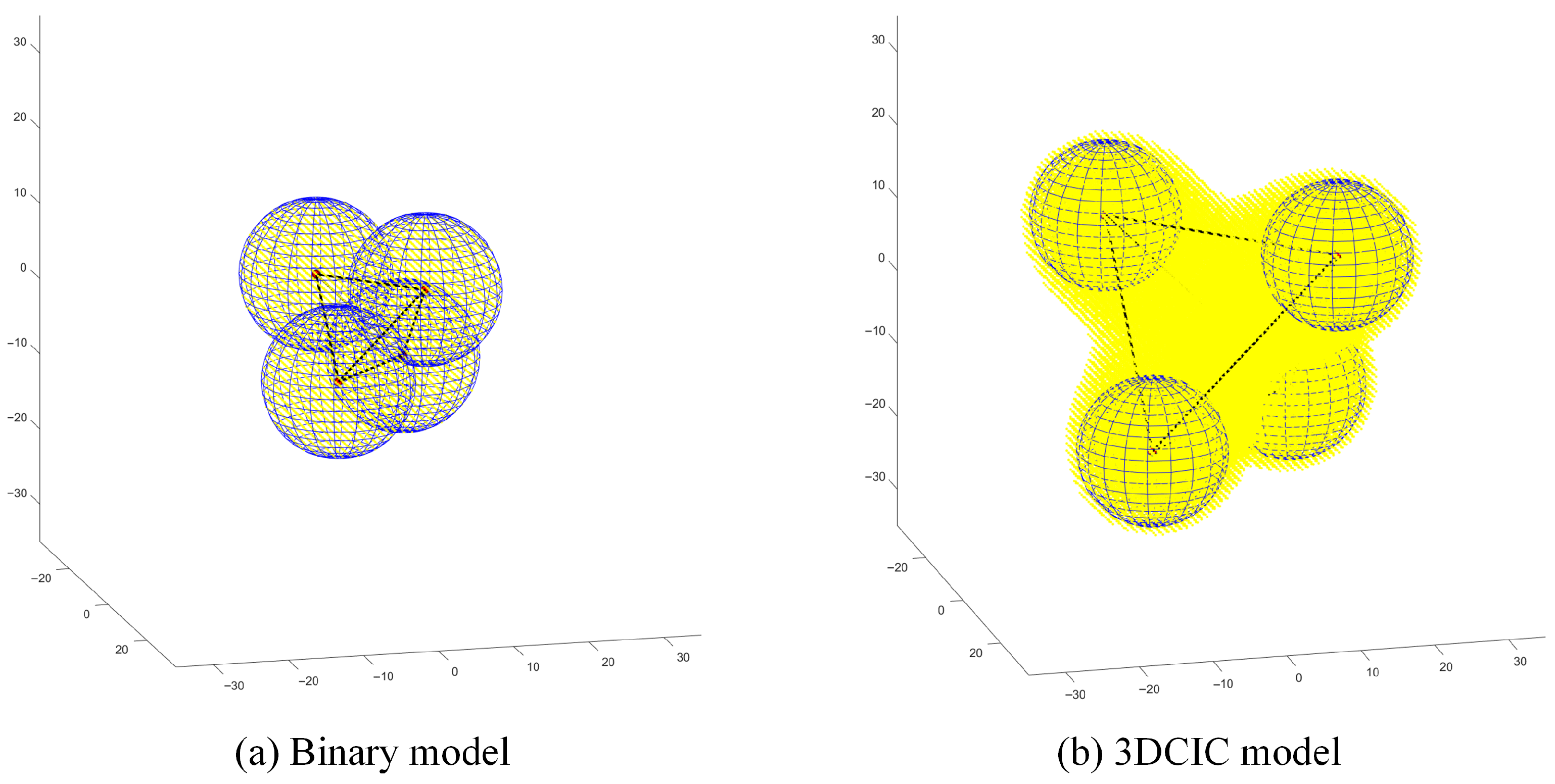
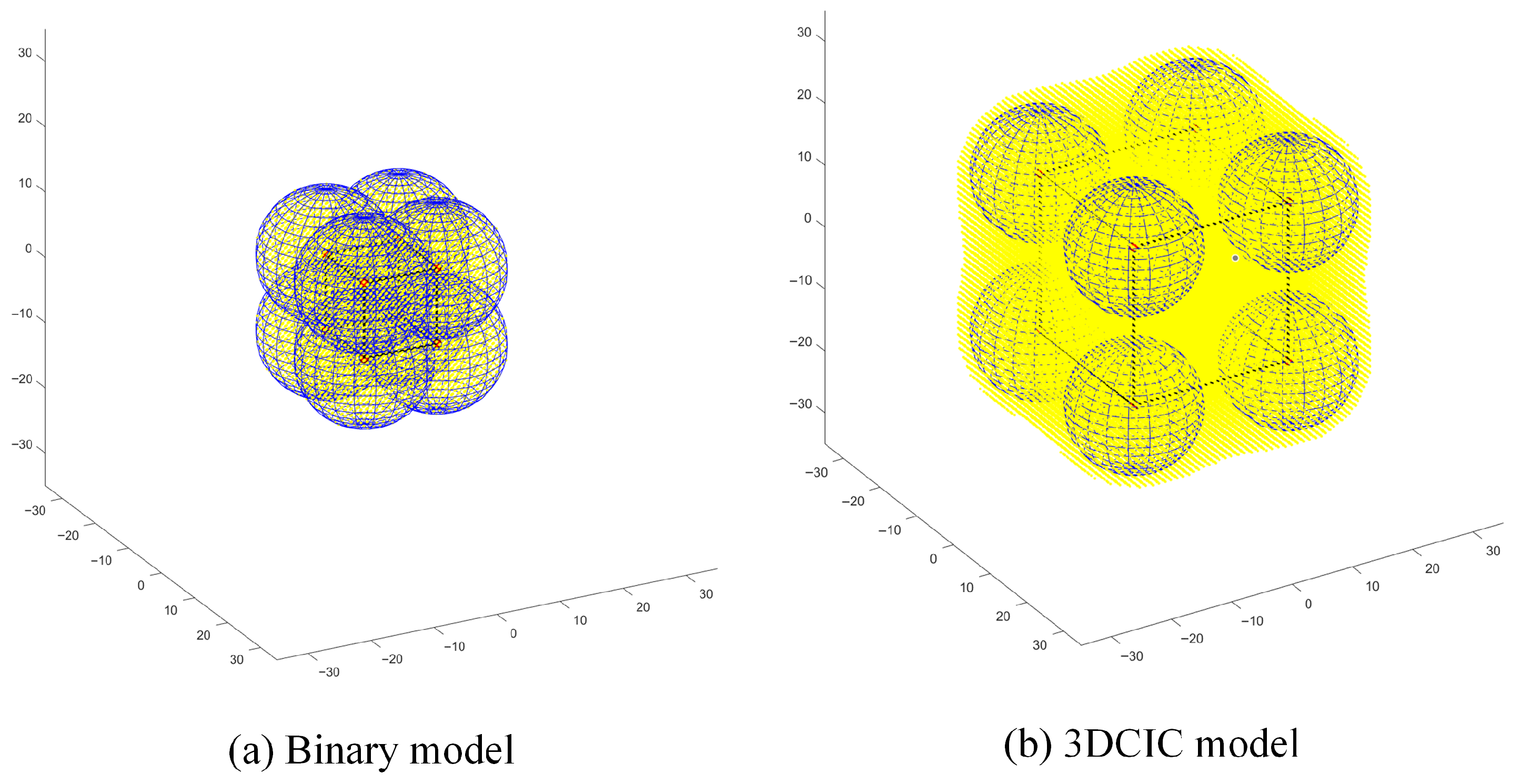
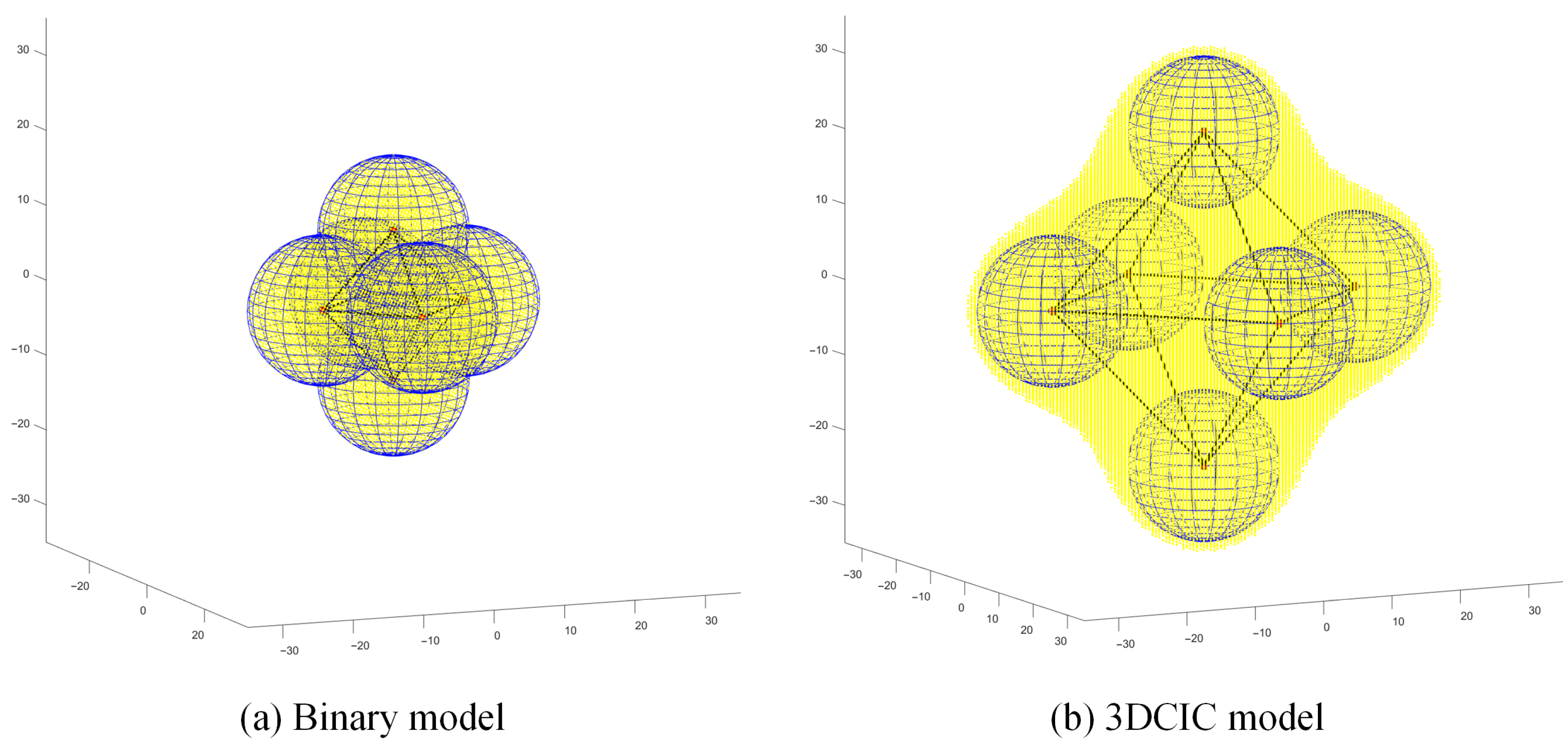
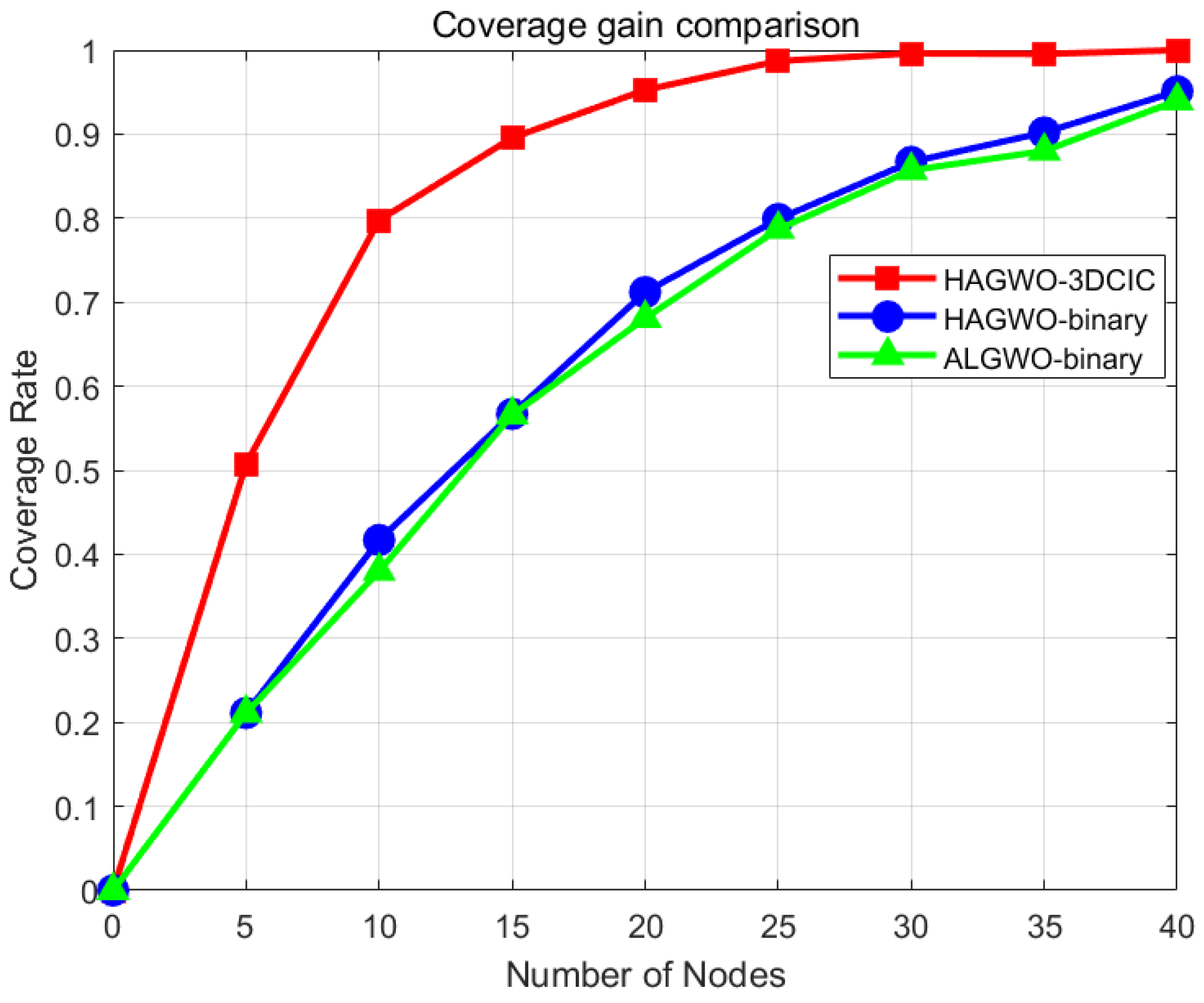
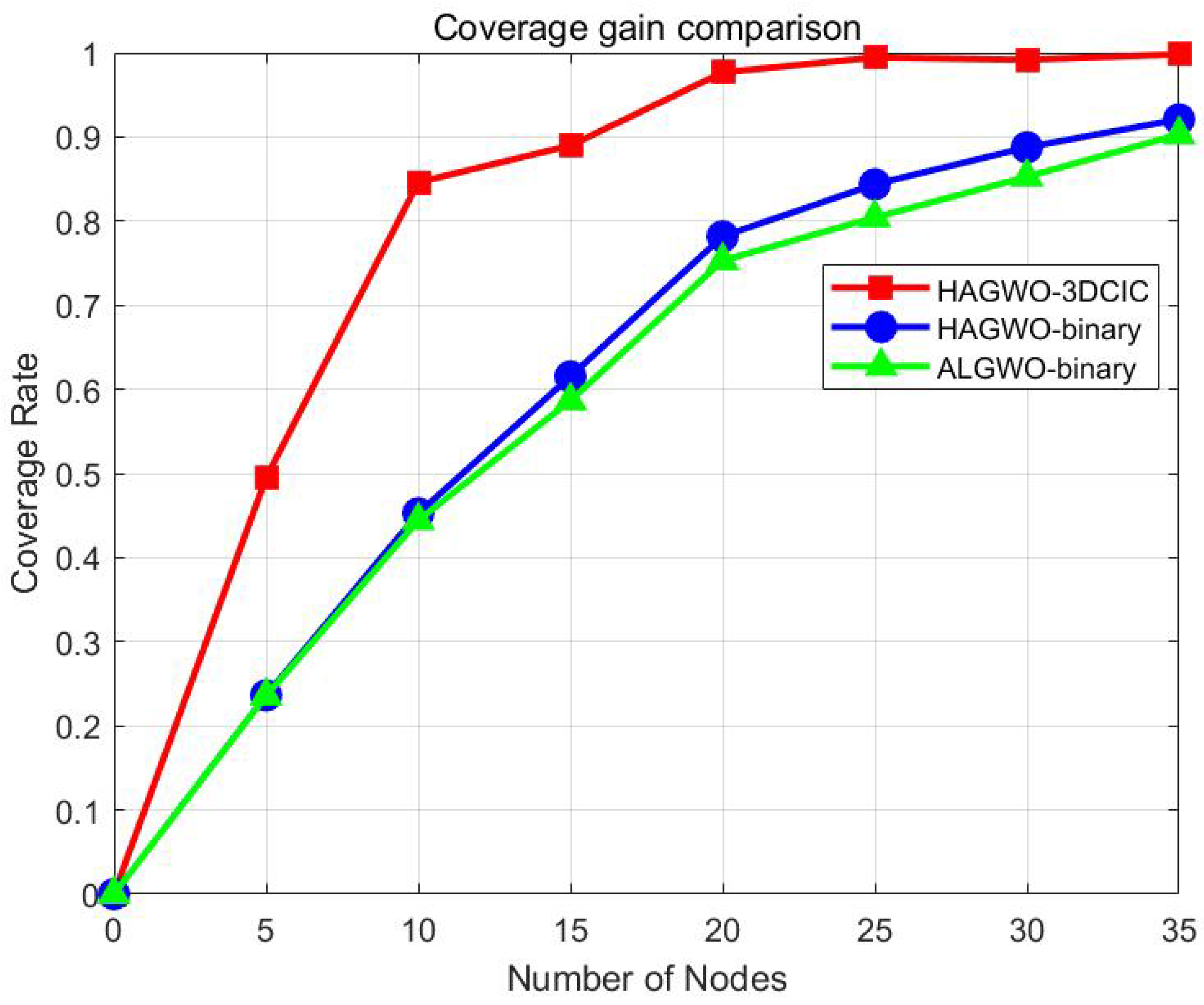
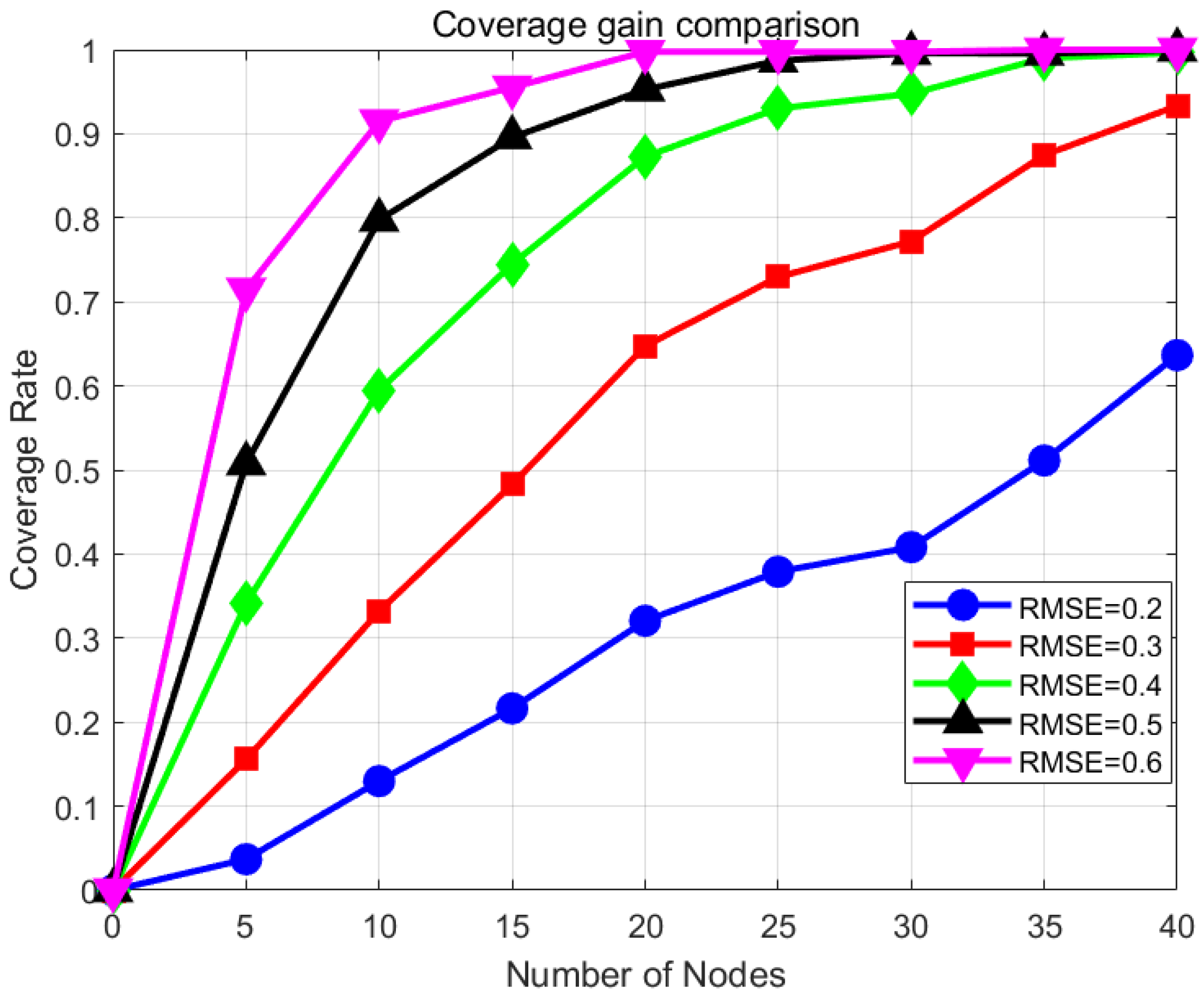
- The 3D cooperative node model based on field reconstruction theory, termed the 3DCIC model, is proposed for the first time. Under conditions of equal node numbers, it demonstrates multiple-fold gains in coverage range compared with conventional binary spherical models.
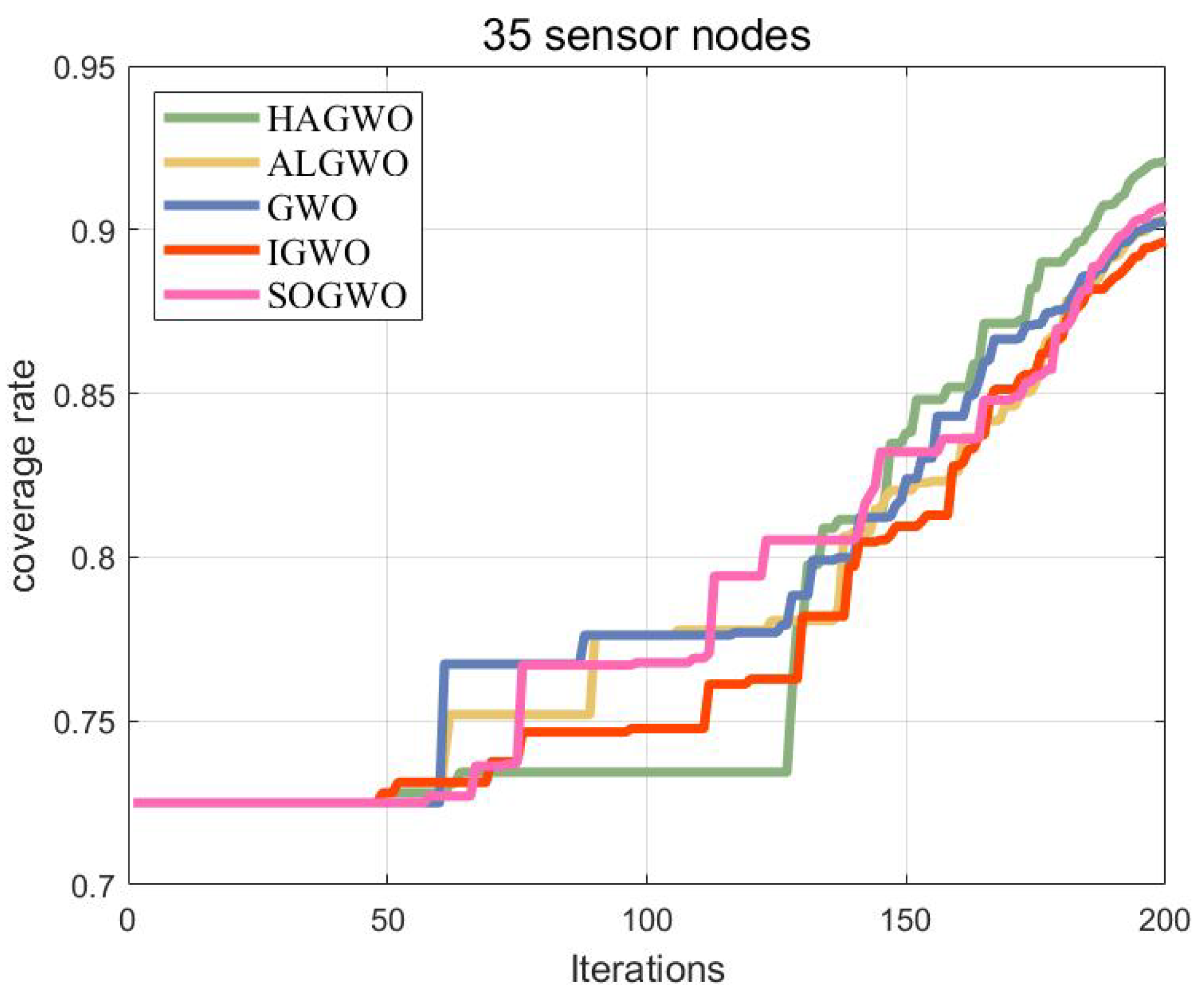
- Based on the hopping rate mechanism of opposition learning and adaptive dimension learning, Hopping Adaptive Grey Wolf Optimizer (HAGWO) algorithm is proposed, which enhances the search range and efficiency of wolves.
- A simulation platform was developed to assess the effectiveness of the proposed scheme. The experimental results indicate that, compared with existing model algorithms, the proposed HAGWO-3DCIC achieves favorable performance in terms of both regional coverage area and uniformity of node distribution.
2. Related Works
2.1. 3D Node Deployment Strategies
2.2. 3D Node Sensing Models
3. The Proposed 3DCIC Model
3.1. The Principle of 3DCIC Model
3.2. Coverage Problem of 3DCIC Model
3.3. Demonstration of Coverage Gain of 3DCIC Model
4. The Optimized HAGWO Algorithm
4.1. GWO
4.2. Opposition-Based Learning Mechanism
4.3. Hopping Adaptive Grey Wolf Optimizer
| Algorithm 1 GWO |
| Input: Objective function f, search space dimension D, population size N, maximum number of iterations |
| 1. Initialize the grey wolf population P |
| 2. Calculate the fitness value of each individual |
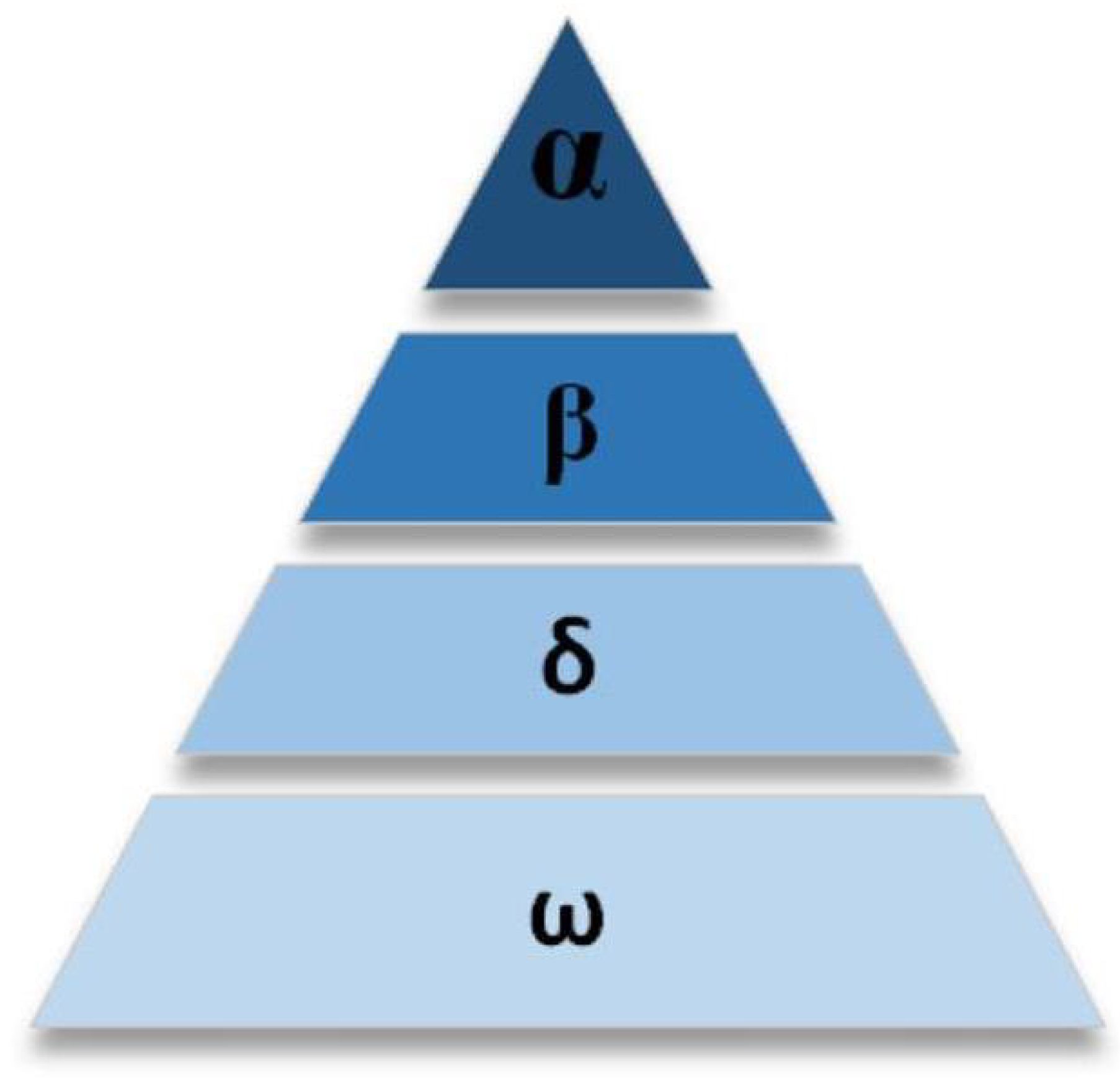
| 3. Set the alpha, beta, and delta wolves as the three individuals with the highest fitness in the population |
| 4. For to |
| 5. Update the positions of the wolf pack using formulas (12) to (14) |
| 6. Calculate the fitness value of each wolf |
| 7. Update the , , and wolves |
| End for |
| Output: The fitness value of the wolf |
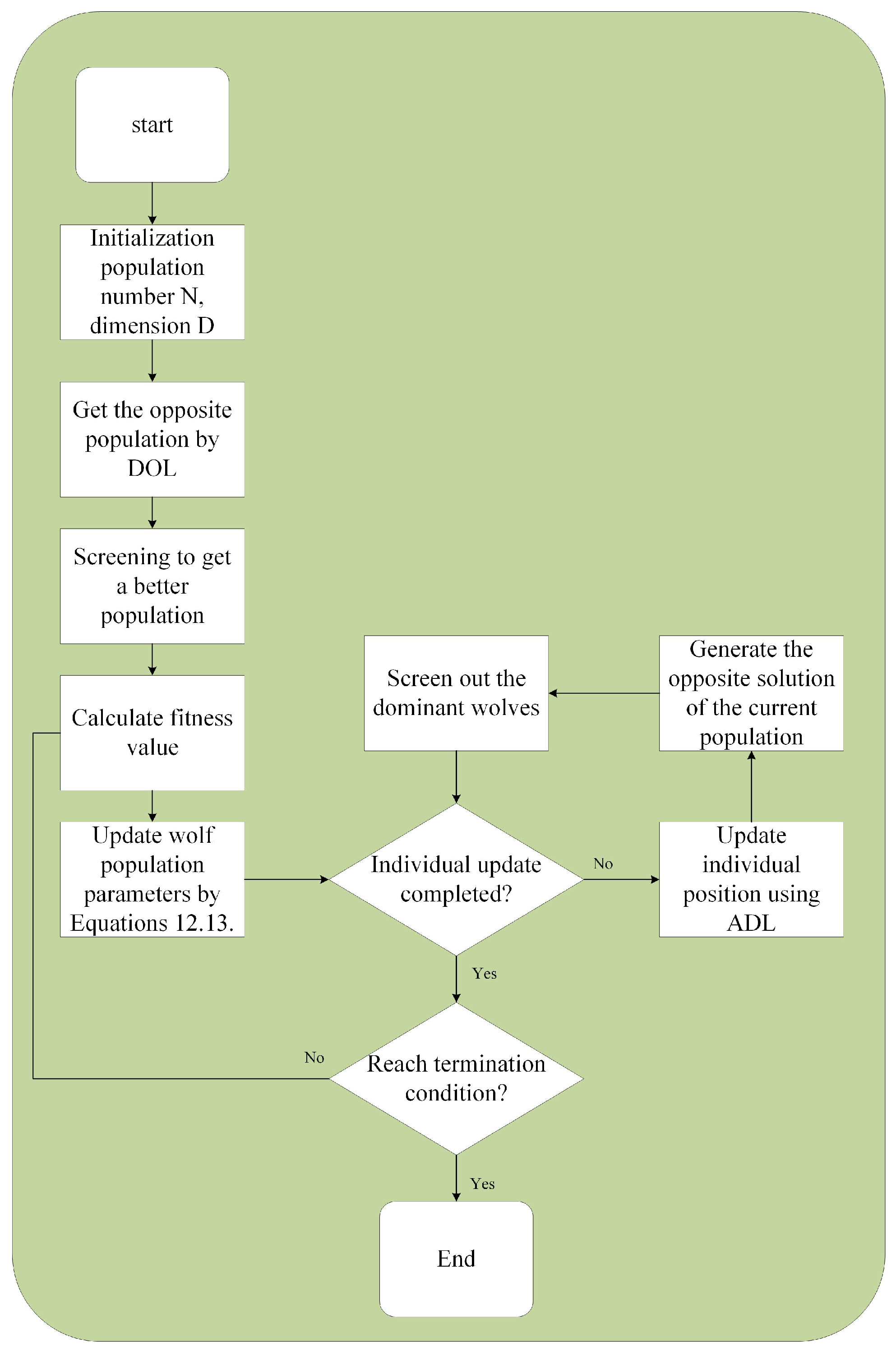
| Algorithm 2 HAGWO |
| Input: Objective function f, search space dimension D, population size N, |
| maximum number of iterations |
| 1. Initialize the grey wolf population P |
| 2. For to N do |
| 3. Generate inverse solutions using DOL |
| 4. End for |
| 5. Check boundaries |
| 6. Select the most suitable population |
| 7. Calculate the fitness value for each individual |
| 8. Set the alpha, beta, and delta wolves as the three individuals with the |
| highest fitness in the population |
| 9. For to do |
| 10. For to N do |
| 11. Update the positions of the wolf pack using Equations (12) to (14) |
| 12. For to D do |
| 13. The wolf pack performs adaptive dimension learning through ADL |
| 14. End for |
| 15. If rand < 0.4 then |
| 16. Generate inverse solutions for the current population using Equation (15) |
| 17. End if |
| 18. Select a more suitable population P |
| 19. End for |
| 20. End for |
| Output: The fitness value of the wolf |
5. Performance Evaluation
6. Conclusions
Author Contributions
Funding
Institutional Review Board Statement
Informed Consent Statement
Data Availability Statement
Conflicts of Interest
References
- Zheng, K.; Fu, J.; Liu, X. Relay Selection and Deployment for NOMA Enabled Multi-UAV-assisted WSN. IEEE Sens. J. 2025, 25, 16235–16249. [Google Scholar] [CrossRef]
- Moslehi, M.M. Exploring coverage and security challenges in wireless sensor networks: A survey. Comput. Netw. 2025, 260, 111096. [Google Scholar] [CrossRef]
- Jamshed, M.A.; Ali, K.; Abbasi, Q.H.; Imran, M.A.; Ur-Rehman, M. Challenges, applications, and future of wireless sensors in internet of things: A review. IEEE Sens. J. 2022, 22, 5482–5494. [Google Scholar] [CrossRef]
- Cai, Z.; Chen, Q.; Shi, T.; Zhu, T.; Chen, K.; Li, Y. Battery-free wireless sensor networks: A comprehensive survey. IEEE Internet Things J. 2022, 10, 5543–5570. [Google Scholar] [CrossRef]
- Saeed, U.; Jan, S.U.; Lee, Y.D.; Koo, I. Fault diagnosis based on extremely randomized trees in wireless sensor networks. Reliab. Eng. Syst. Saf. 2021, 205, 107284. [Google Scholar] [CrossRef]
- Kenyeres, M.; Kenyeres, J.; Hassankhani Dolatabadi, S. Distributed consensus gossip-based data fusion for suppressing incorrect sensor readings in wireless sensor networks. J. Low Power Electron. Appl. 2025, 15, 6. [Google Scholar] [CrossRef]
- Yu, X.; Duan, Y.; Cai, Z.; Luo, W. An adaptive learning grey wolf optimizer for coverage optimization in WSNs. Expert Syst. Appl. 2024, 238, 121917. [Google Scholar] [CrossRef]
- Wang, J.; Liu, Y.; Rao, S.; Zhou, X.; Hu, J. A novel self-adaptive multi-strategy artificial bee colony algorithm for coverage optimization in wireless sensor networks. Ad Hoc Netw. 2023, 150, 103284. [Google Scholar] [CrossRef]
- Afizudeen, S.; Pavithra, R. Grundy number-based optimal sensor placement in 3D wireless sensor network. IEEE Access 2024, 12, 148502–148515. [Google Scholar] [CrossRef]
- Zhu, J.; Rong, J.; Gong, Z.; Liu, Y.; Li, W.; Alqahtani, F.; Tolba, A.; Hu, J. Deployment optimization in wireless sensor networks using advanced artificial bee colony algorithm. Peer-to-Peer Netw. Appl. 2024, 17, 3571–3582. [Google Scholar] [CrossRef]
- Kumar, K.S.; Singh, D.; Anand, V. Strategic node deployment scheme for maximizing coverage area and network lifetime in UASNs using voronoi-fuzzy c-means and salp swarm optimization. IEEE Sens. J. 2024, 24, 16926–16934. [Google Scholar] [CrossRef]
- Kumari, S.; Srirangarajan, S. Node placement and path planning for improved area coverage in mixed wireless sensor networks. IEEE Robot. Autom. Lett. 2024, 9, 6800–6807. [Google Scholar] [CrossRef]
- Jia, R.; Zhang, H. Wireless sensor network (WSN) model targeting energy efficient wireless sensor networks node coverage. IEEE Access 2024, 12, 27596–27610. [Google Scholar] [CrossRef]
- Abdulwahid, H.M.; Mishra, A. Deployment optimization algorithms in wireless sensor networks for smart cities: A systematic mapping study. Sensors 2022, 22, 5094. [Google Scholar] [CrossRef]
- Ahmad, B.; Ahmed, M.; Anjum, N.; Rehman, M.U.; Ramzan, N. Energy efficient gateway based routing with maximized node coverage in a UAV assisted wireless sensor network. PLoS ONE 2023, 18, e0295615. [Google Scholar] [CrossRef]
- Hamadou, A.N.S.; wa Maina, C.; Soidridine, M.M. A hybrid PSO-GWO-based phase shift design for a hybrid-RIS-aided heterogeneous network system. Heliyon 2024, 10, e33175. [Google Scholar]
- Singh, A.; Sharma, S.; Singh, J. Nature-inspired algorithms for wireless sensor networks: A comprehensive survey. Comput. Sci. Rev. 2021, 39, 100342. [Google Scholar] [CrossRef]
- Faris, H.; Aljarah, I.; Al-Betar, M.A.; Mirjalili, S. Grey wolf optimizer: A review of recent variants and applications. Neural Comput. Appl. 2018, 30, 413–435. [Google Scholar] [CrossRef]
- Rodríguez, L.; Castillo, O.; Soria, J.; Melin, P.; Valdez, F.; Gonzalez, C.I.; Martinez, G.E.; Soto, J. A fuzzy hierarchical operator in the grey wolf optimizer algorithm. Appl. Soft Comput. 2017, 57, 315–328. [Google Scholar] [CrossRef]
- Dhargupta, S.; Ghosh, M.; Mirjalili, S.; Sarkar, R. Selective opposition based grey wolf optimization. Expert Syst. Appl. 2020, 151, 113389. [Google Scholar] [CrossRef]
- Nadimi-Shahraki, M.H.; Taghian, S.; Mirjalili, S. An improved grey wolf optimizer for solving engineering problems. Expert Syst. Appl. 2021, 166, 113917. [Google Scholar] [CrossRef]
- Zhu, C.; Zheng, C.; Shu, L.; Han, G. A survey on coverage and connectivity issues in wireless sensor networks. J. Netw. Comput. Appl. 2012, 35, 619–632. [Google Scholar] [CrossRef]
- Shih, K.P.; Chen, H.C.; Chou, C.M.; Liu, B.-J. On target coverage in wireless heterogeneous sensor networks with multiple sensing units. J. Netw. Comput. Appl. 2009, 32, 866–877. [Google Scholar] [CrossRef]
- Barshandeh, S.; Koulaeizadeh, S.; Masdari, M.; AbdollahZadeh, B.; Ghasembaglou, M. A learning-based metaheuristic administered positioning model for 3D IoT networks. Appl. Soft Comput. 2023, 136, 110113. [Google Scholar] [CrossRef]
- Xu, Y.; Jiao, W.; Tian, M. An energy-efficient routing protocol for 3D wireless sensor networks. IEEE Sens. J. 2021, 21, 19550–19559. [Google Scholar] [CrossRef]
- Arivudainambi, D.; Pavithra, R. Coverage and connectivity-based 3D wireless sensor deployment optimization. Wirel. Pers. Commun. 2020, 112, 1185–1204. [Google Scholar] [CrossRef]
- Hao, Z.; Qu, N.; Dang, X.; Hou, J. RSS-based coverage deployment method under probability model in 3D-WSN. IEEE Access 2019, 7, 183091–183104. [Google Scholar] [CrossRef]
- Wang, Z.; Xie, H. Wireless sensor network deployment of 3D surface based on enhanced grey wolf optimizer. IEEE Access 2020, 8, 57229–57251. [Google Scholar] [CrossRef]
- Du, Y. Method for the optimal sensor deployment of WSNs in 3D terrain based on the DPSOVF algorithm. Ieee Access 2020, 8, 140806–140821. [Google Scholar] [CrossRef]
- Yao, Y.; Liao, H.; Liu, M.; Yang, X. Coverage optimization strategy for 3-D wireless sensor networks based on improved sparrow search algorithm. IEEE Sens. J. 2023, 23, 23721–23733. [Google Scholar] [CrossRef]
- Xiao, F.; Yang, Y.; Wang, R.; Sun, L. A novel deployment scheme based on three-dimensional coverage model for wireless sensor networks. Sci. World J. 2014, 2014, 846784. [Google Scholar] [CrossRef]
- Wang, Z.; Wang, B.; Xiong, Z. A novel coverage algorithm based on 3D-voronoi cell for underwater wireless sensor networks. In Proceedings of the 2015 International Conference on Wireless Communications & Signal Processing (WCSP), Nanjing, China, 15–17 October 2015; IEEE: Piscataway, NJ, USA, 2015; pp. 1–5. [Google Scholar]
- Saad, A.; Senouci, M.R.; Benyattou, O. Toward a realistic approach for the deployment of 3D wireless sensor networks. IEEE Trans. Mob. Comput. 2020, 21, 1508–1519. [Google Scholar] [CrossRef]
- Fu, W.; Yang, Y.; Hong, G.; Hou, J. WSN deployment strategy for real 3D terrain coverage based on greedy algorithm with DEM probability coverage model. Electronics 2021, 10, 2028. [Google Scholar] [CrossRef]
- Wang, B.; Deng, X.; Liu, W.; Yang, L.T.; Chao, H.-C. Confident information coverage in sensor networks for field reconstruction. IEEE Wirel. Commun. 2014, 20, 74–81. [Google Scholar] [CrossRef]
- Webster, R.; Oliver, M.A. Geostatistics for Environmental Scientists; John Wiley & Sons: Hoboken, NJ, USA, 2007. [Google Scholar]
- Harrington, B.; Huang, Y.; Yang, J.; Li, X. Energy-efficient map interpolation for sensor fields using kriging. IEEE Trans. Mob. Comput. 2008, 8, 622–635. [Google Scholar] [CrossRef]
- Hernandez-Penaloza, G.; Beferull-Lozano, B. Field estimation in wireless sensor networks using distributed kriging. In Proceedings of the 2012 IEEE International Conference on Communications (ICC), Ottawa, ON, Canada, 10–15 June 2012; IEEE: Piscataway, NJ, USA, 2012; pp. 724–729. [Google Scholar]
- Mirjalili, S.; Mirjalili, S.M.; Lewis, A. Grey wolf optimizer. Adv. Eng. Softw. 2014, 69, 46–61. [Google Scholar] [CrossRef]
- Tizhoosh, H.R. Opposition-based learning: A new scheme for machine intelligence. In Proceedings of the International Conference on Computational Intelligence for Modelling, Control and Automation and International Conference on Intelligent Agents, Web Technologies and Internet commerce (CIMCA-IAWTIC’06), Vienna, Austria, 28–30 November 2005; IEEE: Piscataway, NJ, USA, 2005; pp. 695–701. [Google Scholar]
- Ramalingam, R.; Karunanidy, D.; Balakrishnan, A.; Rashid, M.; Dumka, A.; Afifi, A.; Alshamrani, S.S. OGWO-CH: Hybrid opposition-based learning with gray wolf optimization based clustering technique in wireless sensor networks. Electronics 2022, 11, 2593. [Google Scholar] [CrossRef]
- Xu, Y.; Yang, Z.; Li, X.; Kang, H.; Yang, X. Dynamic opposite learning enhanced teaching–learning-based optimization. Knowl.-Based Syst. 2020, 188, 104966. [Google Scholar] [CrossRef]
- Musikawan, P.; Kongsorot, Y.; Muneesawang, P.; So-In, C. An enhanced obstacle-aware deployment scheme with an opposition-based competitive swarm optimizer for mobile WSNs. Expert Syst. Appl. 2022, 189, 116035. [Google Scholar] [CrossRef]
- Yao, Y.; Hu, S.; Li, Y.; Wen, Q. A node deployment optimization algorithm of WSNs based on improved moth flame search. IEEE Sens. J. 2022, 22, 10018–10030. [Google Scholar] [CrossRef]
- Dong, W.; Wu, X.J.; Xu, T.; Feng, Z.; Ahmed, S.A.A.; Awais, M.; Kittler, J. View-shuffled clustering via the modified Hungarian algorithm. Neural Netw. 2024, 179, 106602. [Google Scholar] [CrossRef] [PubMed]
- Wang, Z.; Huang, L.; Yang, S.; Luo, X.; He, D.; Chan, S. Multi-strategy enhanced grey wolf algorithm for obstacle-aware WSNs coverage optimization. Ad Hoc Netw. 2024, 152, 103308. [Google Scholar] [CrossRef]



| Deployment Mode | Magnification Times |
|---|---|
| regular tetrahedron | 2.78 |
| regular hexahedron | 4.41 |
| regular octahedron | 4.00 |
| Parameter | Value |
|---|---|
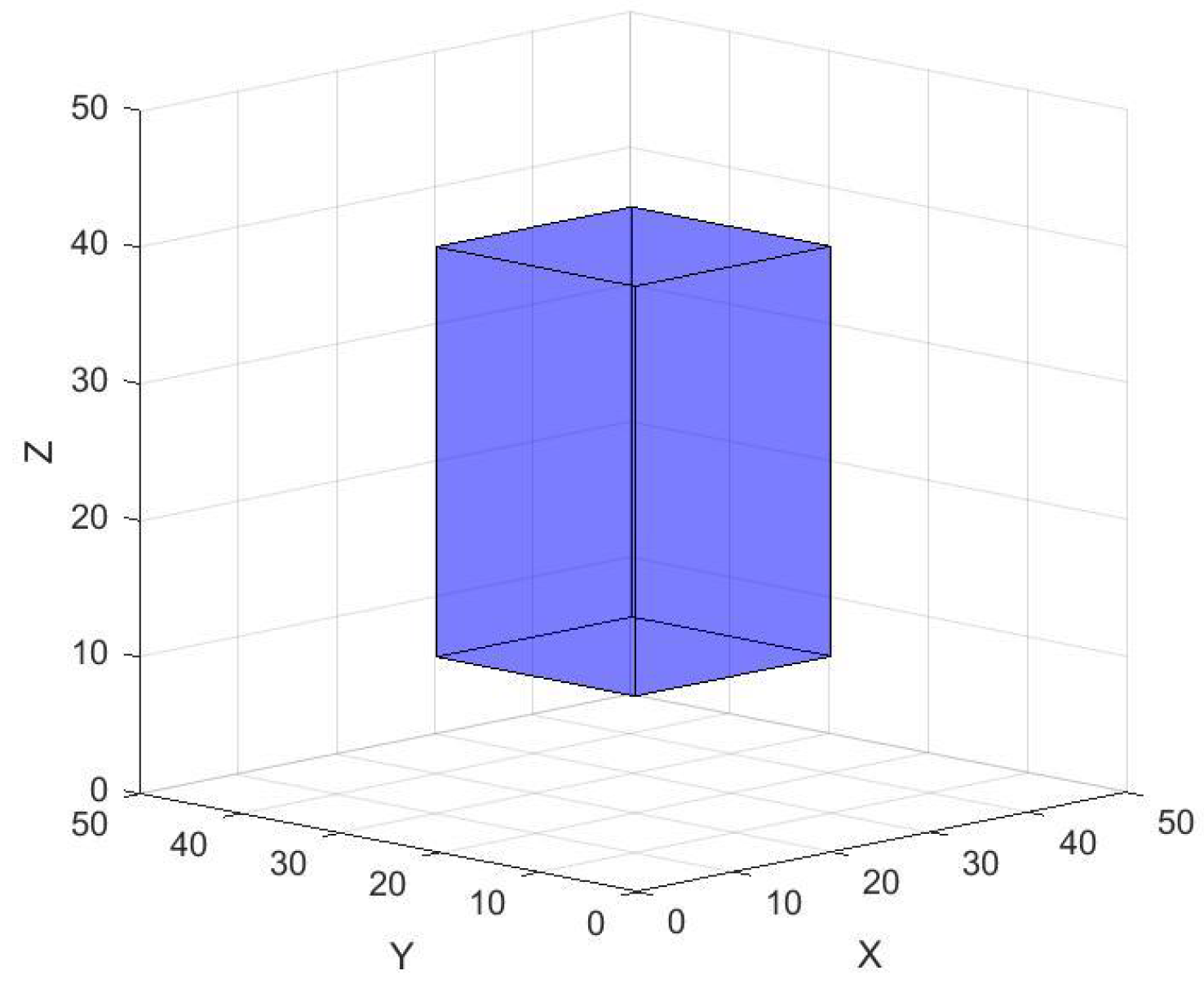
| 3D area size | 50 m ∗ 50 m ∗ 50 m |
| Sensing radius in 3D area | 11 m |
| Amount of nodes in 3D area | 40 |
| Population scale | 20 |
| Max Iterations | 200 |
| RMSE Threshold | 0.5 |
| Algorithm | Average Moving Distance (m) |
|---|---|
| HAGWO | 9.041 |
| ALGWO | 9.263 |
| GWO | 9.391 |
| IGWO | 9.574 |
| SOGWO | 9.304 |
Disclaimer/Publisher’s Note: The statements, opinions and data contained in all publications are solely those of the individual author(s) and contributor(s) and not of MDPI and/or the editor(s). MDPI and/or the editor(s) disclaim responsibility for any injury to people or property resulting from any ideas, methods, instructions or products referred to in the content. |
© 2025 by the authors. Licensee MDPI, Basel, Switzerland. This article is an open access article distributed under the terms and conditions of the Creative Commons Attribution (CC BY) license (https://creativecommons.org/licenses/by/4.0/).
Share and Cite
Wang, M.; Wu, Z.; Fan, B.; Wang, Y. Node Collaborative Strategy for 3D Coverage Based on Hopping Adaptive Grey Wolf Optimizer in Wireless Sensor Network. Sensors 2025, 25, 7431. https://doi.org/10.3390/s25247431
Wang M, Wu Z, Fan B, Wang Y. Node Collaborative Strategy for 3D Coverage Based on Hopping Adaptive Grey Wolf Optimizer in Wireless Sensor Network. Sensors. 2025; 25(24):7431. https://doi.org/10.3390/s25247431
Chicago/Turabian StyleWang, Minghua, Zhuowen Wu, Bo Fan, and Yan Wang. 2025. "Node Collaborative Strategy for 3D Coverage Based on Hopping Adaptive Grey Wolf Optimizer in Wireless Sensor Network" Sensors 25, no. 24: 7431. https://doi.org/10.3390/s25247431
APA StyleWang, M., Wu, Z., Fan, B., & Wang, Y. (2025). Node Collaborative Strategy for 3D Coverage Based on Hopping Adaptive Grey Wolf Optimizer in Wireless Sensor Network. Sensors, 25(24), 7431. https://doi.org/10.3390/s25247431