Secure Fog Computing for Remote Health Monitoring with Data Prioritisation and AI-Based Anomaly Detection



Abstract
1. Introduction
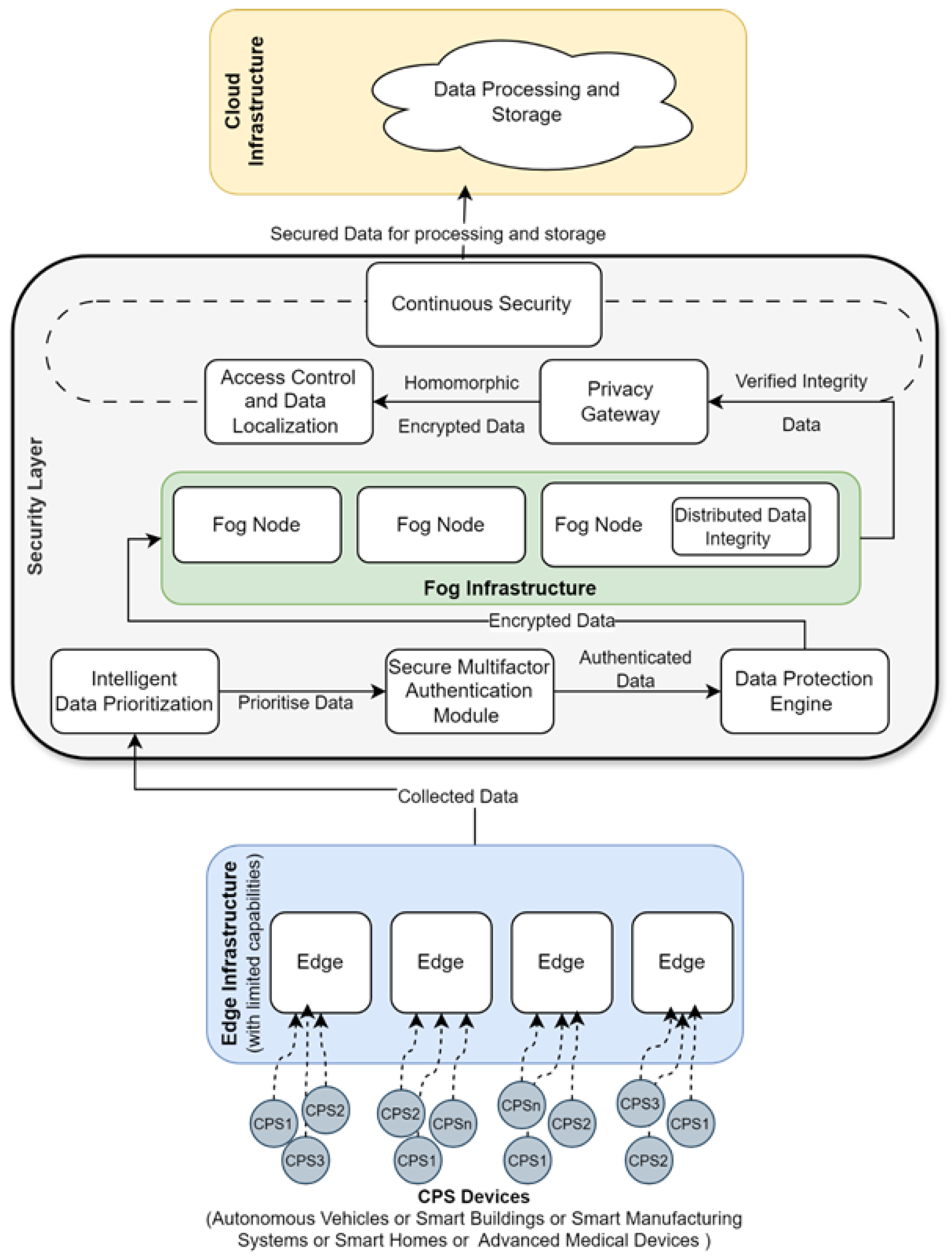
- The focus of our research problem is to propose a novel fog architecture integrating IDP, AI-based anomaly detection and dynamic data prioritisation.
- The scientific methods adopted aim to address the drawbacks of existing frameworks and to alleviate the gaps found in the literature. The enhanced Random Forest method used for AI-based anomaly detection adopts an ensemble of decision trees to improve accuracy and robustness.
- Our main contribution lies in the development of a unique framework for secure fog computing with IDP and AI strategies in an enhanced Random Forest for anomaly detection. Our innovative AI-based model incorporates medical context-dependent expert rule based data prioritisation in a dynamic and distributed environment with experimental validations performed in a stimulated healthcare scenario.
2. Background
2.1. Related Work
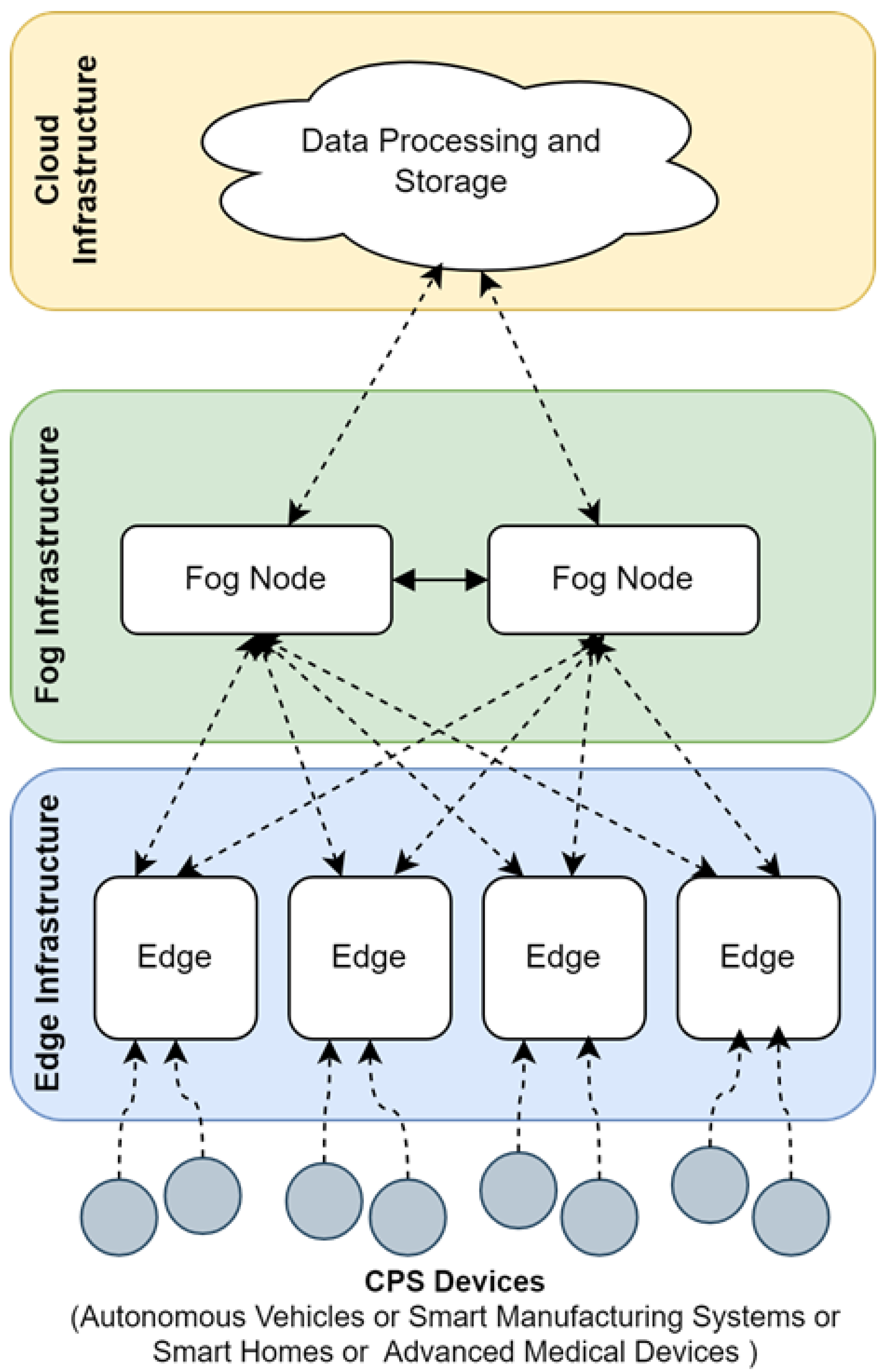
2.2. Fog and Edge Computing Environments
2.2.1. Edge and Fog Computing
2.2.2. Edge and Fog Paradigm and Smart Healthcare
2.2.3. Security Challenges of Fog Computing
3. Proposed Framework
4. Experimental Design and Evaluation
4.1. Simulation Setup for Remote Patient Monitoring with AI Anomaly and Threat Detection
4.2. AI-Driven Anomaly and Threat Detection
4.3. Results
- Processing fog node data can reduce latency and enable near real-time insights into patient health, as shown by anomaly detection in the simulation.
- Preliminary fog analysis can detect potential health problems before cloud processing, decreasing unnecessary data transfer and prioritising urgent information.
- Fog nodes can be set up to activate automated alerts whenever thresholds are exceeded, allowing timely intervention.
- Implementing local filtering and processing at fog nodes can decrease the amount of data transmitted to the cloud, enhancing bandwidth efficiency.
- Processing nearer to the source can reduce security risks during transmission.
- The anomaly detection model based on Random Forests showed reliable results across various dataset partitions.
- The ensemble approach of the Random Forest model minimises overfitting risk and enhances its ability to generalise.
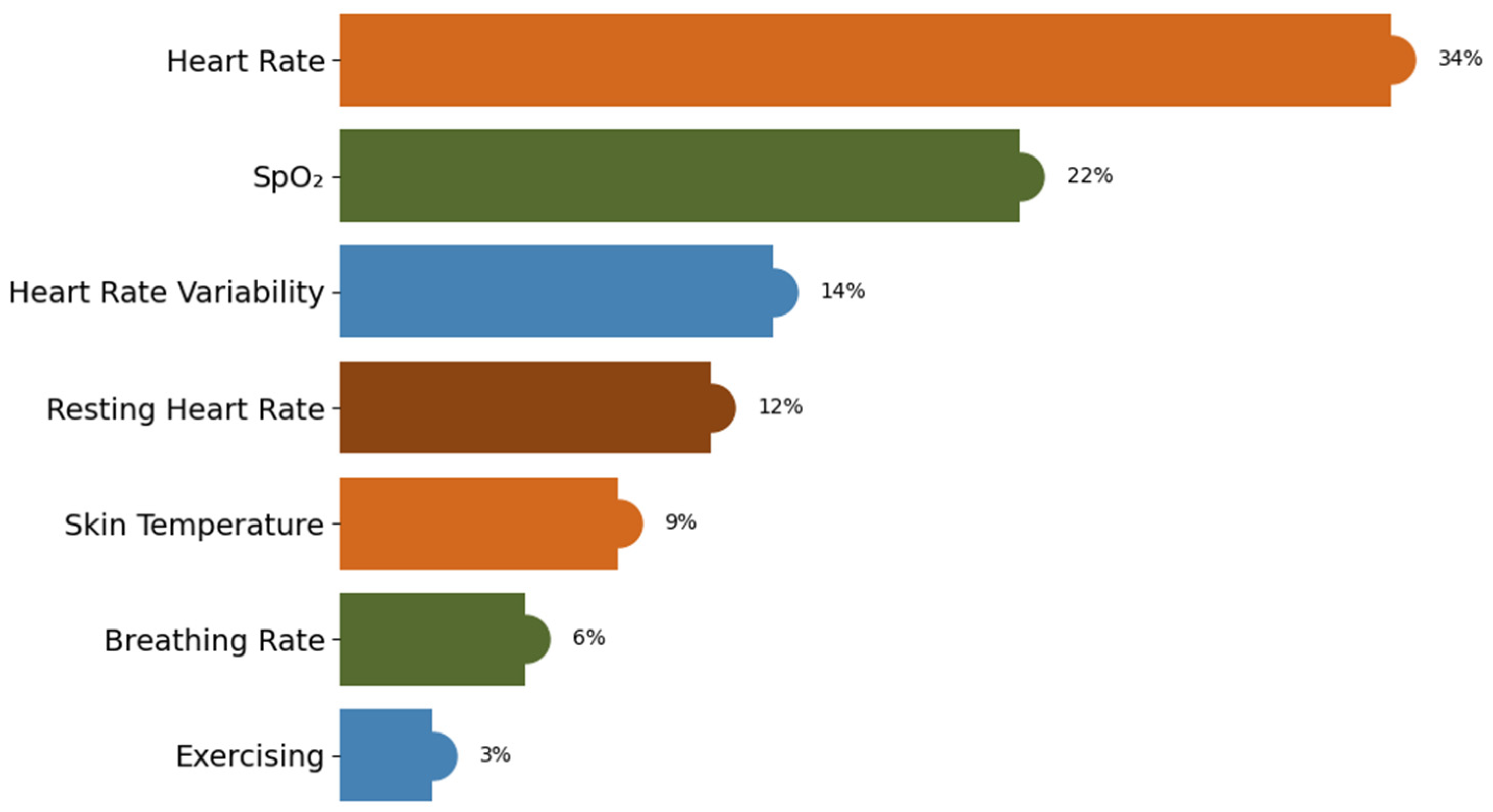
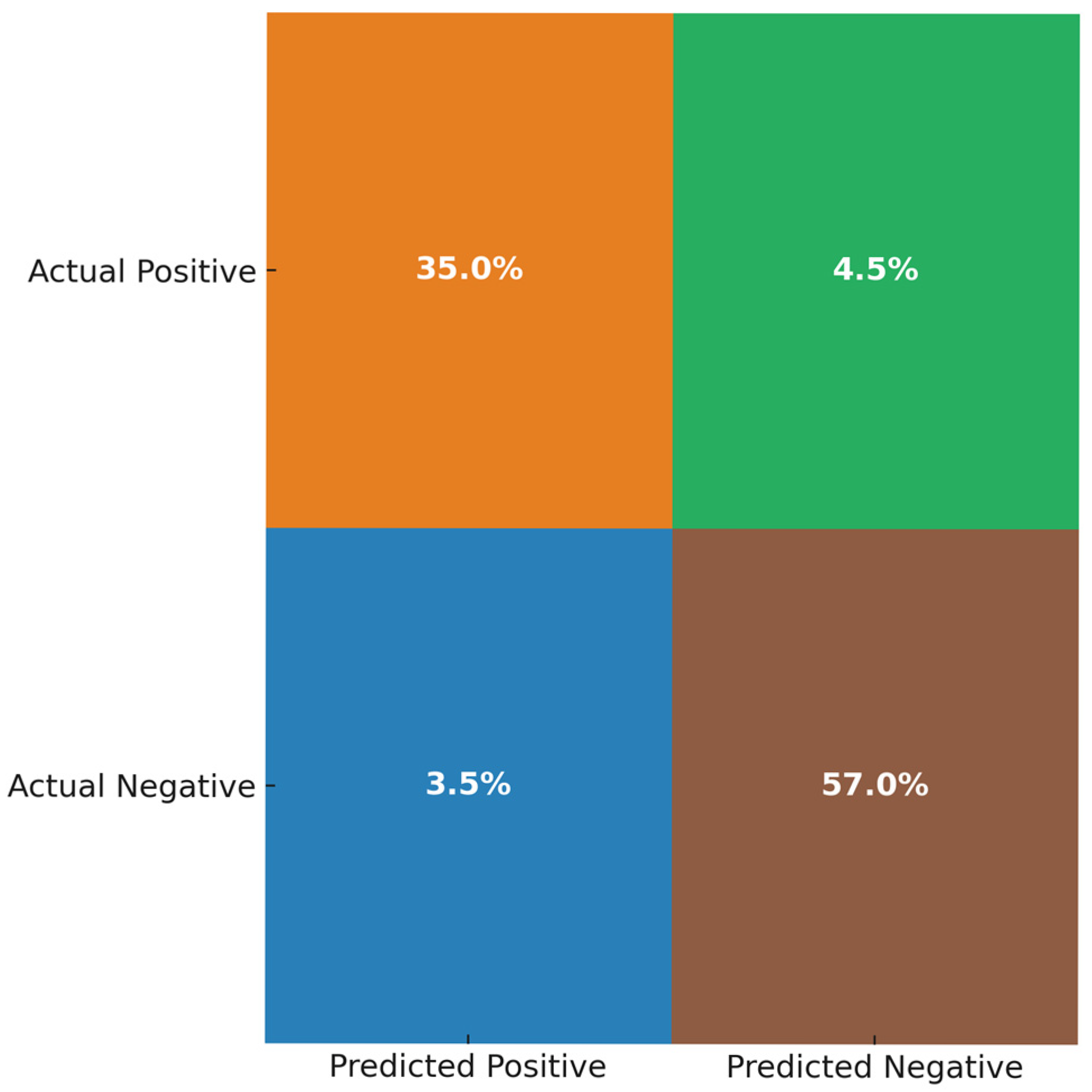
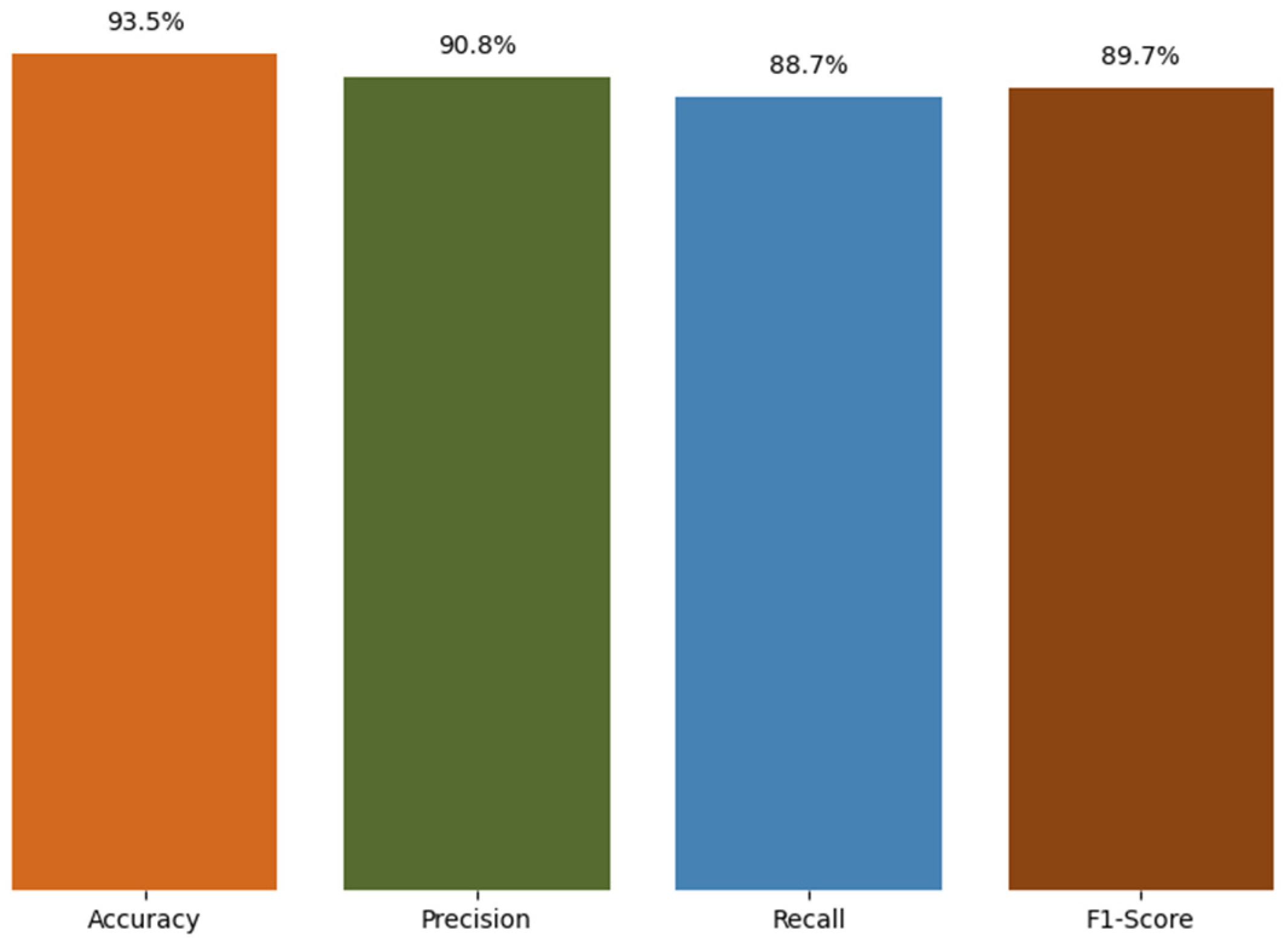
- The Random Forest model demonstrated high accuracy in detecting anomalies, showcasing its reliability for identifying critical health data irregularities.
5. Discussion and Recommendations
5.1. Summary of Our Research Contribution
- The importance of a privacy-centric approach in the design of fog environments. An existing study [35] emphasises the imperative of proactive privacy practices given that fog nodes live close to sensitive data sources. Trust-based and privacy-protected frameworks combined with encryption of sensitive information such as identity, authentication, location and other attributes associated with each fog node would establish reliable communication across distributed healthcare networks [36,37].
- The use of lightweight encryption techniques, which a fog environment necessitates, has given the limited availability of computational resources. For example, data masking and anonymisation, where the data is needed only for analysis rather than for complete retrieval. Additionally, determining the level of Homomorphic Encryption —partial (PHE) or full (FHE) —involves a trade-off between performance and security.
- The limitations of battery life in IoT devices emphasise the importance of this trade-off. In our smart remote patient monitoring case study, the successful use of lightweight techniques was demonstrated by maintaining patient health data confidentiality during transmission by low-power wearable devices.
- Considerations for fog-optimised data management, particularly database optimisation and the efficiency of query strategies. Non-relational databases can play a vital role in fog computing by offering scalability and flexibility. Relational databases, for instance, may experience latency when complex joins are required across fog nodes. Besides the performance and uptime issues faced by relational databases, they also pose risks to data security and privacy [38].
5.2. Limitations of the Study and Future Recommendations
- Analyse workload characteristics of CPS applications (data volume, processing intensity, real-time requirements) to tailor hybrid architectures. Existing work [35,39] on workload modelling for CPS in hybrid environments has shown that understanding factors such as data volume, processing intensity, and real-time requirements is crucial for tailoring the hybrid architecture appropriately.
- Develop automated workload scheduling tools for efficient tasks and resource distribution across cloud, fog, and edge tiers.
- Apply several other AI and deep learning algorithms, such as PCA, Autoencoders-DNN, RNN, GNN, GAN, LSTM, etc., not only for bottleneck detection but also for anomaly detection and strengthening security in prioritised health data streams [40].
- Explore collaboration between fog nodes (load balancing, failover, resource sharing) to improve resilience and scalability.
- The use of multi-factor authentication. For example, applying a zero-trust model (which can be particularly important in fog environments where different manufacturers produce devices and may run other operating systems) and exploring continuous authentication techniques, such as keystroke analysis and device usage patterns, can be beneficial.
6. Conclusions
Author Contributions
Funding
Institutional Review Board Statement
Informed Consent Statement
Data Availability Statement
Conflicts of Interest
Abbreviations
| AI | Artificial Intelligence |
| CPS | Cyber–Physical System |
| IoT | Internet of Things |
| IDP | Intelligent Data Prioritisation |
| DPE | Data Protection Engine |
| AES | Advanced Encryption Standard |
| PG | Privacy Gateway |
| IAM | Identity and Access Management |
| IDS | On-Node Intrusion-Detection System |
| SpO2 | Oxygen Saturation |
| PHE | Partial Homomorphic Encryption |
| FHE | Full Homomorphic Encryption |
References
- Arnott, M. Global IoT Forecast Report, 2023–2033. 2024. Available online: https://transformainsights.com/research/reports/global-iot-forecast-report-2023-2033 (accessed on 6 June 2025).
- Natarajan, K. Performance Evaluation of Fog Computing for Latency and Energy Efficiency in IoT Applications. J. Comput. Commun. Netw. 2025, 1, 22–32. [Google Scholar]
- Wang, X.; Gu, B.; Qu, Y.; Ren, Y.; Xiang, Y.; Gao, L. Reliable Customized Privacy-Preserving in Fog Computing. In Proceedings of the 2020 IEEE International Conference on Communications (ICC), Dublin, Ireland, 7–11 June 2020; pp. 1–6. [Google Scholar]
- Alwakeel, A.M. An Overview of Fog Computing and Edge Computing Security and Privacy Issues. Sensors 2021, 21, 8226. [Google Scholar] [CrossRef]
- Rani, S.; Kataria, A.; Chauhan, M. Fog computing in industry 4.0: Applications and challenges—A research roadmap. In Energy Conservation Solutions for Fog-Edge Computing Paradigms; Springer: Berlin/Heidelberg, Germany, 2022; pp. 173–190. [Google Scholar]
- Pop, P.; Zarrin, B.; Barzegaran, M.; Schulte, S.; Punnekkat, S.; Ruh, J.; Steiner, W. The FORA fog computing platform for industrial IoT. Inf. Syst. 2021, 98, 101727. [Google Scholar] [CrossRef]
- Apat, H.K.; Bhaisare, K.; Sahoo, B.; Maiti, P. Energy efficient resource management in fog computing supported medical cyber-physical system. In Proceedings of the 2020 International Conference on Computer Science, Engineering and Applications (ICCSEA), Gunupur, India, 13–14 March 2020; pp. 1–6. [Google Scholar]
- Porkodi, V.; Singh, A.R.; Sait, A.R.W.; Shankar, K.; Yang, E.; Seo, C.; Joshi, G.P. Resource provisioning for cyber-physical-social system in cloud-fog-edge computing using optimal flower pollination algorithm. IEEE Access 2020, 8, 105311–105319. [Google Scholar] [CrossRef]
- Ghobaei-Arani, M.; Souri, A.; Safara, F.; Norouzi, M. An efficient task scheduling approach using moth-flame optimization algorithm for cyber-physical system applications in fog computing. Trans. Emerg. Telecommun. Technol. 2020, 31, e3770. [Google Scholar] [CrossRef]
- Kaur, N.; Mittal, A.; Lilhore, D.K.; Simaiya, S.; Dalal, S.; Saleem, K.; Ghith, E. Securing fog computing in healthcare with a zero-trust approach and blockchain. EURASIP J. Wirel. Commun. Netw. 2025, 2025, 5. [Google Scholar] [CrossRef]
- Anand, D.; Khemchandani, V. Data Security and Privacy Functions in Fog Computing for Healthcare 4.0. In Fog Computing: Theory and Practice; Springer: Singapore, 2020; pp. 387–420. [Google Scholar]
- Baker, S.; Rashid, S.; Alsaif, O. Fog Computing: A Comprehensive Review of Architectures, Applications, and Security Challenges. NTU J. Eng. Technol. 2023, 2. [Google Scholar] [CrossRef]
- Kiourtis, A.; Mavrogiorgou, A.; Kyriazis, D. A computer vision-based IoT data ingestion architecture supporting data prioritization. Health Technol. 2023, 13, 391–411. [Google Scholar] [CrossRef]
- Yadegari, F.; Asosheh, A. A unified IoT architectural model for smart hospitals: Enhancing interoperability, security, and efficiency through clinical information systems (CIS). J. Big Data 2025, 12, 149. [Google Scholar] [CrossRef]
- Anand, J.; Karthikeyan, B. Dynamic priority-based task scheduling and adaptive resource allocation algorithms for efficient edge computing in healthcare systems. Results Eng. 2025, 25, 104342. [Google Scholar] [CrossRef]
- Tabassum, M.; Mahmood, S.; Bukhari, A.; Alshemaimri, B.; Daud, A.; Khalique, F. Anomaly-based threat detection in smart health using machine learning. BMC Med. Inform. Decis. Mak. 2024, 24, 347. [Google Scholar] [CrossRef]
- Palanisamy, S.; Thangaraju, V.; Kandasamy, J.; Salau, A. Towards precision in IoT-based healthcare systems: A hybrid optimized framework for big data classification. J. Big Data 2025, 12, 190–202. [Google Scholar] [CrossRef]
- Nawaz, M.; Ahmed, J. Cloud-based healthcare framework for real-time anomaly detection and classification of 1-D ECG signals. PLoS ONE 2022, 17, e0279305. [Google Scholar] [CrossRef]
- Choudhury, R.T.; Katal, A.; Dahiya, S.; Singh, N. Fog Computing: Concepts, Frameworks, and Applications, 1st ed.; Chapman and Hall/CRC: New York, NY, USA, 2022. [Google Scholar]
- Velotio Technologies. A Beginner’s Guide to Edge Computing. 2019. Available online: https://medium.com/velotio-perspectives/a-beginners-guide-to-edge-computing-6cfea853aa11 (accessed on 20 June 2025).
- Butler, B. What Is Fog Computing? Connecting the Cloud to Things. 2019. Available online: https://www.networkworld.com/article/3243111/what-is-fog-computing-connecting-the-cloud-to-things.html (accessed on 20 June 2025).
- Abdelaziza, J.; Adda, M.; Mcheick, H. An Architectural Model for Fog Computing. J. Ubiquitous Syst. Pervasive Netw. 2018, 10, 21–25. [Google Scholar] [CrossRef]
- Ometov, A.; Molua, O.L.; Komarov, M.; Nurmi, J. A Survey of Security in Cloud, Edge, and Fog Computing. Sensors 2022, 22, 927. [Google Scholar] [CrossRef]
- Shwe, T.; Aritsugi, M. Optimizing Data Processing: A Comparative Study of Big Data Platforms in Edge, Fog, and Cloud Layers. Appl. Sci. 2024, 14, 452. [Google Scholar] [CrossRef]
- Mutlag, A.A.; Ghani, M.K.A.; Arunkumar, N.; Mohamed, M.A.; Mohd, O. Enabling technologies for fog computing in healthcare IoT systems. Future Gener. Comput. Syst. 2019, 90, 62–78. [Google Scholar] [CrossRef]
- Gajiwala, C. NoSQL Technologies in Big Data Ecosystems: A Comprehensive Review of Architectural Paradigms and Performance Metrics. Int. J. Multidiscip. Res. 2024, 6, 1–13. [Google Scholar]
- Rahmani, A.-M.; Thanigaivelan, N.K.; Gia, T.N.; Granados, J.; Negash, B.; Liljeberg, P.; Tenhunen, H. Smart e-Health Gateway: Bringing intelligence to Internet-of-Things based ubiquitous healthcare systems. In Proceedings of the 2015 12th Annual IEEE Consumer Communications and Networking Conference (CCNC), Las Vegas, NV, USA, 9–12 January 2015; pp. 826–834. [Google Scholar]
- Hayyolalam, V.; Aloqaily, M.; Ozkasap, O.; Guizani, M. Edge-Assisted Solutions for IoT-Based Connected Healthcare Systems: A Literature Review. IEEE Internet Things J. 2022, 9, 9419–9443. [Google Scholar] [CrossRef]
- Hartmann, M.; Hashmi, U.S.; Imran, A. Edge computing in smart health care systems: Review, challenges, and research directions. Trans. Emerg. Telecommun. Technol. 2022, 33, e3710. [Google Scholar] [CrossRef]
- Rincon, J.A.; Guerra-Ojeda, S.; Carrascosa, C.; Julian, V. An IoT and Fog Computing-Based Monitoring System for Cardiovascular Patients with Automatic ECG Classification Using Deep Neural Networks. Sensors 2020, 20, 7353. [Google Scholar] [CrossRef]
- Rahman, G.; Wen, C. Fog Computing, Applications, Security and Challenges, Review. Int. J. Eng. Technol. 2018, 7, 1615. [Google Scholar] [CrossRef]
- Sanchez, J.M.G. Edge computing for cyber-physical systems. ACM Trans. Cyber-Phys. Syst. 2022, 1, 1–29. [Google Scholar] [CrossRef]
- de Araujo-Filho, P.F.; Kaddoum, G.; Campelo, D.R.; Santos, A.G.; Macedo, D.; Zanchettin, C. Intrusion detection for cyber-physical systems using generative adversarial networks in fog environment. IEEE Internet Things J. 2020, 8, 6247–6256. [Google Scholar] [CrossRef]
- Zhou, H.; Pal, S.; Jadidi, Z.; Jolfaei, A. A Fog-Based Security Framework for Large-Scale Industrial Internet of Things Environments. IEEE Internet Things Mag. 2022, 6, 64–68. [Google Scholar] [CrossRef]
- Almaiah, M.A.; Ali, A.; Hajjej, F.; Pasha, M.F.; Alohali, M.A. A Lightweight Hybrid Deep Learning Privacy Preserv-ing Model for FC-Based Industrial Internet of Medical Things. Sensors 2022, 22, 2112. [Google Scholar] [CrossRef] [PubMed]
- Kumar, S.; Abhishek, K.; Selvarajan, S. A lightweight and secure authentication and privacy protection scheme for internet of medical things. Sci. Rep. 2025, 15, 23876. [Google Scholar] [CrossRef]
- Sabri, O.; Al-Shargabi, B.; Abuarqoub, A.; Hakami, T.A. A Lightweight Encryption Method for IoT-Based Healthcare Applications: A Review and Future Prospects. IoT 2025, 6, 23. [Google Scholar] [CrossRef]
- Fahd, K.; Venkatraman, S.; Hammeed, F.K. A Comparative Study of NoSQL System Vulnerabilities with Big Data. Int. J. Manag. Inf. Technol. 2019, 11, 1–19. [Google Scholar] [CrossRef]
- Raza, Z.; Jangu, N. Workload Classification: For Better Resource Management in Fog-Cloud Environments. Int. J. Syst. Serv. Oriented Eng. 2022, 12, 1–14. [Google Scholar] [CrossRef]
- Alsadie, D. Artificial Intelligence Techniques for Securing Fog Computing Environments: Trends, Challenges, and Future Directions. IEEE Access 2024, 12, 151598–151648. [Google Scholar] [CrossRef]
- Venkatraman, S.; Parvin, S. Developing an IoT Identity Management System Using Blockchain. Systems 2022, 10, 39. [Google Scholar] [CrossRef]





| Feature | Edge Computing | Fog Computing | Cloud Computing |
|---|---|---|---|
| Processing Location | On or near the data-generating devices (sensors, gateways) | Intermediate layer between edge and cloud (local servers, routers) | Centralised data centres located far from end devices |
| Latency | Very low (milliseconds) | Low (near real-time) | High (dependent on network distance) |
| Scope of Processing | Device-level processing | Regional/local aggregation of multiple edge devices | Global-level processing and storage |
| Scalability | Limited to device capacity | Moderate—scalable within local networks | Highly scalable but bandwidth dependent |
| Security and Privacy | Basic device-level security | Enhanced localised security and privacy control | Centralised security; higher risk during data transmission |
| Real-time Analytics | Fast for simple tasks | Suitable for time-sensitive, distributed analytics | Limited for latency-sensitive operations |
| Example Applications | Smart vehicles, industrial sensors | Smart healthcare, intelligent transport, smart grids | Data storage, deep analytics, and training of AI models |
| Attribute | Description |
|---|---|
| Device ID | Unique identifier for each Fitbit device (1 to 5). |
| Timestamp | Hourly timestamp for each day in one month. |
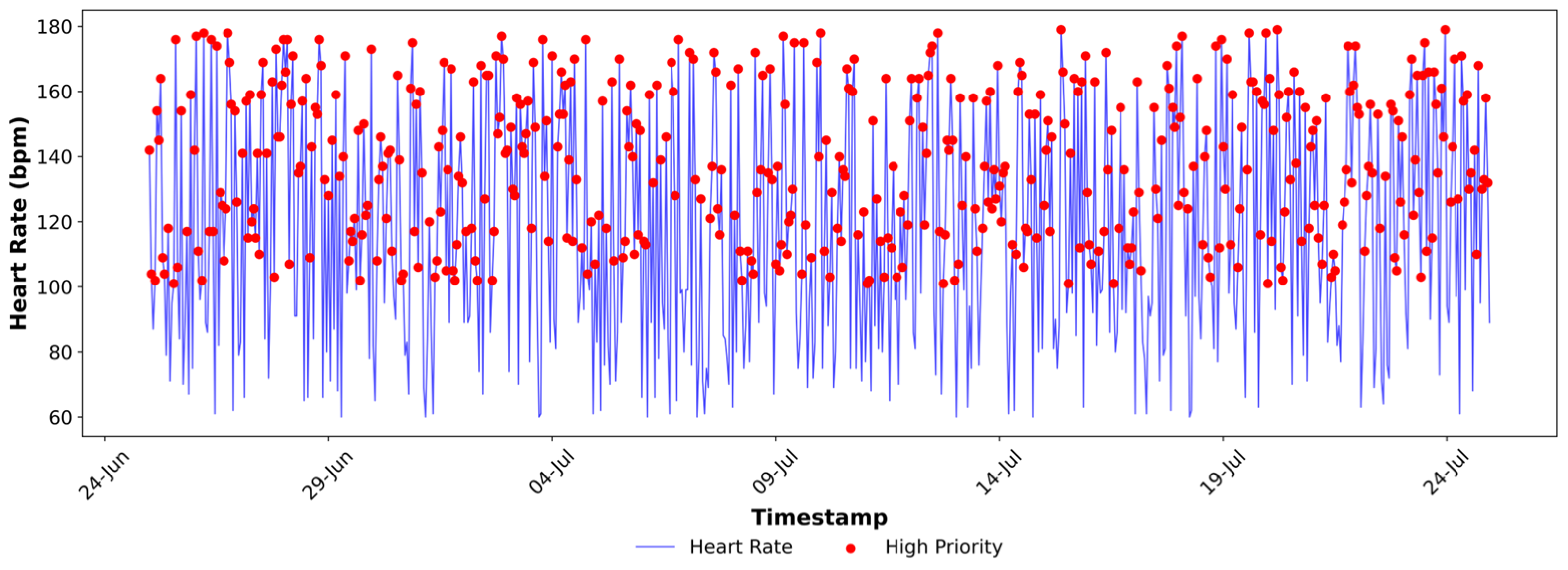
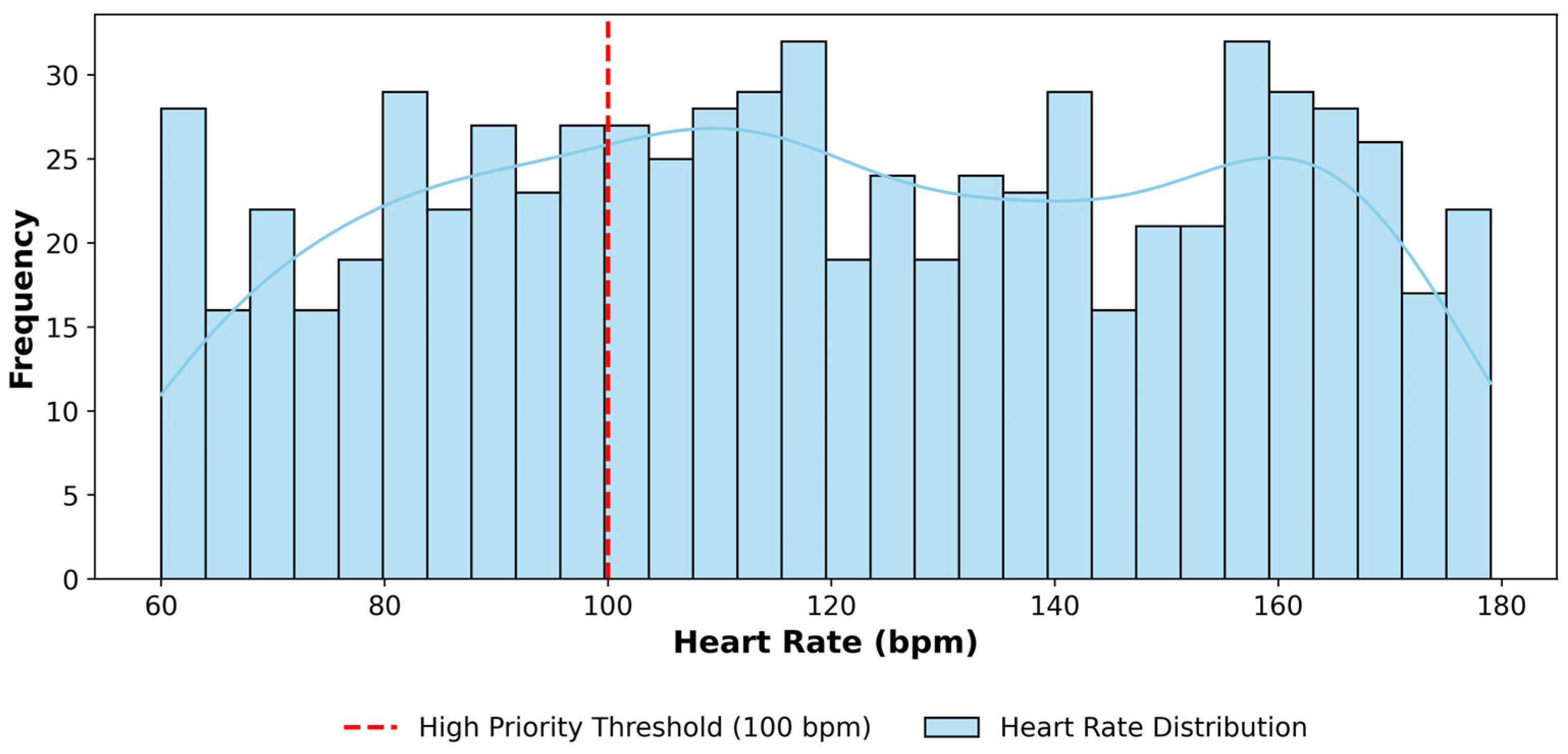
| Heart Rate | Simulated heart rate values (60–180 bpm). |
| Heart Rate Priority | Priority classification of heart rate values (high) based on critical readings exceeding 100 bpm. |
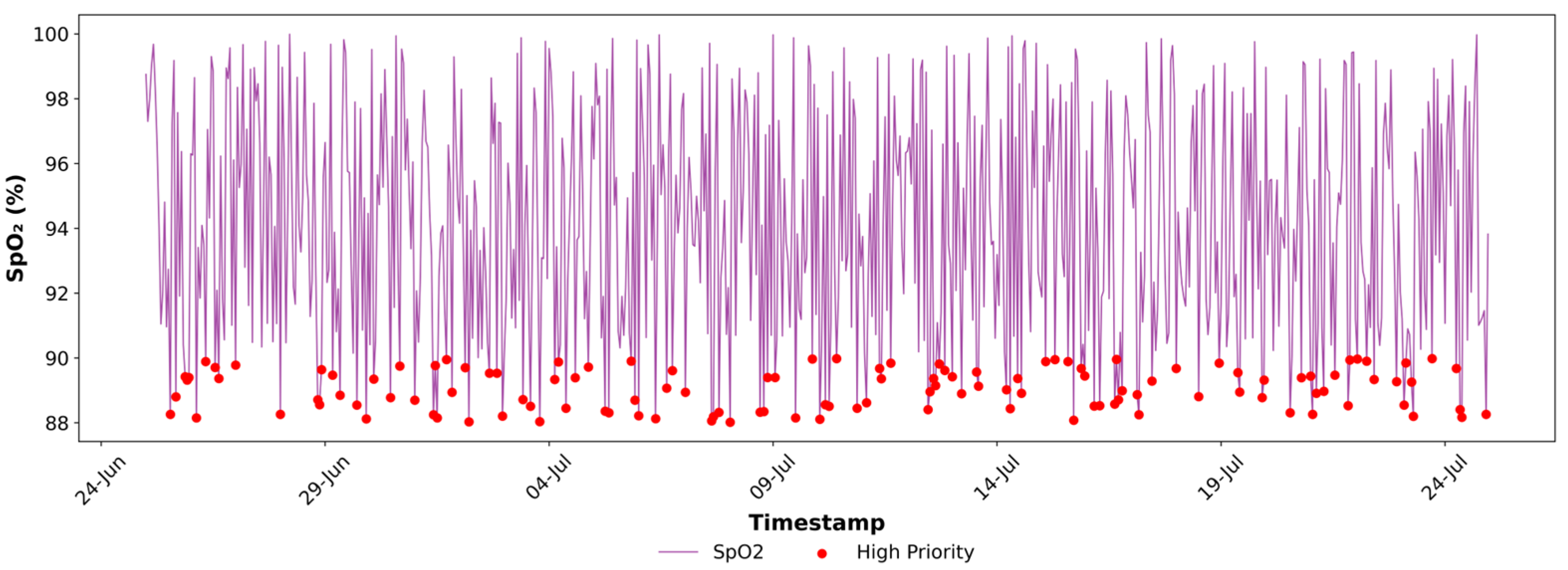
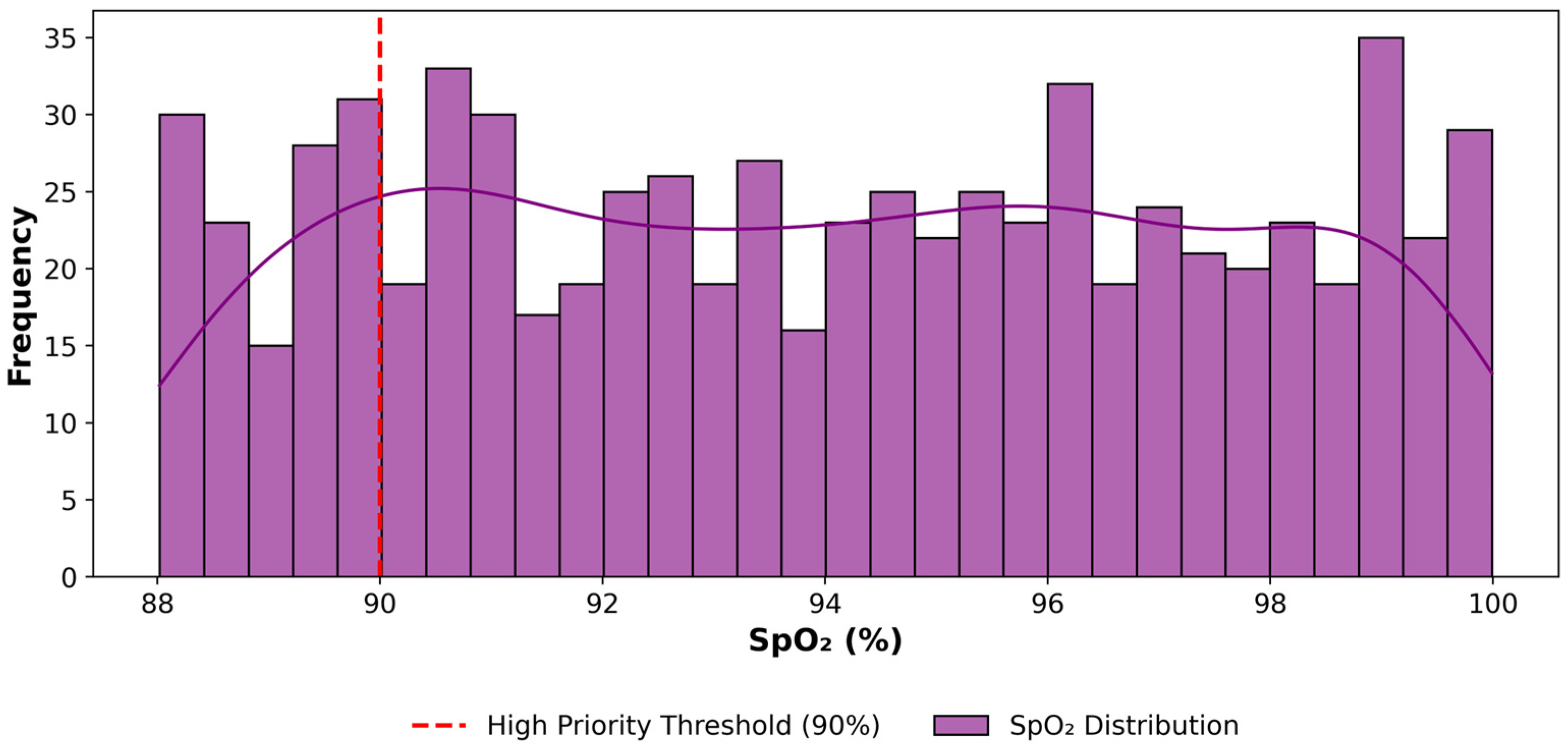
| SpO2 | Simulated oxygen saturation levels in the blood. |
| SpO2 Priority | Priority classification of SpO2 values (high/low), e.g., values below 90% flagged as urgent. |
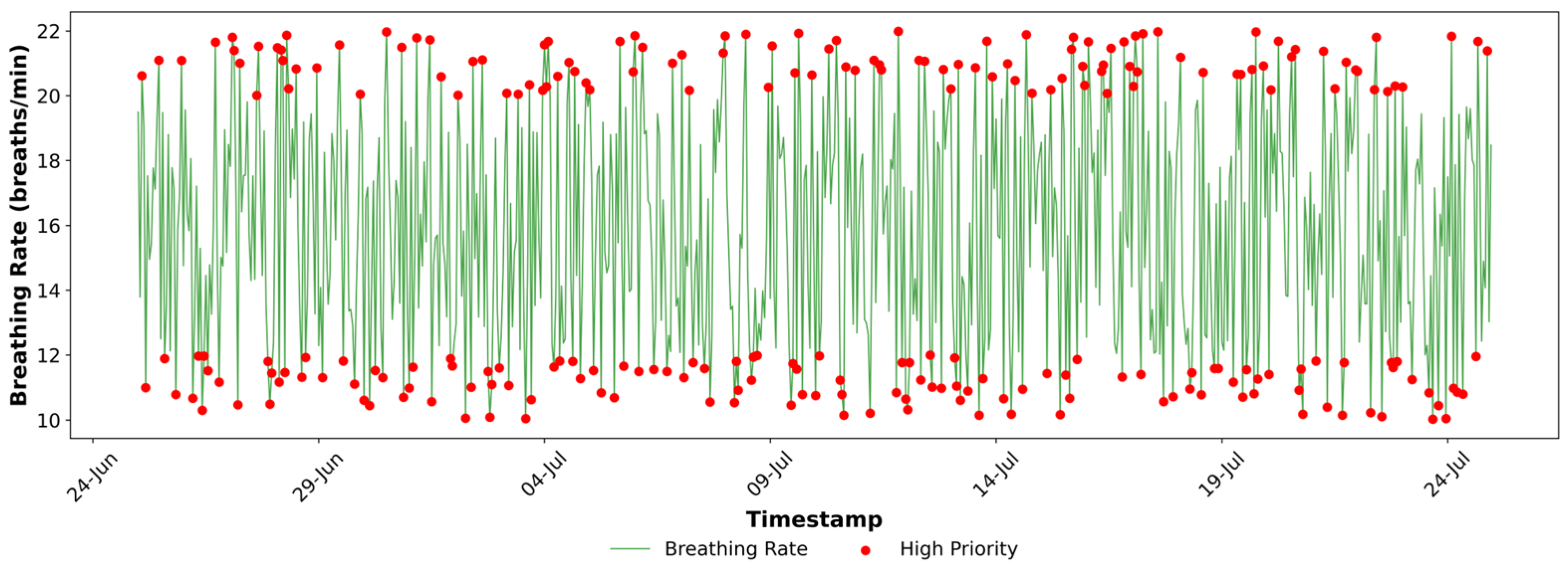
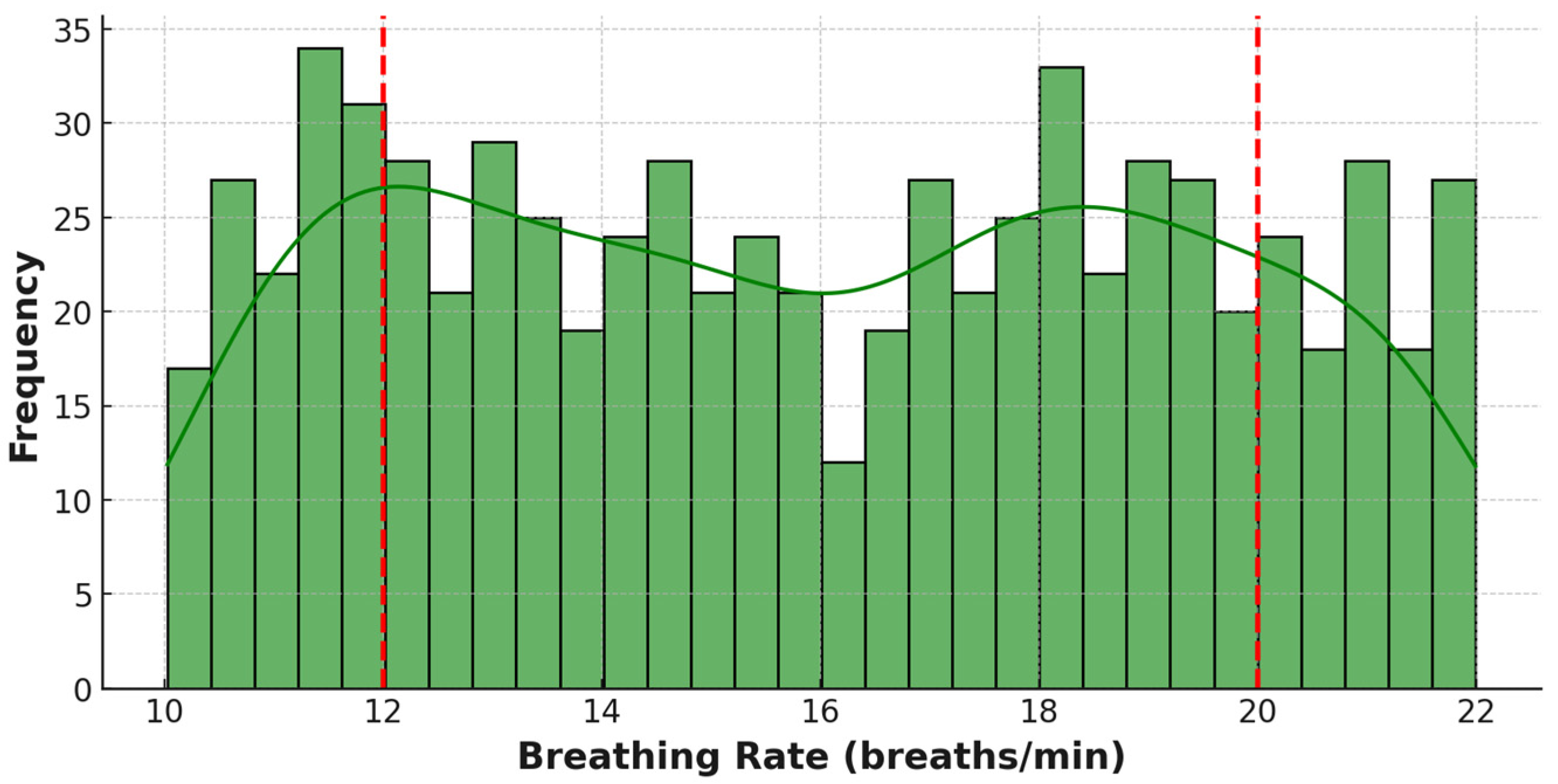
| Breathing Rate | Simulated breathing rate values. |
| Breathing Rate Priority | Priority classification of breathing rate values (high/low), e.g., less than 12 or greater than 20 breaths per minute, is flagged as urgent. |
| Exercising | Indicator of whether the individual is exercising (Yes/No). |
| Skin Temperature | Simulated skin temperature values. |
| Heart Rate Variability | Simulated heart rate variability values to capture variability in cardiac activity. |
| Resting Heart Rate | Simulated resting heart rate values. |
| Status | A label (“ok” or “alert”) derived from combined thresholds, used for AI-based anomaly detection. |
| Metric | Formula | Calculation | Result |
|---|---|---|---|
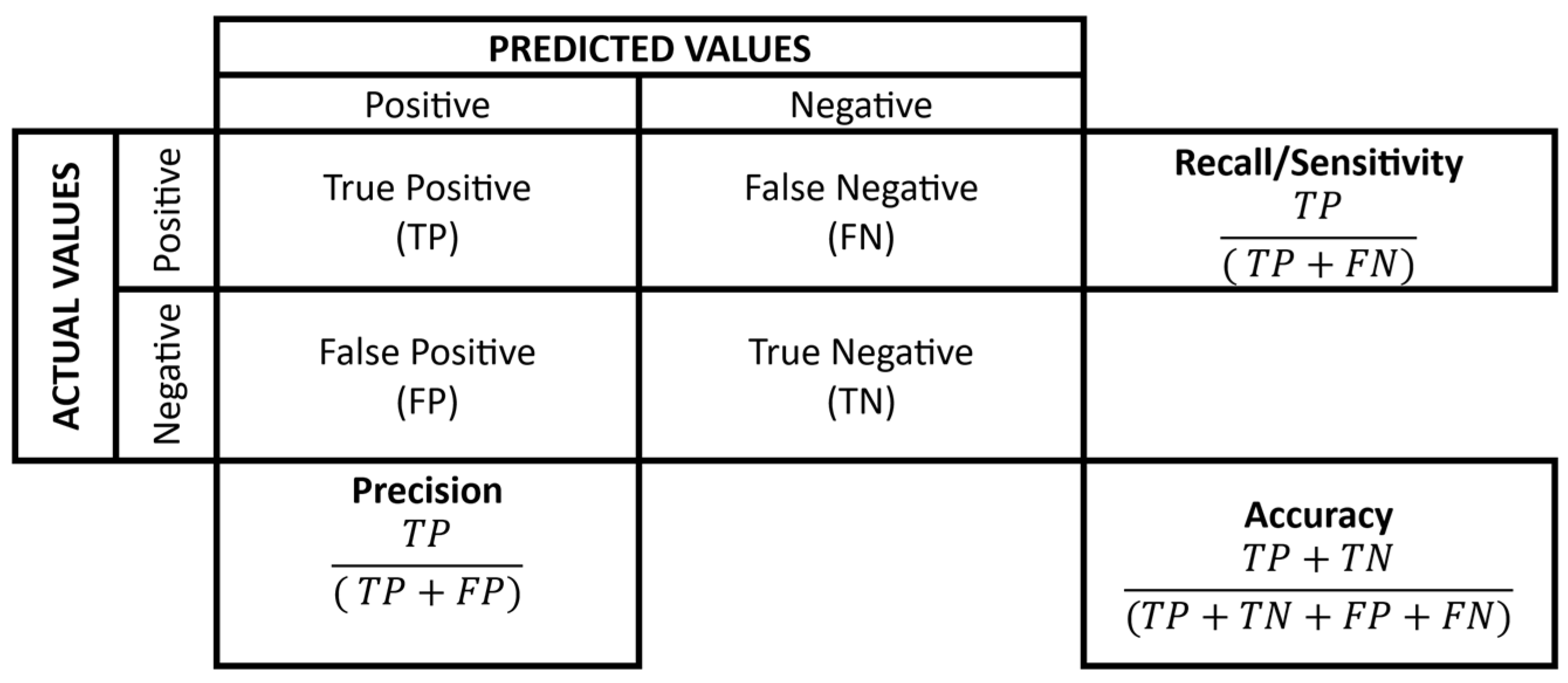
| Accuracy | (TP + TN)/(TP + TN + FP + FN) | (3500 + 5695)/10,000 = 9195/10,000 | 0.935 → 93.5% |
| Precision | TP/(TP + FP) | 3500/(3500 + 355) = 3500/3855 | 0.908 → 90.8% |
| Recall | TP/(TP + FN) | 3500/(3500 + 450) = 3500/3950 | 0.887 → 88.7% |
| F1-Score | 2 × (Precision × Recall)/(Precision + Recall) | 2 × (0.908 × 0.887)/(0.908 + 0.887) = 2 × 0.805/1.795 | 0.897 → 89.7% |
Disclaimer/Publisher’s Note: The statements, opinions and data contained in all publications are solely those of the individual author(s) and contributor(s) and not of MDPI and/or the editor(s). MDPI and/or the editor(s) disclaim responsibility for any injury to people or property resulting from any ideas, methods, instructions or products referred to in the content. |
© 2025 by the authors. Licensee MDPI, Basel, Switzerland. This article is an open access article distributed under the terms and conditions of the Creative Commons Attribution (CC BY) license (https://creativecommons.org/licenses/by/4.0/).
Share and Cite
Fahd, K.; Parvin, S.; Di Serio, A.; Venkatraman, S. Secure Fog Computing for Remote Health Monitoring with Data Prioritisation and AI-Based Anomaly Detection. Sensors 2025, 25, 7329. https://doi.org/10.3390/s25237329
Fahd K, Parvin S, Di Serio A, Venkatraman S. Secure Fog Computing for Remote Health Monitoring with Data Prioritisation and AI-Based Anomaly Detection. Sensors. 2025; 25(23):7329. https://doi.org/10.3390/s25237329
Chicago/Turabian StyleFahd, Kiran, Sazia Parvin, Antony Di Serio, and Sitalakshmi Venkatraman. 2025. "Secure Fog Computing for Remote Health Monitoring with Data Prioritisation and AI-Based Anomaly Detection" Sensors 25, no. 23: 7329. https://doi.org/10.3390/s25237329
APA StyleFahd, K., Parvin, S., Di Serio, A., & Venkatraman, S. (2025). Secure Fog Computing for Remote Health Monitoring with Data Prioritisation and AI-Based Anomaly Detection. Sensors, 25(23), 7329. https://doi.org/10.3390/s25237329