1. Introduction
Microfluidics has proven itself as a promising technology for point-of-care (POC) applications due to its ability to provide a functional lab-on-a-chip with minimal equipment requirements. These chips offer solutions not only for analyzing biological samples but also for preparing them through enrichment, reactions, and even on-chip imaging [
1]. In particular, capillary-driven microfluidic chips, which autonomously drive fluid through microchannels via capillary action, have gained attention for portable diagnostics [
1,
2]. They are compact and can be easily manufactured from inexpensive polymer materials, e.g., polymethyl methacrylate (PMMA) or others, rendering them particularly suitable for single-use diagnostic assays. Many diagnostic workflows involve imaging the sample, followed by image processing or machine learning-based approaches for cell detection and tracking to extract quantitative biological parameters [
3,
4,
5,
6,
7]. Accurate tracking of cells flowing through such chips is crucial for applications like on-chip flow cytometry, cell counting, and biomechanical assays, as it allows real-time quantification much like a bench-top flow cytometers.
Unlike pump-driven microfluidic systems, where cells typically move at a uniform speed, capillary-driven systems pose greater challenges for tracking because of flow instabilities, rapid cell displacements (often spanning hundreds of pixels per frame), and the complex dynamics exhibited by cells under varying flow velocities. Conventional tracking tools such as TrackPy [
8] and TrackMate [
9] assume small displacements between frames, relying on isotropic search windows or linear assignment problem (LAP) frameworks [
10], which break down under these conditions. Multi-object tracking frameworks such as SORT and DeepSORT [
11,
12] incorporate Kalman prediction and data association. Their reliance on slow-motion assumptions or appearance makes them unsuitable for capillary-driven microfluidic cell tracking, where cells are visually similar and move rapidly. As a result, generic tracking algorithms are prone to track fragmentation and identity switches in high-speed capillary-driven microfluidic assays.
To overcome these limitations, we present FloCyT, a dedicated tracker that leverages microchannel geometry and flow direction to improve robustness. FloCyT diverges from conventional centroid trackers through three core advancements: incorporation of prior global flow knowledge, anisotropic search gating aligned with the flow axis, and channel-specific data association to maintain identity across parallel lanes. Together, these enable reliable, high-speed tracking even where traditional methods fail. We benchmark FloCyT against both TrackPy and SORT, in their original forms and modified global flow-aware variants, using 12 simulated datasets and 4 real patient datasets, using Multi-Object tracking metrics (MOT) designed for the Classification of Events, Activities, and Relationships (CLEAR) evaluation called the CLEAR-MOT metrics framework to measure tracking accuracy [
13].
2. Methods
FloCyT’s framework is based on the Kalman filter and Hungarian assignment paradigm, similar to the SORT tracker [
11]. However, unlike SORT, which propagates bounding boxes and relies on intersection-over-union (IoU) for association, FloCyT performs centroid-based tracking with an anisotropic gated cost function aligned to the microfluidic flow axis. In addition, FloCyT supports channel-specific data association and user-defined region-of-interest (ROI) track lifecycle management, ensuring consistent tracking in capillary-driven flow.
2.1. State Estimation
FloCyT models each cell movement with a linear Kalman filter whose state vector contains the two-dimensional centroid position and velocity given by Equation (
1).
where
and
are the detected centroid coordinates and
and
are the initial velocities obtained by Equation (
5). This formulation assumes approximately constant velocity between consecutive frames, with process noise capturing local fluctuations caused by flow instabilities or cell–cell interactions. At each time step, the filter performs a prediction to estimate the next centroid location, followed by a correction whenever a detection is successfully associated.
2.2. Anisotropic Gated Cost Matrix and Data Association
To associate predicted cell positions with detections, we define a flow-aware cost function. Let denote the i-th predicted position for , where is the number of predicted tracks, and the j-th detected position for , where is the number of detections in the current frame.
The displacements between prediction
i and detection
j are defined in Equation (
2).
where
is the downstream or upstream displacement and
is the orthogonal displacement.
We introduce a binary mask
to enforce the gating condition given by Equation (
3).
where
,
, and
are the forward, backwards, and orthogonal gating thresholds, respectively. They can be user-defined parameters or be calculated via the time-dependent displacement from the current velocity estimate
.
The assignment cost between prediction
i and detection
j is given by Equation (
4).
where
is the Euclidean distance between the predicted and detected positions.
restricts associations to an anisotropic search region, which we have chosen to elongate along the flow direction and narrow in the orthogonal direction, reflecting the physical reality of capillary-driven flows in microfluidic channels. Finally, the cost matrix is used in the linear assignment (Hungarian) algorithm to find the best matches, considering only feasible pairs where .
2.3. Track Creation and Deletion
A new Kalman-based tracker is created for each unmatched detection whose centroids lies within the ROI. The initial velocity is estimated as a weighted average of a global velocity estimate
and a local velocity estimate
given by Equation (
5).
where,
is the component-wise median of recent track velocities from the Kalman filter, and
is obtained using the method described in
Section 2.4. At the beginning of the analysis,
is set to zero so that
relies only on the global velocity estimate. Once a sufficient number of active tracks are available,
is increased (e.g., to 0.7), giving greater weight to the local median velocity. This staged initialization allows the tracker to quickly adapt to the high velocities and temporal variations observed in capillary-driven flows, which would otherwise be difficult to capture reliably.
An active track is deleted when it no longer provides reliable information. Specifically, each track maintains a counter of consecutive missed frames. If a track remains unmatched for more than the user-defined number of frames, it is terminated. In addition, a track is removed once its estimated position leaves the ROI along the flow axis, ensuring that only cells present within the observable channel segment are retained. These rules prevent stale tracks from persisting after a cell exits the ROI or becomes occluded for too long, thereby maintaining a clean and reliable set of active trajectories.
2.4. Tracking Initialization
Objects entrained in laminar channel flow usually have a dominant flow direction and flow speed. An estimate of this dominant motion, the global velocity estimate
, is used for initial velocity estimation when tracking individual particles in Equation (
5).
Let denote the centroid coordinates of an individual object, and let denote the centroids of all m objects detected in the first frame. Similarly, let denote the centroids of all n objects detected in the second frame.
We propose a maximum likelihood estimator of the global velocity from two successive frames using the following steps:
Calculate the displacement between all centroids in the first frame and all centroids in the second frame according to Equation (
6).
Create a 2D histogram of all displacement vectors in to estimate the motion probability density.
Smooth the histogram with a 2D Gaussian kernel with an appropriate size. The kernel size should chosen so displacement patterns arising from the bulk motion are emphasized. It should be large enough to provide robust estimation, but not so large that it over-smooths motion patterns.
Select the histogram bin with the highest smoothed density value as the as maximum likelihood estimate of the global velocity vector.
A key advantage of this approach is its minimal user-defined parameter requirements. The only user-defined parameter is the size of the Gaussian kernel used for histogram smoothing; no explicit displacement thresholds or directional priors are required. Larger Gaussian kernels yield smoother probability surfaces and improve robustness when fewer displacement vectors are available, whereas smaller kernels preserve finer detail when a large number of displacement vectors are available.
Bulk velocity estimation can be made more robust by collecting velocity vectors from consecutive frame pairs before calculating the histogram and smoothing. This temporal collection reduces the effect of local fluctuations and should be limited when there is high flow variability, as long-term collection may mask transient flow changes.
Applying kernel density estimation to the histogram instead of each velocity vector has computational advantages. The computation time is bounded by the histogram size instead of the number of displacement vectors in which can be very large for dense flows over many frames.
3. Real Dataset Preparation
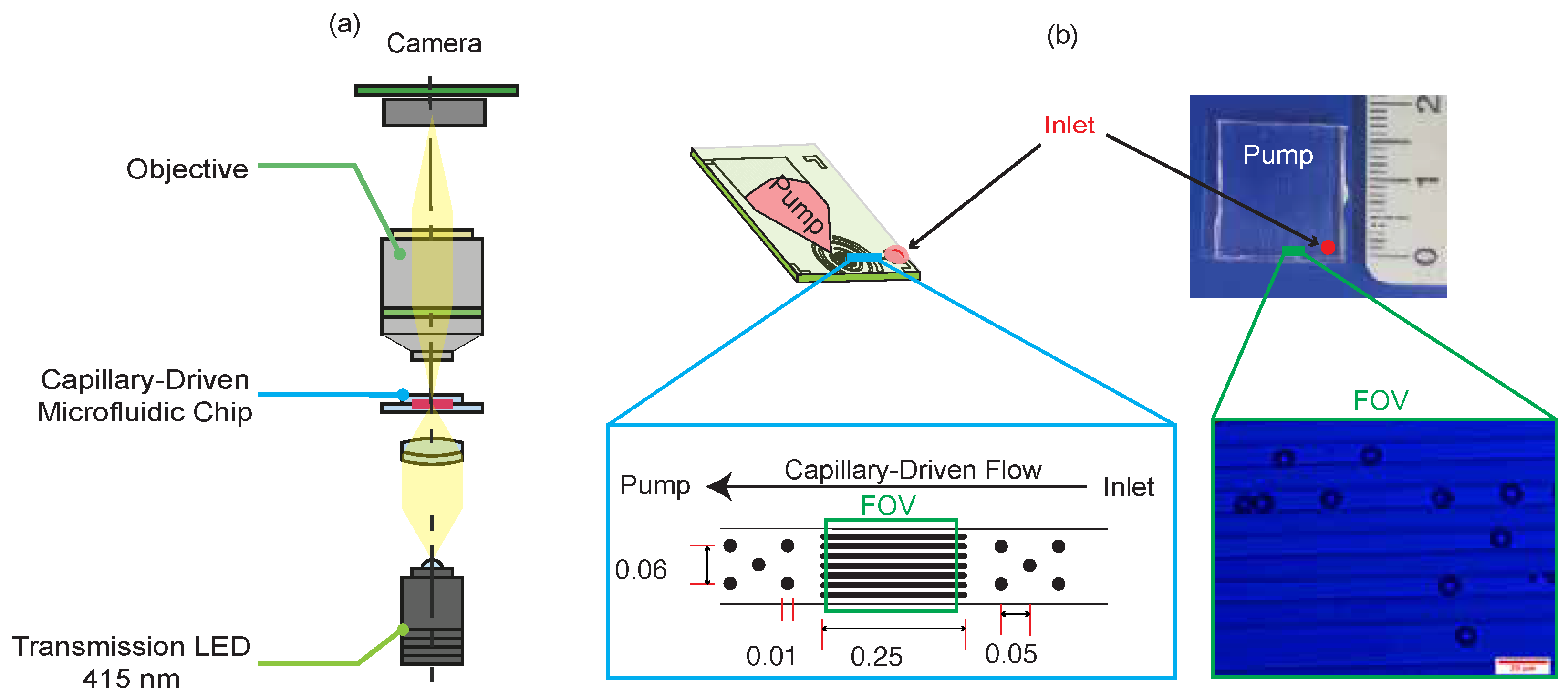
Blood samples from four patients were provided by the University Hospital Bern (Inselspital). Each sample was diluted with Phosphate-buffered saline (PBS) (pH 7.2; Sigma-Aldrich, St. Louis, MO, USA, Product No. 806544) at a ratio of 1:20. Then, 5 µL of the diluted sample was placed at the inlet of the capillary-driven chip, enabling the cells to flow passively through the microchannels. Video recordings of the flowing cells were captured using a microscope with a transmission light wavelength of 415 nm at a frame rate of 30 fps, as shown in
Figure 1a. A typical capillary-driven chip design and and the final chip fabricated using polydimethylsiloxane–polyethylene oxide (PDMS–PEO) are shown in
Figure 1b. During fabrication, the PDMS–PEO mixture was prepared by mixing the elastomer base and curing agent in a 10:1 ratio (Sylgard 184, PDMS kit), with 0.1–0.2% (
w/
w) dimethylsiloxane (60–70% ethylene oxide) block copolymer (Gelest, Morrisville, PA, USA, Product number: DBE-712) to make the PDMS hydrophilic [
14]. In
Figure 1b, the green rectangle highlights the parallel grid structures within the field of view (FOV) and the blue box indicates the inlet channel structures. The circular pillars before and after the FOV act as spacer filters to break up agglomerations and prevent channel collapse onto the glass surface. The grid structures in the FOV restrict the lateral motion of red blood cells (RBCs).
In image flow cytometry, the channel width is typically designed to be comparable to the cell diameter to enable single-cell analysis [
7]. This configuration maximizes throughput by accommodating multiple parallel channels on a single FOV. Moreover, matching the channel width to the cell diameter improves both detection and tracking accuracy. The geometric confinement limits lateral displacement, ensuring that cells predominantly move along the flow direction. This unidirectional motion reduces trajectory overlap and occlusion, simplifies detection, and enhances the robustness of tracking algorithms.
Unlike externally pumped systems, in capillary pump-driven devices, the flow rate is not constant for a given liquid due the change in pressure gradient over time. It varies with the pump geometry and the filling state of the pump, which makes tracking more challenging. The time-dependent behavior of capillary-driven flow, including pump design optimization, filling dynamics, and CFD modelling of such systems, is discussed in detail by Tavakolidakhrabadi et al. [
15].
In our study, the microfluidic pump structures were fixed and channel depth was kept at 5 µm to prevent flipping of RBCs. However, we varied the parallel channels’ width and the number of channels between samples to generate complex flow scenarios by allowing limited lateral movements or to accommodate the magnification from microscope objective as well as to improve the throughput (details in
Appendix A).
Remark 1. In our setup, one pixel corresponds to 0.1548 μm and all the datasets in this study is captured at 30 frames per second (fps). Cell displacement in the video is observed in pixel units. The displacement of cells per frame depends primarily on two factors: (i) the actual physical flow rate in the microfluidic channel and (ii) the frame rate at which the video is captured. For instance, if cells move at an average velocity of 1 mm/s, a video recorded at 30 fps would show a displacement of approximately 200 pixels per frame, whereas recording the same flow at 60 fps would show about 100 pixels per frame. Therefore, from this point onward, we report motion in pixels or pixels per frame rather than in mm/s to avoid ambiguity.
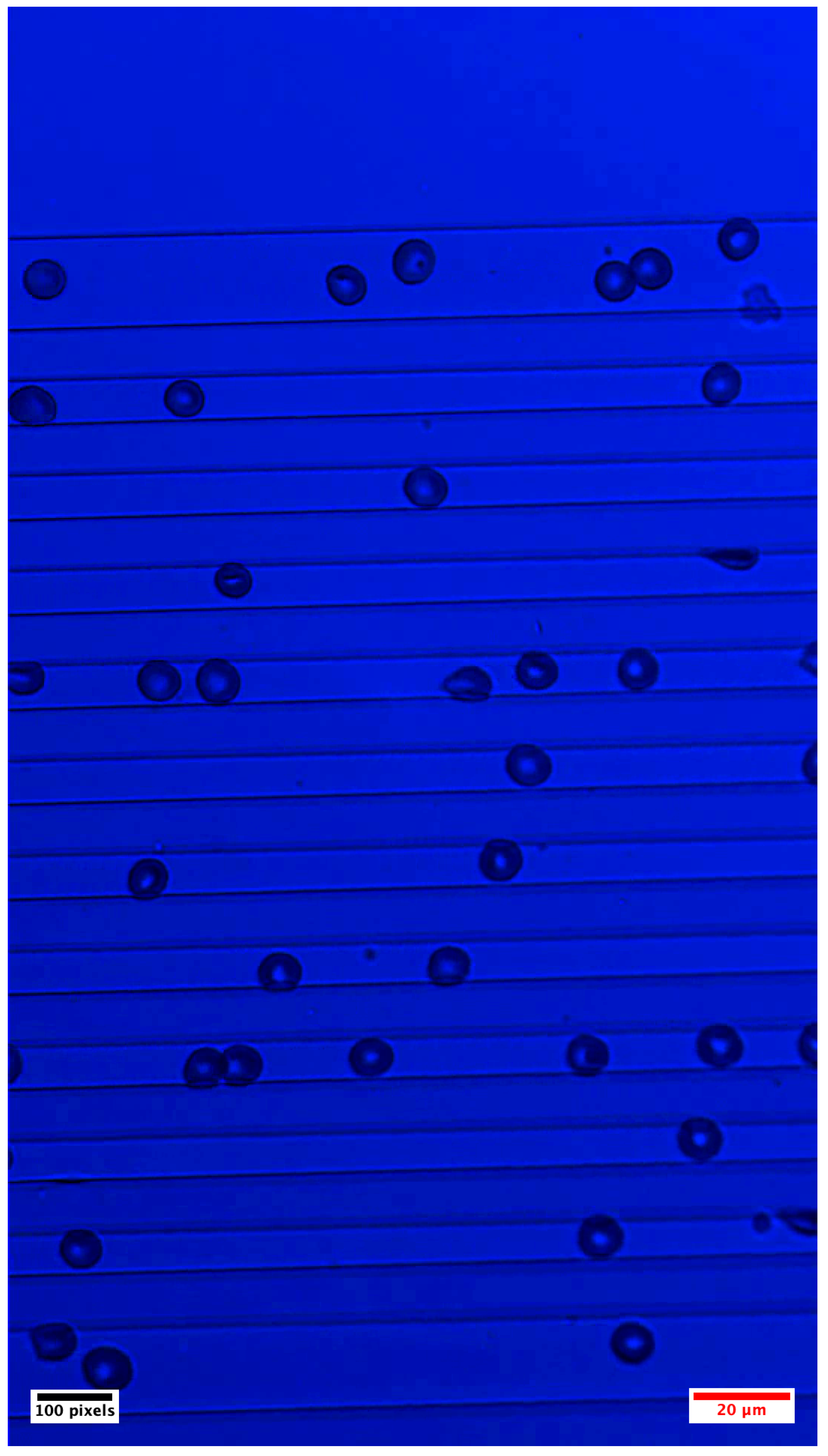
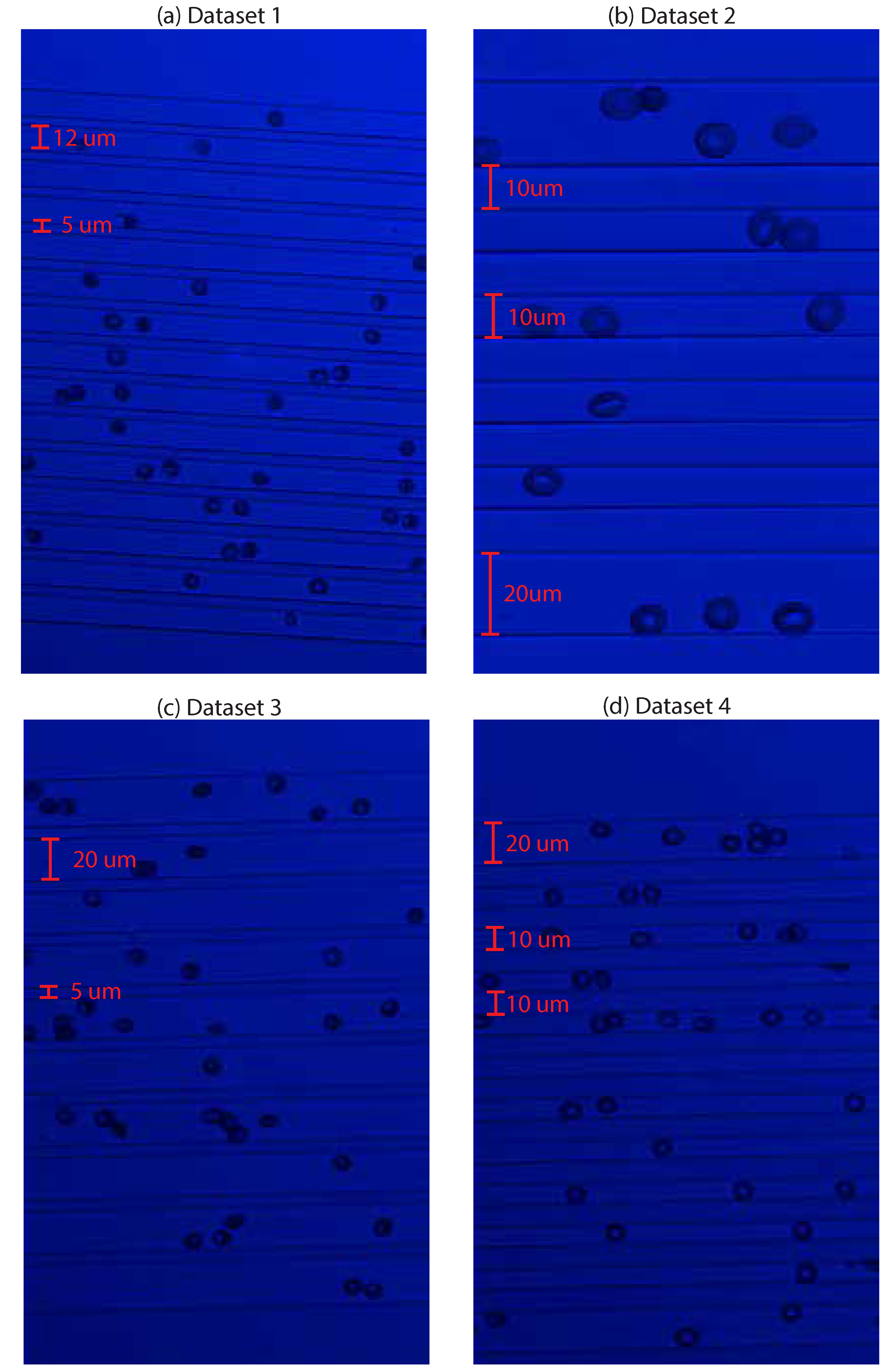
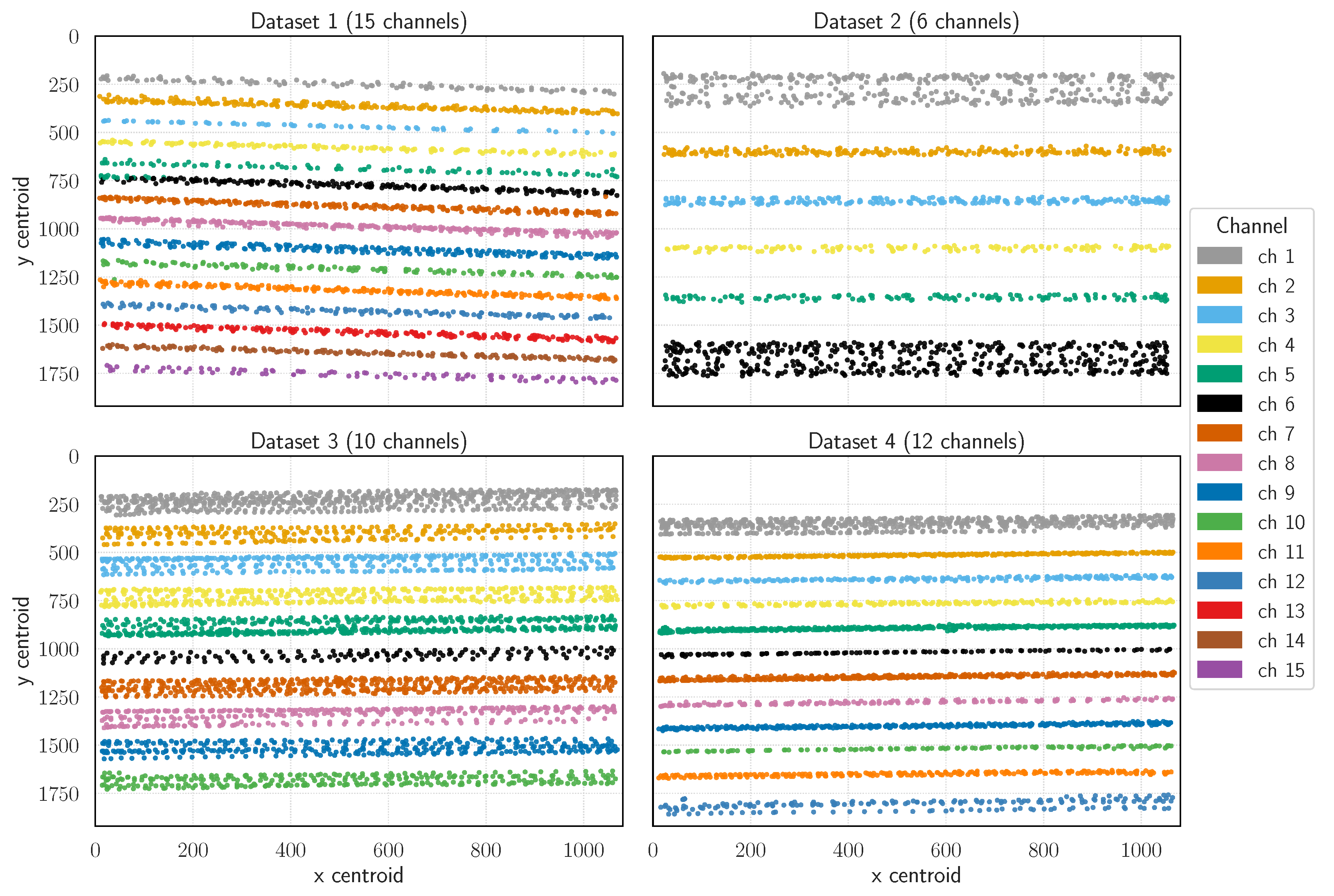
Figure 2 shows a representative frame of patient blood cells flowing in the microfluidic channel. The acquired data was manually annotated and the data characteristics are summarized in
Table 1. Additional details such as channel orientation, magnification and number of the channel is presented in the
Appendix B,
Figure A2.
4. Synthetic Dataset Generation
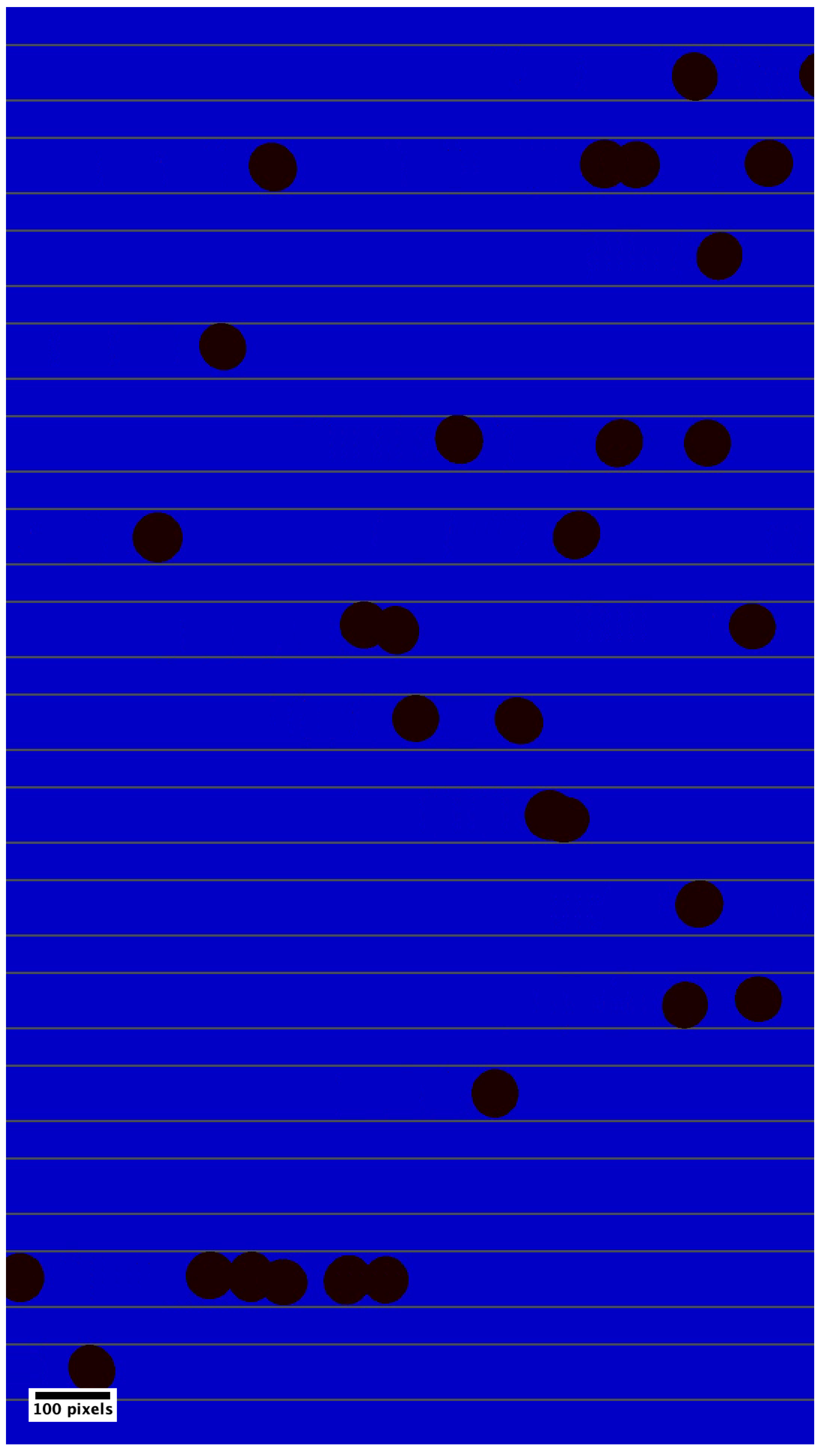
To enable more controlled testing of the tracking algorithms beyond the real dataset, we generate synthetic datasets for stress testing of the algorithms. Our simulation does not aim to reproduce the complex biomechanics of RBCs. Instead, we use simplified elliptical particles with controlled motion, heterogeneity, and noise as shown in
Figure 3. This design is consistent with established tracking evaluation practice, where synthetic data serves to create known ground truth and systematically vary in difficulty [
10,
16]. This synthetic stress testing complements the real capillary-driven datasets and enables systematic evaluation of the robustness of the algorithm under high particle density, occlusions, and heterogeneous flow conditions. For synthetic data generation, we used the Python (version 3.9.6) open-source scientific library NumPy (version 2.2.5) to model the movement of ellipse centroids and OpenCV (version 4.11.0) to generate images and videos. The centroid positions, frame numbers, average ellipse radii, and ellipse IDs were stored in a CSV file, which served as ground truth for stress-testing the tracking algorithms.
Each cell
i is initialized with a constant base velocity
, randomly chosen from a normal distribution in interval
to emulate heterogeneity of the flow among the cells. A global modulation term applied to all cells emulates temporal variation in the flow, as given by Equation (
7) where
t is the frame index and
N is the total number of frames. A subset of cells is randomly selected to emulate stopping and accelerating behavior during the flow, and their states are maintained separately.
The effective per frame displacements of the
i-th cell are defined as follows:
where
is the longitudinal velocity of cell i, which may be updated by the stop/deceleration logic;
is the lateral velocity of cell i within the channel;
are the per-frame displacements in the longitudinal and lateral directions, respectively;
are Gaussian noise terms modeling uncertainty in the centroid position;
denote the global bounds for the base velocity distribution.
For the simulated datasets we fixed the channel width to be approximately equal to the cell diameter for 15 parallel channels (see
Figure 3), similar to real datasets 1 and 4 (refer to
Appendix A). Twelve datasets were simulated to capture low, medium, and high heterogeneity in cell flow. For each condition, different throughputs (cells/s) flowing through the field of view was considered to vary the complexity. All simulations were run for 1500 (at 30 fps) frames with a frame size of 1080 × 1920, using zero-mean Gaussian noise terms
and
with standard deviations 5 and 0.5 respectively. The details of the synthetic datasets are summarized in
Table 2. The smaller the
, the more the possibility for the high-speed cells to overtake, hence more overlapping, resulting in more complexity for the tracking algorithms. The higher the
the cells will be visible in the field of view for only a few consecutive frames; therefore, more cells can be added to increase the throughput.
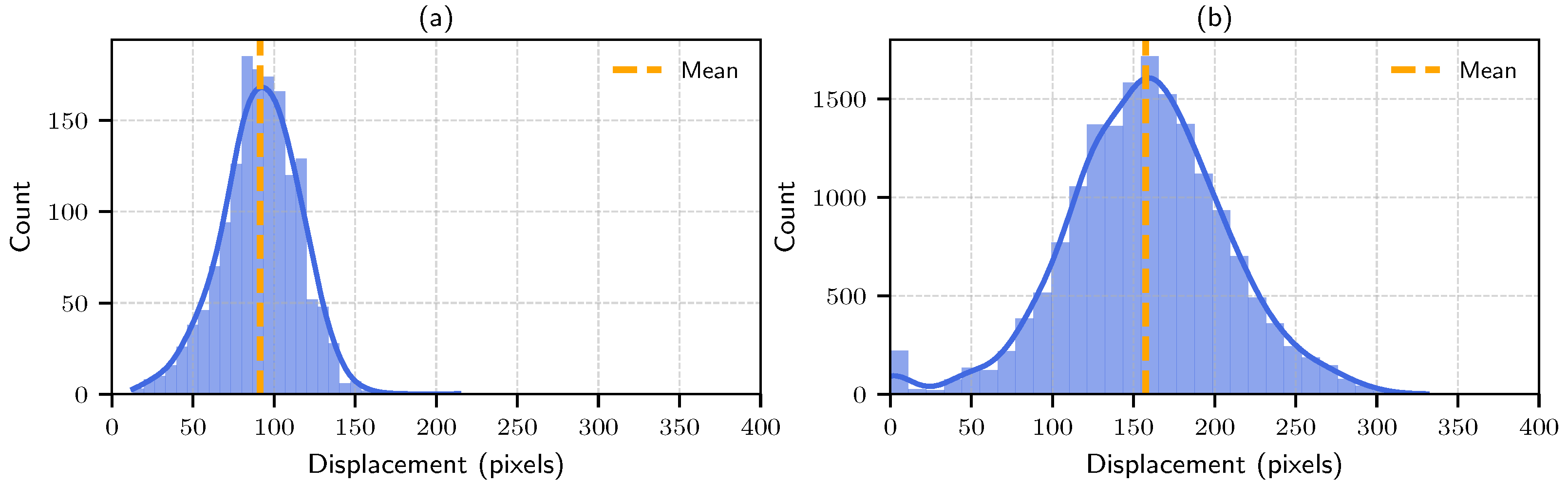
Figure 4 provides a comparison between the displacement distribution profile of the cells between consecutive frames. Panel (a) shows the displacement distribution of the real dataset 4; panel (b) shows the displacement distribution of the simulated dataset L.
Benchmarking
The real datasets and simulated datasets, summarized in
Table 1 and
Table 2, were used to evaluate and compare six tracking algorithms: FloCyT, FloCyT per channel, TrackPy-original, TrackPy-modified, SORT, and SORT-modified. FloCyT was run with parameters
,
, and
. In the FloCyT per channel variant, KMeans clustering was applied to cluster the centroids in the channel-wise fashion then tracking was done on each cluster with the same search parameter as FloCyT. This variant minimizes the cross-channel association. TrackPy-modified incorporated the initialization algorithm described in
Section 2.4 into the TrackPy framework, while the baseline TrackPy was used in its standard form; both were run with a search range of x and y
respectively. The baseline SORT algorithm was applied with its standard parameters, and SORT-modified extended it by integrating the initialization strategy described in
Section 2.4. For FloCyT, FloCyT per channel, TrackPy-modified, and SORT-modified used 15 consecutive frames and
was used to estimate global velocity
. The common parameters were kept the same for all the tracking algorithms for better comparability.
Performance was assessed using the CLEAR MOT metrics framework [
13] using open-source Python implementation py-motmetrics [
17]. Since the requirements for cell detection vary depending on the application, we did not employ an automatic detection method. Instead, ground truth centroids were used as detections, which eliminates classical detection errors (misses and false positives). Consequently, the following metrics are the most informative for performance comparison.
Multiple Object Tracking Accuracy (MOTA) (↑): In our setup, it depends mainly on the number of ID switches.
ID Switches (IDSW) (↓): The absolute count of identity reassignments.
Identification F1 Score (IDF1) (↑): Reflects identity preservation over time.
Mostly Tracked (MT) (↑): The proportion of objects tracked for at least 80% in their lifetime.
Together, these metrics capture both overall tracking accuracy and long-term identity preservation. The predicted trajectories were compared with ground truths for each dataset, allowing systematic evaluation under varying velocity heterogeneity and particle densities.
5. Results and Discussions
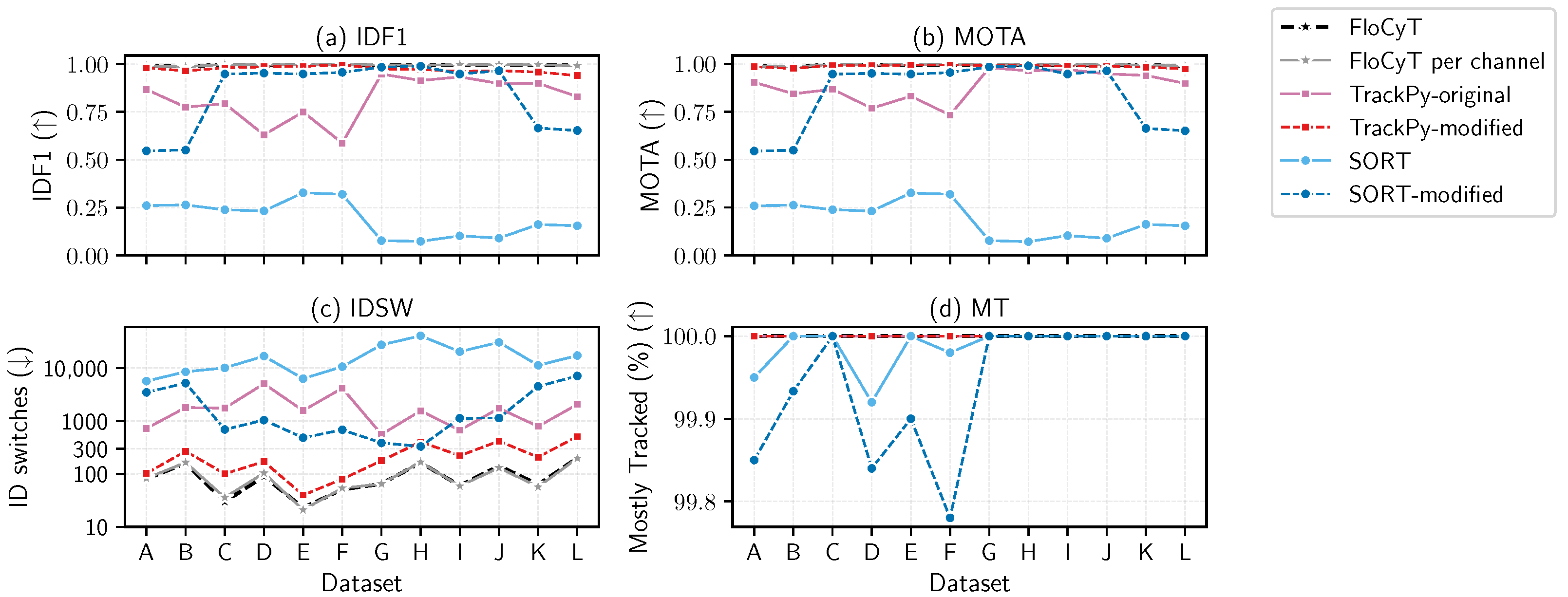
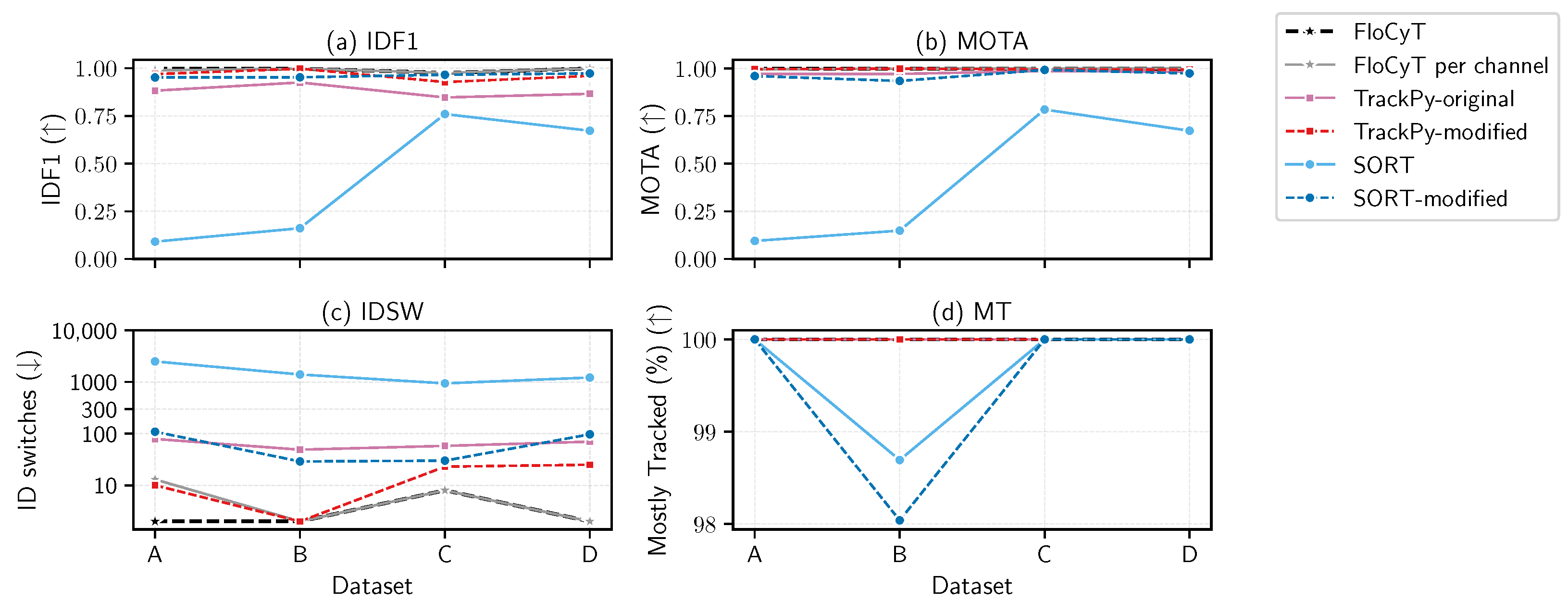
The comparative evaluation of six tracking methodologies—FloCyT, FloCyT per-channel, TrackPy-original, TrackPy-modified, SORT, and SORT-modified—was undertaken using both synthetic and real capillary-driven microfluidic flow datasets, as demonstrated in
Figure 5 and
Figure 6, respectively. This assessment examines the effectiveness of each method in maintaining accurate trajectories and preserving cellular identities under high-density and heterogeneous flow conditions in capillary-driven microfluidic flow.
For artificial datasets (
Table 2 and
Figure 5), both FloCyT and its per channel variant demonstrated consistent performance, achieving IDF1 and MOTA scores exceeding 0.97 and 100% MT. These methods achieved the lowest identity switch counts (IDSW <= 200) among all tested trackers, even under the challenging conditions of high velocity ranges and high particle densities (datasets B, D, F, and L).
The original TrackPy framework demonstrated significant variability in IDF1 and MOTA scores. Notably, the datasets A–F, characterized by higher
and
(refer to
Table 2), exhibited lower IDF1 and MOTA scores, especially under conditions of high cell density (higher throughput). In contrast, datasets G–L, where
and velocity ranges were smaller, TrackPy achieved higher IDF1 and MOTA outcomes consistently reaching nearly 100% MT. However, the IDSW exceeded 1000 in high-density scenarios. This underscores TrackPy’s reliance on isotropic nearest-neighbor linking, which is based on small-displacement assumptions. Under high-velocity conditions with large centroid displacements, heterogeneous flow, and high cell density, these assumptions became unreliable, leading to frequent identity switches and lower accuracy. In contrast, for low displacement conditions (small
and narrow velocity range) and the low density in datasets G–L, these assumptions are more applicable, resulting in improved identity preservation and tracking accuracy. The modified variant of TrackPy, benefited by our flow-aware track initialization strategy, displayed competitive performance, with IDF1 and MOTA close to those of FloCyT and its per-channel variant. However, the IDSW values for this enhanced approach remained consistently higher than those of FloCyT, indicating ongoing challenges in identity preservation due to isotropic nearest-neighbor linking.
SORT produced the least favorable tracking outcomes overall, characterized by lowest IDF1 and MOTA and the highest IDSW values (several 1000 s) among all tracking algorithms across all the datasets. The SORT-modified variant showed improvement compared to the baseline SORT, and in several datasets (C–J), even outperformed the original TrackPy in terms of IDF1 and IDSW counts. Notably, the IDF1 values for the SORT-modified variant remained very consistent compared to the baseline SORT for these datasets, underscoring the benefit of our track initialization method. Nevertheless, the consistently high IDSW values highlighted the limitations of IoU-based association strategies in heterogeneous flow environments and high speed tracking such as capillary-driven microfluidics, often resulting in insufficient overlap between predicted and detected bounding boxes. Beyond these experimental observations, such limitations also carry implications for diagnostic applications. In particular, when cell deformation metrics are clinically relevant and deformation is induced for diagnostic purposes, the IoU criterion is poorly suited, as it does not account for shape variation in deformed cells and detected bounding boxes may fail to sufficiently overlap with predicted.
In the analysis of the real dataset (
Table 1 and
Figure 6), all tracking algorithms demonstrated performance trends analogous to those observed in the artificial dataset. In particular, FloCyT consistently achieved high IDF1 and MOTA values while exhibiting a reduced IDSW and 100% MT. Representative qualitative results and typical failure cases for baseline trackers are shown in
Supplementary Videos S1–S5. An important exception was observed with the per-channel variant of FloCyT, which uses K-Means clustering for channel-based data association; this variant showed a decline in performance under conditions of suboptimal clustering. Such degradation was particularly pronounced in the real Dataset 1, where tilting during clip alignment led to mis-clustering (refer to
Appendix A and
Appendix B,
Figure A1 and
Figure A2, dataset 1, and
Supplementary Video S5), consequently resulting cross-channel data association and higher IDSW. In the second dataset, which had the lowest throughput and well-separated centroid from higher magnification (23 cells/s; see
Table 1 and
Appendix A,
Figure A1), the TrackPy-modified variant achieved an IDSW value that was the same as that of FloCyT. This outcome suggests that the TrackPy-modified isotropic association strategy is more effective under low-throughput conditions (lower cell density in a single frame). Nevertheless, despite these isolated instances, FloCyT overall outperformed its competitors, achieving higher IDF1 and MOTA values along with a greater proportion of tracked cells while maintaining fewer IDSWs.
6. Conclusions
In comparative evaluation of artificial and real capillary-driven microfluidic flow datasets, FloCyT consistently outperforms existing tracking methodologies. The framework achieves high scores in the IDF1 and MOTA metrics, with all centroids characterised as mostly tracked, and significantly reduces the occurrence of identity switches. These outcomes highlight FloCyT’s robustness in challenging scenarios characterised by complex flow dynamics, high particle densities, and heterogeneous trajectories inherent to capillary-driven systems. Although the modified TrackPy approach demonstrated improved competitiveness, particularly under low-throughput conditions, and the SORT-modified method benefited from improved initialisation strategies, both alternatives were limited by higher IDSWs.
This advancement enhances the quantitative optical sensing capability of capillary-driven microfluidic platforms, enabling accurate identity-resolved cell tracking in point-of-care diagnostics and clinical research, where high-throughput, single-cell analysis is required at a low cost and with simpler instrumentation. Future work will focus on integrating FloCyT with embedded optical sensing modules to achieve real-time, automated diagnostics at the point-of-care.