1. Introduction
As one of the typical and important space operation forms, multi-satellite formation has played an important role in space tasks. Furthermore, formation surrounding control (FSC), which may also be known as target enclosing/encirclement control (TEC) or target guarding control (TGC), using multi-satellite formation has become an inevitable and necessary operation for several state-of-the-art space tasks such as the pursuit-escape (PE) issue [
1,
2], proximity detection [
3,
4], collaborative takeover [
5,
6], attitude detumbling [
7,
8] and so on [
9,
10]. For proximity operation tasks, it is necessary to find optimal safe trajectories for multiple satellites to keep enough distance from both each other and the huge target and its specific structures. For this purpose, keeping the formation tracking the target is the most important technique for FSC tasks.
For the formation tracking task with ideal conditions, several attractive solutions that achieve cooperative in-orbit target tracking have been given. For example, Nash equilibrium strategies are given for each satellite by [
11] to overcome communication delays and uncertainties occurring in cooperative target containment. A distributed formation tracking controller is designed by [
12] with angular velocity constraints under partly known information. However, escaping non-cooperative targets presents great challenges for the aforesaid formation tracking methods. As a basic idea, zero-sum games are commonly used to handle the target tracking or capturing tasks. Considering a non-cooperative target with a stronger maneuver capability, pursuit controllers and capturing conditions for multiple pursuers are given in [
13]. Optimal tracking strategies for the target are derived by the MPC framework in [
14] based on zero-sum cost functionals. A target-behavior-free tracking controller for pursuers with interception angle constraints is proposed in [
15] through a zero-sum differential game. In these game-based situations, the target can obey a unified cost functional with all pursuers, and thus, it escapes along a given saddle-point strategy, namely the “worst impact” trajectories. However, in some possible cases, the behavior principle of these non-cooperative targets may not be priori information, which forms incomplete-information game cases.
Achieving formation tracking control against a target with both unknown dynamics and escaping behaviors can be divided into two types. Depending on the introduction of extra estimators is one of them. The target dynamics is estimated by using range measurements by only [
16]. A partly unknown situation is considered in [
17], and an adaptive optimal PE strategy is given. Working as an alternative solution, several estimator-free techniques are also studied. The discrete difference equation is used in [
18] to design a model-free multi-satellite surrounding control scheme. As a direct method, several barrier function-based control methods are proposed in [
19,
20,
21,
22,
23] to constrain the system output directly, of which the dynamics is completely unknown.
The consideration on the safety of the operation formation is not enough by the approaches above. As a basic safety requirement, collision avoidance is necessary for satellite flying, especially for the satellite formation tackling surrounding tasks against a huge target with specific structures, where collision threats are mainly caused by two aspects, namely the one from the other formation satellites and the one from the target structures. Collision avoidance between each formation satellite and each other has been widely discussed by several recent works. A survey of spacecraft formation control with collision avoidance using hall thrusters is given in [
24]. From this, a basic approach for collision avoidance is an artificial potential function (APF) [
25] due to its convenient implementation and low computational load. An adaptive safe cooperative controller is given in [
26] for satellite formation with uncertainties, and the desired formation configuration is guaranteed while the collision among other satellites is avoided. Also considering optimization requirements, optimal solutions for collision-free FSC considering presetting performance is given by [
27] through a differential game framework.
On the other hand, tackling collision avoidance with irregular obstacles faces a bigger challenge, since distance assessment from satellites to obstacle surface suffers significant difficulties. The existing collision-avoidance techniques facing irregular obstacles can be mainly classified into two categories, including path planning [
28,
29] and reactive control [
30,
31,
32]. Especially for general non-spherical obstacles, which can be commonly abstracted from specific structures of the huge space target, a repulsive potential field is designed for irregular celestial bodies in [
33]. As for non-spherical obstacles with simple shapes, and an artificial potential field based on a super ellipsoid is given in [
34] to approximate the envelope of a cuboid or a cylinder. By changing different principles of parameter modeling, such a scheme can be suitable for pyramids, cones, trapezoids, and so on. Based on this, a spacecraft close-range proximity problem is studied in [
35] by using the approximate distance from a point to ellipsoidal envelopes of the spacecraft. By simplifying the huge space target as a hub–beam system formed as a combination of two ellipsoids, a safe controller is designed in [
32] for in-orbit assembly missions.
Based on all the relevant works above, the optimal FSC issue with collision avoidance from dynamic obstacles (including other formation satellites and all specific structures of the target) against an escaping unknown target is still open. An optimal safe collision-avoidance control law is designed for SSat formation to achieve FSC against a fully unknown huge target with specific structures by using relative measurements only. The main contributions are summarized as follows:
Considering a TSat and that the dynamic properties and escaping behavior of the TSat are both unknown, the studied FSC issue is decoupled into a TT issue and a CT issue, and it results in a convenient hybrid controller structure called an OCSS where the TT controller and the CT controller can be designed independently. Compared with the existing estimation-based FSC methods, estimators or approximators are not asked by the proposed TT technique, which reduces the complexity of the control system.
An effective TT is achieved by using funnel-like boundaries to directly shape the transient behaviors to show a prescribed performance. The proposed funnel-like boundaries are initial-condition-free. Such boundaries are extended from the existing initial-dependent boundaries by a new transformation. As a result, the initial-condition-free boundaries can achieve effective constraint of the arbitrary initial tracking error, and thus, the singularity issue caused by the large initial error can be completely avoided.
An adjustable cube-segmentation-based (ACSB) modeling method is proposed for specific structure modeling, which achieves an approximate but convenient envelope modeling method with variable accuracy. Furthermore, optimal safe surrounding strategies with two parts of the collision threats being avoided are given via a nonzero-sum game.
The rest of the paper is organized as follows. In
Section 2, the surrounding task studied is equivalently formulized into two sub-objectives while the collision threat during the surrounding configuration tracking is described as tunning costs. Then, the design and stability analysis of the safe surrounding controller are designed in
Section 3 and
Section 4, respectively. Finally, in
Section 5, the effectiveness and advantages of the proposed techniques are clarified by the simulation results.
Notation. The following notations are used throughout this paper. Vector is obtained from the absolute value of each element of vector , and the operation . denotes the transpose of a vector or a matrix . and denote the set of real numbers and positive integer numbers, respectively. and denote the -dimensional vector and matrix, respectively.
2. Problem Formulation
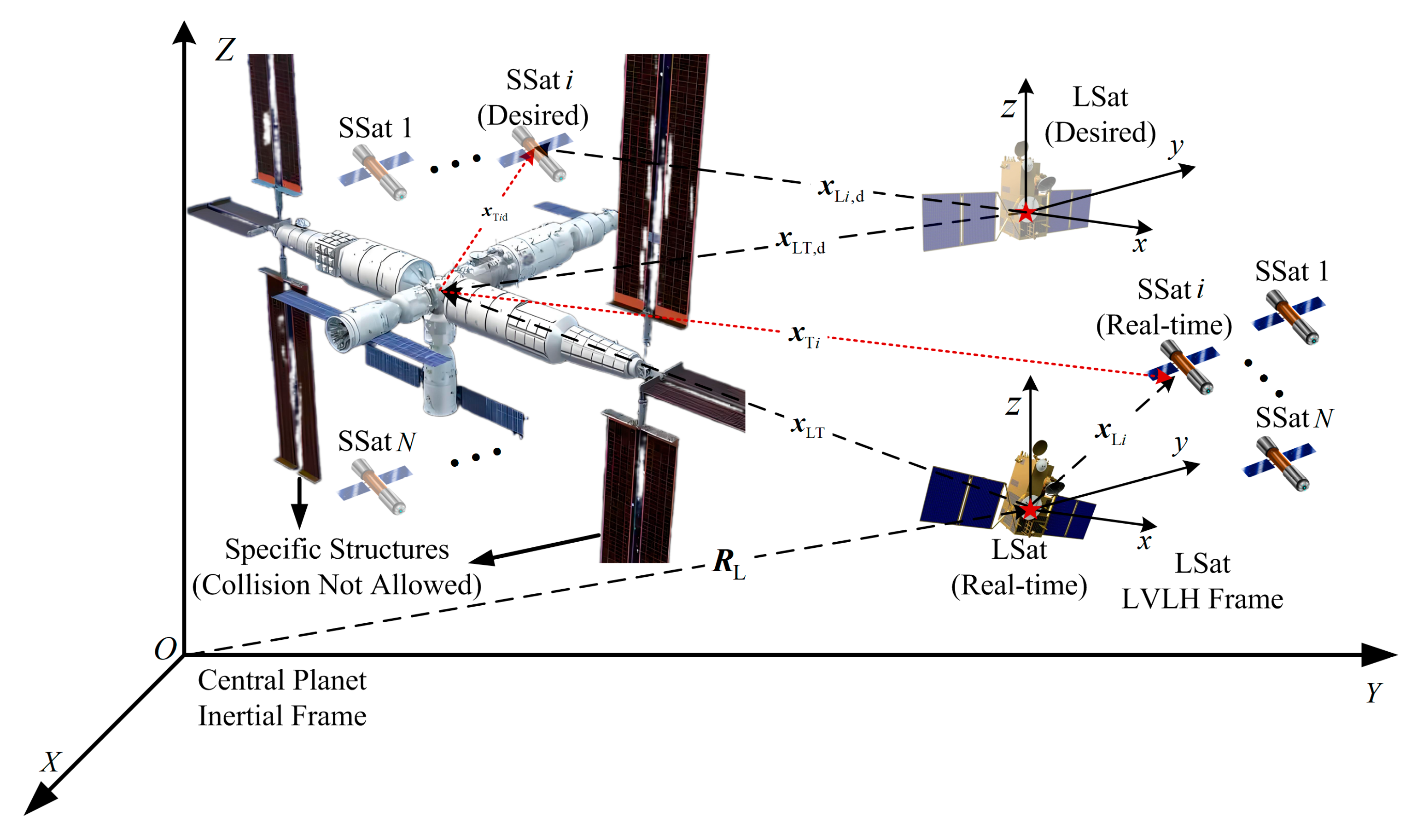
A close-range surrounding task against an unknown non-cooperative TSat with a specific structure by
SSats driven by a leader satellite (LSat) is considered, as shown in
Figure 1. The dynamic properties (including mass and orbital parameters) and maneuver commands of the TSat are all infeasible to both the LSat and all SSats, and these are the unknown elements considered for the non-cooperative TSat in this paper. The relative vectors (including the relative position and velocity) and shape parameters (including TSat size and the appearance parameters of the specific structures) of the TSat can be measured by the LSat accurately. Thus, to achieve a close-range surrounding of the TSat, all SSats are desired to form and track an expected close-range configuration, which is distributed in the gap of the TSat real structure, namely,
hold for all
with
being a positive bound constant as shown in
Figure 1. Each
represents the relative vector from the TSat to SSat
, and
represents the desired one. Furthermore, collision avoidance for all SSats and all specific structures of the huge target is asked.
Remark 1.
The close-range surrounding task studied in this paper is achieved by using SSats under the command of one LSat. Different from the other FSC mission by using multiple homogeneous satellites with equal capacities [16,17], the scheme used in this paper will be more suitable for low-cost service formation, since the necessary measurement and calculation for unknown target tracking are now required only on the LSat instead of each SSats, and the TT control command calculated by the LSat can be directly shared to all SSats. 2.1. Equivalent Formation Surrounding Modeling
Noting all
in
Figure 1 may be infeasible for low-cost SSats without specific sensors. In this section, the aforesaid objective is divided to be achieved by two parts equivalently. By setting a LSat, the following state equations can be obtained:
From Equation (1), the dynamics of
can be equivalently rewritten as follows:
where the relative orbital state of the TSat is written as
with
and
being the position vector and the velocity vector from the LSat to the TSat, respectively. The relative orbital state of each SSat
is written as
with
and
being the position vector and the velocity vector from the LSat to the TSat, respectively. Considering the desired states for
and
as
and
, the CT error can be defined as
with
and
, and the TT error of SSat
can be defined as
with
and
. As a result, all
can be equally calculated by
and
which are all feasible knowledges for the LSat and all SSats, respectively.
According to Equation (2), by Euler-Lagrange equation [
36], the relative motion of TSat and SSat
referring to the LSat satisfy the following differential equations.
where
is the unknown maneuver command of the TSat.
and
denote the active control commands of the LSat and SSat, respectively.
,
, and
represent the mass of the TSat, LSat, and each SSat
. Considering the absolute orbital angular velocity of the LSat
and the absolute position of the LSat
in the central planet inertial frame,
and nonlinear terms
,
can be obtained [
27].
Assumption 1.
For the TSat described by Equation (3), and are unknown information while can be accurately measured by the LSat. The unknown maneuver command of the TSat is bounded, namely satisfies that , , with being an unknown positive constant.
Further, all
satisfy the following state space dynamics:
where
with
being the gravitational constant,
being the position vector of the LSat in the central planet inertial frame, constant vector
, inertia matrix of SSat
, and inertia matrix of the LSat
with
being the identity matrix.
. Since
are Lipschitz continuous, here exists a matrix-value function
, ensuring
[
37]. Based on Equation (2), the controller design of SSat
can be divided as follows:
where the term
is used to make a synchronous maneuver at SSat
according to the commands shared by the LSat.
for all
are used to form and stably track the desired surrounding configuration. From this perspective, the safe formation surrounding the control design for all SSats can be completely and equivalently decoupled into two independent parts, namely, the TT part and surrounding CT part.
Remark 2.
The FSC issues directly solved by the zero-sum differential game framework [13,14,15] commonly assume that all pursuers and escapees share a unified known cost functional, which can obtain a saddle-point strategy for the pursuer under the worst impact caused by the escapee. Inspired by [17], such a prerequisite may not be satisfied by some specific non-cooperative targets. Equation (6) shows a decoupling mechanism, which divides the whole studied FSC task into two parts while the controller of these two parts can be designed independently. 2.2. Collision Threat Modeling During FSC Tasks
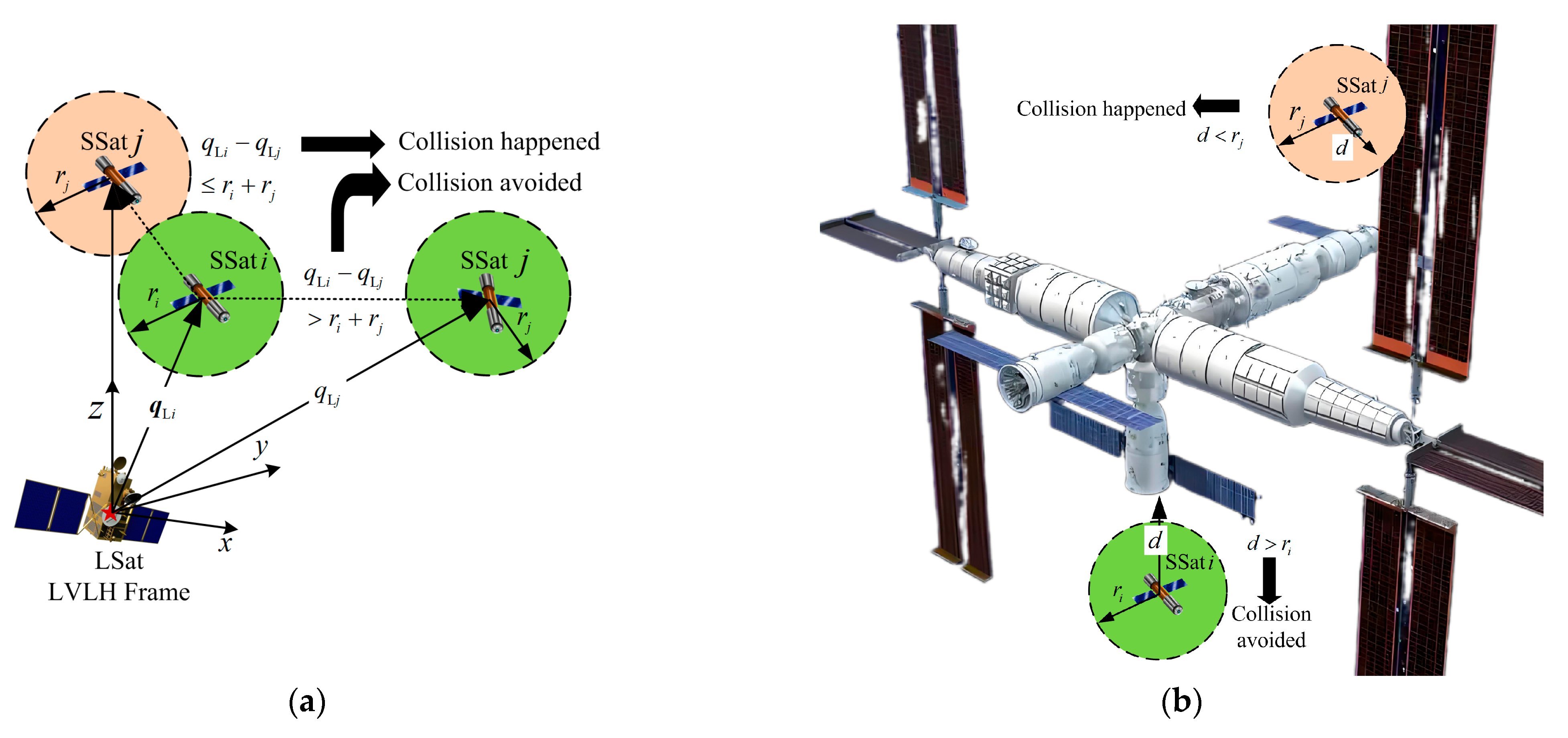
This section focuses on an appropriate formulation of collision threats for all SSats, which is necessary for collision-free controller design. Considering the close-range surrounding requirements against the TSat with specific structures, as shown in
Figure 1, the potential collision threat of SSat
during the studied target surrounding process are mainly two parts, namely the threat from all specific structures of the huge target and the threat from each SSat
,
, as shown in
Figure 2.
To describe the threat from other SSats shown in
Figure 2a, a circumscribed sphere with safe radius
can be directly used for each SSat. Thus, the collision threat imposed by SSat
,
, to SSat
can be written as follows.
where
is a scalar function with a positive correlation to the collision threat between SSat
and SSat
,
.
adjusts the sensitivity to the collision threat.
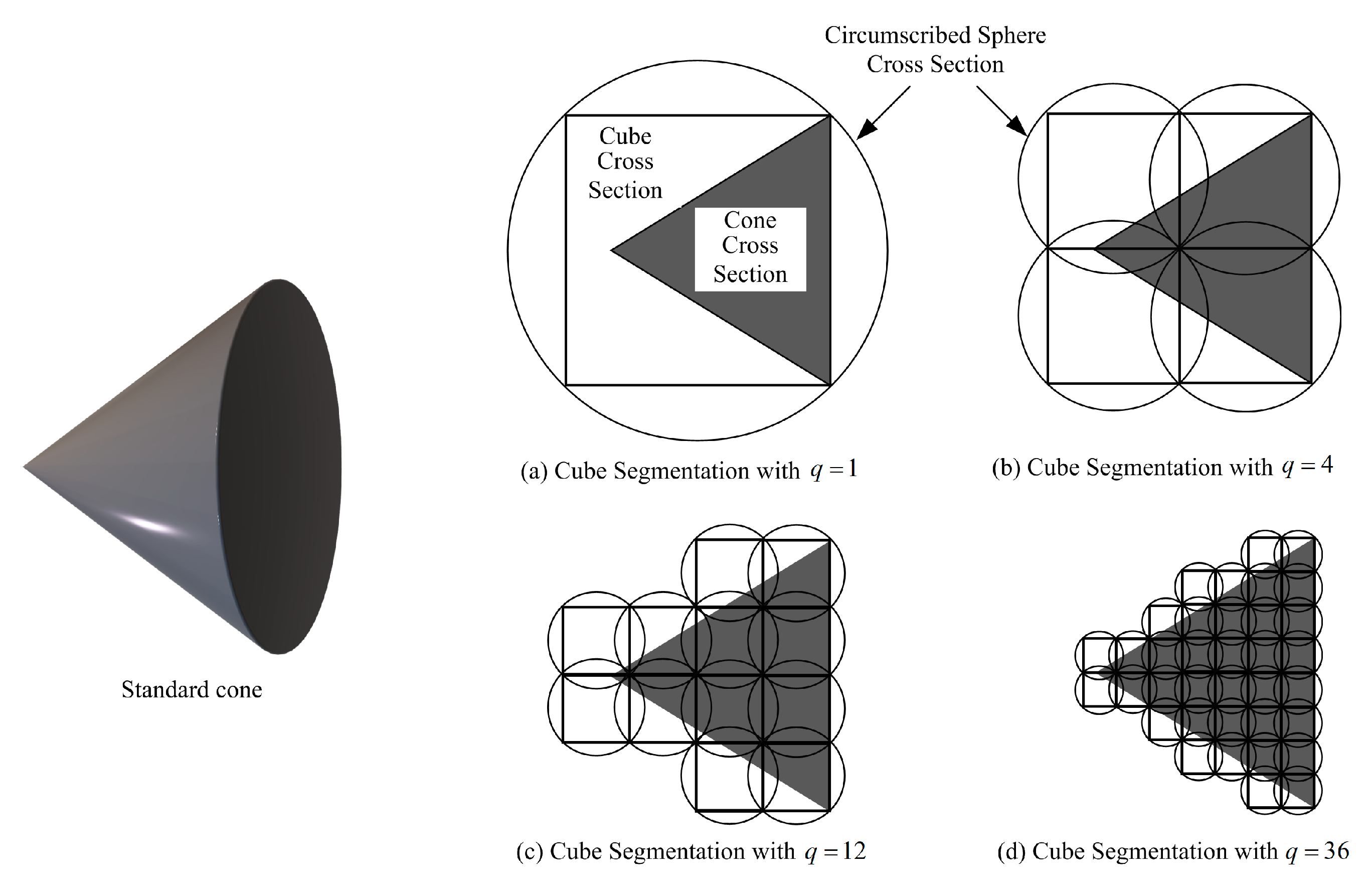
To describe the collision threat from huge structures with possibly irregular profiles, the mass-point model is indeed not enough and using circumscribed spheres of the whole specific structures directly thoroughly occupies the reachable space of SSats. Inspired by the conclusion that the smallest enveloping sphere of a cube is its circumscribed sphere, an adjustable cube-segmentation-based (ACSB) method is proposed to give a complete envelope of the huge TSat with a specific structure, and a cross section of standard cone is used as an example to explain the mechanism of the proposed ACSB envelope modeling.
As shown in
Figure 3, the sample cone can be always contained by
cubes with
,
. Considering
being the circumscribed sphere of the
th cube with radius
and
being the circumscribed-sphere volume of the
th cube, the larger the side length of the
th cube, the larger the total enveloping volume of the circumscribed spheres
. As a result, by selecting different cube sizes for each specific structure of the TSat, the accuracy of the envelope modeling can be flexibly adjusted.
Similarly to the modeling process shown in
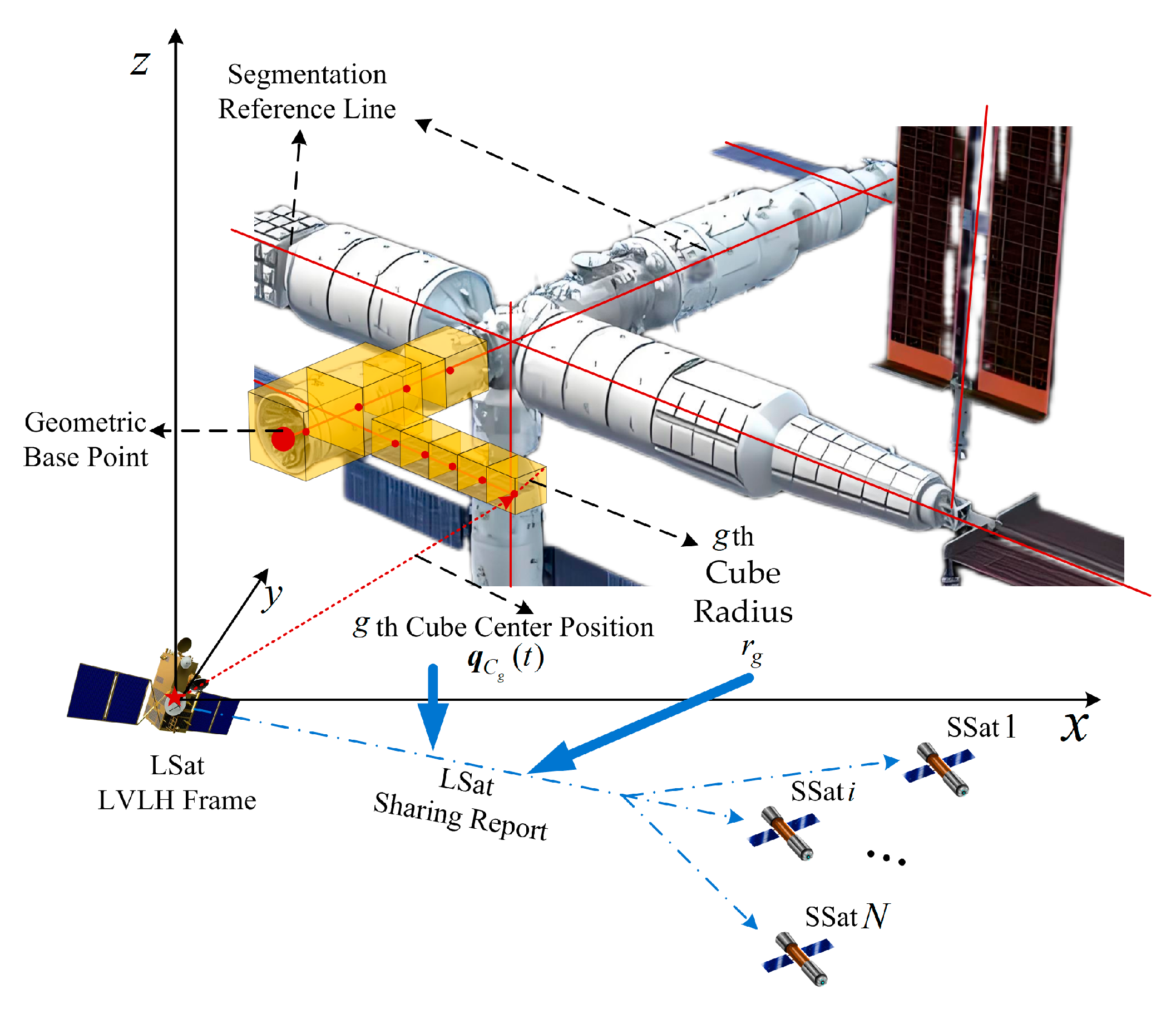
Figure 3, the envelope of the huge TSat with specific structures can be finally modeled as a circumscribed-sphere set
with different cube sizes, namely
with
and
being the circumscribed sphere of the 1st and the
th cube, as shown in
Figure 4. Since the non-cooperative target is time-varying with respect to the LSat,
is the real-time geometric center position of the
th cube (also its circumscribed sphere) in the LSat LVLH frame. Both
and
of each cube are finally reported by the LSat to all SSats as shared information.
Further, based on the ACSB envelope modeling shown in
Figure 3, the collision threat caused by the
th cube for each SSat
can be written as follows:
where
is a scalar function with a positive correlation to the collision threat between SSat
and the
th circumscribed sphere.
adjusts the sensitivity to the collision threat.
Assumption 2.
The attitude of the TSat can be ignored. The TSat’s shape parameters of specific structures can be accurately measured by the LSat, and the cube segmentation of the huge target structures can be achieved via the ACSB method by the LSat, and the parameters of all the circumscribed spheres can be shared to each SSats with no time delay.
Assumption 3.
The initialization of the SSats formation is asked to be collision-free, namely and for all at .
Assumption 4.
The cube segmentation of the huge target structures is asked to satisfy that there always exists a feasible trajectory from real-time position for all to the desired configuration point .
Remark 3.
Compared with the existing accurate collision threat modeling methods based on [4,38], the proposed ACSB-based collision threat modeling method requires an approximate for the TSat structural envelope, which can effectively reduce the measurement load to assess the collision threat from the TSat. Thus, it is more suitable for low-cost SSat formations, although the reachable domain may be sacrificed. The cube segmentation resolution, namely the envelope modeling precision, can be adjusted according to mission requirements. Remark 4.
Cube segmentation is finished through an off-line process by the LSat. Although the number of cube segmentation is adjustable for different task requirements, it remains constant during the whole FSC process. The calculation load of the ACSB-based modeling are mainly two parts, namely the load for the LSat and the load for all SSats. The calculation load the ACSB-based modeling aims to reduce is mainly for the latter, since the online calculation load for each SSat is only the simple norm calculation in (8) by using the information shared by the LSat, and the calculation times in each control step is equal to the number of cubes.
2.3. Game-Based Description for Collision-Free CT Problem
To find optimal collision-free trajectories for all SSats to form the desired surrounding configuration around the huge target, based on the collision threat modeled above, the collision-free CT problem is described as a nonlinear nonzero-sum differential game.
Considering an integrated CT error
, substituting Equation (6) into Equation (5), the dynamics of
can be directly obtained as follows:
with
Considering the collision threat between all SSats and all specific structures as competitive factors, the nonlinear cost functional
of each SSat
is designed as follows:
where
is designed to guarantee minimum control consumption. The nonlinear term
is designed as follows:
where
,
, and
are proportional gain and positive weight coefficients, respectively, and the design of nonlinear term
and
are given in Equations (7) and (8), respectively.
According to Equations (9) and (11), the CT problem can be described as a nonzero-sum differential game. By the extremal conditions [
6], solving the Nash equilibrium strategies
boils down to solving the following coupled Hamilton–Jacobi–Isaacs (HJI) partial differential equations (PDEs) with respect to the value function
.
Remark 5.
Thanks to the collision threat for specific structures and each SSat , the total collision threat of SSat can be determined by both Equations (8) and (12). According to Assumption 3, the initialization ensures that the collision threat of each SSat is bound but not equal to zero. As running costs for the differential game are determined by Equations (9) and (11), a Nash equilibrium is called to be achieved if and only if in Equation (11) are minimized, which avoids the collision between all SSat with respect to arbitrary target specific structures and arbitrary SSat , . More detailed proof can be found in [39]. 2.4. Control Objectives and Preliminaries
As the collision-free formation surrounding the control design for all SSats is decoupled into the TT part and the CT part according to Equations (2) and (6), based on all formulation analyses above, the objectives can be finally achieved by the following objectives:
Problem 1.
Consider relative motion dynamics of the TSat and SSat in Equations (3) and (4). Based on Equations (2) and (6), the safe formation surrounding control against the unknown huge TSat with specific structures boils down to a TT controller design for the LSat and Nash equilibrium CT controller’s design for all SSats, which guarantees that the closed-loop TT error and the closed-loop CT error are both bound while avoiding collisions, namely , with and being positive bound constants while and .
In what follows, several necessary definitions are given.
Definition 1.
(Nash equilibrium strategies) [5] Consider a set consisting of the strategy groups stabilizing the CT error system Equation (9). A group of strategies are said to be the Nash equilibrium strategies of the differential game determined by Equations (9) and (10) if and only if holds for any with . Definition 2.
(Approximate Nash equilibrium strategies) A group of strategies are said to be approximate Nash equilibrium strategies of the differential game determined by Equations (9) and (11) if and only if holds for any with and a scalar function .
Definition 3.
(Diagonal matrix solutions ) [27] Consider the integrated CT error system Equation (9) and the individual cost functionals Equation (11). For existing matrix functions satisfying , and satisfying . Then, a group of diagonal matrix functions are said to be diagonal matrix solutions of the HJI PDE Equation (13). if the following conditions are satisfied. (1) For all ,
satisfies the following: (2) Equation (14) holds for all , .
where , , , and.
3. Main Results
Corresponding to the above controller objectives, an OCSS controller is given as follows.
Facing the challenges caused by unknown dynamics and maneuver commands, arctan-based transformation with respect to the measured TT error
and
are designed as follows:
where
and
are performance functions, which are designed to expand them into the shaping performance boundaries without initial conditions, which can directly constrain the output of
and
.
and
,
. By using the transformed errors
and
, virtual controller
, and TT controller,
can be obtained as follows:
where
and
are all positive parameters, which are designed later.
Remark 6.
Thanks to the skillful usage of the arctan-based transformation, compared with the existing whole-process constraint boundaries [40,41], initial-condition-free boundaries are constructed by Equation (15). Compared with the existing output-constrain-based methods [42,43], by adjusting and , the boundaries constructed by Equation (15) achieve a whole-process constraint with adjustable performance. Meanwhile, noting that and always hold, arbitrary bounded initial TT errors are constrained by the proposed boundaries, which implies that the controllers given in Equations (16) and (17) work globally. According to the individual cost functional design for each SSat
, a collision-free target surrounding control can be achieved by the Nash equilibrium of the nonzero-sum differential game defined by Equations (9) and (11). However, it is too difficult to solve the coupled HJI PDEs in Equation (13) analytically. Different from the existing methods, a constructable approximate value function
with dynamic auxiliary variable
being immersed is designed for each SSat
as follows:
where
for all
are positive-definite coefficient matrices being designed later. According to the individual cost functionals in Equation (11), diagonal matrix solution
satisfying Definition 1 is designed as follows:
To ensure all
are minimized along their gradient direction, a tuning law is designed for the immersed auxiliary variable.
where
is the first-order partial-derivative matrix of vector
.
is a positive proportional coefficient to adjust the speed of the decent. Further, according to Equation (18), dynamic Nash equilibrium safe CT controllers
are given as follows.
where
is obtained by
. By all the designs above, we can obtain the following results.
Theorem 1.
Consider the relative motion of the TSat and SSats in Equations (3) and (4). Describe the CT issue as the nonzero-sum game determined by the integrated system Equation (9) and individual cost functional Equation (11). Considering satisfying and tuning the auxiliary variable as in Equation (20), let the constructed satisfy for the existing scalar function . Then, by using the TT controller given in Equation (17) and the optimal CT controllers given in Equation (21), we can obtain the following results.
(i) (Optimality) Existing constant and a compact set containing the origin ensure that in Equation (18) satisfy the following inequalities. (ii) (Stability) The control objective of enclosing the TSat is guaranteed through in Equation (6), which is determined by in Equation (17) and in Equation (21), namely the norm of the TT error and the CT errors are both uniformly ultimately bound.
5. Simulation Results
The simulation results of an example in-orbit surrounding task by one LSat and
SSats to surround an escaping unknown TSat are shown. The orbit of the LSat is the same as [
27]. The desired pursuit state of the LSat
shown in
Figure 1 is set as
m and
m/s. Set the LSat mass
kg. Set the TSat mass
kg. Set SSat
mass
kg. The actuator capability of the LSat and SSat
are, respectively, considered as
N and
N. The total time is 300 s, and the simulation step is set as 0.1 s.
The TSat are considered as implementing the unknown escaping maneuver command
, satisfying the following differential equation, and the maneuver command
is generated as shown in
Figure 5.
The initialization of the TSat relative states are considered as
m and
m/s, and the desired TT vector is set as
m,
. The CT error
for all SSats are shown in
Table 1. The performance functions
and
are set as
,
and
. The parameters in Equations (16) and (17) are sat as
and
. The parameters in Equations (7), (8) and (20) are
,
,
,
,
, and
. Set
, and the initialization of
is set as follows:
Based on the proposed ACSB method for the TSat envelope modeling, the TSat specific structures are divided into several connected cube cells, and the parameters (including their positions
and threat radius
of their circumscribed spheres) are shown in
Table 2. Noting that the position of each circumscribed sphere
is a time-varying value that changes synchronously with the escaping target, the initial position of each circumscribed sphere can be obtained as
.
For the TT part, by using the virtual controller and TT controller in Equations (16) and (17) respectively, the LSat tracking behavior against the TSat (including the dynamic response of the TT position error
, the transformed error
and the target pursuit controller (
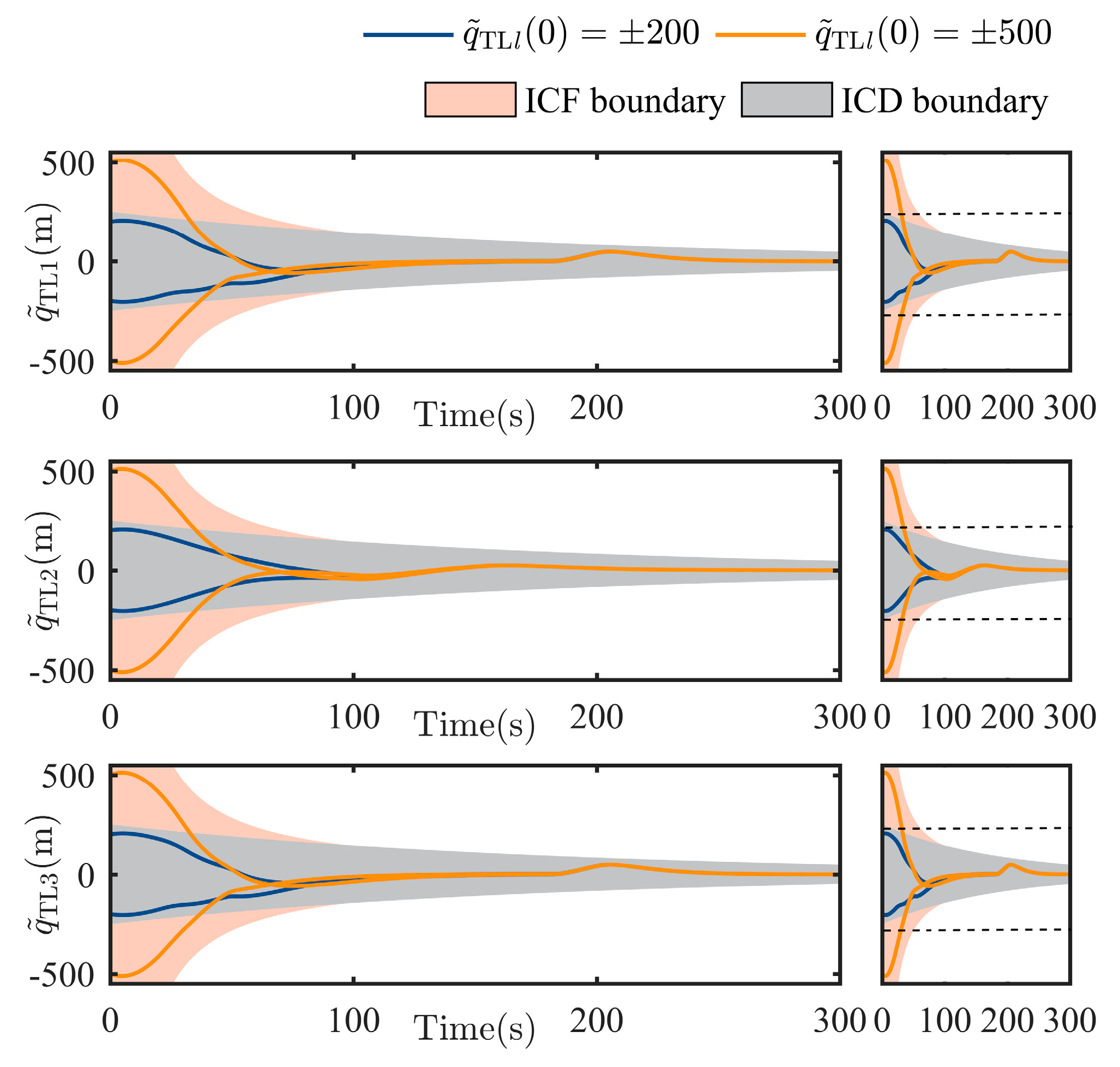
) are firstly shown. Note the initial conditions are commonly asked by the boundaries which can guarantee both user-defined transient and steady-state performance. To further illustrate the advantages of removing these conditions, two categories of boundaries, namely the initial-condition-free (ICF) boundaries and the initial-condition-dependent (ICD) boundaries, are compared under different initialization status. The initial TT states considered are shown in
Table 3, and corresponding comparison results are shown in
Figure 6,
Figure 7 and
Figure 8.
Thanks to the funnel-like boundaries constructed by the arctan-based transformation in Equation (15), as shown in
Figure 6, the TT error in each channel under all initial status is successfully constrained by the funnel-like boundaries
from
to the end. Furthermore, noting that the boundaries have no intersections with y-axis at
(see the gray aera in
Figure 6), arbitrarily finite initial TT error will fall into the boundaries, which also verifies that the controller in Equations (16) and (17) work globally. A different situation happens to the ICD boundaries, namely only group 2 and 3 can be contained by the ICD boundaries. It illustrates that ICD boundaries will be failed for group 1 and 4, which implies the advantages of the proposed ICF boundaries. Meanwhile, by adjusting
and
in
, the boundaries constructed by Equation (15) achieve a whole-process constraint with adjustable performance. As shown in
Figure 6, considering the initialization and the parameters setting above, the tracking accuracy of the TT error can be shaped into
m at 300 s as we prescribed.
Further in
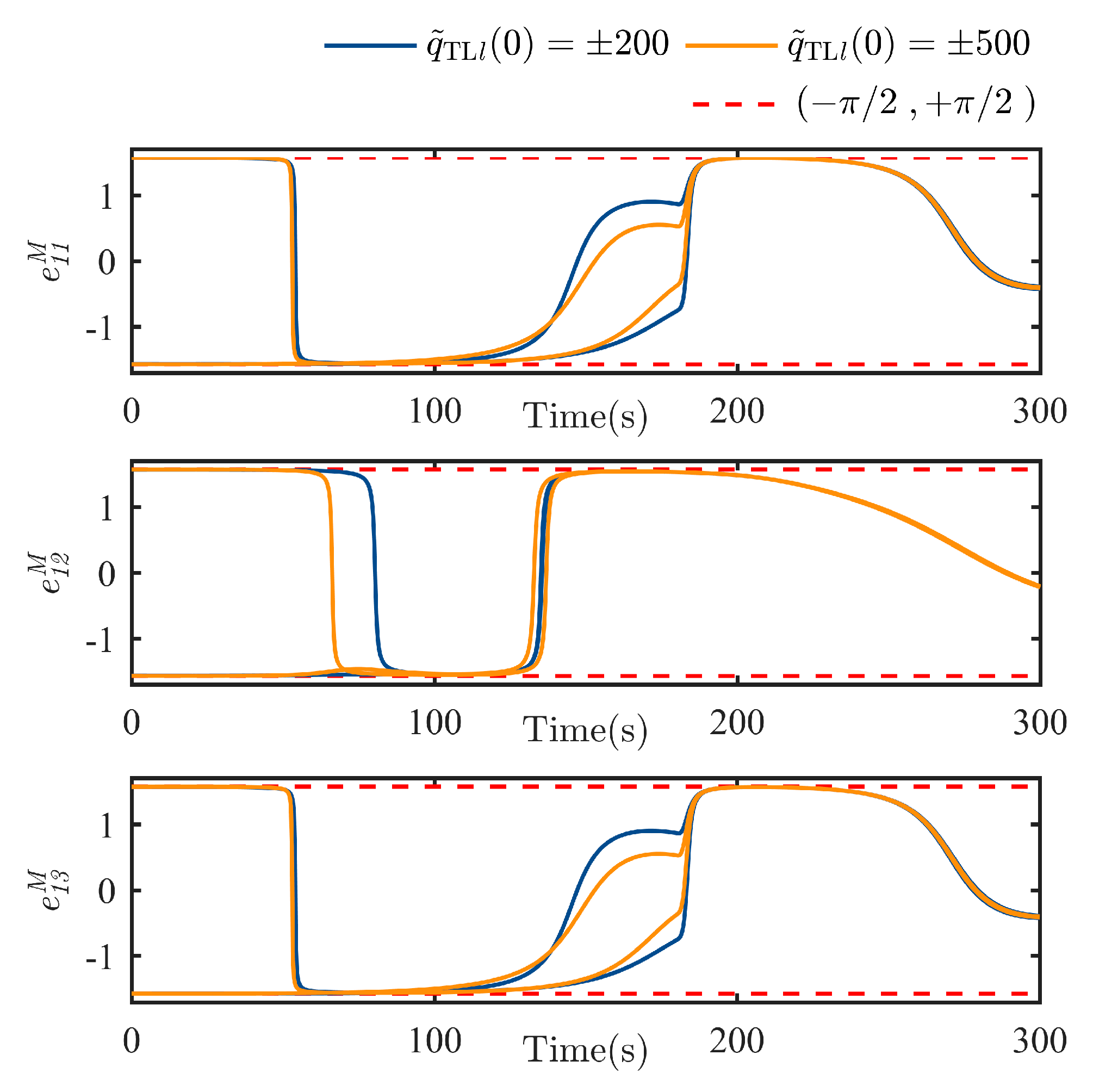
Figure 7, the responses in each transformed TT error channel
can be always kept in the open set
, which verifies the conclusion given in Equation (41), namely
holds for
. According to the transformation given in Equation (15), the intersection between arbitrary
and the open set
implies that the intersection between the corresponding TT error
and boundaries
.
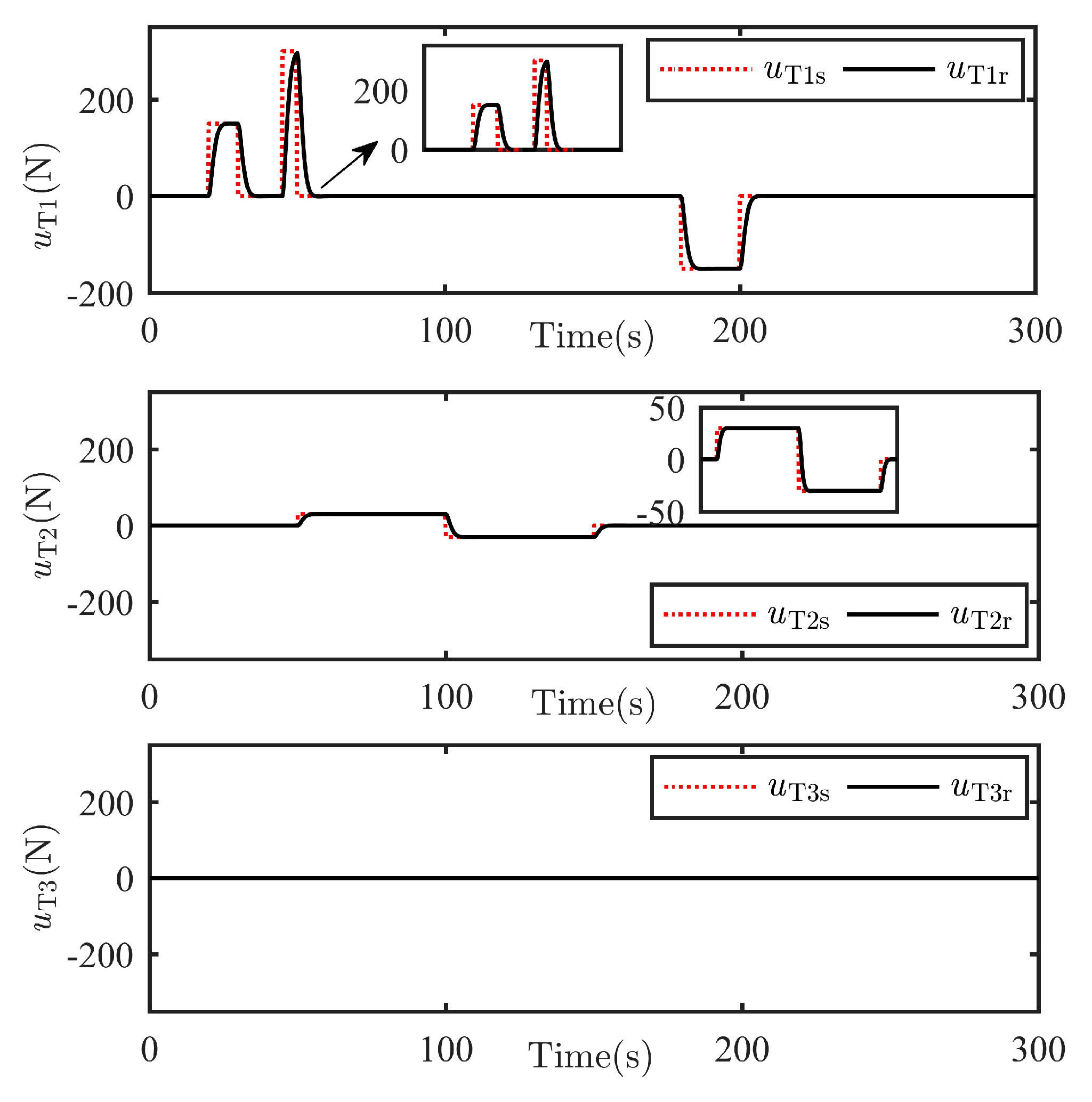
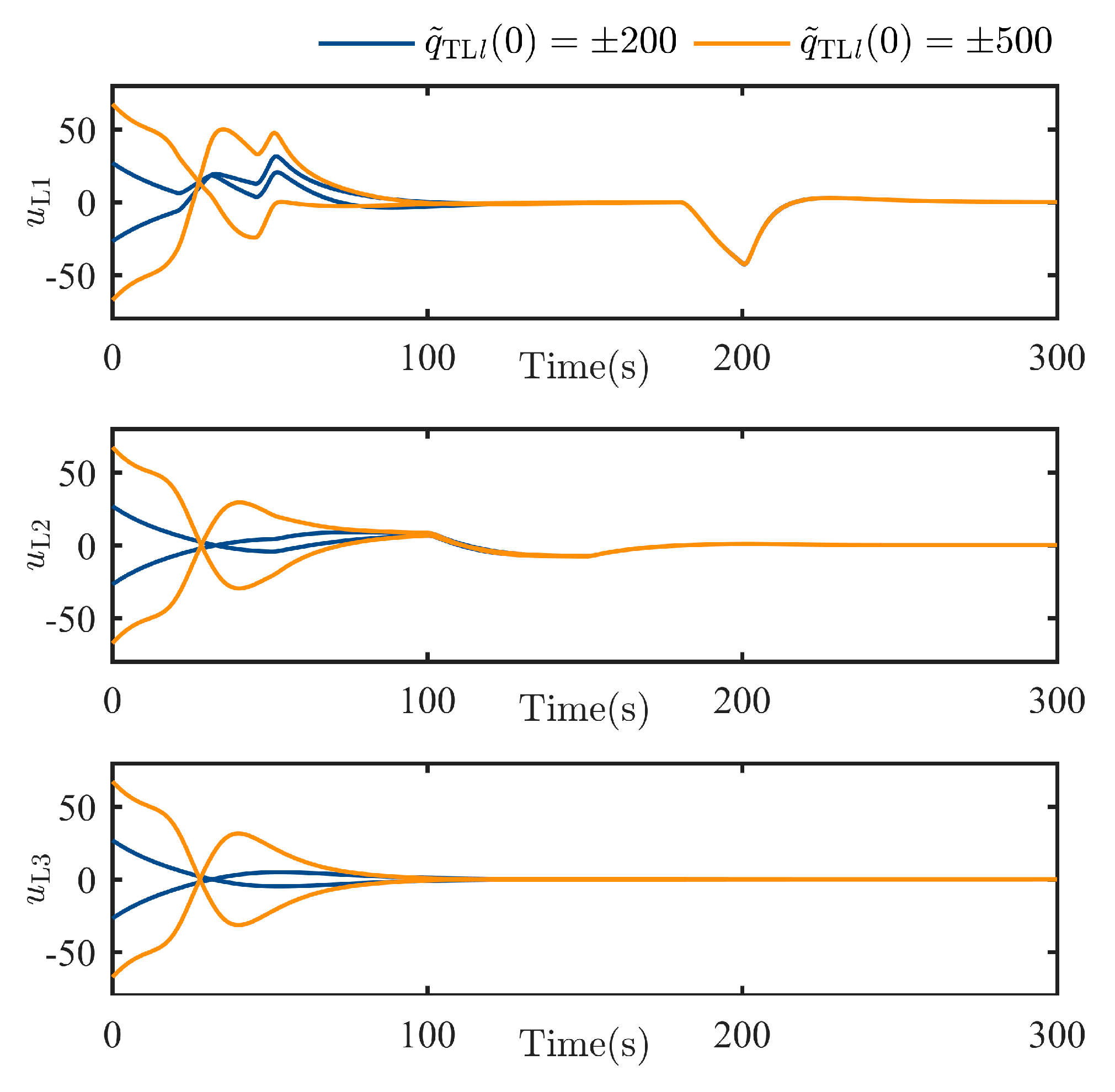
The TT controller command in each channel
is shown in
Figure 8, respectively. It illustrates that the controller designed in Equations (16) and (17) can firstly track the escaping behavior of the TSat successfully. On the other hand, the proposed controller will not ask high requirements for the actuators of the LSat (such as extremely high amplitude or sudden step), which also guarantees feasibilities for all SSats with a weaker maneuverability than the LSat.
After the escaping unknown TSat tracking is guaranteed by the TT controller above, it is shared with all SSats as shown in Equation (6). Then, the Nash equilibrium strategies
for all SSats are given in Equation (21) with the immersed auxiliary variable
tuned by Equation (20) to ensure a safe surrounding of the escaping TSat with specific structures. Considering the initialization shown in
Table 1 and the parameters set above. The process of the surrounding CT is shown in
Figure 9,
Figure 10,
Figure 11,
Figure 12,
Figure 13,
Figure 14,
Figure 15 and
Figure 16.
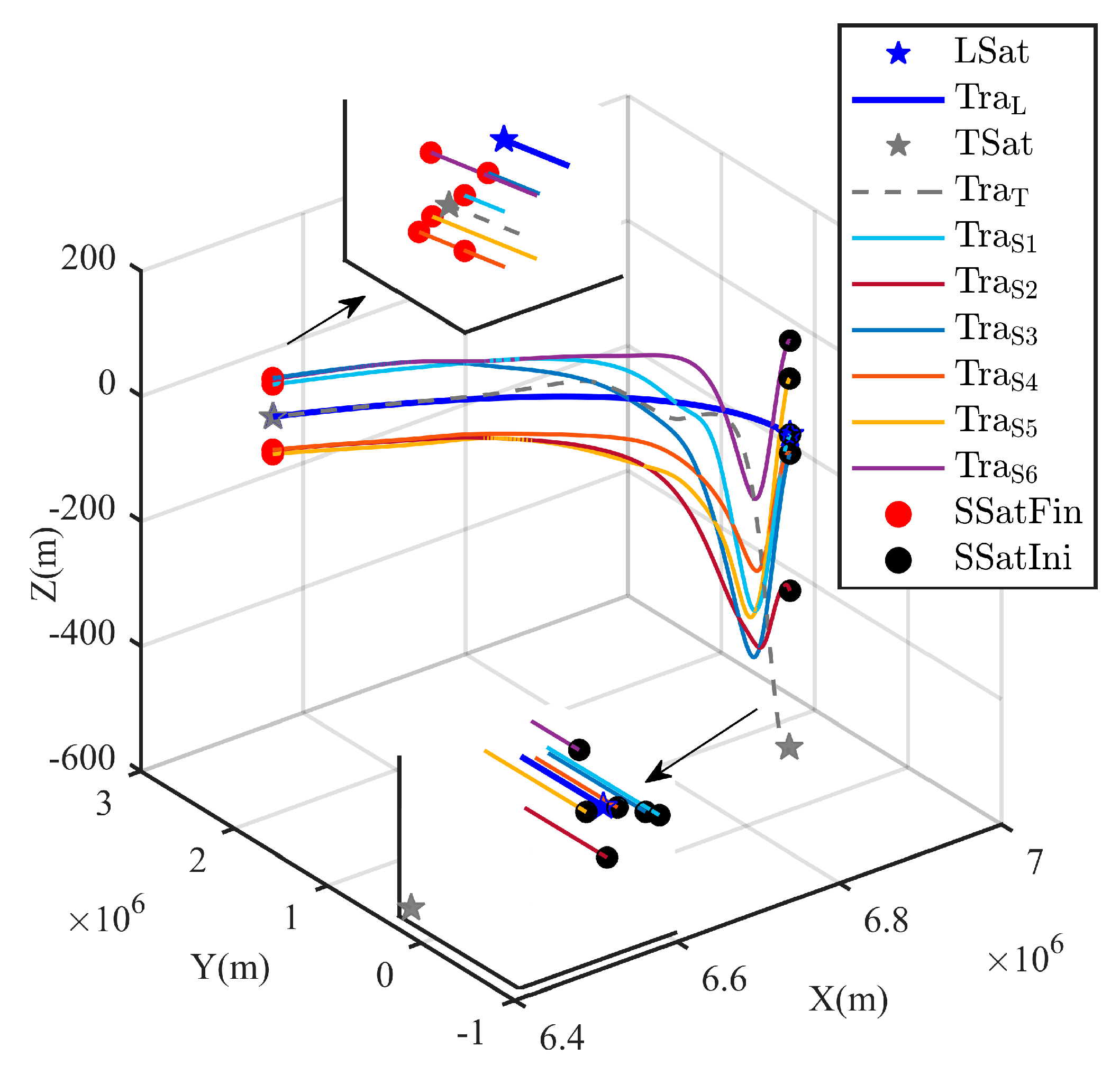
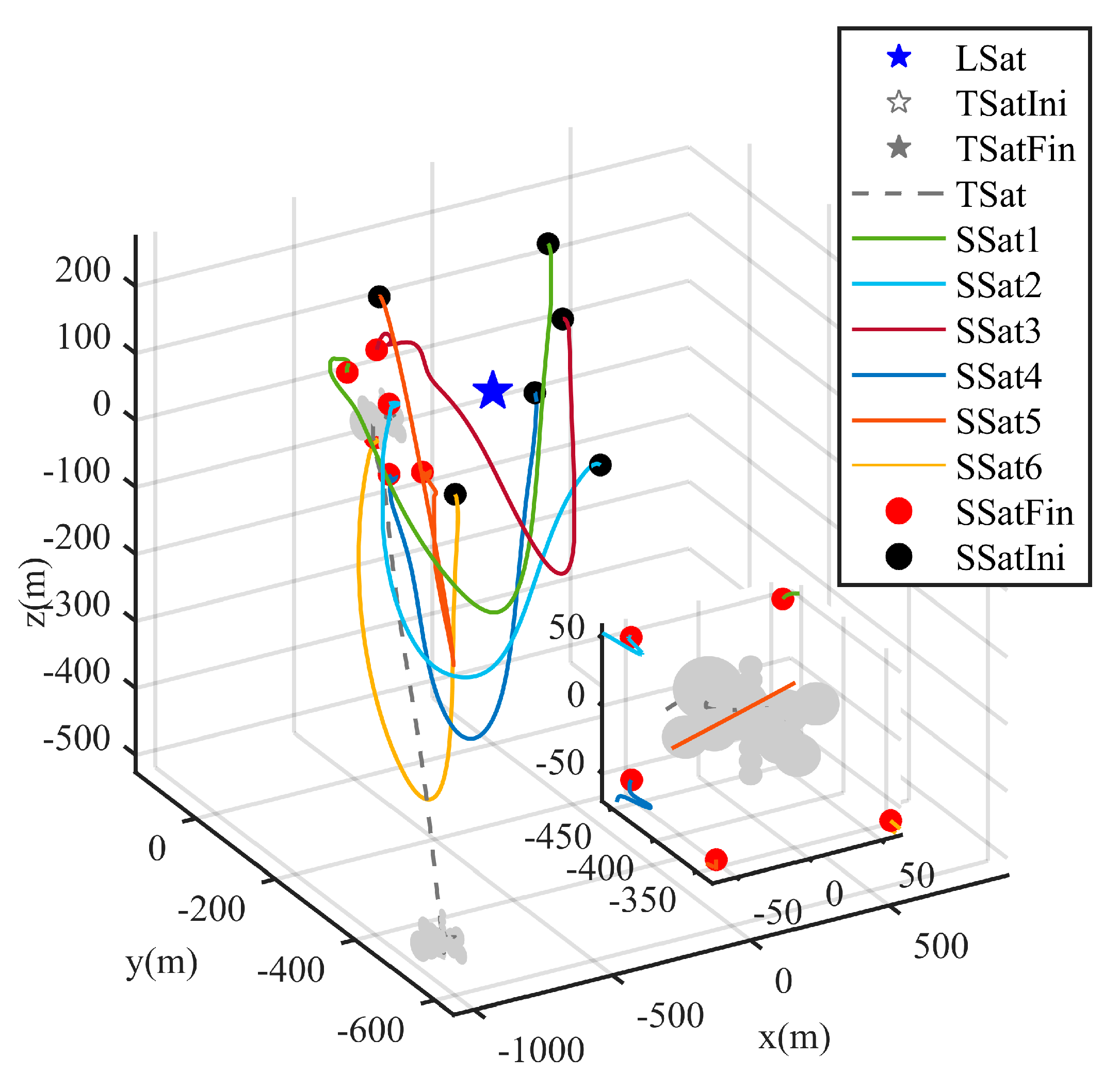
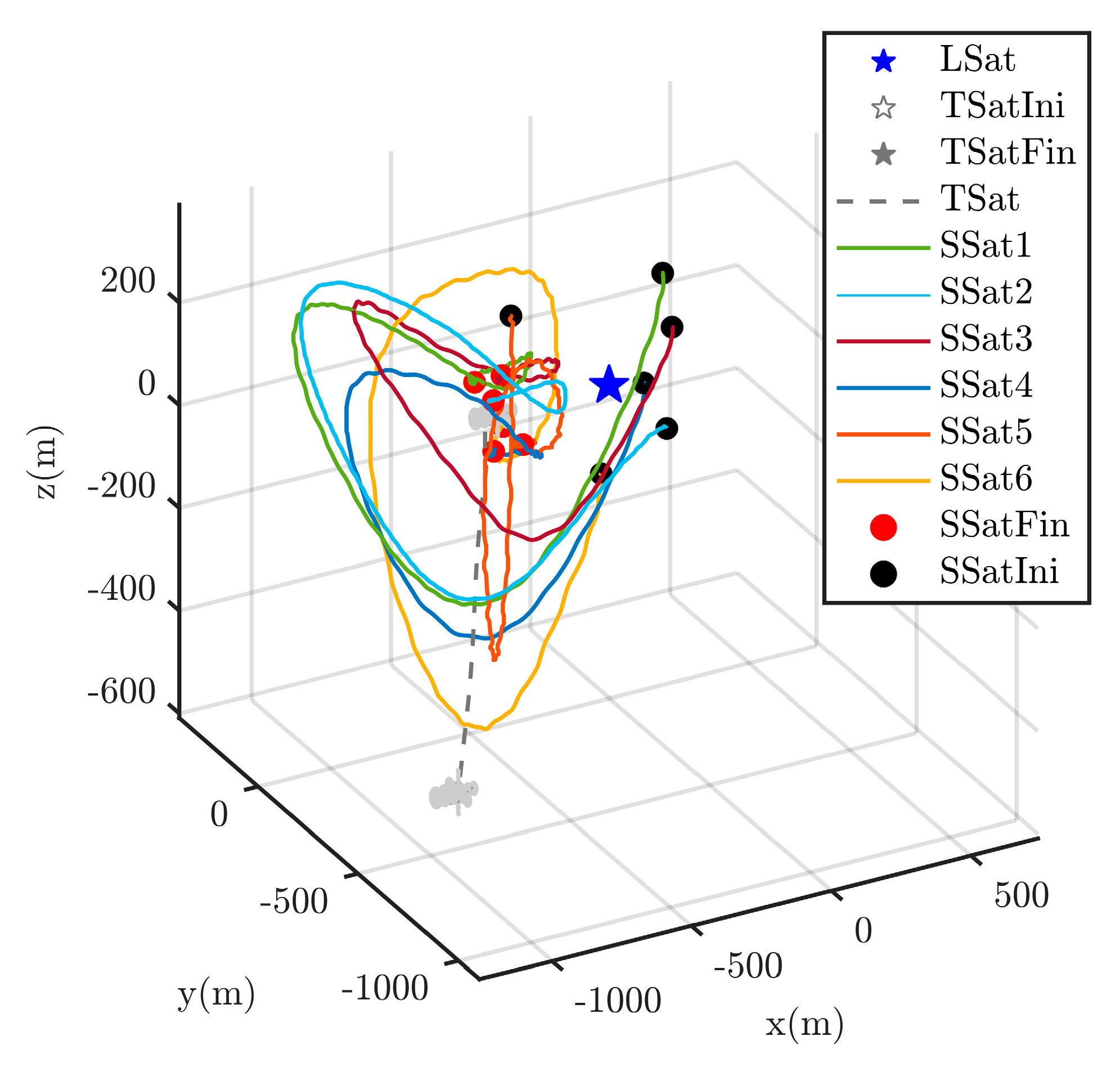
The whole process of the surrounding CT is shown in
Figure 9 and
Figure 10 with respect to ECI frame and the LSat LVLH frame respectively. Due to the orbit inclination of the LSat are set as 0 deg, clearer distance is shown on the z-axis in
Figure 9. In particular, as shown in
Figure 10, the control strategies
in Equation (6) firstly guarantee the successful surrounding of the escaping TSat. Through the partial zoom in
Figure 10, we can see that all the SSats get into the desired position around the TSat while any collision is avoided.
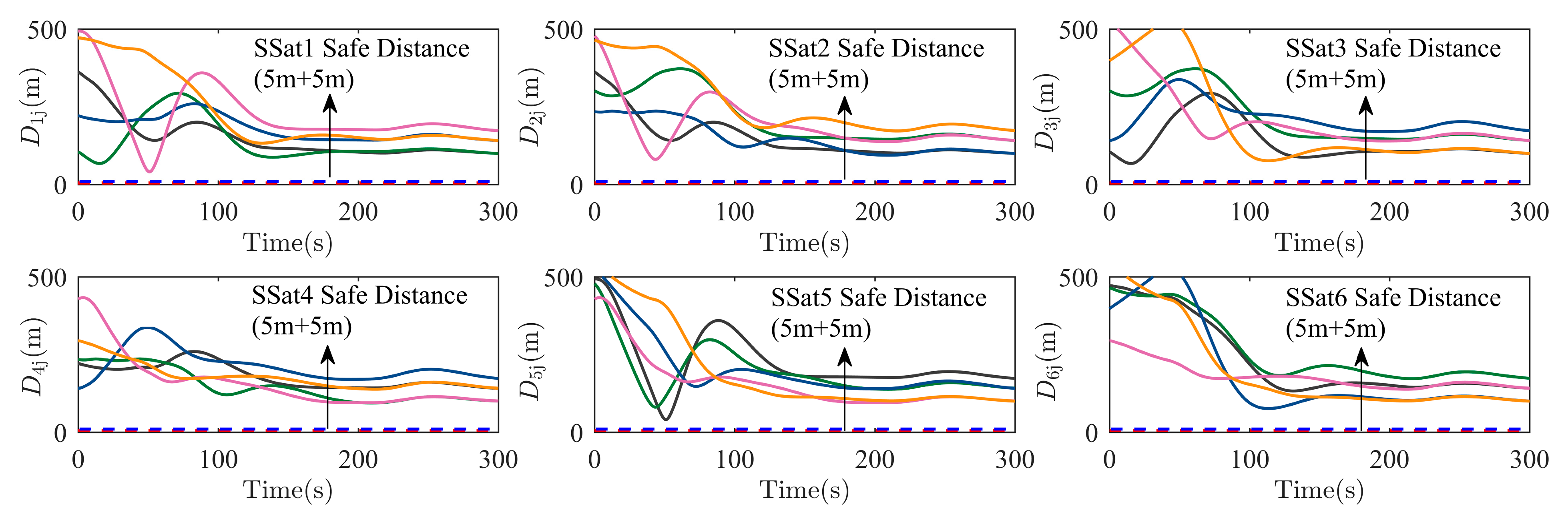
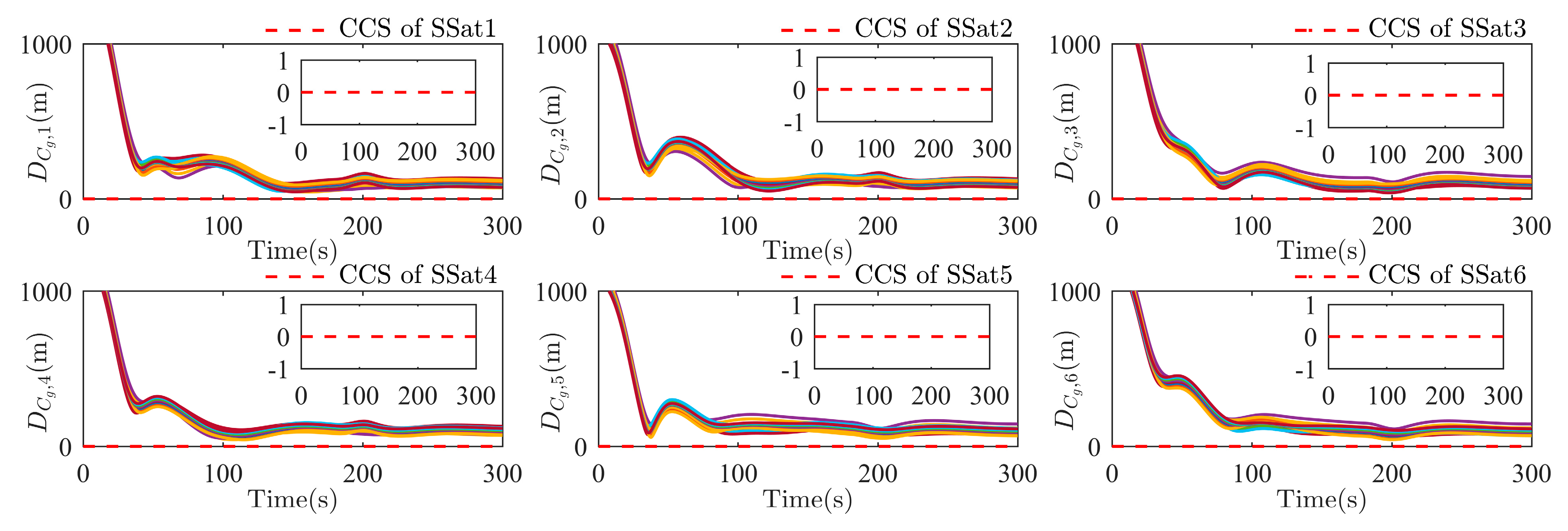
To further check the effectiveness of collision avoidance (including the collision between each SSat
with
,
, and the collision between any SSat and the specific structures of the TSat
with
,
), the real-time distance between each SSat is shown in
Figure 11, and the real-time distance from the
th SSat to all modeled structural envelope spheres is shown in
Figure 12. As shown in
Figure 11, the
th SSat can keep the safe distance during the whole surrounding process with the safe range of each SSat being 5 m, which implies that any collision between each SSat is avoided. Then, a collision checking signal (CCS)
(
with
if and only if the
th SSat has a collision with the
th envelope sphere) is used in
Figure 12 to show the effectiveness of the collision avoidance between all SSats and all envelope spheres. As the distance is reduced along the surrounding process, the CCSs of all SSats are always kept as 0, which illustrates the collision avoidance of the formation with respect to the specific structures of the TSat.
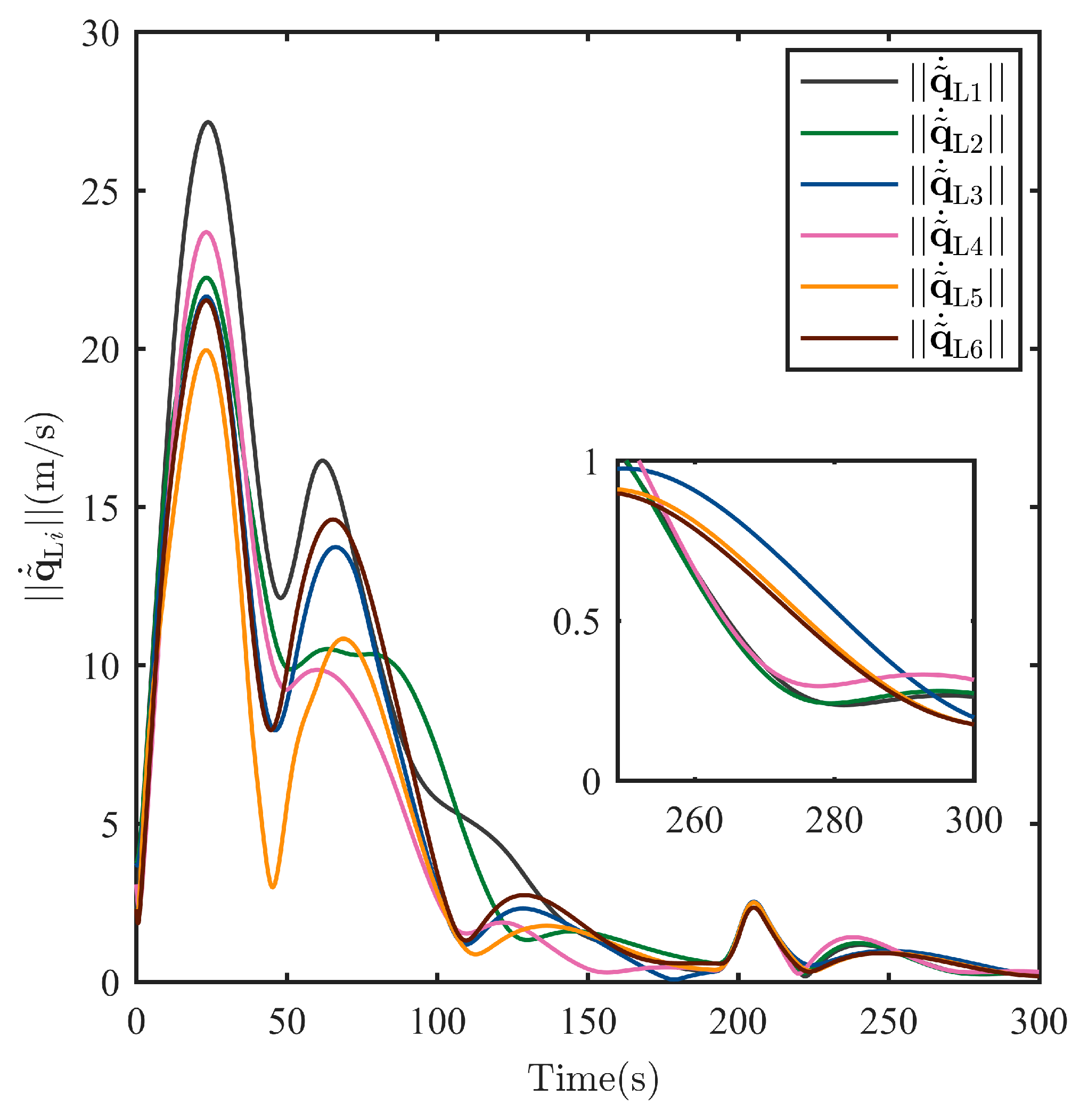
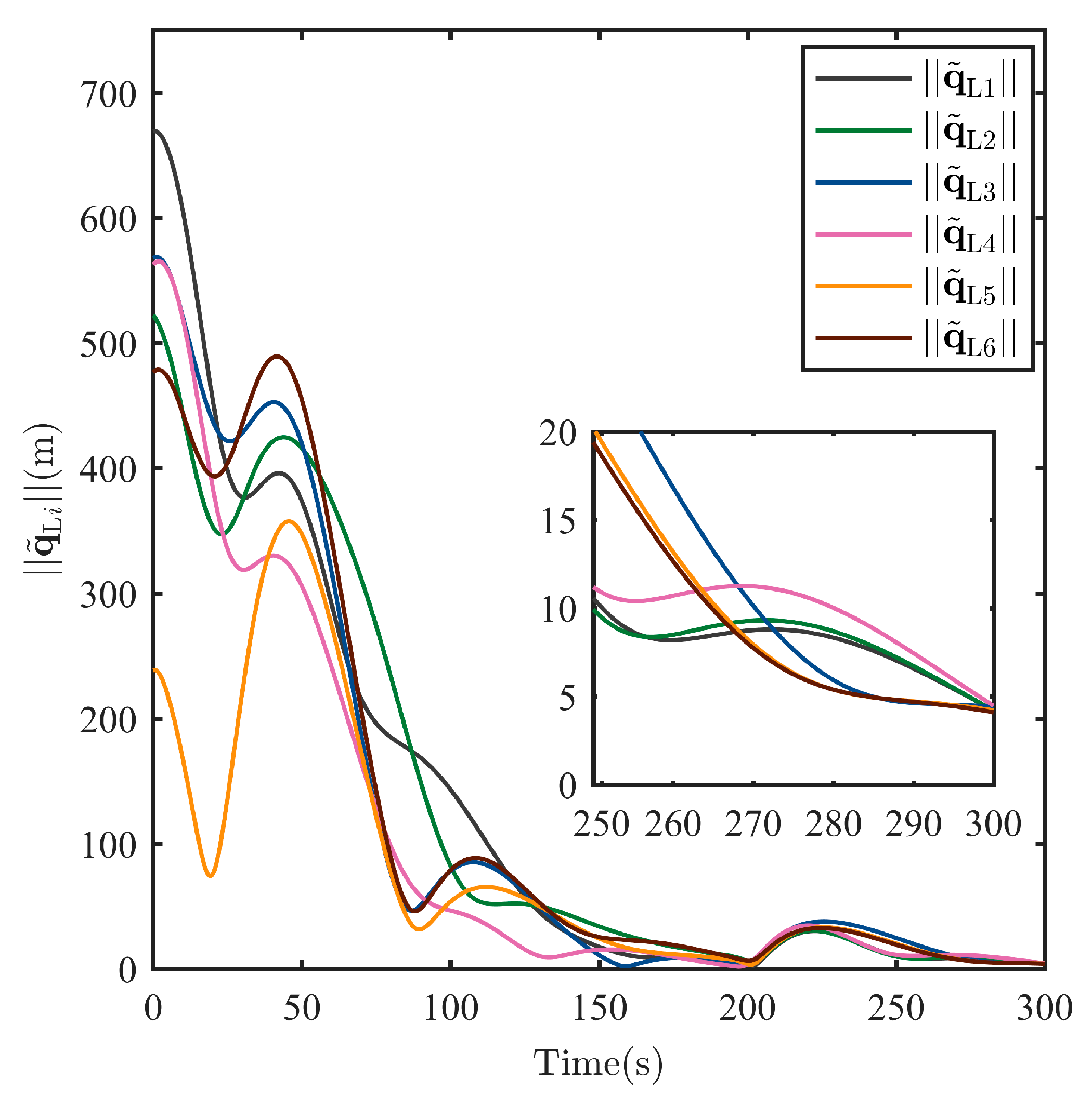
To show the surrounding CT accuracy, the real-time norm of the CT error (including the norm of the position error
and the velocity error
for all
) are, respectively, shown in
Figure 13 and
Figure 14. Both the position tracking error and the velocity tracking error shows an asymptotic stability, and the final tracking accuracy at 300 s for position tracking and velocity tracking has reached, respectively, into
m and
m/s.
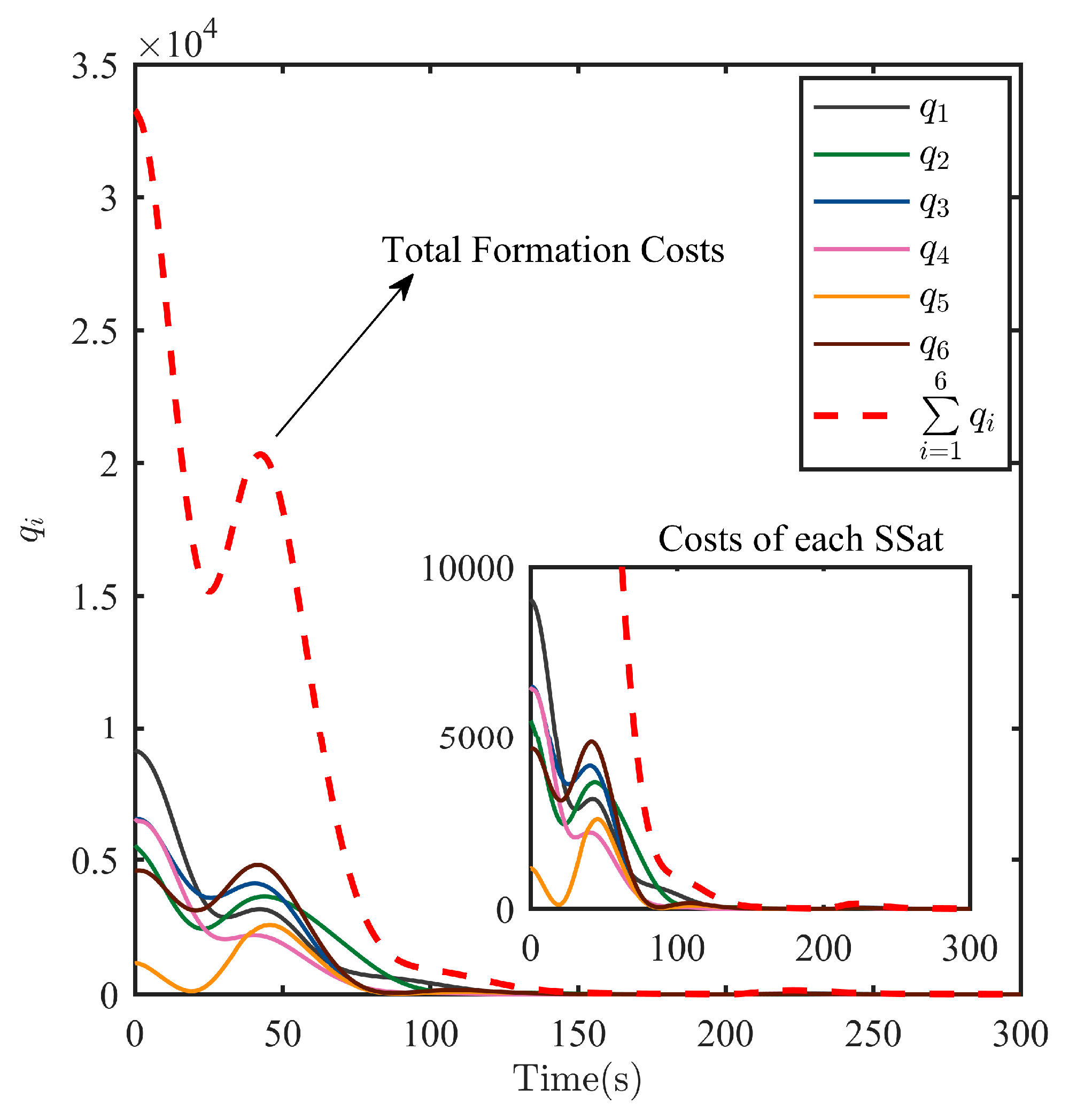
As the most intuitive explanation of all results shown in
Figure 9,
Figure 10,
Figure 11,
Figure 12,
Figure 13 and
Figure 14, responds of the running costs
in Equation (12) and responds of the total running cost of the whole formation
are shown in
Figure 15. From
Figure 15, it is shown that both the total running cost
and the running costs of each SSat
are ensured to be minimized. Note the change at 50 s is caused by the process that
. As the total running cost
and the running costs of each SSat
are minimized to zero, according to their definition given in Equation (12), all the CT error
satisfy that
, and the collision threat of all SSats are minimized.
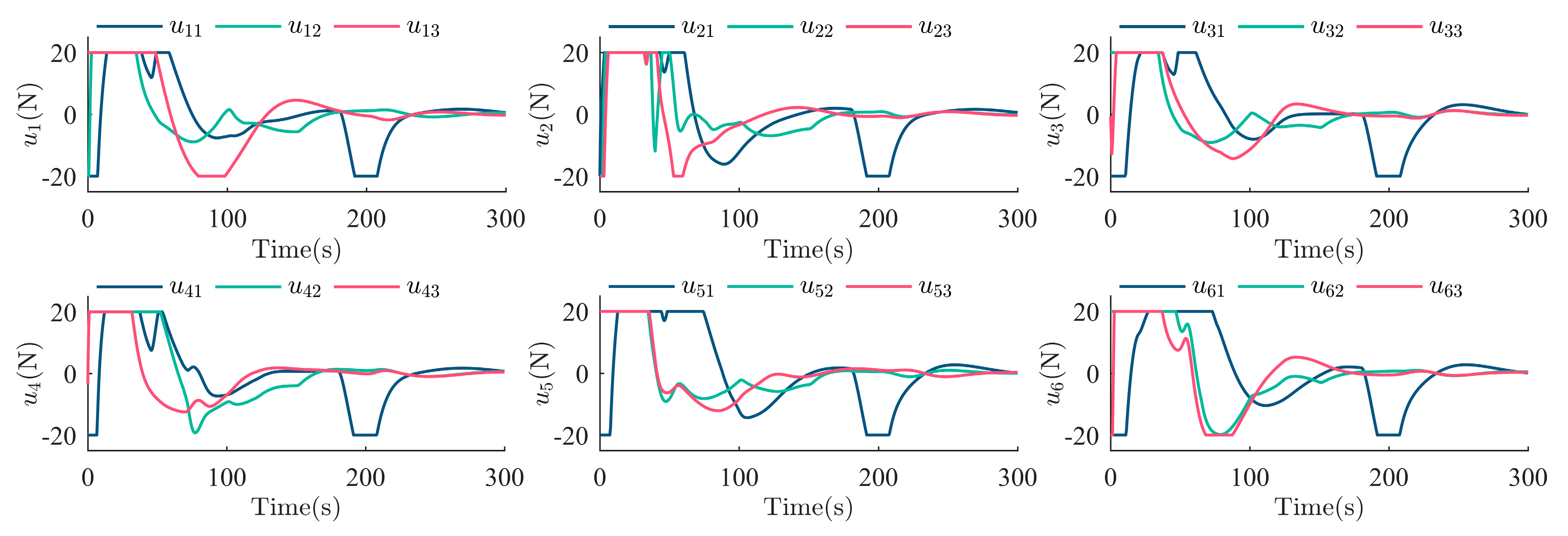
Figure 16 shows the controller command actually applied to each SSat according to Equation (6), which is mainly determined by the TT controller
and the CT controller
. As it is shown, the actuators of each SSat face saturation status at around 0 s–80 s, which is caused by the huge initial TT error and the initial CT error. Meanwhile, to synchronize with the LSat when the TSat is escaping, all SSats also update their control commands at around 100 s and 200 s.
To further support the advantages on CT performance, another collision-free controller against dynamic obstacles called cognitive-conditioned-reflex-based (CCRB) methods, similar to [
44], is tested as a comparison under the same situation, namely the TT control command shared by the LSat, initialization of the formation, desired surrounding configuration, and the cube-based target modeling results are all considered to be the same as the OCSS method proposed. The compared CT performance includes the average total fuel consumption (ATFC), average minimum distance to obstacles (AMD_obs), and average minimum distance to satellites (AMD_sat). ATFC is calculated by the average value of six SSats of their total fuel consumption during the whole simulation time, namely 300 s. AMD_obs and AMD_sat, respectively, record the average minimum distance from each SSats to all obstacles and the average minimum distance from each SSats to each other during the whole 300 s.
Figure 16 shows the surrounding path found for each SSats in LVLH frame by using the CCRB technique, and the CT performances are compared based on all the indices above in
Table 4.
As shown in
Figure 17 firstly, compared with the trajectories obtained by OCSS in
Figure 10, the trajectories obtained by CCRB show chattering phenomenon due to its search & learning mechanism especially at the area closing to the target and its specific structures, which also result in a higher fuel consumption shown in
Table 3. And as shown by the other indices, namely AMD_sat and AMD_obs, the results obtained by OCSS generally show a better performance than the one obtained by CCRB, which mainly thanks to the reference manifold ensuring the running costs descent along its gradient designed by Equation (20).