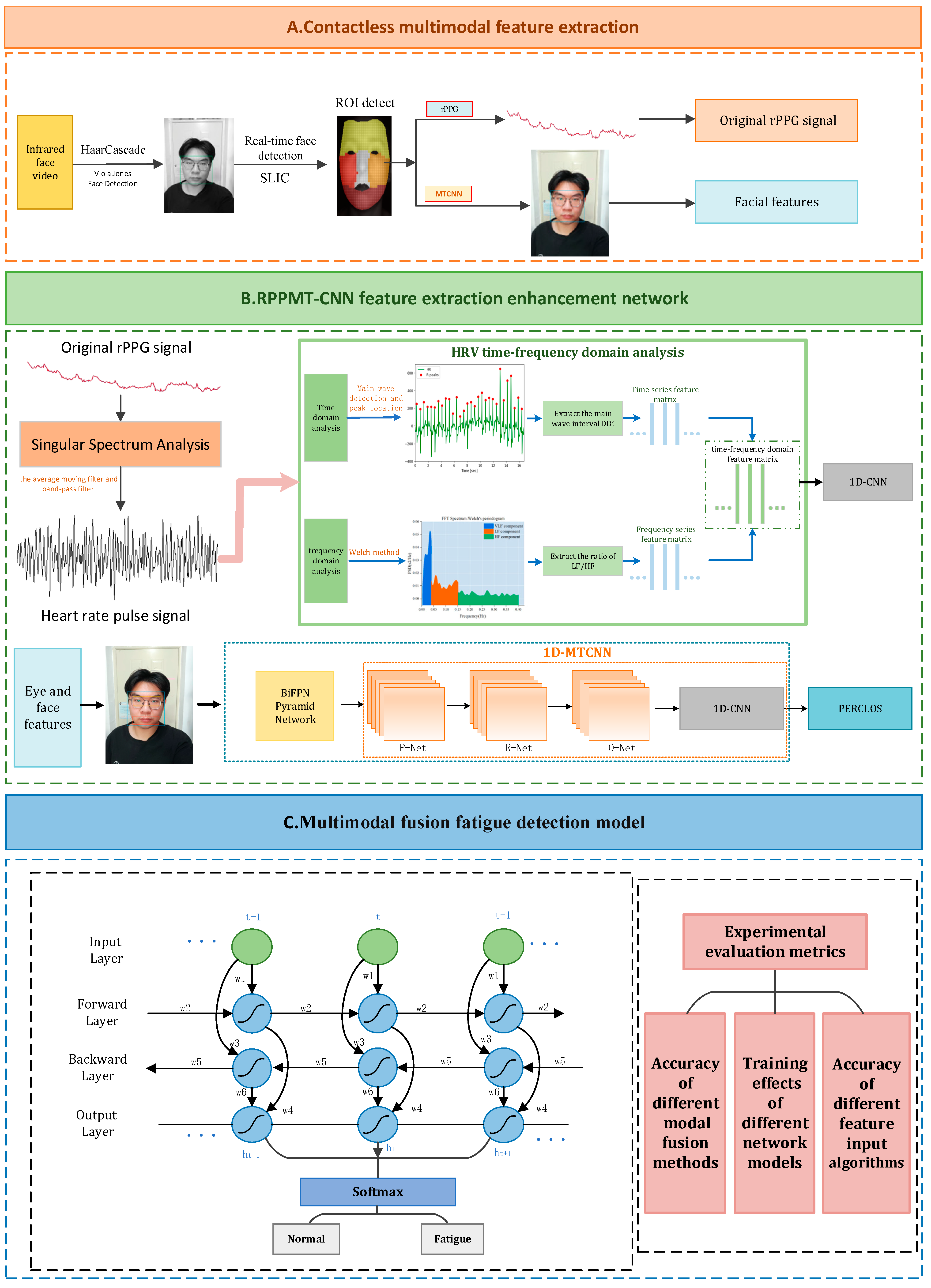
Remote Photoplethysmography and Motion Tracking Convolutional Neural Network with Bidirectional Long Short-Term Memory: Non-Invasive Fatigue Detection Method Based on Multi-Modal Fusion


Abstract
Share and Cite
Kong, L.; Xie, K.; Niu, K.; He, J.; Zhang, W. Remote Photoplethysmography and Motion Tracking Convolutional Neural Network with Bidirectional Long Short-Term Memory: Non-Invasive Fatigue Detection Method Based on Multi-Modal Fusion. Sensors 2024, 24, 455. https://doi.org/10.3390/s24020455
Kong L, Xie K, Niu K, He J, Zhang W. Remote Photoplethysmography and Motion Tracking Convolutional Neural Network with Bidirectional Long Short-Term Memory: Non-Invasive Fatigue Detection Method Based on Multi-Modal Fusion. Sensors. 2024; 24(2):455. https://doi.org/10.3390/s24020455
Chicago/Turabian StyleKong, Lingjian, Kai Xie, Kaixuan Niu, Jianbiao He, and Wei Zhang. 2024. "Remote Photoplethysmography and Motion Tracking Convolutional Neural Network with Bidirectional Long Short-Term Memory: Non-Invasive Fatigue Detection Method Based on Multi-Modal Fusion" Sensors 24, no. 2: 455. https://doi.org/10.3390/s24020455
APA StyleKong, L., Xie, K., Niu, K., He, J., & Zhang, W. (2024). Remote Photoplethysmography and Motion Tracking Convolutional Neural Network with Bidirectional Long Short-Term Memory: Non-Invasive Fatigue Detection Method Based on Multi-Modal Fusion. Sensors, 24(2), 455. https://doi.org/10.3390/s24020455