Article

Do Elite Basketball Players Maintain Peak External Demands throughout the Entire Game?

by
Hugo Salazar
1,
Filip Ujakovic
2,
Jernej Plesa
2,
Alberto Lorenzo
3,* and
Enrique Alonso-Pérez-Chao
4,5
1
Faculty of Education and Sport, University of Basque Country (UPV/EHU), 01007 Vitoria-Gasteiz, Spain
2
Basketball Club Cedevita Olimpija, 1000 Ljubljana, Slovenia
3
Faculty of Physical Activity and Sport Sciences—INEF, Polytechnic University of Madrid, 28040 Madrid, Spain
4
Department of Physical Activity and Sports Science, University Alfonso X el Sabio, 28691 Villanueva de la Cañada, Spain
5
Faculty of Sports Science, European University of Madrid, 28670 Villaviciosa de Odón, Spain
*
Author to whom correspondence should be addressed.
Sensors 2024, 24(13), 4318; https://doi.org/10.3390/s24134318
Submission received: 2 May 2024 / Revised: 29 May 2024 / Accepted: 24 June 2024 / Published: 3 July 2024
(This article belongs to the Special Issue Sensors for Performance Analysis in Team Sports)

Abstract

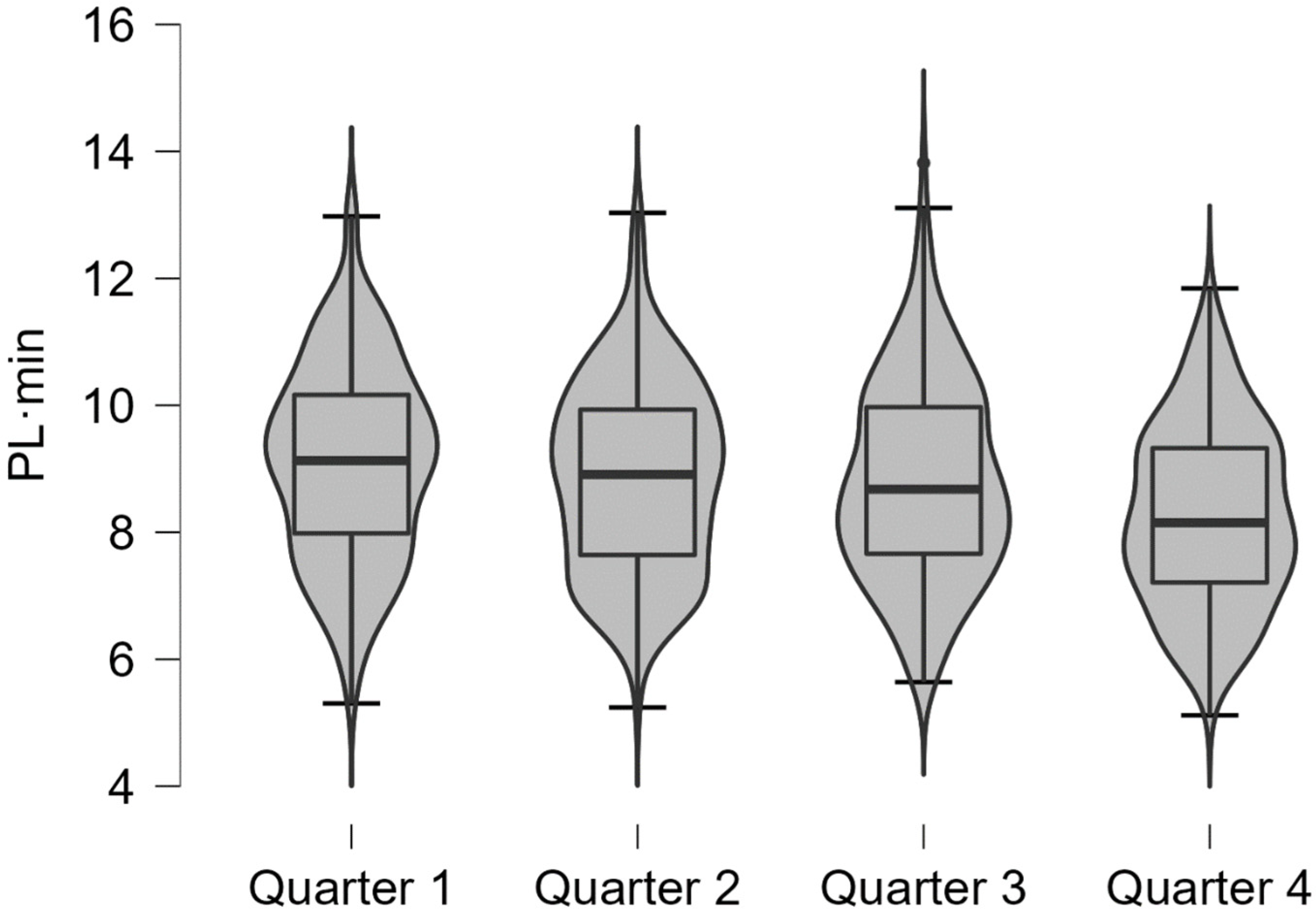
Consideration of workload intensity and peak demands across different periods of basketball games contributes to understanding the external physical requirements of elite basketball players. Therefore, the aim of this study was to investigate the average intensity and peak demands encountered by players throughout game quarters. PlayerLoad per minute and PlayerLoad at three different time samples (30 s, 1 min, and 3 min) were used as workload metrics. A total of 14 professional elite male basketball players were monitored during 30 official games to investigate this. A linear mixed model and Cohen’s d were employed to identify significant differences and quantify the effect sizes among game quarters. The results showed a significant, moderate effect in PlayerLoad per minute between Q1 vs. Q4, and a small effect between Q2 and Q3 vs. Q4. Furthermore, a small to moderate decline was observed in external peak values for PlayerLoad across game quarters. Specifically,, a significant decrease was found for the 3 min time window between Q1 and other quarters. The findings from the present study suggest that professional basketball players tend to experience fatigue or reduced physical output as the game progresses.
Keywords: basketball; most demanding scenarios; PlayerLoad; team sport; physical demands; accelerometry basketball; most demanding scenarios; PlayerLoad; team sport; physical demands; accelerometry