Article

An Intelligent System to Sense Textual Cues for Location Assistance in Autonomous Vehicles

School of Information Science and Technology, Dalian Maritime University, Dalian 116026, China
*
Authors to whom correspondence should be addressed.
Sensors 2023, 23(9), 4537; https://doi.org/10.3390/s23094537
Submission received: 11 April 2023 / Revised: 3 May 2023 / Accepted: 4 May 2023 / Published: 6 May 2023
(This article belongs to the Section Vehicular Sensing)

Abstract

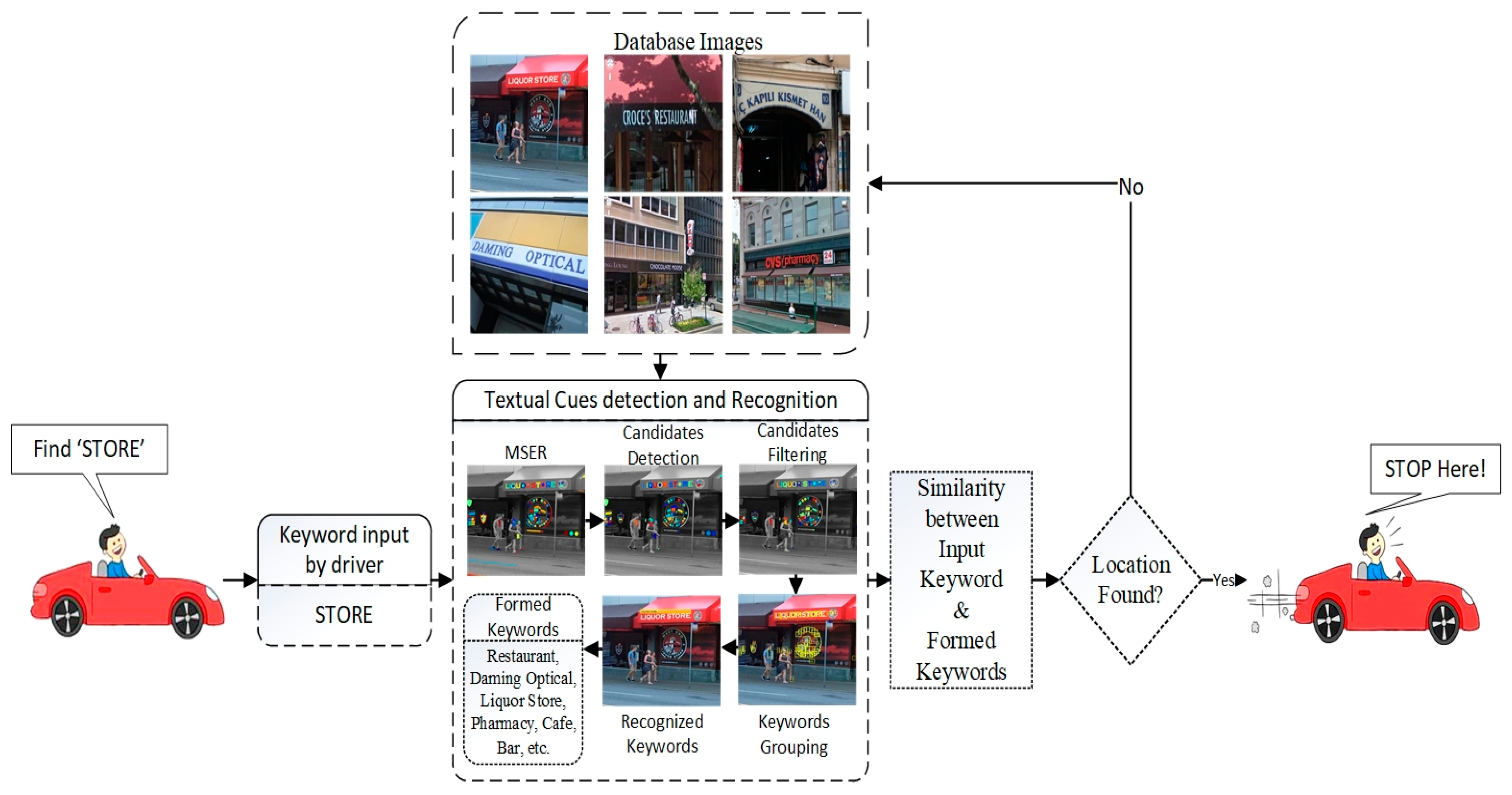
The current technological world is growing rapidly and each aspect of life is being transformed toward automation for human comfort and reliability. With autonomous vehicle technology, the communication gap between the driver and the traditional vehicle is being reduced through multiple technologies and methods. In this regard, state-of-the-art methods have proposed several approaches for advanced driver assistance systems (ADAS) to meet the requirement of a level-5 autonomous vehicle. Consequently, this work explores the role of textual cues present in the outer environment for finding the desired locations and assisting the driver where to stop. Firstly, the driver inputs the keywords of the desired location to assist the proposed system. Secondly, the system will start sensing the textual cues present in the outer environment through natural language processing techniques. Thirdly, the system keeps matching the similar keywords input by the driver and the outer environment using similarity learning. Whenever the system finds a location having any similar keyword in the outer environment, the system informs the driver, slows down, and applies the brake to stop. The experimental results on four benchmark datasets show the efficiency and accuracy of the proposed system for finding the desired locations by sensing textual cues in autonomous vehicles.
Keywords: sensing system; autonomous vehicles; advanced driver assistance system; image sensing; vision sensor sensing system; autonomous vehicles; advanced driver assistance system; image sensing; vision sensor