You are currently viewing a new version of our website. To view the old version click .
Sensors
  • Article
  • Open Access

17 April 2023

Internet of Underground Things in Agriculture 4.0: Challenges, Applications and Perspectives

,
,
and
Université Clermont Auvergne, INRAE, UR TSCF, 9 av. Blaise Pascal CS 20085, F-63178 Aubière, France
*
Authors to whom correspondence should be addressed.
This article belongs to the Special Issue Evolution of IoT and IIoT: Opportunities, Challenges, and Applications

Abstract

Internet of underground things (IoUTs) and wireless underground sensor networks (WUSNs) are new technologies particularly relevant in agriculture to measure and transmit environmental data, enabling us to optimize both crop growth and water resource management. The sensor nodes can be buried anywhere, including in the passage of vehicles, without interfering with aboveground farming activities. However, to obtain fully operational systems, several scientific and technological challenges remain to be addressed. The objective of this paper is to identify these challenges and provide an overview of the latest advances in IoUTs and WUSNs. The challenges related to the development of buried sensor nodes are first presented. The recent approaches proposed in the literature to autonomously and optimally collect the data of several buried sensor nodes, ranging from the use of ground relays, mobile robots and unmanned aerial vehicles, are next described. Finally, potential agricultural applications and future research directions are identified and discussed.

1. Introduction

The agricultural sector is today facing to major economic, societal and ecological challenges [1,2]. In particular, the constantly rising food demand together with the diminution of arable lands due to a world population and an urbanization continually increasing puts today an important pressure on the agricultural production. This pressure is accentuated by a set of environmental concerns, as soil depletion, soil erosion, surface water pollution, ozone layer degradation and biodiversity loss. The problem is that the intensive farming practices, which enable us to reach high crop yields, contribute to these effects due to the massive use of phytosanitary products and heavy machinery. In addition, the global warming and climate change are becoming major concerns, especially for the water resource management and crop growth.
Agricultural practices and models have thus to be rethought to become more efficient, more productive and more environmentally friendly. Numerous actors and stakeholders agree today that a way to achieve this objective will come from the adoption of new emerging technologies such as the Internet of things (IoT), robotics, big data analytics, artificial intelligence (AI), cloud computing (CC), and blockchains, see [3,4]. As in the past, with the introduction of mechanization and automation in agriculture, the gradual introduction of these new technologies is leading to a new agricultural revolution, the fourth one, called Agriculture 4.0, see [5].
Data are at the heart of this digital revolution. Smart IoT devices are progressively implanted in the fields to feed decision-making processes with accurate environmental measurements (e.g., soil moisture, soil and air temperature, solar radiation, pH level, wind strength and direction), see [6,7,8,9]. In its simplest form, an IoT device is built around a microcontroller, a radio transceiver located aboveground and with more or less high communication range, a power source eventually recharged by a solar panel and one or several sensors connected. In most cases, the IoT devices are installed on the edge of the fields to not disturb the farming activities. The measurements, raw or preprocessed, are sent over the Internet and stored in databases by means of intermediate ground relays (e.g., gateways, cellular stations), satellite relays (e.g., nanosatellites at low Earth orbit (LEO) [10]) or collection vehicles (e.g., mobile robots, unmanned aerial vehicles (UAVs), [11]). Processing algorithms aggregate all the data collected with other information sources (e.g., historic of weather conditions, topography of the fields, soil type, satellite images) to determine the best actions to be performed at a specific location and a specific time (e.g., irrigation control, fertilizer application, seeding), see [9].
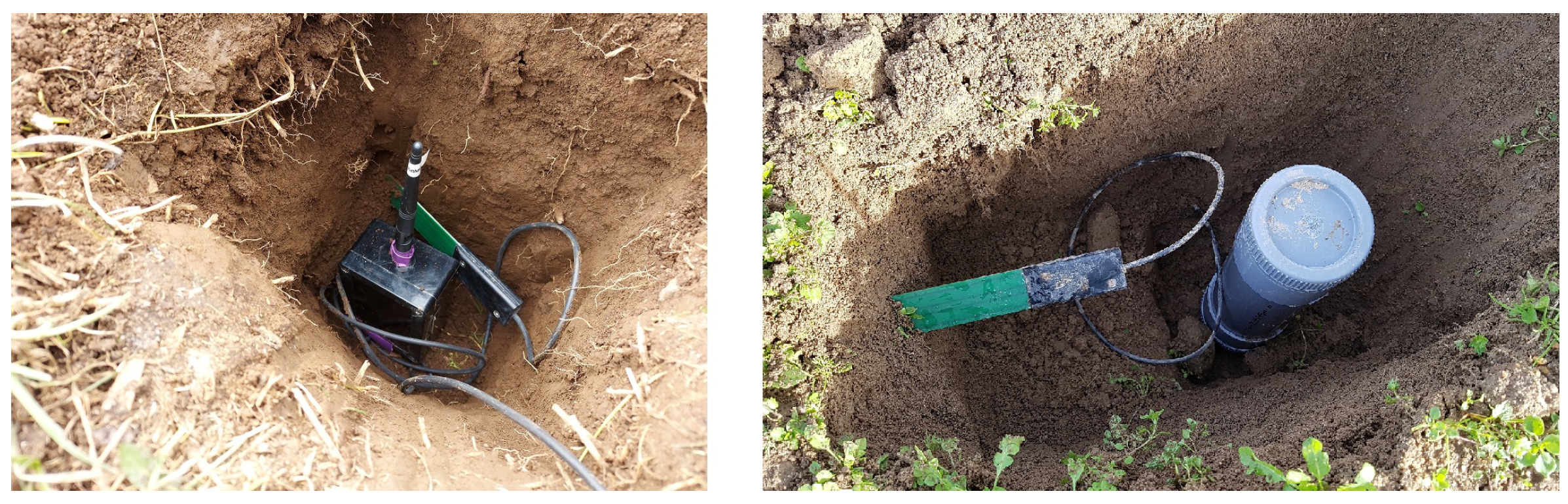
However, in recent years and in complement to this approach, a new paradigm of IoT has emerged. This one is based on sensor nodes fully buried underground, including the radio transceivers and the antennas, at depths varying from a few centimeters to several tens of centimeters; see the examples in Figure 1.
Figure 1. Examples of sensor nodes buried at 15 cm from the surface in a pasture with a moisture probe on the side [12]. The nodes will next be covered with soil and compacted.
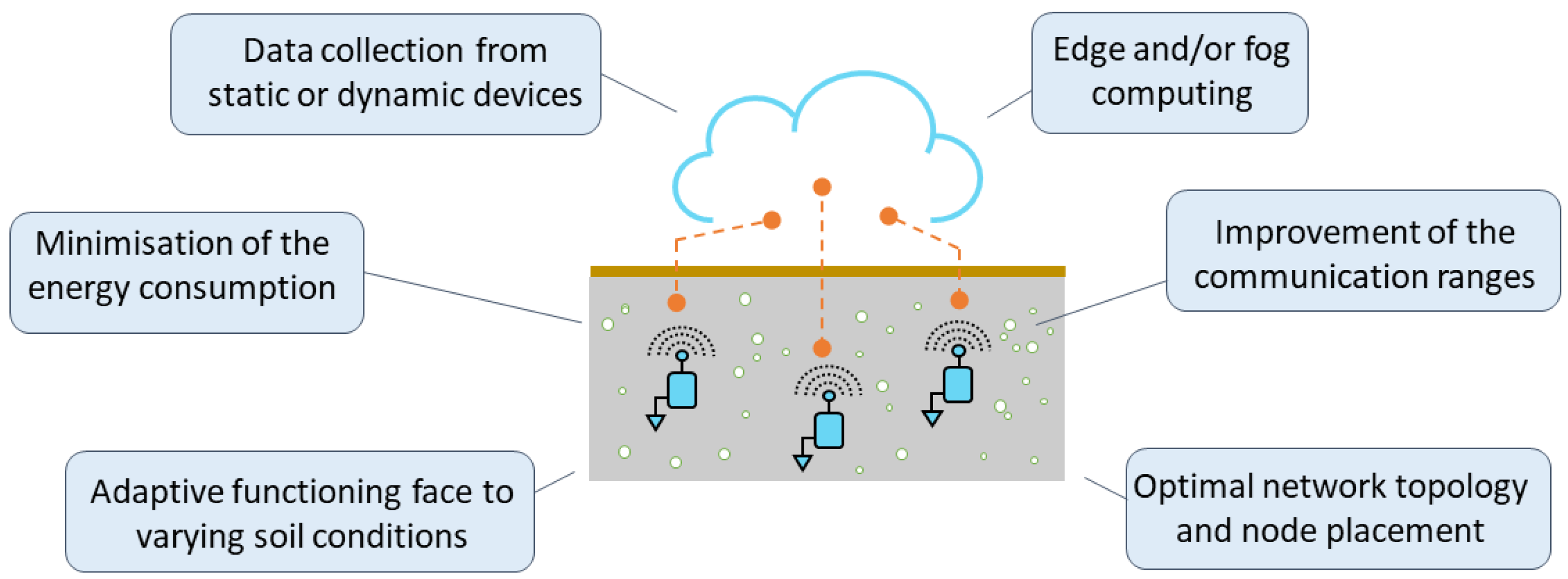
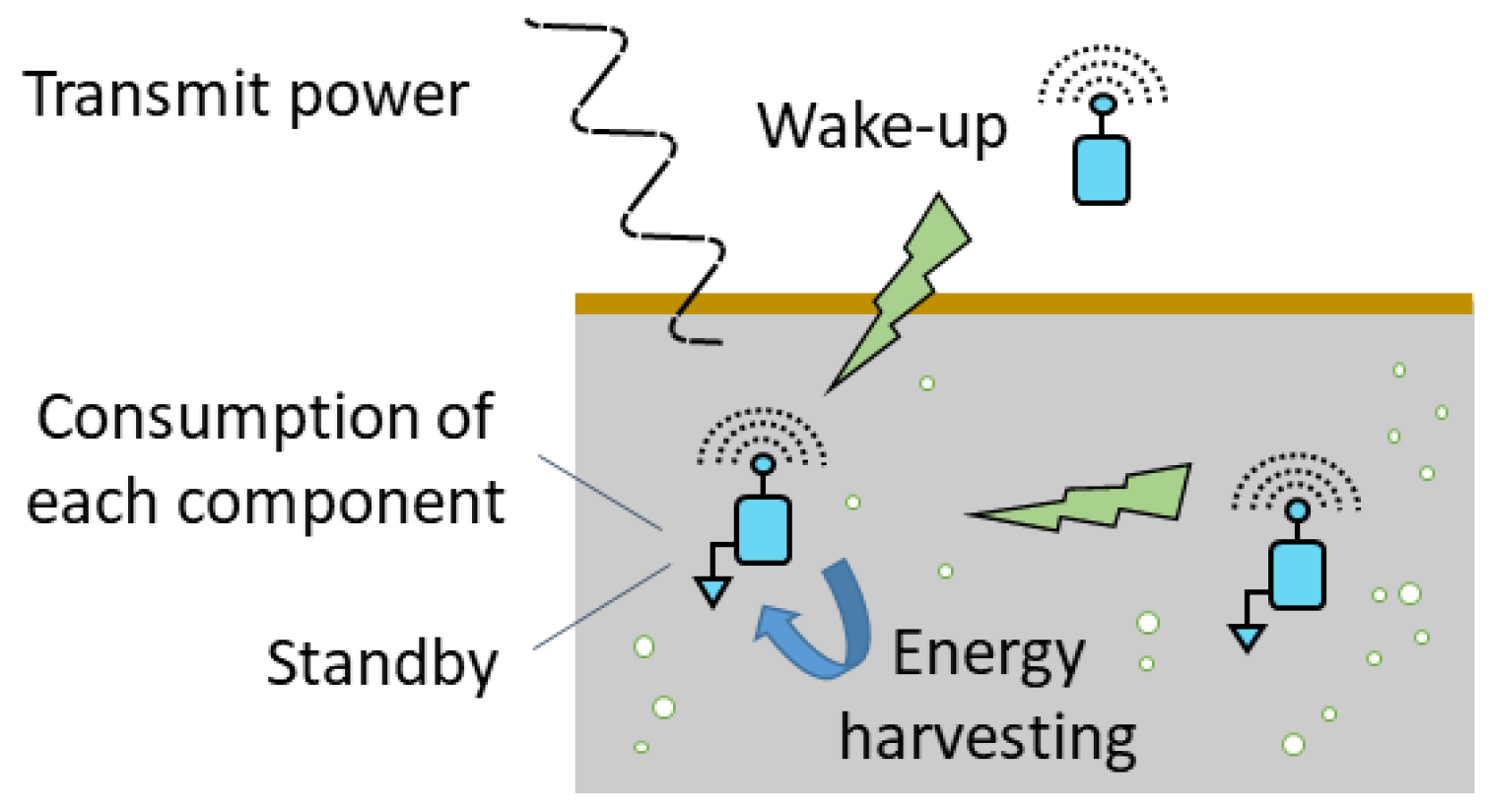
That approach has led to the new concepts of Internet of underground things (IoUTs) and wireless underground sensor networks (WUSNs) [13,14]. The fact of burying and dissimulating the nodes underground has numerous advantages, such as the protection against the damage usually encountered by the aboveground nodes (e.g., theft, vandalism, degradation due to extreme climatic events). Moreover, the buried sensor nodes can be positioned anywhere, including on the passage of farm vehicles within the fields. However, before obtaining fully operational systems with long operational times (i.e., ideally several years without battery replacement), several scientific and technological challenges remain to be overcome, whether it be in terms of communication ranges, energy consumption or data collection. The objective of this paper is to identify these challenges and provide an overview of the recent advances of IoUTs and WUSNs for agricultural applications. To that end, this paper is organized as follows.
The research methodology used to identify and analyze relevant research articles on WUSNs and IoUT is first presented in Section 2. The current issues related to the development of buried sensor nodes are highlighted in Section 3. The approaches proposed in the literature to collect the data transmitted by the buried sensor nodes, whether it be from the use of intermediate ground relays, mobile ground robots or unmanned aerial vehicles (UAVs), are presented in Section 4. Some applications of WUSNs in Agriculture 4.0 and future research directions are identified and discussed in Section 5 and Section 6. The paper ends with the conclusions in Section 7.

2. Research Methodology

This paper provides a synthesis of the state of the art on wireless underground sensor networks (WUSNs) and Internet of underground things (IoUT) applied to smart farming. Guided by [15,16], we first formulated two research questions, namely, which approaches have been developed in the literature to build WUSNs and how the data can be collected from either ground relays, mobile robots or UAVs.
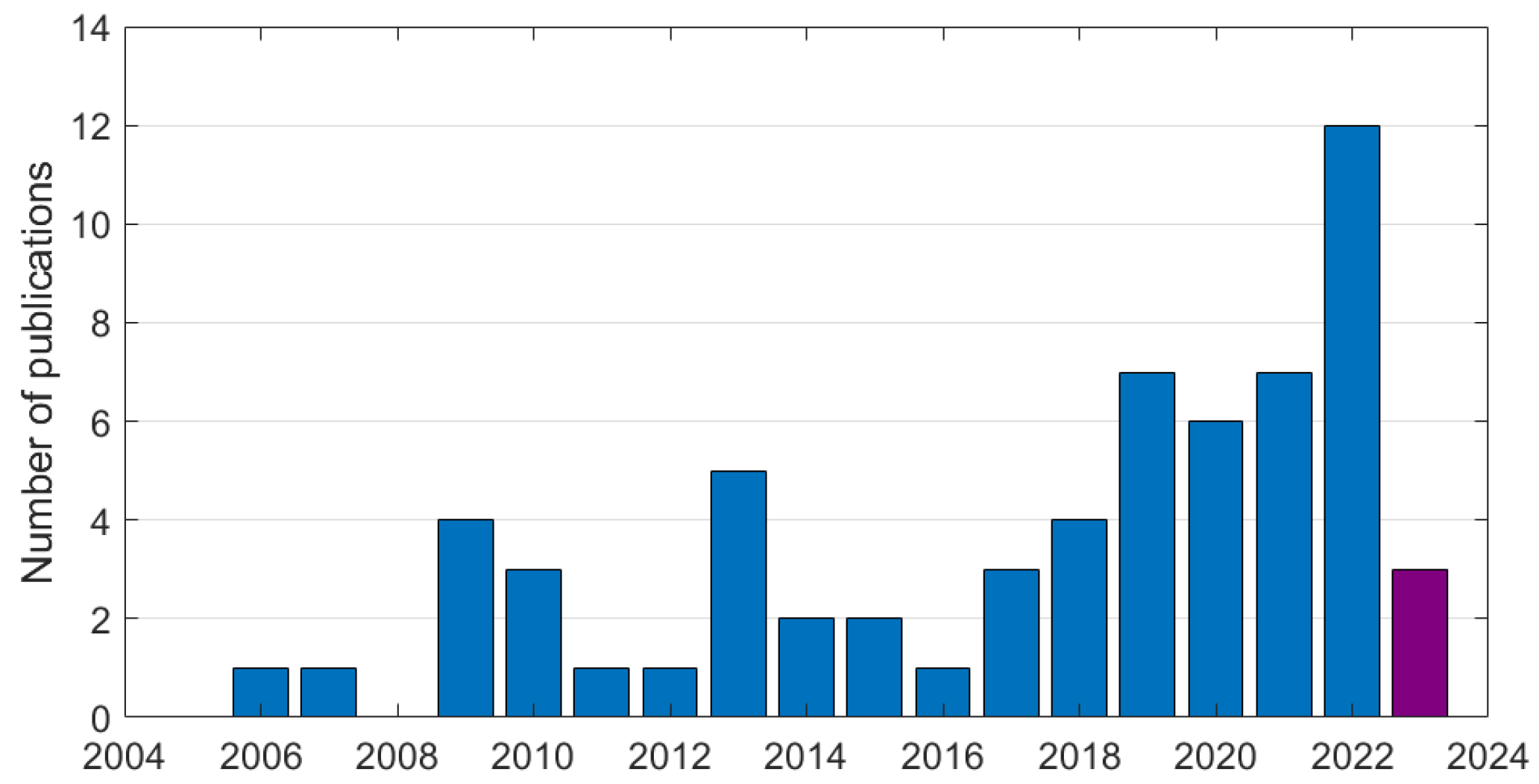
We consulted the research databases “Scopus”, “Web of Science” and “IEEE Xplore” to identify the research articles. We limited the period of publication between 2000 and 2023, and limited our research to peer-reviewed journal articles and conference papers written in English. We searched the keywords “WUSN” or “Internet of Underground Things” in the titles; 75 papers were found by using this research strategy. After reading the abstracts, 12 papers were excluded from the review. We excluded, in particular, the studies applied to the monitoring of underground mines and tunnels as the sensor nodes are not directly in contact with the soil. Finally, 63 research articles, published from 2006 to 2023, were analyzed. Figure 2 presents the distribution of the publications by year. We can observe that, after the first publication in 2006, the number of publications increased regularly with an important growth from the year 2019 and a peak in 2022. The number of publications in 2023, which is the year of this analysis, continues to rise.
Figure 2. Distribution of the number of publications on WUSNs and IoUT by year.
The relatively limited number of research articles found in the literature (75) suggests that the research on WUSN and IoUT is still in its early stage. To contrast with this result, 12759 research articles were found with the keyword “WSN”. The countries where the works are produced are presented on Table 1. We can observe that the United States comes first with the highest number of publications (23), followed by China (9), India (4), Saudi Arabia (4) and France (4). Table 2 classifies these publications by theme and subject (more details are given in Table A1, Table A2 and Table A3 in the Appendix A). Numerous works have focused on the development of propagation models of the electromagnetic waves in soil and also the study of routing protocols and the collection of data from static relay nodes.
Table 1. Classification of the number of publications on WUSNs and IoUT by country.
Table 2. Classification of the publications by theme and subject.
Thirty-seven other research articles are cited in this paper relating to complementary subjects (e.g., Agriculture 4.0, smart farming based on IoT and UAV, agricultural robotics). In total, 100 works have been consulted and analyzed.

4. Data Collection of the Buried Sensor Nodes

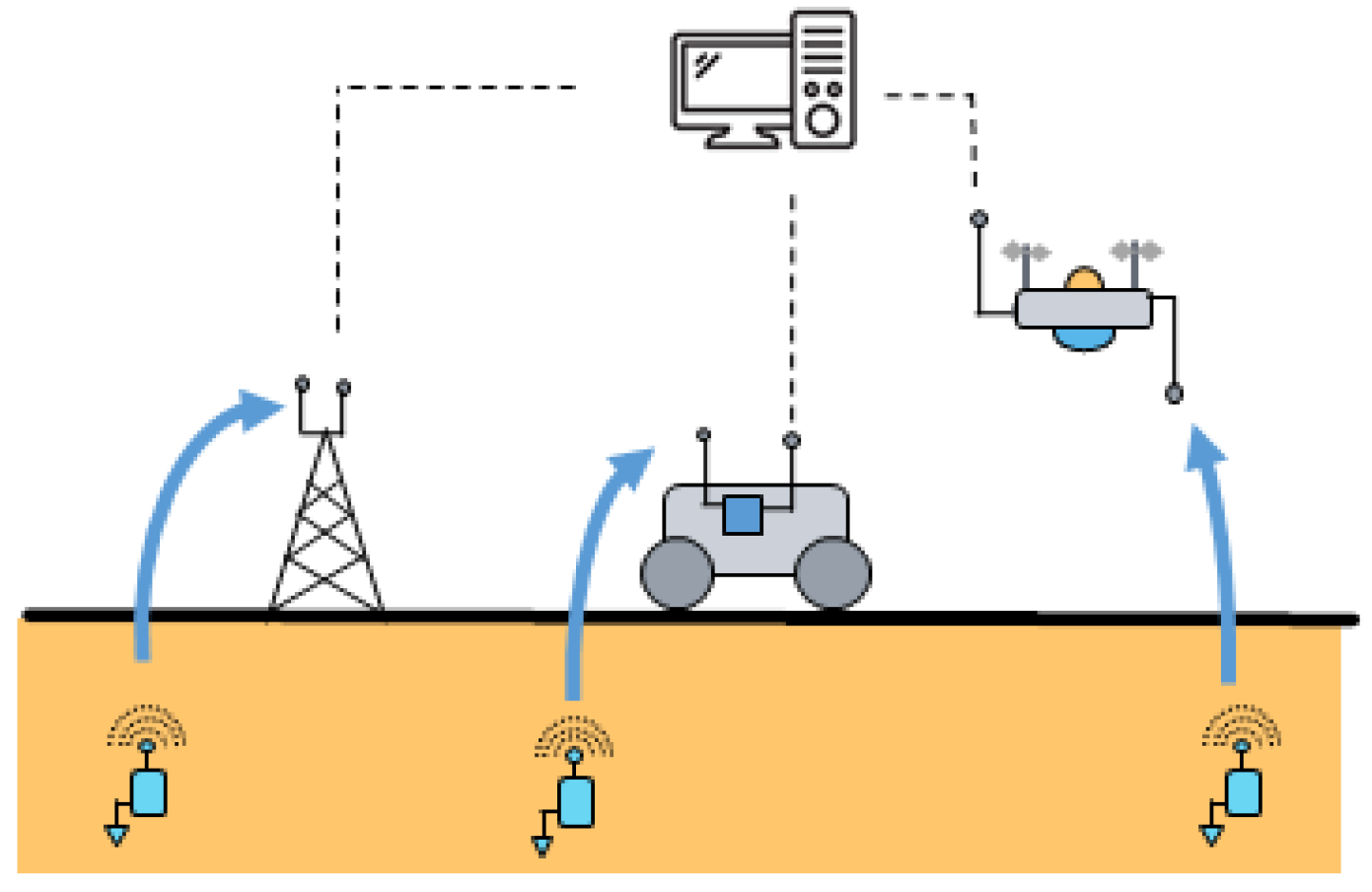
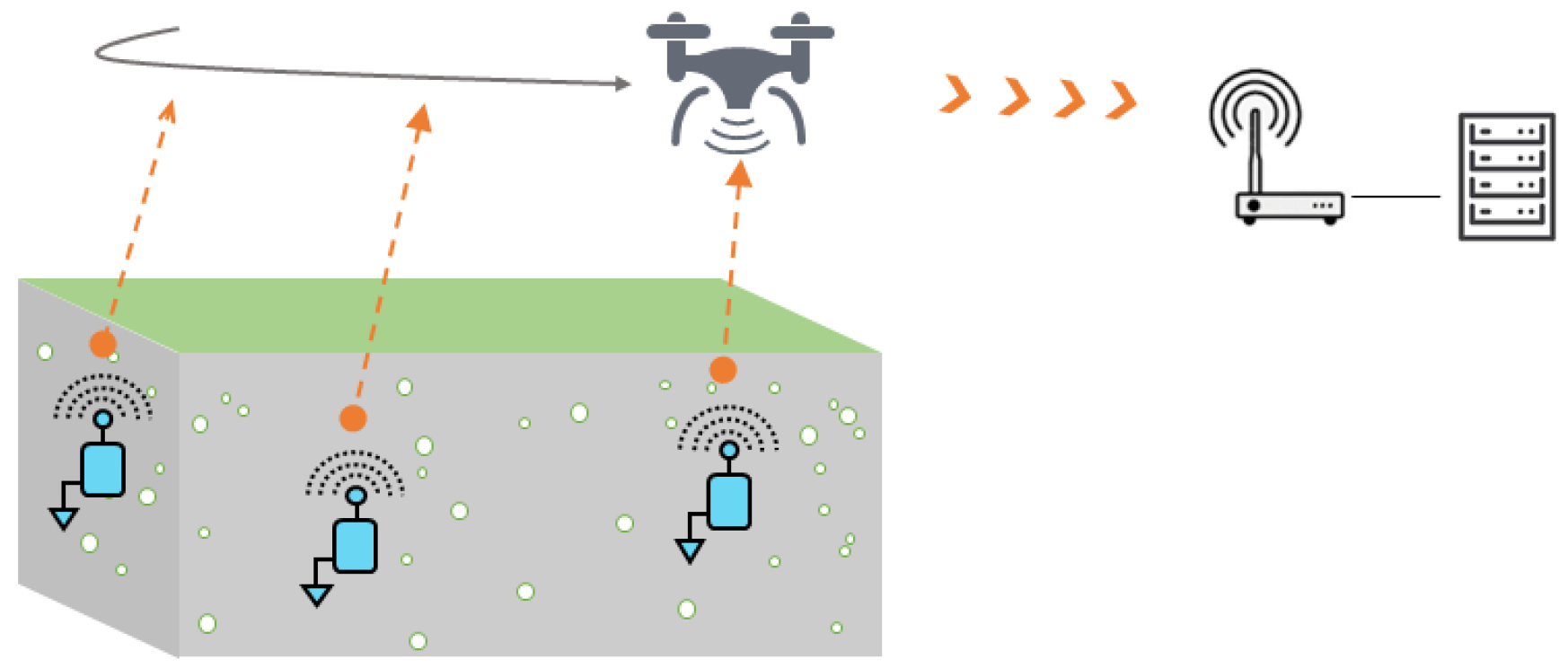
After having presented the different challenges related to the development of buried sensor nodes, the following section will highlight the challenges related to the collection of the data transmitted. This collection task can be carried out by using static approaches (e.g., static ground relays) or dynamic ones (e.g., mobile robots and unmanned aerial vehicles (UAV)); see Figure 8.
Figure 8. Static and dynamic ways to collect the data of buried sensor nodes.

4.1. Static Approaches

In the literature, the conventional approach to collect the data consists in installing ground static gateways in the fields, with advanced processing powers and communication capabilities, to relay the information transmitted by the sensor nodes towards the servers [76,87]. The problem is that the communication ranges of the buried sensor nodes can be limited: in [12], the maximal reachable horizontal distance of the communication link in LoRa at 868-MHz was 275 m by considering a sensor node buried at 15 cm deep and a gateway at a height of 2 m from the ground. Similarly, ref. [64] buried 23 sensor nodes at 40 cm depth within an area of 530 m radius. A static gateway, with an antenna mounted at a height of 10 m, was positioned in the center of the area. The communications were based on Sigfox at 901.2-MHz. The loss of data packets reached 50% when the horizontal distance between the node and the base station was 250 m and rapidly increased with respect to the distance. The drawback of this approach is therefore to require the multiplication of the number of gateways in the case of wide areas to be covered. It is, moreover, not cost-effective (e.g., cost of gateways, installation, maintenance operations), not flexible (e.g., difficult to rapidly change and/or extend an area of instrumentation) and energy consuming (the transmit power of the sensor nodes have to be high to reach the aboveground gateways). The aboveground infrastructure can, moreover, be subject to degradation due to weather conditions as well as malicious acts (vandalism, theft).

4.2. Dynamic Approaches

Another approach, still rarely investigated in the literature, consists of operating without the need of static gateways in the field. In this case, the data collection task is performed by using either a ground vehicle (e.g., mobile robot) or an unmanned aerial vehicle (UAV). These vehicles can embed a gateway connected to the Internet or, most of the time, simply a collector node storing temporarily the data collected.
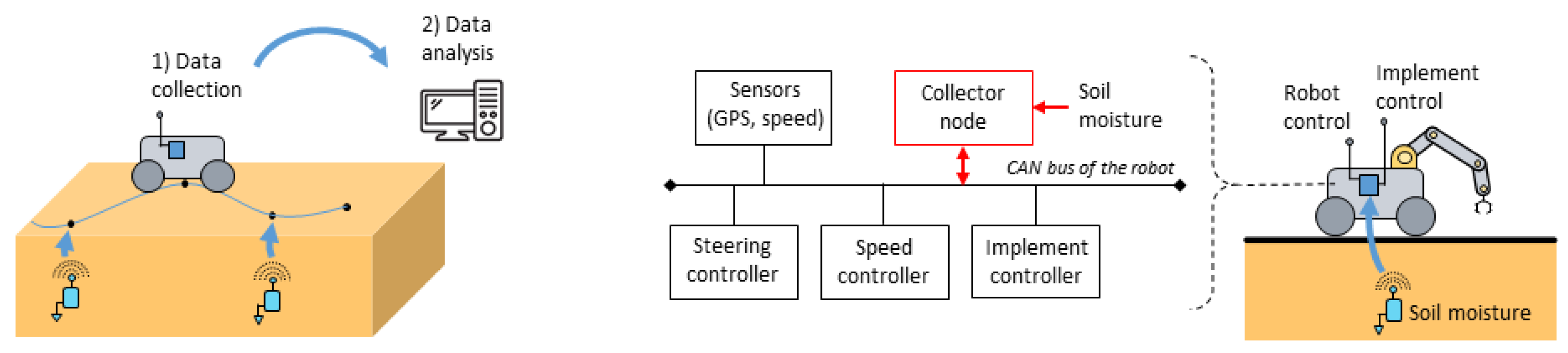
Agricultural robotics has developed strongly over the last two decades to increase farm productivity, perform environmentally friendly operations, as well as relieve farmers from tedious and unhealthy work [90]. When a connection to the cloud is available (e.g., from cellular networks, nanosatellites or long-range communication systems), robots are connected objects offering new possibilities in terms of data sharing and decision-making and also data collection; see [91]. In addition to their agricultural tasks carried out in the field (e.g., detection of weeds, pests and diseases; crop growth monitoring [92]), mobile robots could in the same time collect the data of the buried sensor nodes in the field; see the illustration in Figure 9 (left). This task could also be performed independently, requiring the definition of the trajectories to be followed beforehand. Ref. [72] was one of the first to consider such mobile nodes to collect the data of buried sensor nodes. In this work, different communication protocols were studied based on automatic re-transmissions and hand-shaking. Ref. [73] studied the use of a RFID reader embedded on a mobile robot to collect the soil moisture information estimated from the received signal strength indicator (RSSI) of passive RFID tags buried underground.
Figure 9. Data collection of buried sensor nodes by using a mobile robot (left). The soil moisture information is used in real-time to adapt the behavior of the robot accordingly [74] (right).
Recently, [74] proposed to not only collect and store the soil moisture information from buried sensor nodes but also use this information in real-time to adapt the behavior of the mobile robot (e.g., working speed, implement, trajectories); see Figure 9 (right). This approach is particularly interesting in the control of agricultural mobile robot as it enables facing varying weather conditions and/or heterogeneous soil status and optimizing both the locomotion of the robot as well as the agronomic task carried out. Moreover, that approach enables avoiding the situation where the robot is stuck and blocked in a wetland.
Another way to dynamically collect the data of buried sensor nodes is to use unmanned aerial vehicles (UAVs). This technology is increasingly used in smart farming to perform a great variety of missions, ranging from the monitoring of crop growth with multi-spectral cameras to the data collection of IoT devices [11,93,94,95]. In comparison to ground mobile robots, UAVs have clearly the advantage to be easily and rapidly operational on site. The flight time is, however, limited, which requires to optimize as much as possible the flight trajectories [96]. The regulations governing the use of UAVs in a country have also to be considered (e.g., in France, the use of an UAV in a professional context requires to pass theoretical and practical examinations beforehand. In case of flight out of sight, the maximal authorized horizontal distance is 1000 m).
Still, very few works have investigated the data collection of buried sensor nodes from a UAV; see Figure 10. Recently, ref. [68] studied the impact of the altitude and lateral position of a drone on the received signal strength indicator (RSSI) by a sensor node buried at 15 cm deep in LoRa at 868 MHz. In addition to the experiments performed in hovering mode, dynamical flights enabled to collect data frames at the altitude of 40 m and with flying speeds of 4 m/s and 8 m/s. [69] characterized the decrease in the signal strength of LoRa communications with the increasing sensor node depth and flight height of the drone. Ref. [70] presented field tests carried out with a gateway mounted on an UAV, which received the soil moisture data transmitted by some sensor nodes buried at 30 cm deep. The communications were performed in LoRa at 916 MHz. The UAV flew at very low altitude, from 0.9 m to 3.6 m, with spiral trajectories. It was studied the packet loss at different horizontal distances and with different antenna orientations (co-polarized and cross-polarized). The results showed that less than 17% of the packets were lost at horizontal distances lower than 60 m whatever the relative orientation of the antennas. Ref. [71] presented simulations of a UAV flying in hovering mode above a potato crop of 20 hectares where 2000 sensor nodes were supposed to be buried. Based on NB-IoT communication technology, the objective of that work was to study the impact on the link quality of several parameters, such as the UAV altitude, the burial depth of the nodes as well as the soil moisture.
Figure 10. Data collection by means of a UAV: issues of optimal trajectory planning, reliable UG2AG data transmissions, data collection, data transfer on remote servers.
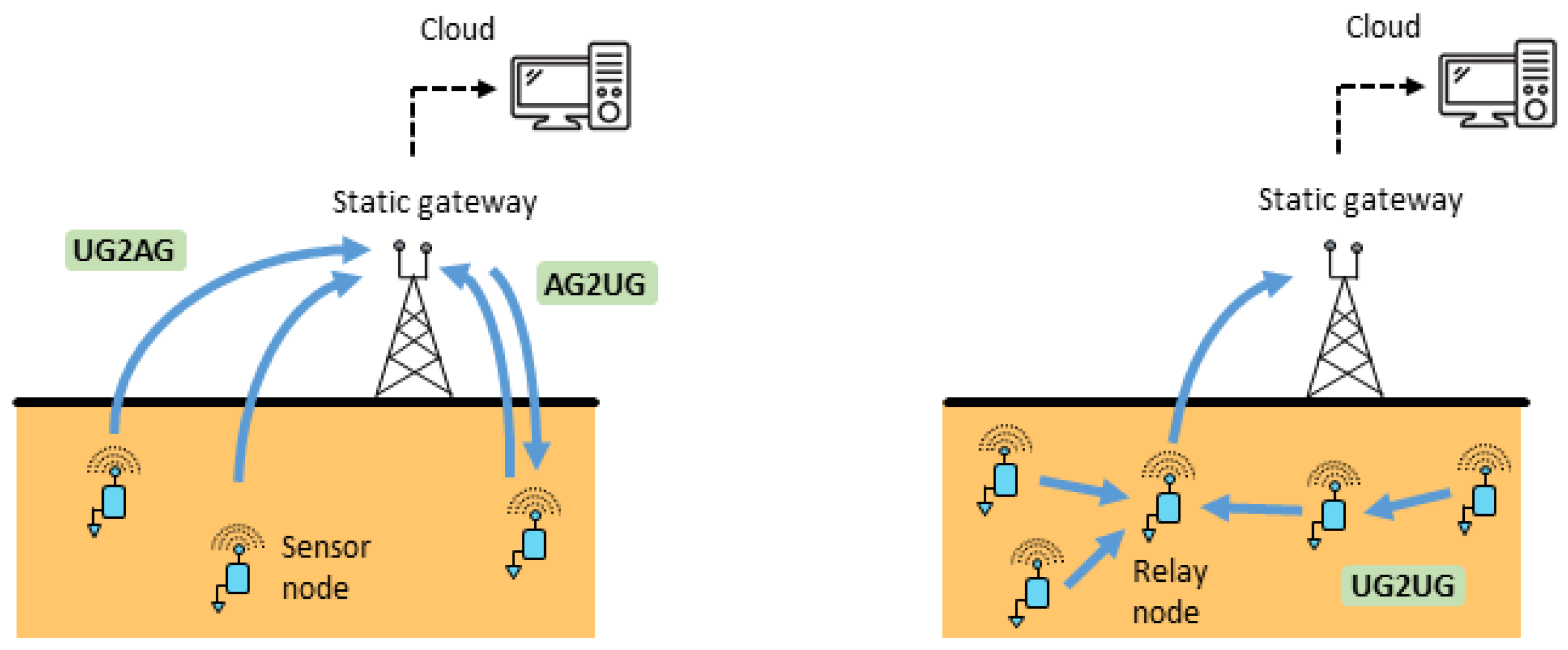
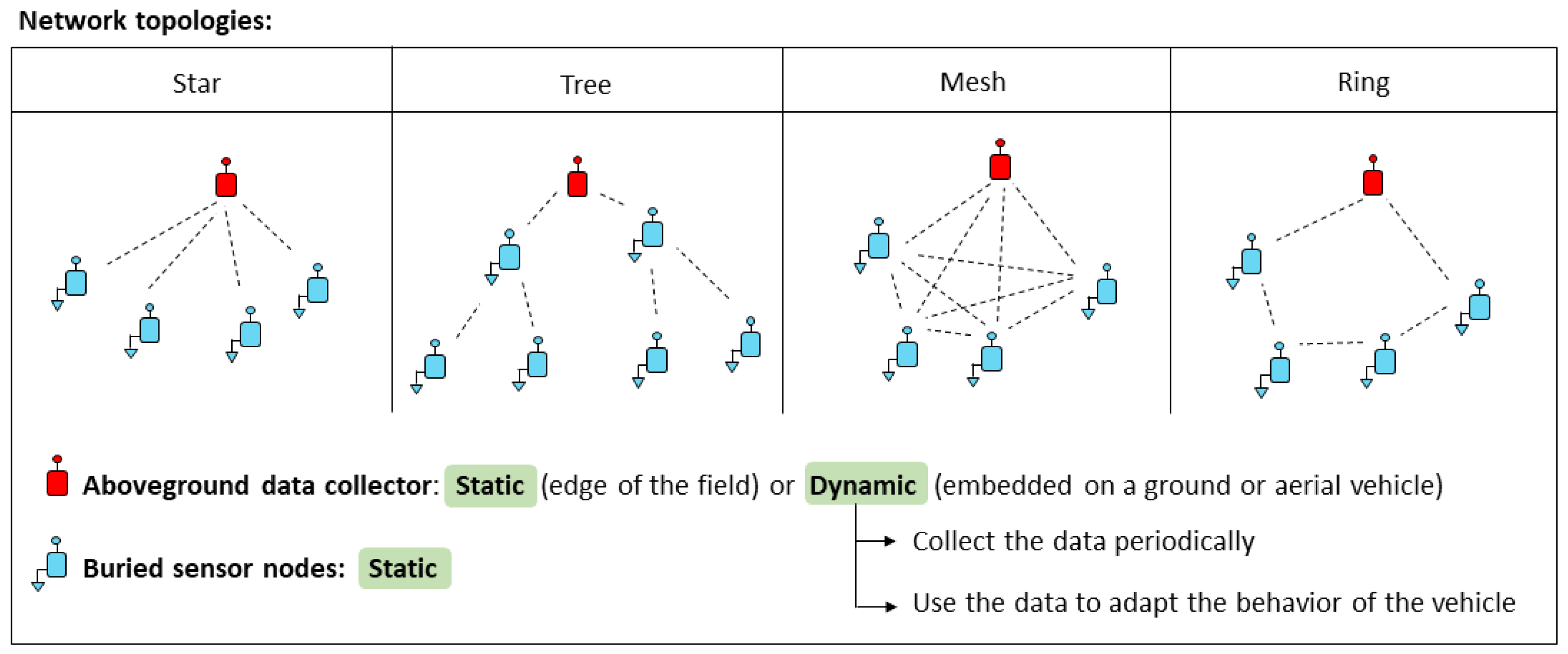
To sum up the different possible configurations in the development of a WUSN, Figure 11 provides an overview of the overall system. Different network topologies can be considered underground (e.g., star, tree, mesh, ring or combining several types of these networks). The aboveground data collector can be static, usually installed at the edge of the field, but also dynamic. In this case, it is embedded on a ground vehicle (e.g., mobile robot) or aerial one (e.g., UAV). The data are collected periodically and successively. This approach provides flexibility. Moreover, the data can be used in real-time to adapt the behavior of the collection vehicle. Obviously, hybrid approaches could also be considered with static aboveground data collectors, storing the data until the passage of the collection vehicles.
Figure 11. Overview of different possible configurations in terms of network topology and static or dynamic data collection.

5. Applications of WUSNs in Agriculture

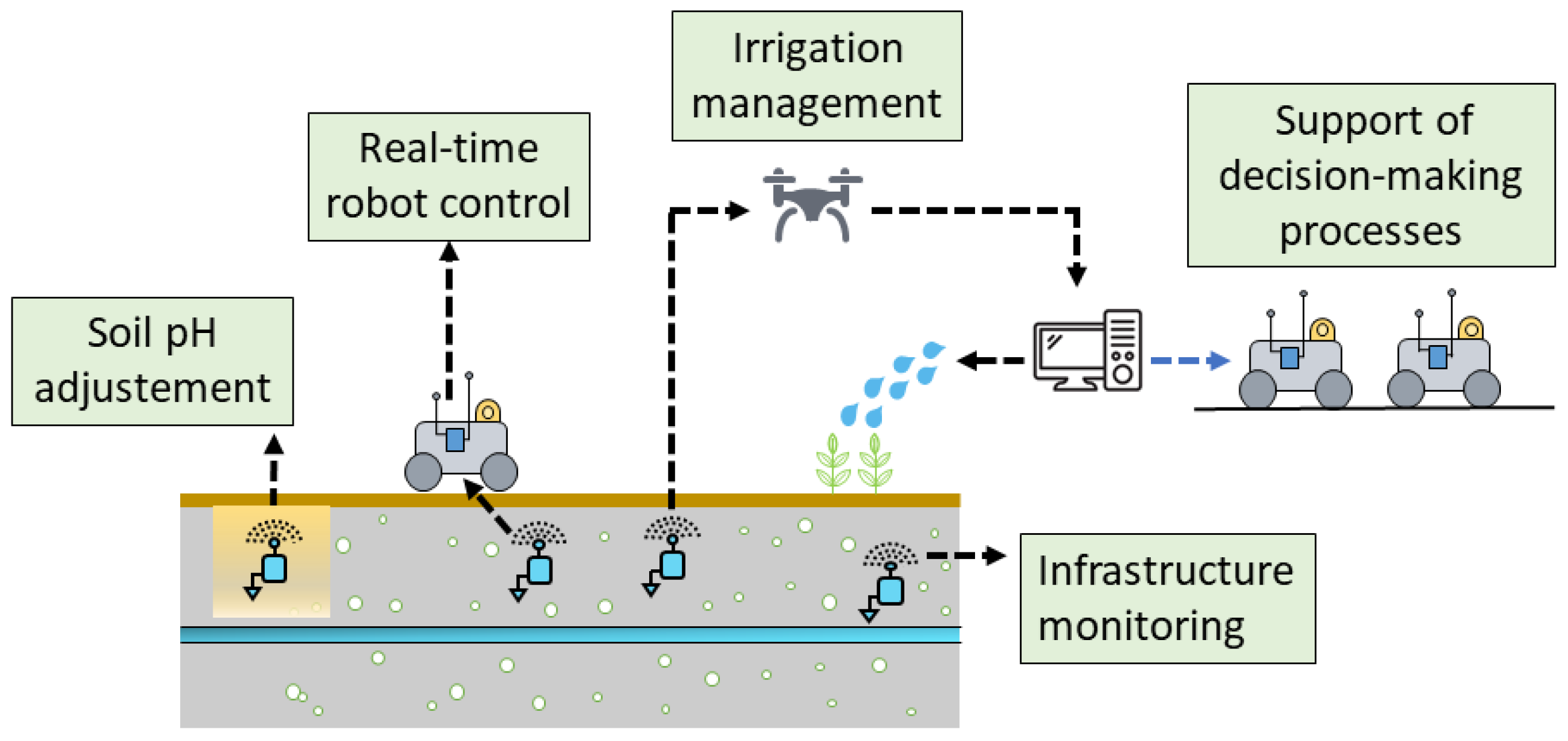
For the time being, the WUSNs have not yet been exploited on a large scale due to the panel of scientific and technical challenges listed in the previous sections and remaining to be tackled. However, WUSNs should progressively support numerous agricultural applications in the near future. In particular, the measurements of the soil moisture and temperature, accurately and at several depths, would enable the optimization of the irrigation processes and crop growth in the fields and also integrate decision-making processes as well as improve the behavior of autonomous vehicles in real-time; see Figure 12. Some part of these challenges are currently under development with the establishment of the first proof-of-concepts. The subsections hereafter present a brief list of these potential future applications.
Figure 12. Fields of application of WUSNs in agriculture.

5.1. Irrigation Management

The irrigation is the main agricultural application targeted for WUSNs in the literature. A well-managed irrigation system leads in fact to optimal crop yield and minimize the use of water. The introduction of buried sensor nodes, strategically placed in the field, would enable to regularly monitor the soil moisture and operate the irrigation process in closed-loop; see Figure 11. This objective is followed by several works; see [65,97]. In recent years, WUSNs have started to be implemented in real field conditions, mainly on corn crops. We can cite, for example, [64,66,67,69], who respectively used buried sensor nodes to optimize the irrigation in corn and soybean crops (continental climate; Illinois, USA), corn crops (continental climate; Nebraska, USA), poplar orchards (Mediterranean climate; California, USA) and corn crops (continental climate, Germany). The adoption and deployment of such smart irrigation systems will become essential in the near future to face the global warming and the increasing water scarcity.

5.2. Support of Decision-Making Processes

The germination, vegetative growth and yield performance of plants highly depend on the soil temperature and moisture. The knowledge of the dynamic of these parameters, in combination with other sources of information (e.g., weather conditions, ground topology, type of soil) would enable the precise determination of the optimal date for seeding and also the different times to perform the operations (e.g., tillage, fertilization; see [98]) and set the parameters of both the mobile robots and their implements (e.g., adjustment of the tyre pressure, depth of tillage, working speed). In addition, the tracking of the soil moisture and temperature data combined with the history of the field operations, the crop status and the plant varieties could enable us to accurately analyze the plant growth and develop optimal growth models. These data could also help to select the best varieties of plant and the optimal field operations accordingly, all the more in a climate change context.

5.3. Real-Time Robot Control

Currently, the accurate control of mobile robots is confronted to the incapacity to know the soil conditions beforehand, leading to issues of slippage, loss of traction and even blockage in wetlands. The soil conditions can, moreover, rapidly change following rainfalls or between the beginning and the end of the working day. The real-time measurements of the soil moisture at different depths could enable us to adapt in real-time both the locomotion (i.e., steering, speed) and the trajectories of the agricultural vehicles accordingly. Excessively wet areas could, for example, be avoided, with a re-planning of the trajectories to be followed by the robot. The settings of the implement could also be adapted in real-time to the soil moisture and temperature information measured in the field.
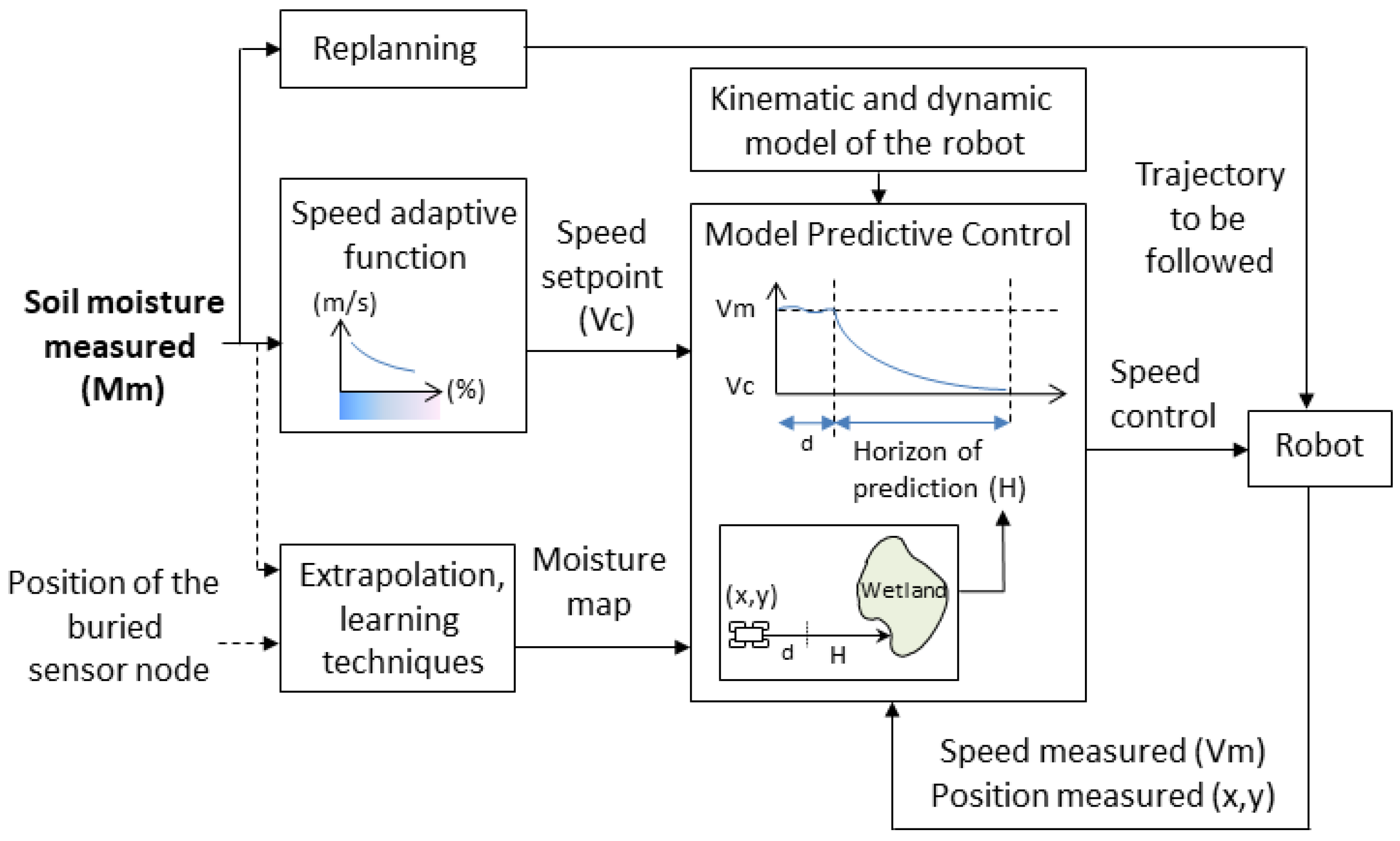
Figure 13 presents an example of integration of the soil moisture information in the speed controller of a mobile robot. A speed-adaptive function determines the working speed of the robot with respect to the soil moisture measured. A model predictive controller (MPC) enables us to anticipate the speed variations while taking into account the kinematic and dynamic capabilities of the robot. The horizon of prediction is determined with respect to the current position of the robot and a moisture map progressively updated.
Figure 13. Use of the soil moisture information in the speed controller of a mobile robot [68].

5.4. Infrastructure Monitoring

Another potential application of WUSNs is the monitoring of underground infrastructure in agriculture, such as pipes, drains and water storage tanks. In fact, pipes are widely used in agriculture to transport water pumped from a stream, well or reservoir to the point of use (e.g., crop, livestock watering), and the drains enable the removal of excess water from wet fields. WUSNs could be advantageously used to detect and locate pipe leakages and drain blockages, which is a particularly challenging and time-consuming task for the farmers. Leakages can, moreover, rapidly lead to substantial costs. It is therefore essential to monitor the good condition of the underground water network in farms and rapidly perform the repairs, all the more in the current context of water scarcity.

5.5. Soil pH Adjustment

WUSNs could also be used to monitor the fertility of the agricultural soils, in particular by measuring the soil pH. In fact, most of the crops requires a pH value ranging between 6 and 7 to grow properly. However, the pH of a soil changes over time and throughout the year with respect to various factors (e.g., agricultural practices, weather, type of crop). Limestone is commonly used by farmers to increase the pH of a soil, and sulfur is used to decrease the pH. Controlling the pH of the soil is therefore essential to enable optimal crop production, which can be brought by the development of buried sensor nodes and WUSNs.

6. Perspectives

The deployment of IoUT devices will certainly be significant in the near future, in particular in the agricultural fields to analyze, understand and support the consequences of the climate change on the crop growth and adapt the agricultural practices accordingly. However, that requires beforehand to overcome the different scientific and technical challenges highlighted in this paper, whether they be at the level of the buried sensor nodes or data collection processes.
One of the major remaining difficulties is to obtain reliable communications in WUSNs and develop buried sensor nodes having a long energy autonomy. The costs should also be limited (i.e., hardware, energy, maintenance, subscriptions for licensed communications if required). Moreover, the privacy and security issues should also be carefully studied [99,100]. In fact, the IoUT devices can not embed complex algorithms due to their limited memory and their constraint of energy consumption. They are thus particularly vulnerable to cyber attacks. Malicious people could, for example, take the control of the channels used for data transmission and capture, remove or modify the messages. The consequences can be important (e.g., modification of the data transmitted by moisture sensors leading to the flood of irrigated parcels). An important challenge of Agriculture 4.0 is therefore to secure with advanced algorithms each layer composing the IoUT (i.e., user, perception, data transport, data collection, data storage, data processing, actuation). That necessitates developing effective protocols enabling us to ensure, for example, data privacy (e.g., the data of sensors are confidential), location privacy (e.g., the positions of the sensors and mobile devices are not known), entity authentication (e.g., the transmitter and receiver must verify their identities before each data exchange), access control (e.g., the role and attributes of each entity is defined), authorization (e.g., each entity has a defined area of action) and data integrity verification. The pursuit of privacy and security goals is essential in new farming technologies and in IoUT in particular.
The optimal placement of the node is also a complex problem when the notions of priority, density of nodes, communication constraints and agronomic needs are considered together. Several WUSNs and WSNs can also co-exist, which raises some problems of interference. The optimal trajectory planning of the mobile data collector has also to be considered (e.g., solve the Close Enough Salesman Problem (CETSP), see [96]). Finally, all the data collected would require important storage capacities and the development of efficient management tools to analyze them and take the appropriate decisions.

7. Conclusions

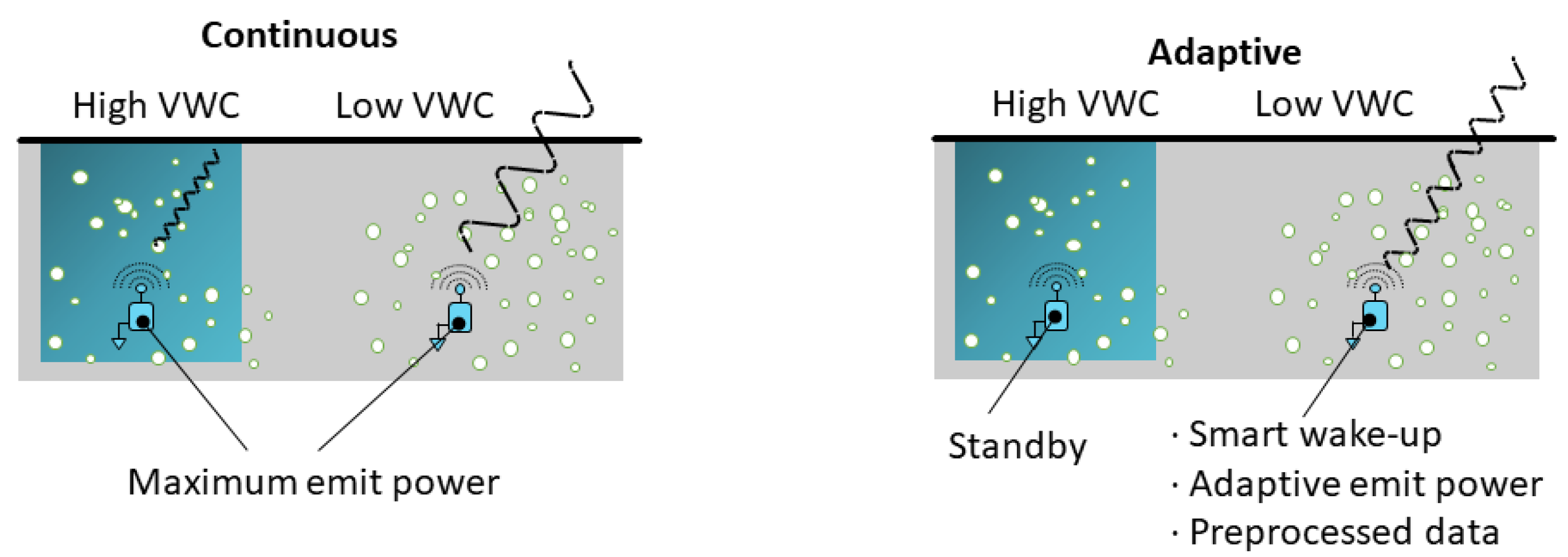
This paper presented an overview of the main current scientific and technological challenges related to the development of WUSNs in agriculture. Several issues have been identified and discussed, ranging from the need of adaptive functioning of the buried sensor nodes face to varying soil conditions as ways to minimize energy consumption. Different approaches of data collection have been presented, based on either static ground relays, mobile robots or unmanned aerial vehicles (UAVs). A panel of potential applications was highlighted and several perspectives were pointed out.
WUSNs and IoUT will undoubtedly play a great role in the near future, especially in agriculture to contribute to the development of smarter and better targeted agricultural practices. The development of IoUT can lead to several changes as the creation of communities on the cloud regrouping farmers and experts in agronomy able to share experimental data on soil health and crop growth with other sources of information (e.g., weather prediction). The data collected can be used to train models (e.g., artifical intelligence) and deliver recommendations in real-time to farmers. Climate change will also certainly increase the demands of optimal management and automation of irrigation processes due to the increasingly scarcity of water. The development of IoUT can therefore lead to optimized crop production, improved productivity and reduced operational costs and also reduces food loss and providing the means to the autonomous vehicles to perform accurate and targeted work in the fields. However, an important challenge of IoUT will be to develop data exchange and communication standards to link the different entities together. That will contribute, moreover, to facilitate the adoption of these new technologies by farmers.
In addition, other sectors of activity would also benefit from the development of WUSNs, such as the monitoring of the environment (e.g., landslides, volcanic activities), the monitoring of infrastructure (e.g., stadiums [20]) and the detection of the passage of animals, vehicles and humans by using vibration sensors. All these applications require reliable communications, energy-efficient nodes and innovative data collection, which all represent exciting research directions.

Author Contributions

C.C. and L.M.-A.: conceptualization, methodology, software, formal analysis, investigation, writing original draft preparation, supervision. F.P. and J.-P.C.: project administration, funding acquisition. All authors have read and agreed to the published version of the manuscript.

Funding

This work was supported by the International Research Center “Innovation Transportation and Production Systems” of the I-SITE CAP 20-25.

Acknowledgments

The authors thank the ConnecSenS community, the FEDER program of the European Union and the employees of the National Research Institute for Agriculture, Food and Environment (INRAE) who were involved in this work.

Conflicts of Interest

The authors declare no conflict of interest.

Abbreviations

The following abbreviations are used in this manuscript:
AG2UGAboveground to Underground
IoUTInternet of Underground Things
LPWANLow-Power Wide Area Network
MIMagnetic Induction
RFIDRadio Frequency Identification
RSSIReceived Signal Strength Indication
UG2AGUnderground to Aboveground
UG2UGUnderground to Underground
VWCVolumetric Water Content
UAVUnmanned Aerial Vehicle
WSNWireless Sensor Network
WUSNWireless Underground Sensor Network

Appendix A

Table A1. Research works in IoUT.
SubjectRef.Methodology
Concept[18]- Present the research challenges in WUSNs
[19]- Present an overview of the architectures WUSNs
[13]- Highlight the future of WUSN
[17]- Present state-of-the-art, UG2UG, simulations and field experiments
[20]- Study the possibility to use WUSNs in stadiums
Propagation[29]- Evaluate Friis and Fresnel models for UG2UG at 434 MHz
[30]- Review the signal propagation models in soil medium
[21]- Propose a model on the Peplinski principle
[27]- Develop a semi-empirical model for UG2AG at 2.44 GHz
[22]- Design an empirical model for UG2UG at 433 MHz
[31]- Propose a theoretical model for UG2AG at 433 MHz
[35]- Review and compare propagation models
[23]- Evaluate Friis and Fresnel models for UG2AG at 915 MHz
[34]- Propose underground channel models
[32]- Evaluate a soil dielectric model
[33]- Compare the Friis and Fresnel models
[28]- Analyze the multi-carrier modulation underground
[42]- Develop an algorithm for detection of coverage hole
[25]- Evaluate the UG2UG communications
[26]- Develop a testbed for the communications underground
[38]- Analyze the inter-node connectivity in WUSN
[14]- Present underground channel models
[36]- Present a system based on acoustic waves
[39]- Develop and evaluate a path loss model
[37]- Study the propagation characteristic of EM waves
Routing[43]- Propose a routing protocol for WUSN
[46]- Optimize the power of the relay node on WUSN
[44]- Use cluster-based cooperative models
[45]- Deploy relay nodes to prolong network lifetime
[40]- Description of a single-hop approach in WUSN
[41]- Study the optimal placement of the relay nodes
Energy[49]- Analyze the energy consumption of different networks
[50]- Study the wake-up of buried sensor nodes
[48]- Propose multi-hoped communications guarantying energy efficiency
[47]- Present energy harvesting approaches for WUSN
Antenna [53] - Study the impacts of moisture on antenna return loss and bandwidth
[54]- Model the antenna return loss face to moisture variations
[51]- Present a design of phased array antennas
[52]- Study the impact of soil on UWB antenna
MI[55]- Analyze the multi-hop underground communications based on MI
[56]- Investigate MI communications based on relay circuits
[57]- Propose a routing protocol for WUSN based on MI
[58]- Compare the communications based on MI and EM waves
[59]- Present the challenges of MI communications in WUSN
[60]- Compare the communications based on MI and EM waves
Table A2. Research works in data collection.
SubjectRef.Methodology
Static relay[64]- Experiment 23 nodes in an agricultural field and predict soil VWC
[65]- Develop a UG2AG link to manage a pivot irrigation system
[62]- Evaluate LoRa at 433 MHz in UG2UG and UG2AG
[66]- Evaluate LoRa at 915 MHz in UG2AG
[63]- Evaluate UG2AG in LoRa in UG2AG
[12]- Evaluate UG2AG in LoRa at 433 and 868 MHz
[67]- Develop a UG2AG link to manage a pivot irrigation system
[61]- Experiment UG2AG in LoRa in different conditions
UAV[68]- Analyze the RSSI signals received by an UAV (high altitude)
[71]- Perform simulations with an UAV in hovering mode
[69]- Analyze the RSSI signals received by an UAV (low altitude)
[70]- Analyze the packet loss received by an UAV (low altitude)
Table A3. Research works in IoUT.
SubjectRef.Methodology
Robot[73]- Use RFID to collect soil moisture information
[74]- Control the speed of a robot from the soil moisture measurement
[72]- Develop communication protocols (re-transmissions, hand-shaking)
Survey[76]- Collect RSSI and VWC in LoRaWAN to develop a virtual VWC sensor
[75]- State-of-the-art on IoUT: challenges, technologies, applications
[14]- State-of-the-art on IoUT: challenges, technologies, precision farming

References

  1. FAO. The Future of Food and Agriculture, Trends and Challenges; Food and Agriculture Organization of the United Nations: Rome, Italy, 2017. [Google Scholar]
  2. FAO. The Future of Food and Agriculture, Drivers and Triggers for Transformation; Food and Agriculture Organization of the United Nations: Rome, Italy, 2022. [Google Scholar] [CrossRef]
  3. Abbasi, R.; Martinez, P.; Ahmad, R. The digitization of agricultural industry—A systematic literature review on agriculture 4.0. Smart Agric. Technol. 2022, 2, 100042. [Google Scholar] [CrossRef]
  4. Javaid, M.; Haleem, A.; Singh, R.P.; Suman, R. Enhancing smart farming through the applications of Agriculture 4.0 technologies. Int. J. Intell. Netw. 2022, 3, 150–164. [Google Scholar] [CrossRef]
  5. Liu, Y.; Ma, X.; Shu, L.; Hancke, G.P.; Abu-Mahfouz, A.M. From industry 4.0 to agriculture 4.0: Current status, enabling technologies, and research challenges. IEEE Trans. Ind. Inform. 2021, 17, 4322–4334. [Google Scholar] [CrossRef]
  6. Ayaz, M.; Ammad-Uddin, M.; Sharif, Z.; Mansour, A.; Aggoune, E.H. Internet-of-Things (IoT)-based smart agriculture: Toward making the fields talk. IEEE Access 2019, 7, 129551–129583. [Google Scholar] [CrossRef]
  7. Elijah, O.; Rahman, T.A.; Orikumhi, I.; Leow, C.Y.; Hindia, M.N. An overview of internet of things (IoT) and data analytics in agriculture: Benefits and challenges. IEEE Internet Things J. 2018, 5, 3758–3773. [Google Scholar] [CrossRef]
  8. Farooq, M.S.; Riaz, S.; Abid, A.; Abid, K.; Naeem, M.A. A survey on the role of IoT in agriculture for the implementation of smart farming. IEEE Access 2019, 7, 156237–156271. [Google Scholar] [CrossRef]
  9. Quy, V.K.; Hau, N.V.; Anh, D.V.; Quy, N.M.; Ban, N.T.; Lanza, S.; Randazzo, G.; Muzirafuti, A. IoT-enabled smart agriculture: Architecture, applications, and challenges. Appl. Sci. 2022, 12, 3396. [Google Scholar] [CrossRef]
  10. Fraire, J.A.; Iova, O.; Valois, F. Space-terrestrial integrated Internet of Things: Challenges and opportunities. IEEE Commun. Mag. 2022, 60, 64–70. [Google Scholar] [CrossRef]
  11. Almalki, F.A.; Soufiene, B.O.; Alsamhi, S.H.; Sakli, H. A low-cost platform for environmental smart farming monitoring system based on IoT and UAVs. Sustainability 2021, 13, 5908. [Google Scholar] [CrossRef]
  12. Moiroux-Arvis, L.; Cariou, C.; Chanet, J.P. Evaluation of LoRa technology in 433-MHz and 868-MHz for underground to aboveground data transmission. Comput. Electr. Agric. 2022, 194, 156237–156271. [Google Scholar] [CrossRef]
  13. Silva, A.R.; Moghaddam, M.; Liu, M. The future of wireless underground sensing networks considering physical layer aspects. In The Art of Wireless Sensor Networks; Springer: Berlin/Heidelberg, Germany, 2014; pp. 451–484. [Google Scholar] [CrossRef]
  14. Vuran, M.C.; Salam, A.; Wong, R.; Imak, S. Internet of underground things in precision agriculture: Architecture and technology aspects. CSE J. Artic. 2018, 189, 1–17. [Google Scholar] [CrossRef]
  15. Khan, J.; Lee, E.; Balobaid, A.S.; Kim, K. A comprehensive review of conventional, machine learning, and deep learning models for groundwater level (GWL) forecasting. Appl. Sci. 2023, 13, 2743. [Google Scholar] [CrossRef]
  16. Page, M.J.; McKenzie, J.E.; Bossuyt, P.M.; Boutron, I.; Hoffmann, T.C.; Mulrow, C.D.; Shamseer, L.; Tetzlaff, J.M.; Akl, E.A.; Brennan, S.E.; et al. The PRISMA 2020 statement: An updated guideline for reporting systematic reviews. BMJ 2021, 372, n71. [Google Scholar] [CrossRef]
  17. Vuran, M.C.; Silva, A.R. Communication through soil in wireless underground sensor networks—Theory and practice. In Sensor Networks; Springer: Berlin/Heidelberg, Germany, 2009; pp. 309–347. [Google Scholar] [CrossRef]
  18. Akyildiz, I.F.; Stuntebeck, E.P. Wireless underground sensor networks: Research challenges. Ad Hoc Netw. 2006, 4, 669–686. [Google Scholar] [CrossRef]
  19. Raza, U.; Salam, A. A Survey on Subsurface Signal Propagation. Smart Cities 2020, 3, 1513–1561. [Google Scholar] [CrossRef]
  20. Wang, D.; Ming, H. Simulation test of wireless underground sensor network in stadiums. J. Sens. 2021, 2021, 1–12. [Google Scholar] [CrossRef]
  21. Banaseka, F.K.; Franklin, H.; Katsriku, F.A.; Abdulai, J.D.; Ekpezu, A.; Wiafe, I. Soil medium electromagnetic scattering model for the study of wireless underground sensor networks. Wirel. Commun. Mob. Comput. 2021, 2021, 8842508. [Google Scholar] [CrossRef]
  22. Han, M.; Zhang, Z.; Yang, J.; Zheng, J.; Han, W. An attenuation model of node signals in wireless underground sensor networks. Remote Sens. 2021, 13, 4642. [Google Scholar] [CrossRef]
  23. Lai, Y.; Lin, J.; Zhang, Z.; Zhu, H.; Narsilio, G.; Tomko, M.; Jowett, K. Testing ground conditions for effective buried sensor wireless Lorawan signal transmission. International Archives of the Photogrammetry. Remote Sens. Spat. Inf. Sci. 2022, XLVIII-4-W5-2022, 83–89. [Google Scholar]
  24. Vuran, M.; Akyildiz, I. Channel model and analysis for wireless underground sensor networks in soil medium. Phys. Commun. 2010, 3, 245–254. [Google Scholar] [CrossRef]
  25. Silva, A.R.; Vuran, M.C. Empirical evaluation of wireless underground-to-underground communication in wireless underground sensor networks. Int. Conf. Distrib. Comput. Sens. Syst. 2009, 10, 231–244. [Google Scholar] [CrossRef]
  26. Silva, A.; Vuran, M. Development of a testbed for Wireless Underground Sensor Networks. EURASIP J. Wirel. Commun. Netw. 2010, 1, 620307. [Google Scholar] [CrossRef]
  27. Bogena, H.R.; Huisman, J.A.; Meier, U.; Rosenbaum, H.; Weuthen, A. Hybrid wireless underground sensor networks: Quantification of signal attenuation in soil. Vadose Zone J. 2009, 8, 755–761. [Google Scholar] [CrossRef]
  28. Salam, A.; Vuran, M.C. Impacts of soil type and moisture on the capacity of multi-carrier modulation in internet of underground things. In Proceedings of the 25th International Conference on Computer Communication and Networks, Waikoloa, HI, USA, 1–4 August 2016; pp. 1–9. [Google Scholar] [CrossRef]
  29. Abdorahimi, D.; Sadeghioon, A.M. Comparison of radio frequency path loss models in soil for wireless underground sensor networks. J. Sens. Actuator Netw. 2019, 8, 35. [Google Scholar] [CrossRef]
  30. Banaseka, F.K.; Katsriku, F.A.; Abdulai, J.D.; Adu-Manu, K.S.; Engmann, F. 2021. Signal propagation models in soil medium for the study of wireless underground sensor networks: A review of current trends. Wirel. Commun. Mob. Comput. 2021, 2021, 8836426. [Google Scholar] [CrossRef]
  31. Huang, H.; Shi, J.; Wang, F.; Zhang, D.; Zhang, D. Theoretical and experimental studies on the signal propagation in soil for wireless underground sensor networks. Sensors 2020, 20, 2580. [Google Scholar] [CrossRef]
  32. Nethravathi, K.A.; Shankar, S.R. Signal superposition model with mineralogy based spectroscopic dielectric model in wireless underground sensor networks. Int. J. Electron. Telecommun. 2019, 65, 693–699. [Google Scholar]
  33. Sadeghioon, A.M.; Chapman, D.N.; Metje, N.; Anthony, C.J. A new approach to estimating the path loss in underground wireless sensor networks. J. Sens. Actuator Netw. 2017, 6, 18. [Google Scholar] [CrossRef]
  34. Liy, L.; Vuran, M.C.; Akyildiz, I.F. Characteristics of underground channel for wireless underground sensor networks. In Proceedings of the Sixth Annual Mediterranean Ad Hoc Networking WorkShop, Corfu, Greece, 12–15 June 2007; pp. 92–99. [Google Scholar]
  35. Huang, Y.; Chen, Z.; Han, T.; Liu, X. One energy-efficient random-walk topology evolution method for underground wireless sensor networks. Int. J. Distrib. Sens. Netw. 2018, 14, 1–9. [Google Scholar] [CrossRef]
  36. Yang, S.; Baltaji, O.; Hashash, Y.M.; Singer, A. Soilcomm: A miniaturized through-soil wireless data transmission system. J. Acoust. Soc. Am. 2018, 144, 1872. [Google Scholar] [CrossRef]
  37. Zhou, Q.; Yao, X.; Hu, J. Study on the propagation characteristic of electromagnetic wave based on WUSN. J. Electromagn. Waves Appl. 2021, 35, 1708–1718. [Google Scholar] [CrossRef]
  38. Sun, Z.; Akyildiz, I.F.; Hancke, G.P. Dynamic connectivity in wireless underground sensor networks. IEEE Trans. Wirel. Commun. 2011, 10, 4334–4344. [Google Scholar] [CrossRef]
  39. Wohwe Sambo, D.; Forster, A.; Yenke, B.O.; Sarr, I.; Gueye, B.; Dayang, P. Wireless underground sensor networks path loss model for precision agriculture (WUSN-PLM). IEEE Sens. J. 2020, 20, 5298–5313. [Google Scholar] [CrossRef]
  40. Tiusanen, M.J. Soil scouts: Description and performance of single hop wireless underground sensor nodes. Ad Hoc Netw. 2013, 11, 1610–1618. [Google Scholar] [CrossRef]
  41. Yuan, B.; Chen, H.; Yao, X. Optimal relay placement for lifetime maximization in wireless underground sensor networks. Inf. Sci. 2017, 418–419, 463–479. [Google Scholar] [CrossRef]
  42. Sharma, P.; Singh, R.P. Energy-efficient deterministic approach for coverage hole detection in wireless underground sensor network: Mathematical model and simulation. Computers 2022, 11, 86. [Google Scholar] [CrossRef]
  43. Adel, A.; Norsheila, F. Probabilistic routing protocol for a hybrid wireless underground sensor networks. Wirel. Commun. Mob. Comput. 2013, 13, 142–156. [Google Scholar] [CrossRef]
  44. Radhakrishnan, K.; Ramakrishnan, D.; Khalaf, O.I.; Uddin, M.; Chen, C.-L.; Wu, C.-M. A novel deep learning-based cooperative communication channel model for wireless underground sensor networks. Sensors 2022, 22, 4475. [Google Scholar] [CrossRef]
  45. Tam, N.; Binh, H.; Dung, D.; Lan, P.; Vinh, L.; Yuan, B.; Yao, X. A hybrid clustering and evolutionary approach for wireless underground sensor network lifetime maximization. Inf. Sci. 2017, 504, 372–393. [Google Scholar] [CrossRef]
  46. Ayedi, M.; Eldesouky, E.; Nazeer, J. Energy-spectral efficiency optimization in wireless underground sensor networks using salp swarm algorithm. J. Sens. 2021, 1–16. [Google Scholar] [CrossRef]
  47. Raza, U.; Salam, A. On-site and external energy harvesting in underground wireless. Electronics 2020, 9, 681. [Google Scholar] [CrossRef]
  48. Kanthavel, R.; Indra Priyadharshini, S.; Sudha, D.; Sundara Velrani, K.; Dhaya, R. Multi-hoped cooperative communication-based wireless underground sensor network design. Int. J. Commun. Syst. 2022, 35. [Google Scholar] [CrossRef]
  49. Anisi, M.; Abdul-Salaam, G.; Abdullah, A. A survey of wireless sensor network approaches and their energy consumption for monitoring farm fields in precision agriculture. Precis. Agric. 2015, 16, 216–238. [Google Scholar] [CrossRef]
  50. Jansen, A. Underground wireless communication and wake-up at 125 KHz. In Proceedings of the 33th Twente Student Conference on IT, Enschede, The Netherlands, 3 July 2020. [Google Scholar]
  51. Salam, A. Subsurface MIMO: A beamforming design in Internet of Underground Things for digital agriculture applications. J. Sens. Actuator Netw. 2019, 8, 41. [Google Scholar] [CrossRef]
  52. Zemmour, H.; Baudoin, G.; Hamouda, C.; Diet, A.; Biancheri-Astier, M. Impact of soil on UWB buried antenna and communication link in IR-UWB WUSN applications. In Proceedings of the 2015 European Microwave Conference (EuMC), Paris, France, 7–10 September 2015; Volume 10, pp. 353–356. [Google Scholar] [CrossRef]
  53. Dong, X.; Vuran, M.C. Impacts of soil moisture on cognitive radio underground networks. In Proceedings of the First International Black Sea Conference on Communications and Networking (BlackSeaCom), Batumi, Georgia, 3–5 July 2013; pp. 222–227. [Google Scholar] [CrossRef]
  54. Salam, A.; Vuran, M.C.; Dong, X.; Argyropoulos, C.; Irmak, S. A theoretical model of underground dipole antennas for communications in internet of underground things. IEEE Trans. Antennas Propag. 2019, 67, 3996–4009. [Google Scholar] [CrossRef]
  55. Ishtiaq, M.; Hwang, S.-H. Performance analysis of multihop underground magnetic induction communication. Electronics 2021, 10, 1255. [Google Scholar] [CrossRef]
  56. Kisseleff, S.; Akyildiz, I.F.; Gerstacker, W. On modulation for magnetic induction based transmission in wireless underground sensor networks. In Proceedings of the IEEE International Conference on Communications, Sydney, NSW, Australia, 10–14 June 2014; pp. 71–76. [Google Scholar] [CrossRef]
  57. Liu, G. A Q-Learning-based distributed routing protocol for frequency-switchable magnetic induction-based wireless underground sensor networks. Future Gener. Comput. Syst. 2023, 139, 253–266. [Google Scholar] [CrossRef]
  58. Malik, P.; Abouhawwash, M.; Almutairi, A.; Singh, R.; Singh, Y. Comparative analysis of magnetic induction based communication techniques for wireless underground sensor networks. PeerJ Comput. Sci. 2022, 8, E789. [Google Scholar] [CrossRef]
  59. Singh, P.; Singh, R.; Singh, Y.; Chohan, J.; Sharma, S.; Sadeghzadeh, M.; Issakhov, A. Magnetic induction technology-based wireless sensor network for underground infrastructure, monitoring soil conditions, and environmental observation applications: Challenges and future aspects. J. Sens. 2022, 2022, 9332917. [Google Scholar] [CrossRef]
  60. Sun, Z.; Akyildiz, I.F. Underground wireless communication using magnetic induction. In Proceedings of the 2009 IEEE International Conference on Communications, Dresden, Germany, 14–18 June 2009; pp. 1–5. [Google Scholar] [CrossRef]
  61. Yu, X.; Wu, P.; Han, W.; Zhang, Z. A survey on wireless sensor network infrastructure for agriculture. Comput. Stand. Interfaces 2013, 35, 59–64. [Google Scholar] [CrossRef]
  62. Hardie, M.; Hoyle, D. Underground wireless data transmission using 433-MHz LoRa for agriculture. Sensors 2019, 19, 4232. [Google Scholar] [CrossRef] [PubMed]
  63. Lin, K.; Hao, T.; Yu, Z.; Zheng, W.; He, W. A preliminary study of UG2AG link quality in LoRa-based wireless underground sensor networks. In Proceedings of the IEEE 44th Conference on Local Computer Networks, Osnabrueck, Germany, 14–17 October 2019; pp. 51–59. [Google Scholar] [CrossRef]
  64. Balivada, S.; Grant, G.; Zhang, X.; Ghosh, M.; Guha, S.; Matamala, R. A wireless underground sensor network field pilot for agriculture and ecology: Soil moisture mapping using signal attenuation. Sensors 2022, 22, 3913. [Google Scholar] [CrossRef] [PubMed]
  65. Dong, X.; Vuran, M.C.; Irmak, S. Autonomous precision agriculture through integration of wireless underground sensor networks with center pivot irrigation systems. Ad Hoc Netw. 2013, 11, 1975–1987. [Google Scholar] [CrossRef]
  66. Levintal, E.; Ganot, Y.; Taylor, G.; Freer-Smith, P.; Suvočarev, K.; Dahlke, H. An underground, wireless, open-source, low-cost system for monitoring oxygen, temperature, and soil moisture. SOIL 2022, 8, 85–97. [Google Scholar] [CrossRef]
  67. Silva, A.R.; Vuran, M.C. (CPS)2: Integration of center pivot systems with wireless underground sensor networks for autonomous precision agriculture. In Proceedings of the ICCPS ’10: ACM/IEEE 1st International Conference on Cyber-Physical Systems, Stockholm, Sweden, 10–13 April 2010. [Google Scholar]
  68. Cariou, C.; Moiroux-Arvis, L.; Pinet, F.; Chanet, J.P. Data collection from buried sensor nodes by means of an unmanned aerial vehicle. Sensors 2022, 22, 5926. [Google Scholar] [CrossRef]
  69. Holtorf, L.; Titov, I.; Daschner, F.; Gerken, M. UAV-based Wireless data collection from underground sensor nodes for precision agriculture. AgriEngineering 2023, 5, 338–354. [Google Scholar] [CrossRef]
  70. Hossain, F.F.; Messenger, R.; Captain, G.L.; Ekin, S.; Jacobs, J.D.; Taghcaeian, S.; O’Hara, J.F. Soil moisture monitoring through UAS-assisted internet of things LoRaWAN wireless underground sensors. IEEE Access 2022, 10, 102107–102118. [Google Scholar] [CrossRef]
  71. Castellanos, G.; Deruyck, M.; Martens, L.; Joseph, W. System assessment of WUSN using NB-IoT UAV-aided networks in potato crops. IEEE Access 2020, 8, 56823–56836. [Google Scholar] [CrossRef]
  72. Tooker, J.; Vuran, M.C. Mobile data harvesting in wireless underground sensor networks. In Proceedings of the 9th Annual IEEE Communications Society Conference on Sensor, Mesh and Ad Hoc Communications and Networks, Seoul, Republic of Korea, 18–21 June 2012; pp. 560–568. [Google Scholar] [CrossRef]
  73. Aroca, R.V.; Hernandes, A.C.; Magalhaes, D.V.; Becker, M.; Vaz, C.M. P; Calbo, A.G. Calibration of passive UHF RFID tags using neural networks to measure soil moisture. J. Sens. 2018, 2018, 3436503. [Google Scholar] [CrossRef]
  74. Moiroux-Arvis, L.; Cariou, C.; Pinet, F.; Chanet, J.P. CIDEA: Robot behavior adaptation from interactive communication with buried sensor nodes. Application to smart agriculture. In Proceedings of the 8th International Conference on Machine Guidance, Wroclaw, Poland, 17–18 November 2022. [Google Scholar]
  75. Saeed, N.; Alouini, M.S.; Al-Naffouri, T.Y. Toward the internet of underground things: A systematic survey. IEEE Commun. Surv. Tutorials 2019, 21, 3443–3466. [Google Scholar] [CrossRef]
  76. Bertocco, M.; Parrino, S.; Peruzzi, G.; Pozzebon, A. Estimating volumetric water content in soil for IoUT contexts by exploiting RSSI-based augmented sensors via machine learning. Sensors 2023, 23, 2033. [Google Scholar] [CrossRef] [PubMed]
  77. Sobral, J.V.V.; Rodrigues, J.J.P.C.; Rabêlo, R.A.L.; Al-Muhtadi, J.; Korotaev, V. Routing protocols for low power and lossy networks in Internet of Things applications. Sensors 2019, 19, 2144. [Google Scholar] [CrossRef] [PubMed]
  78. Goodrich, P.; Betancourt, O.; Arias, A.C.; Zohdi, T. Placement and drone flight path mapping of agricultural soil sensors using machine learning. Comput. Electron. Agric. 2023, 205, 107591. [Google Scholar] [CrossRef]
  79. Zhang, S.; Qian, Z.; Wu, J.; Kong, F.; Lu, S. Wireless charger placement and power allocation for maximizing charging quality. IEEE Trans. Mob. Comput. 2017, 17, 1483–1496. [Google Scholar] [CrossRef]
  80. Halgamuge, M.N.; Zukerman, M.; Ramamohanarao, K.; Vu, H.L. An estimation of sensor energy consumption. Prog. Electromagn. Res. 2009, 12, 259–295. [Google Scholar] [CrossRef]
  81. Chen, J.; Dai, Z.; Chen, Z. Development of radio-frequency sensor wake-up with unmanned aerial vehicles as an aerial gateway. Sensors 2019, 19, 1047. [Google Scholar] [CrossRef]
  82. Hou, L.; Tan, S.; Zhang, Z.; Bergmann, N.W. Thermal energy harvesting WSNs node for temperature monitoring in IIoT. IEEE Access 2018, 6, 35243–35249. [Google Scholar] [CrossRef]
  83. Reddy, D.S.; Teja, C.; Nishanth, B.; Reddy, D.V.; Pasha, A. IoT based automatic rain water harvesting and irrigation system. Int. J. Adv. Res. Comput. Sci. 2020, 11, 16–20. [Google Scholar] [CrossRef]
  84. Serban, A.; Paraschiv, S.; Paraschiv, S. Assessment of wind energy potential based on Weibull and Rayleigh distribution models. Energy Rep. 2020, 6, 250–267. [Google Scholar] [CrossRef]
  85. Sharma, H.; Haque, A.; Jaffery, Z.A. Maximization of wireless sensor network lifetime using solar energy harvesting for smart agriculture monitoring. Ad Hoc Netw. 2019, 94, 101966. [Google Scholar] [CrossRef]
  86. Zungeru, A.M.; Ang, L.M.; Prabaharan, S.R.S.; Seng, K.P. Radio frequency energy harvesting and management for wireless sensor networks. In Green Mobile Devices and Networks: Energy Optimization and Scavenging Techniques; CRC Press: Boca Raton, FL, USA, 2012; Volume 13, pp. 341–368. [Google Scholar] [CrossRef]
  87. Wang, J.; Geng, L.; Ding, L.; Zhu, H.; Yurchenko, D. The state-of-the-art review on energy harvesting from flow-induced vibrations. Appl. Energy 2020, 267, 114902. [Google Scholar] [CrossRef]
  88. Singh, R.K.; Puluckul, P.P.; Berkvens, R.; Weyn, M. Energy consumption analysis of LPWAN technologies and lifetime estimation for IoT application. Sensors 2020, 20, 4794. [Google Scholar] [CrossRef] [PubMed]
  89. Augustin, A.; Clausen, T.; Townsley, W.M. A study of LoRa: Long range and low power networks for the Internet of Things. Sensors 2016, 16, 1466. [Google Scholar] [CrossRef]
  90. Oliveira, L.F.P.; Moreira, A.P.; Silva, M.F. Advances in agriculture robotics: A state-of-the-art review and challenges ahead. Robotics 2021, 10, 52. [Google Scholar] [CrossRef]
  91. Romeo, L.; Petitti, A.; Marani, R.; Milella, A. Internet of robotic things in smart domains: Applications and challenges. Sensors 2020, 20, 3355. [Google Scholar] [CrossRef] [PubMed]
  92. Fountas, S.; Malounas, I.; Athanasakos, L.; Avgoustakis, I.; Espejo-Garcia, B. AI-assisted vision for agricultural robots. AgriEngineering 2022, 4, 674–694. [Google Scholar] [CrossRef]
  93. Behjati, M.; Noh, A.B.M.; Alobaidy, H.A.H.; Zulkifley, M.A.; Nordin, R.; Abdullaha, N.F. LoRa communications as an enabler for internet of drones towards large-scale livestock monitoring in rural farms. Sensors 2021, 21, 5044. [Google Scholar] [CrossRef]
  94. Gao, D.; Sun, Q.; Hu, B.; Zhang, S. A framework for agricultural pest and disease monitoring based on internet-of-things and unmanned aerial vehicles. Sensors 2020, 20, 1487. [Google Scholar] [CrossRef]
  95. Popescu, D.; Stoican, F.; Stamatescu, G.; Ichim, L.; Dragana, C. Advanced UAV–WSN system for intelligent monitoring in precision agriculture. Sensors 2020, 20, 817. [Google Scholar] [CrossRef]
  96. Cariou, C.; Moiroux-Arvis, L.; Pinet, F.; Chanet, J.P. Evolutionary algorithm with geometrical heuristics for solving the Close Enough Traveling Salesman Problem: Application to the trajectory planning of an Unmanned Aerial Vehicle. Algorithms 2023, 16, 44. [Google Scholar] [CrossRef]
  97. Froiz-Miguez, I.; Lopez-Iturri, P.; Fraga-Lamas, P.; Celaya-Echarri, M.; Blanco-Novoa, O.; Azpilicueta, L.; Falcone, F.; Fernández-Carames, T.M. Design, implementation, and empirical validation of an IoT smart irrigation system for fog computing applications based on LoRa and LoRaWAN sensor nodes. Sensors 2020, 20, 6865. [Google Scholar] [CrossRef] [PubMed]
  98. Jarrah, M.; Mayel, S.; Franko, U.; Kuka, K. Effects of agricultural management practices on the temporal variability of soil temperature under different crop rotations in Bad Lauchstaedt-Germany. Agronomy 2022, 12, 1199. [Google Scholar] [CrossRef]
  99. Gupta, M.; Adelsalam, M.; Khorsandroo, S.; Mittal, S. Security and privacy in smart farming: Challenges and opportunities. IEEE Access 2020, 8, 34564–34584. [Google Scholar] [CrossRef]
  100. Vangala, A.; Das, A.K.; Chamola, V.; Korotaev, V.; Rodrigues, J.P.C. Security in IoT-enabled smart agriculture: Architecture, security solutions and challenges. Clust. Comput. 2022, 26, 879–902. [Google Scholar] [CrossRef]
Disclaimer/Publisher’s Note: The statements, opinions and data contained in all publications are solely those of the individual author(s) and contributor(s) and not of MDPI and/or the editor(s). MDPI and/or the editor(s) disclaim responsibility for any injury to people or property resulting from any ideas, methods, instructions or products referred to in the content.

Article Metrics

Citations

Article Access Statistics

Multiple requests from the same IP address are counted as one view.