Room-Temperature Nitric Oxide Gas Sensors Based on NiO/SnO2 Heterostructures

 ,
,  , ,
, , 
Abstract
1. Introduction
2. Materials and Methods
2.1. Synthesis of NiO/SnO2 Heterostructure
2.2. Fabrication of NiO/SnO2 Sensor
2.3. Materials Characterization
3. Results
4. Conclusions
Author Contributions
Funding
Institutional Review Board Statement
Informed Consent Statement
Data Availability Statement
Conflicts of Interest
References
- Singh, A.K.; Yen, C.C.; Wen, C.F.; Horng, R.H.; Wuu, D.S. Growth and Characterization of Sputtered ZnO:ZnGa2O4 Dual-Phase Films on Sapphire Substrates for NO Gas-Sensing Applications. ACS Appl. Electron. Mater. 2023, 5, 2574–2582. [Google Scholar] [CrossRef] [Scilit]
- Censabella, M.; Iacono, V.; Scandurra, A.; Moulaee, K.; Neri, G.; Ruffino, F.; Mirabella, S. Low Temperature Detection of Nitric Oxide by CuO Nanoparticles Synthesized by Pulsed Laser Ablation. Sens. Actuators B Chem. 2022, 358, 131489. [Google Scholar] [CrossRef] [Scilit]
- Li, W.; Geng, X.; Guo, Y.; Rong, J.; Gong, Y.; Wu, L.; Zhang, X.; Li, P.; Xu, J.; Cheng, G.; et al. Reduced Graphene Oxide Electrically Contacted Graphene Sensor for Highly Sensitive Nitric Oxide Detection. ACS Nano 2011, 5, 6955–6961. [Google Scholar] [CrossRef] [Scilit]
- Lim, N.; Kim, K.H.; Byun, Y.T. Preparation of Defected SWCNTs Decorated with En-APTAS for Application in High-Performance Nitric Oxide Gas Detection. Nanoscale 2021, 13, 6538–6544. [Google Scholar] [CrossRef] [Scilit]
- Chung, M.H.; Hwang, R.C.; Chiu, J.J.; Yang, M.W.; Hung, T.T.; Shen, C.Y. Enhanced Sensitive Surface Acoustic Wave Device Designed for Nitric Oxide Gas Detection. Sens. Mater. 2019, 31, 2195–2212. [Google Scholar] [CrossRef] [Scilit]
- Tsai, Y.T.; Chang, S.J.; Ji, L.W.; Hsiao, Y.J.; Tang, I.T.; Lu, H.Y.; Chu, Y.L. High Sensitivity of NO Gas Sensors Based on Novel Ag-Doped ZnO Nanoflowers Enhanced with a UV Light-Emitting Diode. ACS Omega 2018, 3, 13798–13807. [Google Scholar] [CrossRef] [Scilit]
- Su, P.; Li, W.; Zhang, J.; Xie, X. Chemiresistive Gas Sensor Based on Electrospun Hollow SnO2 Nanotubes for Detecting NO at the Ppb Level. Vacuum 2022, 199, 110961. [Google Scholar] [CrossRef] [Scilit]
- Rispandi; Putro, D.T.; Chu, C.S. Optical Dual Sensor Single Fiber Pt(II) Complex Coated Perovskite Quantum Dots Green for Oxygen and Nitric Oxide Gas Detection. In Proceedings of the 2022 IET International Conference on Engineering Technologies and Applications (IET-ICETA), Changhua, Taiwan, 14–16 October 2022; pp. 1–2. [Google Scholar] [CrossRef] [Scilit]
- Wang, S.H.; Kuo, S.H.; Shen, C.Y. A Nitric Oxide Gas Sensor Based on Rayleigh Surface Acoustic Wave Resonator for Room Temperature Operation. Sens. Actuators B Chem. 2011, 156, 668–672. [Google Scholar] [CrossRef] [Scilit]
- Wang, S.H.; Shen, C.Y.; Huang, H.M.; Shih, Y.C. Rayleigh Surface Acoustic Wave Sensor for Ppb-Level Nitric Oxide Gas Sensing. Sens. Actuators A Phys. 2014, 216, 237–242. [Google Scholar] [CrossRef] [Scilit]
- Lin, C.H.; Chang, S.J.; Hsueh, T.J. A WO3 Nanoparticles NO Gas Sensor Prepared by Hot-Wire CVD. IEEE Electron Device Lett. 2017, 38, 266–269. [Google Scholar] [CrossRef] [Scilit]
- Akamatsu, T.; Itoh, T.; Izu, N.; Shin, W.; Sato, K. Sensing Properties of Pd-Loaded CO3O4 Film for a Ppb-Level NO Gas Sensor. Sensors 2015, 15, 8109–8120. [Google Scholar] [CrossRef] [Scilit]
- Wei, T.; Li, W.; Zhang, J.; Xie, X. Synthesis of Tb2O3/ZnO Composite Nanofibers via Electrospinning as Chemiresistive Gas Sensor for Detecting NO Gas. J. Alloys Compd. 2023, 947, 169651. [Google Scholar] [CrossRef] [Scilit]
- Soltabayev, B.; Ajjaq, A.; Yergaliuly, G.; Kadyrov, Y.; Turlybekuly, A.; Acar, S.; Mentbayeva, A. Ultrasensitive Nitric Oxide Gas Sensors Based on Ti-Doped ZnO Nanofilms Prepared by RF Magnetron Sputtering System. J. Alloys Compd. 2023, 953, 170125. [Google Scholar] [CrossRef] [Scilit]
- Madhaiyan, G.; Tung, T.W.; Zan, H.W.; Meng, H.F.; Lu, C.J.; Ansari, A.; Chuang, W.T.; Lin, H.C. UV-Enhanced Room-Temperature Ultrasensitive NO Gas Sensor with Vertical Channel Nano-Porous Organic Diodes. Sens. Actuators B Chem. 2020, 320, 128392. [Google Scholar] [CrossRef] [Scilit]
- Karaduman Er, I.; Çağirtekin, A.O.; Çorlu, T.; Yildirim, M.A.; Ateş, A.; Acar, S. Low-Level NO Gas Sensing Properties of Zn1-XSnxO Nanostructure Sensors under UV Light Irradiation at Room Temperature. Bull. Mater. Sci. 2019, 42, 32. [Google Scholar] [CrossRef] [Scilit]
- Li, M.; Zou, C.; Liang, F.; Hou, E.; Huang, H.; Lin, J. Preparation and Gas-Sensing Performance under Photoactivation of TiO2 Nanotubes/Carbon Nanotubes/ZnS Quantum Dots Gas-Sensitive Materials. Mater. Today Commun. 2023, 36, 106487. [Google Scholar] [CrossRef] [Scilit]
- Chang, Y.S.; Chen, F.K.; Tsai, D.C.; Kuo, B.H.; Shieu, F.S. N-Doped Reduced Graphene Oxide for Room-Temperature NO Gas Sensors. Sci. Rep. 2021, 11, 1–12. [Google Scholar] [CrossRef] [Scilit] [PubMed]
- Gusain, A.; Joshi, N.J.; Varde, P.V.; Aswal, D.K. Flexible NO Gas Sensor Based on Conducting Polymer Poly[N-9′-Heptadecanyl-2,7-Carbazole-Alt-5,5-(4′,7′-Di-2-Thienyl-2′,1′,3′-Benzothiadiazole)] (PCDTBT). Sens. Actuators B Chem. 2017, 239, 734–745. [Google Scholar] [CrossRef] [Scilit]
- Kuchi, C.; Naresh, B.; Reddy, P.S. In Situ TiO2-RGO Nanocomposite for Low Concentration NO Gas Sensor. ECS J. Solid State Sci. Technol. 2021, 10, 037008. [Google Scholar] [CrossRef] [Scilit]
- Barsan, N.; Schweizer-Berberich, M.; Göpel, W. Fundamental and Practical Aspects in the Design of Nanoscaled SnO2 Gas Sensors: A Status Report. Fresenius J. Anal. Chem. 1999, 365, 287–304. [Google Scholar] [CrossRef] [Scilit]
- Das, S.; Jayaraman, V. SnO2: A Comprehensive Review on Structures and Gas Sensors. Prog. Mater. Sci. 2014, 66, 112–255. [Google Scholar] [CrossRef] [Scilit]
- Yuliarto, B.; Gumilar, G.; Septiani, N.L.W. SnO2 Nanostructure as Pollutant Gas Sensors: Synthesis, Sensing Performances, and Mechanism. Adv. Mater. Sci. Eng. 2015, 2015, 694823. [Google Scholar] [CrossRef] [Scilit]
- Masuda, Y. Recent Advances in SnO2 Nanostructure Based Gas Sensors. Sens. Actuators B Chem. 2022, 364, 131876. [Google Scholar] [CrossRef] [Scilit]
- Kumar, R.; Mamta; Kumari, R.; Singh, V.N. SnO2-Based NO2 Gas Sensor with Outstanding Sensing Performance at Room Temperature. Micromachines 2023, 14, 728. [Google Scholar] [CrossRef] [Scilit]
- Tyagi, P.; Sharma, A.; Tomar, M.; Gupta, V. Metal Oxide Catalyst Assisted SnO2 Thin Film Based SO2 Gas Sensor. Sens. Actuators B Chem. 2016, 224, 282–289. [Google Scholar] [CrossRef] [Scilit]
- Lu, S.; Zhang, Y.; Liu, J.; Li, H.Y.; Hu, Z.; Luo, X.; Gao, N.; Zhang, B.; Jiang, J.; Zhong, A.; et al. Sensitive H2 Gas Sensors Based on SnO2 Nanowires. Sens. Actuators B Chem. 2021, 345, 130334. [Google Scholar] [CrossRef] [Scilit]
- Bunpang, K.; Wisitsoraat, A.; Tuantranont, A.; Singkammo, S.; Phanichphant, S.; Liewhiran, C. Highly Selective and Sensitive CH4 Gas Sensors Based on Flame-Spray-Made Cr-Doped SnO2 Particulate Films. Sens. Actuators B Chem. 2019, 291, 177–191. [Google Scholar] [CrossRef] [Scilit]
- Ayesh, A.I.; Alyafei, A.A.; Anjum, R.S.; Mohamed, R.M.; Abuharb, M.B.; Salah, B.; El-Muraikhi, M. Production of Sensitive Gas Sensors Using CuO/SnO2 Nanoparticles. Appl. Phys. A Mater. Sci. Process. 2019, 125, 550. [Google Scholar] [CrossRef] [Scilit]
- Wang, L.; Lou, Z.; Zhang, R.; Zhou, T.; Deng, J.; Zhang, T. Hybrid CO3O4/SnO2 Core-Shell Nanospheres as Real-Time Rapid-Response Sensors for Ammonia Gas. ACS Appl. Mater. Interfaces 2016, 8, 6539–6545. [Google Scholar] [CrossRef] [Scilit]
- Tyagi, P.; Sharma, A.; Tomar, M.; Gupta, V. Low Temperature Operated NiO-SnO2 Heterostructured SO2 Gas Sensor. AIP Conf. Proc. 2016, 1724, 020077. [Google Scholar] [CrossRef] [Scilit]
- Meng, D.; Liu, D.; Wang, G.; Shen, Y.; San, X.; Li, M.; Meng, F. Low-Temperature Formaldehyde Gas Sensors Based on NiO-SnO2 Heterojunction Microflowers Assembled by Thin Porous Nanosheets. Sens. Actuators B Chem. 2018, 273, 418–428. [Google Scholar] [CrossRef] [Scilit]
- Wang, X.; Wang, S.; Tian, J.; Cui, H.; Wang, X. Synthesis of 1D SnO2 Nanorods/2D NiO Porous Nanosheets p-n Heterostructures for Enhanced Ethanol Gas Sensing Performance. Vacuum 2022, 205, 111399. [Google Scholar] [CrossRef] [Scilit]
- Liang, Y.; Li, H.; Zhao, X.; Xue, L.; Tang, L.; Xue, F.; Yu, T.; Yang, Y. Crystal Facets-Controlled NiO/SnO2 p-n Heterostructures with Engineered Surface and Interface towards Triethylamine Sensing. J. Alloys Compd. 2023, 947, 169503. [Google Scholar] [CrossRef] [Scilit]
- Ma, Q.; Li, H.; Guo, J.; Chu, S.; Zhang, Q.; Lin, Z. Available Surface Electronic Transmission of Porous SnO2/NiO Hollow Nanofibers for the Enhanced Gas-Sensing Performance toward n-Butanol. Mater. Sci. Semicond. Process. 2021, 128, 105762. [Google Scholar] [CrossRef] [Scilit]
- Majder-Łopatka, M.; Wesierski, T.; Dmochowska, A.; Salamonowicz, Z.; Polańczyk, A. The Influence of Hydrogen on the Indications of the Electrochemical Carbon Monoxide Sensors. Sustainability 2020, 12, 14. [Google Scholar] [CrossRef] [Scilit]
- Ye, W.; Jiang, C.; Lei, J.; Feng, Z.; Xiong, D.; He, M. Fluorine-Doped and Carbon-Coated Porous SnO2-NiO Composite as a High Performance Anode Material for Lithium Ion Batteries. Chem. Phys. Lett. 2023, 826, 140652. [Google Scholar] [CrossRef] [Scilit]
- Muruganandam, S.; Kannan, S.; Anishia, S.R.; Krishnan, P. Electrochemical Performance of Yttrium Doped SnO2–NiO Nanocomposite for Energy Storage Applications. J. Phys. Chem. Solids 2023, 179, 111420. [Google Scholar] [CrossRef] [Scilit]
- Maarisetty, D.; Baral, S.S. Effect of Defects on Optical, Electronic, and Interface Properties of NiO/SnO2 Heterostructures: Dual-Functional Solar Photocatalytic H2 Production and RhB Degradation. ACS Appl. Mater. Interfaces 2021, 13, 60002–60017. [Google Scholar] [CrossRef] [Scilit]
- Athira, M.; Shafna, K.K.F.; Angappane, S. Enhanced Photodetector Performance of SnO2/NiO Heterojunction via Au Incorporation. Semicond. Sci. Technol. 2023, 38, 055014. [Google Scholar] [CrossRef] [Scilit]
- Jeon, J.Y.; Kang, B.C.; Byun, Y.T.; Ha, T.J. High-Performance Gas Sensors Based on Single-Wall Carbon Nanotube Random Networks for the Detection of Nitric Oxide down to the Ppb-Level. Nanoscale 2019, 11, 1587–1594. [Google Scholar] [CrossRef] [Scilit]
- Bei-Yu Chang, Chen-Yang Wang, Hsiao-Fang Lai, Ren-Jang Wua, Murthy Chavali Evaluation of Pt/In2O3–WO3 Nano Powder Ultra-Trace Level NO Gas Sensor. J. Taiwan Inst. Chem. Eng. 2014, 45, 1056–1064. [CrossRef] [Scilit]




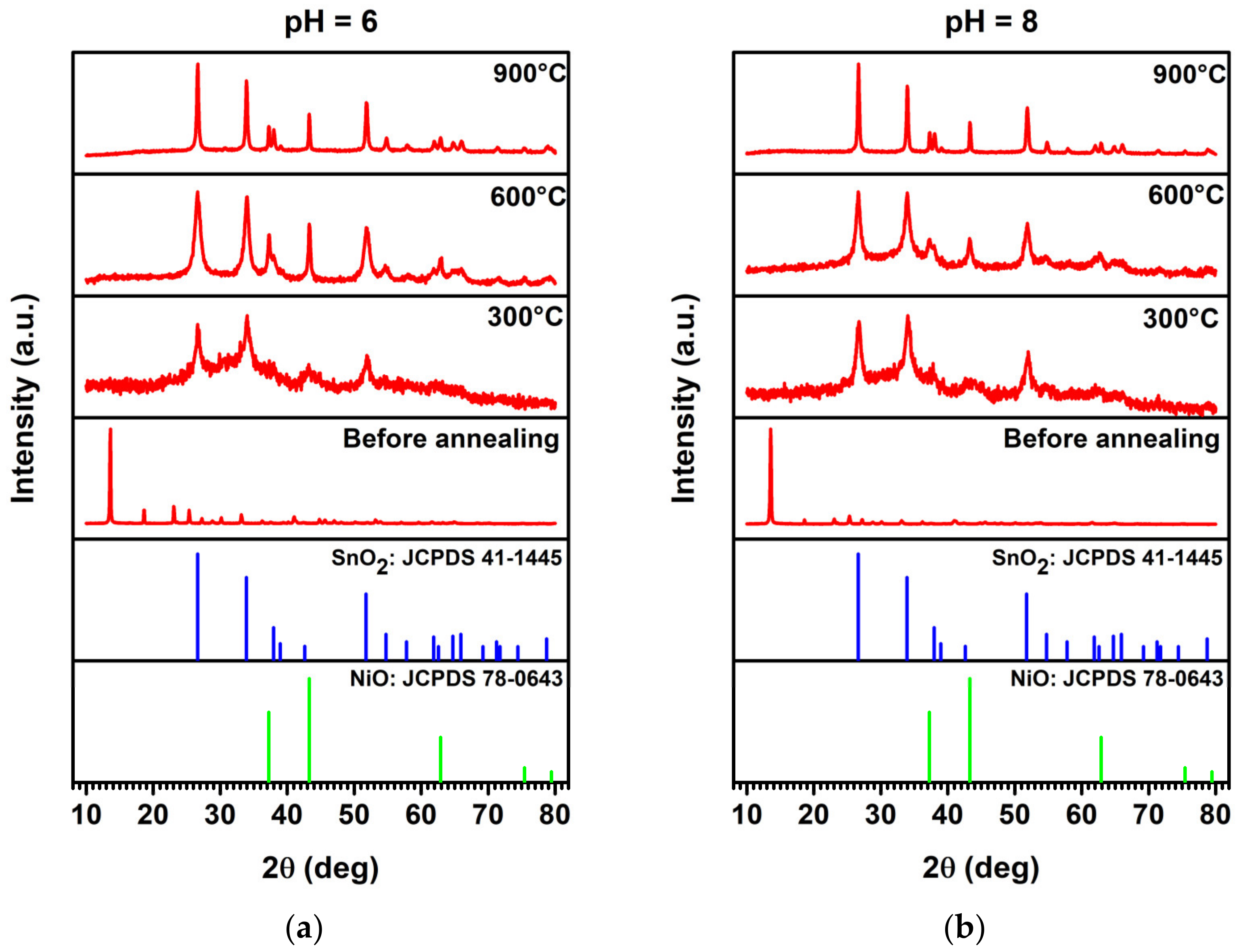
| pH | Annealing Temperature (°C) | Material | Planes |
|---|---|---|---|
| 6 | 300 | NiO | (200) |
| SnO2 | (110), (101) | ||
| 600 | NiO | (202), (021), (024) | |
| SnO2 | (110), (101), (111), (211), (220) | ||
| 900 | NiO | (202), (021), (024), (312), (223) | |
| SnO2 | (110), (101), (111), (210), (220), (002), (310), (112), (301) | ||
| 8 | 300 | NiO | (202) |
| SnO2 | (110), (101), (211) | ||
| 600 | NiO | (202), (021), (024) | |
| SnO2 | (110), (101), (220), (021) | ||
| 900 | NiO | (202), (021), (024), (312), (223) | |
| SnO2 | (110), (101), (111), (210), (220), (002), (310), (112), (301) |
| pH | Annealing Temperature (°C) | NiO/SnO2 (%)/(%) | Crystallite Size (nm) |
|---|---|---|---|
| 6 | 300 | 35.66/64.34 | 14.0 |
| 600 | 40.85/59.15 | 9.4 | |
| 900 | 35.71/64.29 | 30.1 | |
| 8 | 300 | 35.31/64.69 | 14.1 |
| 600 | 36.10/63.90 | 9.9 | |
| 900 | 43.64/56.36 | 33.3 |
| Material | Operation Temperature (°C) | Response | Concentration (ppm) | Response Time (s) | Ref. |
|---|---|---|---|---|---|
| ZnO:ZnGa2O4 | 400 | 28.6 * | 100 | 8 | [1] |
| CuO NPs | 50 | 3 ** | 100 | <2.5 | [2] |
| Ag:ZnO | 100 | 53.28% *** | 0.0216 | - | [6] |
| SnO2 | 160 | 33.3 * | 0.5 | 214 | [7] |
| N:rGO | RT | 1.7 * | 1 | - | [18] |
| WO3 | 150 | 3.22 * | 0.1 | - | [11] |
| Pd loaded Co3O4 | 200 | 1.16 * | 0.2 | 456 | [12] |
| PCDTBT Conductive polymer | RT | 80.6% *** | 100 | 300 | [19] |
| TiO2-rGO | RT | 7.1 * | 2.75 | 440 | [20] |
| Tb2O3/ZnO | 180 | 28.3 * | 1 | 208 | [13] |
| NiO/SnO2 (pH = 6) | RT | 0.5 * | 2.5 | 223 | This work |
| NiO/SnO2 (pH = 8) | RT | 1.8 * | 2.5 | 257 | This work |
Disclaimer/Publisher’s Note: The statements, opinions and data contained in all publications are solely those of the individual author(s) and contributor(s) and not of MDPI and/or the editor(s). MDPI and/or the editor(s) disclaim responsibility for any injury to people or property resulting from any ideas, methods, instructions or products referred to in the content. |
© 2023 by the authors. Licensee MDPI, Basel, Switzerland. This article is an open access article distributed under the terms and conditions of the Creative Commons Attribution (CC BY) license (https://creativecommons.org/licenses/by/4.0/).
Share and Cite
Gagaoudakis, E.; Tsakirakis, A.; Moschogiannaki, M.; Sfakianou, A.; Binas, V. Room-Temperature Nitric Oxide Gas Sensors Based on NiO/SnO2 Heterostructures. Sensors 2023, 23, 8583. https://doi.org/10.3390/s23208583
Gagaoudakis E, Tsakirakis A, Moschogiannaki M, Sfakianou A, Binas V. Room-Temperature Nitric Oxide Gas Sensors Based on NiO/SnO2 Heterostructures. Sensors. 2023; 23(20):8583. https://doi.org/10.3390/s23208583
Chicago/Turabian StyleGagaoudakis, Emmanouil, Apostolos Tsakirakis, Marilena Moschogiannaki, Angeliki Sfakianou, and Vassilios Binas. 2023. "Room-Temperature Nitric Oxide Gas Sensors Based on NiO/SnO2 Heterostructures" Sensors 23, no. 20: 8583. https://doi.org/10.3390/s23208583
APA StyleGagaoudakis, E., Tsakirakis, A., Moschogiannaki, M., Sfakianou, A., & Binas, V. (2023). Room-Temperature Nitric Oxide Gas Sensors Based on NiO/SnO2 Heterostructures. Sensors, 23(20), 8583. https://doi.org/10.3390/s23208583