Abstract
This paper investigates a class of nonholonomic chained systems with integral input-to-state stable (iISS) inverse dynamics subject to unknown virtual control directions and parameter uncertainty included in drift terms. First, the system is divided into two interconnected subsystems according to the system’s structure. Second, one controller is designed using a switch strategy for state finite escape. Then, another controller and adaptive law are designed by combining a reduced-order state observer and backstepping method after input-state scaling. Finally, simulation results validate the feasibility of the proposed control algorithm.
1. Introduction
In recent years, the control of nonholonomic systems has drawn considerable attention due to the enormous potential practical values. And nonholonomic systems have penetrated deeply into humans’ daily lives, such as in the case of planar space robots, the knife edge, a rigid spacecraft with two torque actuators, cars towing several trailers and multiple mobile manipulators [1,2,3]. Some classical nonlinear control methods have been developed rapidly in recent years, such as recursive integral backstepping control [4], adaptive output feedback control [5], sliding mode control [6], etc. Control of nonholonomic systems has been booming for several years in the nonlinear control field. However, the stabilization problem for nonholonomic systems, while the systems are subject to nonholonomic constraints, makes it difficult to utilize the classical control methods of nonlinear systems [7]. It is further proved by Brockett’s necessary condition that the equilibrium of a simple nonholonomic system could not be stabilized by any static continuous state feedback control even for a controllable open loop system [8]. Alternatively, time-varying controllers and discontinuous controllers have been developed for nonholonomic systems’ stability. For example, ref. [9] investigated the state feedback and output feedback to address the effects of nonholonomic constraints in event-triggered control. Ref. [10] developed a continuous state feedback control strategy for first-order nonholonomic systems.
It is well-recognized that a lot of nonholonomic systems could be transformed into their corresponding chained forms. Therefore, nonholonomic systems in a chained form as fundamental systems have been taken much more seriously [11]. Furthermore, the design of adaptive controllers for nonholonomic systems with unknown control directions is a considerable concerned problem [12]. The adaptive control problem becomes more difficult when the sign of virtual control is unknown. Robust control is a common strategy for the stability problem of nonholonomic systems with unknown control direction [13]. This method first designs a controller according to the assumed control direction, and then identifies the control direction online. If the actual control direction is the opposite of the assumed direction, then a continuous switching law is applied to modify the controller.
Unlike previous works, in this paper, a class of integral Input state stability (iISS) inverse dynamics is introduced to a canonical chained nonholonomic system with parameter uncertainties, which is shown as follows:
where and represent the control inputs; and are system states; is referred to inverse dynamics and is available to control design; y denotes the measurable output; is locally Lipschitz and holds . , and are smooth vector functions and satisfy , ; shows a vector of unknown constant parameters; indicate virtual control directions while are unknown but bounded.
ilSS was first defined in [14], and is strictly weaker than ISS. The properties of iISS are further ventilated in [15]. ISS is a nonlinear extension on the finite gain of the maximum norm and , replacing finite linear gains that require too much general nonlinear control with nonlinear gains. When excited by a uniformly bounded energy signal, a system exhibits a low energy response, which is a highly demanding qualitative characteristic. In this case, a weaker condition iISS is proposed naturally and applied to nonlinear systems with good performance [16,17]. As iISS inverse dynamics are first introduced into nonholonomic systems with unknown control direction and strong drift, two interconnected subsystems are divided according to the system’s structure. Then, one controller is designed by a switch strategy for state finite escape. Another controller is designed by combining a reduced-order state observer and backstepping method after input-state scaling. Generally, the control problem of interest is to design adaptive output feedback controllers to make the components of closed-loop system bounded and , , converge to its equilibrium when on the condition that the inverse dynamics is iISS.
The rest of this paper is organized as follows. Section 2 presents the essential preliminary results. An output feedback controller is provided in Section 3 with the aid of Section 3.1 controller design for and Section 3.2 controller design for . Section 4 addresses the switch control. Section 5 illustrates the effectiveness of the proposed algorithm.
2. Preliminary Results
Consider the following nonlinear control system
where u denotes the control input, x represents the state and f satisfying is a locally Lipschitz function. Next, let us recall several important definitions and propositions.
Definition 1
([18]). A continuous function is said to be a -function if it is strictly increasing and . The -function is called a -function if and as .
Definition 2
([18]). A continuous function is said to be a -function if, for every fixed s, the mapping is a -function with respect to r and, for every fixed r, the mapping is decreasing with respect to s and as .
Definition 3
([19]). System (2) is called integral input-to-state stable (iISS) with respect to u, if for any initial value there always exist -functions α, and a -function such that
The definition of iISS could be equivalently illustrated by the Lyapunov function in the following proposition.
Proposition 1
([19]). System (2) is iISS if and only if there is a positive definite and proper function , referred to an iISS-Lyapunov function, such that
where , and γ are -functions, β represents a positive definite continuous function.
Before the following proportion, there is a notation for simplicity that denotes for some constant and any s in a small neighborhood of the origin.
Proposition 2
([20]). Consider the system (2) with an iISS-Lyapunov function satisfying (4). If any smooth function π with the property is taken. And the additional condition holds when β is bounded. Then there always exists a positive definite function σ and a -function ω such that
Furthermore, if the iISS-gain γ satisfies , so is ω.
Now we start to investigate the nonholonomic system (1). Before the output controller design, there are some commonly used hypotheses.
Assumption A1.
There is a constraint of that . Furthermore, for nonlinear vector function , there exists a nonnegative smooth function such that .
Assumption A2.
There exist continuously differential matrix functions and continuous matrix functions , where and
such that satisfy .
Remark 1.
3. Output Feedback Controller
For system (8), an adaptive output feedback controller will be designed via input-state scaling transformation and backstepping technique. In detail, this system will be divided into two subsystems around its inherent structure. First, will be designed to stabilize the -subsystem under the condition that is iISS. And then, the stability of subsystem is guaranteed by controller to be framed later. For clarity, the discussion will be separated into two categories: and . This section is concerned with the condition of .
3.1. Controller Design for
For subsystem
the following sufficient conditions are required:
(A1) System (9) is iISS, i.e., there is an iISS-Lyapunov function , such that
where , and are -functions, represents a positive definite continuous function.
(A2) There is two unknown positive constants , , and two known positive semidefinite smooth functions , such that
where denotes the estimate of unknown parameter in -subsystem; is the corresponding estimate error and satisfies . Then controller and adaptive law are given in the succeeding theorem.
Theorem 1.
Suppose that the conditions A1) and A2) hold with the properties and . When β is bounded, there is . If the control law and adaptive law are chosen as:
then by appropriately selecting positive smooth function and positive parameters c, Γ, we obtain:
(ii)For any initial states,
Proof.
(i) For subsystem (10), a candidate Lyapunov function is chosen as . The time derivative of along trajectories (10), (13) and (14) is granted by
According to Proposition 2, we can achieve
where is a positive definite function, and satisfies . Select a positive smooth function such that
The existence of function is guaranteed by the fact that is a positive semidefinite smooth function, and are - functions. Then with (13), (18) and (16) can be rewritten as
Integrating both side of (19), it yields
where .
It is assumed that the solutions of the closed-loop system are defined on a right-maximal interval with . will be proved to be bounded on by contradiction. Suppose that is unbounded. Since that is an increasing function and when . Upon division of both side of (20), we obtain
Obviously, the left hand of (21) tends to a finite number while the right tends to . It leads to a contradiction. Therefore, It reveals that is bounded on .
According to (13) and (18) and the boundness of , it easily draw a conclusion that is bounded on interval . Moreover, using (11), it follows that defined on interval is bounded. Based on (20) and the boundness of , we also obtain that and are bounded. Finally, can be similarly proved by the proof of Proposition 6 in [21]. The proof of (i) is completed.
(ii) The boundness of and imply that is uniformly continuous on . Furthermore, the property and Barbalat Lemma yield . This, in turn, indicates , . Then, by applying and Proposition 6 in [21], it follows that as . Finally, the whole proof of Theorem 1 is completed. □
Remark 2.
If a nonnegative function is chosen as , its time derivative could be arranged into the form of coupled with (13) and Assumption 1, where . Then, it is easy to note that by Comparison Lemma. In this case, we arrive at a straightforward conclusion that when . As a result, it is of interest to interpret that the input-state technique to be introduced below is available.
From the above analysis, we are actually aware that the state of -subsystem could be regulated to zero. But -subsystem is uncontrollable. In order to avoid this phenomenon, a discontinuous input-state scaling transformation is proposed:
Under the z coordination, -subsystem is rearranged into
where , , , .
3.2. Controller Design for
Since states are measurable and is definitely given by Theorem 1 that state which is obtained by transformations and is measurable. Therefore, a reduced-order state observer could be proposed for system (23). For notation convenience, we covert the -subsystem into its compact form:
where , , , , , . In addition, denote the estimate of states . e is the estimate error and satisfies the equation . and represent the estimates of and . and are the responding estimate errors, and satisfy , , respectively. is the estimate of . It is certainly useful to make several assumptions in the following part.
Assumption A3.
There are continuous bounded matrix functions , ,, , such that , , and , , when .
Assumption A4.
Matrix is negative definite, which makes the following dimension reduced-order state observer feasible.
We now establish the dimension reduced-order state observer
where and are, respectively, generated by
Under the condition of (24), (25) and Assumption 3, we obtain the following differential equation of observer error vector e after a simple manipulator
If we perform and substitute (26) into it, a new differential equation is achieved
where . Furthermore, according to Assumption 4, a positive parameter is properly chosen such that the following linear matrix inequality(LMI) holds
where are positive definite matrix; I denotes identity matrix. Now we can rewrite the feedback control system into
where , .
Remark 3.
There are always solutions for LMI (29) by appropriately choosing δ. For example, if matrix is arbitrarily given, we can select a suitable δ so that a positive definite matrix P exists and satisfies inequality (29). On the other hand, we can also solve the inequality (29) by LMI tool box. According to Schur Lemma [22], (29) can be rewritten into its LMI form
Then we can arrive at by LMI toolbox in Matlab.
Now, we are in a position to sketch the controller of the system (30) based on the backstepping technique.
Step 1. Consider -subsystem and define new state variables , , where is applied as a virtual control input. Our candidate Lyapunov function is introduced as
Then its derivative with respect to t is
Using the property of perfect square yields . If virtual control law and tuning functions , of adaptive control law , are picked as
where , then is rendered into
It is obvious that is a smooth function and satisfies .
Step i (). For system , redefine state variable , where is the virtual control input to be designed in step i. Before step i, we have already received the smooth virtual control input and
Now, we augment with a quadratic term of state to acquire the Lyapunov function . Its derivative is
With the help of perfect square property, it holds
We will attempt to employ the following control law and tuning functions to cope with (38)
where . It is interesting to note that is a smooth function and satisfies . Eventually, in view of (39)–(41), it is easy to show that
Step n. Investigate the system , where state variable , the smooth virtual control input is already designed in step . The basic idea of step n is to exploit the real control law and adaptive laws , to guarantee that the derivative of the suitable Lyapunov function is nonpositive. Now let us introduce the augmented candidate Lyapunov function . With repeated application of , its time derivative along trajectory is
Similarly, by the choice of control law
where , and adaptive laws
the time derivative becomes and is guaranteed to be nonpositive.
The analysis of the adaptive controller will be further extended into the following theorem.
Theorem 2.
Proof.
4. Switching Controller
As we all know, is commonly applied as a constant controller in multiple works when . However, in this paper, due to the nonlinearity in the first equation of (8), finite escape may occur in subsystem . To avoid this phenomenon, we set
where . The positive constant in drives the state away from zero. Assuming that when , it can be known that is bounded for . We also learn that is bounded and for according to the similar procedure of proof in theorem 1. Therefore, will not blow up under the control (46) when . Next, it is easy to show that does not cross zero by the fact of Remark 2. Meanwhile, the control input is essentially designed as same as the case of .
The above analysis is summarized into the following theorem.
5. Simulation Example
In this section, a three-dimensional nonholonomic system with iISS inverse dynamics is proposed to illustrate the effectiveness of the derived control laws.
where is an unknown parameter. The original goal of this simulation is to design control inputs , such that when . There is no loss of generality in assuming initial state nonzero. Then system (47) is further divided into two subsystems:
and
For system (48), it can be drawn a conclusion that the inverse dynamics is iISS, not ISS. In fact, choosing , it is easy to testify that , with , . Obviously, is merely a positive definite continuous function, not belongs to -function. Then according to theorem 1, the control law is constructed as . The parameters are picked up as , , , . For system (49), it can be converted into , by coordinate transformation (7) and (22). A reduced-order observer is proposed by . Define the error and it satisfies . Apparently, assumptions all hold. Then control inputs and adaptive law are obtained by the similar procedure of Section 3.2.
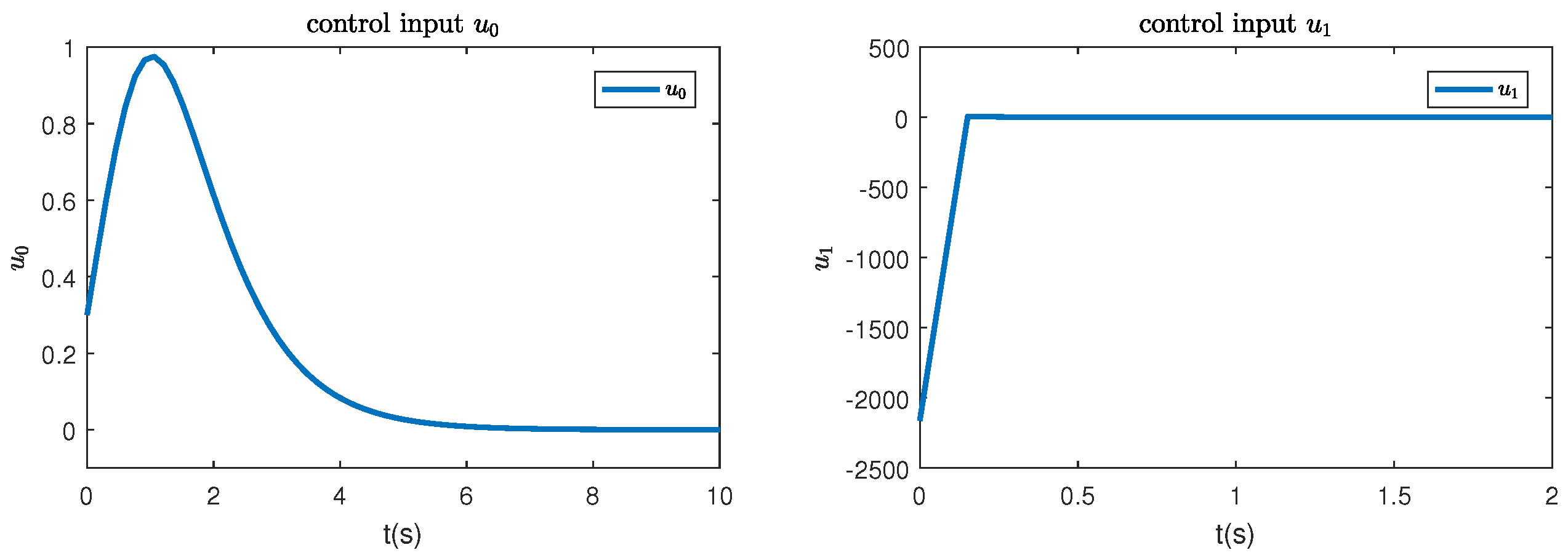
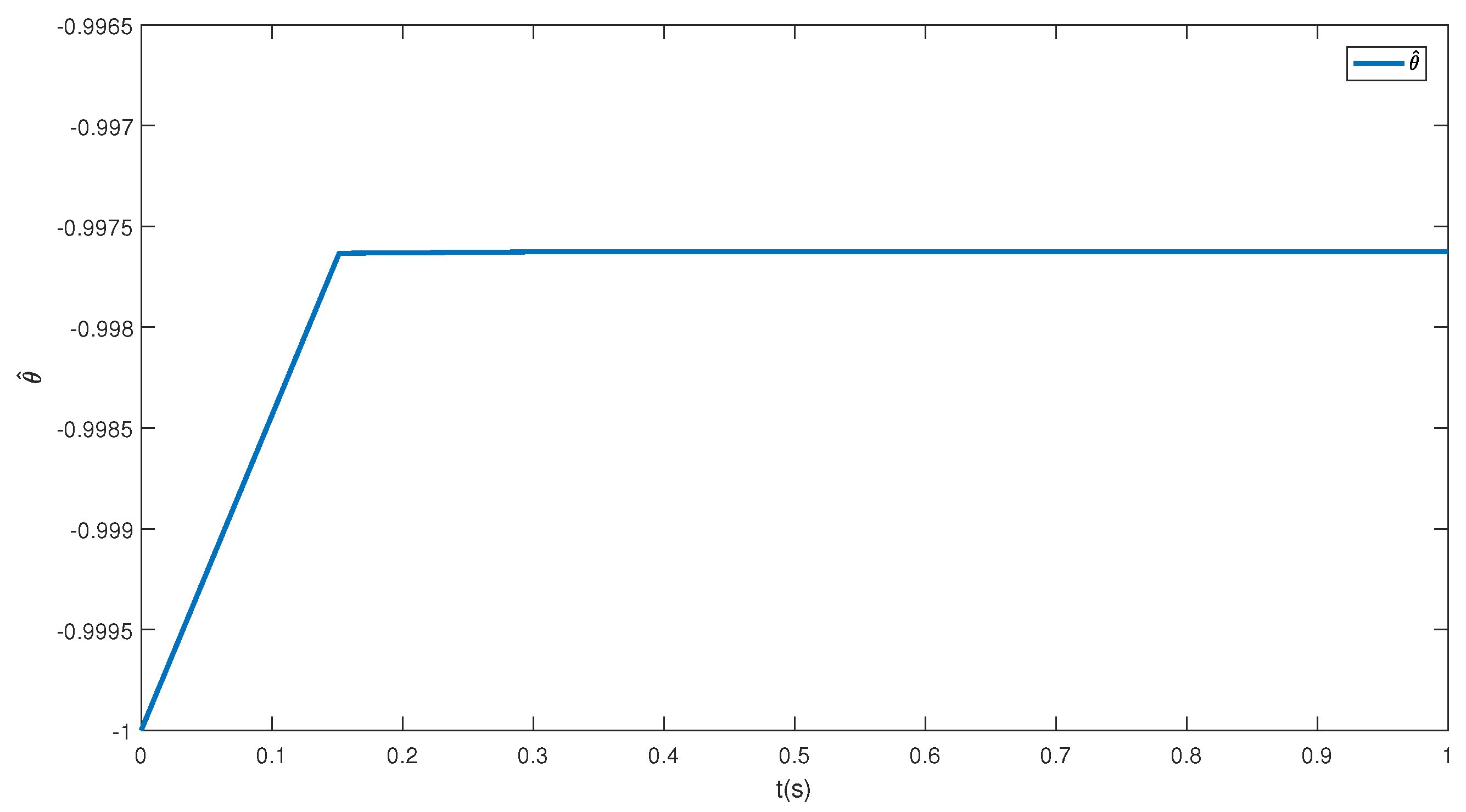
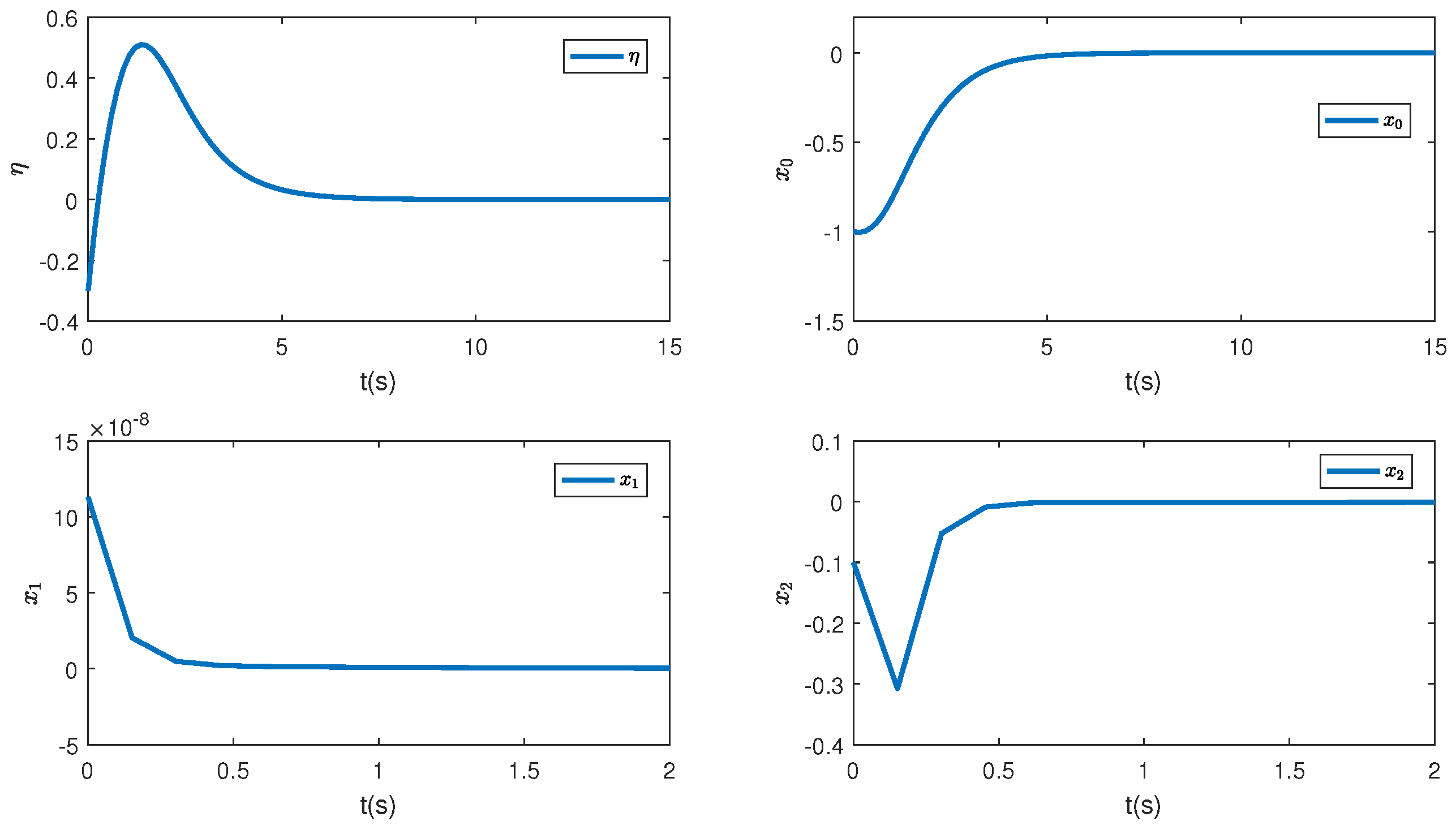
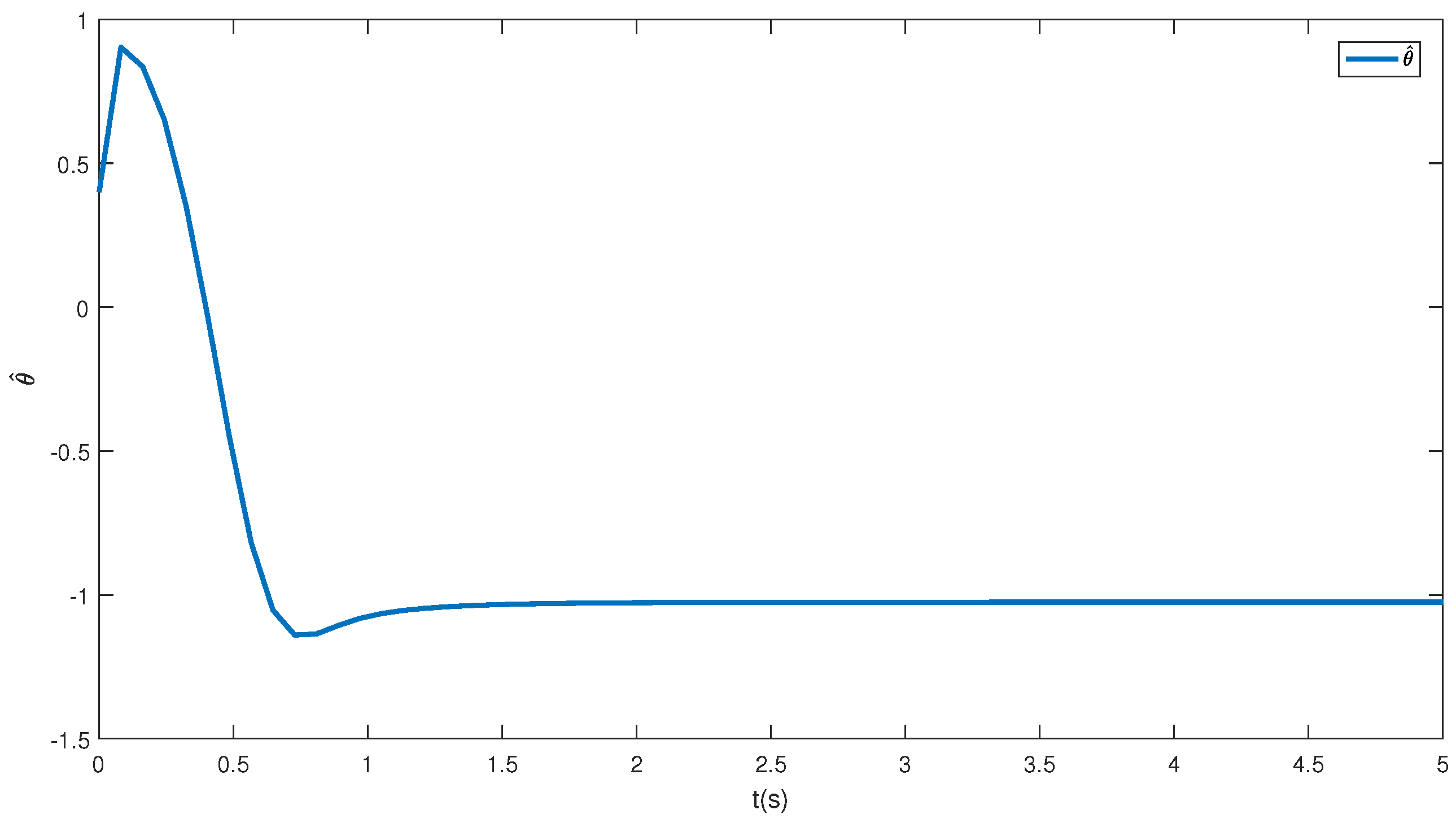
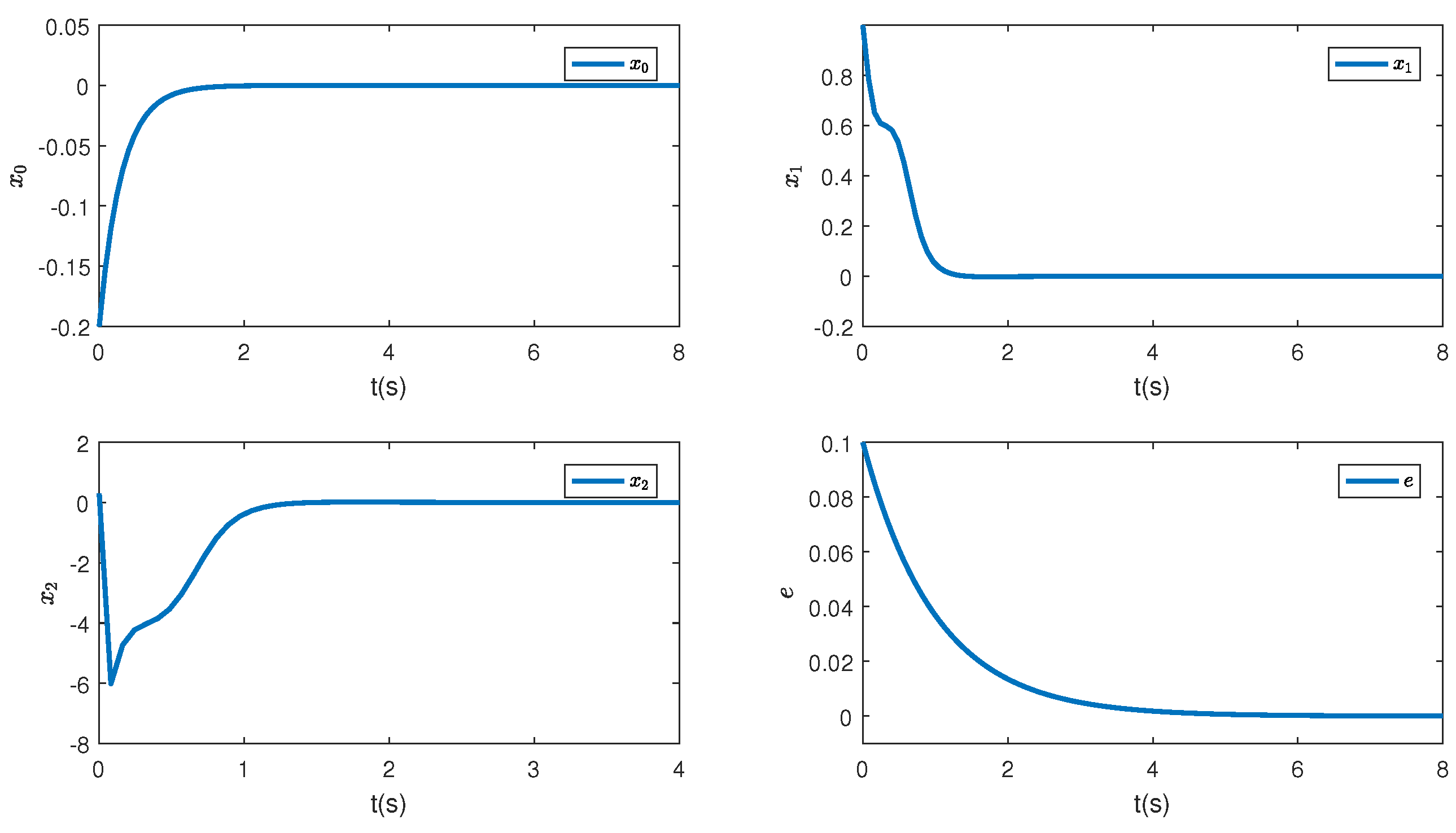
In this paper, a simulation is carried out based on the Matlab software of a 64-bit operation computer. Some values are set as , , , and the initial condition is . Figure 1 depicts the control inputs designed by Theorem 1 and the reduced-order state observer-based backstepping method. The adaptive estimation of the parameter is given in Figure 2. It can be observed that the parameter estimation keeps stable after 0.15 s and nearly converges to its actual value. Figure 3 shows the inverse dynamic and states. As studied, and are regulated to their original equilibriums after 5 s under the controller . The states and are stable after 0.5 s under the controller . This phenomenon is consistent with the tendency of controllers to some extent and the effectiveness of the proposed strategies is also shown.
Figure 1.
The control inputs and .
Figure 2.
The unknown parameter estimation.
Figure 3.
The corresponding states of the systems.
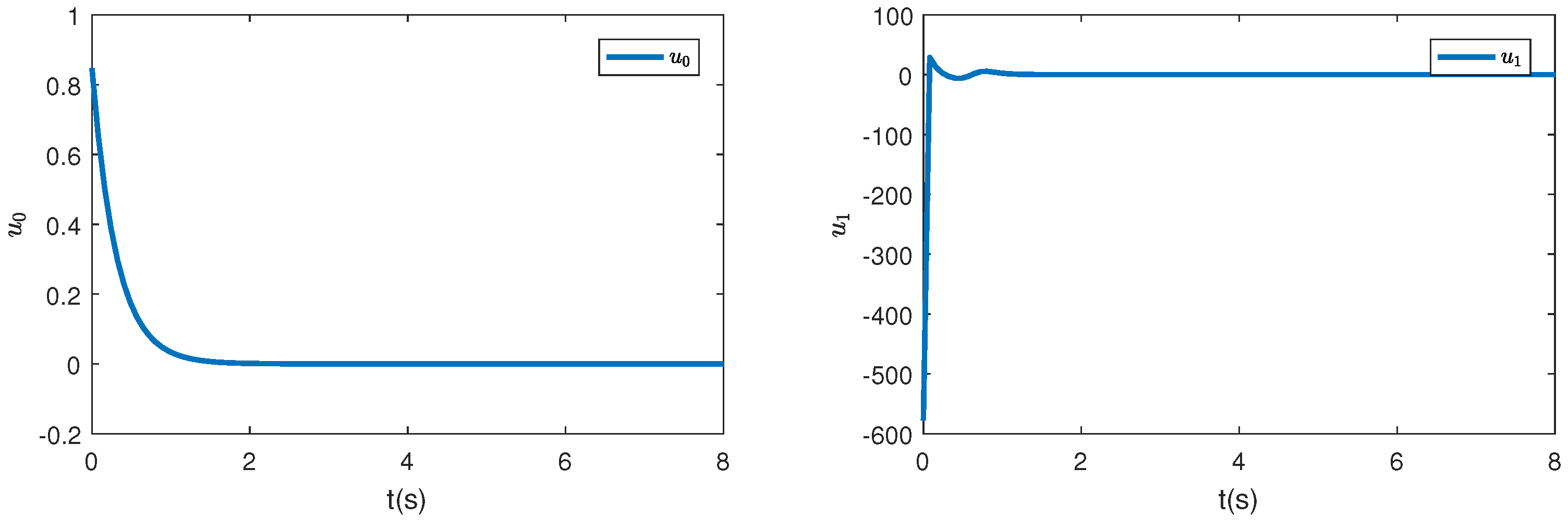
To comprehensively illustrate the influence of the iISS inverse dynamics, a simulation is performed in a system without inverse dynamics. Figure 4, Figure 5 and Figure 6 are controllers, parameter estimation, states, and errors between and desired values, respectively. It can be noticed from Figure 6 that all the states converge to their equilibriums at similar times. Thus, it can be seen that the inverse dynamic affects the convergence time of the system.
Figure 4.
The control inputs and without inverse dynamics.
Figure 5.
The unknown parameter estimation without inverse dynamics.
Figure 6.
The system states without inverse dynamics.
6. Conclusions
In this paper, an adaptive output controller is designed for a class of nonholonomic chained systems with iISS inverse dynamics. Specifically, the nonholonomic system subjected to unknown virtual control directions and parameter uncertainty is divided into two subsystems. Two different controllers are designed for avoiding state finite escape and adaptive control objectives. One controller is designed by a switch strategy. Another is designed by combining a reduced-order state observer and backstepping method. However, there are still some problems unsolved in our work. Our future research will focus on more general nonholonomic systems with modeling uncertainties and environmental disturbances. And another coming issue is to take nonholonomic systems with iISS inverse dynamics and time delay into account.
Author Contributions
Conceptualization, L.X., Y.L. and X.W.; methodology, L.X. and X.W.; software, X.W.; validation, L.X. and Y.L.; formal analysis, L.X. and X.W.; investigation, Y.L., X.W. and L.X.; resources, X.W. and L.X.; data curation, X.W.; writing—original draft preparation, Y.L.; writing—review and editing, Y.L., X.W. and and C.W.; visualization, X.W.; supervision, X.W.; project administration, X.W.; funding acquisition, X.W., L.X. and C.W. All authors have read and agreed to the published version of the manuscript.
Funding
This research was funded by the National Science Foundation of China (Grant No. 62103251, 62203213), Zhejiang Provincial Natural Science Foundation of China (Grant No. LQ23F030016), Natural Science Foundation of Jiangsu Province (Grant No. BK20220332) and the China Postdoctoral Science Foundation (Grant No. 2021M702075).
Institutional Review Board Statement
Not applicable.
Informed Consent Statement
Not applicable.
Data Availability Statement
The data presented in this study are available on request from the corresponding author after obtaining permission of an authorized person.
Conflicts of Interest
The authors declare no conflict of interest.
References
- Ye, D.; Zou, A.M.; Sun, Z. Predefined-time predefined-bounded attitude tracking control for rigid spacecraft. IEEE Trans. Aerosp. Electron. Syst. 2021, 58, 464–472. [Google Scholar] [CrossRef]
- Xin, J.; Meng, C.; Schulte, F.; Peng, J.; Liu, Y.; Negenborn, R.R. A time-space network model for collision-free routing of planar motions in a multirobot station. IEEE Trans. Ind. Inform. 2020, 16, 6413–6422. [Google Scholar] [CrossRef]
- Sandakalum, T.; Ang, M.H., Jr. Motion planning for mobile manipulators—A systematic review. Machines 2022, 10, 97. [Google Scholar] [CrossRef]
- Rabbani, M.J.; Memon, A.Y. Trajectory tracking and stabilization of nonholonomic wheeled mobile robot using recursive integral backstepping control. Electronics 2021, 10, 1992. [Google Scholar] [CrossRef]
- Zhang, X.; He, W.; Zhang, Y. An Adaptive Output Feedback Controller for Boost Converter. Electronics 2022, 11, 905. [Google Scholar] [CrossRef]
- Yeh, Y.L. Output Feedback Tracking Sliding Mode Control for Systems with State-and Input-Dependent Disturbances. Actuators 2021, 10, 117. [Google Scholar] [CrossRef]
- Li, Y.; Cai, B.; Song, X.; Chu, X.; Su, B. Modeling of maglev yaw system of wind turbines and its robust trajectory tracking control in the levitating and landing process based on NDOB. Asian J. Control 2019, 21, 770–782. [Google Scholar] [CrossRef]
- Brockett, R.W. Asymptotic stability and feedback stabilization. Differ. Geom. Control Theory 1983, 27, 181–208. [Google Scholar]
- Zhang, P.; Liu, T.; Jiang, Z.P. Systematic design of robust event-triggered state and output feedback controllers for uncertain nonholonomic systems. IEEE Trans. Autom. Control 2020, 66, 213–228. [Google Scholar] [CrossRef]
- Lai, X.; Zhang, P.; Wang, Y.; Chen, L.; Wu, M. Continuous state feedback control based on intelligent optimization for first-order nonholonomic systems. IEEE Trans. Syst. Man Cybern. Syst. 2018, 50, 2534–2540. [Google Scholar] [CrossRef]
- Rocha, E.; Castaños, F.; Moreno, J.A. Robust finite-time stabilisation of an arbitrary-order nonholonomic system in chained form. Automatica 2022, 135, 109956. [Google Scholar] [CrossRef]
- Gao, F.; Yuan, F.; Wu, Y. Adaptive stabilization for a class of stochastic nonlinearly parameterized nonholonomic systems with unknown control coefficients. Asian J. Control 2014, 16, 1829–1838. [Google Scholar] [CrossRef]
- Xu, L.; Wang, C.; Cai, X.; Xu, Y.; Jing, C. Two-layer distributed formation-containment control of multiple Euler–Lagrange systems with unknown control directions. Neurocomputing 2020, 387, 359–368. [Google Scholar] [CrossRef]
- Sontag, E.D. Smooth stabilization implies comprime factorization. IEEE Trans. Autom. Control 1989, 34, 435–443. [Google Scholar] [CrossRef]
- Ito, H.; Jiang, Z.P. Necessary and sufficient small gain conditions for integral input-to-state stable systems: A Lyapunov perspective. IEEE Trans. Autom. Control 2009, 54, 2389–2404. [Google Scholar] [CrossRef]
- Ito, H. Construction of Lyapunov functions for networks of iISS systems: An explicit solution for a cyclic structure. In Proceedings of the 2010 American Control Conference, Marriott Waterfront, Baltimore, MD, USA, 30 June–2 July 2010; pp. 196–201. [Google Scholar]
- Chaillet, A.; Angeli, D.; Ito, H. Combining iISS and ISS with respect to small inputs: The strong iISS property. IEEE Trans. Autom. Control 2014, 59, 2518–2524. [Google Scholar] [CrossRef]
- Khalil, H.K. Nonlinear Systems, 3rd ed.; House of Electronisc Indestry: Beijing, China, 2012; pp. 144–147. [Google Scholar]
- Angeli, D.; Sontag, E.D.; Wang, Y. A characterization of integral input-to-state stability. IEEE Trans. Autom. Control 2000, 45, 1082–1097. [Google Scholar] [CrossRef]
- Jiang, Z.P.; Mareels, I.; Hill, D.J.; Huang, J. A unifying framework for global regulation via nonlinear output feedback: From ISS to iISS. IEEE Trans. Autom. Control 2004, 49, 549–562. [Google Scholar] [CrossRef]
- Sontag, E.D. Comments on integral variants of ISS. Syst. Control Lett. 1998, 34, 93–100. [Google Scholar] [CrossRef]
- Boyd, S.; Ghaoui, L.E.; Feron, E.; Balakrishnan, V. Linear Matrix Inequalities in System and Control Theory; Society for Industrial and Applied Mathematics: Philadelphia, PA, USA, 1994. [Google Scholar]
Disclaimer/Publisher’s Note: The statements, opinions and data contained in all publications are solely those of the individual author(s) and contributor(s) and not of MDPI and/or the editor(s). MDPI and/or the editor(s) disclaim responsibility for any injury to people or property resulting from any ideas, methods, instructions or products referred to in the content. |
© 2023 by the authors. Licensee MDPI, Basel, Switzerland. This article is an open access article distributed under the terms and conditions of the Creative Commons Attribution (CC BY) license (https://creativecommons.org/licenses/by/4.0/).