Propositional Inference for IoT Based Dosage Calibration System Using Private Patient-Specific Prescription against Fatal Dosages


 ,
,
Abstract
1. Introduction
“Manufacturers of medical IoT devices should be prioritizing security, especially considering the potential detrimental consequences of a breach.”(Catherine Norcom, Hardware hacker for IBM’s X-Force Red)
- The dosage is increased resulting in extreme decomposition of blood glucose. The nominal result is fatigue, and in extreme cases, fatality.
- The dosage is decreased resulting in build-up of glucose, leading to hyperglycemia. The nominal result is shortness of breath and nausea, and in extreme cases, cardiovascular problems.
- The dosage dispersal frequency becomes chaotic. The basal and bolus factor is affected. The nominal result varies from patient to patient based on the severity of the disease.
2. Background and Challenges
- Basal—Nominal amount of insulin injected periodically to maintain blood sugar. Period depends upon program.
- Bolus—Heavy dosage of insulin to be initiated by the patient at mealtime, or hyperglycemia symptoms affect quality of life.
- A sensor and actuator that collect data and effect quantifiable change. In the case of an insulin pump, the motor, piston and cannula together form the insulin delivery actuator.
- A processor with the insulin delivery program installed, which is subject to change based on human intervention through a communication module.
- A battery power source that runs the device.
- A communication module, which, in IoT pumps may represent a wired or wireless communication link. Wireless technologies include BT-WiFi, BLE (Bluetooth Low Energy) & ZigBee. The primary vulnerabilities recognized in IoT insulin pumps that resulted in recall were present in the communications module that negatively affected the processor module. The processor module, in turn, affects the rest of the IoT components in a cascading fashion.
3. Related Work
3.1. A Brief Chronology of Medical Device Security—A.J Burns et al. [14]
- Identification. Identify processes and assets needing protection,
- Protection. Define available safeguards.
- Detection. Devise incident detection techniques.
- Response. Formulate a response plan.
- Recovery. Formalize a recovery plan.
3.2. Deep Insecurities: The Internet of Things Shifts Technology Risk—Samuel Greengard [15]
3.3. Internet of Things (IoT): Application Systems and Security Vulnerabilities [8]
|
|
3.4. Security and Privacy Considerations for IoT Application on Smart Grids: Survey and Research Challenges [22,23]
|
|
3.5. The Security Challenges in the IoT Enabled Cyber-Physical Systems and Opportunities for Evolutionary Computing and Other Computational Intelligence [11]
3.6. IoT Security Framework for Building Trustworthy Smart Car Services [24]
3.7. Summary of Inferences
4. Proposed Secure IoT Based Insulin Dosage Dispensary System Using Patient-Specific Private Blockchain
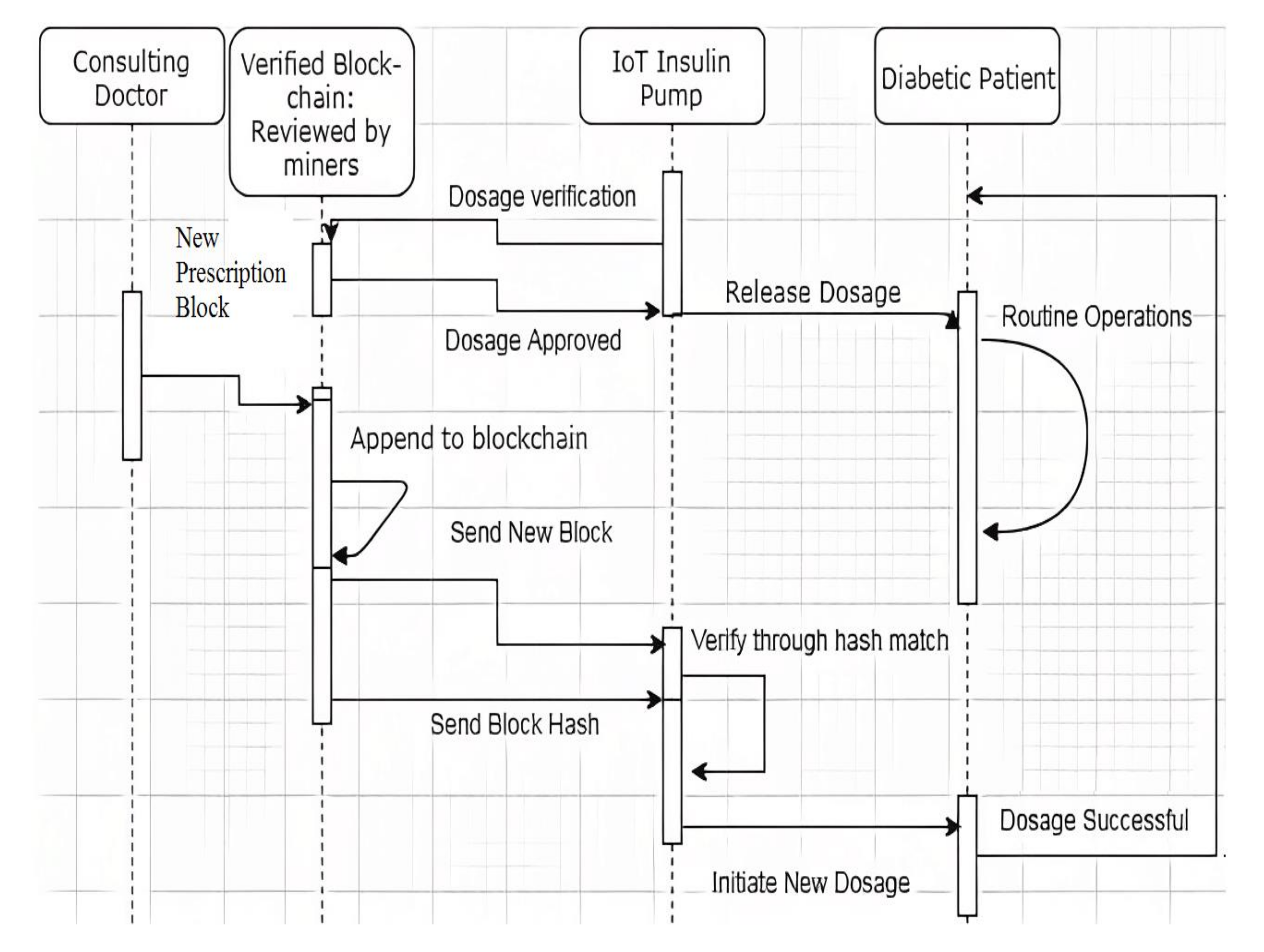
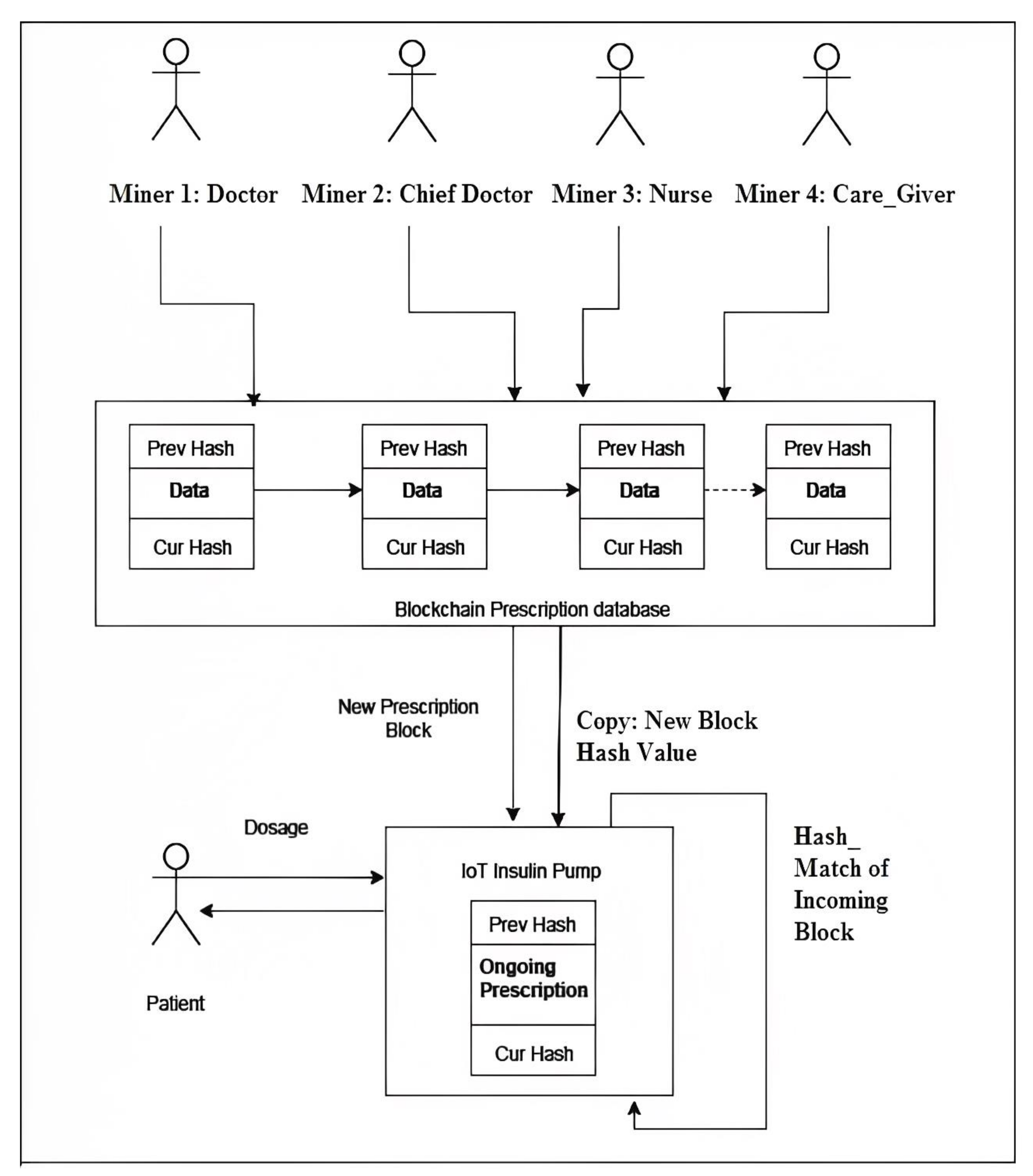
- i.
- The patient-specific private blockchain is bootstrapped by its miners (i.e., doctor, chief doctor and caretaker of the patient)
- ii.
- The doctor decides the dosage information (i.e., specifies the quantity of insulin and the time of delivery) for the patient and generates the block in the chain containing the latest prescription information. The block is validated by the consensus mechanism that includes chief doctor, nurse and caretaker of the patient, and is appended to the blockchain.
- iii.
- It sends the block hash value in one transaction.
- The entire block (i.e., dosage information and hash value) is transmitted in another transaction.
- iv.
- The pump hashes the block contents and compares them against the block hash obtained in the separate transaction.
- If equal, go to step (v).
- Else, reject the new block and terminate the dosage procedure until a valid block arrives.
- v.
- The pump compares the previous hash of the new block with the current hash of the existing block [32].
- If equal, initiate insulin delivery.
- Else, reject the new block and terminate dosage until a valid block arrives.
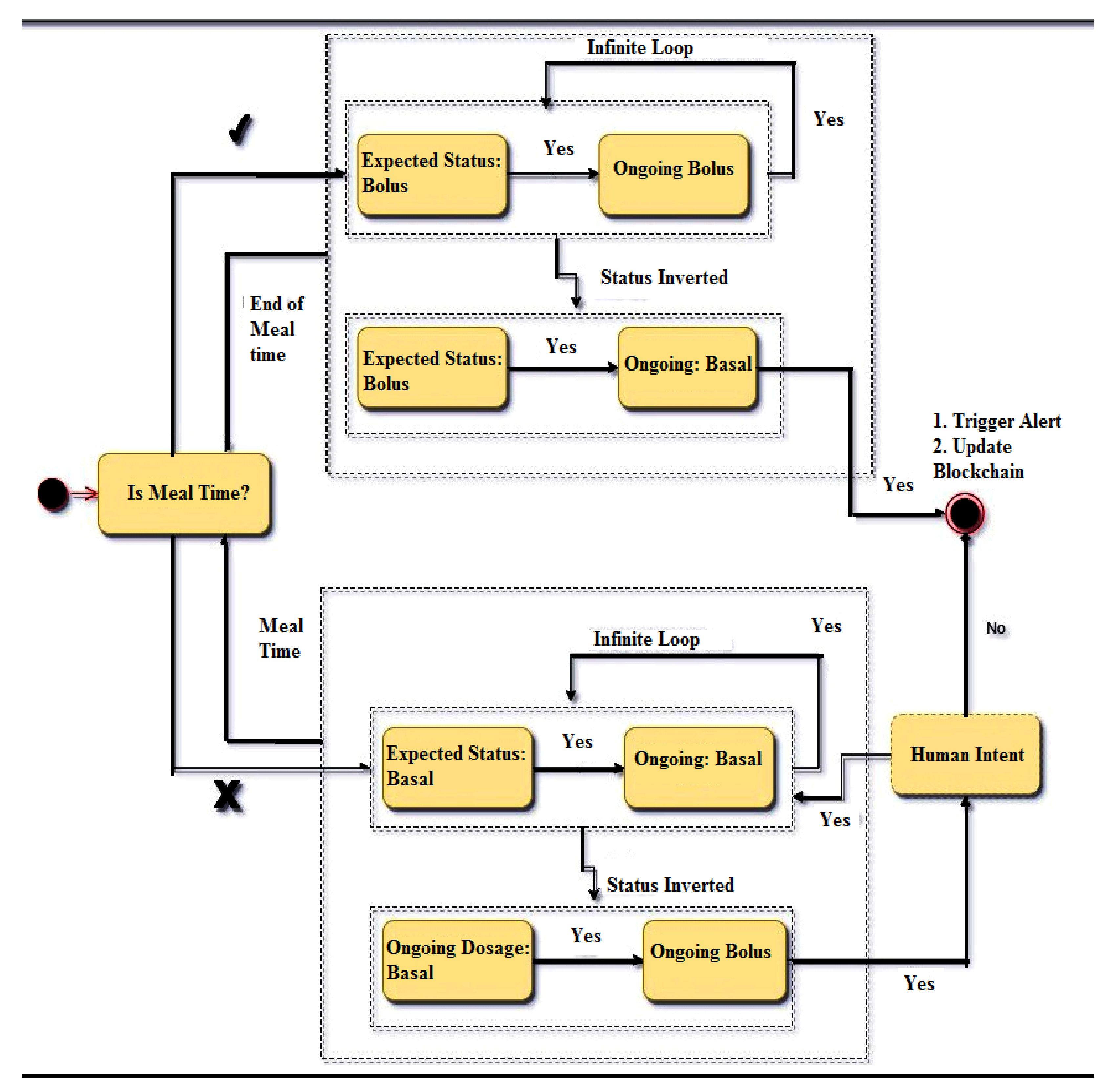
- Battery replacement
- Insulin cartridge replacement
- Patient opts to remove it for a period of time.
5. Proof of Impenetrability through Propositional Calculus
- Successful State: L
- Failure State: BC^H (or) !L
6. Conclusions
Author Contributions
Funding
Institutional Review Board Statement
Informed Consent Statement
Data Availability Statement
Acknowledgments
Conflicts of Interest
References
- Bouhenguel, R.; Mahgoub, I.; Ilyas, M. Bluetooth Security in Wearable Computing Applications. In Proceedings of the 2008 International Symposium on High Capacity Optical Networks and Enabling Technologies, Penang, Malaysia, 18–20 November 2008; pp. 182–186. [Google Scholar]
- Available online: https://www.nxp.com/applications/solutions/industrial/healthcare/wireless-insulin-pump:WIRELESS-INSULIN-PUMP (accessed on 26 November 2022).
- Frustaci, M.; Pace, P.; Aloi, G. Securing the IoT world: Issues and perspectives. In Proceedings of the 2017 IEEE Conference on Standards for Communications and Networking (CSCN), Helsinki, Finland, 18–20 September 2017; pp. 246–251. [Google Scholar]
- Berrehili, F.Z.; Belmekki, A. Privacy Preservation in the Internet of Things. In Advances in Ubiquitous Networking 2. Lecture Notes in Electrical Engineering; El-Azouzi, R., Menasche, D., Sabir, E., De Pellegrini, F., Benjillali, M., Eds.; Springer: Singapore, 2017; Volume 397. [Google Scholar]
- Sain, M.; Kumar, P.; Lee, Y.D.; Lee, H.J. Secure middleware in ubiquitous healthcare. In Proceedings of the 5th International Conference on Computer Sciences and Convergence Information Technology, Seoul, Republic of Korea, 30 November–2 December 2010; pp. 1072–1077. [Google Scholar]
- Das, A.K.; Pathak, P.H.; Chuah, C.N.; Mohapatra, P. Uncovering privacy leakage in ble network traffic of wearable fitness trackers. In Proceedings of the 17th International Workshop on Mobile Computing Systems and Applications (HotMobile), St. Augustine, FL, USA, 23–24 February 2016. [Google Scholar]
- Langone, M.; Setola, R.; Lopez, J. Cybersecurity of Wearable Devices: An Experimental Analysis and a Vulnerability Assessment Method. In Proceedings of the 2017 IEEE 41st Annual Computer Software and Applications Conference (COMPSAC), Turin, Italy, 4–8 July 2017; pp. 304–309. [Google Scholar]
- Ahamed, J.; Rajan, A.V. Internet of Things (IoT): Application systems and security vulnerabilities. In Proceedings of the 2016 5th International Conference on Electronic Devices, Systems and Applications (ICEDSA), Ras Al Khaimah, United Arab Emirates, 6–8 December 2016; pp. 1–5. [Google Scholar]
- Pantelopoulos, A.; Bourbakis, N.G. A survey on Wearable sensor-Based Systems for Health Monitoring and Prognosis. IEEE Trans. Syst. Man Cybern. Part C (Appl. Rev.) 2010, 40, 1–12. [Google Scholar] [CrossRef] [Scilit]
- Hwang, D.; Choi, J.; Kim, K. Dynamic Access Control Scheme for IoT Devices using Blockchain. In Proceedings of the 2018 International Conference on Information and Communication Technology Convergence (ICTC), Jeju, Republic of Korea, 17–19 October 2018; pp. 713–715. [Google Scholar]
- He, H.; Maple, C.; Watson, T.; Tiwari, A.; Mehnen, J.; Jin, Y.; Gabrys, B. The security challenges in the IoT enabled cyber-physical systems and opportunities for evolutionary computing & other computational intelligence. In Proceedings of the 2016 IEEE Congress on Evolutionary Computation (CEC), Vancouver, BC, Canada, 24–29 July 2016; pp. 1015–1021. [Google Scholar]
- Harris, A.F.; Sundaram, H.; Kravets, R. Security and Privacy in Public IoT Spaces. In Proceedings of the 2016 25th International Conference on Computer Communication and Networks (ICCCN), Waikoloa, HI, USA, 1–4 August 2016; pp. 1–8. [Google Scholar]
- Williams, R.; McMahon, E.; Samtani, S.; Patton, M.; Chen, H. Identifying vulnerabilities of consumer Internet of Things (IoT) devices: A scalable approach. In Proceedings of the 2017 IEEE International Conference on Intelligence and Security Informatics (ISI), Beijing, China, 22–24 July 2017; pp. 179–181. [Google Scholar]
- Burns, A.J.; Johnson, M.E.; Honeyman, P. A brief chronology of medical device security. Commun. ACM 2016, 59, 66–72. [Google Scholar] [CrossRef] [Scilit]
- Greengard, S. Deep insecurities: The internet of things shifts technology risk. Commun. ACM 2019, 62, 20–22. [Google Scholar] [CrossRef] [Scilit]
- Gupta, P.; Chhabra, J. IoT based Smart Home design using power and security management. In Proceedings of the 2016 International Conference on Innovation and Challenges in Cyber Security (ICICCS-INBUSH), Noida, India, 3–5 February 2016; pp. 6–10. [Google Scholar]
- Patel, S.; Gupta, P.; Goyal, M.K.; Agarwal, A. Low Cost Hardware Design of a Web Server for Home Automation Systems. In Conference on Advances in Communication and Control Systems (CAC2S); Atlantis Press: Amsterdam, The Netherlands, 2013. [Google Scholar]
- Golzar, M.G.; Tajozzakerin, H. A New Intelligent Remote Control System for Home Automation and Reduce Energy Consumption. In Proceedings of the 2010 Fourth Asia International Conference on Mathematical/Analytical Modelling and Computer Simulation, Kota Kinabalu, Malaysia, 26–28 May 2010. [Google Scholar]
- Alkar, A.Z.; Roach, J.; Baysal, D. IP based home automation system. IEEE Trans. Consum. Electron. 2010, 56, 2201–2207. [Google Scholar] [CrossRef] [Scilit]
- Al-Ali, A.R.; Al-Rousan, M. Java-based home automation system. IEEE Trans. Consum. Electron. 2004, 50, 498–504. [Google Scholar] [CrossRef] [Scilit]
- Khan, R.; Khan, S.U.; Zaheer, R.; Khan, S. Future Internet: The Internet of Things Architecture Possible Applications and Key Challenges. In Proceedings of the 2012 10th International Conference on Frontiers of Information Technology, Islamabad, Pakistan, 17–19 December 2012; pp. 257–260. [Google Scholar]
- Dalipi, F.; Yayilgan, S.Y. Security and Privacy Considerations for IoT Application on Smart Grids: Survey and Research Challenges. In Proceedings of the 2016 IEEE 4th International Conference on Future Internet of Things and Cloud Workshops (FiCloudW), Vienna, Austria, 22–24 August 2016; pp. 63–68. [Google Scholar]
- Zeadally, S.; Pathan, A.; Alcaraz, C.; Badra, M. Towards Privacy Protection in Smart grid. Wirel. Pers. Commun. 2012, 73, 23–50. [Google Scholar] [CrossRef] [Scilit]
- Pacheco, J.; Satam, S.; Hariri, S.; Grijalva, C.; Berkenbrock, H. IoT Security Development Framework for building trustworthy Smart car services. In Proceedings of the 2016 IEEE Conference on Intelligence and Security Informatics (ISI), Tucson, AZ, USA, 28–30 September 2016; pp. 237–242. [Google Scholar]
- Available online: https://www.entefy.com/blog/post/581/blockchain-and-the-end-of-the-middleman (accessed on 26 November 2022).
- Jeon, J.; Kim, K.; Kim, J. Block chain based data security enhanced IoT server platform. In Proceedings of the 2018 International Conference on Information Networking (ICOIN), Chiang Mai, Thailand, 10–12 January 2018; pp. 941–944. [Google Scholar]
- Available online: https://www.draw.io (accessed on 26 November 2022).
- Weng, L.; Amsaleg, L.; Morton, A.; Marchand-Maillet, S. A Privacy-Preserving Framework for Large-Scale Content-Based Information Retrieval. IEEE Trans. Inf. Forensics Security 2015, 10, 152–167. [Google Scholar] [CrossRef] [Scilit]
- Naidu, V.; Mudliar, K.; Naik, A.; Bhavathankar, P.P. A Fully Observable Supply Chain Management System Using Block Chain and IOT. In Proceedings of the 2018 2018 3rd International Conference for Convergence in Technology (I2CT), Pune, India, 6–8 April 2018; pp. 1–4. [Google Scholar]
- Available online: https://www.investopedia.com/terms/b/blockchain.asp#targetText=By%20spreading%20its%20operations%20across,the%20processing%20and%20transaction%20fees (accessed on 26 November 2022).
- Available online:https://www.blockchaintechnologies.com/applications/internet-of-things-iot/ (accessed on 26 November 2022).
- Available online: https://en.wikipedia.org/wiki/Propositional_calculus (accessed on 26 November 2022).
- Bhulania, P.; Raj, G. Analysis of Cryptographic Hash in Blockchain for Bitcoin Mining Process. In Proceedings of the 2018 International Conference on Advances in Computing and Communication Engineering (ICACCE), Paris, France, 22–23 June 2018; pp. 105–110. [Google Scholar]
- Tanwar, S.; Gupta, N.; Iwendi, C.; Kumar, K.; Alenezi, M. Next generation IOT and Blockchain Integration. J. Sens. 2022, 2022, 9077348. [Google Scholar] [CrossRef] [Scilit]


| Meal Time | B. Sugar Threshold | Outcome | Duration | Programmable Factor |
|---|---|---|---|---|
| ✓ | ✓ | Bolus | 1–4 h | Quantity of Insulin |
| ✘ | ✓ | Bolus | Symptoms abation | Quantity of Insulin |
| ✘ | ✘ | Basal | Periodic | Quantity of Insulin & Frequency |
| ✓ | ✘ | - | Patient recovery imminent | Abstinence |
| Paper Name | Issues Addressed | Solution Proposed | Observations | IoT Relevance |
|---|---|---|---|---|
| A brief chronology of medical device security |
| Five step security protocols. | Organized criteria for medical IoT. | Prescription of organization adopted. |
| Deep insecurities: the internet of things shifts technology risk |
| NA | Recommendation of blockchain architecture resolution. | Need for external verifications with supervision. |
| Internet of Things (IoT): Application Systems and Security Vulnerabilities |
| None Provides consolidation of threats only |
| Vulnerability implies fatality. |
| Security and Privacy Considerations for IoT Application on Smart Grids: Survey and Research Challenges | Management of vast amounts of data amongst others. | None | Consolidation of IoT challenges provided. | Study of data in transit. |
| The security challenges in the IoT enabled cyber-physical systems and opportunities for evolutionary computing & other computational intelligence | Attack surfaces indentified. | None |
| Areas of counter-threat measures identified. |
| IoT Security Development Framework for building trustworthy smart car services | Security is an afterthought in IoT. | Layered architecture and threat ranking protocols are prescribed. | False positives in sensor data are 4.2% of positives observed. | Blockchain architecture replacement considered. |
| Duration (h) | Meal Time | Insulin Status Expected | Ongoing Insulin Status | User Triggered | Inference |
|---|---|---|---|---|---|
| 06:00 h to 08:00 | ✘ | Basal | Basal | NA | No Deviation |
| Basal | Bolus | Y | Update Care giver | ||
| Basal | Bolus | N—Violation | Trigger Alert | ||
| 08:01 h to 09:00 | ✓ | Bolus | Bolus | NA | No Deviation |
| Bolus | Basal | N—Violation | Trigger Alert | ||
| 09:01 h to 12:30 | ✘ | Basal | Basal | NA | No Deviation |
| Basal | Bolus | Y | Update Care giver | ||
| Basal | Bolus | N—Violation | Trigger Alert |
| Statement | Axiom |
|---|---|
| Data in Blockchain is immutable. | BC |
| Two dosage settings basal and bolus. Basal and Bolus are mutually exclusive. | BS, BL; BS = !BL |
| Two triggers normal time and meal time. Normal time and meal time are mutually exclusive. | NT, MT; NT = !MT |
| Normal time triggers basal dosage state | NT→BS |
| Normal time basal dosage triggers continual loop. | BS→L |
| Meal time triggers bolus dosage. | MT→BL |
| Meal time bolus dosage triggers basal dosage at normal time. | BL^NT→BS |
| User can trigger bolus dosage. | U→ BL |
| Outsider should not change dosage. | !U→!BS; !U→!BL |
| Outsider changes dosage triggers loop break and triggers BC data entry & system halt. | (!U→BS)→BC^H(!U→BL)→BC^H |
| Registration and halt happens only during failure. | BC^H ←→!L |
| Proposition | Derivation |
|---|---|
| U→BL | Given |
| (!U→BS)→BC^H | Axiom (10) |
| !(BC^H)→!(!U→BS) | Contraposition (4) |
| !(BC^H)→(U→!BS) | Association (5) |
| !(BC^H)→(U→BL) | BS and BL are mutually exclusive |
| !(!L)→(U→BL) | Axiom (11) |
| L→(U→BL) | Double negation (8) |
| !U→!BL | Double negation (3) |
| !(U→BL) | Association (10) |
| !L | Modus Tollens of (9) & (11) |
| BC^H | Axiom (11) |
Disclaimer/Publisher’s Note: The statements, opinions and data contained in all publications are solely those of the individual author(s) and contributor(s) and not of MDPI and/or the editor(s). MDPI and/or the editor(s) disclaim responsibility for any injury to people or property resulting from any ideas, methods, instructions or products referred to in the content. |
© 2022 by the authors. Licensee MDPI, Basel, Switzerland. This article is an open access article distributed under the terms and conditions of the Creative Commons Attribution (CC BY) license (https://creativecommons.org/licenses/by/4.0/).
Share and Cite
Gopalakrishnan, K.; Balakrishnan, A.; Govardhanan, K.; Selvarasu, S. Propositional Inference for IoT Based Dosage Calibration System Using Private Patient-Specific Prescription against Fatal Dosages. Sensors 2023, 23, 336. https://doi.org/10.3390/s23010336
Gopalakrishnan K, Balakrishnan A, Govardhanan K, Selvarasu S. Propositional Inference for IoT Based Dosage Calibration System Using Private Patient-Specific Prescription against Fatal Dosages. Sensors. 2023; 23(1):336. https://doi.org/10.3390/s23010336
Chicago/Turabian StyleGopalakrishnan, Karthikeyan, Arunkumar Balakrishnan, Kousalya Govardhanan, and Sadagopan Selvarasu. 2023. "Propositional Inference for IoT Based Dosage Calibration System Using Private Patient-Specific Prescription against Fatal Dosages" Sensors 23, no. 1: 336. https://doi.org/10.3390/s23010336
APA StyleGopalakrishnan, K., Balakrishnan, A., Govardhanan, K., & Selvarasu, S. (2023). Propositional Inference for IoT Based Dosage Calibration System Using Private Patient-Specific Prescription against Fatal Dosages. Sensors, 23(1), 336. https://doi.org/10.3390/s23010336