Article

Vertical Handover Prediction Based on Hidden Markov Model in Heterogeneous VLC-WiFi System
by
Oluwaseyi Paul Babalola
* and
Vipin Balyan
Department of Electrical, Electronics and Computer Science Engineering, Faculty of Engineering and the Built Environment, Cape Peninsula University of Technology, Bellville 7537, South Africa
*
Author to whom correspondence should be addressed.
Sensors 2022, 22(7), 2473; https://doi.org/10.3390/s22072473
Submission received: 15 December 2021 / Revised: 14 February 2022 / Accepted: 17 February 2022 / Published: 23 March 2022
(This article belongs to the Section Intelligent Sensors)

Abstract

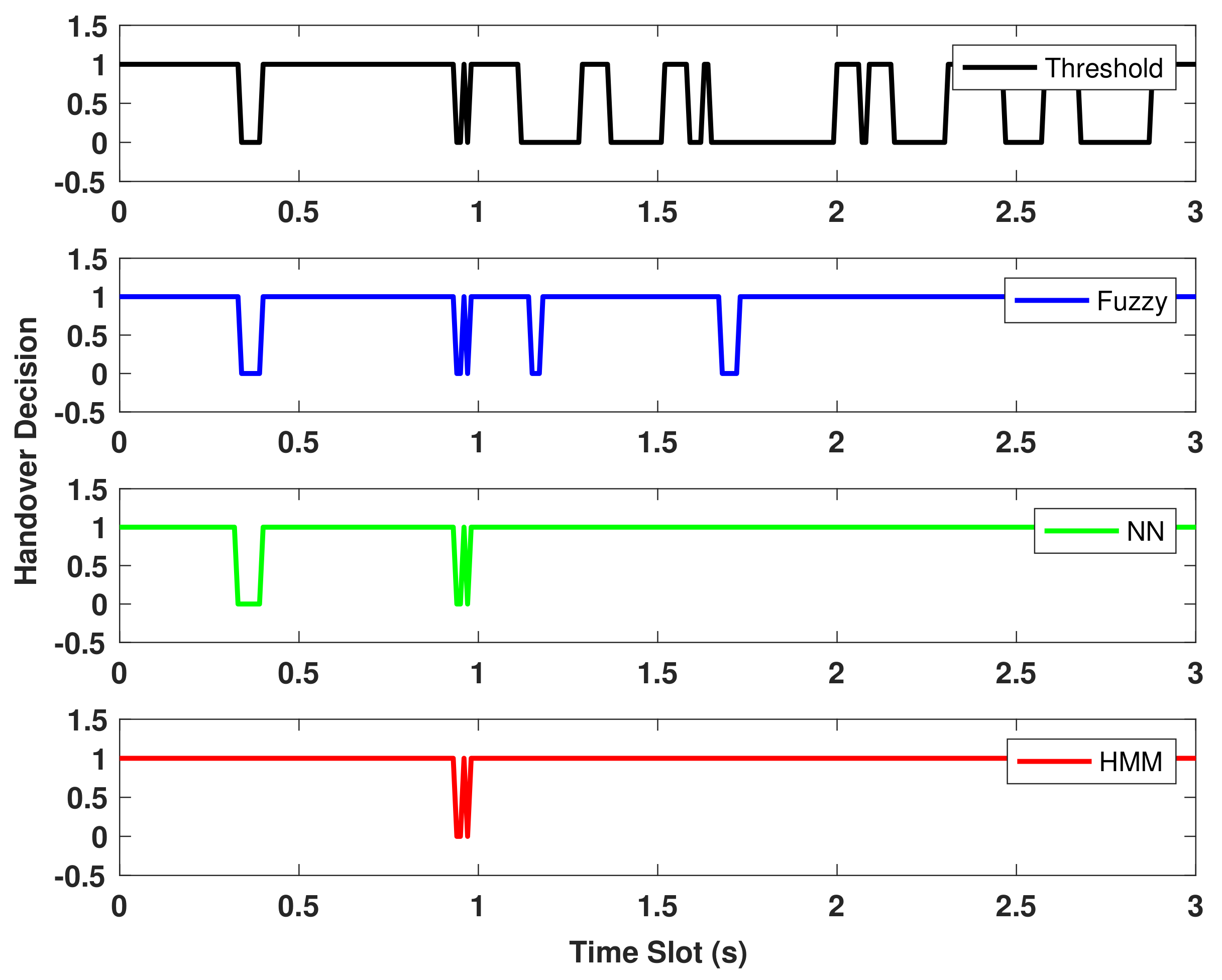
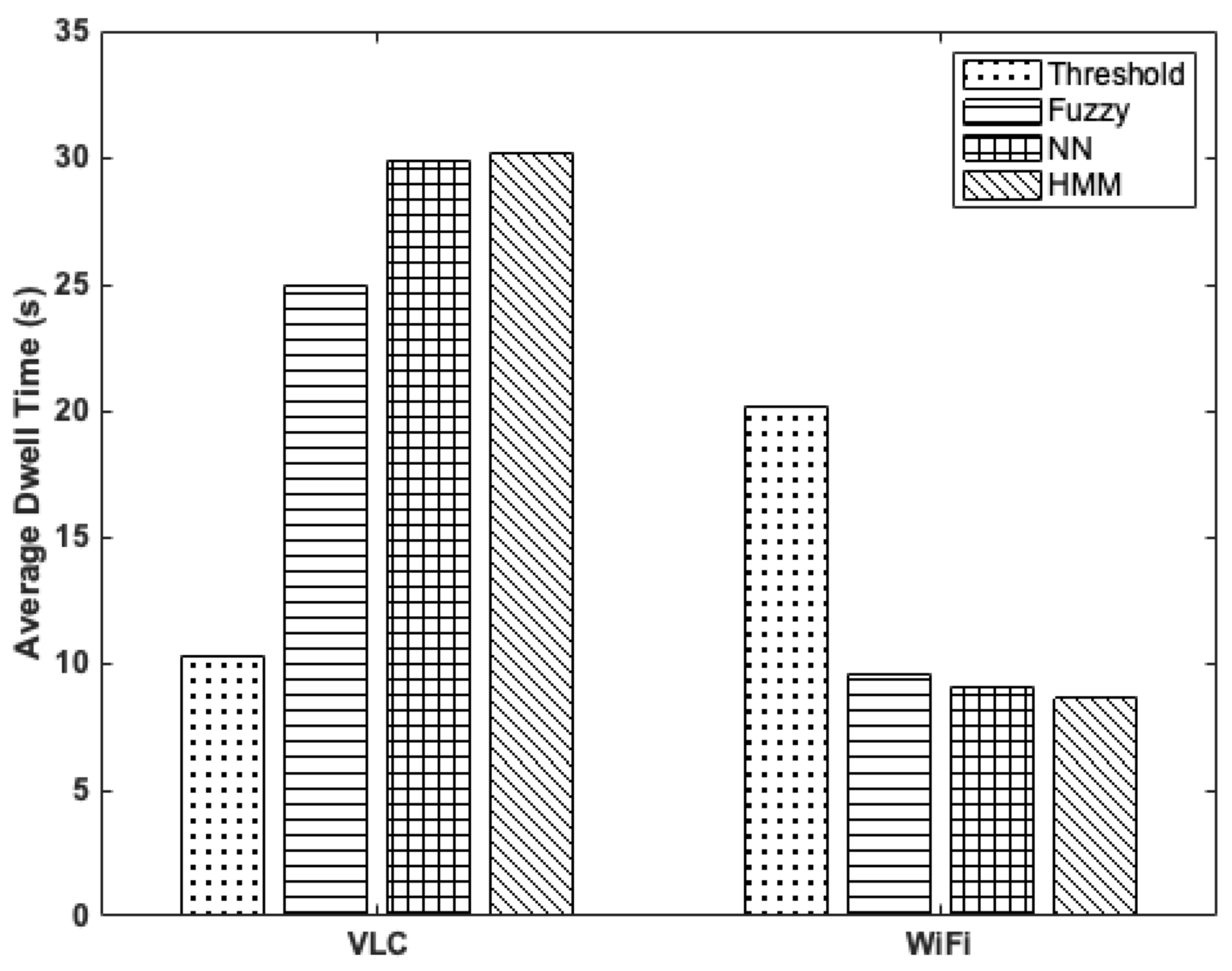
Visible light communication (VLC) channel quality depends on line-of-sight (LoS) transmission, which cannot guarantee continuous transmission due to interruptions caused by blockage and user mobility. Thus, integrating VLC with radio frequency (RF) such asWireless Fidelity (WiFi), provides good quality of experience (QoE) to users. A vertical handover (VHO) scheme that optimizes both the cost of switching and dwelling time of the hybrid VLC–WiFi system is required since blockage on VLC LoS usually occurs for a short period. Hence, an automated VHO algorithm for the VLC–WiFi system based on the hidden Markov model (HMM) is developed in this article. The proposed VHO prediction scheme utilizes the channel characterization of the networks, specifically, the measured received signal strength (RSS) values at different locations. Effective RSS are extracted from the huge datasets using principal component analysis (PCA), which is adopted with HMM, and thus reducing the computational complexity of the model. In comparison with state-of-the-art VHO handover prediction methods, the proposed HMM-based VHO scheme accurately obtains the most likely next assigned access point (AP) by selecting an appropriate time window. The results show a high VHO prediction accuracy and reduced mixed absolute percentage error performance. In addition, the results indicate that the proposed algorithm improves the dwell time on a network and reduces the number of handover events as compared to the threshold-based, fuzzy-controller, and neural network VHO prediction schemes. Thus, it reduces the ping-pong effects associated with the VHO in the heterogeneous VLC–WiFi network.
Keywords: hidden Markov model; principal component analysis; radio frequency; received signal strength; vertical handover; visible light communication; WiFi hidden Markov model; principal component analysis; radio frequency; received signal strength; vertical handover; visible light communication; WiFi