Abstract
The electroencephalogram (EEG) introduced a massive potential for user identification. Several studies have shown that EEG provides unique features in addition to typical strength for spoofing attacks. EEG provides a graphic recording of the brain’s electrical activity that electrodes can capture on the scalp at different places. However, selecting which electrodes should be used is a challenging task. Such a subject is formulated as an electrode selection task that is tackled by optimization methods. In this work, a new approach to select the most representative electrodes is introduced. The proposed algorithm is a hybrid version of the Flower Pollination Algorithm and -Hill Climbing optimizer called FPA-hc. The performance of the FPA-hc algorithm is evaluated using a standard EEG motor imagery dataset. The experimental results show that the FPA-hc can utilize less than half of the electrode numbers, achieving more accurate results than seven other methods.
1. Introduction
Over many years, our world has transferred into a digital community, where each subject lives with an unique digital identifier [1]. Indeed, there are many identifiers, such as identification passwords and cards. At the same time, these identifiers can be easily circumvented, stolen, and forgotten [2]. Therefore, personal characteristics or behaviors can be used to strengthen identification applications. Such techniques, so-called biometrics, use several in-person information to allow more robust identification systems, such as face and voice recognition, fingerprint information, and iris data, among others [3].
On the other hand, the widespread and influential deployment of biometric systems leads to a new challenge, which is called “spoofing” [1,4]. Such an attack is classified as the most dangerous in security systems since it is designed to break the biometrics systems’ security, thus allowing unwarranted persons to obtain admission to the system [2].
In real life, there have already been several spoofing attacks on biometrics systems, such as face spoofing (printed photos and 3D mask attacks [5,6]), fake fingerprints (gummy fingers), finger–vein systems fooled through a piece of paper [7], iris recognition systems fooled by an eyeball opposite to the scanner of iris, and voice recognition fooled by replaying a voice recording opposite to the recognition system speaker [7]. Therefore, people are looking for biometric authentication systems that can grant access to a person based on invisible characteristics, thus becoming harder to be attacked by an external threat. In this context, one shall refer to user authentication based on brain signals, which can be captured by the well-known electroencephalogram (EEG) exam [8].
The EEG is a clinical test that places electrodes on the person’s scalp to detect the brain’s electrical activities, which are further recorded for visualization purposes. Such information reflects the voltage currents inside the brain from ionic flows concerning the neurons’ activity [2]. Approaches to capture electrical brain signals can be categorized as invasive and non-invasive [9], where the former ones require surgery to embed electrodes in the brain. The electrocorticography brain–computer interface (ECoG BCI) is an example, which is usually intended for recording the movements of the arm [2]. Other signal types are used in the non-invasive approaches, such as functional magnetic resonance imaging and magnetoencephalography.
Many studies have proposed to solve issues relevant to identification in biometric applications. For instance, Jayarathne [10] gathered signals as a biometric approach from 21 test subjects to verify their identity. The authors employed the EMOTIV EEG Headset with 14 channels. The Common Spatial Patterns were used for feature extraction and Linear Discriminant Analysis for classification purposes. The proposed approach achieved a recognition rate, which motivated the authors to claim that EEG signals might be an excellent approach to replace PINs when accessing ATMs. However, the selection of relevant channels that produces the optimal subset of EEG features is of prime importance for (i) reducing computational complexity, (ii) reducing over-fitting, and (iii) eliminating inconveniences during clinical application [11]. Table 1 presents some studies we thought might be relevant to EEG channel selection.
Table 1.
Some relevant works related to EEG channel selection.
According to Table 1, many studies have worked on the channel selection problem with different methodologies such as Common Spatial Patterns, optimization, Pearson correlation coefficient, and additional connectivity metrics. Most existing works were implemented based on the data extracted from 64 EEG channels. Furthermore, most works reduced the number of channels and presented significant classification accuracy. In contrast, refs. [10,11] reported good classification performances, but the number of selected channels is still high. On the other hand, some studies have reduced channels up to , but with a moderated classification rate.
Recently, several researchers proposed the use of optimization approaches to solve challenges with non-stationary signals [1,6,12,13]. In addition, EEG-based user identification with supervised classification and optimization methods has shown significant improvements compared to traditional techniques [2,14,15].
Signal acquisition is one of the significant problems concerning the EEG-based user identification technique, which is performed by placing electrodes on the head of a human [19,20,21]. In addition, such a process is usually uncomfortable since it requires good knowledge to place the sensors correctly. Additionally, some questions must be considered: “Is it essential to place all these electrodes on the head of persons?” and “Whether not, may we detect the most significant ones for user identification and then utilize fewer electrodes?”.
The above questions led our work to model the EEG channel selection as an optimization problem. Flower Pollination Algorithm (FPA) is a robust optimization method and has been successfully applied to many real-world problems [22]. Although FPA has proved to be a great success in finding optimal solutions to many issues, it suffers, like metaheuristic algorithms, from the inability to generate new solutions when it is stuck in local minima [23]. According to [1], the authors tested several meta-heuristic algorithms for EEG channel selection, with FPA achieving the most accurate results. However, it still has some problems, such as being stuck in local minima. For this reason, we propose to hybridize FPA with the local search optimizer -hill climbing (-hc) [24].
This work is one of the first to employ hybrid optimization methods with supervised classification methods for biometric user identification using EEG. The main point of hybridizing any two approaches is to complement their advantages and avoid their shortcomings. This work aims to learn the most critical EEG channels by proposing a hybrid approach composed of -hc and FPA, named “FPA-hc”. Therefore, we expect to obtain more accurate results when applying optimization approaches to select optimal EEG channels. The main contributions of this work are summarized as follows:
- To evaluate the proposed FPA-hc for EEG-based user identification. Such a hybrid approach aims to improve local pollination in FPA to avoid being stuck in local minima.
- To perform an extensive study to select the most suitable classifier to guide the optimization process using FPA-hc. Our experiments showed that Support Vector Machines with Radial Basis Function (SVM-RBF) obtained the most effective results, thus being the preferred approach in this work.
The remainder of this article is organized as follows: Section 1 presents the main concepts regarding EEG signals, as well as related works about EEG-based identification. The proposed method is detailed in Section 2. The results are discussed in Section 3, the discussion is provided in Section 4, and the conclusions and future works are set out in Section 5.
2. Proposed Method
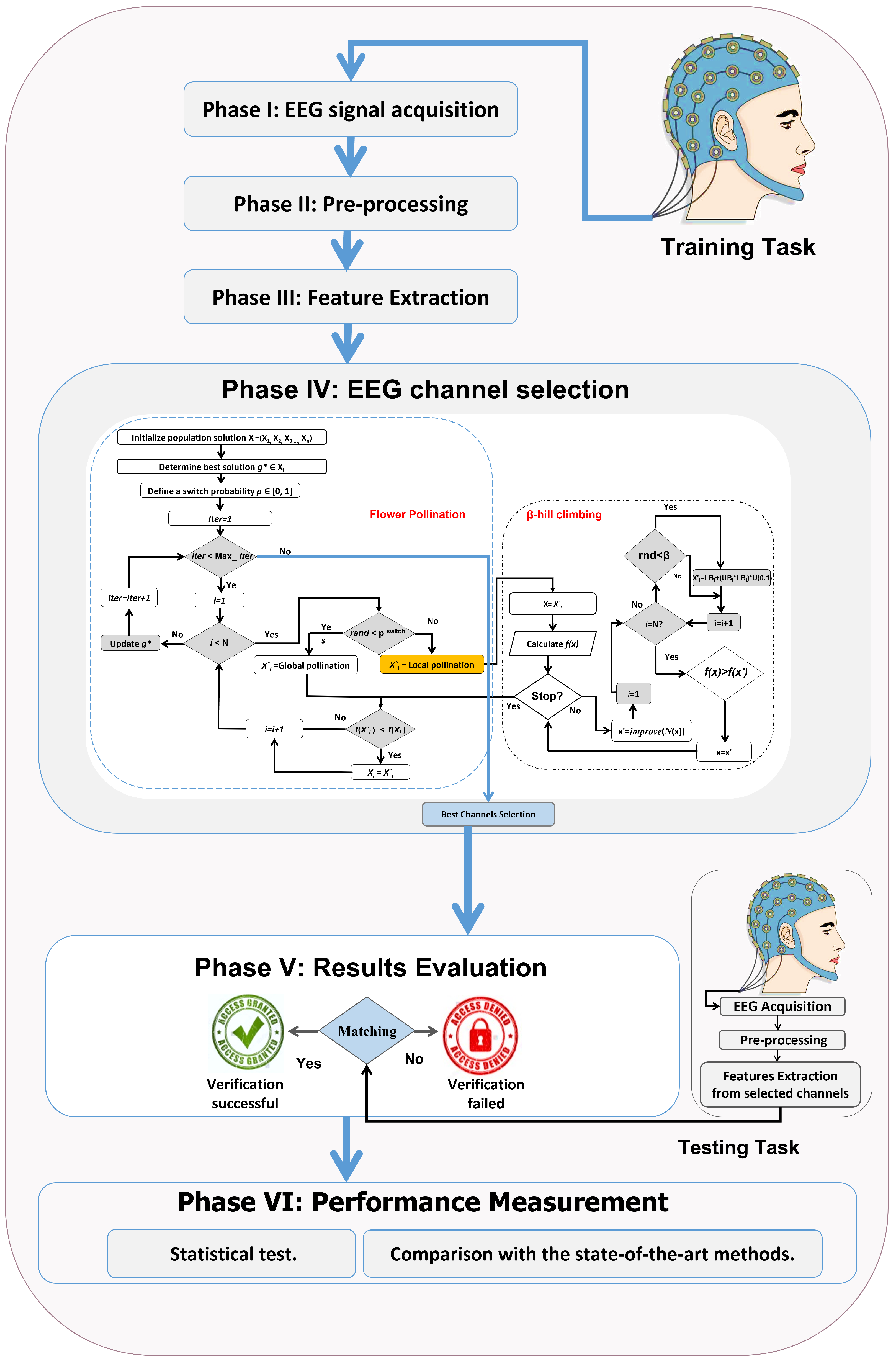
This section provides a detailed explanation of the proposed approach for EEG channel selection through FPA-hc, which comprises five steps such that every stage’s output acts as an input to the other one. The proposed approach is depicted in Figure 1.
Figure 1.
Proposed EEG-based user identification system using FPA-hc.
2.1. EEG Signal Acquisition
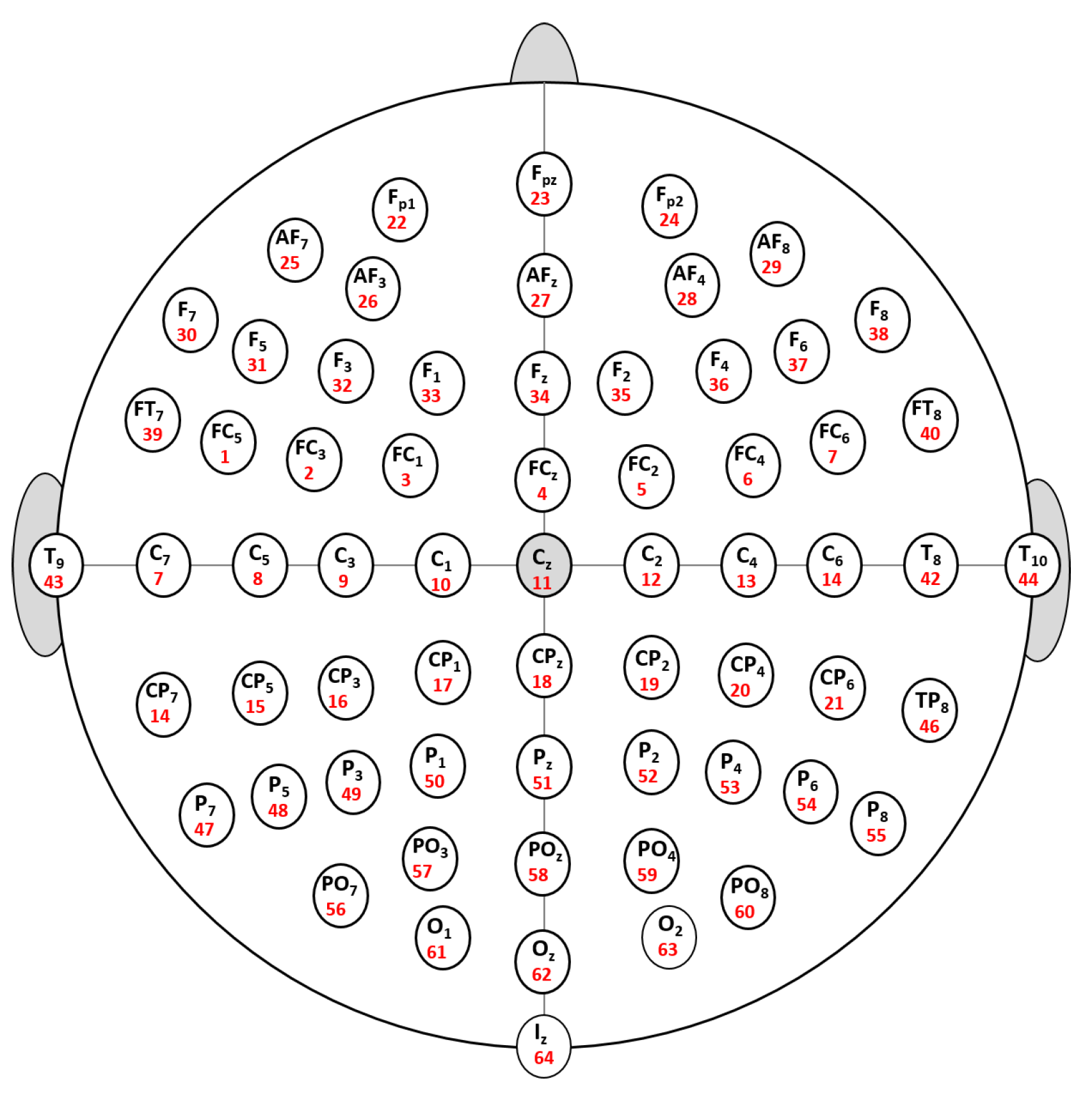
The EEG signal acquisition step is carried out over a typical EEG signal dataset. By using a brain–computer interface software called the BCI2000 system, the EEG signals are gathered from 109 healthy persons [25]. The EEG signals are acquired from 64 electrodes (i.e., channels), and 12 motor/imagery tasks are performed by every subject (i.e., 12 EEG signals records for each individual). Furthermore, AR features with three different numbers of coefficients are derived from these recordings: , , and . To reduce the dispersion of the EEG patterns and quickly process the extracted features, we compute the mean value of each electrode. The electrode distribution used in this work is depicted in Figure 2.
Figure 2.
Distribution of the electrodes used in the study.
2.2. Pre-Processing
The original EEG signal is separated into six sub-signals, each comprising . We utilized a notch filter, and a band-pass for denoising purposes for the EEG signal can be corrupted during recording.
2.3. Feature Extraction
Feature extraction plays a significant role in any authentication system. Therefore, the primary purpose of this step is to find unique information from the EEG signals. In this work, two feature extraction methods have been used to represent features: Wavelet Transform and Auto-regressive (AR) models. This work uses the Yule–Walker method to estimate the AR coefficients using the least-squares method with three different numbers of coefficients, i.e., 5, 10, and 20, as suggested by Rodrigues [1].
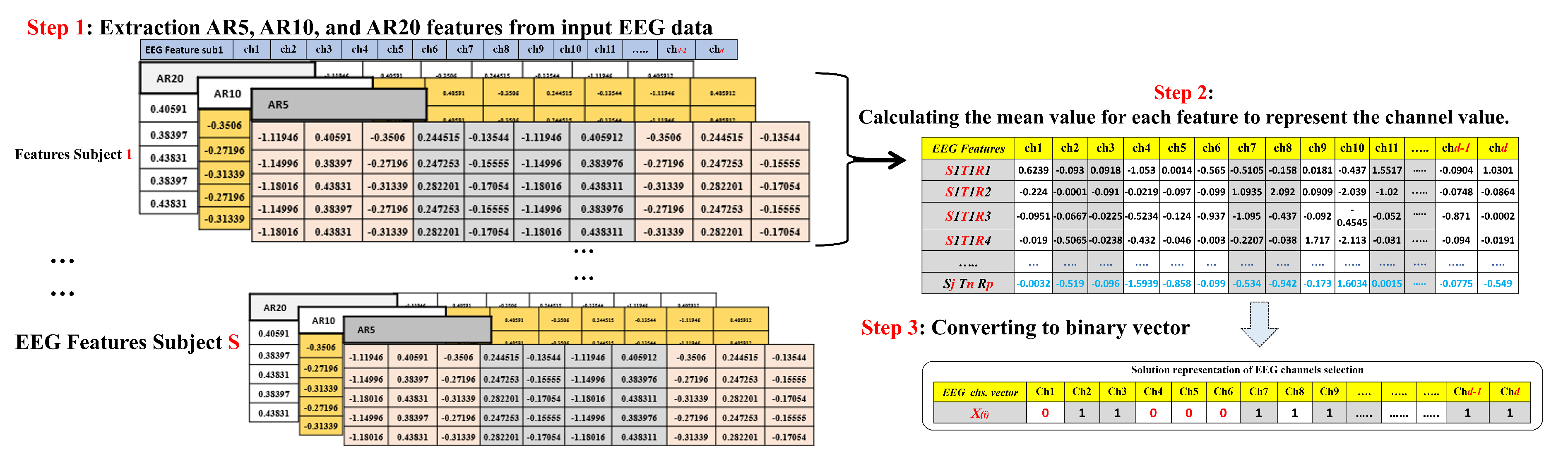
First, we need to keep these features in a standard format of rows and columns. In general, the rows represent the AR feature values of each channel (electrode), and the columns represent the input EEG signals. Finally, a bidimensional matrix will be constructed. Figure 3 shows the final EEG dataset representation from data recorded from several subjects.
Figure 3.
EEG feature representation.
Notably, not all features are helpful for final decisions. Some of them will increase the complexity or will lead to achieving high miss-classification rates. We model the problem of selecting proper AR features as an optimization problem using the objective function defined in Section 2.4, where the channels that achieved the best results are the ones that will be selected.
2.4. Objective Function
Since the proposed method is initially designed to handle continuous-valued optimization problems, we need to map each possible solution onto a binary-valued position, for the EEG channel selection problem requires encoding each possible solution as a binary vector, where ‘0’ means the channel will not be selected and ‘1’ otherwise [1]. To restrict binary solutions only, we need to use the so-called “transfer function” Z, which refers to the Z-shaped transformation function. The primary purpose of using a transformation function is to convert a real-valued solution to another one with binary values suitable for the channel selection problem. This transformation function has been used in [1], where Z can be defined as follows:
where
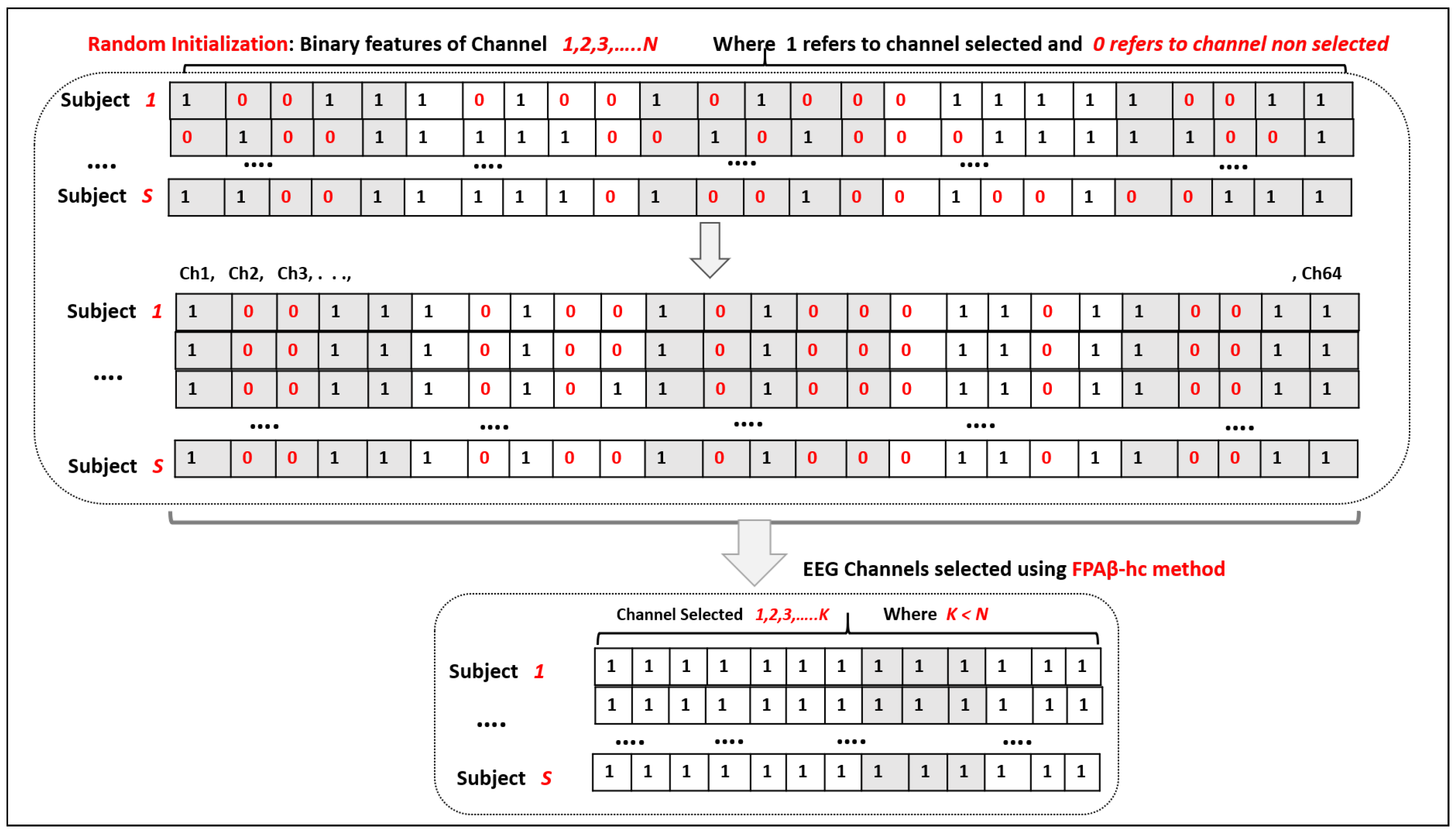
and . Figure 4 illustrates how to build such a binary vector and to select the optimal EEG subset channels using the proposed FPA-hc.
Figure 4.
EEG channel selection using the proposed approach (FPA-hc).
Three steps must be considered when selecting the optimal subset of channels. First, a random initialization of the binary vector (representing the EEG channels) is conducted, where ‘1’ refers that a given channel will be selected, and ‘0’ denotes that the channel will not be selected. Second, the FPA-hc starts searching the space to find the optimal subset of channels, i.e., the one that can provide the highest accuracy rate based on Equation (3). Finally, we discard all channels with ‘0’ values and keep the remaining ones.
The objective function used to evaluate the classification performance of EEG channel selection is formulated below:
where denotes the objective function (accuracy rate) calculated for each row of the AR feature matrix, and , , , and represent the true acceptance, true reject, false acceptance, and false reject rates, respectively.
Algorithm 1 presents the proposed method that employs BFPAhc for EEG-channel selection using the SVM-RBF classifier and Equations (1) and (2) as the transfer function.
| Algorithm 1 Hybridizing Flower Pollination Algorithm with -hill climbing for EEG Channels Selection. |
|
2.5. Experimental Setup
The dataset is partitioned into three subgroups, , which stand for the training, validation, and test sets, respectively. In addition, we decided to use of the dataset for training purposes and and for the test and validation datasets, respectively, as suggested by Rodrigues et al. [1]. We adopted the classification accuracy of a Support Vector Machine with Radial Basis Function (SVM-RBF) over the validation set as the objective function to assist the optimization process. The main idea is to employ training and validation sets to find the subset of EEG features that maximize the classification accuracy over the latter. Finally, we select the best subgroups of channels that provide the highest accuracy rates and train the classifier once more. The final accuracy is assessed over the test set. The experiments have been performed utilizing a Lenovo Ideapad 310 PC, Intel Core-i7 with 2.59 Ghz processor, 8 GB of RAM, and Windows 10. The FPA and FPA-hc parameter values are presented in Table 2. Notice that T refers to the maximum number of iterations used in the experiments. These parameters have been selected based on our previous works [13,24].
Table 2.
Parameter setting up.
3. Results
This section details the experiments used to evaluate the proposed approach; standard approaches in Section 3.1; comparison against standard FPA, -hc, and FPA-hc in Section 3.2; and, finally, comparison with State-of-the-Art in Section 3.3.
3.1. EEG Classification Using Standard Machine Learning Approaches
Eight classifiers are selected from the literature according to their performance in EEG applications and evaluated their effectiveness to guide the optimization process proposed in the work: Linear Support Vector Machines, Artificial Neural Networks (ANN), Optimum-Path Forest (OPF), k-Nearest Neighbors (k-NN), Support Vector Machine with Radial Basis Function, Linear Discriminant Analysis (LDA), Decision Tree (J48), and Naive Bayes. Table 3 presents the parameter setting for these classifiers.
Table 3.
Parameter setting up.
Since the proposed approach is non-deterministic, we computed the mean accuracy rate over 25 runs for avoiding bias outcomes as used in [1]. To evaluate the proposed approach, we considered five measures: (i) Accuracy (Acc), (ii) Number of selected channels (No. Ch), (iii) Sensitivity (Sen), (v) Specificity (Spe), and (iv) F-Score.
Table 4 presents the performance of FPA-hc with different classifiers. Regarding AR model, it has been observed that FPA-hc-SVM-RBF outperforms all methods on all evaluation measurements. The LDA stands out as the second-best approach with the five best values of Acc, Sen, Spe, and F-Score measures. Concerning and , FPA-hc-SVM-RBF outperforms other methods for all evaluation metrics. Similar to its performance in , LDA stands out as the second-best performance method with the five best values for Acc, Sen, Spe, and F-Score in and models. One of the exciting details in Table 4 concerns that the proposed method (FPA-hc-SVM) achieved zero misclassification rates with the model.
Table 4.
Comparison against FPA-hc-SVM-RBF and other classifiers.
Furthermore, a statistical test is applied to determine whether there is a significant difference between FPA-hc-SVM-RBF and others. This study stated a null hypothesis as follows: “channel subset chosen by FPA-hc-SVM-RBF for user authentication is no better than channel subset chosen by FPA-hc with other classifiers”. The statistical test is based on the classification accuracy obtained by all methods on the testing data. A t-test was conducted to test the hypothesis in this study, where the significance level was set to . As one can observe in Table 5, the p-value for all tests was below 0.05, which means the hypothesis is rejected. Accordingly, the channel subset obtained by FPA-hc-SVM-RBF is significantly better than FPA-hc with other classifiers, thus handling EEG-based person identification better.
Table 5.
t-test result between FPA-hc-SVM-RBF and other approaches.
3.2. Comparison against Standard FPA, -hc, and FPA-hc
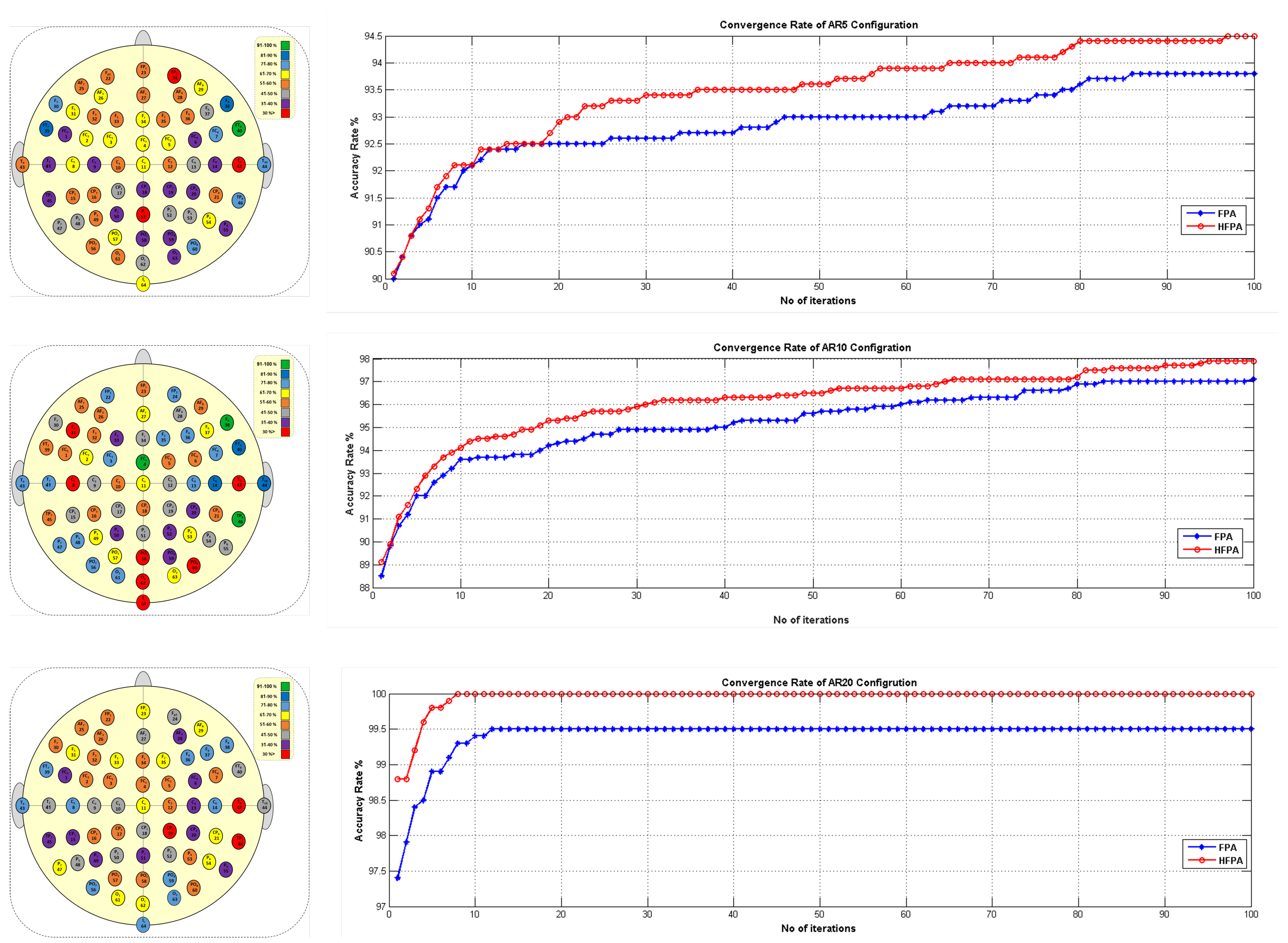
After selecting the best classifier for the EEG-based person identification problem (i.e., SVM-RBF), standard FPA, -hc, and FPA-hc are compared to select the best one for further comparison with some state-of-the-art techniques. Figure 5 depicts the convergence ratio, and the frequency of chosen electrodes for standard FPA and FPA-hc for 25 runs during the experimental evaluation using AR-5, AR-10, AR-20, and Wavelet Transform .
Figure 5.
Convergence rate and the frequency of channel selection for FPA-hc and FPA.
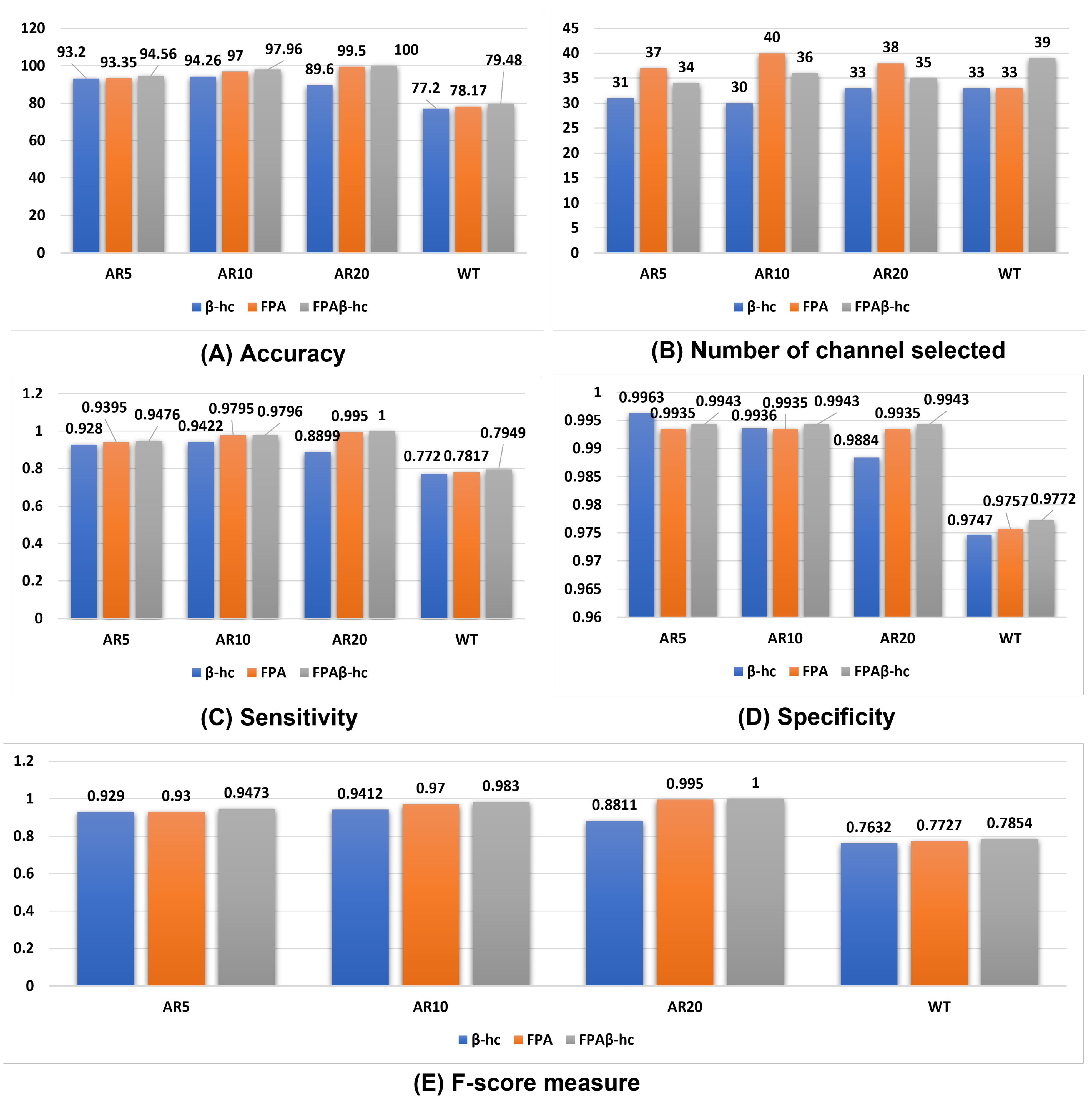
Table 6 presents the overall results concerning the comparison between standard FPA, -hc, and FPA-hc. It is clear from the experimental outcomes that the proposed method considerably improves the results considering all auto-regressive coefficients. Regarding the number of selected channels, the proposed approach showed quite good performance. On the other hand, -hc selected the lowest number of channels, but it yielded worse results than the proposed method concerning the remaining measures (i.e., Acc, Sen, Spe, and F-Score). Even though -hc obtained the lowest number of channels, it has less classification accuracy when compared with FPA-hc.
Table 6.
Comparison between FPA, -hc and FPA-hc.
The proposed approach provides an excellent compromise between the number of selected channels and the remaining evaluation measurements compared to -hc. Figure 6 depicts the results considering all measures. Additionally, we conducted the Wilcoxon signed-rank statistical test to check if there is a substantial variance between standard FPA and FPA-hc. The statistical outcomes are tabulated in Table 7 in terms of P-value, w-value, z-value, and T-Sig. For all experiments (i.e., AR models and ), FPA-hc results are significantly better than basic FPA. The proposed FPA-hc-SVM obtained success in achieving the best results compared with standard FPA and -hc EEG channel selection. This points out the power of hybridization to complement their advantage and avoid their shortcomings (i.e., FPA and -hc).
Figure 6.
Performance results of the proposed approach over different feature extraction methods.
Table 7.
Wilcoxon signed-rank test between FPA and FPA-hc.
3.3. Comparison with State-of-the-Art
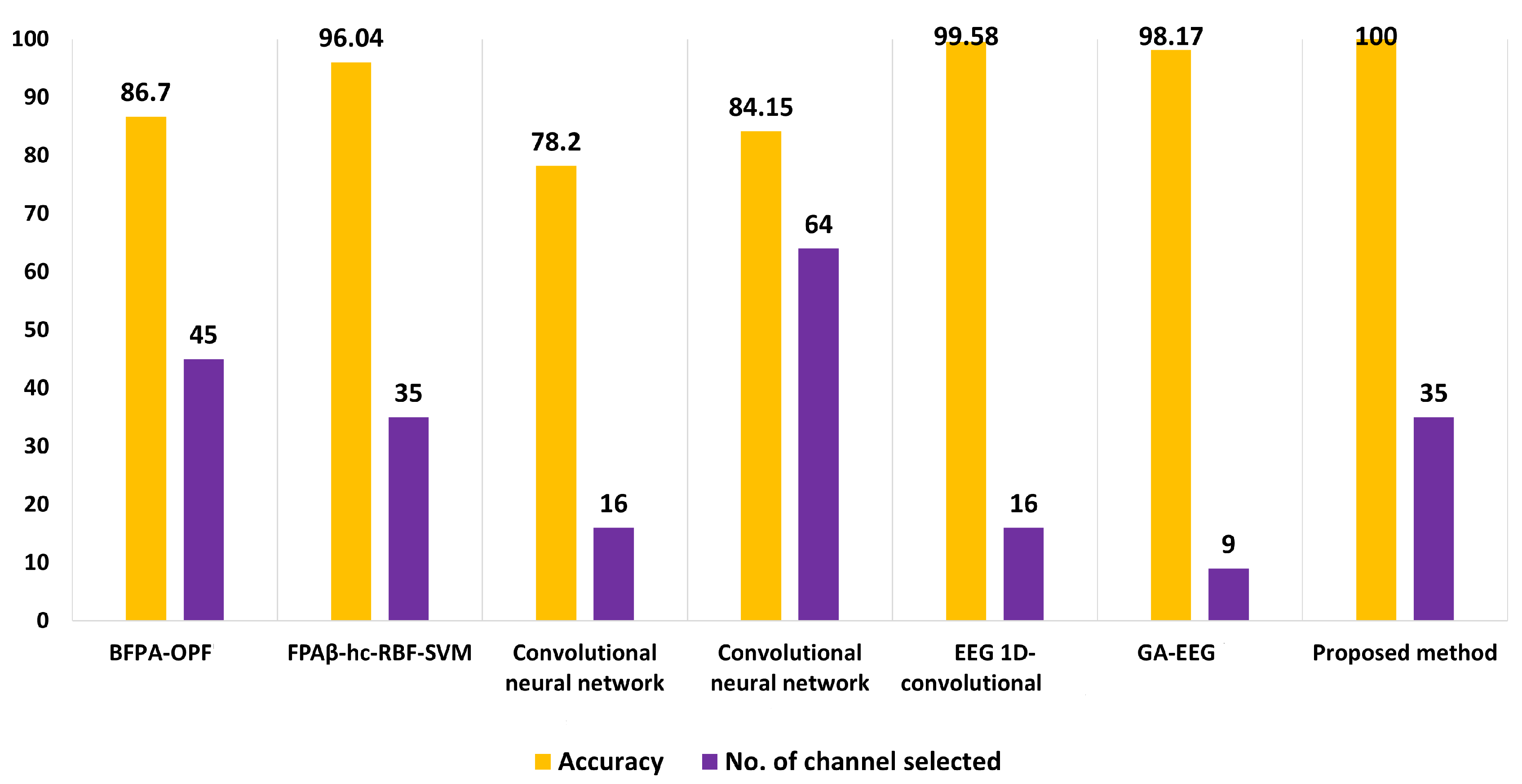
The proposed FPA-hc-SVM-RBF is compared against six different state-of-the-art approaches. These methods were carefully selected from the literature, where some are used as a metaheuristic algorithm to select the optimal number of channels: Binary Flower pollination Algorithm with OPF classifier (BFPA-OPF) [1], hybrid FPA with -hill climbing [2], Genetic algorithm (GA) [26], and a deep learning approach proposed in [27,28]. The comparison involved two criteria, i.e., the accuracy rate and the number of selected channels. The proposed FPA-hc showed significant superiority in accuracy criteria, achieving of recognition rate. However, concerning the number of selected, it is ranked third. Figure 7 and Table 8 present a comparison of the accuracy rate using the proposed approach against the methods mentioned earlier.
Figure 7.
Comparison of the proposed approach with state-of-art methods.
Table 8.
Comparison of the proposed method (FPA-hc-SVM) with state-of-the-art approaches.
4. Discussions
As aforementioned, the primary purpose of this study is to evaluate the proposed FPA-hc-SVM for EEG-based user identification. In this work, we modeled the channel selection task as an optimization problem and introduced the SVM classifier for EEG-based biometric user identification. One can observe the proposed methods achieved similar accuracy rates using SVM considering three different autoregressive coefficients and wavelet features, with an advantage to FPA-hc-SVM when compared to standard FPA and -hc optimizers.
Concerning the number of selected channels, FPA-hc-SVM has succeeded in reducing up to half of the total electrodes. The proposed algorithm reduced the total number of electrodes from 64 to 34, 36, 35, and 39 for , , , and , respectively. Moreover, we can observe that different coefficients provide different accuracy rates regarding the EEG-based person identification task. The proposed approach obtained of accuracy using only 35 sensors and with features.
Another exciting feature of FPA-hc-SVM concerns the location of the selected electrodes. It is worth noticing that the proposed method showed that the most common sensors are located on the frontal, occipital, and parietal lobes, although they also spread along with the head. Such finding is an interesting observation, which means FPA-hc-SVM tried to identify channels not too close to each other to obtain relevant details from all over the human brain. Table 6 shows a comparison of the proposed method against some state-of-the-art techniques. It is worth noting that FPA-hc-SVM achieved the highest accuracy rate when compared to other methods. However, considering the number of selected channels, some improvements are still needed to achieve a minimum number of channels selected, such as the application of multi-objective optimization.
Compared with the previous work, the proposed approach achieved more accurate results using the same feature extraction method (AR). The accuracy rate was , while the number of channels selected is 32 for the previous work. Here, the proposed method achieved an accuracy rate of using 34 channels for the AR features. Overall, the proposed method archived the best accuracy results () with only 35 channels, where the previous work achieved the best results with an accuracy of 96 with the same number of selected channels (i.e., 35 channels).
5. Conclusions and Future Works
In this work, we proposed a hybrid approach composed of the Flower Pollination Algorithm and the -hill climbing algorithm (FPA-hc-SVM) to address the challenge of channel selection in EEG-based biometric person identification. The hybrid approach between FPA and -hc algorithm has been designed to improve the local pollination part of the FPA to overcome local minima. It is worth mentioning that another version of hybrid FPA was also introduced in [2]. However, the main differences between the proposed approach and the previous ones are: (i) the hybridization in [2] is used to enhance the quality of the best-achieved solution, but here, the hybridization is used for local pollination solutions; (ii) the feature extraction techniques used in [2] were time domain, frequency domain, and time-frequency domain, and the feature extraction methods used here are computed by wavelet features and auto-regressive features; (iii) furthermore, in [2], the 10-fold cross-validation method is used for the training–testing stage, while in this study, a training–validation–testing stage is used.
The primary purpose of this work is to demonstrate that all electrodes are not needed to achieve a high accuracy rate. Therefore, this paper is introduced to model the problem of channel selection as an optimization problem. The channel’s subset that optimizes the recognition ratio over a validation set is employed as the fitness function.
The proposed approach (FPA-hc-SVM) is tested using a standard EEG dataset with 64 EEG channels and the data recorded from 109 individuals. In addition, the performance of the proposed method is evaluated using five criteria, which are (i) Accuracy, (ii) F-Score, (iii) Recall, (v) Specificity, and (iv) the number of the channel selected. The FPA-hc-SVM was tested using two different feature extraction methods, i.e., Wavelet feature s() and Auto-regressive models with three different coefficients (i.e., AR, AR, and AR). The outcomes of the experiments presented the introduced method excelled both standard FPA and the one proposed by [1,2,26,27,28]. It is worth noting that, while retaining high accuracy rates, the number of sensors has been lessened by half. Additionally, the outcomes displayed a positive correlation between the number of features obtained from the EEG signal and the accuracy ratio. Such a finding suggests that the proposed approach can remove duplicate and undesirable features while retaining specific features.
On the other hand, the current version of the proposed algorithm has some limitations, which are as follows:
- The proposed algorithm was tested by splitting EEG datasets into three subgroups, i.e., training, validating, and test sets. This approach may lead to overfitting the results. We recommended trying the FPA-hc-SVM using k-fold-cross-validation approach instead.
- The FPA-hc-SVM technique was tested using features and auto-regressive models only. Future work may recommend testing the proposed method over different features. In addition, we recommend investigating the usage of a multi-objective approach.

Author Contributions
Conceptualization, Z.A.A.A., O.A.A., J.P.P. and M.A.A.-B.; methodology, Z.A.A.A., P.K., K.H.A. and O.T.; software, Z.A.A.A.; validation, S.K., M.A.M., P.K. and O.T.; formal analysis, M.A.A.-B., and O.A.A.; investigation, Z.A.A.A. and K.H.A.; resources, J.P.P. and M.A.M.; data correction, P.K. and S.K.; writing—original draft preparation, Z.A.A.A., O.A.A., J.P.P., M.A.A.-B. and O.T.; writing—review and editing, Z.A.A.A., M.A.M., P.K. and O.T.; visualization, O.A.A.; supervision, S.K. and M.A.M.; project administration, S.K.; funding acquisition, M.A.M. All authors have read and agreed to the published version of the manuscript.
Funding
This research received no external funding.
Institutional Review Board Statement
Not applicable.
Informed Consent Statement
Not applicable.
Data Availability Statement
Not applicable.
Acknowledgments
This research work was partially supported by Chiang Mai University and research network team to contribute the best research.
Conflicts of Interest
The authors declare no conflict of interest.
Abbreviations
The following abbreviations are used in this manuscript:
| BFPA | Binary Flower Pollination Algorithm |
| -hc | Hill Climbing |
| EEG | Electroencephalogram |
| ECoG-BCI | Electrocardiography Brain-Computer Interface |
| FPA | Flower Pollination Algorithm |
| RBF | Radial Basis Function |
| SVM | Support Vector Machines |
| GA | Genetic Algorithm |
| GWO | Grey Wolf Optimizer |
| MRI | Magnetic Resonance Imaging |
| EA | Evolutionary-based Algorithms |
| TAs | Trajectory-based Algorithms |
| SI | Swarm Intelligence |
References
- Rodrigues, D.; Silva, G.F.; Papa, J.P.; Marana, A.N.; Yang, X.S. EEG-based person identification through binary flower pollination algorithm. Expert Syst. Appl. 2016, 62, 81–90. [Google Scholar] [CrossRef] [Green Version]
- Alyasseri, Z.A.A.; Khader, A.T.; Al-Betar, M.A.; Alomari, O.A. Person identification using EEG channel selection with hybrid flower pollination algorithm. Pattern Recognit. 2020, 105, 107393. [Google Scholar] [CrossRef]
- Al-Qazzaz, N.K.; Alyasseri, Z.A.A.; Abdulkareem, K.H.; Ali, N.S.; Al-Mhiqani, M.N.; Guger, C. EEG feature fusion for motor imagery: A new robust framework towards stroke patients rehabilitation. Comput. Biol. Med. 2021, 137, 104799. [Google Scholar] [CrossRef] [PubMed]
- Alyasseri, Z.A.A.; Khader, A.T.; Al-Betar, M.A. Electroencephalogram signals denoising using various mother wavelet functions: A comparative analysis. In Proceedings of the International Conference on Imaging, Signal Processing and Communication, Penang, Malaysia, 26–28 July 2017; pp. 100–105. [Google Scholar]
- Souza, L.; Oliveira, L.; Pamplona, M.; Papa, J. How Far Did We Get in Face Spoofing Detection? Eng. Appl. Artif. Intell. 2018, 72, 368–381. [Google Scholar] [CrossRef]
- Alyasseri, Z.A.A.; Abasi, A.K.; Al-Betar, M.A.; Makhadmeh, S.N.; Papa, J.P.; Abdullah, S.; Khader, A.T. EEG-Based Person Identification Using Multi-Verse Optimizer as Unsupervised Clustering Techniques. In Evolutionary Data Clustering: Algorithms and Applications; Springer: Singapore, 2021; p. 89. [Google Scholar]
- Marcel, S.; Nixon, M.S.; Li, S.Z. Handbook of Biometric Anti-Spoofing; Springer: London, UK, 2014. [Google Scholar]
- Campisi, P.; La Rocca, D. Brain waves for automatic biometric-based user recognition. IEEE Trans. Inf. Forensics Secur. 2014, 9, 782–800. [Google Scholar] [CrossRef]
- Ramadan, R.A.; Vasilakos, A.V. Brain computer interface: Control signals review. Neurocomputing 2017, 223, 26–44. [Google Scholar] [CrossRef]
- Jayarathne, I.; Cohen, M.; Amarakeerthi, S. BrainID: Development of an EEG-based biometric authentication system. In Proceedings of the 2016 IEEE 7th Annual Information Technology, Electronics and Mobile Communication Conference (IEMCON), Vancouver, BC, Canada, 13–15 October 2016; pp. 1–6. [Google Scholar]
- Kaur, B.; Singh, D. Neuro signals: A future biomertic approach towards user identification. In Proceedings of the IEEE 2017 7th International Conference on Cloud Computing, Data Science & Engineering-Confluence, Noida, India, 12–13 January 2017; pp. 112–117. [Google Scholar]
- Alyasseri, Z.A.A.; Khader, A.T.; Al-Betar, M.A.; Yang, X.S.; Mohammed, M.A.; Abdulkareem, K.H.; Kadry, S.; Razzak, I. Multi-objective flower pollination algorithm: A new technique for EEG signal denoising. Neural Comput. Appl. 2022, 1–20. [Google Scholar] [CrossRef]
- Alyasseri, Z.A.A.; Khader, A.T.; Al-Betar, M.A.; Papa, J.P.; Alomari, O.A. EEG Feature Extraction for Person Identification using Wavelet Decomposition and Multi-Objective Flower Pollination Algorithm. IEEE Access 2018, 6, 76007–76024. [Google Scholar] [CrossRef]
- Abdi Alkareem Alyasseri, Z.; Alomari, O.A.; Al-Betar, M.A.; Awadallah, M.A.; Hameed Abdulkareem, K.; Abed Mohammed, M.; Kadry, S.; Rajinikanth, V.; Rho, S. EEG Channel Selection Using Multiobjective Cuckoo Search for Person Identification as Protection System in Healthcare Applications. Comput. Intell. Neurosci. 2022, 2022, 5974634. [Google Scholar] [CrossRef] [PubMed]
- Alyasseri, Z.A.A.; Alomari, O.A.; Makhadmeh, S.N.; Mirjalili, S.; Al-Betar, M.A.; Abdullah, S.; Ali, N.S.; Papa, J.P.; Rodrigues, D.; Abasi, A.K. EEG Channel Selection for Person Identification Using Binary Grey Wolf Optimizer. IEEE Access 2022, 10, 10500–10513. [Google Scholar] [CrossRef]
- Fraschini, M.; Didaci, L.; Marcialis, G.L. EEG-based personal identification: Comparison of different functional connectivity metrics. bioRxiv 2018, 254557. [Google Scholar] [CrossRef] [Green Version]
- Gaur, P.; McCreadie, K.; Pachori, R.B.; Wang, H.; Prasad, G. An automatic subject specific channel selection method for enhancing motor imagery classification in EEG-BCI using correlation. Biomed. Signal Process. Control. 2021, 68, 102574. [Google Scholar] [CrossRef]
- Idowu, O.P.; Adelopo, O.; Ilesanmi, A.E.; Li, X.; Samuel, O.W.; Fang, P.; Li, G. Neuro-evolutionary approach for optimal selection of EEG channels in motor imagery based BCI application. Biomed. Signal Process. Control. 2021, 68, 102621. [Google Scholar] [CrossRef]
- Alyasseri, Z.A.A.; Khader, A.T.; Al-Betar, M.A.; Papa, J.P.; Alomari, O.A.; Makhadmeh, S.N. Classification of EEG mental tasks using Multi-Objective Flower Pollination Algorithm for Person Identification. Int. J. Integr. Eng. 2018, 10. Available online: https://publisher.uthm.edu.my/ojs/index.php/ijie/article/view/3478 (accessed on 21 January 2022). [CrossRef]
- Alyasseri, Z.A.A.; Khader, A.T.; Al-Betar, M.A.; Papa, J.P.; Osama, A.A.; Makhadme, S.N. An efficient optimization technique of EEG decomposition for user authentication system. In Proceedings of the 2nd International Conference on BioSignal Analysis, Processing and Systems (ICBAPS), Kuching, Malaysia, 24–26 July 2018; pp. 25–31. [Google Scholar]
- Alyasseri, Z.A.A.; Khader, A.T.; Al-Betar, M.A.; Papa, J.P.; ahmad Alomari, O. EEG-based person authentication using multi-objective flower pollination algorithm. In Proceedings of the 2018 IEEE Congress on Evolutionary Computation (CEC), Rio de Janeiro, Brazil, 8–13 July 2018; pp. 1–8. [Google Scholar]
- Yang, X.S. Flower pollination algorithm for global optimization. In International Conference on Unconventional Computing and Natural Computation; Springer: Berlin/Heidelberg, Germany, 2012; pp. 240–249. [Google Scholar]
- Alyasseri, Z.A.A.; Al-Betar, M.A.; Awadallah, M.A.; Makhadmeh, S.N.; Abasi, A.K.; Doush, I.A.; Alomari, O.A. A Hybrid Flower Pollination with β-Hill Climbing Algorithm for Global Optimization. J. King Saud Univ.-Comput. Inf. Sci. 2021, in press. [Google Scholar] [CrossRef]
- Al-Betar, M.A. β-Hill climbing: An exploratory local search. Neural Comput. Appl. 2017, 28, 153–168. [Google Scholar] [CrossRef]
- Schalk, G.; McFarland, D.J.; Hinterberger, T.; Birbaumer, N.; Wolpaw, J.R. BCI2000: A general-purpose brain-computer interface (BCI) system. IEEE Trans. Biomed. Eng. 2004, 51, 1034–1043. [Google Scholar] [CrossRef]
- Albasri, A.; Abdali-Mohammadi, F.; Fathi, A. EEG electrode selection for person identification thru a genetic-algorithm method. J. Med. Syst. 2019, 43, 1–12. [Google Scholar] [CrossRef] [PubMed]
- Karácsony, T.; Hansen, J.P.; Iversen, H.K.; Puthusserypady, S. Brain computer interface for neuro-rehabilitation with deep learning classification and virtual reality feedback. In Proceedings of the 10th Augmented Human International Conference 2019, Reims, France, 11–12 March 2019; pp. 1–8. [Google Scholar]
- Sun, Y.; Lo, F.P.W.; Lo, B. EEG-based user identification system using 1D-convolutional long short-term memory neural networks. Expert Syst. Appl. 2019, 125, 259–267. [Google Scholar] [CrossRef]
Publisher’s Note: MDPI stays neutral with regard to jurisdictional claims in published maps and institutional affiliations. |
© 2022 by the authors. Licensee MDPI, Basel, Switzerland. This article is an open access article distributed under the terms and conditions of the Creative Commons Attribution (CC BY) license (https://creativecommons.org/licenses/by/4.0/).