1. Introduction
In target tracking and localization problems, target–sensor geometries are known to play a significant role in determining the localization and tracking performance. In this paper, we focus on optimal target–sensor geometries for angle-of-arrival (AOA) localization in the 2D plane using a single moving sensor. First, the localization problem is cast as a Bayesian estimation problem, which assumes the availability of prior information in the form of a Gaussian prior for the unknown target location. For this problem, optimal sensor placement results are developed using approximate estimation bounds. Next, the Bayesian estimation problem is extended to target tracking using the Kalman filter, and optimal sensor trajectories are developed to track a manoeuvring target.
Optimal sensor placement has been researched for several decades. Early works included [
1,
2,
3], where the performance of the extended Kalman filter (EKF) [
4] and several deterministic (non-Bayesian) estimators was reported for different bearings-only sensor manoeuvres, mostly in sonar applications. In [
5], optimal bearings-only sensor manoeuvres for tracking a constant-velocity target were derived using optimal control theory. The sensor trajectory optimization problem was formulated as a partially observable Markov decision problem (POMDP) for a manoeuvring target using the trace of FIM, which is similar to the A-optimality criterion (minimizing trace of inverse FIM), as the reward function in [
6]. In [
7], the D-optimality criterion, whereby the sensor location is determined to maximize the determinant of the Fisher information matrix (FIM), was adopted to determine optimal sensor trajectories for the localization of a stationary target. Optimal sensor manoeuvres necessary to make a constant-velocity target observable were discussed in [
8]. The sensor trajectory optimization problem in the Bayesian sense was considered in [
9], where the posterior Cramer–Rao lower bound (PCRLB) [
10] was employed to minimize the largest root-mean-square-error (RMSE)-bound approximated by the reciprocal of measurement data contributions to target location information.
A comprehensive analysis of the 2D optimal AOA sensor placement problem for a stationary target was presented in [
11,
12]. Optimal 3D AOA target–sensor geometries for a stationary target were analysed in [
13]. A gradient-descent algorithm for sensor path optimization to minimize the mean-square error of predicted EKF target location estimates was proposed in [
14]. A UAV path optimization algorithm that solves a nonlinear programming problem based on the D-optimality criterion was developed in [
15] to geolocate a stationary target using a heterogeneous mix of passive payload sensors. In [
16], a unified framework was proposed for AOA, range-only, and received signal strength localization when the target was stationary. Optimal target–sensor geometries for maximum a posteriori (MAP) target localization with a Gaussian prior were investigated in [
17]. In [
18], the optimality criteria for target–sensor geometries in a Kalman filtering setting were analysed for several sensor types using an approximation of the Bayesian FIM. A unified 2D target–sensor geometry optimization framework was proposed in [
19] for stationary target localization with a Gaussian prior, reducing the optimization problem to minimization of the modulus of a vector sum, akin to [
11]. In [
20], optimal sensor placement in 3D space was studied for AOA target localization with a Gaussian prior, employing rotational invariance arguments.
This paper develops optimal sensor placement results for a single AOA sensor at a fixed distance from the mean of the Gaussian prior. To do this, the Bayesian FIM is approximated by replacing the expectation of the contribution form measurement data with its instantaneous value calculated at the mean of the Gaussian prior. It is argued that this approximation is valid when the covariance of the Gaussian prior is relatively small compared with the target range. The optimal sensor placements for the D- and A-optimality criteria are shown to be identical and align with the minor axis of the error ellipse of the prior covariance. In the context of bearings-only manoeuvring target tracking, numerical search methods based on the D- and A-optimality criteria and a new closed-form projection algorithm that attempts to achieve alignment with the minor axis of the prior covariance error ellipse are proposed for sensor trajectory optimization subject to turn-rate constraints. It is observed that the D- and A-optimality criteria yield markedly different optimal sensor trajectories even though they produce identical optimal sensor placement for the localization of a stationary target. The projection algorithm is shown to outperform the other two methods in simulation studies.
This paper is organized as follows.
Section 2 investigates the optimal sensor placement problem for a stationary target with a Gaussian prior using the D- and A-optimality criteria.
Section 3 extends the results of
Section 2 to Kalman filter tracking of a manoeuvring target, proposing two sensor trajectory optimization methods and a new closed-from projection algorithm.
Section 4 presents simulation examples to verify the optimal sensor placement results derived in
Section 2 and to compare and demonstrate the effectiveness of the sensor trajectory optimization algorithms proposed in
Section 3. Concluding remarks are made in
Section 5.
2. Optimal Target-Sensor Geometry with Gaussian Prior
In tracking problems with a state space that can be modelled or approximated as a Gauss–Markov process, the Kalman filter has been extensively used to compute the Gaussian prior for state estimates from the noisy sensor measurements available in each recursion in the form of the predicted state estimate and predicted state covariance. Starting with the Gaussian prior
, where
is the mean and
is the covariance of the prior, the objective of optimal sensor placement is to determine a sensor location
at a fixed distance of
, where
, from the mean of the Gaussian prior (or predicted target location estimate)
so that sensor measurements collected at the new sensor location will optimize a well-defined objective function that is related to the Bayesian localization performance. The new measurements together with the Gaussian prior are then used to compute the filtered state estimate and covariance, which are optimized in terms of target–sensor geometry. We consider two optimality criteria for sensor placement: namely, the D-optimality and A-optimality criteria [
21,
22,
23], which are commonly used in practice. Referring to
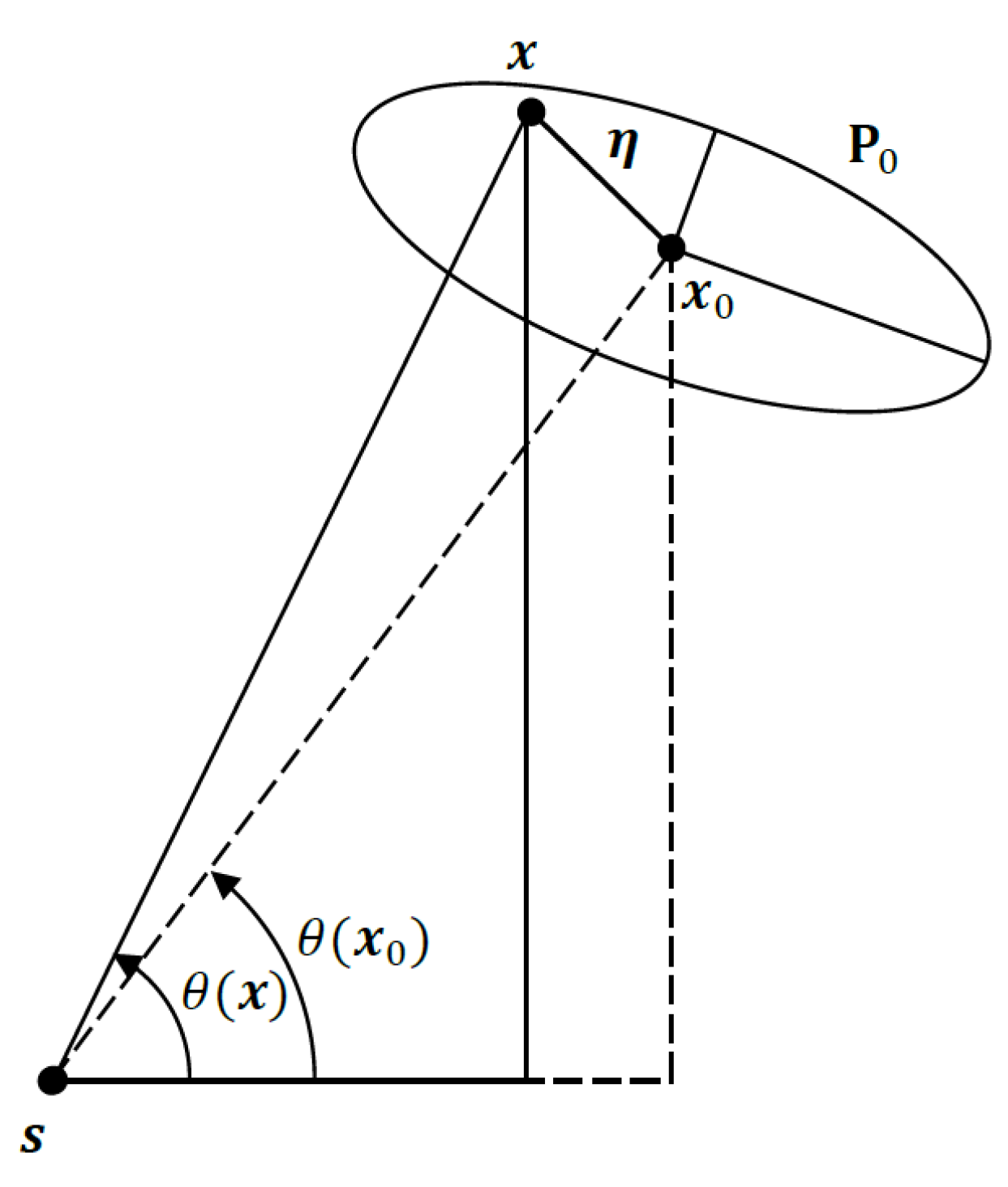
Figure 1, the task of geometry optimization is reduced to finding a range vector
or bearing angle
pivoted at the mean of the Gaussian prior with
fixed, which gives the location of the sensor to satisfy the chosen optimization criterion.
The bearing measurements collected by the sensor located at
are given by
where
is the Bayesian prior,
is the bearing angle noise, and
is the true bearing angle with
and
. In (
2),
is the four-quadrant arc-tangent. The objective of Bayesian estimation is to determine an estimate for the unknown random target location
from the bearing measurement
and the knowledge of the Gaussian prior with mean
and covariance
.
The optimality criteria considered in this paper employ estimation bounds obtained from the FIM or CRLB. In Bayesian estimation problems that involve random unknown parameters, these bounds are replaced by the Bayesian FIM (BFIM) or Bayesian CRLB (BCRLB). The BFIM for the single-sensor AOA localization problem is defined as [
24]
where
denotes the expectation over
,
is the unit vector orthogonal to the range vector, and
is the target range from the sensor positioned at
. The matrix
represents the contribution of the a priori information, and
is the contribution of data. The inverse of the BFIM gives the BCRLB.
Equation (
5) can be rewritten as
which gives
The approximation in (
9) is valid for a sufficiently “small” prior covariance compared with the target range. Here, we measure the size of prior covariance by its trace (see (
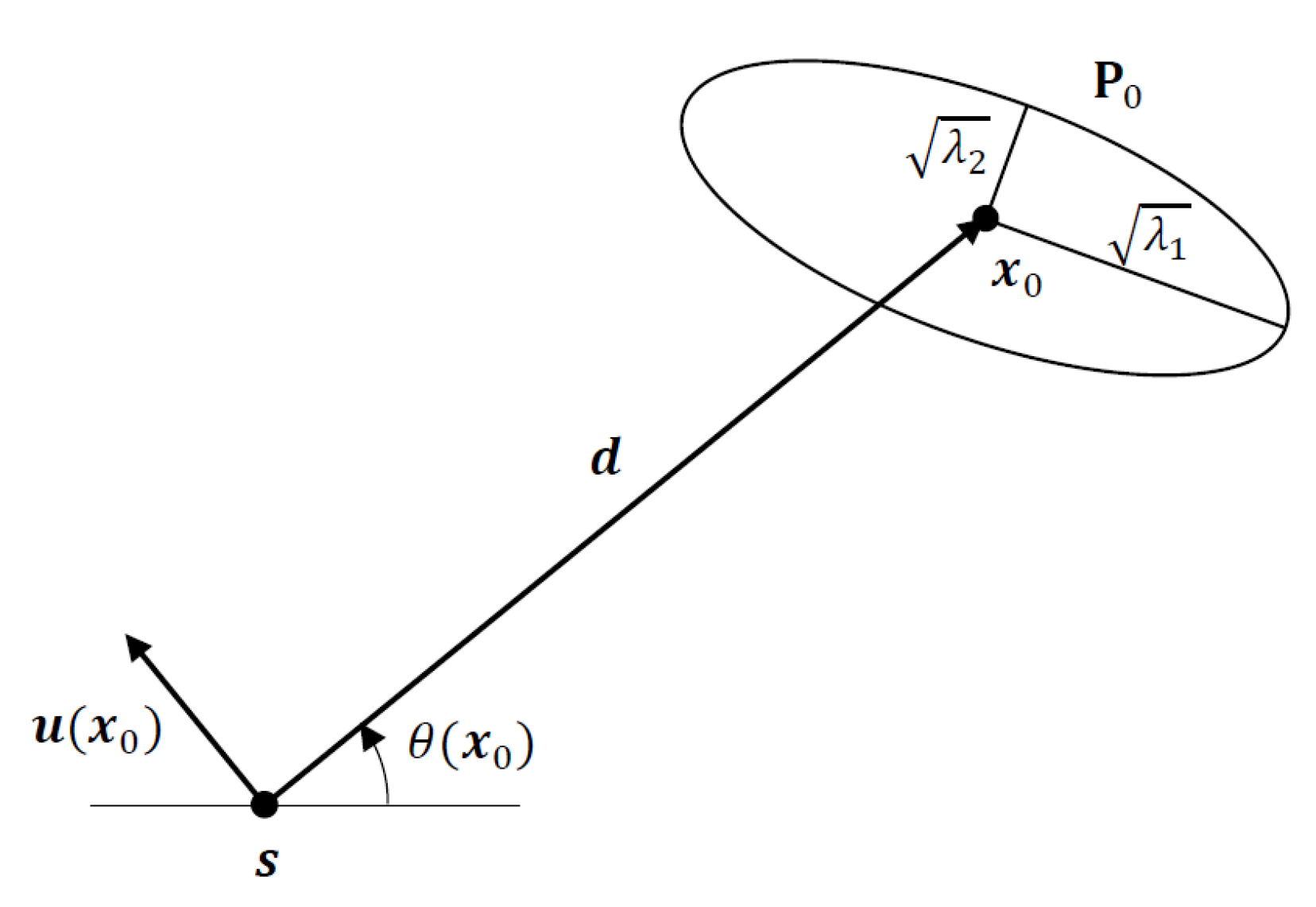
16)). Referring to
Figure 2, we have
where
, and
. Taking the expectation of the squared sine function yields
if
Here, tr denotes trace. Applying the same line of reasoning to
and
, we conclude that (
16) is the condition that must be met to justify (
9).
2.1. D-Optimality Criterion
The
D-optimality criterion aims to maximize the determinant of the Fisher information matrix (FIM). For the Bayesian estimation problem considered here, the FIM is replaced by the Bayesian FIM (BFIM). Considering the optimization problem described in
Figure 1, the optimal placement for the sensor is obtained from the solution of
where
denotes the determinant. The optimization problem in (
17) determines the sensor location
that maximizes the determinant of BFIM for a given Gaussian prior.
Noting that in (
9)
is a square matrix and
is a column vector, the determinant of the BFIM can be rewritten as a sum of two terms [
25]
where
is the adjoint of
, defined by
Thus, for a given Gaussian prior
and fixed
d, the optimization problem in (
17) reduces to
Since
is a unit vector, (
21) is a problem of quadratic form maximization over the unit circle. Using the eigenvalues of
, denoted by
with
, the solution of (
21) is given by [
26]:
where
is an orthonormal eigenvector of
corresponding to
. The optimal bearing angle for the sensor,
, is easily obtained from the optimal unit vector
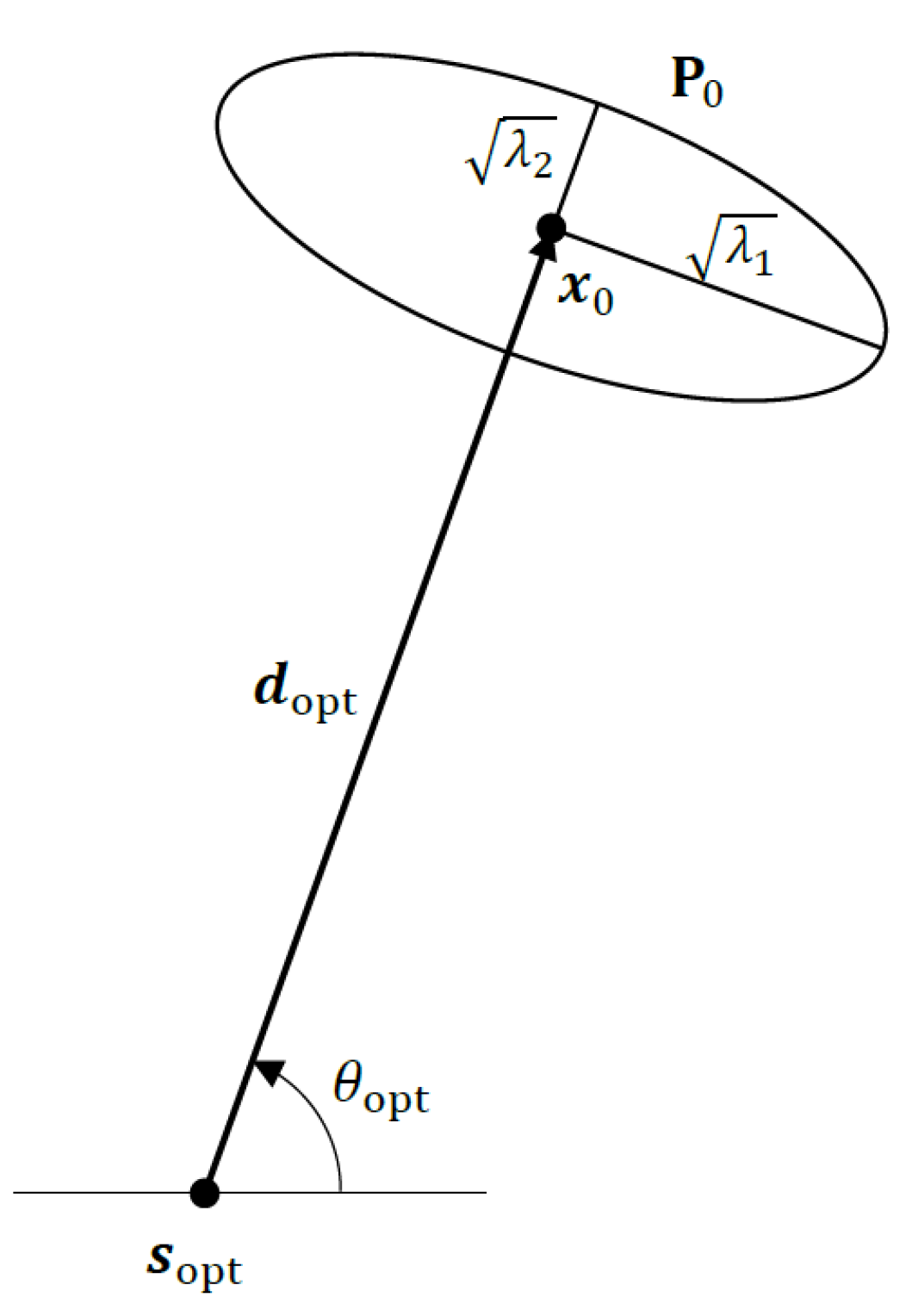
by noting that it is orthogonal to the range vector (see
Figure 1). In other words, the optimal range vector
must be aligned with the minor axis of the error ellipsoid of the Gaussian prior, as shown in
Figure 3.
Some remarks are in order here:
If the Gaussian prior has a circular error ellipse with
given by a scaled identity matrix, (
21) becomes
which means that optimality is achieved by any bearing angle
.
In all other cases, there are two optimal bearing angles aligned with the minor axis of the error ellipse, producing two possible optimal sensor locations with range vectors symmetric about .
2.2. A-Optimality Criterion
The objective of the
A-optimality criterion is to minimize the trace of the BCRLB or the inverse BFIM. In this case, the optimal sensor placement is obtained from
Applying the matrix inversion lemma [
27] to the approximate BFIM in (
9), we get
It is clear that to solve (
25), we need to maximize the trace of the second term on the right-hand side of (
26); i.e.,
or
To solve (
28) for
, let
and set its gradient equal to zero,
which results in
Left-multiplying both sides of the above equation with
finally gives
where the nonzero scalar
R is an eigenvalue of
and the unit vector
is the corresponding eigenvector. We therefore conclude that
R is maximized when
, which is the eigenvector of
associated with its largest eigenvalue
. Note that this optimality result is identical to that for the A-optimality criterion derived in
Section 2.1.
3. Application to Tracking
In this section, sensor waypoint optimization algorithms are devised to embed the optimal sensor placement results derived in
Section 2 into the Kalman filter. As a specific application, bearings-only manoeuvring target tracking is considered. When the target is moving, it is often the case that the target dynamics and constraints on the motion of a single sensor, such as turn-rates and distances between successive waypoints, do not allow strictly optimal sensor placement geometries to be achieved from one Kalman filter recursion to the next. We develop sensor trajectory optimization methods that respect dynamic sensor constraints.
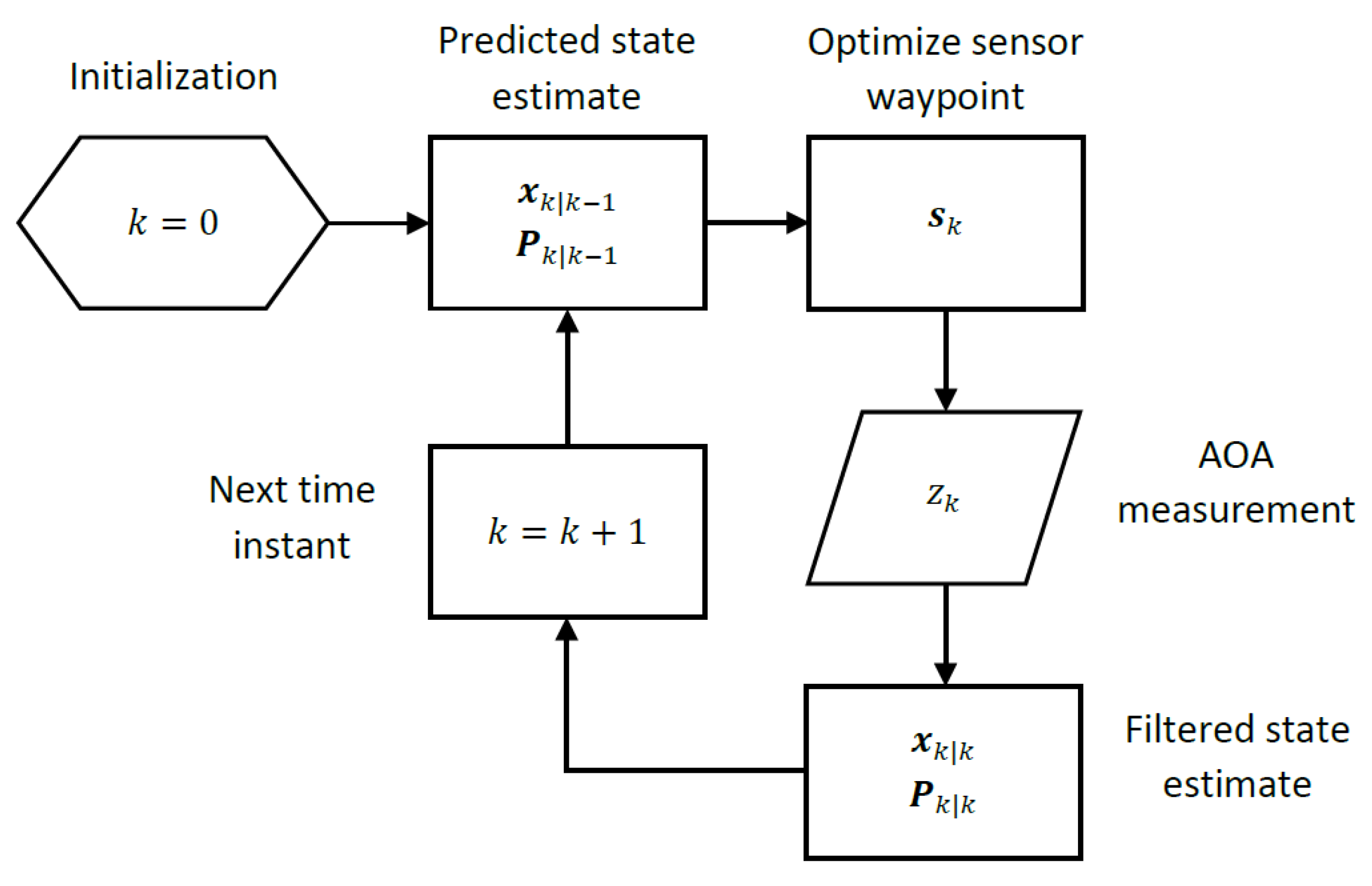
The principle we follow is based on the treatment of each Kalman filter recursion as solving a Bayesian target localization problem with a Gaussian prior available from the previous recursion and measurements taken at a new optimized sensor location to compute filtered state estimates and an updated prior for the next Kalman filter recursion.
Figure 4 captures the computational steps of a Kalman filter recursion with sensor waypoint optimization embedded into it. The details of how optimal sensor waypoints are computed from Kalman filter parameters are discussed later in the section.
The single moving sensor collects AOA measurements from a manoeuvring target at time instants
. The sensor location at time
k is denoted by
. The process equation for the target is
where
is the target state vector with
and
denoting the target location and velocity, respectively, at time
k. In (
34) the dynamical constraint (the state transition matrix) is given by
where
T denotes the time interval between discrete-time instants
k. The process noise
accounts for unknown target manoeuvres and is zero-mean white Gaussian with covariance
where
and
are often determined from maximum target acceleration [
28].
The AOA measurement equation is
where
is the bearing angle of the target from the sensor location [see (
2)], and
is the bearing measurement noise. As the measurement Equation (
37) is nonlinear, the extended Kalman filter (EKF) is often used to estimate the target state vector, which is given by the recursion:
State Update:
where
is the state prediction at time
k given all measurements up to time
, and
is the filtered state estimate at time
k. The EKF replaces the nonlinear measurement Equation (
37) with
where
is the Jacobian of
evaluated at
:
Here,
is the target–sensor range estimate computed from
and
, and
is the unit vector defined in (
4).
The moving AOA sensor is assumed to travel with a constant velocity, which means that the distance between successive waypoints is constant, i.e.,
. Assuming a maximum turn-rate of
in azimuth, the next waypoint is constrained to lie on an arc defined by
where
is the sensor heading vector with heading angle
at time instant
k.
The recursive BFIM for the Kalman filter tracking problem is given by [
24]
where
is the Jacobian matrix in (
45) calculated at target state
. Equation (
47) has the same structure as (
3) in that it is the sum of prior information
and contribution from measurements
. It is necessary to simplify (
47) so that readily available Kalman filter estimates can be used rather than resorting to computationally expensive Monte Carlo simulations to calculate the expectation.
The contribution from measurements is approximated by
where
is the Jacobian in (
45). Thus, using
as the prior information and (
48) as the contribution from measurements, we have
where both
and
are calculated by the EKF. In the following subsections, we show how to apply the D- and A-optimality criteria to the approximate recursive BFIM expression in (
49) to derive trajectory optimization algorithms.
3.1. Sensor Trajectory Optimization Using D-Optimality
Referring to (
21) and (
49), the optimal waypoint for the sensor at time
k using the D-optimality for the EKF takes the following form:
which can be rewritten as
where
is the set of permissible waypoints compliant with the turn-rate
and
is the
covariance matrix for predicted target location, which is extracted from
as shown below:
Note that as
also depends on
(i.e., the fixed range constraint does not apply), (
51) does not have a simple closed-form solution. This means that it must be solved by a numerical search over a finite number of permissible waypoints contained in the set
.
3.2. Sensor Trajectory Optimization Using A-Optimality
Using (
28), the A-optimality criterion for sensor waypoints is given by
which is obtained by substituting
for
and
for
into (
28).
Different from the D-optimality criterion in (
51), (
55) depends not only on the target range
through the Jacobian
, but also the bearing noise variance
. Again, it is not straightforward to solve (
55) for the optimal
. A numerical search over the members of the set
is necessary.
3.3. Projection Algorithm: A Closed-Form Solution
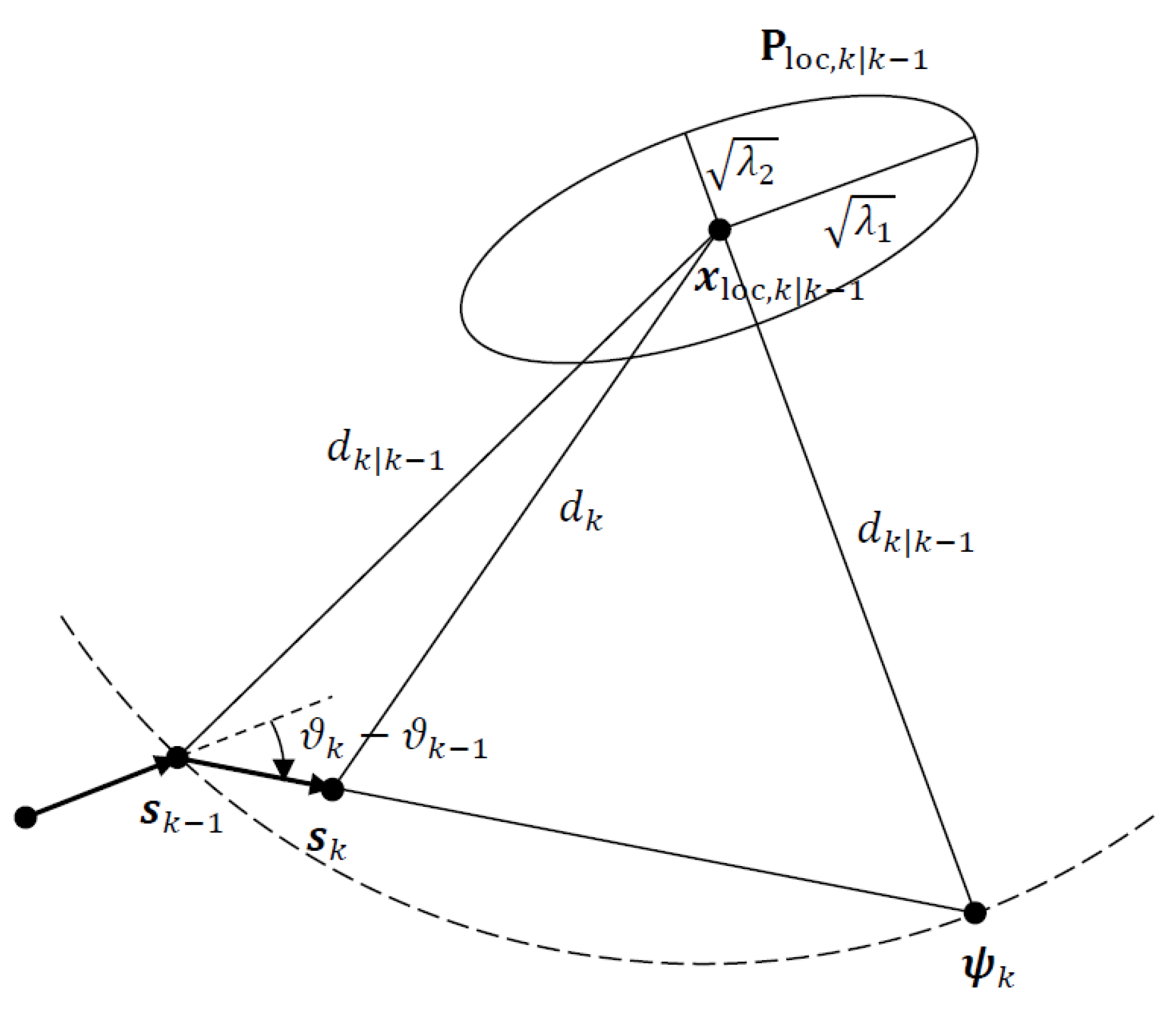
The D- and A-optimality solutions for determining optimal sensor waypoints described above can be computationally expensive, especially if the numerical search must be carried out over a large number of candidate waypoints in the set . In this subsection, we present an alternative closed-form solution, called the projection algorithm, inspired by the ultimate objective of aligning the sensor with the minor axis of the prior covariance error ellipse.
The idea behind the projection algorithm is illustrated in
Figure 5. The next waypoint
is chosen to guide the sensor towards the closest point
that is aligned with the minor axis of the target location prior
and is at the same distance from the mean of the prior
as the estimated target–sensor range
. The next waypoint is found by projecting the waypoint vector
to
subject to the turn-rate constraint. If the projection causes the sensor heading angle to exceed the turn-rate, the next waypoint is chosen to have the maximum turn-rate. This projection also brings the sensor closer to the target with
. The reduction in
is proportional to how far
is from
. If
is aligned with the major axis of the error ellipse, which represents the worst geometry, the distance between
and
is maximized and
will have the maximum reduction.
This behaviour makes sense because the optimality of a target–sensor geometry is improved at the maximum rate by moving the sensor directly towards the optimal sensor location for the given Gaussian prior with mean and covariance .
A detailed description of the projection algorithm is provided in Algorithm 1.
| Algorithm 1 Projection algorithm. |
| Input: , , , , , s |
|
Output:
|
| Calculate , eigenvector of associated with its smallest eigenvalue |
|
Calculate |
| Calculate |
| If |
| |
| Else |
| |
| End |
| If (sensor is already aligned with prior covariance minor axis) |
| Return (no change in sensor heading) |
| Else |
| Calculate |
| Calculate , (∠ denotes bearing angle) |
| If |
| Return |
| Else |
| Calculate |
| Return |
| End |
| End
|
4. Simulation Examples
This section presents simulation examples to verify the optimization results and to demonstrate the performance of the sensor trajectory optimization algorithms developed in
Section 2 and
Section 3. In the first set of simulations, the focus is on optimal target–sensor geometries using the D- and A-optimality criteria for Bayesian target localization. The Gaussian prior has zero mean
and covariance
with eigenvalues
and
. The minor axis of the error ellipse make an angle of
with the positive
x-axis. The AOA sensor is allowed to be located on a circle of radius
km centred at the mean of the Gaussian prior
, and the bearing angle noise standard deviation is
.
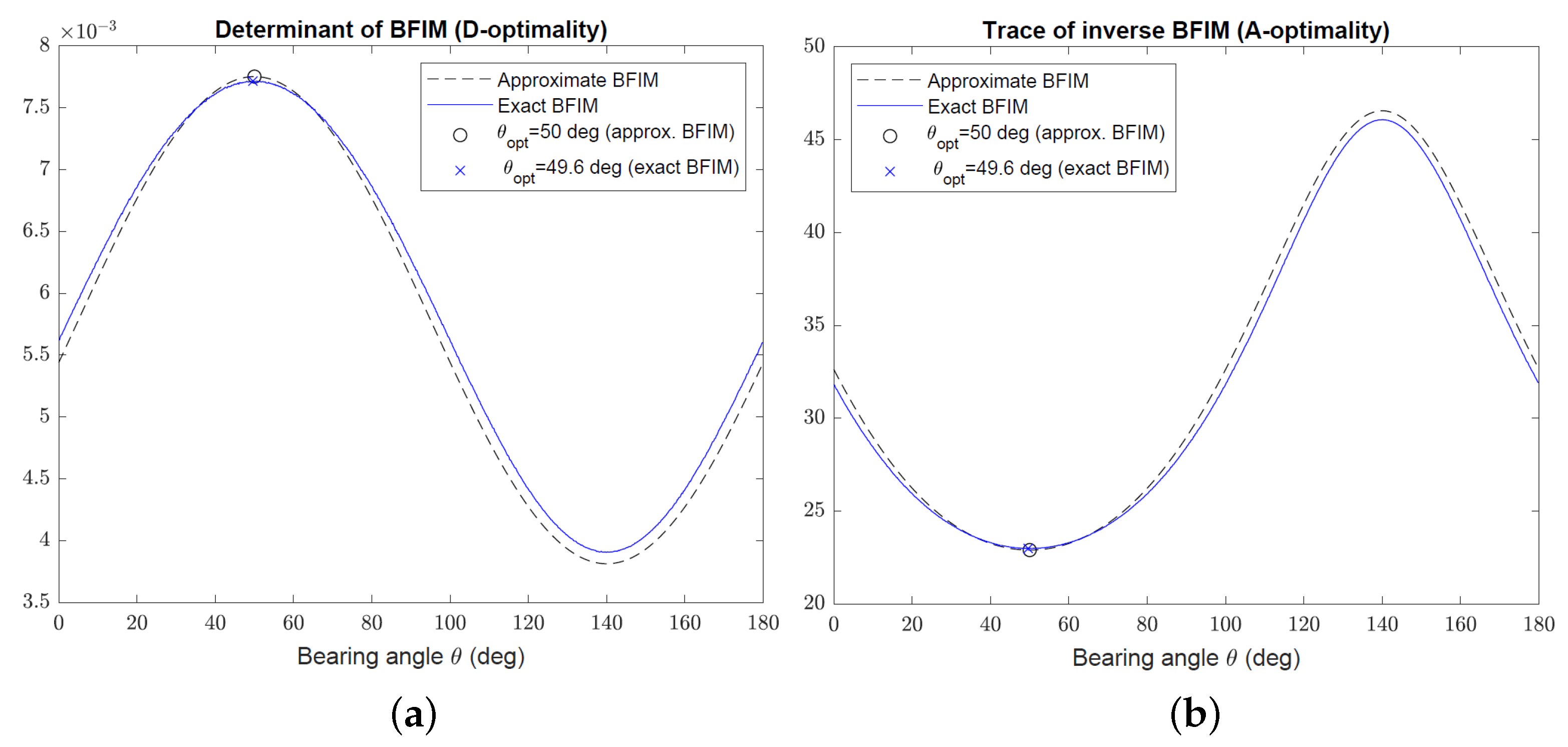
Figure 6 shows the D- and A-optimality measures,
and
, respectively, versus the bearing angle
in the range
for the approximate and exact BFIM given by (
9) and (
3), respectively. The exact BFIM was calculated using 50,000 Monte Carlo runs for each bearing angle. As evident from
Figure 6, the simulated optimal bearing angles are not significantly different for the approximate and exact BFIM. This is also backed up by the close proximity of the two curves in
Figure 6. The optimal bearing angle obtained from the approximate BFIM aligns with the minor axis of the error ellipse at
for both D- and A-optimality criteria, which is in agreement with the analytical results derived in
Section 2.
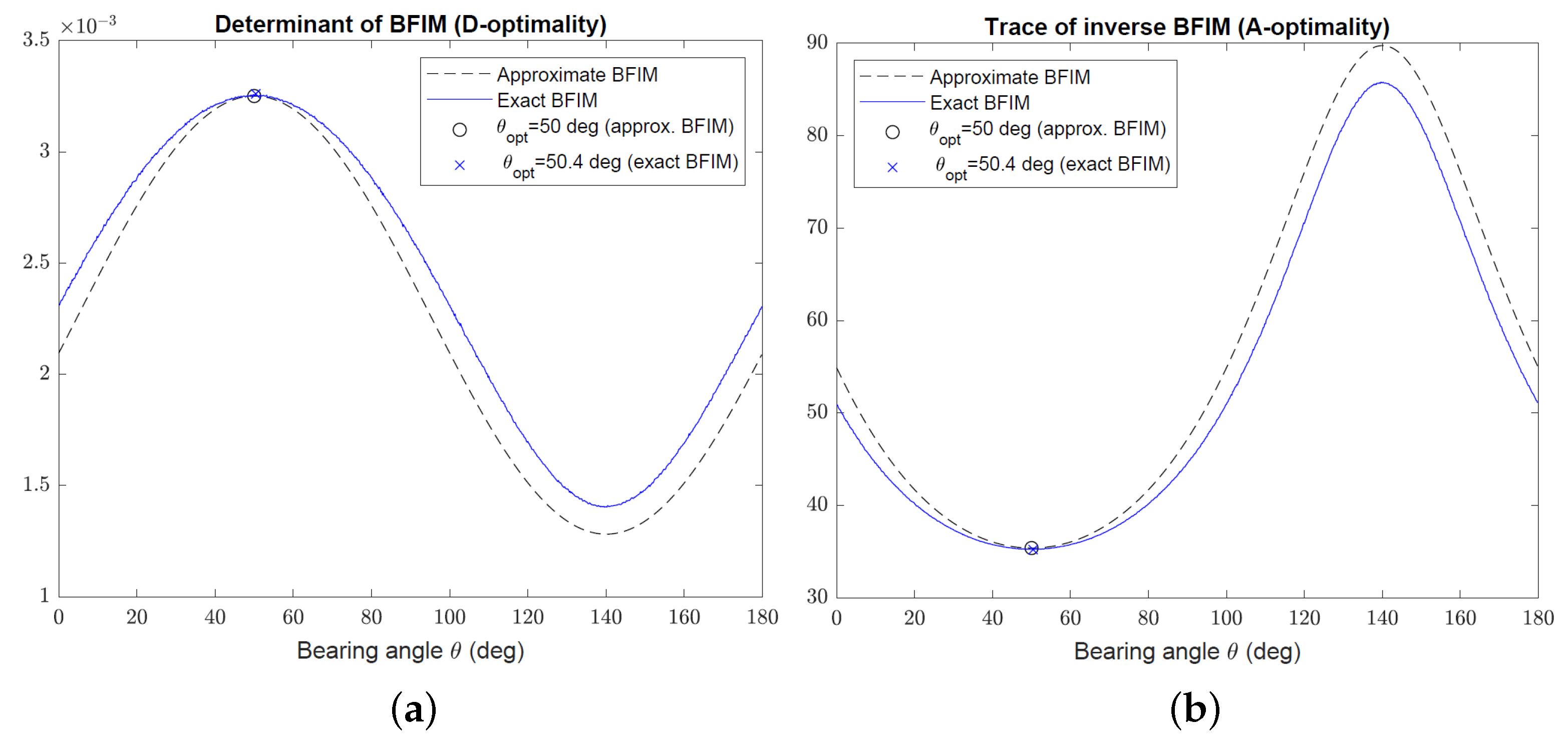
To confirm that (
9) is a valid approximation only for sufficiently small
compared with the target range, we repeated the previous simulations for
increased by a factor of two.
Figure 7 shows the resulting D- and A-optimality measures for the approximate and exact BFIM. While the approximate and exact BFIM still yield almost the same optimal bearing angles, the curves corresponding to them exhibit significant discrepancy, in particular at bearing angles away from
.
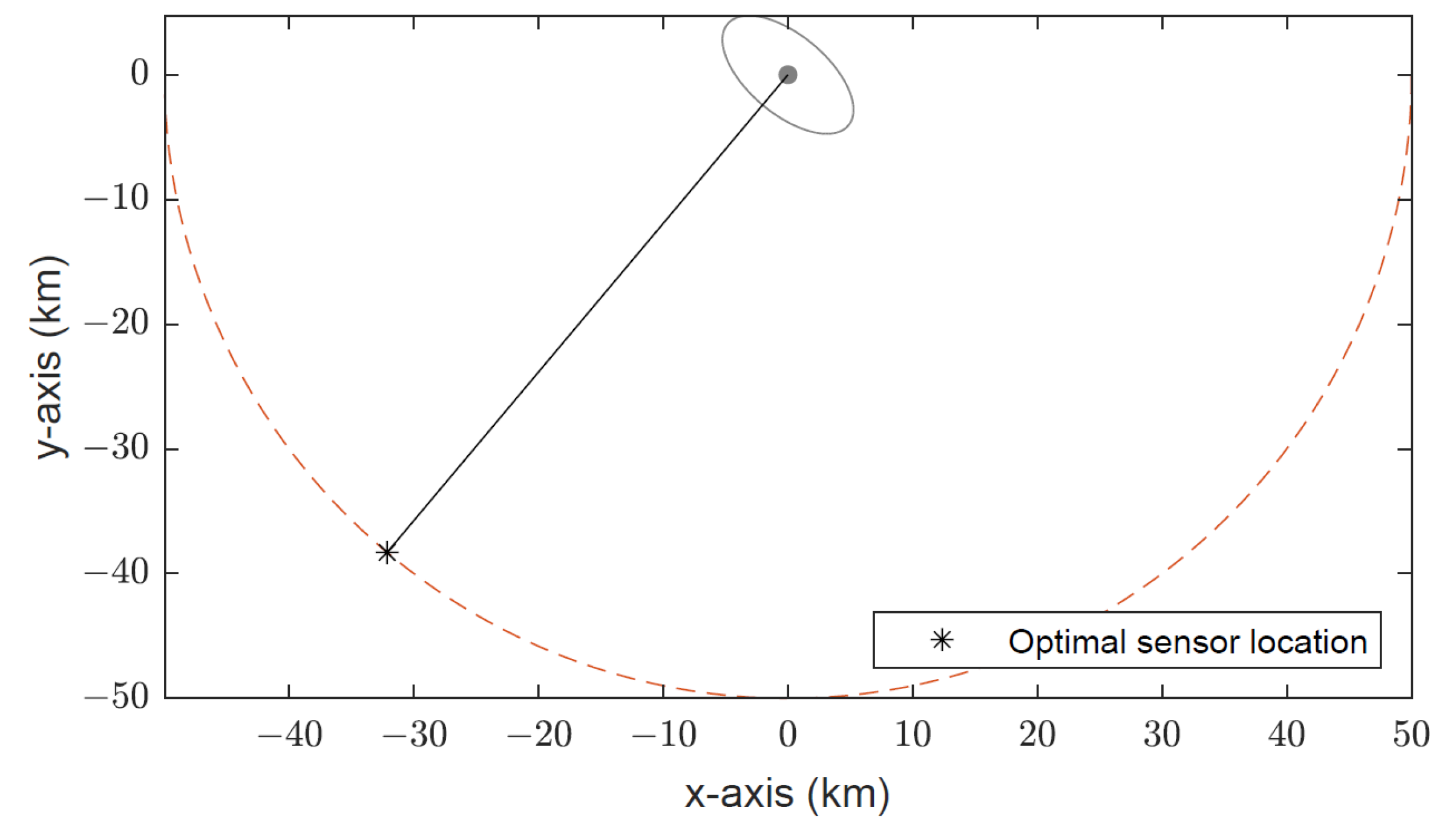
The optimal target–sensor geometry for the simulated scenario is depicted in
Figure 8. As expected, at the optimal bearing angle, the target–sensor range vector is perfectly aligned with the minor axis of the error ellipse of the Gaussian prior. Note that there are, in fact, two optimal sensor locations. The other one has the bearing angle
degrees.
In the next set of simulations, we consider sensor trajectory optimization in a bearings-only manoeuvring target tracking problem. The algorithms in (
51), (
55) and Algorithm 1 are simulated for a single realization of target manoeuvres. The process noise parameter for the target is
m
/s
. The bearing angle noise is assumed to be
. The initial target dynamics are
and
The time interval between successive EKF recursions is set equal to s. The sensor is initially located at km and moves with a constant speed of 25 m/s (90 km/h). The maximum turn-rate for the sensor is per 10 s. The separation between successive sensor waypoints is km. For the sensor trajectory optimization methods based on the D- and A-optimality criteria, 10 uniformly spaced points are used for numerical search over sensor waypoints in the set .
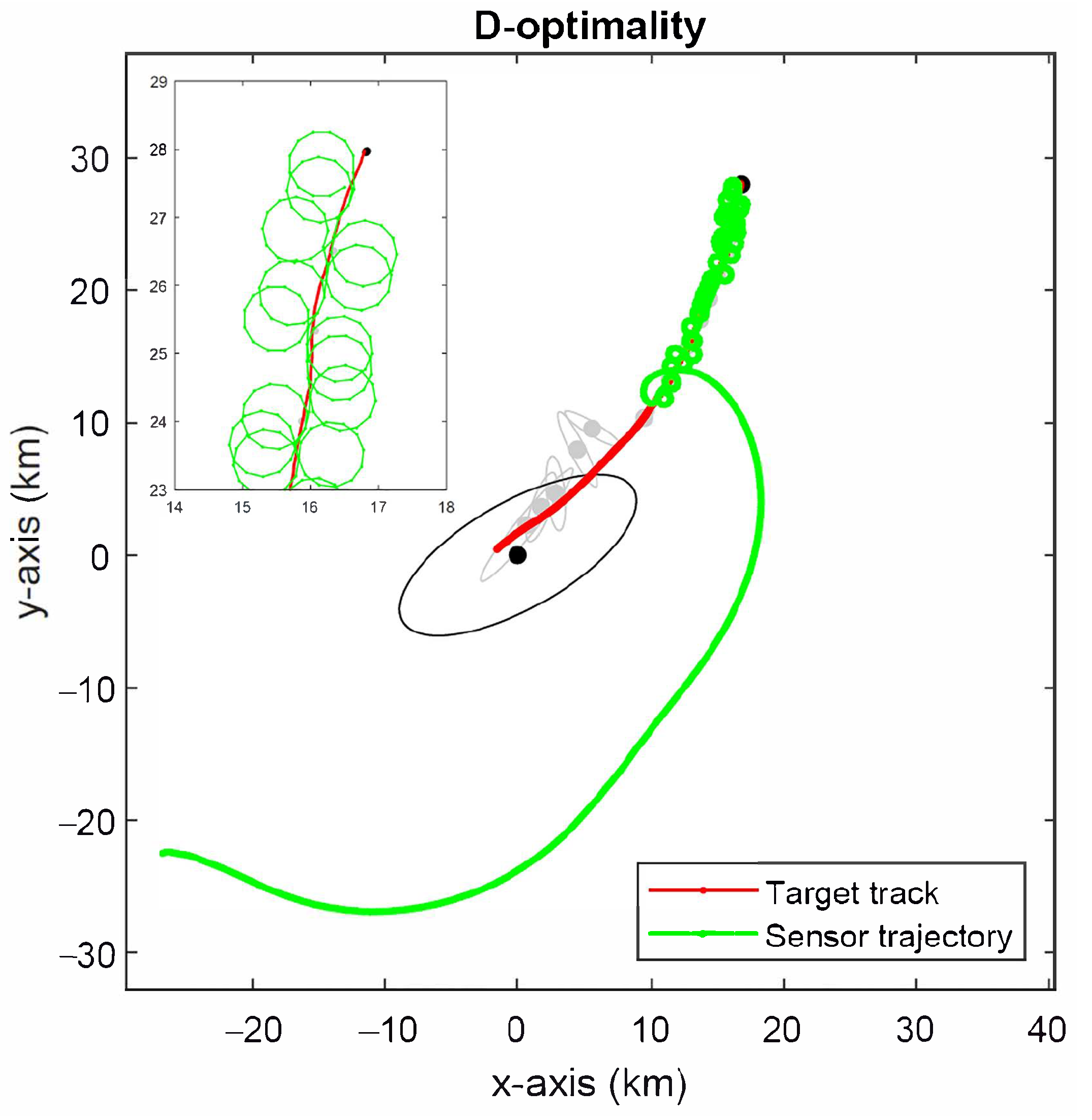
The simulated sensor trajectory for the D-optimality criterion in (
51) is depicted in
Figure 9. The 2-
error ellipses for predicted target location estimates are plotted every 50 time instants. The initial error ellipse is drawn in black and all others are in grey. The optimal sensor trajectory achieves a rapid reduction in the size of error ellipses. Following the initial approach, the sensor chases the target by circling around it.
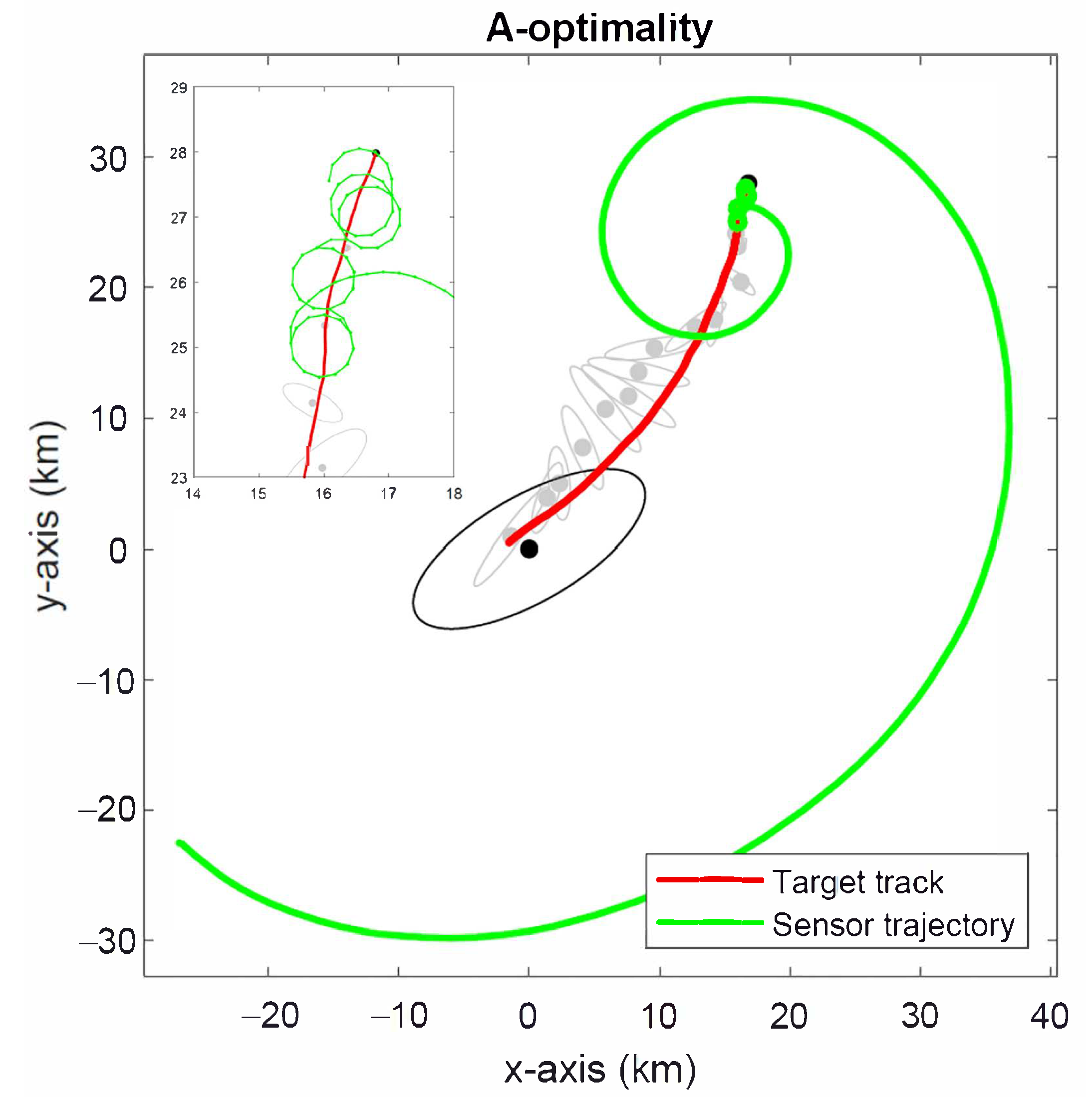
Figure 10 shows the simulated sensor trajectory for the A-optimality criterion in (
55). The optimal sensor trajectory has a markedly different behaviour to that observed for the D-optimality criterion (see
Figure 9) in that it seems to favour circling the target more than getting close to it initially. As a consequence, it takes longer to achieve a significant reduction in error ellipses than the A-optimality criterion.
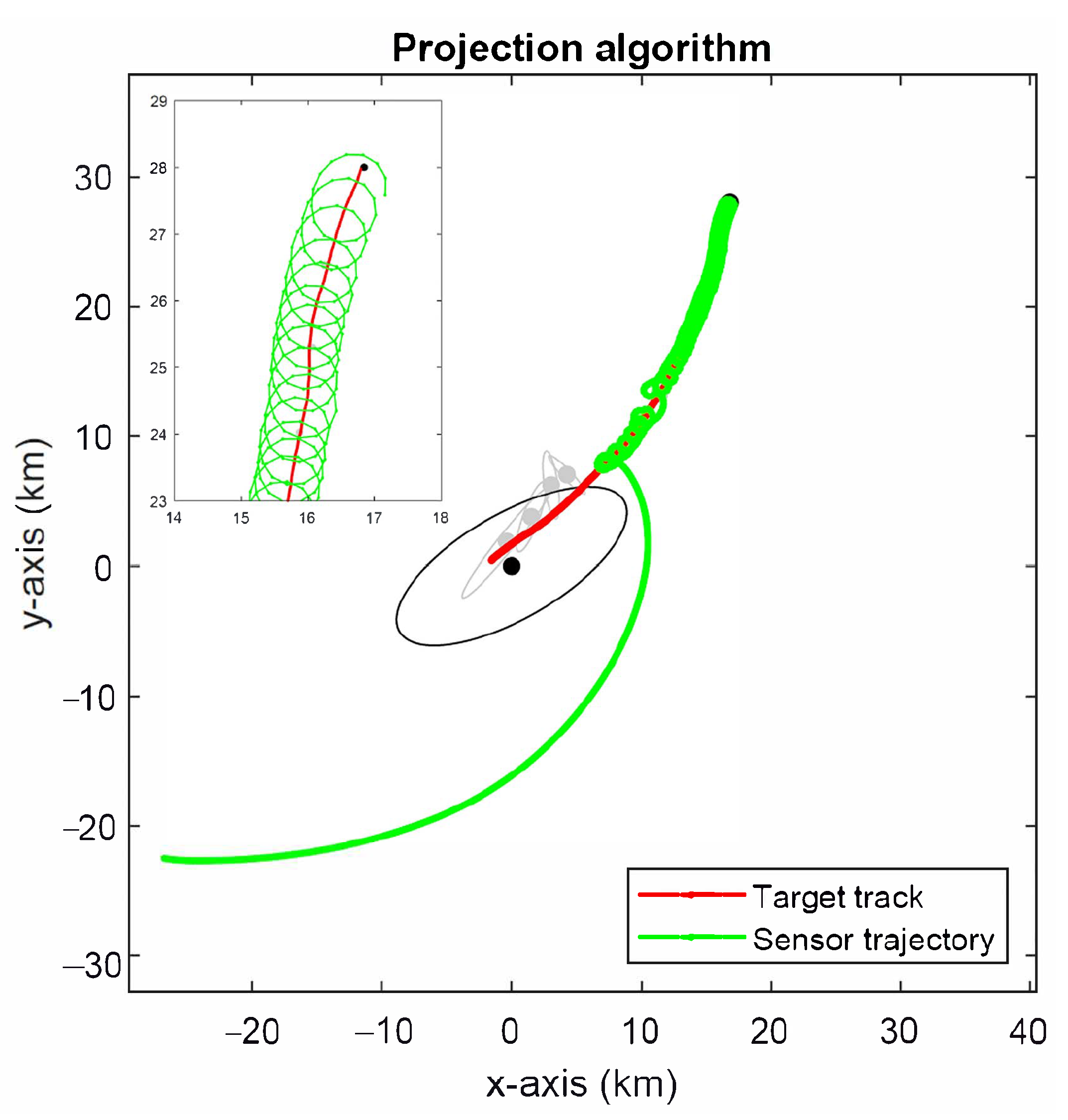
The simulation results for the projection algorithm in Algorithm 1 are shown in
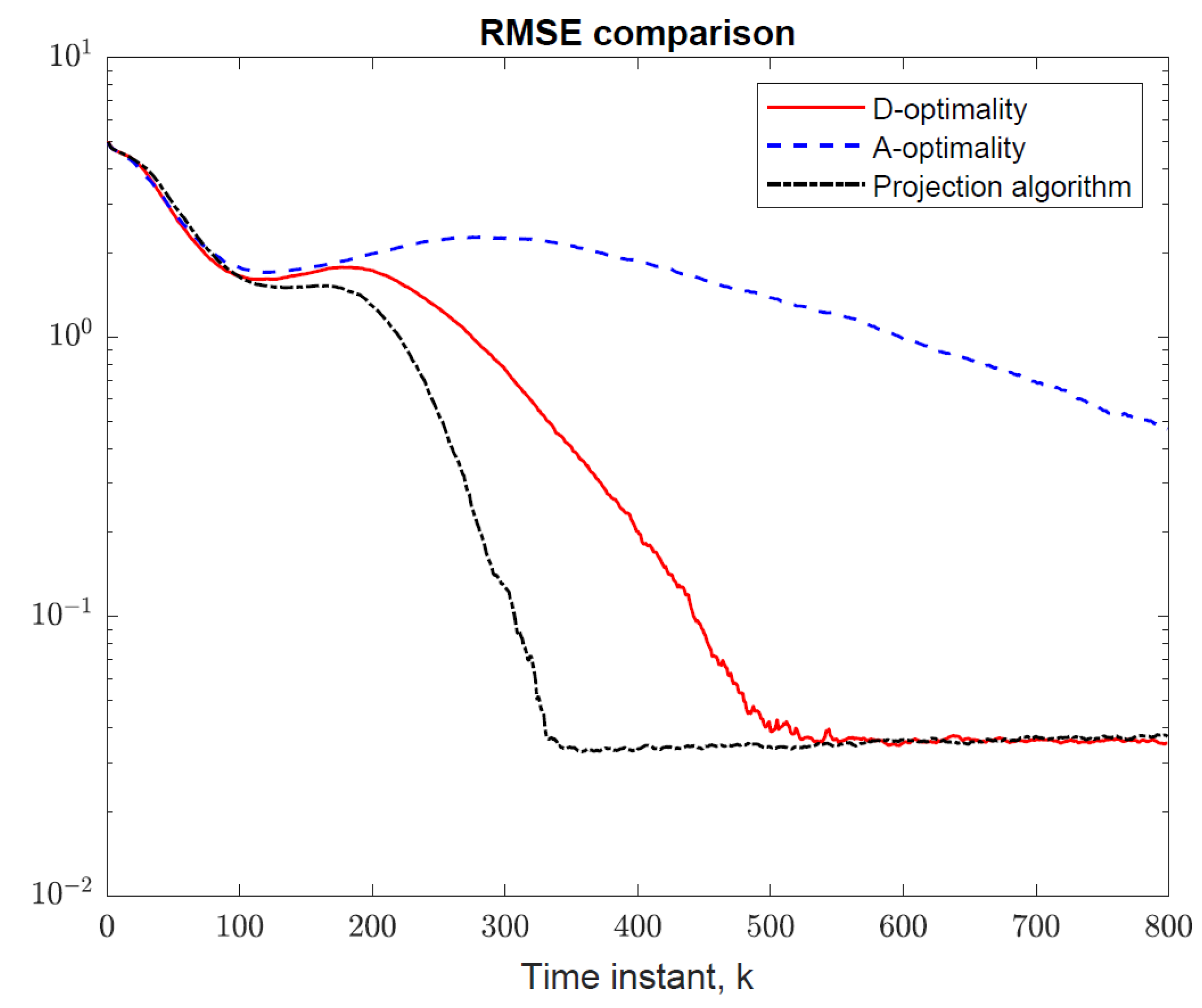
Figure 11. The sensor follows a more direct route towards the target than both the D- and A-optimality methods, followed by circling manoeuvres. This is expected to produce faster convergence to the minimum estimation error than the D- and A-optimality methods at the expense of somewhat larger estimation error initially. This observation is confirmed by the root-mean-square error (RMSE) of target location estimates shown in
Figure 12, which were computed from 5000 Monte Carlo simulation runs.