ERCP: Energy-Efficient and Reliable-Aware Clustering Protocol for Wireless Sensor Networks

 ,
,  ,
,  and
and 
Abstract
1. Introduction
- (1)
- Propose a novel energy-efficient and reliable clustering algorithm considering nodes’ residual energy, quality of wireless links, cluster head load, and distance representing the average intra-cluster distance and distance to sink node.
- (2)
- Propose an energy-efficient reliable-aware routing algorithm considering the link quality, distance to sink node, nodes’ residual energy, and load balancing.
2. Related Work
3. Problem Modelling
- (1)
- Provides the shortest average intra-cluster distance.
- (2)
- Provides the highest possible data transfer reliability.
- (3)
- Provides the shortest inter-cluster distance (the distance to the sink node).
- (4)
- Has the highest energy level.
- (5)
- Has the minimum cluster load metric value.
- (1)
- Minimum communication distance.
- (2)
- Maximum reliability.
- (3)
- In order to establish a better energy balance, the nodes participating in such a path have the highest value resulting from the new proposed energy load function.
4. Proposed ERCP Clustering Algorithm
4.1. Cluster Head Selection
| Algorithm 1: ERCP cluster head selection algorithm |
| 1: ch is the cluster head ID; 2: NEBx is the neighbor set of sensor node x. 3: next_cluster head [ ] is the array containing the selected cluster head nodes; 4: NMx[ ] is the array containing the neighbor nodes of sensor node x that is not covered by any cluster head; 5: y is the neighbor node; 6: CH is the number of candidate cluster head nodes; 7: R[CH] is the array for sorting probability amount of candidate cluster heads; Proc 1: Candidate member nodes calculation 8: Node x sends the “member” message to its all neighbors NEBx; 9: When a response is received from a node y, it does: 10: if y is not covered by any cluster head 11: then add y to NMx array 12: Endproc Proc 2: Decision Making 13: Node x sends “join” message to its neighbors with the value of its CHCostx(t) as given in Equation (8); 14: 15: 16: For (n = 0; n = CH; n++) 17: If (R[n] > Rmax) 18: 19: 20: next_cluster head [ ] ← x; 21: EndIf 22: EndFor 21: Endproc |
4.2. Inter-Cluster Routing Protocol
| Algorithm 2: ERCP next hop selection algorithm |
| 1: x = Relay node ID; 2: y = Next relay node; 3: next_hop[ ] = Array containing the selected relay nodes; 4: X = The number of neighbors located in the direction of sink node; 5: P[X] = Array for sorting probability amount of neighbors; Proc 1: ERCP-Next-Hop-Selection 6: Node x sends “next hop selection message” to its cluster head neighbors NEBx; 7: Each node sends reply with the current REy(t), PRRxy(t), NDRy(t); 8: For each do 9: If (ED(y,sink) ≥ ED(x,sink)|)) 10: discard the reply message; 11: Else 12: calculates the cost RCostxy(t) of each y based on Equation (9) and Equation (10); 13: 14: Endif 15: EndFor 16: 17: For (r = 0; r = X; r++) 18: If (P[r] > Pmax) 19: 20: 21: next_hop[ ]= y 22: EndIf 23: EndFor 24: EndProc |
5. Performance Evaluations
5.1. Performance Evaluation Criteria
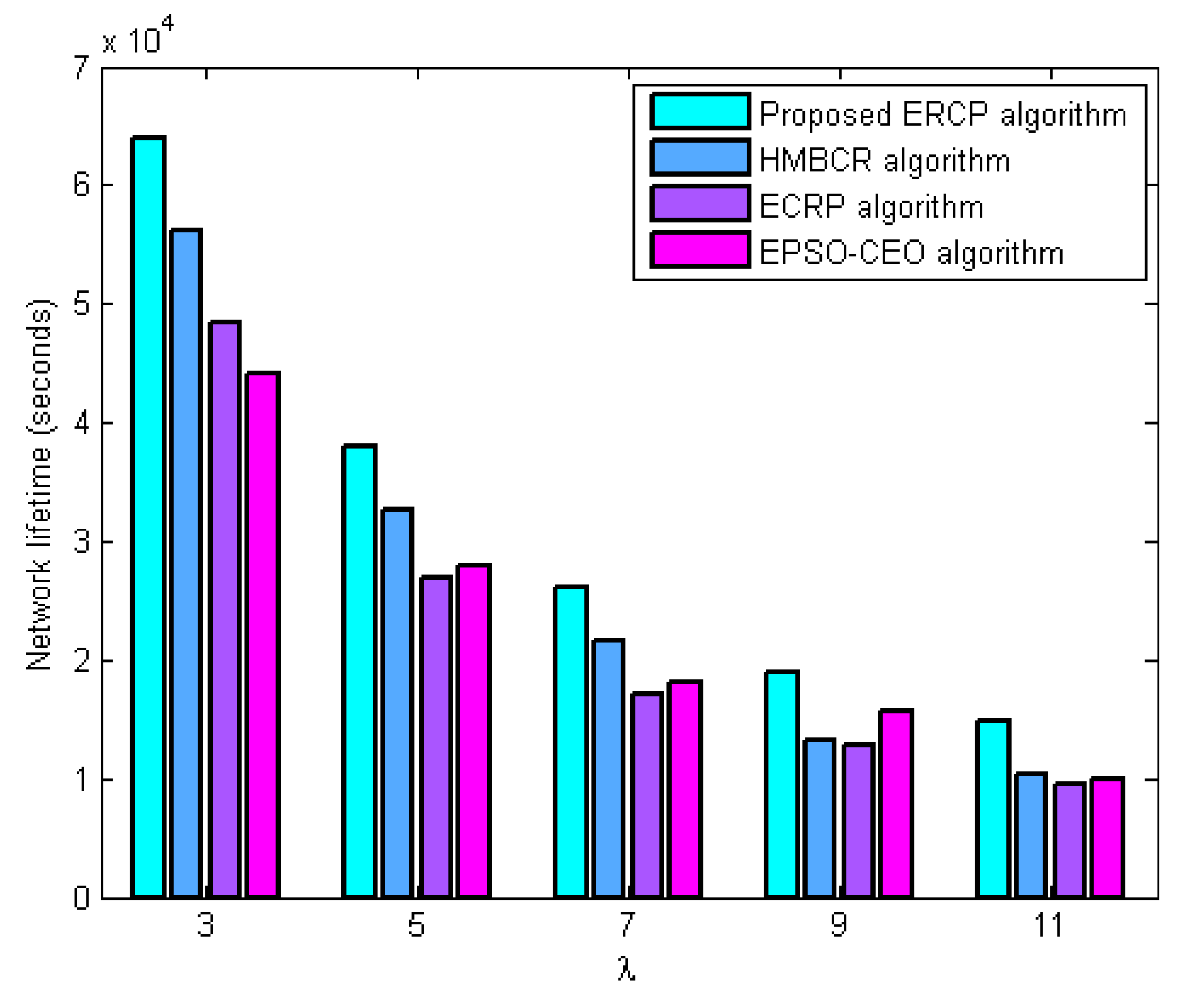
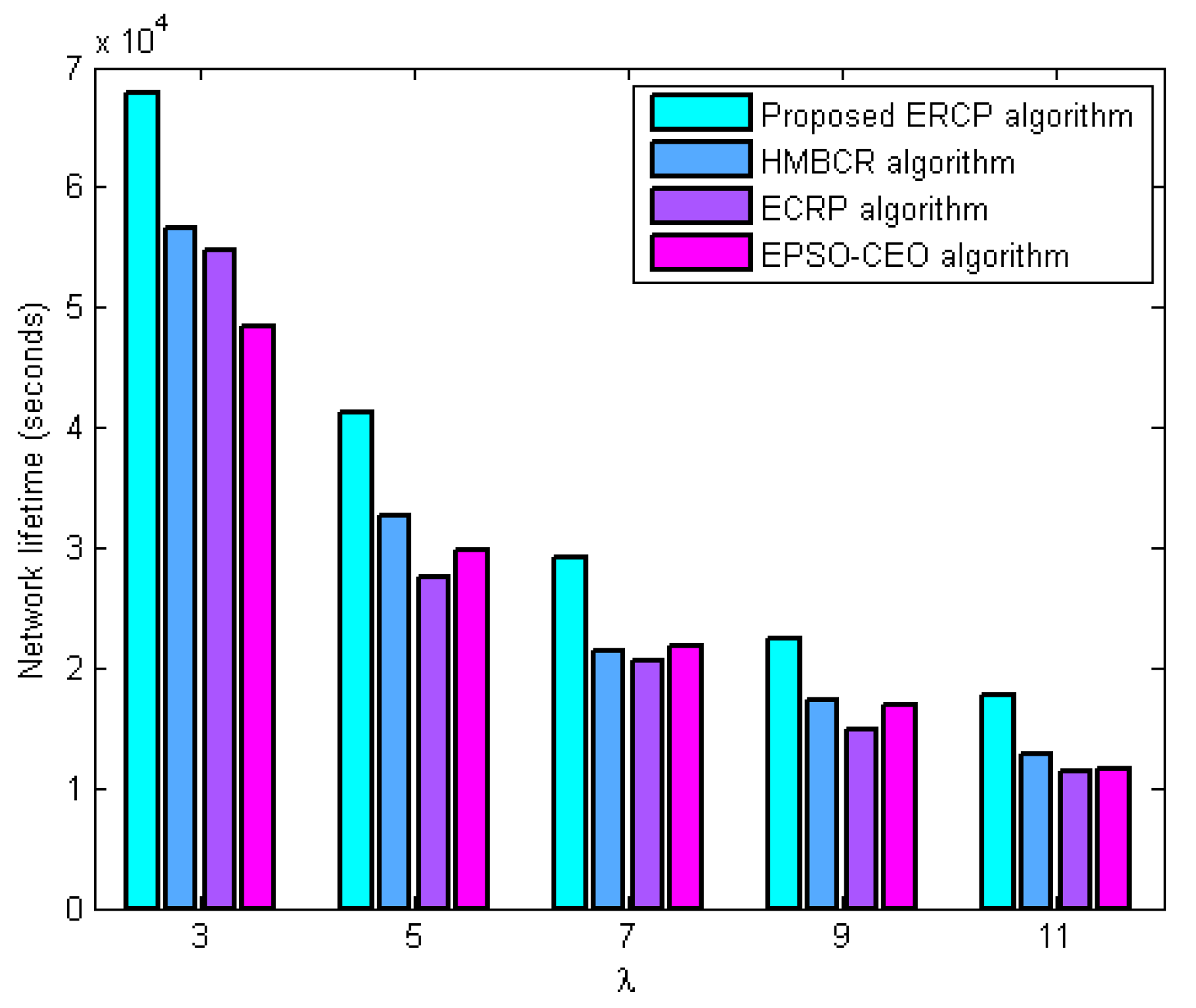
- Network Lifetime [31] is the amount of time that has passed since the network started running until the first node in the network stops working because its battery is depleted.
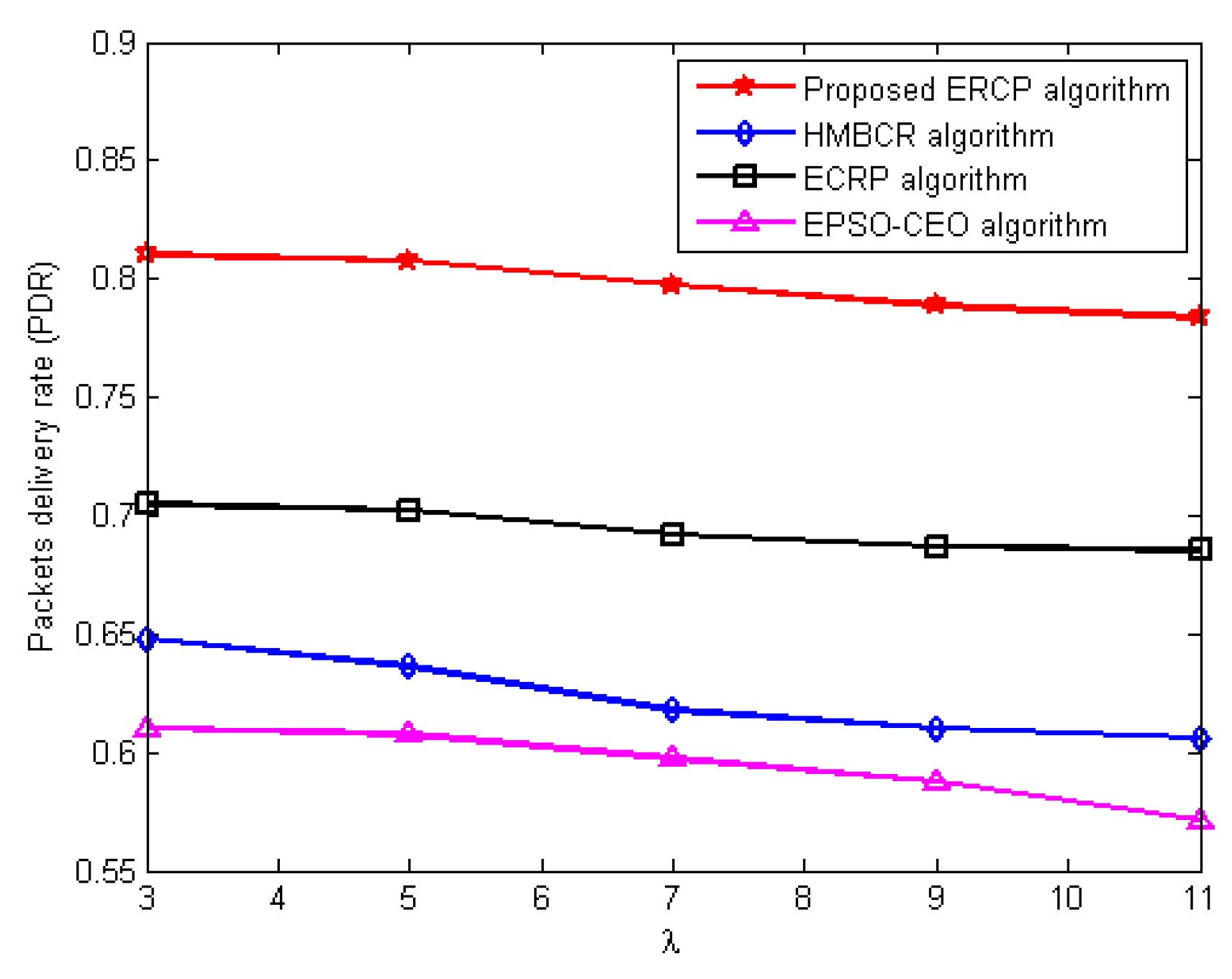
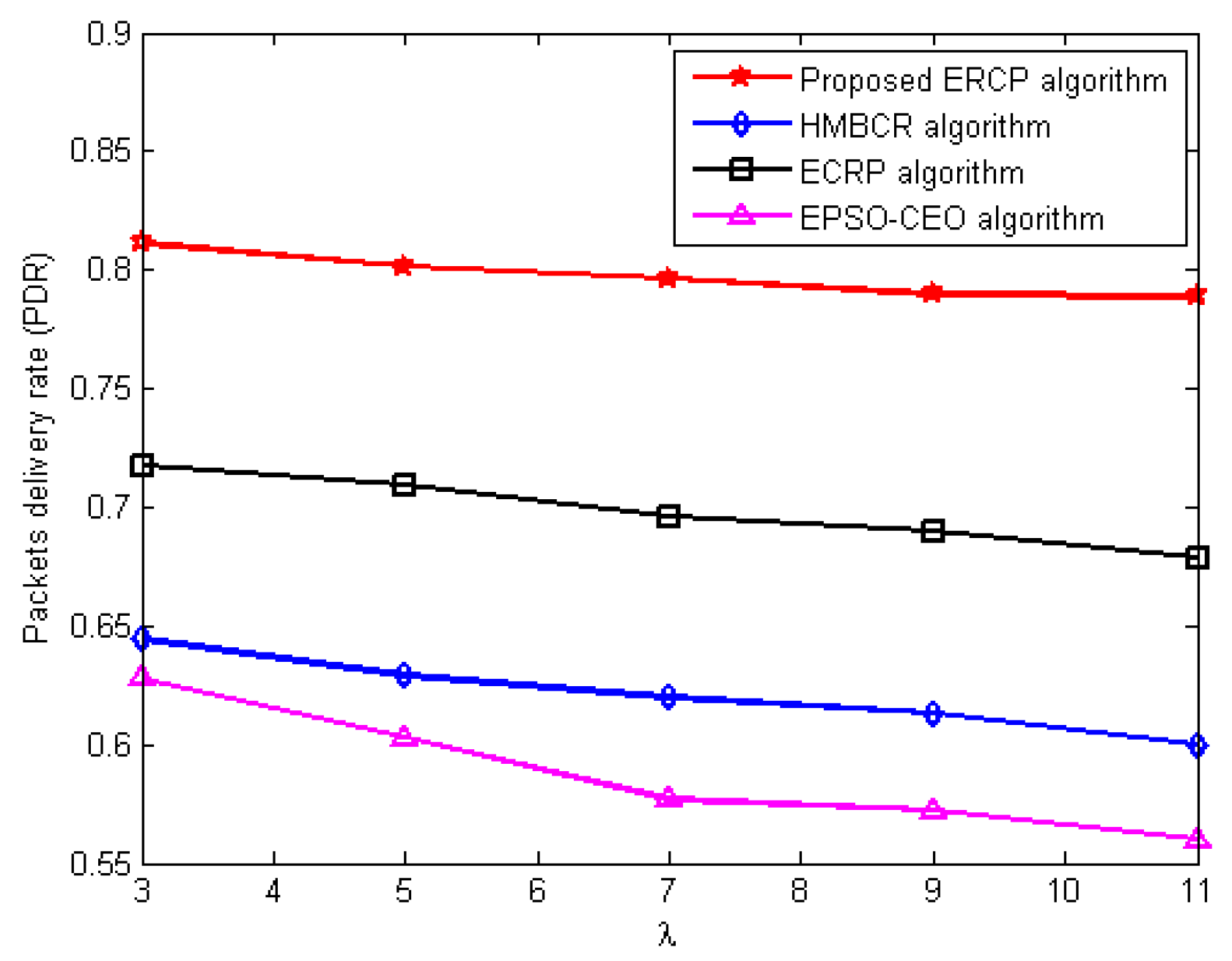
- The packet delivery rate (PDR) [31] is the ratio of the number of successful messages sent by the source nodes that the sink node received.
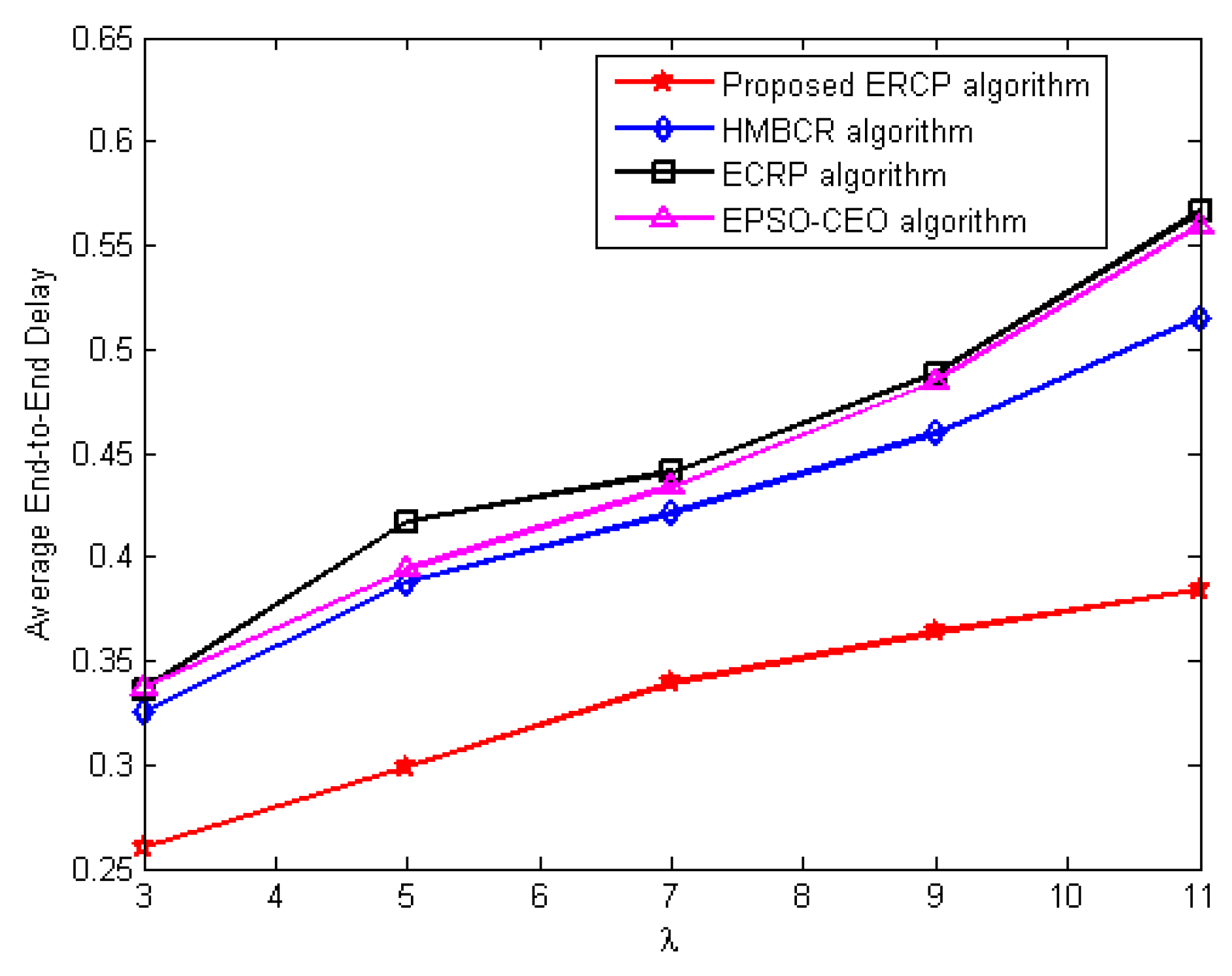
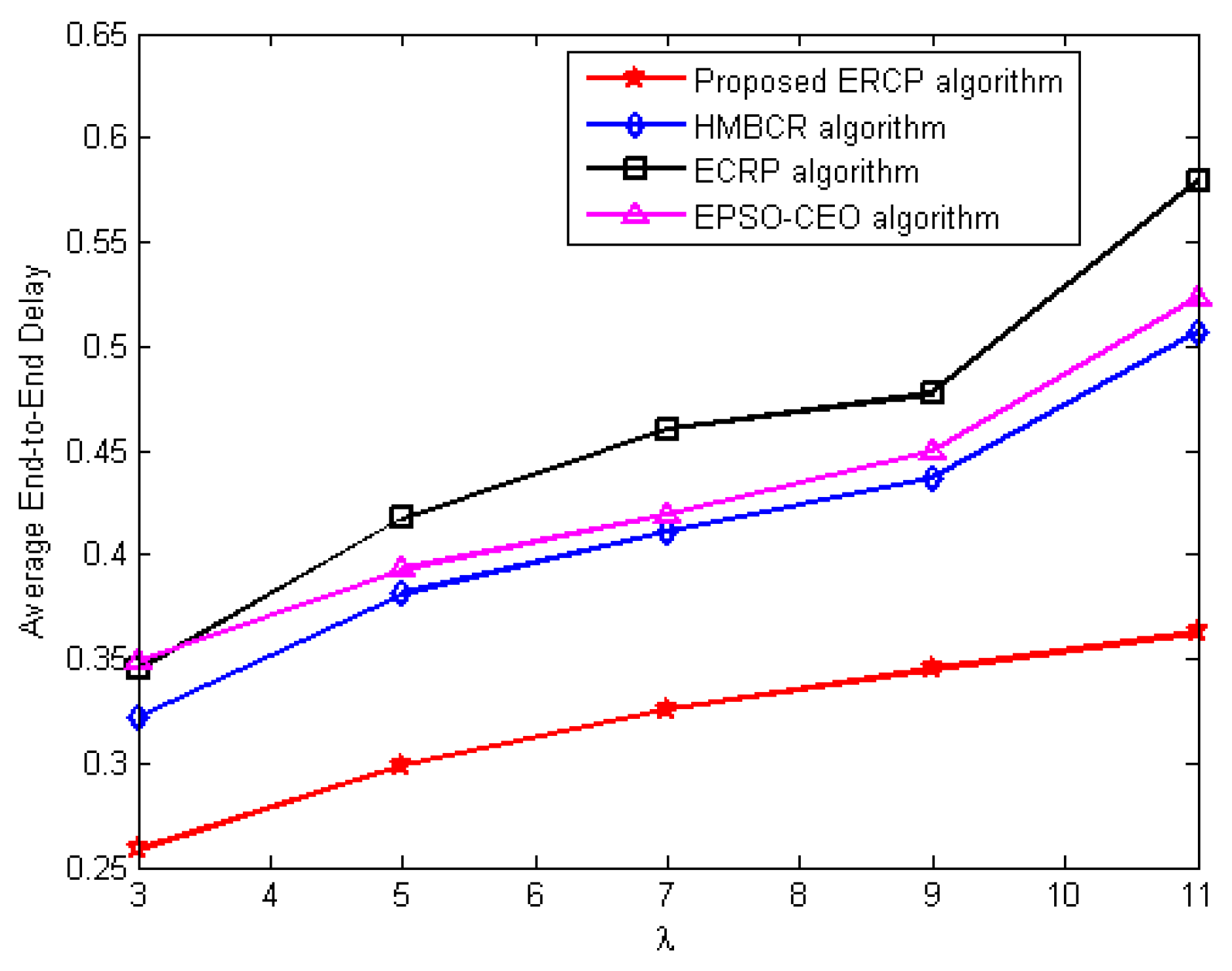
- The average end-to-end delay [31] is the average amount of time it takes for a data packet to travel from the source node to the sink.
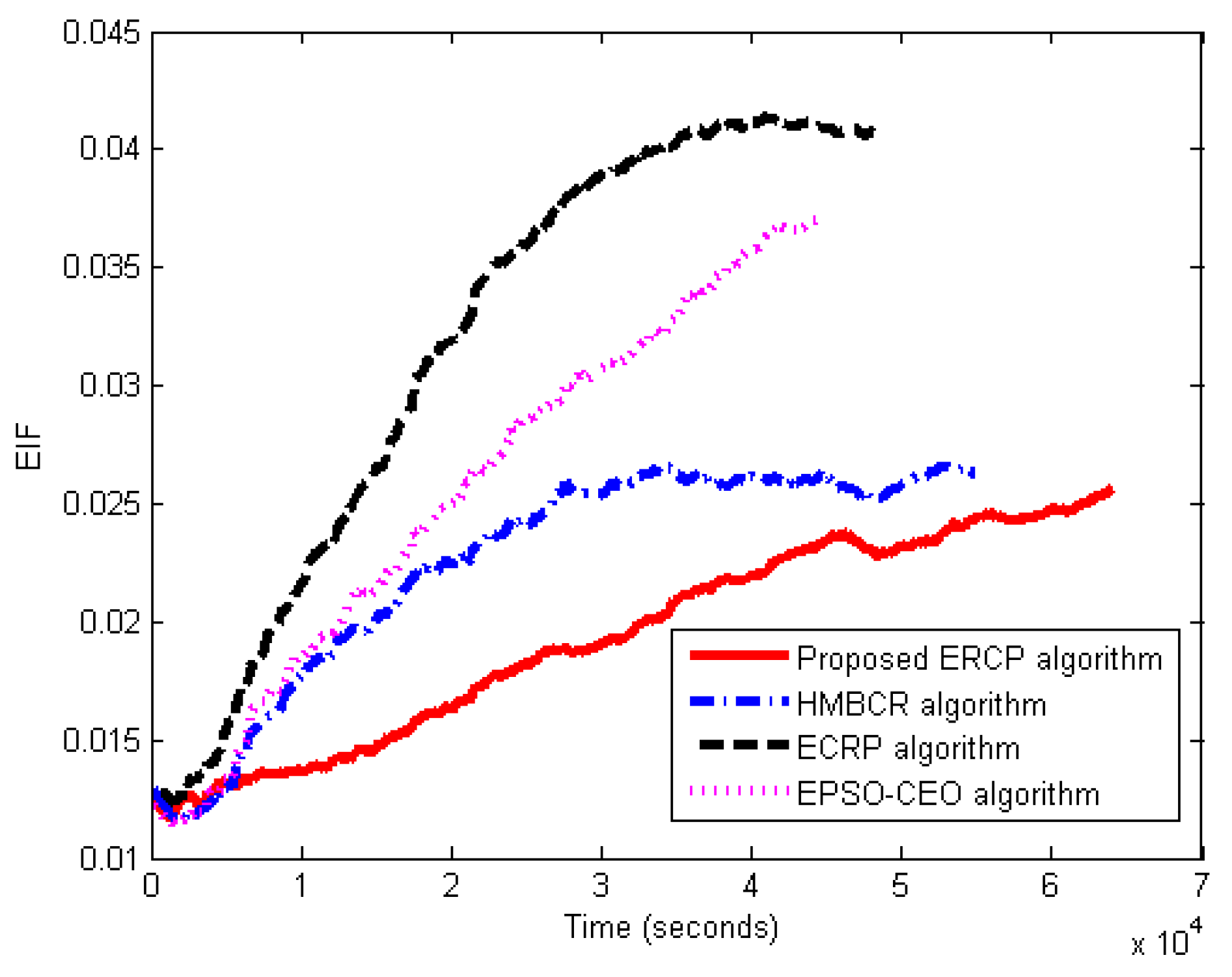
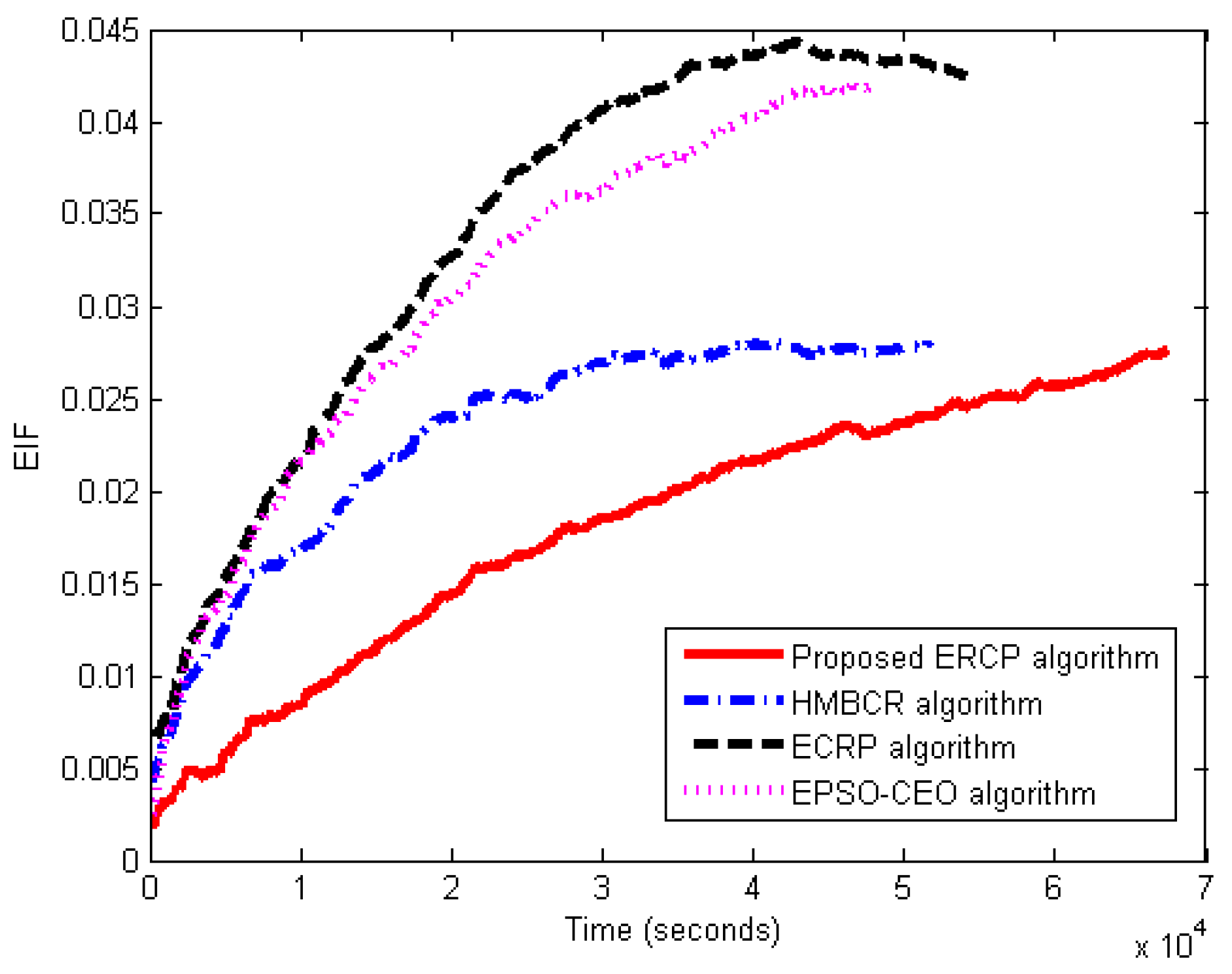
- EIF, or the Energy Imbalance Factor [31], is the average difference in energy between the nodes in the whole network.where n is the number of nodes, REi is the node’s i residual energy, and REavg is all nodes’ average residual energy.
5.2. Simulation Model
5.3. Simulation Results
5.3.1. Network Lifetime Evaluation
5.3.2. Packets Delivery Ratio (PDR) Evaluation
5.3.3. Average End-to-End Delay Evaluation
5.3.4. Energy Balance Evaluation
5.3.5. Complexity Evaluation
6. Conclusions
Author Contributions
Funding
Institutional Review Board Statement
Informed Consent Statement
Data Availability Statement
Conflicts of Interest
References
- Ilyas, M.; Mahgoub, I. Handbook of Sensor Networks; CRC Press: London, UK, 2005; pp. 117–140. [Google Scholar]
- Krishnan, M.; Jung, Y.M.; Yun, S. An Improved Clustering with Particle meta Optimization-Based Mobile Sink for Wireless Sensor Networks. In Proceedings of the 2nd International Conference on Trends in Electronics and Informatics, Tirunelveli, India, 11–12 May 2018. [Google Scholar]
- Behera, T.M.; Nanda, S.; Mohapatra, S.K.; Samal, U.C.; Khan, M.S.; Gandomi, A.H. CH Selection via Adaptive Threshold Design Aligned on Network Energy. IEEE Sens. J. 2021, 21, 8491–8500. [Google Scholar] [CrossRef]
- Abbasi, A.A.; Younis, M. A survey on clustering algorithms for wireless sensor networks. Comput. Commun. 2007, 30, 2826–2841. [Google Scholar] [CrossRef]
- Akkaya, K.; Younis, M. A survey on routing protocols for wireless sensor networks. Ad Hoc Netw. 2005, 3, 325–349. [Google Scholar] [CrossRef]
- Rao, P.C.S.; Jana, P.K.; Banka, H. A particle swarm optimization based energy efficient cluster head selection algorithm for wireless sensor networks. Wirel. Netw. 2016, 23, 2005–2020. [Google Scholar] [CrossRef]
- Yadav, A.; Kumar, S.; Vijendra, S. Network Life Time Analysis of WSNs Using Particle Swarm Optimization. Procedia Comput. Sci. 2018, 132, 805–815. [Google Scholar] [CrossRef]
- Darabkh, K.A.; El-Yabroudi, M.Z.; El-Mousa, A.H. BPA-CRP: A balanced power-aware clustering and routing protocol for wireless sensor networks. Ad Hoc Netw. 2019, 82, 155–171. [Google Scholar] [CrossRef]
- Naeem, A.; Javed, A.R.; Rizwan, M.; Abbas, S.; Lin, J.C.W.; Gadekallu, T.R. DARE-SEP: A Hybrid Approach of Distance Aware Residual Energy-Efficient SEP for WSN. IEEE Trans. Green Commun. Netw. 2021, 5, 611–621. [Google Scholar] [CrossRef]
- Al-Otaibi, S.; Al-Rasheed, A.; Mansour, R.F.; Yang, E.; Joshi, G.P.; Cho, W. Hybridization of Metaheuristic Algorithm for Dynamic Cluster-Based Routing Protocol in Wireless Sensor Networks. IEEE Access 2021, 9, 83751–83761. [Google Scholar] [CrossRef]
- Moussa, N.; Hamidi-Alaoui, Z.; Alaoui, A.E.B.E. ECRP: An energy-aware cluster-based routing protocol for wireless sensor networks. Wirel. Netw. 2020, 26, 2915–2928. [Google Scholar] [CrossRef]
- Wang, C.; Liu, X.; Hu, H.; Chu-Hang, W.; Yao, M. Energy-Efficient and Load-Balanced Clustering Routing Protocol for Wireless Sensor Networks Using a Chaotic Genetic Algorithm. IEEE Access 2020, 8, 158082–158096. [Google Scholar] [CrossRef]
- Aydin, M.A.; Karabekir, B.; Zaim, A.H. Energy Efficient Clustering-Based Mobile Routing Algorithm on WSNs. IEEE Access 2021, 9, 89593–89601. [Google Scholar] [CrossRef]
- Han, Y.; Li, G.; Xu, R.; Su, J.; Li, J.; Wen, G. Clustering the Wireless Sensor Networks: A Meta-Heuristic Approach. IEEE Access 2020, 8, 214551–214564. [Google Scholar] [CrossRef]
- George, A.M.; Kulkarni, S.Y.; Kurian, C.P. Gaussian Regression Models for Evaluation of Network Lifetime and Cluster-Head Selection in Wireless Sensor Devices. IEEE Access 2022, 10, 20875–20888. [Google Scholar] [CrossRef]
- Hossan, A.; Choudhury, P.K. DE-SEP: Distance and Energy Aware Stable Election Routing Protocol for Heterogeneous Wireless Sensor Network. IEEE Access 2022, 10, 55726–55738. [Google Scholar] [CrossRef]
- Qureshi, K.N.; Bashir, M.U.; Lloret, J.; Leon, A. Optimized Cluster-Based Dynamic Energy-Aware Routing Protocol for Wireless Sensor Networks in Agriculture Precision. J. Sensors 2020, 2020, 9040395. [Google Scholar] [CrossRef]
- Heinzelman, W.R.; Chandrakasan, A.; Balakrishnan, H. Energy efficient communication protocol for wireless micro sensor networks. In Proceedings of the 33rd Annual Hawaii International Conference on System Sciences, Maui, HI, USA, 4–7 January 2000; pp. 1–10. [Google Scholar]
- Ran, G.; Zhang, H.; Gong, S. Improving on LEACH protocol of wireless sensor networks using fuzzy logic. J. Inf. Comput. Sci. 2010, 7, 767–775. [Google Scholar]
- Gupta, I.; Riordan, D.; Sampalli, S. Cluster-head election using fuzzy logic for wireless sensor networks. In Proceedings of the 3rd Annual Communication Networks and Services Research Conference, Halifax, NS, Canada, 16–18 May 2005; pp. 255–260. [Google Scholar]
- Alami, H.E.; Najid, A. Energy-efficient fuzzy logic cluster head selection in wireless sensor networks. In Proceedings of the 2016 International Conference on Information Technology for Organizations Development, Fez, Morocco, 30 March–1 April 2016; pp. 1–7. [Google Scholar]
- Behera, T.M.; Samal, U.C.; Mohapatra, S.K. Energy-efficient modified LEACH protocol for IoT application. IET Wirel. Sens. Syst. 2018, 8, 223–228. [Google Scholar] [CrossRef]
- Behera, T.M.; Mohapatra, S.K.; Samal, U.C.; Khan, M.S.; Daneshmand, M.; Gandomi, A.H. Residual Energy-Based Cluster-Head Selection in WSNs for IoT Application. IEEE Internet Things J. 2019, 6, 5132–5139. [Google Scholar] [CrossRef]
- Vimalarani, C.; Subramanian, R.; Sivanandam, S.N. An Enhanced PSO-Based Clustering Energy Optimization Algorithm for Wireless Sensor Network. Sci. World J. Hindawi 2016, 2016, 8658760. [Google Scholar] [CrossRef]
- Singh, B.; Lobiyal, D.K. A novel energy-aware cluster head selection based on particle swarm optimization for wireless sensor networks. Human-Cent. Comput. Inf. Sci. 2012, 2, 13. [Google Scholar] [CrossRef]
- Hong, Z.; Wang, R.; Li, X. A clustering-tree topology control based on the energy forecast for heterogeneous wireless sensor networks. IEEE/CAA J. Autom. Sin. 2016, 3, 68–77. [Google Scholar]
- Devi, V.S.; Ravi, T.; Priya, S.B. Cluster Based Data Aggregation Scheme for Latency and Packet Loss Reduction in WSN. Comput. Commun. 2019, 149, 36–43. [Google Scholar] [CrossRef]
- Niu, J.; Cheng, L.; Gu, Y.; Shu, L.; Das, S.K. R3E: Reliable Reactive Routing Enhancement for Wireless Sensor Networks. IEEE Trans. Ind. Inform. 2013, 10, 784–794. [Google Scholar] [CrossRef]
- Cheng, L.; Niu, J.; Cao, J.; Das, S.K.; Gu, Y. QoS Aware Geographic Opportunistic Routing in Wireless Sensor Networks. IEEE Trans. Parallel Distrib. Syst. 2013, 25, 1864–1875. [Google Scholar] [CrossRef]
- Liu, A.; Ren, J.; Li, X.; Chen, Z.; Shen, X. Design principles and improvement of cost function based energy aware routing algorithms for wireless sensor networks. Comput. Netw. 2012, 56, 1951–1967. [Google Scholar] [CrossRef]
- El-Fouly, F.H.; Ramadan, R.A.; Mahmoud, M.I.; Dessouky, M.I. Resource aware and reliable data reporting algorithm for object tracking in WSNs. J. Intell. Fuzzy Syst. 2016, 31, 99–113. [Google Scholar] [CrossRef]
- Li, Y.; Chen, C.S.; Song, Y.-Q.; Wang, Z.; Sun, Y. Enhancing Real-Time Delivery in Wireless Sensor Networks with Two-Hop Information. IEEE Trans. Ind. Inform. 2009, 5, 113–122. [Google Scholar] [CrossRef]





| Name of the Algorithm | Advantages | Disadvantages |
|---|---|---|
| LEACH | Enhances energy efficiency by Periodically rotating the cluster heads. | Unbalanced energy consumption due to the random selection of the cluster heads, and it is not addressed the reliability issue. |
| FR-LEACH | Enhances energy efficiency by utilizing energy factor. | The load balancing issue is not fully addressed and the reliability issue is not considered. |
| DARE-SEP | Enhances energy efficiency by utilizing energy and distance factors. | The load balancing issue is not fully addressed and the reliability issue is not considered. |
| HMBCR | Enhances energy efficiency by utilizing energy, distance, and load factors. | The reliability issue is not considered. |
| ECRP | Enhances energy efficiency by utilizing energy and distance factors. | The load balancing issue is not fully addressed, and the reliability issue is not considered. |
| CRCGA | Enhances energy efficiency by utilizing energy, distance, and load factors. | The reliability issue is not considered. |
| CPMA | Enhances energy efficiency by utilizing energy and distance factors. | The load balancing issue is not fully addressed, and the reliability issue is not considered. |
| Greedy & GA ANN & GA | Enhances energy efficiency by utilizing energy and distance factors. | The load balancing issue is not fully addressed, and the reliability issue is not considered. |
| ML-TSEP | Enhances energy efficiency by utilizing energy, distance, and load factors. | The reliability issue is not considered. |
| DE-SEP | Enhances energy efficiency by utilizing energy, and distance factors. | The load balancing issue is not fully addressed, and the reliability issue is not considered. |
| GCEEC | Enhances energy efficiency and coverage. | The load balancing issue is not fully addressed, and the reliability issue is not considered. |
| EPSO-CEO | Enhances energy efficiency by utilizing energy and distance factors. | The load balancing issue is not fully addressed and the reliability issue is not considered. |
| The proposed ERCP | The energy efficiency, load balancing, and reliability issues are considered | Has more computation energy. |
| Parameters | Values |
|---|---|
| Deployment strategy | Uniformly random |
| Num sensor nodes | 300 |
| Maximum number of retransmissions | 4 |
| Packet size | 50 byte |
| Buffer size | 128 Kbyte |
| Frequency Path loss exponent | 868 MHz 3 |
| Minimum radio range | 150 m |
| Data rate | 20 Kbps |
| Shadow fading variance | 3 |
| Reference distance | 1 m |
Publisher’s Note: MDPI stays neutral with regard to jurisdictional claims in published maps and institutional affiliations. |
© 2022 by the authors. Licensee MDPI, Basel, Switzerland. This article is an open access article distributed under the terms and conditions of the Creative Commons Attribution (CC BY) license (https://creativecommons.org/licenses/by/4.0/).
Share and Cite
El-Fouly, F.H.; Khedr, A.Y.; Sharif, M.H.; Alreshidi, E.J.; Yadav, K.; Kusetogullari, H.; Ramadan, R.A. ERCP: Energy-Efficient and Reliable-Aware Clustering Protocol for Wireless Sensor Networks. Sensors 2022, 22, 8950. https://doi.org/10.3390/s22228950
El-Fouly FH, Khedr AY, Sharif MH, Alreshidi EJ, Yadav K, Kusetogullari H, Ramadan RA. ERCP: Energy-Efficient and Reliable-Aware Clustering Protocol for Wireless Sensor Networks. Sensors. 2022; 22(22):8950. https://doi.org/10.3390/s22228950
Chicago/Turabian StyleEl-Fouly, Fatma H., Ahmed Y. Khedr, Md. Haidar Sharif, Eissa Jaber Alreshidi, Kusum Yadav, Huseyin Kusetogullari, and Rabie A. Ramadan. 2022. "ERCP: Energy-Efficient and Reliable-Aware Clustering Protocol for Wireless Sensor Networks" Sensors 22, no. 22: 8950. https://doi.org/10.3390/s22228950
APA StyleEl-Fouly, F. H., Khedr, A. Y., Sharif, M. H., Alreshidi, E. J., Yadav, K., Kusetogullari, H., & Ramadan, R. A. (2022). ERCP: Energy-Efficient and Reliable-Aware Clustering Protocol for Wireless Sensor Networks. Sensors, 22(22), 8950. https://doi.org/10.3390/s22228950