Article

A Local Electricity and Carbon Trading Method for Multi-Energy Microgrids Considering Cross-Chain Interaction

1
School of Automation, Guangdong University of Technology, Guangzhou 510006, China
2
Key Laboratory of Intelligent Information Processing and System Integration of IoT, Ministry of Education, Guangzhou 510006, China
3
111 Center for Intelligent Batch Manufacturing Based on IoT Technology, Guangzhou 510006, China
4
Guangdong Key Laboratory of IoT Information Technology, Guangzhou 510006, China
5
Guangdong-HongKong-Macao Joint Laboratory for Smart Discrete Manufacturing, Guangzhou 510006, China
*
Author to whom correspondence should be addressed.
Sensors 2022, 22(18), 6935; https://doi.org/10.3390/s22186935
Submission received: 15 August 2022 / Revised: 3 September 2022 / Accepted: 6 September 2022 / Published: 14 September 2022
(This article belongs to the Special Issue Advanced Communication and Computing Technologies for Smart Grid)

Abstract

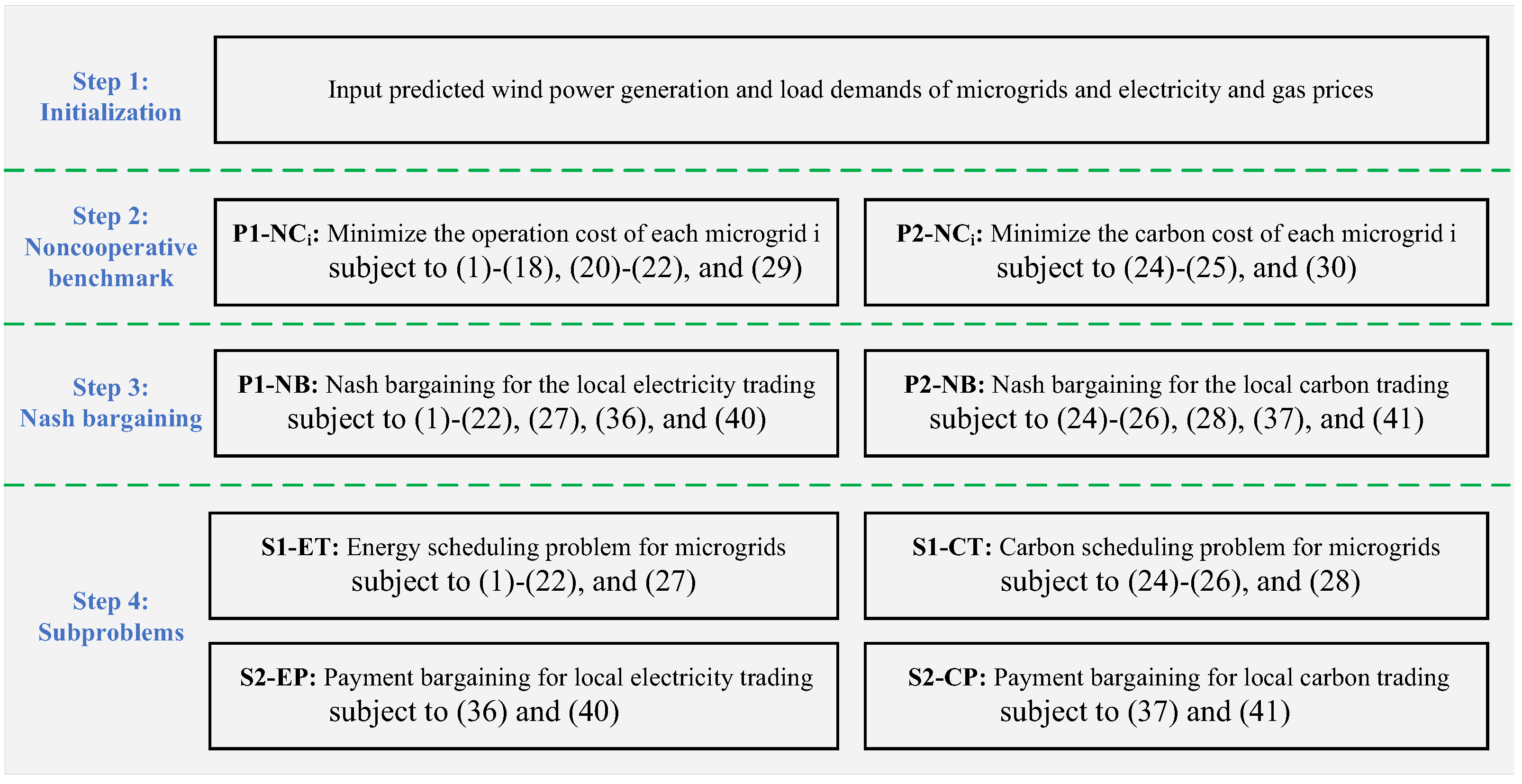
The objective of this paper is to propose a local electricity and carbon trading method for interconnected multi-energy microgrids. A local electricity market and a local carbon market are established, allowing microgrids to trade electricity and carbon allowance within the microgrid network. Specifically, excessive electricity and carbon allowance of a microgrid can be shared with other microgrids that require them. A local electricity trading problem and a local carbon trading problem are formulated for multi-energy microgrids using the Nash bargaining theory. Each Nash bargaining problem can be decomposed into two subproblems, including an energy/carbon scheduling problem and a payment bargaining problem. By solving the subproblems of the Nash bargaining problems, the traded amounts of electricity/carbon allowance between microgrids and the corresponding payments will be determined. In addition, to enable secure information interactions and trading payments, we introduce an electricity blockchain and a carbon blockchain to record the trading data for microgrids. The novelty of the usage of the blockchain technology lies in using a notary mechanism-based cross-chain interaction method to achieve value transfer between blockchains. The simulation results show that the proposed local electricity and carbon trading method has great performance in lowering total payments and carbon emissions for microgrids.
Keywords: multi-energy microgrid; electricity and carbon trading; Nash bargaining; blockchain; cross-chain interaction multi-energy microgrid; electricity and carbon trading; Nash bargaining; blockchain; cross-chain interaction