Article

Development of a Non-Contacting Muscular Activity Measurement System for Evaluating Knee Extensors Training in Real-Time
1
Faculty of Science and Engineering, Waseda University, Tokyo 1690051, Japan
2
Department of Modern Mechanical Engineering, Waseda University, Tokyo 1690051, Japan
3
Humanoid Robotics Institute, Waseda University, Tokyo 1690051, Japan
*
Author to whom correspondence should be addressed.
Sensors 2022, 22(12), 4632; https://doi.org/10.3390/s22124632
Submission received: 25 May 2022 / Revised: 14 June 2022 / Accepted: 17 June 2022 / Published: 19 June 2022

Abstract

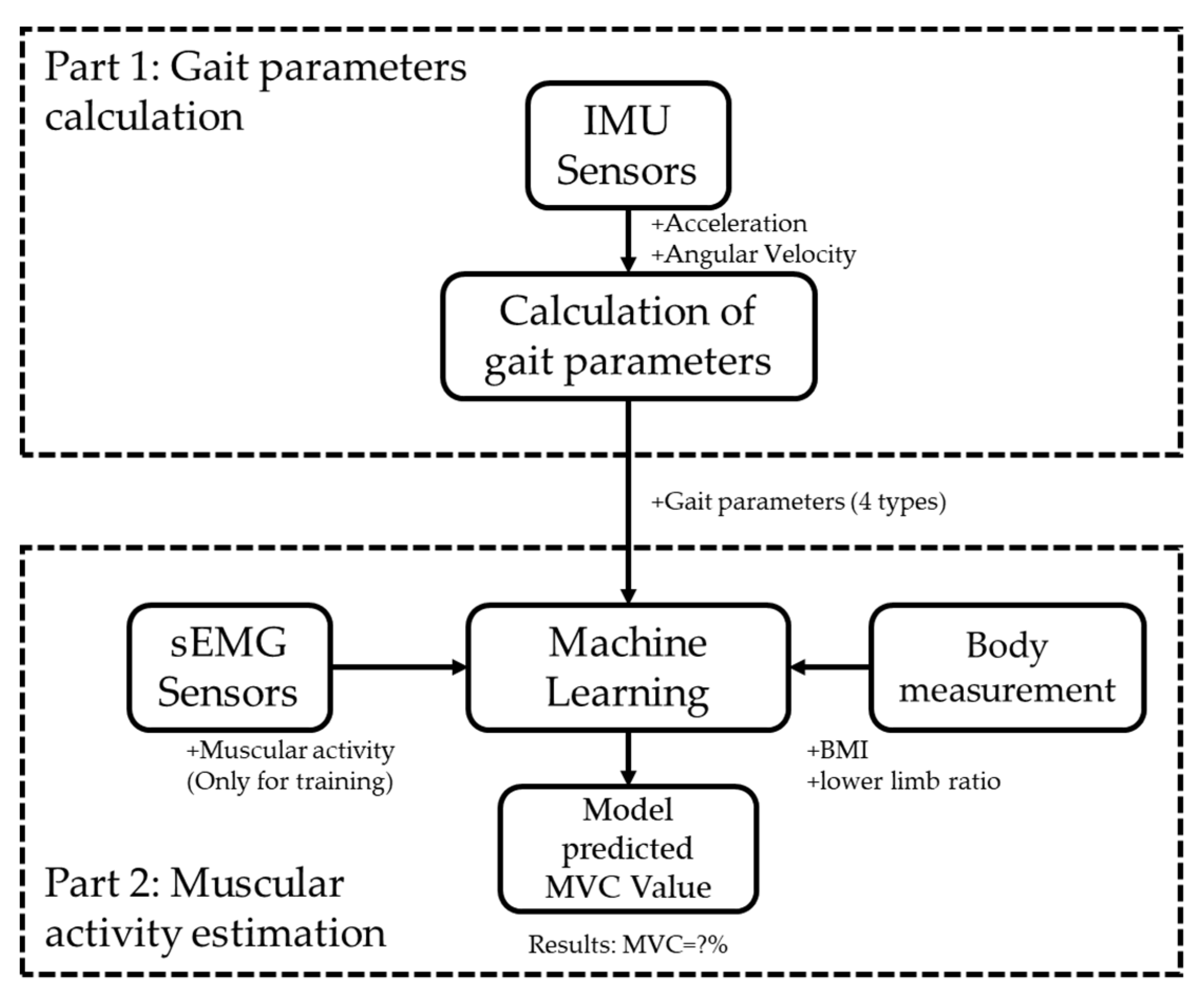
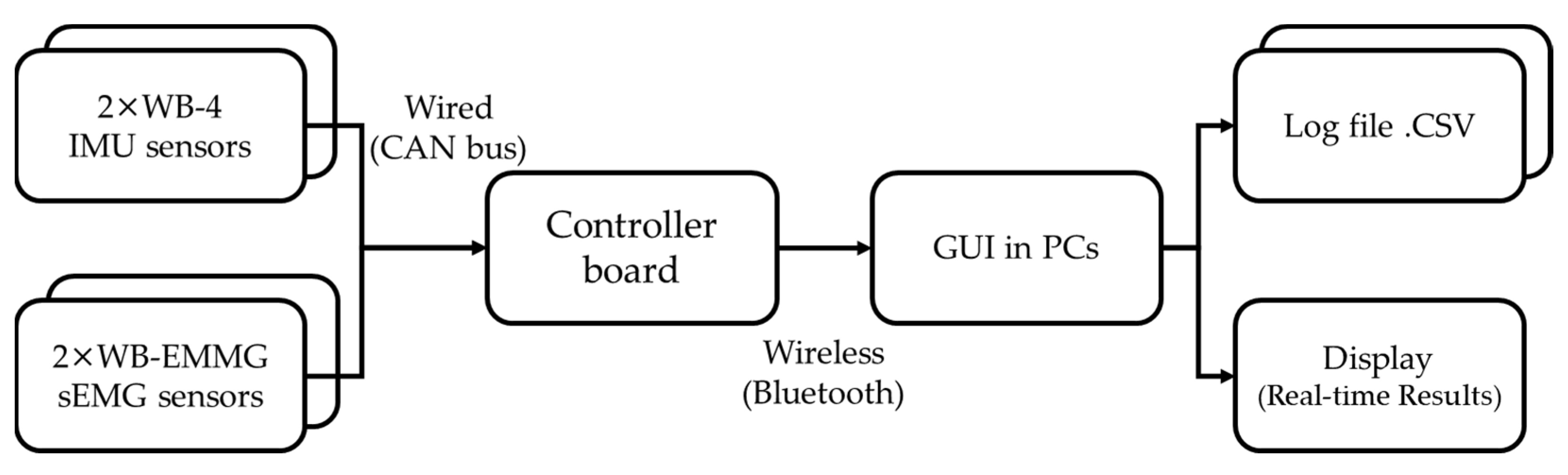
To give people more specific information on the quality of their daily motion, it is necessary to continuously measure muscular activity during everyday occupations in an easy way. The traditional methods to measure muscle activity using a combination of surface electromyography (sEMG) sensors and optical motion capture system are expensive and not suitable for non-technical users and unstructured environment. For this reason, in our group we are researching methods to estimate leg muscle activity using non-contact wearable sensors, improving ease of movement and system usability. In a previous study, we developed a method to estimate muscle activity via only a single inertial measurement unit (IMU) on the shank. In this study, we describe a method to estimate muscle activity during walking via two IMU sensors, using an original sensing system and specifically developed estimation algorithms based on ANN techniques. The muscle activity estimation results, estimated by the proposed algorithm after optimization, showed a relatively high estimation accuracy with a correlation efficient of R2 = 0.48 and a standard deviation STD = 0.10, with a total system average delay of 192 ms. As the average interval between different gait phases in human gait is 250–1000 ms, a 192 ms delay is still acceptable for daily walking requirements. For this reason, compared with the previous study, the newly proposed system presents a higher accuracy and is better suitable for real-time leg muscle activity estimation during walking.
Keywords: muscular activity estimation; knee extensors; muscle training; rehabilitation; real-time; neuron network; IMU sensor muscular activity estimation; knee extensors; muscle training; rehabilitation; real-time; neuron network; IMU sensor