Multi-Layer Attack Graph Analysis in the 5G Edge Network Using a Dynamic Hexagonal Fuzzy Method


Abstract
1. Introduction
- (1)
- The 5G network supports heterogenous infrastructure. Any security solution should use a combination of centralized and distributed, physical and virtual deployments to ensure security at multiple levels (e.g., slices, services, and resources) across multiple domains (i.e., administrative and technological domains where 5G services are orchestrated such as Mobile Virtual Network Operators (MVNOs) for automotive, eHealth, massive IoT, massive multimedia broadband, etc. [4]).
- (2)
- The 5G network requires scalable and higher-performance security solutions. The increase in bandwidth from 4G eNodeB to 5G gNodeB will cause significant increases in performance and scale requirements that the current security infrastructure may not be able to handle. This means the threat detection and vulnerability analysis solutions should be dynamic, consistent, and scalable.
- (3)
- Distributed edge clouds create new attacks surfaces and vulnerability points. If no proper security mechanisms are in place, such as encryption or firewalls, IP connectivity will terminate at the edge of the operator. As a result, edge cloud nodes become susceptible to spoofing, eavesdropping, and other attack [5].
- (4)
- (a)
- are still at an early stage;
- (b)
- (c)
- are not accurate enough when they are applied to large-scale systems like the 5G networks;
- (d)
- do not consider the 5G challenges such as performance monitoring, scalability, orchestration and management, heterogeneous network support, and integration of the SDN, NFV, and edge computing;
- (e)
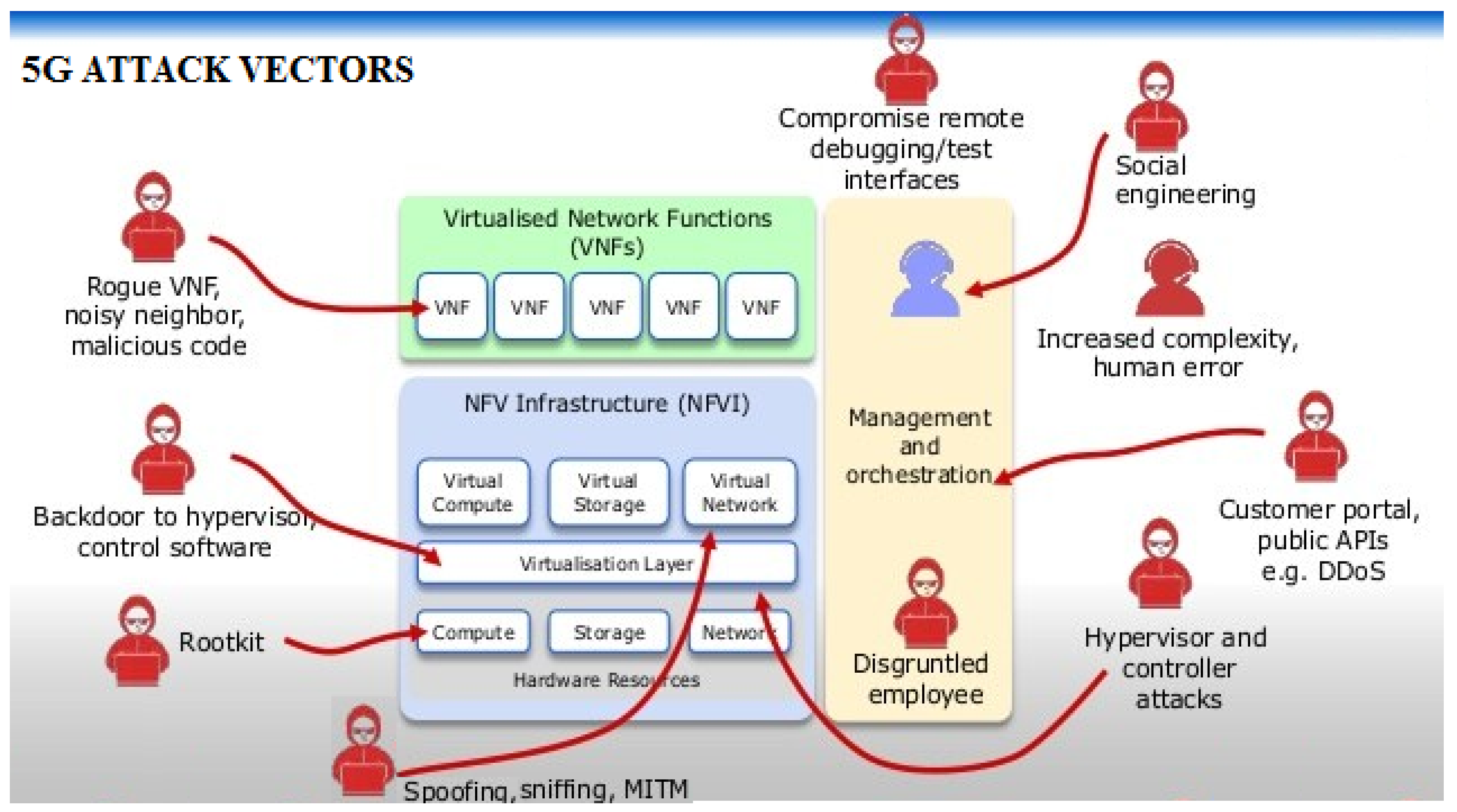
- use generalized attack graph model and do not consider specific 5G attack vectors.
- (a)
- analyze the vulnerabilities in the 5G core components (i.e., SDN, NFV, and cloud Edge servers) and User Equipment (UE) from the attacker perspective especially concerning the dynamic, low latency, and scalable properties of the 5G networks;
- (b)
- generate attack graphs based on the 5G attack vector;
- (c)
- quantify the security level of the network and attack cost by deriving each attack node’s minimal effort in the attack tree.
- (a)
- help the Intrusion Response Systems (IRS) predict the position where attacks and exploits will be propagated in the 5G network;
- (b)
- reduce the cardinality exponential growth of the system security state space that any IRS computes and that usually causes the state space explosion problem when applying a mitigation action in large-scale systems such as 5G Edge networks.
2. Background and Related Work
2.1. The Technique for Order Preference by Similarity to an Ideal Solution (TOPSIS)
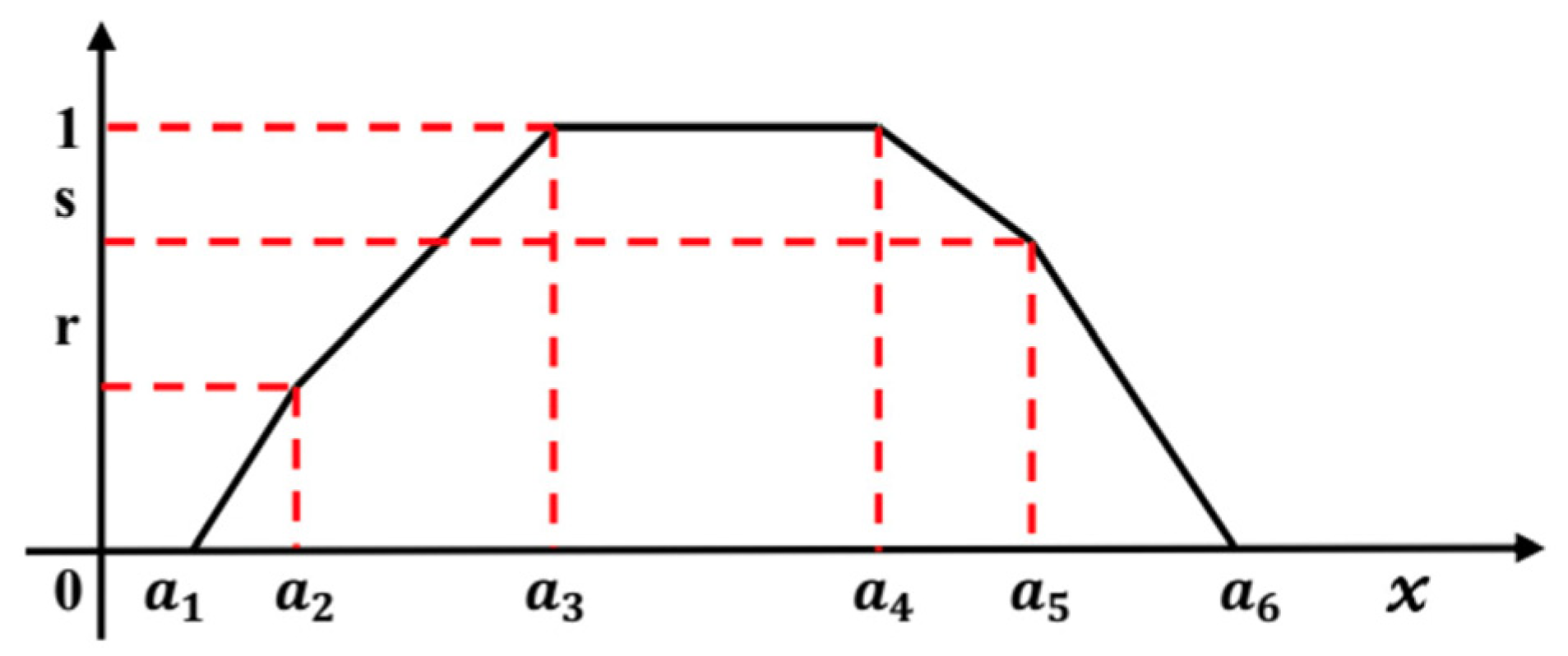
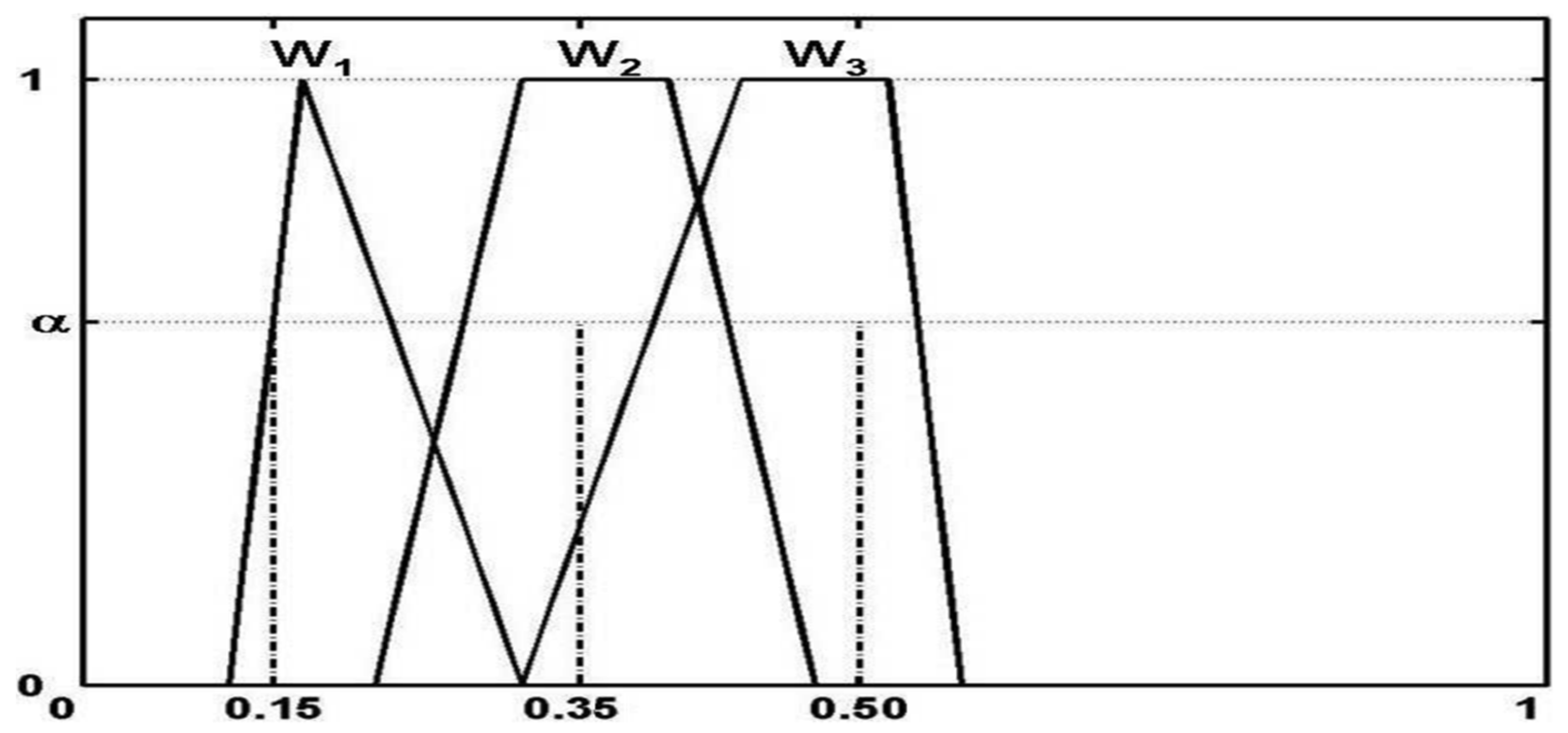
2.2. Hexagonal Fuzzy Number
- (a)
- Operation on Hexagonal Fuzzy Numbers
- Addition: M˜ ⊕ N˜ = (m1 + n1, m2 + n2, m3 + n3, m4 + n4, m5 + n5, m6 + n6);
- Subtraction: M˜ − N˜ = (m1 − n6, m2 − n5, m3 − n4, m4 − n3, m5 − n2, m6 − n1);
- Multiplication: M˜ × N˜ = (m1 × n1, m2 × n2, m3 × n3, m4 × n4, m5× n5, m6 × n6);
- Division: M˜/N˜ = (m1/n6, m2/n5, m3/n4, m4/n3, m5/n2, m6/n1).
- (b)
- The Distance between Two HFNs
3. The 5G Edge Attack Vector
- Threat 1: Attack from VMs in the same domain. Attackers would manipulate the VM and potentially extend the attack to other VMs. This threat category includes Buffer overflow, DOS, ARP, Hypervisor, and vswitch threats;
- Threat 2: Attack to host, hypervisor, and VMs from applications in host Machine. The attacker exploits vulnerabilities caused by the main poor design of hypervisors and improper configuration and injects malicious software to virtual memory and control VM. This threat category includes the malformed packet attacks to hypervisors;
- Threat 3: Attack from host applications communicating with VMs. This includes attacks that exploit vulnerabilities caused by improper network isolation and improper configuration to application privileges of the host machine;
- Threat 4: Attack to VMs from remote management path. This includes eavesdropping, tampering, DOS attack, and Man-in-the-Middle attack;
- Threat 5: Attack to external communication with third party applications. This includes illegal access to API and DOS attacks to API;
- Threat 6: Attack from external network via network edge node. This includes attacks against Virtualized Firewalls and Residential gateways;
- Threat 7: Attack from host machines or VMs of an external network domain. This includes attacks against the VNF migration and VNF scaling.
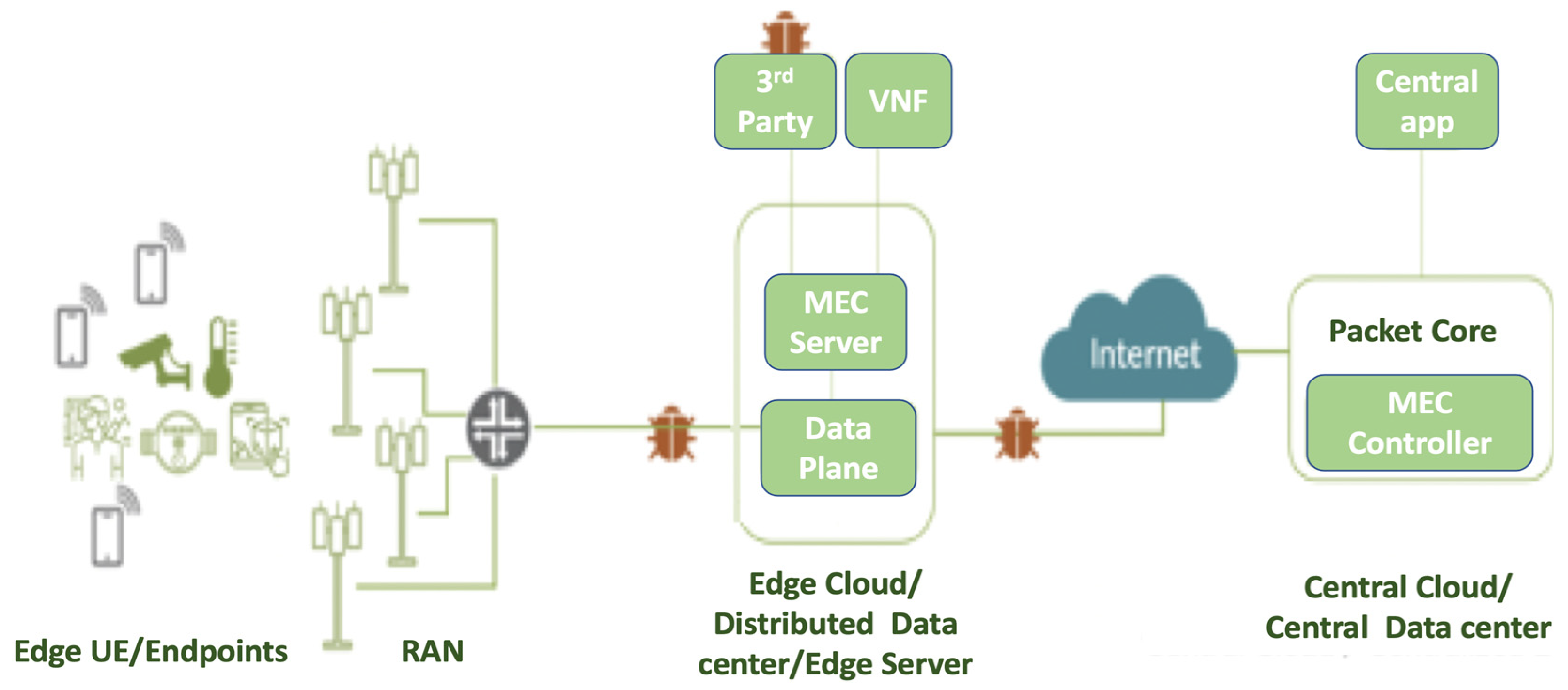
- (I): Insecuremobile backhaul network. Data exchanged between MEC nodes often traverse insecure shared backhaul that is vulnerable to MITM attacks, including eavesdropping and spoofing. Such attacks can also come from edge nodes connected to the public internet through the edge Firewall Interfaces (e.g., SGi/N6);
- (S): Shared infrastructure with third-party applications. MEC nodes can be opened to allow authorized participants to deploy applications/services to other users. However, poorly designed applications can create opportunities for attackers to invade the system and pose threats to the network applications running on the platform;
- (P): Privacy leakage illegitimate access to the Multi-access MEC system. In this case, an attacker can compromise the service infrastructure and the network hampering information privacy, and accessing the information stored at the edge system’s upper layers that in turns poses a serious concern for privacy leakage. In this paper, we mainly target these attacks using the VAA.
4. The New 5G Edge Security Testbed and the Scalable Deployment of the Security Framework
- (a)
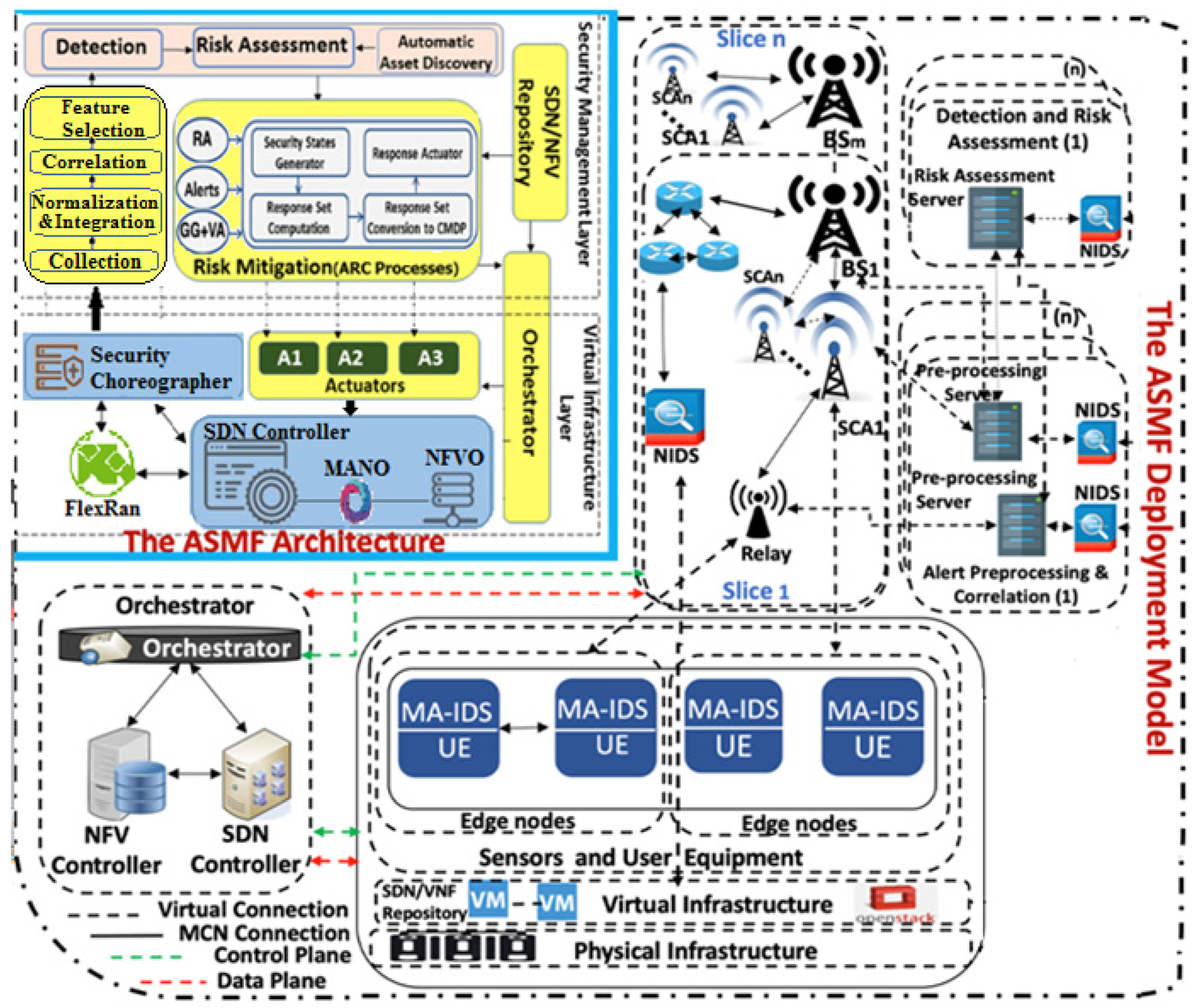
- Collection. This process collects events and logs from several IDSs sensors and sends them to the integration process;
- (b)
- Integration. This process integrates distinct events that are collected from distinct sensors through two processes, namely, normalization and prioritization. The former formats any sensor event into the IDMEF protocol format [60] to facilitate the analysis and correlation of these events in the next layer. The latter handles the prioritization systems of distinct detectors i.e., Mobile Agent IDS(MA-IDS) and network-based IDSs (NIDS);
- (c)
- Correlation. It correlates the normalized events from different sensors to highlight the few critical ones. It compares each event against a set of attack rules to discover if it signals a true attack and then it correlates the related events;
- (d)
- Feature Selection. This process extracts a subset of relevant important features from the correlation process to enhance the classification results. More details about this process are listed in [54];
- (e)
- Risk Assessment. The risk assessment model assesses the risk in the 5G infrastructure based on the alert level of different events;
- (f)
- OpenStack [61] is an open-source hypervisor platform that uses pooled physical and virtual resources to deliver Infrastructure-as-a-service (IaaS);
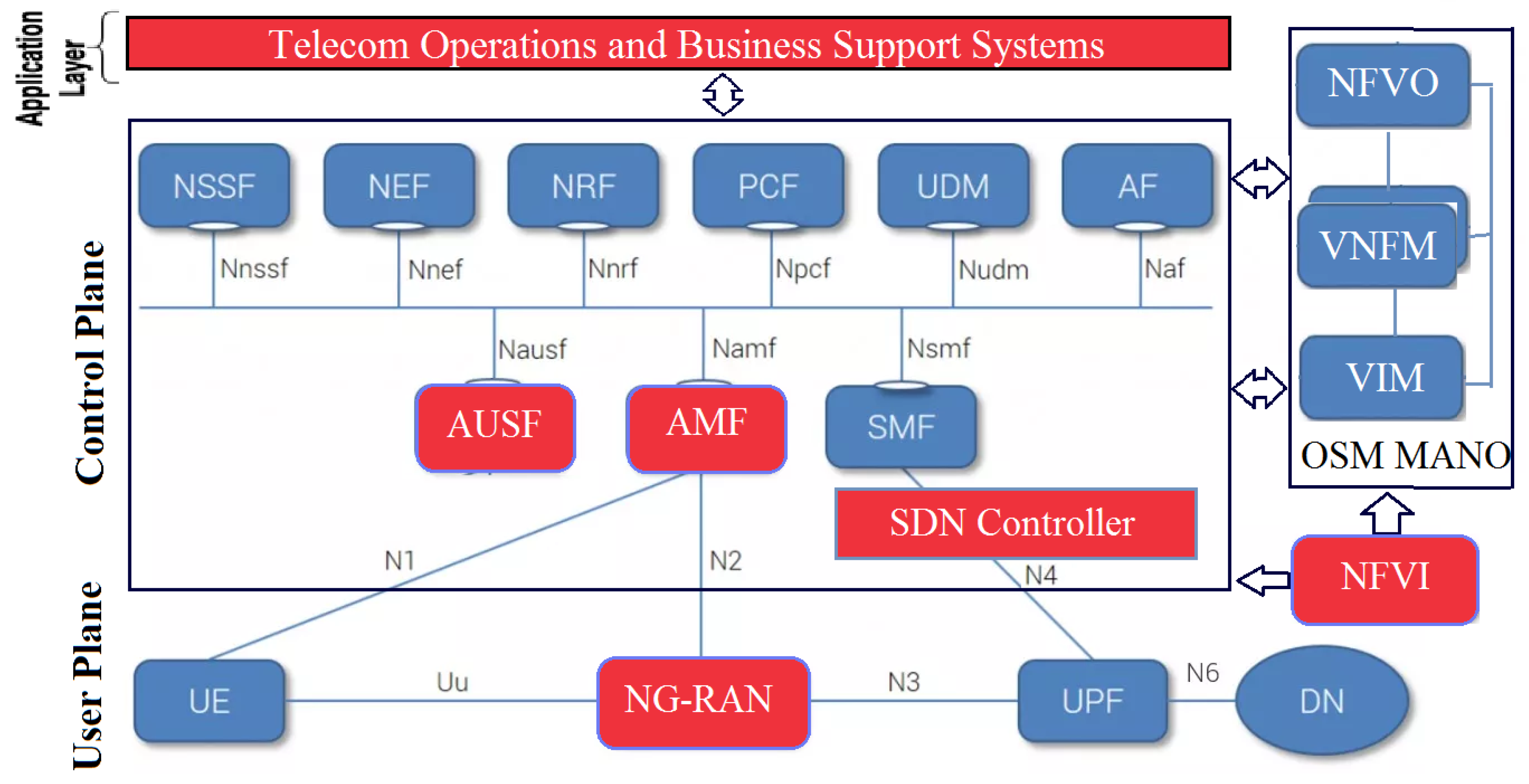
- The Open-Source Network Function Virtualization Management and Orchestration (OSM) [62] handles the management and orchestration of NFV layers. OSM enables the creation of network services with programmatic ease. It has two principal elements for building a network service: (1) VNF packages and (2) NS packages;
- The FlexRan [63] platform is made up of two main components: the FlexRAN Control Plane and FlexRAN Agent API. The FlexRAN protocol facilitates the communication between the master controller and the agents;
- Open5GS [64] integrates with 5G New Radio Stand-Alone (SA) base stations and user equipment supporting the current need to have a flexible 5G Core Network.
5. The New Vulnerability Analysis Approach (VAA)
5.1. Develop the VAA Using the Classical TOPSIS
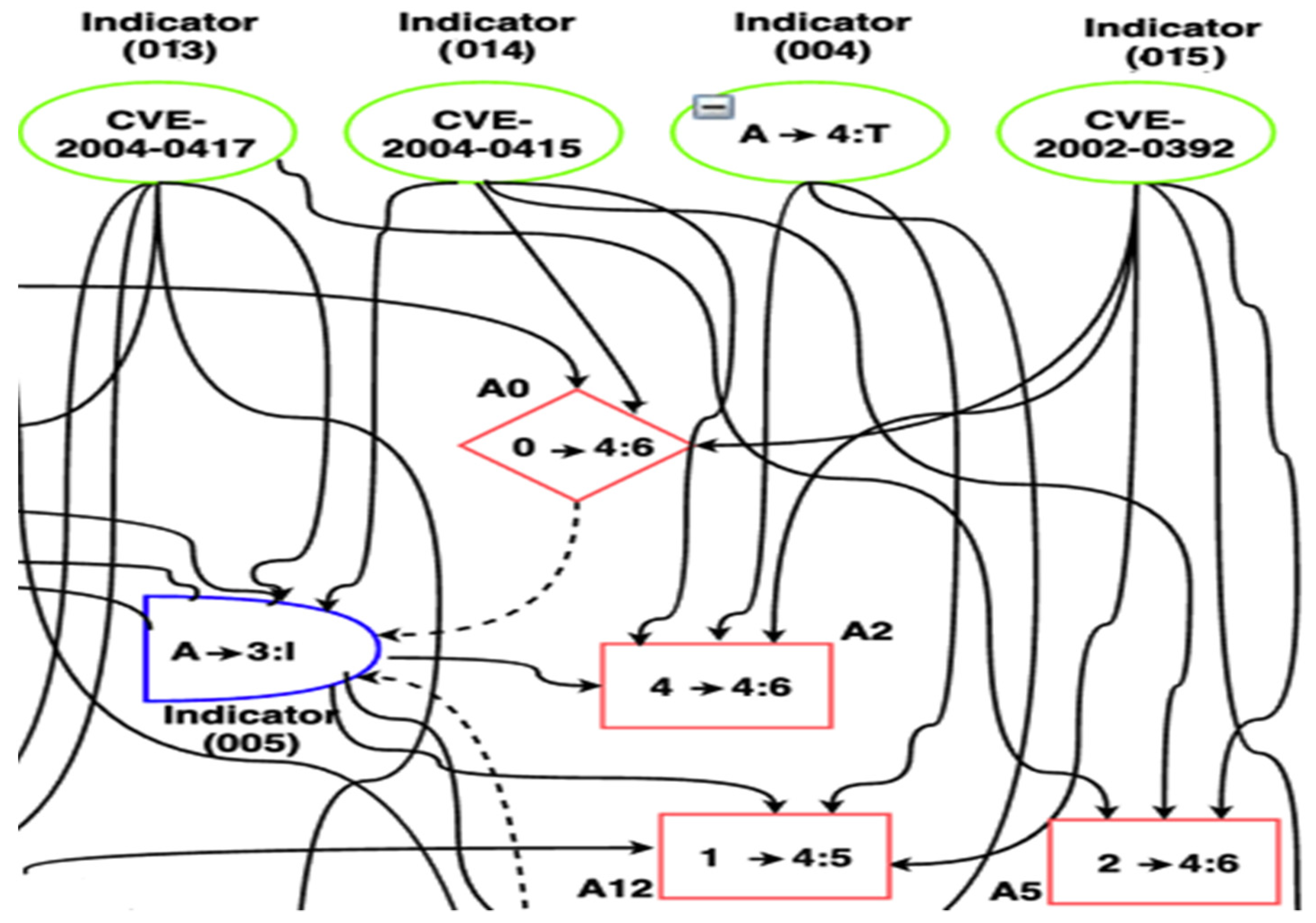
- Step 1: Develop a scalable attack Graph Generator (GG) model.
- (1)
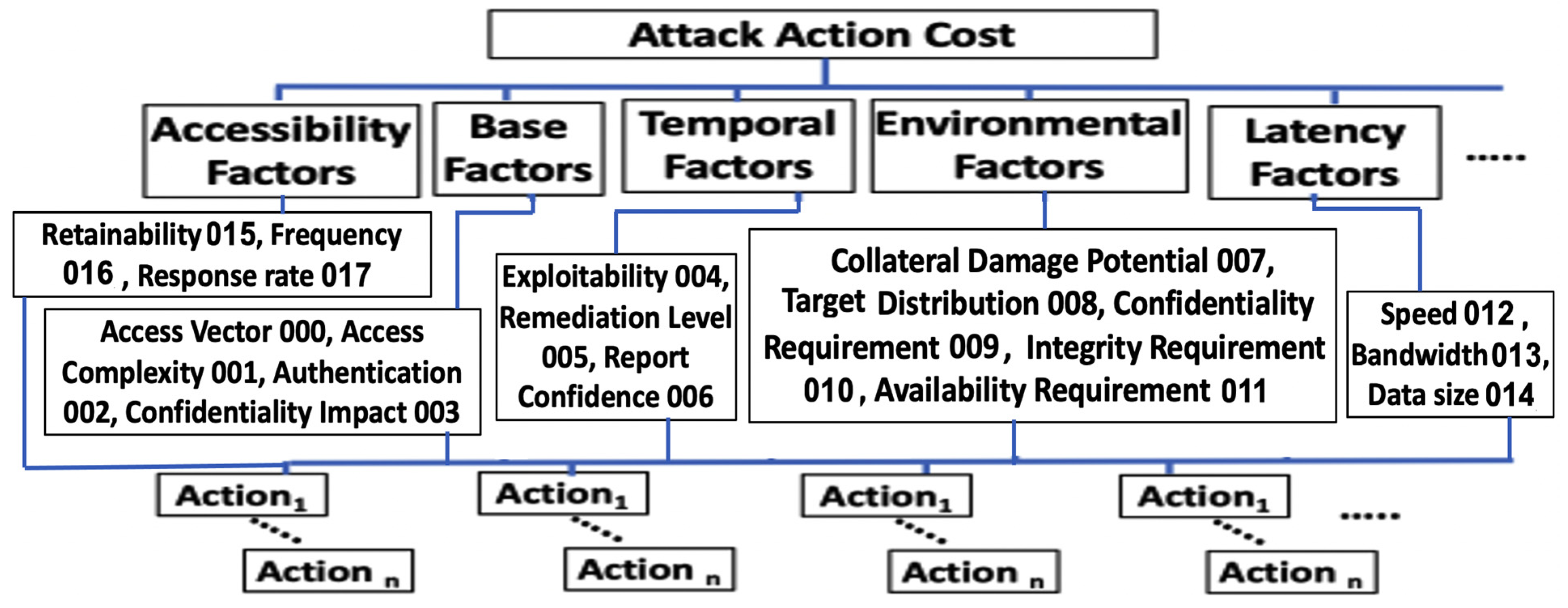
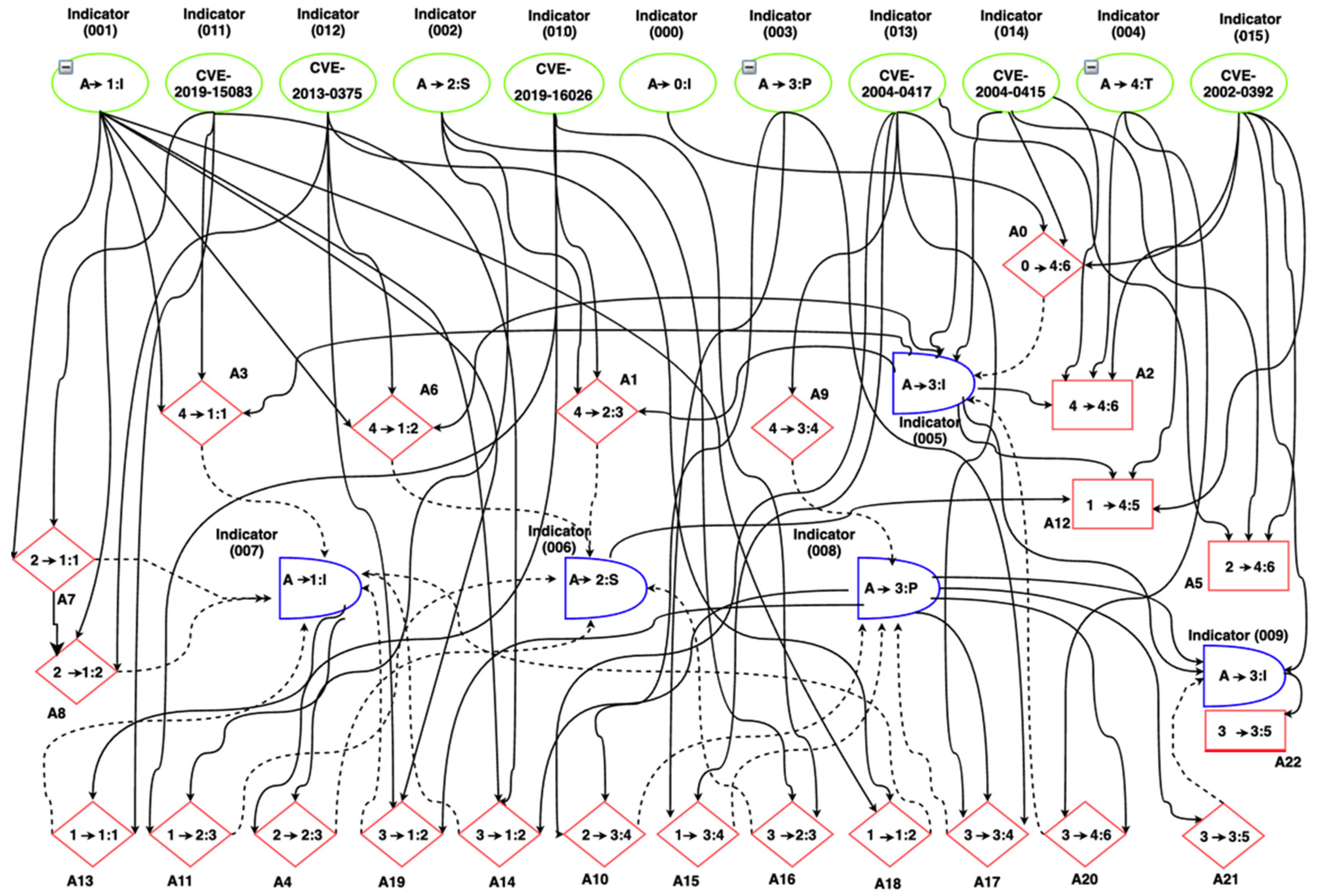
- Create the GG three-layer hierarchical model based on the vulnerability and dynamic network factors, see Figure 6.
- (2)
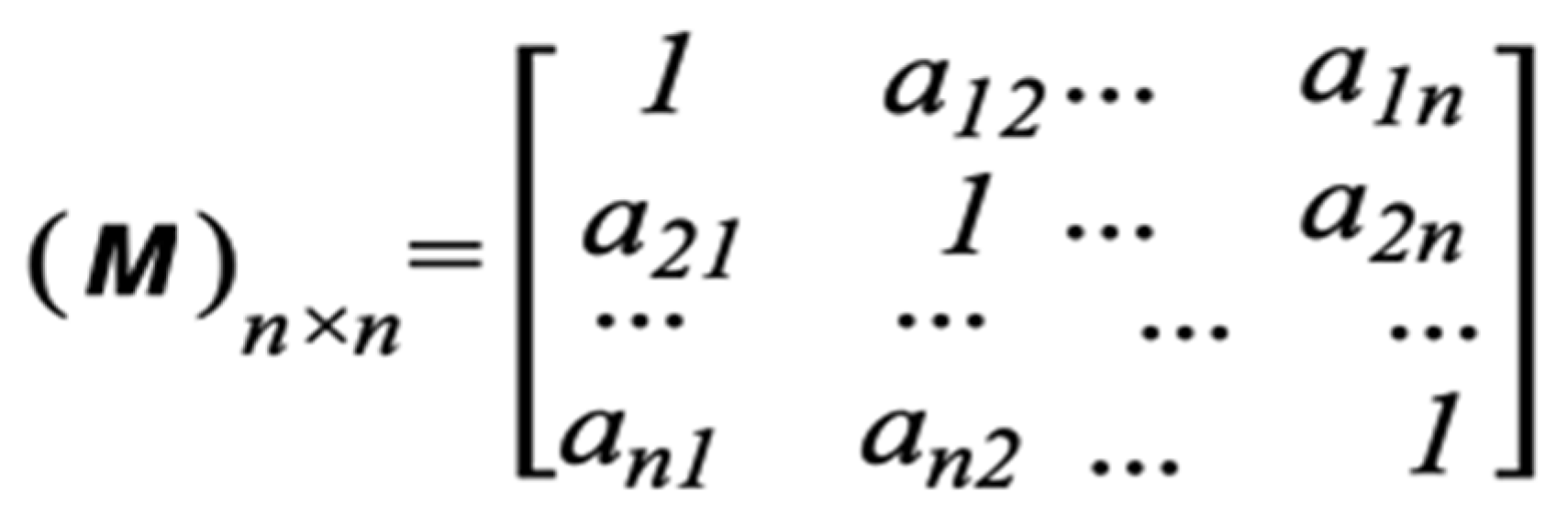
- Construct a pair-wise evaluation matrix M, see Figure 7, based on the attack graph. After that, we compute the combinatorial weights (Wi) which refer to the weight of the impact of each layer’s dynamic factors, in the GG three-layer model, on the attacker decision as given in Equation (3).
- Step 2: Compute the attack cost of actions using the classical TOPSIS.
- (1)
- Normalize the pair-wise decision matrix M to form the normalized decision matrix N as given in Equation (5).
- (2)
- Calculate the weighted normalized decision matrix and the best and worth alternatives.
- (3)
- Calculate the cost of the attacker’s actions. We use the L2-distance defined by the TOPSIS approach to calculate L2i+, the distance between the target alternative i and the best condition E+ as given in Equation (10) and L2i−, the distance between the target alternative i and the worst condition E− as given in Equation (11).
5.2. Develop the VAA Using the Hexagonal Fuzzy TOPSIS Method
- Step 1: Construct the fuzzy decision matrix M. The fuzzy decision matrix has each entry of the HFN as given below:
- Step 2: Construct the normalized decision matrix N˜ij using M entries as shown in Equation (13).
- Step 3: Calculate the weighted normalized decision matrix.
- Step 4: Calculate the fuzzy positive ideal alternative E˜+ and the fuzzy negative ideal alternativeE˜− as shown in Equations (14) and (15), respectively.
- Step 5: Determine the distance measures to ideal solutions, since the E˜+ and E˜− are still HFN, we calculate Di+, the distance between the target alternative i() and the best condition in E˜+ from the attacker perspective as given in Equation (16), and Di−, the distance between the target alternative i() and the worst condition in E˜− as given in Equation (17).
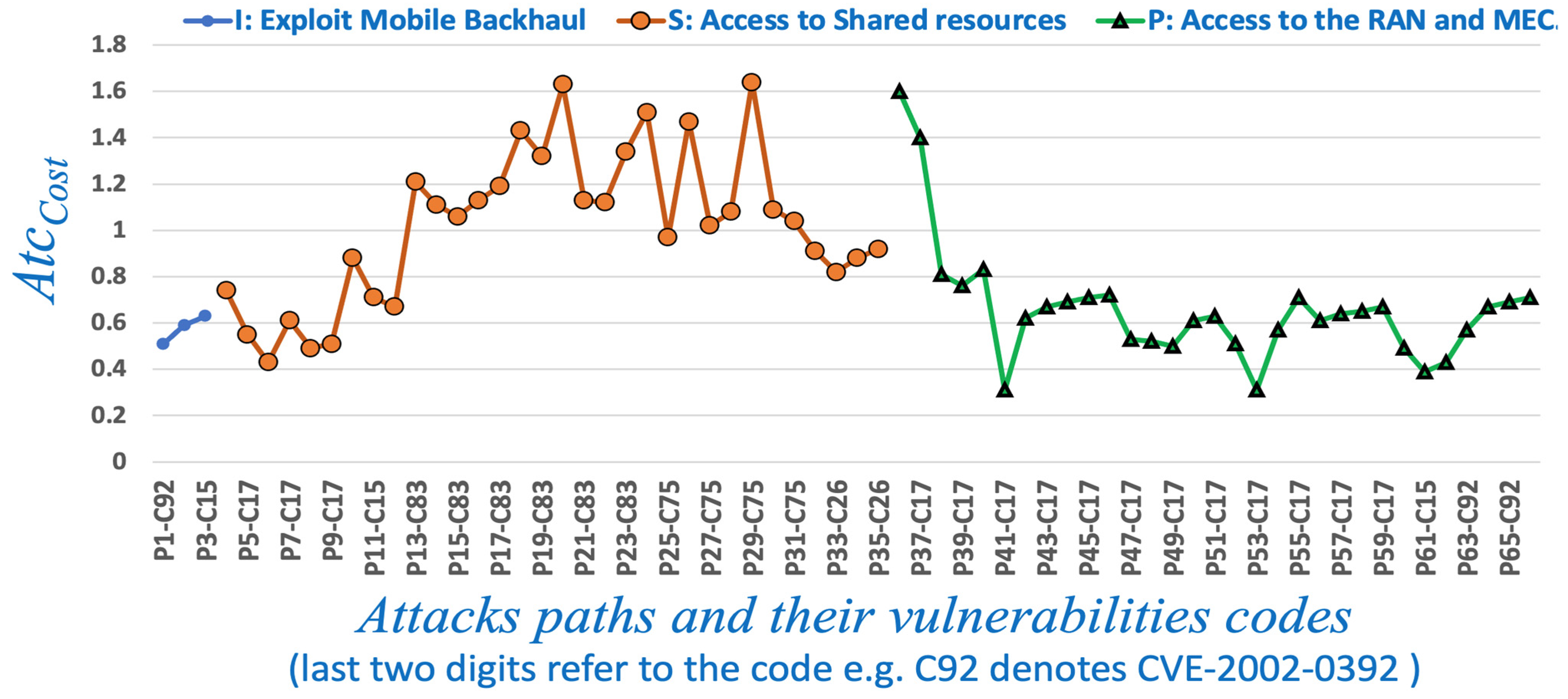
- Step 6: Calculate the cost and benefits of the attacker’s actions. Based on the Di+ and Di− distances, we compute the similarity to the worst condition as the cost of the attacker’s actions (AtcCost) as shown in Equation (18).
6. Performance and Accuracy Evaluation: Case Study
6.1. Evaluating the VAA Using the Classic TOPSIS
6.2. Evaluating the VAA Using the Hexagonal Fuzzy TOPSIS Method
- Step 1: Construct the fuzzy decision matrix M.
- Step 2: Construct the normalized decision matrix.
- Step 3: Calculate the weighted normalized decision matrix.
- Step 4: Calculate the positive and the negative alternatives.
- Step 5: Determine the distance measures to ideal solutions.
- Step 6: Calculate the cost and benefits of the attacker’s actions.
- Step 7: Compute the Shortest Attack Path.
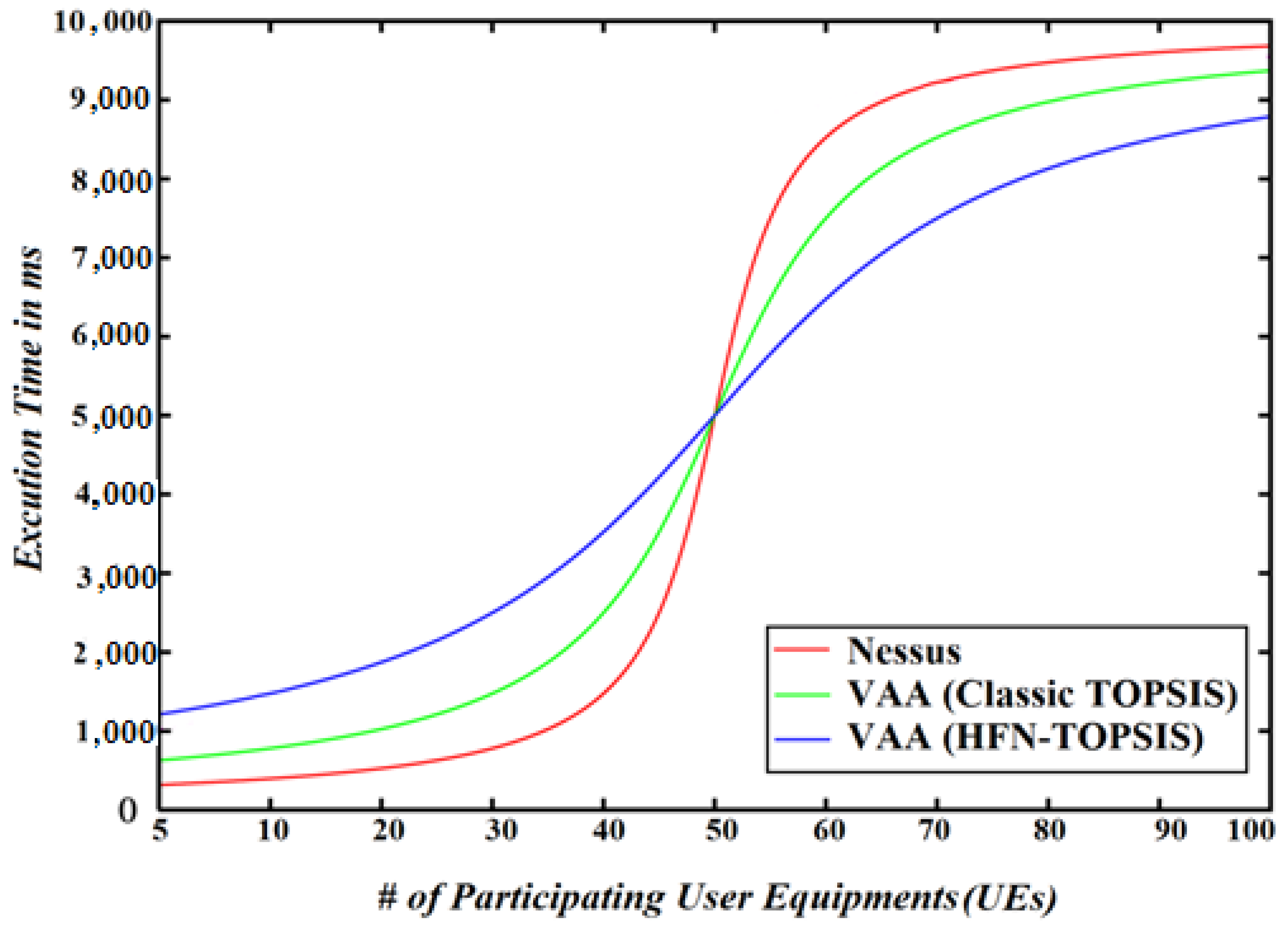
7. Compare the Accuracy and Performance of the VAA with the Nessus
8. Conclusions and Future Work
Funding
Institutional Review Board Statement
Informed Consent Statement
Data Availability Statement
Conflicts of Interest
References
- Norrman, K.; Nakarmi, P.K.; Fogelstrm, E. 5G Security Enabling a Trust-Worthy 5g System. 2018. Available online: https://www.ericsson.com/en/reports-and-papers/white-papers/5g-security---enabling-a-trustworthy-5g-system (accessed on 5 September 2021).
- 5G Security Issues, White Paper by Positive-Tech. Co. 2019. Available online: https://positive-tech.com/expert-lab/research/5g-security-issues/ (accessed on 5 September 2021).
- The National Strategy to Secure 5g Implementation Plan. The National Telecommunications and Information Administration (NTIA). 2020. Available online: https://www.govinfo.gov/content/pkg/FR-2020-06-16/pdf/2020-12960.pdf (accessed on 5 September 2021).
- Afolabi, I.; Ksentini, A.; Bagaa, M.; Taleb, T.; Corici, M.; Nakao, A. Towards 5G Network Slicing over Multiple-Domains. IEICE Trans. Commun. 2017, E100-B, P1992–P2006. [Google Scholar] [CrossRef] [Scilit]
- Vijayan, J. 4 Ways Edge Computing Changes Your Threat Model. May 2020. Available online: https://www.csoonline.com/article/3543191/4-ways-edge-computing-changes-your-threat-model.html (accessed on 10 October 2021).
- Subedi, P.; Alsadoon, A.; Prasad, P.W.C.; Rehman, S.; Giweli, N.; Imran, M.; Arif, S. Network slicing: A next generation 5G perspective. J. Wirel. Commun. Netw. 2021, 2021, 102. [Google Scholar] [CrossRef] [Scilit]
- Fernandez, J.-M.; Vidal, I.; Valera, F. Enabling the Orchestration of IoT Slices through Edge and Cloud Microservice Platforms. Sensors 2019, 19, 2980. [Google Scholar] [CrossRef] [Scilit] [PubMed]
- Makris, N.; Zarafetas, C.; Valantasis, A.; Korakis, T. Service Orchestratidoion Over Wireless Network Slices: Testbed Setup and Integration. IEEE Trans. Netw. Serv. Manag. 2021, 18, 482–497. [Google Scholar] [CrossRef] [Scilit]
- Rodrigo, R.; Javier Lopez, M.M. Mobile edge computing, Fog et al.: A survey and analysis of security threats and challenges. Future Gener. Comput. Syst. 2018, 78, 680–698. [Google Scholar]
- Fan, Z.; Xiao, Y.; Nayak, A.; Tan, C. An improved network security situation assessment approach in software defined networks. Peer-to-Peer Netw. Appl. 2019, 12, 295–309. [Google Scholar] [CrossRef] [Scilit]
- Khan, R.; Kumar, P.; Jayakody, D.N.K.; Liyanage, M. A survey on security and privacy of 5g technologies: Potential solutions, recent advancements and future directions. IEEE Commun. Surv. Tutor. 2019, 22, 196–248. [Google Scholar] [CrossRef] [Scilit]
- Rudolph, H.C.; Kunz, A.; Iacono, L.L.; Nguyen, H.V. Security challenges of the 3gpp 5g service based architecture. IEEE Commun. Stand. Mag. 2019, 3, 60–65. [Google Scholar] [CrossRef] [Scilit]
- Enisa Threat Landscape for 5G Networks, Report, European Union for Cybersecurity. 2019. Available online: https://www.enisa.europa.eu/publications/enisa-threat-landscape-report-for-5g-networks (accessed on 10 December 2020).
- Abdulqadder, I.; Zou, D.; Aziz, I.; Yuan, B.; Dai, W. Deployment of robust security scheme in sdn based 5g network over nfv enabled cloud environment. IEEE Trans. Emerg. Top. Comput. 2018, 9, 866–877. [Google Scholar] [CrossRef] [Scilit]
- Tian, Z.; Sun, Y.; Su, S.; Li, M.; Du, X.; Guizani, M. Automated attack and defense framework for 5g security on physical and logical layers. arXiv 2019, arXiv:1902.04009. [Google Scholar]
- Luo, S.; Wu, J.; Li, J.; Guo, L.; Pei, B. Toward Vulnerability Assessment for 5G Mobile Communication Networks. In Proceedings of the 2015 IEEE International Conference on Smart City/SocialCom/SustainCom (SmartCity), Chengdu, China, 19–21 December 2015; pp. 72–76. [Google Scholar] [CrossRef] [Scilit]
- Batalla, J.M.; Andrukiewicz, E.; Gomez, G.P.; Sapiecha, P.; Mavromoustakis, C.X.; Mastorakis, G.; Zurek, J.; Imran, M. Security Risk Assessment for 5G Networks: National Perspective. IEEE Wirel. Commun. 2020, 27, 16–22. [Google Scholar] [CrossRef] [Scilit]
- Khan, J.A.; Chowdhury, M.M. Security Analysis of 5G Network. In Proceedings of the 2021 IEEE International Conference on Electro Information Technology (EIT), Mt. Pleasant, MI, USA, 14–15 May 2021. [Google Scholar] [CrossRef] [Scilit]
- Sun, Y.; Tian, Z.; Li, M.; Zhu, C.; Guizani, N. Automated Attack and Defense Framework toward 5G Security. IEEE Netw. 2020, 34, 247–253. [Google Scholar] [CrossRef] [Scilit]
- Xu, H.; Dong, M.; Ota, K.; Wu, J.; Li, J. Toward Software Defined Dynamic Defense as a Service for 5G-Enabled Vehicular Networks. In Proceedings of the 2019 International Conference on Internet of Things (iThings) and IEEE Green Computing and Communications (GreenCom) and IEEE Cyber, Physical and Social Computing (CPSCom) and IEEE Smart Data (SmartData), Atlanta, GA, USA, 14–17 July 2019; pp. 880–887. [Google Scholar] [CrossRef] [Scilit]
- Kumar, A.; Sah, B.; Singh, A.R.; Deng, Y.; He, X.; Kumar, P.; Bansal, R. Chapter 1—Multicriteria decision-making methodologies and their applications in sustainable energy system/microgrids. In Decision Making Applications in Modern Power Systems; Academic Press: Cambridge, MA, USA, 2020; pp. 1–40. ISBN 9780128164457. [Google Scholar]
- Behzadian, M.; Khanmohammadi Otaghsara, S.; Yazdani, M.; Ignatius, J. A state-of the-art survey of TOPSIS applications. Expert Syst. Appl. 2012, 39, 13051–13069. [Google Scholar] [CrossRef] [Scilit]
- Dursun, M.; Ertugrul Karsak, E. A fuzzy MCDM approach for personnel selection. Expert Syst. Appl. 2010, 37, 4324–4330. [Google Scholar] [CrossRef] [Scilit]
- Ansari, M.T.J.; Al-Zahrani, F.A.; Pandey, D.; Agrawal, A. A fuzzy TOPSIS based analysis toward selection of effective security requirements engineering approach for trustworthy healthcare software development. BMC Med. Inform. Decis. Mak. 2020, 20, 236. [Google Scholar] [CrossRef] [Scilit] [PubMed]
- Chakraborty, A.; Maity, S.; Jain, S.; Mondal, S.P.; Alam, S. Hexagonal fuzzy number and its distinctive representation, ranking, defuzzification technique and application in production inventory management problem. Granul. Comput. 2021, 6, 507–521. [Google Scholar] [CrossRef] [Scilit]
- Fathi, M.R.; Matin, H.Z.; Zarchi, M.K.; Azizollahi, S. The application of fuzzy TOPSIS approach to personnel selection for Padir Company. Iran. J. Manag. Res. 2011, 3, 1–14. [Google Scholar] [CrossRef] [Scilit]
- Gheorghe-Pop, E.D. FOKUS, 5G Ready Testbeds: Enabling Early Prototyping and Experimentation, In Proceedings of the IEEE 5G and Beyond Testbed Workshop, Toronto, ON, Canada, 24 September 2017.
- Geller, M.; Nair, P. 5G Security Innovation White Paper. Available online: .https://www.netsync.com/2019/05/03/white-paper-5g-security-innovation-with-cisco/ (accessed on 5 April 2019).
- 5G Network Evolution with AWS. 2020. Available online: https://d1.awsstatic.com/whitepapers/5g-network-evolution-with-aws.pdf (accessed on 5 April 2019).
- Huawei 5G Security White Paper. Available online: https://www-file.huawei.com/-/media/corporate/pdf/trust-center/huawei-5g-security-white-paper-4th.pdf (accessed on 10 December 2020).
- Dutta, A.; Hammad, E. 5G Security Challenges and Opportunities: A System Approach. In Proceedings of the 2020 IEEE 3rd 5G World Forum (5GWF), Bangalore, India, 10–12 September 2020; pp. 109–114. [Google Scholar] [CrossRef] [Scilit]
- Nessus Vulnerability Scanner. Available online: http://www.nessus.org (accessed on 10 December 2020).
- Park, S.; Kim, D.; Park, Y.; Cho, H.; Kim, D.; Kwon, S. 5G Security Threat Assessment in Real Networks. Sensors 2021, 21, 5524. [Google Scholar] [CrossRef] [Scilit]
- Holtrup, G.; Lacube, W.; David, D.P.; Mermoud, A.; Bovet, G.; Lenders, V. 5G System Security Analysis. arXiv 2021, arXiv:2108.08700. [Google Scholar]
- Sullivan, S.; Brighente, A.; Kumar, S.A.P. 5G Security Challenges and Solutions: A Review by OSI Layers. IEEE Access 2021, 9, 116294–116314. [Google Scholar] [CrossRef] [Scilit]
- Li, W.; Wang, N.; Jiao, L.; Zang, K. Physical Layer Spoofing Attack Detection in MmWave Massive MIMO 5G Networks. IEEE Access 2021, 9, 60419–60432. [Google Scholar] [CrossRef] [Scilit]
- Singh, R.; Kumar, H.; Singla, R.K. TOPSIS Based Multi-Criteria Decision Making of Feature Selection Techniques for Network Traffic Dataset. Int. J. Eng. Technol. 2013, 5, 4598–4604. [Google Scholar]
- Haque, N.; Rahman, M.; Chen, D.; Kholidy, H. BIoTA: Control-Aware Attack Analytics for Building Internet of Things. In Proceedings of the 18th IEEE International Conference on Sensing, Communication and Networking (SECON), Rome, Italy, 6–9 July 2021. [Google Scholar]
- Kholidy, H.A.; Karam, A.; Sidoran, J.L.; Rahman, M.A. 5G Core Security in Edge Networks: A Vulnerability Assessment Approach. In Proceedings of the 26th IEEE Symposium on Computers and Communications (ISCC), Athens, Greece, 5–8 September 2021; pp. 1–6. [Google Scholar] [CrossRef] [Scilit]
- Steele, B.; Kholidy, H.A. 5G Networks Security: Attack Detection Using the J48 and the Random Forest Tree Classifiers. DSPACE and SDR Open Access Repository. Available online: https://soar.suny.edu/handle/20.500.12648/1604 (accessed on 10 December 2020).
- Ferrucci, R.; Kholidy, H.A. A Wireless Intrusion Detection for the Next Generation (5G) Networks: DSPACE and SOAR Open Access Repository. 2020. Available online: https://soar.suny.edu/handle/20.500.12648/1607 (accessed on 11 May 2020).
- Borgesen, M.L.; Kholidy, H.A. Evaluating Variant Deep Learning and Machine Learning Approaches for the Detection of Cyberattacks on the Next Generation 5G Systems. The SUNY Digital Repository, SUNY Open Access Repository. Available online: https://dspace.sunyconnect.suny.edu/handle/1951/71327 (accessed on 10 December 2020).
- Lin, H.T.; Chang, W.L. Order selection and pricing methods using flexible quantity and fuzzy approach for buyer evaluation. Eur. J. Oper. Res. 2008, 187, 415–428. [Google Scholar] [CrossRef] [Scilit]
- Kamble, P.N.; Parveen, N. An application of integrated fuzzy AHP and fuzzy TOPSIS method for staff selection. J. Comput. Math. Sci. 2018, 9, 1161–1169. [Google Scholar] [CrossRef] [Scilit]
- Ashtiani, B.; Haghighirad, F.; Makui, A.; Montazer, G.A. Extension of fuzzy TOPSIS method based on interval-valued fuzzy sets. Appl. Soft Comput. 2008, 9, 457–461. [Google Scholar] [CrossRef] [Scilit]
- Gyumin, L.; Chung, E.S.; Jun, K.S. MCDM Approach for Flood Vulnerability Assessment using TOPSIS Method with a Cut Level Sets. J. Korea Water Resour. Assoc. 2013, 46. [Google Scholar] [CrossRef] [Scilit]
- Yazdani, M.Y.M.; Alidoosti, A.; Basiri, M.H. Risk Analysis for Critical Infrastructures Using Fuzzy TOPSIS. J. Manag. Res. 2012, 4, 1–19. [Google Scholar] [CrossRef] [Scilit]
- Tupper, M.; Zincir-Heywood, A. VEA-bility security metric: A network security analysis tool. In Proceedings of the 2008 Third International Conference on Availability, Reliability and Security, Barcelona, Spain, 4–7 March 2008. [Google Scholar]
- Leela-apiradee, W.; Thipwiwatpotjana, P. A Ranking Method of Hexagonal Fuzzy Numbers Based on Their Possibilistic Mean Values. Available online: https://link.springer.com/chapter/10.1007/978-3-030-21920-8_29 (accessed on 10 December 2020).
- Ghosh, A.; Ghorui, N.; Mondal, S.P.; Kumari, S.; Mondal, B.K.; Das, A.; Gupta, M.S. Application of Hexagonal Fuzzy MCDM Methodology for Site Selection of Electric Vehicle Charging Station. Mathematics 2021, 9, 393. [Google Scholar] [CrossRef] [Scilit]
- Kholidy, H.A.; Erradi, A.; Abdelwahed, S.; Baiardi, F. A hierarchical, autonomous, and forecasting cloud IDS. In Proceedings of the 5th International Conference on Modelling, Identification and Control (ICMIC), Cairo, Egypt, 31 August–2 September 2013; pp. 213–220. [Google Scholar]
- Kholidy, H.A. Autonomous mitigation of cyber risks in the Cyber–Physical Systems. Future Gener. Comput. Syst. 2020, 115, 171–187. [Google Scholar] [CrossRef] [Scilit]
- Kholidy, H.A.; Erradi, A.; Abdelwahed, S.; Baiardi, F. A risk mitigation approach for autonomous cloud intrusion response system. Computing 2016, 98, 1111–1135. [Google Scholar] [CrossRef] [Scilit]
- Kholidy, H.A.; Erradi, A. VHDRA: A Vertical and Horizontal Intelligent Dataset Reduction Approach for Cyber-Physical Power Aware Intrusion Detection Systems. Available online: https://www.hindawi.com/journals/scn/2019/6816943/ (accessed on 10 December 2020).
- Kholidy, H.A. Towards A Scalable Symmetric Key Cryptographic Scheme: Performance Evaluation and Security Analysis. In Proceedings of the 2019 2nd International Conference on Computer Applications & Information Security (ICCAIS), Riyadh, Saudi Arabia, 1–3 May 2019; IEEE: Piscataway Township, NJ, USA, 2019. [Google Scholar]
- Kholidy, H.A. Detecting impersonation attacks in cloud computing environments using a centric user profiling approach. Gener. Comput. Syst. 2021, 117, 299–320. [Google Scholar] [CrossRef] [Scilit]
- Kholidy, H.A. Correlation-based sequence alignment models for detecting masquerades in cloud computing. IET Inf. Secur. 2020, 14, 39–50. [Google Scholar] [CrossRef] [Scilit]
- Kholidy, H.A.; Baiardi, F.; Hariri, S. DDSGA: A Data-Driven Semi-Global Alignment Approach for Detecting Masquerade Attacks. IEEE Trans. Depend. Sec. Comput. 2015, 12, 164–178. [Google Scholar] [CrossRef] [Scilit]
- Kholidy, H.A.; Abdelkarim, E. A Cost-Aware Model for Risk Mitigation in Cloud Computing Systems. In Proceedings of the 2015 IEEE/ACS 12th International Conference of Computer Systems and Applications (AICCSA), Marrakech, Morocco, 17–20 November 2015; IEEE: Piscataway Township, NJ, USA, 2015. [Google Scholar]
- Debar, H.; Curry, D. The Intrusion Detection Message Exchange Format (IDMEF). Available online: https://datatracker.ietf.org/doc/html/rfc4765 (accessed on 6 August 2021).
- OpenStack. Available online: https://www.openstack.org/ (accessed on 1 July 2021).
- Open-Source MANO (OSM). Available online: https://osm.etsi.org/ (accessed on 10 December 2021).
- FlexRAN (Mosaic5G). Available online: https://mosaic5g.io/flexran/ (accessed on 13 May 2021).
- Open5GS. Available online: https://open5gs.org/ (accessed on 10 June 2021).
- Bräuning, F.; Koopman, J.S. The dynamic factor network model with an application to international trade. J. Econom. 2019, 216, 494–515. [Google Scholar] [CrossRef] [Scilit]
- Common Vulnerability Scoring System (CVSS) Factors. Available online: https://www.first.org/cvss/specification-document (accessed on 8 November 2021).
- The Metasploit Framework. Available online: https://www.metasploit (accessed on 2 October 2021).
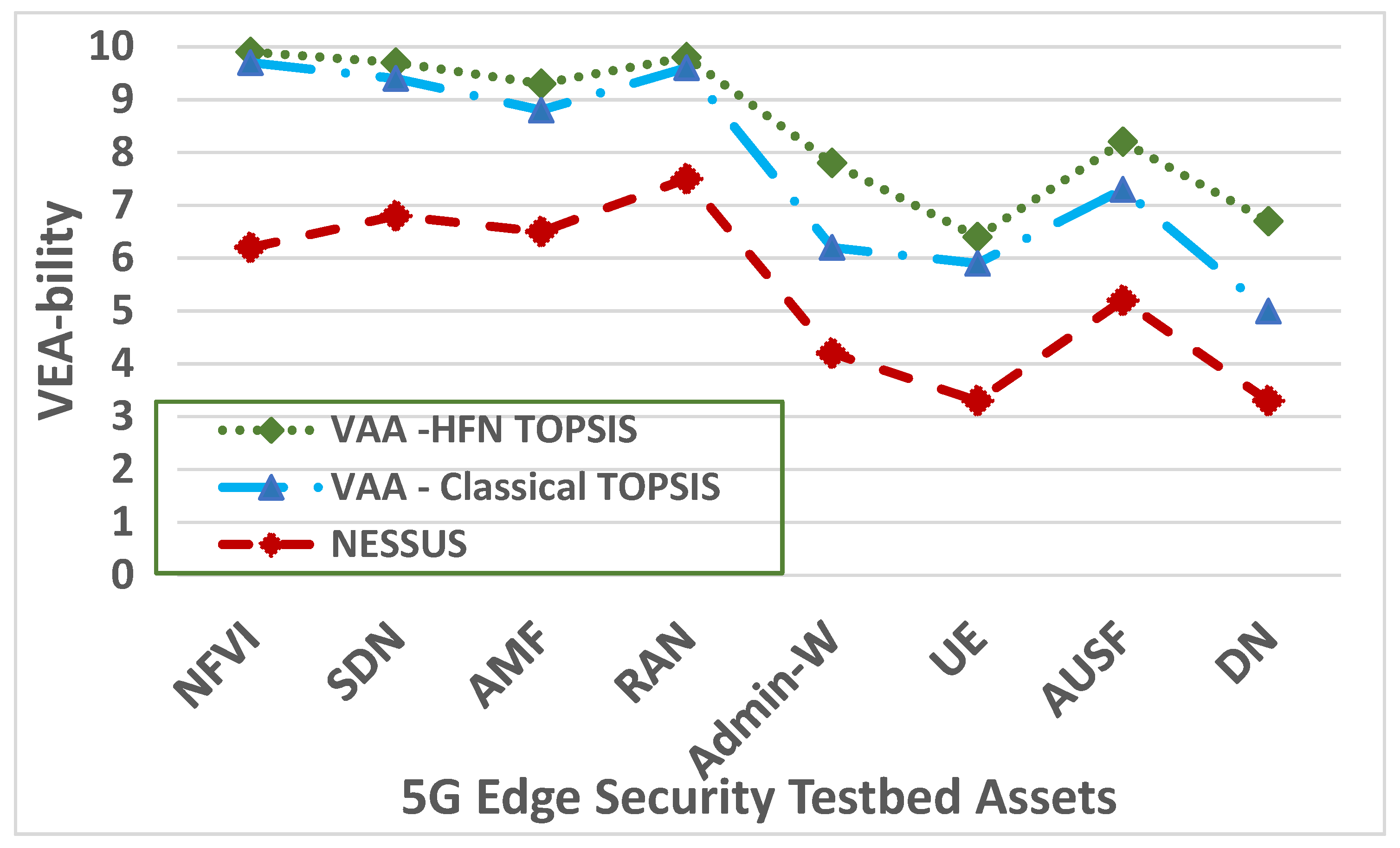
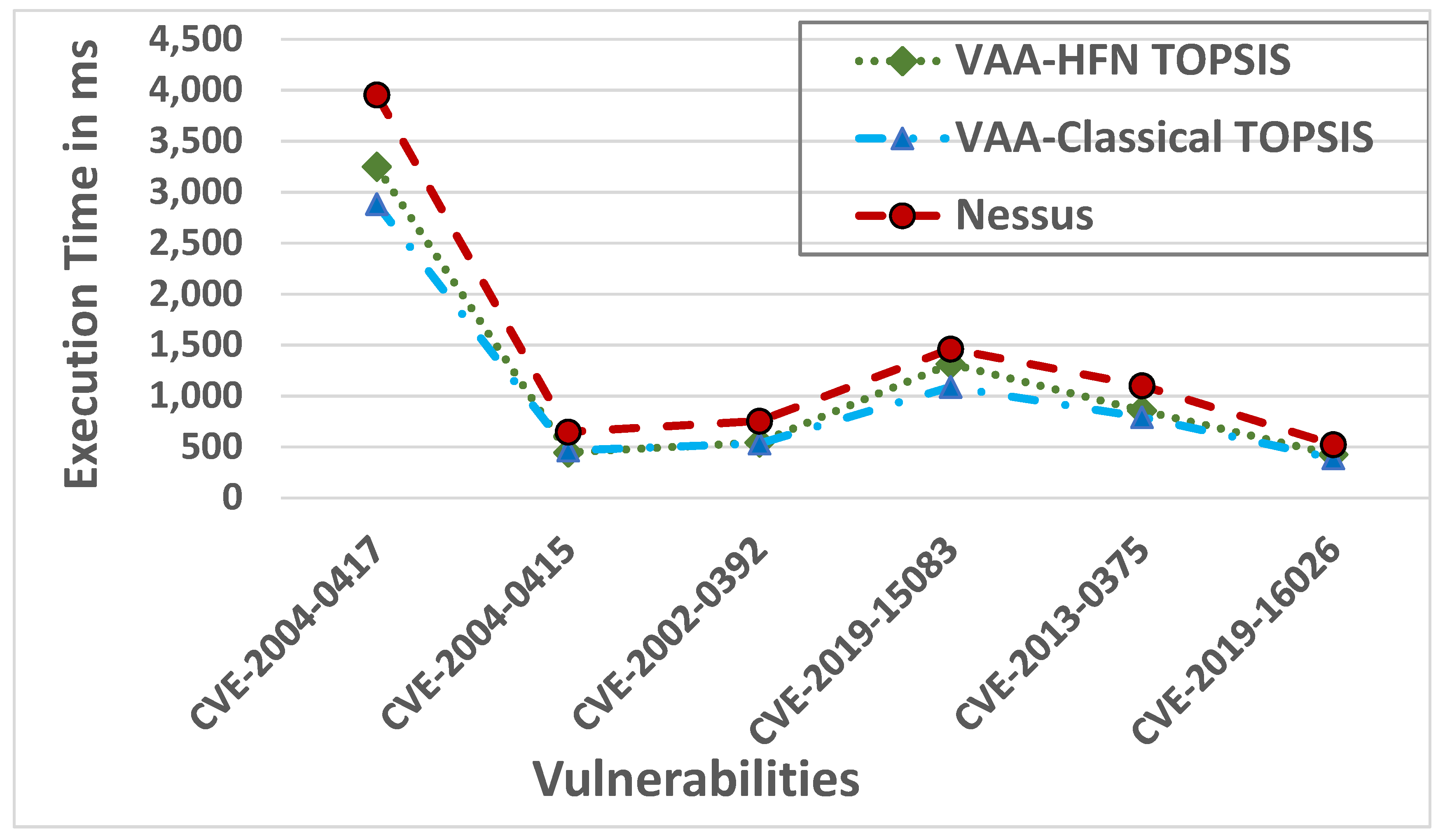


| Component | System Parameters | ||
|---|---|---|---|
| OSM, OpenStack, and Open5GS | OS: UBUNTU 20.04 LTS GHz SSD: 3TB(RAID 5) OpenStack Version: Wallaby. OAI-CN Version: 1.0 | RAM: 128 GB OSM Version: 9.1. Open5GS Version: 2.3. | CPU: 32 Cores 2.10 MicroK8s Version: 1.19 |
| FlexRAN | OS: UBUNTU 20.04 LTS. GHz SSD: 2TB(RAID 5) | RAM: 32 GB. | CPU: 4 Cores 2.33 |
| SDR USRP B210 | Frequency Range: 70 MHz–6 GHz | Channels: 2TX*2RX |
| Attacker Goal | Exploitation Starting Point | |||
| CVE-2004-0417 | CVE-2004-0415 | CVE-2002-0392 | ||
| I: disruption for NFVI Services | A5 | A5 | A5 | |
| S: illegitimate access to Shared SDN | A12 | A0–A12, A12 | A12 | |
| P: illegitimate access to the RAN | A2 | A0–A2, A2 | A2 | |
| 001 | 002 | 003 | 004 | 005 | 006 | 007 | 008 | 009 | 011 | 012 | … | |
|---|---|---|---|---|---|---|---|---|---|---|---|---|
| 001 | 1 | 3 | 2 | 1/8 | 1/9 | 1/7 | 1/4 | 1/6 | 1/7 | 2 | 1/4 | … |
| 002 | 1/7 | 1 | 3 | 2 | 1 | 1/5 | 1/3 | 1/9 | 2 | 1/6 | 1/5 | … |
| 003 | 1/8 | 1/9 | 1 | 1/3 | 1/2 | 1/3 | 1/7 | 3 | 1/2 | 1/4 | 2 | … |
| 004 | 1/8 | 1/9 | 1/2 | 1 | 1/8 | 1/3 | 1/4 | 2 | 1/5 | 1/3 | 1/4 | … |
| 005 | 3 | 1/3 | 1/6 | 1/5 | 1 | 1/5 | 1/3 | 1/5 | 1/6 | 1/6 | 1/9 | … |
| 006 | 1/2 | 1/7 | 2 | 1/3 | 1/2 | 1 | 1/7 | 3 | 1/2 | 1/9 | 1/3 | … |
| 007 | 1/6 | ½ | 1/7 | 2 | 1/3 | 1/5 | 1 | 1/6 | 1/8 | 1/7 | 1/7 | … |
| 008 | 1/2 | 4 | 1/2 | 2 | 1/7 | 1/3 | 1/6 | 1 | 3 | 1/5 | 4 | … |
| 009 | 1/6 | 1/5 | 3 | 1/6 | 1/4 | 1/6 | 1/3 | 1/5 | 1 | 1/3 | 4 | … |
| 011 | 3 | 1 | 1/6 | 1/9 | 2 | 1/2 | 1/7 | 1/3 | 1/5 | 1 | 1/3 | … |
| 012 | 1/5 | 1/9 | 1/6 | 1/7 | 1 | 1/8 | 2 | 1/7 | 1/3 | 2 | 1 | … |
| Attacker Goal | Exploitation Starting Point. Action Paths with the Lowest Costs Are Underlined | ||||||
| CVE-2004-0417 | CVE-2004-0415 | CVE-2002-0392 | CVE-2019-15083 | CVE-2013-0375 | CVE-2019-16026 | ||
| I: Exploit mobile backhaul network. | 5. AtcCost = 0.63 | 5. AtcCost = 0.51 | 5. AtcCost = 0.59 | - | - | - | |
| S: Access to Shared resources | 12, 10-17-20-12, 9-17-20-12, 9-20-12, 15-17-20-12, 15-20-12. AtcCost = 0.43 | 0-12, 12. AtcCost = 0.71 | 12. AtcCost = 0.67 | 3-13-11-12, 3-11-12, 3-4-12, 3-13-4-12, 7-8-4-12, 7-11-12, 7-4-12, 8-4-12, 8-11-12, 14-4-12, 14-11-12. AtcCost =1.06 | 8-12, 8-4-12, 8-11-12, 19-11-12, 19-4-12, 6-12, 18-4-12, 18-11-12. AtcCost = 0.97 | 11-12, 4-12, 1-12, 16-12 AtcCost = 0.82 | |
| P: Access to the RAN and MEC. | 2, 22, 10-17-20-22, 10-17-21-22, 10-17-20-2, 10-17-22, 9-17-20-2, 9-17-20-22, 9-17-21-22, 9-17-22, 9-22, 9-20-2, 9-20-12, 9-20-22, 9-21-22, 15-17-20-2, 15-17-20-22, 15-17-21-22, 15-17-22, 15-22, 15-20-2, 15-20-12, 15-20-22, 15-21-22. AtcCost = 0.31 | 0-2, 2, 0-22. AtcCost = 0.39 | 2, 22, 0-2, 0-22. AtcCost = 0.57 | - | - | - | |
| Criteria/Indicators/Factors | Wi | Criteria/Indicators/Factors | Wi | Criteria/Indicators/Factors | Wi |
|---|---|---|---|---|---|
| Access Vector 000 | W0 = 0.03 | Report Confidence 006 | W6 = 0.01 | Speed 012 | W12 = 0.08 |
| Access Complexity 001 | W1 = 0.04 | Collateral Damage 007 | W7 = 0.06 | Bandwidth 013 | W13 = 0.08 |
| Authentication 002 | W2 = 0.09 | Target Distribution 008 | W8 = 0.01 | Data Size 014 | W14 = 0.08 |
| Confidentiality impact 003 | W3 = 0.09 | Confidentiality req. 009 | W9 = 0.09 | Retainability 015 | W15 = 0.03 |
| Exploitability 004 | W4 = 0.11 | Integrity req. 010 | W10 = 0.09 | - | - |
| Remediation level 005 | W5 = 0.02 | Availability req. 011 | W11 = 0.09 | - | - |
| Linguistic Variables | Hexagonal Fuzzy Numbers | Linguistic Variables | Hexagonal Fuzzy Numbers |
|---|---|---|---|
| Very low (VL) | (1, 2, 3, 4, 5, 6) | Medium high (MH) | (3, 4, 5, 6, 7, 8) |
| Low (L) | (1.5, 2.5, 3.5, 4.5, 5.5, 6.5) | High (H) | (3.5, 4.5, 5.5, 6.5, 7.5, 8.5) |
| Medium low (ML) | (2, 3, 4, 5, 6, 7) | Very high (VH) | (4, 5, 6, 7, 8, 9) |
| Neutral (N) | (2.5, 3.5, 4.5, 5.5, 6.5, 7.5) |
| 𝑊0 | 𝑊1 | 𝑊2 | 𝑊3 | 𝑊4 | 𝑊5 | 𝑊6 | 𝑊7 | 𝑊8 | 𝑊9 | 𝑊10 | 𝑊11 | 𝑊12 | 𝑊13 | 𝑊14 | 𝑊15 | |
|---|---|---|---|---|---|---|---|---|---|---|---|---|---|---|---|---|
| A0 | VH | VL | VL | VL | VL | VL | VL | VL | VL | VL | VL | VL | VL | VL | VH | VH |
| A1 | N | VL | VH | VL | VL | VH | VL | VL | VL | VL | VH | VL | VL | H | H | N |
| A2 | VL | VL | L | VL | VH | VH | VL | VL | VL | VL | VL | VL | L | MH | VH | VH |
| A3 | N | VH | VL | L | ML | VH | VL | VL | VL | VL | VL | VH | VL | MH | MH | N |
| A4 | L | N | L | VL | L | N | VL | H | VL | VL | VL | N | L | ML | ML | L |
| A5 | VL | VL | VL | VL | VL | VL | VL | VL | VL | VL | VL | VL | VL | VH | VH | VH |
| ⋮ | ⋮ | ⋮ | ⋮ | ⋮ | ⋮ | ⋮ | ⋮ | ⋮ | ⋮ | ⋮ | ⋮ | ⋮ | ⋮ | ⋮ | ⋮ | ⋮ |
| A22 | L | L | VL | VL | L | N | VL | VL | ML | VH | VL | VL | L | ML | ML | H |
| W0 | W1 | W2 | W3 | W4 | W5 | ||
|---|---|---|---|---|---|---|---|
| A0 | (4, 5, 6, 7, 8, 9) | (1, 2, 3, 4, 5, 6) | (1, 2, 3, 4, 5, 6) | (1, 2, 3, 4, 5, 6) | (1, 2, 3, 4, 5, 6) | (1, 2, 3, 4, 5, 6) | … |
| A1 | (2.5, 3.5, 4.5, 5.5, 6.5, 7.5) | (1, 2, 3, 4, 5, 6) | (4, 5, 6, 7, 8, 9) | (1, 2, 3, 4, 5, 6) | (1, 2, 3, 4, 5, 6) | (4, 5, 6, 7, 8, 9) | … |
| A2 | (1, 2, 3, 4, 5, 6) | (1, 2, 3, 4, 5, 6) | (1.5, 2.5, 3.5, 4.5, 5.5, 6.5) | (1, 2, 3, 4, 5, 6) | (4, 5, 6, 7, 8, 9) | (4, 5, 6, 7, 8, 9) | … |
| A3 | (2.5, 3.5, 4.5, 5.5, 6.5, 7.5) | (4, 5, 6, 7, 8, 9) | (1, 2, 3, 4, 5, 6) | (1.5, 2.5, 3.5, 4.5, 5.5, 6.5) | (2, 3, 4, 5, 6, 7) | (4, 5, 6, 7, 8, 9) | … |
| A4 | (1.5, 2.5, 3.5, 4.5, 5.5, 6.5) | (2.5, 3.5, 4.5, 5.5, 6.5, 7.5) | (1.5, 2.5, 3.5, 4.5, 5.5, 6.5) | (1, 2, 3, 4, 5, 6) | (1.5, 2.5, 3.5, 4.5, 5.5, 6.5) | (2.5, 3.5, 4.5, 5.5, 6.5, 7.5) | … |
| A5 | (1, 2, 3, 4, 5, 6) | (1, 2, 3, 4, 5, 6) | (1, 2, 3, 4, 5, 6) | (1, 2, 3, 4, 5, 6) | (1, 2, 3, 4, 5, 6) | (1, 2, 3, 4, 5, 6) | … |
| ⋮ | ⋮ | ⋮ | ⋮ | ⋮ | ⋮ | ⋮ | ⋮ |
| A22 | (1.5, 2.5, 3.5, 4.5, 5.5, 6.5) | (1.5, 2.5, 3.5, 4.5, 5.5, 6.5) | (1, 2, 3, 4, 5, 6) | (1, 2, 3, 4, 5, 6) | (1.5, 2.5, 3.5, 4.5, 5.5, 6.5) | (2.5, 3.5, 4.5, 5.5, 6.5, 7.5) | … |
| W0 | W1 | W2 | W3 | W4 | W5 | ||
|---|---|---|---|---|---|---|---|
| A0 | (0.24, 0.30, 0.36, 0.42, 0.48, 0.54) | (0.10, 0.20, 0.31, 0.41, 0.52, 0.62) | (0.10, 0.20, 0.31, 0.41, 0.52, 0.62) | (0.10, 0.20, 0.31, 0.41, 0.52, 0.62) | (0.10, 0.20, 0.31, 0.41, 0.52, 0.62) | (0.10, 0.20, 0.31, 0.41, 0.52, 0.62) | … |
| A1 | (0.19, 0.27, 0.34, 0.42, 0.50, 0.57) | (0.10, 0.20, 0.31, 0.41, 0.52, 0.62) | (0.24, 0.30, 0.36, 0.42, 0.48, 0.54) | (0.10, 0.20, 0.31, 0.41, 0.52, 0.62) | (0.10, 0.20, 0.31, 0.41, 0.52, 0.62) | (0.24, 0.30, 0.36, 0.42, 0.48, 0.54) | … |
| A2 | (0.10, 0.20, 0.31, 0.41, 0.52, 0.62) | (0.10, 0.20, 0.31, 0.41, 0.52, 0.62) | (0.14, 0.23, 0.32, 0.42, 0.51, 0.61) | (0.10, 0.20, 0.31, 0.41, 0.52, 0.62) | (0.24, 0.30, 0.36, 0.42, 0.48, 0.54) | (0.24, 0.30, 0.36, 0.42, 0.48, 0.54) | … |
| A3 | (0.19, 0.27, 0.34, 0.42, 0.50, 0.57) | (0.24, 0.30, 0.36, 0.42, 0.48, 0.54) | (0.10, 0.20, 0.31, 0.41, 0.52, 0.62) | (0.14, 0.23, 0.32, 0.42, 0.51, 0.61) | (0.16, 0.25, 0.33, 0.42, 0.50, 0.59) | (0.24, 0.30, 0.36, 0.42, 0.48, 0.54) | … |
| A4 | (0.14, 0.23, 0.32, 0.42, 0.51, 0.61) | (0.19, 0.27, 0.34, 0.42, 0.50, 0.57) | (0.14, 0.23, 0.32, 0.42, 0.51, 0.61) | (0.10, 0.20, 0.31, 0.41, 0.52, 0.62) | (0.14, 0.23, 0.32, 0.42, 0.51, 0.61) | (0.19, 0.27, 0.34, 0.42, 0.50, 0.57) | … |
| A5 | (0.10, 0.20, 0.31, 0.41, 0.52, 0.62) | (0.10, 0.20, 0.31, 0.41, 0.52, 0.62) | (0.10, 0.20, 0.31, 0.41, 0.52, 0.62) | (0.10, 0.20, 0.31, 0.41, 0.52, 0.62) | (0.10, 0.20, 0.31, 0.41, 0.52, 0.62) | (0.10, 0.20, 0.31, 0.41, 0.52, 0.62) | … |
| ⋮ | ⋮ | ⋮ | ⋮ | ⋮ | ⋮ | ⋮ | ⋮ |
| A22 | (0.14, 0.23, 0.32, 0.42, 0.51, 0.61) | (0.14, 0.23, 0.32, 0.42, 0.51, 0.61) | (0.10, 0.20, 0.31, 0.41, 0.52, 0.62) | (0.10, 0.20, 0.31, 0.41, 0.52, 0.62) | (0.14, 0.23, 0.32, 0.42, 0.51, 0.61) | (0.19, 0.27, 0.34, 0.42, 0.50, 0.57) | … |
| W0 | W1 | W2 | W3 | W4 | W5 | ||
|---|---|---|---|---|---|---|---|
| A0 | (0.0072, 0.009, 0.0108, 0.0126, 0.0144, 0.0162) | (0.004, 0.008, 0.0124, 0.0164, 0.0208, 0.0248) | (0.009, 0.018, 0.0279, 0.0369, 0.0468, 0.0558) | (0.009, 0.018, 0.0279, 0.0369, 0.0468, 0.0558) | (0.011, 0.022, 0.0341, 0.0451, 0.0572, 0.0682) | (0.002, 0.004, 0.0062, 0.0082, 0.0104, 0.0124) | … |
| A1 | (0.0057, 0.0081, 0.0102, 0.0126, 0.015, 0.0171) | (0.004, 0.008, 0.0124, 0.0164, 0.0208, 0.0248) | (0.0216, 0.027, 0.0324, 0.0378, 0.0432, 0.0486) | (0.009, 0.018, 0.0279, 0.0369, 0.0468, 0.0558) | (0.011, 0.022, 0.0341, 0.0451, 0.0572, 0.0682) | (0.0048, 0.006, 0.0072, 0.0084, 0.0096, 0.0108) | … |
| A2 | (0.003, 0.006, 0.0093, 0.0123, 0.0156, 0.0186) | (0.004, 0.008, 0.0124, 0.0164, 0.0208, 0.0248) | (0.0126, 0.0207, 0.0288, 0.0378, 0.0459, 0.0549) | (0.009, 0.018, 0.0279, 0.0369, 0.0468, 0.0558) | (0.0264, 0.033, 0.0396, 0.0462, 0.0528, 0.0594) | (0.0048, 0.006, 0.0072, 0.0084, 0.0096, 0.0108) | … |
| A3 | (0.0057, 0.0081, 0.0102, 0.0126, 0.015, 0.0171) | (0.0096, 0.012, 0.0144, 0.0168, 0.0192, 0.0216) | (0.009, 0.018, 0.0279, 0.0369, 0.0468, 0.0558) | (0.0126, 0.0207, 0.0288, 0.0378, 0.0459, 0.0549) | (0.0176, 0.0275, 0.0363, 0.0462, 0.055, 0.0649) | (0.0048, 0.006, 0.0072, 0.0084, 0.0096, 0.0108) | … |
| A4 | (0.0042, 0.0069, 0.0096, 0.0126, 0.0153, 0.0183) | (0.0076, 0.0108, 0.0136, 0.0168, 0.02, 0.0228) | (0.0126, 0.0207, 0.0288, 0.0378, 0.0459, 0.0549) | (0.009, 0.018, 0.0279, 0.0369, 0.0468, 0.0558) | (0.0154, 0.0253, 0.0352, 0.0462, 0.0561, 0.0671) | (0.0038, 0.0054, 0.0068, 0.0084, 0.01, 0.0114) | … |
| A5 | (0.003, 0.006, 0.0093, 0.0123, 0.0156, 0.0186) | (0.004, 0.008, 0.0124, 0.0164, 0.0208, 0.0248) | (0.009, 0.018, 0.0279, 0.0369, 0.0468, 0.0558) | (0.009, 0.018, 0.0279, 0.0369, 0.0468, 0.0558) | (0.011, 0.022, 0.0341, 0.0451, 0.0572, 0.0682) | (0.002, 0.004, 0.0062, 0.0082, 0.0104, 0.0124) | … |
| ⋮ | ⋮ | ⋮ | ⋮ | ⋮ | ⋮ | ⋮ | ⋮ |
| A22 | (0.0042, 0.0069, 0.0096, 0.0126, 0.0153, 0.0183) | (0.0056, 0.0092, 0.0128, 0.0168, 0.0204, 0.0244) | (0.009, 0.018, 0.0279, 0.0369, 0.0468, 0.0558) | (0.009, 0.018, 0.0279, 0.0369, 0.0468, 0.0558) | (0.0154, 0.0253, 0.0352, 0.0462, 0.0561, 0.0671) | (0.0038, 0.0054, 0.0068, 0.0084, 0.01, 0.0114) | … |
| Positive Ideal Solutions | Negative Ideal Solutions |
|---|---|
| E˜+0 = (0.0072, 0.009, 0.0108, 0.0126, 0.0144, 0.0162) | E˜−0 = (0.003, 0.006, 0.0093, 0.0123, 0.0156, 0.0186) |
| E˜+1 = (0.0096, 0.012, 0.0144, 0.0168, 0.0192, 0.0216) | E˜−1 = (0.004, 0.008, 0.0124, 0.0164, 0.0208, 0.0248) |
| E˜+2 = (0.0216, 0.027, 0.0324, 0.0378, 0.0432, 0.0486) | E˜−2 = (0.009, 0.018, 0.0279, 0.0369, 0.0468, 0.0558) |
| E˜+3 = (0.0171, 0.0243, 0.0306, 0.0378, 0.04, 0.0513) | E˜−3 = (0.009, 0.018, 0.0279, 0.0369, 0.0468, 0.0558) |
| E˜+4 = (0.0264, 0.033, 0.0396, 0.0462, 0.0528, 0.0594) | E˜−4 = (0.011, 0.022, 0.0341, 0.0451, 0.0572, 0.0682) |
| E˜+5 = (0.0048, 0.006, 0.0072, 0.0084, 0.0096, 0.0108) | E˜−5 = (0.002, 0.004, 0.0062, 0.0082, 0.0104, 0.0124) |
| Action | Di+ | Di− | AtcCost(i) | AtcBenefit(i) |
|---|---|---|---|---|
| A0 | 0.0111 | 0.0021 | 0.1591 | 0.8409 |
| A1 | 0.0092 | 0.0066 | 0.4177 | 0.5823 |
| A2 | 0.0071 | 0.0080 | 0.5298 | 0.4702 |
| A3 | 0.0080 | 0.0051 | 0.3893 | 0.6107 |
| A4 | 0.0086 | 0.0033 | 0.2773 | 0.7227 |
| A5 | 0.0114 | 0 | 0.0000 | 1.0000 |
| ⋮ | ⋮ | ⋮ | ⋮ | ⋮ |
| A22 | 0.0098 | 0.0024 | 0.1967 | 0.8033 |
| Attacker Goal | Exploitation Starting Point. Action Paths with the Lowest Costs Are Underlined. | ||
| CVE-2004-0415 | CVE-2002-0392 | ||
| I: Exploit mobile backhaul network. |
|
| |
| S: Access to Shared resources |
|
| |
| P: Access to the RAN and MEC. |
|
| |
Publisher’s Note: MDPI stays neutral with regard to jurisdictional claims in published maps and institutional affiliations. |
© 2021 by the author. Licensee MDPI, Basel, Switzerland. This article is an open access article distributed under the terms and conditions of the Creative Commons Attribution (CC BY) license (https://creativecommons.org/licenses/by/4.0/).
Share and Cite
Kholidy, H.A. Multi-Layer Attack Graph Analysis in the 5G Edge Network Using a Dynamic Hexagonal Fuzzy Method. Sensors 2022, 22, 9. https://doi.org/10.3390/s22010009
Kholidy HA. Multi-Layer Attack Graph Analysis in the 5G Edge Network Using a Dynamic Hexagonal Fuzzy Method. Sensors. 2022; 22(1):9. https://doi.org/10.3390/s22010009
Chicago/Turabian StyleKholidy, Hisham A. 2022. "Multi-Layer Attack Graph Analysis in the 5G Edge Network Using a Dynamic Hexagonal Fuzzy Method" Sensors 22, no. 1: 9. https://doi.org/10.3390/s22010009
APA StyleKholidy, H. A. (2022). Multi-Layer Attack Graph Analysis in the 5G Edge Network Using a Dynamic Hexagonal Fuzzy Method. Sensors, 22(1), 9. https://doi.org/10.3390/s22010009