Research on the Cooperative Detection of Stochastic Resonance and Chaos for Weak SNR Signals in Measurement While Drilling

Abstract
1. Introduction
2. Frequency Detection of a Weak Signal Based on the SR of a Variable-Scale Duffing System
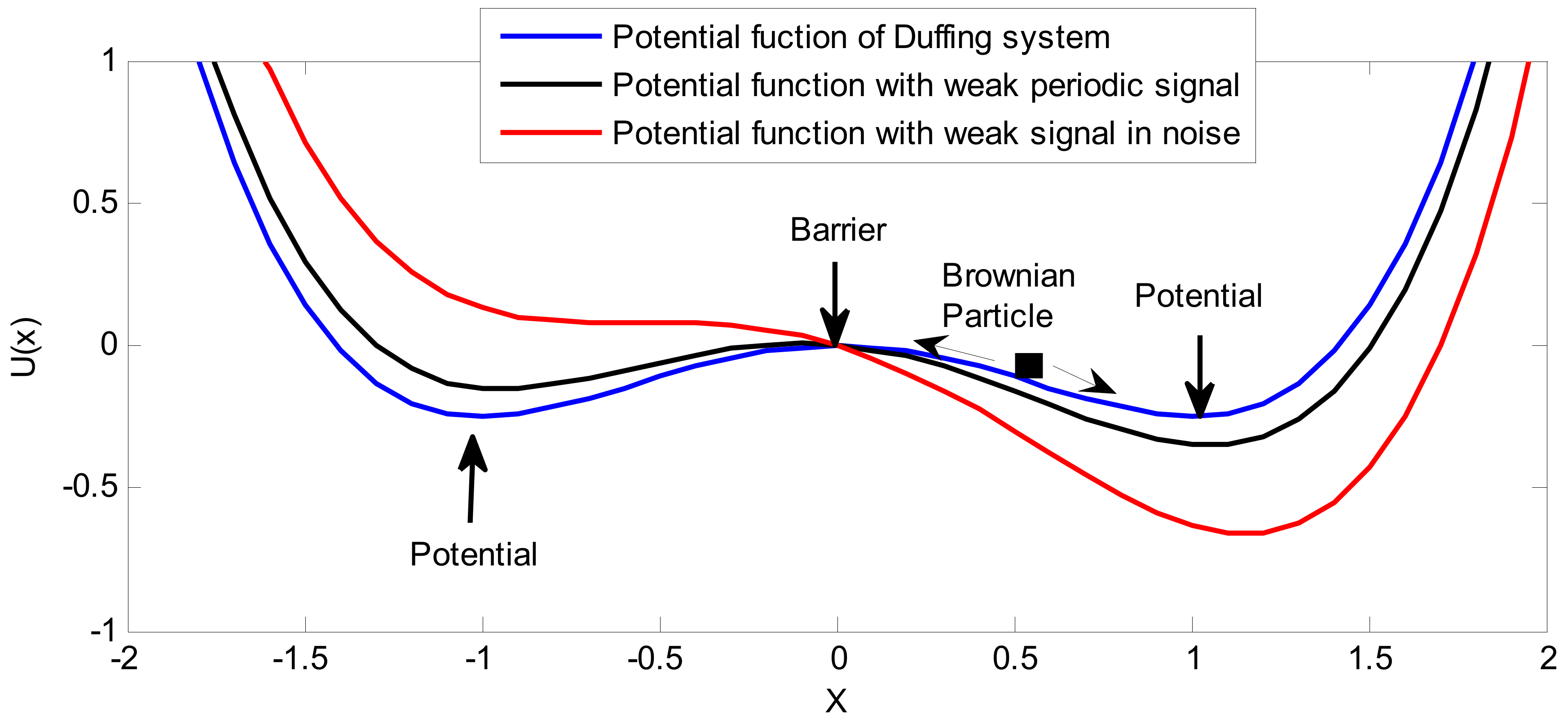
2.1. Basic Principle of Frequency Detection Based on the SR of a Duffing System
2.2. Frequency Detection Based on the SR of a Variable-Scale Duffing System
3. Parameter Estimation of a Weak Signal Based on the CPT of a Duffing System
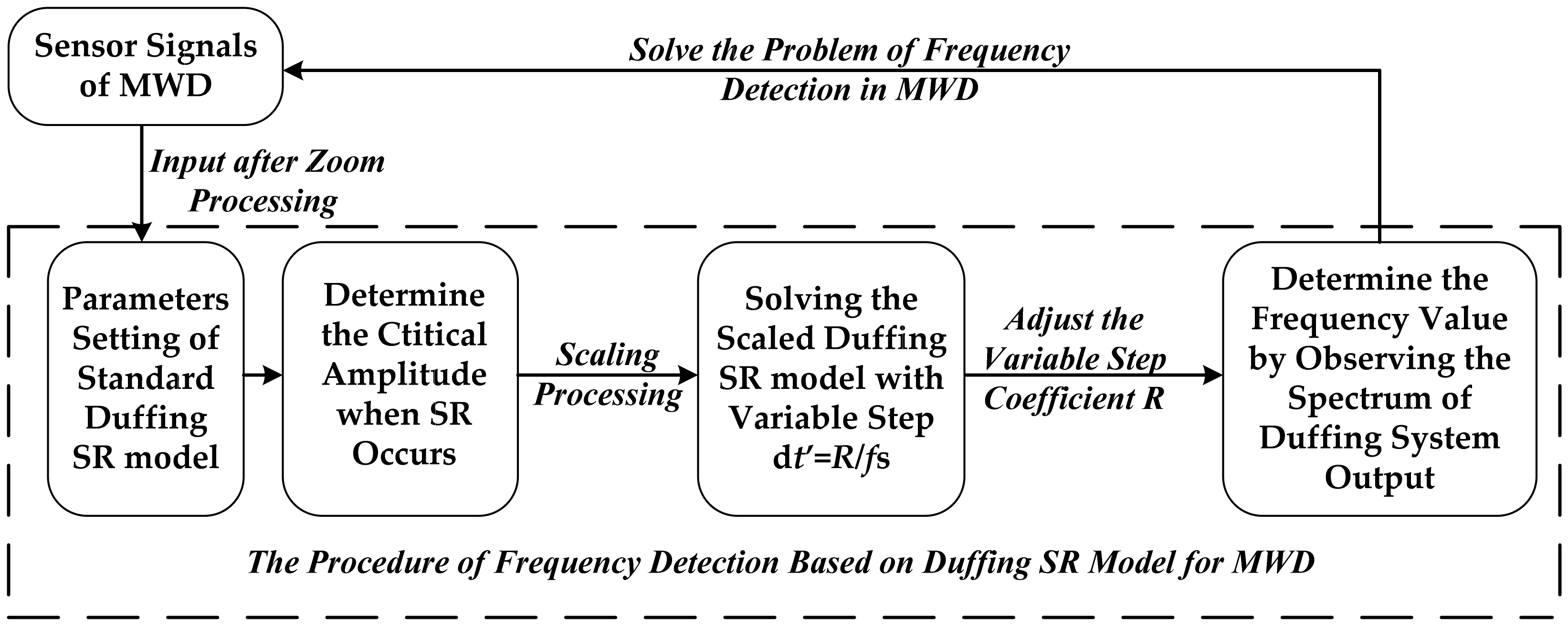
- Determine the parameters of the SR model of the Duffing system. For example, in Equation (1), k = 0.5, a = b = 1, and the initial value of state (x(0), x′(0)) = (0, 0), and the critical amplitude λC = (4a3/27b) ≈ 0.148 are usually taken.
- Estimate the strength of the measured sensor signal, and normalize the collected signal; that is, the amplitude of the signal is linearly compressed or expanded so that the signal strength is within the appropriate processing range, i.e., less than the critical amplitude λC.
- Introduce the variable-scale coefficient R to change the signal with the sampling frequency of fs and signal frequency of f0 into a signal with a sampling frequency of fs/R and an actual frequency of f0/R. Take the calculation step dt′ = R/fs to solve the Duffing SR model and obtain the system waveform and signal spectrum.
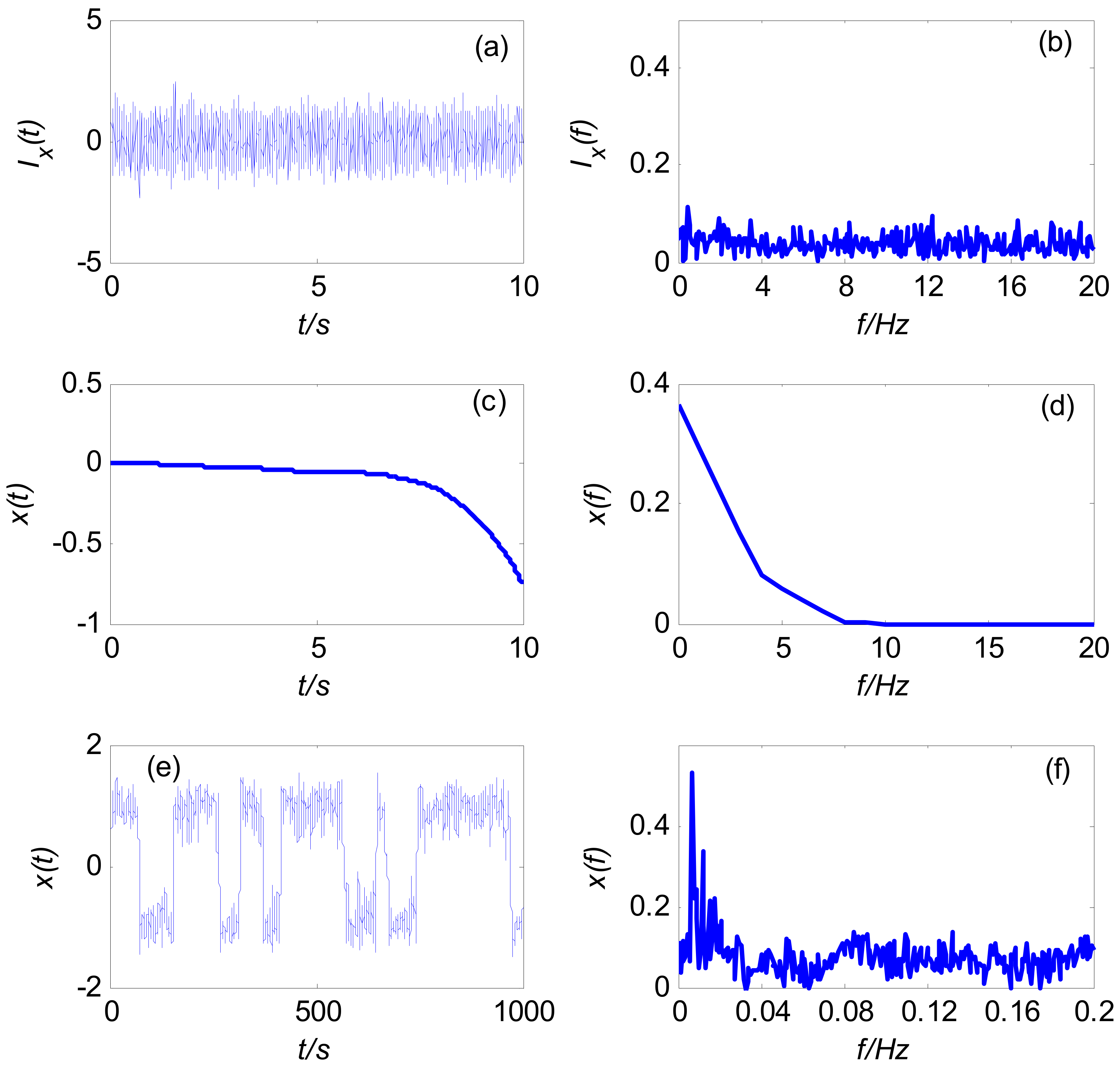
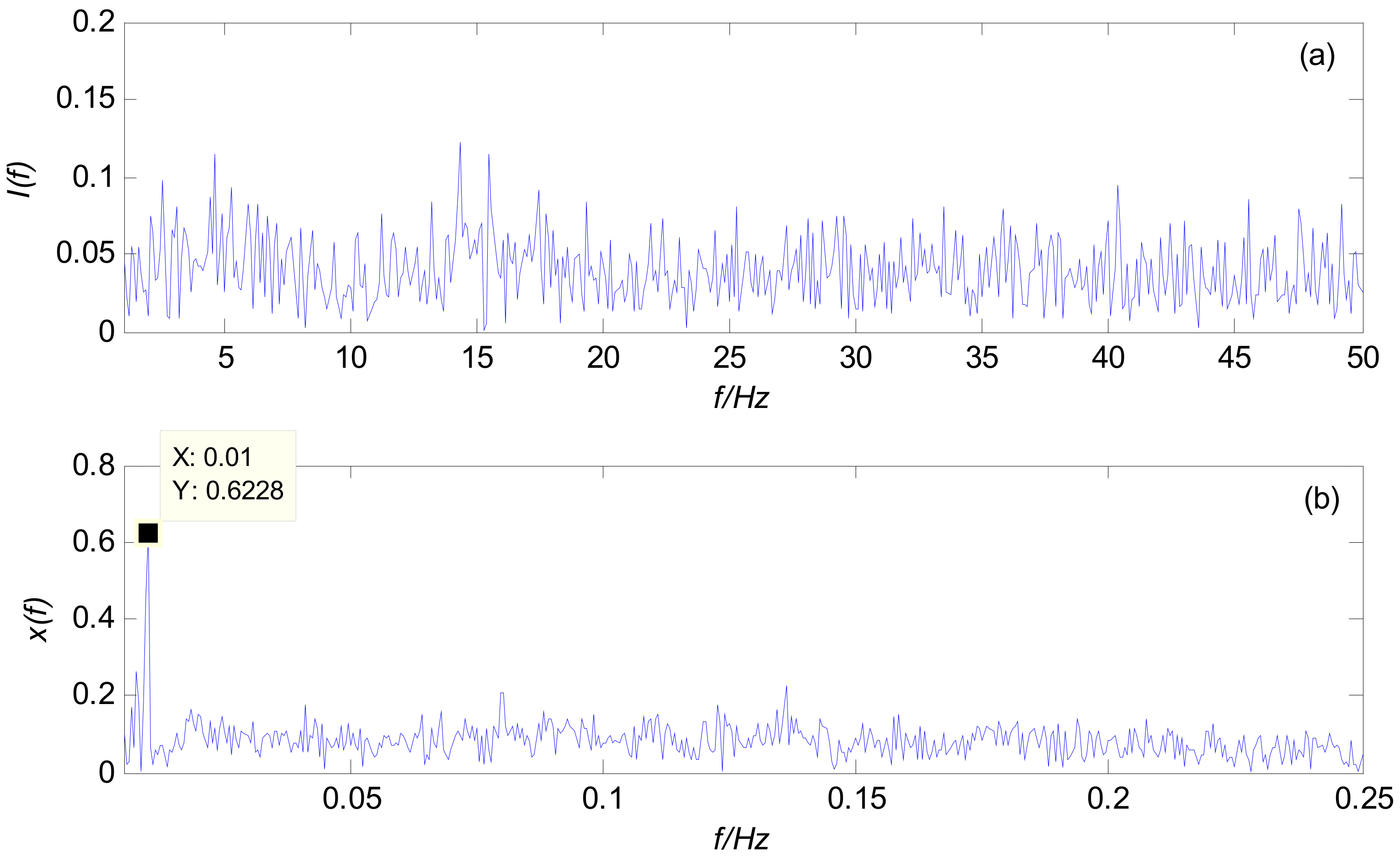
- Adjust the variable-scale coefficient R and observe the spectrum of the output signal. If the signal has an obvious peak at frequency 0.01, it will produce SR effect, and the value of R is the frequency value of the measured signal.
- Set the relevant parameters of the Duffing chaotic system, such as the amplitude of driving term A = 0.825 in Equation (12).
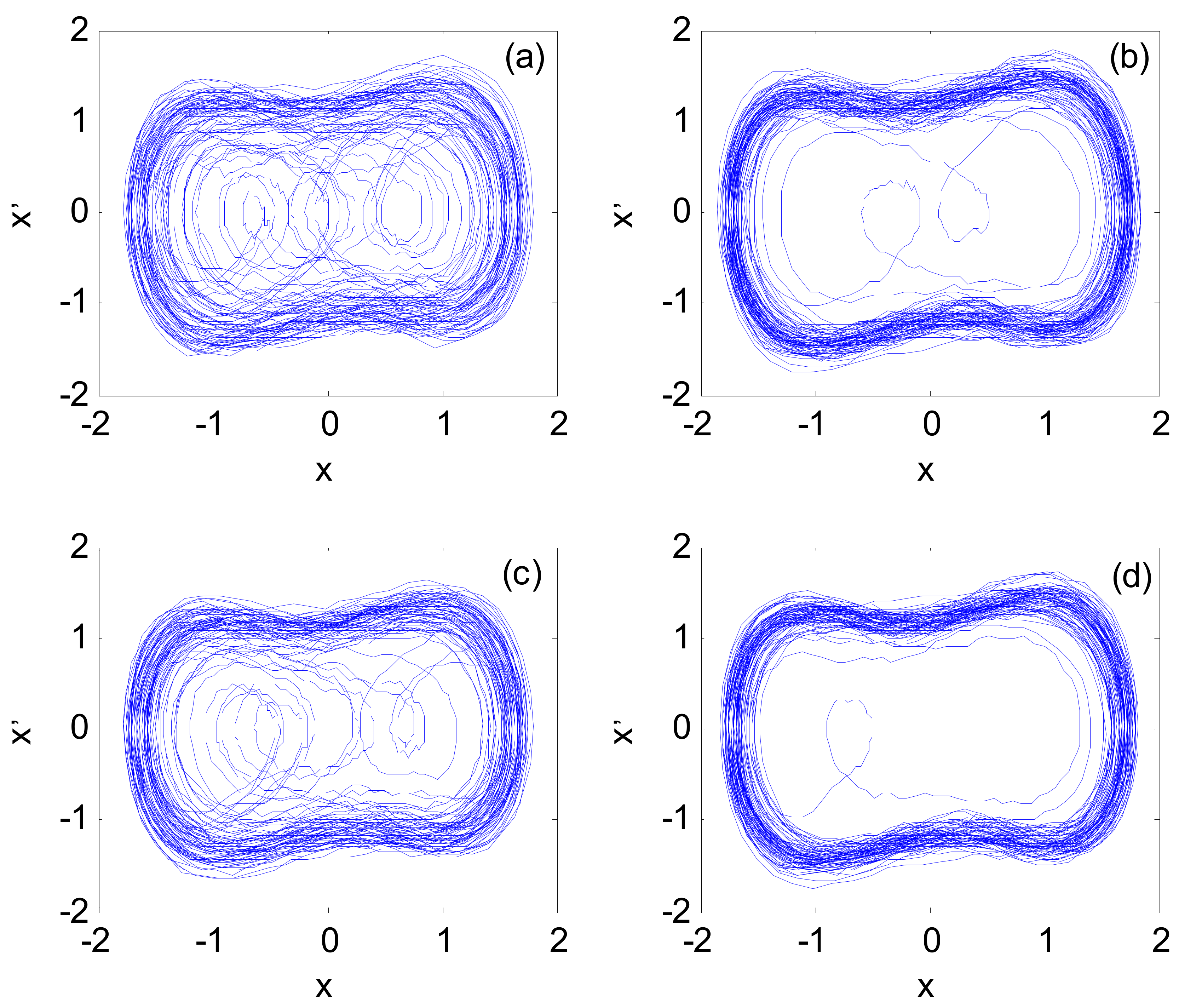
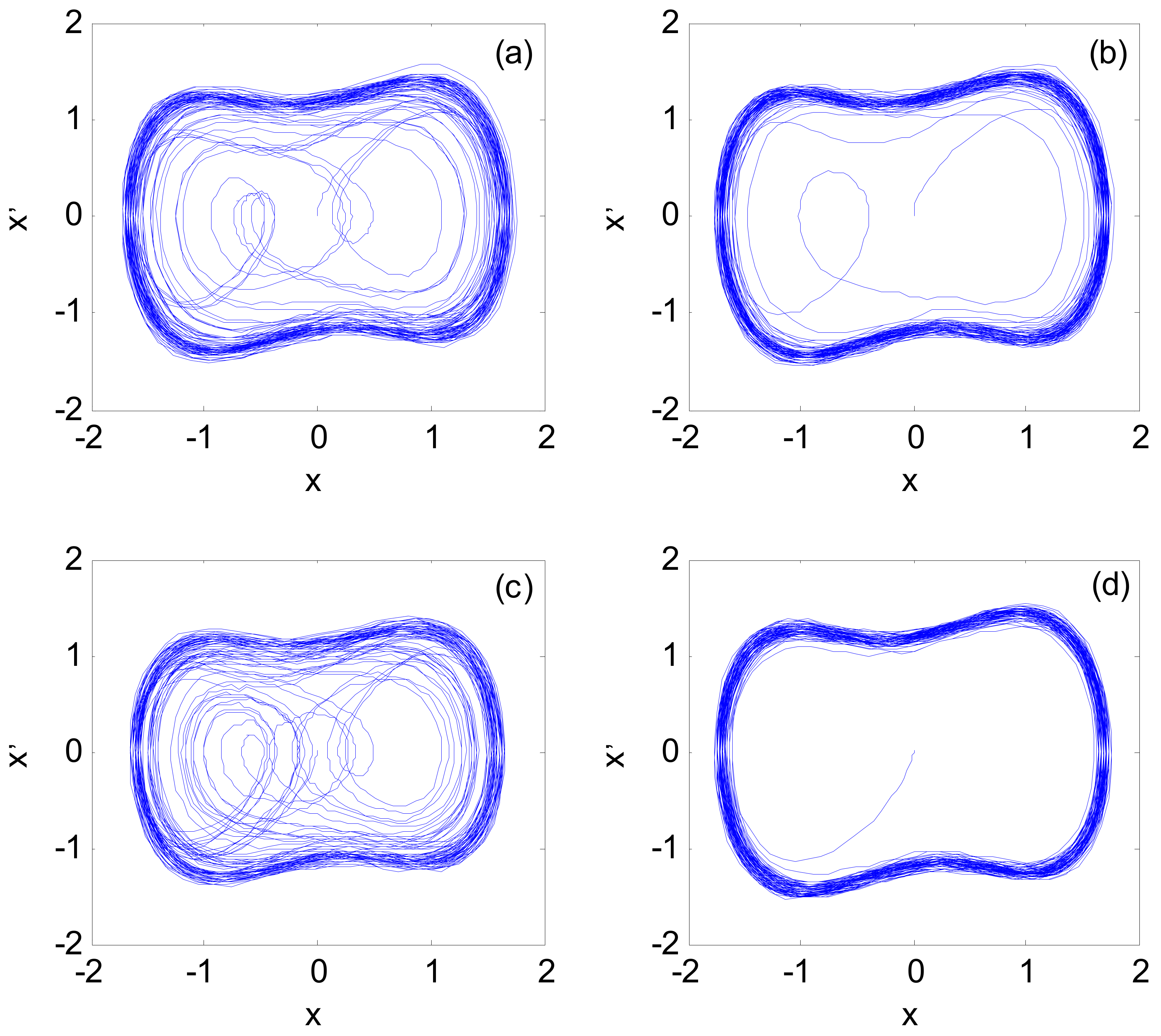
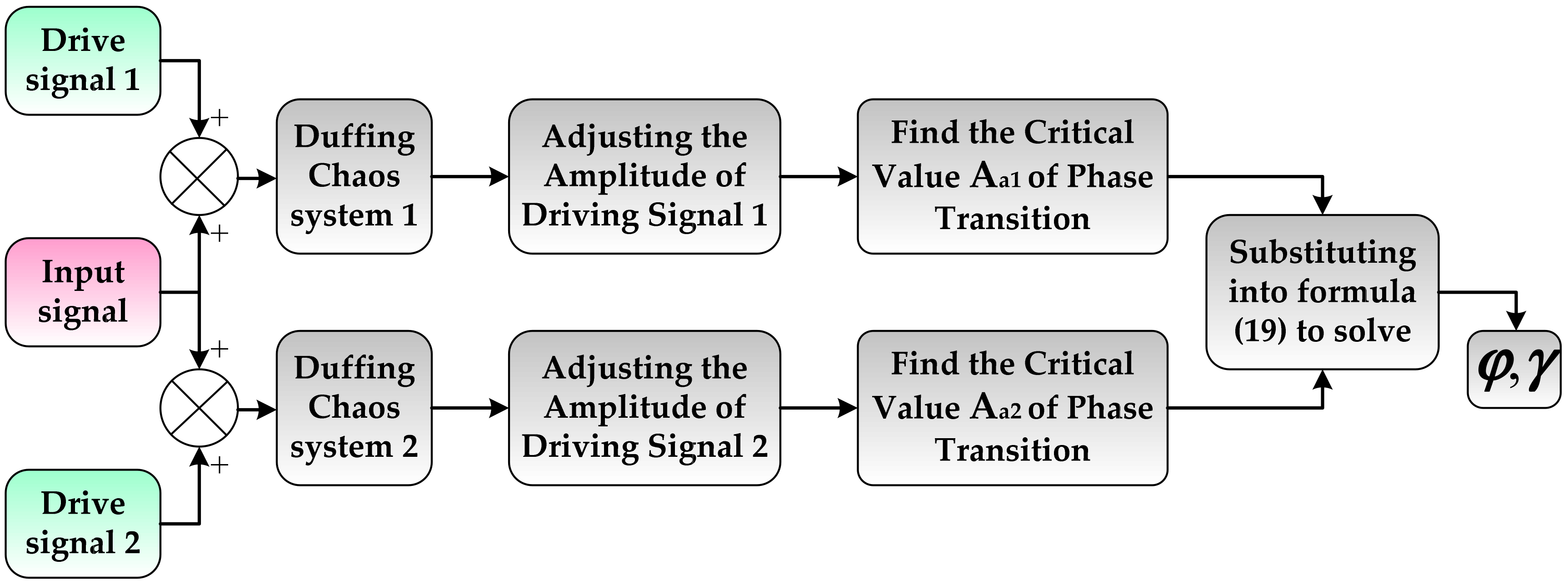
- Set the initial phase of the driving term to 0 and π, and record it as detection systems 1 and 2. The measured signal is input into two detection systems respectively, and the change of the output phase diagram of the system is observed. If the output of detection system 1 is chaotic after adding the measurement signal, the amplitude of the driving signal will be increased gradually with a certain amplitude until the system output jumps to the periodic state; if the system output is periodic, the amplitude of the driving signal will be decreased gradually until the system jumps from the periodic state to the chaotic state. The amplitude of the system jumping into a large-scale periodic state is denoted as Aa1.
- Use the same method to obtain the amplitude of detection system 2 when it jumps to a large-scale periodic state, which is recorded as Aa2. Finally, Aa1 and Aa2 are substituted into Equation (14) in order to obtain the estimated values of the amplitude and phase parameters of the MWD signal.
4. Performance Evaluation and Discussion
4.1. Laboratory Testing
4.1.1. Simulation Experiment of the Frequency Detection Based on SR
4.1.2. Simulation Experiment of the Parameter Estimation Based on CPT
4.1.3. Analysis of the Attitude Angle Solving Results
4.2. Field-Drilling Testing
5. Conclusions
Author Contributions
Funding
Institutional Review Board Statement
Informed Consent Statement
Data Availability Statement
Acknowledgments
Conflicts of Interest
References
- Zhu, X.H.; Hu, Z.Q. Lateral vibration characteristics analysis of a bottom hole assembly based on interaction between bit and rock. J. Vib. Shock 2014, 33, 90–93. [Google Scholar]
- Yang, Y.; Li, F.; Gao, Y.; Mao, Y. Multi-Sensor Combined measurement while drilling based on the improved adaptive fading square root unscented Kalman filter. Sensors 2020, 20, 1897. [Google Scholar] [CrossRef] [Scilit] [PubMed]
- Li, F. Study on the Vibration of Drilling Motors in Unconventional Oil and Gas Exploration with a Miniature Recorder. J. Eng. 2020, 2020, 79–85. [Google Scholar] [CrossRef] [Scilit]
- Liang, Y.; Ju, X.; Li, A.; Li, C.; Dai, Z.; Ma, L. The process of high-data-rate mud pulse signal in logging while drilling system. Math. Probl. Eng. 2020, 2020, 1–11. [Google Scholar] [CrossRef] [Scilit]
- Mwachaka, S.M.; Wu, A.; Fu, Q. A review of mud pulse telemetry signal impairments modeling and suppression methods. J. Petrol. Exp. Pro. Technol. 2019, 9, 779–792. [Google Scholar] [CrossRef] [Scilit]
- Greenwood, J.A. Vibration monitoring and mitigation-an integrated measurement system. In Proceedings of the Society of Petroleum Engineers IADC/SPE Drilling Conference & Exhibition, Fort Worth, TX, USA, 1 March 2016. [Google Scholar]
- Urenda-Cazares, E.; Gallegos, A.; Jaimes-Reategui, R. Effects of multiplicative noise on the Duffing oscillator with variable coefficients and its integral of motion. Int. J. Mod. Phys. C 2020, 31, 2050095. [Google Scholar] [CrossRef] [Scilit]
- Leung, H.; Lo, T. Chaotic radar signal processing over the sea. IEEE J. Ocean. Eng. 1993, 18, 287–295. [Google Scholar] [CrossRef] [Scilit]
- Haykin, S.; Principe, J. Making sense of a complex world [chaotic events modeling]. IEEE Signal Proc. Mag. 1998, 15, 66–81. [Google Scholar] [CrossRef] [Scilit]
- Wang, W.; Li, Q.; Zhao, G.J. Novel approach based on chaotic oscillator for machinery fault diagnosis. Measurement 2008, 41, 904–911. [Google Scholar]
- Shi, H.C.; Li, W.L. The application of chaotic oscillator in detecting weak resonant signal of MEMS resonator. Rev. Sci. Instrum. 2017, 88, 1–7. [Google Scholar] [CrossRef] [Scilit]
- Luo, J.; Xu, X.; Ding, Y.; Yuan, Y.; Yang, B.; Sun, K.; Yin, L. Application of a memristor-based oscillator to weak signal detection. Eur. Phys. J. Plus 2018, 133, 239. [Google Scholar] [CrossRef] [Scilit]
- Wang, W.; Zeng, Y.C.; Sun, R.T. Research on a six-order chaotic circuit with three memristors. Acta Phys. Sin. 2017, 66, 040502. [Google Scholar]
- Lin, Z.H.; Wang, H.X. Efficient image encryption using chaos-based PWL memristor. IETE Technol. Rev. 2010, 27, 318–325. [Google Scholar] [CrossRef] [Scilit]
- Min, G.-Q.; Wang, L.-D.; Duan, S.-K. Chaotic circuit of ion migration memristor and its application in the voice secure communication. Acta Phys. Sin. 2015, 64, 210507. [Google Scholar]
- He, B.; Huang, Y.; Wang, D.; Yan, B.; Dong, D. A parameter-adaptive stochastic resonance based on whale optimization algorithm for weak signal detection for rotating machinery. Measurement 2019, 136, 658–667. [Google Scholar] [CrossRef] [Scilit]
- Qiu, Y.; Yuan, F.; Ji, S.; Cheng, E. Stochastic resonance with reinforcement learning for underwater acoustic communication signal. Appl. Acous. 2021, 173, 107688. [Google Scholar] [CrossRef] [Scilit]
- Zhou, Y.-H.; Xu, X.-M.; Yin, L.-Z.; Ding, Y.-P.; Ding, J.-F.; Sun, K.-H. Novel Woods-Saxon stochastic resonance system for weak signal detection. Chinese Phys. B 2020, 29, 217–225. [Google Scholar] [CrossRef] [Scilit]
- Guo, W.; Zhou, Z.; Chen, C.; Li, X. Multi-frequency weak signal detection based on multi-segment cascaded stochastic resonance for rolling bearings. Microelectron. Reliab. 2017, 75, 239–252. [Google Scholar] [CrossRef] [Scilit]
- Reda, H.T.; Mahmood, A.; Diro, A.; Chilamkurti, N.; Kallam, S. Firefly-inspired stochastic resonance for spectrum sensing in CR-based IoT communications. Neural Comput. Appl. 2020, 32, 16011–16023. [Google Scholar] [CrossRef] [Scilit]
- Zhou, D.; Huang, D.; Hao, J.; Ren, Y.; Jiang, P.; Jia, X. Vibration-based fault diagnosis of the natural gas compressor using adaptive stochastic resonance realized by Generative Adversarial Networks. Eng. Fail. Anal. 2020, 116, 104759. [Google Scholar] [CrossRef] [Scilit]
- Lu, S.; He, Q.; Hu, F.; Kong, F. Sequential multiscale noise tuning stochastic resonance for train bearing fault diagnosis in an Embedded System. IEEE Trans. Instrum. Meas. 2014, 63, 106–116. [Google Scholar] [CrossRef] [Scilit]
- Lu, S.; He, Q.; Hu, F.; Kong, F. Research on mud pulse signal detection based on adaptive stochastic resonance. J. Petrol. Sci. Eng. 2017, 157, 643–650. [Google Scholar]
- Kim, H.; Tai, W.C.; Zuo, L. Stochastic resonance energy harvesting from general rotating shaft vibrations. In Proceedings of the SPIE Proceedings, Portland, OR, USA, 11 April 2017. [Google Scholar]
- Chen, C.; Cheng, W.B.; Kang, S.M.; Bo, Y.J. Stochastic resonance detection method of borehole acoustic communication signal. Comput. Simul. 2015, 32, 277. [Google Scholar]
- Niu, J.; Liu, R.; Shen, Y.; Yang, S. Chaos detection of Duffing system with fractional-order derivative by Melnikov method. Chaos 2019, 29, 123106. [Google Scholar] [CrossRef] [Scilit]
- Dong, H.; Shen, X.; He, K.; Wang, H. Nonlinear filtering effects of intrawell matched stochastic resonance with barrier constrainted duffing system for ship radiated line signature extraction. Chaos Soliton. Fract. 2020, 141, 110428. [Google Scholar] [CrossRef] [Scilit]
- El-Borhamy, M. Chaos transition of the generalized fractional duffing oscillator with a generalized time delayed position feedback. Nonlinear Dyn. 2020, 101, 2471–2487. [Google Scholar] [CrossRef] [Scilit]
- Zhang, G.; Wu, Z. Homotopy analysis method for approximations of Duffing oscillator with dual frequency excitations. Chaos Soliton. Fract. 2019, 127, 342–353. [Google Scholar] [CrossRef] [Scilit]
- Wu, A.; Mwachaka, S.M.; Pei, Y.; Fu, Q. A novel weak signal detection method of electromagnetic LWD based on a Duffing oscillator. J. Sens. 2018, 2, 1–14. [Google Scholar] [CrossRef] [Scilit]
- Yang, Y.; Chen, J.; Gao, Y.; Fan, H. Chaos detection and parameters recovery of Duffing oscillator for weak SNR signal while drilling. Chin. J. Sci. Instrum. 2020, 41, 235–244. [Google Scholar]





| Vibration Type | Main Modes | Frequency Range (Hz) |
|---|---|---|
| Stick-Slip | Torsional Vibration | 0.01–5 |
| Bounce | Axial Vibration | 1–10 |
| Rotate | Lateral Vibration | 3–50 |
| Lateral Shock | Lateral Vibration | Irregular |
| Torsional Resonance | Torsional Vibration | 20–350 |
| Parametric Resonance | Axial and Lateral | 0.1–10 |
| Modes Coupled | Axial, Lateral, and Torsional | 0.1–20 |
| Input Signal | Aa1 | Aa2 | Amplitude Estimation Result | The Relative Error of Amplitude | Phase Estimation Result | The Relative Error of Phase |
|---|---|---|---|---|---|---|
| sx(t) | 0.801 | 0.851 | 0.048 | 4% | 58.4° | 2.7% |
| Data Processing Method | Attitude Parameter | Statistical Index of Solution Error | |
|---|---|---|---|
| Max Error | RMS Error | ||
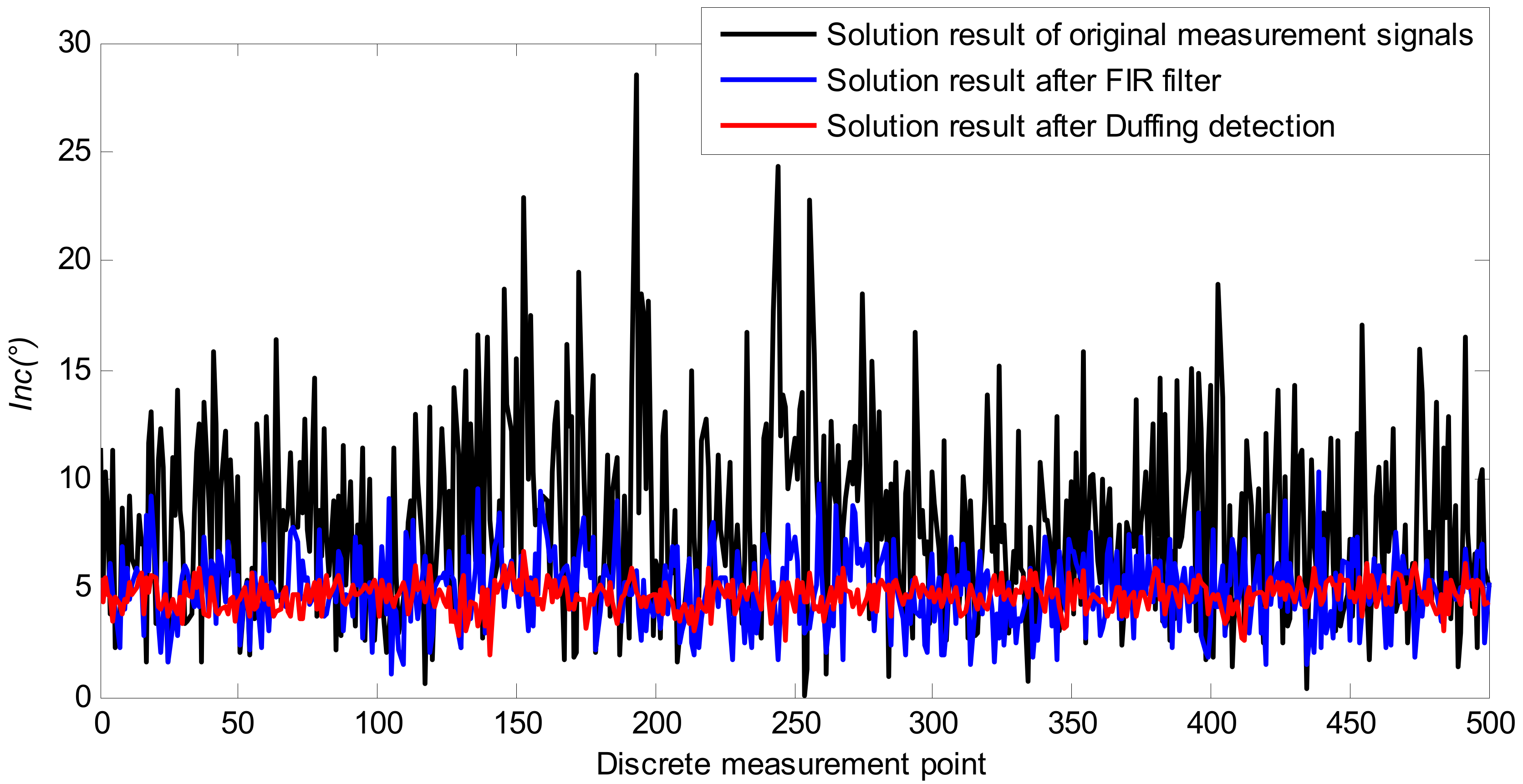
| SR and CPT based on Duffing system | Inclination (°) | 2.53 | 0.68 |
| FIR filter | Inclination (°) | 5.78 | 1.73 |
| Original measurement data | Inclination (°) | 24.01 | 5.54 |
| Parameters | Value |
|---|---|
| Well depth | 1740–1805 m |
| WOB | 10 MPa |
| Downhole temperature | 40 °C |
| Pump pressure | 6.6 MPa |
| Drilling fluid density | 1.15 g/cm3 |
| Suspended load | 79 kN |
| Operation time | 75 h |
| Rotary speed | 120 rpm |
| The setting value of inclination | 2.5° |
| The Performance Index | Axial | X | Y | Z |
| Range | ±3 g (±1~±100 g) | |||
| Bandwidth | 0 to ≥500 Hz | |||
| Scale factor | 300 ± 30 mV/g | |||
| Calibration | ≤1 mg | |||
| Non-linearity | ≤0.3% Fs | |||
| Zero-bias (25 °C) | 1.5 ± 0.1 V | |||
| Zero-bias temperature drift | ±1 mg/°C | |||
| Startup time | ≤0.001 s | |||
| Environmental Characteristics | Work temperature | −40 °C ~ +70 °C | ||
| Storage temperature | −40 °C ~ +125 °C | |||
| Anti-crash (0.5 ms) | 104 g | |||
| Physical Characteristics | Weight | 40 g | ||
| Size | 19.5 × 18 × 10 mm | |||
| Algorithm | Attitude Parameter | Depth/m | ||||
|---|---|---|---|---|---|---|
| 1756.12 | 1767.56 | 1782.38 | 1793.56 | 1801.36 | ||
| Static Measurement | Inclination (°) | 2.04 | 2.53 | 2.95 | 2.77 | 2.41 |
| FIR filter | Inclination (°) | 2.50 | 2.17 | 2.41 | 1.93 | 3.12 |
| Relative error | 22.55% | 14.23% | 16.61% | 30.32% | 29.46% | |
| SR and CPT based on Duffing system | Inclination (°) | 2.20 | 1.94 | 3.39 | 2.51 | 2.17 |
| Relative error | 7.84% | 23.32% | 12.54% | 9.39% | 9.96% | |
Publisher’s Note: MDPI stays neutral with regard to jurisdictional claims in published maps and institutional affiliations. |
© 2021 by the authors. Licensee MDPI, Basel, Switzerland. This article is an open access article distributed under the terms and conditions of the Creative Commons Attribution (CC BY) license (https://creativecommons.org/licenses/by/4.0/).
Share and Cite
Yang, Y.; Li, F.; Zhang, N.; Huo, A. Research on the Cooperative Detection of Stochastic Resonance and Chaos for Weak SNR Signals in Measurement While Drilling. Sensors 2021, 21, 3011. https://doi.org/10.3390/s21093011
Yang Y, Li F, Zhang N, Huo A. Research on the Cooperative Detection of Stochastic Resonance and Chaos for Weak SNR Signals in Measurement While Drilling. Sensors. 2021; 21(9):3011. https://doi.org/10.3390/s21093011
Chicago/Turabian StyleYang, Yi, Fei Li, Nan Zhang, and Aiqing Huo. 2021. "Research on the Cooperative Detection of Stochastic Resonance and Chaos for Weak SNR Signals in Measurement While Drilling" Sensors 21, no. 9: 3011. https://doi.org/10.3390/s21093011
APA StyleYang, Y., Li, F., Zhang, N., & Huo, A. (2021). Research on the Cooperative Detection of Stochastic Resonance and Chaos for Weak SNR Signals in Measurement While Drilling. Sensors, 21(9), 3011. https://doi.org/10.3390/s21093011