Article

Experiments of Image Classification Using Dissimilarity Spaces Built with Siamese Networks

1
Department of Information Engineering (DEI), Via Gradenigo 6, 35131 Padova, Italy
2
Department of Information Technology and Cybersecurity, Missouri State University, 901 S, National Street, Springfield, MO 65804, USA
3
Department of Computer Science and Engineering (DISI), University of Bologna, Via dell’Università 50, 47521 Cesena, Italy
*
Author to whom correspondence should be addressed.
Sensors 2021, 21(5), 1573; https://doi.org/10.3390/s21051573
Submission received: 22 December 2020 / Revised: 12 February 2021 / Accepted: 21 February 2021 / Published: 24 February 2021
(This article belongs to the Section Biomedical Sensors)

Abstract

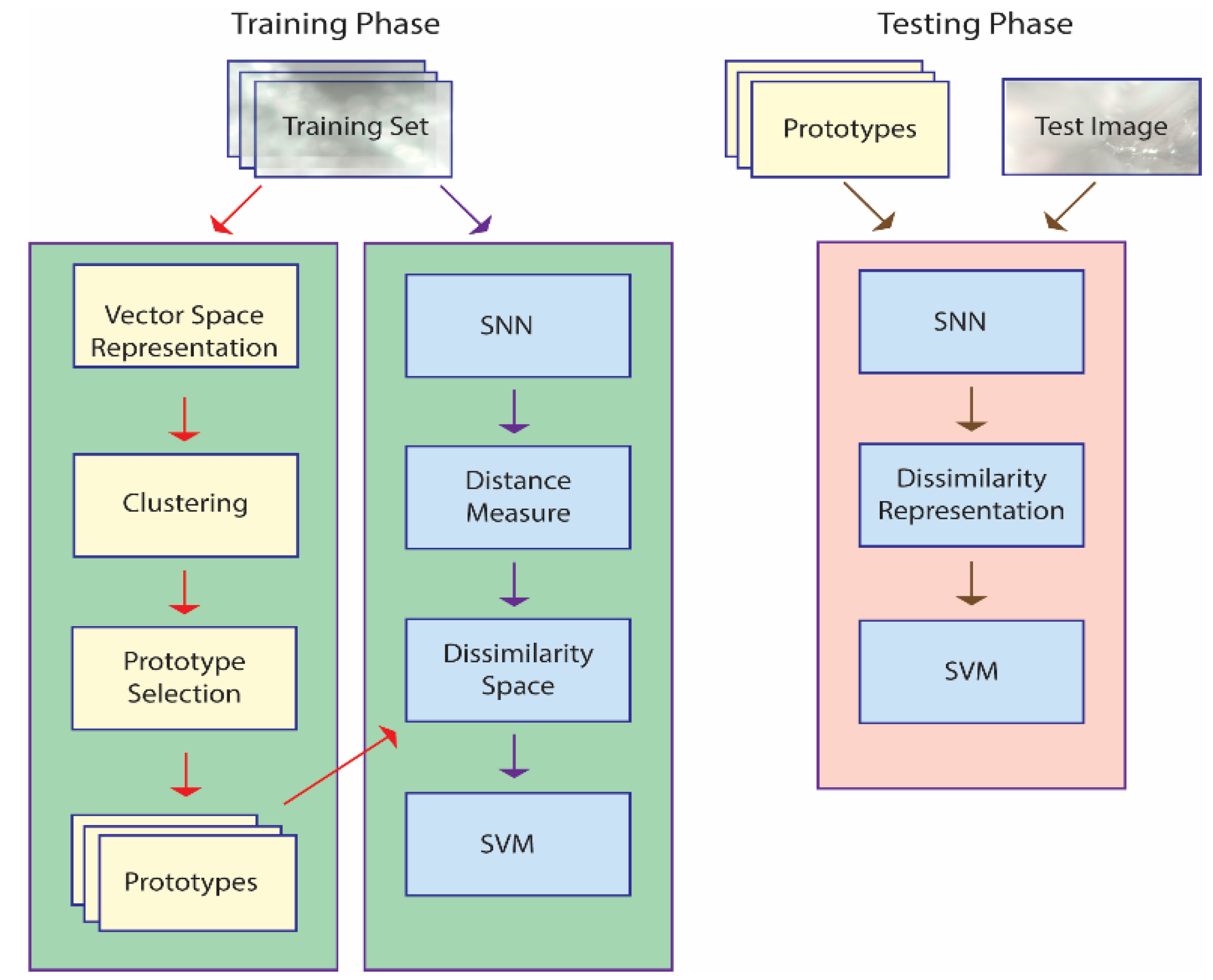
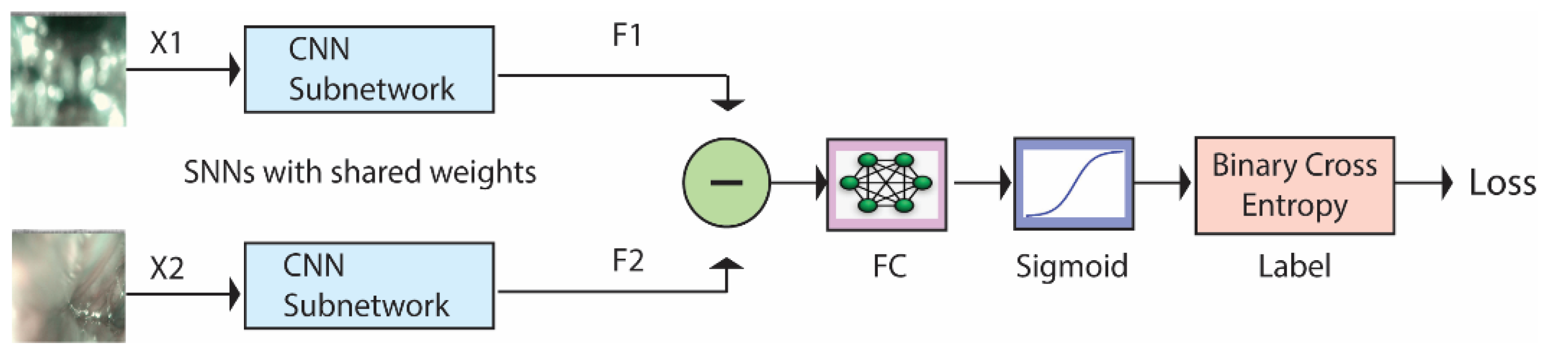
Traditionally, classifiers are trained to predict patterns within a feature space. The image classification system presented here trains classifiers to predict patterns within a vector space by combining the dissimilarity spaces generated by a large set of Siamese Neural Networks (SNNs). A set of centroids from the patterns in the training data sets is calculated with supervised k-means clustering. The centroids are used to generate the dissimilarity space via the Siamese networks. The vector space descriptors are extracted by projecting patterns onto the similarity spaces, and SVMs classify an image by its dissimilarity vector. The versatility of the proposed approach in image classification is demonstrated by evaluating the system on different types of images across two domains: two medical data sets and two animal audio data sets with vocalizations represented as images (spectrograms). Results show that the proposed system’s performance competes competitively against the best-performing methods in the literature, obtaining state-of-the-art performance on one of the medical data sets, and does so without ad-hoc optimization of the clustering methods on the tested data sets.
Keywords: audio sound classification; image classification; clustering; prototype selection; siamese network; dissimilarity space audio sound classification; image classification; clustering; prototype selection; siamese network; dissimilarity space