PC5-Based Cellular-V2X Evolution and Deployment

Abstract
1. Introduction
- V2V (Vehicle-to-Vehicle): between vehicle and vehicle, e.g., for keeping safe distance, speed, and lane changing.
- V2I (Vehicle-to-Infrastructure): between vehicle and road infrastructure, e.g., road sign, traffic light, toll gantry.
- V2P (Vehicle-to-Pedestrian): between vehicle and pedestrian, e.g., sensing nearby person or cyclist.
- V2N (Vehicle-to-Network): communication between vehicle and network, e.g., infotainment from the Internet, sending vehicle mechanical performance to its automaker.
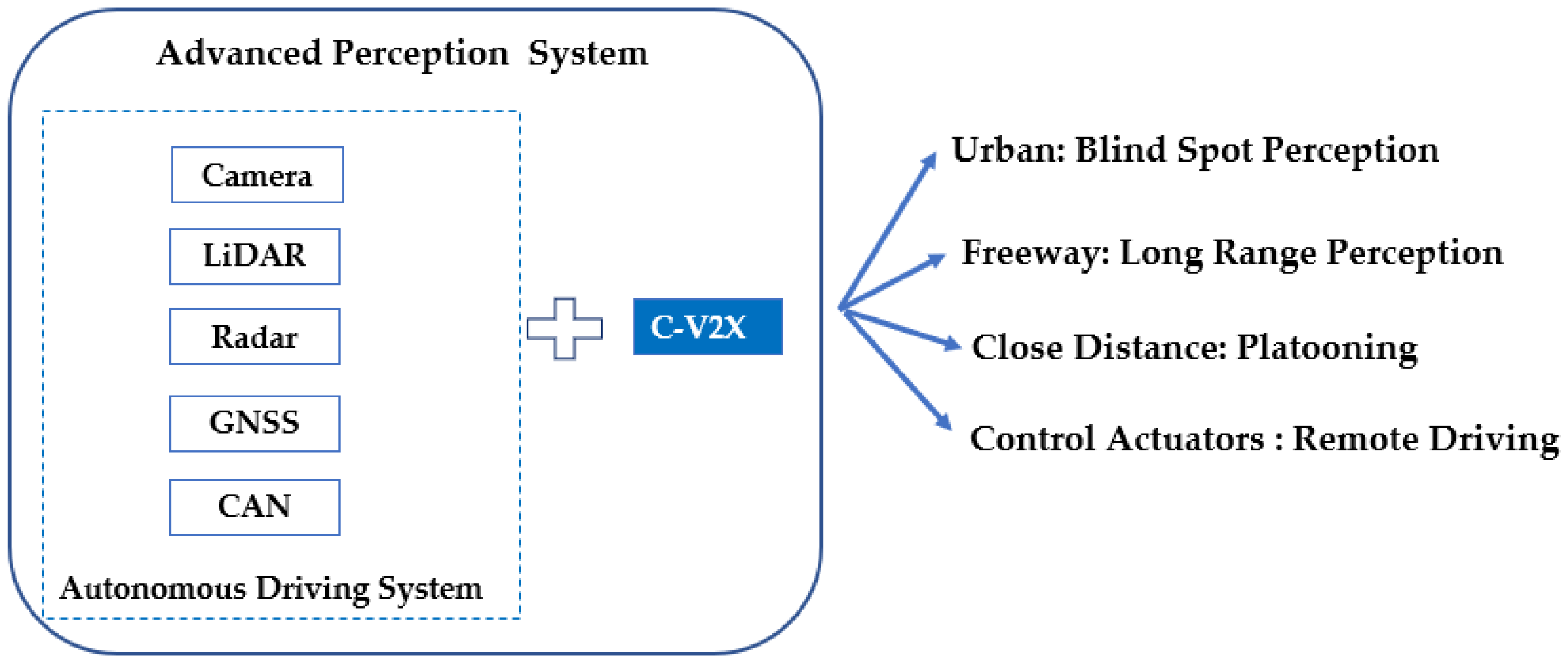
2. C-V2X Benefits
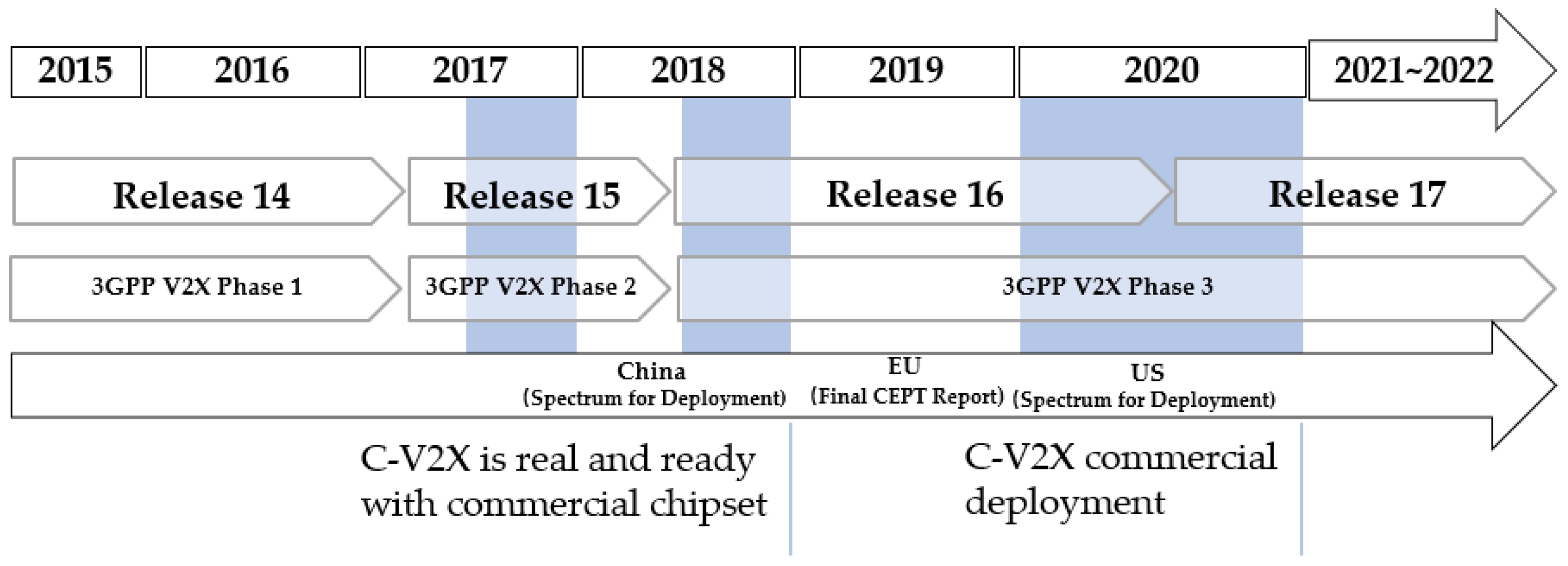
3. C-V2X Standard and Application Scenarios
3.1. LTE-V2X
- Platooning: Vehicles dynamically form a platoon traveling together. All vehicles in the platoon exchange information that enables them to maintain a short distance safely.
- Extended Sensors: Exchange of raw or processed sensor data among vehicles, roadside units, devices of pedestrians, and V2X application servers, enhancing environment perception beyond what sensors can detect (e.g., via the exchange of live video).
- Advanced Driving: Enable semi-automated or fully-automated driving. Perception data obtained from local sensors and driving intention exchanged with vehicles in proximity to synchronize and coordinate.
- Remote Driving: Remote driver or V2X application operates remote vehicle (e.g., for disabled passenger, vehicle in dangerous environment, predictable route driving, etc.).
3.2. NR-V2X
- RSU: Wireless transmitting device can provide direct sildelink communication via PC5 interface without cellular networks. Road signs, traffic lights, and IP camera information can be broadcasted in real-time to the vehicle via RSU in the predefined area. Another useful scenario is that RSU can be equipped with a SIM card to transfer road information via cellular networks to create additional applications for public safety.
- OBU: Installed in a vehicle as a wireless communication device to enhance autonomous driving vehicles’ sensor function by direct communication with RSU and other OBUs. OBU is responsible for broadcasting vehicle’s location, direction, and speed information to other defined devices while receiving other vehicle’s data as input for its internal algorithms to avoid possible accidents.
3.3. PC5-Based C-V2X Application Scenarios
- SPAT (Signal Phase and Timing Message): a V2I service that integrates traffic signal controller (light color and remaining time) with long-range wireless transmission device RSU, which broadcasts them to the OBU. Depending on this information, the driver or autonomous driving control unit can decide whether to change the route or speed up.
- TSP (Traffic Signal Preemption): a V2I service that allows high-priority vehicles, such as ambulances, fire trucks, and police cars approaching the signal control intersection to send a priority signal so that the vehicles can pass through.
- VRUCW (Vulnerable Road User Collision Warning): a V2P service that alerts the driver or autonomous driving control unit when a vehicle is sensing a potential pedestrian collision threat via IP Camera and RSU on the roadside.
- ICW (Intersection Collision Warning): a V2V service that warns the host vehicle driving towards an intersection if there is a risk of collision.
- EBW (Emergency Brake Warning): another V2V service, which warns the host vehicle if the front remote vehicle is making a sudden brake. The host vehicle receives an alert from the front vehicle and determines if a collision will happen.
- DNPW (Do Not Pass Warning): a V2V service used when a host vehicle is planning to overtake the front vehicle via opposite direction lane. The host vehicle will alert the nearby vehicle traveling in the opposite direction. The host vehicle’s OBU will receive a DNPW message to decide if it is safe to overtake.
- HLW (Hazardous Location Warning): a V2I service that warns a host vehicle of potentially hazardous situations, such as deep waters after a storm, deep pits on the road surface, or slippery roads.
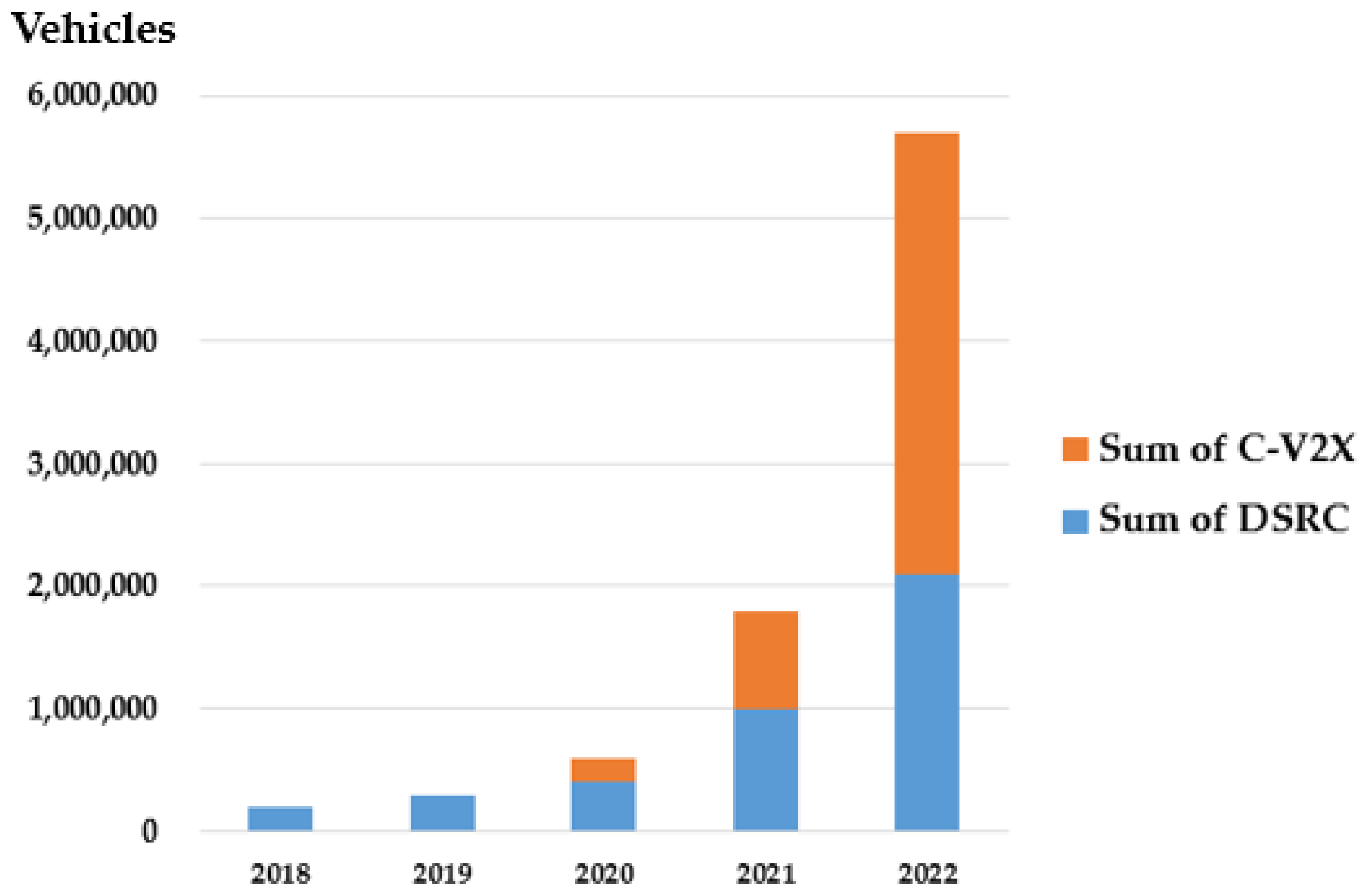
4. C-V2X Deployment in Global
5. PC5-Based C-V2X Deployment in Taiwan
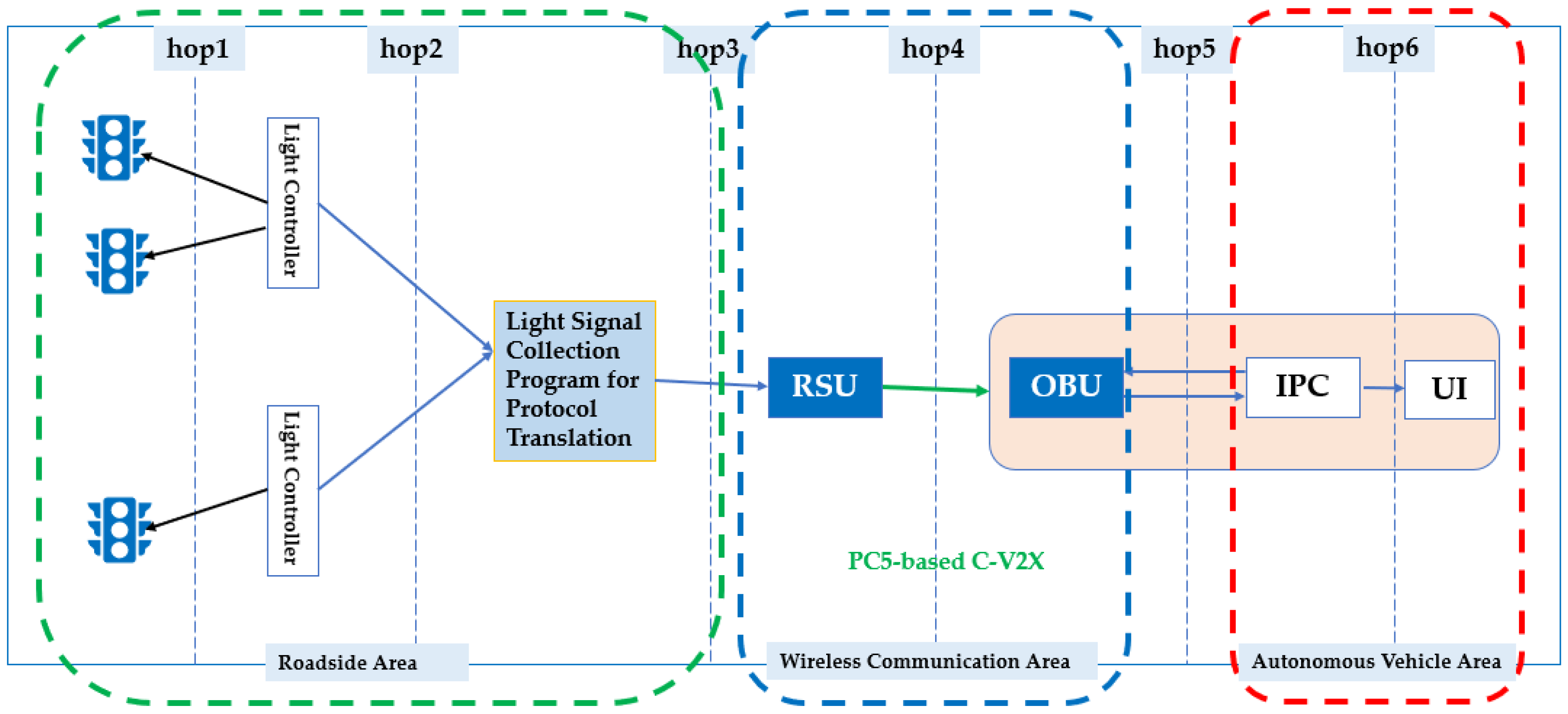
- Solution1: Traffic Light Control System IntegrationTo realize SPAT application locally, we have designed a system architecture shown in Figure 6. Accordingly, the PC5-based C-V2X SPAT application has been launched successfully and is introduced in this chapter.
- We can collect traffic light information from the light controller directly.
- Light signaling collection program is responsible for receiving roadside light signal information, including light phase, color and remaining time, etc. All this information is sent to RSU.
- RSU reads and encapsulates them to C-V2X protocol messages.
- RSU broadcasts C-V2X messages to OBU via PC5 interface.
- OBU installed in the autonomous driving vehicle analyzes and filters these messages and then sends them to IPC (Industrial PC) of autonomous driving system for slow or stop control.
- User Interface (UI) displays light information for intuitive C-V2X technology presentation.
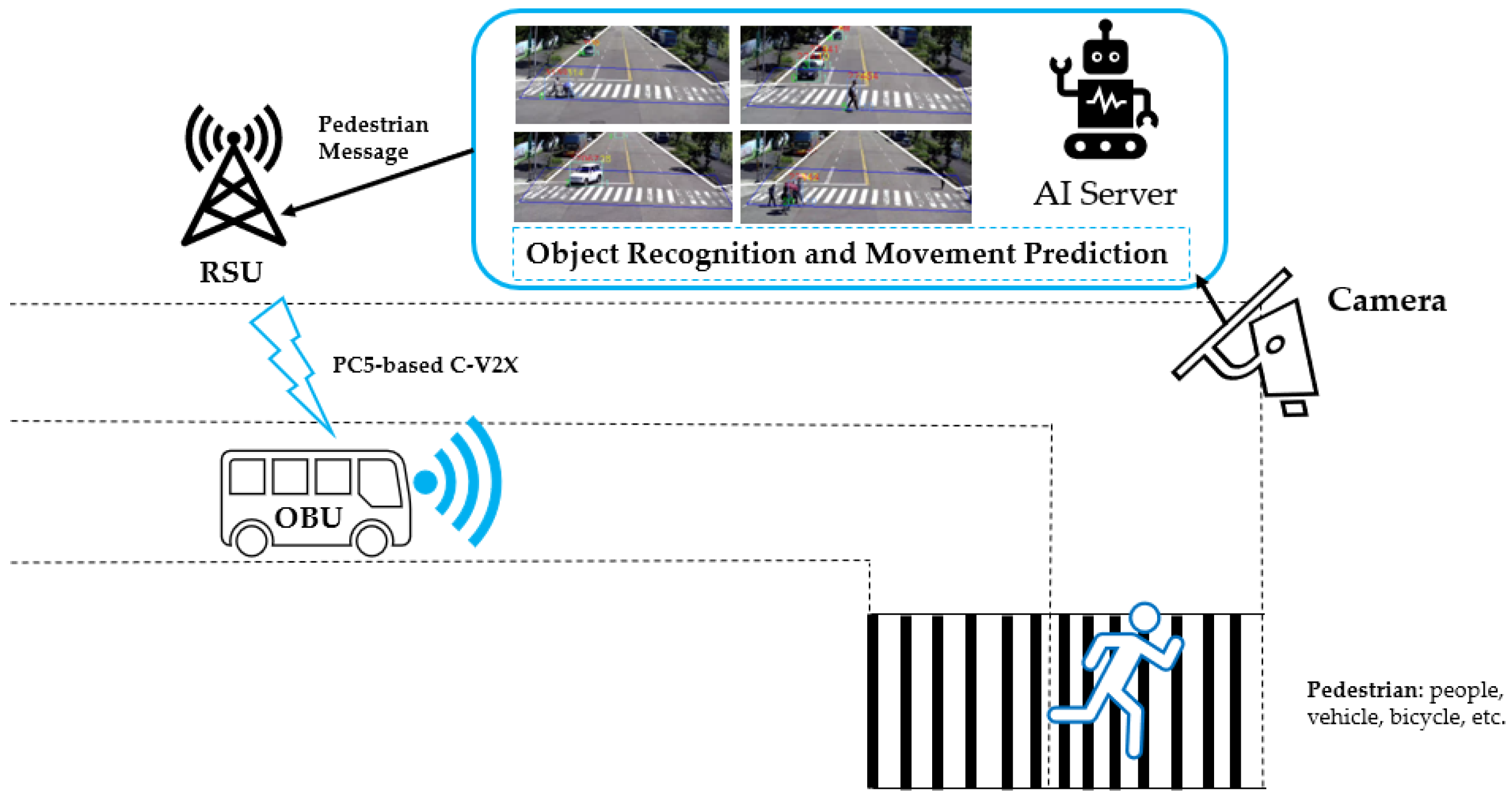
- Solution2: C-V2X VRUCW Application System IntegrationFor the PC5-based C-V2X VRUCW application, we have developed a network diagram shown in Figure 7.
- The VRUCW application can be regarded as P2I2V service ( Pedestrian to Infrastructure to Vehicle). The IP cameras must be built on road areas for both line-of-sight (LOS) and non-line-of-sight (NLOS) monitoring purposes.
- It uses an AI server equipped with a series of deep learning technologies such as CNN (Convolutional Neural Network) and SSD (Single Shot Detection). Objects will be detected if any pedestrian passes an area under camera coverage.
- The AI server transfers the analysis result with object recognition and movement prediction to RSU, which broadcasts this information to all the OBUs under the coverage of this RSU.
- OBU is responsible for combining vehicle information such as speed, heading, and location to determine if a collision is approaching. We use the target classification algorithm to determine the pedestrian’s direction for subsequent warning possibility calculation.
- Supposing that there is a risk of collision between pedestrian and host vehicle, for example, their distance is within 50 meters and driving speed of vehicle is more than 10km/hour. We use below Algorithm 1 for collision warning trigger.
| Algorithm 1 |
| if then |
| the target pedestrian is heading in the same direction as the host vehicle, no collision warning is sent |
| else if then |
| the target pedestrian is heading in the conflict direction with the host vehicle, collision warning is sent |
| else if then |
| the target pedestrian is crossing on the left side of the host vehicle, collision warning is sent |
| else if then |
| the target pedestrian is crossing on the right side of the host vehicle, collision warning is sent |
| end if |
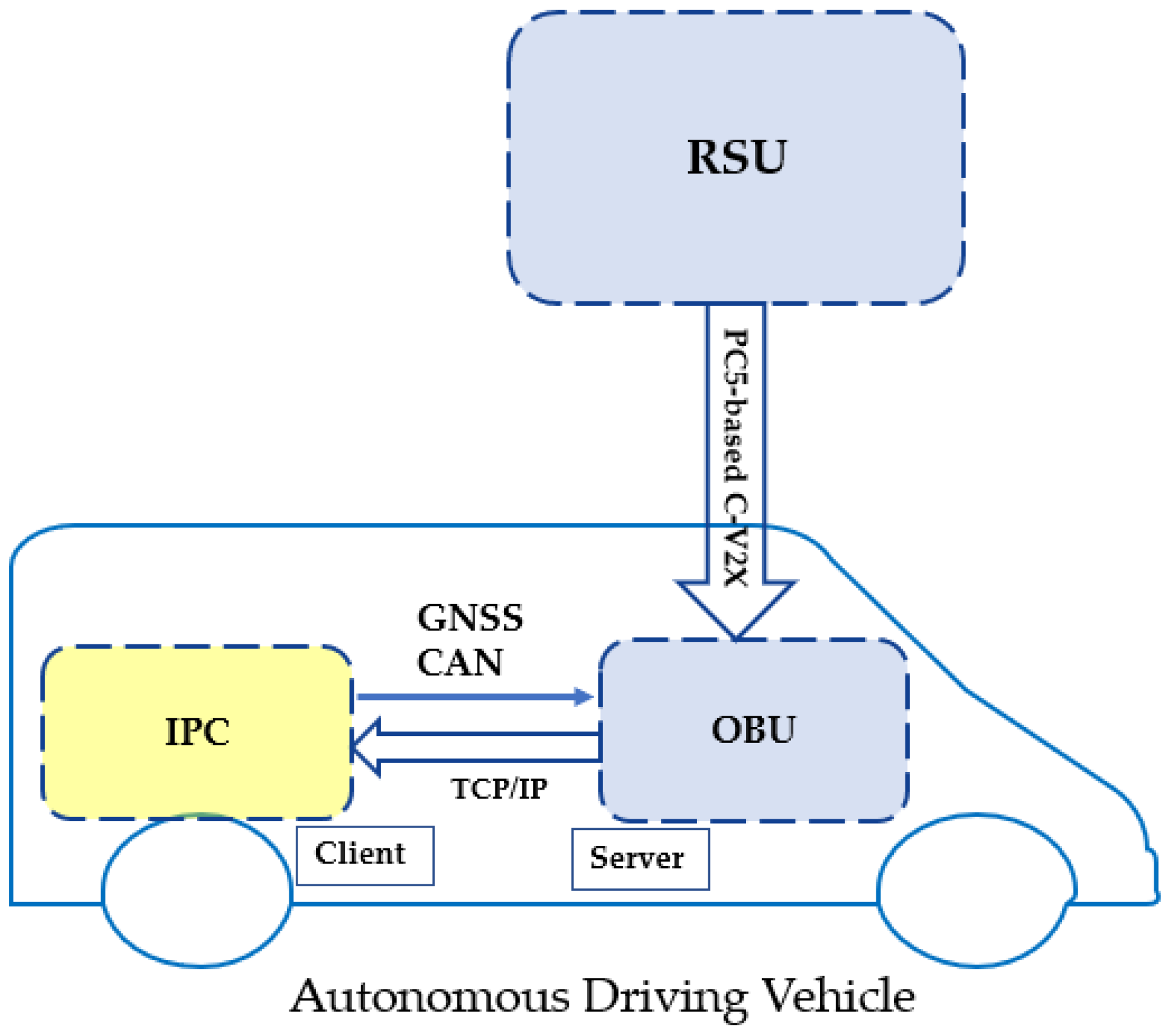
- Solution3: Automated Driving System IntegrationWe have designed and implemented the system integration between PC5-based C-V2X and automated driving system, shown below in Figure 8:
- RSU receives information from traffic light controllers or AI servers. Then, it broadcasts this information by using a predefined message format in its coverage field.
- OBU receives broadcasting messages via PC5-based C-V2X communication.
- OBU is connected with IPC (Industrial PC) of the autonomous driving system via TCP/IP. OBU receives GSNN (Global Navigation System Satellite) and CAN (Controller Area Network) messages from the vehicle.
- OBU uses advanced internal algorithms to judge if the situation is dangerous or not. Then a warning message will be sent accordingly to the IPC of the autonomous driving system.
- Finally, C-V2X technology is integrated with the automated driving system as expected.
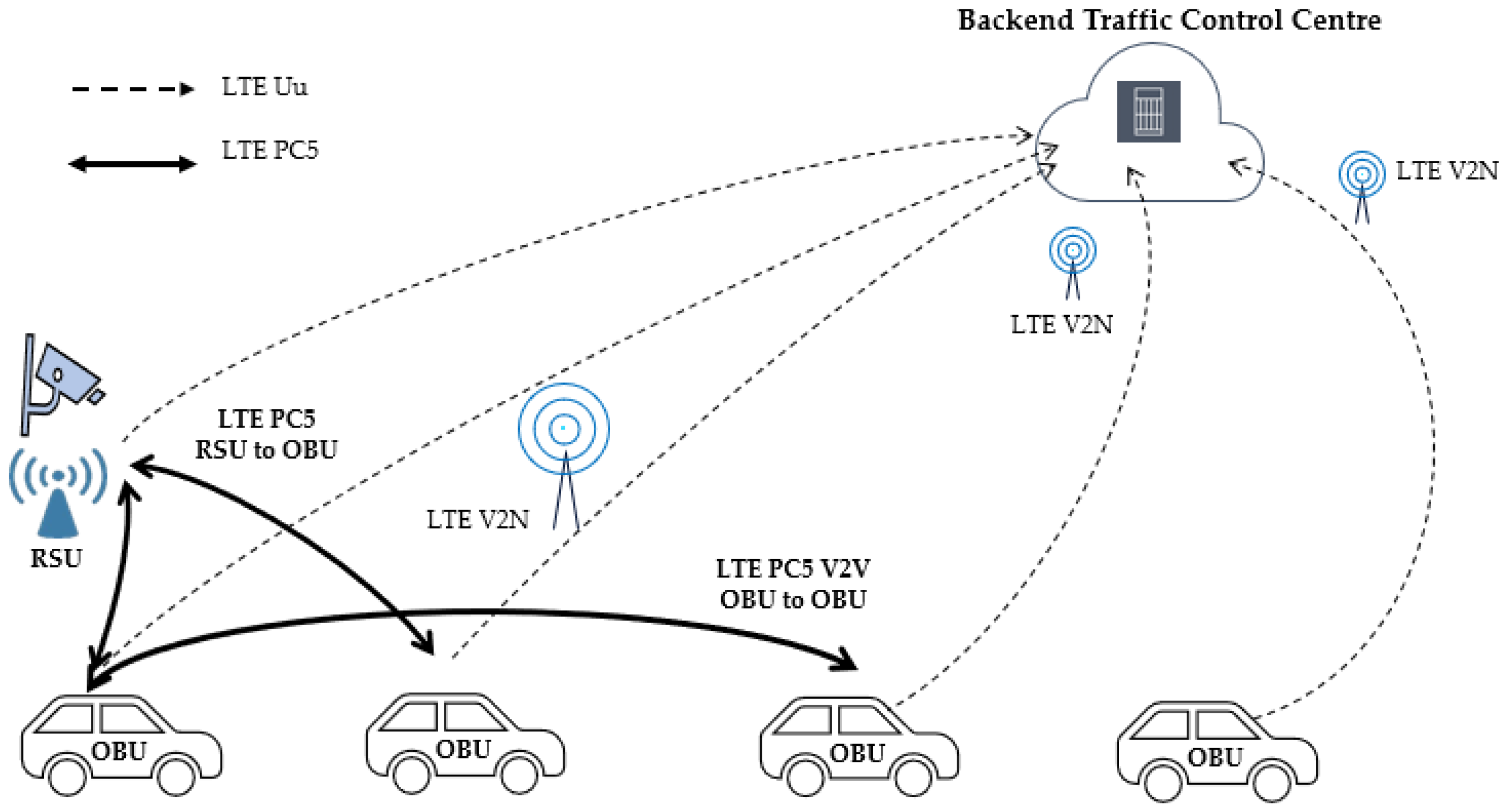
5.1. V2V and V2N Field Testing
- One RSU is installed to extend the test vehicle’s field of vision. The RSU transmits predefined road information such as pedestrian detection to OBU by PC5-based C-V2X.
- OBUs are installed in the test vehicles to receive RSU information as well as between OBUs via PC5-based V2V application.
- RSU/OBU information is transferred back to “Traffic Control Centre” by 4G LTE cellular network as a V2N application.
5.2. Commercial Pilot
5.3. Commercial Project
6. Discussion
- C-V2X is an eco-system. There must be robust engagements from industry stakeholders, like road transport authority, autonomous driving developers, network transmission operators, and government. To improve C-V2X, the government needs to push road transport facility development and unify its standards. For example, traffic light control systems need to be upgraded from traditional equipment to higher processing devices. To transmit the traffic information promptly, it requires a traffic light control system to send signal changing information with a predefined frequency of at least 10HZ. But existing devices across Taiwan can’t meet this requirement. A mediation conversion process must be added. The disadvantage of this process is that it increases the message transport latency. So, there are delays between the traffic light control console and traffic lights, which is against the ITS standard. This problem causes difficulties in obtaining the correct timing information for C-V2X devices to synchronize in the SPAT application. To overcome these problems, the government must develop a unified standard to push the upgrade of traffic light control systems.
- Technical application layer specifications are not standardized in C-V2X. Some organizations follow up European Standard, while some use American Standard or combine both as a national standard. It is still unclear which standard will be adopted globally. Unifying and balancing all the pros and cons should be part of the government’s smart city agenda.
- In some regions such as Taiwan, 5G is still a year away from island-wide coverage, though it has completed LTE-V2X service testing and trials. So far, it is only focused on applications with limited KPI (Key Performance Indicator) performance. C-V2X will reach a new level once 5G is introduced, where bandwidth, low latency, and high throughput are critical for the use case. However, the deployment of 5G NR-V2X still needs the entire eco-system to be fully adopted.
- Plenty of privacy and confidential information from vehicles, roadside infrastructure, and IP cameras are broadcast in the public space. Protecting information security is an essential topic for PC5-based C-V2X deployment, as mentioned in [30,31,32]. The country needs a standard to define a security policy.
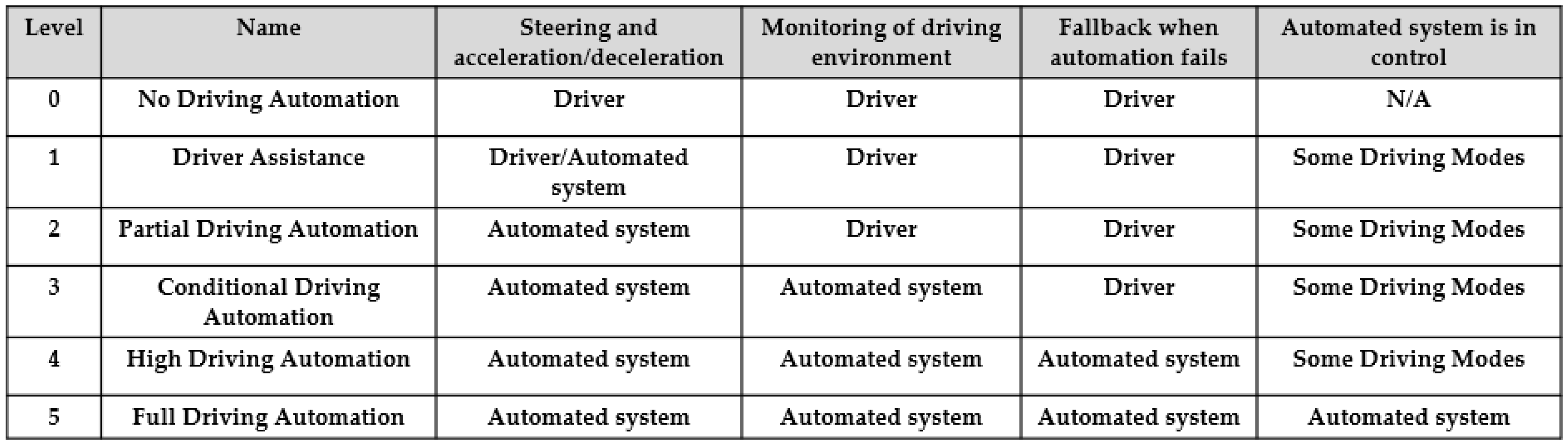
- Autonomous Driving is defined as Level 0–Level 5 according to international specification SAE J3016 [13]. However, there are no international standards for road level definition.
- Regulations and insurance claims for ITS road accident are yet to be defined.
7. Conclusions
Author Contributions
Funding
Data Availability Statement
Acknowledgments
Conflicts of Interest
References
- Road Traffic Injuries. Available online: https://www.who.int/news-room/fact-sheets/detail/road-traffic-injuries (accessed on 29 December 2020).
- Federal Communications Commission News. Available online: https://www.fcc.gov/document/fcc-modernizes-59-ghz-band-improve-wi-fi-and-automotive-safety (accessed on 29 December 2020).
- Study on LTE-Based V2X Services. Available online: https://www.3gpp.org/ftp//Specs/archive/36_series/36.885/ (accessed on 20 January 2021).
- 5GCAR Deliverable D2.1. Available online: https://5gcar.eu/wp-content/uploads/2017/05/5GCAR_D2.1_v1.0.pdf (accessed on 29 December 2020).
- 5GAA, an Assessment of LTE-V2X (PC5) and 802.11p Direct Communications Technologies for Improved, December 2017. Available online: https://5gaa.org/wp-content/uploads/2017/12/5GAA-Road-safety-FINAL2017-12-05.pdf (accessed on 29 December 2020).
- NHTSA, Keynote Address at ITS America, June 2018. Available online: https://www.nhtsa.gov/speeches-presentations/keynote-address-its-america (accessed on 29 December 2020).
- Automotive Research&Testing Center. Available online: https://www.artc.org.tw/chinese/03_service/03_02detail.aspx?pid=13371 (accessed on 29 December 2020).
- Auto-Talks. Available online: https://www.auto-talks.com/technology/global_v2x_dsrc-and-c-v2x/ (accessed on 24 November 2020).
- Savari. Available online: https://savari.net/technology-cv2x (accessed on 29 December 2020).
- 5GAA, Connectivity Standards in the Automotive Industry. Available online: https://www.itu.int/en/ITU-T/extcoop/cits/Documents/Meeting-20191028-e-meeting/18_5GAA_ITS-status-update.pdf (accessed on 29 December 2020).
- Evolved Universal Terrestrial Radio Access (E-UTRA), Physical Layer Procedures. Available online: https://www.3gpp.org/ftp//Specs/archive/36_series/36.213/ (accessed on 20 January 2021).
- Study on Enhancement of 3GPP Support for 5G V2X Services. Available online: https://www.3gpp.org/ftp//Specs/archive/22_series/22.886/ (accessed on 20 January 2021).
- Automated Driving: Levels of Driving Automation as per SAE International Standard J3016. Available online: https://www.sae.org/standards/content/j3016_201806/ (accessed on 29 December 2020).
- Shenzhi, C.; Jinling, H.; Yan, S.; Li, Z.; Wen, L. A Vision of C-V2X: Technologies, Field Testing and Challenges with Chinese Development. IEEE Internet Things J. 2020, 5, 3872–3881. [Google Scholar]
- 3GPP R16. Available online: https://www.3gpp.org/release-16 (accessed on 29 December 2020).
- 3GPP release 17, December 2020. Available online: https://www.3gpp.org/release-17 (accessed on 20 January 2021).
- Study on self-evaluation towards IMT-2020 submission. Available online: https://www.3gpp.org/ftp//Specs/archive/37_series/37.910/ (accessed on 20 January 2021).
- Study on LTE support for Vehicle-to-Everything (V2X) Services. Available online: https://www.3gpp.org/ftp//Specs/archive/22_series/22.885/ (accessed on 20 January 2021).
- Takeshi, H.; Tutomu, M. Performance Evaluations of PC5-based Cellular-V2X Mode 4 for Feasibility Analysis of Driver Assistance Systems with Crash Warning. Sensors 2020, 20, 2950. [Google Scholar]
- Nardini, G.; Virdis, A.; Campolo, C.; Molinaro, A.; Stea, G. Cellular-V2X communications for platooning: Design and evaluation. Sensors 2018, 18, 1527. [Google Scholar] [CrossRef] [Scilit] [PubMed]
- Federal Communications Commission News. Available online: https://www.fcc.gov/document/fcc-seeks-promote-innovation-59-ghz-band (accessed on 29 December 2020).
- 5GAA, a Visionary Roadmap for Advanced Driving Use Cases, Connectivity Technologies, and Radio Spectrum Needs. Available online: https://5gaa.org/news/the-new-c-v2x-roadmap-for-automotive-connectivity/ (accessed on 29 December 2020).
- China Times News. Available online: https://www.chinatimes.com/newspapers/20191205000277-260202?chdtv (accessed on 29 December 2020).
- Tan, D.; Lin, Y.; Hua, K. Incremental Learning of Multi-Domain Image-to-Image Translations. IEEE Trans. Circuits Syst. Video Technol. 2021. [Google Scholar] [CrossRef] [Scilit]
- Ople, J.; Yeh, P.; Sun, S.; Tsai, I.; Hua, K. Multi-Scale Neural Network with Dilated Convolutions for Image Deblurring. IEEE Access 2020, 8, 53942–53952. [Google Scholar] [CrossRef] [Scilit]
- Chen, W.; Ople, J.; Si, M.; Tan, D.; Hua, K. Perspective Preserving Style Transfer for Interior Portraits. IEEE Access 2021, 9, 7033–7042. [Google Scholar] [CrossRef] [Scilit]
- Liberty Times Net. Available online: https://news.ltn.com.tw/news/life/paper/1343581 (accessed on 29 December 2020).
- The Storm Media. Available online: https://www.storm.mg/article/2910302 (accessed on 29 December 2020).
- Taiwan Mobile. Available online: https://corp.taiwanmobile.com/press-release/news/press_20200720_260048.html (accessed on 29 December 2020).
- Waller, A.; Sandy, I.; Power, E.; Aivaloglou, E.; Skianis, C.; Muñoz, A.; Maña, A. Policy based management for security in cloud computing. In Proceedings of the FTRA International Conference on Secure and Trust Computing, Data Management, and Application, Berlin, Heidelberg, 28 June 2011; pp. 130–137. [Google Scholar]
- Muñoz, A.; Serrano, D.; Maña, A. Secure Profiles as a Cornerstone in Emerging Ambient Intelligence Scenarios. In Developing Ambient Intelligence; Springer: Paris, France, 2008; pp. 34–46. [Google Scholar]
- Toutouh, J.; Muñoz, A.; Nesmachnow, S. Evolution Oriented Monitoring oriented to Security Properties for Cloud Applications. In Proceedings of the 13th International Conference on Availability, Reliability and Security, Hamburg, Germany, 27 August 2018; pp. 1–7. [Google Scholar]



| Items | LTE-V2X | NR-V2X |
|---|---|---|
| Specification | 3GPP Rel-14/Rel-15 | 3GPP Rel-16/Rel-17 |
| Latency | Low latency: 10~100 ms | Ultra-low latency: 1 ms [17] |
| PC5 Message Type | Broadcast | Broadcast, Unicast and Groupcast |
| Application Scenario | Safety related/Enhanced | Advanced Application |
| Cellular Network Coverage | Uu and PC5 Mode3 | Uu and PC5 Mode1 |
| Out of Cellular Network Coverage | PC5 Mode4 | PC5 Mode2 |
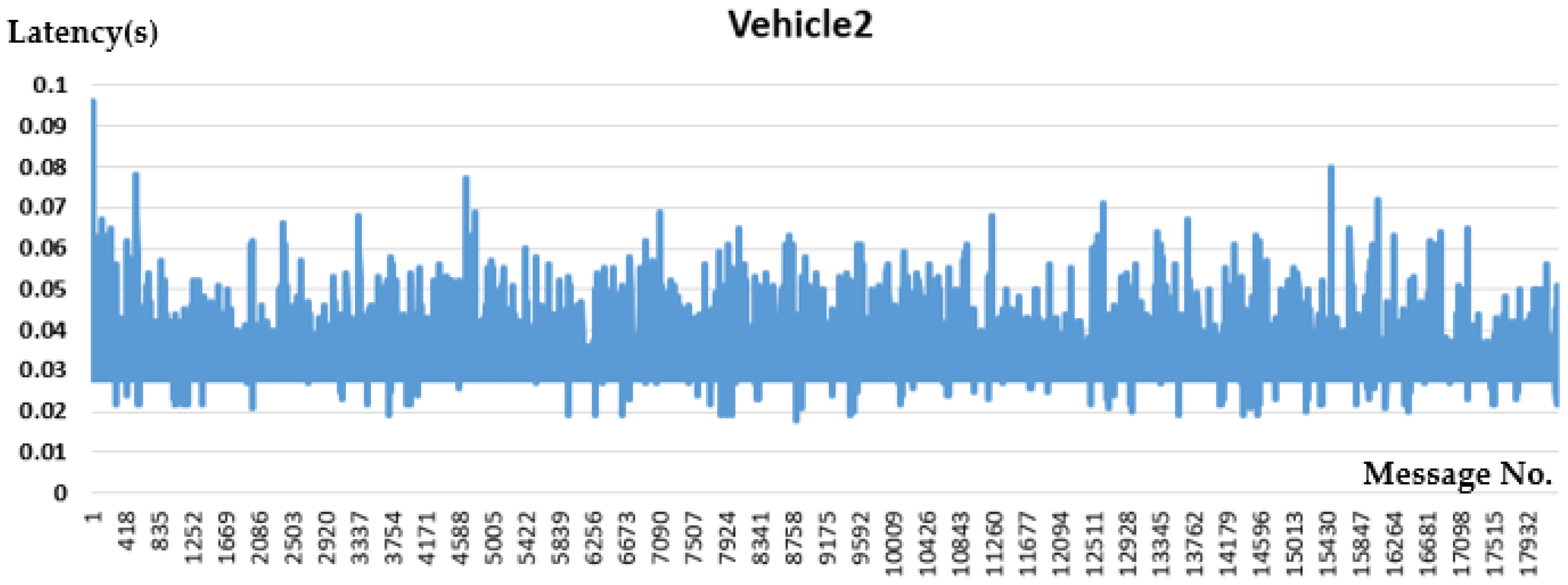
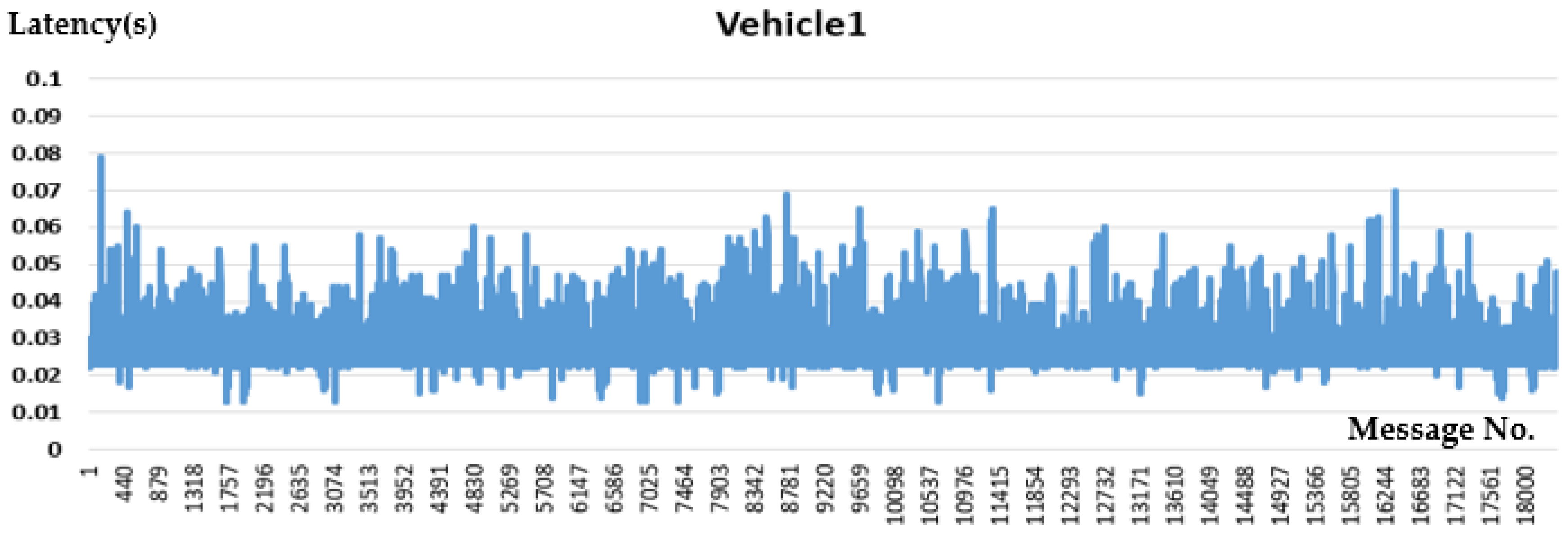
| Performance (between OBUs) | Vehicle 1 | Vehicle 2 |
|---|---|---|
| Packet Transmission Frequency | 100 Hz | 100 Hz |
| Average Latency | 27 ms | 32 ms |
| Package Drop Rate | 2.47% | 2.72% |
Publisher’s Note: MDPI stays neutral with regard to jurisdictional claims in published maps and institutional affiliations. |
© 2021 by the authors. Licensee MDPI, Basel, Switzerland. This article is an open access article distributed under the terms and conditions of the Creative Commons Attribution (CC BY) license (http://creativecommons.org/licenses/by/4.0/).
Share and Cite
Miao, L.; Virtusio, J.J.; Hua, K.-L. PC5-Based Cellular-V2X Evolution and Deployment. Sensors 2021, 21, 843. https://doi.org/10.3390/s21030843
Miao L, Virtusio JJ, Hua K-L. PC5-Based Cellular-V2X Evolution and Deployment. Sensors. 2021; 21(3):843. https://doi.org/10.3390/s21030843
Chicago/Turabian StyleMiao, Lili, John Jethro Virtusio, and Kai-Lung Hua. 2021. "PC5-Based Cellular-V2X Evolution and Deployment" Sensors 21, no. 3: 843. https://doi.org/10.3390/s21030843
APA StyleMiao, L., Virtusio, J. J., & Hua, K.-L. (2021). PC5-Based Cellular-V2X Evolution and Deployment. Sensors, 21(3), 843. https://doi.org/10.3390/s21030843