A Methodology for Designing Smart Urban Living Labs from the University for the Cities of the Future

 and
and 
Abstract
1. Introduction
“A Smart Sustainable City is a city that meets the needs of its present inhabitants without compromising the ability for other people or future generation to meet their needs, and thus, does not exceed local or planetary environmental limitations, and where this is supported by Information and Communication Technologies (ICT).”
2. Methods
2.1. Megatrend Analysis
2.2. Technology Roadmaps
2.3. Technology Evaluation and Research Capabilities Mapping
3. Results
3.1. Megatrend Analysis Results
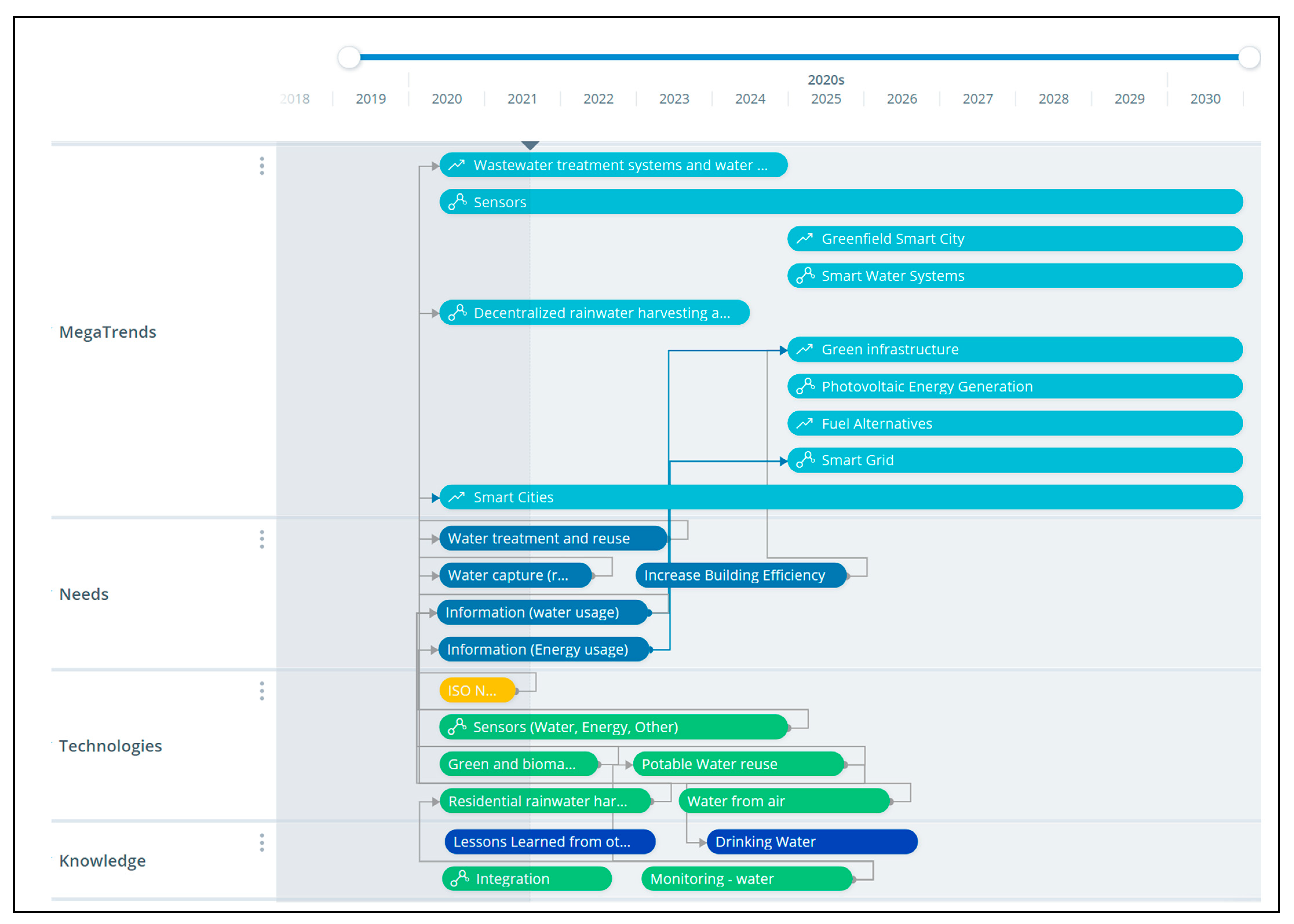
3.2. Technology Roadmapping Results
3.3. Technology Evaluation and Research Capabilities Mapping
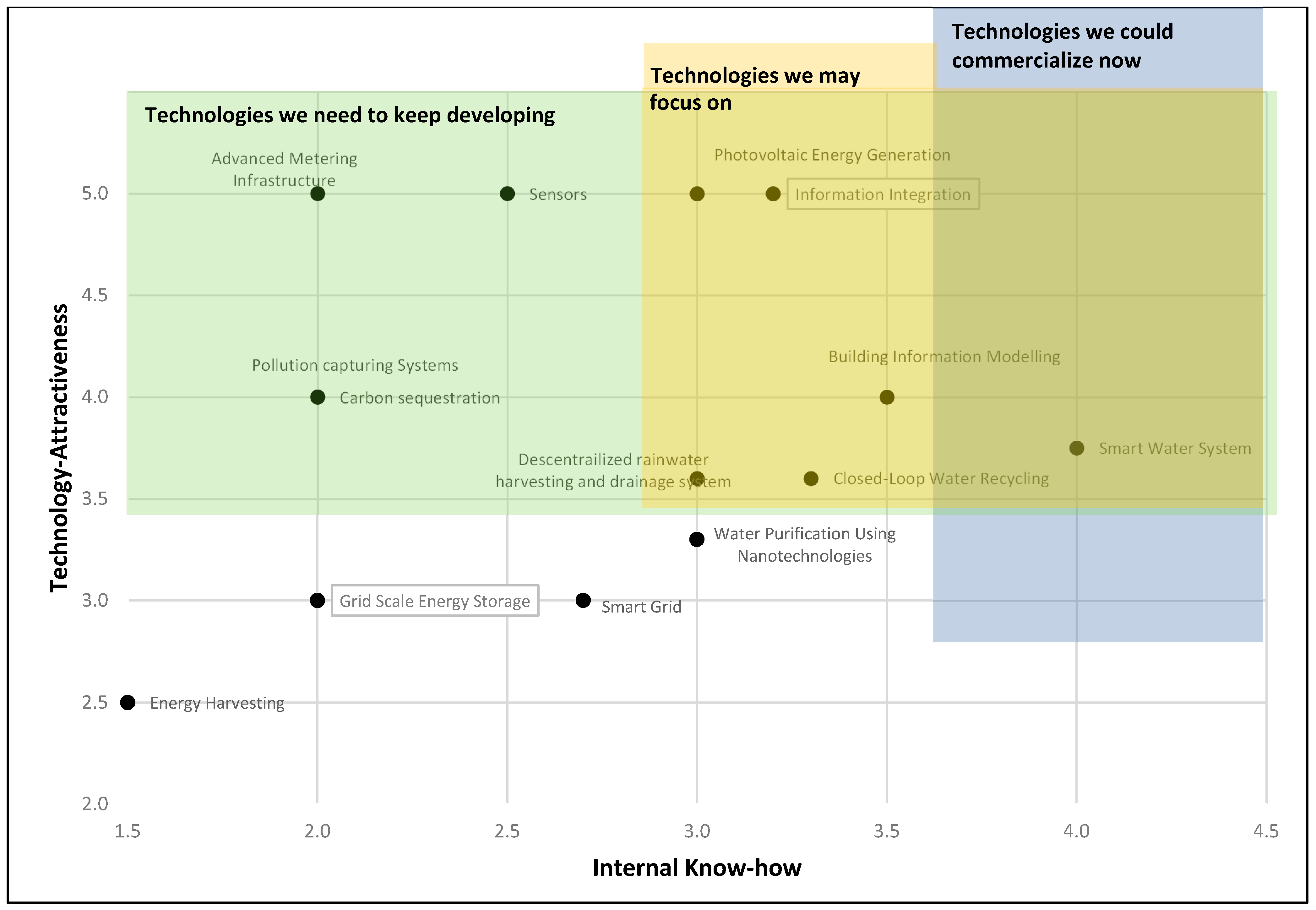
- Green area: this area represents those technologies with a high technology attractiveness value. It represents those technologies that the university may continue developing for their high attractiveness.
- Blue area: this area represents those technologies the university is developing with the highest internal know-how evaluation. Those technologies are the ones the university may commercialize or transfer in the short term because of their expertise. This area’s description is the same for Figure 3 and Figure 4.
- Yellow area: this area is intended to cover the most valuable intersection for the green and blue areas, highlighting the most important technologies to focus on, according to the technology attractiveness and internal know-how evaluation.
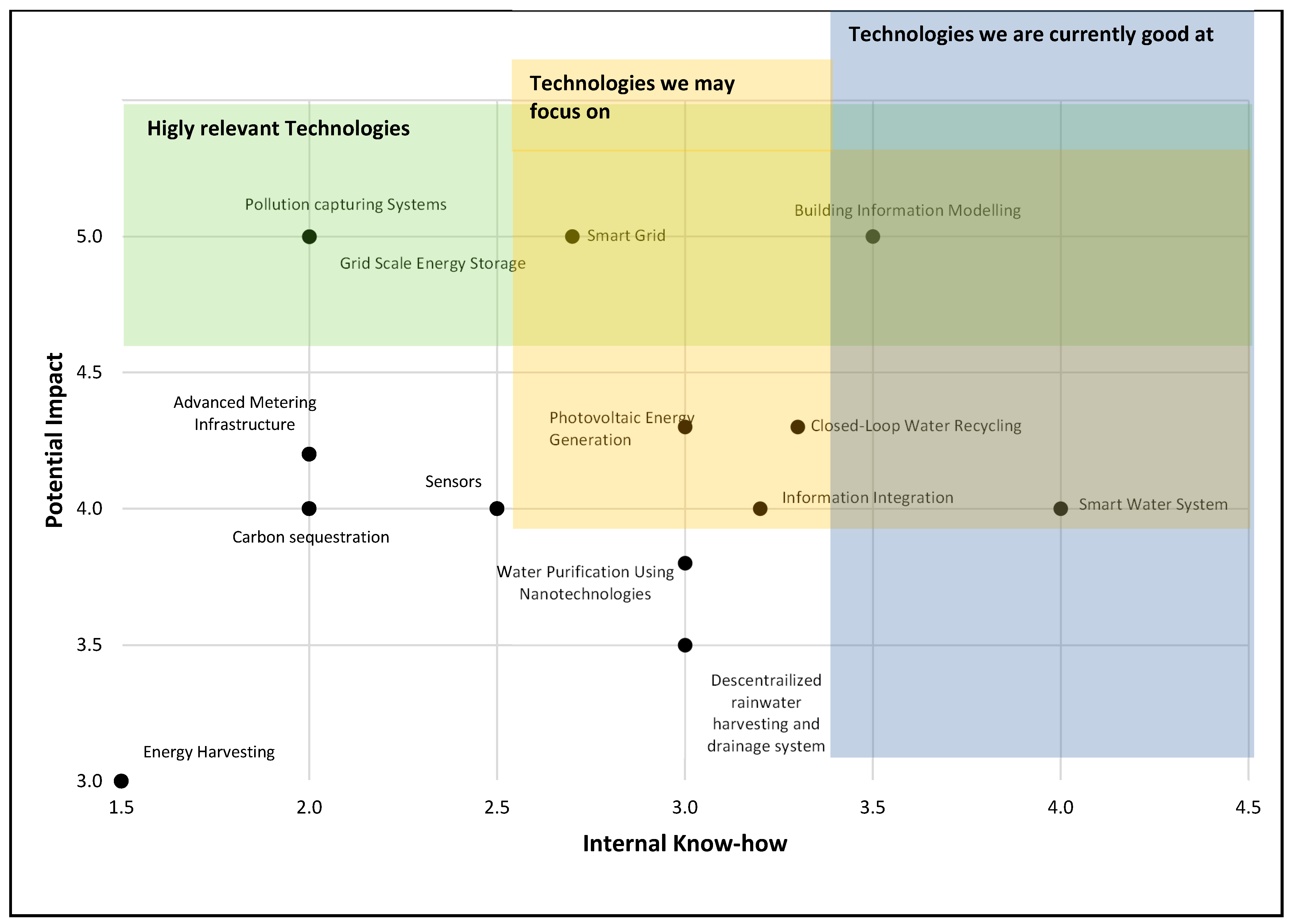
- Green area: this area represents those technologies with a high technology impact value. It represents those technologies that the university may continue developing for their future high impact on the market.
- Blue area: this area represents the university’s technologies with the highest internal know-how evaluation, as described in Figure 2.
- Yellow area: this area is intended to cover the most valuable intersection for the green and blue areas, highlighting the most important technologies to focus on, according to the technology’s potential impact and internal know-how evaluation.
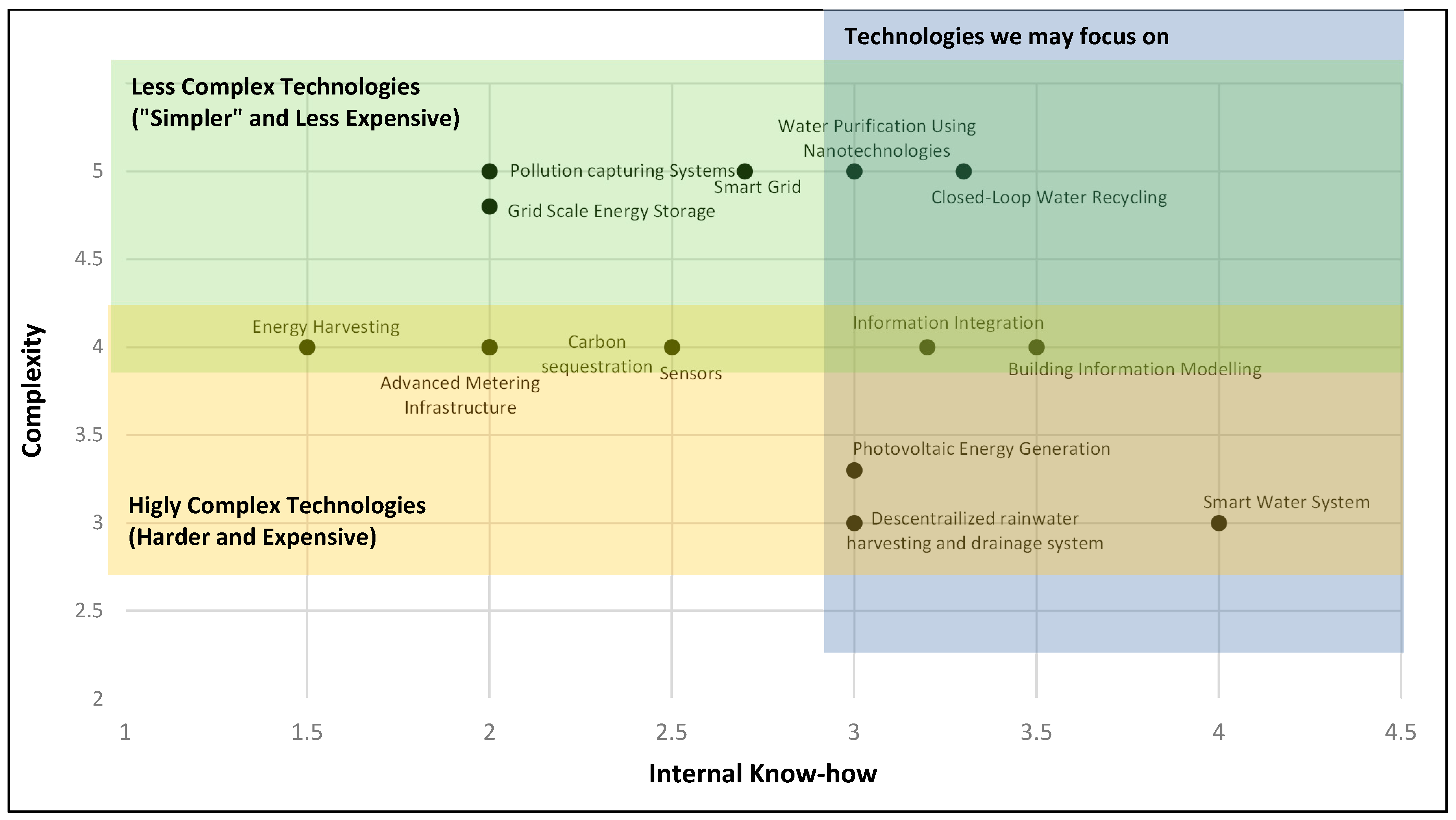
- Green area: this area represents the top part of the region, where the technologies that fall within this section are “harder and more expensive” to develop.
- Yellow area: this area represents the bottom part, identifying the less complex technologies, “simpler and less expensive” to develop.
- Blue area: this area is on the right part of the graph, representing those technologies for which the university has the know-how, regardless of their complexity.
3.4. Designing the Smart Living Lab
4. Discussion and Conclusions
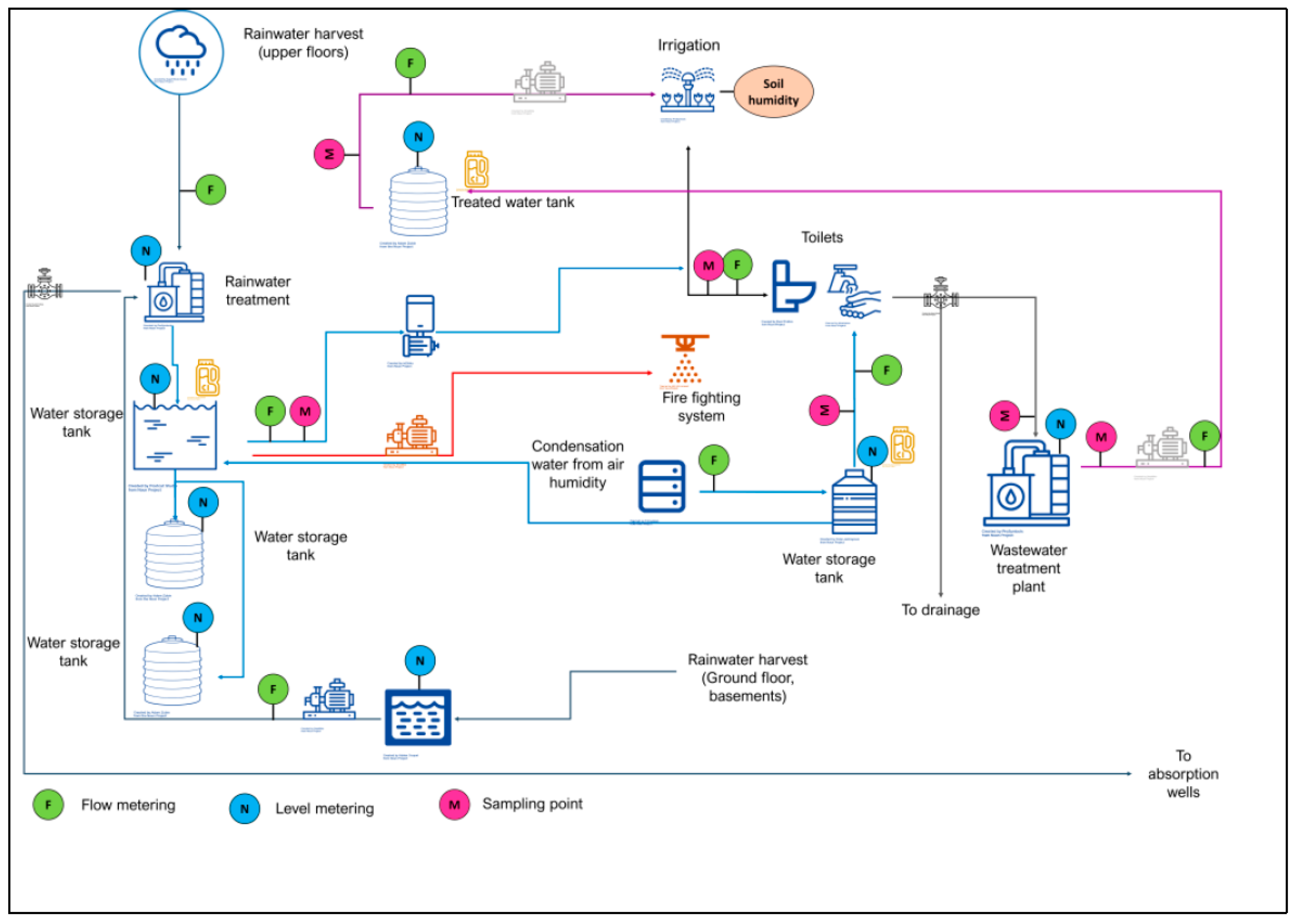
- Rainwater collection and treatment systems to discharge into toilets and general building services.
- Generation of water from the condensation of humidity in the air for sinks and drinking fountains.
- Treatment plant for wastewater and greywater, whose discharge will be reused in the irrigation of green areas.
- A solar photovoltaic generation system, installed on the roof of the building, which also collects rainwater.
- A monitoring system for water and energy generation and consumption.
Author Contributions
Funding
Institutional Review Board Statement
Informed Consent Statement
Acknowledgments
Conflicts of Interest
References
- Von Wirth, T.; Fuenfschilling, L.; Frantzeskaki, N.; Coenen, L. Impacts of urban living labs on sustainability transitions: Mechanisms and strategies for systemic change through experimentation. Eur. Plan. Stud. 2019, 27, 229–257. [Google Scholar] [CrossRef] [Scilit]
- Negreiros, I.; Camargo Francisco, A.C.; Hashimoto Fengler, F.; Faria, G.; Gomes Pereira Pinto, L.; Tolotto, M.; Barbosa Rogoschewski, R.; Relva Romano, R.; Silva Netto, R. Smart Campus® as a living lab on sustainability indicators monitoring. In Proceedings of the 2020 IEEE International Smart Cities Conference (ISC2), Piscataway, NJ, USA, 28 September–1 October 2020; pp. 1–5. [Google Scholar] [CrossRef] [Scilit]
- McCormick, K.; Hartmann, C. The Emerging Landscape of Urban Living Labs—Characteristics, Practices and Examples; Lund University: Lund, Sweden, 2017; p. 20. [Google Scholar]
- UN-Habitat. Las Ciudades, “Causa y Solución” del Cambio Climático. Available online: https://onuhabitat.org.mx/index.php/las-ciudades-causa-y-solucion-del-cambio-climatico (accessed on 12 March 2021).
- Höjer, M.; Wangel, J. Smart Sustainable Cities: Definition and Challenges. In ICT Innovations for Sustainability; Springer: Berlin/Heidelberg, Germany, 2015; pp. 333–349. [Google Scholar] [CrossRef] [Scilit]
- Naisbitt, J.; Aburdene, P. Megatrends 2000: Ten New Directions for the 1990s; William Morrow and Co.: New York, NY, USA, 1990. [Google Scholar]
- Toffler, A. Future Shock; Bantam Books: New York, NY, USA, 1971; p. 561. [Google Scholar]
- Amezcua-Martinez, J.L.; Güemes-Castorena, D. Strategic foresight methodology to identifying technology trends and business opportunities. In Strategic Planning Decisions in the High Tech Industry; Cetidamar, D., Daim, T., Beyhan, B., Basoglu, N., Eds.; Springer: London, UK, 2013; pp. 53–65. [Google Scholar]
- Güemes-Castorena, D. Megatrend methodology to identify development opportunities. In Proceedings of the PICMET ’09, Portland, OR, USA, 2–6 August 2009; pp. 2391–2396. [Google Scholar]
- Güemes-Castorena, D.; Romero, G.; Villarreal González, A. Technological foresight model for the identification of business opportunities (TEFMIBO). Foresight 2013, 15, 492–516. [Google Scholar] [CrossRef] [Scilit]
- OECD. Water and Cities: Ensuring Sustainable Futures; Éditions OCDE/OECD Publishing: Paris, France, 2015. [Google Scholar]
- OECD. Water Resources Allocation: Sharing Risks and Opportunities; Éditions OCDE/OECD Publishing: Paris, France, 2015. [Google Scholar]
- Beinhocker, E.; Davis, I.; Mendonca, L. The 10 Trends You Have to Watch. Harv. Bus. Rev. 2009, 87, 55–60. [Google Scholar]
- Boccaletti, G.; Grobbel, M.; Stuchtey, M.R. The Business Opportunity in Water Conservation; McKinsey Quarterly, Mckinsey and Company: New York, NY, USA, 2009; pp. 66–74. [Google Scholar]
- Asit, K.B.; Cecilia, T.; Philippe, R. Assessing Global Water Megatrends (Water Resources Development and Management); Springer: Singapore, 2018. [Google Scholar]
- Tratz-Ryaan, B.; Finnerty, B. Hype Cycle for Smart City Technologies and Solutions; Gartner, Inc.: Stamford, CT, USA, 2019. [Google Scholar]
- Chen, Y. Energy Science & Technology in China: A Roadmap to 2050; Springer: Berlin/Heidelberg, Germany, 2010. [Google Scholar]
- Geoff, O.B.; Nicola, P.; Phil, O.K. The Future of Energy Use; Routledge: London, UK, 2010. [Google Scholar]
- National Academy of Engineering and National Research Council. Energy Futures and Urban Air Pollution: Challenges for China and the United States; National Academies Press: Washington, DC, USA, 2008. [Google Scholar] [CrossRef] [Scilit]
- Towler, B. The Future of Energy; Elsevier: Amsterdam, The Netherlands, 2014. [Google Scholar] [CrossRef] [Scilit]
- Frost & Sullivan. Global Mega Trends to 2030, Futurecasting Key Themes That Will Shape Our Future Lives; Frost & Sullivan: Santa Clara, CA, USA, 2019. [Google Scholar]
- Lu, H.P.; Chen, C.S.; Yu, H. Technology roadmap for building a smart city: An exploring study on methodology. Future Gener. Comput. Syst. 2019, 97, 727–742. [Google Scholar] [CrossRef] [Scilit]
- Harmon, R.R.; Castro-Leon, E.G.; Bhide, S. Smart cities and the Internet of Things. In Proceedings of the 2015 Portland International Conference on Management of Engineering and Technology (PICMET), Portland, OR, USA, 2–6 August 2015; pp. 485–494. [Google Scholar] [CrossRef] [Scilit]
- Lloyd Owen, D.A. Smart Water and Water Megatrend Management and Mitigation. In Assessing Global Water Megatrends; Biswas, A.K., Tortajada, C., Rohner, P., Eds.; Springer: Singapore, 2018; pp. 87–104. [Google Scholar]
- Bughin, J.; Chui, M.; Manyika, J. Clouds, Big Data, and Smart Assets: Ten Tech-Enabled Business Trends to Watch; McKinsey Quarterly, Mckinsey and Company: New York, NY, USA, 2018; pp. 1–14. [Google Scholar]
- Toro-Jarrín, M.A.; Ponce-Jaramillo, I.E.; Güemes-Castorena, D. Methodology for the of building process integration of Business Model Canvas and Technological Roadmap. Technol. Forecast. Soc. Chang. 2016, 110, 213–225. [Google Scholar] [CrossRef] [Scilit]



| Alternative Energy Adoption | Green Supply Chain | Smart Cities |
| Closed-Loop Water Recycling | Mega Cities | Smart Lighting |
| Connected Mobility | Microgrids | Smart Public Services |
| Consumer Habits Regarding Water Use | Micro Mobility | Wastewater Treatment Systems and Water Reuse |
| Fuel Alternatives | Natural Resources Stress | Water Allocation and Distribution |
| Green Infrastructure | New Business Models with Water Infrastructure Investment | Water as a Luxury |
| Green Manufacturing Growth | Off-Grid Energy | Water Deficit |
| Greenfield Smart City Infrastructure | Pollution Capturing System | Water Purification Using Nanotechnologies |
| Hyper Growth Energy Demand | Rewarding Sustainable Behavior | Zero Waste |
| Megatrend | Future Needs |
|---|---|
| Water-related megatrends | Better water collection |
| Methods to purify water | |
| Rainwater collection and treatment | |
| Energy-related megatrends | Monitoring/measurement |
| Improve energy efficiency |
| Evaluation → Technology Attractiveness ↓ | None | Very Low | Low | Medium | High | Very High |
|---|---|---|---|---|---|---|
| 0 | 1 | 2 | 3 | 4 | 5 | |
| Market Potential |
|
|
|
|
|
|
| Competitive Situation |
|
|
|
|
|
|
| Technology Potential |
|
|
|
|
|
|
| Evaluation → Demonstrated Capabilities ↓ | None | Very Low | Low | Medium | High | Very High |
|---|---|---|---|---|---|---|
| 0 | 1 | 2 | 3 | 4 | 5 | |
| Publication capabilities |
|
|
|
|
|
|
| People capabilities |
|
|
|
|
|
|
| Number of projects |
|
|
|
|
|
|
| Collaboration capabilities |
|
|
|
|
|
|
| Evaluation → Need for Action ↓ | None | Very Low | Low | Medium | High | Very High |
|---|---|---|---|---|---|---|
| 0 | 1 | 2 | 3 | 4 | 5 | |
| Technological capabilities availability |
|
|
|
|
|
|
| Resources availability (financial + labs + partners) |
|
|
|
|
|
|
| Customers for the technology |
|
|
|
|
|
|
| Technology, need, and megatrend alignment |
|
|
|
|
|
|
| Regional importance |
|
|
|
|
|
|
| Alignment to the strategy of the University |
|
|
|
|
|
|
| Sensors | Greenfield smart city infrastructure |
| Smart grid | Green infrastructure |
| Smart cities | Photovoltaic energy generation |
| Fuel alternatives | Wastewater treatment systems and water reuse |
| Smart water systems | Decentralized rainwater harvesting and drainage systems |
| Water | Collection | |
| Purification | ||
| Rainwater collection and treatment | ||
| Monitoring/measurement | ↔ Sensing | |
| Efficiency | ||
| Wastewater treatment | ||
| Treatment and reuse | ||
| Energy | Generation Efficiency | |
| Monitoring/measurement | ↔ Sensing |
| Advanced Metering Infrastructure | Allows two-way data transmission between the customer and the utility. As well as being a tool for the active influence of customer behavior, it can detect leaks at the individual household level and detect anomalous usage patterns. |
| Building Information Modelling | It is a system that involves generating and managing digital representations of places’ physical and functional properties. It provides an intelligent 3D model of an area that gives insights and tools to plan, design, construct, and manage buildings more efficiently. BIM creates a unique perspective of the building process, saving money and time, and simplifying the entire construction development procedure. |
| Carbon Sequestration | CO2 is the most produced greenhouse gas and a major cause of global warming. Carbon sequestration occurs both naturally and as a consequence of anthropogenic activities. Success in this area will benefit the environment and industries such as oil and gas, agriculture, renewable energy, and industrial construction. |
| Closed-Loop Water Recycling | The process restores and regenerates waste as part of its design to keep materials at their highest utility and value. The process will help wastewater producers reduce their carbon footprint and achieve corporate sustainability |
| Decentralized Rainwater Harvesting and Drainage System | Decentralized systems also apply to stormwater drainage, with a growing use of “source control” technologies that handle stormwater near the point of generation, i.e., locally. For instance, green roofs or pervious surfaces capture rainwater before it runs onto polluted pavements and streets. |
| Energy Harvesting | Energy harvesting is the process of pulling ambient energy from external environmental sources. The energy, once captured, is stored to be used. Currently, it is applied to areas such as building and industry automation, smart cities, automotive vehicles, and security systems, for example. Developments in big data, the Internet of Things, and the need to replace batteries, are major forces driving advances in energy harvesting technologies. |
| Grid-Scale Energy Storage | Storing energy in this way provides the needed flexibility to manage dynamic resources effectively while reducing the overall costs associated with peak-time energy transmission. Most new grid-scale energy storage solutions are based on lithium-ion battery technology. However, research reveals alternative solutions, such as liquid silicone storage, which may economically secure energy in a greater capacity. |
| Information Integration | Networking technology connects all kinds of equipment and machines to integrate related virtual and physical services. |
| Photovoltaic Energy Generation | As photovoltaic technologies develop, they are offering higher conversion efficiency and lower costs to traditional solar panels. Photovoltaics appeal to the construction industry as the panels aid in achieving energy targets for building design. At the same time, the renewable energy sector will benefit through the offering of better energy performance. |
| Pollution-Capturing Systems | Pollution-capturing systems or smog-eating technology refers to newly produced materials designed to capture toxic air pollution and hold it within the core of the material, preventing it from escaping. These come in the form of CO2-infused concrete, smog-eating tiles, and large city air purifiers. These materials and systems are increasingly being tested and applied to construction projects, contributing to the improvement of the environment and reducing overall construction costs. |
| Sensors | Water, power, and energy monitoring: A new type of digital water and power meter can accurately indicate the amount of energy consumption and report the information over the network. This helps to increase efficiency and helps to ensure the best use of the resources. The employment of sensors along the transmission route creates the recording of vital information that can then be relayed. |
| Smart Grid | A smart grid refers to digital technology enabling two-way communication between an energy utility and its customers. Smart grids allow for real-time electricity supply and demand data collection, simultaneously alongside transmission and distribution. Real-time data collection makes evaluation, monitoring, consumption, and maintenance much more efficient. |
| Smart Water System and Water Purification using Nanotechnologies | This refers to the use of various nano-water filtration systems and techniques to purify all contaminated water types. Nanotechnologies are viewed in science circles as a viable solution to the problem due to manipulating core properties at the nano level while being cost-efficient. |
| Evaluations → | Potential Impact | Complexity | Technology Attractiveness | Internal Know-How | Need for Action | TRL 1 | |
|---|---|---|---|---|---|---|---|
| Technologies ↓ | |||||||
| Advanced Metering Infrastructure | 4.2 | 4 | 5 | 2 | 2 | 9 | |
| Building Information Modelling | 5 | 4 | 4 | 3.5 | 3.5 | 7 | |
| Carbon sequestration | 4 | 4 | 4 | 2 | 3 | 3 | |
| Closed-Loop Water Recycling | 4.3 | 5 | 3.6 | 3.3 | 4 | 3 | |
| Decentralized Rainwater Harvesting and Drainage System | 3.5 | 3 | 3.6 | 3 | 3 | 9 | |
| Energy Harvesting | 3 | 4 | 2.5 | 1.5 | 2 | 7 | |
| Grid Scale Energy Storage | 5 | 4.8 | 3 | 2 | 3 | 7 | |
| Information Integration | 4 | 4 | 5 | 3.2 | 3.3 | 7 | |
| Photovoltaic Energy Generation | 4.3 | 3.3 | 5 | 3 | 3 | 9 | |
| Pollution-Capturing Systems | 5 | 5 | 4 | 2 | 3 | 7 | |
| Sensors | 4 | 4 | 5 | 2.5 | 2.5 | 9 | |
| Smart Grid | 5 | 5 | 3 | 2.7 | 4 | 7 | |
| Smart Water System | 4 | 3 | 3.75 | 4 | 4 | 8 | |
| Water Purification Using Nanotechnologies | 3.8 | 5 | 3.3 | 3 | 3 | 8 | |
| Technology ↓ Selection Criteria → | I | II | III |
|---|---|---|---|
| Advanced Metering Infrastructure | |||
| Building Information Modelling | √ | √ | √ |
| Carbon Sequestration | |||
| Closed-Loop Water Recycling | √ | √ | √ |
| Decentralized Rainwater Harvesting and Drainage System | √ | √ | |
| Energy Harvesting | |||
| Grid-Scale Energy Storage | |||
| Information Integration | √ | √ | √ |
| Photovoltaic Energy Generation | √ | √ | √ |
| Pollution-Capturing Systems | |||
| Sensors | |||
| Smart Grid | √ | ||
| Smart Water System, Water Purification, and Recycling | √ | √ | √ |
Publisher’s Note: MDPI stays neutral with regard to jurisdictional claims in published maps and institutional affiliations. |
© 2021 by the authors. Licensee MDPI, Basel, Switzerland. This article is an open access article distributed under the terms and conditions of the Creative Commons Attribution (CC BY) license (https://creativecommons.org/licenses/by/4.0/).
Share and Cite
Martínez-Bello, N.; Cruz-Prieto, M.J.; Güemes-Castorena, D.; Mendoza-Domínguez, A. A Methodology for Designing Smart Urban Living Labs from the University for the Cities of the Future. Sensors 2021, 21, 6712. https://doi.org/10.3390/s21206712
Martínez-Bello N, Cruz-Prieto MJ, Güemes-Castorena D, Mendoza-Domínguez A. A Methodology for Designing Smart Urban Living Labs from the University for the Cities of the Future. Sensors. 2021; 21(20):6712. https://doi.org/10.3390/s21206712
Chicago/Turabian StyleMartínez-Bello, Nadhiely, Mónica José Cruz-Prieto, David Güemes-Castorena, and Alberto Mendoza-Domínguez. 2021. "A Methodology for Designing Smart Urban Living Labs from the University for the Cities of the Future" Sensors 21, no. 20: 6712. https://doi.org/10.3390/s21206712
APA StyleMartínez-Bello, N., Cruz-Prieto, M. J., Güemes-Castorena, D., & Mendoza-Domínguez, A. (2021). A Methodology for Designing Smart Urban Living Labs from the University for the Cities of the Future. Sensors, 21(20), 6712. https://doi.org/10.3390/s21206712