Article

A Hierarchical Approach to Activity Recognition and Fall Detection Using Wavelets and Adaptive Pooling

1
Department of Computer Science and Engineering, University of Louisville, Louisville, KY 40208, USA
2
Department of Computer Science and Information Technology, Hood College, Frederick, MD 21701, USA
*
Author to whom correspondence should be addressed.
Sensors 2021, 21(19), 6653; https://doi.org/10.3390/s21196653
Submission received: 24 August 2021 / Revised: 19 September 2021 / Accepted: 4 October 2021 / Published: 7 October 2021
(This article belongs to the Special Issue Sensors for Biomedical Applications and Cyber Physical Systems)

Abstract

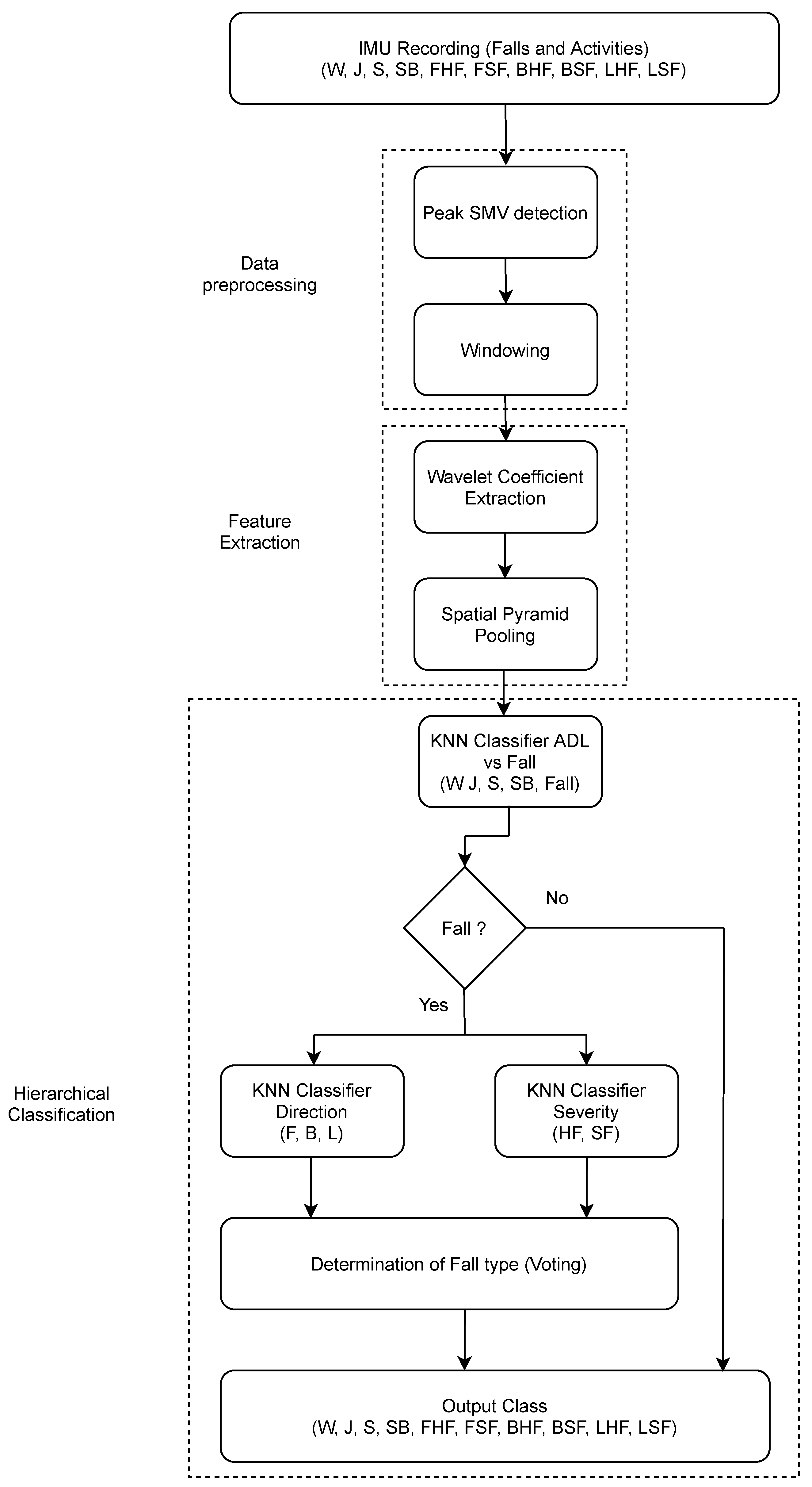
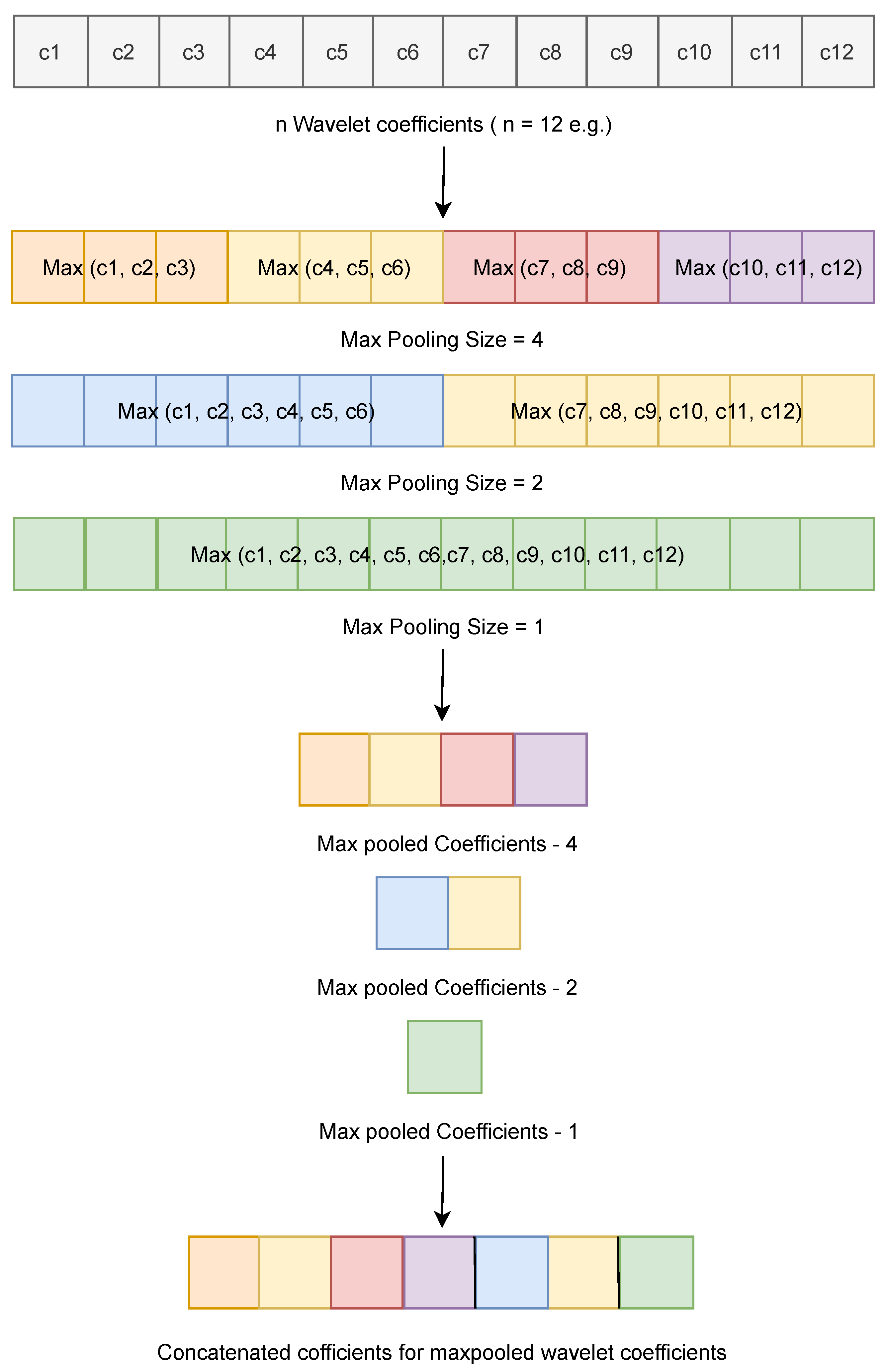
Human activity recognition has been a key study topic in the development of cyber physical systems and assisted living applications. In particular, inertial sensor based systems have become increasingly popular because they do not restrict users’ movement and are also relatively simple to implement compared to other approaches. In this paper, we present a hierarchical classification framework based on wavelets and adaptive pooling for activity recognition and fall detection predicting fall direction and severity. To accomplish this, windowed segments were extracted from each recording of inertial measurements from the SisFall dataset. A combination of wavelet based feature extraction and adaptive pooling was used before a classification framework was applied to determine the output class. Furthermore, tests were performed to determine the best observation window size and the sensor modality to use. Based on the experiments the best window size was found to be 3 s and the best sensor modality was found to be a combination of accelerometer and gyroscope measurements. These were used to perform activity recognition and fall detection with a resulting weighted F1 score of 94.67%. This framework is novel in terms of the approach to the human activity recognition and fall detection problem as it provides a scheme that is computationally less intensive while providing promising results and therefore can contribute to edge deployment of such systems.
Keywords: smart health; Internet of Things (IoT); artificial intelligence; activity recognition; cyber physical systems; fall detection; direction and severity smart health; Internet of Things (IoT); artificial intelligence; activity recognition; cyber physical systems; fall detection; direction and severity