Vibration Anatomy and Damage Detection in Power Transmission Towers with Limited Sensors



Abstract
1. Introduction
Objectives and Contributions
2. A State-of-the-Art Literature Review
2.1. Structural Damage Detection
2.2. Damage Detection of Power Transmission Equipment
3. Proposed Methodology and Underpinning Theories
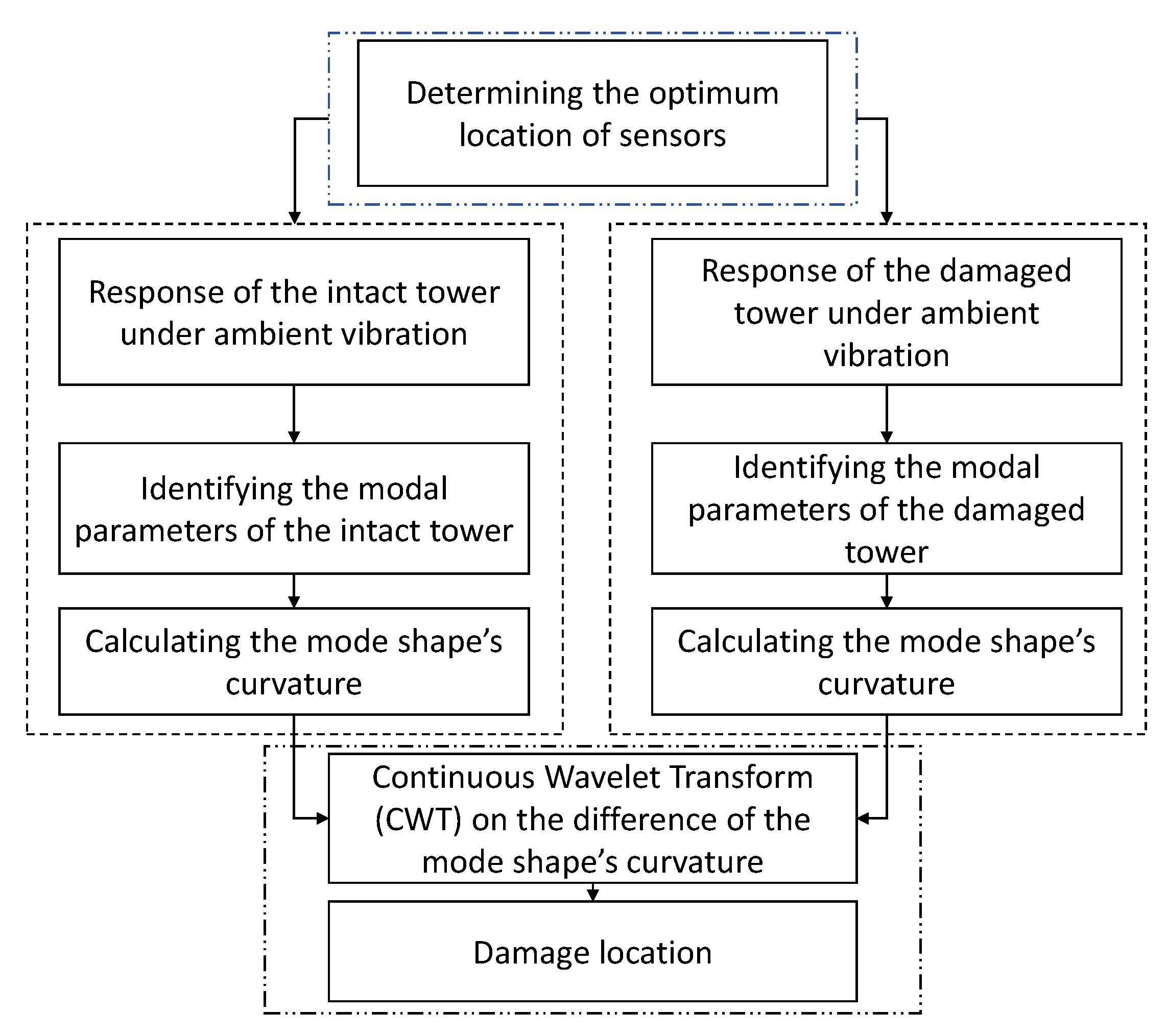
3.1. Summary of the Proposed Method
3.2. Theoretical Background of Continuous Wavelet Transform
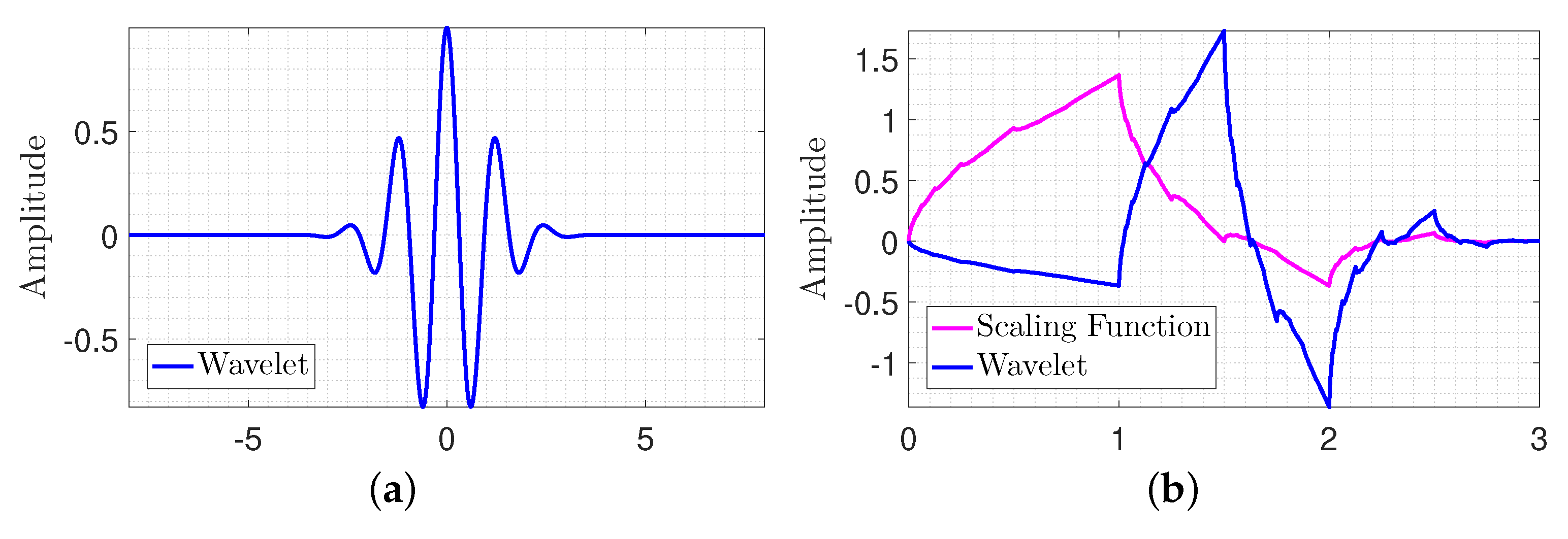
- Gaussian, Morlet, Mexican Hat, and Shannon wavelets are models in which the wavelet function, , has an explicit expression. The scaling function does not exist for these wavelets, and thus, DWT, fast wavelet transform (FWT), and discrete reconstruction are unavailable. Analysis with these wavelets is limited to CWT.
- Meyer wavelet is an infinity regular wavelet. It does not have an explicit expression form, but the scaling function does exist, and using DWT is possible (FWT is still unavailable).
- Daubechies wavelets of order N, Symlet wavelets of order N, Coiflet wavelet of order N, and Haar wavelet are examples of orthogonal wavelets. They do not have an explicit expression for the wavelet function (except for Daubechies wavelet of order one which is similar to Haar wavelet).
3.3. Theoretical Background of Cubic Spline
4. Case Study Tower
4.1. Tower Properties and Type of Conductors
4.2. Numerical Modeling
4.3. Verification
4.4. Parametric Study
5. Sensors Location Optimization
- First, all the possible locations at which the sensors could be placed were identified (i.e., 35 nodes along the tower).
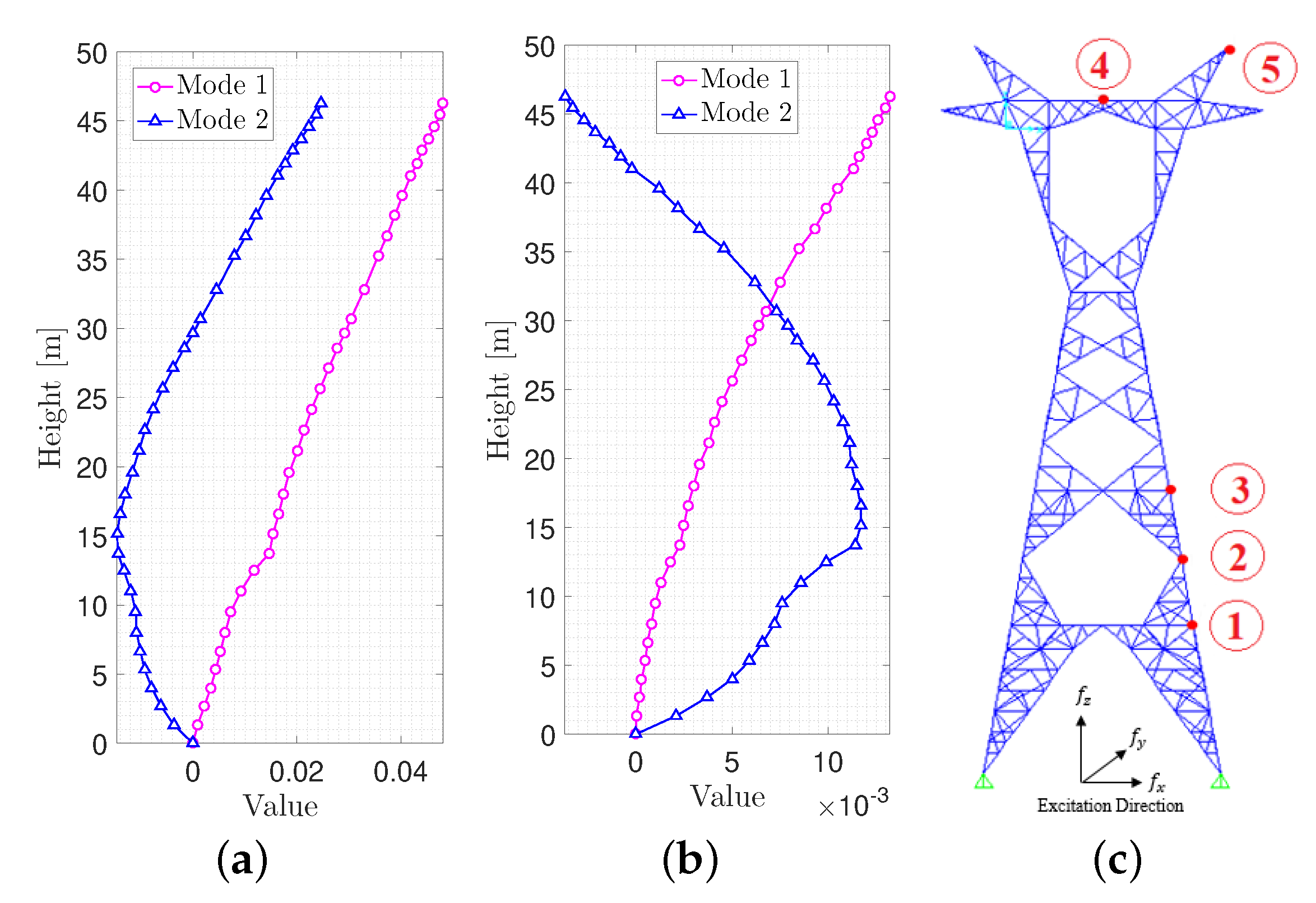
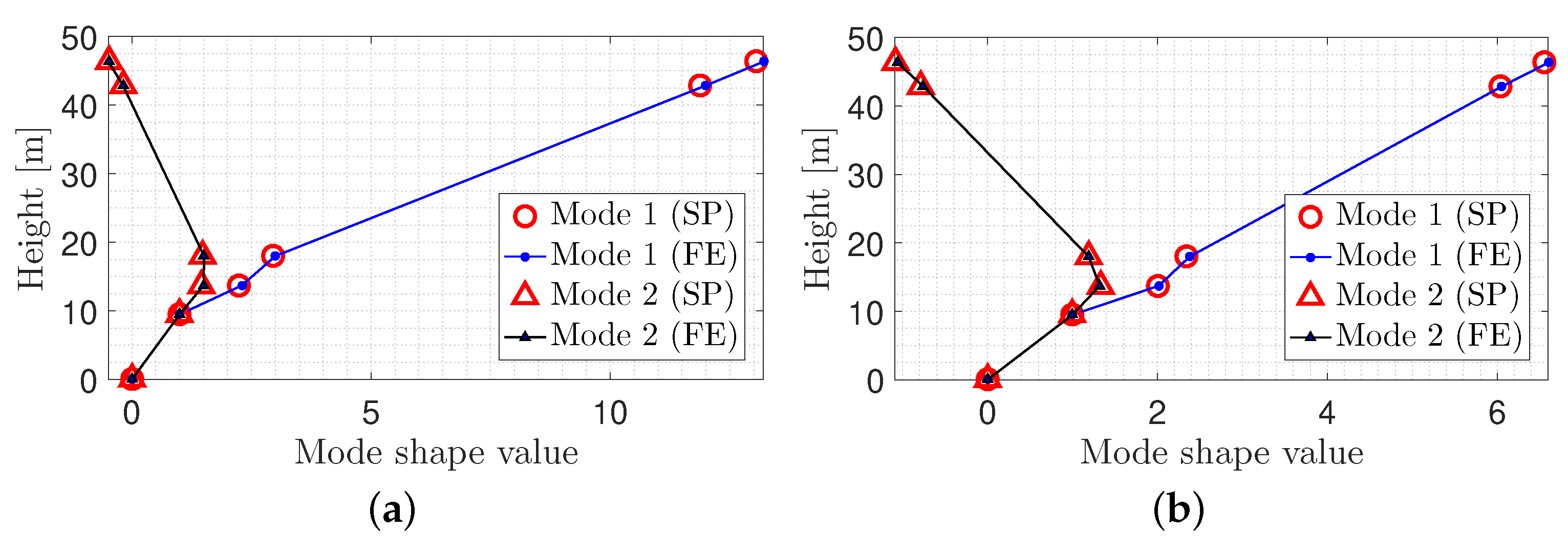
- Second, the modal analysis was conducted, and the mode shapes of the structure were obtained for the identified nodes. Figure 6a,b shows the mode shapes of the tower according to the 35 nodes for both in-plane directions.
- Next, five intended sensors were placed in locations where the mode shapes have maximum linear in-dependency. In other words, the sensors were placed in such a way that the non-diagonal entries of the MAC matrix approach a minimum value [37]. For this purpose, the first sensor was located at the apex of the tower. The next sensor was located at one of the 34 remaining locations to minimize the non-diagonal entries of MAC matrix.
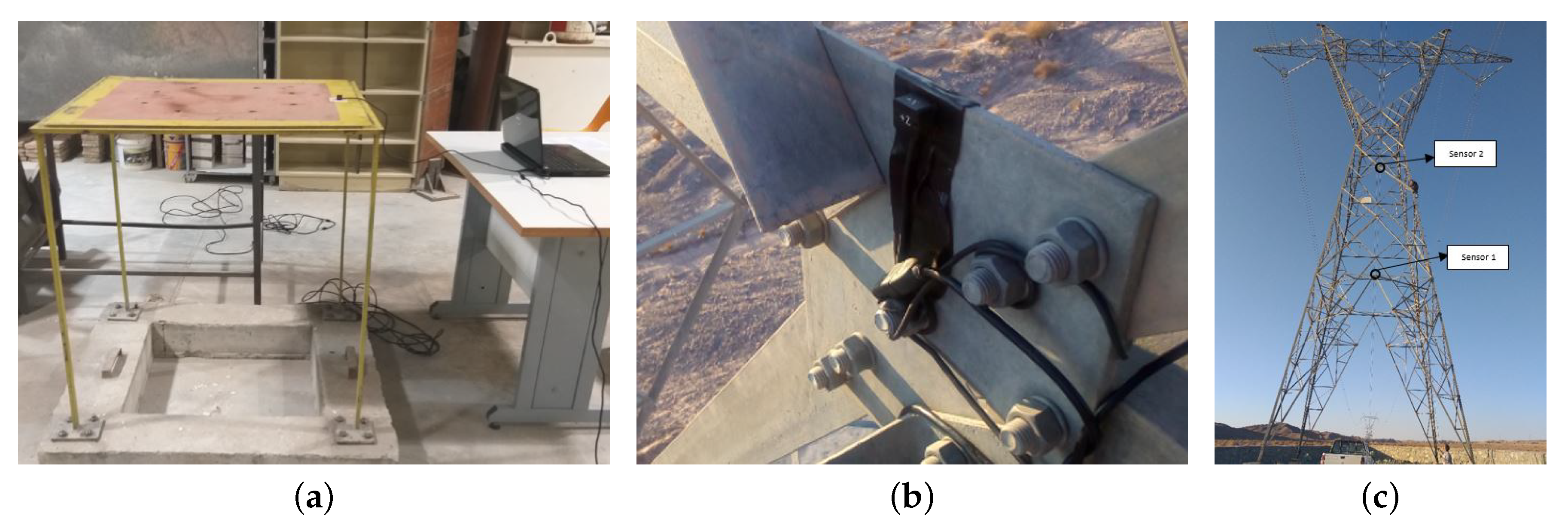
- This procedure was repeated iteratively for the remaining sensors until the best arrangement was found. Eventually, the optimal location for the sensors was obtained as shown in Figure 8c.
6. Dynamic Anatomy Identification
6.1. Input Excitation
6.2. Free Vibration
6.3. Mode Decomposition
6.4. Natural Frequency and Modal Damping
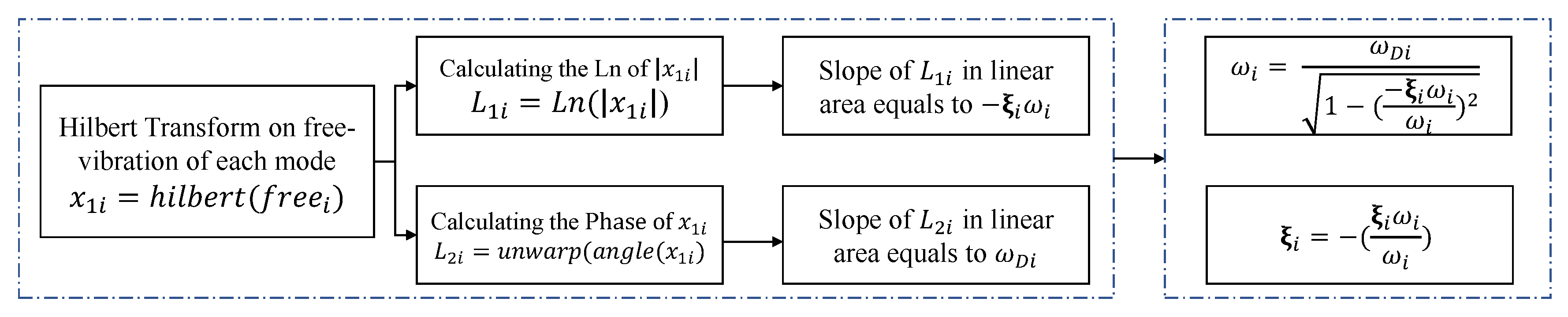
- First, the Hilbert transform of the free vibration corresponding to each mode was calculated.
- Second, the amplitude and phase of the envelope signal (from previous step) was obtained.
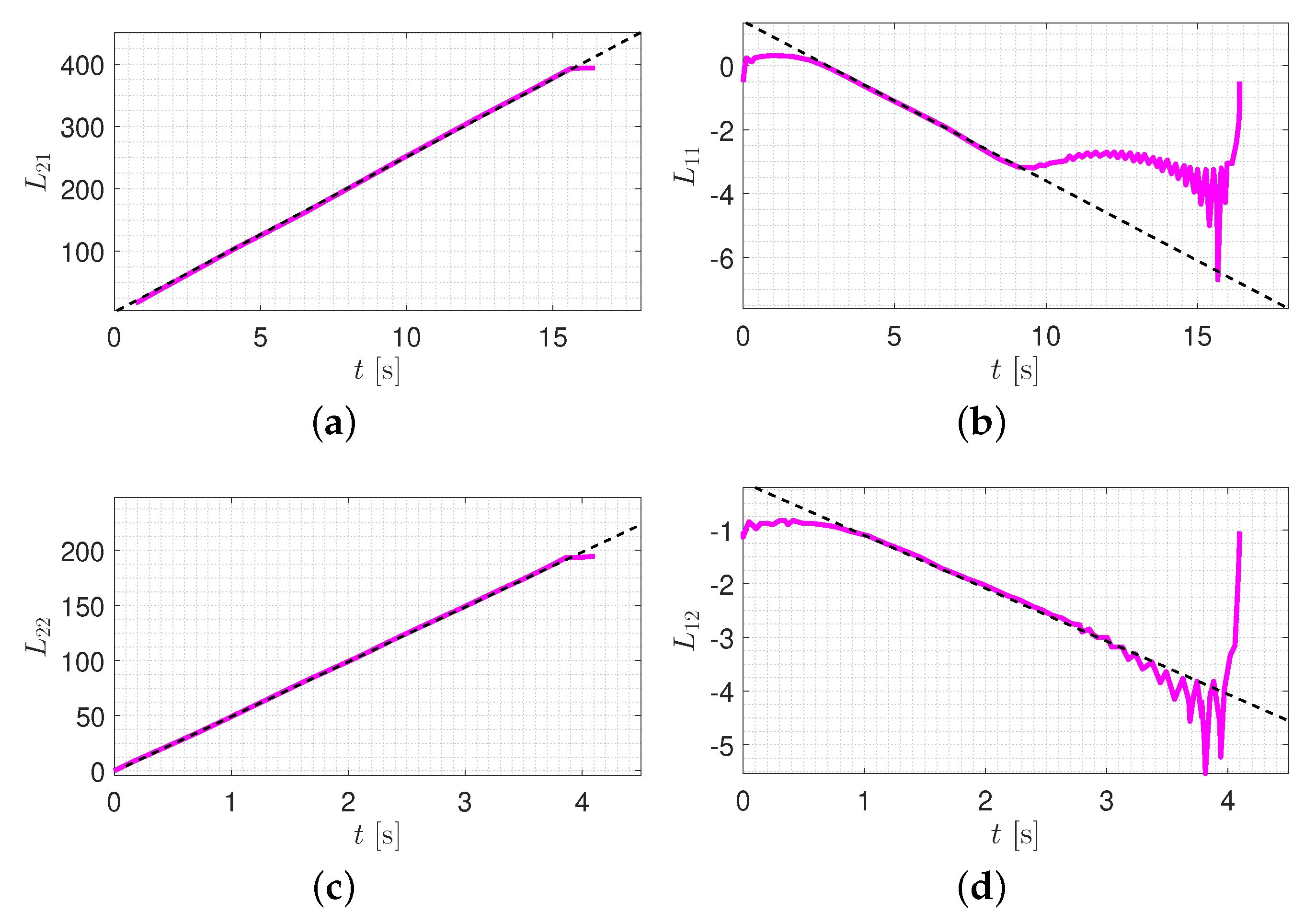
- Third, the slope of amplitude signal was calculated which leads to . Moreover, the slope of the phase signal was obtained which leads to .
- Finally, the fundamental of structural dynamics was applied to find and .
6.5. Noise Effect
6.6. Mode Shape Identification
7. Structural Damage Detection
7.1. Proposed Damage Detection Procedure
7.2. Damage Scenarios
- Scenario #1; Leg: Stiffness of 12 members of the leg is reduced (in X direction). In order to perception the severity of damage, one can compute the ratio of the damaged element to the total number of elements of the tower. For instance, in this scenario: 12/1978 = 0.61% of the tower’s elements have been damaged,
- Scenario #2; Trunk: Stiffness of the top members of the trunk is reduced (in X direction),
- Scenario #3; Body: Stiffness of the main elements of the body (at the lower 40% of total height) is reduced (in Y direction), and
- Scenario #4; Bridge: Stiffness of the diagonal members of the bridge is reduced (in X direction).
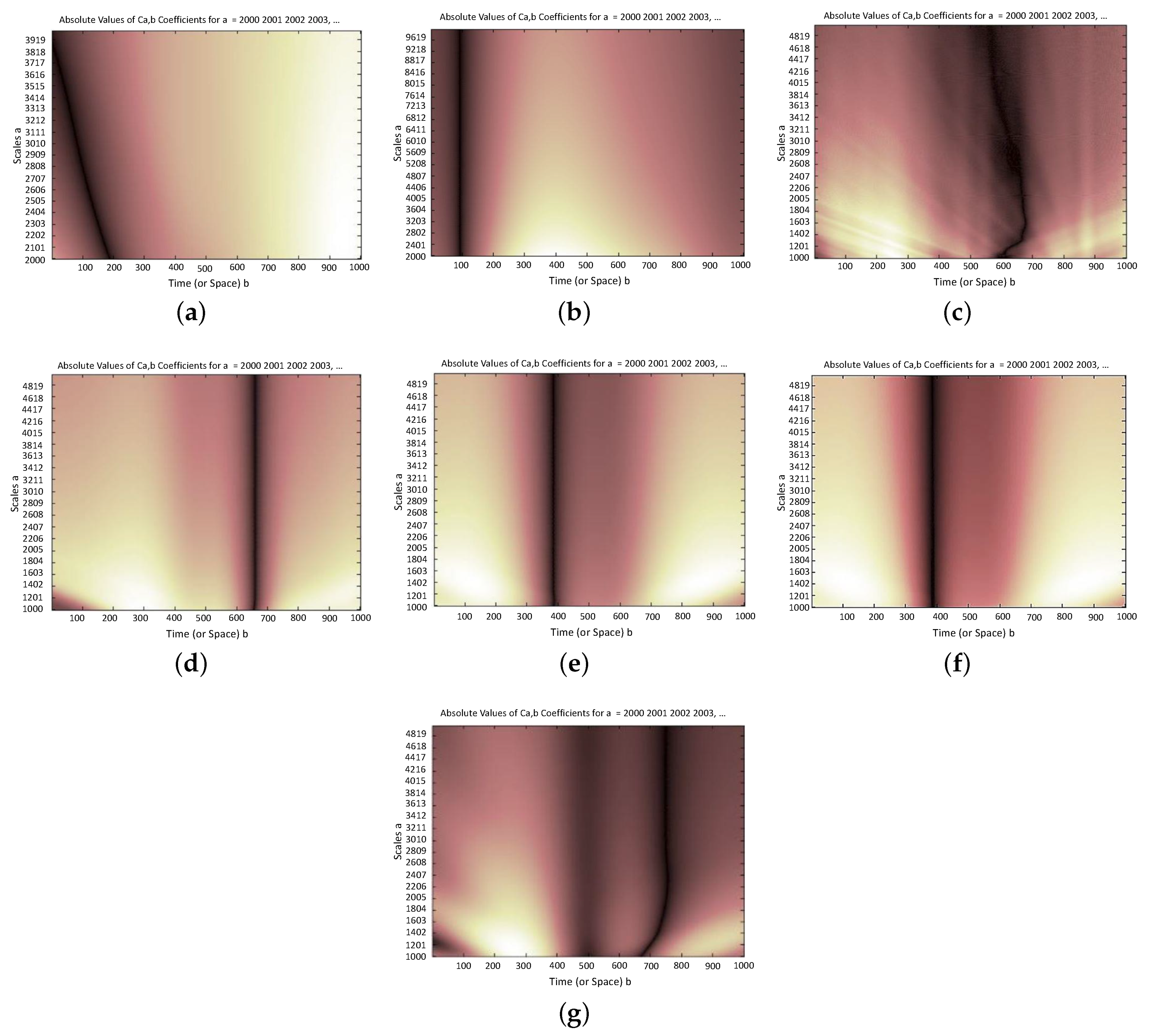
- Scenario #1: According to Figure 15a,b, at about 10% of tower’s total height, a jump in the summation of wavelet coefficients was observed. This indeed shows the presence of damage. It is notable that the dynamic properties of the upper modes are more sensitive to occurrence of damage. Therefore, as it can be seen in Figure 15a, a variation of the wavelet coefficients of the first mode is not purely vertical, and it is inclined along the height of the structure. Besides, as shown in Figure 15b, variation of the wavelet coefficients of the second mode shape is purely vertical.
- Scenario #2: According to Figure 15c,d, at about 60% of tower’s total height, a jump in the summation of wavelet coefficients was observed due to pre-defined damage. As for the previous scenario, unlike the first mode, a jump in the wavelet coefficients of the second mode is located exactly at the damage location.
- Scenario #3: According to Figure 15e,f, at about 40% of tower’s total height, a jump in the summation of wavelet coefficients was observed due to pre-defined damage.
- Scenario #4: According to Figure 15g, at about 75% of tower’s total height, a jump in the summation of wavelet coefficients was observed due to pre-defined damage. It should be noted that in this scenario, the first mode shape does not contribute to the damage detection process. It is evident that once the upper elements of the tower experience damage, they have a minimal effect on the mode shapes variations.
7.3. Comparison with Other Studies
8. Conclusions
Author Contributions
Funding
Conflicts of Interest
Abbreviations
| ABC | Artificial Bee Colony |
| ANN | Artificial Neural Network |
| CVT | Capacitive Voltage Transformer |
| CWT | Continuous Wavelet Transform |
| DOF | Degree Of Freedom |
| DOG | Difference of Gaussian |
| DWT | Discrete Wavelet Transform |
| FE | Finite Element |
| FWT | Fast Wavelet Transform |
| FRF | Frequency Response Function |
| GA | Genetic Algorithm |
| IGA | Immune Genetic Algorithm |
| LS-SVM | Least Square Support Vector Machine |
| MAC | Modal Assurance Criteria |
| MK-SVM | Multi-Kernel Support Vector Machine |
| MSE | Modal Strain Energy |
| NExT | Natural Excitation Technique |
| PCA | Principal Component Analysis |
| PSO | Particle Swarm Optimization |
| RDT | Random Decrement Technique |
| RMS | Root Mean Square |
| SHM | Structural Health Monitoring |
| SNR | Signal to Noise Ratio |
| SP | Signal Processing |
| SWT | Stationary Wavelet Transform |
| VMD | Variational Mode Decomposition |
References
- Albermani, F.; Kitipornchai, S.; Chan, R.W. Failure analysis of transmission towers. Eng. Fail. Anal. 2009, 16, 1922–1928. [Google Scholar] [CrossRef] [Scilit]
- Xu, Y.L.; Lin, J.F.; Zhan, S.; Wang, F.Y. Multistage damage detection of a transmission tower: Numerical investigation and experimental validation. Struct. Control Health Monit. 2019, 26, e2366. [Google Scholar] [CrossRef] [Scilit]
- Tian, L.; Yu, Q.; Ma, R. Study on seismic control of power transmission tower-line coupled system under multicomponent excitations. Math. Probl. Eng. 2013. [Google Scholar] [CrossRef] [Scilit]
- Zhang, P.; Song, G.; Li, H.N.; Lin, Y.X. Seismic control of power transmission tower using pounding TMD. J. Eng. Mech. 2012, 139, 1395–1406. [Google Scholar] [CrossRef] [Scilit]
- Gomes, G.F.; Mendez, Y.A.D.; Alexandrino, P.d.S.L.; da Cunha, S.S.; Ancelotti, A.C. A review of vibration based inverse methods for damage detection and identification in mechanical structures using optimization algorithms and ANN. Arch. Comput. Methods Eng. 2019, 26, 883–897. [Google Scholar] [CrossRef] [Scilit]
- Caicedo, J.M. Practical guidelines for the natural excitation technique (NExT) and the eigensystem realization algorithm (ERA) for modal identification using ambient vibration. Exp. Tech. 2011, 35, 52–58. [Google Scholar] [CrossRef] [Scilit]
- Montejo, L.A. Signal processing based damage detection in structures subjected to random excitations. Struct. Eng. Mech. 2011, 40, 745–762. [Google Scholar] [CrossRef] [Scilit]
- Liu, J.; Zhu, W.; Charalambides, P.; Shao, Y.; Xu, Y.; Fang, X. A dynamic model of a cantilever beam with a closed, embedded horizontal crack including local flexibilities at crack tips. J. Sound Vib. 2016, 382, 274–290. [Google Scholar] [CrossRef] [Scilit]
- Garcia-Palencia, A.; Santini-Bell, E.; Gul, M.; Catbas, N. A FRF-based algorithm for damage detection using experimentally collected data. Struct. Monit. Maint. 2015, 2, 399–418. [Google Scholar] [CrossRef] [Scilit]
- Ditommaso, R.; Ponzo, F.; Auletta, G. Damage detection on framed structures: Modal curvature evaluation using Stockwell Transform under seismic excitation. Earthq. Eng. Eng. Vib. 2015, 14, 265–274. [Google Scholar] [CrossRef] [Scilit]
- Zhang, J.; Guo, S.; Wu, Z.; Zhang, Q. Structural identification and damage detection through long-gauge strain measurements. Eng. Struct. 2015, 99, 173–183. [Google Scholar] [CrossRef] [Scilit]
- Yazdanpanah, O.; Seyedpoor, S. A new damage detection indicator for beams based on mode shape data. Struct. Eng. Mech. 2015, 53, 725–744. [Google Scholar] [CrossRef] [Scilit]
- Ghiasi, R.; Torkzadeh, P.; Noori, M. A machine-learning approach for structural damage detection using least square support vector machine based on a new combinational kernel function. Struct. Health Monit. 2016, 15, 302–316. [Google Scholar] [CrossRef] [Scilit]
- Lv, Z.; Tang, B.; Zhou, Y.; Zhou, C. A novel method for mechanical fault diagnosis based on variational mode decomposition and multikernel support vector machine. Shock Vib. 2016. [Google Scholar] [CrossRef] [Scilit]
- Cha, Y.J.; Choi, W.; Büyüköztürk, O. Deep learning-based crack damage detection using convolutional neural networks. Comput.-Aided Civ. Infrastruct. Eng. 2017, 32, 361–378. [Google Scholar] [CrossRef] [Scilit]
- Zhao, Y.; Noori, M.; Altabey, W.A. Damage detection for a beam under transient excitation via three different algorithms. Struct. Eng. Mech. 2017, 64, 803–817. [Google Scholar]
- Karami-Mohammadi, R.; Mirtaheri, M.; Salkhordeh, M.; Hariri-Ardebili, M.A. A cost-effective neural network–based damage detection procedure for cylindrical equipment. Adv. Mech. Eng. 2019, 11. [Google Scholar] [CrossRef] [Scilit]
- Vahidi, M.; Vahdani, S.; Rahimian, M.; Jamshidi, N.; Kanee, A.T. Evolutionary-base finite element model updating and damage detection using modal testing results. Struct. Eng. Mech. 2019, 70, 339–350. [Google Scholar]
- Chang, M.; Kim, J.K.; Lee, J. Hierarchical neural network for damage detection using modal parameters. Struct. Eng. Mech. 2019, 70, 457–466. [Google Scholar]
- Ghannadi, P.; Kourehli, S.S. Structural damage detection based on MAC flexibility and frequency using moth-flame algorithm. Struct. Eng. Mech. 2019, 70, 649–659. [Google Scholar]
- Nguyen, D.H.; Bui, T.T.; De Roeck, G.; Wahab, M.A. Damage detection in Ca-Non Bridge using transmissibility and artificial neural networks. Struct. Eng. Mech. 2019, 71, 175–183. [Google Scholar]
- Qu, W.; Song, W.; Xia, Y.; Xu, Y.; Qin, W.; Jiang, Z. Two-step method for instability damage detection in tower body of transmission structures. Adv. Struct. Eng. 2013, 16, 219–232. [Google Scholar] [CrossRef] [Scilit]
- Huang, X.; Zhao, Y.; Zhao, L. A Vibration-based Monitoring System for Transmission Tower Settlement. In Proceedings of the 2018 Condition Monitoring and Diagnosis (CMD), Perth, Australia, 23–26 September 2018; pp. 1–4. [Google Scholar]
- Lam, H.F.; Yang, J. Bayesian structural damage detection of steel towers using measured modal parameters. Earthq. Struct. 2015, 8, 935–956. [Google Scholar] [CrossRef] [Scilit]
- Yin, T.; Lam, H.F.; Chow, H.M.; Zhu, H. Dynamic reduction-based structural damage detection of transmission tower utilizing ambient vibration data. Eng. Struct. 2009, 31, 2009–2019. [Google Scholar] [CrossRef] [Scilit]
- Morlet, J.; Arens, G.; Fourgeau, E.; Glard, D. Wave propagation and sampling theory—Part I: Complex signal and scattering in multilayered media. Geophysics 1982, 47, 203–221. [Google Scholar] [CrossRef] [Scilit]
- Grossmann, A.; Morlet, J.; Paul, T. Transforms associated to square integrable group representations. I. General results. J. Math. Phys. 1985, 26, 2473–2479. [Google Scholar] [CrossRef] [Scilit]
- Young, R.K. Wavelet Theory and Its Applications; Springer Science & Business Media: New York, NY, USA, 2012; Volume 189. [Google Scholar]
- Antoniadis, A.; Oppenheim, G. Wavelets and Statistics; Springer Science & Business Media: New York, NY, USA, 2012; Volume 103. [Google Scholar]
- Ovanesova, A.; Suarez, L.E. Applications of wavelet transforms to damage detection in frame structures. Eng. Struct. 2004, 26, 39–49. [Google Scholar] [CrossRef] [Scilit]
- Lin, J.; Qu, L. Feature extraction based on Morlet wavelet and its application for mechanical fault diagnosis. J. Sound Vib. 2000, 234, 135–148. [Google Scholar] [CrossRef] [Scilit]
- Brito, N.; Souza, B.; Pires, F. Daubechies wavelets in quality of electrical power. In Proceedings of the 8th International Conference on Harmonics and Quality of Power, Proceedings (Cat. No. 98EX227), Athens, Greece, 14–16 October 1998; IEEE: New York, NY, USA, 1998; Volume 1, pp. 511–515. [Google Scholar]
- Popov, D.; Gapochkin, A.; Nekrasov, A. An Algorithm of Daubechies Wavelet Transform in the Final Field When Processing Speech Signals. Electronics 2018, 7, 120. [Google Scholar] [CrossRef] [Scilit]
- McKinley, S.; Levine, M. Cubic spline interpolation. Coll. Redwoods 1998, 45, 1049–1060. [Google Scholar]
- Mirtaheri, M.; Salehi, F. Ambient vibration testing of existing buildings: Experimental, numerical and code provisions. Adv. Mech. Eng. 2018, 10. [Google Scholar] [CrossRef] [Scilit]
- Liu, J. A dynamic modelling method of a rotor-roller bearing-housing system with a localized fault including the additional excitation zone. J. Sound Vib. 2020, 469, 115144. [Google Scholar] [CrossRef] [Scilit]
- Chang, M.; Pakzad, S.N. Optimal sensor placement for modal identification of bridge systems considering number of sensing nodes. J. Bridge Eng. 2014, 19, 04014019. [Google Scholar] [CrossRef] [Scilit]
- Murray-Smith, R.; Girard, A. Gaussian Process priors with ARMA noise models. In Proceedings of the Irish Signals and Systems Conference, Maynooth, Ireland, 25–27 June 2001; pp. 147–152. [Google Scholar]
- MATLAB. MATLAB Version 9.1 (R2016b); The MathWorks Inc.: Natick, MA, USA, 2016. [Google Scholar]
- Morsy, R.; Marzouk, H.; Gu, X.; Elshafey, A. Use of the random decrement technique for nondestructive detection of damage to beams. Mater. Struct. 2016, 49, 4719–4727. [Google Scholar] [CrossRef] [Scilit]
- Wijesundara, K.; Negulescu, C.; Monfort, D.; Foerster, E. Identification of Modal Parameters of Ambient Excitation Structures Using Continuous Wavelet Transform; CCSD: Villeurbanne, France, 2012. [Google Scholar]
- De Boer, J.F.; Cense, B.; Park, B.H.; Pierce, M.C.; Tearney, G.J.; Bouma, B.E. Improved signal-to-noise ratio in spectral-domain compared with time-domain optical coherence tomography. Opt. Lett. 2003, 28, 2067–2069. [Google Scholar] [CrossRef] [Scilit] [PubMed]
- Lin, Y.Z.; Nie, Z.H.; Ma, H.W. Structural damage detection with automatic feature-extraction through deep learning. Comput.-Aided Civ. Infrastruct. Eng. 2017, 32, 1025–1046. [Google Scholar] [CrossRef] [Scilit]
- Yang, J.N.; Lei, Y.; Pan, S.; Huang, N. System identification of linear structures based on Hilbert–Huang spectral analysis. Part 1: Normal modes. Earthq. Eng. Struct. Dyn. 2003, 32, 1443–1467. [Google Scholar] [CrossRef] [Scilit]
- Sazonov, E.; Klinkhachorn, P. Optimal spatial sampling interval for damage detection by curvature or strain energy mode shapes. J. Sound Vib. 2005, 285, 783–801. [Google Scholar] [CrossRef] [Scilit]
- Seyedpoor, S. A two stage method for structural damage detection using a modal strain energy based index and particle swarm optimization. Int. J. Non-Linear Mech. 2012, 47, 1–8. [Google Scholar] [CrossRef] [Scilit]






| Mode | Numerical Model | Experimental Test | Error [%] |
|---|---|---|---|
| First mode (longitudinal direction) | 1.04 Hz | 1.16 Hz | −10.3 |
| First mode (latitudinal direction) | 3.93 Hz | 4.08 Hz | −3.7 |
| First flexural mode | 5.9 Hz | - | - |
| Second mode (longitudinal direction) | 5.83 Hz | 6.01 Hz | −3.0 |
| Second mode (in latitudinal direction) | 7.81 Hz | 7.98 Hz | −2.1 |
| Mode | Finite Element Model (FEM) | Identified Value | ||
|---|---|---|---|---|
| Frequency [Hz] | Damping Ratio [%] | Frequency [Hz] | Damping Ratio [%] | |
| 1 | 1.04 | 2.0 | 1.07 | 2.02 |
| 2 | 3.93 | 2.0 | 3.97 | 2.04 |
| 3 | 5.83 | 2.0 | 5.91 | 1.93 |
| 5 | 7.81 | 2.0 | 7.92 | 1.96 |
| Mode | Without Noise | With Noise | ||
|---|---|---|---|---|
| Frequency [Hz] | Damping Ratio [%] | Frequency [Hz] | Damping Ratio [%] | |
| 1 | 3.97 | 2.04 | 4.02 | 2.02 |
| 2 | 7.92 | 1.96 | 7.98 | 1.95 |
© 2020 by the authors. Licensee MDPI, Basel, Switzerland. This article is an open access article distributed under the terms and conditions of the Creative Commons Attribution (CC BY) license (http://creativecommons.org/licenses/by/4.0/).
Share and Cite
Karami-Mohammadi, R.; Mirtaheri, M.; Salkhordeh, M.; Hariri-Ardebili, M.A. Vibration Anatomy and Damage Detection in Power Transmission Towers with Limited Sensors. Sensors 2020, 20, 1731. https://doi.org/10.3390/s20061731
Karami-Mohammadi R, Mirtaheri M, Salkhordeh M, Hariri-Ardebili MA. Vibration Anatomy and Damage Detection in Power Transmission Towers with Limited Sensors. Sensors. 2020; 20(6):1731. https://doi.org/10.3390/s20061731
Chicago/Turabian StyleKarami-Mohammadi, R., M. Mirtaheri, M. Salkhordeh, and M. A. Hariri-Ardebili. 2020. "Vibration Anatomy and Damage Detection in Power Transmission Towers with Limited Sensors" Sensors 20, no. 6: 1731. https://doi.org/10.3390/s20061731
APA StyleKarami-Mohammadi, R., Mirtaheri, M., Salkhordeh, M., & Hariri-Ardebili, M. A. (2020). Vibration Anatomy and Damage Detection in Power Transmission Towers with Limited Sensors. Sensors, 20(6), 1731. https://doi.org/10.3390/s20061731