A Survey of Smartphone-Based Indoor Positioning System Using RF-Based Wireless Technologies



Abstract
1. Introduction
2. Typical Survey Papers on RF-Based IPS
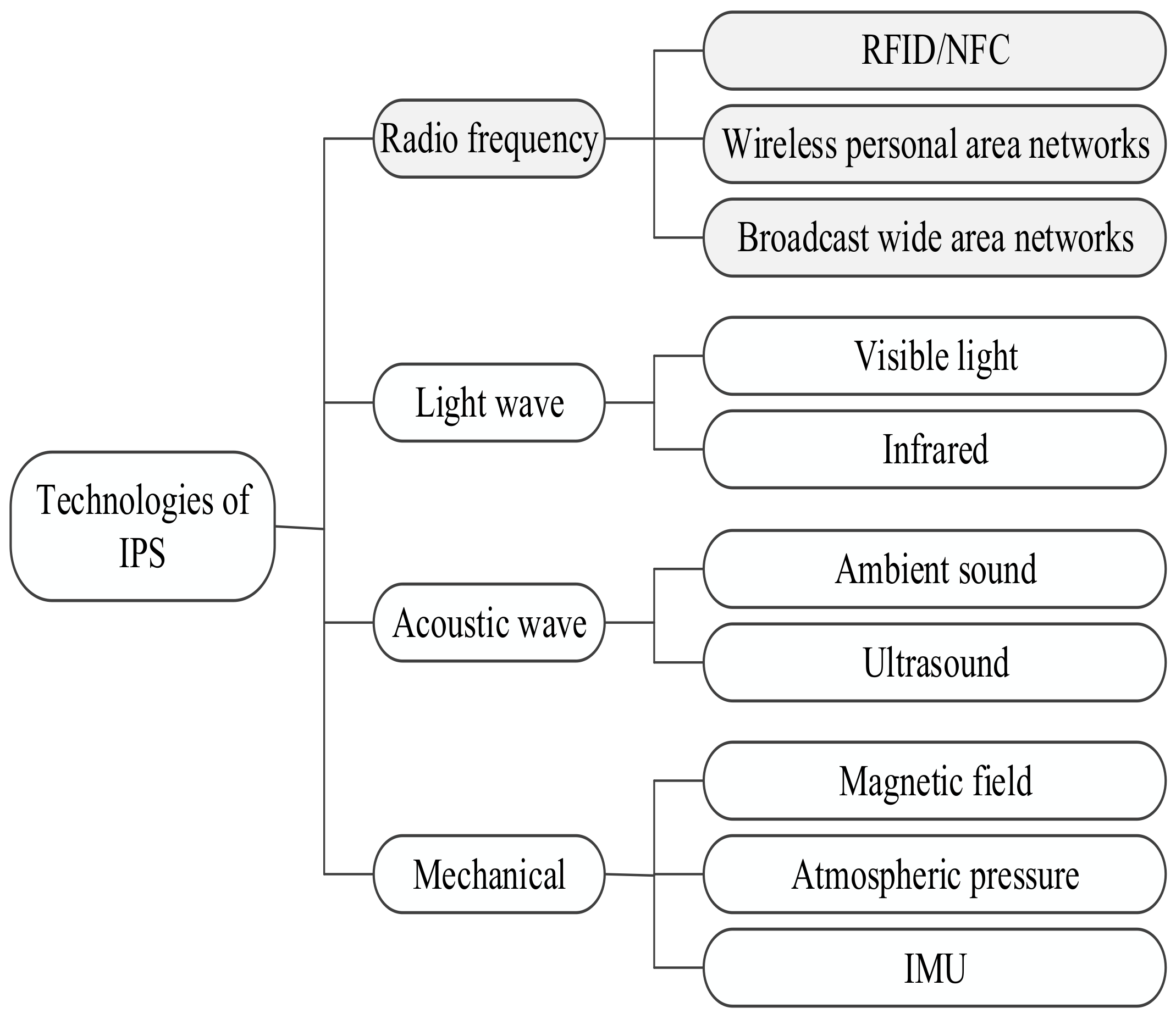
3. Wireless Technologies for IPS
3.1. RFID/NFC
3.2. UWB
3.3. Wireless Sensor Networks
3.4. Wi-Fi
3.5. BLE

| Parameters | Wi-Fi | BLE |
|---|---|---|
| Deployment cost | Low | High |
| AP reliability | Not-dedicated to IPS | Dedicated to IPS |
| Hardware efficiency | Requires ≥ 3 s to scan new RSS data [57] | RSS sample acquired every second |
| AP differentiating parameters | SSID, BSSID (MAC) | UUID, MAC [65] |
| Transmission range | High (∼50 m) | Low (∼30 m) |
| Power consumption [tag] | High [71] | Low [71] |
| Power source [AP] | Plugged into mains | Powered by coin shaped battery |
| Channel availability | Three independent channels at most (2.4 GHz band) [57] | Three advertisement channels [72] |
| Proximity detection | Normally final location estimation is available | Immediate, Near, and Far proximity available [73] |
| Implementation platform | Only on Android devices [54,55] | iOS and Android devices |
3.6. Cellular Networks
4. Signal Measurement Principles
4.1. RSS
4.2. TOA
4.3. TDOA
4.4. AOA
4.5. CSI and RTT
5. The Performance Metrics
5.1. Accuracy and Precision
5.2. Complexity
5.3. Scalability and Robustness
5.4. Cost
6. The Problems of Practical IPS
6.1. Complex Indoor Environment and Unstable RSS
6.2. Terminal Device Heterogeneity and Battery Efficiency
6.3. Learning Methodology of Radio Signals in Scene Analysis
6.4. Computational Time and System Cost
7. Positioning Algorithms and Survey of Available Solutions
7.1. Proximity-Based
7.2. Lateral/Angular
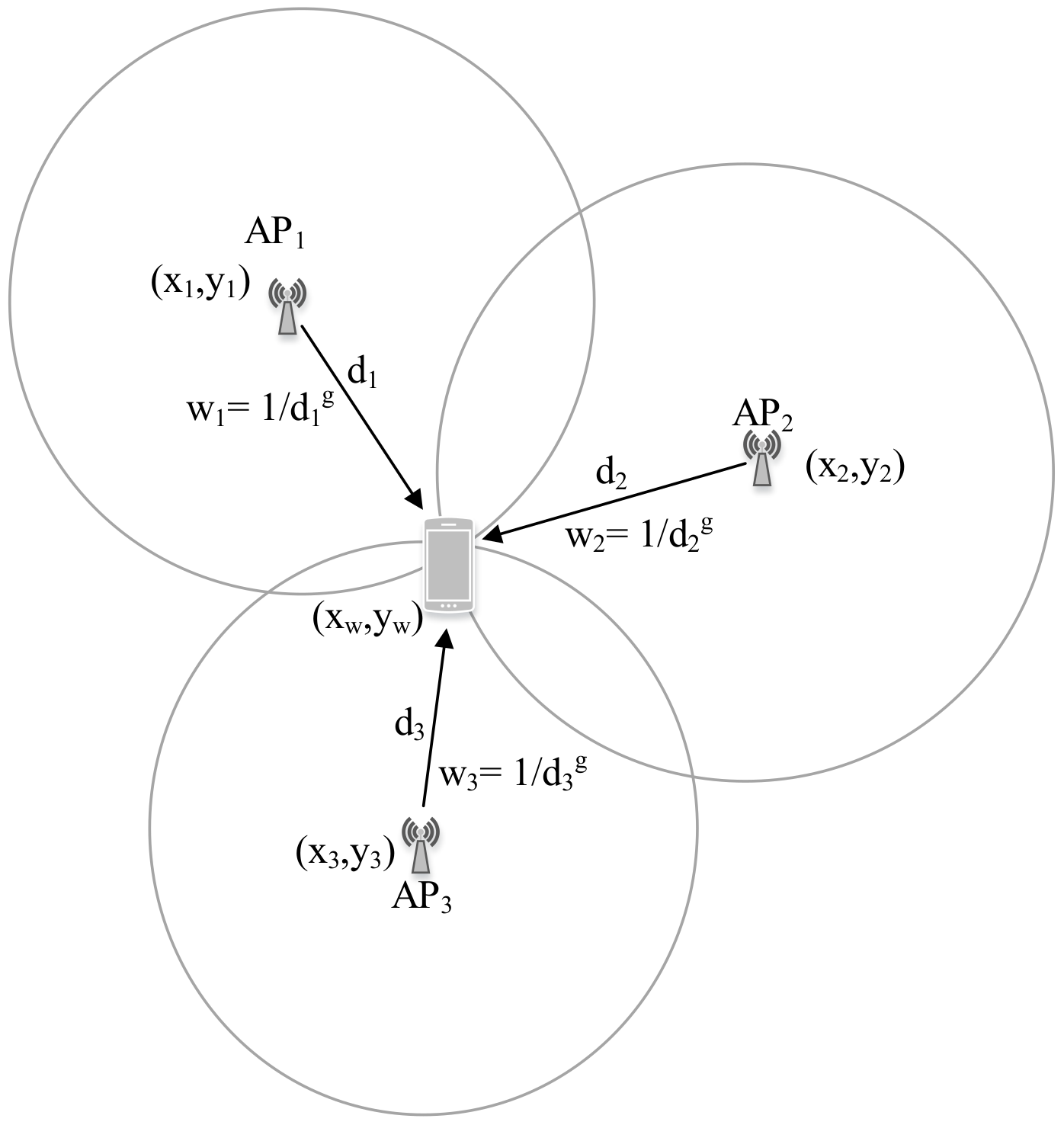
7.2.1. WC Localization
- The estimated location is confined inside the APs’ real location only.
- The estimated location is dragged towards the nearest AP owing to its largest weight.
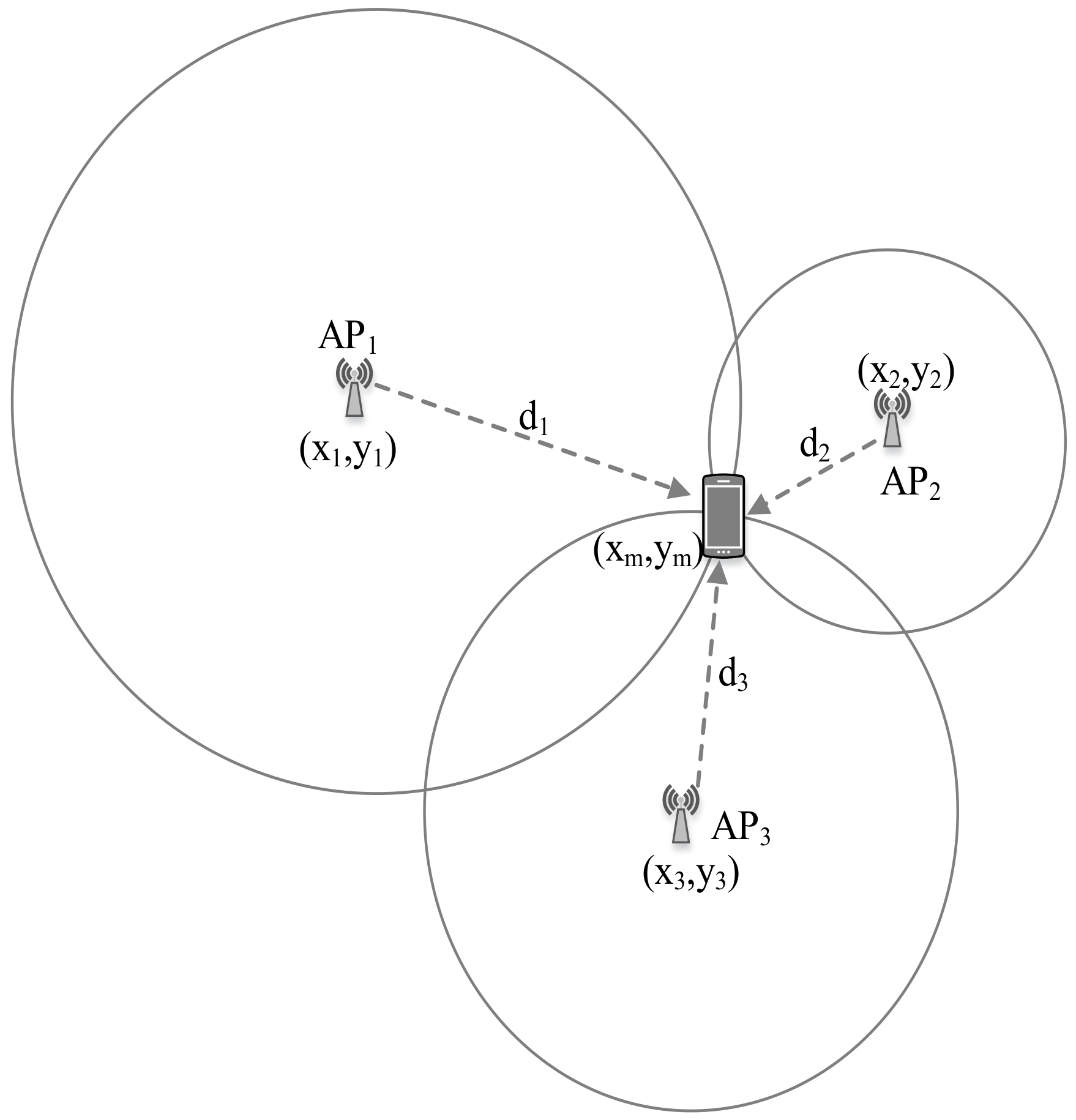
7.2.2. Trilateration
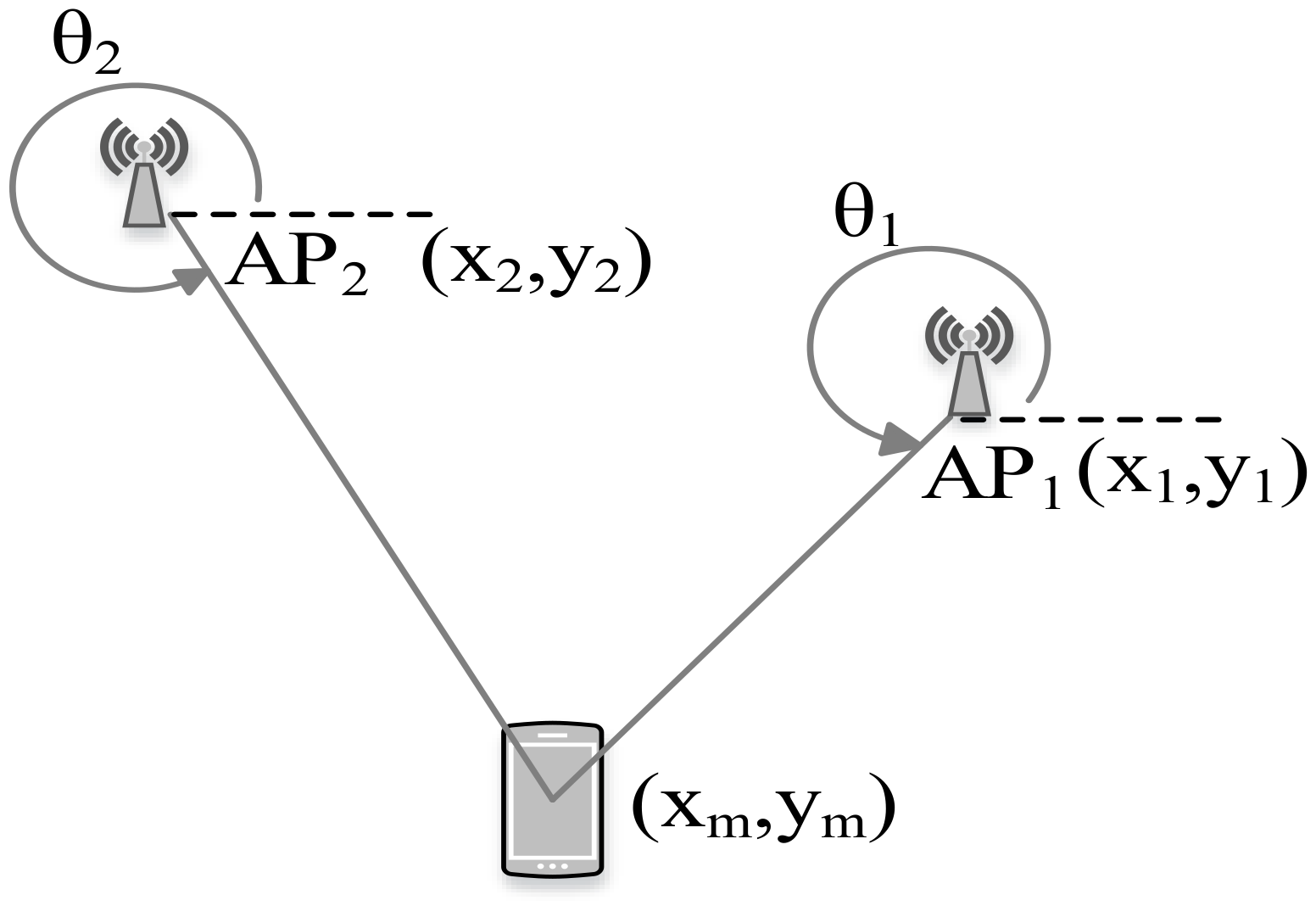
7.2.3. Triangulation
7.3. Fingerprinting
7.3.1. Deterministic Fingerprinting Localization
7.3.2. Probabilistic Fingerprinting Localization
7.3.3. Neural Networks-Based Fingerprinting Localization
7.3.4. Survey of Available Fingerprinting Localization Solutions
- Fingerprinting localization using Wi-Fi and BLE signals: Pavel et al. present an IPS research work based on Wk-NN positioning method using BLE beacons [146]. The k-nearest fingerprints are found in a radio map database by employing the Euclidean distance between the observed RSS and the database’s referred one. This work further compares the localization methods based on Wi-Fi and a combination of BLE and Wi-Fi. They recommend that the combination of wireless technologies help to increase the localization accuracy. Next work based on BLE beacons using fingerprinting technique is reported in [80] where a Gaussian filter is used to preprocess the received RSS. This work proposes a distance-weighted filter based on the triangle theorem of trilateral relations to filter out the wrong distance value caused by an abnormal RSS.The traditional Wk-NN fingerprinting has also been realized with Wi-Fi signals. Reference [29] elaborates recent advances on Wi-Fi fingerprinting localization. They overview advanced localization techniques and efficient system development utilizing Wi-Fi technology in their survey work. An improvisation over the conventional Wk-NN fingerprinting using Wi-Fi signals is put forward in [147,148]. The former approach uses average RSS and standard deviation of Wi-Fi signals at the RPs from the APs to construct a fingerprint radio map. Both the average RSS and the standard deviation are processed to estimate a Euclidean distance in the online phase. With the Euclidean distance, k RPs are selected to estimate a coarse location. Furthermore, a joint probability for each RP is calculated, based on which the k RPs are selected to estimate another coarse location. Later, both the coarse localization estimations are fused, employing the shortest Euclidean distance and the largest joint probability to yield a final localization estimation. Meanwhile, the later approach proposes to use Manhattan distance instead of Euclidean distance to compare the closeness of acquired Wi-Fi signal strength with the stored database.
- Machine learning-based methods: The machine learning algorithm extracts valuable information from the raw data and represents it as a model or hypothesis, which can be used for other unseen data to infer things. Although Gaussian process regression (GPR) is widely used in geostatistics as a Bayesian kringing, it has drawn a lot of attention in the machine learning community in recent decades. The GPR can be defined as a supervised learning task, which can predict the RSSs at arbitrary coordinates based on acquired training data. The prediction of RSS across the testbed with little training data helps to reduce the human workload significantly. Reference [123] presents a GPR-based fingerprinting IPS using indoor Wi-Fi APs. This work uses a few data points to train the Gaussian process (GP), where the firefly algorithm is used to estimate the GP’s hyperparameters. Moreover, it also shows that the probabilistic-based localization performs better than deterministic-based localization using the predicted radio map. Liu et al. proposed a GPR-plus method with Bluetooth transmitters using a naïve Bayes algorithm [152]. They compare their method with [123] and claim that their method is computationally cheaper. Another example of GPR-based fingerprinting is put forward in [149]. This work estimated the hyperparameters by using the subspace trust-region method and shows that location estimation with a radio map built using GPR is better than that of Horus fingerprinting method [153]. The GPR-based IPS in [151] utilizes BLE beacons for localization where the Hlhyperparameters are optimized employing limited memory BFGS-B [154]. Here, the predicted RSS data is further preprocessed for RSS clustering, where the final localization result is obtained with the minimized offline workload and reduced online computational complexity.In [155], the use of a support vector machine (SVM) is proposed to estimate the Wi-Fi signal strength at non-sight-surveyed locations on the testbed. This system creates an RSS reference surface for each AP using discrete train data with SVM. During the testing phase, the sampled online RSS from each AP is searched on the corresponding surfaces. Here, the coordinate that is found in the higher number of such surfaces is estimated as the tag device’s location.
- Crowdsourcing techniques: Although machine learning approaches like GPR are intended to solve the offline workload problem, they still require a little training data that are manually acquired from the localization area. Hence, recent literature on solving the offline workload problem of fingerprinting localization is more focused on the crowdsourcing [156,157]. Here, the main concept is to crowdsource the RSS data from freely moving users across the testbed. It is straightforward to understand that unlabeled RSS data are easy to acquire from various users. However, the main concern is to find a plausible way to label the crowdsourced RSS data with the ground-truth location.In [158], a smartphone-based crowdsourcing approach is proposed that employs an accelerometer as a pedometer. Here, multidimensional scaling (MDS) is used to create a map that displays the relative positions of several objects employing only a table of distance values among them. The walking distance between two RPs is estimated using the accelerometer to form a distance matrix. The MDS utilizes the distance matrix as its input to map all the RPs into a d-dimensional Euclidean space forming a "stress-free" floor plan. Meanwhile, a next distance matrix is also formed utilizing the walking distance between two fingerprint positions, where again the MDS maps all fingerprints to a d-dimensional Euclidean space to form a fingerprint space. Finally, the stress-free floor plan and the fingerprint space are mapped to form a radio map database. X. Tong et al. suggested a system for indoor radio map construction employing BLE beacons and PDR as the source of reference information [159]. The system generated the tag’s trace and then determines the map for the trace. For online positioning, this system merges the tag’s trace into the existing floorplan.Similarly, [160] has put forward a trajectory learning method utilizing crowdsourcing measurements to support the absence of a map. Here, the k-nearest neighbor is used to perform a classification model with linear discriminant analysis (LDA) and principal component analysis (PCA) for floor detection. The combination of LDA and PCA employs the acquired training data to make a classification model. Moreover, [161] uses a commercial software called Trusted Positioning Navigator (T-PN) for crowdsourcing based IPS. This method forms a crowdsourced fingerprinting database employing the RSS values and position information from the T-PN software.
- Clustering-based approaches: The conventional fingerprinting is also termed as flat fingerprinting and can be converted to two-step fingerprinting using clustering or segmentation.The two-step fingerprinting is realized with a coarse localization step and fine localization step, as the name suggests. Clustering reduces the searching space of RPs in the online phase of fingerprinting, which eventually reduces the system’s computational cost. Moreover, it also helps to reduce the localization estimation error by removing the outliers.Clustering on IPS can be realized using either hardware (Wi-Fi or BLE) or the RSS clustering. An example of a clustering module using hardware is Horus [153]. Here, the clustering module is employed where any cluster is a set of RPs sharing a common set of Wi-Fi APs. This approach estimates the tag’s position based on the largest posterior probability by Bayesian interference [162]. Similarly, [163] uses BLE beacon proximity to reduce the searching space in the online phase. Here, BLE’s proximity provides coarse localization, and for fine localization, a selected set of RPs is used with Wi-Fi fingerprint datasets.The performance of indoor fingerprinting positioning can be improved with RSS clustering [30]. An RSS clustering method chooses a set of cluster centers to reduce the sum of squared distances between the RSS value and their corresponding centers. For example, a K-means clustering [164] begins by choosing both the number of output clusters and the corresponding set of initial cluster heads, where the clustering algorithm iteratively refines the output clusters to decrease the sum of squared distances [165]. Hence, K-means clustering has a requirement of an arbitrary selection of initial cluster centers. On the other hand, affinity propagation clustering (APC) starts by assigning each point (RP in this study) the same chance to become a cluster center where all the points are joined in the large space [166]. Reference [167] uses APC for clustering the testbed using Wi-Fi RSS data. Here, the cluster-head is determined on the coarse localization, and Wk-NN is used for fine localization. In addition to APC and K-means, other clustering methods in IPS include fuzzy c-means and hierarchical clustering strategy (HCS) [168,169,170,171]. APC has been a widely used clustering technique in IPS owing to its initialization-independent and better cluster head selection characteristics. Many kinds of literature on IPS have employed APC for RSS clustering where their fine localization is either probabilistic-based or deterministic-based [150,167,172,173].
| [-0.5+]System | [-0.5+]Tech. | [-0.5+]Signal | [-0.5+]Positioning Algorithm | Performance Metrics | |||||
|---|---|---|---|---|---|---|---|---|---|
| Accuracy | Precision | Complexity | Scalability/ Space Dimension | Robustness | Cost | ||||
| Horus [174] | Wi-Fi | RSS | Probabilistic method | 2 m | 90% (2.1 m) | Moderate | Good/2D | Good | Low |
| RADAR [175] | Wi-Fi | RSS | deterministic method | 3–5 m | 50% (2.5 m), 90% (5.9 m) | Moderate | Good/2D,3D | Good | Low |
| Robot assistive [176] | Wi-Fi | RSS | Bayesian approach | 1.5 m | Over 50% (1.5 m) | Medium | Good/2D | Good | Medium |
| Ekahau [177] | Wi-Fi | RSS | Probabilistic method | 1 m | 50% (2 m) | Moderate | Good/2D | Good | Low |
| IPS in [178] | Wi-Fi, IMU | RSS | Fingerprinting+PDR | 2.4 m | 88% (3 m) | High | Good/2D | Weak | Low |
| IPS in [123] | Wi-Fi | RSS | Probabilistic method | 3 m | 90% (9 m) | Moderate | Excellent/2D | Good | Low |
| IPS in [149] | Wi-Fi | RSS | Probabilistic method | 2.3 m | N/A | Moderate | Excellent/2D | Good | Low |
| IPS in [179] | Wi-Fi, IMU | RSS | Fingerprinting+PDR | 2.2 m | 90% (1 m) | High | Good/2D | Weak | Low |
| IPS in [124] | Wi-Fi | RSS | Support vector regression | 0.68 m | 90% (1.4 m) | Moderate | Excellent/2D | Good | Low |
| IPS in [150] | Wi-Fi | RSS | Probabilistic method | 2.23 m | 80% (3 m) | Moderate | Good/2D | Weak | Low |
| IPS in [172] | Wi-Fi | RSS | Probabilistic method | 1.94 m | 94% (3 m) | Moderate | Good/2D | Weak | Low |
| IPS in [180] | BLE, IMU | RSS | Proximity+PDR | 0.28 m | N/A | High | Excellent/2D | Weak | Medium |
| IPS in [72] | BLE | RSS | WCL+Fingerprinting | 1.6 m | 90% (2 m) | Moderate | Good/2D | Good | Medium |
| IPS in [134] | BLE, IMU | RSS | Proximity+PDR | 2.26 m | N/A | High | Good/2D | Weak | Medium |
| IPS in [59] | BLE | RSS | Probabilistic method | N/A | 95% (2.6 m) | Moderate | Good/2D | Good | Medium |
| IPS in [151] | BLE | RSS | Probabilistic method | 2.25 m | 76% (3 m) | Moderate | Excellent/2D | Good | Medium |
| IPS in [181] | BLE, IMU | RSS | Fingerprinting+PDR | 0.65 m | 95% (1.5 m) | High | Good/2D | Weak | Medium |
| IPS in [114] | BLE | RSS | WCL+Fingerprinting | 1.06 m | 95% (1.5 m) | Moderate | Good/2D | Good | Medium |
| IPS in [182] | BLE | RSS | Rank-based fingerprinting | 0.78 m | 70% (1 m) | Moderate | Good/2D | Good | Medium |
| IPS in [118] | BLE, Magnetic field, IMU | RSS, Magnetic Flux | Wk-NN+PDR | 1.31 m | 85% (2 m) | Very High | Good/2D | Weak | Low |
| FineLoc [159] | BLE IMU | RSS | Crowdsourcing, trace merge, PDR | 1.21 m | 80% (1.57 m) | High | Excellent/2D | Good | Medium |
| LiFS [158] | Wi-Fi, IMU | RSS | Crowdsourcing, deterministic method | 2 m | 90% (4 m) | High | Excellent/2D | Good | Low |
| IPS in [125] | BLE | RSS | Crowdsourcing, probabilistic method | 2.34 m | 76% (4 m) | Moderate | Excellent/2D | Good | Medium |
8. Conclusions and Future Research Trends
Author Contributions
Funding
Acknowledgments
Conflicts of Interest
References
- GPS. GPS: The Global Positioning System. 2020. Available online: https://www.gps.gov/ (accessed on 28 August 2020).
- Information Analytical Centre of GLONASS and GPS Controlling. 2020. Available online: https://www.glonass-iac.ru/en/ (accessed on 28 August 2020).
- European GNSS Service Centre|European GNSS Service Centre. 2020. Available online: https://www.gsc-europa.eu/ (accessed on 28 August 2020).
- BeiDou Navigation Satellite System. 2020. Available online: http://en.beidou.gov.cn/ (accessed on 28 August 2020).
- Vasisht, D.; Kumar, S.; Katabi, D. Decimeter-level localization with a single WiFi access point. In Proceedings of the 13th USENIX Symposium on Networked Systems Design and Implementation (NSDI ’16), Santa Clara, CA, USA, 17–18 March 2016; pp. 165–178. [Google Scholar]
- Liu, H.H.; Yang, Y.N. WiFi-based indoor positioning for multi-floor environment. In Proceedings of the TENCON 2011—2011 IEEE Region 10 Conference, Bali, Indonesia, 21–24 November 2011; pp. 597–601. [Google Scholar]
- Bhattarai, B.; Yadav, R.K.; Gang, H.S.; Pyun, J.Y. Geomagnetic Field Based Indoor Landmark Classification Using Deep Learning. IEEE Access 2019, 7, 33943–33956. [Google Scholar] [CrossRef]
- Xiong, J.; Jamieson, K. Arraytrack: A fine-grained indoor location system. Presented at the 10th USENIX Symposium on Networked Systems Design and Implementation (NSDI ’13), Lombard, IL, USA, 2–5 April 2013; pp. 71–84. [Google Scholar]
- Xiong, J.; Sundaresan, K.; Jamieson, K. Tonetrack: Leveraging frequency-agile radios for time-based indoor wireless localization. In Proceedings of the 21st Annual International Conference on Mobile Computing and Networking, Paris, France, 7–11 September 2015; pp. 537–549. [Google Scholar]
- Xiong, J. Pushing the Limits of Indoor Localization in Today’s Wi-Fi Networks. Ph.D. Thesis, UCL (University College London), London, UK, 2015. [Google Scholar]
- Rusli, M.E.; Ali, M.; Jamil, N.; Din, M.M. An improved indoor positioning algorithm based on rssi-trilateration technique for internet of things (IoT). In Proceedings of the 2016 International Conference on Computer and Communication Engineering (ICCCE), Kuala Lumpur, Malaysia, 25–27 July 2016; pp. 72–77. [Google Scholar]
- Subedi, S.; Kwon, G.R.; Shin, S.; Hwang, S.s.; Pyun, J.Y. Beacon based indoor positioning system using weighted centroid localization approach. In Proceedings of the 2016 Eighth International Conference on Ubiquitous and Future Networks (ICUFN), Vienna, Austria, 5–8 July 2016; pp. 1016–1019. [Google Scholar]
- Potortì, F.; Barsocchi, P.; Girolami, M.; Torres-Sospedra, J.; Montoliu, R. Evaluating indoor localization solutions in large environments through competitive benchmarking: The EvAAL-ETRI competition. In Proceedings of the 2015 International Conference on Indoor Positioning and Indoor Navigation (IPIN), Banff, AB, Canada, 13–16 October 2015; pp. 1–10. [Google Scholar]
- Potortì, F.; Park, S.; Jiménez Ruiz, A.; Barsocchi, P.; Girolami, M.; Crivello, A.; Lee, S.; Lim, J.; Torres-Sospedra, J.; Seco, F.; et al. Comparing the performance of indoor localization systems through the EvAAL framework. Sensors 2017, 17, 2327. [Google Scholar] [CrossRef] [PubMed]
- Lymberopoulos, D.; Liu, J.; Yang, X.; Choudhury, R.R.; Sen, S.; Handziski, V. Microsoft indoor localization competition: Experiences and lessons learned. GetMob. Mob. Comput. Commun. 2015, 18, 24–31. [Google Scholar] [CrossRef]
- Potortì, F.; Crivello, A.; Barsocchi, P.; Palumbo, F. Evaluation of indoor localisation systems: Comments on the ISO/IEC 18305 standard. In Proceedings of the 2018 International Conference on Indoor Positioning and Indoor Navigation (IPIN), Nantes, France, 24–27 September 2018; pp. 1–7. [Google Scholar]
- Kotaru, M.; Joshi, K.; Bharadia, D.; Katti, S. Spotfi: Decimeter level localization using wifi. In Proceedings of the 2015 ACM Conference on Special Interest Group on Data Communication, London, UK, 17–21 August 2015; pp. 269–282. [Google Scholar]
- Wang, J.; Liang, X.; Shi, W.; Niu, Q.; Gulliver, T.A.; Liu, X. Fingerprinting localization based on 60 GHz impulse radio. In Proceedings of the 2015 IEEE Pacific Rim Conference on Communications, Computers and Signal Processing (PACRIM), Victoria, BC, Canada, 24–26 August 2015; pp. 491–495. [Google Scholar] [CrossRef]
- Davidson, P.; Piché, R. A survey of selected indoor positioning methods for smartphones. IEEE Commun. Surv. Tutor. 2016, 19, 1347–1370. [Google Scholar] [CrossRef]
- Harle, R. A survey of indoor inertial positioning systems for pedestrians. IEEE Commun. Surv. Tutor. 2013, 15, 1281–1293. [Google Scholar] [CrossRef]
- Al Nuaimi, K.; Kamel, H. A survey of indoor positioning systems and algorithms. In Proceedings of the 2011 International Conference on Innovations in Information Technology, Abu Dhabi, UAE, 25–27 April 2011; pp. 185–190. [Google Scholar]
- Xiao, J.; Zhou, Z.; Yi, Y.; Ni, L.M. A survey on wireless indoor localization from the device perspective. ACM Comput. Surv. CSUR 2016, 49, 1–31. [Google Scholar] [CrossRef]
- Yang, Z.; Zhou, Z.; Liu, Y. From RSSI to CSI: Indoor localization via channel response. ACM Comput. Surv. CSUR 2013, 46, 1–32. [Google Scholar] [CrossRef]
- Ferreira, A.F.G.; Fernandes, D.M.A.; Catarino, A.P.; Monteiro, J.L. Localization and positioning systems for emergency responders: A survey. IEEE Commun. Surv. Tutor. 2017, 19, 2836–2870. [Google Scholar] [CrossRef]
- Maghdid, H.S.; Lami, I.A.; Ghafoor, K.Z.; Lloret, J. Seamless outdoors-indoors localization solutions on smartphones: Implementation and challenges. ACM Comput. Surv. CSUR 2016, 48, 1–34. [Google Scholar] [CrossRef]
- Zafari, F.; Gkelias, A.; Leung, K.K. A survey of indoor localization systems and technologies. IEEE Commun. Surv. Tutor. 2019, 21, 2568–2599. [Google Scholar] [CrossRef]
- Koyuncu, H.; Yang, S.H. A survey of indoor positioning and object locating systems. IJCSNS Int. J. Comput. Sci. Netw. Secur. 2010, 10, 121–128. [Google Scholar]
- Liu, H.; Darabi, H.; Banerjee, P.; Liu, J. Survey of wireless indoor positioning techniques and systems. IEEE Trans. Syst. Man Cybern. Part Appl. Rev. 2007, 37, 1067–1080. [Google Scholar] [CrossRef]
- He, S.; Chan, S.H.G. Wi-Fi fingerprint-based indoor positioning: Recent advances and comparisons. IEEE Commun. Surv. Tutor. 2016, 18, 466–490. [Google Scholar] [CrossRef]
- Khalajmehrabadi, A.; Gatsis, N.; Akopian, D. Modern WLAN fingerprinting indoor positioning methods and deployment challenges. IEEE Commun. Surv. Tutor. 2017, 19, 1974–2002. [Google Scholar] [CrossRef]
- Subramanian, S.P.; Sommer, J.; Schmitt, S.; Rosenstiel, W. RIL—Reliable RFID based indoor localization for pedestrians. In Proceedings of the 2008 16th International Conference on Software, Telecommunications and Computer Networks, Milan, Italy, 14–16 November 2008; pp. 218–222. [Google Scholar]
- Choi, B.S.; Lee, J.W.; Lee, J.J. Localization and map-building of mobile robot based on RFID sensor fusion system. In Proceedings of the 2008 6th IEEE International Conference on Industrial Informatics, Daejeon, Korea, 13–16 July 2008; pp. 412–417. [Google Scholar]
- Choi, B.S.; Lee, J.W.; Lee, J.J. An improved localization system with RFID technology for a mobile robot. In Proceedings of the 2008 34th Annual Conference of IEEE Industrial Electronics, Orlando, FL, USA, 10–13 November 2008; pp. 3409–3413. [Google Scholar]
- Tesoriero, R.; Gallud, J.A.; Lozano, M.D.; Penichet, V.M. Tracking autonomous entities using RFID technology. IEEE Trans. Consum. Electron. 2009, 55, 650–655. [Google Scholar] [CrossRef]
- Koutsou, A.D.; Seco, F.; Jiménez, A.R.; Roa, J.O.; Ealo, J.L.; Prieto, C.; Guevara, J. Preliminary localization results with an RFID based indoor guiding system. In Proceedings of the 2007 IEEE International Symposium on Intelligent Signal Processing, Alcala De Henares, Spain, 3–5 October 2007; pp. 1–6. [Google Scholar]
- Chae, H.; Han, K. Combination of RFID and vision for mobile robot localization. In Proceedings of the 2005 International Conference on Intelligent Sensors, Sensor Networks and Information Processing, Melbourne, VIC, Australia, 5–8 December 2005; pp. 75–80. [Google Scholar]
- Hepeng, D.; Donglin, S. Indoor location system using RFID and ultrasonic sensors. In Proceedings of the 2008 8th International Symposium on Antennas, Propagation and EM Theory, Kunming, China, 2–5 November 2008; pp. 1179–1181. [Google Scholar]
- Wang, C.S.; Cheng, L.C. RFID & vision based indoor positioning and identification system. In Proceedings of the 2011 IEEE 3rd International Conference on Communication Software and Networks, Xi’an, China, 27 May 2011; pp. 506–510. [Google Scholar]
- Ozdenizci, B.; Ok, K.; Coskun, V.; Aydin, M.N. Development of an indoor navigation system using NFC technology. In Proceedings of the 2011 Fourth International Conference on Information and Computing, Phuket, Thailand, 25–27 April 2011; pp. 11–14. [Google Scholar]
- Ozdenizci, B.; Coskun, V.; Ok, K. NFC internal: An indoor navigation system. Sensors 2015, 15, 7571–7595. [Google Scholar] [CrossRef]
- Luo, Y.; Law, C.L. Indoor positioning using UWB-IR signals in the presence of dense multipath with path overlapping. IEEE Trans. Wirel. Commun. 2012, 11, 3734–3743. [Google Scholar] [CrossRef]
- Kim, D.H.; Kwon, G.R.; Pyun, J.Y.; Kim, J.W. NLOS identification in UWB channel for indoor positioning. In Proceedings of the 2018 15th IEEE Annual Consumer Communications & Networking Conference (CCNC), Las Vegas, NV, USA, 12–15 January 2018; pp. 1–4. [Google Scholar]
- Waadt, A.; Wang, S.; Kocks, C.; Burnic, A.; Xu, D.; Bruck, G.H.; Jung, P. Positioning in multiband OFDM UWB utilizing received signal strength. In Proceedings of the 2010 7th Workshop on Positioning, Navigation and Communication, Dresden, Germany, 11–12 March 2010; pp. 308–312. [Google Scholar]
- Subedi, S.; Das, S.; Shet, N.S.V. Dynamic Spectrum Allocation in Wireless sensor Networks. Int. J. Mod. Eng. Res. 2014, 4, 18–25. [Google Scholar]
- Sohraby, K.; Minoli, D.; Znati, T. Wireless Sensor Networks: Technology, Protocols, and Applications; John Wiley & Sons: Hoboken, NJ, USA, 2007. [Google Scholar]
- Siekkinen, M.; Hiienkari, M.; Nurminen, J.K.; Nieminen, J. How low energy is bluetooth low energy? Comparative measurements with zigbee/802.15.4. In Proceedings of the 2012 IEEE wireless communications and networking conference workshops (WCNCW), Paris, France, 1 April 2012; pp. 232–237. [Google Scholar]
- Luo, R.C.; Hsiao, T.J. Indoor Localization System Based on Hybrid Wi-Fi/BLE and Hierarchical Topological Fingerprinting Approach. IEEE Trans. Veh. Technol. 2019, 68, 10791–10806. [Google Scholar] [CrossRef]
- Khandker, S.; Torres-Sospedra, J.; Ristaniemi, T. Analysis of Received Signal Strength Quantization in Fingerprinting Localization. Sensors 2020, 20, 3203. [Google Scholar] [CrossRef]
- Mathivannan, S.; Srinath, S.; Shashank, R.; Aravindh, R.; Balasubramanian, V. A Dynamic Weighted Trilateration Algorithm for Indoor Localization Using Dual-Band WiFi. In International Symposium on Web and Wireless Geographical Information Systems; Springer: Berlin/Heidelberg, Germany, 2019; pp. 174–187. [Google Scholar]
- Ismail, A.H.; Kitagawa, H.; Tasaki, R.; Terashima, K. WiFi RSS fingerprint database construction for mobile robot indoor positioning system. In Proceedings of the 2016 IEEE International Conference on Systems, Man, and Cybernetics (SMC), Budapest, Hungary, 9–12 October 2016; pp. 1561–1566. [Google Scholar]
- Wang, X.; Gao, L.; Mao, S.; Pandey, S. CSI-based fingerprinting for indoor localization: A deep learning approach. IEEE Trans. Veh. Technol. 2016, 66, 763–776. [Google Scholar] [CrossRef]
- Ciurana, M.; Cugno, S.; Barcelo-Arroyo, F. WLAN indoor positioning based on TOA with two reference points. In Proceedings of the 2007 4th Workshop on Positioning, Navigation and Communication, Dresden, Germany, 11–12 March 2007; pp. 23–28. [Google Scholar]
- Kodippili, N.; Dias, D. Integration of fingerprinting and trilateration techniques for improved indoor localization. In Proceedings of the 2010 Seventh International Conference on Wireless and Optical Communications Networks-(WOCN), Colombo, Sri Lanka, 6–8 September 2010; pp. 1–6. [Google Scholar]
- iOS Wi-Fi Management APIs. 2017. Available online: developer.apple.com/library/archive/qa/qa1942/_index.html (accessed on 27 January 2020).
- Berkovich, G. Accurate and reliable real-time indoor positioning on commercial smartphones. In Proceedings of the 2014 International Conference on Indoor Positioning and Indoor Navigation (IPIN), Busan, Korea, 27–30 October 2014; pp. 670–677. [Google Scholar]
- Wi-Fi Scanning Overview. 2020. Available online: https://developer.android.com/guide/topics/connectivity/wifi-scan#wifi-scan-restrictions (accessed on 28 November 2020).
- Liu, H.H.; Liu, C. Implementation of Wi-Fi signal sampling on an android smartphone for indoor positioning systems. Sensors 2018, 18, 3. [Google Scholar] [CrossRef] [PubMed]
- Dahlgren, E.; Mahmood, H. Evaluation of Indoor Positioning Based on Bluetooth Smart Technology. Master’s Thesis, Chalmers University of Technology, Goteborg, Sweden, 2014. [Google Scholar]
- Faragher, R.; Harle, R. Location fingerprinting with bluetooth low energy beacons. IEEE J. Sel. Areas Commun. 2015, 33, 2418–2428. [Google Scholar] [CrossRef]
- Spachos, P.; Plataniotis, K. BLE Beacons in the Smart City: Applications, Challenges, and Research Opportunities. IEEE Internet Things Mag. 2020, 3, 14–18. [Google Scholar] [CrossRef]
- Corbacho Salas, A. Indoor Positioning System Based on Bluetooth Low Energy. Bachelor’s Thesis, Universitat Politècnica de Catalunya, Barcelona, Spain, 2014. [Google Scholar]
- Powar, J.; Gao, C.; Harle, R. Assessing the impact of multi-channel BLE beacons on fingerprint-based positioning. In Proceedings of the 2017 International Conference on Indoor Positioning and Indoor Navigation (IPIN), Sapporo, Japan, 18–21 September 2017; pp. 1–8. [Google Scholar] [CrossRef]
- Mackey, A.; Spachos, P.; Song, L.; Plataniotis, K.N. Improving BLE Beacon Proximity Estimation Accuracy Through Bayesian Filtering. IEEE Internet Things J. 2020, 7, 3160–3169. [Google Scholar] [CrossRef]
- Kluge, T.; Groba, C.; Springer, T. Trilateration, Fingerprinting, and Centroid: Taking Indoor Positioning with Bluetooth LE to the Wild. In Proceedings of the 2020 IEEE 21st International Symposium on “A World of Wireless, Mobile and Multimedia Networks” (WoWMoM), Rome, Italy, 21 July 2020; pp. 264–272. [Google Scholar] [CrossRef]
- Tomažič, S.; Dovžan, D.; Škrjanc, I. Confidence-Interval-Fuzzy-Model-Based Indoor Localization. IEEE Trans. Ind. Electron. 2019, 66, 2015–2024. [Google Scholar] [CrossRef]
- Jeon, K.E.; She, J.; Soonsawad, P.; Ng, P.C. BLE Beacons for Internet of Things Applications: Survey, Challenges, and Opportunities. IEEE Internet Things J. 2018, 5, 811–828. [Google Scholar] [CrossRef]
- Akinsiku, A.; Jadav, D. BeaSmart: A beacon enabled smarter workplace. In Proceedings of the NOMS 2016—2016 IEEE/IFIP Network Operations and Management Symposium, Istanbul, Turkey, 25–29 April 2016; pp. 1269–1272. [Google Scholar] [CrossRef]
- Beacon Compatibility with iOS and Android. 2020. Available online: https://www.beaconzone.co.uk/blog/beacon-compatibility-with-ios-and-android/ (accessed on 28 November 2020).
- FlutterBlue. 2020. Available online: https://pub.dev/packages/flutter_blue (accessed on 28 November 2020).
- Universal Bluetooth Beacon Library. 2020. Available online: https://github.com/andijakl/universal-beacon (accessed on 28 November 2020).
- Putra, G.D.; Pratama, A.R.; Lazovik, A.; Aiello, M. Comparison of energy consumption in Wi-Fi and bluetooth communication in a Smart Building. In Proceedings of the 2017 IEEE 7th Annual Computing and Communication Workshop and Conference (CCWC), Las Vegas, NV, USA, 9–11 January 2017; pp. 1–6. [Google Scholar]
- Subedi, S.; Pyun, J.Y. Practical fingerprinting localization for indoor positioning system by using beacons. J. Sens. 2017, 2017. [Google Scholar] [CrossRef]
- Newman, N. Apple iBeacon technology briefing. J. Direct Data Digit. Mark. Pract. 2014, 15, 222–225. [Google Scholar] [CrossRef]
- Yassin, A.; Nasser, Y.; Awad, M.; Al-Dubai, A.; Liu, R.; Yuen, C.; Raulefs, R.; Aboutanios, E. Recent advances in indoor localization: A survey on theoretical approaches and applications. IEEE Commun. Surv. Tutor. 2016, 19, 1327–1346. [Google Scholar] [CrossRef]
- Slock, D. Location aided wireless communications. In Proceedings of the 2012 5th International Symposium on Communications, Control and Signal Processing, Roma, Italy, 2–4 May 2012; pp. 1–6. [Google Scholar]
- Witrisal, K.; Hinteregger, S.; Kulmer, J.; Leitinger, E.; Meissner, P. High-accuracy positioning for indoor applications: RFID, UWB, 5G, and beyond. In Proceedings of the 2016 IEEE International Conference on RFID (RFID), Orlando, FL, USA, 3–5 May 2016; pp. 1–7. [Google Scholar]
- Anagnostopoulos, G.G.; Deriaz, M. Accuracy enhancements in indoor localization with the weighted average technique. SensorComm 2014, 2014, 112–116. [Google Scholar]
- Sklar, B. Rayleigh fading channels in mobile digital communication systems. I. Characterization. IEEE Commun. Mag. 1997, 35, 90–100. [Google Scholar] [CrossRef]
- Kaemarungsi, K. Design of Indoor Positioning Systems Based on Location Fingerprinting Technique. Ph.D. Thesis, University of Pittsburgh, Pittsburgh, PA, USA, 2005. [Google Scholar]
- Jianyong, Z.; Haiyong, L.; Zili, C.; Zhaohui, L. RSSI based Bluetooth low energy indoor positioning. In Proceedings of the 2014 International Conference on Indoor Positioning and Indoor Navigation (IPIN), Busan, Korea, 27–30 October 2014; pp. 526–533. [Google Scholar]
- Chai, S.; An, R.; Du, Z. An indoor positioning algorithm using bluetooth low energy RSSI. In Proceedings of the 2016 International Conference on Advanced Materials Science and Environmental Engineering, Chiang Mai, Thailand, 26–27 June 2016; Atlantis Press: Amsterdam, The Netherlands, 2016. [Google Scholar]
- Brown, R.G.; Meyer, R.F. The fundamental theorem of exponential smoothing. Oper. Res. 1961, 9, 673–685. [Google Scholar] [CrossRef]
- Bshara, M.; Orguner, U.; Gustafsson, F.; Van Biesen, L. Fingerprinting localization in wireless networks based on received-signal-strength measurements: A case study on WiMAX networks. IEEE Trans. Veh. Technol. 2009, 59, 283–294. [Google Scholar] [CrossRef]
- Song, B.; Zhang, S.; Long, J.; Hu, Q. Fingerprinting localization method based on toa and particle filtering for mines. Math. Probl. Eng. 2017, 2017. [Google Scholar] [CrossRef]
- Joung, J.; Jung, S.; Chung, S.; Jeong, E. CNN-based Tx–Rx distance estimation for UWB system localisation. Electron. Lett. 2019, 55, 938–940. [Google Scholar] [CrossRef]
- Heidari, M.; Pahlavan, K. Identification of the absence of direct path in toa-based indoor localization systems. Int. J. Wirel. Inf. Netw. 2008, 15, 117–127. [Google Scholar] [CrossRef]
- Yang, C.; Shao, H.R. WiFi-based indoor positioning. IEEE Commun. Mag. 2015, 53, 150–157. [Google Scholar] [CrossRef]
- Khalaf-Allah, M. Particle Filtering for Three-Dimensional TDoA-Based Positioning Using Four Anchor Nodes. Sensors 2020, 20, 4516. [Google Scholar] [CrossRef]
- Gustafsson, F.; Gunnarsson, F. Mobile positioning using wireless networks: Possibilities and fundamental limitations based on available wireless network measurements. IEEE Signal Process. Mag. 2005, 22, 41–53. [Google Scholar] [CrossRef]
- Wei, X.; Palleit, N.; Weber, T. AOD/AOA/TOA-based 3D positioning in NLOS multipath environments. In Proceedings of the 2011 IEEE 22nd International Symposium on Personal, Indoor and Mobile Radio Communications, Toronto, ON, Canada, 11–14 September 2011; pp. 1289–1293. [Google Scholar]
- Wang, G.; Zhu, W.; Ansari, N. Robust TDOA-based localization for IoT via joint source position and NLOS error estimation. IEEE Internet Things J. 2019, 6, 8529–8541. [Google Scholar] [CrossRef]
- Wang, G.; Razul, S.G.; See, C.M. DOA estimation using multiple antenna arrays. In Proceedings of the 2017 Sensor Signal Processing for Defence Conference (SSPD), London, UK, 6–7 December 2017; pp. 1–5. [Google Scholar]
- Sadhukhan, P.; Das, P.K. MGALE: A modified geometry-assisted location estimation algorithm reducing location estimation error in 2D case under NLOS environments. In International Workshop on Mobile Entity Localization and Tracking in GPS-less Environments; Springer: Berlin/Heidelberg, Germany, 2009; pp. 1–18. [Google Scholar]
- Oumar, O.A.; Siyau, M.F.; Sattar, T.P. Comparison between MUSIC and ESPRIT direction of arrival estimation algorithms for wireless communication systems. In Proceedings of the The First International Conference on Future Generation Communication Technologies, London, UK, 12–14 December 2012; pp. 99–103. [Google Scholar]
- Kumar, S.; Gil, S.; Katabi, D.; Rus, D. Accurate indoor localization with zero start-up cost. In Proceedings of the 20th Annual International Conference on Mobile Computing and Networking, Houston, TX, USA, 29–30 May 2014; pp. 483–494. [Google Scholar]
- Wang, Y.; Liu, J.; Chen, Y.; Gruteser, M.; Yang, J.; Liu, H. E-eyes: Device-free location-oriented activity identification using fine-grained wifi signatures. In Proceedings of the 20th Annual International Conference on Mobile Computing and Networking, Houston, TX, USA, 29–30 May 2014; pp. 617–628. [Google Scholar]
- Wu, K.; Xiao, J.; Yi, Y.; Gao, M.; Ni, L.M. Fila: Fine-grained indoor localization. In Proceedings of the 2012 Proceedings IEEE INFOCOM, Orlando, FL, USA, 25–30 March 2012; pp. 2210–2218. [Google Scholar]
- Xiao, J.; Wu, K.; Yi, Y.; Wang, L.; Ni, L.M. Pilot: Passive device-free indoor localization using channel state information. In Proceedings of the 2013 IEEE 33rd International Conference on Distributed Computing Systems, Philadelphia, PA, USA, 8–11 July 2013; pp. 236–245. [Google Scholar]
- Farid, Z.; Nordin, R.; Ismail, M. Recent advances in wireless indoor localization techniques and system. J. Comput. Netw. Commun. 2013, 2013. [Google Scholar] [CrossRef]
- Wi-Fi Location: Ranging with RTT. 2019. Available online: https://developer.android.com/guide/topics/connectivity/wifi-rtt (accessed on 4 November 2019).
- Wi-Fi Aware Overview. 2020. Available online: https://developer.android.com/guide/topics/connectivity/wifi-aware (accessed on 28 November 2020).
- Gentner, C.; Ulmschneider, M.; Kuehner, I.; Dammann, A. WiFi-RTT Indoor Positioning. In Proceedings of the 2020 IEEE/ION Position, Location and Navigation Symposium (PLANS), Portland, OR, USA, 20–23 April 2020; pp. 1029–1035. [Google Scholar] [CrossRef]
- Horn, B.K. Doubling the Accuracy of Indoor Positioning: Frequency Diversity. Sensors 2020, 20, 1489. [Google Scholar] [CrossRef] [PubMed]
- Guo, G.; Chen, R.; Ye, F.; Peng, X.; Liu, Z.; Pan, Y. Indoor Smartphone Localization: A Hybrid WiFi RTT-RSS Ranging Approach. IEEE Access 2019, 7, 176767–176781. [Google Scholar] [CrossRef]
- Bullmann, M.; Fetzer, T.; Ebner, F.; Ebner, M.; Deinzer, F.; Grzegorzek, M. Comparison of 2.4 GHz WiFi FTM-and RSSI-Based Indoor Positioning Methods in Realistic Scenarios. Sensors 2020, 20, 4515. [Google Scholar] [CrossRef] [PubMed]
- Positioning in Wlan Systems. 2019. Available online: patents.google.com/patent/US20180295601A1/en (accessed on 4 November 2019).
- Si, M.; Wang, Y.; Xu, S.; Sun, M.; Cao, H. A Wi-Fi FTM-Based Indoor Positioning Method with LOS/NLOS Identification. Appl. Sci. 2020, 10, 956. [Google Scholar] [CrossRef]
- Cao, H.; Wang, Y.; Bi, J.; Xu, S.; Si, M.; Qi, H. Indoor Positioning Method Using WiFi RTT Based on LOS Identification and Range Calibration. ISPRS Int. J. Geo-Inf. 2020, 9, 627. [Google Scholar] [CrossRef]
- Taki, S.U.; Chakrabarty, A.; Piran, M.J.; Pham, Q.V.; Suh, D.Y. An Indoor Positioning and Navigation System Using Named Data Networking. IEEE Access 2020, 8, 196408–196424. [Google Scholar] [CrossRef]
- Welch, G.; Bishop, G. An Introduction to the Kalman Filter; University of North Carolina: Chapel Hill, NC, USA, 1995. [Google Scholar]
- Apte, V.; Powar, Y.A. Improving the accuracy of wireless LAN based location determination systems using Kalman filter and multiple observers. In Proceedings of the IEEE Wireless Communications and Networking Conference, Las Vegas, NV, USA, 3–6 April 2006; Volume 1, pp. 463–468. [Google Scholar]
- Terejanu, G.A. Discrete Kalman Filter Tutorial; University at Buffalo: New York, NY, USA, 2013; p. 14260. [Google Scholar]
- Farhad, A.; Kim, D.H.; Subedi, S.; Pyun, J.Y. Enhanced LoRaWAN Adaptive Data Rate for Mobile Internet of Things Devices. Sensors 2020, 20, 6466. [Google Scholar] [CrossRef]
- Subedi, S.; Gang, H.S.; Ko, N.Y.; Hwang, S.S.; Pyun, J.Y. Improving Indoor Fingerprinting Positioning With Affinity Propagation Clustering and Weighted Centroid Fingerprint. IEEE Access 2019, 7, 31738–31750. [Google Scholar] [CrossRef]
- Zou, H.; Jin, M.; Jiang, H.; Xie, L.; Spanos, C.J. WinIPS: WiFi-based non-intrusive indoor positioning system with online radio map construction and adaptation. IEEE Trans. Wirel. Commun. 2017, 16, 8118–8130. [Google Scholar] [CrossRef]
- Zou, H.; Huang, B.; Lu, X.; Jiang, H.; Xie, L. A robust indoor positioning system based on the procrustes analysis and weighted extreme learning machine. IEEE Trans. Wirel. Commun. 2015, 15, 1252–1266. [Google Scholar] [CrossRef]
- Hossain, A.M.; Jin, Y.; Soh, W.S.; Van Nguyen, H. SSD: A robust RF location fingerprint addressing mobile devices’ heterogeneity. IEEE Trans. Mob. Comput. 2011, 12, 65–77. [Google Scholar] [CrossRef]
- Gang, H.S.; Pyun, J.Y. A Smartphone Indoor Positioning System Using Hybrid Localization Technology. Energies 2019, 12, 3702. [Google Scholar] [CrossRef]
- Wang, X.; Qin, D.; Guo, R.; Zhao, M.; Ma, L.; Berhane, T.M. The Technology of Crowd-Sourcing Landmarks-Assisted Smartphone in Indoor Localization. IEEE Access 2020, 8, 57036–57048. [Google Scholar] [CrossRef]
- Lee, G.; Moon, B.; Park, M. Crowdsourcing-Based Learning Data Collection for Real-Time Sensor Error Correction in Indoor Environments. IEEE Access 2020, 8, 127353–127367. [Google Scholar] [CrossRef]
- Mirowski, P.; Ho, T.K.; Yi, S.; MacDonald, M. SignalSLAM: Simultaneous localization and mapping with mixed WiFi, Bluetooth, LTE and magnetic signals. In Proceedings of the International Conference on Indoor Positioning and Indoor Navigation, Montbeliard, France, 28–31 October 2013; pp. 1–10. [Google Scholar]
- Montemerlo, M.; Thrun, S.; Koller, D.; Wegbreit, B. FastSLAM: A factored solution to the simultaneous localization and mapping problem. In Proceedings of the Eighteenth National Conference on Artificial Intelligence (AAAI-02), Edmonton, AB, Canada, 28 July–1 August 2002; pp. 593–598. [Google Scholar]
- Yiu, S.; Yang, K. Gaussian process assisted fingerprinting localization. IEEE Internet Things J. 2016, 3, 683–690. [Google Scholar] [CrossRef]
- Shi, K.; Ma, Z.; Zhang, R.; Hu, W.; Chen, H. Support vector regression based indoor location in IEEE 802.11 environments. Mob. Inf. Syst. 2015, 2015. [Google Scholar] [CrossRef]
- Subedi, S.; Gang, H.S.; Pyun, J.Y. Regression Assisted Crowdsourcing Approach for Fingerprint Radio Map Construction. In Proceedings of the 2019 International Conference on Indoor Positioning and Indoor Navigation (IPIN), Pisa, Italy, 30 September–3 October 2019; pp. 1–7. [Google Scholar]
- Rai, A.; Chintalapudi, K.K.; Padmanabhan, V.N.; Sen, R. Zee: Zero-effort crowdsourcing for indoor localization. In Proceedings of the 18th Annual International Conference on Mobile Computing and Networking, Istanbul, Turkey, 22–26 August 2012; pp. 293–304. [Google Scholar]
- Peng, M.; Zhang, Z.; Kai, C.; Wang, L. Wi-Fi Fingerprint Database Construction Algorithm based on Regional Environment Parameters. In Proceedings of the 2019 International Symposium on Signal Processing Systems, Beijing, China, 20–22 September 2019; pp. 51–55. [Google Scholar]
- Bi, J.; Wang, Y.; Li, Z.; Xu, S.; Zhou, J.; Sun, M.; Si, M. Fast radio map construction by using adaptive path loss model interpolation in large-scale building. Sensors 2019, 19, 712. [Google Scholar] [CrossRef]
- Ding, G.; Tan, Z.; Wu, J.; Zhang, J. Efficient indoor fingerprinting localization technique using regional propagation model. IEICE Trans. Commun. 2014, 97, 1728–1741. [Google Scholar] [CrossRef]
- Salamah, A.H.; Tamazin, M.; Sharkas, M.A.; Khedr, M.; Mahmoud, M. Comprehensive investigation on principle component large-scale Wi-Fi indoor localization. Sensors 2019, 19, 1678. [Google Scholar] [CrossRef] [PubMed]
- Chawathe, S.S. Beacon placement for indoor localization using bluetooth. In Proceedings of the 2008 11th International IEEE Conference on Intelligent Transportation Systems, Beijing, China, 12–15 October 2008; pp. 980–985. [Google Scholar]
- Chawathe, S.S. Low-latency indoor localization using bluetooth beacons. In Proceedings of the 2009 12th International IEEE Conference on Intelligent Transportation Systems, St. Louis, MO, USA, 4–7 October 2009; pp. 1–7. [Google Scholar]
- Montaser, A.; Moselhi, O. RFID indoor location identification for construction projects. Autom. Constr. 2014, 39, 167–179. [Google Scholar] [CrossRef]
- Li, X.; Wang, J.; Liu, C. A bluetooth/PDR integration algorithm for an indoor positioning system. Sensors 2015, 15, 24862–24885. [Google Scholar] [CrossRef] [PubMed]
- Poulose, A.; Eyobu, O.S.; Han, D.S. A Combined PDR and Wi-Fi Trilateration Algorithm for Indoor Localization. In Proceedings of the 2019 International Conference on Artificial Intelligence in Information and Communication (ICAIIC), Okinawa, Japan, 11–13 February 2019; pp. 72–77. [Google Scholar] [CrossRef]
- Liu, L.; Li, B.; Yang, L.; Liu, T. Real-Time Indoor Positioning Approach Using iBeacons and Smartphone Sensors. Appl. Sci. 2020, 10, 2003. [Google Scholar] [CrossRef]
- Hou, Y.; Yang, X.; Abbasi, Q.H. Efficient AoA-based wireless indoor localization for hospital outpatients using mobile devices. Sensors 2018, 18, 3698. [Google Scholar] [CrossRef]
- Zhang, L.; Du, T.; Jiang, C. Detection of an unknown radio transmitter using an enhanced K-nearest neighbor algorithm based on virtual reference point and RSSD information. EURASIP J. Wirel. Commun. Netw. 2019, 2019, 71. [Google Scholar] [CrossRef]
- Kim, J.; Ji, M.; Jeon, J.i.; Park, S.; Cho, Y. K-NN based positioning performance estimation for fingerprinting localization. In Proceedings of the 2016 Eighth International Conference on Ubiquitous and Future Networks (ICUFN), Vienna, Austria, 5–8 July 2016; pp. 468–470. [Google Scholar]
- Wang, H.; Wang, X.; Xue, Y.; Jiang, Y. UWB-based Indoor Localization Using a Hybrid WKNN-LSTM Algorithm. In Proceedings of the 2020 IEEE 4th Information Technology, Networking, Electronic and Automation Control Conference (ITNEC), Chongqing, China, 12–14 June 2020; Volume 1, pp. 1720–1725. [Google Scholar] [CrossRef]
- Poulose, A.; Han, D.S. Performance Analysis of Fingerprint Matching Algorithms for Indoor Localization. In Proceedings of the 2020 International Conference on Artificial Intelligence in Information and Communication (ICAIIC), Fukuoka, Japan, 19–21 February 2020; pp. 661–665. [Google Scholar] [CrossRef]
- Youssef, M.; Agrawala, A. The Horus WLAN location determination system. In Proceedings of the 3rd International Conference on Mobile Systems, Applications, and Services, Seattle, WA, USA, 6–8 June 2005; pp. 205–218. [Google Scholar]
- Taboga, M. “Normal distribution—Maximum Likelihood Estimation”, Lectures on Probability Theory and Mathematical Statistics, 3rd ed.; Kindle Direct Publishing: Seattle, WA, USA, 2017. [Google Scholar]
- Zhang, W.; Liu, K.; Zhang, W.; Zhang, Y.; Gu, J. Deep neural networks for wireless localization in indoor and outdoor environments. Neurocomputing 2016, 194, 279–287. [Google Scholar] [CrossRef]
- Bernas, M.; Płaczek, B. Fully connected neural networks ensemble with signal strength clustering for indoor localization in wireless sensor networks. Int. J. Distrib. Sens. Netw. 2015, 11, 403242. [Google Scholar] [CrossRef]
- Kriz, P.; Maly, F.; Kozel, T. Improving indoor localization using bluetooth low energy beacons. Mob. Inf. Syst. 2016, 2016. [Google Scholar] [CrossRef]
- Ma, R.; Guo, Q.; Hu, C.; Xue, J. An improved WiFi indoor positioning algorithm by weighted fusion. Sensors 2015, 15, 21824–21843. [Google Scholar] [CrossRef]
- Li, C.; Qiu, Z.; Liu, C. An improved weighted k-nearest neighbor algorithm for indoor positioning. Wirel. Pers. Commun. 2017, 96, 2239–2251. [Google Scholar] [CrossRef]
- Kumar, S.; Hegde, R.M.; Trigoni, N. Gaussian process regression for fingerprinting based localization. Ad Hoc Netw. 2016, 51, 1–10. [Google Scholar] [CrossRef]
- Tian, Z.; Tang, X.; Zhou, M.; Tan, Z. Fingerprint indoor positioning algorithm based on affinity propagation clustering. EURASIP J. Wirel. Commun. Netw. 2013, 2013, 272. [Google Scholar] [CrossRef]
- Subedi, S.; Pyun, J.Y. Lightweight workload fingerprinting localization using affinity propagation clustering and Gaussian process regression. Sensors 2018, 18, 4267. [Google Scholar] [CrossRef]
- Liu, K.; Meng, Z.; Own, C.M. Gaussian Process Regression Plus Method for Localization Reliability Improvement. Sensors 2016, 16, 1193. [Google Scholar] [CrossRef]
- Rehim, A.A.Y.A.; Amin, M. HORUS: A WLAN-Based Indoor Location Determination System. Ph.D. Thesis, University of Maryland, College Park, MD, USA, 2004. [Google Scholar]
- Zhu, C.; Byrd, R.; Lu, P.; Nocedal, J. L_BFGS_B Fortran Subroutines for Large Scale Bound Constrained Optimization, L BFGS B_ FORTRAN sub routines for large scale bound constrained optimization. In Technol Report Department of Electrical Engineering and Computer Science; Northwestern University: Evanston, IL, USA, 1995. [Google Scholar]
- Hernández, N.; Ocaña, M.; Alonso, J.; Kim, E. Continuous space estimation: Increasing WiFi-based indoor localization resolution without increasing the site-survey effort. Sensors 2017, 17, 147. [Google Scholar] [CrossRef]
- Zhao, Y.; Zhang, Z.; Feng, T.; Wong, W.; Garg, H.K. GraphIPS: Calibration-free and Map-free Indoor Positioning using Smartphone Crowdsourced Data. IEEE Internet Things J. 2020. [Google Scholar] [CrossRef]
- Li, T.; Han, D.; Chen, Y.; Zhang, R.; Zhang, Y.; Hedgpeth, T. IndoorWaze: A Crowdsourcing-Based Context-Aware Indoor Navigation System. IEEE Trans. Wirel. Commun. 2020, 19, 5461–5472. [Google Scholar] [CrossRef]
- Wu, C.; Yang, Z.; Liu, Y. Smartphones based crowdsourcing for indoor localization. IEEE Trans. Mob. Comput. 2014, 14, 444–457. [Google Scholar] [CrossRef]
- Tong, X.; Liu, K.; Tian, X.; Fu, L.; Wang, X. FineLoc: A Fine-grained Self-calibrating Wireless Indoor Localization System. IEEE Trans. Mob. Comput. 2018. [Google Scholar] [CrossRef]
- Yoo, J.; Johansson, K.H.; Kim, H.J. Indoor localization without a prior map by trajectory learning from crowdsourced measurements. IEEE Trans. Instrum. Meas. 2017, 66, 2825–2835. [Google Scholar] [CrossRef]
- Zhuang, Y.; Syed, Z.; Li, Y.; El-Sheimy, N. Evaluation of two WiFi positioning systems based on autonomous crowdsourcing of handheld devices for indoor navigation. IEEE Trans. Mob. Comput. 2015, 15, 1982–1995. [Google Scholar] [CrossRef]
- Zang, H.; Baccelli, F.; Bolot, J. Bayesian inference for localization in cellular networks. In Proceedings of the 2010 Proceedings IEEE INFOCOM, San Diego, CA, USA, 14–19 March 2010; pp. 1–9. [Google Scholar]
- Kanaris, L.; Kokkinis, A.; Liotta, A.; Stavrou, S. Fusing bluetooth beacon data with Wi-Fi radiomaps for improved indoor localization. Sensors 2017, 17, 812. [Google Scholar] [CrossRef] [PubMed]
- Hartigan, J.A.; Wong, M.A. Algorithm AS 136: A k-means clustering algorithm. J. R. Stat. Soc. Ser. C Appl. Stat. 1979, 28, 100–108. [Google Scholar] [CrossRef]
- Gokcay, E.; Principe, J.C. Information theoretic clustering. IEEE Trans. Pattern Anal. Mach. Intell. 2002, 24, 158–171. [Google Scholar] [CrossRef]
- Dueck, D. Affinity Propagation: Clustering Data by Passing Messages. Ph.D. Thesis, University of Toronto, Toronto, ON, Canada, 2009. [Google Scholar]
- Caso, G.; De Nardis, L.; Di Benedetto, M.G. A mixed approach to similarity metric selection in affinity propagation-based WiFi fingerprinting indoor positioning. Sensors 2015, 15, 27692–27720. [Google Scholar] [CrossRef]
- Mézard, M. Passing messages between disciplines. Science 2003, 301, 1685–1686. [Google Scholar] [CrossRef]
- Jain, A.K. Data clustering: 50 years beyond K-means. Pattern Recognit. Lett. 2010, 31, 651–666. [Google Scholar] [CrossRef]
- Bezdek, J.C.; Ehrlich, R.; Full, W. FCM: The fuzzy c-means clustering algorithm. Comput. Geosci. 1984, 10, 191–203. [Google Scholar] [CrossRef]
- Sadhukhan, P. Performance analysis of clustering-based fingerprinting localization systems. Wirel. Netw. 2018, 2018 25, 2497–2510. [Google Scholar] [CrossRef]
- Luo, J.; Fu, L. A smartphone indoor localization algorithm based on WLAN location fingerprinting with feature extraction and clustering. Sensors 2017, 17, 1339. [Google Scholar]
- Karegar, P.A. Wireless fingerprinting indoor positioning using affinity propagation clustering methods. Wirel. Netw. 2018, 24, 2825–2833. [Google Scholar] [CrossRef]
- Youssef, M.; Agrawala, A. The Horus location determination system. Wirel. Netw. 2008, 14, 357–374. [Google Scholar] [CrossRef]
- Bahl, P.; Padmanabhan, V.N.; Bahl, V.; Padmanabhan, V. RADAR: An in-building RF-based user location and tracking system. In Proceedings of the IEEE INFOCOM 2000. Conference on Computer Communications. Nineteenth Annual Joint Conference of the IEEE Computer and Communications Societies (Cat. No.00CH37064), Tel Aviv, Israel, 26–30 March 2000. [Google Scholar]
- Ladd, A.M.; Bekris, K.E.; Marceau, G.; Rudys, A.; Wallach, D.S.; Kavraki, L.E. Using wireless ethernet for localization. In Proceedings of the IEEE/RSJ International Conference on Intelligent Robots and Systems, Osaka, Japan, 30 September–4 October 2002; Volume 1, pp. 402–408. [Google Scholar]
- Ekahau Positioning Engine. 2020. Available online: https://www.ekahau.com (accessed on 15 January 2020).
- Kim, Y.; Shin, H.; Chon, Y.; Cha, H. Smartphone-based Wi-Fi tracking system exploiting the RSS peak to overcome the RSS variance problem. Pervasive Mob. Comput. 2013, 9, 406–420. [Google Scholar] [CrossRef]
- Lee, S.; Cho, B.; Koo, B.; Ryu, S.; Choi, J.; Kim, S. Kalman filter-based indoor position tracking with self-calibration for RSS variation mitigation. Int. J. Distrib. Sens. Netw. 2015, 11, 674635. [Google Scholar] [CrossRef]
- Lee, S.H.; Lim, I.K.; Lee, J.K. Method for improving indoor positioning accuracy using extended kalman filter. Mob. Inf. Syst. 2016, 2016. [Google Scholar] [CrossRef]
- Yadav, R.K.; Bhattarai, B.; Gang, H.S.; Pyun, J.Y. Trusted K Nearest Bayesian Estimation for Indoor Positioning System. IEEE Access 2019, 7, 51484–51498. [Google Scholar] [CrossRef]
- Ma, Z.; Poslad, S.; Bigham, J.; Zhang, X.; Men, L. A BLE RSSI ranking based indoor positioning system for generic smartphones. In Proceedings of the 2017 Wireless Telecommunications Symposium (WTS), Chicago, IL, USA, 26–28 April 2017; pp. 1–8. [Google Scholar]



| Parameters | FTM-Based Approach | UWB-Based Approach |
|---|---|---|
| Time transfer | Reference Broadcast Infrastructure Synchronization (RBIS) | Precision Time Protocol (PTP) |
| Ranging | Fine Timing Measurement (FTM) | Two-Way Ranging (TWR) |
| Cost | Low | High |
| Power consumption | High | Low |
| Distance estimation accuracy | >1 m [103] | 5–10 cm |
| Smartphone compatibility | Wi-Fi RTT introduced in Android 9 (API level 28) | Samsung Galaxy Note 20 Ultra and iPhone 11/12 contain a chip for UWB |
Publisher’s Note: MDPI stays neutral with regard to jurisdictional claims in published maps and institutional affiliations. |
© 2020 by the authors. Licensee MDPI, Basel, Switzerland. This article is an open access article distributed under the terms and conditions of the Creative Commons Attribution (CC BY) license (http://creativecommons.org/licenses/by/4.0/).
Share and Cite
Subedi, S.; Pyun, J.-Y. A Survey of Smartphone-Based Indoor Positioning System Using RF-Based Wireless Technologies. Sensors 2020, 20, 7230. https://doi.org/10.3390/s20247230
Subedi S, Pyun J-Y. A Survey of Smartphone-Based Indoor Positioning System Using RF-Based Wireless Technologies. Sensors. 2020; 20(24):7230. https://doi.org/10.3390/s20247230
Chicago/Turabian StyleSubedi, Santosh, and Jae-Young Pyun. 2020. "A Survey of Smartphone-Based Indoor Positioning System Using RF-Based Wireless Technologies" Sensors 20, no. 24: 7230. https://doi.org/10.3390/s20247230
APA StyleSubedi, S., & Pyun, J.-Y. (2020). A Survey of Smartphone-Based Indoor Positioning System Using RF-Based Wireless Technologies. Sensors, 20(24), 7230. https://doi.org/10.3390/s20247230