Measuring Open Porosity of Porous Materials Using THz-TDS and an Index-Matching Medium




Abstract
1. Introduction
2. Materials and Methods
2.1. Sample Preparation
2.2. Terahertz Time-Domain Spectroscopy
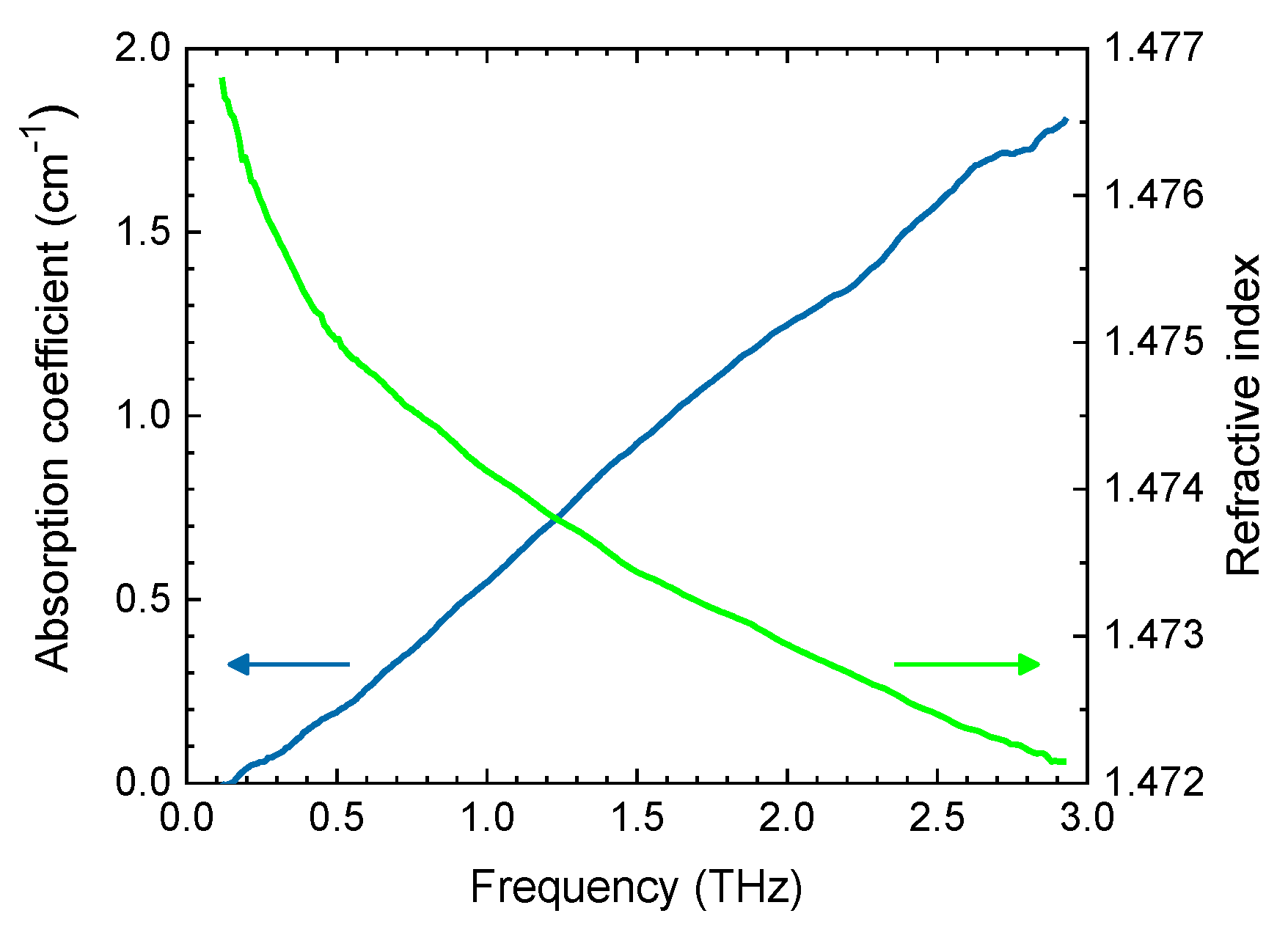
2.3. Index-Matching Material
2.4. Open Porosity Measurement
2.5. Disintegration Testing
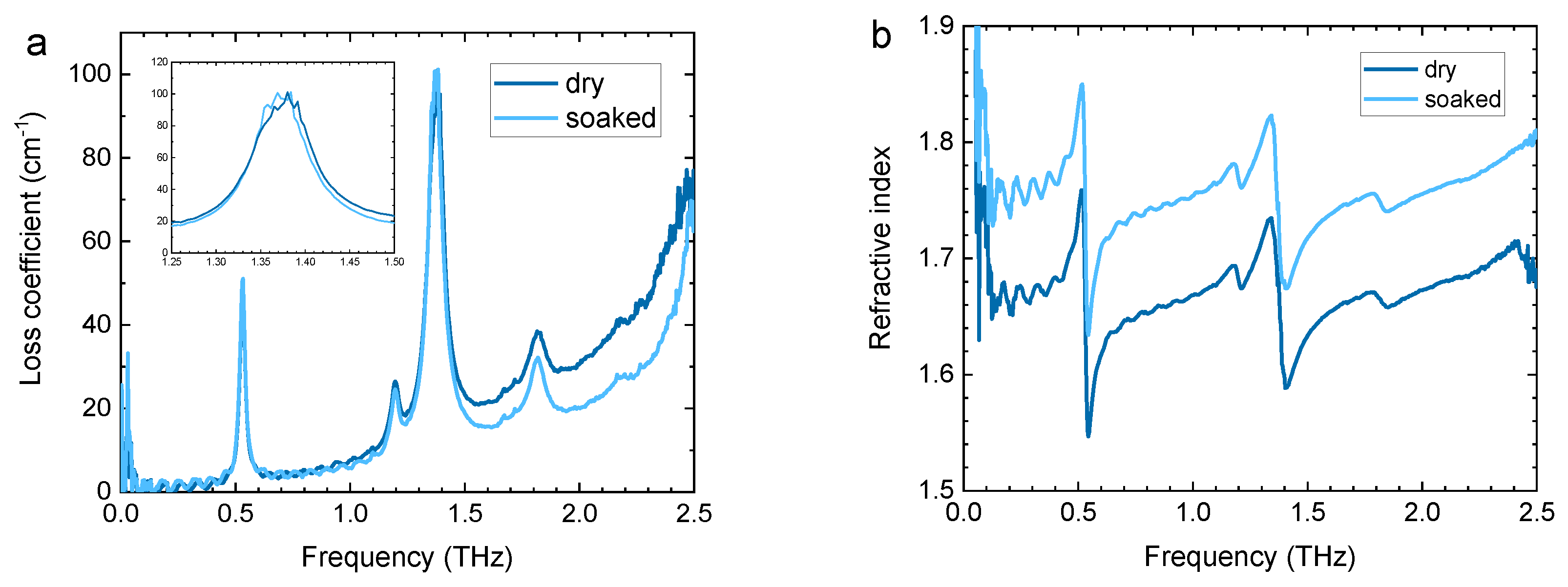
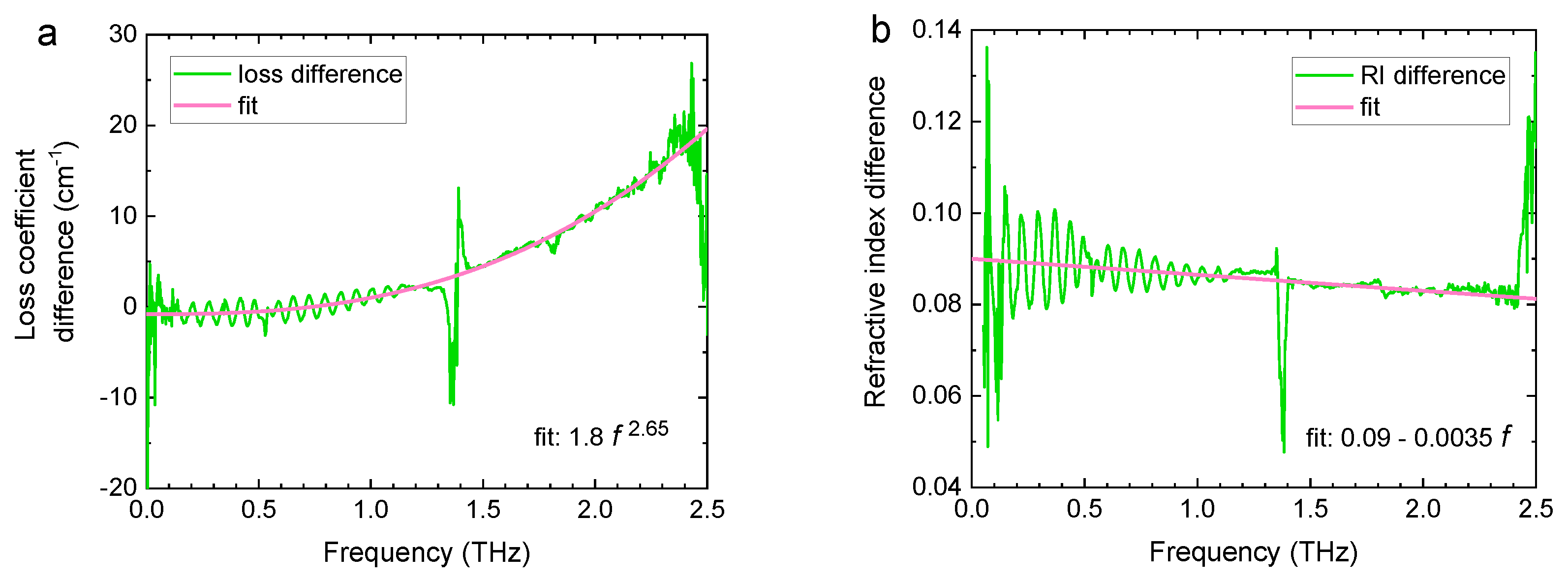
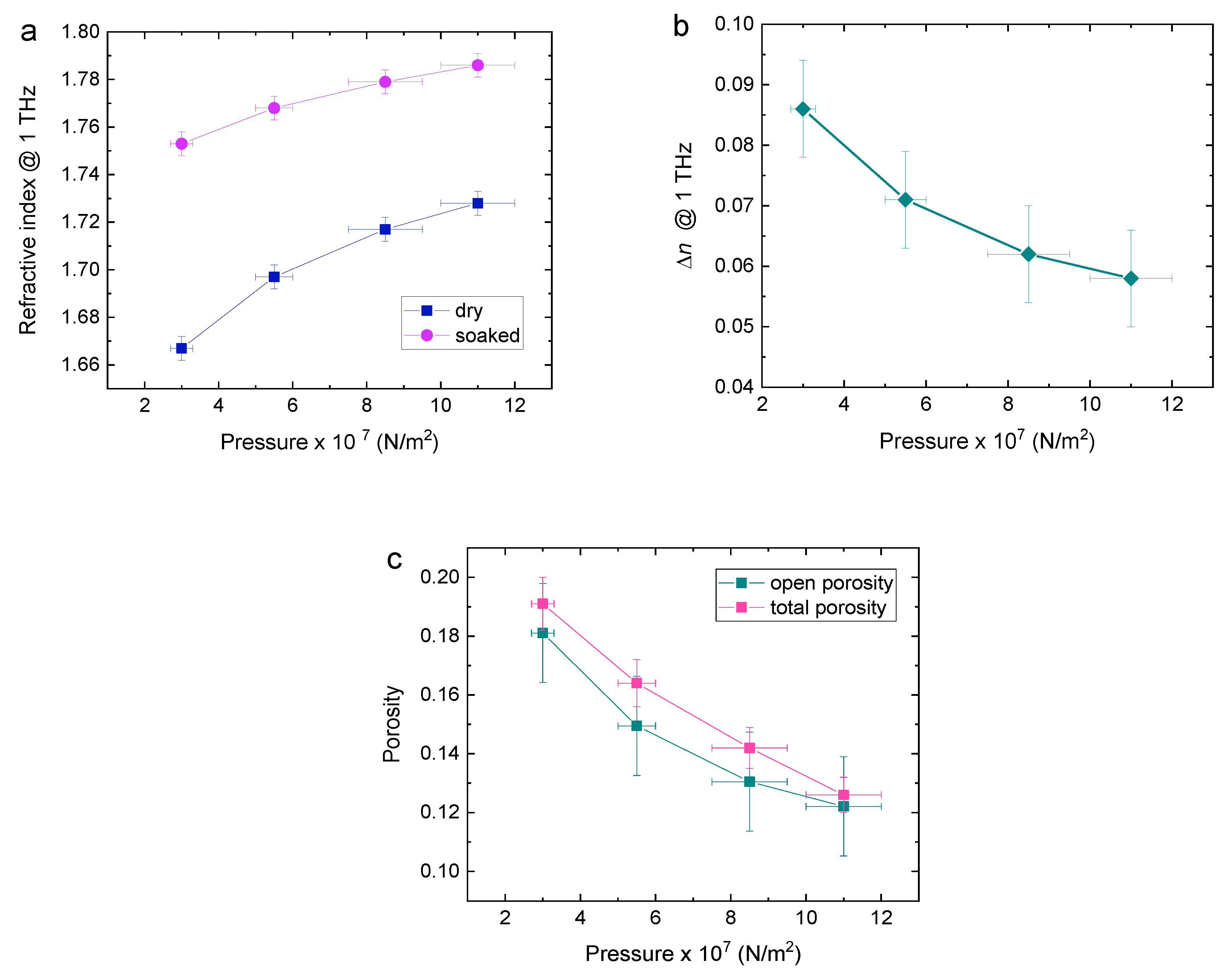
3. Results
4. Discussion
5. Conclusions
Author Contributions
Funding
Conflicts of Interest
References
- Fischer, A.; Jindra, J.; Wendt, H. Porosity and catalyst utilization of thin layer cathodes in air operated PEM-fuel cells. J. Appl. Electrochem. 1998, 28, 277–282. [Google Scholar] [CrossRef]
- Samanta, A.; Zhao, A.; Shimizu, G.K.H.; Sarkar, P.; Gupta, R. Post-Combustion CO2 Capture Using Solid Sorbents: A Review. Ind. Eng. Chem. Res. 2011, 51, 1438–1463. [Google Scholar] [CrossRef]
- Chae, H.K.; Siberio-Pérez, D.Y.; Kim, J.; Go, Y.; Eddaoudi, M.; Matzger, A.J.; O’Keeffe, M.; Yaghi, O.M. A route to high surface area, porosity and inclusion of large molecules in crystals. Nature 2004, 427, 523–527. [Google Scholar] [CrossRef] [PubMed]
- Aslannejad, H.; Hassanizadeh, S.M. Study of Hydraulic Properties of Uncoated Paper: Image Analysis and Pore-Scale Modeling. Transp. Porous Med. 2017, 120, 67–81. [Google Scholar] [CrossRef]
- Aslannejad, H.; Hassanizadeh, S.M.; Raoof, A.; de Winter, D.A.M.; Tomozeiu, N.; van Genuchten, M.T. Characterizing the hydraulic properties of paper coating layer using FIB-SEM tomography and 3D pore-scale modeling. Chem. Eng. Sci. 2017, 160, 275–280. [Google Scholar] [CrossRef]
- Markl, D.; Zeitler, J.A. A review of disintegration mechanisms and measurement techniques. Pharm. Res. 2017, 34, 890–917. [Google Scholar] [CrossRef]
- Markl, D.; Strobel, A.; Schlossnikl, R.; Bøtker, J.; Bawuah, P.; Ridgway, C.; Rantanen, J.; Rades, T.; Gane, P.; Peiponen, K.-E.; et al. Characterisation of pore structures of pharmaceutical tablets: A review. Int. J. Pharm. 2018, 538, 188–214. [Google Scholar] [CrossRef]
- Alkhatib, H.S.; Hamed, S.; Mohammad, M.K.; Bustanji, Y.; Alkhalidi, B.; Aiedeh, K.M.; Najjar, S. Effects of thermal curing conditions on drug release from polyvinyl acetate–polyvinyl pyrrolidone matrices. AAPS PharmSciTech 2010, 11, 253–266. [Google Scholar] [CrossRef]
- Ridgway, C.; Bawuah, P.; Markl, D.; Zeitler, J.A.; Ketolainen, J.; Peiponen, K.-E.; Gane, P. On the role of API in determining porosity, pore structure and bulk modulus of the skeletal material in pharmaceutical tablets formed with MCC as sole excipient. Int. J. Pharm. 2017, 526, 321–331. [Google Scholar] [CrossRef]
- Ferrero, C.; Jiménez-Castellanos, M.R. The influence of carbohydrate nature and drying methods on the compaction properties and pore structure of new methyl methacrylate copolymers. Int. J. Pharm. 2002, 248, 157–171. [Google Scholar] [CrossRef]
- Luukkonen, P.; Maloney, T.; Rantanen, J.; Paulapuro, H.; Yliruusi, J. Microcrystalline Cellulose-Water Interaction—A Novel Approach Using Thermoporosimetry. Pharm. Res. 2001, 18, 1562–1569. [Google Scholar] [CrossRef] [PubMed]
- Boissier, C.; Feidt, F.; Nordstierna, L. Study of Pharmaceutical Coatings by Means of NMR Cryoporometry and Sem Image Analysis. J. Pharm. Sci. 2012, 101, 2512–2522. [Google Scholar] [CrossRef] [PubMed]
- Tuntikulwattana, S.; Mitrevej, A.; Kerdcharoen, T.; Williams, D.B.; Sinchaipanid, N. Development and optimization of micro/nanoporous osmotic pump tablets. AAPS PharmSciTech 2010, 11, 924–935. [Google Scholar] [CrossRef] [PubMed]
- Heng, D.; Tang, P.; Cairney, J.M.; Chan, H.-K.; Cutler, D.J.; Salama, R.; Yun, J. Focused-ion-beam Milling: A novel approach to probing the interior of particles used for inhalation aerosols. Pharm. Res. 2007, 24, 1608–1617. [Google Scholar] [CrossRef] [PubMed]
- Barman, S.; Bolin, D. A three-dimensional statistical model for imaged microstructures of porous polymer films. J. Microsc. 2018, 269, 247–258. [Google Scholar] [CrossRef] [PubMed]
- Strange, J.H.; Webber, J.B.W.; Schmidt, S.D. Pore size distribution mapping. Magn. Reson. 1996, 14, 803–805. [Google Scholar] [CrossRef]
- Markl, D.; Zeitler, J.A.; Rasch, C.; Michaelsen, M.H.; Müllertz, A.; Rantanen, J.; Rades, T.; Bøtker, J. Analysis of 3D prints by X-ray computed microtomography and terahertz pulsed imaging. Pharm. Res. 2017, 34, 1037–1052. [Google Scholar] [CrossRef]
- Markl, D.; Bawuah, P.; Ridgway, C.; van den Ban, S.; Goodwin, D.J.; Ketolainen, J.; Gane, P.; Peiponen, K.-E.; Zeitler, J.A. Fast and non-destructive pore structure analysis using terahertz time-domain spectroscopy. Int. J. Pharm. 2018, 537, 102–110. [Google Scholar] [CrossRef]
- Bawuah, P.; Markl, D.; Farrell, D.; Evans, M.; Portieri, A.; Anderson, A.; Goodwin, D.; Lucas, R.; Zeitler, J.A. Terahertz-based porosity measurement of pharmaceutical tablets: A tutorial. J. Infrared Milli. Terahz. Waves. 2020, 6, 1–20. [Google Scholar] [CrossRef]
- Heshmat, B.; Andrews, G.M.; Naranjo-Montoya, O.A.; Castro-Camus, E.; Ciceri, D.; Sanchez, A.R.; Allanore, A.; Kmetz, A.A.; Eichmann, S.L.; Poitzsch, M.E.; et al. Terahertz scattering and water absorption for porosimetry. Opt. Express 2017, 25, 27370–27385. [Google Scholar] [CrossRef]
- Bawuah, P.; Pierotic Mendia, A.; Silfsten, P.; Pääkkönen, P.; Ervasti, T.; Ketolainen, J.; Zeitler, J.A.; Peiponen, K.-E. Detection of porosity of pharmaceutical compacts by terahertz radiation transmission and light reflection measurement techniques. Int. J. Pharm. 2014, 465, 70–76. [Google Scholar] [CrossRef] [PubMed]
- Bawuah, P.; Ervasti, T.; Tan, N.; Zeitler, J.A.; Ketolainen, J.; Peiponen, K.-E. Noninvasive porosity measurement of biconvex tablets using terahertz pulses. Int. J. Pharm. 2016, 509, 439–443. [Google Scholar] [CrossRef] [PubMed]
- Markl, D.; Wang, P.; Ridgway, C.; Karttunen, A.-P.; Chakraborty, M.; Bawuah, P.; Pääkkönen, P.; Gane, P.; Ketolainen, J.; Peiponen, K.-E.; et al. Characterization of the pore structure of functionalized calcium carbonate tablets by terahertz time-domain spectroscopy and X-ray computed microtomography. J. Pharm. Sci. 2017, 106, 1586–1595. [Google Scholar] [CrossRef] [PubMed]
- Bawuah, P.; Chakraborty, M.; Ervasti, T.; Zeitler, J.A.; Ketolainen, J.; Gane, P.A.C.; Peiponen, K.-E. A structure parameter for porous pharmaceutical tablets obtained with the aid of Wiener bounds for effective permittivity and terahertz time-delay measurement. Int. J. Pharm. 2016, 506, 87–92. [Google Scholar] [CrossRef]
- DFE Pharma Lactose: Some Basic Properties and Characteristics. Available online: https://www.dfepharma.com/lactose-some-basic-properties (accessed on 30 May 2020).
- Naftaly, M.; Dudley, R. Linearity calibration of amplitude and power measurements in terahertz systems and detectors. Opt. Lett. 2009, 34, 674–676. [Google Scholar] [CrossRef] [PubMed]
- Withayachumnankul, W.; Naftaly, M. Fundamentals of measurement in terahertz time-domain spectroscopy. J. Infrared Milli. Terahz. Waves 2014, 35, 610–637. [Google Scholar] [CrossRef]
- Shen, Y.C.; Taday, P.F.; Pepper, M. Elimination of scattering effects in spectral measurement of granulated materials using terahertz pulsed spectroscopy. Appl. Phys. Lett. 2008, 92, 051103-3. [Google Scholar] [CrossRef]
- Markl, D.; Sauerwein, J.; Goodwin, D.J.; van den Ban, S.; Zeitler, J.A. Non-destructive determination of disintegration time and dissolution in immediate release tablets by terahertz transmission measurements. Pharm. Res. 2017, 34, 1012–1022. [Google Scholar] [CrossRef]
- Bawuah, P.; Tan, N.; Tweneboah, S.N.A.; Ervasti, T.; Zeitler, J.A.; Ketolainen, J.; Peiponen, K.-E. Terahertz study on porosity and mass fraction of active pharmaceutical ingredient of pharmaceutical tablets. Eur. J. Pharm. Biopharm. 2016, 105, 122–133. [Google Scholar] [CrossRef]



| Code | Pressure (N/m2) × 107 | Thickness (mm) ± 0.01 | Density (g/cm3) ± 0.02 | Porosity |
|---|---|---|---|---|
| B01 | 3 ± 0.3 | 1.21 | 1.25 | 0.191 ± 0.009 |
| B02 | 5.5 ± 0.5 | 1.17 | 1.29 | 0.164 ± 0.007 |
| B03 | 8.5 ± 0.9 | 1.14 | 1.32 | 0.142 ± 0.006 |
| B04 | 11 ± 1 | 1.12 | 1.35 | 0.126 ± 0.005 |
© 2020 by the authors. Licensee MDPI, Basel, Switzerland. This article is an open access article distributed under the terms and conditions of the Creative Commons Attribution (CC BY) license (http://creativecommons.org/licenses/by/4.0/).
Share and Cite
Naftaly, M.; Tikhomirov, I.; Hou, P.; Markl, D. Measuring Open Porosity of Porous Materials Using THz-TDS and an Index-Matching Medium. Sensors 2020, 20, 3120. https://doi.org/10.3390/s20113120
Naftaly M, Tikhomirov I, Hou P, Markl D. Measuring Open Porosity of Porous Materials Using THz-TDS and an Index-Matching Medium. Sensors. 2020; 20(11):3120. https://doi.org/10.3390/s20113120
Chicago/Turabian StyleNaftaly, Mira, Iliya Tikhomirov, Peter Hou, and Daniel Markl. 2020. "Measuring Open Porosity of Porous Materials Using THz-TDS and an Index-Matching Medium" Sensors 20, no. 11: 3120. https://doi.org/10.3390/s20113120
APA StyleNaftaly, M., Tikhomirov, I., Hou, P., & Markl, D. (2020). Measuring Open Porosity of Porous Materials Using THz-TDS and an Index-Matching Medium. Sensors, 20(11), 3120. https://doi.org/10.3390/s20113120