Collaborative Neural Network Algorithm for Event-Driven Deployment in Wireless Sensor and Robot Networks



Abstract
1. Introduction
- It is the first time that complex event-driven deployment problems are solved by neural network methods. By using collaborative neural networks, the event-driven deployment algorithm can be adapted to different application scenarios to meet a variety of monitoring requirements;
- For the first time, a multi-constrained event-driven deployment model based on the maximum entropy function is proposed. This model transforms the complex event-driven deployment problem into two single-objective sub-problems. Both of the sub-problems are continuously differentiable. This model overcomes the limitation that the objective function of the traditional min–max method is non-differential;
- It is the first time that the difficulty of obtaining a large amount of sensor data and environmental information in a complex and dangerous monitoring environment is effectively overcome. Unlike traditional deployment methods, the collaborative neural network (CONN) algorithm can adaptively provide an optimal deployment solution for a variety of complex monitoring environments. This greatly reduces the time and cost involved in adapting to different monitoring environments.
2. Related Works
3. Compound Event-Driven Deployment Model Based on the Maximum Entropy Function
3.1. Main Idea
3.2. Problem Formulation
4. Compound Event-Driven Deployment Algorithm Based on the Collaborative Neural Network Strategy
4.1. Main Idea
4.2. The Neural Network Strategy for a Sub-Problem
4.3. Compound Event-Driven Deployment Algorithm Based on the Collaborative Neural Network Strategy
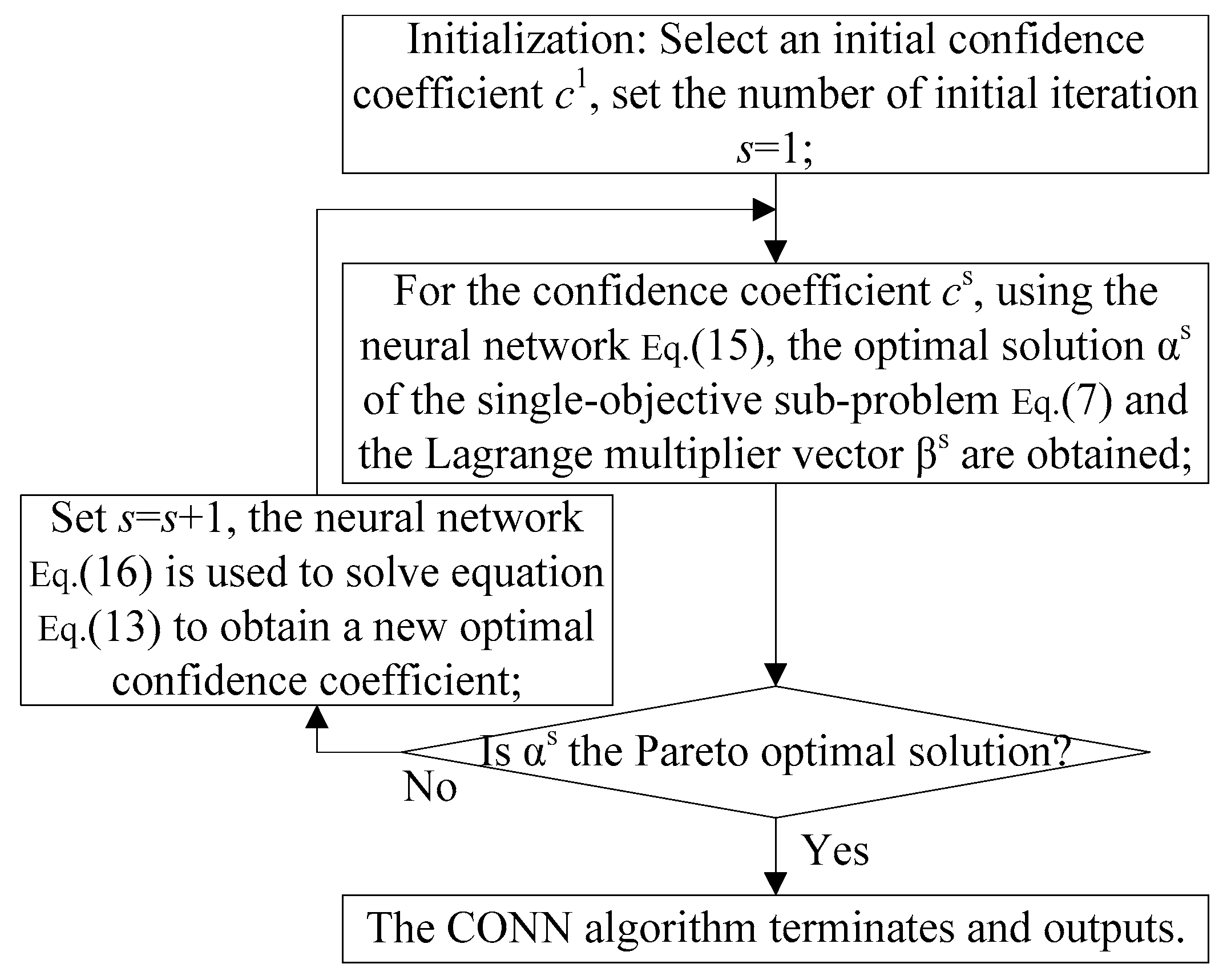
| Algorithm 1 Compound Event-Driven Deployment Algorithm Based on the Collaborative Neural Network Strategy. |
| 1: Initialization: An initial confidence coefficient is selected, and the number of initial iterations is set; |
| 2: For the confidence coefficient , using Neural Network (15), the optimal solution of the single-objective Sub-problem (7) and the Lagrange multiplier vector are obtained. If is the Pareto optimal solution for the multi-constrained compound event-driven deployment problem, the algorithm terminates and outputs; otherwise, the process skips to step 3; |
| 3: After obtaining and in step 2, Neural Network (16) is used to solve Formula (13) to obtain a new optimal confidence coefficient; |
| 4: The number of iterations is set and the process skips to step 2. |
4.4. The Complexity and Convergence Analysis of the Algorithm
5. Performance Evaluation
5.1. Environment Settings
5.2. Experimental Evaluation
5.3. Comparison with the ASMP Algorithm in Terms of the Deployment Intensity
5.4. Comparison with ASMP, EPDS, and OCQ-Max-Fit Algorithms
6. Conclusions and Future Work
Author Contributions
Funding
Conflicts of Interest
References
- Dziengel, N.; Seiffert, M.; Ziegert, M.; Adler, S.; Pfeiffer, S.; Schiller, J. Deployment and evaluation of a fully applicable distributed event detection system in Wireless Sensor Networks. Ad Hoc Netw. 2016, 37, 160–182. [Google Scholar] [CrossRef]
- Zhang, P.; Nevat, I.; Peters, G.W.; Xiao, G.; Tan, H.-P. Event detection in wireless sensor networks in random spatial sensors deployments. IEEE Trans. Signal. Process. 2015, 63, 6122–6135. [Google Scholar] [CrossRef]
- Guo, P.; Jiang, T.; Zhang, K. Novel 2-hop coloring algorithm for time-slot assignment of newly deployed sensor nodes without ID in wireless sensor and robot networks. Comput. Commun. 2012, 35, 1125–1131. [Google Scholar] [CrossRef]
- Wang, H.; Li, Y.; Chang, T.; Chang, S.; Fan, Y. Event-Driven Sensor Deployment in an Underwater Environment Using a Distributed Hybrid Fish Swarm Optimization Algorithm. Appl. Sci. 2018, 8, 1–17. [Google Scholar] [CrossRef]
- Wichmann, A.; Korkmaz, T.; Tosun, A.S. Robot Control Strategies for Task Allocation with Connectivity Constraints in Wireless Sensor and Robot Networks. IEEE Trans. Mob. Comput. 2017, 17, 1429–1441. [Google Scholar] [CrossRef]
- Gao, J.; Li, J.; Cai, Z.; Gao, H. Composite event coverage in wireless sensor networks with heterogeneous sensors. In Proceedings of the IEEE Conference on Computer Communications (INFOCOM), Hong Kong, China, 26 April–1 May 2015; pp. 217–225. [Google Scholar]
- Koutsougeras, C.; Liu, Y.; Zheng, R. Event-driven sensor deployment using self-organizing maps. Int. J. Sens. Netw. 2008, 3, 142. [Google Scholar] [CrossRef]
- Yang, Y.; Ambrose, A.; Cardei, M. Coverage for composite event detection in wireless sensor networks. Wirel. Commun. Mob. Comput. 2011, 11, 1168–1181. [Google Scholar] [CrossRef]
- Gao, J.; Li, J. Model-based approximate event detection in heterogeneous wireless sensor networks. In Proceedings of the International Conference on Wireless Algorithms, Systems, and Applications, Harbin, China, 23–25 June 2014; pp. 225–235. [Google Scholar]
- Zhou, Z.; Xing, R.; Duan, Y.; Zhu, Y.; Xiang, J. Event Coverage Detection and Event Source Determination in Underwater Wireless Sensor Networks. Sensors 2015, 15, 31620–31643. [Google Scholar] [CrossRef] [PubMed]
- Huang, H.; Savkin, A.V.; Ding, M.; Huang, C. Mobile robots in wireless sensor networks: A survey on tasks. Comput. Netw. 2019, 148, 1–19. [Google Scholar] [CrossRef]
- Yang, C.; Chin, K.-W. On nodes placement in energy harvesting wireless sensor networks for coverage and connectivity. IEEE Trans. Ind. Inform. 2016, 13, 27–36. [Google Scholar] [CrossRef]
- Costanzo, C.; Loscrí, V.; Natalizio, E.; Razafindralambo, T. Nodes self-deployment for coverage maximization in mobile robot networks using an evolving neural network. Comput. Commun. 2012, 35, 1047–1055. [Google Scholar] [CrossRef]
- Tao, D.; Wu, T.-Y. A Survey on Barrier Coverage Problem in Directional Sensor Networks. IEEE Sens. J. 2015, 15, 876–885. [Google Scholar] [CrossRef]
- Gharaei, N.; Abu Bakar, K.; Hashim, S.Z.M.; Pourasl, A.H. Energy-Efficient Intra-Cluster Routing Algorithm to Enhance the Coverage Time of Wireless Sensor Networks. IEEE Sens. J. 2019, 19, 4501–4508. [Google Scholar] [CrossRef]
- Zhu, X.; Li, J.; Chen, X.; Zhou, M. Minimum Cost Deployment of Heterogeneous Directional Sensor Networks for Differentiated Target Coverage. IEEE Sens. J. 2017, 17, 4938–4952. [Google Scholar] [CrossRef]
- Cao, B.; Zhao, J.; Yang, P.; Yang, P.; Liu, X.; Zhang, Y. 3-D Deployment Optimization for Heterogeneous Wireless Directional Sensor Networks on Smart City. IEEE Trans. Ind. Inform. 2019, 15, 1798–1808. [Google Scholar] [CrossRef]
- Chen, Z.; Teng, G.; Zhou, X.; Chen, T. Passive-Event-Assisted Approach for the Localizability of Large-Scale Randomly Deployed Wireless Sensor Network. Tsinghua Sci. Technol. 2019, 24, 134–146. [Google Scholar] [CrossRef]
- Janakiram, D.; Kumar, A.; Reddy, A. Component oriented middleware for distributed collaboration event detection in wireless sensor networks. In Proceeding of the MPAC’05, the 3rd International Workshop on Middleware for Pervasive and Ad-Hoc Computing, Grenoble, France, 28 November–2 December 2005; pp. 1–8. [Google Scholar]
- Harrison, D.C.; Seah, W.K.G.; Rayudu, R. Coverage Preservation with Rapid Forwarding in Energy-Harvesting Wireless Sensor Networks for Critical Rare Events. ACM Trans. Embed. Comput. Syst. 2018, 17. [Google Scholar] [CrossRef]
- Zhu, W.; Cao, J.; Raynal, M. Energy-Efficient Composite Event Detection in Wireless Sensor Networks. IEEE Commun. Lett. 2018, 22, 177–180. [Google Scholar] [CrossRef]
- Wang, W.; Huang, H.; He, F.; Xiao, F.; Jiang, X.; Sha, C. An Enhanced Virtual Force Algorithm for Diverse k-Coverage Deployment of 3D Underwater Wireless Sensor Networks. Sensors 2019, 19, 3496. [Google Scholar] [CrossRef]
- Deng, X.; Yu, Z.; Tang, R.; Qian, X.; Yuan, K.; Liu, S. An Optimized Node Deployment Solution Based on a Virtual Spring Force Algorithm for Wireless Sensor Network Applications. Sensors 2019, 19, 1817. [Google Scholar] [CrossRef]
- Guo, J.; Jafarkhani, H. Movement-Efficient Sensor Deployment in Wireless Sensor Networks with Limited Communication Range. IEEE Trans. Wirel. Commun. 2019, 18, 3469–3484. [Google Scholar] [CrossRef]
- Zhuang, Y.; Wu, C.; Zhang, Y.; Jia, Z. Compound Event Barrier Coverage in Wireless Sensor Networks under Multi-Constraint Conditions. Sensors 2017, 17, 25. [Google Scholar] [CrossRef] [PubMed]
- Zhuang, Y.; Wu, C.; Zhang, Y.; Jia, Z. Compound Event Barrier Coverage Algorithm Based on Environment Pareto Dominated Selection Strategy in Multi-Constraints Sensor Networks. IEEE Access 2017, 5, 10150–10160. [Google Scholar] [CrossRef]
- Kim, W.; Yoon, W. Multi-constrained Max–Min Fair Resource Allocation in Multi-channel Wireless Sensor Networks. Wirel. Pers. Commun. 2017, 97, 1–19. [Google Scholar] [CrossRef][Green Version]
- Hasan, M.Z.; Al-Turjman, F.; Al-Rizzo, H. Optimized multi-constrained quality-of-service multipath routing approach for multimedia sensor networks. IEEE Sens. J. 2017, 17, 2298–2309. [Google Scholar] [CrossRef]
- Yu, J.; Lin, Y.; Wang, Y. Ant-Based Reliable Multi-Constrained Anycast Routing for Sensor Networks. Int. J. Distrib. Sens. Netw. 2014, 5, 30–31. [Google Scholar] [CrossRef]
- Akbas, A.; Yildiz, H.U.; Ozbayoglu, A.M.; Tavli, B. Neural network based instant parameter prediction for wireless sensor network optimization models. Wirel. Netw. 2019, 25, 3405–3418. [Google Scholar] [CrossRef]
- Gharghan, S.K.; Mohammed, S.L.; Al-Naji, A.; Abu-AlShaeer, M.J.; Jawad, H.M.; Jawad, A.M.; Chahl, J. Accurate Fall Detection and Localization for Elderly People Based on Neural Network and Energy-Efficient Wireless Sensor Network. Energies 2018, 11, 2866. [Google Scholar] [CrossRef]
- Jondhale, S.R.; Deshpande, R.S. Kalman Filtering Framework-Based Real Time Target Tracking in Wireless Sensor Networks Using Generalized Regression Neural Networks. IEEE Sens. J. 2019, 19, 224–233. [Google Scholar] [CrossRef]
- Kamel, M.S. Neural networks: The state of the art. In Proceedings of the 11th International Conference on Microelectronics (IEEE Cat. No.99EX388), Kuwait, Kuwait, 22–24 November 1999. [Google Scholar]
- Kamel, M.S.; Xia, Y. Cooperative recurrent modular neural networks for constrained optimization: A survey of models and applications. Cogn. Neurodynamics 2008, 3, 47–81. [Google Scholar] [CrossRef][Green Version]
- Xia, Y.S. Further Results on Global Convergence and Stability of Globally Projected Dynamical Systems. J. Optim. Theory Appl. 2004, 122, 627–649. [Google Scholar] [CrossRef]
- Ko, Y.J.; Maystre, L.; Grossglauser, M. Collaborative recurrent neural networks for dynamic recommender systems. In Proceedings of the Journal of Machine Learning Research: Workshop and Conference Proceedings, Lausanne, Switzerland, 4–7 May 2016; pp. 366–381. [Google Scholar]
- Chase, M.; Gilad-Bachrach, R.; Laine, K.; Lauter, K.E.; Rindal, P. Private Collaborative Neural Network Learning. IACR Cryptol. Eprint Arch. 2017, 2017, 762. [Google Scholar]
- Zhang, T.; He, J.; Zhang, Y. Secure Sensor Localization in Wireless Sensor Networks based on Neural Network. Int. J. Comput. Intell. Syst. 2012, 5, 914–923. [Google Scholar] [CrossRef]
- Yan, X.; Cheng, H.; Zhao, Y.; Yu, W.; Huang, H.; Zheng, X. Real-Time Identification of Smoldering and Flaming Combustion Phases in Forest Using a Wireless Sensor Network-Based Multi-Sensor System and Artificial Neural Network. Sensors 2016, 16, 1228. [Google Scholar] [CrossRef] [PubMed]
- Nadimi, E.S.; Jorgensen, R.N.; Blanes-Vidal, V.; Christensen, S. Monitoring and classifying animal behavior using ZigBee-based mobile ad hoc wireless sensor networks and artificial neural networks. Comput. Electron. Agric. 2012, 82, 44–54. [Google Scholar] [CrossRef]
- Yang, J.-B.; Sen, P. Interactive tradeoff analysis and preference modelling for preliminary multiobjective ship design synthesis. Syst. Anal. Model. Simul. 1996, 26, 25–55. [Google Scholar]
- Li, X. An entropy-based aggregate method for minimax optimization. Eng. Optim. 1992, 18, 277–285. [Google Scholar]
- Feng, Y.; Liu, H.; Zhou, S.; Liu, S. A smoothing trust-region Newton-CG method for minimax problem. Appl. Math. Comput. 2008, 199, 581–589. [Google Scholar] [CrossRef]
- Fliege, J.; Graña, L.M.; Svaiter, D.B.F. Newton’s Method for Multiobjective Optimization. Siam J. Optim. 2009, 20, 602–626. [Google Scholar] [CrossRef]
- Lin, J.G. On min-norm and min-max methods of multi-objective optimization. Math. Program. 2005, 103, 1–33. [Google Scholar] [CrossRef]




| Symbol | Meaning | R/M | T/S | C | Conf |
|---|---|---|---|---|---|
| Camera Sensor | 40 | 5 | 40 | 0.35 | |
| RFID Sensor | 10 | 2 | 15 | 0.20 | |
| Light Sensor | 35 | 3 | 30 | 0.15 | |
| Bluetooth Sensor | 15 | 4 | 20 | 0.05 | |
| Pyroelectric Sensor | 5 | 1 | 25 | 0.10 |
| Case | D/M | T/S | C | MIN | Ratio | Time |
|---|---|---|---|---|---|---|
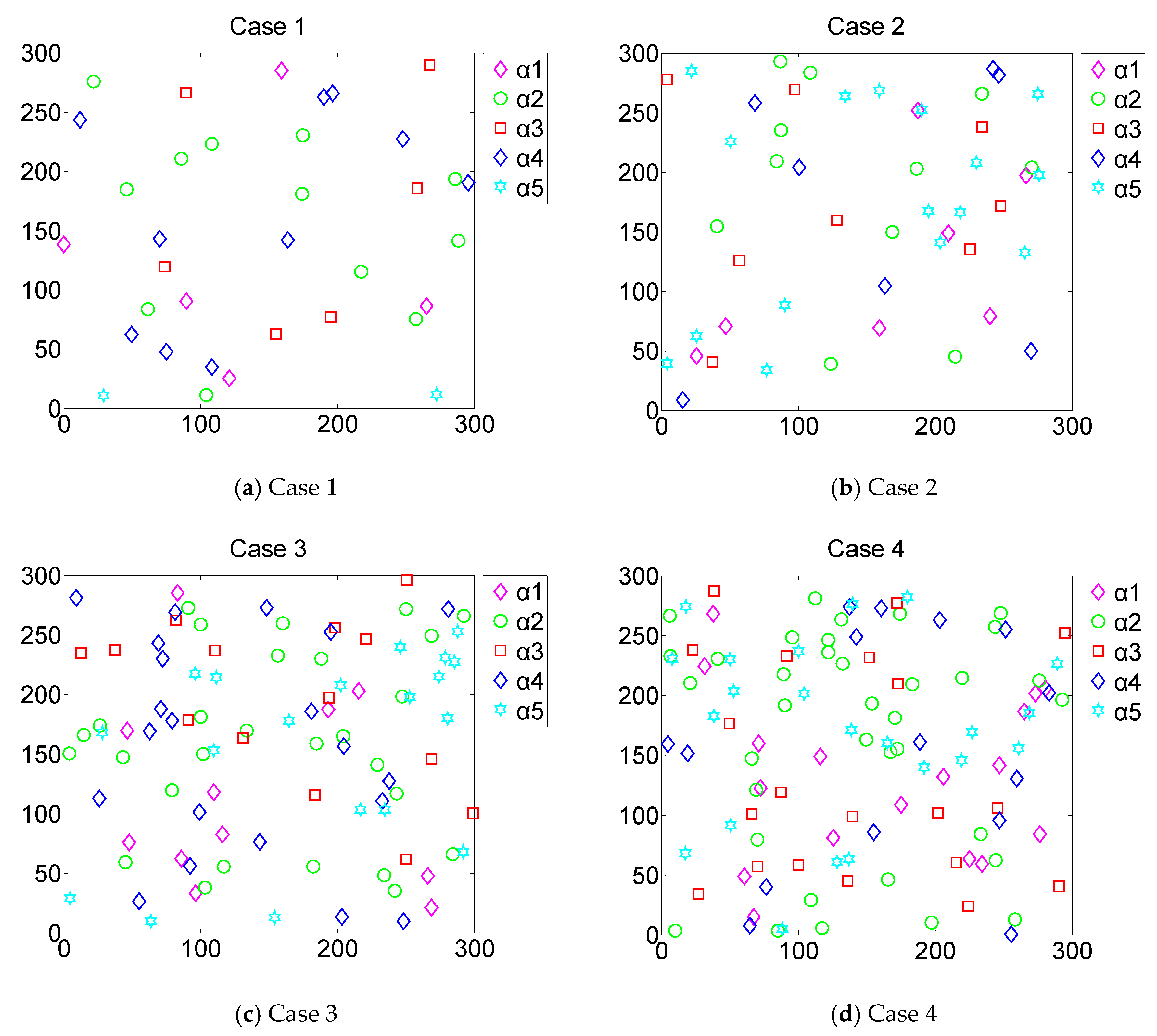
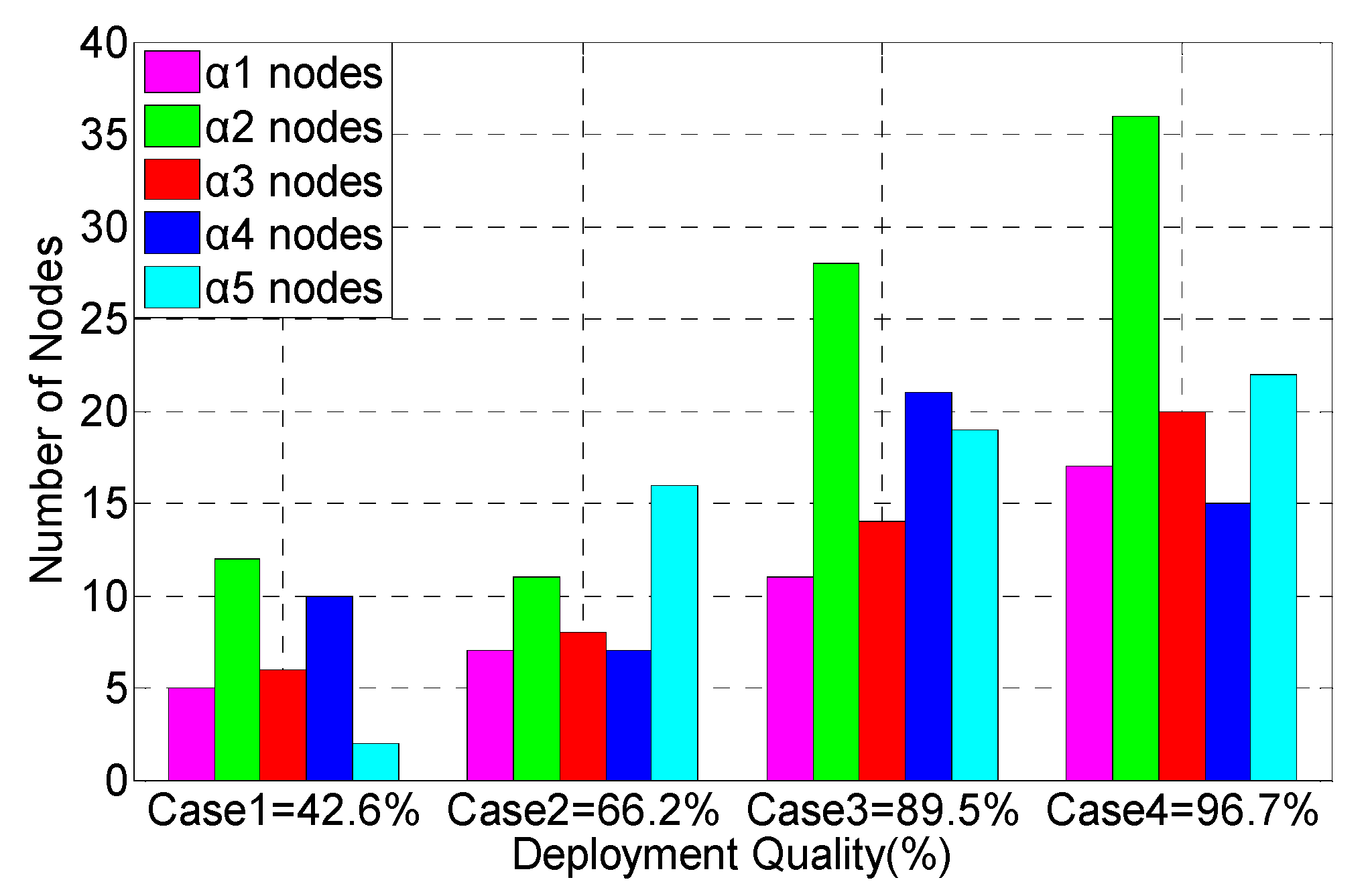
| 1 | 690 | 89 | 810 | 0.76 | 42.6% | 0.3922 s |
| 2 | 855 | 125 | 1225 | 0.83 | 66.2% | 0.4086 s |
| 3 | 1620 | 256 | 2175 | 0.91 | 89.5% | 0.4921 s |
| 4 | 2075 | 299 | 2670 | 0.98 | 96.7% | 0.8510 s |
© 2020 by the authors. Licensee MDPI, Basel, Switzerland. This article is an open access article distributed under the terms and conditions of the Creative Commons Attribution (CC BY) license (http://creativecommons.org/licenses/by/4.0/).
Share and Cite
Zhuang, Y.; Wu, C.; Wu, H.; Zhang, Z.; Gao, Y.; Li, L. Collaborative Neural Network Algorithm for Event-Driven Deployment in Wireless Sensor and Robot Networks. Sensors 2020, 20, 2779. https://doi.org/10.3390/s20102779
Zhuang Y, Wu C, Wu H, Zhang Z, Gao Y, Li L. Collaborative Neural Network Algorithm for Event-Driven Deployment in Wireless Sensor and Robot Networks. Sensors. 2020; 20(10):2779. https://doi.org/10.3390/s20102779
Chicago/Turabian StyleZhuang, Yaoming, Chengdong Wu, Hao Wu, Zuyuan Zhang, Yuan Gao, and Li Li. 2020. "Collaborative Neural Network Algorithm for Event-Driven Deployment in Wireless Sensor and Robot Networks" Sensors 20, no. 10: 2779. https://doi.org/10.3390/s20102779
APA StyleZhuang, Y., Wu, C., Wu, H., Zhang, Z., Gao, Y., & Li, L. (2020). Collaborative Neural Network Algorithm for Event-Driven Deployment in Wireless Sensor and Robot Networks. Sensors, 20(10), 2779. https://doi.org/10.3390/s20102779