Long-Term Monitoring with Fiber Optics Distributed Temperature Sensing at Campi Flegrei: The Campi Flegrei Deep Drilling Project

 ,
, 

 ,
,
Abstract
1. Introduction
- a)
- If not permanently installed and operating, simultaneous long-term and on-line temperature surveying for the entire length of the borehole is not feasible;
- b)
- In the case of long, inclined (>30°) or horizontal boreholes, or boreholes that are directed upwards, conventional probing with moving temperature probes will fail for technical reasons;
- c)
- Viscous mud has to be removed before thermal probe lowering, a procedure that entails considerable risk of damage to the entire borehole.
2. Materials and Methods
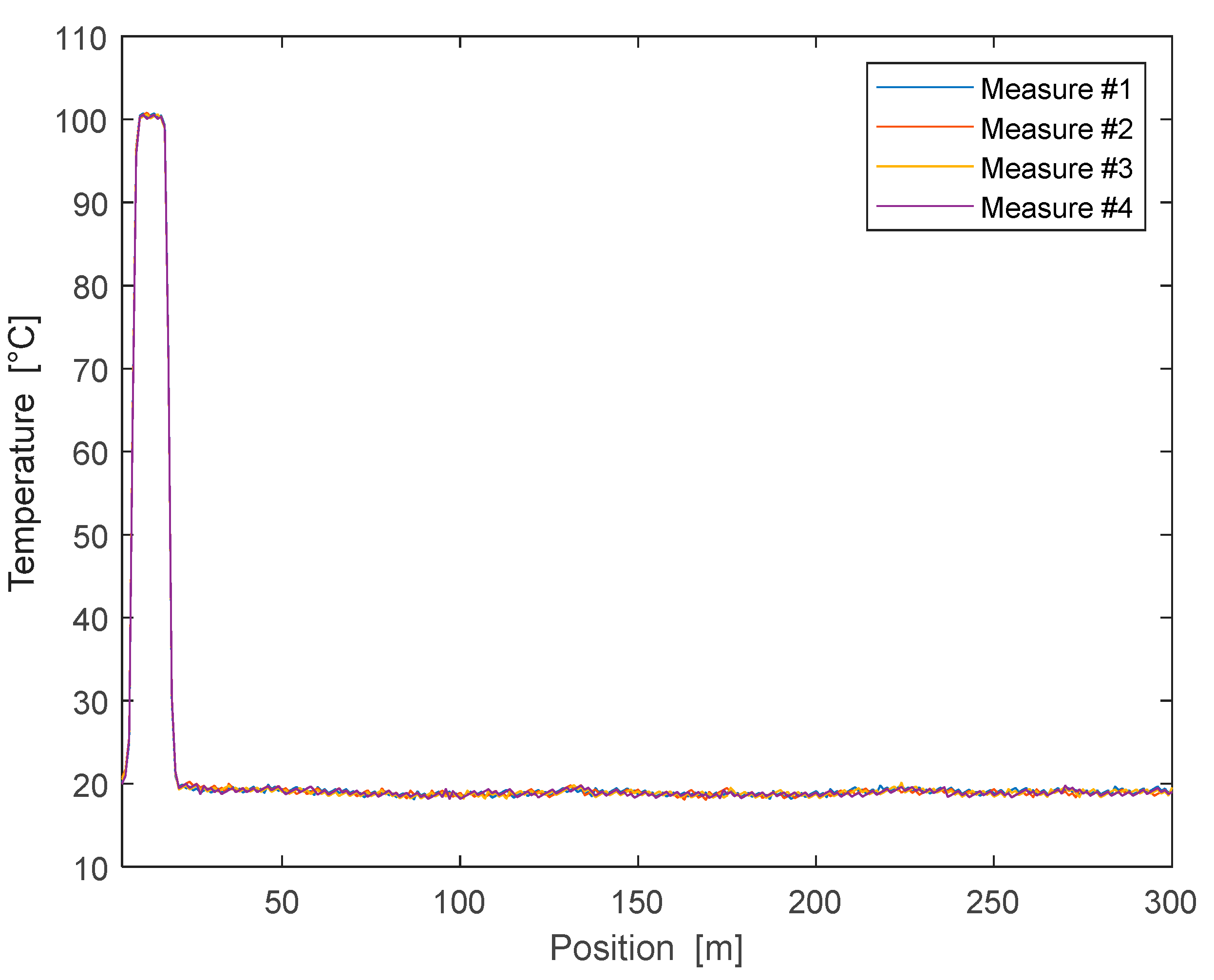
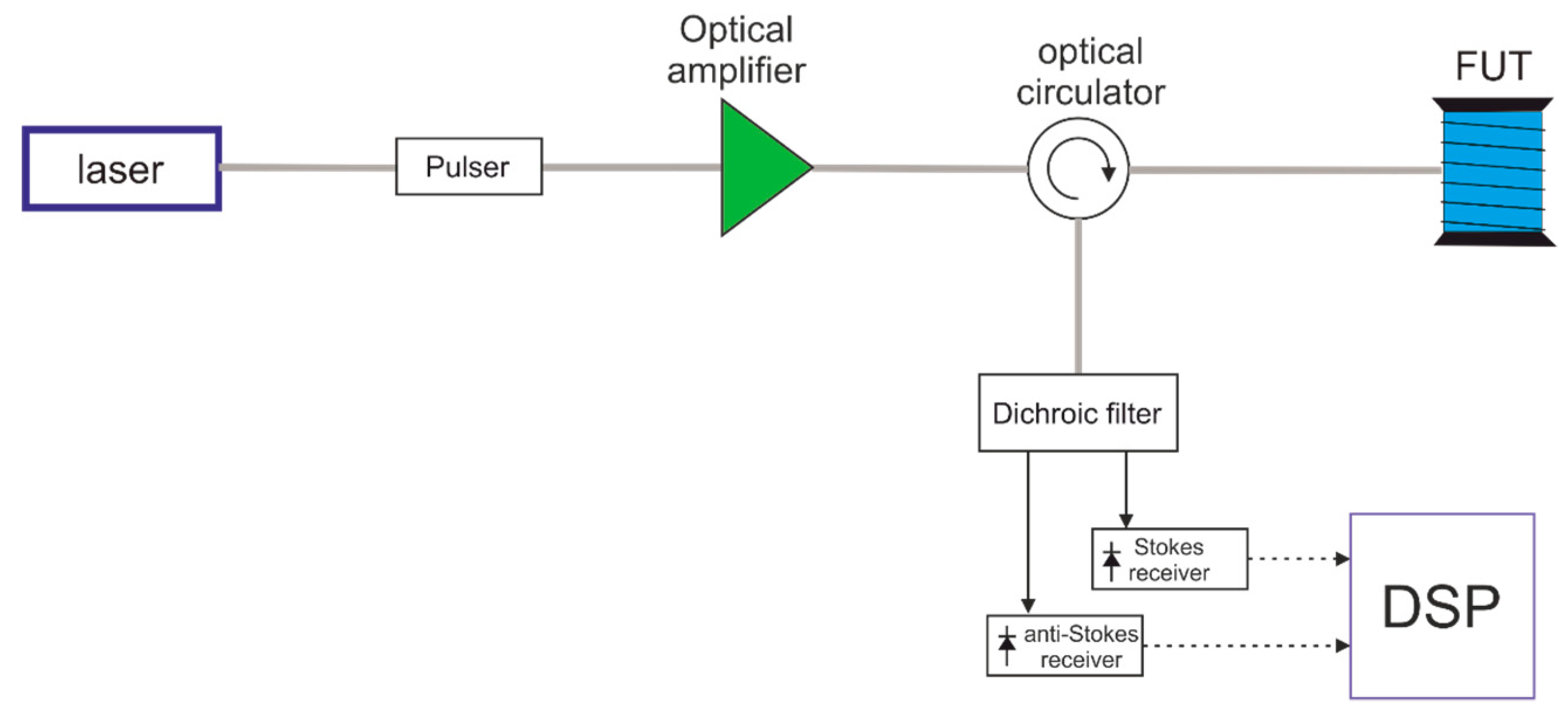
2.1. The DTS Sensors
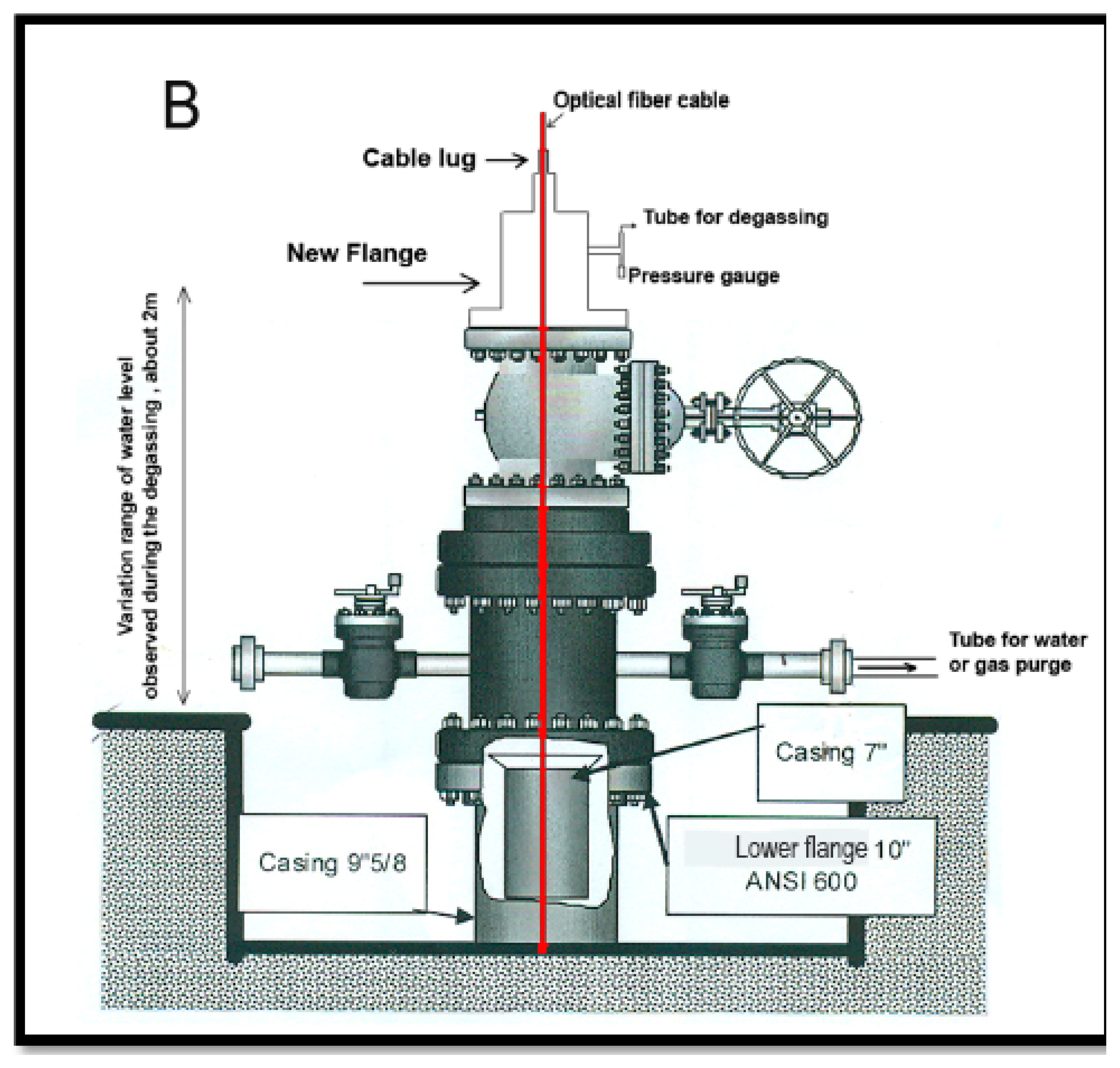
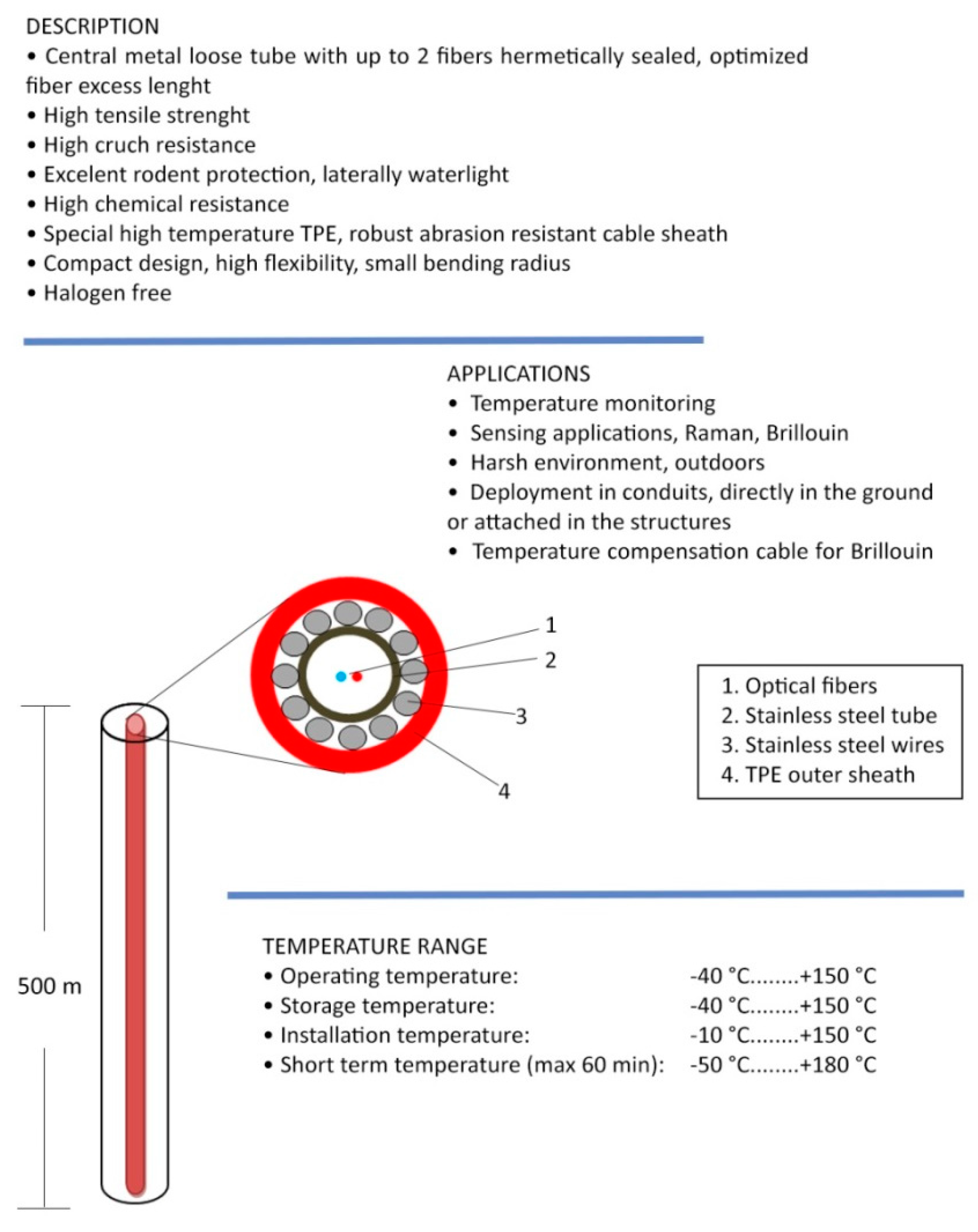
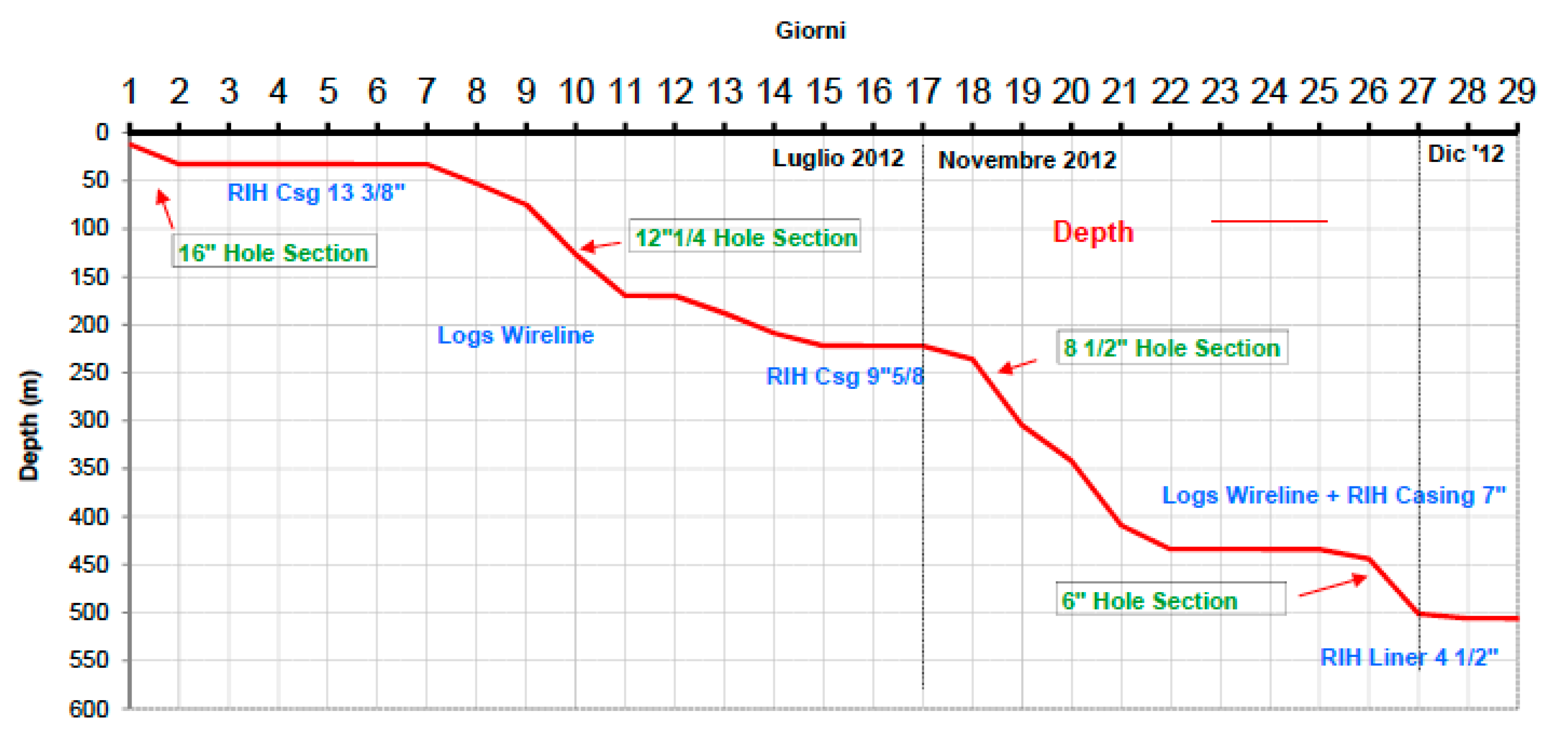
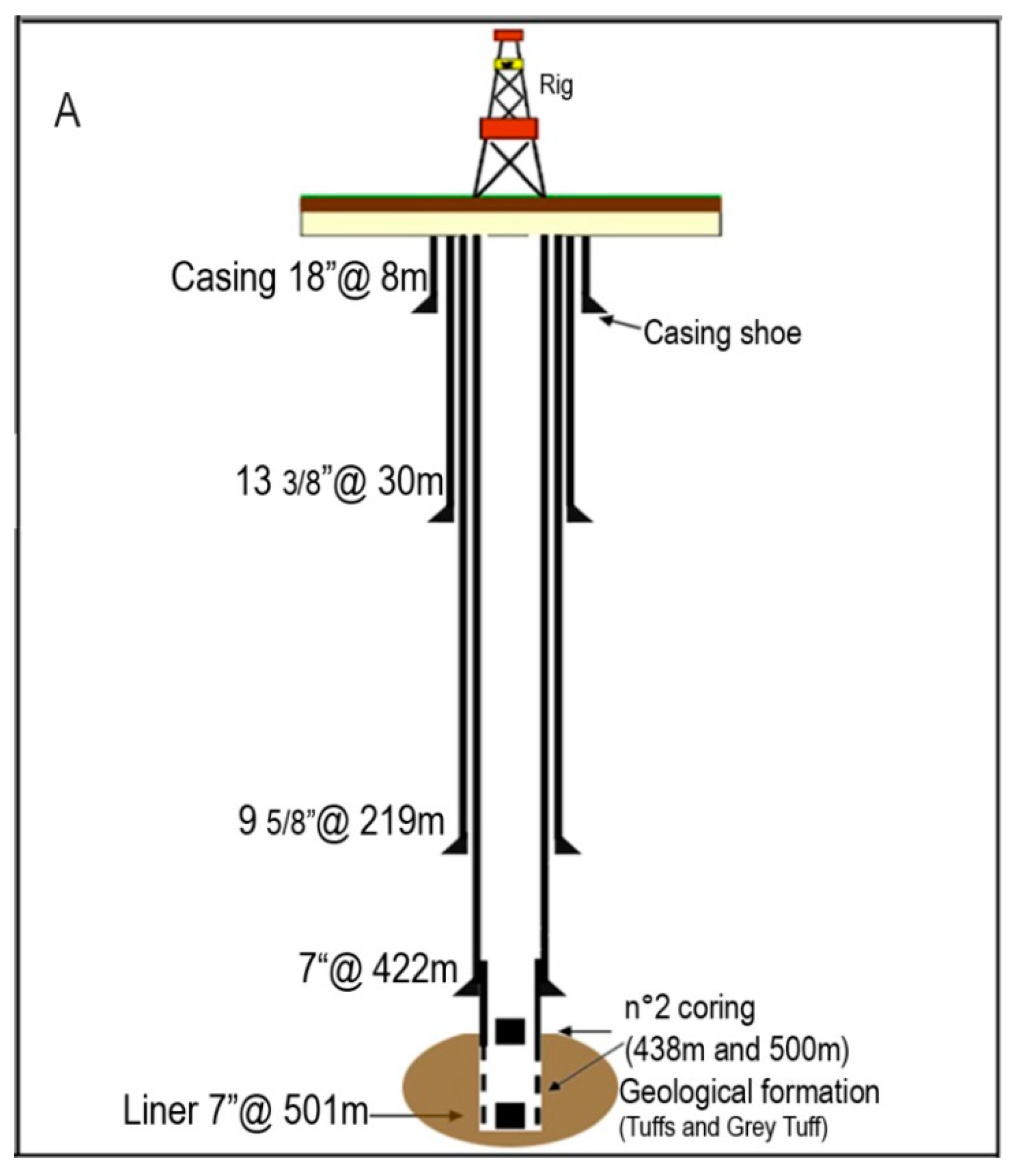
2.2. Well and Fiber Optic Design
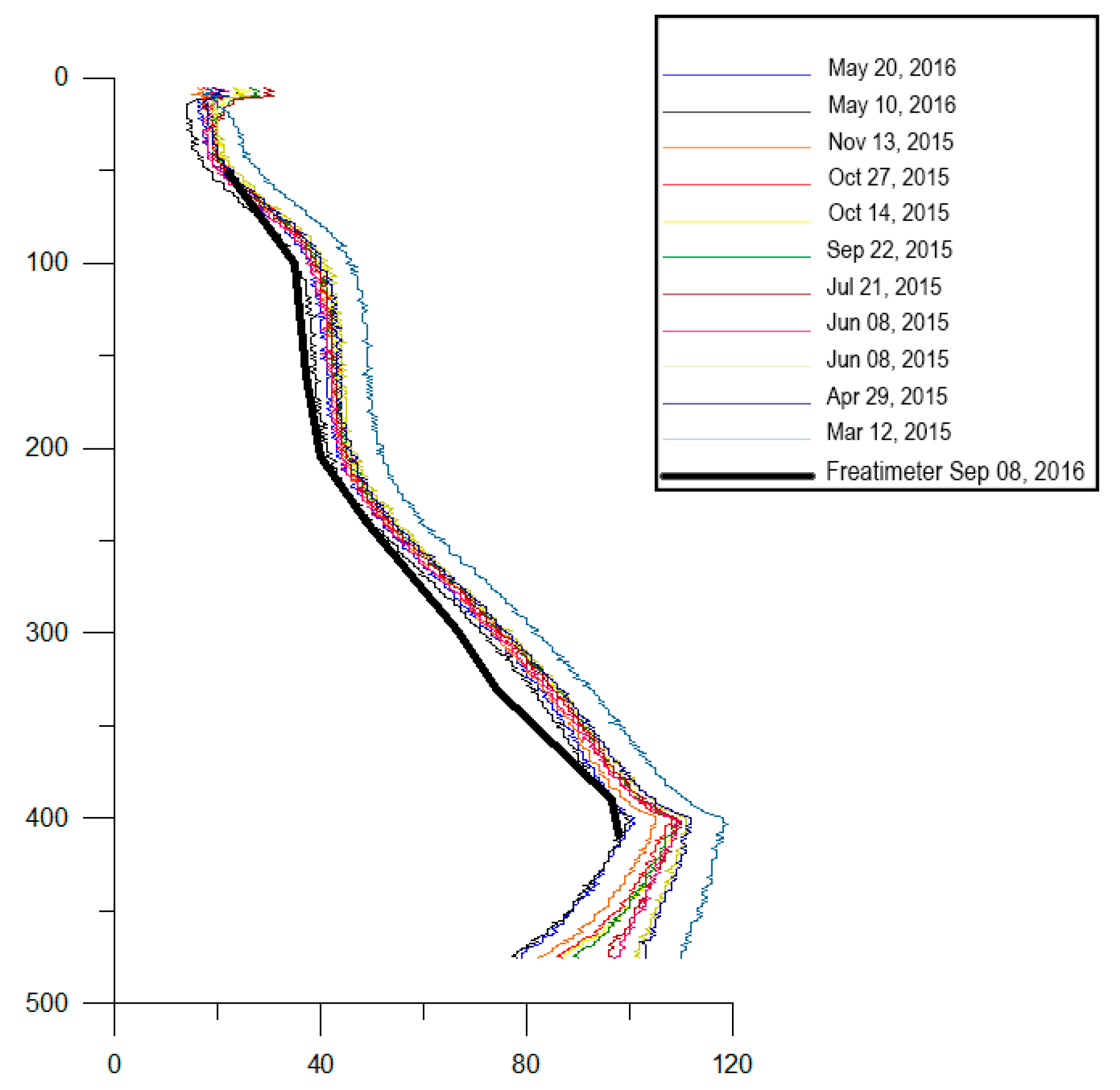
3. Results and Discussion
4. Conclusions
Author Contributions
Funding
Conflicts of Interest
References
- Ferraro, P.; De Natale, G. On the possible use of optical fiber Bragg gratings as strain sensors for geodynamical monitoring. Opt. Lasers Eng. 2002, 37, 115–130. [Google Scholar] [CrossRef]
- De Natale, G.; Troise, C. The ‘Campi Flegrei Deep Drilling Project’: From risk mitigation to renewable energy production. Eur. Rev. 2011, 19, 337–353. [Google Scholar] [CrossRef]
- Carlino, S.; Kilburn, C.R.J.; Tramelli, A.; Troise, C.; Somma, R.; De Natale, G. Tectonic stress and renewed uplift at Campi Flegrei caldera, southern Italy: New insights from caldera drilling. Earth Planet. Sci. Lett. 2015, 420, 23–29. [Google Scholar] [CrossRef]
- DiPippo, R. Geothermal Power Generation; Woodhead Publishing: Sawston, Cambridge, 2016; p. 854. Available online: https://www.elsevier.com/books/geothermal-power-generation/dipippo/978-0-08-100337-4 (accessed on 8 June 2016).
- McDaniel, A.; Fratta, D.; Tinjum, J.M.; Hart, D.J. Long-term district-scale geothermal exchange verified monitoring with fiber optic distributed temperature sensing. Geothermics 2018, 72, 193–204. [Google Scholar] [CrossRef]
- Jessop, A.M.; Judge, A.S. Temperature measurement in boreholes for the mining industry. Pap. Geol. Surv. Can. 1977; pp. 31–75. Available online: https://geoscan.nrcan.gc.ca/starweb/geoscan/servlet.starweb?path=geoscan/fulle.web&search1=R=102602 (accessed on 1 January 1976).
- Drudy, M.J. Borehole temperature logging for the detection of water flow. Geoexploring 1984, 22, 231–243. [Google Scholar] [CrossRef]
- Blackwell, D.D.; Spafford, R.E. Experimental Methods in Continental Heat Flow. In Experimental Methods in Physics; Sammis, C.G., Henyey, T.L., Eds.; Academic Press: Orlando, FL, USA, 1987; pp. 189–226. [Google Scholar]
- Jorden, J.R.; Campbell, F.L. Well Logging: Rock Properties, Borehole Environment, Mud and Temperature Logging; SPE of AIME: Richardson, TX, USA, 1984; p. 167. [Google Scholar]
- Plisga, G.J. Temperature in wells. In Petroleum Engineering Handbook; Bradley, H.B., Ed.; Society of Petroleum Engineers: Richardson, TX, USA, 1987; pp. 31-1–31-7. [Google Scholar]
- Hill, A.D. Temperature logging. In Production Logging—Theoretical and Interpretative Elements; Society of Petroleum Engineers Memoir No. 14; Society of Petroleum Engineers: Richardson, TX, USA, 1990; pp. 19–36. [Google Scholar]
- Hallenburg, J.K. Geophysical Logging for Mineral and Engineering Applications; PennWell Books: Houston, TX, USA, 1984; p. 254. [Google Scholar]
- Schenato, L.; Palmieri, L.; Camporese, M.; Bersan, S.; Cola, S.; Pasuto, A.; Simonini, P. Distributed optical fibre sensing for early detection of shallow landslides triggering. Sci. Rep. 2017, 7, 14686. [Google Scholar] [CrossRef] [PubMed]
- Komori, S.; Kagiyama, T.; Hoshizumi, H.; Takakura, S.; Mimura, M. Vertical mapping of hydrothermal fluids and alteration from bulk conductivity: Simple interpretation on the USDP-1 site, Unzen Volcano, SW Japan. J. Volcanol. Geotherm. 2010, 198, 339–347. [Google Scholar] [CrossRef]
- Axelsson, G.; Egilson, T.; Gylfasdòttir, S. Modelling of temperature conditions near the bottom of well IDDP-1 in Krafla, Northeast Iceland. Geothermics 2014, 49, 49–57. [Google Scholar] [CrossRef]
- Ingason, K.; Árnason, A.B.; Bóasson, H.Á.; Sverrisson, H.; Sigurjónsson, K.Ö.; Gíslason, T. IDDP 2, Well design. In Proceedings of the World Geothermal Congress 2015, Melbourne, Australia, 19–25 April 2015; p. 12. [Google Scholar]
- Vedum, J.; Morten, H.; Røed, M.H.; Kolberg, S.; Hjelstuen, M.; Liverud, A.E.; Stamnes, Ø.N. Development of a Novel Logging Tool for 450 °C, Geothermal Wells. In Proceedings of the International Microelectronics Assembly and Packaging Society, Relaight, NC, USA, 10–12 July 2017. [Google Scholar]
- Haenel, R.; Rybach, L. Handbook of Terrestrial Heat-Flow Density Determination: With Guidelines and Recommendations of the International Heat Flow Commission; Springer Science & Business Media, Kluwer Academic Publishers: London, UK, 2012; Volume 4, p. 382. [Google Scholar]
- Troise, C.; De Natale, G.; Schiavone, R.; Somma, R.; Moretti, R. The Campi Flegrei caldera unrest: Discriminating magma intrusions from hydrothermal effects and implications for possible evolution. Earth Sci. Rev. 2019, 188, 108–122. [Google Scholar] [CrossRef]
- Jessop, A.M. Comparison of industrial and high-resolution thermal data in a sedimentary basin. Pure Appl. Geophys. 1990, 133, 251–267. [Google Scholar] [CrossRef]
- Hartog, A.H. An Introduction to Distributed Optical Fibre Sensors; CRC Press: Boca Raton, FL, USA, 2017. [Google Scholar]
- Gerges, A.S.; Farahi, F.; Newson, T.P.; Jones, J.D.C.; Jackson, D.A. Fiber-optic interferometric sensor utilization low coherence length source resolution enhancement. Electron. Lett. 1988, 24, 472–474. [Google Scholar] [CrossRef]
- Farries, M.C.; Rogers, A.J. Distributed sensing using stimulated Raman interaction in a monomode optical fibre. In Proceedings of the 2nd International Conference on Optical Fiber Sensors: OFS’84, International Society for Optics and Photonics, Stuttgart, Germany, 5–7 September 1984; pp. 121–133. [Google Scholar]
- Dakin, J.P.; Pratt, D.J.; Bibby, G.W.; Ross, J.N. Distributed optical fiber Raman temperature sensor using a semiconductor light source and detector. Electron. Lett. 1985, 21, 569–570. [Google Scholar] [CrossRef]
- Rogers, A.J. Distributed optical-fiber sensors for the measurements of pressure, strain and temperature. Phys. Rep. 1988, 169, 99–143. [Google Scholar] [CrossRef]
- Hartog, A.; Gamble, G. Photonic distributed sensing. Phys. World 1991, 3, 45–49. [Google Scholar] [CrossRef]
- Boiarski, A. Distributed Fiber Optic Temperature Sensing. In Applications of Fiber Optic Senosrs in Engineering Mechanics; Ansari, F., Ed.; ASCE: New York, NY, USA, 1993; pp. 210–224. [Google Scholar]
- Carlino, S.; Mirabile, M.; Troise, C.; Sacchi, M.; Zeni, L.; Minardo, A.; Caccavale, M.; Darányi, V.; De Natale, G. Distributed-Temperature-Sensing Using Optical Methods: A First Application in the Offshore Area of Campi Flegrei Caldera (Southern Italy) for Volcano Monitoring. Remote Sens. 2016, 8, 674. [Google Scholar] [CrossRef]
- Suzuki, K.; Horiguchi, T.; Seikai, S. Optical time-domain reflectometer with a semiconductor laser Amplifier. Electron. Lett. 1984, 20, 714–716. [Google Scholar] [CrossRef]
- Suzuki, K.; Noguchi, K.; Uesugi, N. Long-range OTDR for single-mode optical fiber using a P2O5 highly doped fiber Ramanlaser. Electron. Lett. 1986, 22, 1273–1274. [Google Scholar] [CrossRef]
- Stone, J.; Chraplyvy, A.R.; Kasper, B.L. Long-range 1.5 mm OTDR in a single-mode fiber using a D2 gas-in-glass laser (100 km) or a semiconductor laser (60 km). Electron. Lett. 1985, 21, 541–542. [Google Scholar] [CrossRef]
- Wanser, K.H.; Haselhuhn, M.; Lafond, M. High temperature distributed strain and temperature sensing using OTDR. In Applications of Fiber Optic Sensors in Engineering Mechanics; Ansari, F., Ed.; ASCE: Reston, VA, USA, 1993; pp. 194–209. [Google Scholar]
- Hurtig, E.; Großwig, S.; Jobmann, M.; Kühn, K.; Marschall, P. Fibre optic temperature measurements in shallow boreholes: Experimental application for fluid logging. Geothermics 1994, 23, 355–364. [Google Scholar] [CrossRef]
- Grosswing, S.; Hurtig, E.; Kuhn, K.; Rudolph, F. Distributed Fibre-optic Temperature Sensing Technique (DTS) for Surveying Underground Gas Storage Facilitie. Oil Gas Eur. Mag. 2001, 27, 31–34. [Google Scholar]
- De Natale, G.; Troise, C.; Mark, D.; Mormone, A.; Piochi, M.; Di Vito, M.A.; Isaia, R.; Carlino, S.; Barra, D.; Somma, R. The Campi Flegrei Deep Drilling Project (CFDDP): New insight on caldera structure, evolution and hazard implications for the Naples area (Southern Italy). Geochem. Geophys. Geosyst. 2016, 17, 4836–4847. [Google Scholar] [CrossRef]
- Ramos, R.; Hawthorn, W.D. Survivability of Optical Fiber for Harsh Environments. In Proceedings of the SPE Annual Technical Conference and Exhibition, Denver, CO, USA, 21–24 September 2008. [Google Scholar]
- Kutz, M. Applied Plastic Engineering Handbook Processing and Materials; PDL Handbook Series; William Andrew: Waltham, MA, USA, 2011; p. 644. [Google Scholar]
- De Natale, G.; Troise, C.; Kilburn, C.R.J.; Somma, R.; Moretti, R. Understanding volcanic hazard at the most populated caldera in the world: Campi Flegrei, Southern Italy. Geochem. Geophys. Geosyst. 2017, 18, 2004–2008. [Google Scholar] [CrossRef]
- Moretti, R.; De Natale, G.; Troise, C. A geochemical and geophysical reappraisal to the significance of the recent unrest at Campi Flegrei caldera (Southern Italy). Geochem. Geophys. Geosyst. 2017, 18, 1244–1269. [Google Scholar] [CrossRef]
- Sanjuan, B.; Millot, R.; Brach, M.; Asmundsson, R.; Giroud, N. Use of a new sodium/lithium (Na/Li) geothermometric relationship for high-temperature dilute geothermal fluids from Iceland. In Proceedings of the World Geothermal Congress 2010, Bali, Indonesia, 25–30 April 2010; 12p. [Google Scholar]
- Ásmundsson, R.; Pezard, P.; Sanjuan, B.; Henninges, J.; Deltombe, J.L.; Halladay, N.; Lebert, F.; Gadalia, A.; Millot, R.; Gibert, B.; et al. High temperature instruments and methods developed for supercritical geothermal reservoir characterization and exploitation—The HiTI project. Geothermics 2014, 49, 90–98. [Google Scholar] [CrossRef]
- Friedlefsson, G.O.; Bogason, S.G.; Stoklos, A.W.; Ingolfsson, H.P.; Vergnes, P.T.I.O.; Peter-Borie, M.; Kohl, T.; Edelmann, T.; Bertani, R.; Sæther, S.; et al. Deployment of deep enhanced geothermal systems for sustainable energy business. In Proceedings of the Conference: European Geothermal Congress 2016, Straburg, France, 19–24 September 2016; p. 8. [Google Scholar]
- Fridleifsson, G.Ó.; Elders, W.A. The Iceland Deep Drilling Project: A Search for Deep Unconventional Geothermal Resources. Geothermics 2005, 34, 269–285. [Google Scholar] [CrossRef]
- Gagliardi, G.; Salza, M.; Ferraro, P.; De Natale, P.; Di Maio, A.; Carlino, S.; De Natale, G.; Boschi, E. Design and test of a laser-based optical fiber Bragg-grating accelerometer for seismic applications. Meas. Sci. Technol. 2008, 19, 085306.1–085306.7. [Google Scholar] [CrossRef]




| Well | Date | CO2 | H2S | 36Ar | 40Ar | O2 | N2 | CH4 | H2 | He | CO | |
|---|---|---|---|---|---|---|---|---|---|---|---|---|
| CFDDP | Oct/Nov 2014 | max | 992577 | 16.12 | 0.00965 | 3.38 | 23.96 | 6625 | 10402 | 12118 | 7.52 | 36.6 |
| CFDDP | min | 971432 | 5.74 | 0.00638 | 2.88 | 5.13 | 2059 | 3253 | 2078 | 2.23 | 0.00 | |
| CFDDP | Jul/Nov 2016 | max | 977439 | 44.40 | n.a. | 119.39 | 78.79 | 5209 | 8448 | 10102 | 13.97 | n.a. |
| CFDDP | min | 954402 | 28.77 | n.a. | 22.85 | 14.83 | 3042 | 5533 | 2671 | 7.67 | n.a. |
© 2019 by the authors. Licensee MDPI, Basel, Switzerland. This article is an open access article distributed under the terms and conditions of the Creative Commons Attribution (CC BY) license (http://creativecommons.org/licenses/by/4.0/).
Share and Cite
Somma, R.; Troise, C.; Zeni, L.; Minardo, A.; Fedele, A.; Mirabile, M.; De Natale, G. Long-Term Monitoring with Fiber Optics Distributed Temperature Sensing at Campi Flegrei: The Campi Flegrei Deep Drilling Project. Sensors 2019, 19, 1009. https://doi.org/10.3390/s19051009
Somma R, Troise C, Zeni L, Minardo A, Fedele A, Mirabile M, De Natale G. Long-Term Monitoring with Fiber Optics Distributed Temperature Sensing at Campi Flegrei: The Campi Flegrei Deep Drilling Project. Sensors. 2019; 19(5):1009. https://doi.org/10.3390/s19051009
Chicago/Turabian StyleSomma, Renato, Claudia Troise, Luigi Zeni, Aldo Minardo, Alessandro Fedele, Maurizio Mirabile, and Giuseppe De Natale. 2019. "Long-Term Monitoring with Fiber Optics Distributed Temperature Sensing at Campi Flegrei: The Campi Flegrei Deep Drilling Project" Sensors 19, no. 5: 1009. https://doi.org/10.3390/s19051009
APA StyleSomma, R., Troise, C., Zeni, L., Minardo, A., Fedele, A., Mirabile, M., & De Natale, G. (2019). Long-Term Monitoring with Fiber Optics Distributed Temperature Sensing at Campi Flegrei: The Campi Flegrei Deep Drilling Project. Sensors, 19(5), 1009. https://doi.org/10.3390/s19051009