Automatic Extraction of Structural and Non-Structural Road Edges from Mobile Laser Scanning Data

Abstract
1. Introduction
2. Previous Work
3. Key Technology and Algorithm
3.1. Topological Network Construction
3.2. Recognition of Ground Points
3.3. Detection of Curb Points
3.4. Extraction of Road Edges
- (1)
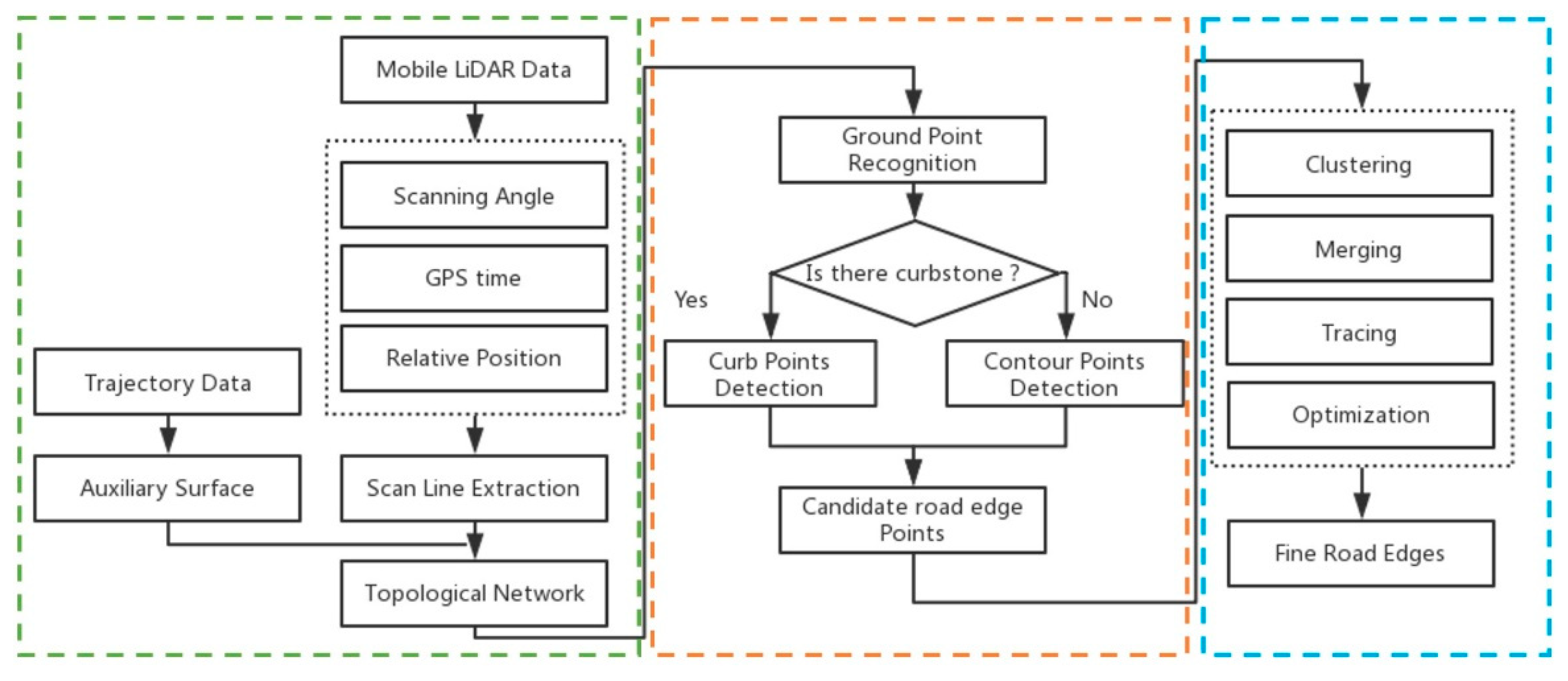
- Clustering. The K-nearest neighbor method [2] was used to divide candidate edge points into clusters. At the same time, considering the similar geometrical properties between the adjacent parts of a road boundary, we used the Euclidean distance between edge points and the auxiliary surface as the distance metric to assist clustering. If points were located on the same road edge, the distance difference () of adjacent edge points was less than 0.1 m.
- (2)
- Merging. Clusters in the same road boundary were merged using two distance metrics: The distance difference () between the cluster and auxiliary surface, and the minimum distance () between two clusters. We used to identify whether clusters were located on the same road edge. If they were, and if was within a selected value, we merged the clusters.
- (3)
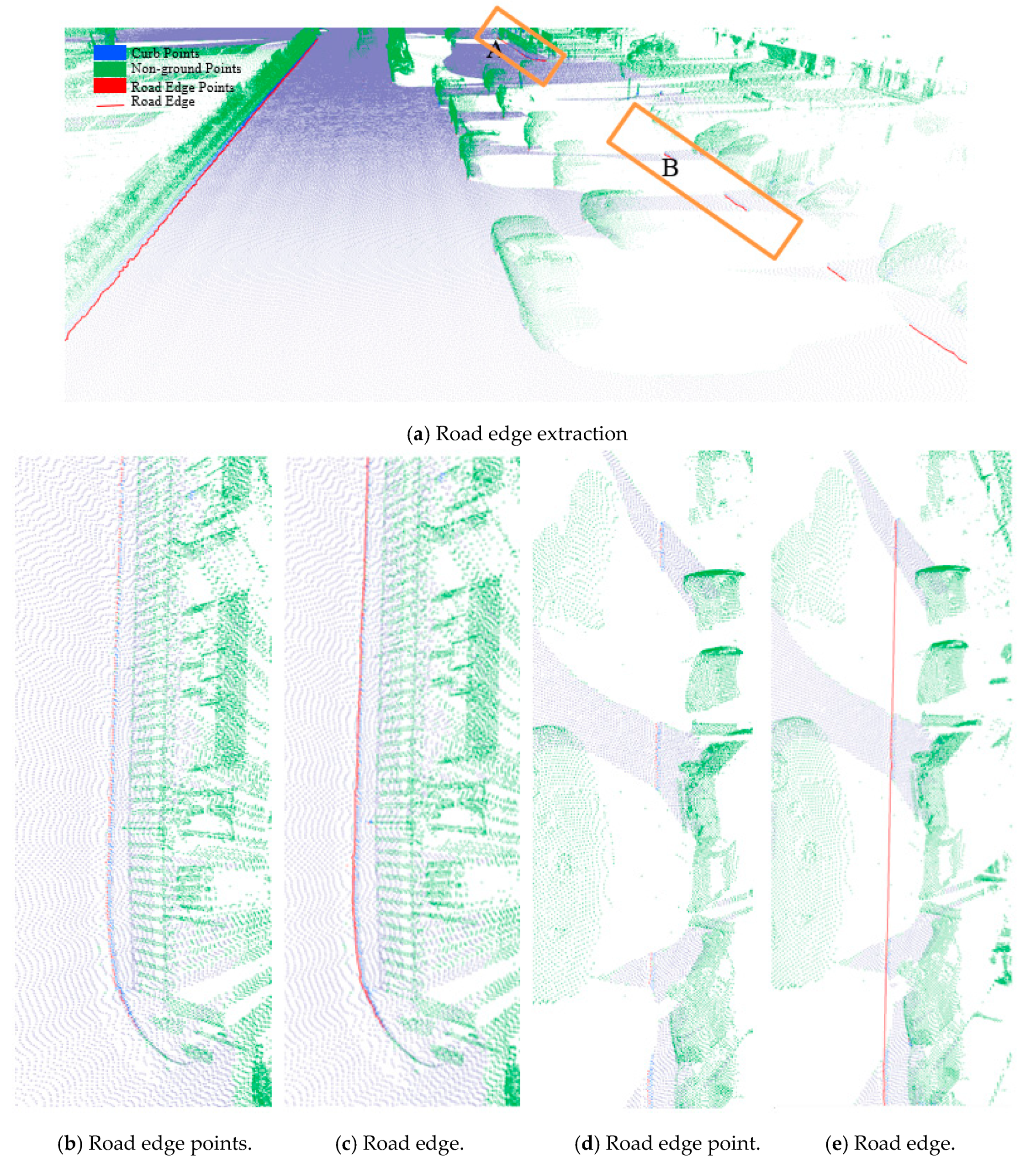
- Tracing and optimization. Given the similar geometries for a given edge, we performed optimization using the auto-check, auto-repair, and auto-fill methods. Auto-check was used to identify and eliminate non-road edge points and clusters from candidate road edge points. We identified non-road edge points with large distance differences between the point and auxiliary surface compared with other candidate road edge points located in the same cluster and non-road edge clusters with fewer points if the number within the cluster was less than N. Here, N is the number threshold of laser points in a cluster.
4. Experiments and Analysis
4.1. Experimental Dataset
- (1)
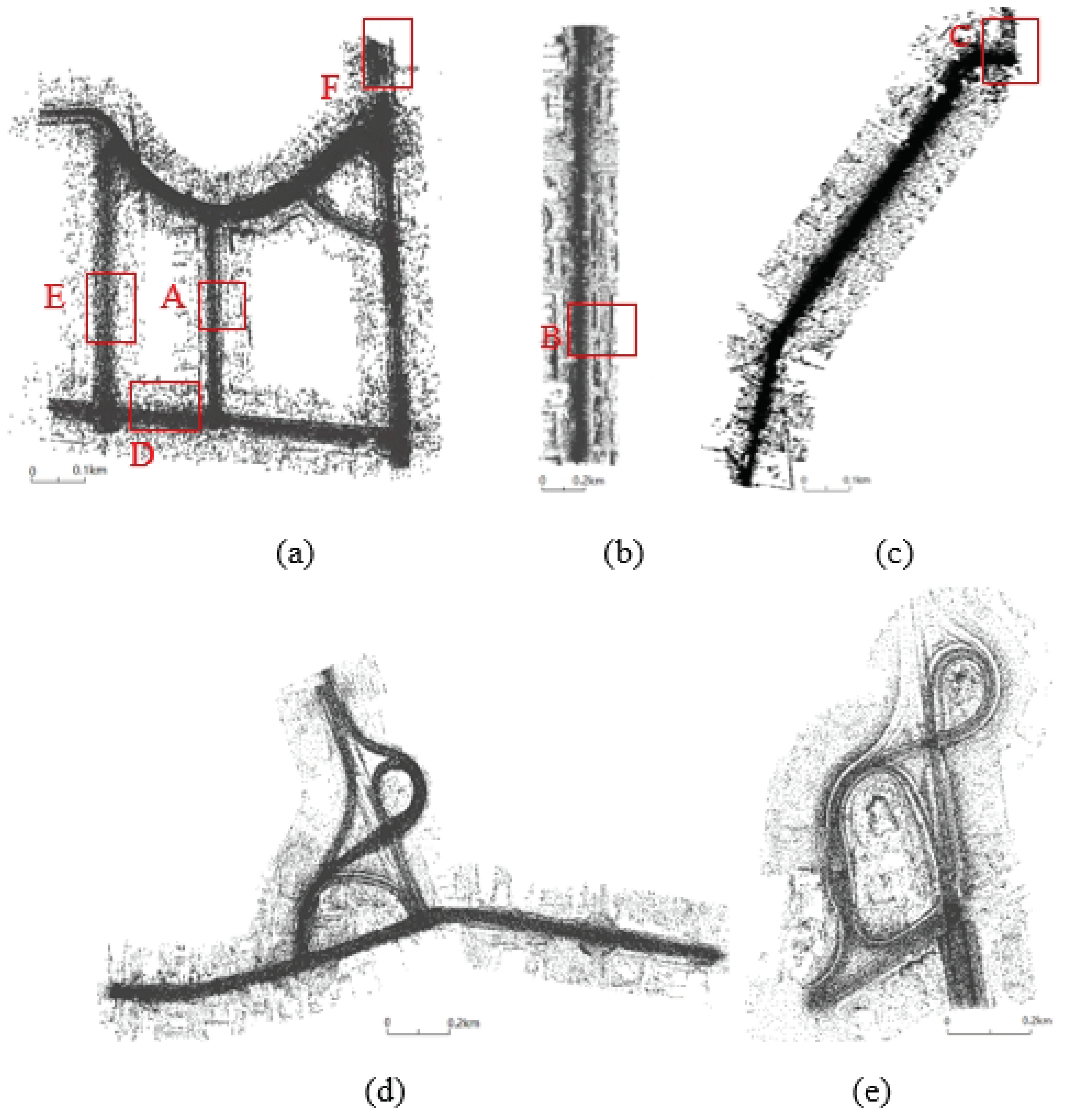
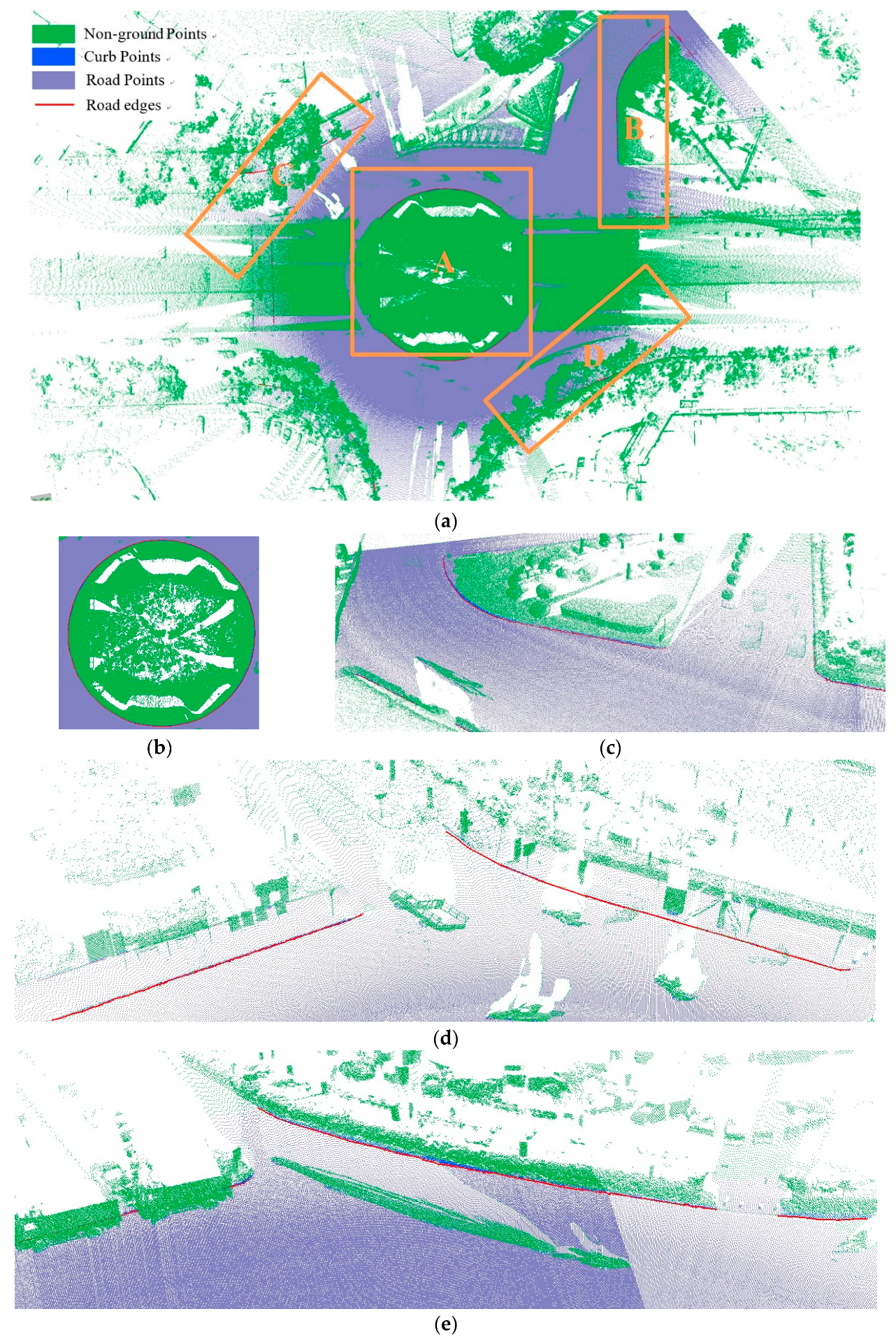
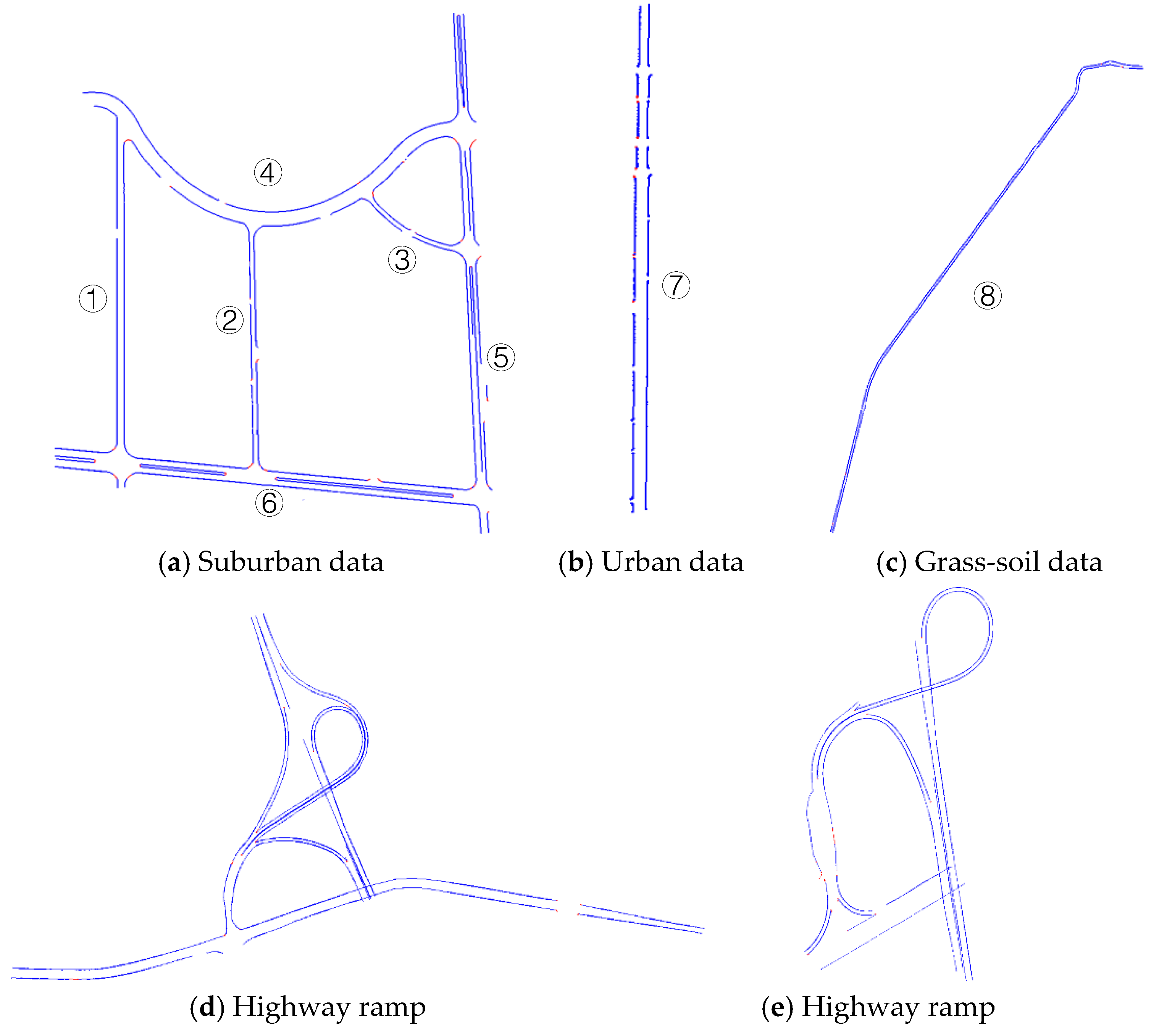
- The dataset shown in Figure 8a originates from a complex suburban area located in Tianjin, China. We performed data acquisition using an SSW-IV with the domestic RTW laser scanner. The data consist of approximately 206 million laser points with a total length of 4.26 km. The mean laser point density is 694 p/m2. The scene has three types of curbstones (vertical, inclined, and arc curbs) as road edges. This dataset has a complex road environment with many occlusions and road entrances (occlusions and road entrances are challenges for road edge extraction).
- (2)
- The dataset in Figure 8b shows an urban residential area in Beijing, China, characterized by a complex and occlusion-rich road environment that includes many cars, trees, fences, and pedestrians. The presence of these objects increases the difficulty of road extraction. This dataset was also acquired using the SSW-IV with the Riegl laser scanner. The mean laser point density is 7416 p/m2 and the number of laser points in the scene total to 164 million with a length of 1.9 km.
- (3)
- Figure 8c shows a non-structural road dataset from a rural area of Lianjiang, China, which was acquired using the SSW-IV with a domestic RTW laser scanner. The mean laser point density is 1717 p/m2 and the number of laser points in the scene total 36 million with a length of 1.07 km.
- (4)
- The datasets in Figure 8d,e show highway ramps for structural and non-structural road types in Taian, China, respectively, and were acquired using the SSW-IV with a Riegl laser scanner. The mean laser point density is 867 p/m2. Laser points in Figure 8d total 54 million with a length of 4.08 km and those in Figure 8e total 34 million with a length of 2.8 km.
4.2. Means of Validation
4.3. Results and Discussion
5. Discussion
Author Contributions
Funding
Conflicts of Interest
References
- Husain, A.; Vaishya, R.C. Road surface and its center line and boundary lines detection using terrestrial Lidar data. Egypt. J. Remote Sens. Space Sci. 2018, 21, 363–374. [Google Scholar] [CrossRef]
- Yang, B.; Fang, L.; Li, J. Semi-automated extraction and delineation of 3D roads of street scene from mobile laser scanning point clouds. ISPRS J. Photogramm. Remote Sens. 2013, 79, 80–93. [Google Scholar] [CrossRef]
- Navarro, S.; Lerma, J.L. Accuracy analysis of a mobile mapping system for close range photogrammetric projects. Measurement 2016, 93, 148–156. [Google Scholar] [CrossRef]
- Masuda, H.; He, J. TIN generation and point-cloud compression for vehicle-based mobile mapping systems. Adv. Eng. Inform. 2015, 29, 841–850. [Google Scholar] [CrossRef]
- Tao, C.V.; Li, J. Advances in Mobile Mapping Technology; Taylor & Francis, Group: London, UK, 2007. [Google Scholar]
- Barber, D.; Mills, J.; Smithvoysey, S. Geometric validation of a ground-based mobile laser scanning system. ISPRS J. Photogramm. Remote Sens. 2008, 63, 128–141. [Google Scholar] [CrossRef]
- Haala, N.; Peter, M.; Kremer, J.; Hunter, G. Mobile LiDAR mapping for 3D point cloud collection in urban areas—A performance test. Int. Arch. Photogramm. Remote Sens. Spat. Inf. Sci. 2008, 37, 1119–1124. [Google Scholar]
- Graham, L. Mobile mapping system overview. Photogramm. Eng. Remote Sens. 2010, 76, 222–228. [Google Scholar]
- Kumar, P.; Mcelhinney, C.P.; Lewis, P.; Mccarthy, T. An automated algorithm for extracting road edges from terrestrial mobile lidar data. ISPRS J. Photogramm. Remote Sens. 2013, 85, 44–55. [Google Scholar] [CrossRef]
- Yang, B.; Wei, Z.; Li, Q.; Li, J. Semi-automated building facade footprint extraction from mobile lidar point clouds. Geosci. Remote Sens. Lett. IEEE 2013, 10, 766–770. [Google Scholar] [CrossRef]
- Yang, B.; Dong, Z.; Zhao, G.; Dai, W. Hierarchical extraction of urban objects from mobile laser scanning data. ISPRS J. Photogramm. Remote Sens. 2014, 9945–9957. [Google Scholar] [CrossRef]
- Jochem, A.; Höfle, B.; Rutzinger, M. Extraction of vertical walls from mobile laser scanning data for solar potential assessment. Remote Sens. 2011, 3, 650–667. [Google Scholar] [CrossRef]
- Yang, B.; Fang, L.; Li, Q.; Li, J. Automated extraction of road markings from mobile lidar point clouds. Photogramm. Eng. Remote Sens. 2012, 78, 331–338. [Google Scholar] [CrossRef]
- Kumar, P.; Mcelhinney, C.P.; Lewis, P.; Mccarthy, T. Automated road markings extraction from mobile laser scanning data. Int. J. Appl. Earth Obs. Geoinf. 2014, 32, 125–137. [Google Scholar] [CrossRef]
- Guan, H.; Li, J.; Yu, Y.; Wang, C.; Chapman, M.; Yang, B. Using mobile laser scanning data for automated extraction of road markings. Int. J. Appl. Earth Obs. Geoinf. 2014, 87, 93–107. [Google Scholar] [CrossRef]
- Riveiro, B.; González-Jorge, H.; Martínez-Sánchez, J.; Díaz-Vilariño, L.; Arias, P. Automatic detection of zebra crossings from mobile lidar data. Opt. Laser Technol. 2015, 70, 63–70. [Google Scholar] [CrossRef]
- Guan, H.; Li, J.; Yu, Y.; Chapman, M.; Wang, C. Automated road information extraction from mobile laser scanning data. IEEE Trans. Intell. Transp. Syst. 2015, 16, 194–205. [Google Scholar] [CrossRef]
- Lehtomaki, M.; Jaakkola, A.; Hyyppa, A.; Kukko, A.; Kaartinen, H. Detection of vertical pole-like objects in a road environment using vehicle-based laser scanning data. Remote Sens. 2010, 2, 641–664. [Google Scholar] [CrossRef]
- Brenner, C. Extraction of Features from Mobile Laser Scanning Data for Future Driver Assistance Systems. In Advances in GIScience; Springer: Berlin/Heidelberg, Germany, 2009. [Google Scholar] [CrossRef]
- Yan, W.; Morsy, S.; Shaker, A.; Tulloch, M. Automatic extraction of highway light poles and towers from mobile LiDAR data. Opt. Laser Technol. 2016, 77, 162–168. [Google Scholar] [CrossRef]
- Li, L.; Li, D.; Zhu, H.; Li, Y. A dual growing method for the automatic extraction of individual trees from mobile laser scanning data. ISPRS J. Photogramm. Remote Sens. 2016, 120, 37–52. [Google Scholar] [CrossRef]
- Che, E.; Jung, J.; Olsen, M.J. Object recognition, segmentation, and classification of mobile laser scanning point clouds: A state of the art review. Sensors 2019, 19, 810. [Google Scholar] [CrossRef]
- Ma, L.; Li, Y.; Li, J.; Wang, C.; Wang, R.; Chapman, M.A. Mobile laser scanned point-clouds for road object detection and extraction: A review. Remote Sens. 2018, 10, 1531. [Google Scholar] [CrossRef]
- Miraliakbari, A.; Hahn, M.; Sok, S. Automatic extraction of road surface and curbstone edges from mobile laser scanning data. Int. Arch. Photogramm. Remote Sens. Spat. Inf. Sci. 2015, 40, 119. [Google Scholar] [CrossRef]
- Ibrahim, S.; Lichti, D. Curb-based street floor extraction from mobile terrestrial LiDAR point cloud. Int. Arch. Photogramm. Remote Sens. Spat. Inf. Sci 2012, 39, 193–198. [Google Scholar] [CrossRef]
- Jaakkola, A.; Hyyppä, J.; Hyyppä, H.; Kukko, A. Retrieval algorithm for road surface modeling using Laser-based mobile mapping. Sensors 2008, 8, 5238–5249. [Google Scholar] [CrossRef]
- Guo, J.; Tsai, M.J.; Han, J.Y. Automatic reconstruction of road surface features by using terrestrial mobile lidar. Autom. Constr. 2015, 58, 165–175. [Google Scholar] [CrossRef]
- Yu, S.J.; Sukumar, S.R.; Koschan, A.F.; Page, D.L.; Abidi, M.A. 3d reconstruction of road surfaces using an integrated multi-sensory approach. Opt. Lasers Eng. 2007, 45, 808–818. [Google Scholar] [CrossRef]
- Hernández, J.; Marcotegui, B. Filtering of Artifacts and Pavement Segmentation from Mobile Lidar Data. Laser Scanning IAPRS. 2009. Available online: http://hal.univ-nantes.fr/PSL/hal-00833573 (accessed on 24 September 2019).
- Munoz, D.; Vandapel, N.; Hebert, M. Directional Associative Markov Network for 3-D Point Cloud Classification. In Proceedings of the International Symposium on 3-D Data Processing, Visualization, and Transmission, Atlanta, GA, USA. 2008. Available online: https://www.cc.gatech.edu/conferences/3DPVT08/Program/Papers/paper200.pdf (accessed on 24 September 2019).
- Manandhar, D.; Shibasaki, R. Auto-Extraction of Urban Features from Vehicle-Borne. In Proceedings of the ISPRS Commission IV, Symposium 2002 Geospatial Theory, Processing and Applications, Ottawa, ON, Canada, 9–12 July 2002. [Google Scholar]
- McElhinney, C.P.; Kumar, P.; Cahalane, C.; McCarthy, T. Initial results from European road safety inspection (EURSI) mobile mapping project. In International Archives of the Photogrammetry, Remote Sensing and Spatial Information Sciences; International Society of Photogrammetry and Remote Sensing (ISPRS): Newcastle Upon Tyne, UK, 2010; Volume 38, pp. 440–445. [Google Scholar]
- Goulette, F.; Nashashibi, F.; Ammoun, S.; Abuhadrous, I.; Laurgeau, C. An Integrated On-Board Laser Range Sensing System for On-The-Way City and Road Modelling. In Proceedings of the ISPRS Commission I Symposium from Sensors to Imagery. 2012. Available online: http://isprs.free.fr/documents/Papers/T10-43.pdf (accessed on 24 September 2019).
- Abuhadrous, I.; Ammoun, S.; Nashashibi, F.; Goulette, F. Digitizing and 3D modeling of urban environments and roads using vehicle-borne laser scanner system. In Proceedings of the 2004 IEEE/RSJ International Conference on Intelligent Robots and Systems (IROS), Sendai, Japan, 28 September–2 October 2004; IEEE: Piscataway, NJ, USA, 2004; Volume 1, pp. 76–81. [Google Scholar]
- Yoon, J.; Crane, C.D. Evaluation of terrain using LADAR data in urban environment for autonomous vehicles and its application in the DARPA urban challenge. In Proceedings of the 2009 ICCAS-SICE, Fukuoka, Japan, 18–21 August 2009; pp. 641–646. [Google Scholar]
- Yu, C.; Zhang, D. Road Curbs Detection Based on Laser Radar. In Proceedings of the 2006 8th International Conference on Signal Processing, Beijing, China, 16–20 November 2016; IEEE: Piscataway, NJ, USA, 2007; Volume 4, pp. 8–11. [Google Scholar]
- Zhang, W. Lidar-based road and road-edge detection. In Proceedings of the 2010 IEEE Intelligent Vehicles Symposium, San Diego, CA, USA, 21–24 June 2010; Volume 43, pp. 845–848. [Google Scholar]
- Fang, L.; Yang, B. Automated Extracting Structural Roads from Mobile Laser Scanning Point Clouds. Acta Geod. Cartogr. Sin. 2013, 42, 260–267. [Google Scholar]
- Yadav, M.; Singh, A.K.; Lohani, B. Extraction of road surface from mobile lidar data of complex road environment. Int. J. Remote Sens. 2017, 38, 4645–4672. [Google Scholar] [CrossRef]
- Yadav, M.; Singh, A.K.; Lohani, B. Computation of road geometry parameters using mobile lidar system. Remote Sens. Appl. Soc. Environ. 2018, 10. [Google Scholar] [CrossRef]
- Yuan, X.; Zhao, C.X.; Cai, Y.F.; Zhang, H.; Chen, D.B. Road-surface Abstraction using Ladar Sensing. In Proceedings of the 2008 10th International Conference on Control, Automation, Robotics and Vision, Hanoi, Vietnam, 17–20 December 2008; IEEE: Piscataway, NJ, USA, 2009; pp. 1097–1102. [Google Scholar]
- Yang, B.; Liu, Y.; Dong, Z.; Liang, F.; Li, B.; Peng, X. 3d local feature bkd to extract road information from mobile laser scanning point clouds. ISPRS J. Photogramm. Remote Sens. 2017, 130. [Google Scholar] [CrossRef]
- Balado, J.; Díaz-Vilariño, L.; Arias, P.; González-Jorge, H. Automatic classification of urban ground elements from mobile laser scanning data. Autom. Constr. 2018, 86, 226–239. [Google Scholar] [CrossRef]
- Zai, D.; Li, J.; Guo, Y.; Cheng, M.; Lin, Y.; Luo, H.; Wang, C. 3-d road boundary extraction from mobile laser scanning data via super voxels and graph cuts. IEEE Trans. Intell. Transp. Syst. 2018, 19, 1–12. [Google Scholar] [CrossRef]
- Cabo, C.; Kukko, A.; García-Cortés, S.; Kaartinen, H.; Hyyppä, J.; Ordoñez, C. An algorithm for automatic road asphalt edge delineation from mobile laser scanner data using the line clouds concept. Remote Sens. 2016, 8, 740. [Google Scholar] [CrossRef]
- Ma, H.; Pei, Z.H.; Wei, Z.Y.; Zhong, R.F. Automatic extraction of road markings from mobile laser scanning data. Int. Arch. Photogramm. Remote Sens. Spat. Inf. Sci. 2017, XLII-2/W7, 825–830. [Google Scholar] [CrossRef]
- Yang, M.; Wan, Y.; Liu, X.; Xu, J.; Wei, Z.; Chen, M.; Sheng, P. Laser data based automatic recognition and maintenance of road markings from MLS system. Opt. Laser Technol. 2018, 107, 192–203. [Google Scholar] [CrossRef]






| Parameter | Value | ||||
|---|---|---|---|---|---|
| Suburban Data | Urban Data | Rural Area | Ramp (d) | Ramp (e) | |
| ∆θ (°) | 100 | 100 | 100 | 100 | 100 |
| Δz1 (m) | 0.05 | 0.05 | 0.05 | 0.05 | 0.05 |
| Δz2 (m) | 0.2 | 0.2 | 0.2 | 1.0 | 1.0 |
| Δd (m) | 0.25 (Vertical curb) | 0.1 | |||
| 0.15 (Inclined curb) | |||||
| 0.3 (Arc curb) | |||||
| Δz3(m) | 0.1 | 0.1 | |||
| Δdist_p (m) | 0.1 | 0.1 | 0.1 | 0.1 | 0.1 |
| Δdist_c (m) | 0.3 | 0.3 | 0.3 | 0.3 | 0.3 |
| Δdist_min | 2 | 2 | 2 | 2 | 2 |
| N | 10 | 20 | 15 | 15 | 15 |
| time(min) | 25.12 | 19.87 | 4.52 | 6.81 | 3.67 |
| Δz1/Δz2 | Extraction Results | Amplified Height (×10) |
|---|---|---|
| 0.01/0.2 |  |  |
| 0.05/0.2 |  |  |
| 0.1/0.2 |  |  |
| 0.05/0.1 |  |  |
| 0.05/0.3 |  |  |
| Δd/Δz3 | Extraction Results | Curb Points Only |
|---|---|---|
| 0.25/0.2 |  |  |
| 0.30/0.2 |  |  |
| 0.35/0.2 |  |  |
| 0.30/0.1 |  |  |
| 0.30/0.3 | 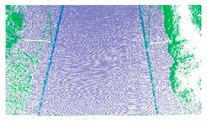 | 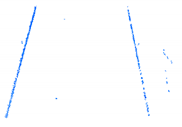 |
| Position | D | E | F |
|---|---|---|---|
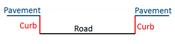
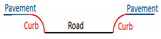
| Curb type | Inclined Curb | Vertical Curb | Arc Curb |
 |  |  | |
| Ground and curb points |  |  |  |
| Road edge |  |  |  |
| Overlay map |  |  |  |
| Local effect |  |  |  |
| Data | Road | Correctness | Completeness | Quality | |
|---|---|---|---|---|---|
| Suburban | ① | Left | 0.993 | 0.967 | 0.960 |
| Right | 0.993 | 0.961 | 0.955 | ||
| ② | Left | 0.977 | 0.941 | 0.920 | |
| Right | 0.994 | 0.955 | 0.949 | ||
| ③ | Up | 0.983 | 0.924 | 0.909 | |
| Down | 0.995 | 0.926 | 0.921 | ||
| ④ | Up | 0.991 | 0.959 | 0.951 | |
| Down | 0.990 | 0.947 | 0.938 | ||
| ⑤ | Left | 0.984 | 0.941 | 0.927 | |
| Middle | 0.986 | 0.943 | 0.931 | ||
| Right | 0.980 | 0.937 | 0.919 | ||
| ⑥ | Up | 0.984 | 0.917 | 0.904 | |
| Middle | 0.985 | 0.930 | 0.916 | ||
| Down | 0.979 | 0.974 | 0.955 | ||
| Urban | ⑦ | Left | 1 | 0.965 | 0.965 |
| Right | 0.978 | 0.982 | 0.961 | ||
| Rural | ⑧ | Left | 0.971 | 1 | 0.965 |
| Right | 0.955 | 0.998 | 0.953 | ||
| Ramp (d) | 0.978 | 0.962 | 0.941 | ||
| Ramp (e) | 0.981 | 0.977 | 0.959 | ||
| Dataset | Method | Assessment | ||
|---|---|---|---|---|
| Correctness | Completeness | Quality | ||
| Suburban | Proposed method | 0.987 | 0.944 | 0.933 |
| Yang et al. [2] | 0.981 | 0.946 | 0.929 | |
| Urban | Proposed method | 0.989 | 0.974 | 0.963 |
| Yang et al. [2] | 0.969 | 0.941 | 0.922 | |
| Rural | Proposed method | 0.963 | 0.999 | 0.959 |
| Yang et al. [2] | --- | --- | --- | |
| Ramp (d) | Proposed method | 0.978 | 0.962 | 0.941 |
| Yang et al. [2] | --- | --- | --- | |
| Ramp (e) | Proposed method | 0.981 | 0.977 | 0.959 |
| Yang et al. [2] | --- | --- | --- | |
© 2019 by the authors. Licensee MDPI, Basel, Switzerland. This article is an open access article distributed under the terms and conditions of the Creative Commons Attribution (CC BY) license (http://creativecommons.org/licenses/by/4.0/).
Share and Cite
Yang, M.; Liu, X.; Jiang, K.; Xu, J.; Sheng, P.; Yang, D. Automatic Extraction of Structural and Non-Structural Road Edges from Mobile Laser Scanning Data. Sensors 2019, 19, 5030. https://doi.org/10.3390/s19225030
Yang M, Liu X, Jiang K, Xu J, Sheng P, Yang D. Automatic Extraction of Structural and Non-Structural Road Edges from Mobile Laser Scanning Data. Sensors. 2019; 19(22):5030. https://doi.org/10.3390/s19225030
Chicago/Turabian StyleYang, Mengmeng, Xianlin Liu, Kun Jiang, Jingzhong Xu, Peng Sheng, and Diange Yang. 2019. "Automatic Extraction of Structural and Non-Structural Road Edges from Mobile Laser Scanning Data" Sensors 19, no. 22: 5030. https://doi.org/10.3390/s19225030
APA StyleYang, M., Liu, X., Jiang, K., Xu, J., Sheng, P., & Yang, D. (2019). Automatic Extraction of Structural and Non-Structural Road Edges from Mobile Laser Scanning Data. Sensors, 19(22), 5030. https://doi.org/10.3390/s19225030