Article

Learning to Detect Cracks on Damaged Concrete Surfaces Using Two-Branched Convolutional Neural Network

1
Department of Electrical and Electronic Engineering, Ewha Womans University, Seoul 03760, Korea
2
Department of Architectural and Urban Systems Engineering, Ewha Womans University, Seoul 03760, Korea
*
Author to whom correspondence should be addressed.
Sensors 2019, 19(21), 4796; https://doi.org/10.3390/s19214796
Submission received: 10 September 2019 / Revised: 27 October 2019 / Accepted: 1 November 2019 / Published: 4 November 2019
(This article belongs to the Section Intelligent Sensors)

Abstract

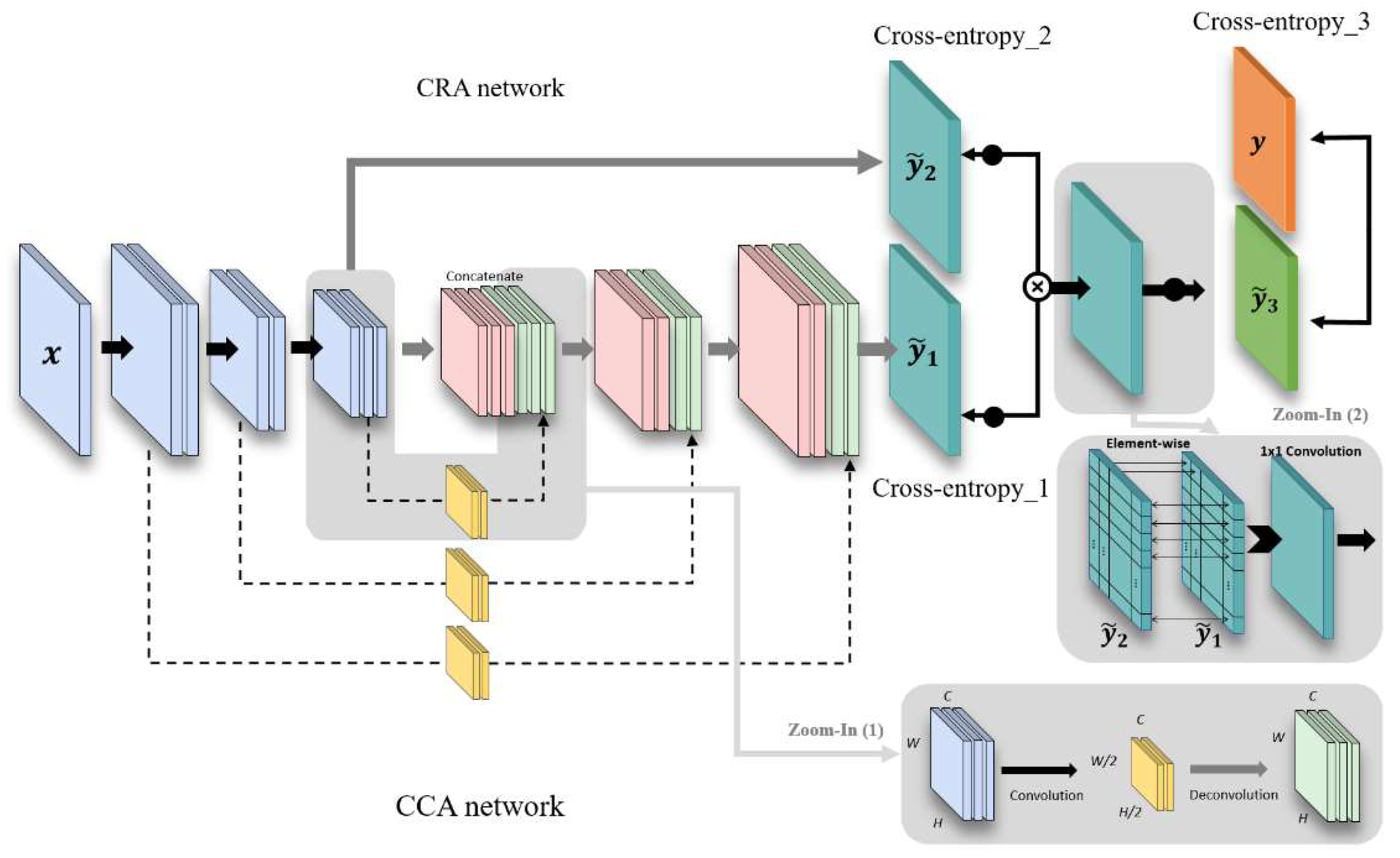
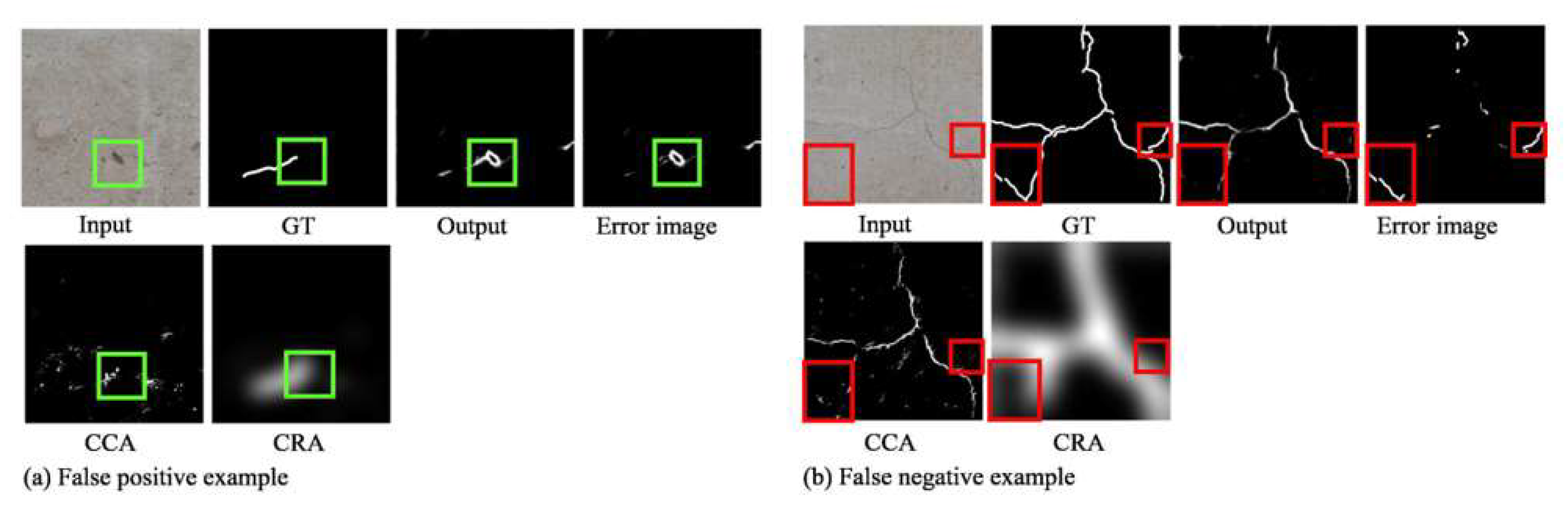
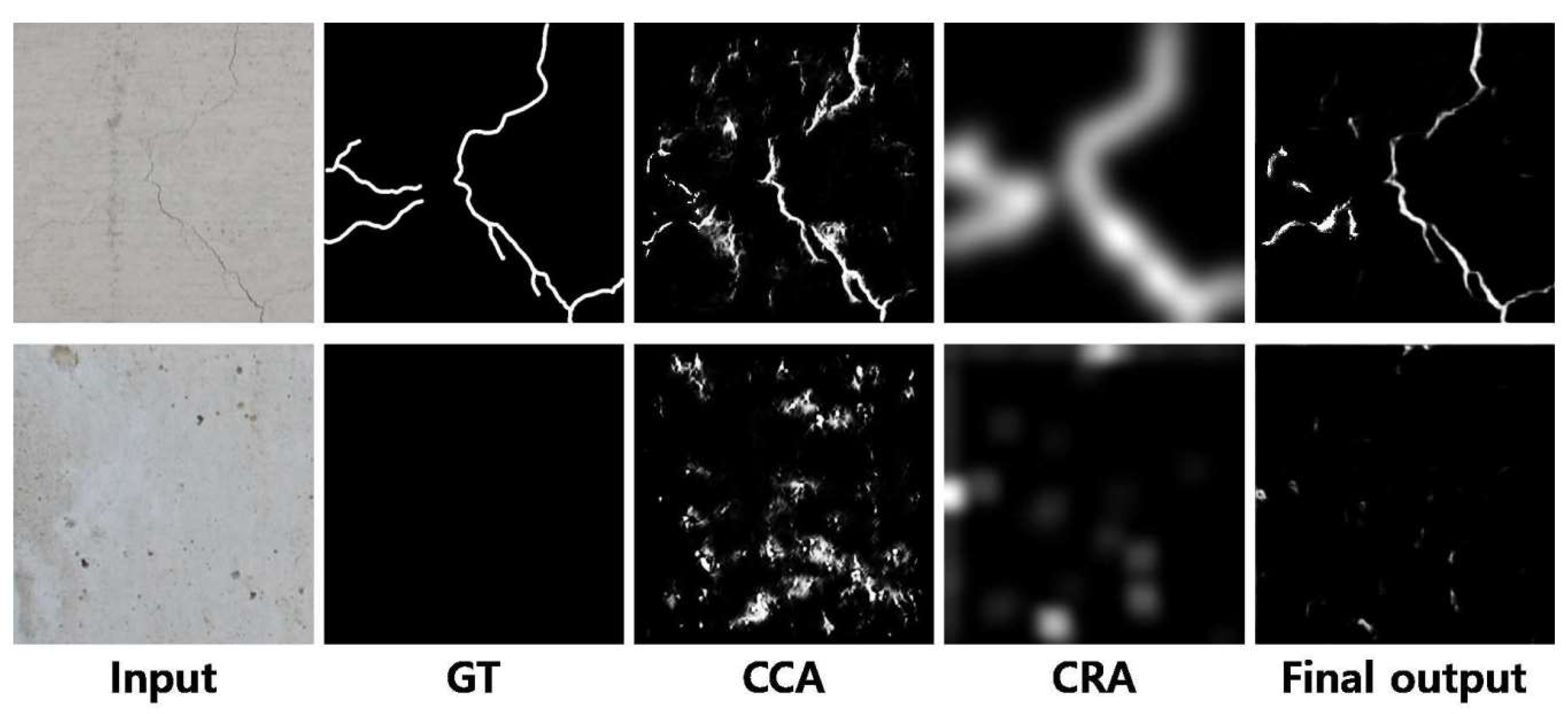
Image sensors are widely used for detecting cracks on concrete surfaces to help proactive and timely management of concrete structures. However, it is a challenging task to reliably detect cracks on damaged surfaces in the real world due to noise and undesired artifacts. In this paper, we propose an autonomous crack detection algorithm based on convolutional neural network (CNN) to solve the problem. To this aim, the proposed algorithm uses a two-branched CNN architecture, consisting of sub-networks named a crack-component-aware (CCA) network and a crack-region-aware (CRA) network. The CCA network is to learn gradient component regarding cracks, and the CRA network is to learn a region-of-interest by distinguishing critical cracks and noise such as scratches. Specifically, the two sub-networks are built on convolution-deconvolution CNN architectures, but also they are comprised of different functional components to achieve their own goals efficiently. The two sub-networks are trained in an end-to-end to jointly optimize parameters and produce the final output of localizing important cracks. Various crack image samples and learning methods are used for efficiently training the proposed network. In the experimental results, the proposed algorithm provides better performance in the crack detection than the conventional algorithms.
Keywords: deep learning; crack detection; convolutional neural network; edge detection; fire-damaged concrete; image processing deep learning; crack detection; convolutional neural network; edge detection; fire-damaged concrete; image processing